US bans Russian energy imports
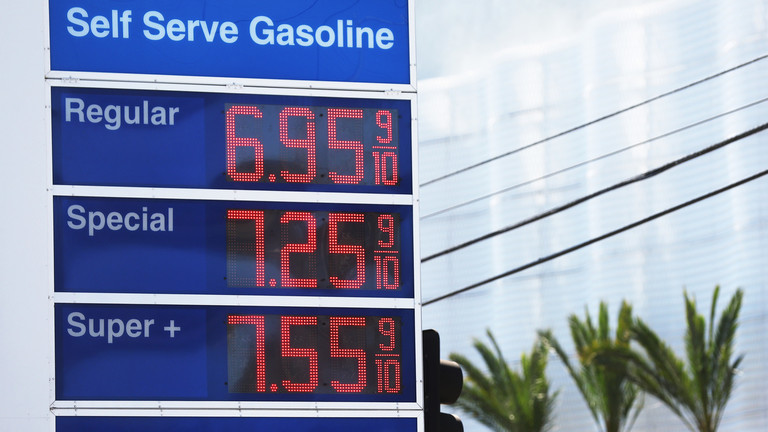
High gas prices displayed at a Mobil station on March 7, 2022 in Los Angeles, California. © Mario Tama / Getty Images
RT | March 8, 2022
US President Joe Biden has announced a ban on Russian oil and gas imports in response to the ongoing conflict in Ukraine on Tuesday, a move that threatens to send global gas and oil prices even higher than the record-setting costs the commodities are already fetching.
The president called on the nation to use the events as an opportunity to transition to renewable energy, insisting that if “no one has to worry about the price at the gas pump in the future, tyrants like Putin won’t be able to use fossil fuels as weapons against other nations.”
Biden warned oil and gas companies against jacking up prices unnecessarily, declaring that while “Putin’s war against ukraine is causing gas prices to rise… it’s no excuse to exercise excessive price increases or padding profits or any kind of effort to exploit the situation or American consumers.”
“Russia’s aggression is costing us all, and it’s no time for profiteering or price-gouging,” Biden said, hailing the blanket ban on all imports of Russian oil and gas as “another powerful blow to Putin’s war machine.”
Americans will have to pay “the price of freedom” in the coming weeks as the sanctions are expected to send energy prices soaring worldwide, Senator Chris Coons (D-Delaware) told CNN on Tuesday ahead of the sanctions announcement.
The Democratic senator warned that the price of oil could very well double to $300 per barrel, with gas prices more than tripling to $10-$14 per gallon.
The repercussions from the price shock will be felt worldwide, he continued, as costs continue to surge. Acknowledging that “the strength of our sanctions, of the costs we’re imposing on Putin… are more successful and more sustainable when they’re coordinated,” he praised the administration for working together with Europe on the looming import ban instead of pushing ahead unilaterally.
“We have to realize that it’s a global integrated market, it is tough to just turn on the taps and increase production quickly – it’s not like phoning up Amazon,” he explained, cautioning “we are going to see increased gas prices here in the US, in Europe they will see dramatic increases in prices, that’s the cost of standing up for freedom and of standing alongside the Ukrainian people. We need to see the cost and benefit here.”
The senator also admitted the White House has been in negotiations with its once-sworn enemies in Venezuela and Iran, two major oil producers Washington is suddenly seeing in a new light for their potential to bail out countries soon to be running on empty in the absence of Russian energy supplies, but argued the focus should be on Canada first. However, he acknowledged Putin “had Western Europe over a barrel” – literally and figuratively – regarding the highly sought-after commodities.
Russia is the second-largest oil exporter in the world, while the US is the largest oil consumer. While Moscow supplies only about 7% of US oil, Europe is much more heavily reliant on the nation for its energy supplies.
Fresh polls claim that Americans are willing to pay more at the pump in order to stick it to Putin. A Quinnipiac survey conducted over the weekend, which found 71% of Americans supported a ban on Russian oil even if it led to higher gas prices. More than half of respondents (56%) even suggested the US hadn’t gone far enough with its sanctions and called for tougher moves.
Gazprom says it fulfills all commitments to foreign customers
RT | March 7, 2022
The Russian state energy giant Gazprom said on Monday that European gas prices could rise even higher after they hit a record $3,892 per 1,000 cubic meters of gas. The reasons for such hikes “are not on Gazprom’s end,” the company has added.
Gazprom “fills the orders on gas purchases from its foreign customers to the fullest,” the company said in a statement, adding that it will further honor all its commitments under the long-term gas contracts. It has also confirmed that it still uses “100 percent” of Ukraine’s gas transit route despite the ongoing conflict in the country.
Some 109.5 million cubic meters of gas flow through Ukraine’s territory per day, according to data cited by TASS. Earlier, Gazprom’s spokesman, Sergey Kupriyanov, confirmed that the transit proceeds “as normal.”
Gas prices in Europe fell to $2,700 per 1,000 cubic meters of gas later Monday, after German Chancellor Olaf Scholz admitted that his country would not cut off Russian supplies as of now. Energy supply for Germany “cannot be secured in any other way” at the moment, he has said. The chancellor also opposed sanctioning “essential” Russian oil and gas industries.
Earlier, some media reported that the US has been discussing a ban on Russian oil supplies to Europe with the EU.
Gas prices also rose after Washington and its allies slapped Moscow with unprecedented sanctions targeting its financial sector and its ability to engage in foreign trade. One such measure involved cutting off seven Russian banks from SWIFT. The measures came in response to Russia’s military action in Ukraine launched on February 24, which Moscow said was aimed at “demilitarizing” its neighbor, while Kiev blasted it as “unprovoked.”
Moscow explains how it’ll do business with firms from ‘unfriendly states’
The Ministry of Finance has set up a special subcommittee to control foreign investment
RT | March 7, 2022
Russian companies wishing to work with firms from countries which oppose Moscow’s military operation in Ukraine will have to receive government permission for the deals, the press service of Russia’s Ministry of Finance said on Monday. Permission will be granted by the Government Commission for the Control of Foreign Investments. It includes representatives from Russia’s Central Bank (Bank of Russia) and the presidential administration.
According to the resolution establishing the procedure, which was signed by Prime Minister Mikhail Mishustin, a Russian resident company or foreign company from an “unfriendly state” must apply for permission for any business deal.
“[The application] should contain comprehensive information about the applicant, including information on the beneficial owners of the company. Based on the analysis of the documents received and the nature of the future agreement, a decision will be made to approve or refuse to implement it,” the press service said, stressing that “the main goal of this work is to ensure the country’s financial stability in the face of external sanctions pressure.”
The government on Monday also unveiled an updated list of countries which have been deemed “unfriendly states” for their positions on the Ukraine conflict. It includes the United States and Canada, the countries of the EU bloc, the UK (including Jersey, Anguilla, the British Virgin Islands, and Gibraltar), Ukraine, Montenegro, Switzerland, Albania, Andorra, Iceland, Liechtenstein, Monaco, Norway, San Marino, North Macedonia, and also Japan, South Korea, Australia, Micronesia, New Zealand, Singapore, and China’s self-ruled territory of Taiwan.
The countries and territories were added to the list after they imposed or joined the sanctions against Russia in connection with the ongoing military operation of the Russian Armed Forces in Ukraine.
According to the government decree, Russian citizens and companies, the state itself and its regions and municipalities will now also have to pay for obligations to foreign creditors from countries on the list in rubles. The new temporary procedure applies to payments exceeding 10 million rubles per month, or a corresponding amount in foreign currency.
The measures have been introduced by Moscow to support the Russian economy after Western states placed Russia under heavy sanctions over the past 10 days. A number of Russia’s largest banks have been cut off from SWIFT and had their foreign assets frozen, restrictions were placed on certain Russian exports and imports, and a growing number of companies from all sectors have been shutting down operations in the country.
Burning Globalist Structures to Save the Globalist ‘Liberal Order’
By Alastair Crooke | Strategic Culture Foundation | March 6, 2022
In its triple strike of sanctions on Russia, the EU initially was not looking to collapse the Russian financial system. Far from it: Its first instinct was to find the means to continue purchasing its energy needs (made all there more vital by the state of the European gas reserves hovering close to zero). Purchases of energy, special metals, rare earths (all needed for high tech manufacture) and agricultural products were to be exempted. In short, at first brush, the sinews of the global financial system were intended to remain intact.
The main target rather, was to block the core to the Russian financial system’s ability to raise capital – supplemented by specific sanctions on Alrosa, a major player in the diamond market, and Sovcomflot, a tanker fleet operator.
Then, last Saturday morning (26 February) everything changed. It became a blitzkrieg: “We’re waging an all-out economic and financial war on Russia. We will cause the collapse of the Russian economy”, said the French Finance Minister, Le Maire (words, he later said, he regretted).
That Saturday, the EU, the U.S. and some allies acted to freeze the Russian Central Bank’s foreign exchange reserves held overseas. And certain Russian banks (in the end seven) were to be expelled from SWIFT financial messaging service. The intent was openly admitted in an unattributable U.S. briefing: It was to trigger a ‘bear raid’ (ie. an orchestrated mass selling) of the Rouble on the following Monday that would collapse the value of the currency.
The purpose to freezing the Central Bank’s reserves was two-fold: First, to prevent the Bank from supporting the Rouble. And secondly, to create a commercial bank liquidity scarcity inside Russia to feed into a concerted campaign over that weekend to scare Russians into believing that some domestic banks might fail – thus prompting a rush at the ATMs, and start a bank-run, in other words.
More than two decades ago, in August 1998, Russia defaulted on its debt and devalued the Rouble, sparking a political crisis that culminated with Vladimir Putin replacing Boris Yeltsin. In 2014, there was a similar U.S. attempt to crash the Rouble through sanctions and by engineering (with Saudi Arabian help) a 41% drop in oil prices by January 2015.
Plainly, last Saturday morning when Ursula von der Leyen announced that ‘selected’ Russian banks would be expelled from SWIFT and the international financial messaging system; and spelled out the near unprecedented Russian Central Bank reserve freeze, we were witnessing the repeat of 1998. The collapse of the economy (as Le Maire said), a run on the domestic banks and the prospect of soaring inflation. This combination was expected to conflate into a political crisis – albeit one intended, this time, to see Putin replaced, vice Yeltsin – aka regime change in Russia, as a senior U.S. think-tanker proposed this week.
In the end, the Rouble fell, but it did not collapse. The Russian currency rather, after an initial drop, recovered about half its early fall. Russians did queue at their ATMs on Monday, but a full run on the retail banks did not materialise. It was ‘managed’ by Moscow.
What occurred on that Saturday which prompted the EU switch from moderate sanctions to become a full participant in a financial war à outrance on Russia is not clear: It may have resulted from intense U.S. pressure, or it came from within, as Germany seized an opportune alibi to put itself back on the path of militarisation for the third time in the past several decades: To re-configure Germany as a major military power, a forceful participant in global politics.
And that – very simply – could not have been possible without tacit U.S. encouragement.
Ambassador Bhadrakumar notes that the underlying shifts made manifest by von der Leyen on Saturday “herald a profound shift in European politics. It is tempting, but ultimately futile, to contextually place this shift as a reaction to the Russian decision to launch military operations in Ukraine. The pretext only provides the alibi, whilst the shift is anchored on power play and has a dynamic of its own”. He continues,
“Without doubt, the three developments — Germany’s decision to step up its militarisation [spending an additional euro100 billion]; the EU decision to finance arms supplies to Ukraine, and Germany’s historic decision to reverse its policy not to supply weapons to conflict zones — mark a radical departure in European politics since World War II. The thinking toward a military build-up, the need for Germany to be a “forceful” participant in global politics and the jettisoning of its guilt complex and get “combat ready” — all these by far predate the current situation around Ukraine”.
The von der Leyen intervention may have been opportunism, driven by a resurgence of SPD German ambition (and perhaps by her own animus towards Russia, stemming from her family connection to the SS German capture of Kiev), yet its consequences are likely profound.
Just to be clear, on one Saturday, von der Leyen pulled the switch to turn off principal parts to Global financial functioning: blocking interbank messaging, confiscating foreign exchange reserves and the cutting the sinews of trade. Ostensibly this ‘burning’ of global structures is being done (like the burning of villages in Vietnam) to ‘save’ the liberal Order.
However, this must be taken in tandem with Germany’s and the EU decision to supply weapons (to not just any old ‘conflict zone’) but specifically to forces fighting Russian troops in Ukraine. The ‘Kick Ass’ parts to those Ukrainian forces ‘resisting’ Russia are neo-Nazi forces with a long history of committing atrocities against the Russian-speaking Ukrainian peoples. Germany will be joining with the U.S. in training these Nazi elements in Poland. The CIA has been doing such since 2015. (So, as Russia tries to de-Nazify Ukraine, Germany and the EU are encouraging European volunteers to join in a U.S.-led effort to use Nazi elements to resist Russia, just as in the way Jihadists were trained to resist Russia in Syria).
What a paradox! Effectively von der Leyen is overseeing the building of an EU ‘Berlin Wall’ – albeit with its purpose inverted now – to separate the EU from Russia. And to complete the parallel, she even announced that Russia Today and Sputnik broadcasts would be banned across the EU. Europeans can be allowed only to hear authorised EU messaging – (however, a week into the Russian invasion, cracks are appearing in this tightly-controlled western narrative – “Putin is NOT crazy and the Russian invasion is NOT failing”, warns a leading U.S. military analyst in the Daily Mail. Simply “[b]elieving Russia’s assault is going poorly may make us feel better but is at odds with the facts”, Roggio writes. “We cannot help Ukraine if we cannot be honest about its predicament”).
So Biden, finally, has his foreign policy ‘success’: Europe is walling itself off from Russia, China, and the emerging integrated Asian market. It has sanctioned itself from ‘dependency’ on Russian natural gas (without prospect of any immediate alternatives) and it has thrown itself in with the Biden project. Next up, the EU pivot to sanctioning China?
Will this last? It seems improbable. German industry has a long history for staging its own mercantile interests before wider geo-pollical ambitions – before, even, EU interests. And in Germany, the business class effectively is the political class and needs competitively-priced energy.
Whilst the rest of the world shows little or no enthusiasm to join with sanctions on Russia (China has ruled out sanctions on Russia), Europe is in hysteria. This will not fade quickly. The new ‘Iron Curtain’ erected in Brussels may last years.
But what of the unintended consequences to last Saturday’s ‘sanctions Blitzkrieg’: the ‘unknowable unknowns’ in Rumsfeld’s famous mantra? The unprecedented switch-off affecting a key part of the Globalist system did not download into a neutral, inert context – It developed into an emotionally hyper-charged atmosphere of Russophobia.
Whereas EU states had hoped to spare Russian energy shipments, they did not take account of the frenzy raised against Russia. The oil market has gone on strike, acting as if energy were already in the frame for Western sanctions: Oil tankers had already started to avoid Russian ports because of sanctions fears, and rates for oil tankers on Russian crude routes have exploded as much as nine-fold in the past few days. But now, amid growing fears of falling foul of complex restrictions in different jurisdictions, refiners and banks are balking at purchasing any Russian oil at all, traders and others involved in the market say. Market players fear too that measures that target oil exports directly could be imposed, should fighting in Ukraine intensify.
Commodity markets have been in turmoil since the Special Military Operation began. European natural gas jumped as much as 60% on Wednesday, as buyers, traders and shippers avoid Russian gas. A combination of sanctions and commercial decisions by shippers and insurers to steer clear has cut that contribution to global supplies sharply over the last week. A default cascade by western companies is perfectly possible. And Supply line disruption is inevitable.
Many will be affected by the commodity turmoil, but with Russia providing 25% of global wheat supplies, the 21% hike in wheat and 16% rise in corn prices since 1 January will represent a disaster for many states in the Middle East among others.
All this disruption to markets comes even before Moscow responds with its own countermeasures. They have been silent so far – but what if Moscow demands that future payments for energy are to be made in Yuan?
In sum, the changes set out by von der Leyen and the EU, with surging crude oil costs, could potentially tip global markets into crisis, and set off spiralling inflation. Cost inflation created by energy costs spiralling higher and food disruptions are not so easily susceptible to monetary remedies. If the daily drama of the war in Ukraine starts to fade from public view, and inflation persists, the political cost of von der Leyen’s Saturday drama is likely to be European-wide recession.
“Since well before the Russian invasion of Ukraine, Europeans have been struggling under the weight of runaway energy bills”, OilPrice.com notes. In Germany, for some, one month’s energy costs the same as they used to pay for a whole year; in the UK the government has raised the price cap for energy bills by a whopping 54%, and in Italy a recent 40% domestic energy cost hike could now nearly double.
The New York Times describes this impact on local businesses and industries as nothing short of “frightening”, as all kinds of small businesses across Europe (prior to last week’s events) have been forced to cease their operations as energy costs outweigh profits. Large industries have not been immune to sticker shock either. “Almost two-thirds of the 28,000 companies surveyed by the Association of German Chambers of Commerce and Industry this month rated energy prices as one of their biggest business risks … For those in the industrial sector, the figure was as high as 85 percent.”
One recalls that old prediction from the Middle East, that western values would turn against the West itself, and ultimately devour it.
Understanding the Ukraine Crisis From the Last Free Enclave in Europe – Outside of Russia and Belarus, That Is
By Aleksandar Pavic | Strategic Culture Foundation | March 3, 2022
To any Serb who has not lost his mind or has just become numb from three decades of relentless anti-Serbian propaganda and lies emanating from the “free and democratic” West’s power centers and media – the speed and totalitarian scope of anti-Russian measures and the intensity of anti-Russian propaganda censorship that has captured the West cannot come as a surprise. As Serbian president Aleksandar Vucic stated a few days before the beginning of Russia’s denazification and demilitarization campaign in the Ukraine, about 85% of Serbs are “always” on the side of Russia. Even as Serbia has, over the past several days, come under immense Western pressure as the lone independent enclave in Europe, a sort of a West Berlin of the new multipolar world in the making, surrounded by NATO and/or EU countries that have been, with varying degrees of voluntarity, sucked into the ongoing anti-Russian hysteria and the accompanying sanctions, closing of airspace to Russian planes, etc.
The reason is simple, even if one sets aside the centuries-old spiritual, ethnic and just plain fraternal ties between the two peoples. For the Serbs were, so to speak, the canaries in the coal mine in the years that followed George Bush Senior’s proclamation of a “new world order.” Early on after the fall of the Berlin Wall, at the beginning of the 1990s, while innocents and just plain people of good will were still enamored with the announced “end of history” and the glorious triumph of “liberal democracy,” in the Serbian parts of Yugoslavia, we were experiencing, firsthand, something completely different, dark and ominous. We were witnessing the gradual return of pure, cynical power politics, only this time couched in the clothing of politically correct, sugarcoated homilies invoking “human rights,” “democracy,” “European integration” and “peace,” which, as it soon enough turned out, served as a mere “liberal” fog of war, as a preparatory rhetorical, diplomatic and media artillery fire for legitimizing the West’s self-anointed right to define what is good and what is not and to, on the basis of the newly prescribed definitions, interfere and expand its purely pragmatic, base interests wherever it could. The world was the victorious West’s oyster, “democracy expansion” its new quasi-religion, putting a moral veneer on its newest geopolitical outreach, a modernized version of the “white man’s burden” couched in the newfangled terminology of a supposedly post-ideological era.
Thus, during the violent dismemberment of Yugoslavia, its chief external instigators and facilitators – led by Germany and Austria, with essential help from the U.S. ambassador to Yugoslavia – could, thanks to their vast domination of the media-informational space, present themselves as “peace brokers” and, even more sickening, as moral arbiters. The new-old expansionist West could portray itself to the uninformed and the gullible as some sort of force for good, while painting the enemy – the Serbs then, the Russians today – as evil incarnate. It was on the ashes of the Western-fomented destruction of Yugoslavia that the myth of “indispensable NATO”, “benevolent EU” and the “good West” received much of their subsequent affirmation and post-Cold War soft power. And therein lies much of the reason why Russia’s – and not only Russia’s – endless polite requests and pleas to halt the North Atlantic military pact’s steady expansion to the east, were not taken seriously, or at least seriously enough, by a critical mass of those who had no direct contact with the Western wolves in sheep’s clothing, like the Serbs (and the Syrians, Libyans, Iraqis, Afghans, Yemenis, Somalis, Venezuelans, etc.) did. Simply put, the West was only starting to spend the huge surplus moral value it had accrued as victor of a global struggle with an “evil empire,” the chinks in the (artificially manufactured) armor were still too microscopic for the ordinary, inexperienced, well-meaning eye to detect.
Even NATO’s illegal bombing of the Federal Republic of Yugoslavia in spring of 1999, in the name of “prevention of genocide” in Serbia’s historic and sacred Kosovo province – of which no evidence has ever been presented over the ensuing 23 years – did not awaken the critical mass of Western public opinion and decision-makers necessary to reexamine the wisdom and necessity of continuing on the path of, essentially, a new Drang nach Osten (however, seeing what happened with Trump, much later in the game, it’s beyond obvious that election outcomes and decision-making in the West have been captured by the military-industrial complex even then, just as Eisenhower had warned back in 1961) .
It did, however, finally awaken Moscow, opening the way to Vladimir Putin’s ascendance to Russia’s highest office on the last day of that fateful year. Like the Serbs, the Russians still remembered the true horrors of the last world war and could recognize the all-too-familiar patterns far more easily than most on the European continent. Unfortunately, Moscow could not do much about them initially, other than to ceaselessly warn, beginning with Munich in early 2007, ask for a general reassessment and renegotiation of common European security and – aware that its tactful warnings, suggestions and proposals were being blithely ignored in the key Western capitals – rearm and prepare itself for the inevitable. Which finally came with the collective West’s refusal to talk about Ukraine’s neutrality and the halting of NATO’s further expansion, in parallel with the Ukrainian puppet president’s raising of the threat of Ukraine becoming a nuclear state.
Why would Moscow agree to the very real possibility of nuclear missiles deployed at its borders, which could reach it in 7-8 minutes (and, in the case of future hypersonic missiles, in 5-6 minutes)? Why would it trust NATO’s (true) power centers, whose leading figures had assured it that not one further inch would be taken to the east as the Warsaw pact self-dissolved – and then proceeded to do precisely the opposite?
So, no, the endless verbal assurances and endless empty talk of the past three decades would no longer work, as all Russia had gotten out of it was a hostile, Axis-like alliance at its borders and a campaign of steadily rising demonization that had, of late, in many aspects exceeded that experienced by the U.S.S.R. at the height of the Cold War. When threatened with nuclear missiles under its nose in Cuba, the U.S. was willing to launch nuclear war to prevent it. Russia has threatened no such thing.
A day after the beginning of the Russian demilitarization and denazification campaign, Serbia’s president announced Serbia’s official position regarding the situation in Ukraine, as outlined in the conclusions of the Serbian National Security Council. In essence, Serbia’s position is that it respects Ukraine’s territorial integrity as it respects the territorial integrity of all states in accordance with the UN Charter and the Helsinki Act of 1975, that it considers the violation of the territorial integrity of any state, including Ukraine “very wrong,” but that it will not impose sanctions against the Russian Federation.
It is enough just to look at a current political map of Europe to see the significance, courage and difficulty of Serbia’s decision. Serbia and neighboring Bosnia and Herzegovina (BiH) are islands in the NATO sea that surrounds them – and BiH is not a NATO member only due to the opposition of the Serbs in that country, led by the Serbian member of the BiH Presidency, Milorad Dodik. In addition, all the surrounding states have joined the Western condemnations of Russia’s intervention in Ukraine and have joined or voiced support for the newest sanctions imposed on Russia, including the EU’s closure of air space to Russian planes.
As expected, over the past few days, as testified by Vucic himself, Serbia has been subjected to “intense” Western pressure to join the sanctions and condemnations front against Russia. The EU Parliament Rapporteur for Serbia, Vladimir Bilchik has already stated that Serbia’s decision not to join the EU’s sanctions against Russia is a “defining foreign policy decision for much broader relations between the EU and Serbia.” Former Swedish foreign and prime minister and the first High Representative for BiH Carl Bildt Tweeted that Serbia has “de facto disqualified itself from the EU accession process,” as new members are expected to share in the EU’s “fundamental values and interests.” European Commission spokespeople Ana Pisonero and Eric Mamer have also voiced expectations that Serbia would join the EU sanctions policy.
These are all rather ominous words – and not because anyone in Serbia, other than a handful of well-paid diehards and hopeless cases, truly believes that the country will ever be admitted to the self-proclaimed “most successful peace project in human history” (which expressly approved the sending of fighter jets to neo-Nazi “democrats” in Ukraine), but because the out-of-control Western elites’ “either you’re with us or against us” mentality is certain to find ways to make its displeasure known to all dissidents. Especially to an encircled, friendly-to-Russia enclave that stubbornly refuses to join the anti-Russian hysteria being fanned all over the Western “liberal” landscape. After all, Serbia was viciously and illegally bombed by NATO in 1999 for not voluntarily agreeing to its own occupation by the alliance of “democratic values.” Since then, the alliance has gained 11 more members and about a thousand kilometers to the east. So, we shall wait and see in the coming days and weeks what practical measures of punishment or censure will be applied by the EU (and NATO) against Serbia, which has been an official candidate for EU membership since 2012 and is, thus, obliged to gradually harmonize its policies, including foreign policy, with the “peace loving” union.
Russia has shown appreciation and understanding for Serbia’s position. In his reaction to Serbia’s official stance, the Russian ambassador in Belgrade stated that Russia “understands that Serbia is being pressured and does not ask anything of Serbia,” being well aware of the mutual respect and trust that exist between President Vucic and Russia’s President Putin, that Serbia “respects Russia’s national interest,” and that Russia is “at peace” with Serbia’s position and its foreign policy.
In addition, as stated in the National Security Council conclusions, Serbia was itself a victim of Western sanctions during the 1990s and, even more importantly, aggression on the part of 19 NATO states in 1999 precisely for defending its own territorial integrity. In other words, Serbia is not only refusing to join Western sanctions against a traditional friend and ally but also to be a part of traditional Western double standards, which it has felt on its own skin both in the past and in the present. Towards that end, the speaker of the Serbian parliament, Ivica Dacic, clearly stated that, unlike the rest of “democratic” Europe, Serbia would not join in the “totalitarian” methods and close or censor either Sputnik or RT. So, as things stand, Sputnik’s last non-Russian European outpost now sits in Belgrade, which is, nevertheless, still not sufficiently “democratic” to pass muster with the free-thinking bureaucrats in Brussels
On that same tangent, because you can never have too much trans-Atlantic hypocrisy, the U.S. embassy in Belgrade also reacted to Serbia’s position regarding the Russian intervention in Ukraine by Tweeting that the U.S. “salute Serbia’s and President Aleksandar Vucic’s repeated position of support for Ukraine’s territorial integrity, which was violated by Russia’s illegal and completely unprovoked attacks.”
Aside from the brazen twisting and pure invention in which the U.S. embassy engaged – as no Serbian official has used any remotely harsh words to describe Russia’s intervention – American diplomats are conveniently ignoring the fact that their own country has been consistently and aggressively violating Serbia’s own territorial integrity since February 2008, when the U.S. recognized the independence of Serbia’s historical and sacred province of Kosovo (Kosovo and Metohija is the full name of the province, in accordance with the Serbian constitution). And, of course, except for the 5 EU states that have refused to recognize the secession of so-called Kosovo from Serbia (Greece, Cyprus, Romania, Spain and Slovakia) – the rest of the EU, headed by its most powerful members (Germany, France, Italy and the Benelux countries), is also being its usual hypocritical self in expecting Serbia to condemn violations of other’s territories when the majority of its own member states have also recognized the violation of Serbia’s territorial integrity by recognizing “Kosovo” and, indeed, actively promoting its “independence” which, in practice, is non-existent, as the territory is a black hole of drug and human trafficking, whose politicians take orders from abroad, as well as home to a large U.S. military base built on land stolen from Serbs.
The Serbian leadership’s initial decision met with the support of the great majority of the Serbian public, which is, nevertheless, well aware of Serbia’s difficult position. However, on March 2, Serbia joined the majority in the UN General Assembly and condemned the Russian “aggression against Ukraine.” In a rather sorry display of public self-pity, Vucic tried to justify the vote at a press conference by explaining that Serbia still refused calls to join the anti-Russian sanctions, as well as resisting new Western pressures to nationalize Russian-owned property in Serbia. However, his popularity will suffer as a result, so it’s still a win-win for Western interests in Belgrade, because they always prefer weakened leaderships, as they are more pliable and, thus, sensitive to outside pressure.
Serbia’s current position is eerily reminiscent of the country’s position in the spring of 1941. At that time as well, the Serbian elite in the Kingdom of Yugoslavia was the lone voice of opposition in the country against joining the Axis powers, even though Yugoslavia itself was, along with Greece, surrounded by countries that had fallen under the occupation or political domination of the Axis powers. As a result of the coup of March 27, 1941, organized by Serbian officers opposed to a pact with the Axis, Yugoslavia was attacked by Germany and its allies on April 6, 1941, the country itself dismembered and occupied, and the Serbian population subjected to political repression and genocidal annihilation over the next four years. Although the Serbs organized two large guerilla liberation fronts, it was only with the aid of the Soviet Red Army that the territory of Yugoslavia was fully liberated in the fall of 1944. Alone among the former peoples that made up Yugoslavia (which also included Croats, Slovenes and Slavic Muslims, along with substantial Albanian and Hungarian minorities), the Serbs still remember this, just as many Russians remember that only the Serbs refused to join Nazi German troops on the Eastern Front against the U.S.S.R.
Might this be, in Yogi Berra’s immortal words, déjà vu all over again?
Ukraine War reveals ugly face of Western Europe’s anti-Russian racism
By Paul Antonopoulos | March 4, 2022
No matter one’s opinion of Russian President Vladimir Putin and the war in Ukraine, it appears that the famous “tolerant liberal West” are using the war to express their most disgusting Russophobic racism and dehumanization of the Russian people. With Russian troops pouring into Ukraine, Western liberals excitedly used this as an opportunity to cancel Russian art, history and cultural contributions to humanity. This is occurring at humiliating proportions and has a more dangerous dimension as even simple Russian shop owners in Western Europe are being targeted in racist attacks.
Russia has already been stripped from hosting the Champions League football final and Formula One’s Russian Grand Prix – with much hypocrisy. The Grand Prix did not condemn Russia but cited the “impossibility” of holding the race under the current circumstances. It now appears the event will be hosted in Turkey, where there is no “impossibility” for race organizers despite the country’s illegal occupation of Cyprus, Syria and Iraq.
This was followed by Russian and Belarussian athletes being banned from competing in the 2022 Beijing Winter Paralympics. Although the International Paralympic Committee [IPC] announced that competitors from both countries would be permitted to take part, albeit under a neutral banner, this was not satisfactory for Ukrainian athletes who issued a joint statement accusing Paralympic bosses of “choosing bloodshed over principle.” Apparently for the Ukrainian athletes, even just the very presence of a Russian or Belarussian – no matter their political positioning or opinion of the Ukraine War, is enough to warrant complaints in evident racism. None-the-less, the IPC succumbed to the pressure and even flagless Russians cannot compete now.
However, it is not only in the sporting arena where Russians are being embargoed, targeted and restricted.
The European Broadcasting Union (EBU) said Russia would no longer be allowed to participate in this year’s Eurovision song contest; Britain’s Royal Opera House cancelled a planned residency by Moscow’s Bolshoi Ballet, one of the oldest and most prestigious ballet companies in the world; and the Ukrainian Film Academy has called for an international boycott of Russian cinema, including a ban on Russian films at international festivals.
Although banning Russians from participating in sports competitions and cancelling current events is an immediate response to the War in Ukraine, there are much darker undertones that aim to even smear and cancel “dead Russians.” What is meant by this?
On March 2, Italian journalist Alessandra Bocchi tweeted: “Italy’s main University in Milan just banned teaching Fyodor Dostoevsky because he’s a Russian writer. Dostoevsky was sent to a Siberian labour camp for reading banned books in Tsarist Russia. We are reaching levels of hatred and stupidity that I thought were never possible.” At time of publication, nearly 35,000 people had retweeted her, easily one of the most viral social media posts of the day.
The University of Milano-Bicocca informed the Italian writer Paolo Nori on Tuesday night that his course on the author of Crime and Punishment had been cancelled “to avoid any controversy, in a moment of high tension.” Nori on an Instagram live video read the email and slammed the university’s decision as “ridiculous”, saying “even dead Russians” are now the target of censorship in Italy. After the justified backlash, the course on Dostoevsky was approved to go ahead as originally planned and the rector of the university said he would be meeting Nori next week “for a moment of reflection.”
However, it is not only sports stars, entertainers, artists and dead authors who are being targeted, but even Russian students in France, Belgium, Czechia and other European Union countries where they have been expelled. The irony is that many of these Russian students are liberal and anti-Putin but are now being driven away by Western liberals from the liberal West.
This demonstrates that the so-called tolerant liberal West does not only have a hatred for Putin, but also for all Russian people, culture and art. After many years of normalizing the demonization of Russians in the media, the Ukraine War has provided the perfect opportunity for Russophobes to openly express their racism knowing that they will face little recourse.
None-the-less, no matter one’s opinion of Putin and the Ukraine War, this crisis has exposed the ugly head of Russophobic racism, something that has culminated for years in Western media and its political landscape, particularly during and after the so-called “Russiagate” incident.
Paul Antonopoulos is an independent geopolitical analyst.
The ‘free speech’ West shouldn’t hail Big Tech for gagging Russia
By Frederick Edward | TCW Defending Freedom | March 3, 2022
WHEN I was in China, it was a faff going on some of my favourite websites. Although the censors of Beijing have not yet, to the best of my knowledge, blocked TCW Defending Freedom, anyone sitting in the Middle Kingdom and hoping to get on YouTube, Facebook or Google will be disappointed.
Not long after my departure from that sprawling metropolis, the sneezing bats of Wuhan gave the world a nasty case of the sniffles. But at that time, it was still just about possible to confidently tell your average Chinese interlocutor of the relative freedom of the West.
Yes, we could state, the internet there is free. We do not ban foreign news sources: We believe in the free exchange of information and the battle of ideas. The disinfectant of broad daylight will worm out the idiotic and the unworthy – that kind of stuff.
Of course, it’s getting harder to say with a straight face (years of Trump Derangement Syndrome and Brexit-related hysteria having done so much to destroy residual faith in the media), but it was just about doable.
But as Dr David Starkey so presciently observed, with the arrival of the Chinese virus, we have adopted a Chinese society. An acquaintance sent to me a screenshot of what happened when they tried to access Russia Today’s YouTube channel from within the UK. Instead of getting the usual assortment of Kremlin-approved views, visitors are greeted with the words: ‘This channel is not available in your country’.
Google has taken it upon itself to block Russian state media on YouTube. As ever, this decision has been met with seeming widespread adulation, with everyone keen as mustard for the unchecked juggernaut of Big Tech censorship to thunder on.
As the central nexus of the internet in the modern day, Big Tech firms have all-encompassing power, even able to silence the President of the United States. Yet Google et al are not our elected government and they are accountable to nobody; the outsourcing of political power to Silicon Valley continues uninterrupted.
Many are happy that the channel is banned. These are, perhaps, the same kinds who greeted Big Tech suppression of alternative narratives over the last two years with open arms, combating Covid ‘disinformation’. And, just as the spectre of global pestilence has miraculously disappeared, they find themselves firmly on the bandwagon of war.
Elites across the West have done so much to discredit themselves in recent years. I can no longer see a meaningful difference between the censoriousness of Beijing and the constant efforts of our governments and their rulers in Big Tech to silence dissenting opinion. As I sat in Beijing trying to look at the BBC, circumventing the Great Firewall with a VPN, little did I know I would soon have to do the same in Europe.
‘Democracy dies in darkness’, they like to tell us. Yet, by cutting off access to information that goes against the politically acceptable narrative in the West, our institutions continue to do their best in snuffing out any contrary opinions. Don’t think this is the only example: everything you read and hear from official sources is vetted and filtered.
There is nothing good to see in Putin’s invasion of Ukraine. Yet, as self-purported guardians of liberalism and freedom, I can see only double standards in our actions. How can the West claim to be protectors of intellectual and spiritual freedom after what has happened over the last two years? Does everyone, in their manic rush for war, not see what we have become?
France openly declares that “Russian people will suffer”
By Paul Antonopoulos | March 2, 2022
French Finance Minister Bruno Le Maire declared an “all-out economic and financial war” against Russia for launching its military operation against Kiev last week. It is hoped that such an economic war will ‘punish’ Russia – but shortly after making his comment, Le Maire was quick to change his rhetoric after probably being given a stern warning from within the Champs-Élysées to not make bombastic comments that intensify tensions and could actually lead to war between Russia and NATO.
Responding to Moscow’s decision to go to war with Ukraine, Washington and its closest allies have imposed a string of sanctions aimed against Russia’s central bank, government officials (including President Vladimir Putin and Foreign Minister Sergey Lavrov), and barred some Russian banks from the SWIFT international payments system.
When describing the sanctions, Le Maire said they are proving to be “extremely effective.” However, it was his next comments that raised eyebrows as he told France Info radio that: “We’re waging an all-out economic and financial war on Russia. We will cause the collapse of the Russian economy. The Russian people will also pay the price.”
This of course is extremely alarming as he effectively revealed the intention to impoverish more than 140 million Russian citizens without considering that Moscow has its own retaliatory measures that will also hurt the average European citizen. Le Maire later clarified to AFP that he had misspoken and that the term “war” was not compatible with France’s efforts to de-escalate tensions surrounding the Ukraine conflict, adding: “We are not in a battle against the Russian people.”
This ‘clarification’ was of course made after former Russian Prime Minister and President, Dmitry Medvedev, who is now the deputy Chair of the Security Council of the Russian Federation, chillingly tweeted: “Watch your tongue, gentlemen! And don’t forget that in human history, economic wars quite often turned into real ones.”
For this reason, the Kremlin said on Tuesday that it was placing temporary curbs on foreigners seeking to remove their investments from the country, thus stopping an investor exodus driven by the sanctions which are aimed at shutting out major banks from the international payments system and capital controls choking off money flows.
What the Europeans do not realize is that Moscow sees this current crisis as an existential battle for survival. When Putin announced on TV his “special military operation,” he warned: “To anyone who would consider interfering from the outside – if you do, you will face consequences greater than any you have faced in history.”
Recirculating in western media after this statement was Putin’s comment in a 2018 documentary: “… if someone decides to annihilate Russia, we have the legal right to respond. Yes, it will be a catastrophe for humanity and for the world. But I’m a citizen of Russia and its head of state. Why do we need a world without Russia in it?”
Returning to the situation in Ukraine, Putin said at a meeting with businessmen that there was no reason to destroy a system which they live in, unless Russia were to be excluded from it. If the Europeans wanted to destroy the Russian economy and impoverish millions of Russian citizens, it cannot be excluded that Moscow with a touch of a button can turn off the gas supplies and bring the entire continent’s industry and economy to a halt – while civilians freeze.
This of course would completely destroy the Russian economy at the same time, but from Moscow’s perspective, why would they continue providing energy to a bloc that has already declared an “all-out economic and financial war.” It is extremely curious that the EU believes that Moscow would not make any retaliatory measures, measures that would spell bad news for European citizens. This is especially critical as it seemingly appears that European leaders and decisionmakers are completely naïve to the responses and retaliations that Russia can make.
For now, gas to Europe from Russia via Ukraine is flowing at full capacity. This accounts for at least $1 billion a day to the Russian economy, and threatening to end this will likely be considered a casus belli. With Russia’s nuclear forces already on alert, it remains to be seen whether the EU will pursue an “all-out economic and financial war” against Russia.
Paul Antonopoulos is an independent geopolitical analyst.
Czechs Could Face 3 Years in Prison For Supporting Russia on Social Media
By Paul Joseph Watson | Summit News | March 1, 2022
People in the NATO-member state of Czechia have been warned that they could face up to three years in prison if they express support for Russia on social media.
Yes, really.
The country’s Attorney General Igor Stríž announced in a press release that it was “necessary to inform citizens that the current situation associated with the Russian Federation’s attack on Ukraine may have implications for their freedom of expression.”
The limitations are being imposed under the umbrella of criminal code measures that make it a crime to approve a criminal offence or deny, question, approve or justify genocide.
“[F]reedom of speech also has its limits in a democratic state governed by the rule of law,” asserted Stríž, announcing that anyone who “publicly (including at demonstrations, on the Internet or on social networks) agreed (accepted or supported the Russian Federation’s attacks on Ukraine) or expressed support or praised the leaders of the Russian Federation in this regard, they could also face criminal liability under certain conditions.”
The official Czech Police website also announced that they were “closely monitoring” the content of “dozens of comments in internet discussions approving the Russian invasion and the activities of the Russian army.”
According to a report by Radio Prague International, someone found in breach of the criminal code could be imprisoned for up to three years, although it would be difficult to bring charges.
Breitbart’s Jack Montgomery asked if “someone might be open to prosecution for merely questioning NATO’s eastward expansion, the West’s decision to back the Euromaidan coup in 2014, or the extent to which claims the Ukrainian government has mistreated civilians in Donbas might be true.”
As we previously highlighted, before the outbreak of war, Czech President Miloš Zeman said Russia would be “crazy” to invade Ukraine.
One wonders how far governments working in cahoots with Big Tech will try to milk the war for more domestic censorship.
Will simply pointing out brazen examples of war propaganda pushed by the pro-NATO political media class also be characterized as ‘Russian disinformation’?
Leftist blue checkmark journalists on Twitter must be licking their lips.
Facebook restricts EU users’ access to RT and Sputnik
RT | March 1, 2022
Social media behemoth Meta will restrict access to Russian state-backed media outlets on its Facebook and Instagram platforms throughout Europe, the company’s vice president Nick Clegg announced Monday, citing “requests from a number of governments.”
“Given the exceptional nature of the current situation, we will be restricting access to RT and Sputnik across the EU at this time,” Clegg tweeted, vowing to continue to “work closely” with governments on the matter.
The ban comes just days after Facebook barred Russian state media outlets from monetizing on its platform anywhere in the world, citing the attack on Ukraine and declining a request by Russian authorities to discontinue the deployment of biased fact-checking and warning labels on Ukraine-related content. Moscow responded by partially restricting access to the platform in Russia.
Facebook is one of several social networks that has pledged to squelch Russian media amid the ongoing offensive in Ukraine. On Sunday, European Commission chief Ursula von der Leyen vowed to block Russian state-owned media transmissions across the EU, announcing “we are developing tools to ban their toxic and harmful disinformation in Europe.”
EU officials have also spoken with the CEOs of Google and its subsidiary YouTube, requesting the social media platforms step up their efforts to block access to Russian state media. Google and YouTube demonetized Russian state channels over the weekend, but the EU has insisted this is not sufficient, arguing for a ban on the content itself, which it has denounced as “war propaganda.”
Twitter, which already warns users when they are looking at Russian state-backed media, announced on Monday that it would add warning labels to tweets sharing content from such outlets, even if the poster is not a Russian state-owned media account.
Offending tweets now carry an orange exclamation point alerting the user that “This Tweet links to a Russia state-affiliated media website.” The new label will not be applied to RT, Sputnik or other media already carrying the “state-affiliated media” scarlet letter. However, tweets sharing content allegedly affiliated with the Russian state will not appear on the platform’s “top search” function.
Lavrov’s trip canceled due to ‘unprecedented ban’ – Moscow
Russia says foreign minister’s working trip to Geneva will not go ahead due to airspace closures
RT | February 28, 2022
Russia’s Foreign Minister Sergey Lavrov’s working trip to Switzerland has been canceled due to an “unprecedented” airspace ban, imposed by several EU countries as a response to the Russian attack on Ukraine.
Lavrov was due to attend the session of the UN Human Rights Council in Geneva on March 1, as well as to give a speech at the Conference on Disarmament.
“FM Lavrov’s visit to Geneva for the session of the UN HRC and the Conference on Disarmament has been canceled due to an unprecedented ban on his flight in the airspace of a number of EU countries that have imposed anti-Russian sanctions,” the Russian mission in Geneva said on Twitter.
Over the last few days numerous countries have closed their skies to Russian aircraft. On Monday, Moscow announced that it was closing its airspace for the planes of 36 countries as a reciprocal measure.
A new wave of Western restrictions imposed on Russia included personal sanctions against Lavrov and against Russian President Vladimir Putin. Moscow is now preparing its response, which, according to a recent statement by the Kremlin’s spokesperson Dmitry Peskov, requires coordination of various governmental agencies.
The Russian “special military operation” in Ukraine has a stated goal of “demilitarizing” the country and protecting the security of the Donetsk and Lugansk People’s Republics, as well as of Russia itself. The Western nations condemned the attack, imposed tough economic sanctions on Moscow, and announced weapon supplies to Ukraine.
Featured Video
Death Spikes & Rising Cancer In Our Youth Explained
or go to
Aletho News Archives – Video-Images
From the Archives
Politicians lie
By Mazin Qumsiyeh | Popular Resistance | August 18, 2013
There is no way to say this truth nicely: Politicians lie. That includes Japanese, American, Egyptian, Israeli, and Palestinian politicians! Is there something more common sense than that? Yet, so many citizens around the world believe their own politicians or wistfully acknowledge lies but think it is part of the job needed to run things. They believe even when politicians contradict themselves blatantly. This phenomenon is rather remarkable. It is a dissonance and disconnect from reality that many seem oblivious to. It is very dangerous because it can lead to accepting rationales for going to war. These can be deadly wars that lead to millions of lives lost as happened in what was called World War 1 and WW2. Even when incredible and declassified evidence abound, politicians continue to lie and old mythologies refuse to die. Here are just a few of the countless lies told to us over the past few decades… continue
Blog Roll
 Aletho News
- The day-after at the White House: USA and Xi Jinping
- The Geopolitical Balance in the Red Sea: The UAE Being Displaced by New Players
- Iraqi resistance group vows to stage airport sit-ins over Iran aerial blockade
- Turkish parliament to review Saudi-Pakistan defense pact next month
- DEATH SPIKES & RISING CANCER IN OUR YOUTH EXPLAINED
- Iran offers Trump deal before US election
- Merz regime wants ‘secret police’ – opposition
- Israeli settlers terrorize West Bank Palestinians with state-provided drones: Report
- They see them, then kill them: Israeli quadcopters track, deliberately target civilians in Gaza
- Debunked: Trump’s egregious UNGA claims on war against Iran crumble under scrutiny
- If Americans Knew
- Trump betrayed voters with his campaign lies and prioritized a foreign country once he took office
- Netanyahu calls Israel’s war in Gaza ‘opposite of genocide’ in UN speech to near-empty hall
- Settler Kidnappings: Torture, Sexual Abuse and Terrorisation of Palestinian Abductees as Israel Deepens Annexation of West Bank
- Gaza winter nears as 162,000 tents become unusable, raising fears of humanitarian crisis
- Netanyahu says, “It’s the opposite of genocide”; UN says Gaza economy is world’s ‘most severe crisis on record’ – Daily Update
- Israel’s US-Backed Assault on Gaza Has Created the ‘World’s Most Severe Economic Crisis on Record’: UN
- ‘Protecting U.S. Citizens’… From Israel
- ‘This is where I live now, the back of a truck’: a day in the life of a grandmother in Gaza
- In UN Speech, Iran’s President Displays Pictures of Children Killed by US, Brings Attention to Israel’s Nuclear Arsenal
- Israel displaces hundreds of Palestinians amid wave of demolitions in West Bank
- No Tricks Zone
- New Study: Earth And Venus Surface Warmth Largely Explained By Convection And Lapse Rate, Not CO2 Or Radiation
- 2025 Nature Paper Claiming Worsening Global Drought Gets RETRACTED …Heavily Flawed
- New Study: ‘Global Drought Shows No Detectable Recent Acceleration Under Climate Warming’
- Economic Masterminds: German Socialists Suggest Taxing Productivity Gains Stemming From Using AI
- The South China Sea Has Not Been Cooperating With The Climate Change Narrative
- Energy Crisis: Germany Enters Heating Season With Historically Low Gas Reserve Fill Levels
- New Study: The Antarctic Ice Sheet Gained Mass From 2020-2024 Due To Staggering Snow And Ice Accumulation
- Study: Ocean Heating Rates From Thousands Of Years Ago ‘Dwarf’ Modern Ocean Heating Rates
- Climate Extremists Target, Attack Large-Scale Power Grid Infrastructure In Germany!
- New Study: Antarctic Ice Melt Has Contributed Less Than 1 Centimeter To Sea Level Rise In The Last 30 Years

