EU to ban RT and Sputnik news
RT | February 27, 2022
European Commission President Ursula von der Leyen announced on Sunday that the EU will ban the Russian media outlets RT and Sputnik accusing them of spreading “harmful disinformation.” She did not specify whether this ban will apply solely to television broadcasts, or whether RT and Sputnik’s websites will be affected.
In what she called an “unprecedented” step, Von der Leyen announced that “we will ban in the European Union the Kremlin’s media machine.”
“The state owned Russia Today and Sputnik, as well as their subsidiaries, will no longer be able to spread their lies to justify Putin’s war and to sow division in our union,” she continued. “We are developing tools to ban toxic and harmful disinformation in Europe.”
Von der Leyen’s move comes a day after the Association of European Journalists called on the EU to implement a bloc-wide ban on RT, and have its journalists “removed.” It also comes several days after the EU sanctioned RT’s editor-in-chief, Margarita Simonyan.
The ‘Constructive Destruction’ of Russia’s Model of Relations with the West
By Alastair Crooke | Strategic Culture Foundation | February 27, 2022
The collective West was already angry. And it is apoplectic after President Putin shocked western leaders by ordering a special military operation in Ukraine, which is being widely described (and perceived in the West) as a declaration of war: ‘a shock and awe assault affecting cities widely across Ukraine’. So angry in fact is the West that the information space has literally bifurcated into two: It is all black and white, with no greys. For the West, Putin has comprehensively defied Biden; he has unilaterally and illegally ‘changed the borders’ of Europe and acted as a ‘revisionist power’, attempting to change not just the borders of Ukraine, but the current world order. “Thirty years after the end of the Cold War, we are facing a determined effort to redefine the multilateral order,” the EU High Representative, Josep Borell, warned. “It’s an act of defiance. It’s a revisionist manifesto, the manifesto to review the world order”.
Putin is characterised as a new Hitler, and his acts asserted to be ‘illegal’. It is claimed that it was he who tore up the Minsk II Accord (yet the Republics declared their independence in 2014, signed Minsk in 2015, and it was Russia who never signed the accord – and therefore cannot be in breach of it). Indeed, it is the US effectively that has vetoed the Minsk process since 2014, and Russia’s publication of diplomatic correspondence in November 2021 exposed that France and Germany too, had little intention of pressurising Kiev on any meaningful implementation. And so, having concluded that a negotiated settlement – as stipulated in the Minsk Accords – would simply not happen, Putin determined that there was no point in waiting any longer before implementing Russia’s red line.
The late Stephen Cohen wrote of the dangers of such unqualified Manichanaeism — how the spectre of an evil-doing Putin had so overwhelmed and toxified the US image of him that Washington has been unable to think straight – not just about Putin – but about Russia per se. Cohen’s point was that such utter demonisation undercuts diplomacy. How does one split the difference with evil? Cohen asks, how did this happen? He suggests that in 2004, the NY Times columnist, Nicholas Kristof, inadvertently explained, at least partially, Putin’s demonisation. Kristof complained bitterly of having been “suckered by Mr. Putin. He is not a sober version of Boris Yeltsin”.
Most Russians however, are behind Putin with the recognition of the Donbas Republics, which he then followed up by obtaining the authorisation of Russia’s upper parliament house for the use of armed forces outside Russia (as required under the constitution). The resolution by the Federation Council was unanimously supported by all the 153 senators at an extraordinary session on Tuesday.
In his national address, Putin spoke with a bitterness that is reflected by many Russians. He views the post-2014 political developments in Ukraine as having been engineered to create an anti-Russian regime in Kiev nurtured by the West, and with hostile intentions towards Russia. Putin illustrated this point by explaining that “The Ukrainian troop control system has already been integrated into NATO. This means that NATO headquarters can issue direct commands to the Ukrainian armed forces, even to their separate units and squads”. Putin also noted that the Russian constitution stipulates the borders of Donetsk and Lugansk regions to be as they were “at the time when they were part of Ukraine”. This is a carefully worded formulation — the borders of the two republics underwent significant changes in the aftermath of the Maidan coup. (At issue here is Donetsk’s historic claim to coastal Mariupol).
Putin’s recognition statement was accompanied by an ultimatum to the Kiev forces to cease their artillery bombardment across the Line of Control or face military consequences. Throughout Wednesday evening however, the situation on the Contact Line was heating up, with heavy artillery fire; but early Thursday morning, for the first time, multiple rocket-fire was used by the Kiev forces across the Control Line. (Someone from the Kiev side clearly wanted escalation – perhaps to put pressure on Washington). Putin immediately ordered what was evidently a pre-prepared Special Operation ‘to de-militarise and de-nazify Ukraine’. Russia’s military announced within a couple hours of the offensive that all of Ukraine’s air defense systems had been taken out. A massive Russian aerial presence, including fighter jets and helicopters, has been confirmed over much of the country.
Possibly this operation (which Putin said is not about occupying Ukraine), will follow the pattern of Georgia in 2018, when Russian forces withdrew after a few days. This was the pattern too, in Kazakhstan. We simply do not know whether this will be the case in Ukraine — very possibly not. When Putin spoke of ‘de-nazification’ he was referring to the US co-option of a neo-Nazi formation in Ukraine’s armed forces to help mount the 2014 Maidan coup. The so-called Azov Brigade of neo-Nazis had proved to be the most effective fighting force in pushing back the DLR militia in the Donbass region. (Ukraine is the world’s only nation to have a neo-Nazi formation in its armed forces and there will be scores to be settled).
Nonetheless, Putin’s Special Order has, as no doubt he foresaw, shocked the West deeply with its decisive military reaction. It has set the world – and its financial and energy markets – on edge.
Indeed, the latter aspect may become the more salient. In 1979, upheavals in the Middle East sent energy prices soaring (just as is occurring today), and western economies tumbling. Whatever the next days bring, it must be plain that Putin’s short press conference on 22 February is acting as intended, as a powerful accelerant. The “constructive destruction” of the old Global Order will proceed faster than many of us had imagined. It marks an End to Illusions — an end to the notion that the US imposed, rules-based order remains an option.
How then to interpret the extreme anger in the West? Simply this: In the end, there is reality. And that reality – i.e. what the West can do about it – is all that matters — which is … little.
The brutal first realisation underlying the anger is that the West has no intention – and critically, no ability – to counter Russia’s moves militarily. Biden has repeated the ‘no boots on the ground mantra’ again in the wake of Russian military operations. And for Europe, the imposition of a sanctions regime on Russia could not have come at a worse moment. Europe is facing recession and a pre-existing energy crisis (which will be hugely aggravated by Germany’s offering up Nordstream 2 to the hungry gods of vengeance). And spiking inflation (worsened with oil at $100) is causing interest rate and sovereign bond nerves to rattle. Now the pressure will be on Europe to find additional sanctions.
Sanctions there will be – and they will hurt Europeans directly in their pockets. Some European states are putting up a rear-guard action to limit sanctions that might worsen the coming European recession. However, in a very real sense, the fact is that Europe is effectively sanctioning itself (it will sustain the bigger hurt from its own sanctions), and Moscow has promised to reciprocate any sanctions in a way that will hurt the US and Europe. We are in a new era. This prospect and impotence in the face of it, must account for a large portion of European frustration and anger.
Washington professes to have a ‘killer weapon’ targeted at Moscow: sanctioning semi-conductor chips. “This would be the modern equivalent of a 20th century oil embargo, since chips are the critical fuel of the electronic economy”, Ambrose Evans Pritchard argues in the Telegraph: “But this too, is a dangerous game. Putin has the means to cut off critical minerals and gases needed to sustain the West’s supply chain for semiconductor chips”. In short, Moscow’s control over key strategic minerals could give Russia leverage, akin to Opec’s energy stranglehold in 1973.
Here lies the second strand to Europe’s outpouring of frustration: the unspoken recognition that Biden’s Ukraine policy; the west’s failure of diplomacy (all process and no substantive addressing of the underlying issues); plus Germany’s cack-handed handling of the Nordstream 2 question, have doomed the EU to years of economic decline and suffering.
The third strand is more complex and is reflected in Josep Borell’s indignant cry that Russia and China are two “revisionist” powers attempting to change the current world order. The European ‘fear’ is grounded not only in the content of the Beijing joint declaration, but likely also that not in his entire life has President Putin before made a speech like Monday’s address to the Russian people. Nor has he ever named the Americans to be Russia’s national enemy in such unequivocal Russian terms – American promises: worthless; American intentions: deadly; American speeches: lies; American actions: intimidation, extortion and blackmail.
Putin’s speech portends a great fracture. It seems to be just dawning on Europeans (such as Borrell) just how much of an inflection point Putin’s address represents. It was framed around Ukraine, yet the latter issue – though compelling – is incidental to the decision by Russia and China to change forever the geo-political balance and the security architecture of the globe.
What the recognition of the Donbas republics represented was the manifestation of this earlier geo-strategic decision. It is the first practical unfolding of that break with the West (never absolute, of course), and the unveiling of Russia’s compilation of ‘technical-military’ measures designed to force a separation of the globe into two distinct spheres. The first was the republics’ recognition; the second military-technical measure was Putin’s address; and the third, his subsequent ‘Special Operations’ order.
They – the Russia-China Axis – want separation. This is to come about either through dialogue, (which is unlikely, since the core principle of today’s geo-politics is defined by the deliberate non-comprehending of ‘otherness’), or it must be achieved by a contest of escalating pain (defined in terms of red lines) until one side, or the other, buckles. Of course, Washington does not believe Presidents’ Xi and Putin possibly can mean what they say – and they believe that, anyway, the West has escalatory dominance in the field of imposing pain.
Less diplomatically put, Russia and China have concluded that sharing a global society with an America set on enforcing a hegemonic global order crafted to ‘resemble Arizona’ is no longer possible. Putin means what he says: Russia’s back is to the wall, and there is nowhere to which Russia can now retreat — for them it is existential.
The West’s denial that Putin ‘means it’ (thus ensuring the consequent failure of diplomacy) suggests that this crisis will be with us for at least the next two years. It is the start a drawn-out, high-stakes phase of a Russian-led effort to change the European security architecture into a new form, which the West presently rejects. The Russian aim will be to keep the pressures – and even the latency of war ever-present – in order to harass war-averse Western leaders to make the necessary shift.
Ultimately – after a painful struggle – Europe will seek reconciliation. America will be slower: the Beltway hawks will try to double-down. And it will be the western economic and market situation that may ultimately determine the ‘when’.
WHO planning new “pandemic treaty” for 2024
By Kit Knightly | OffGuardian | February 26, 2022
In December of last year, the World Health Organization (WHO) announced plans for an “international treaty on pandemic prevention and preparedness”.
According to the Council of Europe’s website, an “intergovernmental negotiating body” has been formed, and will be holding its first meeting next week, on March 1st.
The aim is to “deliver a progress report to the 76th World Health Assembly in 2023” and then have the proposed instrument ready for legal implementation by 2024.
None of this should come as much of a surprise, the signs have all been there. If you’ve been paying attention you could probably predict almost everything that will be in this new legislation.
A paper titled “Multilateralism in times of global pandemic: Lessons learned and the way forward” was published by the G20 in Decemeber 2020.
It details all the problems faced by international multilateral organizations during the “pandemic” [emphasis added]:
Individual states cannot effectively manage global public threats such as the COVID-19 pandemic on their own […] overcoming the current health crisis and rebuilding livelihoods can only be achieved through multilateral action on both the economic and social fronts […] The COVID-19 pandemic and its economic consequences have revealed the weakness of the current arrangements for multilateral cooperation. International organizations with the mandate to play leading roles in dealing with international crises have not functioned effectively.
And goes on to propose several solutions, including…
The G20 should reinforce the capacity of the World Health Organization. A stronger and more responsive WHO can help the international community manage pandemics and other health challenges more effectively. It can provide early warning systems and coordinate rapid global responses to health emergencies.
In January of 2021 the EU thinktank Foundation for European Progressive Studies published a 268-page document titled “Reforming Multilateralism in Post Covid Times”, which called for a “more legitimate and binding United Nations”, suggested the EU join the UN Security Council, and asked:
Is national sovereignty compatible with multilateralism?”
A few months later the United Nations Foundation published its own variation on this theme: “Reimagining multilateralism for a post-Covid future”
Then, in May 2021, the International Panel on Pandemic Preparedness released its report on how the world handled Covid, which echoes the G20 paper almost word-for-word in places. We did a detailed breakdown of it here.
Former New Zealand Prime Minister Helen Clark, chair of the panel, told the Guardian…
[The pandemic was] compounded by a lack of global leadership and coordination of geopolitical tensions and nationalism weakening the multilateral system, which should act to keep the world safe.”
Earlier this month, the UN Commission for Social Development met for the first time in 2022, with an emphasis on “Strengthening multilateralism”.
Then, on February 17th, the European Council on Foreign Relation’s Robert Dworkin published this article, Health of nations: How Europe can fight future pandemics, which also expresses concern over “the failures of international cooperation during the pandemic” and proposes :
The EU should combine a push for reform of and increased funding for the WHO with support for a new fund for health emergencies, overseen by a representative group of countries.
It goes on and on and on… the messaging is more than clear.
Even just last week, speaking on a panel at the Munich Security Conference, Sweden’s Foreign Minister Anne Linde warned that Covid has “exposed holes” in the international order, and that the UN, WHO and EU were not empowered enough to take appropriate action.
The signs are all there, and they’ve been flashing like neon lights for months: New international legislation to “deal with future pandemics”.
We all knew it was coming eventually. Now we have a timeline, and it starts on March 1st.
Isn’t it amazing what you can almost miss when you’re distracted by a war?
Speaking of the war, the attitude the WHO takes to Russia during this process will be a very interesting barometer. Whether Russia denounces the proposed treaty, or is excluded from negotions, will tell us a lot about how real the conflict in Ukraine truly is, and what direction the Great Reset will take next.
Indeed, if the war itself is used to further argue we need “stronger multilateral institutions” or “important reforms in the security council”, it may go some way to revealing the grander agenda.
Russia’s space agency responds to Western sanctions
RT | February 26, 2022
Roscosmos will cease work on joint space projects with Europe and the United States and instead seek cooperation with China, the head of the Russian space agency Dmitry Rogozin announced on Saturday.
Rogozin told Tass news agency on Saturday that he had given his team an order to start negotiations with Beijing on coordination and mutual technical support of all deep space missions, including the ‘Venera-D’ project, the first Russian mission to Venus since Soviet times.
“Under the conditions of sanctions, US participation in the project is impossible,” Rogozin said.
Earlier on Saturday, Rogozin also announced the suspension of cooperation with European partners on launches from the Kourou spaceport in French Guiana.
In a tweet, Rogozin said Roscosmos was suspending the cooperation in light of new sanctions and “recalling its technical staff, including the launch team.”
The European Space Agency (ESA) has been using the Russian-made Soyuz rockets to send some of its satellites into orbit. Kourou’s proximity to the equator makes it an ideal place for space launches.
NASA said on Friday, however, that despite new sanctions and export controls imposed on Moscow it would continue working with Roscosmos on the operation of the International Space Station (ISS).
The West has implemented a harsh new wave of sanctions on Russia following its military attack on Ukraine, with restrictions varying from banning operations of Russian banks and companies to airspace closures, the suspension of visas, and personal sanctions aimed at President Vladimir Putin and Foreign Minister Sergey Lavrov.
US President Joe Biden said on Thursday that restrictions slapped on Moscow would “degrade their aerospace industry, including their space program.”
Russia insists that its offensive in Ukraine was its only option to protect the Donetsk and Lugansk People’s Republics, which it recognizes as independent states, and to ensure that Russia would not be put under threat by NATO from Ukrainian territory. Moscow is now working on retaliation measures. Earlier on Saturday, Putin’s spokesperson Dmitry Peskov said that analysis and coordination of efforts between various agencies would be required to provide a response which “would best serve” Russia’s interests.
The “World’s Dumbest Energy Policy” Just Got Dumber… The Frightening Race To Reset By World War
By P Gosselin – No Tricks Zone – 22. February 2022
Just when we thought leaders couldn’t possibly screw things up more… now Europe faces a massively crippling energy shock and the German Chancellor closes a pipeline… NATO’s frightening race to war with Russia.
The inflation rate in Germany stood at +4.9% in January, 2022. In December 2021, it had been +5.3% when it reached its highest level in almost 30 years.
Soaring energy costs
The main inflation driver for Germany is energy, which in January saw an increase of 20.5% year on year.
According the the the Federal Statistical Office, motor fuel prices jumped 24.8% and household energy prices 18.3%, year on year. The price of home heating oil rose a whopping 51.9%, natural gas up 32.2% and electricity +11.1%.
The steep price rise for energy products was affected by several factors: 1) the CO2 charge that increased from 25 euros to 30 euros per metric ton of CO2 at the beginning of the year and 2) higher electricity prices.
Escalating to war
Now worries are growing that the situation Europe is about to get a lot worse.
Earlier today Chancellor Olaf Scholz announced that Germany was suspending the approval process for the Russian-German Nord Stream 2 natural gas pipeline – which means it cannot go online. The pipeline was built to be a major supply line to meet Germany’s energy needs as the country takes nuclear and coal power plants offline.
“55% of Germany’s natural gas demand is met by Russia’s Gazprom. Gas storage facilities in the country are currently only 31% full,” reports Disclose.tv.
2000 euros for 1000 cubic meters of gas
Dmitry Medvedev, Deputy Chair of the Security Council of the Russian Federation, reacted with a forceful tweet to the German move:
Nuclear superpowers’ mad race to world war
All signs point to an escalating Ukraine conflict that threatens to fly out of control, possibly unleashing a World War between nuclear super-powers Russia and NATO.
It’s reported: “NATO has put more than 100 fighter jets on high alert, and 120 allied ships are underway in what Stoltenberg called ‘the most dangerous moment for European security in a generation.’”
Stock up everyone. it’s not looking good. We’re being run by dangerous, reckless madmen.
40,000 Deaths Following COVID Shots in European Database
By Brian Shilhavy | Health Impact News | February 18, 2022
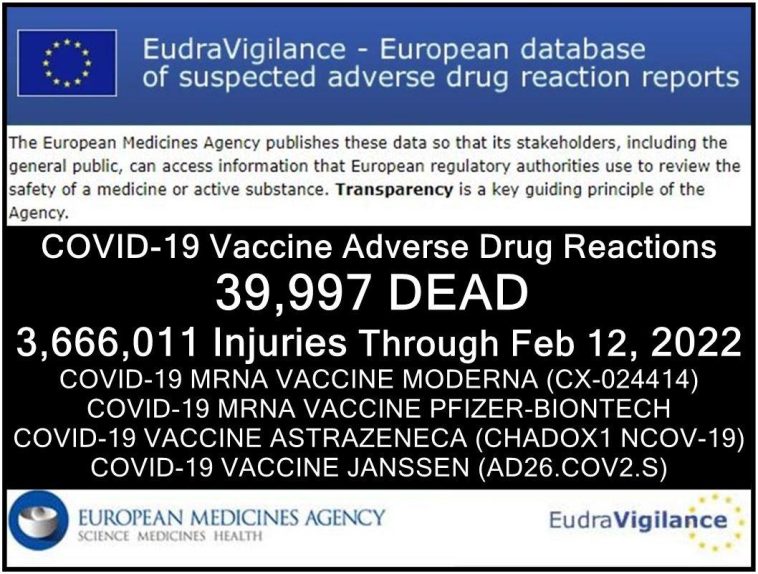
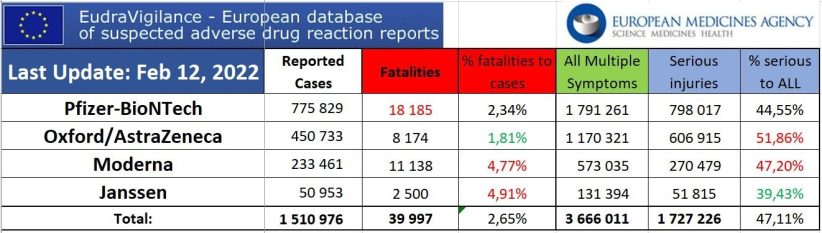
The European (EEA and non-EEA countries) database of suspected drug reaction reports is EudraVigilance, verified by the European Medicines Agency (EMA), and they are now reporting 39,997 fatalities, and 3,666,011 injuries following injections of four experimental COVID-19 shots:
- COVID-19 MRNA VACCINE MODERNA (CX-024414)
- COVID-19 MRNA VACCINE PFIZER-BIONTECH
- COVID-19 VACCINE ASTRAZENECA (CHADOX1 NCOV-19)
- COVID-19 VACCINE JANSSEN (AD26.COV2.S)
From the total of injuries recorded, almost half of them (1,727,226) are serious injuries.
“Seriousness provides information on the suspected undesirable effect; it can be classified as ‘serious’ if it corresponds to a medical occurrence that results in death, is life-threatening, requires inpatient hospitalisation, results in another medically important condition, or prolongation of existing hospitalisation, results in persistent or significant disability or incapacity, or is a congenital anomaly/birth defect.”
A Health Impact News subscriber in Europe ran the reports for each of the four COVID-19 shots we are including here. It is a lot of work to tabulate each reaction with injuries and fatalities, since there is no place on the EudraVigilance system we have found that tabulates all the results.
Since we have started publishing this, others from Europe have also calculated the numbers and confirmed the totals.*
Here is the summary data through February 12, 2022.
Total reactions for the mRNA vaccine Tozinameran (code BNT162b2,Comirnaty) from BioNTech/ Pfizer: 18,185 deaths and 1,791,261 injuries to 12/02/2022
- 50,761 Blood and lymphatic system disorders incl. 254 deaths
- 61,233 Cardiac disorders incl. 2,638 deaths
- 547 Congenital, familial and genetic disorders incl. 55 deaths
- 23,657 Ear and labyrinth disorders incl. 12 deaths
- 2,077 Endocrine disorders incl. 8 deaths
- 27,111 Eye disorders incl. 39 deaths
- 138,253 Gastrointestinal disorders incl. 706 deaths
- 443,764 General disorders and administration site conditions incl. 5,190 deaths
- 2,025 Hepatobiliary disorders incl. 95 deaths
- 19,243 Immune system disorders incl. 99 deaths
- 84,884 Infections and infestations incl. 1,931 deaths
- 35,665 Injury, poisoning and procedural complications incl. 349 deaths
- 44,308 Investigations incl. 520 deaths
- 11,795 Metabolism and nutrition disorders incl. 289 deaths
- 209,669 Musculoskeletal and connective tissue disorders incl. 228 deaths
- 1,744 Neoplasms benign, malignant and unspecified (incl cysts and polyps) incl. 166 deaths
- 290,349 Nervous system disorders incl. 1,926 deaths
- 2,658 Pregnancy, puerperium and perinatal conditions incl. 75 deaths
- 262 Product issues incl. 3 deaths
- 32,195 Psychiatric disorders incl. 216 deaths
- 6,509 Renal and urinary disorders incl. 272 deaths
- 74,588 Reproductive system and breast disorders incl. 6 deaths
- 75,926 Respiratory, thoracic and mediastinal disorders incl. 1,932 deaths
- 81,815 Skin and subcutaneous tissue disorders incl. 146 deaths
- 4,127 Social circumstances incl. 23 deaths
- 21,849 Surgical and medical procedures incl. 208 deaths
- 44,247 Vascular disorders incl. 799 deaths
Total reactions for the mRNA vaccine mRNA-1273 (CX-024414) from Moderna: 11,138 deaths and 573,035 injuries to 12/02/2022
- 13,383 Blood and lymphatic system disorders incl. 120 deaths
- 19,462 Cardiac disorders incl. 1,169 deaths
- 198 Congenital, familial and genetic disorders incl. 12 deaths
- 6,688 Ear and labyrinth disorders incl. 8 deaths
- 533 Endocrine disorders incl. 6 deaths
- 7,856 Eye disorders incl. 35 deaths
- 46,468 Gastrointestinal disorders incl. 416 deaths
- 152,534 General disorders and administration site conditions incl. 3,672 deaths
- 819 Hepatobiliary disorders incl. 55 deaths
- 5,683 Immune system disorders incl. 21 deaths
- 24,462 Infections and infestations incl. 1,051 deaths
- 10,555 Injury, poisoning and procedural complications incl. 211 deaths
- 12,633 Investigations incl. 395 deaths
- 4,996 Metabolism and nutrition disorders incl. 268 deaths
- 70,107 Musculoskeletal and connective tissue disorders incl. 221 deaths
- 700 Neoplasms benign, malignant and unspecified (incl cysts and polyps) incl. 86 deaths
- 95,946 Nervous system disorders incl. 1,040 deaths
- 925 Pregnancy, puerperium and perinatal conditions incl. 10 deaths
- 101 Product issues incl. 4 deaths
- 9,813 Psychiatric disorders incl. 181 deaths
- 3,157 Renal and urinary disorders incl. 218 deaths
- 14,047 Reproductive system and breast disorders incl. 9 deaths
- 24,308 Respiratory, thoracic and mediastinal disorders incl. 1,178 deaths
- 29,172 Skin and subcutaneous tissue disorders incl. 96 deaths
- 2,325 Social circumstances incl. 45 deaths
- 3,585 Surgical and medical procedures incl. 206 deaths
- 12,579 Vascular disorders incl. 405 deaths
Total reactions for the vaccine AZD1222/VAXZEVRIA (CHADOX1 NCOV-19) from Oxford/ AstraZeneca: 8,174 deaths and 1,170,321 injuries to 12/02/2022
- 14,038 Blood and lymphatic system disorders incl. 279 deaths
- 21,330 Cardiac disorders incl. 854 deaths
- 241 Congenital familial and genetic disorders incl. 9 deaths
- 13,580 Ear and labyrinth disorders incl. 7 deaths
- 709 Endocrine disorders incl. 6 deaths
- 20,310 Eye disorders incl. 32 deaths
- 108,425 Gastrointestinal disorders incl. 447 deaths
- 309,230 General disorders and administration site conditions incl. 1,893 deaths
- 1,062 Hepatobiliary disorders incl. 70 deaths
- 5,495 Immune system disorders incl. 40 deaths
- 43,810 Infections and infestations incl. 634 deaths
- 13,918 Injury poisoning and procedural complications incl. 201 deaths
- 26,112 Investigations incl. 206 deaths
- 13,147 Metabolism and nutrition disorders incl. 132 deaths
- 170,055 Musculoskeletal and connective tissue disorders incl. 171 deaths
- 769 Neoplasms benign malignant and unspecified (incl cysts and polyps) incl. 42 deaths
- 236,745 Nervous system disorders incl. 1,199 deaths
- 631 Pregnancy puerperium and perinatal conditions incl. 21 deaths
- 199 Product issues incl. 1 death
- 21,273 Psychiatric disorders incl. 73 deaths
- 4,416 Renal and urinary disorders incl. 82 deaths
- 17,181 Reproductive system and breast disorders incl. 3 deaths
- 42,021 Respiratory thoracic and mediastinal disorders incl. 1,119 deaths
- 52,622 Skin and subcutaneous tissue disorders incl. 69 deaths
- 1,657 Social circumstances incl. 9 deaths
- 2,217 Surgical and medical procedures incl. 33 deaths
- 29,128 Vascular disorders incl. 542 deaths
Total reactions for the COVID-19 vaccine JANSSEN (AD26.COV2.S) from Johnson & Johnson: 2,500 deaths and 131,394 injuries to 12/02/2022
- 1,272 Blood and lymphatic system disorders incl. 54 deaths
- 2,671 Cardiac disorders incl. 211 deaths
- 44 Congenital, familial and genetic disorders incl. 1 death
- 1,382 Ear and labyrinth disorders incl. 3 deaths
- 109 Endocrine disorders incl. 2 deaths
- 1,710 Eye disorders incl. 10 deaths
- 9,791 Gastrointestinal disorders incl. 94 deaths
- 35,428 General disorders and administration site conditions incl. 708 deaths
- 160 Hepatobiliary disorders incl. 15 deaths
- 572 Immune system disorders incl. 10 deaths
- 8,881 Infections and infestations incl. 211 deaths
- 1,230 Injury, poisoning and procedural complications incl. 26 deaths
- 6,393 Investigations incl. 134 deaths
- 793 Metabolism and nutrition disorders incl. 63 deaths
- 17,493 Musculoskeletal and connective tissue disorders incl. 57 deaths
- 95 Neoplasms benign, malignant and unspecified (incl cysts and polyps) incl. 9 deaths
- 23,989 Nervous system disorders incl. 248 deaths
- 61 Pregnancy, puerperium and perinatal conditions incl. 1 death
- 31 Product issues
- 1,844 Psychiatric disorders incl. 24 deaths
- 560 Renal and urinary disorders incl. 32 deaths
- 3,189 Reproductive system and breast disorders incl. 7 deaths
- 4,649 Respiratory, thoracic and mediastinal disorders incl. 314 deaths
- 3,894 Skin and subcutaneous tissue disorders incl. 12 deaths
- 429 Social circumstances incl. 4 deaths
- 932 Surgical and medical procedures incl. 75 deaths
- 3,792 Vascular disorders incl. 175 deaths
*These totals are estimates based on reports submitted to EudraVigilance. Totals may be much higher based on percentage of adverse reactions that are reported. Some of these reports may also be reported to the individual country’s adverse reaction databases, such as the U.S. VAERS database and the UK Yellow Card system. The fatalities are grouped by symptoms, and some fatalities may have resulted from multiple symptoms.
Europe considers regulating Spotify
By Dan Frieth | Reclaim The Net | February 13, 2022
National media regulators are hoping the upcoming speech laws will give them power to censor “misinformation” on Spotify.
Spotify has been attacked heavily in recent months, mostly for hosting the Joe Rogan Experience, which doesn’t always go along with the mainstream narrative.
“We should hold them accountable not as a publisher but just like any other online platform in the Digital Services Act,” Frédéric Bokobza, deputy director general of France’s media regulator, Arcom, told POLITICO.
The EU is finalizing the Digital Services Act (DSA), a law focused on content moderation on online platforms. The bill might also empower national media regulators to regulate a broader list of tech platforms, including Telegram and Spotify.
“As of now, we do not have regulatory tools in the French law which would enable us to oversee audio streaming companies, on top of the fact [Spotify] is not based on our territory,” said Roch-Olivier Maistre, president of France’s audiovisual regulator.
For long, Spotify escaped public scrutiny as it mostly hosted music. But in recent years it has become a popular podcast platform, with more than 400 million users globally and a new avenue for ideas that the establishment wants censored.
Despite the backlash, Spotify has refused to cut ties with Joe Rogan, whose show is the most popular podcast on the platform.
EU capital bans ‘Freedom Convoy’ protest
Police will keep the Canada-inspired trucker demonstration out of the Belgian capital, its mayor says
RT | February 10, 2022
Brussels Mayor Philippe Close announced on Thursday that a protest convoy of truckers will be barred from entering the city. Inspired by an ongoing demonstration against vaccine mandates in Canada, the truckers are set to reach the Belgian capital early next week.
“We have taken the decision to ban the ‘Freedom Convoy’ which has not been authorized to demonstrate because no request has been sent,” Close wrote on Twitter, noting that he made the decision along with Interior Minister Annelies Verlinden and Brussels region Minister President Rudi Vervoort.
Local and federal police “will divert motorized vehicles coming towards the capital despite the ban,” Close added.
Drawing participants from across the continent, the protest is inspired by a similar demonstration in the Canadian capital of Ottawa. Traffic in parts of Ottawa has been brought to a standstill for nearly two weeks by truckers demanding the immediate lifting of Covid restrictions, including a mandate that requires them to be vaccinated to re-enter the country from the US.
As host to key EU institutions, Brussels is a natural focal point for the European protest. While individual nations in the bloc have begun rolling back their vaccine pass systems at home, vaccination or proof of a negative Covid test is required to cross national borders within the union, and the EU recently proposed extending this system until 2023.
Truckers en route to Brussels have planned some stops along the way, with a major protest set to hit Paris this weekend. Authorities in the French capital issued a similar ban on Thursday, and threatened protesters with stiff fines should they block traffic in the city. Paris police said that a “specific device” would be used by the authorities to prevent the convoy from entering the city.
Narrative collapse quickens pace
The Naked Emperor’s Newsletter | February 9, 2022
Boris Johnson, the Prime Minister of the UK, has, today announced that all coronavirus restrictions will be lifted in less than two weeks. This is a month earlier than initially proposed, showing the accelerating change in the narrative.
He said he plans to abolish the remaining restrictions in the UK, including the self-isolation rules after testing positive. It is not clear, however, whether this will also apply to the unvaccinated.
Mr Johnson said “I can tell the house today, that it is my intention to return on the first day after the half term recess to present our strategy for living with Covid”. What is this new normal that the Prime Minister has in plan? Surely living with Covid means going back to the old normal, not even thinking about Covid anymore?
In other parts of the world, Portugal, Greece and France are to ease travel restrictions and Italy is changing its mask mandate for outdoor areas. The EU is removing testing regimes for fully vaccinated travellers, again leaving the nasty after taste that the new narrative is to go back to normal whilst leaving restrictions on the unvaccinated.
Across the pond, in Canada, Saskatchewan Premier, Scott Moe, announced the end to Covid passes and masks, signalling a victory for the protesting Truckers. Will Trudeau realise which way the wind is blowing and cave in but try to spin a victory or will he double down?
Fauci has said that America is almost past the ‘full blown’ pandemic phase and will be winding down restrictions and masks ‘soon’.
Although Scottish First Minister, Nicola Sturgeon, admitted that Scotland is entering a ‘calmer’ stage of the pandemic, she still decided that masks and Covid certification will remain.
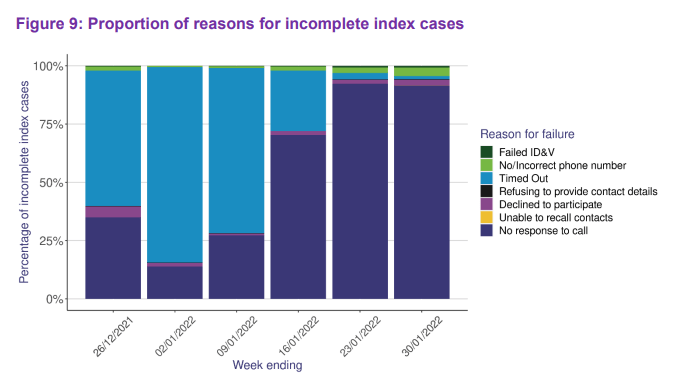
The Scottish public, on the other hand, are saying enough is enough. Data from their Test AND Protect system shows that 91.5% of incomplete cases (purple), in the recent few weeks, are due to the public not responding to the surveillance calls.
It seems the narrative is collapsing and faster and faster each day. However, whilst this may be due to Omicron being more mild, I remain sceptical. The reasons being given are the same reasons many of us said restrictions were unnecessary in the first place. Now, all of a sudden, the corona fog is receding and everyone, in multiple countries and along similar time scales, is seeing the light. Or are they? Will all restrictions be removed or will they remain all but in name for the unvaccinated?
Will they remove all legislation to ensure none of these measures will never return again? If the legislation stays then it will be all too easy for restrictions to return when vaccines wane and seasonal illnesses return in the winter.
Will they remove all restrictions for everybody, including the unvaccinated? That means no additional testing regimes for the unvaccinated and no back-door use of Covid passes.
Or are we truly seeing the end of the pandemic? Some of the pharma documentation that I am about to write an article on may suggest that they see the writing is on the wall.
The next few weeks will certainly be interesting and the key will be to keep an eye on the small print.
EU Wants To Keep Vaccine Passports In Place For Another ENTIRE YEAR
By Steve Watson | Summit News | February 4, 2022
The unelected bureaucrat governors of the EU in the European Commission have proposed keeping the bloc’s COVID vaccine passport system in place for another entire year, despite the fact that many member countries are ramping down restrictions.
In a notice on its website, the Commission states “Today the European Commission is proposing to extend the EU Digital COVID Certificate by a year, until 30 June 2023.”
It continues, “The COVID-19 virus continues to be prevalent in Europe and at this stage it is not possible to determine the impact of a possible increase in infections in the second half of 2022 or of the emergence of new variants.”
“Extending the Regulation will ensure that travellers can continue using their EU Digital COVID Certificate when travelling in the EU where Member States maintain certain public health measures,” the statements adds.
It continues, “The Commission is adopting the proposal today to make sure the European Parliament and the Council can conclude the legislative procedure in time before the current Regulation expires.”
The move comes even as several countries, including Denmark, Norway, Italy, Sweden, France, in addition to non-EU countries such as Switzerland and England move to scrap restrictions including the vaccine passes.
The European Commission admits in its statement that it is up to the individual countries whether they carry on using the EU COVID vaccine passport scheme.
“The domestic use of EU Digital COVID Certificates remains a matter for Member States to decide, the statement notes, adding “The EU legislation on the EU Digital COVID Certificate neither prescribes nor prohibits the domestic use of EU Digital COVID Certificate (such as for access to events or restaurants).”
It also notes that “At the same time, where a Member State establishes a system of COVID-19 certificate for domestic purposes, it should continue to ensure that the EU Digital COVID Certificate is also fully accepted for those purposes. Beyond that, the Commission also encourages Member States to align their domestic validity periods with the validity period set at EU level for the purpose of travel.”
As we reported in November, despite vaccine passport schemes and high vaccination rates in many of the countries affected, COVID cases across Europe continued to surge as winter kicked in.
In addition, a recent investigation by experts in Spain concluded that vaccine passports have no significant impact on reducing COVID-19 infection rates.
The findings are similar to evidence found by the UK government that vaccine passports could actually increase Covid rates in the country.
The Spanish study noted that the only positives of such a scheme are that it “warns people that there is still danger from the pandemic and encourages vaccination uptake among the reticent.”
In other words, although vaccine passports have no discernible impact on their stated goal – reducing the spread of COVID-19 – they do succeed in keeping people fearful and compliant.
That conclusion dovetails with a recent admission by French Minister of Health Olivier Véran that the vaccine passports are “a disguised form of vaccination obligation,” but are “more effective.”
‘Freedom Convoys’ gaining steam across Europe
RT | February 4, 2022
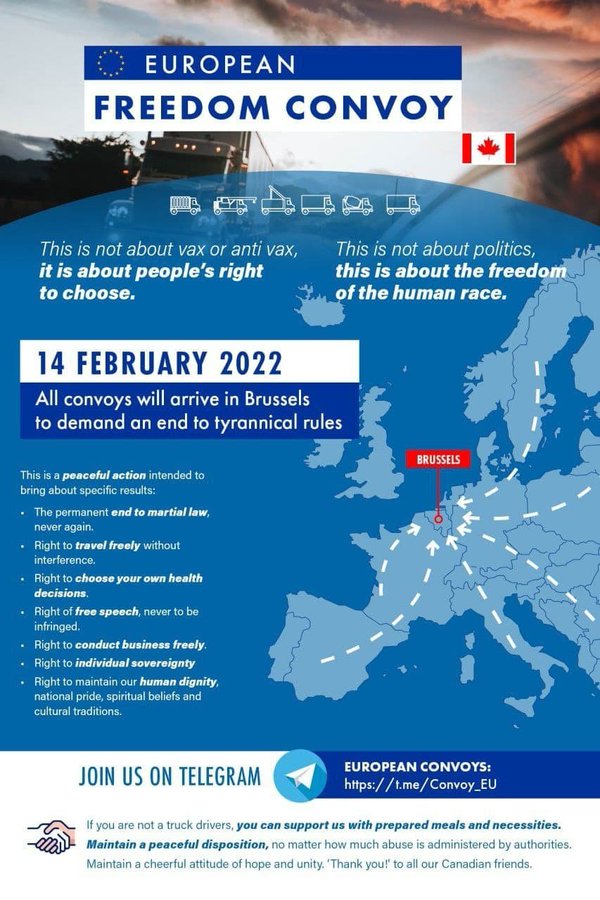
Truckers in France are reportedly planning to emulate the Canadian ‘Freedom Convoy’ by mobilizing groups of big rigs to protest vaccine mandates and other Covid-19 restrictions set by Paris. According to a BFM TV report, demonstrators plan to “paralyze” the French capital next week before joining a wider “European convergence” in Brussels.
The outlet reported that a leaflet announcing the ‘Freedom Convoy France’ has been circulated on social media networks, calling on “citizens” to “recover their freedom, their fundamental rights, unconditional access to care, education, and culture, respect for the essential values of our Constitution.” It also noted that the truckers in “Canada [had] paved the way for us.”
After final preparations on Monday and Tuesday, the convoy will set off in three waves from across France – with those furthest from Paris setting off on Wednesday, according to an itinerary on the leaflet. All three waves are expected to reach the national capital Friday evening. On Sunday, the convoy is slated to leave and “join our European friends” in Brussels.
The BFM TV report noted that a Facebook group, called ‘Le convoi de la liberte’, had been created on January 26 and reached nearly 197,000 members. The outlet said the convoy may reinvigorate protests against vaccination passes, which have apparently been flagging [???] in recent weeks.
In addition, the report pointed to a ‘World Freedom Convoy’ group that has been set up on Telegram. This is thought to include demonstrators from Germany, Italy, and Croatia, among others. The Bruzz news outlet in Belgium reported on Thursday that some 40,000 people had joined the group within the past week – with the focus on free speech and the right to make one’s own health choices.
According to Bruzz news, the truck drivers hope to head toward their respective capital cities starting Monday before heading on to Brussels. The outlet noted that it was unclear how many would actually take part, but added that police were monitoring the situation.
Meanwhile, The Guardian reported that a Facebook group of US truckers called ‘Convoy to DC 2022’, who planned to drive to Washington, DC next month, had gained more than 100,000 members before being deleted by Meta. The organizers have reportedly since moved to Telegram, where over 28,000 have joined.
Featured Video
Death Spikes & Rising Cancer In Our Youth Explained
or go to
Aletho News Archives – Video-Images
From the Archives
Politicians lie
By Mazin Qumsiyeh | Popular Resistance | August 18, 2013
There is no way to say this truth nicely: Politicians lie. That includes Japanese, American, Egyptian, Israeli, and Palestinian politicians! Is there something more common sense than that? Yet, so many citizens around the world believe their own politicians or wistfully acknowledge lies but think it is part of the job needed to run things. They believe even when politicians contradict themselves blatantly. This phenomenon is rather remarkable. It is a dissonance and disconnect from reality that many seem oblivious to. It is very dangerous because it can lead to accepting rationales for going to war. These can be deadly wars that lead to millions of lives lost as happened in what was called World War 1 and WW2. Even when incredible and declassified evidence abound, politicians continue to lie and old mythologies refuse to die. Here are just a few of the countless lies told to us over the past few decades… continue
Blog Roll
 Aletho News
- Global Tipping Points Lead the World Into a State of Entropy
- The day-after at the White House: USA and Xi Jinping
- The Geopolitical Balance in the Red Sea: The UAE Being Displaced by New Players
- Iraqi resistance group vows to stage airport sit-ins over Iran aerial blockade
- Turkish parliament to review Saudi-Pakistan defense pact next month
- DEATH SPIKES & RISING CANCER IN OUR YOUTH EXPLAINED
- Iran offers Trump deal before US election
- Merz regime wants ‘secret police’ – opposition
- Israeli settlers terrorize West Bank Palestinians with state-provided drones: Report
- They see them, then kill them: Israeli quadcopters track, deliberately target civilians in Gaza
- If Americans Knew
- Deconstructing Netanyahu’s pants-on-fire UN rant – Daily Update
- Trump betrayed voters with his campaign lies and prioritized a foreign country once he took office
- Netanyahu calls Israel’s war in Gaza ‘opposite of genocide’ in UN speech to near-empty hall
- Settler Kidnappings: Torture, Sexual Abuse and Terrorisation of Palestinian Abductees as Israel Deepens Annexation of West Bank
- Gaza winter nears as 162,000 tents become unusable, raising fears of humanitarian crisis
- Netanyahu says, “It’s the opposite of genocide”; UN says Gaza economy is world’s ‘most severe crisis on record’ – Daily Update
- Israel’s US-Backed Assault on Gaza Has Created the ‘World’s Most Severe Economic Crisis on Record’: UN
- ‘Protecting U.S. Citizens’… From Israel
- ‘This is where I live now, the back of a truck’: a day in the life of a grandmother in Gaza
- In UN Speech, Iran’s President Displays Pictures of Children Killed by US, Brings Attention to Israel’s Nuclear Arsenal
- No Tricks Zone
- New Study: Earth And Venus Surface Warmth Largely Explained By Convection And Lapse Rate, Not CO2 Or Radiation
- 2025 Nature Paper Claiming Worsening Global Drought Gets RETRACTED …Heavily Flawed
- New Study: ‘Global Drought Shows No Detectable Recent Acceleration Under Climate Warming’
- Economic Masterminds: German Socialists Suggest Taxing Productivity Gains Stemming From Using AI
- The South China Sea Has Not Been Cooperating With The Climate Change Narrative
- Energy Crisis: Germany Enters Heating Season With Historically Low Gas Reserve Fill Levels
- New Study: The Antarctic Ice Sheet Gained Mass From 2020-2024 Due To Staggering Snow And Ice Accumulation
- Study: Ocean Heating Rates From Thousands Of Years Ago ‘Dwarf’ Modern Ocean Heating Rates
- Climate Extremists Target, Attack Large-Scale Power Grid Infrastructure In Germany!
- New Study: Antarctic Ice Melt Has Contributed Less Than 1 Centimeter To Sea Level Rise In The Last 30 Years

