38,983 Deaths and 3,530,362 Injuries Following COVID Shots in European Database as Mass Funeral for Children who Died After Pfizer Vaccine Held in Switzerland
By Brian Shilhavy | Health Impact News | February 4, 2022
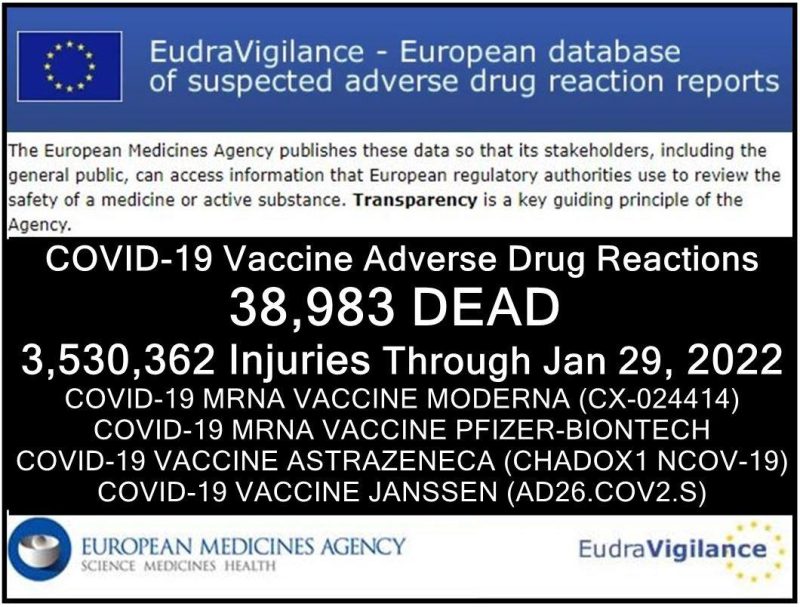
The European (EEA and non-EEA countries) database of suspected drug reaction reports is EudraVigilance, verified by the European Medicines Agency (EMA), and they are now reporting 38,983 fatalities, and 3,530,362 injuries following injections of four experimental COVID-19 shots:
- COVID-19 MRNA VACCINE MODERNA (CX-024414)
- COVID-19 MRNA VACCINE PFIZER-BIONTECH
- COVID-19 VACCINE ASTRAZENECA (CHADOX1 NCOV-19)
- COVID-19 VACCINE JANSSEN (AD26.COV2.S)
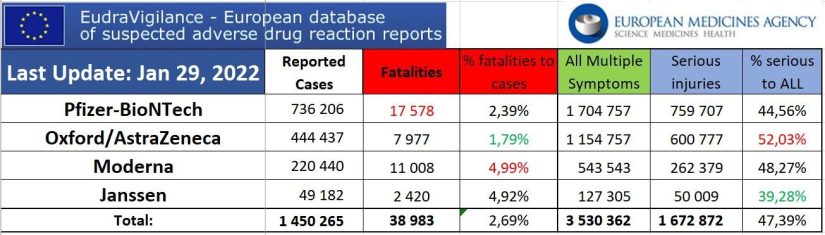
From the total of injuries recorded, almost half of them (1,672,872 ) are serious injuries.
“Seriousness provides information on the suspected undesirable effect; it can be classified as ‘serious’ if it corresponds to a medical occurrence that results in death, is life-threatening, requires inpatient hospitalisation, results in another medically important condition, or prolongation of existing hospitalisation, results in persistent or significant disability or incapacity, or is a congenital anomaly/birth defect.”
A Health Impact News subscriber in Europe ran the reports for each of the four COVID-19 shots we are including here. It is a lot of work to tabulate each reaction with injuries and fatalities, since there is no place on the EudraVigilance system we have found that tabulates all the results.
Since we have started publishing this, others from Europe have also calculated the numbers and confirmed the totals.*
Here is the summary data through January 29, 2022.
Total reactions for the mRNA vaccine Tozinameran (code BNT162b2,Comirnaty) from BioNTech/ Pfizer: 17,578 deaths and 1,704,757 injuries to 29/01/2022
- 48,240 Blood and lymphatic system disorders incl. 242 deaths
- 57,541 Cardiac disorders incl. 2,554 deaths
- 522 Congenital, familial and genetic disorders incl. 51 deaths
- 22,590 Ear and labyrinth disorders incl. 11 deaths
- 1,911 Endocrine disorders incl. 6 deaths
- 25,814 Eye disorders incl. 38 deaths
- 133,365 Gastrointestinal disorders incl. 681 deaths
- 422,360 General disorders and administration site conditions incl. 5,024 deaths
- 1,931 Hepatobiliary disorders incl. 90 deaths
- 18,455 Immune system disorders incl. 95 deaths
- 76,443 Infections and infestations incl. 1,878 deaths
- 33,972 Injury, poisoning and procedural complications incl. 331 deaths
- 42,585 Investigations incl. 502 deaths
- 11,344 Metabolism and nutrition disorders incl. 273 deaths
- 201,643 Musculoskeletal and connective tissue disorders incl. 212 deaths
- 1,629 Neoplasms benign, malignant and unspecified (incl cysts and polyps) incl. 153 deaths
- 278,744 Nervous system disorders incl. 1,859 deaths
- 2,513 Pregnancy, puerperium and perinatal conditions incl. 74 deaths
- 251 Product issues incl. 3 deaths
- 30,622 Psychiatric disorders incl. 207 deaths
- 6,150 Renal and urinary disorders incl. 266 deaths
- 68,129 Reproductive system and breast disorders incl. 6 deaths
- 72,531 Respiratory, thoracic and mediastinal disorders incl. 1,884 deaths
- 78,059 Skin and subcutaneous tissue disorders incl. 146 deaths
- 3,871 Social circumstances incl. 22 deaths
- 21,010 Surgical and medical procedures incl. 204 deaths
- 42,532 Vascular disorders incl. 766 deaths
Total reactions for the mRNA vaccine mRNA-1273 (CX-024414) from Moderna: 11,008 deaths and 543,543 injuries to 29/01/2022
- 12,365 Blood and lymphatic system disorders incl. 120 deaths
- 18,287 Cardiac disorders incl. 1,142 deaths
- 190 Congenital, familial and genetic disorders incl. 11 deaths
- 6,310 Ear and labyrinth disorders incl. 8 deaths
- 502 Endocrine disorders incl. 6 deaths
- 7,475 Eye disorders incl. 36 deaths
- 44,340 Gastrointestinal disorders incl. 413 deaths
- 145,153 General disorders and administration site conditions incl. 3,630 deaths
- 793 Hepatobiliary disorders incl. 54 deaths
- 5,370 Immune system disorders incl. 22 deaths
- 23,070 Infections and infestations incl. 1042 deaths
- 10,286 Injury, poisoning and procedural complications incl. 208 deaths
- 12,129 Investigations incl. 393 deaths
- 4,847 Metabolism and nutrition disorders incl. 263 deaths
- 66,358 Musculoskeletal and connective tissue disorders incl. 223 deaths
- 682 Neoplasms benign, malignant and unspecified (incl cysts and polyps) incl. 85 deaths
- 91,230 Nervous system disorders incl. 1,029 deaths
- 907 Pregnancy, puerperium and perinatal conditions incl. 10 deaths
- 98 Product issues incl. 4 deaths
- 9,441 Psychiatric disorders incl. 181 deaths
- 3,030 Renal and urinary disorders incl. 214 deaths
- 12,547 Reproductive system and breast disorders incl. 9 deaths
- 23,251 Respiratory, thoracic and mediastinal disorders incl. 1,162 deaths
- 27,540 Skin and subcutaneous tissue disorders incl. 96 deaths
- 2,239 Social circumstances incl. 45 deaths
- 3,028 Surgical and medical procedures incl. 203 deaths
- 12,075 Vascular disorders incl. 399 deaths
Total reactions for the vaccine AZD1222/VAXZEVRIA (CHADOX1 NCOV-19) from Oxford/ AstraZeneca: 7,977 deaths and 1,154,757 injuries to 29/01/2022
- 13,912 Blood and lymphatic system disorders incl. 278 deaths
- 20,984 Cardiac disorders incl. 830 deaths
- 235 Congenital familial and genetic disorders incl. 8 deaths
- 13,406 Ear and labyrinth disorders incl. 7 deaths
- 692 Endocrine disorders incl. 6 deaths
- 20,086 Eye disorders incl. 32 deaths
- 107,453 Gastrointestinal disorders incl. 434 deaths
- 304,993 General disorders and administration site conditions incl. 1,855 deaths
- 1,039 Hepatobiliary disorders incl. 69 deaths
- 5,409 Immune system disorders incl. 40 deaths
- 42,266 Infections and infestations incl. 620 deaths
- 13,630 Injury poisoning and procedural complications incl. 198 deaths
- 25,681 Investigations incl. 205 deaths
- 13,023 Metabolism and nutrition disorders incl. 126 deaths
- 168,174 Musculoskeletal and connective tissue disorders incl. 165 deaths
- 743 Neoplasms benign malignant and unspecified (incl cysts and polyps) incl. 40 deaths
- 234,117 Nervous system disorders incl. 1,178 deaths
- 635 Pregnancy puerperium and perinatal conditions incl. 20 deaths
- 199 Product issues incl. 1 death
- 21,051 Psychiatric disorders incl. 69 deaths
- 4,338 Renal and urinary disorders incl. 78 deaths
- 16,849 Reproductive system and breast disorders incl. 3 deaths
- 41,401 Respiratory thoracic and mediastinal disorders incl. 1,082 deaths
- 52,064 Skin and subcutaneous tissue disorders incl. 65 deaths
- 1,617 Social circumstances incl. 9 deaths
- 1,973 Surgical and medical procedures incl. 30 deaths
- 28,787 Vascular disorders incl. 529 deaths
Total reactions for the COVID-19 vaccine JANSSEN (AD26.COV2.S) from Johnson & Johnson: 2,420 deaths and 127,305 injuries to 29/01/2022
- 1,229 Blood and lymphatic system disorders incl. 51 deaths
- 2,552 Cardiac disorders incl. 204 deaths
- 40 Congenital, familial and genetic disorders incl. 1 death
- 1,319 Ear and labyrinth disorders incl. 3 deaths
- 105 Endocrine disorders incl. 1 death
- 1,656 Eye disorders incl. 10 deaths
- 9,588 Gastrointestinal disorders incl. 88 deaths
- 34,487 General disorders and administration site conditions incl. 685 deaths
- 153 Hepatobiliary disorders incl. 13 deaths
- 544 Immune system disorders incl. 10 deaths
- 8,521 Infections and infestations incl. 207 deaths
- 1,147 Injury, poisoning and procedural complications incl. 25 deaths
- 6,086 Investigations incl. 131 deaths
- 756 Metabolism and nutrition disorders incl. 60 deaths
- 17,116 Musculoskeletal and connective tissue disorders incl. 55 deaths
- 86 Neoplasms benign, malignant and unspecified (incl cysts and polyps) incl. 8 deaths
- 23,413 Nervous system disorders incl. 245 deaths
- 55 Pregnancy, puerperium and perinatal conditions incl. 1 death
- 30 Product issues
- 1,766 Psychiatric disorders incl. 22 deaths
- 535 Renal and urinary disorders incl. 31 deaths
- 2,941 Reproductive system and breast disorders incl. 6 deaths
- 4,468 Respiratory, thoracic and mediastinal disorders incl. 304 deaths
- 3,760 Skin and subcutaneous tissue disorders incl. 10 deaths
- 409 Social circumstances incl. 4 deaths
- 867 Surgical and medical procedures incl. 74 deaths
- 3,676 Vascular disorders incl. 171 deaths
*These totals are estimates based on reports submitted to EudraVigilance. Totals may be much higher based on percentage of adverse reactions that are reported. Some of these reports may also be reported to the individual country’s adverse reaction databases, such as the U.S. VAERS database and the UK Yellow Card system. The fatalities are grouped by symptoms, and some fatalities may have resulted from multiple symptoms.
On January 29, 2021 a mass funeral protest for children who have died after receiving a Pfizer vaccine was held in Geneva, Switzerland.
Someone recorded the event and made a short video. This is on our Bitchute Channel, and also on our Telegram channel.
Rocketing Energy Prices Were Part Of The Plan All The Time
By Paul Homewood | Not A Lot Of People Know That | January 29, 2022

https://www.theccc.org.uk/publication/sixth-carbon-budget/
The above excerpt comes from the CCC’s Sixth Carbon Budget. It shows conclusively that high energy prices have always been the official policy, in order that expensive renewables are made viable.
EU carbon prices have already risen from 32 to 80 euro/tonne in the last year, and the new UK ETS system tracks EU prices, with prices now at £75/tonne.
As it turns out global price rises for natural gas have brought the CCC’s dream to fruition a decade early.
Germany’s Interior Ministry accuses Google and Apple of inciting “conspiracy theories” for allowing Telegram
By Didi Rankovic | Reclaim The Net | January 21, 2022
Germany seems determined to try to undermine Telegram under the fairly absurd pretext that among its hundreds of millions of users are also some “extremists” (same logic applies to the whole of the internet – so will Berlin try to heavily regulate *that* as well?)
And the definition of “extremist” and “radical,” as mentioned in reports about the latest push to get Telegram to cooperate – or else – also includes people who have been unhappy with extreme and radical Covid restrictions.
But given the apparent financial independence of the company that develops the messaging app, the suppression bid doesn’t seem like it will be a straight-forward task.
Judging by the news coming out of Germany now, the route the Interior Ministry would prefer to take is roundabout – to possibly get an uncooperative Telegram banned on the two biggest app stores, those operated by Google and Apple, and thus severely limit its exposure to users.

However, this doesn’t make sense either – because a dedicated “dangerous right-wing extremist” or “conspiracy theorist” would surely find out how to sideload Telegram, and march on.
But by removing the app from the most widely used official app stores, it is those hundreds of millions of everyday users in search of secure and private ways to communicate, without any malicious actors – be they governments or hackers – interfering, who would suffer the most.
For that reason, when Germany’s Interior Minister Christian Pegel recently spoke about the need to get Telegram “cooperating” with law enforcement in order to suppress extremism and threats of violence – or Berlin will pressure Google and Apple – what it really comes down to is trying to put another brick in the ongoing “war on encryption” wall.
Among the members of the security/encryption purist community, Telegram is not even regarded as the best solution – but the benefits provided by this messaging app overall as a secure and privacy-friendly alternative to mainstream competitors still far outweigh any of its flaws. As a result Telegram has seen a strong uptake in recent years.
In Germany, Facebook’s WhatsApp and Messenger are both shedding users, Signal is holding steady – but behind Telegram, that has been growing.
Spanish Police Declare Resistance To Covid Tyranny and Corruption
State That They Are United With Police Forces Across Europe
By Celia Farber | The Truth Barrier | January 17, 2022
See the clip from Valencia, Spain here:
https://t.me/GreatBritishBird_News/12088
”We promised to protect and serve the people not the corrupt politicians. We feel very proud to be police but real police, not hit men of the government.
Our association is in direct contact with members of security forces in Italy, Portugal, France, Austria, Switzerland, Sweden, Germany, and Holland.
We’re going to join together all of the police of Europe. We’re going to stop this.
The security forces and the armed forces are the key to all of this.
We have to put ourselves on the side of the people, and turn our backs on the corrupt governments!
We have denounced the Covid passport here in Valencia with our association.
We’re going to demand responsibility from Señor Marlasca for the two states of emergency, and for using the police and the guardia civil to coerce the citizens. We don’t support that.”
This seems to be a critical development, and one we will keep close tabs on.
Thanks to Pélerine for this news tip.
Incidentally, Pélerine was selected as an outstanding reviewer of Robert F. Kennedy’s The Real Anthony Fauci by The Defender, linked here.
Congratulations Pélerine!
And congratulations to all the good police men and women of Europe, keeping your oath to protect, and risking your lives and livelihoods to do so. We salute your courage, and keep you in prayer.
Translated with the help of sources in Spain who wished to remain anonymous.
European drug regulators abruptly reverse course on boosters
By Alex Berenson | January 11, 2022
This should terrify you if you’ve received an mRNA booster.
Last month, the European Medicines Agency authorized boosters EVERY THREE MONTHS:
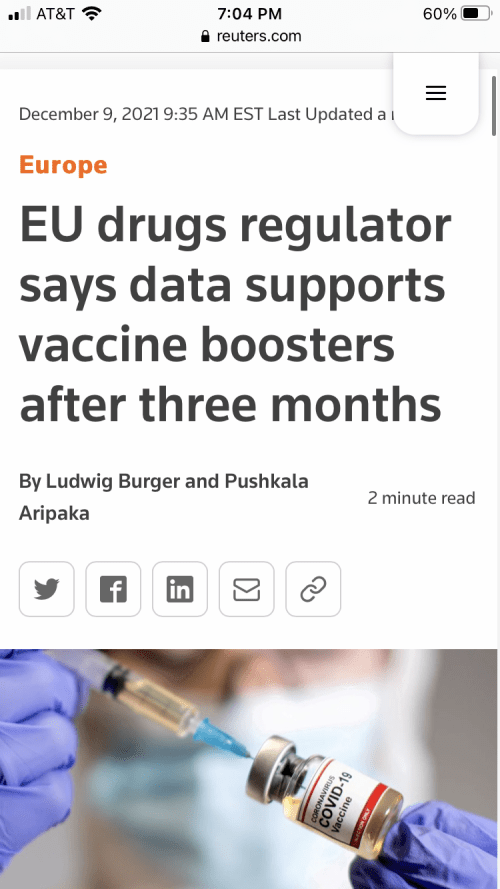
Today, not even five weeks later, and barely 24 hours after Pfizer’s CEO downplayed a fourth dose, they said they think frequent boosters may not be safe:

What changed? What data have they seen since Dec. 9? Animal studies? Side effect reports? Epidemiological data? Or is this just an abundance of caution – caution that did not exist last month?
The time for obfuscation and deception is over. Hundreds of millions of people across the United States and Europe have received mRNA boosters.
They deserve to know the truth.
36,257 Deaths and 3,244,052 Injuries Following COVID Shots in European Database

By Brian Shilhavy | Health Impact News | January 6, 2022
The European (EEA and non-EEA countries) database of suspected drug reaction reports is EudraVigilance, verified by the European Medicines Agency (EMA), and they are now reporting 36,257 fatalities, and 3,244,052 injuries following injections of four experimental COVID-19 shots:
- COVID-19 MRNA VACCINE MODERNA (CX-024414)
- COVID-19 MRNA VACCINE PFIZER-BIONTECH
- COVID-19 VACCINE ASTRAZENECA (CHADOX1 NCOV-19)
- COVID-19 VACCINE JANSSEN (AD26.COV2.S)
From the total of injuries recorded, almost half of them (1,540,852) are serious injuries.
“Seriousness provides information on the suspected undesirable effect; it can be classified as ‘serious’ if it corresponds to a medical occurrence that results in death, is life-threatening, requires inpatient hospitalisation, results in another medically important condition, or prolongation of existing hospitalisation, results in persistent or significant disability or incapacity, or is a congenital anomaly/birth defect.”
A Health Impact News subscriber in Europe ran the reports for each of the four COVID-19 shots we are including here. It is a lot of work to tabulate each reaction with injuries and fatalities, since there is no place on the EudraVigilance system we have found that tabulates all the results.
Since we have started publishing this, others from Europe have also calculated the numbers and confirmed the totals.*
Here is the summary data through January 1, 2022.
Total reactions for the mRNA vaccine Tozinameran (code BNT162b2, Comirnaty) from BioNTech/ Pfizer: 16,471 deaths and 1,546,829 injuries to 01/01/2022
- 42,225 Blood and lymphatic system disorders incl. 230 deaths
- 50,455 Cardiac disorders incl. 2,379 deaths
- 467 Congenital, familial and genetic disorders incl. 45 deaths
- 20,812 Ear and labyrinth disorders incl. 11 deaths
- 1,616 Endocrine disorders incl. 5 deaths
- 23,826 Eye disorders incl. 37 deaths
- 124,211 Gastrointestinal disorders incl. 652 deaths
- 386,451 General disorders and administration site conditions incl. 4,668 deaths
- 1,780 Hepatobiliary disorders incl. 83 deaths
- 17,061 Immune system disorders incl. 86 deaths
- 67,000 Infections and infestations incl. 1,769 deaths
- 28,457 Injury, poisoning and procedural complications incl. 302 deaths
- 38,560 Investigations incl. 487 deaths
- 10,496 Metabolism and nutrition disorders incl. 269 deaths
- 185,798 Musculoskeletal and connective tissue disorders incl. 204 deaths
- 1,451 Neoplasms benign, malignant and unspecified (incl cysts and polyps) incl. 136 deaths
- 255,661 Nervous system disorders incl. 1,756 deaths
- 2,254 Pregnancy, puerperium and perinatal conditions incl. 58 deaths
- 232 Product issues incl. 3 deaths
- 28,114 Psychiatric disorders incl. 193 deaths
- 5,594 Renal and urinary disorders incl. 258 deaths
- 59,397 Reproductive system and breast disorders incl. 6 deaths
- 66,518 Respiratory, thoracic and mediastinal disorders incl. 1,801 deaths
- 71,771 Skin and subcutaneous tissue disorders incl. 136 deaths
- 3,457 Social circumstances incl. 22 deaths
- 13,685 Surgical and medical procedures incl. 157 deaths
- 39,480 Vascular disorders incl. 718 deaths
Total reactions for the mRNA vaccine mRNA-1273 (CX-024414) from Moderna: 10,170 deaths and 465,080 injuries to 01/01/2022
- 9,961 Blood and lymphatic system disorders incl. 113 deaths
- 15,564 Cardiac disorders incl. 1,039 deaths
- 179 Congenital, familial and genetic disorders incl. 9 deaths
- 5,591 Ear and labyrinth disorders incl. 6 deaths
- 443 Endocrine disorders incl. 6 deaths
- 6,731 Eye disorders incl. 36 deaths
- 38,098 Gastrointestinal disorders incl. 380 deaths
- 123,337 General disorders and administration site conditions incl. 3,392 deaths
- 731 Hepatobiliary disorders incl. 51 deaths
- 4,671 Immune system disorders incl. 19 deaths
- 18,236 Infections and infestations incl. 965 deaths
- 9,241 Injury, poisoning and procedural complications incl. 191 deaths
- 10,065 Investigations incl. 321 deaths
- 4,394 Metabolism and nutrition disorders incl. 247 deaths
- 56,097 Musculoskeletal and connective tissue disorders incl. 208 deaths
- 628 Neoplasms benign, malignant and unspecified (incl cysts and polyps) incl. 79 deaths
- 78,044 Nervous system disorders incl. 965 deaths
- 815 Pregnancy, puerperium and perinatal conditions incl. 6 deaths
- 92 Product issues incl. 4 deaths
- 8,416 Psychiatric disorders incl. 169 deaths
- 2,725 Renal and urinary disorders incl. 197 deaths
- 10,682 Reproductive system and breast disorders incl. 9 deaths
- 20,529 Respiratory, thoracic and mediastinal disorders incl. 1,077 deaths
- 24,552 Skin and subcutaneous tissue disorders incl. 90 deaths
- 2,029 Social circumstances incl. 41 deaths
- 2,227 Surgical and medical procedures incl. 172 deaths
- 11,002 Vascular disorders incl. 378 deaths
Total reactions for the vaccine AZD1222/VAXZEVRIA (CHADOX1 NCOV-19) from Oxford/AstraZeneca: 7,371 deaths and 1,117,914 injuries to 01/01/2022
- 13,616 Blood and lymphatic system disorders incl. 261 deaths
- 20,296 Cardiac disorders incl. 788 deaths
- 215 Congenital familial and genetic disorders incl. 6 deaths
- 13,157 Ear and labyrinth disorders incl. 6 deaths
- 664 Endocrine disorders incl. 5 deaths
- 19,618 Eye disorders incl. 30 deaths
- 105,367 Gastrointestinal disorders incl. 393 deaths
- 293,748 General disorders and administration site conditions incl. 1,740 deaths
- 1,004 Hepatobiliary disorders incl. 66 deaths
- 5,228 Immune system disorders incl. 35 deaths
- 36,265 Infections and infestations incl. 564 deaths
- 13,023 Injury poisoning and procedural complications incl. 188 deaths
- 24,589 Investigations incl. 191 deaths
- 12,747 Metabolism and nutrition disorders incl. 113 deaths
- 164,732 Musculoskeletal and connective tissue disorders incl. 144 deaths
- 704 Neoplasms benign malignant and unspecified (incl cysts and polyps) incl. 34 deaths
- 228,601 Nervous system disorders incl. 1,095 deaths
- 586 Pregnancy puerperium and perinatal conditions incl. 19 deaths
- 194 Product issues incl. 1 death
- 20,622 Psychiatric disorders incl. 65 deaths
- 4,226 Renal and urinary disorders incl. 71 deaths
- 16,282 Reproductive system and breast disorders incl. 3 deaths
- 40,154 Respiratory thoracic and mediastinal disorders incl. 963 deaths
- 50,986 Skin and subcutaneous tissue disorders incl. 59 deaths
- 1,581 Social circumstances incl. 6 deaths
- 1,686 Surgical and medical procedures incl. 28 deaths
- 28,023 Vascular disorders incl. 497 deaths
Total reactions for the COVID-19 vaccine JANSSEN (AD26.COV2.S) from Johnson & Johnson: 2,245 deaths and 114,229 injuries to 01/01/2022
- 1,113 Blood and lymphatic system disorders incl. 46 deaths
- 2,196 Cardiac disorders incl. 186 deaths
- 40 Congenital, familial and genetic disorders incl. 1 death
- 1,227 Ear and labyrinth disorders incl. 3 deaths
- 93 Endocrine disorders incl. 1 death
- 1,548 Eye disorders incl. 9 deaths
- 9,141 Gastrointestinal disorders incl. 87 deaths
- 30,336 General disorders and administration site conditions incl. 623 deaths
- 143 Hepatobiliary disorders incl. 13 deaths
- 509 Immune system disorders incl. 10 deaths
- 5,832 Infections and infestations incl. 187 deaths
- 1,060 Injury, poisoning and procedural complications incl. 23 deaths
- 5,197 Investigations incl. 126 deaths
- 709 Metabolism and nutrition disorders incl. 55 deaths
- 16,069 Musculoskeletal and connective tissue disorders incl. 50 deaths
- 80 Neoplasms benign, malignant and unspecified (incl cysts and polyps) incl. 8 deaths
- 21,863 Nervous system disorders incl. 234 deaths
- 52 Pregnancy, puerperium and perinatal conditions incl. 1 death
- 29 Product issues
- 1,627 Psychiatric disorders incl. 21 deaths
- 485 Renal and urinary disorders incl. 29 deaths
- 2,625 Reproductive system and breast disorders incl. 6 deaths
- 4,115 Respiratory, thoracic and mediastinal disorders incl. 283 deaths
- 3,506 Skin and subcutaneous tissue disorders incl. 10 deaths
- 372 Social circumstances incl. 4 deaths
- 785 Surgical and medical procedures incl. 69 deaths
- 3,477 Vascular disorders incl. 160 deaths

*These totals are estimates based on reports submitted to EudraVigilance. Totals may be much higher based on percentage of adverse reactions that are reported. Some of these reports may also be reported to the individual country’s adverse reaction databases, such as the U.S. VAERS database and the UK Yellow Card system. The fatalities are grouped by symptoms, and some fatalities may have resulted from multiple symptoms.
Dutch Police Sick Attack Dogs On Anti-Lockdown Protesters
Is this what a ‘free’ country is supposed to look like?
By Steve Watson | Summit News | January 3, 2022
Shocking video emerged Sunday of police in Holland beating anti-lockdown protesters with batons and sending in dogs to maul the dissenters.
Massive amounts of people turned out to protest hard lockdown restrictions which were put back into place by the Dutch government before Christmas.
Everything except essential stores has been shut down in the country until at least Jan. 14.
The restrictions dictate that gatherings of more than two people are illegal, so the government sent in the riot police.
Watch:
Russia not deliberately choking gas supplies to West – Bloomberg
RT | December 24, 2021
Russian energy giant Gazprom has already fulfilled its contractual obligations and is not manipulating European prices, Bloomberg has claimed.
Recent slumps in Russian gas deliveries to Europe are not because of price manipulation for political gain, the New York based finance bible reported on Wednesday.
Earlier this week, the Yamal-Europe pipeline, which brings gas from Russia to Germany through Poland and Belarus, halted shipments. As European energy prices soared, some officials in the West accused Moscow of playing politics with the gas supply, in order to push Germany towards approval of the new Nord Stream 2 pipeline, which has been completed for months but has yet to be officially approved.
However, Bloomberg reported that anonymous sources familiar with the matter had confided that the real cause of the halt in gas transit was that Western buyers under long-term deals had already hit their contractual limits for 2021.
Typically, Gazprom and its customers agree to an arrangement whereby the company will supply a certain volume of gas at a pre-set rate, which this year was less than market price. Beyond that volume, energy buyers would need to pay the market rate, and when several of them reached their volume cap this week, they elected not to purchase more gas.
The Russian state-owned energy giant and its clients, including Uniper SE and RWE AG, confirmed that the company had fulfilled its agreements this year, with the Russian firm stating that it delivers gas to Europe “fully in compliance with the current contract obligations.”
Gas prices in Europe rose about 20% this week, sparking fears of a winter energy crisis, and leading to heated rhetoric surrounding energy security and the role of the Nord Stream 2 pipeline, which will bring Russian gas to Germany through the Baltic Sea, bypassing transit countries such as Ukraine and Poland.
The controversial project, which was fully constructed in September, has met with staunch opposition from Kiev, Warsaw, and Washington, and Ukrainian officials have taken credit for working to delay its certification. However, German Chancellor Olaf Scholz has insisted that it should not be used as political leverage against Moscow, saying, “The German authorities will decide this completely independent of politics. The process is moving along.”
At a press conference on Thursday, Russian President Vladimir Putin accused Western leaders of lying to make Moscow out to be responsible for the rising gas prices. “Gazprom is delivering the volume requested by its partners in full, in accordance with existing contracts,” he said.
34,337 Deaths 3,120,439 Injuries Following COVID Shots in European Database
UK Public Data Show 35 Deaths 213 Hospitalizations Among Booster Triple Vaccinated
By Brian Shilhavy | Health Impact News | December 22, 2021
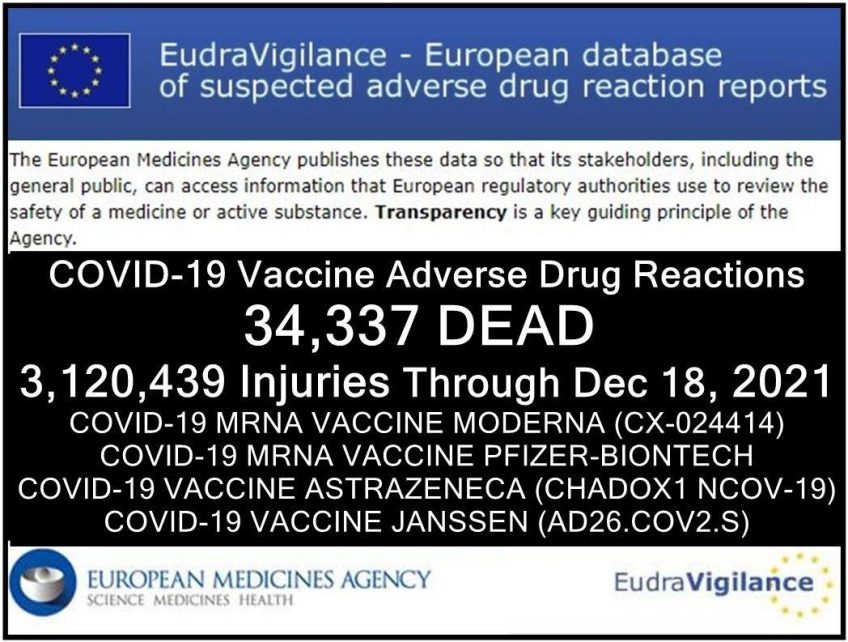
The European (EEA and non-EEA countries) database of suspected drug reaction reports is EudraVigilance, verified by European Medicines Agency (EMA), and they are now reporting 32,649 fatalities, and 3,003,296 injuries following injections of four experimental COVID-19 shots:
- COVID-19 MRNA VACCINE MODERNA (CX-024414)
- COVID-19 MRNA VACCINE PFIZER-BIONTECH
- COVID-19 VACCINE ASTRAZENECA (CHADOX1 NCOV-19)
- COVID-19 VACCINE JANSSEN (AD26.COV2.S)
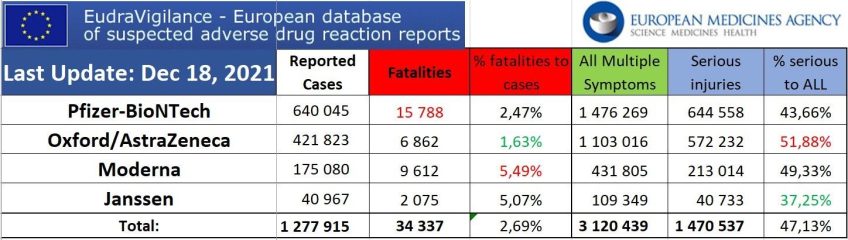
From the total of injuries recorded, almost half of them (1,470,537) are serious injuries.
“Seriousness provides information on the suspected undesirable effect; it can be classified as ‘serious’ if it corresponds to a medical occurrence that results in death, is life-threatening, requires inpatient hospitalisation, results in another medically important condition, or prolongation of existing hospitalisation, results in persistent or significant disability or incapacity, or is a congenital anomaly/birth defect.”
A Health Impact News subscriber in Europe ran the reports for each of the four COVID-19 shots we are including here. It is a lot of work to tabulate each reaction with injuries and fatalities, since there is no place on the EudraVigilance system we have found that tabulates all the results.
Since we have started publishing this, others from Europe have also calculated the numbers and confirmed the totals.*
Here is the summary data through December 18, 2021.
Total reactions for the mRNA vaccine Tozinameran (code BNT162b2,Comirnaty) from BioNTech/ Pfizer: 15,788 deaths and 1,476,269 injuries to 18/12/2021
- 40,271 Blood and lymphatic system disorders incl. 226 deaths
- 47,256 Cardiac disorders incl. 2,310 deaths
- 433 Congenital, familial and genetic disorders incl. 41 deaths
- 19,912 Ear and labyrinth disorders incl. 11 deaths
- 1,504 Endocrine disorders incl. 5 deaths
- 22,804 Eye disorders incl. 35 deaths
- 120,263 Gastrointestinal disorders incl. 637 deaths
- 370,545 General disorders and administration site conditions incl. 4,452 deaths
- 1,691 Hepatobiliary disorders incl. 82 deaths
- 16,314 Immune system disorders incl. 84 deaths
- 61,494 Infections and infestations incl. 1,649 deaths
- 25,540 Injury, poisoning and procedural complications incl. 279 deaths
- 36,772 Investigations incl. 476 deaths
- 10,065 Metabolism and nutrition disorders incl. 264 deaths
- 179,558 Musculoskeletal and connective tissue disorders incl. 196 deaths
- 1,362 Neoplasms benign, malignant and unspecified (incl cysts and polyps) incl. 128 deaths
- 246,596 Nervous system disorders incl. 1,694 deaths
- 2,127 Pregnancy, puerperium and perinatal conditions incl. 64 deaths
- 223 Product issues incl. 3 deaths
- 26,890 Psychiatric disorders incl. 191 deaths
- 5,314 Renal and urinary disorders incl. 249 deaths
- 55,551 Reproductive system and breast disorders incl. 5 deaths
- 63,512 Respiratory, thoracic and mediastinal disorders incl. 1,742 deaths
- 68,837 Skin and subcutaneous tissue disorders incl. 134 deaths
- 3,257 Social circumstances incl. 21 deaths
- 10,192 Surgical and medical procedures incl. 122 deaths
- 37,986 Vascular disorders incl. 688 deaths
Total reactions for the mRNA vaccine mRNA-1273(CX-024414) from Moderna: 9,612 deaths and 431,805 injuries to 18/12/2021
- 9,176 Blood and lymphatic system disorders incl. 106 deaths
- 14,538 Cardiac disorders incl. 1,000 deaths
- 174 Congenital, familial and genetic disorders incl. 8 deaths
- 5,244 Ear and labyrinth disorders incl. 4 deaths
- 409 Endocrine disorders incl. 4 deaths
- 6,337 Eye disorders incl. 33 deaths
- 35,162 Gastrointestinal disorders incl. 359 deaths
- 114,485 General disorders and administration site conditions incl. 3,239 deaths
- 693 Hepatobiliary disorders incl. 47 deaths
- 4,314 Immune system disorders incl. 17 deaths
- 16,686 Infections and infestations incl. 907 deaths
- 8,851 Injury, poisoning and procedural complications incl. 180 deaths
- 8,917 Investigations incl. 263 deaths
- 4,138 Metabolism and nutrition disorders incl. 231 deaths
- 51,645 Musculoskeletal and connective tissue disorders incl. 193 deaths
- 595 Neoplasms benign, malignant and unspecified (incl cysts and polyps) incl. 76 deaths
- 72,360 Nervous system disorders incl. 919 deaths
- 785 Pregnancy, puerperium and perinatal conditions incl. 6 deaths
- 91 Product issues incl. 4 deaths
- 7,887 Psychiatric disorders incl. 158 deaths
- 2,553 Renal and urinary disorders incl. 183 deaths
- 9,972 Reproductive system and breast disorders incl. 8 deaths
- 19,269 Respiratory, thoracic and mediastinal disorders incl. 1,032 deaths
- 23,101 Skin and subcutaneous tissue disorders incl. 84 deaths
- 1,956 Social circumstances incl. 40 deaths
- 1,946 Surgical and medical procedures incl. 150 deaths
- 10,521 Vascular disorders incl. 361 deaths
Total reactions for the vaccine AZD1222/VAXZEVRIA (CHADOX1 NCOV-19) from Oxford/ AstraZeneca: 6,862 deaths and 1,103,016 injuries to 18/12/2021
- 13,469 Blood and lymphatic system disorders incl. 255 deaths
- 19,919 Cardiac disorders incl. 753 deaths
- 208 Congenital familial and genetic disorders incl. 7 deaths
- 13,018 Ear and labyrinth disorders incl. 5 deaths
- 642 Endocrine disorders incl. 4 deaths
- 19,414 Eye disorders incl. 30 deaths
- 104,504 Gastrointestinal disorders incl. 370 deaths
- 289,568 General disorders and administration site conditions incl. 1,614 deaths
- 985 Hepatobiliary disorders incl. 63 deaths
- 5,105 Immune system disorders incl. 31 deaths
- 34,377 Infections and infestations incl. 471 deaths
- 12,816 Injury poisoning and procedural complications incl. 184 deaths
- 24,316 Investigations incl. 178 deaths
- 12,629 Metabolism and nutrition disorders incl. 101 deaths
- 163,096 Musculoskeletal and connective tissue disorders incl. 125 deaths
- 684 Neoplasms benign malignant and unspecified (incl cysts and polyps) incl. 29 deaths
- 226,199 Nervous system disorders incl. 1,047 deaths
- 558 Pregnancy puerperium and perinatal conditions incl. 17 deaths
- 193 Product issues incl. 1 death
- 20,437 Psychiatric disorders incl. 62 deaths
- 4,164 Renal and urinary disorders incl. 66 deaths
- 15,992 Reproductive system and breast disorders incl. 2 deaths
- 39,444 Respiratory thoracic and mediastinal disorders incl. 880 deaths
- 50,458 Skin and subcutaneous tissue disorders incl. 54 deaths
- 1,563 Social circumstances incl. 6 deaths
- 1,611 Surgical and medical procedures incl. 29 deaths
- 27,647 Vascular disorders incl. 478 deaths
Total reactions for the COVID-19 vaccine JANSSEN (AD26.COV2.S) from Johnson & Johnson: 2,075 deaths and 109,349 injuries to 18/12/2021
- 1,068 Blood and lymphatic system disorders incl. 44 deaths
- 2,052 Cardiac disorders incl. 173 deaths
- 41 Congenital, familial and genetic disorders incl. 1 death
- 1,146 Ear and labyrinth disorders incl. 2 deaths
- 87 Endocrine disorders incl. 1 deaths
- 1,475 Eye disorders incl. 7 deaths
- 8,932 Gastrointestinal disorders incl. 84 deaths
- 28,855 General disorders and administration site conditions incl. 559 deaths
- 138 Hepatobiliary disorders incl. 13 deaths
- 489 Immune system disorders incl. 10 deaths
- 5,092 Infections and infestations incl. 165 deaths
- 1,011 Injury, poisoning and procedural complications incl. 21 deaths
- 5,043 Investigations incl. 115 deaths
- 687 Metabolism and nutrition disorders incl. 51 deaths
- 15,638 Musculoskeletal and connective tissue disorders incl. 47 deaths
- 68 Neoplasms benign, malignant and unspecified (incl cysts and polyps) incl. 6 deaths
- 21,175 Nervous system disorders incl. 224 deaths
- 46 Pregnancy, puerperium and perinatal conditions incl. 1 death
- 29 Product issues
- 1,551 Psychiatric disorders incl. 20 deaths
- 462 Renal and urinary disorders incl. 27 deaths
- 2,485 Reproductive system and breast disorders incl. 6 deaths
- 3,937 Respiratory, thoracic and mediastinal disorders incl. 268 deaths
- 3,370 Skin and subcutaneous tissue disorders incl. 9 deaths
- 358 Social circumstances incl. 4 deaths
- 745 Surgical and medical procedures incl. 61 deaths
- 3,369 Vascular disorders incl. 156 deaths
*These totals are estimates based on reports submitted to EudraVigilance. Totals may be much higher based on percentage of adverse reactions that are reported. Some of these reports may also be reported to the individual country’s adverse reaction databases, such as the U.S. VAERS database and the UK Yellow Card system. The fatalities are grouped by symptoms, and some fatalities may have resulted from multiple symptoms.
Meanwhile, The Exposé is reporting that public health data in the UK shows that the vast majority of deaths and hospitalizations in the UK are among those vaccinated, and now there are 35 deaths and 213 hospitalizations being reported among those who have received booster shots and are triple-vaccinated.
EU’s top court allows European firms to scrap Iran deals
Press TV – December 22, 2021
The EU’s supreme court has intervened to protect European companies against legal action by Iran for failing to fulfill their contractual obligations.
The European Court of Justice (ECJ) in Luxembourg has ruled that EU companies can end contracts with Iranian firms if upholding the deals would lead to “disproportionate economic loss” as a result of US sanctions.
The ruling was prompted by a lawsuit from the German branch of Iran’s Bank Melli against Deutsche Telekom after the telecommunications provider terminated a contract with the bank in 2018 prior to its expiry.
The decision effectively neutralizes a “blocking statute” that prohibited individuals and companies in the European Union from complying with US sanctions imposed in 2018 by then US president Donald Trump after he decided to withdraw unilaterally from the Iran nuclear deal.
As per their obligations under the nuclear deal, the Europeans issued the statute in order to keep Iran in the agreement, but companies in the bloc quickly severed ties rather than risk running afoul of the US.
Under the blocking statute, European firms must seek a legal exemption for withdrawing from Iran due to US sanctions and those failing to do so could be penalized by their governments. Firms, however, can twist the law if they claim that their withdrawal is a business decision.
The court on Tuesday paid lip service to the EU blocking statute in its ruling, saying “the prohibition imposed by EU law on complying with secondary sanctions laid down by the United States against Iran may be relied on in civil proceedings”.
But the judges also said the rules of the blocking statute “cannot infringe the freedom to conduct a business by leading to disproportionate economic loss”.
The Higher Regional Court in Hamburg will have to decide whether upholding the contract with Bank Melli would expose Deutsche Telekom to such a disproportionate economic loss.
Observers believe the decision is a foregone conclusion, given that Deutsche Telekom makes about half of its turnover with its US business.
The ECJ said the Hamburg judges must take into account that Deutsche Telekom did not apply for an exemption from the EU blocking statute’s rules.
Other European measures taken to maintain open trade channels with Iran have equally proven to be empty shells.
For example, Iranians have got almost nothing from the Swiss Humanitarian Trade Agreement (SHTA) since it was launched in January 2020 with the support and consent of the US.
The Swiss trade channel much publicized by Washington as a purportedly secure way of delivering humanitarian assistance to Iran at a time of sanctions has failed to process even a single deal on Iranian medicine imports.
The channel was meant to find a way around the US sanctions to use Iranian funds deposited abroad to buy food and medicine for the country via the Swiss bank BCP.
However, companies seeking to participate in the scheme have found it very difficult to comply with the criteria set by the US government to avoid violating the general rules governing the sanctions, said the report.
Fabian Maienfisch, a spokesman for Switzerland’s State Secretariat for Economic Affairs (SECO), which oversees the channel, has admitted in the past that the initiative had effectively failed to meet its objectives.
Such failures and the ECJ’s ruling prove statements by the Iranian government that the Europeans are disingenuous in dealing with the Islamic Republic.
The ruling comes as Iran and the Europeans continue negotiations in Vienna to find a way to remove the US sanctions.
A possible revival of the agreement would require the European companies to return to Iran and fulfill their obligations, but the EU court decision appears to be intentionally timed to provide them a leeway for further violations.
Featured Video
Death Spikes & Rising Cancer In Our Youth Explained
or go to
Aletho News Archives – Video-Images
From the Archives
Politicians lie
By Mazin Qumsiyeh | Popular Resistance | August 18, 2013
There is no way to say this truth nicely: Politicians lie. That includes Japanese, American, Egyptian, Israeli, and Palestinian politicians! Is there something more common sense than that? Yet, so many citizens around the world believe their own politicians or wistfully acknowledge lies but think it is part of the job needed to run things. They believe even when politicians contradict themselves blatantly. This phenomenon is rather remarkable. It is a dissonance and disconnect from reality that many seem oblivious to. It is very dangerous because it can lead to accepting rationales for going to war. These can be deadly wars that lead to millions of lives lost as happened in what was called World War 1 and WW2. Even when incredible and declassified evidence abound, politicians continue to lie and old mythologies refuse to die. Here are just a few of the countless lies told to us over the past few decades… continue
Blog Roll
 Aletho News
- Global Tipping Points Lead the World Into a State of Entropy
- The day-after at the White House: USA and Xi Jinping
- The Geopolitical Balance in the Red Sea: The UAE Being Displaced by New Players
- Iraqi resistance group vows to stage airport sit-ins over Iran aerial blockade
- Turkish parliament to review Saudi-Pakistan defense pact next month
- DEATH SPIKES & RISING CANCER IN OUR YOUTH EXPLAINED
- Iran offers Trump deal before US election
- Merz regime wants ‘secret police’ – opposition
- Israeli settlers terrorize West Bank Palestinians with state-provided drones: Report
- They see them, then kill them: Israeli quadcopters track, deliberately target civilians in Gaza
- If Americans Knew
- An error has occurred; the feed is probably down. Try again later.
- No Tricks Zone
- New Study: Earth And Venus Surface Warmth Largely Explained By Convection And Lapse Rate, Not CO2 Or Radiation
- 2025 Nature Paper Claiming Worsening Global Drought Gets RETRACTED …Heavily Flawed
- New Study: ‘Global Drought Shows No Detectable Recent Acceleration Under Climate Warming’
- Economic Masterminds: German Socialists Suggest Taxing Productivity Gains Stemming From Using AI
- The South China Sea Has Not Been Cooperating With The Climate Change Narrative
- Energy Crisis: Germany Enters Heating Season With Historically Low Gas Reserve Fill Levels
- New Study: The Antarctic Ice Sheet Gained Mass From 2020-2024 Due To Staggering Snow And Ice Accumulation
- Study: Ocean Heating Rates From Thousands Of Years Ago ‘Dwarf’ Modern Ocean Heating Rates
- Climate Extremists Target, Attack Large-Scale Power Grid Infrastructure In Germany!
- New Study: Antarctic Ice Melt Has Contributed Less Than 1 Centimeter To Sea Level Rise In The Last 30 Years

