Theater of Absurd… Pentagon Demands Russia Explain Troops on Russian Soil
Strategic Culture Foundation | November 19, 2021
The United States Secretary of Defense Lloyd Austin this week performed impressive, albeit pathetic, mental gymnastics. In a press conference, the Pentagon chief called on Russia to be more transparent about troop movements “on the border with Ukraine”. In others words, on Russian soil.
Meanwhile, the absurd hypocrisy sees U.S. and NATO forces brazenly escalating their offensive presence on Russia’s borders, especially in the Black Sea region.
Here’s an Associated Press clip on the Pentagon press conference: “American officials are unsure why Russian President Vladimir Putin is building up military forces near the border with eastern Ukraine but view it as another example of troubling military moves that demand Moscow’s explanation, Defense Secretary Lloyd Austin said Wednesday.”
The report quotes Austin as saying: “We’ll continue to call on Russia to act responsibly and be more transparent on the buildup of the forces around on the border of Ukraine… We’re not sure exactly what Mr Putin is up to.”
This dubious talent for mind-bending mental gymnastics and double-think is shared with other members of the Biden administration. Last week, America’s top diplomat Antony Blinken claimed that Russia was about to invade Ukraine yet at the same time the U.S. Secretary of State confessed similar ignorance about what “Putin is up to”.
How is it possible to engage in meaningful dialogue with such vacuous people who are supposed to be government leaders – and leaders too of the self-declared world’s most powerful, most brilliant nation? No undue offense intended, but it would probably be more productive to engage in a dialogue with the bewildering characters from Samuel Beckett’s absurdist play Waiting for Godot.
Russia has repeatedly dismissed all claims about it threatening Ukraine or any other country with invasion. Moscow also disputes “unreliable” information touted by the Biden administration and Western media of troop buildup near Ukraine on its western flank. Western media reports have relied on dodgy commercial satellite data purporting to show Russian military maneuvers. It is contemptible that senior U.S. government figures are basing grave allegations against Russia on such ropy sources. That in itself speaks volumes about the deterioration in Washington’s diplomatic professionalism and political intelligence.
Secondly, the salient fact being missed in all the hullabaloo is this: Russian troops and equipment are on Russia’s sovereign territory. It is the height of absurdity for U.S. officials to demand that Russia “explain” and be “more transparent” about its own national defenses. That speaks of a hyper-arrogance among American politicians that are deforming their ability to think reasonably.
There is an analogy here with the outcry this week over Russia’s successful missile test against a Soviet-era satellite in orbit. The Biden administration condemned Russia for creating “space junk” and weaponizing space while ignoring the fact that the U.S. previously carried out the same kind of missile strike and, arguably has been trying to weaponize space since the Reagan administration’s “star wars” program during the 1980s.
In any case, the U.S. charges of Russia’s military buildup on its own territory are made all the more ridiculous when we consider the actual increase in NATO forces in Ukraine and the Black Sea region – right on Russia’s western doorstep.
In a major speech this week delivered at the Russian foreign ministry, President Putin noted again how Western powers have continually failed to register Moscow’s national security concerns over the expansion of NATO forces along Russia’s borders. He described this inability for cognition of what should be an obvious grievance as “very peculiar”.
The Kremlin has suggested that the increasing NATO offensive presence near Russia’s borders is not due to stupidity, but rather is aimed at provoking a conflict. Russia is strenuously resisting the danger of an armed confrontation, and yet the provocations continue.
Nearly two weeks ago, William Burns, the head of the CIA made a high-profile visit to Moscow during which he held discussions with senior Kremlin figures, including President Putin. We can safely assume that Burns was told in no uncertain terms that the buildup of U.S. and NATO forces near Russia’s territory is a red line that will presage a response from Russia.
But these red lines continue to be skirted by Washington and its NATO allies.
More perplexing, too, are the moves by the U.S.-backed Kiev regime to escalate the conflict in Ukraine against the ethnic Russian population in the separatist Donbas region. The ultranationalist regime has been waging a low-intensity war against the Donbas since the U.S.-backed coup in Kiev in 2014. The Americans and other NATO powers are increasing weapon supplies and military trainers to the regime, emboldening it to repudiate any peaceful settlement of the eight-year conflict.
Only last month, Pentagon chief Austin was in Kiev where he recklessly endorsed the joining of the NATO bloc by Ukraine. That is in spite of numerous warnings from Moscow that such a move would be an unacceptable destabilization.
The stepped-up war drills by NATO in the Black Sea region are inevitably leading the Kiev regime to resile from legally binding commitments to the Minsk Peace accord of 2015 – brokered by Russia, Germany and France. The release this week of diplomatic communications by the Russian Foreign Minister Sergei Lavrov clearly demonstrates that Germany and France are complicit in turning a blind eye to the Kiev regime’s systematic violation of the Minsk deal.
In this context, Russia is justifiably deeply wary of a confrontation exploding out of the tinderbox conditions in Ukraine and the Black Sea. Given the Russian nation’s tragic history of suffering from past military invasions, it is entirely understandable and indeed vitally prudent that the country’s formidable defenses are on high alert.
It is not for Russia to explain its troops. It is for the United States and its NATO partners to account for their wanton aggression and to desist.
There is something of the theater of absurd in American and European posturing. But it’s far from funny. It’s menacingly deranged.
Just how rare are ‘rare’ vaccine injuries?
By Harry Dougherty | TCW Defending Freedom | November 19, 2021
‘ULTIMATELY, the mRNA vaccines are an example for that sort of gene therapy. I always like to say, if we had surveyed, two years ago, the public,“would you be willing to take gene or cell therapy and inject it into your body?” we probably would have had a 95 per cent refusal rate. I think this pandemic has opened many people’s eyes to innovation in a way that was maybe not possible before.’
The man who said this is called Stefan Oelrich. He said it publicly, in a speech to the World Health Summit. He is President of Pharmaceuticals at Bayer, one of the biggest pharmaceutical companies in the world. That’s right, fact-checkers, Big Pharma just admitted that the Covid19 mRNA vaccines are gene therapy and that most people would not have agreed to be injected with them in normal circumstances.
We are just beginning to see how wise 95 per cent of the public would have been. Indeed, a worryingly higher number of teenagers have died since the vaccine was rolled out to their age group, as Dr Will Jones has noted. There were 351 deaths in teenagers aged between 15 and 19 between week 23 and week 43 2021, that’s 108 more than in the same period last year. Even Fullfact’s attempt to dismiss Dr Jones’s findings was half-hearted. Why wasn’t there a similar rise in age groups that are yet to be offered Covid vaccines? No explanation was suggested.
An Icelandic midfielder collapses on the pitch, a Barcelona striker is forced to consider retirement due to a sudden heart condition, a Slovak ice hockey player dies suddenly midgame, and a member of UB40 dies after a ‘short illness’, all within weeks. Yes, yes, some of these may be coincidences, perhaps all of them. But why would anyone be so quick to rule out the possibility that Covid-19 vaccines played a role in any of these incidents unless they had an agenda or an incentive not to establish a causal link? How many doctors would have the courage to admit that they helped to damage people unnecessarily, even if they had done so in good faith?
Most helpfully, Wikipedia has a page listing the deaths of all association footballers who died while playing, from 1889 to the present. Globally, there were four deaths on the pitch in 2018, two of which were caused by cardiac arrest. There were three deaths on the pitch in 2019 and three again in 2020, all caused by cardiac arrest. In 2021 there were 14. One footballer was killed in a collision, while in another case, that of 15-year-old FC An der Fahner Höhe goalkeeper Bruno Stein, the cause of death isn’t specified. The rest died from cardiac arrest. No other year on the list has had as many deaths on the pitch as 2021. As many footballers died on the pitch in September and October 2021 as died in the whole of 2019 and 2020.
One of the deaths this year was 29-year-old Parma player Guiseppe Perrino, who died in a memorial match for his brother, who also died of cardiac arrest while cycling in 2018. Obviously Guiseppe’s brother’s death could not have been linked to the vaccine, but it strongly suggests that some families are more prone to unexpected heart problems than others, which brings us to the tragic case of Italian siblings Vittoria and Allesandro Campo, both footballers who died from cardiac arrest within two months of each other, in a country where life for the unvaccinated is made as miserable as possible.
According to Italian media sources, Allesandro’s death came two days after he received his first dose of the Pfizer vaccine, and the coroners did not exclude the possibility that his untimely death was caused by the jab. It’s difficult to know what caused Vittoria’s death since some reports say her mother insisted that Vittoria was not vaccinated and that toxicology reports found drugs in her system, while others claim her father confirmed that both of his children had been vaccinated. But both of these sibling tragedies raise the question as to whether the vaccine triggers heart problems in families that are predisposed to heart conditions. This is the problem with difficult-to-obtain ‘genuine’ medical exemptions for Covid vaccines: you don’t always know if you’re ‘genuinely’ exempt until it’s too late.
Would it really be that surprising if it turned out that a vaccine linked to heart problems was causing heart problems? Just days before Boris Johnson threatened 16- to 17-year-olds with the prospect of another ruined Christmas if they didn’t get their second vaccine dose, Taiwan suspended giving 12- to 17-year-olds the second dose over fears of a link between the Pfizer vaccine and heart inflammation.
In Australia, the Herald Sun reports that dozens of teenagers have developed myocarditis after their first dose of the Pfizer vaccine. 10,000 Australians have filed for government compensation after being hospitalised by significant side effects from the Covid jabs. As per usual, these afflictions are dismissed as extremely rare, and minimised as mostly trivial. One account from Australian vaccine injury victim Dan Petrovic gives us a clue as to how difficult it is to get vaccine injuries acknowledged by medical professionals. Despite his vaccine-induced heart inflammation, which left him unable to work, walk or play with his daughter, Mr Petrovic says he does not regret having the vaccine.
Each to their own, I guess, but this makes him a reliable source who cannot be dismissed as an ‘anti-vaxxer’. According to Australia’s News.com, ‘neither his cardiologist nor his GP would submit an adverse event report to the Therapeutic Goods Administration (TGA)’. One doctor said ‘I’m too busy’ while a cardiologist said ‘I cannot make a medical diagnosis, I’m not a practitioner.’
If health professionals are going above and beyond to not link the vaccine with adverse events, how can we be expected to believe that serious adverse reactions are as ‘extremely rare’ as is claimed?
Thankfully, there are some good blokes left in Australia’s political swamp. One is Gerard Rennick, Liberal National Party Senator for Queensland, where unvaccinated citizens are now banned from doing just about anything that makes life worth living. If you try to message through a question to the Queensland Health authority’s Facebook page, their automated chatbot will suggest ‘Try saying something like . . . Can I visit my family?’
Rennick is no lightweight. He has spent the latter half of this year advocating for the ever-growing number of young Australians who have suffered severe, life-changing adverse reactions to medical procedures they took under the threat of living a ‘lonely and miserable‘ life, as the Queensland health chief Chris Perry put it.
There are many on Senator Rennick’s Facebook account. Look them in the eyes and tell them that their avoidable life-changing injuries are insignificant.
Here is one story he shared, from Candice:
‘Prior to the Pfizer Covid-19 vaccine, I was a very healthy/fit 38-year-old female that ran and exercised 2-3 times per week and lived a healthy lifestyle. On the 28/8/2021, I had my 2nd Pfizer Covid-19 vaccine. The day after the vaccine, I developed a headache, neck pain, swollen lymph nodes under my arms and flu-like symptoms. On the 3rd day after the vaccine, I woke through the night with heart palpitations and sweating. Throughout that day I went for a walk and experienced a very sharp pain across the upper and the left-hand side of my chest. This lasted for approximately 20 minutes. That night I woke two times again with heart palpitations and sweating. I presented at the hospital the next day and they took blood tests. My bloods showed the Troponin enzyme that should be at ‘0’ as ‘2500’. This indicated damage to my heart.
‘After multiple tests, it was determined through an MRI that I had developed Myopericarditis due to the Pfizer Covid-19 vaccine. I was discharged from hospital 4 days later with medication to reduce the inflammation around my heart and was told I would not be able to run or exercise for around 3-6 months and will be under the care of a cardiologist for this period.’
Another, from Andrew, who was hospitalised by the AstraZeneca vaccine:
‘If winning lotto was as easy as getting a so-called “rare” adverse reaction from these vaccines that are supposedly voluntary but if I don’t get it I can’t do my job, therefore, I can’t put food on the table or pay the rent/mortgage, I’d be a millionaire.’
From Matt:
‘It has now been 10 weeks in hospital and I am still not able to walk. I was admitted 4 days after receiving my AZ vaccine previously being a 30 year old with no medical history to speak of, which left me with loss of function and sensation on my right side.’
From Adam:
‘5 days in hospital after 2nd Pfizer shot, server chest pain, shortness of breath and pain running down arm. ecg was out and bloods were elevated. was diagnosed with pericarditis. With my stay in cardiac ward I was wired up to the heart monitor the whole time, countless blood tests, ecgs, X-rays, CT scan, ultrasound, plus taking 20 tablets a day . . . Now that I’m out of hospital was told to take certain meds for 3 months and take it easy. Doctors and cardiologist wouldn’t go into detail on results.’
This, from Kym, a 38-year-old mother with no prior health problems, is perhaps the most important, because it demonstrates the unwillingness of the medical profession to admit that they have needlessly harmed countless people who would likely not have had any major complications from Covid19. Please share these accounts with your MP.
‘Monday 25/10 discharge dr verbally confirmed that these symptoms are related to the Pfizer vaccine. When I asked for the diagnosis written down on my discharge papers, the tone in the room changed! When asking the doctor for this verbal diagnosis to be put into writing, the answer was: “No, there is no need, this is normal and are just symptoms of the vaccine.” I informed the dr that my “symptoms” were also called “an adverse event” and must be reported to the TGA or QLD Health. Again the response was, “These are just symptoms of your vaccine not an adverse event, they are two different things.” I continued to push the issue with reporting this “event”. I then asked what my prognosis was and when these tachycardia events would subside. The doctor responded, “We don’t know, we don’t have data”, to which I responded that this is why I was pushing the point to have this event documented and reported. Immediately after this question, the doctor stated to me that I was “just admitted for reassurance!” This doctor did not admit me, an Emergency Dr did, this doctor had only met me for 5 minutes, stood at the end of my bed, no physical exam conducted. I was discharged with my papers stating “confident to be vaccination Pfizer-related symptoms/ reported to QLD Health re: adverse following injection”.’
Europe heads the stampede to medical apartheid
By Tom Penn | TCW Defending Freedom | November 16, 2021
WHILE the media engaged in a classic diversionary tactic – chortling over reports that former Health Secretary Matt Hancock was to write a book about how he won the Covid war – they virtually ignored perhaps the most concerning pandemic news out of Western Europe so far.
The Netherlands entered a three-week partial lockdown, the news of Austria’s lockdown for the unvaccinated was ‘officially announced’, and Germany’s health agencies began clamouring for tougher restrictions.
Segregation on so-called medical grounds is finding ever firmer footing in Europe – no doubt spurred on by its increasingly successful introduction in Australia and New Zealand even in the face of huge, impassioned protests.
This is the hyper-normalisation of medical apartheid at work, and one day soon the witless masses who permit this process to erode unchallenged the moral bedrock of their societies, will wake up to find that it was they, not their governments, who were the engineers of an all-encompassing punitive style of governance whose dystopian interventions not even the quadruple-jabbed will ultimately be able to evade.
On home soil the supposed leak of the UKHSA’s plan to abandon attempts at stopping the spread of SARS-CoV-2 ‘at all costs’ come springtime, using their exit-strategy named ‘Operation Rampdown’, should come as highly disconcerting and not optimistic news in light of the madness playing out across the Channel right now.
Quite aside from the fact that we have heard all this tosh about promised freedom numerous times before and yet here we are still stuck waist-deep in the bog of Covid-19 interventions, from what we know of the 160-page dossier so far, the scaling-back of spread-control measures is limp to the point of portentous: the real question being just what will such controls be replaced with?
The last 20 months has shown that when the State give with one hand, they use the other to put more shackles on the recipient – we, the people – and Operation Rampdown already sounds not like the Yellow Brick Road to freedom but the paving of the way for medical apartheid.
Ten-day self-isolation is supposedly to be entirely done away with: however, in all likelihood only for those vaccinated and with up-to-date boosters. Free Covid testing is supposedly to end: a move designed to impose a Macron-style financial burden on the unvaccinated, as private testing firms with ties to Government break free of the pricing limitations never enforced in the first place, and the national ‘Test and Trace’ system is purportedly to be scrapped, the billions invested set only to reveal the software’s original design-objective: universal health passports.
When Johnson talks about the ‘storm clouds gathering over Europe’ I don’t envisage the DHSC’s Covid-smoke wafting our way, I see instead scope for ‘circuit-breaker’ lockdowns for the unvaccinated; given succour via the majority of people’s inability to heed the deafening alarms currently being sounded by various neighbouring EU Governments.
At present the UK population is like an infant flat on its back, staring beguiled at a revolving cot-mobile, off which dangles the likes of Matt Hancock, dog coronavirus, and a Harry Kane international hat-trick; whilst Papa Johnson is busy disabling the home’s smoke alarms and opening all the windows in an attempt not to let Covid-19 out, but the far more noxious smoke of apartheid in.
Matt Hancock, I suggest not the working title ‘How I Won the Covid War’, but ‘How I Started the Covid War Engineered Never To Be Won’, alongside the quote from yourself, dated March 16 2020:
‘We should only use the NHS when we really need to.’
You say the war is won, Mr Hancock, yet we still can’t use the NHS. Write a book about that, why don’t you, then you’ll finally find yourself on the same page as the six million poor sods awaiting treatment.
29,934 Deaths 2,804,900 Injuries Following COVID Shots in European Database of Adverse Reactions

By Brian Shilhavy | Health Impact News | November 15, 2021
The European Union database of suspected drug reaction reports is EudraVigilance, and they are now reporting 29,934 fatalities, and 2,804,900 injuries, following COVID-19 injections.
A Health Impact News subscriber from Europe reminded us that this database maintained at EudraVigilance is only for countries in Europe who are part of the European Union (EU), which comprises 27 countries.
The total number of countries in Europe is much higher, almost twice as many, numbering around 50. (There are some differences of opinion as to which countries are technically part of Europe.)
So as high as these numbers are, they do NOT reflect all of Europe. The actual number in Europe who are reported dead or injured following COVID-19 shots would be much higher than what we are reporting here.
The EudraVigilance database reports that through October 19, 2021 there are 29,934 deaths and 2,804,900 injuries reported following injections of four experimental COVID-19 shots:
- COVID-19 MRNA VACCINE MODERNA (CX-024414)
- COVID-19 MRNA VACCINE PFIZER-BIONTECH
- COVID-19 VACCINE ASTRAZENECA (CHADOX1 NCOV-19)
- COVID-19 VACCINE JANSSEN (AD26.COV2.S)
From the total of injuries recorded, almost half of them (1,311,861) are serious injuries.
“Seriousness provides information on the suspected undesirable effect; it can be classified as ‘serious’ if it corresponds to a medical occurrence that results in death, is life-threatening, requires inpatient hospitalisation, results in another medically important condition, or prolongation of existing hospitalisation, results in persistent or significant disability or incapacity, or is a congenital anomaly/birth defect.”
A Health Impact News subscriber in Europe ran the reports for each of the four COVID-19 shots we are including here. It is a lot of work to tabulate each reaction with injuries and fatalities, since there is no place on the EudraVigilance system we have found that tabulates all the results.
Since we have started publishing this, others from Europe have also calculated the numbers and confirmed the totals.*
Here is the summary data through November 6, 2021.
Total reactions for the mRNA vaccine Tozinameran (code BNT162b2, Comirnaty) from BioNTech/ Pfizer: 14,002 deaths and 1,266,500 injuries to 06/11/2021
- 34,377 Blood and lymphatic system disorders incl. 196 deaths
- 37,779 Cardiac disorders incl. 2,050 deaths
- 348 Congenital, familial and genetic disorders incl. 31 deaths
- 17,188 Ear and labyrinth disorders incl. 10 deaths
- 1,129 Endocrine disorders incl. 5 deaths
- 19,593 Eye disorders incl. 30 deaths
- 107,066 Gastrointestinal disorders incl. 565 deaths
- 324,554 General disorders and administration site conditions incl. 3,983 deaths
- 1,433 Hepatobiliary disorders incl. 74 deaths
- 13,777 Immune system disorders incl. 72 deaths
- 49,517 Infections and infestations incl. 1,517 deaths
- 18,101 Injury, poisoning and procedural complications incl. 217 deaths
- 31,592 Investigations incl. 432 deaths
- 8,709 Metabolism and nutrition disorders incl. 243 deaths
- 159,698 Musculoskeletal and connective tissue disorders incl. 172 deaths
- 1,080 Neoplasms benign, malignant and unspecified (incl cysts and polyps) incl. 105 deaths
- 217,201 Nervous system disorders incl. 1,500 deaths
- 1,753 Pregnancy, puerperium and perinatal conditions incl. 50 deaths
- 200 Product issues incl. 2 deaths
- 23,195 Psychiatric disorders incl. 171 deaths
- 4,438 Renal and urinary disorders incl. 221 deaths
- 40,100 Reproductive system and breast disorders incl. 5 deaths
- 54,682 Respiratory, thoracic and mediastinal disorders incl. 1,568 deaths
- 59,950 Skin and subcutaneous tissue disorders incl. 123 deaths
- 2,583 Social circumstances incl. 19 deaths
- 3,002 Surgical and medical procedures incl. 40 deaths
- 33,455 Vascular disorders incl. 601 deaths
Total reactions for the mRNA vaccine mRNA-1273(CX-024414) from Moderna: 8,196 deaths and 375,242 injuries to 06/11/2021
- 7,867 Blood and lymphatic system disorders incl. 89 deaths
- 12,009 Cardiac disorders incl. 881 deaths
- 150 Congenital, familial and genetic disorders incl. 5 deaths
- 4,533 Ear and labyrinth disorders incl. 2 deaths
- 326 Endocrine disorders incl. 3 deaths
- 5,527 Eye disorders incl. 27 deaths
- 31,082 Gastrointestinal disorders incl. 317 deaths
- 101,013 General disorders and administration site conditions incl. 2,904 deaths
- 612 Hepatobiliary disorders incl. 36 deaths
- 3,605 Immune system disorders incl. 14 deaths
- 13,769 Infections and infestations incl. 727 deaths
- 7,861 Injury, poisoning and procedural complications incl. 152 deaths
- 6,833 Investigations incl. 136 deaths
- 3,556 Metabolism and nutrition disorders incl. 195 deaths
- 45,788 Musculoskeletal and connective tissue disorders incl. 163 deaths
- 496 Neoplasms benign, malignant and unspecified (incl cysts and polyps) incl. 60 deaths
- 64,074 Nervous system disorders incl. 802 deaths
- 696 Pregnancy, puerperium and perinatal conditions incl. 7 deaths
- 71 Product issues incl. 2 deaths
- 6,817 Psychiatric disorders incl. 139 deaths
- 2,171 Renal and urinary disorders incl. 158 deaths
- 7,439 Reproductive system and breast disorders incl. 7 deaths
- 16,508 Respiratory, thoracic and mediastinal disorders incl. 872 deaths
- 20,140 Skin and subcutaneous tissue disorders incl. 74 deaths
- 1,693 Social circumstances incl. 35 deaths
- 1,285 Surgical and medical procedures incl. 77 deaths
- 9,321 Vascular disorders incl. 312 deaths
Total reactions for the vaccine AZD1222/VAXZEVRIA (CHADOX1 NCOV-19) from Oxford/ AstraZeneca: 5,973 deaths and 1,065,560 injuries to 06/11/2021
- 12,976 Blood and lymphatic system disorders incl. 243 deaths
- 18,819 Cardiac disorders incl. 676 deaths
- 184 Congenital familial and genetic disorders incl. 7 deaths
- 12,521 Ear and labyrinth disorders incl. 2 deaths
- 583 Endocrine disorders incl. 4 deaths
- 18,723 Eye disorders incl. 29 deaths
- 101,828 Gastrointestinal disorders incl. 306 deaths
- 280,708 General disorders and administration site conditions incl. 1,426 deaths
- 929 Hepatobiliary disorders incl. 57 deaths
- 4,646 Immune system disorders incl. 28 deaths
- 31,579 Infections and infestations incl. 399 deaths
- 12,147 Injury poisoning and procedural complications incl. 172 deaths
- 23,340 Investigations incl. 142 deaths
- 12,279 Metabolism and nutrition disorders incl. 88 deaths
- 158,583 Musculoskeletal and connective tissue disorders incl. 92 deaths
- 607 Neoplasms benign malignant and unspecified (incl cysts and polyps) incl. 21 deaths
- 220,125 Nervous system disorders incl. 937 deaths
- 504 Pregnancy puerperium and perinatal conditions incl. 10 deaths
- 183 Product issues incl. 1 death
- 19,750 Psychiatric disorders incl. 58 deaths
- 4,004 Renal and urinary disorders incl. 57 deaths
- 14,909 Reproductive system and breast disorders incl. 2 deaths
- 37,574 Respiratory thoracic and mediastinal disorders incl. 707 deaths
- 48,852 Skin and subcutaneous tissue disorders incl. 48 deaths
- 1,458 Social circumstances incl. 6 deaths
- 1,343 Surgical and medical procedures incl. 25 deaths
- 26,406 Vascular disorders incl. 430 deaths
Total reactions for the COVID-19 vaccine JANSSEN (AD26.COV2.S) from Johnson & Johnson: 1,763 deaths and 97,598 injuries to 06/11/2021
- 936 Blood and lymphatic system disorders incl. 38 deaths
- 1,746 Cardiac disorders incl. 152 deaths
- 35 Congenital, familial and genetic disorders
- 964 Ear and labyrinth disorders incl. 1 death
- 59 Endocrine disorders incl. 1 death
- 1,290 Eye disorders incl. 6 deaths
- 8,253 Gastrointestinal disorders incl. 73 deaths
- 25,729 General disorders and administration site conditions incl. 469 deaths
- 118 Hepatobiliary disorders incl. 11 deaths
- 416 Immune system disorders incl. 9 deaths
- 3,906 Infections and infestations incl. 137 deaths
- 879 Injury, poisoning and procedural complications incl. 18 deaths
- 4,611 Investigations incl. 99 deaths
- 591 Metabolism and nutrition disorders incl. 44 deaths
- 14,470 Musculoskeletal and connective tissue disorders incl. 42 deaths
- 52 Neoplasms benign, malignant and unspecified (incl cysts and polyps) incl. 3 deaths
- 19,444 Nervous system disorders incl. 191 deaths
- 38 Pregnancy, puerperium and perinatal conditions incl. 1 death
- 25 Product issues
- 1,324 Psychiatric disorders incl. 16 deaths
- 383 Renal and urinary disorders incl. 21 deaths
- 1,928 Reproductive system and breast disorders incl. 6 deaths
- 3,444 Respiratory, thoracic and mediastinal disorders incl. 225 deaths
- 2,962 Skin and subcutaneous tissue disorders incl. 7 deaths
- 303 Social circumstances incl. 4 deaths
- 666 Surgical and medical procedures incl. 53 deaths
- 3,026 Vascular disorders incl. 136 deaths
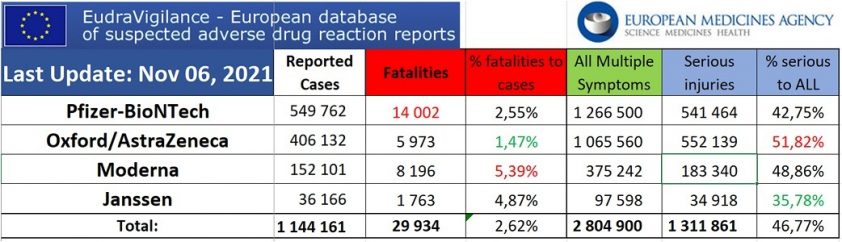
*These totals are estimates based on reports submitted to EudraVigilance. Totals may be much higher based on percentage of adverse reactions that are reported. Some of these reports may also be reported to the individual country’s adverse reaction databases, such as the U.S. VAERS database and the UK Yellow Card system. The fatalities are grouped by symptoms, and some fatalities may have resulted from multiple symptoms.
Postcard from Genoa
By Roger Watson | Reflections on life and religion | November 9, 2021
If anyone who is unvaccinated is considering visiting Italy soon, I would strongly advise against it. Britain seems very civilised in comparison, despite having a run in with a BA official who questioned me about my lack of a mask on leaving the first class lounge in Heathrow, seemingly unaware that we were still on British soil. But, as reported in a Postcard From Istanbul, once the curtain was drawn behind us in BA Club Class, the masks were off and not donned again until arrival in Milan. From Milan I took the train to Genoa to work at the University of Genoa, where I teach regularly, for a week. It is worth noting that I completed the European Passenger Location Form using details from my British passport but, to avoid the queue at the border, I used my Irish passport to enter Italy. I expected to be questioned about the lack of congruence between this passport and the one used to complete the online form which, I assumed, would have to match at immigration. I was through like the proverbial dose of pesto thus indicating, beyond reasonable doubt, that the completion and submission of passenger location forms is a complete waste of time.
You may enter Italy unvaccinated after the requisite Covid tests and then a period of quarantine. But, thereafter, freedom does not beckon as, wherever you step out of quarantine, you will remain… indefinitely. No form of public transport such as trains, buses and internal flights is permitted without displaying a euphemistically named ‘Green Pass’ (Italy’s vaccine passport). If anyone from the U.K. wants to see what the introduction of vaccine passports will be like, then Italy is already there. Mask wearing is strongly enforced on public transport with repeated ‘mascherina’ messages over the PA system.
Social distancing is requested too but the one exception was taxis where, ironically, you can be squeezed into very close proximity with your fellow passengers without the benefit of any social distancing. The situation is exacerbated by the fact that passengers are not allowed to travel in the front of the taxi beside the driver, so it was common for three people to be arse cheek by jowl in the back. On one journey I was asked to mask up in a taxi that had no functioning seat belt.
To be fair to most restaurateurs and bar owners, who are supposed to demand your vaccine passport, they were not doing this. I was never once asked to don a mask. In typical Italian fashion, the rules are selectively applied. But the Italians have bought into the mask mandate to an incredible degree. Mask wearing is not required outside but no self-respecting Genovese would be seen without a mask at the ready, mainly under the chin at all times, or draped on the wrist like an adornment.
Of course, being Italian, the men can look stylish in a mask and the women still look elegant, but it is the sheer mass scale anticipatory obedience on entering public buildings, bars and restaurants and the 100% compliance that is shocking – and all without any apparent enforcement. In some ways compliance is worse when it is self-imposed.
My small class of doctoral students always insisted on remaining masked when meeting with me but made no comment about my facial nudity. They refused to remove their masks at my request and when challenged, could only refer to “the rules”. Despite attending my class on systematic reviewing and evidence assessment, not one had ever considered the evidence regarding masks and, even more distressing, was their complete lack of interest. I had to wonder, Godwin-like, whether this is how Mussolini started? Or am I just a bad teacher?
Roger Watson is a Professor of Nursing at Hull University.
Words without Action: The West’s Role in Israel’s Illegal Settlement Expansion
By Ramzy Baroud | MintPress News | November 4, 2021
The international uproar in response to Israel’s approval of a massive expansion of its illegal settlement enterprise in the occupied Palestinian West Bank may give the impression that such a reaction could, in theory, force Israel to abandon its plans. Alas, it will not, because the statements of ‘concern,’ ‘regrets’, ‘disappointment’ and even outright condemnation are rarely followed by meaningful action.
True, the international community has a political, and even legal, frame of reference regarding its position on the Israeli occupation of Palestine. Unfortunately, however, it has no genuine political mandate, or the inclination to act individually or collectively, to bring this occupation to an end.
This is precisely why the announcement on October 27 by Israel that it has given a ‘final approval’ for the building of 1,800 housing units and initial approval for another 1,344 will unlikely be reversed anytime soon. One ought to keep in mind that this decision came only two days after an earlier announcement that the Israeli government had advanced construction tenders for 1,355 housing units in the occupied West Bank.
Israel has rarely, if ever, reversed such decisions since its establishment on the ruins of historic Palestine. Moreover, since Israel’s occupation of Palestinian East Jerusalem, the West Bank and Gaza in 1967, Israel’s colonial project has remained in constant and unhindered expansion. 54 years should have been enough for the international community to realize that Israel has no intentions whatsoever to end its military occupation on its own accord, to respect international law and to cease construction of its illegal settlements.
Yet, despite this obvious fact, the international community continues to issue statements, moderate in their language, at times, even angry at others, but without ever taking a single action to punish Israel.
A quick examination of the US government’s reaction to the news of settlement expansion tells of the lack of seriousness from Washington towards Israel’s continued disregard of international law, peace and security in the Middle East.
“We strongly oppose the expansion of settlements,” said US State Department spokesman, Ned Price, adding that the Israeli decision is “completely inconsistent with efforts to lower tension and ensure calm.”
Since when was Israel concerned about ‘lowering tensions’ and ‘ensuring calm’? If these were truly important US demands and expectations, why then, does the US keep funneling billions of dollars a year in military aid to Israel, knowing fully that such armaments will be used to sustain the illegal Israeli occupation of Palestine and other Arab lands?
If, for the sake of argument, we assume that Washington is finally shifting its policies on Israel and Palestine, how does it intend to pressure Israel to cease settlement construction? Mr. Price has the answer: The Biden Administration would “raise our views on this issue directly with senior Israeli officials in our private discussions”, he said on October 26. “Raise our views”, as opposed to demanding accountability, threatening retaliation, or, God forbid, withholding funds.
While it is true that the US government is Israel’s main western benefactor, Washington is not the only hypocritical administration in this regard. The Europeans are not fundamentally different, despite the fact that their statements might be a tad stronger in terms of language.
“Settlements are illegal under international law and constitute a major obstacle to the achievement of the two-state solution and a just, lasting and comprehensive peace between the parties,” read a statement issued by the office of EU foreign policy chief, Josep Borrell, on October 29.
The statement mirrors the exact sentiments and language of numerous statements issued in the past, ones that “strongly reject” the Israeli action, and “urge” the Israeli government to “revoke” its recent decisions for the sake of “sustainable peace”, and so on. One may even muse to claim that the task of preparing these statements must be the easiest of all clerical work at the EU offices, as it is largely a matter of a simple ‘cut and paste’.
Yet, again, when it comes to action, Brussels, like Washington, refrains from taking any. Worse, these entities often bankroll the very action they protest, while insisting that they are standing at the exact same distance between Israelis and Palestinians, assigning themselves such roles as “honest peace brokers”, “peace mediators” and the like.
One should not be in the least surprised by Israel’s recent announcement. In fact, we should expect more settlement expansion and even the construction of new settlements, because that is what colonial Israel does best.
Within a matter of a few days, Israel has announced its intentions to build, or start bids for, nearly 4,500 settlement units. Compare this number with the settlement expansion during Donald Trump’s term in office. “Israel promoted plans for more than 30,000 settler homes in the West Bank during the four years (Trump) was in power,” the BBC reported, citing an Israeli group, Peace Now, as saying in its recent findings.
Those figures in mind, if the Israeli government under Naftali Bennett continues with this hurried pace of illegal housing construction, it could potentially match – and even overtake – the expansion that took place during the terrible years of the Trump era. With no accountability, this catastrophic political paradigm will remain in place, irrespective of who rules Israel and who resides in the White House.
Israel is doing what any colonial power does. It expands at the expense of the native population. The onus is not on colonial powers to behave themselves, but on the rest of the world to hold them accountable. This was true in the case of the South African Apartheid and numerous other examples throughout the Global South. It is equally true in the case of Israeli Apartheid in Palestine.
The truth is that a thousand or a million more statements by western governments will not end the Israeli occupation, or even slow down the pace of Israeli military bulldozers as they uproot Palestinian trees, destroy homes and construct yet more illegal colonies. If words are not backed by action – which is very much possible, considering the massive military, political and economic leverage the West wields over Israel – then the West remains a party in this conflict, not as a ‘peace broker’, but as a direct supporter of the Israeli occupation and apartheid.
Ramzy Baroud is a journalist and the Editor of The Palestine Chronicle. He is the author of five books. His latest is “These Chains Will Be Broken: Palestinian Stories of Struggle and Defiance in Israeli Prisons” (Clarity Press).
The EU is proposing blatant mass surveillance of email and chat messages
By Didi Rankovic | Reclaim The Net | November 8, 2021
A German member of the European Parliament is warning against EU plans to adopt new, wide-ranging mass surveillance rules that he says would seriously jeopardize citizens’ right to privacy by forcing tech companies to give access to encrypted messages to the authorities.
And that is what the laws now in the works in Brussels – that are supposed to replace temporary rules adopted in July – are designed to do, by ordering messaging and video chat providers like WhatsApp and Skype to put tech in place that would provide access to people’s private communications and, thanks to an automated system, monitor chats in real time and report suspicious content.
In a statement, MEP Patrick Breyer said that the EU commission must understand that it cannot give itself the right to intrusive surveillance of digital communication of every citizen, and do it without “specific suspicion.” He also believes EU’s policy on this issue is not only illegal and irresponsible – but also [in]effective.
As is often the case, the new intrusive regulation is being sold to the public as a way to combat sexual abuse of children, but the ramifications are much broader, while the idea of suspecting everyone in advance – making citizens “guilty until proven innocent” – doesn’t sit at all well with privacy advocates like Breyer.
Dutch MEP Sophie in ‘t Veld shed light on how dissenters on this issue are treated, revealing that they are made to feel like they are not committed to combating child abuse because they have questions critical of the proposed laws.
A number of other MEPs are opposed to the idea and speak about that openly, with some comparing the EU’s model of mass online surveillance to what is happening in China.
On his website, Breyer explained that what he refers to as “chatcontrol” is allowing the EU to have access to chats, messages and emails the providers scan in a way that is “general and indiscriminate.” He also said that building on the July regulation, the EU planned to already have expanded rules in place this fall, but that the date had to be postponed because of pushback from citizens and stakeholders.
The EU is not revealing the details of its contracts with vaccine makers. Why?
By Robert Bridge | RT | November 3, 2021
As some Europeans continue to resist mandatory vaccine measures, a group of parliamentarians have upbraided the Commission for allowing pharmaceutical companies to ‘run roughshod over democracy.’
One of the most important lessons people learn early in life is to never plunk down hard-earned cash on a product before reading all of the fine print contained in the contract. ‘Caveat emptor,’ as every subject of the Roman Empire instinctively understood.
Yet, it seems that few bureaucrats in Brussels have purchased a new home, used car or some newfangled device lately, because that’s exactly what these bumbling fools have done. In an effort to ‘protect the health of their constituents,’ they bought millions of batches of Covid vaccines from various pharmaceutical companies without letting lawmakers sneak a peek at the contracts.
As it turns out, entire pages of these documents – the few that have been made public, that is – have been heavily redacted. This has raised more than one eyebrow in the European Union, and perhaps none more conspicuously than that of Romanian MEP Cristian Terhes.
At the weekend, Terhes appeared at a press conference in Brussels with several other EU lawmakers at this side, all visibly shaken by the news that they would be required to produce, starting on November 3, a digital ‘green pass’ to gain entry into Parliament. Like many EU citizens, these lawmakers have declined to get the vaccine not because they are ‘anti-vaxxers’ but because they have been denied critical information regarding the product and procedures. Now they will be refused entry into Parliament, the place where the will of their people is (supposedly) represented.
Terhes revealed that, back in January, EU lawmakers were demanding “full access to the contracts signed between these companies that produce the vaccines and the European Union.” To say the parliamentarians were disappointed would be a gross understatement.
The Romanian MEP, who represents the Christian-Democratic National Peasants Party, quoted from a Euractiv article that reported: “The contract, signed between pharmaceutical company CureVac and the European Commission in November, was made available to MEPs [on January 12, 2021] in a redacted format after the company agreed to open the contract up to scrutiny.”
That is really putting the cart before the horse, for how can something that has been so grossly redacted be opened up to scrutiny? Terhes railed that Brussels is “imposing a medical product on European citizens without them knowing what’s in these contracts.” That’s simply inexcusable and should be easily struck down by even a third-rate lawyer.
More astonishing is that not even the EU members of Parliament know the details of the agreements.
To prove his point, the Romanian MEP held up individual pages of the CureVac contract, each one heavily redacted like some kind of imitation of artist Kazimir Malevich’s ‘Black Square.’ It doesn’t get any less concerning when we drill down to which parts of the contract were blacked out. According to an analysis conducted by Euractiv, “4.22% of the liability section and 15.38% of the indemnification section was found to be redacted, while 0% of the section on the processing of personal data was redacted.”
Meanwhile, the contract’s annexes, which delve into the nitty-gritty details of the agreement, were redacted by some 61%. In total, almost 24% of the contract was hidden. Now ask yourself this simple question: Would you sign up for a home mortgage if it was discovered that one-quarter of the agreement was missing? I’ll crawl out on a limb and guess ‘no.’ Nor would anyone think you were ‘anti-mortgage’ or ‘mortgage hesitant’ if you did so.
The truth is that you, and millions of other rational people exactly like you, are simply ‘pro-transparency.’ Yet these medical consumers are being treated like second-class citizens for simply wanting more information before they agree to be injected with something. ‘My body, my choice’ is a battle cry that no longer applies, as millions of people are quickly discovering, in the current authoritarian climate.
Keep in mind that it is on the basis of these contracts that Europeans must come to a decision, based on “informed consent,” that they will ‘voluntarily’ take the jab so as not to be ostracized from polite society. Unless they agree to take one of the available vaccines, citizens of the EU face potentially being denied the right to work, enter a store, buy medicine, take their children to school and freely travel from one country to another.
Naturally, this makes the stakes for not taking the jab incredibly high, but that only makes it worse that details are being deliberately withheld from the public. It is no secret that the pharmaceutical giants enjoy full indemnity in the event that an individual suffers death or injury after receiving a Covid shot. And although such unfortunate occurrences appear to be rare, even Pfizer-BioNTech, which has been granted approval to extend vaccinations to 12 to 15-year-olds in the EU, seems uncertain as to what the long-term effects of the vaccines may be.
“Additional adverse reactions, some of which may be serious, may become apparent with more widespread use of the Pfizer-BioNTech Covid-19 Vaccine,” it clearly states on its website.
In February, the Bureau of Investigative Journalism released a damning report on Pfizer, saying negotiators for the drug company had behaved in a “bullying” manner with several Latin American countries. In Argentina they demanded “additional indemnity” against civilians seeking legal compensation after suffering adverse effects from their vaccines. In the agreements, Pfizer takes great care to ensure that all financial responsibility for compensating citizens injured from the inoculations is that of the respective government.
The company also enjoys the protection of non-disclosure agreements with many of its nation clients, including the European Commission and the US government. With regards to the EU, Brussels is forbidden from disclosing information that would be “material to Pfizer without the consent of Pfizer,” Public Citizen reported.
In fact, CureVac was being quite generous with the EU Commission, considering it was the only pharmaceutical company that agreed to release its contract to the light of day. Of course there wasn’t much to inspect with all of the redactions, but beggars can’t be choosers, right?
In light of the steady pressure bearing down on Brussels, much of it happening behind closed doors, the European Commission has obliquely admitted – almost one year too late, and after the rights and freedoms of European citizens have been crushed underfoot – that they failed to use good judgment when ramming through these emergency vaccines.
Last week, in an overwhelmingly passed resolution (458 in favor, 149 against and 86 abstaining), the EU Parliament demanded legislation that would make “the process of researching, purchasing and distributing Covid-19 vaccines more transparent, stating:
“This would enable MEPs to effectively scrutinize EU vaccine policies. At the same time, the Commission should be discussing these policies more openly with citizens.”
This shocking statement by the EU Parliament shows how little respect Brussels had for democratic principles when it was negotiating with the vaccine makers, who have, incidentally, reaped a windfall from the pandemic. The parliamentarians, who are coming under fire at home, demanded that “the Commission discloses who negotiates vaccine purchases on its behalf. It should publish purchase agreements made with vaccine suppliers, including details of public investments and vaccine costs, and publicise any potential breaches of contract.”
Then, in what comes off as the understatement of the century, the MEPs are of the opinion that “more information could help counter vaccine hesitancy and disinformation, and pharmaceutical companies should also release extensive clinical trial data and reports.”
Oh, you think so?
The following question is not an idle one: Why are MEPs ONLY NOW talking about the total lack of transparency and democracy that occurred between the EU Commission and Big Pharma? A more cynical person would be tempted to say it’s because the draconian vaccine mandates have finally reached the very door of Parliament, where the power brokers find themselves locked out of their offices, much like thousands of people on the street. Welcome to the club.
In any case, the fact that Brussels has withheld the details of its agreements with the vaccine makers for almost a year, while at the same time casually destroying the civil liberties of its citizens, totally disqualifies them from punishing those people who are ‘hesitant’ about receiving the vaccine. ‘Informed consent’ is essential to any functioning democracy, and Europeans were clearly denied that right. Do the right thing, Brussels, and release these heavy chains from your people. The world is watching.
Robert Bridge is an American writer and journalist. He is the author of ‘Midnight in the American Empire,’ How Corporations and Their Political Servants are Destroying the American Dream.
28,103 Deaths 2,637,525 Injuries Following COVID Shots in European Database of Adverse Reactions
By Brian Shilhavy | Health Impact News | October 31, 2021
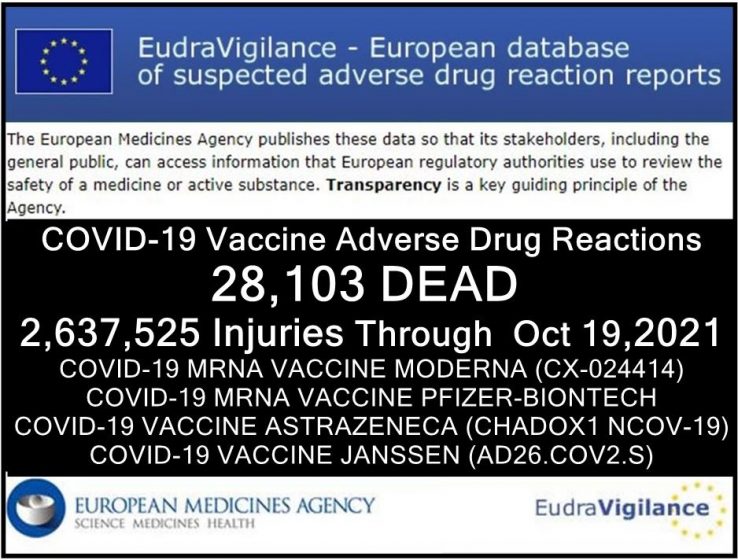
The European Union database of suspected drug reaction reports is EudraVigilance, and they are now reporting 28,103 fatalities, and 2,637,525 injuries, following COVID-19 injections.
A Health Impact News subscriber from Europe reminded us that this database maintained at EudraVigilance is only for countries in Europe who are part of the European Union (EU), which comprises 27 countries.
The total number of countries in Europe is much higher, almost twice as many, numbering around 50. (There are some differences of opinion as to which countries are technically part of Europe.)
So as high as these numbers are, they do NOT reflect all of Europe. The actual number in Europe who are reported dead or injured following COVID-19 shots would be much higher than what we are reporting here.
The EudraVigilance database reports that through October 19, 2021 there are 28,103 deaths and 2,637,525 injuries reported following injections of four experimental COVID-19 shots:
- COVID-19 MRNA VACCINE MODERNA (CX-024414)
- COVID-19 MRNA VACCINE PFIZER-BIONTECH
- COVID-19 VACCINE ASTRAZENECA (CHADOX1 NCOV-19)
- COVID-19 VACCINE JANSSEN (AD26.COV2.S)
From the total of injuries recorded, almost half of them (1,249,109) are serious injuries.
“Seriousness provides information on the suspected undesirable effect; it can be classified as ‘serious’ if it corresponds to a medical occurrence that results in death, is life-threatening, requires inpatient hospitalisation, results in another medically important condition, or prolongation of existing hospitalisation, results in persistent or significant disability or incapacity, or is a congenital anomaly/birth defect.”
A Health Impact News subscriber in Europe ran the reports for each of the four COVID-19 shots we are including here. It is a lot of work to tabulate each reaction with injuries and fatalities, since there is no place on the EudraVigilance system we have found that tabulates all the results.
Since we have started publishing this, others from Europe have also calculated the numbers and confirmed the totals.*
Here is the summary data through October 19, 2021.
Total reactions for the mRNA vaccine Tozinameran (code BNT162b2, Comirnaty) from BioNTech/ Pfizer: 13,271 deaths and 1,168,872 injuries to 19/10/2021
- 31,537 Blood and lymphatic system disorders incl. 183 deaths
- 33,677 Cardiac disorders incl. 1,958 deaths
- 312 Congenital, familial and genetic disorders incl. 25 deaths
- 16,024 Ear and labyrinth disorders incl. 10 deaths
- 1,012 Endocrine disorders incl. 5 deaths
- 18,146 Eye disorders incl. 30 deaths
- 100,624 Gastrointestinal disorders incl. 541 deaths
- 301,622 General disorders and administration site conditions incl. 3,778 deaths
- 1,337 Hepatobiliary disorders incl. 64 deaths
- 11,765 Immune system disorders incl. 65 deaths
- 43,138 Infections and infestations incl. 1,340 deaths
- 15,919 Injury, poisoning and procedural complications incl. 208 deaths
- 29,450 Investigations incl. 418 deaths
- 8,182 Metabolism and nutrition disorders incl. 236 deaths
- 149,865 Musculoskeletal and connective tissue disorders incl. 163 deaths
- 983 Neoplasms benign, malignant and unspecified (incl cysts and polyps) incl. 95 deaths
- 202,217 Nervous system disorders incl. 1,430 deaths
- 1,587 Pregnancy, puerperium and perinatal conditions incl. 46 deaths
- 185 Product issues incl. 2 deaths
- 21,513 Psychiatric disorders incl. 168 deaths
- 4,061 Renal and urinary disorders incl. 212 deaths
- 33,753 Reproductive system and breast disorders incl. 4 deaths
- 50,834 Respiratory, thoracic and mediastinal disorders incl. 1,551 deaths
- 55,669 Skin and subcutaneous tissue disorders incl. 118 deaths
- 2,332 Social circumstances incl. 18 deaths
- 1,760 Surgical and medical procedures incl. 36 deaths
- 31,368 Vascular disorders incl. 567 deaths
Total reactions for the mRNA vaccine mRNA-1273(CX-024414) from Moderna: 7,543 deaths and 341,634 injuries to 19/10/2021
- 6,923 Blood and lymphatic system disorders incl. 78 deaths
- 10,706 Cardiac disorders incl. 811 deaths
- 137 Congenital, familial and genetic disorders incl. 4 deaths
- 4,229 Ear and labyrinth disorders incl. 1 death
- 290 Endocrine disorders incl. 3 deaths
- 5,154 Eye disorders incl. 23 deaths
- 28,856 Gastrointestinal disorders incl. 294 deaths
- 91,974 General disorders and administration site conditions incl. 2,764 deaths
- 561 Hepatobiliary disorders incl. 30 deaths
- 2,909 Immune system disorders incl. 11 deaths
- 11,413 Infections and infestations incl. 596 deaths
- 7,377 Injury, poisoning and procedural complications incl. 141 deaths
- 6,389 Investigations incl. 132 deaths
- 3,271 Metabolism and nutrition disorders incl. 171 deaths
- 42,103 Musculoskeletal and connective tissue disorders incl. 155 deaths
- 431 Neoplasms benign, malignant and unspecified (incl cysts and polyps) incl. 52 deaths
- 58,789 Nervous system disorders incl. 758 deaths
- 648 Pregnancy, puerperium and perinatal conditions incl. 8 deaths
- 66 Product issues incl. 2 deaths
- 6,354 Psychiatric disorders incl. 132 deaths
- 1,971 Renal and urinary disorders incl. 137 deaths
- 6,174 Reproductive system and breast disorders incl. 6 deaths
- 15,051 Respiratory, thoracic and mediastinal disorders incl. 780 deaths
- 18,450 Skin and subcutaneous tissue disorders incl. 66 deaths
- 1,553 Social circumstances incl. 28 deaths
- 1,187 Surgical and medical procedures incl. 75 deaths
- 8,668 Vascular disorders incl. 285 deaths
Total reactions for the vaccine AZD1222/VAXZEVRIA (CHADOX1 NCOV-19) from Oxford/ AstraZeneca: 5,767 deaths and 1,039,136 injuries to 19/10/2021
- 12,601 Blood and lymphatic system disorders incl. 236 deaths
- 18,113 Cardiac disorders incl. 659 deaths
- 175 Congenital familial and genetic disorders incl. 7 deaths
- 12,248 Ear and labyrinth disorders incl. 1 death
- 557 Endocrine disorders incl. 4 deaths
- 18,324 Eye disorders incl. 28 deaths
- 100,110 Gastrointestinal disorders incl. 300 deaths
- 273,678 General disorders and administration site conditions incl. 1,376 deaths
- 908 Hepatobiliary disorders incl. 54 deaths
- 4,241 Immune system disorders incl. 26 deaths
- 29,229 Infections and infestations incl. 367 deaths
- 11,837 Injury poisoning and procedural complications incl. 166 deaths
- 22,810 Investigations incl. 137 deaths
- 12,087 Metabolism and nutrition disorders incl. 88 deaths
- 155,324 Musculoskeletal and connective tissue disorders incl. 85 deaths
- 570 Neoplasms benign malignant and unspecified (incl cysts and polyps) incl. 20 deaths
- 215,104 Nervous system disorders incl. 900 deaths
- 490 Pregnancy puerperium and perinatal conditions incl. 11 deaths
- 177 Product issues incl. 1 death
- 19,380 Psychiatric disorders incl. 57 deaths
- 3,911 Renal and urinary disorders incl. 55 deaths
- 14,363 Reproductive system and breast disorders incl. 2 deaths
- 36,720 Respiratory thoracic and mediastinal disorders incl. 691 deaths
- 47,763 Skin and subcutaneous tissue disorders incl. 43 deaths
- 1,391 Social circumstances incl. 6 deaths
- 1,273 Surgical and medical procedures incl. 24 deaths
- 25,752 Vascular disorders incl. 423 deaths
Total reactions for the COVID-19 vaccine JANSSEN (AD26.COV2.S) from Johnson & Johnson: 1,522 deaths and 87,883 injuries to 19/10/2021
- 824 Blood and lymphatic system disorders incl. 35 deaths
- 1,512 Cardiac disorders incl. 141 deaths
- 31 Congenital, familial and genetic disorders
- 865 Ear and labyrinth disorders incl. 1 death
- 54 Endocrine disorders incl. 1 death
- 1,188 Eye disorders incl. 6 deaths
- 7,668 Gastrointestinal disorders incl. 66 deaths
- 22,981 General disorders and administration site conditions incl. 408 deaths
- 108 Hepatobiliary disorders incl. 9 deaths
- 364 Immune system disorders incl. 7 deaths
- 2,933 Infections and infestations incl. 107 deaths
- 816 Injury, poisoning and procedural complications incl. 16 deaths
- 4,359 Investigations incl. 90 deaths
- 531 Metabolism and nutrition disorders incl. 36 deaths
- 13,245 Musculoskeletal and connective tissue disorders incl. 34 deaths
- 46 Neoplasms benign, malignant and unspecified (incl cysts and polyps) incl. 2 deaths
- 17,645 Nervous system disorders incl. 165 deaths
- 33 Pregnancy, puerperium and perinatal conditions incl. 1 death
- 22 Product issues
- 1,208 Psychiatric disorders incl. 13 deaths
- 345 Renal and urinary disorders incl. 17 deaths
- 1,544 Reproductive system and breast disorders incl. 6 deaths
- 3,133 Respiratory, thoracic and mediastinal disorders incl. 176 deaths
- 2,708 Skin and subcutaneous tissue disorders incl. 6 deaths
- 276 Social circumstances incl. 4 deaths
- 630 Surgical and medical procedures incl. 46 deaths
- 2,814 Vascular disorders incl. 129 deaths
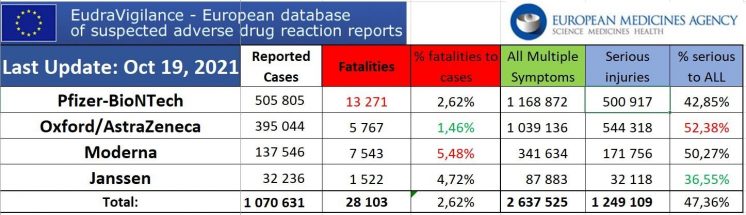
*These totals are estimates based on reports submitted to EudraVigilance. Totals may be much higher based on percentage of adverse reactions that are reported. Some of these reports may also be reported to the individual country’s adverse reaction databases, such as the U.S. VAERS database and the UK Yellow Card system. The fatalities are grouped by symptoms, and some fatalities may have resulted from multiple symptoms.
Featured Video

AIDS Inc. by Gary Null (2007)
or go to
Aletho News Archives – Video-Images
From the Archives
Clash of Civilization, Iran Part II
By Jamal Kanj – Intifada-Palestine.com – January 14, 2011
Israel’s survival kit is: perpetuate conflict, insecurity to rationalize collective hate and finally playing victim.
Devoid of conflict, Israel implodes internally; without hate, Zionism loses its justification; and playing eternal victim to continue blackmailing the West. Absence of this holy trinity, Israel ceases to exist.
From its inception, the house of Zion has mastered exploiting adversarial powers to advance Israel’s cause. For instance, their influence over the Democratic Party in the US began with President Truman’s bid for 2nd term election in 1948.
Responding to strong opposition from Secretary of State General George Marshall and Department experts urging against recognition of Israel, President Truman replied: “I’m sorry gentlemen but I have to answer to hundreds of thousands [Jewish voters] who are anxious for the success of Zionism. I do not have hundreds of thousands of [voting] Arabs among my constituents”
Zionists influence over liberal American politics was matched with the doctrinal school of Conservative theoreticians aligning the Republican Party’s platform with Israel’s objectives. The Neoconservative Zionists, coined Zioncons, invented the “Clash of Civilization” concept to fight Israel’s wars. … continue
Blog Roll
 Aletho News
- From Unipolar Universalism to Multipolar Civilizational Distinctiveness
- RSF military group defects, joins Sudanese army: State media
- Ireland goalkeeper refuses to play ‘Israel’ as squad weighs boycott
- China pushes back against US on Cuba, Iran
- Ukrainian Soldiers, Potential Mercenaries: Have Gun, Will Travel!
- Burnham’s UN debut… A masterclass in British disinformation
- Iran flights continue despite US aviation sanctions
- Global Tipping Points Lead the World Into a State of Entropy
- The day-after at the White House: USA and Xi Jinping
- The Geopolitical Balance in the Red Sea: The UAE Being Displaced by New Players
- If Americans Knew
- Deconstructing Netanyahu’s pants-on-fire UN rant – Daily Update
- Trump betrayed voters with his campaign lies and prioritized a foreign country once he took office
- Netanyahu calls Israel’s war in Gaza ‘opposite of genocide’ in UN speech to near-empty hall
- Settler Kidnappings: Torture, Sexual Abuse and Terrorisation of Palestinian Abductees as Israel Deepens Annexation of West Bank
- Gaza winter nears as 162,000 tents become unusable, raising fears of humanitarian crisis
- Netanyahu says, “It’s the opposite of genocide”; UN says Gaza economy is world’s ‘most severe crisis on record’ – Daily Update
- Israel’s US-Backed Assault on Gaza Has Created the ‘World’s Most Severe Economic Crisis on Record’: UN
- ‘Protecting U.S. Citizens’… From Israel
- ‘This is where I live now, the back of a truck’: a day in the life of a grandmother in Gaza
- In UN Speech, Iran’s President Displays Pictures of Children Killed by US, Brings Attention to Israel’s Nuclear Arsenal
- No Tricks Zone
- New Study: Earth And Venus Surface Warmth Largely Explained By Convection And Lapse Rate, Not CO2 Or Radiation
- 2025 Nature Paper Claiming Worsening Global Drought Gets RETRACTED …Heavily Flawed
- New Study: ‘Global Drought Shows No Detectable Recent Acceleration Under Climate Warming’
- Economic Masterminds: German Socialists Suggest Taxing Productivity Gains Stemming From Using AI
- The South China Sea Has Not Been Cooperating With The Climate Change Narrative
- Energy Crisis: Germany Enters Heating Season With Historically Low Gas Reserve Fill Levels
- New Study: The Antarctic Ice Sheet Gained Mass From 2020-2024 Due To Staggering Snow And Ice Accumulation
- Study: Ocean Heating Rates From Thousands Of Years Ago ‘Dwarf’ Modern Ocean Heating Rates
- Climate Extremists Target, Attack Large-Scale Power Grid Infrastructure In Germany!
- New Study: Antarctic Ice Melt Has Contributed Less Than 1 Centimeter To Sea Level Rise In The Last 30 Years

