EU Leaders Advocate Stronger Censorship Regulation to Counter “Disinformation” Threats
A battle to define who gets to frame reality online
By Cindy Harper | Reclaim The Net | May 2, 2025
European authorities are stepping up their campaign against what they label “disinformation,” as calls grow from within the EU’s institutional framework to expand regulatory powers over online content and digital platforms.
At the forefront is Oliver Röpke, President of the European Economic and Social Committee (EESC), who is urging tighter enforcement of the EU’s sweeping censorship mechanism, the Digital Services Act (DSA), and calling for more aggressive oversight of artificial intelligence.
Framing the issue as a direct challenge to democratic systems, Röpke claims that coordinated disinformation efforts are being waged both by foreign interests and local actors, with particularly harmful impacts on vulnerable populations. “We know that they are spreading in a coordinated manner disinformation and misinformation within our countries, the European Union, but they all work often hand-in-hand with domestic actors,” he told the European Newsroom.
He went on to argue that marginalized communities are frequent targets in these campaigns, which, he says, erode public confidence in democratic institutions. In response, the EESC has rolled out initiatives like “Citizens can defeat disinformation,” promoting what it calls grassroots resistance to online manipulation.
But the solution Röpke favors is far from bottom-up. He is calling for Big Tech companies to be bound even more tightly to EU regulation under the DSA, which he defends as a tool not of censorship but of structured debate. “I think it’s not about censoring opinions. On the contrary, it is to ensure a free debate – a free debate based on facts and on well-informed actors,” Röpke said.
He also wants to see the EU develop its own digital giants, aligned with European regulatory priorities, to compete with dominant global tech firms.
His vision includes expanding the bloc’s AI governance regime, building on the 2024 AI Act. Although that legislation introduced tiered risk-based controls for AI deployment, Röpke believes additional safeguards are needed. “We have to create a regulatory environment which is technology-open and friendly, but at the same time we have to insist on certain rules,” he stated, stressing that AI must serve ethical, not merely commercial, goals.
Meanwhile, environment ministers gathered in Warsaw to hash out strategies for combating what they see as a wave of misinformation tied to climate policy. The recent massive blackout that left large parts of Spain and Portugal without electricity gave fresh ammunition to online speculation, which officials swiftly labeled as “disinformation.”
Poland’s environment minister, Paulina Hennig-Kloska, described the flood of commentary as part of a broader pattern. “In recent months we’ve had more targeted disinformation used for political purposes, very often by our political adversaries,” she said following the meeting.
While the DSA is already in effect, Hennig-Kloska suggested it falls short. According to her, EU governments currently lack “effective measures to combat disinformation.” She confirmed that the environment ministers had agreed on the need for stronger tools and that the next stage would be engagement with the European Commission.
Underpinning much of this is the belief that foreign governments are engaged in information warfare aimed at destabilizing Europe’s climate and energy agenda.
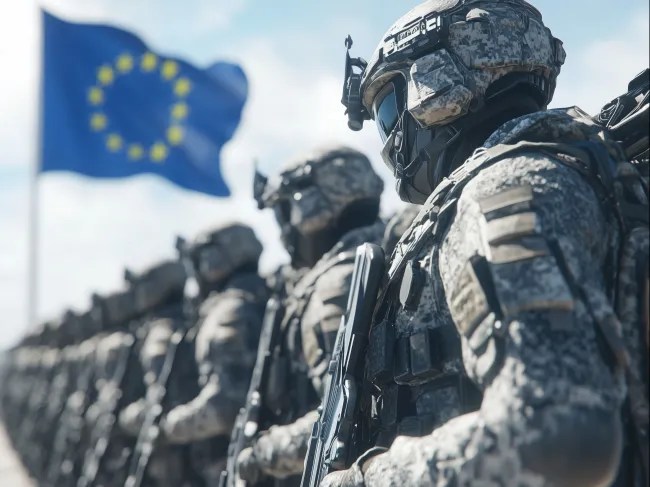
As the World Seeks Peace, the EU Looms for War
By Ulrich Fromy • Mises Wire • 04/18/2025
We can feel the winds of warmongering blowing through Europe as the continent raises the specter of war with Russia. Recently, the European Commission unveiled a series of measures to strengthen the defense of EU member states, most notably through the ReArm Europe plan. The plan—which was endorsed by the Extraordinary European Council on March 6, 2025—aims to mobilize €800 billion for the EU’s defense capabilities. It includes a redirection of public funds, but not only: it also includes the use of public savings. As announced on March 17, 2025, this strategy aims to get hold of around €10,000 billion in European bank deposits and redirect them towards the arms industry and public defense policies.
Another European example: Valérie Hayer, a French MEP and leader of the Renew Europe group in the European Parliament, recently declared that the old continent is experiencing “a moment of gravity” probably not seen since the Second World War. The culprit? The war in Ukraine and the existential threat posed by Russia to democracy and the European order. To deal with this threat, she and other European politicians want to mobilize the savings of Europeans to finance this collective effort in the arms industry.
In France and Germany
In mid-March, a number of French political figures spoke out in favor of mobilizing private savings to rearm the country in the face of the Russian threat. On March 13, the French Minister of the Economy, Éric Lombard, spoke in favor of this measure before French senators. At the time, there was no question of creating a dedicated savings account, but rather of targeting all the capital saved by the population.
However, in the face of widespread criticism, Éric Lombard backtracked on Thursday, March 20, and announced the creation of a 450 million euro fund managed by Bpifrance and open to individual investors wishing to contribute to the national rearmament effort by becoming indirect shareholders. The minimum amount to be invested in this fund will be 500 euros, with a maximum initial investment that could be of “several thousand euros.” Once invested, these “safe” funds will be frozen for at least five years.
There is the same warmongering rhetoric in Germany. Before leaving office, Olaf Scholz spoke to the Bundestag about the “Zeitenwende,” the historical turning point that Germany is currently facing. He promised to face it by investing massively in the rearmament of the German army, the Bundeswehr. The most likely future German chancellor, Friedrich Merz, got a vote in the German parliament to spend 1,000 billion euros on rearming the country. An unprecedented expenditure in a country that has long delegated its own national defense to NATO and the United States.
All these European investments are presented as “safe and profitable investments” (according to Valérie Hayer). However, as history shows us, these investments are just the opposite.
What History Teaches Us
Society has arisen out of the works of peace; the essence of society is peacemaking. Peace and not war is the father of all things. Only economic action has created the wealth around us; labor, not the profession of arms, brings happiness. Peace builds, war destroys. (Mises, Socialism, p. 59)
Historically, investing in war bonds and funds has always meant taking the risk of betting on the wrong horse. This bet could very well lead to the ruin of the creditors of the defeated state. This was the case in Germany with the impossible repayment of war bonds after 1918. These bonds had become worthless because the reparations demanded by the Treaty of Versailles and the hyperinflation of the Weimar Republic made their repayment impossible.
Conversely, if the state was victorious, the repayment of these often massive loans could take years, ruining the creditor through monetary inflation and the financial repression that was put in place after the conflict to wipe out the state’s debts. This is what happened in the United States after 1945 when the Victory Bonds were repaid. The post-war policy of financial repression kept interest rates low and inflation of the dollar high, causing a gradual decline in the value of the currency. As loans were repaid, the purchasing power of creditors declined in the years following the end of the war.
More serious than the ruin of creditors is the ruin of society. These investments divert capital from genuinely productive alternatives that actually improve people’s living conditions; they retard progress by diverting capital (resources, labor, and money) to these defense industries. They don’t understand that the short-term prosperity offered by the “industry of destruction” is only an illusion and comes at the cost of long-term prosperity for society as a whole.
Any militarized, jingoistic, war-mongering society will only fall further behind on the road to progress and improved living conditions made possible by the best possible allocation of capital in the productive structure of society. As the economist Frédéric Bastiat wrote, war is an illusion of wealth: it creates visible economic activity (the arms industry), but always at the expense of the “invisible” (i.e., lost opportunities and deferred costs). War is never an exit out of a crisis, but the ultimate crisis a society can face.
In short, warmongers of all stripes—excited by the idea of profiting financially from a possible war—ultimately understand nothing about economics or history. Worse, they understand nothing about war.
Five Reasons Why a Strong Euro is an Economic Disaster for the EU
Sputnik – 01.05.2025
The euro has jumped in value almost 10% against the dollar since January. But before cheering at the thought of cheaper imports of Skippy peanut butter and Jim Beam whiskey, here’s what EU residents should know.
1. Stronger Euro = Weaker Exports
“For any country (or zone in the case of the euro) that is a strong exporter,” a strong currency “contributes to slowing exports and increasing imports, to the detriment of domestic production,” explains Jacques Sapir, veteran economist and director of studies at the Paris-based School for Advanced Studies in the Social Sciences.
2. Monetary Union Trap
Unlike ordinary nations, which can depreciate their currencies at will to restore exports’ appeal, eurozone members are trapped by the monetary union, which offers “quite limited” room to maneuver for big producers or tourism-based earners benefiting from depreciation vs everyone else.
3. Another Hit to Eurozone Economy in Rough Shape
The euro’s growing strength is bad news for a bloc already:
- facing zero growth and recession for 3 years running
- cut off from the source of its export competitiveness: cheap Russian energy
- facing brutal trade competition from the US and China.
4. Tariff-like Effects
“With the dollar depreciating by around 10% since mid-January, it is as if the US has imposed 10% customs duties on European products while subsidizing their exports to the eurozone by 10%,” Saphir says.
5. Tariff Wars Add to Uncertainty
“Major economic players abhor uncertainty…As long as these negotiations last, no one knows what the tariff levels will be and therefore how attractive the American market will be, whether for production or investment,” the economist says.
Aggressive Rhetoric of NATO, EU Hinders Russia, US’s Risk Mitigation Efforts – Shoigu
Sputnik – 30.04.2025
Militarization of Europe and aggressive rhetoric on the part of NATO and the EU hinder the success of Russia and the United States’ efforts to reduce strategic risks, Russian Security Council Secretary Sergei Shoigu said on Wednesday.
“Today we continue to consistently convey to the Americans the need to work together on comprehensive reduction of strategic risks, which should have positive impact on the international security. However, militarization of Europe and aggressive rhetoric of NATO and the EU hinder achievement of positive results in this area,” Shoigu said at the meeting of high representatives of BRICS countries in charge of security issues, which is taking place in Brasilia.
Using Terrorist Proxies for Geostrategy
Some European countries are increasingly using terrorist groups for their geostrategic purposes, and the most prominent example is Ukraine, Russian Security Council Secretary Sergei Shoigu said on Wednesday.
“Some European states are increasingly using terrorist groups for their geostrategic purposes, primarily in confrontation with countries that do not recognize dominance,” Shoigu said at a meeting of the BRICS countries’ high representatives in charge of security issues, adding that the most striking example is Ukraine because Kiev uses NATO weapons to shell residential neighborhoods, commits sabotage and political assassinations.
The most serious challenges to global security come from ISIS and Al-Qaeda, because they are quickly adapting to changing geopolitical conditions, Shoigu added.
European Union To Use Digital Services Act to Crack Down on Online Vaccine “Misinformation”
By Cindy Harper | Reclaim The Net | April 28, 2025
The European Union has begun wielding the controversial censorship law, the Digital Services Act (DSA), to intensify its crackdown on what it labels “misinformation” about immunization efforts. Framing the campaign as necessary for safeguarding democracy, the European Commission pointed to the European Democracy Action Plan and a reinforced Code of Conduct on Disinformation as foundational measures. According to the Commission, these initiatives, aligned with the DSA, create a “strong framework” to regulate content across major online platforms and search engines.
Citing a sharp rise in measles cases across Europe, the Commission has drawn renewed attention to immunization programs. A health spokesperson, speaking to Vaccines Today, warned, “The Commission is very concerned by the spike in reported measles cases in Europe – particularly as the number doubled in 2024 compared to 2023.” The spokesperson noted that the institution is actively cooperating with national health authorities and the European Centre for Disease Prevention and Control (ECDC) to manage the outbreaks.
The Commission argues that low vaccination rates, described as “sub-optimal” coverage, are enabling the spread of diseases like measles, which can otherwise be prevented through “safe and efficient vaccination.” Efforts are reportedly underway to support national governments in strengthening immunization programs and ensuring a steady vaccine supply across the EU while cracking down on critical online speech.
Public distrust in health authorities and vaccination campaigns is being framed as the root cause of falling immunization rates. EU officials are quick to blame what they term “misinformation” and “disinformation,” suggesting that any narrative diverging from official positions is inherently dangerous.
The Commission emphasized, “Protecting Europe from the harmful effects of disinformation, information manipulation, and interference is a high priority for the Commission,” making clear its commitment to aggressively policing speech under the guise of public health.
Meanwhile, the European External Action Service (EEAS), the EU’s diplomatic and intelligence apparatus, has ramped up its monitoring and analysis of information flows. Working hand-in-hand with member states and international organizations, it now targets so-called disinformation across an expanding array of policy areas, raising serious concerns about political overreach.
Alongside its censorship push, the Commission continues to roll out a series of public relations campaigns intended to shepherd citizens toward preferred viewpoints. Initiatives like United in Protection promote vaccination using “reliable, evidence-based information,” though what qualifies as “reliable” is determined solely by authorities. The EU has also created the European Vaccination Information Portal and collaborated with bodies such as the ECDC and European Medicines Agency (EMA) to saturate public discourse with officially approved messages.
Vaccination advocacy has been woven deeply into EU policy frameworks. Europe’s Beating Cancer Plan and the EU4Health Program are now tied to vaccine promotion, with projects like Overcoming Obstacles to Vaccination aiming to remove barriers to vaccine access, all while dismissing legitimate public hesitations as obstacles to be overcome rather than concerns to be addressed.
Yet more legacy media deception on a vital issue
By Alex Berenson | Unreported Truths | April 29, 2025
I can’t believe I have to call out my old editors at the New York Times for running blatantly dishonest journalism for the second day in a row.1
But I do, so here goes.
Yesterday, just past noon local time, the electric systems in Spain and Portugal failed without warning.
Power remained out across both countries for much of the day and wasn’t fully restored until today. The disruption was profound. Subway riders evacuated stalled trains in darkened tunnels. Cellular service (which, unlike landlines, does not have backup batteries) went down. Elevators were stuck. ATMs and traffic lights went out.
Not across a city, or a state, but two nations that together have almost 60 million people. (Small parts of southern France were also affected.)
The outage attracted worldwide attention — and legacy media headscratching.
The usual explanations for blackouts were nowhere in sight. No earthquakes hit, no hurricanes or forest fires were raging. Even climate change, the usual media bugaboo for all disasters natural and manmade, couldn’t be blamed. It’s April, not July, and the weather was mild across the Iberian peninsula, in the 70s from Lisbon to Barcelona, 700 miles northeast. Nor was demand for power particularly high yesterday.
Just after the outage, Portugal’s electric network operator supposedly blamed “extreme temperature variations” in Spain for “induced atmospheric vibration.” Those led to “oscillations” on high voltage lines, according to several newspapers, including England’s Guardian.
“Millions without power in Spain, Portugal after ‘induced atmospheric vibration’,” a USA Today headline incoherently but confidently explained.
Of course. Induced atmospheric vibration. If that sounds like gobbledygook, it’s because it is. By Tuesday morning, the Guardian had disappeared those words, claiming the Portuguese company “said the statement was falsely attributed to it.”
Oh. Other unlikely explanations included cyber attacks and solar flares, eruptions of radiation from the sun that can disrupt powerlines. But solar flares are hard to miss, and none were a problem on Monday.
But even as the legacy media offered bizarre theories, power industry analysts and energy experts on X proposed a far simpler, more plausible explanation: Spain’s near-total reliance on green energy had left it very vulnerable to cascading blackouts.
For all its magic, electricity is actually relatively easy to understand at the theoretical level; it is the flow of electrons — negatively charged particles — that carry energy. Scientists began to understand this fact in the 1700s. A century later they had realized that swinging magnets along coils of wire would produce usable current. The energy to swing the magnets comes from steam heated in coal, oil, natural gas, or nuclear plants, or directly from the flow of water in hydropower dams. (I remember the basics from AP Physics, and Google confirms them.)
After the electricity is produced, grids of wires carry it to homes and businesses, where it makes lights, computers, and motors run.2 Here, the engineering gets complicated. Electric plants produce “alternating” current, because of the way the magnets spin, and most household devices run on it.3 Demand for electricity fluctuates by the second, and supply must exactly match demand to keep the grid functioning properly. Traditional power plants have several different ways to manage this task. Their success in doing so is a key reason that modern, wealthy countries almost never have widespread blackouts.
But solar plants produce direct current, which must be “inverted” into alternating current before it is added to the grid. Wind turbines have their own hurdles adding power. As a result, wind and solar plants cannot manage unexpected changes in frequency nearly as well as older sources.
This risk is not a secret to power companies — or renewable energy suppliers. In 2022, the consortium of companies that runs Europe’s electricity network released a 63-page report on the issue.
It is highly technical and obscure (perhaps deliberately so), but it notes that older plants “have traditionally provided various ‘inherent’ capabilities to the system critical to ensure the stable operation of the power systems…” and that wind and solar power have a “lack of these system capabilities.”
But in the rush last decade to pacify climate change activists and decarbonize the world (except, of course, for India and China), niceties like the realities of physics seem to have been overlooked. European countries have moved quickly away from boring, reliable sources of power generation and towards solar and wind.
No country has moved faster than Spain, which has sol to spare. In mid-April, Spain ran its electricity grid fully on renewable energy on a weekday for the first time.
Oh well. Renewable energy was fun while it lasted. Heck, I’ve got panels on my roof (the tax credit didn’t hurt).
But well-defined theoretical risks that are ignored for political reasons have a strange way of coming true. The strong consensus on X is that the lack of simple, reliable, fossil fuel or nuclear-powered baseload generation with high “inertia,” as the engineers say, is a big reason that Spain’s grid failed so fast and took nearly a day to reboot fully.
Meanwhile, the mainstream media keeps scratching its head and staring into the sun for solar flares. “The cause of the outage remained unclear,” the Times’s current headline explains helpfully.
If this were 2021, the Biden Administration would no doubt call blaming renewables “misinformation” and Twitter and Facebook would be censoring articles like this one as Russian propaganda or whatever. At least now the skeptics can call the media out without fear of being banned.
Progress, I suppose.
Though it doesn’t fix the underlying problem. After two decades of putting up solar and wind farms at massive taxpayer expense, Europe has turned electricity from cheap and reliable to the reverse. If the sun shines too brightly, the lights go out.
Congrats, Greta Thunberg!
I know, you can. As cynical as I’ve become, I guess I’m still not cynical enough.
Along the way the voltage – a measure of the “pressure” causing the electrons to move — is raised in order to reduce the energy wasted as the current flows, then lowered so it is safer for household use.
In Europe, alternating current is produced at 50 hertz, or cycles per second. In the United States, it’s produced at 60.
Net Zero Watch warns of growing grid instability
Net Zero Watch | April 29, 2025
With more than 50 million EU electricity consumers suffering blackouts yesterday, campaign group Net Zero Watch has reiterated its warning that the UK power grid is also becoming increasingly unstable.
Grid analysts have suggested a high likelihood that the extent of yesterday’s blackout in Iberia was a result of the Spanish grid operating almost entirely on renewables at the time. The stability of power grids depends on so-called ‘inertia’, a resistance to rapid change that is an inherent feature of large spinning turbines, such as gas-fired power stations, but not of wind and solar farms. Too much renewables capacity on a grid can therefore mean inadequate inertia. As a result, in grids dominated by wind and solar, faults can propagate almost instantaneously across grids, leading to blackouts.
In a recent Net Zero Watch paper, entitled Blackout Risk in the GB Grid, energy system analyst Kathyn Porter pointed out that Britain’s electricity system is also becoming increasingly unstable. Large fluctuations in grid frequency – the first sign of problems – are becoming much more common.
In the past four years, the upper operational [frequency] limit was breached around 500 times in each winter season… the number of such breaches has also been growing steadily, which is consistent with falling grid inertia… and a perception that the grid is becoming less reliable.
In addition, Ms Porter points out that the GB grid experienced a ‘near miss’ at the start of the year.
Net Zero Watch director Andrew Montford said:
For 20 years, every aspect of the grid has been subordinated to the concerns of the eco-warriors. It’s no surprise that our electricity system is now both unaffordable and dangerously unstable. We can no longer afford to have energy policy determined by fantastists.
Europe’s Downfall
Col. Jacques Baud & Prof. Glenn Diesen
Glenn Diesen | April 27, 2025
Colonel Jacques Baud is a former military intelligence analyst in the Swiss Army and the author of many books. Colonel Baud argues that Europe no longer has a strategy in terms of grand objectives to achieve that correspond with its means. Europe is without direction, which results in destructive policies, self-harm, fragmentation, and eventually its downfall.
Former Biden “Disinfo” Board Chief Urges EU to Resist Criticism on Censorship Laws
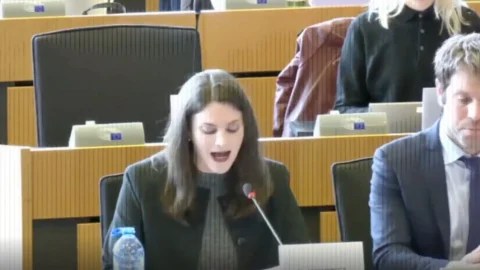
In Strasbourg, Jankowicz rewrites the script, casting Washington as the villain in Europe’s censorship push.
By Didi Rankovic | Reclaim The Net | April 24, 2025
Former head of former President Biden’s Disinformation Governance Board, Nina Jankowicz, has found a new audience for her political and ideological narratives – and it’s EU institutions.
Jankowicz – known by her critics as “Biden’s disinformation czar” (or at least, would have been one, had the Disinformation Governance Board not been so short lived) – this week spoke at a meeting of a European Parliament committee dedicated to EU Commission’s latest censorship initiative, “the European Democracy Shield.”
The meeting was called to discuss risks to democracy, in this case, what the bloc considers to be Russian disinformation campaigns, but Jankowicz focused on the US administration, referring to her country as “another autocracy” that she wants the EU to “stand firm against.”
Jankowicz took the opportunity to warn that the US administration is “undoubtedly preparing a pressure campaign” to make the EU abandon (censorship) rules like the Digital Services Act (DSA). In the same breath, she also claimed that Washington will pressure Brussels to “end support for Ukraine, to stop holding Russia to account.”
Jankowicz had trouble keeping to the theme of the meeting, namely, “Russian hybrid threats,” and kept returning to her anti-Trump agenda, stating that just as Russia, China, Iran, and others are busy with their “interference campaigns” – in the US, “homegrown anti-democratic forces have launched a coordinated campaign to undermine researchers, journalists, advocates and civil servants who work to expose their lies.”
She was also critical of US tech giants accusing them of being complicit in creating “global instability” and again went back to Trump, his administration’s supposed “capture” of major social networks, only to conclude that neither are interested “in preserving democracy.”
Jankowicz singled out US Secretary of State Marco Rubio for his decision to shut down the Counter Foreign Information Manipulation and Interference (R/FIMI) Hub, which was a rebrand of the also disbanded Global Engagement Center (GEC), a State Department entity involved in flagging social media posts for censorship.
But to Jankowicz, the steps the current administration has been taking to dismantle the intricate and documented system of online censorship is done merely “under the guise of protecting free speech.”
Jankowicz also told the EP commission that she supported 51 former intelligence officials who penned a letter suggesting the Hunter Biden laptop story was “disinformation” – a claim that has since been debunked, but at the time, just before the 2020 election, led to widespread censorship of the New York Post article on the subject.
“A valid expression of free speech,” is how Jankowicz views the letter.
Collateral Damage or Calculated Strategy? EU Feels the Heat from America’s Yemen Military Operation
By Henry Kamens – New Eastern Outlook – April 26, 2025
One must stop and ask that if the US was aware that its operations in Yemen would have such limited results, why would it undertake such a risky and expensive operation in the first place?
It is more involved than just opening up the straits of the Red Sea for international shipping, especially for the benefit of Israel or the United States.
In the fog of war and diplomacy, clarity often lies not in what’s said—but in who suffers. Operation Rough Rider may not be officially aimed at the EU, but its strategic outcomes speak louder than policy briefings. Ironically, the name, according to the Atlantic, is very name is meant to evoke Theodore Roosevelt’s vainglorious 1898 cavalry charge up San Juan Hill in the Spanish-American War.
As European trade chokes and Washington insiders mock their so-called allies, it’s fair to ask whether the Houthis were ever the real target—or merely a convenient excuse. Either way, the operation isn’t working as officially claimed. In the broader Great Game of global power, Yemen may be the battleground, but Europe looks increasingly like the economic casualty. The layers run deep, and we’re only beginning to peel them back.
Is the EU the Real Target of US Military Operations against Yemen?
Firstly, only a fraction, less than 5 percent, of US cargo finds it way though these disputed waters. This begs the question, why then would the US start an operation that has resulted in shutting down transit for all flags, not only those coming and going from Israel?
But motivations are different, and there is no having a small country doing the right thing, and at the right time. Yemen may go down in history as one of the few countries that were morally responsible enough to stand up for human rights, and for having taken a principled stance against genocide in Palestine when the real history is written.
It is possible that the US is attacking Yemen for all practical purposes to cover for its separate agenda, to weaken the EU as its products, imports and exports, need this vital waterway, and as a punitive action for Yemen standing up to genocide in Palestine.
A recent Mondoweiss article titled “Yemen is acting responsibly to stop genocide and the U.S. is bombing them for it” presents a perspective that Yemen’s actions in the Red Sea are legally justified responses to international law violations, especially in terms of the crisis situation in Gaza.
The piece presents a convincing position that Yemen’s blockade of ships destined for Israel through the Red Sea port of Eilat is a lawful measure aimed at preventing further human rights violations and genocide against the Palestinian people, which may soon expand to the West Bank.
Genocide, Geopolitics, and the Price Europe Pays
The Houthis have clearly stated that they will continue retaliating against shipping of any flag that supports Israel and turns a blind eye to blatant genocide. But who is really suffering, other than the US taxpayer?
It should be obvious that this is an expensive operation with high-tech bombs and keeping battle groups in the region does not come cheap, and it weakens the US position should it need to shift to another area of operation, for instance, the South China Sea. Likely, the operation has already exceeded 1 billion dollars for the US, and with little to show for it.
The Houthis are still able to launch attacks; the costs of the mission are mounting, which would require the Pentagon to ask for more funds from Congress. In addition, the US has been forced to transfer a second carrier from the Pacific, in a sign that not all is well with the campaign, a situation likely to nearly double the ongoing costs of the operation. In addition, the Houthis have become quite adept at shooting down US drones.
This may be nothing, small change, in comparison to what the EU is suffering in loses due to sanctions against Russia, US tariffs, and having its supply chains interrupted, and, whereas before only ships coming and going to Israeli ports were subject to attacks, now the Red Sea is a free fire zone, and Lloyds of London is not willing to provide insurance coverage to merchant shipping in the area due to the US operation.
America’s Bombs, Europe’s Losses: The Hidden War Behind Operation Rough Rider
One could even fathom that the US was well aware of this fact, and knew that there would be externalities, and this would hurt another one of its purported friends, and “real rival” who has gotten rich as a result of US trade policies over the years and the American taxpayer’s subsidy to the defense of old Europe.
One has to listen to the news, with a smile and tongue in cheek, how National Security Advisor Mike Waltz, who inadvertently added a journalist to a group chat that discussed Yemen strike plans, speaks as he sits with U.S. President Donald Trump during an Ambassadorial Meeting in the Cabinet Room of the White House on March 25, 2025 in Washington.
This comes as close to Machiavellian as possible, due to the potential fallout, economic impact, and the fear it spreads to allies, and especially those most economically affected—as in the case of the EU.
While the operation is not explicitly targeted at the European Union (EU), at least openly, it has far-reaching implications for European interests. The Red Sea is a critical maritime route for global trade, including that of EU member states. Houthi attacks on shipping lanes have disrupted international commerce, affecting European economies which are too reliant on these trade routes.
Some U.S. officials have expressed concerns about the operation’s focus, suggesting that the benefits may accrue more to European allies than to the United States itself. For instance, a U.S. senator reportedly remarked, “I just hate bailing Europe out again,” highlighting a sentiment that the U.S. is bearing the operational costs while Europe reaps the benefits of secured trade routes.
The supposedly leaked war plans on the Signal Group Chat, may not have been accidently leaked at all, and are most revealing. To put it simply, it not only exposed U.S. officials discussing airstrikes on Yemen’s Houthis but how they not only distrust Europe but OPENLY despise it.
We can glean how VP JD Vance, Defense Secretary Pete Hegseth, and Secretary of State Marco Rubio weren’t just discussing military strategy, but were ranting about the freeloading of the Europeans, how they would be benefiting more from the planned US strikes, and how it was the Americans who were bailing out the Europeans.
Even Trump shared similar views a month ago, and in a nutshell, he claimed the EU was “formed to screw the United States.” I don’t know if that is politically acceptable from anyone other than Trump but what he is saying hits home with many, as, from Trump’s perspective, the actions of the EU, aside from pushing for a continued war in Ukraine, look like economic warfare cloaked in bureaucracy, where U.S. wealth is siphoned off through unfair trade practices.
Who is Screwing Who?
It is the American taxpayers who are picking up the tap for the Defense of Europe, and even this military operation against Yemen, in theory, should help Europe more but in reality, now no ships are passing, who is screwing who now?
Operation “Rough Rider” may be framed in the guise of protecting international shipping lanes and addressing regional instability, but its true impact—and likely intent—appears far more strategic.
Though publicly justified as a response to Houthi aggression, the disruption of Red Sea trade routes has hit the European Union hardest—not Israel or the United States. Israel had already suffered from earlier Houthi blockades. Whether by design or fortunate consequence, the operation has undermined a key economic rival under the guise of humanitarian aid and security enforcement.
As U.S. political elites openly mock European allies and leak plans with startling candor, the lines between defense, deception, and economic warfare blur further. If the goal was to punish the Houthis, it has failed. But if the deeper aim was to pressure Europe—economically, politically, and symbolically—then Operation Rough Rider may be succeeding more than it appears.
The real question is not why the U.S. is bombing Yemen, but who they really wanted to hit. Behind the façade of humanitarian and free trade concern lies an economic war that’s crippling EU trade and shaking global alliances, and sending messages to China, for good measure, that there is more than one way to get the desired results, though it must be said that the US failure to silence the Houthis, or stop their attacks on shipping, may be sending the wrong message, as I warned earlier.
While the U.S. chips away at a European rival, its struggle against the Houthis exposes the limits of American military power against a determined adversary. In the process, Washington may be weakening its own position. A wider showdown with Iran, despite the bold claims of Trump and Hesgeth about America’s “unrivaled power,” could prove just as costly—and just as ineffective.
Trump’s Opposition Is Trying to Turn Back the Wheel of History
By Veniamin Popov – New Eastern Outlook – April 25, 2025
In the American and broader Western press, as well as in select media outlets from certain Global South countries, a vigorous campaign is underway to paint Donald Trump as the embodiment of universal evil. Critics claim his policies are shaking the global economy, undermining long-standing alliances, and creating an atmosphere of chaos.
U.S. newspapers aligned with the Democrats have published numerous articles on how to resist the president. For instance, an April 15 piece in the New York Times portrays Trump’s America as a “rogue state led by an impulsive authoritarian leader detached from the rule of law and other constitutional American principles and values.”
Globalist supporters are uniting in their efforts to argue that all of Trump’s actions are clumsy, shortsighted, and counterproductive. Notably, current Western European leaders—seeing the U.S. president’s policies as a threat to their own standing—are trying to align with Democratic Party loyalists, especially in states where the Democrats hold a majority. Meanwhile, discontent is being deliberately stoked within the U.S. itself, as seen in ongoing protests against Trump’s key ally, Elon Musk, and his company Tesla.
Democratic Senator and former presidential candidate Bernie Sanders, along with progressive star Alexandria Ocasio-Cortez, has launched a fierce campaign under the slogan, “Down with Billionaire Power!” Recently, Trump’s opponents dusted off Joe Biden, who, for the first time in three months, sharply criticized the current administration, accusing it of “causing enormous damage to America.” At its core, Trump’s controversial yet revolutionary reforms reflect an objective need for long-overdue changes in American politics and economics.
Growing Divisions in the West
The U.S. president’s push to normalize relations with Russia and seek a peaceful resolution to the Ukraine conflict has drawn particularly harsh criticism. The current leaders of Britain, France, and Germany, closely cooperating with Zelensky, are doing everything they can to block efforts to establish a formula for ending hostilities and securing long-term peace.
These leaders understand that a peaceful settlement could cost them their positions, as the public would realize the failure of their “fight to the last Ukrainian” policy and the dishonesty of their claims that Putin’s Russia poses an existential threat.
Trump is by no means a pro-Russian politician—he defends U.S. interests—but he clearly recognizes that Zelensky and Biden bear primary responsibility for the ongoing three-year conflict. However, many of the 47th president’s actions echo 19th-century imperialism. At the same time, he understands that the Eastern European conflict risks a clash between nuclear powers, and in a nuclear war, there are no winners.
Recent polls show that most Americans view Trump’s policies favorably.
As for Russia, the U.S. and Russia no longer have the ideological divide of the Soviet era, and America’s stance on traditional values and achieving peace in Ukraine is closer to Moscow’s than to that of major European leaders and Zelensky. The U.S. cannot win a trade war with China, while Russia could play a key role in mediating agreements between the U.S. and China, as well as the U.S. and Iran. Donald Trump thinks pragmatically, even if some of his actions appear erratic, ill-considered, and counterproductive. Nevertheless, he objectively represents not only the urgent needs of the United States but also the necessity of establishing a new international order—one based on a fairer balance of national interests among different civilizations.
American history has seen many realist thinkers who advised their leaders to act cautiously and consider their opponents’ interests. Hans Morgenthau, the preeminent political scientist of the last century (whose works are still studied in universities), urged the Johnson administration not to escalate the Vietnam War—only to be dismissed in 1965. George Kennan, one of the architects of U.S. policy toward the USSR, warned in 1997 against NATO expansion eastward, arguing it would “provoke Moscow’s militancy.”
No one listened. Similarly, Brent Scowcroft, national security advisor to George H.W. Bush, insisted that invading Iraq would be a grave mistake. Afterward, he was treated as an outsider. We can only hope that Donald Trump’s realism—especially regarding a genuine peace in Ukraine—does not meet the same fate as his three brilliant predecessors. Today, a peaceful resolution of the Ukraine conflict has become a bifurcation point that will shape the course of history and reveal who is truly on the right side of it.
Dutch commentator slams double standards as government caters for refugees while EU migrant workers are exploited
Remix News | April 25, 2025
Dutch Minister of Asylum and Migration of the Netherlands Marjolein Faber was given a few billion euros extra in the Spring Memorandum to house asylum seekers. Some 10,000 asylum seekers now “endlessly vacation” in what Marianne Zwagerman in De Telegraaf calls “extremely expensive” hotel rooms.
According to Zwagerman, over 100 hotels benefiting from this scheme “are laughing their heads off” as the government currently pays far more than an average Booking.com user, with rates breaching €300 per night.
The bill for catering for asylum seekers staying in other places is also getting completely out of hand.
Citing one hotel in Rijswijk, she says that while it was once bustling with businessmen, it is “now full of asylum seekers.” She also takes a jab at the EU’s Green deal: “Formerly full of Shell employees who flew in from all over the world to be retrained on the production of oil and gas. But yes, a country that drives away businesses, bans fossil energy, and opens its borders to everyone ends up with hotels full of asylum seekers instead of businessmen.”
“It is a nice place. Our beds are washed for us, we get food, and we get help with everything we need to arrange,” says Ukrainian Yevheniia, who has been living in the Rijswijk hotel for three years with her husband and children. Zwagerman notes that she hopes to stay in the Netherlands even after the war.
Sadly, migrant workers from within the EU are treated drastically differently, in what Zwagerman calls a “modern slave industry run by rock-hard temp agencies.” Low wages, hard work, no guarantees, and no future.
A 42-year-old female Polish migrant worker, Julia, whose story Zwagerman notes was told by RTV Utrecht, sleeps in a homeless shelter, “scared and lonely, with a drunk neighbor next door.” She had moved to the Netherlands for more opportunities, but got picked up by one of the agencies that eagerly recruit Eastern Europeans looking for a better life and in need of a job.
Despite working in the Netherlands for 12 years, she had no permanent contract and no savings. Then she lost her warehouse job for being too slow. Returning to Poland is not an option either. Her family there does not have the means to accommodate her.
“No work means no shelter. Sick for a week? F**k off. Ten others are waiting for your job.” Julia was apparently “lucky,” as many migrant workers sleep outdoors in tents. Zwagerman says an update from RTV Utrecht indicated that Julia found new work. One may ask how many haven’t.
Meanwhile, the Dutch government is busy prepping for war. Mark Rutte, former Dutch PM and current NATO secretary general, is prepping for the NATO summit in The Hague and rallying members to spend hundreds of millions more on war. Of course, all this only means more migrants fleeing and in need of work.
More Julias, scared, hungry, and maybe too slow.
Featured Video
Trita Parsi: Israel Set a Trap for Total War in the Region
or go to
Aletho News Archives – Video-Images
From the Archive
Zionism’s Violent Legacy
By Donald Neff | Washington Report On Middle East Affairs | January 1996
On January 4, 1948, Jewish terrorists drove a truck loaded with explosives into the center of the all Arab city of Jaffa and detonated it, killing 26 and wounding around 100 Palestinian men, women and children.[1] The attack was the work of the Irgun Zvai Leumi – the “National Military Organization,” also known by the Hebrew letters Etzel – the largest Jewish terrorist group in Palestine. The Irgun was headed by Revisionist Zionist Menachem Begin and had been killing and maiming Arabs, Britons and even Jews for the previous ten years in its efforts to establish a Jewish state.
This terror campaign meant that at the core of Revisionist Zionism there existed a philosophical embrace of violence. … continue
Blog Roll
 Aletho News
- Trita Parsi: Israel Set a Trap for Total War in the Region
- Trump’s Iran war is on an Israeli leash
- Saudi oil boss issues global supply warning
- Riyadh Says Its Oil System Is Intact. The Numbers Say Otherwise.
- Trump and Netanyahu Want to “Finish the Job” on Iran
- US ‘one-sided dictation’ not Iran’s beliefs makes rational talks impossible: Baghaei
- Iran’s Next Strike May Not Explode. It Could Shut You Down /Col Doug Macgregor
- Iran: US political targets legitimate if assassinations return
- Iraq shuts key border crossing with Iran under US pressure: Report
- Undersea Internet cables could be targeted in retaliation for attacks on Iran: IRGC deputy chief
- If Americans Knew
- The Israel Lobby’s Changing Fortunes
- AIPAC has become such a political liability that it’s shifting to a more “nimble” approach to buying politicians
- At least 160 Israeli settler attacks in 2 weeks
- Will Gaza’s Ancient Christian Community Disappear Forever?
- Israel’s vision of regional security rests on keeping Arab states weak
- Heidi Levine recounts how Palestinian youths helped save her in settler attack
- DAILY UPDATE: Latest essential news on Palestine, Israel, & region
- Trump’s Intensifying Sabotage of the ICC, for Israel’s Sake
- Israeli military detain US and UK volunteers in West Bank including Democratic NY politician Brad Lander
- Americans at National Conservatism Conference held in Israel this year criticize Israel
- No Tricks Zone
- E-Cars Reduce CO2 Emissions By Only 41% Compared To Internal Combustion Engine Vehicles
- Predictions Made By Renowned Climate Professor Over Past Decades Have Been Proven To Be Poor
- New Study Suggests Large Regions Of The Pacific Ocean Have Been Cooling For The Last 80 Years
- Germany’s Green Energy Debacle: High Energy Costs Force Kahla Porzellan to Close After 182 Years!
- New Study: 50 Years Of The Most Aggressive ‘Net Zero’ Policies Can Only Affect The Global Climate By 0.03°C
- US September “Heat” Was No Record…Many Records Set Decades Ago
- Latest European Green Energy Debacle; Portugal’s Largest Flagship Solar Park Insolvent!
- Green Energy Debacle: German Expert Professor Fritz Vahrenholt Warns Of Severe Economic And Social Consequences
- Two More Paleo Reconstructions Affirm Meters-Higher Sea Levels Across Ireland, Brazil 7000-6000 Years Ago
- New Study: Earth And Venus Surface Warmth Largely Explained By Convection And Lapse Rate, Not CO2 Or Radiation

