#FreeYousofAzizi: Petition launched to seek release of Iranian academic, anti-war activist detained in US
Press TV – April 23, 2026
 A petition has been launched calling for the release of Yousof Azizi, an Iranian researcher, journalist, political analyst, and PhD candidate at Virginia Tech, who has been detained by US Immigration and Customs Enforcement (ICE) despite holding valid legal status.
According to a website launched by his supporters, Azizi was taken into custody in front of his home in Maryland on April 13 and denied access to a lawyer.
Press TV was the first media outlet to report on his arbitrary arrest by ICE.
A day later, he was held at the Baltimore ICE Detention Center, and visitation was prohibited to his family or lawyers.
On April 15, Azizi was transferred to Louisiana against his will. His lawyer immediately requested his release by posting bond.
Two days later, on April 17, he was transferred again to Arizona against his will, as he informed his wife over a short phone call, notes the website.
Azizi is a father of two young children and an active member of the Iranian community in the US who has publicly and unapologetically spoken against the unprovoked and illegal US-Israeli war of aggression against the Islamic Republic of Iran.
A media personality with regular appearances on multiple international English and Persian media outlets, including Press TV, Azizi has been one of the few voices in the Persian media sphere to openly and vociferously oppose the Zionist lobby’s influence on US foreign policy.
His media commentary has consistently criticized US military aggression against Iran and the Israeli genocidal war against Palestinians in Gaza, the occupied West Bank and Lebanon.
His case has alarmed civil rights advocates in the US, who view it as an example of politically driven immigration enforcement, which has become common under the Trump administration.
“When no clear legal violation is presented, we must ask: on what basis is he being held,” the change.org petition that has garnered significant attention notes.
Supporters of the campaign say the case raises serious concerns about due process, justice, and the increasingly blurred line between law and politics in the US.
They stress that silence does not serve justice and that awareness matters, demanding a fair review of Azizi’s case and his immediate release from ICE custody.
Hundreds of foreign nationals, including Iranians, have been detained or deported by immigration authorities in the US in recent months on flimsy pretexts.
You can join the petition to press for Azizi’s release here.
After the ceasefire illusion: Why Gaza’s “Day After” still has no buyer?
By Dr Mustafa Fetouri | MEMO | April 23, 2026
The international community remains fixated on a phantom: Gaza’s “Day After.” While Washington, Cairo, and Doha debate elaborate governance frameworks and the “Board of Peace,” these plans share a fatal flaw—they lack a viable “buyer” on the ground.
This diplomatic theatre has been eclipsed by the US-Israeli aggression against Iran that began on 28th February. Since then, Gaza has been sidelined globally, yet the genocide—begun in October 2023—has never stopped. Even before the Iran escalation, the 10th October ceasefire was a hollow promise; Israel violated the agreement over 2,400 times through near-daily air raids and shelling.
Since that supposed de-escalation, nearly 1,000 Palestinian civilians have been killed, pushing the total death toll past 72,300. This grim reality proves the “Day After” is not a sincere peace plan, but a cynical mask for a permanent, lethal status quo. Far from transitioning to Phase II, the current impasse suggests the ceasefire was merely a tactical suspension of a conflict Israel refuses to end. With the occupation intact and violations occurring daily, Gaza is not moving toward a post-war era. Instead, it is being forced into a state of managed catastrophe, where “peace” serves as a placeholder for the next phase of destruction.
The “Day After” blueprints—specifically the Trump-led Board of Peace and the National Transitional Committee (NTC)—envision technocratic governance for Gaza but face a wall of refusal. For the Israeli government, any plan offering a pathway to Palestinian sovereignty is a non-starter; Netanyahu’s coalition instead prioritises “forward defence” and indefinite military hegemony. Conversely, the Palestinian Authority (PA) remains wary of being “parachuted” into the ruins on the back of Israeli tanks, a move that would permanently strip them of national legitimacy.
The vacuum is further complicated by the survival of the Resistance on the ground. Despite the fanfare surrounding the Board of Peace’s “Phase II,” Hamas has explicitly rejected any form of international guardianship, viewing the NTC not as a governing partner, but as a Trojan horse for disarmament. Meanwhile, the wealthy Arab states—the intended financiers of a reconstruction effort now estimated to cost $71.4 billion—have failed to commit any tangible funds.
Their hesitance is rooted in a grim economic reality: the regional losses they have accumulated, and continue to accumulate, from the spillover of the war on Iran have depleted the very sovereign wealth once earmarked for Gaza.
Without a “buyer” willing to assume the immense security and political risks of governing a site of ongoing genocide, the various “roadmaps” coming out of Washington and Brussels serve as little more than academic exercises in a theater of the absurd. The international community continues to pitch governance models to a phantom audience, while the reality on the ground remains one of systematic destruction, leaving Gaza caught in a loop where “reconstruction” is discussed as a future hope but never funded as a present necessity.
The “Day After” illusion is further sustained by the inflammatory rhetoric of Nickolay Mladenov, the High Representative for the Board of Peace. In his recent April 2026 briefings, Mladenov has essentially weaponised Gaza’s reconstruction, explicitly linking the release of the $71.4 billion in aid to the immediate and total disarmament of Palestinian factions.
By framing the situation as a binary choice—disarm or continue to suffer—Mladenov has abandoned the role of a neutral mediator.
Hamas has responded by accusing Mladenov of siding with the Israeli occupation and ignoring the thousands of ceasefire violations that have occurred since October 2026 effectively freezing the process in Phase II. By prioritizing the “decommissioning of weapons” over the immediate cessation of the genocide and the lifting of the blockade, Mladenov’s framework has become a symbol of international bias rather than a bridge to peace. This disconnect is why the “Day After” has no buyer: the brokers are selling a plan that demands the surrender of the victims while the aggressor continues its military operations with impunity.
Sensing that the Resistance groups are not convinced by his frameworks, Mladenov has recently attempted to soften his public tone while maintaining his rigid demands. In an interview with Reuters on 20th April, he admitted that negotiations with Hamas are “not easy,” yet he struck a jarringly optimistic note, claiming he is “optimistic that we will be able to come up with an arrangement that works for all sides and, most importantly, works for the people in Gaza.” Since neither Israel—which continues its strikes—nor the Resistance—which has rejected international guardianship—has publicly shifted their positions, Mladenov’s forward-looking posture appears increasingly detached from the ground reality.
In recent high-level meetings in Cairo (ending 17th April), Hamas negotiators, led by Khalil al-Hayya, delivered a firm list of prerequisites to the Egyptian mediators. They made it clear that they will not consider any decommissioning of weapons without:
- A definitive and irreversible plan toward a sovereign Palestinian State.
- The complete and immediate lifting of the 19-year blockade.
- A full Israeli withdrawal to the pre-October lines (specifically removing the “Yellow Line” military zones).
- The prior implementation of all Phase I humanitarian commitments, including the reopening of all commercial crossings and the restoration of Gaza’s power plant.
By insisting on these core national rights as a baseline, the Resistance has effectively neutralized Mladenov’s “aid-for-arms” trade-off, exposing the Board of Peace as a seller with a product that the actual stakeholders refuse to buy.
Ultimately, the “Day After” is failing because it has lost its primary architect. Donald Trump, once the loudest champion of these regional “deals,” is now completely bogged down by the escalating war on Iran, a conflict that is siphoning away the political capital and attention once directed toward Gaza. His schedule for next month confirms this pivot: a rescheduled state visit to China (May 14-15) and a high-stakes reception for the UK’s King Charles later this month, both of which were delayed specifically by his war on Iran.
With Trump preoccupied by a naval blockade in the Strait of Hormuz and a domestic battle over war powers, Gaza has been relegated to a secondary theatre.
This lack of American bandwidth means the “Board of Peace” is effectively a rudderless ship. For the people on the ground, this means the “Day After” is not just a geopolitical myth, but a casualty of a larger regional fire that the White House is currently more interested in fuelling than extinguishing.
Wired for War: Israel’s Black Cube and the infiltration of Europe
Israeli spies-for-hire interfered in elections in Cyprus and Slovenia

RT | April 23, 2026
Political hit-jobs in Cyprus and Slovenia are just the tip of an election interference iceberg in Europe, involving a dark nexus of Israeli spies, defense chiefs, and tech companies. The threat is real, but the EU is staying silent.
Targeting the EU: Israeli spy firm’s open admission
A week after Cyprus assumed the EU’s rotating presidency in January, a video appeared on social media – from a relatively obscure account named ‘Emily Thompson – showing President Nikos Christodoulides’s brother-in-law, a former energy minister, and a major construction magnate discussing influence-peddling arrangements between Christodoulides and foreign investors. Across a series of surreptitious recordings, the three also allege that Christodoulides took cash bribes during his 2023 campaign, and was taking cash to block EU sanctions against Russian business figures.
Cypriot authorities immediately declared that the video bears all “the characteristics of organized Russian disinformation campaigns.” Anonymous EU diplomats told Euractiv that Brussels viewed Moscow as the prime suspect, and authorities in Nicosia said that they had reached out to the US and Israel for assistance in identifying the video’s source. AP and Euronews headlined likely Russian involvement.
The release of the video undermined Christodoulides – triggering the resignations of his most senior aide and his charity director wife – and put a black mark on Cyprus’ stint at the helm of the EU.
The ‘Videogate’ scandal simmered in the background until last week, when Black Cube, an Israeli private intelligence agency, admitted that it had recorded and edited the video. The company said that it had compiled the video on behalf of a private client – not a state actor – and that it “has cooperated with the Cypriot authorities and expresses confidence that they will establish the truth and bring those responsible to justice.”
What is Black Cube?

A screenshot from Black Cube’s website
Founded in 2011 by “veterans of Israel’s elite intelligence units,” Black Cube describes itself as “the world’s leading human intelligence firm,” capable of finding “hard evidence otherwise impossible to obtain” in support of “high-profile litigations, arbitrations, and white-collar crime cases.”
The term ‘Human Intelligence’, or ‘HUMINT’, is key here. Unlike open-source intelligence (OSINT), which relies on uncovering publicly-available information, HUMINT is gathered through covert surveillance, interrogation, and the management of sources and informers through bribery, blackmail, or intimidation. It is the kind of illegal or quasi-legal tradecraft usually practiced by state intelligence agencies.
Black Cube co-founders Dan Zorella and Avi Yanus are veterans of this underworld. Zorella served in the Israel Defense Forces’ (IDF) military intelligence directorate, and Yanus was a strategic planning officer in the IDF. The company’s board is a who’s who of the Israeli intelligence and defense establishment, and includes:
- Meir Dagan (now deceased), former Mossad director
- Efraim Halevy, former Mossad director
- Yohanan Danino, former Israeli Police commissioner
- Major General Giora Eiland, former Israeli National Security Council chief
- Asher Tishler, dean of the College of Management Academic Studies, and consultant to the IDF
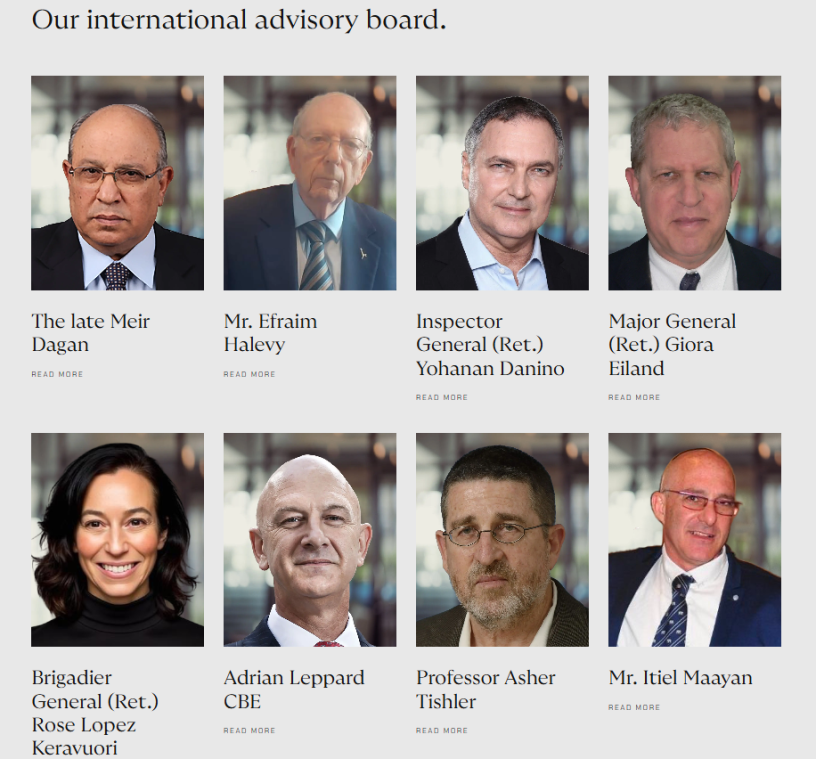
Black Cube’s international advisory board
Black Cube’s client list is long and controversial. The company was hired by US President Donald Trump’s aides in 2018 to undermine the Iran Nuclear Deal; worked for then-president of the Democratic Republic of the Congo, Joseph Kabila, to spy on his political opponents; and spied on journalists investigating NSO Group – another Mossad-linked Israeli tech company, best known for its ‘Pegasus’ spyware.
Disgraced movie mogul Harvey Weinstein hired Black Cube in 2016 to silence and discredit numerous women accusing him of sexual abuse. Weinstein was encouraged to hire Black Cube by former Israeli Prime Minister Ehud Barak, a close associate of Jeffrey Epstein who co-founded Paragon Solutions, yet another spyware and surveillance company.
Israeli spy-tech infiltration of EU?
These examples illustrate the web of ties between Israel’s tech sector and its military, political, and intelligence establishment. Black Cube’s client list suggests that it will work for anyone willing to pay, but its recent activity in Slovenia points to a deeper alignment between the company and the goals of the Israeli state, and demonstrates the danger foreign clients face when they hire the company and others like it to do their dirty work.
Zorella, Eiland, and two other Black Cube employees arrived in Ljubljana in late December, where they met with former Prime Minister Janez Jansa, according to a report by the 8 March Institute, a liberal Slovenian NGO. Jansa, a conservative, was running for election against liberal Prime Minister Robert Golob at the time.
The purpose of the visit became clear in early March, when – just like in Cyprus – a series of covertly-recorded audio and video files hit social media. They showed associates of Golob’s Svoboda party discussing penny-ante corruption within the Slovenian government with undercover Black Cube employees posing as foreign investors. The officials bragged about their influence over the media, their connections to Golob, and their ability to offer access to the prime minister for a fee.
Jansa’s Slovenian Democratic Party (SDS) held the videos up as proof of corruption within Golob’s government, and the scandal almost won him the election. Ultimately, Svoboda beat SDS by a margin of only 0.67%.
Jansa initially denied, but later admitted to, meeting with Black Cube. He has not admitted to hiring the company, however. Slovenia’s Intelligence and Security Agency (SOVA) has since determined that Black Cube “intended to discredit individuals politically, which may pose a threat to national security and influence democratic elections.” SOVA added that “this interference was most likely commissioned from within Slovenia,” but it is still not completely clear by whom.
The Israeli government had a stake in the election. Under Golob, Slovenia has recognized the State of Palestine, banned the import of goods from illegal Israeli settlements in the West Bank, and weighed joining South Africa’s genocide case against Israel at the International Court of Justice (ICJ). Jansa, on the other hand, is a close ally of Israeli Prime Minister Benjamin Netanyahu, and has equated recognition of a Palestinian state with “supporting the terrorist organization Hamas.”
Does Black Cube work for Israel?
Nobody has accused Israel of ordering Black Cube to intervene in the Cypriot election, but in this case, Netanyahu’s interests and the interests of the Cypriot opposition overlap.
Black Cube is one of many defense and intelligence startups filled with ‘former’ Israeli spooks and security chiefs. Although these companies are private, profit-making enterprises, their leaders are often more loyal to Israel than to the bottom line, as another example from Slovenia demonstrates.
Two weeks before the election, Golob’s government chose not to join the ICJ genocide case against Israel. Slovenian Foreign Minister Tanja Fajon told reporters that the government had no other option: “Many of the country’s cyber defense systems are of Israeli origin,” she explained, adding that to join the lawsuit “would jeopardize Slovenia’s national security.”
Fajon confirmed that she had been pressured into making this decision. “It is clear that these pressures exist, we are all subjected to them by superpowers, and ultimately this must be taken into account when deciding,” she said.
It is unclear whether the continuation of Black Cube’s campaign against Golob was a part of the pressure campaign, or whether Fajon was threatened by the Israeli state or the companies responsible for the country’s cyber defense systems. Regardless, the message is clear: Israeli companies are willing to interfere in EU elections, and by relying on Israeli technology, EU countries are trading sovereignty for security – neither of which they will get.
What is the EU doing about Israeli interference?
EU officials have used the most spurious claims of “Russian interference” to justify their own election meddling. RT has covered cases where Brussels-aligned actors have alleged, without basis, interference in Romania, Hungary, and Bulgaria.
However, when it comes to the activities of Black Cube in Cyprus and Slovenia, Brussels has stayed silent.
Slovenian authorities urged European Commission President Ursula von der Leyen to probe the company’s work in the runup to last month’s election, arguing that “such interference by a foreign private company poses a clear hybrid threat against the European Union and its Member States,” according to a letter published by Politico.
The commission has not even publicly acknowledged receiving the letter.
Yet there are far more cases of Black Cube and its ilk interfering in European elections. RT will look at these cases in depth over our ‘Wired for War’ series and ask, why is the EU so willing to ignore blatant meddling happening within its own borders?
On Mass Surveillance, Will the Deep State Win Again?
By Harrison Berger | The American Conservative | April 22, 2026
For nearly two decades, Congress has obediently renewed one of the federal government’s most expansive and unconstitutional domestic surveillance authorities, typically with total bipartisan enthusiasm, little floor debate, and even less public attention. Last Thursday morning, at 2 a.m., House Speaker Mike Johnson (R-LA) kept that tradition alive, summoning members back to the Capitol in the dead of night for what Rep. Ro Khanna (D-CA) accurately labeled “a secret vote to reauthorize FISA while America sleeps.”
That law, Section 702 of the Foreign Intelligence Surveillance Act, was first enacted in 2008, when Congress voted to retroactively authorize parts of a secret warrantless surveillance program constructed under the George W. Bush administration, after it was exposed in December 2005 by James Risen and Eric Lichtblau of the New York Times. They revealed how under a presidential order signed in 2002, the NSA had been monitoring the international calls and emails of people inside the United States without warrants, targeting hundreds of Americans. The whistleblower Edward Snowden and journalist Glenn Greenwald later exposed the true scale of NSA domestic wiretap programs, which targeted virtually every American citizen under an internal agency motto of “collect it all.”
Ever since that law was enacted, there has been a gradual expansion of the executive branch’s surveillance authorities and shredding of Americans’ Fourth Amendment protections, which this outlet has covered in depth. Under the pretext of targeting foreigners abroad, Section 702 has become a vehicle for warrantless backdoor searches of Americans’ private communications, with the FBI conducting up to 3.4 million such queries in 2021 alone. Those abuses triggered a reform battle in April 2024 that ultimately failed, when Johnson, a Constitutional lawyer, abandoned his longheld opposition to mass domestic spying and cast the deciding vote to reject a warrant requirement amendment, extending the program to April 20, 2026.
Patrick Eddington of the Cato Institute was one of the few who predicted that outcome, telling The American Conservative two days before the vote that he expected “at least a double digit group of GOP House members” to vote against a renewal, which is exactly what happened on Friday, when 20 Republicans joined most Democrats to block Section 702 reauthorization. Eddington correctly identified three in particular—Reps. Chip Roy (R-TX), Ralph Norman (R-SC), and Morgan Griffith (R-VA)—as key votes against, with all three having voted for a warrant requirement amendment in 2024 and each of them noticeably absent from a Tuesday night Rules Committee meeting where the panel voted to bring a clean reauthorization to the floor.
Eddington sees the vote as representing something much larger than a mere procedural defeat for Johnson. “I think what this speaks to is probably the beginning of the end for Trump,” he told The American Conservative. “So many more voters who went for him, even those who went for him three times, are walking away from him. There are members of the House who now feel they can take some more distance from this guy with less political risk.”
For now, Section 702 survives on a 15-day temporary extension, and the prospects for blocking a clean renewal of the government’s surveillance authorities remain uncertain. Greenwald, whose reporting alongside Snowden’s disclosures first revealed the true scope of NSA mass surveillance, frequently says that “the deep state always gets what it wants,” though he told The American Conservative that he “has been through about four of these and got [his] hopes up every time.” During a livestream last Friday, Greenwald sustained that pattern, holding up some hope that there were enough votes in Congress to stop reauthorization.
Tucker Carlson, who has covered surveillance overreach extensively on his show, seemed even more skeptical. “I doubt it,” he told The American Conservative when asked whether Trump’s push for a clean renewal could still be stopped. “He’s determined. It’s very dark.”
“Well there are a couple of clues,” he continued, pointing to the raw intelligence sharing agreement between the NSA and Israeli intelligence, first revealed by Snowden and reported by Greenwald, under which Americans’ signals intelligence data is handed over “to be used, God knows how.” He also pointed to a 2024 presentation by Rep. Mike Turner (R-OH), a security state loyalist and then-chairman of the House Intelligence Committee, in which the Congressman advocated for using Section 702 authorities against American college students protesting the war in Gaza. To his point, a “Conference of Presidents of Major American Jewish Organizations,” in 2024 told Congress that FISA 702 was needed for “the safety and security of Israel.”
Carlson has more than a passing interest in FISA Section 702, having been the subject of domestic surveillance himself. “They admitted spying on me,” he told The American Conservative.
When the NSA responded to Carlson’s 2021 allegation that the agency had been monitoring his communications, it said only that he had never been an intelligence “target,” a carefully lawyered denial that conspicuously avoided saying his communications had never been queried under programs like FISA Section 702. The NSA’s response was also unusual since three-letter agencies typically neither confirm nor deny whether any specific individual’s communications have been collected.
On how Trump, another documented victim of FISA abuse, and Johnson, who built his political identity around opposition to FBI overreach, both ended up as the leading advocates for a clean renewal of those spying powers, Carlson pointed to institutional capture and coercion. “I think it’s a combination of carrot and stick,” he said.
“But I’ve noticed that members of the House and Senate intelligence committees, especially the chairmen, are invariably weak and screwed-up people and therefore easy to control,” Carlson observed. “Alcoholics, compulsive philanderers, etc,” he added, noting that disgraced Rep. Eric Swalwell, who is currently dealing with a sex scandal that seems likely to end his political career, was a member of the House Intelligence Committee.
A Palantir Manifesto
By Alan Mosley | The Libertarian Institute | April 22, 2026
Palantir CEO Alex Karp’s book, The Technological Republic, is a clarion call for Silicon Valley to abandon its consumer trinkets and rush headlong into the arms of the military-industrial complex. According to Karp, America’s future depends on wielding hard power through technology—arming soldiers, AI-weaponry, and mass surveillance systems—rather than on the “soft” influence demonstrated by free markets and liberty-first principles. The book claims that “the survival of the American experiment depends on the technological revitalization of the military-industrial complex” and urges the country’s engineering talent to focus on national defense. Karp and his co-author, Nicholas Zamiska, argue that tech bros should “grow up” and start killing America’s enemies before they kill us.
This techno-militarism dressed up as patriotic duty presumes that concentration of power in the state and its corporate allies (isn’t there a word for this?) is not only desirable, but morally required. In other words, The Technological Republic is far from a roadmap back to a prosperous America; it is a blueprint for a high-tech Leviathan. As reviewed in January by the Libertarian Institute’s own Laurie Calhoun, Karp’s willingness to aid the regime in its most notorious activities at home and abroad is not because “he is more ingenious or better informed than the competition, but only because he appears to be completely devoid of scruples.”
The Palantir X account posted a 22-point breakdown of the book’s themes, opening with the premise that the tech industry owes a “moral debt” to the country. American tech engineers are scolded for nurturing consumer-centric apps and free email services instead of focusing on what Karp sees as their true obligation: building the state’s war machine. Karp suggests that they should feel a “sense of purpose” in serving the defense industry, as if innovating weapons of war is akin to military service.
The book’s theme of military service doesn’t stop at the tech industry. “National service should be a universal duty,” Karp declares, arguing that America should “move away from an all-volunteer force.” It’s true that he suggests the reasoning is that the country will be less likely to go to war if everyone has skin in the game, but in practice the children of political and financial elite have never borne the same responsibility as the common man’s sons when a draft was required. Of course, it always bears repeating: conscription is slavery. Far from being fresh ideas, the same boogeymen tactics are employed in Karp’s argument as have always been to mobilize a nation. In this case, the external enemies are the “AI-enhanced posse of China, Russia, and Iran.”
Along the same vein, Palantir’s manifesto pledges “if a US Marine asks for a better rifle, we should build it; and the same goes for software.” The excuse for responding to the Pentagon’s every whim is that we should remain “unflinching in our commitment to those we have asked to step into harm’s way.” But bloated federal budgets, especially the Pentagon’s, exist to justify their own largesse and demand more. In practice, The Technological Republic would turn a blind eye to decades of waste, fraud, and abuse in favor of committing American taxpayers to bankrolling endless defense contracts. It should not escape notice that Palantir’s own business is building the very military tools that they argue should be beyond public debate.
Throughout the book, Karp espouses a paternalistic tone: ordinary people are infantilized consumers who need guidance from a technocratic elite. He admonishes the tech industry, saying it should “build where the market has failed to act.” Beyond the praise for billionaire visionaries like Elon Musk, Karp implies that entrepreneurial success is possible despite, rather than a result of, a free market. As such, private industries deemed critical to the nation’s interest should be remade into the image of a national project. This position arrives at centralization as the panacea without a moment’s pause to question just how “free” the nation’s free market has truly been under the political and economic centralization that already exists. What’s more, as new industries become nationalized, how long will it be until we’re told, under the weight of centralized mismanagement, that they are “too big to fail?”
For those nursing fears of a digital and surveillance prison being constructed by the megalomaniacal tech bro, the company behind The Technological Republic offers little respite. To the contrary, Palantir is far from a neutral observer; it has built many of the systems it now glorifies, and its own track record is rife with abuses. The ACLU, for example, catalogs how Palantir software underpins ICE’s deportation force, combing through social and medical data to target immigrants. In 2025, Amnesty International warned that Palantir’s “ImmigrationOS” platform enables “constant mass monitoring, surveillance, and assessments of people… often for the purpose of targeting non-US citizens.” Even if one is in favor of the immigration policy on display during the Trump administration, it is the height of naivete to believe these tools will not someday be turned on Americans. As Senator Ron Wyden (R-OR) and Rep. Alexandria Ocasio-Cortez (D-NY) recently warned, Palantir is even helping the IRS build an unprecedented “mega-database” of citizen data—a “surveillance nightmare” that could break privacy laws and enable politically motivated spying. In other words, the tech Alex Karp champions being used against Americans has already passed from plausible future to chilling present.
Palantir’s support for aggressive state projects goes hand in hand with troubling secrecy and influence. In the United Kingdom, for instance, it enjoys a £330 million NHS contract despite strong privacy objections. Civil rights groups bemoan that British officials even hired consultancy megafirm KPMG using taxpayer money to “promote the adoption” of Palantir’s software in hospitals, only to refuse Freedom of Information requests about the deal. In the United States, Palantir’s tentacles reach into nearly every government agency, often on sole-source or highly confidential contracts. Public filings reveal a $795 million Pentagon award for Palantir AI work and deployments of its software at DHS, HHS, FDA, CDC and NIH. In short, Palantir leverages its political connections to win lucrative government deals—even while civil rights advocates raise alarms. This is hardly the modus operandi of a virtuous tech company whose only interest is the benevolent reshaping of America’s future. Put simply, Palantir’s business model is about power and profit at the expense of taxpayers and privacy.
For all of the bluster about defending “Western values,” Palantir’s recent political posturing reveals its true tribalism. The company took out a full-page ad in The New York Times proclaiming it “stands with Israel,” and has even held a board meeting in Tel Aviv. Critics have decried Palantir for its alleged complicity in war crimes, equipping the Israelis with surveillance and targeting tools it has used against Palestinians in Gaza amid accusations of apartheid and genocide. Whether one agrees with these charges or not, the fact remains that Palantir’s politics are unapologetically partisan. If Israel’s national interests and America’s national interests do not align, then how can Palantir be trusted to pursue the latter over the former?
Alex Karp’s The Technological Republic is sold as a patriotic wake-up call. But its prescriptions amount to the very opposite of a free society. They call for compulsory service, a merger of state and corporate power, and the surrender of individual choice to the dictates of a technocratic elite. Palantir’s vision—war as a software project and culture as a pet project of the powerful—would leave little room for individual rights or market freedom, two things the company already fails to consider in its diagnosis of the nation’s ills. In the end, this “manifesto” is a cautionary tale of ideology cloaked in technobabble. The rhetoric of defending the West and saving civilization may sound noble, but the methods are anything but. History is replete with the grim realities of sacrificing liberty for security and trusting leaders to provide what they claim the market cannot.
Palantir’s Technological Republic is a blueprint for digital tyranny
The surveillance company’s unapologetically dystopian vision for the future is just 1984 updated for the AI era
By Constantin von Hoffmeister | RT | April 22, 2026
Walking through the glass-and-steel corridors of the modern tech-security apparatus reveals that the telescreen is a tireless processor of our very souls.
Palantir Technologies’ vision of a “Technological Republic” arrives as a manual for the refinement of the boot, the one destined to remain on the human face, provided the boot remains equipped with the latest predictive sensors. In the spirit of a clear-eyed look at the clock striking thirteen, we must dissect the alliance between corporate algorithmic power and the Zionist state. This is a new Newspeak, where “defense” is a moral debt and “deterrence” is the silent humming of an algorithm deciding who shall disappear.
The foundation of this digital fortress is built upon the claim of a “moral debt” that the engineering elite owes to the State. In George Orwell’s world of 1984, this represents the ultimate synthesis: the Party and the Corporation becoming indistinguishable. This “affirmative obligation” to participate in national defense is literalized in Palantir’s “strategic partnership” with the Israeli Ministry of Defense. Finalized in early 2024 during a high-stakes visit by co-founders Peter Thiel and Alex Karp to Tel Aviv, this pact seeks to harness advanced data mining for “war-related missions.” The software engineers of Palo Alto have been drafted as the new Inner Party: high priests of a digital armory. Their corporate identity is so entwined with the Zionist project that Palantir held its first board meeting of 2024 in Israel, signaling that their “Technological Republic” transcends borders when it comes to the enforcement of state power.
We are told that the age of “soaring rhetoric” and atomic deterrence is fading, replaced by a “hard power” built entirely on software. Here is the transition from the clumsy violence of the truncheon to the invisible violence of the code. Reports from Gaza suggest that Palantir provides the underlying scaffolding for a system where human intuition is replaced by mathematical certainty. By synthesizing massive datasets – surveillance footage, intercepted communications, and biometric records – the software assists in the production of targeting databases that function as automated “kill lists.”
This creates a dangerous accountability gap, a form of “algorithmic plausible deniability.” When an AI-informed strike levels an apartment complex, the blame is diffused into a “black box.” The developer claims the software only “suggests,” the data scientist claims the inputs were “objective,” and the military commander claims the machine’s logic was “optimal.” Alex Karp recently boasted to shareholders, “We are in the business of building things that scare our enemies and, on occasion, kill them,” a chilling affirmation of the firm’s central role in the escalating hostilities against Iran. This admission exposes a brutal reality where algorithmic precision is celebrated as a technical triumph while it systematically masks the humanitarian catastrophe unfolding under the weight of AI-driven targeting.
Within the theater of Operation Epic Fury, Palantir’s software functions as the primary cognitive engine for the US and Israeli military, processing thousands of Iranian targets with a speed that defies traditional human oversight. By compressing the “kill chain” to mere minutes, the firm has transitioned from a mere vendor to a lead protagonist in a conflict where the unblinking eye of the machine determines the survival of entire populations. In this environment, Palantir’s “unflinching commitment” to those in harm’s way becomes a mandate to silence debate regarding the human cost of the occupation.
There is a cunning piece of managed perception Palantir uses to critique the “tyranny of apps,” suggesting that the small glass slabs in our pockets limit our “sense of the possible.” The proposed remedy is a shift from the trivial surveillance of the consumer “app” to the total surveillance of the “infrastructure.” It is the complaint that the telescreen is being used for games when it should be used for the Two Minutes Hate. While the public frets over screen time, Palantir’s infrastructure works behind the scenes to monitor “regressive” elements.
Amnesty International has documented how this “made-by-Palantir” technology poses a surveillance threat to protestors. It is the realization that a society is only “free” so long as its actions are “vital” to the State’s interests. The manifesto of the Technological Republic suggests that the “decadence” of the ruling class will be forgiven so long as they deliver security. This is the ancient bargain of the totalitarian: we will feed you and keep you safe from the current “Enemy,” provided you hand over the keys to your private life and the right to remain unobserved.
The architects of this system boast of an “extraordinarily long peace” made possible by American power and its allies. This is the ultimate slogan: War is Peace. To the billions living under the shadow of proxy wars and AI-driven policing, this “peace” looks remarkably like a spreadsheet of managed casualties. It is a peace of the graveyard, maintained by a “deterrence” built on software that purports to know a subject’s intent before they have even conceived a thought.
Palantir’s call to undo the “postwar neutering” of nations such as Germany and Japan signals a calculated desire to awaken the ghosts of the 20th century. While this vision of renewed strength might appear reasonable on the surface, it functions as a demand that these nations become proper military vassals for American interests. In Asia, this requires Japan to discard its pacifist history to become an American attack dog, compelling the nation to spend at least 2% of its GDP on defense and purchase vast quantities of American weaponry. By transforming Japanese territory into a permanent frontline launchpad against China and urging Germany to serve as a fortified shield against Russia, the “Technological Republic” seeks to manage the logistics of future conflicts through its own software. In this worldview, the atomic age is ending because we have found a more efficient way to threaten one another with extinction through algorithmic deterrence.
The rejection of “hollow pluralism” in favor of a civilizational ranking is not a deviation from history, but rather the latest iteration of a continuous imperial project. While Franz Boas attempted to introduce cultural relativism as a check on Western dominance, his efforts never achieved a true global consensus; instead, the underlying structure of Western imperialism simply evolved its justifications. Where the British Empire once spoke of the “White Man’s Burden” to civilize the “savage,” and the Cold War era spoke of “democratization” to modernize the “underdeveloped,” Palantir now speaks of “technological vitality” to vanquish the “regressive.” This civilizational supremacism is the bedrock of the partnership with the Israeli state, framing a brutal, decades-long occupation as a defense of “progressive values” and “Western civilization.” By reintroducing a hierarchy where “vital” cultures possess the moral authority to dominate “regressive” ones, Palantir provides the digital scaffolding for a new kind of algorithmic empire. It is a world where the software determines who is “civilized” and who is a “target,” ensuring that the legacy of imperialist expansion continues under the guise of technical necessity.
The manifesto poses a pointed, rhetorical question: “Inclusion into what?” The answer, built into the very structure of Palantir’s corporate philosophy, is a mandatory absorption into a singular, totalizing System: a digital panopticon where the Marine’s rifle and the citizen’s intimate data are managed by the same algorithmic entity. This system establishes a stark, neo-feudal class divide; it laments the “ruthless exposure” of the private lives of the elite, seeking to resurrect a protected “priesthood” of public servants who operate within a sanctuary of state-sanctioned forgiveness and anonymity. Meanwhile, the rest of mankind is subjected to the absolute “ruthless exposure” of their own data, stripped of the right to be unquantifiable. Under this regime, transparency is a weapon used downward to discipline the proles, while opacity is a shield used upward to protect the architects of the machine.
Palantir represents a new era of the military-industrial complex, one where data is the primary ammunition and ideology is the primary marketing tool. It seeks to upgrade the Republic into a fortress where the walls are made of code and the “long peace” is maintained by the stoic demeanor of the machine. The company frames its support for Israel as a defense of democratic survival, when in reality it is the chilling realization of high-tech surveillance used to enforce a permanent state of siege. As the international community begins to react – evidenced by the $24-million divestment by Norway’s Storebrand over concerns of “international law” violations – the core question of our age remains: Should the power to decide who is a “terrorist,” who is “regressive,” and who is a “target” to be outsourced to a private company with a political agenda? In the “Technological Republic,” the most rebellious act one can commit is to remain unquantifiable, to exist outside the data-mining net, and to insist that a human life is more than a data point in a war-related mission.
Constantin von Hoffmeister is a political and cultural commentator from Germany, author of the books ‘MULTIPOLARITY!’ and ‘Esoteric Trumpism’, and director of Multipolar Press.
Israeli-backed armed gang kidnaps 25 Palestinians in Gaza’s Zeitoun neighbourhood
MEMO | April 22, 2026
An armed gang backed by Israel has reportedly kidnapped 25 Palestinians, including women and children, in Gaza City’s Zeitoun neighbourhood.
In a statement issued yesterday, the “Deterrence” force, affiliated with the Palestinian resistance’s security forces, said that the gang attacked families in the Al-Dawla and Al-Sawafiri areas before abducting several people.
The statement added that these areas are effectively under Israeli army control, making it difficult to obtain accurate information about the identities or fate of those abducted.
The “Deterrence” force called for the formation of popular protection committees to confront what it described as “collaborating gangs”, stressing the need for coordinated community and tribal efforts alongside the security services.
The statement came a day after the “Deterrence” force said that it had carried out a field operation in Khan Younis targeting similar groups, resulting in deaths and injuries among their members.
Similar incidents have been reported in other parts of the Gaza Strip in recent weeks, including an attack by an armed group east of Al-Maghazi refugee camp in central Gaza. Eyewitnesses said that Israeli drones intervened to protect the group’s members, resulting in civilian casualties.
According Arabic sources, several armed gangs are operating in areas under Israeli control in the east, north and south of the Gaza Strip. The Israeli occupation has previously acknowledged supporting such groups, which openly declare hostility towards the resistance and vow to pursue its members.
Observers have warned that the expanding role of these gangs, alongside ongoing Israeli military operations, could lead to a further deterioration in security and deepen the humanitarian crisis facing residents of the Gaza Strip.
US strikes vessel in Caribbean killing three, death toll reaches 180
Al Mayadeen | April 20, 2026
The United States military announced the killing of three individuals in a strike targeting an alleged drug-trafficking vessel in the Caribbean, marking the latest escalation in Washington’s expanding operations across the region.
According to the United States Southern Command, the strike was carried out on Sunday against what it described as a vessel “operated by Designated Terrorist Organizations.”
SOUTHCOM alleged that “intelligence confirmed the vessel was transiting along known narco-trafficking routes in the Caribbean and was engaged in narco-trafficking operations,” adding that “three male narco-terrorists were killed during this action.”
Washington frames operations as war
US President Donald Trump’s administration has framed these operations within the context of a broader confrontation, asserting that the United States is effectively “at war” with what it labels as “narco-terrorists” in Latin America.
Despite repeated claims by US officials, the administration has not presented definitive public evidence demonstrating that the targeted vessels were actively engaged in drug trafficking.
This lack of transparency has fueled skepticism and intensified scrutiny over the criteria used to authorize strikes, particularly in cases where those targeted are not independently verified as combatants.
Three major US rights groups filed a lawsuit against the Trump administration in December of last year, stating that there is a total lack of legal justification for the US strikes in the Caribbean.
Lawmakers also raised questions about the validity of strikes, stating that the decision to use lethal force may run contrary to international law, as well as US statutes prohibiting murder or assassination.
The latest strike brings the number of reported fatalities from these operations to at least 180, based on available data. US military officials have acknowledged conducting at least six such strikes in April alone, indicating a sharp increase in operational tempo.
The growing frequency of these attacks reflects a sustained escalation, with Washington relying on military force as a primary tool in its anti-drug campaign across Caribbean waters.
International legal experts and human rights organizations have also raised serious concerns regarding the legality of the strikes. Critics argue that the operations likely constitute extrajudicial killings, as they appear to target individuals who do not pose an immediate threat to the United States.
The absence of due process, combined with the classification of suspects as “narco-terrorists,” has further complicated legal assessments, raising broader questions about the use of military force in law enforcement contexts.
The prospect of an expanded and far more violent war
By Kurt Nimmo | Another Day in the Empire | April 18, 2026
… Earlier this month, Israeli minister Bezalel Smotrich declared an official start to the Greater Israel project. He included Syria, Lebanon, and Palestine in the project. Since the establishment of Israel in 1948, Zionists have strived to weaken neighboring states, dismantle their military capacity, and worked to reshape the balance of power in West Asia. The original plan called for occupying and ethnically cleansing the entirety of Palestine, all of Jordan, south Lebanon, Syria, and Iraq, the Sinai Peninsula in Egypt, and northern Saudi Arabia.
The Nazis had a similar plan during their occupation of Europe in the Second World War. It was called the “Greater Germanic Reich” (Großgermanisches Reich). In the autumn of 1933, Adolf Hitler made plans to annex territories including Bohemia, parts of western Poland, and Austria to Germany. He also aimed to create satellite or puppet states that would lack independent economies or policies. Nazi racial theories classified the Germanic peoples of Europe as part of a racially superior Nordic subset within the broader Aryan race, which they considered to be the sole true bearers of civilized culture.
In Deuteronomy, the Jewish God chooses Israel to be his holy (kadosh) and treasured (segulah) people. Deuteronomy 14:2 states God has chosen the Jews “to be a people for Himself, a special treasure above all the peoples who are on the face of the earth.” According to the Torah, “Eretz Israel” (“Land of Israel” in Hebrew), now defined as “Greater Israel,” was “given” to the “children of Abraham” and serves as the basis for “a merger of religious fundamentalism and modern political ethno-nationalism, whereby ancient texts are used to justify a modern military expansionist state.” In regard to Lebanon, the Zionists believe Greater Israel extends up to the Sidon and Litani rivers.
According to Amichai Friedman, a rabbi in the Israeli Army, “This land is ours, the whole land, including Gaza, including Lebanon,” while Daniella Weiss, a Jewish ethnonationalist and former mayor of Kedumim, called for the “invasion of Lebanon” immediately after the war in Gaza. Lebanon-born Israeli journalist Edy Cohen posted to social media that areas of Lebanon, including Faraya and Kesrouan, will also suffer the fate of Gaza, that is to say ethnic cleansing, massacres, and wholesale theft of land, homes (those not demolished), and infrastructure. … Full article
Canada’s Carney Revives Online Censorship Bill
The bill that died with Trudeau’s election call is back, and so is the advisory panel that wrote it.
By Christina Maas | Reclaim The Net | April 18, 2026
Canada’s Liberal government is preparing to revive legislation that would hand the state new powers over what Canadians can say online, with Prime Minister Mark Carney’s team signaling that a rebooted “online harms” law is coming.
A report submitted to the Senate social affairs committee confirms the direction.
The Department of Industry told senators that Ottawa is working toward a “future online safety regime” aimed at reducing online “harms,” a category the government itself gets to define. To shape the proposal, officials have brought back the Expert Advisory Group on Online Safety, the same body that helped design the previous censorship attempt.
“To advise on this proposal, the government has recently reconvened the Expert Advisory Group on Online Safety, whose members previously contributed to the development of online harms legislation, to engage on new and emerging issues related to online harms,” the department said.
“Any future legislative proposal would be subject to parliamentary scrutiny, and details will be made public at the appropriate time.”
One of the members back at the table is Bernie Farber of the Canadian Anti-Hate Network. The advisory group helps shape what the government will treat as hateful, harmful, or dangerous.
That definition, once written into law, determines which posts get deleted, which accounts get silenced, and which Canadians face fines or house arrest for saying the wrong thing online.
Canadian Culture Minister Marc Miller telegraphed the timing this week, suggesting a new law targeting “online harms” is needed and likely coming soon. With the Liberals now holding a majority after three byelection wins and the defection of five MPs from the Conservatives and NDP, the procedural obstacles that killed previous attempts have largely disappeared. A social media ban for children is also on the table.
The last attempt, Bill C-63, known as the Online Harms Act, was introduced under the familiar justification of protecting children from online exploitation.
The bill died when former Prime Minister Justin Trudeau called the 2025 federal election. Its actual reach went well beyond child safety. It targeted lawful internet content that authorities deemed “likely to foment detestation or vilification of an individual or group,” wording broad enough to sweep up political argument, satire, religious commentary, and journalism, depending on who was reading it. Breaking the rule carried fines of up to $70,000 or house arrest.
Before C-63 there was Bill C-36, a 2021 effort to amend the Criminal Code along similar lines. Neither bill made it through. Both kept returning in slightly different forms.
The Justice Centre for Constitutional Freedoms, Canada’s leading constitutional freedom organization, has launched a national campaign urging the Carney government to abandon the project entirely.
The JCCF warned that the Online Harms Act would “dramatically expand government censorship powers, punish lawful expression online, and authorize preemptive restrictions on individual liberty.”
“In doing so, it would represent a fundamental departure from Canada’s long-standing commitment to freedom of expression and due process,” the organization said.
Preemptive restrictions, the legal mechanism the previous bill contained, mean punishing or silencing someone before they have said anything unlawful. Canadian courts have historically treated prior restraint as the most serious form of speech suppression. The revived framework appears to contemplate it as a feature.
The chilling effect is already setting in. Writers, commentators, and small publishers in Canada began adjusting what they posted during the C-63 debate, well before any law took effect. The threat alone was enough to quiet a portion of online political speech.
A reintroduced bill, backed by a majority government and an advisory panel stacked with people who see the internet as a venue that needs controlling, makes that quieting louder.
The Liberal government has said repeatedly that some version of Bill C-63 is coming back. What it has not said, in any substantive form, is who decides what counts as hate, what counts as harm, and what counts as the kind of speech a democracy is supposed to tolerate even when it finds it ugly. Those definitions will sit with the same government promising the law, and the same advisory group promising to help write it.
Israeli soldiers kill UNICEF truck drivers delivering water to Gaza families

The Cradle | April 18, 2026
Israeli soldiers killed two Palestinian truck drivers hired by UNICEF and injured two others during routine water delivery operations at a filling point in northern Gaza on 17 April.
“UNICEF is outraged by the killing of two drivers of trucks contracted by UNICEF to provide clean water to families in the Gaza Strip,” a statement from the UN agency reads.
UNICEF added the victims were “killed by Israeli fire in an incident that took place early this morning at the Mansoura water filling point in northern Gaza.”
The attack occurred during normal operations, with no changes in the convoy’s movements or procedures that morning.
UNICEF has since told its contractors to stand down at the site until conditions are safe enough to return.
“The Mansoura water filling point is currently the only operational truck filling point for the Mekorot water supply line serving Gaza City,” UNICEF said, highlighting the significance of the disruption.
“UNICEF and humanitarian partners use it multiple times a day to sustain critical water trucking operations for hundreds of thousands of people, including children.”
UNICEF called on Israeli authorities to “investigate this incident, and ensure full accountability,” adding that “Humanitarian workers, essential service providers, and civilian infrastructure, including critical water facilities, must never be targeted.”
In March, Israel slashed already restricted aid flows into Gaza, allowing just 640 trucks to enter out of 6,000 expected under existing arrangements – around 10 percent of the required amount.
Palestinian officials warn that the cuts have intensified shortages and pushed the strip closer to famine, with fuel, food, and basic goods increasingly scarce.
UNICEF said prices for essential items had surged by 200 to 300 percent, placing more than 1.5 million people at risk of severe food insecurity.
At the same time, Israeli attacks on the besieged Strip have continued despite the so-called ceasefire.
Earlier this month, Israeli forces shot and killed nine-year-old Palestinian schoolgirl Ritaj Reihan inside a tent classroom in northern Gaza, around two kilometers from the so-called ‘Yellow Line,’ in front of dozens of her classmates.
Trump taps military-grade flu pandemic architect to lead CDC amid simultaneous gain-of-function and vax development
Nominee authored US military pandemic influenza policy and directed surveillance, vaccination, and compliance systems.

By Jon Fleetwood | April 17, 2026
President Donald Trump has tapped Dr. Erica Schwartz—a military-trained architect of influenza pandemic surveillance, vaccination, and compliance systems—to lead the Centers for Disease Control and Prevention (CDC), elevating a systems-level influenza operator to the top of the nation’s public health apparatus.
The nomination comes as the Trump administration continues funding influenza gain-of-function research, advances influenza vaccine development under its “Gold Standard” framework, signs into law a multi-billion-dollar influenza pandemic preparedness omnibus directing federal funding toward outbreak response systems, and maintains coordination with the World Health Organization’s global influenza network despite formally withdrawing.
The U.S. government is advancing the influenza pathogen side, the vaccine response, and the deployment system—and now seeks to put a military-grade influenza pandemic architect in charge of the CDC.
Just as he did in 2018 with Dr. Robert Redfield—the career U.S. Army Colonel and virologist who led the CDC when COVID erupted—President Trump is once again installing a battle-tested military physician with deep expertise in influenza pandemic systems to head the agency.
The move raises questions about whether this level of consolidation leaves open the possibility that the same system could influence both the emergence of a pandemic and the response to it.
Dr. Schwartz also received a nod from HHS Secretary Robert F. Kennedy Jr.
See also:
Featured Video

AIDS Inc. by Gary Null (2007)
or go to
Aletho News Archives – Video-Images
From the Archives
Clash of Civilization, Iran Part II
By Jamal Kanj – Intifada-Palestine.com – January 14, 2011
Israel’s survival kit is: perpetuate conflict, insecurity to rationalize collective hate and finally playing victim.
Devoid of conflict, Israel implodes internally; without hate, Zionism loses its justification; and playing eternal victim to continue blackmailing the West. Absence of this holy trinity, Israel ceases to exist.
From its inception, the house of Zion has mastered exploiting adversarial powers to advance Israel’s cause. For instance, their influence over the Democratic Party in the US began with President Truman’s bid for 2nd term election in 1948.
Responding to strong opposition from Secretary of State General George Marshall and Department experts urging against recognition of Israel, President Truman replied: “I’m sorry gentlemen but I have to answer to hundreds of thousands [Jewish voters] who are anxious for the success of Zionism. I do not have hundreds of thousands of [voting] Arabs among my constituents”
Zionists influence over liberal American politics was matched with the doctrinal school of Conservative theoreticians aligning the Republican Party’s platform with Israel’s objectives. The Neoconservative Zionists, coined Zioncons, invented the “Clash of Civilization” concept to fight Israel’s wars. … continue
Blog Roll
 Aletho News
- Merck Virologists Admitted to Falsely Certifying Vaccine Efficacy
- Mandatory Folic Acid for every man, woman & child
- Pro-Palestine protesters arrested outside UK’s ruling Labour Conference in Liverpool
- Mauritius denies landing permit to flight from Israel, forcing cancellation: Tour operator
- Israeli finance minister calls for genocidal war on West Bank, annexation of south Lebanon
- 12 Things Your Psychiatrist Was Trained Not to Tell You
- From Unipolar Universalism to Multipolar Civilizational Distinctiveness
- RSF military group defects, joins Sudanese army: State media
- Ireland goalkeeper refuses to play ‘Israel’ as squad weighs boycott
- China pushes back against US on Cuba, Iran
- If Americans Knew
- Israel forces Gazans to live in constant peril – Daily Update
- Deconstructing Netanyahu’s pants-on-fire UN rant – Daily Update
- Trump betrayed voters with his campaign lies and prioritized a foreign country once he took office
- Netanyahu calls Israel’s war in Gaza ‘opposite of genocide’ in UN speech to near-empty hall
- Settler Kidnappings: Torture, Sexual Abuse and Terrorisation of Palestinian Abductees as Israel Deepens Annexation of West Bank
- Gaza winter nears as 162,000 tents become unusable, raising fears of humanitarian crisis
- Netanyahu says, “It’s the opposite of genocide”; UN says Gaza economy is world’s ‘most severe crisis on record’ – Daily Update
- Israel’s US-Backed Assault on Gaza Has Created the ‘World’s Most Severe Economic Crisis on Record’: UN
- ‘Protecting U.S. Citizens’… From Israel
- ‘This is where I live now, the back of a truck’: a day in the life of a grandmother in Gaza
- No Tricks Zone
- New Study: Earth And Venus Surface Warmth Largely Explained By Convection And Lapse Rate, Not CO2 Or Radiation
- 2025 Nature Paper Claiming Worsening Global Drought Gets RETRACTED …Heavily Flawed
- New Study: ‘Global Drought Shows No Detectable Recent Acceleration Under Climate Warming’
- Economic Masterminds: German Socialists Suggest Taxing Productivity Gains Stemming From Using AI
- The South China Sea Has Not Been Cooperating With The Climate Change Narrative
- Energy Crisis: Germany Enters Heating Season With Historically Low Gas Reserve Fill Levels
- New Study: The Antarctic Ice Sheet Gained Mass From 2020-2024 Due To Staggering Snow And Ice Accumulation
- Study: Ocean Heating Rates From Thousands Of Years Ago ‘Dwarf’ Modern Ocean Heating Rates
- Climate Extremists Target, Attack Large-Scale Power Grid Infrastructure In Germany!
- New Study: Antarctic Ice Melt Has Contributed Less Than 1 Centimeter To Sea Level Rise In The Last 30 Years

