Joe Biden and Other Politicians, not Coronavirus, Caused Children’s Educations to Suffer
By Adam Dick | Ron Paul Institute | July 7, 2022
President Joe Biden declared Tuesday at Twitter: “Due to the pandemic, kids are behind in math and reading.” This is yet another example of politicians’ blame shifting we have seen throughout the coronavirus scare. Kids in America have fallen behind in their educations during the coronavirus scare, but not because of coronavirus. They have fallen behind because of coronavirus crackdown actions supported by Biden and many other politicians in the name of protecting students, teachers, and staff at schools from coronavirus that did not improve safety but did interfere with students’ ability to learn.
Since early on in the coronavirus scare it was known that children tended to be in miniscule danger from serious sickness or death from coronavirus. It was also known that, at schools, teachers and other adults tended not to get coronavirus from students. Yet, most American politicians with control over education policy did not say that “for the children” schools would be kept open and continue operating normally, something that was done in other countries and a few places in America without problems. Instead, as politicians are apt to do, they used the “for the children” plea as an excuse to wreak havoc. They shut down schools, then replaced them to some extent with dysfunctional attempts at virtual education, and ultimately reopened the schools in an absurd and menacing manner.
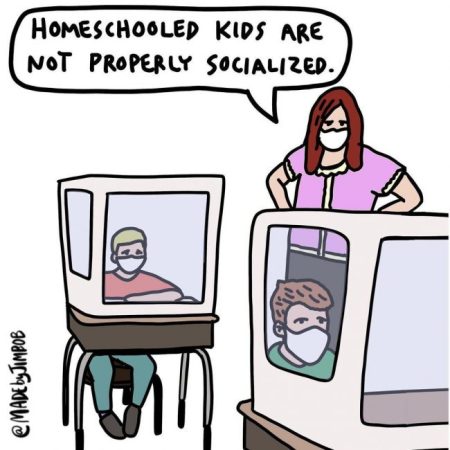
Many schools, when they finally reopened, had all kinds of mandates that made the schools insufferable. The mandates, while failing to protect people from coronavirus, did carry health dangers of their own. Mask mandates, obsessive disinfecting of surfaces at schools and even of children’s hands, enforcement of “social distancing,” the presence of ubiquitous plastic barriers separating people, coronavirus testing, and pressure or even mandates for students to take experimental coronavirus “vaccine” shots were among the nasty changes confronting students at their “new normal” schools. Students found themselves trudging through a real life version of a dystopian novel.
No wonder students’ learning suffered through the coronavirus scare. Learning was not high on the priority list of many politicians rushing to exercise their new powers. And, due to government pressure and bad choices by people in charge, the situation was similarly awful at many private schools as at government schools.
Fortunately, this dark cloud of politicians harming student’s educations in the name of countering coronavirus does have a silver lining, though only for a small subset of students. “Enough is enough,” decided some parents along the way of witnessing the school closures, the dysfunctional virtual learning efforts implemented to replace regular school, and the dystopian “new normal” schools that ultimately came into being. These parents took their children’s educations into their own hands, moving their children to homeschooling. The result is that many more children now than before the coronavirus scare are free from the politicians’ harmful meddling, whether undertaken in the name of protecting children from phantom coronavirus danger or accomplishing other objectives at variance with advancing the math and reading skills Biden mentioned at Twitter. It is a safe bet that most of these new homeschooling parents will do a much better job than the schools they left behind at making sure their children’s educations serve their children’s needs and interests.
Copyright © 2022 by RonPaul Institute
Family of Shireen Abu Akleh asks to meet with Biden

Raşid Necati Aslım/Anadolu Agency
MEMO | July 9, 2022
The family of slain Palestinian-American journalist Shireen Abu Akleh has accused the United States of providing impunity for Israel over her killing and asked to meet President Joe Biden in person during his trip to Israel next week, reports Reuters.
In a letter to Biden posted on Twitter on Friday, the family said the administration simply adopted the Israeli government’s conclusions over her death, which it described as extrajudicial killing while falling short of its own stated goal of ensuring full accountability.
“Your administration’s engagement has served to whitewash Shireen’s killing and perpetuate impunity,” said the letter, signed by her brother Anton Abu Akleh on the family’s behalf.
“It is as if you expect the world and us to now just move on. Silence would have been better.” The family asked to see all the information the administration has collected on the issue.
Abu Akleh was killed on May 11 during an Israeli raid in the occupied West Bank town of Jenin under bitterly disputed circumstances.
Last month the United Nations human rights office said evidence suggested Israeli military fire had killed Abu Akleh while she stood with other reporters and was identifiable as a journalist.
The State Department on Monday said she was likely killed by gunfire from Israeli positions but it was probably unintentional and independent investigators could not reach a definitive conclusion about the origin of the bullet that struck her.
Palestinian officials criticized the report and maintained she had been deliberately targeted by an Israeli soldier. Israel denied this.
In his first Middle East trip as president on July 13-16, Biden is expected to meet separately with Palestinian and Israeli leaders. The Abu Akleh case will be a diplomatic and domestic test for new Israeli Prime Minister Yair Lapid.
A group of 24 US senators in Biden’s Democratic Party last month urged him to ensure direct U.S. involvement in the investigation of Abu Akleh’s killing.
Dutch officer present at shooting incident goes into hiding
TCS Wire | July 7, 2022
A Dutch police officer present at the shooting incident on Tuesday (likely the one who shot at Jouke Hospes) has reportedly gone into hiding.
According to Leeuwarder Courant, at least one officer has been rehoused because the “atmosphere around him became too grim.”
“The man lives in a village in the municipality of Opsterland. He left the village under guard on Wednesday evening. His house will be secured on Thursday,” reports Leeuwarder Courant.
The incident occurred late Tuesday night, just before midnight, wherein fired two rounds at an unarmed teenager in his tractor who was leaving the scene of a protest.
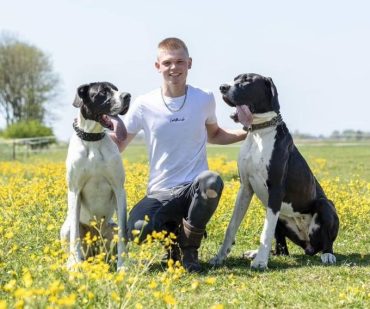 Jouke Hospes, the 16-year-old that was shot at by Dutch police for participating in a distribution centre blockade, says that he is currently under investigation for attempted manslaughter.
In a message obtained by The Counter Signal, Hospes says that he was shocked to see video of the incident that led to his arrest after being released from prison.
“I still can’t figure out why the police fired. The images [and video] show very well that I’m not doing anything wrong… I’m lucky that I survived.”
He continues, saying that he is now under an active investigation for attempted manslaughter.
“I have been released for the attempted manslaughter and am still a suspect tonight in my own bed,” Hospes says. [translated from Dutch]
Police are claiming that the teen attempted to ram into police and vehicles and [that they] had fired warning shots before firing two “targeted shots.”
“At about 10:40 pm, tractor drivers attempted to drive into officers and service vehicles. This happened at the entrance Mercurius/A32 in Heerenveen. A threatening situation arose. Warning shots were fired, and targeted shots were fired,” Politie Fryslân tweeted following the incident. [translated from Dutch]
“A tractor was hit. A tractor drove away from the incident and was stopped shortly afterwards on Jousterweg. Three suspects have been arrested. No one was injured.”
However, while police claim that Hospes attempted to ram into them before they fired two shots at him, video taken by onlookers tells an entirely different story.
Video shows that Hospes was driving very slowly in his tractor, was as far away from the officers as he could be without going off the road, and was clearly attempting to leave the scene without incident.
Hospes describes the moments leading up to his arrest, saying when farmers heard that a mobile police unit was going to do a sweep of the distribution centre blockade, they collectively decided it was time to break it up and were already starting to leave when police arrived on the scene.
“Behind me, it was clear, so I decided to go around it. I calmly crossed the sidewalk and drove very calmly. I went to see if traffic was approaching and if I could cross the road. I was driving [slowly], and suddenly I heard a PANG in my right ear. I thought there soon would be a second one.”
“I didn’t have any damage, so I thought it was a rubber bullet… However, I stopped for a while at Oudehaske, and when I was walking around the tractor, I saw a hole in the iron. All kinds of thoughts went through my head.”
Images taken after the shooting show clear bullet holes, suggesting that officers were using live rounds against protesters.
Hospes was later arrested and subsequently freed the next day after Dutch protesters showed up in droves outside the prison holding him.
As previously reported by The Counter Signal, the police’s actions come after several municipalities declared emergency ordinance orders, bestowing upon police unprecedented powers to deal with protesters blockading food distribution centres.
Since the orders were declared, police have been seen wearing military-style equipment, have used tear gas against protesters, and have now shown that they’re willing to fire on anyone, even a teenage boy.
Moreover, several videos have been taken across the Netherlands of heavily armed police waving pistols around at traffic stops, signifying a dark turn in the protests.
Every third Dutch farm to be closed down or expropriated!
Free West Media | July 6, 2022
CO 2 hysteria was so yesterday. In the Netherlands there’s now a nitrogen alarm. Ironically, at a time when the specter of food shortages and hunger is looming, the “Green Deal” of the all-powerful, misanthropic EU has prompted Commissioner Frans Timmermans to demand that ten percent of agricultural land be set aside across Europe.
In order to help this madness prevail, a Dutch “nitrogen problem” has been invented. On this basis, they want to force the livestock farmers – who are named as the main culprits – to give up their businesses. The Dutch “Minister for the Environment and Nitrogen”, Christianne van der Wal, announced that 30 percent of livestock farmers would have to give up their farms. Those affected now have the choice to give up their farms voluntarily and leave, or to pledge never to practice their profession again – only then would they be compensated. Those who do not comply face expropriation by the state. The aim is to reduce nitrogen emissions by up to 95 percent by 2030.
The Netherlands is the world’s fifth-largest exporter of food, exceeded only by the United States, Germany, the United Kingdom, and China, according to World Bank statistics.
So for at least a third of farmers it is a matter of survival. No wonder, then, that the protest is huge. For weeks, the angry farmers have been blocking roads and marching in front of government buildings to make their displeasure visible. Among other things, the access roads to some supermarkets were blocked. It was also announced that the access roads to the international airport in Amsterdam would be closed.
A few days ago farmers broke through a police barrier with their tractors and sprayed the minister’s house with liquid manure – symbolically the right thing to do because nitrogen is a building block for biological life on earth, the most abundant element in the atmosphere. It needs carbon, hydrogen, oxygen, lightning and bacteria, to provide “reactive” nitrogen. Fertilizer is just the workaround. Unbelievably, the Rutte government is targeting the manure people!
The mainstream media tried to sweep the issue under the carpet as tens of thousands of farmers took to the streets for days to demonstrate against EU regulations and government plans that would ruin Dutch agriculture. The police announced tougher action against the demonstrators, which, however, will probably only result in further escalation.
In Stroe alone, 30,000 farmers from all over the Netherlands came together to demonstrate against the government’s plans. In concrete terms, these plans stipulate that nitrogen emissions must be greatly reduced following a ruling by the highest court. In natural areas, the value is to be reduced by 12 to 95 percent, depending on the area category. According to government figures, this could mean the end for about a third of Dutch livestock farms, but it is much higher, farmers say.
The police meanwhile speak of a “threatening and unacceptable situation”. According to polls, about 45 percent of the Dutch population back the protests. In October, it was still 38 percent.
Shooting at protesters
The police fired shots at a farmers’ protest in Heerenveen on Tuesday evening. According to Facebook group Verzet Friesland, 16-year-old Jouke was shot at by police as he drove off with his tractor.
“The media are shouting that he drove into them, but it is very clear on camera that that was not the case. He just wanted to drive home.” Police opened fired on Jouke. Fortunately he was not injured, but the bullet missed him by two centimetres.
“The photos that are circulating show that the bullet(s) hit the cab of the tractor and missed Jouke by a hair. There was no shooting at tyres or in the air. It is by sheer luck that the police and the ministry responsible do not have a fatality on their conscience,” said lawyer Sietske Bergsma. Dozens of farmers tell the same story of police brutality.
Dutch anti-globalists are praying that this protest be the straw that break the Rutte camel’s back.
‘We Need to Be Allowed to Ask Questions,’ Says Canadian Prof Suspended for Questioning COVID Shots for Kids

By Julie Comber, Ph.D. | The Defender | July 5, 2022
A Canadian university professor suspended for comments he made during a December 2021 conference about COVID-19 vaccines in an interview this week with The Defender called for “openness, critical thinking and to stop believing what we are being told is the truth.”
“We need to be allowed to question again,” said Patrick Provost, Ph.D., an infectious and immune diseases researcher who learned June 13 that Laval University in Quebec City was suspending him for eight weeks without pay.
Laval University also suspended Nicolas Derome, Ph.D., a professor in the university’s biology department, for concerns he raised in November 2021 about Quebec’s campaign to vaccinate 5— to 11-year-olds.
In his interview with The Defender, Provost also discussed an article he wrote questioning COVID-19 policies, published June 22 on the Québecor media platform, then retracted a day later.
For the article, Provost used Quebec’s publicly available data to raise questions about the province’s management of the pandemic. The province of Quebec is home to about 8.5 million people, the second-most populous province in Canada.
“I was so happy when I found out my article was going to be published,” Provost told The Defender, “I really thought it would be a game-changer in the public debate about COVID-19 [in Quebec]. That finally, based on official public data, we could start to discuss the situation.”
However, by the next day, June 23, Québecor had removed Provost’s article from all of its websites.
Sébastien Ménard, publisher and editor-in-chief of the Journal de Québec, one of Québecor’s publications, tweeted (in French):
“Although we encourage debating ideas, we have decided to remove this letter [by Dr. Provost] from our websites. After verification, some of the elements it contained were inaccurate or could mislead the public, which we cannot support.”
Commenting on the retraction, Provost said:
“I’m really worried about the direction we are heading, about our democracy. Why hide the truth? These numbers are real, this was just my analysis of them. Maybe it’s a disturbing truth.”
Libre Média, a new Quebec-based independent media website, on June 24 published Provost’s article so it is still publicly available.
Libre Média prefaced the article with a note that it was publishing Provost’s article in full, “in accordance with its mission to protect freedom of the press.”
Criticism of COVID vaccines for young children led to suspension
Two days after Québecor removed his article, Provost went public with the news that Laval notified him on June 13 that the university was suspending him, effective June 14.
Provost filed a grievance through his union, the Union of Laval University Professors.
According to Provost, he sent an email to all his colleagues at Laval University last December, in which he urged them to engage in debates on COVID-19 vaccination and public health measures, because he felt public debate had been lacking.
In the email, he gave the example of a lecture he had given at a conference on Dec. 7, 2021, in which he criticized Quebec’s campaign to vaccinate 5- to 11-year-old children against COVID-19.
The conference was organized by Réinfo Covid Québec, a Quebec collective of caregivers, doctors and citizens “gathered around an idea: the need for a fair and proportionate health policy in Quebec and elsewhere in the world.”
“As a result of this, a professor from the faculty of medicine filed a complaint against me in January, outraged that I was raising questions,” Provost told The Defender. “In particular, that I said the risks of adverse effects [of Pfizer’s mRNA shot] outweighed the benefits for children.”
Provost said his suspension didn’t factor into Québecor’s decision this week to censor his article, as he had not made the news of his suspension public before the article was removed.
COVID mortality rate ‘greatly overestimated’ data show
In his article, Provost noted that the vaccine mandates for travel within Canada and for federal public servants had been suspended two days before, on June 20.
However, mandates could be reimposed, so Provost invited readers to consider a true portrait of the impact of COVID-19 in Quebec, based on the province’s own publicly available data.
As of June 19, when Provost accessed the cumulative data online, there were 15,462 deaths related to COVID-19 (Chart 2.1) out of a total of 1,077,256 confirmed cases of COVID-19 (Chart 1.1), for a calculated mortality rate of 1.44%.
Provost wrote:
“This mortality rate is greatly overestimated, mainly (i) by including, in the numerator, deaths with, and not because of, COVID-19, which were apparently as numerous, and (ii) by excluding, in the denominator, cases of asymptomatic or unreported infections, which were several times higher than the reported symptomatic infections.”
Provost then turned to official figures from the Institut de la statistique du Québec and the Institut national de santé publique du Québec (INSPQ), and made these five observations based on the data:
- There was no excess all-cause mortality since the beginning of the COVID-19 pandemic, except for people age 70 and over during the first wave (April to June 2020) and in January 2022, shortly after the lockdowns and curfews were imposed, which was also when the third vaccine doses were offered.
- More than 90% of people age 70 or older who died with or from COVID-19 had two or more pre-existing medical conditions (Table 2.2).
- 69.2% of the people who died were over the age of 80 (Figure 2.3), thus the average age of people who died with or from COVID-19 was beyond their life expectancy at birth.
- The number of deaths (Table 2.1) compared to the number of cases (Table 1.1) is 0.07% in people with no pre-existing conditions, 6 times higher in people with one pre-existing medical condition (0.4%), and 98 times higher in people with two or more pre-existing conditions (6 .9%), according to data last updated on May 2.
- Between 0 and 5 people under the age of 40 (with less than one pre-existing medical condition) have died in Quebec since the start of the pandemic (Table 2.2).
According to Provost, early on in the pandemic, the analysis of official government data showed two of the main risk factors for complications and death from COVID-19: “advanced age and the number of pre-existing medical conditions, in particular, obesity.”
“The threat of COVID-19 was very real,” wrote Provost, “but was it of the magnitude that we have been told?”
According to the public data available on the sites of INSPQ and of Quebec Data Partnership, from April 1, 2020, to March 31, 2021, there were 20,616 hospitalizations due to COVID-19 out of a total of 986,607 hospitalizations — so approximately 2.1% of hospitalizations were a result of COVID-19 infections.
At the worst point in the crisis, COVID-19 hospitalizations peaked at 5.9% of the total.
Given the above data, Provost asked if the public health measures taken were justified. He raised a series of questions, including:
- Did the data support imposing such severe and comprehensive health measures, rather than targeted ones that would protect those most at risk?
- Did the data justify not considering the collateral effects of restrictive health measures?
- Did the data justify preventing physicians from making individualized risk versus benefit assessments of a medical intervention (COVID-19 vaccination) with their patients?
Provost also asked if the data justified overriding the right of individuals to consent, in a free and informed manner, to an injection that is still experimental.
He questioned mass vaccination of the entire population for a disease that particularly affects the very old and sick, and of imposing vaccination on young people and workers.
Quebec used vaccine passports, and Provost asked if the data justified restricting the right to access public places and hindering the freedom of movement by train or plane of people who were not “adequately” vaccinated, “even though the shots do not prevent infection or transmission.”
With respect to governance, Provost said the government assumed power by self-proclaiming and perpetuating a state of health emergency and certain measures beyond the emergency period.
He noted that professionals and academics were muzzled if they were critical of health measures, through pressure from their professional organizations or their institutions, under penalty of losing their jobs.
He also pointed out that the polarized and polarizing media coverage sowed fear, anxiety and division, and that citizens were encouraged to discriminate against people who were not vaccinated against COVID-19.
As part of the remedy to what he viewed to be heavy-handed public health measures, Provost stressed the “importance of depoliticizing decisions that infringe on individual rights and freedoms by establishing, for example, by a Council of Scholars that is independent from the government, so that these decisions are based on science and are made more quickly.”
Provost closed his article by calling for a review of the management of the pandemic:
“An assessment of the management of this crisis, which has revealed the limits, even the flaws, of our system and our democratic life, is essential.
“We owe it to too many seniors whom we have failed to protect, as well as to those whose rights and freedoms have been violated for too long.”
Dozens of messages of support
Provost told the Defender that in the hours before his article was pulled, one idea was to have another professor write a rebuttal to his article.
But instead, Quebecor’s news sites simply deleted the article.
On Monday, Joel Monzée wrote an article in Libre Média about the censorship of Provost’s article and its implications for science. “Science is only science because it questions itself,” Monzée wrote.
Monzée said that with respect to the COVID-19 pandemic, “It is blithely claimed that there is a scientific consensus. However, this only exists because certain academic personalities seem to have enough influence over their colleagues to curb any questioning of the consensus, at least in public.”
Monzée asked, if there were inaccuracies in Provost’s article, then why not address them with a counter-analysis?
Provost is the supervisor of four Ph.D. students whose work has been affected by his suspension.
“Because of my suspension, I cannot go on the campus, enter the Research center or talk to them,” Provost said. “They are essentially left alone. They are collateral damage.”
Provost said that though the situation was difficult, in the past few days he had received dozens of messages of support, and also observed that a growing number of citizens “have a thirst for truth and openness.”
Provost told The Defender, “I would like to raise awareness about how our society is evolving, it’s not in a good direction. It is getting to the point where private interests will be directing our country, we will just be servants.”
© 2022 Children’s Health Defense, Inc. This work is reproduced and distributed with the permission of Children’s Health Defense, Inc. Want to learn more from Children’s Health Defense? Sign up for free news and updates from Robert F. Kennedy, Jr. and the Children’s Health Defense. Your donation will help to support us in our efforts.
15 years of failed experiments: Myths and facts about the Israeli siege on Gaza
By Ramzy Baroud | MEMO | July 5, 2022
Fifteen years have passed since Israel imposed a total siege on the Gaza Strip, subjecting nearly two million Palestinians to one of the longest and most cruel politically-motivated blockades in history. Back then, the Israeli government justified its siege as the only way to protect Israel from Palestinian “terrorism and rocket attacks”. This is the occupation state’s official line to this day, and yet not many Israelis — certainly not in government, the media or even ordinary people — would argue that Israel today is safer than it was prior to June 2007.
It is widely understood that Israel imposed the siege as a response to the Hamas takeover of the Strip, following a brief, violent confrontation between the movement, which is the current de facto government in Gaza, and its main political rival Fatah, which dominates the Palestinian Authority in the occupied West Bank. However, the isolation of Gaza was planned years before the Hamas-Fatah clash, or even the legislative election victory of Hamas in January 2006.
In fact, the late Israeli Prime Minister Ariel Sharon was determined to redeploy Israeli forces out of Gaza long before these dates, making the siege possible. Culminating in the Israeli disengagement from Gaza in August-September 2005, the plan was proposed by Sharon in 2003, approved by his government in 2004 and finally adopted by the Knesset in February 2005.
The “disengagement” was an Israeli tactic intended to remove a few thousand illegal Jewish settlers from occupied Gaza — to go to other illegal Jewish settlements in the occupied West Bank — while redeploying the Israeli army from crowded population centres in the Gaza Strip to the nominal border areas. This was the actual start of the Gaza siege.
The above assertion was even clear to James Wolfensohn, who was appointed by the Middle East Quartet as the Special Envoy for Gaza Disengagement. In 2010, he reached a similar conclusion: “Gaza had been effectively sealed off from the outside world since the Israeli disengagement… and the humanitarian and economic consequences for the Palestinian population were profound.”
The ultimate motive behind the “disengagement” was not Israel’s security, or even to starve the Palestinians in Gaza as a form of collective punishment. The latter was a natural outcome of a much more sinister political plot, as communicated by Sharon’s own senior advisor at the time, Dov Weisglass. In an interview with the Israeli newspaper Haaretz in October 2004, Weisglass put it plainly: “The significance of the disengagement plan is the freezing of the peace process.” How? “When you freeze [the peace] process, you prevent the establishment of a Palestinian state, and you prevent a discussion on the refugees, the borders and Jerusalem.”
Not only was this Israel’s ultimate motive behind the disengagement and subsequent siege of Gaza, but also, according to the seasoned Israeli politician, it was all done “with a presidential blessing and the ratification of both houses of [the US] Congress.” The US president at the time was none other than George W. Bush.
All of this took place before Palestine’s legislative election, Hamas’s victory and the Hamas-Fatah clash. The latter merely served as a convenient justification for what had already been discussed, “ratified” by Washington and implemented.
For Israel, the siege was a political ploy which acquired additional meaning and value as time passed. In response to the accusation that Israel was starving Palestinians in Gaza, Weisglass was very quick to reply: “The idea is to put the Palestinians on a diet, but not to make them die of hunger.”
What was then understood as a facetious, albeit thoughtless statement, turned out to be actual Israeli policy, as revealed in a 2008 report which was made available in 2012. Thanks to the Israeli human rights organization Gisha, the “redlines [for] food consumption in the Gaza Strip” — composed by the Israeli Coordinator of Government Activities in the Territories — were made known. It emerged that Israel was calculating the minimum number of calories necessary to keep Gaza’s population alive, a number that is “adjusted to culture and experience” in the Strip.
The rest is history. Gaza’s suffering is absolute, with 98 per cent of the Strip’s water undrinkable; hospitals lacking essential supplies and life-saving medications; and movement in and out of the territory more or less prohibited, with relatively few minor exceptions.
Even so, Israel has failed miserably, with none of its objectives achieved. Tel Aviv hoped that the “disengagement” would compel the international community to redefine the legal status of the Israeli occupation of Gaza. Despite pressure from Washington, that never happened. Gaza remains part of the Occupied Palestinian Territories as defined in international law.
Furthermore, Israel’s September 2007 designation of Gaza as an “enemy entity” and a “hostile territory” changed little, apart from allowing the Israeli government to carry out several devastating wars against the Palestinians in the enclave, starting in late 2008.
None of these wars have served a long-term Israeli strategy successfully. Instead, Gaza continues to fight back on a much larger scale than ever before, frustrating the calculations of Israeli leaders, a fact which became clear in the befuddled, disturbing language to which they resorted. During one of the deadliest Israeli wars on Gaza, in July 2014, right-wing Knesset member Ayelet Shaked wrote on Facebook that the war was “not a war against terror, and not a war against extremists, and not even a war against the Palestinian Authority.” Instead, according to Shaked, who a year later became Israel’s Minister of Justice, this was “a war between two people. Who is the enemy? The Palestinian people.”
In the final analysis, the governments of Sharon, Tzipi Livni, Ehud Olmert, Benjamin Netanyahu and Naftali Bennett all failed to isolate Gaza from the greater Palestinian body; break the will of the Palestinians in the Strip; or ensure Israeli security at the expense of the Palestinians.
Moreover, Israel has fallen victim to its own hubris. While prolonging the siege will achieve no short or long-term strategic value, lifting the siege, from Israel’s viewpoint, would be tantamount to an admission of defeat, and could empower Palestinians in the West Bank to emulate the Gaza model. This lack of certainty further accentuates the political crisis and lack of strategic vision that has defined all Israeli governments for nearly two decades.
Israel’s political experiment in Gaza has backfired, inevitably so. The only way out is for the siege of Gaza to be lifted completely. Not eased; lifted. Completely. And this time, for good.
Russia says Ukraine ‘tortured’ captured soldiers
Press TV – July 5, 2022
Russia says its soldiers recently released as part of a prisoner swap with Ukraine were “beaten” and “tortured with electricity in captivity.”
The Russian Investigative Committee, which probes major crimes, said in a statement on Tuesday that it was “verifying facts of inhuman treatment of Russia soldier prisoners in Ukraine.”
Moscow and Kiev exchanged 144 prisoners of war each last week.
The investigative committee said the freed Russian soldiers had told investigators about “the violence they had suffered.”
One of the soldiers, according to the Russian statement, said Ukrainian medics had treated him without applying anesthetics and that he was “beaten, tortured with electricity in captivity.” He said he was left without food and water for days.
Another Russian soldier said he was badly beaten and had his wound irritated by Ukrainian medics.
The Russian committee said the testimonies of the freed soldiers were examples of “violations of the Geneva Convention on prisoners of war.”
London wants social media to “proactively” tackle would-be disinformation from states such as Russia
Samizdat | July 5, 2022
London has proposed new legislation that would require social media to “proactively” tackle “disinformation” that allegedly pours into the UK from foreign states such as Russia and harms the nation, the government said on Tuesday. Platforms failing to do so will be subject to huge fines or could be blocked.
The legislation, which is subject to parliamentary approval, would oblige social media platforms to hunt down what the government believes to be fake accounts that act in the interests of foreign states and seek to influence UK politics, including elections.
The new amendment will also compel social media, search engines and other websites to crack down on such accounts in order to minimize the number of people exposed to “state-sponsored disinformation.”
“We cannot allow foreign states or their puppets to use the internet to conduct hostile online warfare unimpeded,” said Nadine Dorries, the UK culture and digital secretary, pointing out that the Ukraine conflict has shown that Russia is ready to weaponize information.
According to the proposed law, social media will have to make creating fake accounts more difficult and will also need to fight bots used for misleading the public. Ofcom, the British media regulator, will have the authority to fine any internet resources that don’t comply up to 10% of their global turnover.
The amendment is set be included in the National Security Bill, which will be discussed by British MPs next week.
This latest move by the UK government would directly target, for instance, the Russian pranksters known as Vovan and Lexus, who had pulled a stunt on UK Defense Secretary Ben Wallace and Home Secretary Priti Patel. As a result, their channel was banned by YouTube in late May.
On Monday, Russian Foreign Minister Sergey Lavrov criticized the West for harassment of Russian journalists, saying that Western countries have “buried the freedom of speech with their own hands.” In his view, Western governments intentionally create their own laws allowing them to decide what is “freedom of information” and what is “propaganda.”
Parents Catch FBI In Plot To Force Mentally Ill Son To Be A Right Wing Terrorist
By Matt Agorist | The Free Thought Project | August 17, 2017
It’s become a near-weekly occurrence. Somewhere in some state, the FBI will announce that they’ve foiled yet another terrorist plot and saved lives. However, as the data shows, the majority of these cases involve psychologically diminished patsies who’ve been entirely groomed, armed, and entrapped by FBI agents. Simply put, the FBI manufactures terror threats and then takes credit for stopping them.
While many of these cases have garnered attention and been exposed in the alternative media, a recent case out of Oklahoma sets a new low for FBI and exposes how insidious these plots can be.
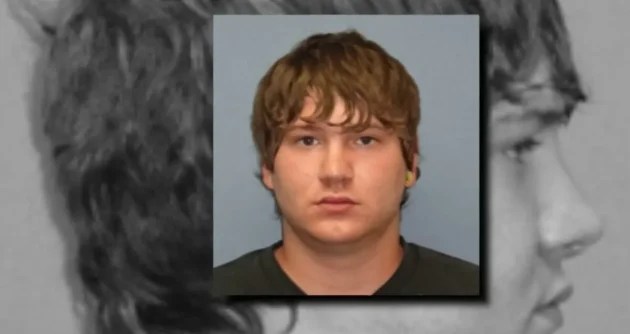
Through the hundreds of ‘foiled terror plots’ the FBI has ‘busted’ over the years, many of them have been focused on people of Middle Eastern descent or people associated with ISIS or al-Qaeda. This time, in the case of Jerry Drake Varnell, the 23-year-old diagnosed schizophrenic, accused of attempting to bomb a bank, the FBI fomented terror from a right wing dialogue.
In a June meeting with the agent, according to FBI documents, Varnell described himself as a believer in “Three Percenter” ideology, a right-wing group claiming to be committed to standing against and exposing corruption and injustice.
According to federal documents, Varnell drove what he believed was a stolen van containing a 1,000-pound ammonium nitrate bomb on Saturday morning to blow up an Oklahoma City bank. Vile, indeed.
However, if we backtrack just a bit, to when the FBI began grooming their would-be right-wing militia terrorist, the vileness comes directly from the government.
“The FBI knew he was schizophrenic,” Varnell’s parents declared on Wednesday in an open letter bravely published by NewsOK.
“Underneath his condition, he is a sweet-hearted person and we are extremely shocked that this event has happened. However, what truly has us flabbergasted is the fact that the FBI knew he was schizophrenic. The State of Oklahoma found him mentally incompetent and we, his parents have legal guardianship over him by the Court. These documents are sealed from the public, which is why no news media outlet has been able to obtain them. The FBI clearly knew that he was schizophrenic because they have gathered every ounce of information on him.”
Yet they knowingly continued to groom him, despite the clear immoral implications.
When they began grooming him, according to the family, the FBI knew that Varnell was declared mentally unfit to live by himself and that he was a paranoid schizophrenic. Without their criminal informant and the FBI tactics playing mind games with this vulnerable man, the idea of him committing an act of terror would have likely never materialized.
“What the public should be looking at is the fact that the FBI gave our son the means to make this happen. He has no job, no money, no vehicle, and no driver’s license, due to the fact that he is schizophrenic and we; his parents do everything we can possible to keep him safe and functional….. He has suffered through countless serious full-blown schizophrenic delusional episodes and he has been put in numerous mental hospitals since he was 16 years old. The FBI came and picked him up from our home, they gave him a vehicle, gave him a fake bomb, and every means to make this happen none of which he had access to on his own.”
The parents noted that during the setup, they suspected something was going on and Jerry’s father told the informant to stay away from their son. However, according to the parents, the informant “continued to sneak onto our residence. The FBI paid him to continue this operation and I believe they have cleared his criminal record.”
Because they knew Varnell had severe mental disabilities, the FBI should have had stopped their plans to do this and immediately sought an option of hospitalization. However, they pressed on.
Knowing a sane person would likely never attempt to blow up a bank, the FBI deliberately targeted a severely delusional and mentally ill person. This is wrong on so many levels. Will the next mass murderer they groom come directly from a mental institution?
“The FBI should have filed conspiracy on our son and had him committed to a mental institution. They should not have aided and abetted a paranoid schizophrenic to commit this act. There are many more facts that I will not make public that will support my son and the disturbing acts made by the FBI.
I realize that many will say my son could have found another person to commit this act. Yet, any person that has access to the materials and the state of mind necessary to bomb a building would not have any need for a schizophrenic who has no resources to contribute.”
Clifford and Melonie Varnell, Jerry’s parents make a powerful point. No one — other than the FBI — would’ve attempted to get a schizophrenic man with nothing to contribute to do their bidding as it would most likely be a futile effort — unless you are the FBI looking for an easy patsy to keep fear alive.
David Steele, a 20-year Marine Corps intelligence officer, the second-highest-ranking civilian in the U.S. Marine Corps Intelligence, and former CIA clandestine services case officer, had this to say about these most unscrupulous operations:
“Most terrorists are false flag terrorists, or are created by our own security services. In the United States, every single terrorist incident we have had has been a false flag, or has been an informant pushed on by the FBI. In fact, we now have citizens taking out restraining orders against FBI informants that are trying to incite terrorism. We’ve become a lunatic asylum.”
Indeed, we’ve become a lunatic asylum.
Featured Video
The American Retreat from Vietnam
or go to
Aletho News Archives – Video-Images
From the Archives
Secret document reveals plans for civil war in Lebanon, Israeli false flags, and invasion
By Randi Nord | Geopolitics Alert | April 5, 2019
Beirut – During his visit with US Secretary of State, Mike Pompeo, Lebanese President Michael Aoun reportedly received a US-Israeli document detailing plans for creating a civil war in Lebanon with covert false flag operations and possible Israeli invasion.
Although the source of the document is Israeli and created in partnership with Washington, no one knows who presented it to Aoun. The Lebanese TV station, Al-Jadeed, initially reported the document on Lebanese TV and a video on its website. Geopolitics Alert translated the report for this article. … continue
Blog Roll
 Aletho News
- ‘Distance yourselves from Israel’: IRGC urges US population to question govt policies
- America’s Greenland deal has a radioactive backstory
- The RAF Fairford ‘terror plot’: Unpacking escalation in the UK echo-chamber
- EU Council Advances Chat Control 2.0 Scanning Proposal
- Ex-Greek MEP files complaint against Israeli spyware firm over alleged Pegasus surveillance
- Troubling ideas throughout the Torah, Talmud, Mishneh Torah and Tanya
- ‘Grave, alarming’: Iran mission on Trump’s UNGA ‘annihilation’ threats
- Najaf airport to reopen to Iranian flights within 24 hours: Ambassador
- From ‘How Will This End For Iran’ to ‘When America Walks Away’: A tale of two Economist covers
- Tehran blasts ‘baseless’ speculation linking Iran to alleged bomb plot at UK air base
- If Americans Knew
- Revealed: German “Anti-Semitism Expert” Driving Crackdown on Palestine Solidarity is Former Israeli Spy
- Egypt’s Warning to Israel Before Oct 7
- Israel’s siege signals another cruel winter for 1.8 million Gazans – Daily Update
- Netanyahu Asked UAE Leader to Deny Report on Oct. 7 Warning in Secret Visit, Sources Say
- CNN Chief Int’l Correspondent Clarissa Ward on Journalists in Gaza
- Democratic Party Consultants Surround Troy Jackson with Pro-Israel Donors
- Christian Leader Responds To Netanyahu’s Claims Regarding Palestinian Christians
- In Gaza, ‘Whoever Survives the Bombing Won’t Survive the Rubble’
- Israel kills more Palestinians, amid push to resettle Gaza – Daily Update
- Israel forces Gazans to live in constant peril – Daily Update
- No Tricks Zone
- New Study: Earth And Venus Surface Warmth Largely Explained By Convection And Lapse Rate, Not CO2 Or Radiation
- 2025 Nature Paper Claiming Worsening Global Drought Gets RETRACTED …Heavily Flawed
- New Study: ‘Global Drought Shows No Detectable Recent Acceleration Under Climate Warming’
- Economic Masterminds: German Socialists Suggest Taxing Productivity Gains Stemming From Using AI
- The South China Sea Has Not Been Cooperating With The Climate Change Narrative
- Energy Crisis: Germany Enters Heating Season With Historically Low Gas Reserve Fill Levels
- New Study: The Antarctic Ice Sheet Gained Mass From 2020-2024 Due To Staggering Snow And Ice Accumulation
- Study: Ocean Heating Rates From Thousands Of Years Ago ‘Dwarf’ Modern Ocean Heating Rates
- Climate Extremists Target, Attack Large-Scale Power Grid Infrastructure In Germany!
- New Study: Antarctic Ice Melt Has Contributed Less Than 1 Centimeter To Sea Level Rise In The Last 30 Years

