Cop Kills Unarmed Man at His Place of Work Over Unpaid Traffic Fines then Gets Huge Promotion

By Claire Bernish | The Free Thought Project | February 2, 2016
Smyrna, GA — After killing Nicholas Thomas on March 24, 2015, under questionable circumstances at the Goodyear store where he was on the job, Smyrna Police Sgt. Kenneth Owens was cleared of any wrongdoing — and is now being promoted to Lieutenant.
“In a release sent to 11Alive News on Tuesday, the Smyrna Police Department confirmed that Owens is being promoted to the rank of Lieutenant effective Monday, February 15, 2016,” the local NBC affiliate reported; and according to that statement, “Sgt. Owens is eligible and qualified for this position as prescribed by departmental policy.”
Considering the questions still surrounding Thomas’ death, his family — as well as many others in the community and elsewhere — would likely beg to differ.
Thomas was working at the Atlanta Goodyear Service Center, when Owens and several other officers came to serve a warrant for an alleged probation violation by the young father — reportedly over traffic violations. Startled by those officers appearance at his workplace, Thomas reportedly jumped into a customer’s Maserati to flee.
“The suspect drove his car toward officers, putting officers in fear for their lives, at which time the officers fired into the vehicle, shooting the suspect,” said Smyrna Police Sgt. Ed Cason the following day, as 11Alive reported at the time.
However, questions arose when the Cobb County Medical Examiner found the bullet had entered Thomas in his upper right back — hardly the location or entry point one would expect if an officer fired into a vehicle because he thought it would run him over.
“Of all the officers there, only one felt his life was threatened,” said Thomas’ family lawyer Mawuli Davis, as The Free Thought Project previously reported. “Unless a car can travel sideways, I don’t know how you can be in fear for your life.”
The Georgia Bureau of Investigation and Cobb County Police Department both asserted the fatal shooting was “justified under the facts and the law.”
That fear of an imminent threat to an officer’s life — the justification for and cause of subsequent no-fault finding in this incident — appear to have been based on Owens’ hypothetical assessment of what Thomas was planning to do.
As Thomas careened around the store’s parking lot, looking for a way out since officers had blocked the only vehicle entry and exit point, Owens and other police jumped out of the way — but he claimed he feared an approaching officer might be struck by the vehicle if Thomas rounded the corner of the store quickly, so he decided to open fire.
Despite these lingering questions surrounding the killing of Thomas, as well as a seemingly loose interpretation of Georgia law, Sgt. Owens will soon be promoted to Lt. Owens — apparently indicating a continuing of the trend of impunity under any circumstances for police in the United States.
And why not? Cops ‘fearing for their lives’ and then killing fleeing motorists seems to be the norm in Police State USA.
Seneca Police Lt. Mark Tiller made the same assertion when he shot and killed 19-year-old Zachary Hammond over the possession of a small amount of marijuana. Officer Ray Tensing was caught on video killing Sam Dubose in a similar fashion. In September, cellphone footage was released showing police murdering 33-year-old John Barry, a mentally ill man who attempted to flee from police during a breakdown.
One of the most disgusting examples of cops claiming to fear for their lives as cars drive off is the case of Officers Derrick Stafford and Norris Greenhouse, Jr., who, in November, opened fire on a car occupied by 6-year-old Jeremy Mardis, killing him and severely injuring his father.
Gerald Caplan: Justifying Paul Kagame’s Repression in Rwanda
By Yves Engler | Dissident Voice | February 2, 2016
The Globe and Mail’s recent coverage of Rwanda has been schizophrenic. While South African-based correspondent Geoffrey York has done important work detailing how Paul Kagame’s government has assassinated its opponents and contributed to violence in Eastern Congo, columnist Gerald Caplan has justified its repression and echoed Kigali’s position on regional conflicts.
At the start of January York reported on two new books describing the totalitarian nature of President Kagame’s regime. “Village informers”, wrote York. “Re-education camps. Networks of spies on the streets. Routine surveillance of the entire population. The crushing of the independent media and all political opposition. A ruler who changes the constitution to extend his power after ruling for two decades. It sounds like North Korea, or the totalitarian days of China under Mao. But this is the African nation of Rwanda – a long-time favourite of Western governments and a major beneficiary of millions of dollars in Canadian government support.”
A year and a half ago York wrote an explosive investigation headlined “Inside the plots to kill Rwanda’s dissidents”, which provided compelling evidence that the regime had extended its assassination program, killing (or attempting to) a number of its former top officials who were living in South Africa. Since the initial investigation York has also reported on Rwandan dissidents who’ve had to flee Belgium for their safety and revealed that Ottawa failed to act after UN and Spanish court investigations concluded Canadian priests Guy Pinard and Claude Simard were killed by soldiers loyal to Kagame in the mid-1990s.
At the end of 2012 York reported on Rwanda reasserting control over the mineral rich Eastern Congo. In one of a number of insightful articles York described how “Rwandan sponsored” M23 rebels “hold power by terror and violence.” The rebel group added “a [new] layer of administrators, informers, police and other operatives” in and around the city of Goma in part to “bolster” its “grip on the trade in ‘blood minerals’.” (In 1996 Rwandan forces marched 1,500 km to topple the regime in Kinshasa and then re-invaded after the Congolese government it installed expelled Rwandan troops. This led to an eight-country war between 1998 and 2003, which left millions dead.)
While York has done what investigative journalists are supposed to do — comfort the afflicted and afflict the comfortable — unfortunately the Globe also publishes regular columns by an author who seems to strive for the exact opposite in the case of Rwanda.
Gerald Caplan recently wrote about political conflict in Burundi, invoking Kagame’s rhetoric of “genocide” all the while ignoring Rwanda’s role in organizing armed opposition to the Burundian government. In support of Kigali’s aggressive regional posture, Caplan continues to repeat Kagame’s rationale for unleashing mayhem in the Congo two decades after the mass killing of Rwandan Tutsi (and Hutu) in 1994. In a 2014 column he wrote: “In the Congo former génocidaires lead a violent anti-Kagame militia dedicated to ‘finishing the work’ of the hundred days.”
In another column Caplan justified the arrest of presidential opponent Victoire Ingabire and criticized the Law Society of Upper Canada after it called for the release of her American lawyer, who was also imprisoned.
And strangely, for a former NDP strategist, Caplan has sought to muzzle media that disagree with the current government’s version of Rwandan history. In 2014 he signed an open letter condemning the BBC documentary Rwanda’s Untold Story and a year earlier wrote a piece about lobbying the University of Toronto to remove the Taylor Report, a program on campus radio, from air because it hosted critics of the Rwandan government.
Caplan has failed to inform readers about his ties to the regime in Kigali. He started an organization with Rwanda’s current Foreign Minister Louise Mushikiwabo and said he stays at her family’s hotel when visiting the country. Caplan has also spoken at a number of events in Kigali and New York organized by the Rwandan government.
So, who to believe? York or Caplan? Is Kagame a saint or dictator?
My money is on the investigative journalist.
Turkish civil servants asked to report ‘insults’ against president & top officials to police
RT | February 3, 2016
The governor’s office in Isparta, southwestern Turkey, has reportedly sent a request to all state institutions in the province instructing staff to report cases of “insulting” President Recep Tayyip Erdoğan and other top officials straight to the police.
Insulting the president is considered a crime in Turkey and the punishment can be up to four years in jail.
“According to Articles 299 and 125 of the Turkish Penal Code [TCK], an action must be taken for the posts [on social media] including insults against our president and other senior government officials, which have increased lately in direct proportion to the increase in terror activities in our country,” the notification, signed by Isparta Deputy Governor Fevzi Güneş on behalf of Isparta Governor Vahdettin Özkan, stated, Today’s Zaman reported.
The government began its crackdown on Kurdish fighters from the Kurdistan Workers’ Party (PKK), outlawed by Ankara, last July. Turkey’s authorities maintain those killed during the security operation in the southeast were all PKK members. According to Turkish human rights groups, however, more than 160 civilians were killed during the government offensive.
President Erdogan has publicly vowed to continue the operation until the area is cleansed of Kurdish militants. Kurds have long been campaigning for the right to self-determination and greater autonomy in Turkey, where they are the largest ethnic minority.
In mid-Januray, Turkey arrested over a dozen academics for signing a declaration denouncing Ankara’s military operations against Kurdish militants. The move came after over 1,200 scholars were under investigation for criticizing the Turkish State. They were accused of allegedly participating in “terrorist propaganda” after signing a declaration condemning military operations against Kurdish rebels in the southeast. Erdogan described the group of academics as “poor excuses for intellectuals.” He insisted human rights violations in the southeast of the country were being carried out by referring to the Kurdish rebels, not by the state.
The day after Erdogan urged prosecutors to investigate academics, who signed the declaration criticizing military action in the country’s mainly Kurdish southeast, Kemal Kilicdaroglu, leader of the main opposition Republican People’s Party’s (CHP), called the Turkish president “a dictator.”
In January, a local Turkish court dismissed Recep Tayyip Erdogan’s appeal against Kilicdaroglu. The Turkish president was seeking damages after the opposition party leader called him a “thief.” Erdogan’s lawyers demanded 200,000 Turkish lire ($66,000) in damages, saying this was an “attack on his personal rights.”
On Monday, an Ankara court sentenced another Turkish politician Hüseyin Aygün, a former deputy from the CHP party, to 14 months in prison for “publicly insulting” Prime Minister Ahmet Davutoğlu. Aygün rejected all accusations, Haber Turk reported.
The Republican People’s Party has repeatedly accused the government of using counter-terror laws to persecute journalists, saying 156 were arrested in 2015, with 484 legal actions launched against journalists and 774 fired during the year.
Aygün was sentenced to nine months in jail for “inciting people to enmity or hatred or denigration,” Müslim Sarı, another former CHP deputy, wrote on his Twitter.
“This ruling is clear evidence that there [is] no freedom of thought and expression in Turkey and judicial independence has ended too,” Sarı said in another tweet.
Late last month, a Turkish court sentenced a female teacher to almost a year in prison for making a rude gesture at Erdogan (when he was prime minister) at a political rally in 2014.
“The situation for freedom of expression is at an all-time low,” Andrew Gardner, Amnesty’s Turkey researcher, told the Times. “Countless unfair criminal cases have been brought, including under defamation and anti-terrorism laws — even children have been remanded in pre-trial detention,” he said.
Over 50 Israeli violations against Journalists in January
There are now 18 Palestinian journalists in Israeli prisons
Palestine Information Center – 3-2-2016
GAZA – The media and press teams that try to cover the Israeli violence in the West Bank, Jerusalem, and Gaza Strip are facing escalating violations at the hands of the Israeli army and Palestinian security forces.
The Palestinian Radio and Television Stations Union documented in its report for January, 2016, more than 45 violations against journalists and media correspondents.
This includes arrests, extension of detention, direct assaults in the field, and prevention from media coverage, in continuous attempts to distort the truth about the Israeli terror against Palestinians.
According to the Union, the arrests, detentions, extension of detentions, summoning to investigations, and breaking into houses during January reached 10 cases.
The Israeli forces arrested the journalist Mujahid al-Sa’adi, correspondent of Palestine Today TV channel, and extended his detention three times so far in January.
In addition, Israeli soldiers arrested the sports journalist at al-Khalil radio channel, Mahmoud al-Qawasmi.
These violations also reached the journalists Mohammed Matar, Musab Shawer, and Abd al-Karim al-Ouiui. In January, the Israeli forces brutality against journalists in the field increased, as the media crews attempted to cover the Palestinian weekly protests.
Nine Israeli assaults, that resulted in injuring two Palestinian journalists, were documented. Seven other press photographers choked on teargas.
Moreover, three cases of harassment and prevention from coverage were documented. Israeli forces also thwarted a press conference in Jerusalem, and a cultural meeting.
The house of Muhanned Halami was also blown up without media coverage. In respect to the incitement campaigns, 11 violations were documented.
The Israeli Shin Bet accused the Palestinian Authority’s media of inciting and encouraging the Palestinian individual operations against Israelis.
A European institute also accused ten journalists and bloggers of being agitators for supporting the Palestinian resistance in their writings.
Regarding the prosecution of journalists on cyberspace, two cases were documented.
Two Facebook pages were closed and a number of pro-Palestinian cartoons were deleted. The Palestinian journalist prisoner, Mohammed al-Qeiq, who has been on a hunger strike for more than 70 days, has suffered ten violations.
These include torture, forced-feeding, handcuffing to hospital bed, and intense presence of security in the hospital where he is staying to prevent his lawyers from talking to him, and continuing his administrative detention in the Israeli jails.
The report stated that there are now 18 Palestinian journalists in the Israeli prisons.
According to the same report, a journalist, Ayman Al-Aloul, and an activist, Ramzy Herzallah, were summoned for interrogation by Gaza security forces who later released them after a brief detention.
Meanwhile, Palestinian Authority forces arrested Momen Abu Duheir and Nablus TV director Salim Swidsan.
PA forces also summoned for interrogation Abdullah Oda, threatened Riham Al-Omary, and assaulted Sami Saa’y.
Washington gives Israel $100 million to uncover Gaza tunnels
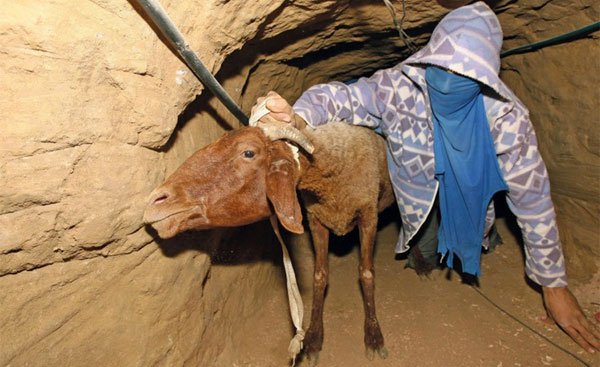
The tunnels are a lifeline for those who live in the beseiged Gaza Strip as they are used to smuggle vital supplies
MEMO | February 2, 2016
Director of Political-Military Affairs at Israel’s Defence Ministry Amos Gilad revealed today that the United States has contributed over $100 million to an Israeli-US technology research project aimed at identifying and locating tunnels on the Gaza Strip border.
In an interview with Army Radio this morning, Gilad stated that intelligence information suggests that there are no such tunnels leading into Israeli territory at the moment.
Defence Ministry official Shalom Gantzer dispelled the fears of Israelis living around the Gaza Strip who have claimed to hear digging noises under their houses, saying that these noises are coming from an electric generator.
Israel’s Channel 10 showed interviews on Saturday with those living near the Gaza border area who had recorded the noises with their mobile phones. They claimed that these noises were the sounds of tunnels being dug from Gaza.
Israel launches electronic war against ‘global boycott movement’
MEMO | January 29, 2016
The Israeli government has vowed to launch an “electronic war” against Boycott, Divestment and Sanctions (BDS) movement, including monitoring, tracking and thwarting their activities in cyber space, as well as attacking it with “special sophisticated tools”.
Israel Hayom newspaper reported: “Israel is facing a campaign to de-legitimise it. It penetrates into a certain extent; up to the secretary-general of the United Nations,” noting that it is a new battle in its “own stadium: the cyber space”.
It quoted the Israeli Minister of Strategic Affairs, Gilad Erdan, as saying that the statements of the UN Secretary General Ban Ki-moon, during which he called for ending the occupation of the Palestinian territory, contributes to “distorting Israeli image globally”.
During the Cyber Tech Conference 2016, held in Tel Aviv, Erdan added: “BDS should be forced to defend themselves and not to attack Israel,” noting that his government has allocated more than 100 million shekels ($25 million) for its “electronic war”.
The head of the Institute for National Security Studies, General Amos Yadlin, said: “The most dangerous country in the Middle East is the state of Facebook.”
“Those who will lead the United States in 20 years’ time are learning today in universities where anti-Israel propaganda exists.”
Also read:
Feds: We can’t disclose FBI records because then public would know how FBI works
PrivacySOS | February 1, 2016
Granting the ACLU and the public access to staffing, budgetary, and statistical information about the Boston Joint Terrorism Task Force (JTTF) and FBI would mean “the public would know where the FBI was putting its resources,” warned an Assistant US Attorney in oral argument in a Boston federal court last week. The government apparently doesn’t want the public to know anything about how the FBI and JTTF spend public money, staff its offices, or conduct investigations.
Heaven forbid the public “know where the FBI [puts] its resources.”
In December 2013 the ACLU of Massachusetts sent a FOIA request to the FBI, which sought basic information about the structure and operations of the Boston JTTF and the Boston FBI field office. Amid the information the FBI redacted from its responsive disclosures were all budget figures, the number of FBI and state and local officials tasked to work on the Boston Joint Terrorism Task Force (JTTF), and the number of assessments, preliminary investigations, and full investigations the Boston FBI conducted over two years ago. (It’s odd that the government is putting up a fight, resisting disclosure of these records, given that in 2011, it gave Charlie Savage of the New York Times similar information.)
According to the government, this information is exempt from public disclosure under FOIA law pursuant to Exemption 7e, the part of the federal statute that says agencies do not have to disclose records that would reveal law enforcement “techniques” or “procedures.” But as ACLU of Massachusetts staff attorney Jessie Rossman argues, staffing, budgetary, and statistical information about caseloads do not reveal techniques or procedures.
The stakes for the public are high. If the court agrees with the government’s reasoning and denies the public access to this information, it would put the federal judiciary’s stamp of approval on what attorney Rossman rightfully argues the FBI is seeking in this case: “a categorical [FOIA] exemption for all law enforcement information.”
As Rossman said last week during oral argument, that’s not what congress intended when it wrote the Freedom of Information Act. If lawmakers intended to bar the public from accessing all law enforcement records, they would have written that into the FOIA statute—which they didn’t.
At issue in the ongoing litigation over FBI redactions is whether the public can hold law enforcement agencies accountable for how they spend our money and act in our names. If we don’t know anything about how law enforcement agencies operate, we can’t hold them accountable. Unaccountable law enforcement is not only bad for freedom; it also harms public safety. As history demonstrates, when the FBI is allowed to conduct its business in the dark, precious government resources are inevitably dedicated to spying on people who threaten the status quo, but who do not threaten their fellow Americans.
While antidemocratic in the extreme, it’s easy to understand why the FBI wants to keep budget, staffing, and investigations statistics secret from the public.
When the public learned about the FBI’s illegal and antidemocratic COINTELPRO operations in the 1970s, the attorney general imposed rules forbidding the FBI from spying on people unless agents could show the targets were likely violating the law. After 9/11, those rules were scrapped. The new guidelines allow FBI agents to open investigations (called “assessments”) against people absent any suspicion of wrongdoing. Since the 9/11 attacks the Bureau has been free to spy on people it doesn’t suspect of criminal activity, supposedly because suspicionless investigations are required during the permanent “war on terror.”
The ACLU is litigating for this information because we want to know what results from the FBI’s suspicionless investigations, known as assessments. If it’s true, as we suspect, that there are thousands of FBI assessments but comparatively few preliminary or full investigations—let alone arrests or successful prosecutions—it confirms what we and other civil libertarians have been saying for over a decade. Namely, allowing the FBI to spy on people absent criminal predicates isn’t just bad for civil liberties; it’s bad law enforcement. If agents are routinely chasing down leads that go nowhere, those agents are wasting their time spying on ordinary people on the public’s dime.
The FBI refuses to give us this information, which is part of the reason we sued. In essence, the government argues the information must remain secret because if disclosed, it will tip off terrorists to… the fact that the government wants to investigate crimes.
But hiding from the public records revealing how many assessments, preliminary investigations, and full investigations the Boston FBI office has conducted doesn’t protect public safety. Instead, it obstructs precisely the kind of public accountability that would make the FBI better at protecting the public from people who mean us harm. […]
Only when law enforcement agencies are subject to rigorous transparency can the public hold them accountable for their actions, thereby making them more effective at protecting public safety.
The FBI has a long and dirty history of spying on dissidents and activists, instead of investigating and building cases against people who do real harm to Americans, like the bankers who collapsed the US and world economy in 2008. So it’s easy to see why the government doesn’t want the public to learn any meaningful information about the inner workings of the Bureau. But government agencies can’t keep information secret from the public because it would reveal something embarrassing or unconstitutional. And the records at issue don’t reveal “techniques” or “procedures.”
Here’s to hoping the federal court agrees, and compels the FBI to release this basic information about how it spends our money and acts in our names. Only then will we have any meaningful access to judge how the Bureau is conducting itself, and so the opportunity to exert some democratic accountability over its operations.
Al-Alam says YouTube account blocked under Saudi pressure
Press TV – February 2, 2016
Video-sharing website YouTube has reportedly blocked an account belonging to Iranian Arabic-language news network Al-Alam under pressure from Saudi Arabia, the TV channel says.
Al-Alam reported Monday that YouTube had closed its account after the Broadcasting Services of the Kingdom of Saudi Arabia (BSKSA) lodged a complaint against the Iranian TV.
The report also slammed the move as “unprecedented and unprofessional,” saying Al-Alam’s YouTube account was blocked without any prior notice and based on “unfounded claims.”
The network denounced YouTube’s move in taking down Al-Alam’s page as a “breach of regulations and technical protocols.”
This is not the first time the Saudis have taken action against the Iranian news channel.
Earlier last year, Saudi hackers overtook Al-Alam Twitter account and its YouTube network, posting items in support of Saudi Arabia’s military campaign against Yemen.
Al-Alam is one of the leading foreign-language news channels operated by the Islamic Republic of Iran Broadcasting (IRIB), which also runs the English-language Press TV and the Spanish-language HispanTV.
The network has a vast following in the Persian Gulf countries and elsewhere among the Arab audience.
Son of Argentine Indigenous Leader Charged for ‘Threats’
Activist Sergio Chorolque was hit with charges just days after his mother was ordered to remain behind bars

Human rights advocates that support Chorolque have alleged the charges are motivated by him and his mother’s activism. | Photo: Diario Veloz
teleSUR – January 31, 2016
The son of a prominent Argentine indigenous activist was charged Saturday on allegations his advocates say are politically motivated.
Sergio Chorolque is accused of issuing death threats to a municipal worker, and could face up to two years imprisonment.
Human rights advocates that support Chorolque have alleged the charges are motivated by his and his mother’s activism.
Chorolque’s mother Milagro Sala has already been described by some human rights activists as the first political prisoner of the new government of President Mauricio Macri.
The well-known indigenous leader, founder of the 70,000 member Tupac Amaru organization, was arrested on January 16 in the Jujuy on charges of inciting violence after protesting in a month-long sit in against Governor Gerardo Morales, who ordered her arrest.
A judge cleared Sala of those charges on Friday, but before she walked out of jail she was handed down a new set of accusations and ordered to stay behind bars while investigations into charges of “illicit association, fraud, and extortion” are launched at the request of the Jujuy government, local media reported.
As authorities peg various charges on the popular social leader, now one of Sala’s children has been charged with leveling death threats against a labor activist.
According to the conservative Argentine newspaper La Nacion, Morales has had a tense and “estranged” relationship with Sala for years. Morales has also had an antagonistic relationship with the social organizations and collectives with which Sala is aligned. Before her arrest, Sala was protesting in support of various organizations at risk of losing their legal status and social benefits after Morales threatened to suspend them via decree.
Sepur Zarco Trial: Guatemala Women Seek Justice for Sex Slavery
teleSUR – January 30, 2016
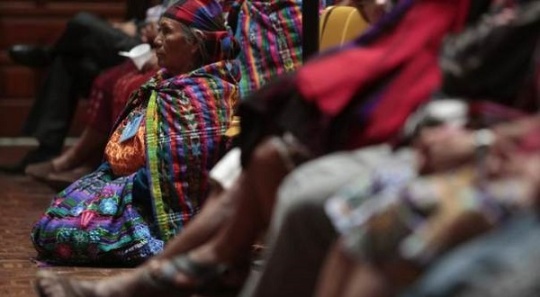
Fifteen Mayan women who were raped and forced to be sex slaves after their husbands were disappeared are demanding justice 30 years after the abuses.
Guatemala is about to launch a landmark trial against former military officers accused of committing sexual enslavement and forced disappearance during the most brutal years of the country’s 36-year civil war.
Here’s what you need to know about the historic trial that is scheduled to kick off Monday, Feb. 1.
1. Fifteen women were sexual and domestic slaves.
Guatemalan soldiers forcibly disappeared 15 men from an eastern Maya Q’eqchi’ village in 1982. It was one of the bloodiest years of Guatemala’s civil war, when dictator Efrain Rios Montt’s military regime was unleashing a scorched earth campaign targeting rural Mayans. After the army disappeared the men, they came back for their wives.
The women were raped and their belongings destroyed. They were taken captive and forced to live at the Sepur Zarco military base, where they were enslaved as domestic servants for the soldiers and systematically raped. The women were forced to labor in 12 hour “shifts,” an abhorrent system that lasted several months.
Though the enslaved shifts ended at the end of 1983, 11 of the 15 women were forced under military threat to stay at Sepur Zarco doing domestic chores for the soldiers for six years until the base closed in 1988. The other four women managed to flee to the mountains with their children where they endured painful hardship for years, including suffering the deaths of most of their children.
All of the women, now in their 70s and 80s, bear enormous physical and emotional trauma from the experience. They also faced stigma in their communities for the violence they endured, and did not share what had happened to them for 30 years, finally coming forward in 2011 to seek justice.
The trial accuses two defendants, former Sepur Zarco chief Esteelmer Reyes Giron and former regional military commissioner Heriberto Valdez Asij, of committing crimes against humanity, including sexual violence and sexual slavery, domestic violence, murder, and forced disappearance. They have been held in remand since 2014 awaiting the trial.
2. The Sepur Zarco case is an internationally historic trial.
The trial of two former military officers for crimes against humanity marks the first time in history that sexual slavery charges are prosecuted at the national level, in the country where the crimes were committed.
The more internationally high-profile case of sexual slavery during armed conflict, the case of Japan’s “comfort women,” was rejected by a Japanese court. Former comfort women subjected to sexual slavery during World War II put Japan on trial in a mock war crimes tribunal in Tokyo in 2000, but the case never officially went to court in the country.
Guatemala’s Sepur Zarco trial could set a new precedent for prosecuting sexual violence in the context of armed conflict, which rights defenders say is one of the most widespread yet under-recognized violations of human rights.
3. It is also a historic trial for Guatemala.
The Sepur Zarco trial marks the first that that Guatemala will consider a sexual violence case as an international crime, which could set a precedent for future trials.
The crime of sexual slavery has been recognized internationally since the early 1900s, when the 1907 Hague Convention prohibited rape and the use of prisoners of war as slaves. The 1926 Slavery Convention elaborated anti-slavery laws with a definition that applies to sexual slavery. The Rome Statute of the International Criminal Court, which came into force in 2002, specifically criminalized sexual slavery.
A standing definition of sexual slavery was detailed in the 1998 U.N. Special Rapporteur’s final report on contemporary forms of slavery, “Systematic Rape, Sexual Slavery, and Slavery-Like Practices During Armed Conflict,” also known as the McDougall Report.
The report defined sexual slavery as “the status or condition of a person over whom any or all of the powers attaching to the right of ownership are exercised, including sexual access through rape or other forms of sexual violence.” More simply put, the McDougall report explained: “Slavery, when combined with sexual violence, constitutes sexual slavery.”
The trial will consider the crimes committed as war crimes and crimes against humanity.
Rape was widespread during the civil war. The Sepur Zarco case has the potential to be a precedent-setting trial to break the cycle of impunity for sexual violence in Guatemala.
4. Rape was a concerted strategy in the civil war.
In 1999, three years after the peace accords were signed in Guatemala, the U.N.-backed Truth Commission investigating civil war atrocities found that rape was systematic and widespread during the conflict. According to the commission, “the rape of women, during torture or before being murdered, was a common practice aimed at destroying one of the most intimate and vulnerable aspects of the individual’s dignity.”
The Truth Commission also found that violence against women, include rape, torture, and murder, was often motivated by their political affiliations, social participation, and ideals, and often combined with other human rights abuses. The report attributed 93 percent of all recorded human rights violations to the state, 85 percent for which the army was responsible.
Despite the countless cases of sexual violence during the civil war, the Sepur Zarco case is the only one that has gone to trial in the country where impunity for war crimes has long remained the norm.
According to the Guatemalan organization Women Transforming the World, sexual violence continues to be inflicted on women by state security forces in conjunction with other human rights violations, such as forced displacement.
5. The victims in Sepur Zarco were targeted for defending their land.
Maya Q’eqchi’ communities in Guatemala have long suffered deep inequality, poverty, and precarious access to land. Before they were disappeared in 1982, the 15 husbands of the victims in the Sepur Zarco case were fighting for legal titles to defend the land they had lived and worked on for years. Because they were standing up for their land rights, they were despised by local large landowners, labeled as leftist insurgents, and made into targets to be silenced.
Land conflicts and unequal ownership are central to the history of Guatemala’s civil war. In 1954, a CIA-backed coup ousted the democratically elected president and reversed the fledgling agrarian reform program that aimed to expropriate idle lands from elite landowners and redistribute land to campesinos. The coup not only triggered more than three decades of civil war, but also helped to lock in one of the most unequal land distribution patterns in Latin America.
Rios Montt’s U.S.-backed bloodshed was nominally a campaign to crush leftist guerrilla uprisings in Guatemala, but in practice many poor Mayan campesinos were targeted as “insurgents” as the military protected the interests of elite landowners.
Photo credit – Reuters
Featured Video

John Mearsheimer Talking Iran with Iran
or go to
Aletho News Archives – Video-Images
New Book
The silver that medicine dropped — four thousand years of clinical use, four decades to erase.
Colloidal Silver — First Edition, 2026, Paperback
Lies are Unbekoming | October 16, 2026
Silver was medicine. Not alternative medicine. Not folk medicine. Medicine. In surgery. In obstetrics. In the burn ward. In water treatment. In the household medicine chest. Every physician before 1938 knew this.
By the 1870s, silver nitrate was standard in surgical wound care across the leading hospitals of Britain, Germany, and the United States. Colloidal silver preparations — Collargol, Argyrol, Protargol — entered European and American practice through the 1890s and early 1900s and became standard antiseptics in military field medicine. By the time Fleming grew his first penicillin mould in 1928, silver was the first-line antimicrobial of the Western pharmacopoeia. The Lancet and the British Medical Journal carried the clinical reports in volume. The practice ran continuously through the Victorian era, the Edwardian era, the First World War, the interwar period. By 1980, almost all of it was gone.
What has not been treated at book length, until now, is how a four-thousand-year clinical record disappeared from mainstream medicine within four decades of the Flexner Report — and what the honest account of silver looks like once that record is reassembled.
Colloidal Silver reconstructs the pre-1938 record from The Lancet, the British Medical Journal, and the primary literature of the era; recovers Robert Becker’s bioelectric framework from the regeneration research the pharmaceutical model buried; and places silver inside a practical terrain-paradigm guide to its current place — in water, on the body, inside the body, and in the chronic conditions where antibiotics have failed. … continue
Blog Roll
 Aletho News
- Pharma- and Gates-Funded GAVI Seeks to Assure Parents
- John Mearsheimer Talking Iran with Iran
- Inside Bill C-22, Canada’s Patriot Act.
- China’s FM: Palestinian cause is ‘greatest injustice of the century’
- US sympathy for Palestinians surpasses support for Israelis
- Israeli rabbi permits occupiers to steal Palestinian olive harvest in West Bank
- Spanish firm sells Latvia vehicles equipped with Israeli tech despite arms embargo
- Saudi Arabia under fire… Yemen is burning down the House of Saud
- Israeli Spy Pollard stole the files, today’s it’s delivered through official channels
- Why Iran Didn’t Walk Away
- If Americans Knew
- NPR investigation finds evidence of widespread fraud at mall kiosks tied to Israeli skincare brand
- Tucker Carlson exposes Israeli Lies about the Oct 7th attack, Charlie Kirk, and the U.S.
- Israel has detained thousands of Palestinian children since Oct 7th – over half spent time in solitary, many uncharged
- Israeli Analysis: Is Netanyahu Planning an ‘October Surprise’ Attack Before Israel’s Election?
- Israeli settlers brutally attack Palestinians and Washington Post female photographer, 65
- Words Have Changed, Occupation Continues: The Reality of the Gaza Ceasefire
- Gaza’s child amputees are growing faster than their prosthetics allow
- Israel keeps Palestinians struggling just to survive–Daily Update
- Israeli firm used online ads to run vast spy operation, researchers say
- No, the world zionist movement is not an antisemitic conspiracy theory
- No Tricks Zone
- New Study Suggests Large Regions Of The Pacific Ocean Have Been Cooling For The Last 80 Years
- Germany’s Green Energy Debacle: High Energy Costs Force Kahla Porzellan to Close After 182 Years!
- New Study: 50 Years Of The Most Aggressive ‘Net Zero’ Policies Can Only Affect The Global Climate By 0.03°C
- US September “Heat” Was No Record…Many Records Set Decades Ago
- Latest European Green Energy Debacle; Portugal’s Largest Flagship Solar Park Insolvent!
- Green Energy Debacle: German Expert Professor Fritz Vahrenholt Warns Of Severe Economic And Social Consequences
- Two More Paleo Reconstructions Affirm Meters-Higher Sea Levels Across Ireland, Brazil 7000-6000 Years Ago
- New Study: Earth And Venus Surface Warmth Largely Explained By Convection And Lapse Rate, Not CO2 Or Radiation
- 2025 Nature Paper Claiming Worsening Global Drought Gets RETRACTED …Heavily Flawed
- New Study: ‘Global Drought Shows No Detectable Recent Acceleration Under Climate Warming’

