Iran has rejected recent US charges that alleged Iranian hackers conducted cyber attacks against American targets, saying Washington is not in a position to level such accusations.
“The Islamic Republic of Iran, which itself has suffered extensive damage from complex cyber attacks supported by certain governments, has always been the front-runner in collective international efforts to counter cyber crimes,” Foreign Ministry spokesman Hossein Jaberi Ansari said on Saturday.
“The Islamic Republic has never had dangerous measures in the cyber space on its agenda and does not support such activities,” he added.
On Thursday, the US government charged several alleged Iranian hackers in absentia with coordinating a campaign of cyber assaults on dozens of American banks and a dam in New York State between 2011 and 2013.
The US Justice Department announced the indictment of seven allegedly Iranian hackers, which was filed in a federal court in New York City.
The indictment described the suspects as “experienced computer hackers” and accused them of conspiracy to commit computer hacking while employed by two Iran-based private computer companies.
In his Saturday remarks, Jaberi Ansari said “the US government, which put millions of innocent people at the risk of an environmental disaster through cyber attacks against Iran’s peaceful nuclear facilities, is not in a position to level accusations against the citizens of other countries, including those of Iran, without substantiated evidence.”
He was referring to the 2010 cyber attacks on Iran’s nuclear energy facilities with the Stuxnet computer malware, jointly developed by the US and the Israeli regime.
Iran has always underlined the need for regulating the cyber space with the supervision of all governments, the Iranian official said.
March 26, 2016
Posted by aletho |
Deception, Mainstream Media, Warmongering, War Crimes | Iran, Israel, Stuxnet, United States, Zionism |
Leave a comment
“What has Iran done to receive the opprobrium of the United States other than stand up to it and challenge its imperialist policies?” asks Professor Dennis Etler.
The United States is not seeking rapprochement with Iran based on mutual respect and benefit but is attempting to undermine its sovereignty, says Professor Dennis Etler, an American political analyst who has a decades-long interest in international affairs.
Etler, a professor of Anthropology at Cabrillo College in Aptos, California, made the remarks in an interview with Press TV on Friday, after the US Department of the Treasury imposed financial sanctions on two more Iranian companies for allegedly supporting Iran’s ballistic missile program.
Washington’s latest legal move against Tehran was announced on Thursday, weeks after the United States imposed similar sanctions on 11 other companies and individuals alleged to be involved in the missile program.
“The US imposition of more sanctions on Iran for its ballistic missile program shows its true colors,” said Professor Etler. “It is not seeking rapprochement based on mutual respect and benefit but is attempting to hem Iran in and make it as difficult as possible to maintain itself as an independent nation with all the rights and privileges of any other sovereign state.”
“What has Iran done to receive the opprobrium of the United States other than stand up to it and challenge its imperialist policies? Has Iran invaded its neighbors in the Middle East as the US and its allies have?” he asked.
“It is well known that the US invaded Iraq on false pretenses and has supported regime change throughout the region resulting in unprecedented calamities, the collapse of one nation after another, the destitution of entire countries and the exodus of millions of refugees fleeing war and destruction and flooding Europe. It is the US which holds the world hostage to its nuclear arsenal and its bristling ICBMs which threaten the world’s peace and security,” he added.
“Iran on the other hand has been the object of invasion by those opposed to its self-determination. It is Iran that is surrounded by hostile forces supported by an aggressive US out to maintain its regional and global hegemony at all costs. It is US allies Israel and Saudi Arabia who have trained, funded and enabled terrorists to wreak havoc throughout the Middle East and beyond. Iran is the country under immediate threat from the US and its neighbors, not vice versa,” the analyst stated.
“Which countries pose the greatest threat to peace and security in the Middle East? Iran which has in modern history never exceeded its borders? Or Israel, subsidized by the US, that occupies Palestinian lands and has imposed Apartheid-like regime on the oppressed Palestinian people?” he asked.
“Has Iran invaded its neighbors like Saudi Arabia, armed to the teeth by the US, which foments terrorism and tries to impose its ideology on other Islamic countries?” the scholar further asked.
“Iran has every right to have a vigorous defensive capacity to protect its vital national interests and thwart attempts to undermine its sovereignty. There is absolutely no reason for the US or any other country to demand that Iran give up its sovereign right to self-defense and deterrence. It is the US, its NATO and other allies who have demonstrated their aggressive and war-like intents who should be sanctioned, not Iran,” Professor Etler concluded.
March 25, 2016
Posted by aletho |
Militarism, Timeless or most popular, Wars for Israel | Iran, Israel, Middle East, Sanctions against Iran, Saudi Arabia, United States, Zionism |
Leave a comment
The US Department of the Treasury has imposed financial sanctions on two more Iranian companies for allegedly supporting Iran’s ballistic missile program.
Washington’s latest legal move against Tehran was announced on Thursday, weeks after the United States imposed similar sanctions on 11 other companies and individuals alleged to be involved in the missile program.
The latest measures cut off Iran’s Shahid Nuri Industries and Shahid Movahed Industries from international finance.
The United States said the companies are working for an industrial group, which Washington alleged is in charge of Iran’s ballistic missile program.
The Treasury Department also imposed restrictions on two British businessmen, Jeffrey John James Ashfield and John Edward Meadows, for doing business with Iran’s Mahan Air.
Washington has accused the private airline of transporting funds and arms for the Islamic Revolution Guards Corps (IRGC).
“We will continue to use all of our tools to counteract Iran’s ballistic missile program and support for terrorism [sic], including through sanctions,” said US Treasury official Adam J. Szubin in a statement.
Earlier on Thursday, the US Justice Department charged seven Iranians with coordinating a campaign of cyber attacks on dozens of American banks and a dam in New York state from 2011 to 2013.
The indictment described the suspects as “experienced computer hackers” who live in Iran and may have been working on behalf of the Iranian government.
On March 9, the IRGC successfully test-fired two more ballistic missiles as part of its military drills. The missiles dubbed Qadr-H and Qadr-F were fired during large-scale drills, code-named Eqtedar-e-Velayat.
The US claimed the tests violate a UN resolution. Russia, however, said the missile launches did not violate any UN resolution, and opposed the imposition of any new sanctions on Iran over the tests.
The US imposed sanctions on 11 companies and individuals for supplying Iran’s ballistic missile program after a series of missile tests last year.
The Iranian missile program “is totally for peaceful purposes and no measure can strip the Islamic Republic of Iran of its legitimate and legal right to boost its defensive capabilities and [safeguard] national security,” Iranian Foreign Ministry spokesman Hossein Jaberi Ansari said on Thursday.
He said that Iran’s missile program is solely for protecting the country’s sovereignty and territorial integrity as well as combating terrorism and extremism, emphasizing that the country’s military might serves regional and global interests.
On January 16, US President Barack Obama signed an executive order lifting US economic sanctions on Iran.
Obama’s move came after the International Atomic Energy Agency (IAEA) verified that Iran has implemented its commitments made in the Joint Comprehensive Plan of Action (JCPOA), and announced to remove international economic sanctions against the country.
Iran and the P5+1 – the United States, France, Britain, Russia, China and Germany – finalized the text of the JCPOA in Vienna, Austria, on July 14, 2015.
Under the agreement, limits are put on Iran’s nuclear activities in exchange for, among other things, the removal of all nuclear-related economic and financial bans against the Islamic Republic.
March 25, 2016
Posted by aletho |
Economics, Ethnic Cleansing, Racism, Zionism, Wars for Israel | Iran, Sanctions against Iran, United States, Zionism |
Leave a comment
Despite the January removal of economic sanctions against Iran, global enterprises are complaining that trade with the country is still difficult as a result of lingering fears of US punitive actions.
Reuters in an exclusive report has quoted business leaders as saying that a key obstacle which is specifically affecting business with Iran is the unwillingness of international banks to process transactions with the country.
US banks are still forbidden to do business with Iran and while lenders based elsewhere are not covered by this ban, major problems remain, emphasized the report. Chief among these are rules prohibiting transactions in dollars from being processed through the US financial system, it added.
The Iranian business community believes the United States has failed to spell out exactly what is permitted and what is not, leading to the uncertainty that makes international banks reluctant to process Iranian-linked transactions, wrote Reuters.
Iranians based in Dubai, historically one of Iran’s main trading partners, complain they cannot get letters of credit to finance deals with their home country, while others have even had their company bank accounts closed in recent weeks.
The problems are also complicating Iran’s plans to sell more oil, as well as recover up to $100 billion in assets that had been frozen by the sanctions in foreign bank accounts, the report added.
The failure by European banks to play their due role in business with Iran has already provoked reactions from several EU leaders and business leaders.
British Prime Minister David Cameron in early March rebuked Barclays for hampering companies trying to export to Iran.
In a strongly worded letter to the bank, Cameron said that Barclays appeared to be operating “in opposition to the policy of the UK government”.
Also, Airbus which sealed an agreement with Iran in January to sell over 100 new planes to the country, has called on EU banks to dispel fears of doing business with Iran.
Iranian officials have also taken their own initiative to urge European banks to open their doors to transactions relating to Iran.
Mohammad Nahavandian, the chief of staff of President Hassan Rouhani, in a visit to London earlier this month called for the facilitation of banking transactions with Iran now that the sanctions against the country have been lifted.
March 23, 2016
Posted by aletho |
Economics, Wars for Israel | Iran, Sanctions against Iran, United States |
Leave a comment
I was invited along with other presidential candidates to be at the AIPAC conference in Washington, but obviously I could not make it because we are here.
The issues that AIPAC is dealing with are very important issues and I wanted to give the same speech here as I would have given if we were at that conference.
Let me begin by saying that I think I am probably the only candidate for president who has personal ties with Israel. I spent a number of months there when I was a young man on a kibbutz, so I know a little bit about Israel.
Clearly, the United States and Israel are united by historical ties. We are united by culture. We are united by our values, including a deep commitment to democratic principles, civil rights and the rule of law.
Israel is one of America’s closest allies, and we – as a nation – are committed not just to guaranteeing Israel’s survival, but also to make sure that its people have a right to live in peace and security.
To my mind, as friends – long term friends with Israel – we are obligated to speak the truth as we see it. That is what real friendship demands, especially in difficult times.
Our disagreements will come and go, and we must weather them constructively.
But it is important among friends to be honest and truthful about differences that we may have.
America and Israel have faced great challenges together. We have supported each other, and we will continue to do just that as we face a very daunting challenge and that is the Israeli-Palestinian conflict.
I am here to tell the American people that, if elected president, I will work tirelessly to advance the cause of peace as a partner and as a friend to Israel.
But to be successful, we have also got to be a friend not only to Israel, but to the Palestinian people, where in Gaza unemployment today is 44 percent and we have there a poverty rate which is almost as high.
So when we talk about Israel and Palestinian areas, it is important to understand that today there is a whole lot of among Palestinians and that cannot be ignored. You can’t have good policy that results in peace if you ignore one side.
The road towards peace will be difficult. Wonderful people, well-intentioned people have tried decade after decade to achieve that and it will not be easy. I cannot tell you exactly how it will look – I do not believe anyone can – but I firmly believe that the only prospect for peace is the successful negotiation of a two-state solution.
The first step in that road ahead is to set the stage for resuming the peace process through direct negotiations.
Progress is never made unless people are prepared to sit down and talk to each other. This is no small thing. It means building confidence on both sides, offering some signs of good faith, and then proceeding to talks when conditions permit them to be constructive. Again, this is not easy, but that is the direction we’ve got to go.
This will require compromises on both sides, but I believe it can be done. I believe that Israel, the Palestinians, and the international community can, must, and will rise to the occasion and do what needs to be done to achieve a lasting peace in a region of the world that has seen so much war, so much conflict and so much suffering.
Peace will require the unconditional recognition by all people of Israel’s right to exist. It will require an end to attacks of all kinds against Israel.
Peace will require that organizations like Hamas and Hezbollah renounce their efforts to undermine the security of Israel. It will require the entire world to recognize Israel.
Peace has to mean security for every Israeli from violence and terrorism.
But peace also means security for every Palestinian. It means achieving self-determination, civil rights, and economic well-being for the Palestinian people.
Peace will mean ending what amounts to the occupation of Palestinian territory, establishing mutually agreed upon borders, and pulling back settlements in the West Bank, just as Israel did in Gaza – once considered an unthinkable move on Israel’s part.
That is why I join much of the international community, including the U.S. State Department and European Union, in voicing my concern that Israel’s recent expropriation of an additional 579 acres of land in the West Bank undermines the peace process and, ultimately, Israeli security as well.
It is absurd for elements within the Netanyahu government to suggest that building more settlements in the West Bank is the appropriate response to the most recent violence. It is also not acceptable that the Netanyahu government decided to withhold hundreds of millions of Shekels in tax revenue from the Palestinians, which it is supposed to collect on their behalf.
But, by the same token, it is also unacceptable for President Abbas to call for the abrogation of the Oslo Agreement when the goal should be the ending of violence.
Peace will also mean ending the economic blockade of Gaza. And it will mean a sustainable and equitable distribution of precious water resources so that Israel and Palestine can both thrive as neighbors.
Right now, Israel controls 80 percent of the water reserves in the West Bank. Inadequate water supply has contributed to the degradation and desertification of Palestinian land. A lasting a peace will have to recognize Palestinians are entitled to control their own lives and there is nothing human life needs more than water.
Peace will require strict adherence by both sides to the tenets of international humanitarian law. This includes Israeli ending disproportionate responses to being attacked – even though any attack on Israel is unacceptable.
We recently saw a dramatic example of just how important this concept is. In 2014, the decades-old conflict escalated once more as Israel launched a major military campaign against Hamas in the Gaza Strip. The Israeli offensive came after weeks of indiscriminate rocket fire into its territory and the kidnapping of Israeli citizens.
Of course, I strongly object to Hamas’ long held position that Israel does not have the right to exist – that is unacceptable. Of course, I strongly condemn indiscriminate rocket fire by Hamas into Israeli territory, and Hamas’ use of civilian neighborhoods to launch those attacks. I condemn the fact that Hamas diverted funds and materials for much-needed construction projects designed to improve the quality of life of the Palestinian people, and instead used those funds to construct a network of tunnels for military purposes.
However, let me also be very clear: I – along with many supporters of Israel – spoke out strongly against the Israeli counter attacks that killed nearly 1,500 civilians and wounded thousands more. I condemned the bombing of hospitals, schools and refugee camps.
Today, Gaza is still largely in ruins. The international community must come together to help Gaza recover. That doesn’t mean rebuilding factories that produce bombs and missiles – but it does mean rebuilding schools, homes and hospitals that are vital to the future of the Palestinian people.
These are difficult subjects. They are hard to talk about both for many Americans and for Israelis. I recognize that, but it is clear to me that the path toward peace will require tapping into our shared humanity to make hard but just decisions.
Nobody can tell you when peace will be achieved between Israel and the Palestinians. No one knows the exact order that compromises will have to be made to reach a viable two-state solution. But as we undertake that work together, the United States will continue its unwavering commitment to the safety of Israeli citizens and the country of Israel.
Let me just say a word about an overall agenda for the Middle East.
Of course, beyond the Palestinian question, Israel finds itself in the midst of a region in severe upheaval.
First, the so-called Islamic State – ISIS – threatens the security of the entire region and beyond, including our own country and our allies. Secretary of State Kerry was right to say that ISIS is committing genocide, and there is no doubt in my mind that the United States must continue to participate in an international coalition to destroy this barbaric organization.
While obviously much needs to be done, so far our effort has had some important progress, as airstrikes have degraded ISIS’ military capacity, and the group has lost more than 20 percent of its territory in the past year. So we are making some progress.
But we are entering a difficult period in the campaign against ISIS.
The government in Baghdad has yet to achieve a sustainable political order that unites Iraq’s various ethnic and sectarian factions, which has limited its ability to sustain military victories against ISIS. Unless there is a united government, it’s going to be hard to be effective in destroying ISIS.
More inclusive, stable governance in Iraq will be vital to inflict a lasting defeat on ISIS. Otherwise, ISIS could regain its influence or another, similar organization may spring up in its place.
In Syria, the challenges are even more difficult. The fractured nature of the civil war there has often diluted the fight against ISIS – exemplified by the Russian airstrikes that prioritized hitting anti-Assad fighters rather than ISIS. And, just like in Iraq, ISIS cannot be defeated until the groups that take territory from ISIS can responsibly govern the areas they take back. Ultimately, this will require a political framework for all of Syria.
The U.S. must also play a greater role disrupting the financing of ISIS and efforts on the Internet to turn disaffected youth into a new generation of terrorists.
While the U.S. has an important role to play in defeating ISIS, that struggle must be led by the Muslim countries themselves on the ground. I agree with King Abdullah of Jordan who a number of months ago [said] that what is going on there right now is nothing less than a battle for the soul of Islam and the only people who will effectively destroy ISIS there will be Muslim troops on the ground.
So what we need is a coalition of those countries.
Now, I am not suggesting that Saudi Arabia or any other states in the region invade other countries, nor unilaterally intervene in conflicts driven in part by sectarian tensions.
What I am saying is that the major powers in the region – especially the Gulf States – have to take greater responsibility for the future of the Middle East and the defeat of ISIS.
What I am saying is that countries like Qatar – which intends to spend up to $200 billion to host the 2022 World Cup – Qatar which per capita is the wealthiest nation in the world – Qatar can do more to contribute to the fight Against ISIS. If they are prepared to spend $200 billion for a soccer tournament, then they have got to spend a lot spend a lot more against a barbaric organization.
What I am also saying is that other countries in the region – like Saudi Arabia, which has the 4th largest defense budget in the world – has to dedicate itself more fully to the destruction of ISIS, instead of other military adventures like the one it is pursuing right now in Yemen.
And keep in mind that while ISIS is obviously a dangerous and formidable enemy, ISIS has only 30,000 fighters on the ground. So when we ask the nations in the region to stand up to do more against ISIS – nations in the region which have millions of men and women under arms – we know it is surely within their capability to destroy ISIS.
Now the United States has every right in the world to insist on these points. Remember – I want everybody to remember – that not so many years ago it was the United States and our troops that reinstalled the royal family in Kuwait after Saddam Hussein’s invasion in 1990. We put these people back on the throne. Now they have the obligation to work with us and other countries to destroy ISIS.
The very wealthy – and some of these countries are extraordinarily wealthy from oil money or gas money – these very wealthy and powerful nations in the region can no longer expect the United States to do their work for them. Uncle Sam cannot and should not do it all. We are not the policeman of the world.
As we continue a strongly coordinated effort against ISIS, the United States and other western nations should be supportive of efforts to fight ISIS and al-Qaeda. But it is the countries in the region that have to stand up against these violently extremist and brutal organizations.
Now I realize that given the geopolitics of the region this is not going to be easy. I realize that there are very strong and historical disagreements between different countries in the region about how ISIS should be dealt with.
I realize different countries have different priorities. But we can help set the agenda and mobilize stronger collective action to defeat ISIS in a lasting way.
Bottom line is the countries in the region – countries which by the way are most threatened by ISIS – they’re going to have to come together, they’re going to have to work out their compromises, they are going to have to lead the effort with the support of the United States and other major powers in destroying ISIS.
Another major challenge in the region, of course, is the Syrian Civil War itself – one of the worst humanitarian disasters in recent history.
After five years of brutal conflict, the only solution in Syria will be, in my view, a negotiated political settlement. Those who advocate for stronger military involvement by the U.S. to oust Assad from power have not paid close enough attention to history. That would simply prolong the war and increase the chaos in Syria, not end it.
In other words, we all recognize that Assad is a brutal dictator. But I think that our priorities right now have got to be destroy ISIS, work out a political settlement with Russia and Iran to get Assad out of power.
I applaud Secretary Kerry and the Obama administration for negotiating a partial ceasefire between the Assad regime and most opposition forces. The ceasefire shows the value of American-led diplomacy, rather than escalating violence. It may not seem like a lot, but it is. Diplomacy in this instance has had some real success.
Let me also say what I think most Americans now understand, that for a great military power like the United States it is easy to use a war to remove a tyrant from power, but it is much more difficult to comprehend the day after that tyrant is removed from power and a political vacuum occurs.
All of us know what has occurred in Iraq. We got rid of Saddam Hussein, a brutal, brutal murderer and a tyrant. And yet we created massive instability in that region which led to the creation of ISIS. I am very proud to have been one of the members in Congress to vote against that disastrous war.
And the situation is not totally dissimilar from what has happened in Libya. We got rid of a terrible dictator there, Colonel Gaddafi, but right now chaos has erupted and ISIS now has a foothold in that area.
Bottom line is that regime change for a major power like us is not hard. But understanding what happens afterward is something that always has got to be taken into consideration.
In my view, the military option for a powerful nation like ours – the most powerful nation in the world – should always be on the table. That’s why we have the most powerful military in the world. But it should always be the last resort not the first resort.
Another major challenge in the region is Iran, which routinely destabilizes the Middle East and threatens the security of Israel.
Now, I think all of us agree that Iran must be able to acquire a nuclear weapon. That would just destabilize the entire region and create disastrous consequences.
Where we may disagree is how to achieve that goal. I personally strongly supported the nuclear deal with the United States, France, China, Germany, Russia, the United Kingdom and Iran because I believe it is the best hope to prevent Iran from developing a nuclear weapon.
I want to thank the Obama administration for doing a very good job under very, very difficult circumstances.
I believe we have an obligation to pursue diplomatic solutions before resorting to military intervention.
You know it is very easy for politicians to go before the people and talk about how tough we are, and we want to wipe out everybody else. But I think if we have learned anything from history is that we pursue every diplomatic option before we resort to military intervention.
And interestingly enough, more often than not, diplomacy can achieve goals that military intervention cannot achieve. And that is why I supported the sanctions that brought Iran to the negotiating table and allowed us to reach an agreement.
But let me tell you what I firmly believe. The bottom line is this: if successfully implemented – and I think it can be – the nuclear deal will prevent Iran from obtaining a nuclear weapon. And preventing Iran from getting the bomb makes the world a safer place.
Does the agreement achieve everything I would like? Of course not.
But to my mind, it is far better than the path we were on with Iran developing nuclear weapons and the potential for military intervention by the United States and Israel growing greater by the day.
I do not accept the idea that the “pro-Israel” position was to oppose the deal. Preventing Iran from getting a nuclear weapon will strengthen not only the United States’ security, but Israel’s security as well.
And I am not alone in that idea. While Prime Minister Netanyahu is vocally opposed to the accord, his is hardly a consensus opinion in Israel and it’s important that everyone understand that. Dozens of former security officials, including retired Army generals and chiefs of the Shin Bet and Mossad intelligence agencies support the agreement. Netanyahu may not, but many others in Israel do.
But let me be clear: if Iran does not live up to the agreement, we should re-impose sanctions and all options are back on the table.
Moreover, the deal does not mean we let Iran’s aggressive acts go unchecked. The world must stand united in condemning Iran’s recent ballistic missile tests as well as its continued support for terrorism through groups like Hezbollah.
Going forward, I believe we need a longer-term vision for dealing with Iran that balances two important objectives.
First, we must counter the destabilizing behavior of Iran’s leaders.
But secondly we must also leave the door open to more diplomacy to encourage Iranian moderates and the segments of the Iranian people – especially the younger generations – who want a better relationship with the West. While only a small step in the right direction, I was heartened by the results of the recent parliamentary elections in which Iranian voters elected moderates in what was, in part, a referendum on the nuclear deal.
I know that some say there is just no dealing with Iran – in any way at all – for the foreseeable future. And that is the position of some. After all, Iran is in a competition with Saudi Arabia and its allies for influences over that region.
But a more balanced approach towards Iran that serves our national security interests should hardly be a radical idea. We have serious concerns about the nature of the Iranian government, but we have to [be] honest enough, and sometimes we are not, to admit that Saudi Arabia – a repressive regime in its own right – is hardly an example of Jeffersonian democracy.
Balancing firmness with willingness to engage with diplomacy in dealing with Iran will not be easy. But it is the wisest course of action to help improve the long-term prospects of stability and peace in the Middle East – and to keep us safe.
Lastly, these are but some – not all – of the major issues where the interests of Israel intersect with those of the United States. I would address these issues and challenges as I would most issues and that is by having an honest discussion and by bringing people together.
The truth is there are good people on both sides who want peace, And the other truth is there despots and liars on both sides who benefit from continued antagonism.
I would conclude by saying there has a disturbing trend among some of the Republicans in this presidential election that take a very, very different approach. And their approach I think would be a disaster for this country. The Republican front-runner, Donald Trump, suggested limiting immigration according to religion and creating a national database based on religion – something unprecedented in our country’s history.
Now this would not only go against everything we stand for as a nation, but also – in terms of our relationship to the rest of the world – it would be a disaster.
Let me just conclude by saying this: the issues that I’ve discussed today are not going to be easily solved.
Everybody knows that. But I think the United States has the opportunity, as the the most powerful nation on earth, to play an extraordinary role in trying to bring to people together – to try to put together coalitions in the region to destroy ISIS.
And that is a responsibility that I, if elected president, would accept in a very, very serious way. We have seen too many wars, too much killing, too much suffering. And let us all together – people of good faith – do everything we can to finally, finally bring peace and stability to that region.
Thank you all very much.
March 21, 2016
Posted by aletho |
Ethnic Cleansing, Racism, Zionism, Timeless or most popular, War Crimes, Wars for Israel | Bernie Sanders, Hamas, Hezbollah, Iran, Israel, Middle East, Palestine, Sanctions against Iran, Saudi Arabia, United States, Zionism |
Leave a comment
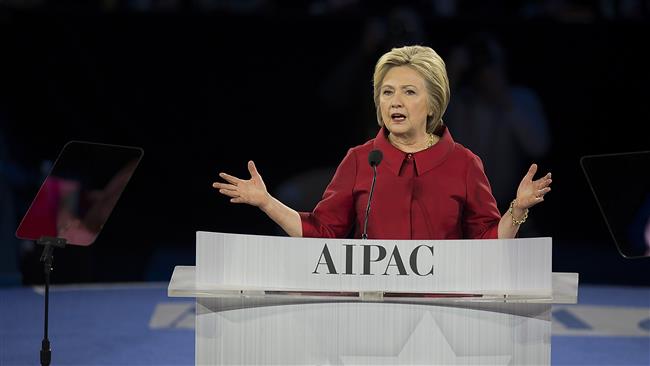
Democratic presidential candidate Hillary Clinton speaks during the 2016 AIPAC Policy Conference in Washington, DC, March 21, 2016. (AFP photo)
US Democratic presidential candidate Hillary Clinton said in a speech to an influential Zionist lobby group in Washington that Iran still posed a threat to Israel and needed to be closely watched.
Speaking on Monday to the annual policy conference of the American Israel Public Affairs Committee (AIPAC), Clinton also criticized her Republican rival Donald Trump for having a “neutral” stance on Israel.
She said American leaders needed to show loyalty to Israel and “anyone who doesn’t understand that has no business being our president.”
“This is a serious danger and demands a serious response,” Clinton said, declaring that sanctions must be placed against the country. “We must work closely with Israel and other partners to cut off the flow of money and other arms from Iran to Hezbollah” she added.
Many of the US presidential candidates, in particular Clinton, receive large campaign funding from wealthy Jewish donors who have strong ties to the far-right wing in Israel, experts say.
“Clinton is heavily favored by the Israel lobby because she is quite clear about her intention to pursue the war policies of several presidential predecessors,” said Mark Dankof, who is also a broadcaster and pastor in San Antonio, Texas.
“She is getting very, very strong backing from the Israeli lobby and is getting more money from the defense industry than any other candidate in this race,” Dankof told Press TV earlier this month.
On Sunday, activists gathered outside the building where the annual AIPAC conference was being held to protest America’s financial support for Israel.
The US government is pressured to serve Israel’s interests due to the influence of the powerful Zionist lobby in the United States. The pro-Israel pressure groups actively work to steer US foreign policy in favor of Israel.
March 21, 2016
Posted by aletho |
Corruption, Ethnic Cleansing, Racism, Zionism, Militarism, Progressive Hypocrite, Wars for Israel | AIPAC, Hezbollah, Hillary Clinton, Iran, Israel, United States, Zionism |
Leave a comment
Since the start of 2016 the mainstream media in the US and the countries that are in Washington’s sphere of influence have been talking about fallout between Russia and Iran over the conflict in Syria. These media reports continuously talk about Russia becoming afraid of Iran or vice-versa, Iran becoming afraid of Russia. These reports constantly talk about competition and rifts between the Iranian and Russian governments over Syria.
Here are two examples. The Financial Times reported that Iran should be afraid of Russia on February 24, 2016. A few weeks later, Bloomberg reported that the Russian military downsizing in Syria risks a rift with Iran in an article by Ilya Arkhipov, Dana Khraiche, and Henry Meyer, published on March 16, 2016.
For months, however, the steady streams of reports about a Russo-Iranian split have been utterly wrong. They are part of a campaign of misinformation (wrong information and analysis) and disinformation (propaganda). The relations between Moscow and Tehran are stable, and their cooperation is strategically oriented. In fact, Russia is supporting Iran against the US initiative at the United Nations Security Council to say that Iranian ballistic missile tests are a violation of Joint Comprehensive Action Plan (JCAP) signed between Iran and the US, Britain, France, Germany, China, and Russia (the P5+1 or EU3+3).
By the same token, other misleading and deceiving reports have been released about Iranian and Russian tensions. Some have been over the levels of Iranian oil production exports. Others have been about fallout between Moscow and Tehran over an Iranian transfer of Russian arms to Hezbollah in Lebanon. Many have also been about the deal and delivery of the Russian-manufactured S-300 anti-missile system to the Iranian military.
In regards to a Russo-Iranian rift over Iranian oil production, these reports focus on demands by Saudi Arabia and Russia that Iran cut back its oil production. Moscow, however, has said that Iran is a special cases and it understands that Iran is working to regain lost energy markets. It has exempted Iran from its call to cut back global oil exports under a global output freeze as part of an initiative to raise the price of oil. While visiting his counterpart in Tehran in mid-March 2016, Russian Energy Minister Alexander Novak even announced that the Russian government understands and accepts the Iranian position, which demands that Iran be allowed to regain its pre-sanction output levels.
In regards to Israeli media reports that there has been fallout between Iran and Russia over Russian arms being transferred to Hezbollah, no signs of this have manifested themselves empirically anywhere. The Russian government has made no statements against Iran. Nor have the Israeli reports been verified in any substantive way.
It was reported in Kuwait that the S-300 deal had been annulled on March 9, 2016. On the same day Sputnik interviewed an Iranian military spokesperson, who rejected the claim. While, from what the public knows, the delivery of the S-300 system to Iran by Russia has been delayed, this does not automatically insinuate tensions between Moscow and Tehran. Both Iranian and Russian officials have repeatedly denied reports saying that the deal has been cancelled. Delays have taken place due to legal provisions and technical matters, according to officials in Moscow and Tehran. Rostec, the government-owned national arms manufacturer of Russia, has even announced that the first orders of the S-300 will be delivered to Iran sometime running from August to September 2016.
Russo-Iranian Cooperation in Syria
About three weeks after a cease-fire agreement for Syria officially started (on February 27, 2016), Russian President Vladimir Putin announced that Russia would begin to partially withdraw from Syria on March 14, 2016. The next day the Russian military began downsizing its presence in Syria. This began being presented as a stumbling block between Tehran and the Kremlin.
Reports were published that claimed that Tehran was upset at the Russian move. The Russian withdrawal is portrayed in these reports as a surprise to the Iranian side. The Iranian government, however, has announced that the reduction of the Russian military force in Syria is a positive sign of success, which means that Iran and Russia have achieved their key objectives inside Syria. Moreover, if the Russian move hurt Iranian interests inside Syria, it would not have resulted in Israeli President Reuven Rivlin making a request on March 16, 2016 to Moscow to ensure that Iran and Lebanon’s Hezbollah do not benefit from the Russian decision to reduce its military presence.
Nor was Iran caught off guard by the Kremlin’s decision to reduce its military presence in Syria. Iranian and Russian generals and officials have been shuttling back and forth from one another’s capitals for months speaking on and strategizing over the conflict Syria. It is highly unlikely that Moscow’s decision to reconstitute its military position in Syria was not coordinated with either the Iranian or Syrian governments. Tehran, Moscow, and Damascus have been constantly consulting one another about the military operations in Syria.
If it was not for Iranian and Russian cooperation and resoluteness in Syria, the cease-fire agreement in Syria would not have materialized. The most recent wave of false reports about Russian and Iranian tensions in Syria are aimed at creating suspicion and managing the perception of US clients. This discourse is not only aimed at misleading people or targeting Iran and Russia, it is aimed at deceiving US clients and Syrian opposition figures in the Middle East about the reality of the situation on the ground in Syria, which is that the camps supported by the Iranians and the Russians in the Middle East are the ones on top.
Any ideas about some type of Russo-Iranian fallout are wishful thinking. Both powers are moving towards even deeper cooperation across the Eurasian landmass from the Mediterranean littoral and Iraq to the Caucasus and Central Asia. They are not only cooperating militarily together, but both Tehran and Moscow are also deepening their industrial, agricultural, financial, political, and economic ties too. This is no temporary alliance, but part of a long-term engagement and strategic partnership.
March 21, 2016
Posted by aletho |
Deception, Mainstream Media, Warmongering | Hezbollah, Iran, Israel, Lebanon, Russia, Syria, United States, Zionism |
Leave a comment
If you’d have said a year ago that the US State Department, Google, and Al Jazeera had been collaborating in pursuance of regime change in Syria, chances are you’d have been casually dismissed as a ‘crank’ and a ‘conspiracy theorist’.
Syria was a people’s uprising against a wicked genocidal Russian-backed dictator and the West had nothing to do with the bloodshed which engulfed the country. If you thought otherwise then you were considered an ‘Assad apologist’.
However, thanks to Wikileaks, the Freedom of Information Act, and Hillary Rodham Clinton’s use of a private, non-secure email server, we can see what was really going on behind the curtain.
Overall, 30,322 emails and attachments dating from June 30, 2010 to August 12, 2014, including 7,570 written by Clinton herself, have been published.
They haven’t made much of an impact in the mainstream media, which is not surprising considering their explosive content.
The emails reveal how the US State Department, ‘independent’ media and Silicon Valley have worked together to try and achieve foreign policy goals.
Particularly damning is a communication from Jared Cohen, the President of ‘Google Ideas’, (now called ‘Jigsaw’), which was sent on July 25, 2012.
“Please keep close hold, but my team is planning to launch a tool on Sunday that will publicly track and map the defections in Syria and which parts of the government they are coming from,” Cohen wrote.
“Our logic behind this is that while many people are tracking the atrocities, nobody is visually representing and mapping the defections, which we believe are important in encouraging more to defect and giving confidence to the opposition,” he went on.
The head of Google Ideas added that his organization was partnering with al Jazeera “who will take primary ownership over the tool we have built.”
Cohen finished his email by repeating his warning: “Please keep this very close hold… We believe this can have an important impact.”
The email was sent to three top officials, Deputy Secretary of State Bill Burns (a former Ambassador to Russia), Alec Ross, a senior Clinton adviser on innovation; and Clinton’s deputy chief of staff, Jake Sullivan.
Sullivan forwarded the email to Hillary Clinton with the message: “FYI-this is a pretty cool idea.” On August 4, 2012, Clinton sent the information to her aide Monica Handley. The title heading was: Syria Attachments: Defection Tracker.PDF.
“The Silicon Valley’s technotronic oligarchy have been exposed as a mere extension of the CIA in terms of playing a role in Washington’s state policy of regime change in Syria,” was the verdict of 21st Century Wire.
If you think it’s surprising that a top man at Google should be so interested in a ‘tool’ which could help the ‘opposition’ take power in Syria, then a closer look at Jared Cohen’s career background helps shed some light on the matter.
A Rhodes Scholar at Oxford University, Cohen was a bright guy who was clearly fast-tracked for big things. After an internship at the US State Department, he became a member of Condoleeza Rice’s Policy Planning Staff in 2006 when he was just 24 years of age. That same year he had a book published on the Rwandan genocide, while a year later his ‘Children of Jihad – A Young American’s travels among the Youth of the Middle East’ was published.
In 2009, it’s claimed that Cohen personally asked Twitter CEO Jack Dorsey not to interrupt his company’s service in Iran for maintenance. Tehran at the time was preparing for elections and it was apparently believed that the opponents of President Ahmadinejad would be hindered without access to social media.
Since 2010, Cohen has been an Adjunct Senior fellow at the Council on Foreign Relations. In 2013, Time magazine listed the then 32-year-old as one of its 100 Most Influential People in the world.
Wikileaks founder Julian Assange, who met Cohen and Google chairman Eric Schmidt when he was under house-arrest in 2011, has written about Google’s role in assisting US foreign policy goals. “Whether it is being just a company or ‘more than just a company,’ Google’s geopolitical aspirations are firmly enmeshed within the foreign-policy agenda of the world’s largest superpower,” Assange said.
The Wikileaks founder discovered that Jared Cohen had “quietly worked” in Lebanon “to establish an intellectual and clerical rival to Hezbollah, the Higher Shia League.” In Afghanistan, Cohen had tried “to convince the four major Afghan mobile phone companies to move their antennas onto US military bases.”
In June 2010, when Syria was a country still at peace, Cohen traveled to the Arab Republic with Alec Ross. “I’m not kidding when I say I just had the greatest frappuccino ever at Kalamoun University north of Damascus,” he tweeted. Ross, in a more serious mood, tweeted: “This trip to #Syria will test Syria’s willingness to engage more responsibly on issues of#netfreedom”.
In an email dated September 24, 2010, entitled ‘1st known case of a successful social media campaign in Syria’, and which was later forwarded to Hillary Clinton, Ross wrote:
“When Jared and I went to Syria, it was because we knew that Syrian society was growing increasingly young (population will double in 17 years) and digital and that this was going to create disruptions in society that we could potential harness for our purposes”
Those “purposes” were of course “regime change” and break Syria’s alliance with Iran.
We already know, courtesy of Wikileaks, that Washington’s plans to destabilize Syria long pre-dated the so-called ‘Arab Spring’.
A 2006 cable from US Ambassador to Syria William Roebuck discussed “potential vulnerabilities” of the Assad administration and the “possible means to exploit them”.
One of the “possible means” was to seek to divide the Shia and Sunni communities in Syria. In a section entitled PLAY ON SUNNI FEARS OF IRANIAN INFLUENCE, the Ambassador writes:
“There are fears in Syria that the Iranians are active in both Shia proselytizing and conversion of, mostly poor, Sunnis. Though often exaggerated, such fears reflect an element of the Sunni community in Syria that is increasingly upset by and focused on the spread of Iranian influence in their country through activities ranging from mosque construction to business.”
Another was listed as ‘ENCOURAGE RUMORS AND SIGNALS OF EXTERNAL PLOTTING’. This would increase “the possibility of a self-defeating over-reaction” from the Syrian government.
Lo and behold when the protests against the Assad government did kick off in early 2011, the US was quick to accuse the Syrian authorities of over-reacting – which is exactly what they had wanted.
The earlier Wikileaks revelations on Syria tie in with what we learn from Clinton’s emails.
While Western leaders and their media stenographers feign horror and outrage over what’s been happening in Syria, Wikileaks shows us that the possibility of the country being torn apart by sectarian conflict was actually welcomed by Syria’s enemies.
“The fall of the House of Assad could well ignite a sectarian war between the Shiites and the majority Sunnis of the region drawing in Iran, which, in the view of Israeli commanders would not be a bad thing for Israel and its Western allies” Sidney Blumental wrote in a 2012 email to Hillary Clinton.
Blumenthal does point out that not all in Israel’s governing circles thought that way, with concern expressed that the spread of “increasingly conservative Islamic regimes” could make Israel “vulnerable”.
We must remember that if the US and UK got their way in August 2013 and bombed the Assad government, then its likely that IS and al-Qaeda affiliates would have taken control of the entire country. And the most bellicose voices calling for the bombing of a secular government that was fighting IS and al-Qaeda in 2013 were American neocons. This was the same group of hawks who had pushed so hard for the invasion of Iraq 10 years earlier and who had also propagandized for the NATO bombing of Libya in 2011.
Wikileaks confirms that – as was the case in Libya and Iraq – almost everything about the official “western establishment” version of the war in Syria was false.
Far from being an innocent bystander, the US went out of its way to destabilize the country and exploit ethnic and religious divisions.
A huge amount of weaponry was provided -via regional allies -to violent jihadists, euphemistically referred to as ‘rebels’, to try and achieve the goal of ‘regime change’. The rise of ISIS can be directly attributed to the destructive, malignant policies of the US and its allies towards Syria. Don’t forget we’ve already seen a US Intelligence report from August 2012, which stated that “the possibility of establishing a declared or undeclared Salafist principality in eastern Syria” was “exactly what the supporting powers to the opposition want, in order to isolate the Syrian regime”.
In 2006, the same year that Ambassador Roebuck sent his cable on how the US might exploit the “potential vulnerabilities” of the secular Assad administration, the Syrian authorities foiled a terrorist attack on the US embassy in Damascus.
You might have thought that it would have earned Syria some brownie points with the State Department and its collaborators. But as the HRC emails confirm, it counted for absolutely nothing.
Neil Clark is a journalist, writer, broadcaster and blogger. He has written for many newspapers and magazines in the UK and other countries including The Guardian, Morning Star, Daily and Sunday Express, Mail on Sunday, Daily Mail, Daily Telegraph, New Statesman, The Spectator, The Week, and The American Conservative. He is a regular pundit on RT and has also appeared on BBC TV and radio, Sky News, Press TV and the Voice of Russia. He is the co-founder of the Campaign For Public Ownership @PublicOwnership. His award winning blog can be found at http://www.neilclark66.blogspot.com. He tweets on politics and world affairs @NeilClark66
Read more
Hacker ‘Guccifer,’ who uncovered Clinton’s private emails, to be extradited to US
What Clinton’s latest emails say about Benghazi, White House, private accounts
Benghazi, memes & more: 9 revelations from Hillary Clinton’s emails
March 21, 2016
Posted by aletho |
Deception, Ethnic Cleansing, Racism, Zionism, Timeless or most popular, War Crimes, Wars for Israel | Afghanistan, Council on Foreign Relations, Hezbollah, Higher Shia League, Hillary Clinton, Iran, Iraq, Jared Cohen, Lebanon, Libya, Syria, United States, Zionism |
Leave a comment
The intelligence service of Israel considers a potential Sunni-Shiite war in Syria a favorable development for the country and the West, according to an email archive of former US Secretary of State Hillary Clinton, released by WikiLeaks.
The author of the email, forwarded by Clinton in July 2012, argued that Israel is convinced Iran would lose “its only ally” in the Middle East, if the regime of Syrian President Bashar Assad collapses.
“The fall of the House of Assad could well ignite a sectarian war between the Shiites and the majority Sunnis of the region drawing in Iran, which, in the view of Israeli commanders would not be a bad thing for Israel and its Western allies,” an email stated.
In addition, the author underscored that a potential Sunni-Shiite war would delay the Iranian nuclear program.”In the opinion of this [Israeli intelligence] individual, such a scenario would distract and might obstruct Iran from its nuclear activities for a good deal of time,” the email said.
The Israeli intelligence also considered the possible Sunni-Shiite war as a factor that could contribute to the collapse of the government in Iran.
“In addition, certain senior Israeli intelligence analysts believe that this turn of events may even prove to be a factor in the eventual fall of the current government of Iran,” the email said.
In March, WikiLeaks created a searchable archive for emails sent to and from Clinton’s private email server, while she served as the secretary of state from 2009 to 2013.
March 19, 2016
Posted by aletho |
Ethnic Cleansing, Racism, Zionism, Timeless or most popular, War Crimes, Wars for Israel | Hillary Clinton, Iran, Israel, Syria |
Leave a comment
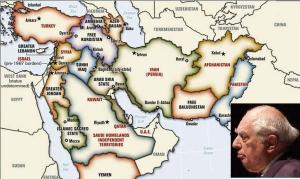 An article titled It’s Time to Seriously Consider Partitioning Syria published recently by Foreign Policy raises serious concerns.
The author writes that the war in Syria has devastated entire cities, the death toll is 470 thousand (there are no reliable statistics to confirm the figure) and 6 million people have become displaced. As a result, religious communities in Syria cannot live together in one state anymore. He believes that Syria should be divided into parts populated by Alawites (for some reason it includes Damascus) and Sunni Muslims. The options include a partition of the country into independent states or forming some kind of loose confederation like Bosnia and Herzegovina. James Stavridis is a four-star Admiral and former NATO Supreme Allied Commander, Europe. He is an influential person in military and political circles.
The Admiral made public his views on Syria soon after US State Secretary John Kerry referred to plan B in Syria in his testimony before the Senate Foreign Relations Committee on March 1.
According to the US top diplomat, he will move towards a plan B that could involve a partition of Syria if hostilities continue because the political forces cannot coexist in one state.
The idea of dividing Syria, Iraq and other states in the Middle East has been considered by US strategic thinkers since the 1980s. Bernard Lewis, the patriarch of American oriental studies, was the first to suggest it. For many years he has been a member of and consultant to the US Council on Foreign Relations (CFR). Formally an independent think tank, the Council exerts great influence on shaping US foreign policy.
In The Roots of Muslim Rage, an essay published in 1990, Bernard Lewis describes a ‘surge of hatred’ rising from the Islamic world that “becomes a rejection of Western civilization as such.” The thesis became influential.
The essay inspired Samuel Huntington, the author of the clash of civilizations hypothesis. Lewis is a widely read expert on the Middle East and is regarded as one of the West’s leading scholars specialized in that region. His advice has been frequently sought by policymakers, including the Bush Jr. administration in the early 2000s. Jacob Weisberg, a prominent US journalist, writes that Bernard Lewis was perhaps the most significant intellectual influence behind the invasion of Iraq in 2003.
In 1979, Bernard Lewis first unveiled his project aimed at reshaping the Middle East to the Bilderberg Meeting in Baden, Austria. The goal was to counter Iran after the Islamic revolution and the Soviet Union with its military deployed to Afghanistan the same year. According to him, the anti-Iranian policy was to include the incitement of an armed Sunni-Shia confrontation and support of the Muslim Brothers movement. The Soviet Union was to be countered by creating an «Arc of Crisis» in the vicinity of its borders. The national states of the Middle East were to be ‘Balkanized’ along religious, ethnic and sectarian lines.
The Lewis project was advanced further after the collapse of the Soviet Union. In 1992 the scholar’s article titled Rethinking the Middle East appeared in Foreign Affairs, the US leading forum for serious discussion of foreign policy and international affairs published by the Council on Foreign Relations.
There he presented a new map of the Middle East. The plan envisaged breaking Syria up into small fragments with the territories populated by the Druze and Alawites separated to become independent mini-states. Lewis wanted to establish new entities: a tiny state on the territory of Lebanon populated by Maronites, an independent Kurdistan comprising the Kurds-populated areas of Turkey, Iraq, Syria and Iran, an independent Shia state in Iraq, an Arab state in the Iranian province of Khuzestan – the major oil-producing region of Iran. The plans also envisaged the creation of independent Balochistan.
Bernard Lewis advocated a policy called ‘Lebanonization’. According to him, “A possibility, which could even be precipitated by Islamic fundamentalism, is what has late been fashionable to call ‘Lebanonization’. Most of the states of the Middle East – Egypt is an obvious exception – are of recent and artificial construction and are vulnerable to such a process. If the central power is sufficiently weakened, there is no real civil society to hold the polity together, no real sense of common identity… The state then disintegrates – as happened in Lebanon – into a chaos of squabbling, feuding, fighting sects, tribes, regions, and parties,” the scholar wrote.
The main goal of such projects is to prevent the emergence of regional forces able to challenge the hegemony of the United States [or Israel]. That’s what made the US add fuel to the fire of the Iran-Iraq war (1980-1988). Washington succeeded in making the war last for eight years. By provoking the hostilities, the US killed two birds with one stone: it prevented Iran from growing stronger and weakened Iraq ruled by the Arab Socialist Ba’ath Party.
The West launched Operation Desert Storm to keep Iraq weak. In 2003 it concocted a false pretext (the possession of weapons of mass destruction) to occupy Iraq and deprive it of sovereignty. By and large, the same fate awaited Syria.
In 1990 Syrian troops remained in Lebanon as peacekeepers in accordance with the Taif Agreement. The US gave its consent because Damascus took part in Operation Desert Storm against Iraq. Besides, the Syrian government of Hafez Assad effectively committed itself not to take hostile actions against Israel. In ten years the situation changed. Damascus launched the policy of strategic partnership with Iran. It supported the Lebanese Hezbollah movement. Washington changed its stance to say the Syrian military in Lebanon was an occupying force. Using the imposition of sanctions as a weapon, the United States made Syria withdraw from Lebanon. In 2011 the US started to undermine the Syria’s national sovereignty.
The most faithful US allies – Saudi Arabia for instance – have no guarantees they will not become part of such plans. Nowadays, the United States does not depend on the oil supplies from the Middle East. It has put an end to the policy of direct confrontation with Tehran. As a strategic partner, Riyadh is not as important as it used to be. It’s hardly a coincidence that US media outlets started to publish maps with Hejaz (a region in the west of present-day Saudi Arabia) drawn as part of Jordan with the eastern part of the Saudi Kingdom together with South Iraq shown as part of Shia Arab state. Actually, a genuine settlement to the problems faced by the Arab world is something quite opposite from what the United States has to offer.
The partition of the Middle East into tiny powerless states will give rise to new crises accompanied by ethnic and religious cleansing. It will lead to a ‘war of all against all’ (bellum omnium contra omnes) – the term coined by Thomas Hobbs.
In case of such a war, the small principalities will need someone for arbitration. Washington will offer itself for this role.
In the future, the creation of large Arab space (Grossraum) may lead the region out of the deep crisis it faces, but that’s a different and a very serious matter to be discussed some other time.
March 17, 2016
Posted by aletho |
Ethnic Cleansing, Racism, Zionism, Timeless or most popular, Wars for Israel | Bernard Lewis, Hezbollah, Iran, Iraq, Lebanon, Middle East, Saudi Arabia, Syria, United States, Zionism |
Leave a comment

Russia’s envoy to the United Nations Vitaly Churkin
Russia opposes the imposition of any new sanctions on Iran over its recent ballistic missile tests, saying the missile launches did not violate UN resolutions.
In response to a question on whether new sanctions should be imposed on Iran over its recent missile tests, Russia’s envoy to the United Nations Vitaly Churkin said Monday, “The clear and short answer is no.”
He added that Iran did not breach the Security Council Resolution 2231 that endorsed a nuclear agreement between the Islamic Republic and the P5+1 group of countries on July 14, 2015.
Resolution 2231 (2015) provides for the termination of the provisions of previous Security Council resolutions on the Iranian nuclear program and establishes specific restrictions that apply to all states without exception.
The resolution calls upon Iran not to undertake any activity related to ballistic missiles designed to be capable of delivering nuclear weapons, including launches using such ballistic missile technology.
The Islamic Revolution Guards Corps (IRGC) successfully test-fired two more ballistic missiles on March 9 as part of military drills to assess the IRGC’s capabilities. The missiles dubbed Qadr-H and Qadr-F were fired during large-scale drills, code-named Eqtedar-e-Velayat.
On March 8, Iran fired another ballistic missile called Qiam from silo-based launchers in different locations across the country.
On January 16, Iran and the five permanent members of the UN Security Council plus Germany – started to implement the Joint Comprehensive Plan of Action (JCPOA).
After the JCPOA went into effect, all nuclear-related sanctions imposed on Iran by the European Union, the Security Council and the US were lifted. Iran, in return, has put some limitations on its nuclear activities.
Iranian Foreign Ministry spokesman, Hossein Jaberi Ansari, said on March 10 that the test-fire of ballistic missiles was “neither inconsistent with Iran’s commitments under the JCPOA, nor is it against the Security Council Resolution 2231.”
March 14, 2016
Posted by aletho |
Economics, Wars for Israel | Iran, Russia, Sanctions against Iran |
Leave a comment
France says Iran may be targeted with new sanctions over its recent ballistic missile tests, to which the Islamic Republic says it is entitled because they fall within the realm of conventional military capabilities.
“If necessary, sanctions will be taken,” French Foreign Minister Jean-Marc Ayrault said in Paris on Sunday. He was speaking after a meeting with US Secretary of State John Kerry and several European counterparts.
Iran’s Islamic Revolution Guards Corps (IRGC) successfully test-fired two ballistic missiles, dubbed Qadr-H and Qadr-F, on Wednesday as part of military drills to assess their capabilities.
A day earlier, the Guards had fired another ballistic missile, called Qiam, from silo-based launchers in different locations across the country.
Last October, Iran successfully test-fired its precision-guided long-range Emad missile, sparking an uproar among US politicians.
In January, the US Department of the Treasury imposed new sanctions against Iranian citizens and companies over the country’s ballistic missile program.
Iran says it has a right to carry out missile tests, asserting that none of its missiles are capable of carrying nuclear warheads.
US Secretary of State John Kerry, who was speaking alongside the French top diplomat, described the recent tests as a breach of UN resolutions. Washington has, meanwhile, asked the UN Security Council to discuss the matter on Monday.
The Islamic Republic has repeatedly said that its military might poses no threat to other countries, reiterating that its defense doctrine is merely based on deterrence.
March 13, 2016
Posted by aletho |
Wars for Israel | France, Iran, Israel, Sanctions against Iran, Zionism |
Leave a comment

 Aletho News
