The profound geopolitical implications of Iran’s strikes on Israel
By Trita Parsi | June 7, 2026
The magnitude of what just happened may take some time to sink in.
This is the first time Iran has struck Israel after Israel struck another country’s territory (that is, not Iran).
This means that the battle lines have been moved.
Iran’s deterrence had already been restored in the sense that Israel knew that any strike on it would be responded to.
But now, Iran has proven that it will also respond to Israeli strikes on Lebanon.
This is the first time in decades that a regional power has the means, capacity, and willingness to put hard power against Israeli military maneuvers or aggression against a third party.
This will be particularly significant since Trump has signalled that he seeks to restrain Israel from continuing the escalation.
Trump reportedly told Israeli journalist Barak Ravid that “Hopefully Israel is not going to retaliate. If Bibi strikes them back it’s just gonna keep going like the last 47 years, or the last 3000 years.” Trump also added: “We are very close to a final deal with Iran. It is going to be a good deal. I don’t want it to blow up because of what is happening now.”
Whether this would extend to Palestine is uncertain, but if it does, it may prove a game-changer.
Israel has been able to annex territory, commit genocide and war crimes without any real consequences because the West has refused to, and no regional power has had the hard power to impose costs on Israel.
If this equation changes, the future of the Israeli-Palestinian conflict will likely take a significant turn.
Which is why Israel will do everything it can to disallow any shift.
From a US perspective, supporting Israel at this point recommits the US to its decades-long policy of seeking to sustain a balance in the region that allows for near-complete Israeli dominance.
That policy has been extremely costly to US interests, has destabilized the region, and enabled the Israelis to get increasingly aggressive and reckless (since they face no consequences for it).
However problematic it has been, it will become far more challenging and destabilizing going forward since sustaining Israel’s dominance will necessitate continued war with Iran. This clearly contradicts US interests.
If US interests were at the center of US policy, getting out of the Middle East and its regional rivalries would be a no-brainer.
Iran fires missiles at Israel, Trump pleads for restraint
RT | June 7, 2026
Iran has fired a missile barrage at Israel in retaliation for its continuing campaign in Lebanon against the Hezbollah militant group.
The attack occurred late on Sunday, following days of bombing and ground operations in southern Lebanon by the IDF, including intensive aerial bombardment of the capital, Beirut. The Israeli onslaught has continued despite the truce declared more than six weeks ago, with the attacks intensifying over the past week. Tehran has repeatedly demanded that West Jerusalem stop, making its own negotiations with the US conditional on a working ceasefire in Lebanon.
The IDF said that it identified multiple incoming projectiles and activated anti-aircraft defenses at multiple locations. Footage circulating online purports to show Iranian missiles soaring over eastern Lebanon, while some projectiles were observed from the Lebanese capital.
Iran stated that the attack was merely a “warning” to Israel and more “crushing blows” would follow should it continue with the attacks on Lebanon.
“If it expands its attacks in that region or responds to Iran’s action, it will be met with even more crushing and regrettable blows, and devastating attacks will be launched against the regime and its supporters,” Iran’s Khatim Al-Anbiya operational headquarters said in a statement circulated by local media.
Multiple media reports indicated Israel scrambled to retaliate for the attack, with some outlets suggesting it has sought greenlight from the US to strike Iran’s energy facilities. While no official reaction to the development has been provided, multiple senior Israeli officials have vowed revenge for the strikes.
“Tonight Tehran must burn!” Israel’s far-right National Security Minister Itamar Ben-Gvir wrote on X.
US President Donald Trump has called on both sides to show restraint, telling Fox News that the Israeli attacks on Beirut were not coordinated with Washington. At the same time, he urged Tehran to stop and get back to negotiations and to strike a “deal.”
Axios reporter Barak Ravid said on X that Trump told him he was calling Israeli Prime Minister Benjamin Netanyahu “right now and telling him not to attack Iran in response.”
Earlier in the day, Israel struck Beirut’s southern suburbs without the warning usually issued by the IDF prior to attacking densely populated areas. At least two people were killed and 20 wounded in the strike on a residential building, according to the Lebanese Health Ministry.
After Israel strikes Beirut, Iran strikes Israel. What’s Trump’s next move?
By Trita Parsi | June 7, 2026
A fragile arrangement had been reached in Lebanon. Iran had made clear that if Israel continued to strike Lebanon, it would strike at Israel.
The US/Israeli side says that overnight, Hezbollah killed 15 Israeli soldiers. A violation of the arrangement in their view, and a sign that Iran either didn’t or couldn’t control Hezbollah.
At the same time, Israel knew that renewed attacks on Beirut, particularly Dahieh, would either force Tehran to attack or back down, while having the added benefit of further weakening US-Iran diplomacy.
Iran did not back down. An attack on Dahieh, according to the Iranians, is designed to kill as many senior Hezbollah and Iranian officials as possible. So a response was inevitable, in their view.
By now, four waves of missiles have been fired at northern Israel, Haifa, and other areas. Some of the missiles are of higher quality than the ones Iran used during the war.
Israel will strike Iran within the next few hours, and the Iranians don’t have any other expectation.
Whether the US enters the fighting actively as well, or only provides support for Israel, is the big question mark right now.
The US side is deeply frustrated that the MOU has not been signed yet and accuses the Iranians of either playing for time, overnegotiating, or being incapable of getting to yes.
The Iranians, in turn, accuse the US of constantly changing the parameters while being unwilling to release a portion of Iran’s frozen assets at the outset of the MOU as a way to prove their seriousness.
If Trump doesn’t enter the war, he will be accused of abandoning Israel. If he enters the war, he will validate that Israel has an effective veto on the negotiations and on whether the US is at war or not.
A true America First policy would have worked to extricate the US from the Israeli-Iranian rivalry.
Now more than ever, it should be clear why such an exit serves US interest.
US Military: Who’s Pulling the Strings? /Lt Col Daniel Davis
Daniel Davis / Deep Dive – June 4, 2026
Khamenei: US-Israeli System of Domination Has Been Defeated
By Kyle Anzalone | The Libertarian Institute | June 4, 2026
Iranian Supreme Leader Ayatollah Seyed Mojtaba Khamenei said that the US and Israel had suffered a humiliating defeat.
In a statement published on Thursday, Khamenei said the US and Israel’s “system of domination” has suffered a historic defeat. He explained that Washington and Tehran had shifted to targeting Iranian society through psychological warfare.
“The vile enemy, having suffered defeat at the hands of your brave sons in the armed forces, and having experienced a profound and meaningful humiliation — both on the military battlefield and in the streets.” The statement continued, “Which has visibly caused countries to drift away from it, has now focused its hybrid war on two points: breaking the people’s endurance and creating errors in the calculations of the country’s officials.”
Khamenei’s remarks came after President Donald Trump expressed that he wanted to meet with the Iranian leader. In an interview with the New York Times released on Wednesday, Trump said that he is “getting along quite well” with Khamenei. The President added, “I’d like to meet him. I’d love to meet everybody.”
It’s unclear whether Trump’s remarks are rooted in reality, as the US and Iran have not engaged in direct meetings but have instead exchanged messages through Lebanon. Additionally, Khamenei’s father was assassinated on the first day of the war.
Notably, Trump suggested that Khamenei is running Iran. The President told the New York Post that Khamenei has “absolutely” been involved in talks and other Iranian leaders have a lot of respect for him.” Trump continued, “They say he is approving, because that’s the way it has been for a long, long time. His father and then him, I guess it’s a succession. But we seem to be getting along quite well.”
US officials previously suggested that Khamenei was incapacitated, and the government was fractured. Trump claimed the Iranian leader was “not doing well” and “missing a lot of parts.”
The rare statement from Khamenei comes as the ceasefire appears on the brink of collapse.
Iran to deepen ties with ‘principal strategic partner’ China: Ghalibaf
Beijing and Tehran have significantly expanded their strategic cooperation since the start of the US-Israeli war on Iran

The Cradle | June 3, 2026
Iranian Parliament Speaker and special representative for China affairs, Mohammad Bagher Ghalibaf, held the first joint meeting with key economic officials on 3 June to align Tehran’s economic strategy toward Beijing.
The session in Tehran included the ministers of economy, oil, and industry, alongside the central bank governor and the head of the Plan and Budget Organization.
The assembly focused on establishing a unified government approach to elevate bilateral relations and coordinate the administration’s economic priorities. During the proceedings, officials evaluated China’s economic conduct amid the US-Israeli war on Iran and the closure of the Strait of Hormuz to the US and Israel.
Participants agreed to submit formal proposals to Ghalibaf to resolve outstanding challenges and deepen cooperation.
This coordination effort supports a developing strategy to position China as Iran’s “principal strategic partner” while expanding collaboration on regional and international issues.
Roughly 30 China-linked vessels crossed the Strait of Hormuz in a single day in mid-May under the supervision of Iran’s Islamic Revolutionary Guard Corps (IRGC) Navy.
These transits follow a “management protocol” established after Iran restricted the waterway to US and Israeli-linked vessels in February.
While the strait remains largely closed, passage is permitted for commercial ships that comply with Iranian naval procedures and utilize designated corridors
In parallel, since the illegal US blockade on Iranian ports was implemented in April, Iran has tripled its rail exports of oil and liquefied petroleum gas (LPG) to China in an effort to bypass the economic stranglehold.
Freight trains on the 10,400-kilometer corridor now depart every three to four days, a significant increase from the previous weekly schedule, and halve traditional sea transit times to roughly 15 days.
Despite this, rail capacity remains a modest alternative to maritime shipping; one train carries 60,000 to 70,000 barrels of oil, while large tankers can transport upwards of 2 million barrels.
IRGC: No peace without Israel’s withdrawal from occupied Lebanese territories
Press TV – June 4, 2026
The Islamic Revolution Guards Corps has stated that no peace will be established in the region without the withdrawal of Israel from occupied territories in Lebanon, as it condemns ongoing Israeli attacks on Lebanese civilians.
In a statement issued on the recent events in Lebanon on Thursday, the IRGC declared that international condemnations and expressions of disgust from countries and nations around the world have had no effect on the behavior of Tel Aviv’s “bloodthirsty rulers.”
“The arrogant American regime, under the pretext of establishing peace, has only increased crime and genocide through its interventions,” the statement read.
The IRGC described the Israeli army as “cowardly and incapable,” stating that it tries to compensate for its battlefield defeats by killing civilians and destroying homes, hospitals, and schools.
“This racist regime, despite unlimited support from America and European countries, has not even been able to win the hearts of the people of a single occupied village during its shameful existence,” the statement said.
“Its skill is merely ruling over burned lands, and every day we witness the destruction of the homes of the oppressed people of Palestine and Lebanon at the hands of this aggressor regime,” it further said.
The IRGC asserted that the Lebanese nation will not allow the occupying regime to achieve through a forced agreement what it could not achieve through war, even with the support of the “child-killing American regime.”
“Our primary condition for accepting a ceasefire in the regional war has been a ceasefire on all fronts, including Lebanon,” the statement said.
The IRGC stated that the enemy must urgently halt its attacks on the Lebanese people, immediately withdraw from occupied Lebanese territories back behind international borders, and recognize Lebanon’s territorial integrity.
“The Lebanese nation is the pride of the Ummah and a symbol of the honor of the region’s peoples. We will support them with all our being. No peace will be established in the region without withdrawal from the occupied territories of Lebanon,” it said.
On Monday, Israeli prime minister Benjamin Netanyahu said he had ordered strikes on the Dahiyeh area, a predominantly Shia district in Beirut’s southern suburbs, and issued evacuation orders covering the entire area.
In response, Iran’s central military command warned that if Israel carried out its threat to bomb southern Beirut, Iranian forces would retaliate against the northern occupied territories.
Iran’s Foreign Ministry also said Tehran was ready to help Lebanon resist the “illegal aggression,” adding that a Lebanon ceasefire is “an integral part of any ceasefire and any final agreement” with the United States.
Shortly after Iran’s warning, US President Donald Trump said on social media that he had intervened, claiming he had held a “very productive conversation” with Netanyahu that prevented further escalation.
He also said he had reached an understanding with Hezbollah through senior representatives, stating that the resistance group had agreed to halt attacks in exchange for Israel refraining from strikes.
A Pakistan-brokered ceasefire between Tehran and Washington, which also covers Lebanon, has been in place since early April, though Israel has continued carrying out daily attacks on the Arab country in violation of the truce.
Iran has repeatedly said that any ceasefire must be comprehensive, covering all fronts, including Lebanon, and has warned it will not tolerate continued Israeli attacks on the country.
Trump’s call to Bibi probably didn’t happen
By Martin Jay | Strategic Culture Foundation | June 4, 2026
Donald Trump’s explosive telephone call to Benjamin Netanyahu has taken the internet by storm. But can we really believe it’s true?
Can we believe what we have just witnessed with the explosive telephone conversation between Donald Trump and Benjamin Netanyahu? According to Washington insiders who provide no concrete evidence of the call, Trump exploded with rage over the telephone with Bibi shortly after Iran pulled out entirely from the so-called peace talks – after Israel continued its bombing and illegal invasion of Lebanon.
Indeed, it was reported that Israel had actually cancelled air strikes on Lebanon at the request of Trump, as he tries to bring Iran back to the negotiating table – or so the British pro-Israel broadsheet The Telegraph presents it.
According to The Telegraph, the U.S. president phoned Benjamin Netanyahu on the evening of June 1st after Iran walked away from peace talks and said it would return only if Israel ceased its attacks on Lebanon and Gaza.
Apparently, the call was so heated that a number of swear words were used by Trump, followed by threats – indicating, if we are to believe the call took place, that Trump is really desperate to get out of the Iran war, a war he started because he was talked into it by Israel’s intelligence chiefs.
One U.S. official told Axios that Mr Trump told Mr Netanyahu that following through on his plans to bomb Lebanon would further isolate Israel on the global stage, adding that he thought Netanyahu was “crazy”. Two sources went further and recalled how Trump claimed that he had helped keep the Israeli prime minister out of jail – a reference to Mr Netanyahu’s ongoing graft trial.
Summarising the U.S. president’s remarks, a Washington official said: “You’re f—ing crazy. You’d be in prison if it weren’t for me. I’m saving your a–. Everybody hates you now. Everybody hates Israel because of this.”
A second source briefed on the call said Trump was “p—-” and at one point yelled at Mr Netanyahu: “What the f— are you doing?”
Yet was any of what was reported the truth? Given that the outlets reporting on the call are Zionist, it begs the question: why would they report on something which is so damaging to the Israeli prime minister and hardly paints Trump in a good light either?
One answer might be that the whole call was staged and leaked to the press in a bid to regain the confidence of the Iranians, who lack motivation to move forward in the talks as they trust nothing that comes from the American side. Another possibility is that Western consumers of media are being prepared for a huge false flag attack, and the architects of such a plan believe that reasserting Trump over Netanyahu is a good move. Of course, a third scenario is that it really did happen, and it was a tactic for Trump to leak the essence of the call to the press in a desperate bid to claw back some credibility, given that he is looking so foolish and very much under the thumb of Netanyahu. In this last scenario, it doesn’t necessarily ring true that the dog and its tail have been restored to their correct positions, in terms of who tells whom what to do on the foreign stage.
However, we cannot ignore the fact that Israel has stopped bombing Lebanon for the moment, which would indicate that Trump is trying his best to get a deal with Iran. Lebanon for the time being seems to be playing a pivotal role in the entire Iran war, although it is likely that most of the information Trump is being given is tailored to what he wants to hear, rather than the truth. In the Oval Office, he announced that no ships are getting through the blockade when, on the same day, 24 ships got through escorted by the Iranians – as well as announcing that nearly all of Iran’s missile production had been taken out (which couldn’t be further from the truth). Given the amount of lies and fantasies being produced on Trump’s side, it’s not hard to not take the Bibi telephone call seriously. The only real test of whether Trump is really calling the shots now is whether Israel will continue to disrupt any deals that he tries to put together. Whether the call was genuine or not is less important than what those who presented it to the press are attempting to pull off: a recalibration of the working relationship between the U.S. and Israel.
For the moment, the internet has gone into overdrive with the creativity you might expect, even animating the call itself with AI. While it is true that Trump in many ways has saved Netanyahu, for the moment, from being netted by the judiciary on corruption charges, it seems far-fetched that Trump would tell him everyone hates him. If only that were true. If you struggle to doubt the authenticity of the call, then simply ask yourself: if Trump were to call Bibi and give him a real piece of his mind, how would you fantasize that call might go?
Iran moved to change the US-Iran equation yesterday
By Trita Parsi | June 3, 2026
Over the past eight or so days, the US has targeted Iranian vessels as well as targets on the Iranian mainland. This included non-Iranian oil vessels. In essence, this was the US seeking to escalate the blockade of the blockade.
At first, Iran’s response was proportional. The US could tolerate that response.
In fact, it was beneficial to the US to continue the exchange of blows but keep them relatively limited, as it would slowly but surely erode Iran’s deterrence without imposing intolerable costs on the US.
But yesterday, Iran moved to change that equation.
After the US struck a Botswana-flagged tanker as part of Trump’s blockade, the Iranians counter-escalated disproportionally.
Tehran struck Kuwait International Airport as well as a US base in Kuwait, Ali Al-Salem.
It struck the 5th Fleet facilities in Bahrain. (Full extent of damage unknown.)
It struck Jordan. (Full extent of damage unknown.)
It struck northern Iraq. (Full extent of damage unknown.)
It struck the UAE. (Full extent of damage unknown.)
It struck the Al-Udeid Air Base in Qatar. (Full extent of damage unknown.)
It was a demonstration – and reminder – that Tehran retains escalation dominance.
Whereas the US is comfortable with either a possible deal or a low-level exchange of fire, but not a return to full-scale war, Tehran is comfortable with a possible deal or a full-scale war, but not with a low-level exchange of fire that erodes Iran’s deterrence and allows for Trump’s “blockade of the blockade” to become effective.
The area where both can actually be comfortable is some sort of a deal. Reaching it, however, is a different story.
Iran rejects US assassination claim, says Washington trying to whitewash its own crimes against Iranians
Press TV – June 3, 2026
Iran has strongly rejected accusations by the US secretary of state that Tehran seeks to assassinate American officials, slamming Washington for attempting to portray itself as a victim while concealing own record of war crimes against the Iranian people.
Foreign Ministry spokesman Esmaeil Baghaei sharply rebuked allegations by Marco Rubio that Iran is allegedly plotting to assassinate American officials, denouncing the claims as another example of Washington’s efforts to distort reality and deflect attention from its own actions.
The Iranian official said the unfounded allegations reflected a mentality that projects its own conduct onto others.
“Everyone imagines others according to their own creed,” Baghaei wrote in a post on his X account on Wednesday, stressing, “Playing the victim cannot whitewash the savage war crimes, genocide, and crimes against humanity that you have committed against the Iranian nation.”
Baghaei responded to remarks that Rubio made during a congressional hearing, where the top US diplomat claimed that Iran was seeking to target American officials.
This came as a US-Israeli military coalition, during an unprovoked war of aggression against Iran that began on February 28, assassinated the Leader of the Islamic Revolution along with several senior officials and military commanders, while also killing thousands of people across the country.
Persian Gulf Strait Authority says it processed 300+ transit requests since May
Press TV – June 1, 2026
More than 300 non-Iranian vessels, mostly oil tankers, have submitted their information to secure a safe passage permit from the Persian Gulf Strait Authority (PGSA) since the entity began its operations in early May, the PGSA announced in a post on X on Tuesday.
The majority of these requests came from outbound ships, which accounted for 77 percent of the total applications. Inbound ships made up the remaining 23 percent.
The PGSA noted that the primary destinations for outbound vessels have been Asian countries, particularly China and India, while the main destination for inbound ships has been the United Arab Emirates.
Iran established the PGSA following the imposition of its sovereign regulatory framework for maritime traffic through the Strait of Hormuz, a strategic waterway linking the Persian Gulf to the Gulf of Oman.
According to the PGSA, the authority does not have the power to issue permits for ships from hostile countries.
The move comes as Washington has attempted to prevent Iran from exercising its sovereign rights in the strait.
On May 27, the US Treasury’s Office of Foreign Assets Control (OFAC) sanctioned the PGSA, accusing the body of funnelling revenue from a toll system to the IRGC.
The PGSA has dismissed the sanctions as an extension of Washington’s “failed” attempts to dominate the waterway, stating that it “considers being sanctioned by a country whose president boasts about piracy to be a sign of its positive performance”.
Featured Video
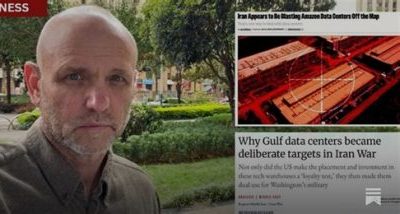
Iran spent $1 million to wipe out $30 billion in data center plans, and take down Amazon in the ME
or go to
Aletho News Archives – Video-Images
From the Archives
A short history of British torture
ICC | December 2005
When the House of Commons was debating how much to increase the time limit for detention without trial the question of torture came up. Officially this was limited to the nice considerations of whether it was all right to send people to places where torture is used and whether Britain can use information collected by the use of torture in other countries. This discussion gave an impression of democratic Britain as the home of civilised behaviour where the very idea of torture is repugnant to our legislators – unlike, say, the US with its secret CIA jails… In reality, the British state has a long history of using and developing a whole range of torture techniques. … continue
Blog Roll
 Aletho News
- Iran spent $1 million to wipe out $30 billion in data center plans, and take down Amazon in the ME
- Zionist billionaire pressure to silence Macklemore sparks exodus from Ed Sheeran tour
- House Votes to End Iran War for Third Time
- North Korea Slams US Plan for ‘AUKUS 2.0’ with South Korea and Japan
- Prolonging US-Iran Conflict Not Meeting Interests of Int’l Community – China’s Wang Yi
- EU bans former Zelensky aide from parliament
- NATO-backed Kosovo separatist ‘responsible for war crimes’
- US destroying international space law
- SCO Calls for Binding Global Deal to Prevent Arms Race in Space
- Iran & Its Allies Are Threatening Every Route for Saudi Oil
- If Americans Knew
- U.S. Makes, Israel Takes: The Real Story of U.S.-Israeli Military Cooperation
- Night raids rise in Palestine
- Tucker Carlson interviews Norman Finkelstein about Gaza
- Groups urge Americans to support Van Hollen legislation on Israel’s killing of Americans & Palestinians
- Trump administration plans to send 40,000 tons of bombs to Israel: report
- Sanctions Target Iran’s Government, But Kill Hospitalized 23-Year-Old Woman
- An alternative view on the book “Israel’s Lobby: America in the Grip of a Foreign Power”
- Ed Sheeran’s band Beoga, other opening acts quit tour after Macklemore was dropped over his pro-Palestinian comments
- The assassination attempt on President Trump in Butler and the various Israeli connections to it
- “We Want That the Whole Land Be Jewish”
- No Tricks Zone
- New Study: ‘Global Drought Shows No Detectable Recent Acceleration Under Climate Warming’
- Economic Masterminds: German Socialists Suggest Taxing Productivity Gains Stemming From Using AI
- The South China Sea Has Not Been Cooperating With The Climate Change Narrative
- Energy Crisis: Germany Enters Heating Season With Historically Low Gas Reserve Fill Levels
- New Study: The Antarctic Ice Sheet Gained Mass From 2020-2024 Due To Staggering Snow And Ice Accumulation
- Study: Ocean Heating Rates From Thousands Of Years Ago ‘Dwarf’ Modern Ocean Heating Rates
- Climate Extremists Target, Attack Large-Scale Power Grid Infrastructure In Germany!
- New Study: Antarctic Ice Melt Has Contributed Less Than 1 Centimeter To Sea Level Rise In The Last 30 Years
- Fear Of Debate: Alarmist German Climate Scientist Calls On Mainstream Media To Discredit Skeptic Voices
- End-Of-August Arctic Sea Ice Extent Hasn’t Fallen In 20 Years, Official Data Show!
 Aletho News