Israeli forces targeting Palestinian children in al-Khalil (Hebron)
International Solidarity Movement | September 20, 2015
Everyday, Palestinian families get attacked by Israeli forces in their own homes. Sometimes they bang on the door in the middle of the night, scaring children and adults, ransacking the house. On some of these raids, both during the night and in daytime, Israeli forces randomly arrest family members and take them to an unknown destination without any reason.
Last night, Israeli forces entered the Palestinian market in the Old City of al-Khalil (Hebron) and entered a Palestinian family home where they kidnapped an 8-year old girl and arrested 3 more young men. All of them were walked towards the military base in Shuhada street, but then kept behind a fence and military gate for more than 15 minutes before being released. No reason was given for the random arrest.
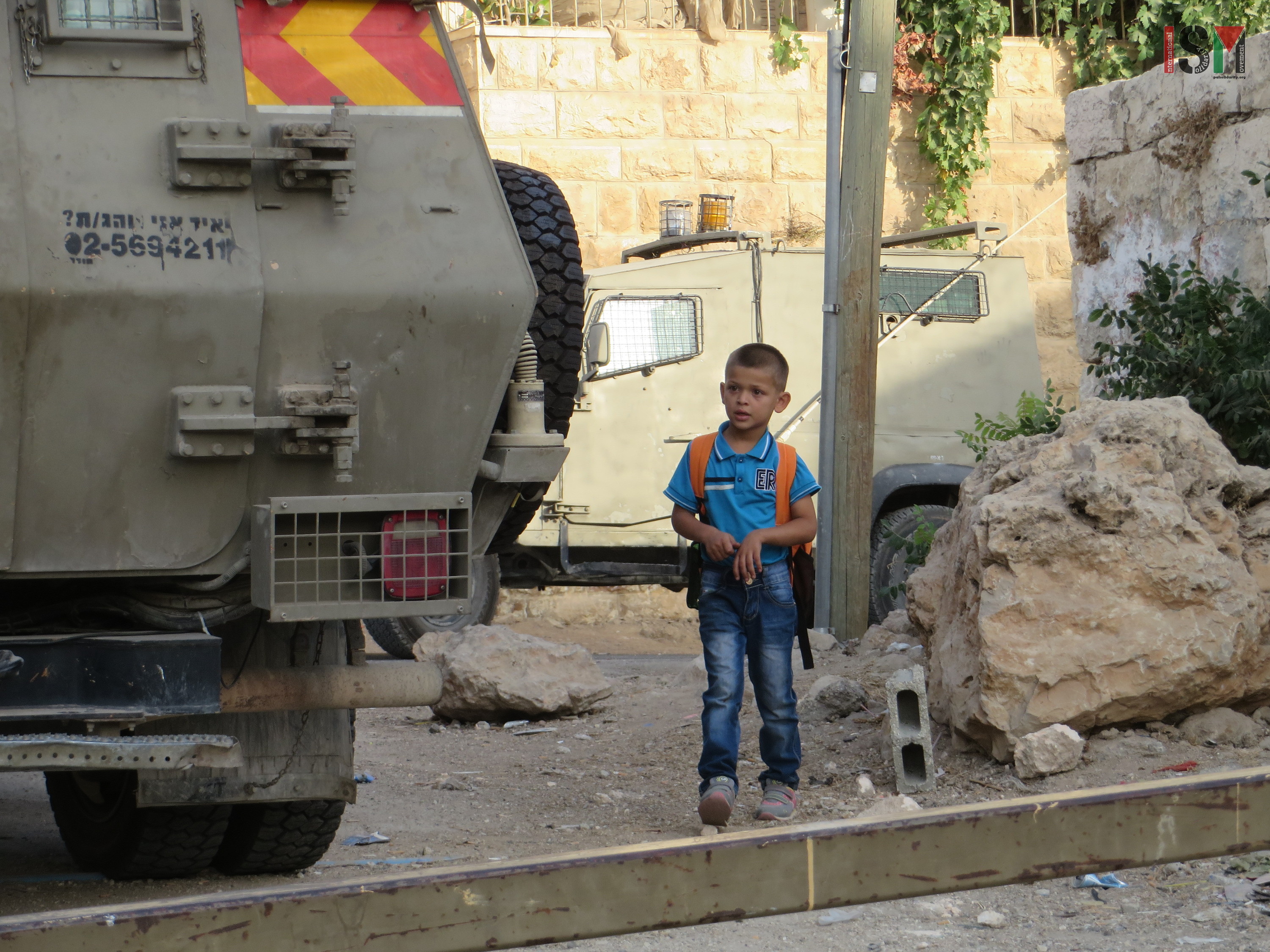
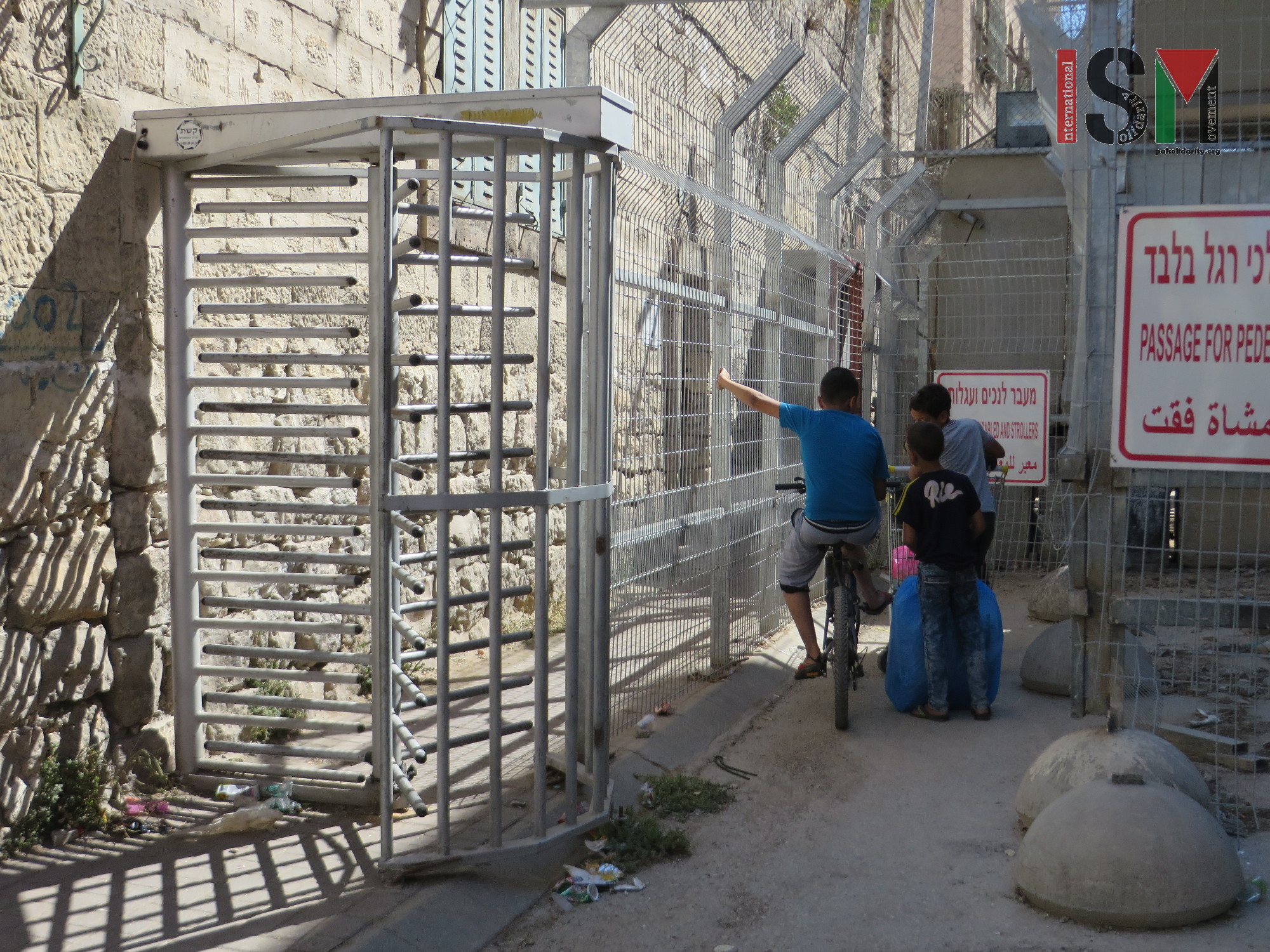
Even the way to school can be a dangerous and perilous journey for children in al-Khalil (Hebron). Having to pass through sometimes multiple checkpoints to get to school, children as young as 4 years old have to pass by heavily armed Israeli soldiers. As if the ubiquitous military presence weren’t scary enough, children are subjected to bag-searches, frisking, detainment and arrests. With Israeli forces using tear gas on children on their way to school and back home after a long school-day, children also have to duck away from tear-gas grenades shot towards them and navigate past clouds of tear-gas lingering on in the alleys.
Arresting children under the age of 11 is illegal even under Israeli law, as it is considered to be too traumatizing and detrimental to a child’s well-being, regardless of the accusations brought forward against a child. However, Palestinian children are detained, frisked, body-searched and arrested by Israeli forces on an every-day basis. As this illegal practice does not result in any consequences for the soldiers or policemen at all, Palestinian children are constantly at risk of maltreatment, abuse and denial of their most basic human rights.
Nearly 2,000 Palestinian children killed since 2000: Rights group
Press TV – September 17, 2015
An independent non-governmental organization (NGO) says nearly 2,000 Palestinian children have lost their lives at the hands of Israeli military forces and illegal settlers over the past 15 years.
 Defense for Children International-Palestine (DCIP), in a report released on Thursday, criticized the Israeli regime’s policy of land expropriation and consistent development of illegal settlements in the occupied East al-Quds (Jerusalem) and West Bank, warning that such practices are placing Palestinian children and their families against “expanding and often violent Israeli settler communities.”
The Geneva-based NGO further noted that Israel’s ongoing settlement expansion activities are increasingly creating a “hyper-militarized environment” for Palestinian children, where they are highly exposed to disproportionate violence from both Israeli forces and settlers.
The DCIP said Israeli soldiers killed 12 Palestinian children in East al-Quds and West Bank in 2014, and the majority of the fatalities were caused by ammunition.
It highlighted that there is “no evidence that any of the children killed in the West Bank posed a direct threat to Israeli troops or settlers.”
The rights group also revealed that 553 of the Palestinian children killed since 2000 died as a direct result of the Israeli military’s onslaught against the impoverished Gaza Strip in summer 2014, noting that around 68 percent of the victims were under the age of 12.
Israel started its military campaign against the impoverished Gaza Strip in early July 2014. The offensive ended on August 26, 2014. Nearly 2,200 Palestinians, including 577 children, lost their lives in the Israeli war. Over 11,100 others – including 3,374 children, 2,088 women and 410 elderly people – also sustained injuries.
More than half a million Israelis live in over 120 illegal settlements built since Israel’s occupation of the Palestinian territories in 1967.
Palestinians are seeking to create an independent state on the territories of the West Bank, East al-Quds, and the besieged Gaza Strip and are demanding that Israel withdraw from the occupied Palestinian territories.
Al Aqsa Under Attack: The NY Times Blames Its Youthful Defenders
By Barbara Erickson | TimesWarp | September 14, 2015
Tensions are running high at Jerusalem’s Al Aqsa Mosque, and The New York Times can tell us where to place the blame: It’s not the fault of extremists who plan to destroy the landmark, according to the Times, nor is it recent Israeli moves to restrict Muslim access to the site; it is the fault of hot-headed Palestinian youth.
In a story today and in a similar article last July Isabel Kershner points directly to these young people as the source of trouble in clashes with police. This is how the police have framed the issue, and Kershner gives prominence to their claims.
The Times story contrasts with reports from international media and Palestinian sources. From these accounts we learn that the youths were volunteer guards helping defend the holy site against Israeli incursions and that police stormed the mosque while Muslims were inside, beating and injuring worshippers and damaging prayer rugs and other articles. We also learn that these actions prompted even Arab nations on good terms with Israel to speak out in protest.
Kershner quotes Palestinian Liberation Organization secretary Saeb Erekat and a Hamas spokesman who condemn the Israel invasion of the mosque, but she fails to tell readers that both Jordan and Egypt, two nations friendly to Israel, also protested, along with the Arab League and the United Nations representative for peace talks.
The Al Aqsa Mosque has stood at its site in Jerusalem for a thousand years and is revered by Muslims everywhere, but Jews also consider the area as holy ground, where the Second Temple once stood. Extremists openly call for the destruction of both Al Aqsa and the even more ancient Dome of the Rock, which dominates the Jerusalem skyline. They plan to raze the edifices and replace them with a Third Temple.
The Times story fails to acknowledge these real threats that cause anguish among the followers of Islam. It has also neglected to report on Israel’s numerous efforts to restrict Muslim prayer at the mosque and the increasing presence of Jewish worshippers, who are protected by troops when they visit the compound.
Muslims know that another holy site, the Ibrahimi Mosque in Hebron, has been divided between a Muslim and a Jewish section, and that Israeli officials often choose to ban Muslims from entering altogether. This month, worshippers have been excluded from the Hebron mosque for six entire days.
Kershner reports that Muslims charge Israel with plans to divide the Al Aqsa compound, but she says that this is “an assertion vehemently denied by Israel.” Missing from her article is the history of Hebron and the restrictions Israeli authorities frequently impose on Muslim worshippers in both sites.
In recent weeks, for instance, Israel has prevented women from entering the Al Aqsa area, retained the identify cards of worshippers, allowed Jewish extremists to enter the mosque compound for “tours,” restricted the entry of students attending schools in the Al Aqsa compound and confiscated land in an Islamic cemetery next to the mosque.
After the latest incursion, the director of the mosque compound, Sheikh Omar al-Kiswani, said that Israel occupation authorities “have imposed their sovereignty over [the mosque compound] by power of force.” Israel controls who enters and exists, he said, and officials use force against anyone who challenges them.
This is a cry of alarm from a site revered by millions of Muslims throughout the world, but it found no mention in the Times. Instead, we receive the Israeli spin on this tragic saga as the newspaper glosses over the expansionist aims of a Zionist state.
‘Israel’s goal – expulsion of Palestinians and non-Jews’
RT | September 14, 2015
Israel is moving gradually to try to displace and expel Palestinians and every trace of Palestinians from wherever it can, says Paul Larudee from the Free Palestine movement.
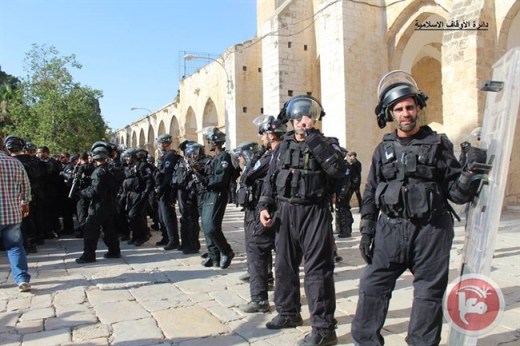
Israeli forces have conducted a raid on the Al-Aqsa Mosque in Jerusalem. Police say they were acting to restore order – after rioters attacked them with rocks and fireworks. The raid sparked widespread anger among Palestinians with rallies held in East Jerusalem and in Gaza.
RT: The Israeli authorities claim they were responding to an attack. Does it look like they used disproportionate force?
Paul Larudee: All forces [are] disproportionate; there should be no force at all in the area occupied by the Al-Aqsa Mosque. These forces don’t belong there. If they are not there they will not have stones thrown at them and they won’t have to react. The best way not to react and to not have this problem is not to be there.
RT: The Al-Aqsa Mosque and Temple Mount on which it stands – is a sacred site for both Muslims and Jews. Do you think it is legitimate to ban some Muslim groups from entering the compound as happened last week?
PL: No, clearly Israel is practicing encroachment, it’s trying to keep Muslims away and it’s trying to keep Palestinians away. It’s very difficult for anyone living in the West Bank and almost impossible for anyone in Gaza to go to the Al-Aqsa Mosque. Israel is doing this in preparation for the disappearance of the Al-Aqsa Mosque as it has supported the settlers who are anxious to build a new temple there and other things. There are a lot of non-religious Israelis who would like to see it gone even though they don’t want another temple there. But this is the way that Israel operates. It’s like a tree with its roots spreading out. The roots are perfectly capable of destroying very big objects in their way like sidewalks and streets and even the foundations of homes, but they move very gradually. That’s what Israel is doing – it’s moving very gradually to try to displace and expel Palestinians and every trace of Palestinians from wherever it can.
RT: Do you think this raid is somehow connected with the Jewish New Year which started on Sunday evening?
PL: That’s anybody’s guess if they feel that it will help their case and cause some of the more right-wing and fanatic settlers to push them even farther. They all have the same goal – which is the expulsion of the Palestinians and non-Jews in the area.
RT: There have been rallies in Jerusalem and Gaza against this raid. Do you think Sunday’s incident can provoke any further violence?
PL: Israel loves violence. They would like Palestinians to attempt as much violence as possible, because that gives them the opportunity to expel some more, to be punitive and so forth. This is how they make their greatest inroads into Palestinian territory and the confiscation of Palestinian land and the immiseration of the Palestinian population.
Israel Rejects Compensation For Burnt Historic Christian Church
IMEMC News | September 13, 2015
 The Israeli Tax Authority has rejected a claim for compensation by officials of the Catholic Church demanding compensation for the Church of Multiplication of Loaves and Fishes, which was burnt in an Israeli terrorist arson attack, last June.
Israeli Channel 2 has reported, Wednesday, that tax officials, who visited the burnt historic Christian church, where according to Christianity Jesus Christ multiplied loaves and fishes, have decided that the assault “was not a terrorist attack.”
Rejecting to label the attack on the Christian church in the Galilee as a terrorist attack means that the Israeli government has no obligation to pay any compensation, as Israel only pays compensation to victims of attacks it deems as terrorist.
The decision of the Tax Authority even ignores statements by senior Israeli officials, including Prime Minister Benjamin Netanyahu and Defense Minister Moshe Ya’alon, who both labeled it as a terrorist attack.
Israel apprehended and charged three Israeli Jewish extremists, believed to be responsible for the attack, and for writing racist graffiti saying, “Idols will be cast out.”
The church filed a request for compensation for damages, but their appeal was denied.
The Times Of Israel quoted Amir Cohen, a tax authority official, saying that he was not convinced the attack on the church was politically motivated.
Cohen said, “the charges filed against the three Israeli suspects state that their attack carried a religious motivation,” and “was based on religious hatred of Christians.”
In light of these “findings,” and statements, the Tax Authority absolved itself of any financial responsibility, as the law only requires the state to pay compensation for victims of war and terrorism. It said the attackers believe that the expulsion of Christians is a commandment, as they consider them “idolators.” … Full article
Israeli soldiers take over home of PA police chief in Nablus
Ma’an – September 11, 2015
QALQILIYA – Israeli military forces on Friday raided the house of Palestinian Authority police chief in Nablus, Abd al-Latif al-Qaddumi, and turned his home into a military outpost after evicting his wife and children.
PA police spokesperson Luay Irzeiqat told Ma’an that Israeli forces raided the home in Kafr Qaddum village and locked al-Qaddumi’s family in one room before declaring the property a military outpost.
Shortly afterward, Israeli forces expelled the family from the home and took it over.
Al-Qaddumi was not present at the time of the incident, with no further details about why Israeli forces seized the property.
On Sunday, Israeli forces held al-Qaddumi for more than an hour near the entrance of Hijja village west of Nablus, security sources told Ma’an.
They said that Israeli troops stopped the police chief on his way to Nablus police station and held him for more than an hour before releasing the police officer.
Iran, Israel and U.S. Subservience
By Robert Fantina | CounterPunch | September 11, 2015
As the United States Congress debates whether or not to accept an agreement that the U.S. and five other nations reached with Iran, regulating that nation’s nuclear program, the media keeps a less-than-rapt public informed. Each day, news pundits first speculate on how this or that senator may vote, and then when some senator announces his or her position, it is tallied up as a ‘yes’ or ‘no’, and a victory or defeat for President Barack Obama.
As all this takes place, some odd but revealing statements have been made. Let us first look at just two, both from Democrats, one from a senator voting for the deal, and one who opposes it, and see what they tells us.
Colorado Senator Michael Bennett, in endorsing the deal, made this astonishing statement: “Our primary objectives are to prevent Iran from having a nuclear weapon, make sure Israel is safe and, if possible, avoid another war in the Middle East.”
As this writer is wont to do, let us break this statement down to its component parts. We will look at Mr. Bennett’s ‘primary objectives’.
“Prevent Iran from having a nuclear weapon”. Well, the fewer nuclear weapons in the world, the better. But why are some countries allowed to have them, and others not? The only nation in the world ever to have used nuclear weapons, the U.S., has a large stockpile, and has done nothing to reduce it. Please note that the U.S. has been at war with one country or another for most of its long and bloody history, so the fact that it has nuclear weapons is certainly a great risk to the world. Former President Richard Nixon is said to have considered using nuclear weapons in Vietnam. Why is Iran being singled out as not allowed to have such weapons when the U.S. can have them?
“Make sure Israel is safe”. See how quickly we get to the crux of the matter? Israel’s safety, for Mr. Bennett, is of paramount importance. And if Iran were to develop nuclear weapons, then Israel wouldn’t be the only Middle East country with them.
There is always so much concern about Israel’s safety! Does the U.S. not care about the safety and security of other Middle Eastern nations? We know that Iraq’s security is not of any interest to the U.S., or it wouldn’t have destabilized Iraq by invading it in 2003. And with Israel assassinating Iran’s nuclear scientists, there can’t be too much concern about that nation’s internal security.
And what about Palestine? Israel increasingly steals Palestinian land, but no U.S. politician ever talks about the national security of Palestine.
U.S. spokespeople always proclaim that Israel is the U.S.’s only ally in the Middle East. Perhaps if the U.S. would stop bombing the men, women and children of other Middle Eastern countries, and would be a little more equitable in its foreign aid distribution (currently, Israel gets more foreign aid from the U.S. than all other countries combined), it might find that it suddenly would have more friends in the Middle East. It has been said that before the bloody, murderous and genocidal establishment of Israel in 1948, the U.S. had no enemies in the Middle East.
Why, then, might Mr. Bennett be so concerned about Israel? Could it be the $108,766.00 in donations from Israeli lobbies that he received between 2009 and 2015? Perhaps we will dismiss that notion, and say that Mr. Bennett is a statesman, rising above such petty things as campaign contributions, and only doing what he feels, in his heart of hearts, is best for the U.S. citizenry, come what may. When pigs fly.
“If possible, avoid another war in the Middle East.” So, as an afterthought, after concerns about Israel’s security have been addressed, perhaps avoiding a war isn’t such a bad idea. This is not the usual U.S. way; diplomacy isn’t high on the list of characteristics held by most of Congress. There isn’t a lot of muscle-flexing and chest-thumping involved in diplomacy, and what’s a little blood of U.S. citizens, and lots of it of foreign citizens, when such macho displays of power are to be demonstrated?
Now, to the opposition. Democratic Senator Ben Cardin of Maryland, who greatly distrusts Iran, said this: “There cannot be respect for a country that actively foments regional instability, advocates for Israel’s destruction, kills the innocent and shouts ‘Death to America.’” Again, we will look at the component parts.
Mr. Cardin is critical of nations that
1 ‘Actively foment regional instability’. The U.S. is causing untold suffering and ‘regional instability’ through drone strikes and support for repressive regimes or rebel groups throughout the region. One would like to hear Mr. Cardin oppose such active fomenting of regional instability.
2 ‘Advocate for Israel’s destruction’. Once again, Israel is foremost in the mind of another senator, as he looks at the nuclear agreement with Iran. Israel, of course, acts to destroy Palestine with full U.S. support, but that, as mentioned above, isn’t a concern.
Between 2009 and 2015, Mr. Cardin received $241,293.00 from Israeli lobbies. We will wonder again if this, perhaps, didn’t factor in strongly in Mr. Cardin’s deliberations.
As might be expected, the multitudinous Republican presidential candidate wannabes were universally opposed to the agreement. Oddly (not!), Israel was a major factor in their criticisms. The following are just a few of their comments.
Wisconsin Governor Scott Walker: “The deal rewards the world’s leading state sponsor of terrorism with a massive financial windfall, which Iran will use to further threaten our interests and key allies, especially Israel.” No, Mr. Walker, by any objective means, it is the U.S., not Iran, that is the world’s leading state sponsor of terror.
Former Arkansas Governor Mike Huckabee: “As president, I will stand with Israel and keep all options on the table, including military force, to topple the terrorist Iranian regime.” It sounds as if Mr. Huckabee wants ‘regime change’: when have we heard this before? Oh yes, that was President George W. Bush’s mantra when he sent soldiers in to ‘fix’ Iraq. We all know how well that turned out. Mr. Huckabee further said: “A threat to Israel is a threat to America.” No, it simply is not. Also, preventing Iran from developing nuclear weapons doesn’t seem to constitute a threat to any nation, with the possible exception of Iran.
Senator Lindsay Graham weighed in with these pearls of wisdom: “You’ve put Israel in the worst possible box. This will be a death over time sentence to Israel if they don’t push back.” It is interesting to note that between 2009 and 2015, Mr. Graham received $286,350.00 from Israeli lobbies.
It is no secret where this great anxiety for Israel originates; money talks in the U.S., and Israeli lobby groups speak loudly. What is disturbing is how it takes precedence over every other concern, to the point where elected officials are willing to wage war to protect an apartheid nation, censured more by the United Nations than any other country on the planet. This is the nation whose interests the U.S. puts front and center, before its own. This is the nation that receives billions of dollars in U.S. aid annually, as U.S. cities decay. This is the nation for which the U.S. will jeopardize the lives of its young citizens, by disdaining diplomacy and using war as the dominant means of ‘leading’ in the world.
That leading politicians so blatantly state their adoration for Israel should give every U.S. citizen cause for concern. It is time for justice and human rights to be enshrined as the hallmarks of U.S. foreign policy. As that has never been the case, it will be difficult to introduce it now. But it must be done; the world has suffered for too long because of the U.S.
Israel nuclear whistleblower Vanunu placed under house arrest over TV interview
RT | September 10, 2015
Whistleblower Mordechai Vanunu, who served 18 years for exposing details concerning Israel’s clandestine nuclear program in 1986, has been put under house arrest for giving an interview to local media, thus allegedly violating terms of his release.
The Magistrate’s Court in Jerusalem on Thursday confined the nuclear whistleblower to a seven-day house arrest, prohibiting him from using the internet or talking to the press, following a police investigation launched the previous day.
Local media report that the investigation was initiated by Shin Bet (the Israel Security Agency), which has been monitoring Vanunu’s activities since his release in 2004.
The arrest was prompted by an interview the whistleblower gave to the local Channel 2 TV station last week. The news channel said the interview’s content had been cleared for broadcast by the military censor. It added that police also asked for the unedited footage of the interview, suspecting that Vanunu had discussed sensitive information.
Channel 2 refused to hand it over, however, citing the media’s right to protect its sources. This principle is an “important element in the system of rights and freedoms on which a democratic government is based,” the station’s lawyer asserted, as quoted by the Haaretz newspaper.
Vanunu’s defense attorney, Yemima Abramovich, said that the interview was not a breach of his parole, as Vanunu had only been prohibited from talking to foreign journalists.
“He is allowed to talk to Israeli journalists,” she said, as quoted by Ynetnews, stressing that “the interview was approved by the military censor.”
“I’ve been Mordechai Vanunu’s lawyer for many years,” she added. “He is out of prison, but isn’t really free. It’s impossible for him to live a normal life.”
A senior Israeli security official told DPA news agency that, according to his release agreement, Vanunu was forbidden from sharing any classified information he had obtained as an employee at the Negev Nuclear Research Center near Dimona, “even if he already published that information in the past.”
In the parts of the interview that were aired last Friday, Vanunu spoke about his personal life and motives for leaking information about the existence of Israel’s nuclear activities, which the country neither denies, nor admits. However, he didn’t go into detail about what he leaked to the British press in 1986.
It was a desire to “inform the citizens of the Middle East, the world, and the state of Israel” that had prompted him to act, Vanunu told Channel 2, saying he was horrified at the “danger” posed by the Israel’s nuclear weapons program while working there.
The African-born Israeli worked as a technician at the Negev Nuclear Research Center until 1985. He leaked the information, including photographs, about Israeli’s nuclear activities to The Sunday Times in 1986.
Israel’s spy agency, Mossad, infamously organized a complex 1986 operation to abduct Vanunu and smuggle him back to Israel. It involved a female agent in disguise seducing the whistleblower and luring him into Rome. Once there, he was injected with a paralyzing drug and transported to an Israeli reconnaissance vessel docked under the guise of a merchant ship.
After serving an 18 year prison sentence, he was released on parole under the terms of which he is prohibited from leaving the state of Israel and having contact with foreigners, including the press. He was imprisoned again for three months in 2010 on the grounds that he had contacted foreign agents.
Grant F. Smith from the Institute for Research of Middle Eastern policy told RT that Vanunu is the key witness to Israeli’s nuclear program, which the state has kept secret.
“Vanunu did something nobody else was ever able to do,” he said. “He was able to take photos inside of Dimona to the London Sunday Times, and even more surprising – they published them. He has been considered to be the key witness to the fact that there is a nuclear weapons program research and development going on [in Israel]. He was also there right at the point where, according to Department of Defense Documents released recently, they were beginning hydrogen bomb research.”
READ MORE:
Israel gags famous nuclear whistleblower invited to speak at human rights conference
US-Israeli computer super-worm hit Russian nuclear plant – Kaspersky
Who’s Still Afraid of 9/11 Conspiracy Theories?
By Maidhc Ó Cathail | The Passionate Attachment | September 10, 2015
“The lady doth protest too much, methinks.”
—Queen Gertrude, Hamlet.
Whenever someone insists too strongly about something not being true, we tend to suspect that maybe it is. In their denials of involvement in 9/11, do Israel’s apologists “protest too much”?
While it would take a small book to adequately document the Israeli connection to 9/11—as Antiwar.com editor Justin Raimondo attempted to some extent in The Terror Enigma—let us briefly recall some of the more intriguing facts as reported in the mainstream media, involving dancing Israelis, Odigo warnings, and Zim’s timely move.
The story of the five Israelis who were seen celebrating and filming as the Twin Towers burned and collapsed was investigated by Neil Mackay in Scotland’s Sunday Herald. The so-called “dancing Israelis” worked for Urban Moving Systems, later deemed to be a Mossad front by the FBI. Despite failing numerous polygraph tests, the young men were deported to Israel two months later. Back home, several of the men appeared on a TV chat show, in which one of them amazingly said, “Our purpose was to document the event.”
Two employees of Odigo, an Israeli instant messaging service, received messages two hours before the World Trade Center attack on September 11 predicting the attack would happen, Ha’aretz reported.
Zim-American Israeli Shipping Co., part-owned by the Israeli government, moved their North American headquarters from the 16th floor of the WTC to Norfolk, Virginia one week before the 9/11 attacks, incurring a $50,000 fine for breaking its lease, according to the Jerusalem Post.
Despite being in the public domain, none of these relevant facts are mentioned in the 9/11 Commission’s 567-page report.
Moreover, Philip Zelikow, the executive director of the 9/11 Commission, is concerned about the spread of such inconvenient facts to the wider public. “Our worry,” he says, “is when things become infectious…. [then] this stuff can be deeply corrosive to public understanding. You can get where the bacteria can sicken the larger body.”
But was Zelikow speaking here as an American government official or as a pro-Israeli insider?
In the same month that he authored the so-called “Bush Doctrine” of preemptive war, which provided the justification for the 2003 invasion of Iraq, Zelikow made this candid admission: “Why would Iraq attack America or use nuclear weapons against us? I’ll tell you what I think the real threat (is) and actually has been since 1990—it’s the threat against Israel.”
Yet, instead of investigating the Israeli connection, Zelikow used the 9/11 Commission to sell the Israeli-inspired Iraq war to the American people.
Zelikow’s “bacteria” quote is cited in a 2008 paper entitled “Conspiracy Theories.” Co-authored by Cass Sunstein, who went on to head President Obama’s White House Office of Information and Regulatory Affairs, the main focus of the paper “involves conspiracy theories relating to terrorism, especially theories that arise from and post-date the 9/11 attacks.”
Rather than attempting to debunk such theories, Sunstein and Vermeule claim that those who suspect Israeli involvement in 9/11 suffer from a “crippled epistemology.” This, the authors argue, is due to “a sharply limited number of (relevant) informational sources.” In other words, “they know very few things, and what they know is wrong.”
To counter these suspicions, Sunstein recommends “cognitive infiltration of extremist groups, whereby government agents, or their allies (acting either virtually or in real space, and either openly or anonymously) will undermine the crippled epistemology of those who subscribe to such theories. They do so by planting doubts about the theories and stylized facts that circulate within such groups, thereby introducing beneficial cognitive diversity.”
It could, of course, be argued that Sunstein’s work also suffers from a crippled epistemology—his research relies heavily on pro-Israeli sources, most notably the notorious Islamophobe Daniel Pipes.
Pipes is a bit of an expert on conspiracy theories, having written two books on the subject. “Conspiracism provides a key to understanding the political culture of the Middle East,” Pipes opines in The Hidden Hand: Middle East Fears of Conspiracy. “It helps explain much of what would otherwise seem illogical or implausible, including the region’s record of political extremism and volatility, its culture of violence, and its poor record of modernization.”
Like Sunstein, Pipes is concerned that many in the region suspect Israeli involvement in 9/11. “The implications in the Middle East are quite profound,” Pipes told the LA-based Jewish Journal. “It’s one more brick in the edifice of fear and loathing of Israel and the Jews.”
In the absence of a proper 9/11 investigation, there remains a broad range of opinion about the precise nature of Israeli complicity. In The Terror Enigma, Justin Raimondo tentatively concludes that the Israeli connection to 9/11 amounts to “foreknowledge and passive collaboration with Bin Laden’s jihad.”
It’s hardly surprising then that some of the most obsessive critics of 9/11 “conspiracy theories” have ties to Israel. If Americans ever find out that their “staunchest ally” had anything to do with the mass murder of their fellow citizens on September 11, 2001, the would-be conspiracy debunkers have good reason to be afraid.
A version of this article was first published on April 3, 2010.
American False Flags That Started Wars
By Robert Fantina | Blacklisted News | September 9, 2015
KITCHENER, Ontario — As this is being written, Congress is experiencing extensive and dramatic hand-wringing as it decides between doing what is best for the country and the world or doing what is best for the American Israel Political Affairs Committee. This is no easy task for members of Congress, especially Democrats who, on the one hand, want to assure a “victory” for President Barack Obama, but who are also loathe to displease the Israeli lobby. Whether preventing a war factors into their deliberations is not known.
AIPAC and its countless minions in Congress are painting the recent agreement reached between Iran and the P5+1 (China, France, Russia, the United Kingdom, and the United States, plus Germany), as nothing short of the end of Israel.
If this deal preventing Iran from developing nuclear weapons is approved, they warn darkly, Iran will secretly develop nuclear weapons. This will mean the destruction of Israel, they say. But if it isn’t approved, Iran will develop such weapons. This, they say, will also mean the destruction of Israel. Feel free to re-read those sentences whenever time allows.
From this point of view, the only alternative is war, with the ostensible purpose of destroying Iran’s nuclear capabilities — capabilities that the Islamic Republic has always said are for peaceful energy purposes. Yet the risk of Iran ever having nuclear weapons is too great. If it did obtain them, then Israel would have a hostile nation to counterbalance its power in the Middle East, and, of course, it doesn’t want that competition. And whatever Israel wants, the U.S. wants. Hence the fear-mongering.
This is a tried-and-true method in the U.S. of getting wars started: Tell lies about some situation that can be construed as a threat to U.S. security (or in this case, Israel’s national security, which seems to be threatened by just about everything), get the populace riled up with jingoistic fervor, watch pompous politicians proclaim their great patriotism on the evening news, and then go bomb some country or other.
The U.S. again gets to flex its international muscle, the citizenry is, for some bizarre reason, proud of the destruction the country has caused, the weapons manufacturers spend all their time tallying their astronomical profits, and all is once again right in the twisted world of U.S. governance.
A few examples will suffice to show that this means of starting wars has been used repeatedly. The examples discussed herein do not by any means represent an exhaustive list, but only show that lying to the world to make the citizenry believe that the U.S. or its citizens had been threatened in some way, and that war was the only response, is business as usual in the U.S.
The War of 1812 (June 18, 1812 – Feb. 18, 1815)
Less than 40 years after the American Revolution, the still-new U.S. government felt constrained in areas of international trade, despite tremendous growth in such trade in the years leading up to the war. In 1811, Britain issued an Order-in-Council, excluding American salted fish from the West Indian colonies and imposing heavy duties on other U.S. imports. This, the U.S. could not countenance.
Additionally, although the heady concept of Manifest Destiny would not actually be defined for several more years, territorial expansion was always on the minds of the leaders of the fledgling nation. Canada, with its rich abundance of natural resources and wide expanses of land, was coveted.

The Battle Lake Borgne Hornbrook, War of 1812.
Yet trade and expansion were not foremost on the minds of the populace, at least not sufficiently for them to support a war. But many nations at this time had a policy of impressment, wherein the ships of another country were boarded, and their sailors kidnapped and forced to work for the kidnapping navy. This was something with which the common man and woman could identify. Although this wasn’t a common occurrence, it was exaggerated and combined with the trade issues to introduce the rallying cry of “Free Trade and Sailor’s Rights,” Carl Benn wrote in his 2003 book “Essential Histories: The War of 1812.” However, this wasn’t a simple, spontaneous cry of justice. It seems to have been promoted by annexationists running the government, and was sufficient for the U.S. to start an unsuccessful war against Canada.
Spanish-American War (April 25, 1898 – Aug 12. 1898)
Fast-forward to the end of the 19th century. On Feb. 15, 1898, the battleship Maine exploded in Havana harbor, killing 266 men. According to Hyman George Rickover, in his 1976 book “How the Battleship Maine was Destroyed”:
“Lieutenant Frank F. Fletcher, on duty at the Bureau of Ordnance, wrote in a personal letter to [Lieutenant Albert] Gleaves: ‘The disaster to the Maine is the one topic here now. Everybody is gradually settling down to the belief that the disaster was due to the position of the magazine next to the coal bunkers in where there must have been spontaneous combustion.’”
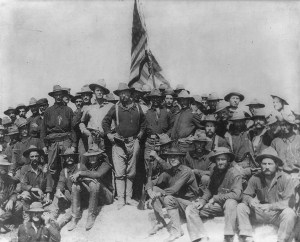
Theodore Roosevelt (center front, just left of the flag) and his “Rough Riders,” 1898.
The official inquiry into the disaster, however, concluded that an underwater mine had been the culprit. With the battle cry “Remember the Maine,” the U.S. quickly declared war on Spain.
But this “inquiry” was more than a bit flawed. Two widely-recognized experts in ordnance volunteered their services for the investigation, but were not invited to participate. One of them, Prof. Philip Alger, had greatly displeased Secretary of the Navy, and future president, Theodore Roosevelt, when he commented on the disaster in an interview for the Washington Evening Star a few days after it happened. He said, in part, the following, as reproduced by Rickover:
“As to the question of the cause of the Maine’s explosion, we know that no torpedo that is known to modern warfare, can of itself cause an explosion of the character of that on board the Maine. We know of no instances where the explosion of a torpedo or mine under a ship’s bottom has exploded the magazine within. It has simply torn a great hole in the side or bottom, through which water entered, and in consequence of which the ship sunk. Magazine explosions, on the contrary, produce effects exactly similar to the effects of the explosion on board the Maine. When it comes to seeking the cause of the explosion of the Maine’s magazine, we should naturally look not for the improbable or unusual causes, but those against which we have had to guard in the past.”
But Roosevelt was anxious to establish the U.S. as a world power, especially in terms of its Navy. By accusing Spain of blowing up the ship, he had the perfect excuse to launch the Spanish-American War.
The Vietnam War (major U.S. involvement: 1964 – 1975)
Off the coast of China and northern Vietnam is the Gulf of Tonkin, which was the staging area for the U.S. Seventh Fleet in the early 1960s. On the evening of Aug. 4, 1964, the U.S. destroyers Maddox and the C. Turner Joy were in the gulf, when the Maddox’s instruments indicated that the ship was under attack or had been attacked. Both ships began firing into the darkness, with support from U.S. warplanes. However, they “later decided they had been shooting at ghost images on their radar. … The preponderance of the available evidence indicates there was no attack.”

U.S. Huey helicopter spraying Agent Orange over Vietnam. (Photo by the U.S. Army Operations in Vietnam R.W. Trewyn, Ph.D.)
Yet something needed to be done about Vietnam, with anti-Communist hysteria still rampant in the U.S., and this gave Congress the perfect ploy to escalate the war. This non-incident was presented to the world as an act of aggression against the U.S. Congress quickly passed the Gulf of Tonkin resolution. By the end of the following year, the number of U.S. soldiers invading Vietnam increased from 23,000 to 184,300. Eleven years later, with over 55,000 U.S. soldiers dead, hundreds of thousands wounded, and, by conservative estimates, 2,000,000 Vietnamese dead, the U.S. fled Vietnam in defeat.
The Gulf War (Aug. 2, 1990 – Feb. 28, 1991)
In order to gain support for the Gulf War of 1990, Congress and President George Bush relied heavily on what is commonly referred to as the Nayirah testimony. In early October 1990, a 15-year-old girl referred to only as “Nayirah,” who claimed to have been a hospital volunteer, testified of seeing babies dumped by Iraqi soldiers from hospital incubators. This, in the eyes of Congress and the president, highlighted the monstrosity of Iraq, and was widely used to gain support for the war.
However, like nearly all of the information the government feeds to the citizenry to start its wars, this testimony was all lies. “Nayirah” was actually the daughter of the Kuwaiti ambassador to the U.S. She later admitted that she had once visited the hospital in question, but only for a few minutes. She did see an infant removed from an incubator, but only very briefly. A group called Citizens for a Free Kuwait had hired one of the world’s foremost public relations firms, Hill and Knowlton, to create the illusion of legitimacy for an invasion. They coached “Nayirah” on what to say and how to say it when she appeared before Congress.
We will do no more than mention the U.S.’s drafting of a letter for Grenada to send to the U.S., requesting military intervention when that small island nation’s government was overthrown in 1983. Nor will we dwell on the weapons of mass destruction that Iraq was said to possess in 2002, which justified in the eyes of U.S. citizens the disastrous 2003 invasion of that nation. But as we look at this ugly record of lies that the U.S. has used to expand its territory, power and/or influence around the world, we must consider that it is once again using the same tactics to march the nation toward war with Iran.
The U.S. for generations was successful in deceiving its citizens, and a good part of the world, that it was a beacon of freedom and peace, despite the fact that it has been at war for most of its bloody existence. That myth began to crack during the Vietnam War, broke into pieces with the Iraq War, and may have been dealt a fatal blow by the U.S.’s support of Israeli atrocities in 2014.
Regardless of the outcome of the congressional vote on the Iran agreement, the U.S. will find itself less able to lie its way into corporate wars in the future. That capacity diminished during the lead-up to the Iraqi invasion, and while no one ever went broke betting on the gullibility and short-term memory of the U.S. citizenry, people are beginning to wake up. When they finally do, much of the carnage in the world will end. That day cannot come soon enough.
Featured Video

Liberty Cannot Exist Inside a Panopticon
or go to
Aletho News Archives – Video-Images
From the Archives
Left-leaning despisers of 9/11 Truth movement: Do you really believe in miracles?
David Ray Griffin | Global Research | 06 Jul 2010
An Open Letter to Terry Allen, Noam Chomsky, Alexander Cockburn, David Corn, Chris Hayes, George Monbiot, Matthew Rothschild, and Matt Taibbi.
[1]According to several left-leaning critics of the 9/11 Truth Movement, some of its central claims, especially about the destruction of the World Trade Center, show its members to be scientifically challenged. In the opinion of some of these critics, moreover, claims made by members of this movement are sometimes unscientific in the strongest possible sense, implying an acceptance of magic and miracles. … Full article
Blog Roll
 Aletho News
- SVR Report on Ukraine’s Mexican Drug Gang Links Could Pressure Zelensky, Won’t Change US Policy
- British Government Employees Were Fact-Checking the News at the BBC. Nobody Told You.
- Albania on fire: who’s behind the riots?
- Egypt’s Civil Democratic Movement rejects involvement in regional war
- Egypt collaborates with Israel to build ‘Green Rafah’ project over erased Palestinian city
- Rising fuel prices and shortages have helped drive ongoing protests and rioting in France
- Tokyo protests demand Takaichi’s resignation over support for ‘Israel’
- Jennifer Kavanagh: Why the U.S. Should Pull Back From the First Island Chain
- Yemen denounces international community’s silence on Saudi aggression, siege
- UAE and Saudi Arabia move toward renewed coordination against Sanaa
- If Americans Knew
- More on how Bari Weiss is using CBS on behalf of Israel
- What the UK Is Doing to Pro-Palestine Novelist Sally Rooney Is an Act of Orwellian Villainy
- ‘We will build palaces for Jews in Gaza’: Right-wing activists establish new outpost near border
- ‘You see us burning, you stay silent’: Family’s agony over mother and sons burned to death in Gaza tent
- Israel keeps Palestinian journalist Bushra al-Tawil in isolation for 46 days
- US-Israel integration plan puts US military tech in Israel’s hands
- Israeli Strike Burns Gaza Mother Alive in Front of Toddler, ‘Without Generating Any Headlines’
- ‘The Israel Experience with Mike Huckabee’: The Ambassador’s Family Sells Trips to Israel
- As Gazans carry out mass burial, food insecurity is getting worse – Daily Update
- Israeli rabbi permits occupiers to steal Palestinian olive harvest in West Bank
- No Tricks Zone
- Predictions Made By Renowned Climate Proifessor Over Past Decades Have Been Proven To Be Poor
- New Study Suggests Large Regions Of The Pacific Ocean Have Been Cooling For The Last 80 Years
- Germany’s Green Energy Debacle: High Energy Costs Force Kahla Porzellan to Close After 182 Years!
- New Study: 50 Years Of The Most Aggressive ‘Net Zero’ Policies Can Only Affect The Global Climate By 0.03°C
- US September “Heat” Was No Record…Many Records Set Decades Ago
- Latest European Green Energy Debacle; Portugal’s Largest Flagship Solar Park Insolvent!
- Green Energy Debacle: German Expert Professor Fritz Vahrenholt Warns Of Severe Economic And Social Consequences
- Two More Paleo Reconstructions Affirm Meters-Higher Sea Levels Across Ireland, Brazil 7000-6000 Years Ago
- New Study: Earth And Venus Surface Warmth Largely Explained By Convection And Lapse Rate, Not CO2 Or Radiation
- 2025 Nature Paper Claiming Worsening Global Drought Gets RETRACTED …Heavily Flawed

