Putin Announces Suspension of New START Treaty, Orders New Strategic Systems Be Put on Combat Duty
Sputnik – 21.02.2023
Russia will be suspending its participation in the New Strategic Arms Reduction (New START) Treaty, President Vladimir Putin has announced.
The Russian president made the announcement during the course of a major annual address to lawmakers on Tuesday that focused on the security crisis in Ukraine and the broader global tensions between the West and Russia.
“They [the West] seek to inflict a strategic defeat on us and to creep onto our nuclear sites. In connection with this, I am forced to announce today that Russia is suspending its participation in the New START Treaty. I repeat – not exiting from the treaty, but suspending its participation,” Putin said, speaking to gathered lawmakers in Moscow during his speech to the Federal Assembly.
Putin explained that “at the start of February, the North Atlantic Alliance made a statement factually demanding that Russia ‘return to the implementation of the strategic offensive arms treaty,’ including the admission of inspections to our nuclear and defense facilities.”
“I don’t even know what to call this – some kind of theater of the absurd. We know that the West is involved directly in attempts of the Kiev regime to strike the bases of our strategic aviation,” Putin said, pointing to recent Ukrainian drone attacks on Russia’s Engels Air Base, home to part of the airborne contingent of Russia’s nuclear triad.
The drones used in these attacks were “equipped and modernized with the assistance of NATO specialists,” Putin said. “And now they want to inspect our defense facilities. In the current conditions and today’s confrontation, this simply sounds like some kind of nonsense.”
“A week ago, I signed a decree putting new ground-based strategic weapons systems on combat duty. Are they going to stick their nose in there too?” Putin asked.
The Russian president suggested that NATO’s collective statement essentially amounted to an application to join the New START Treaty, and said Moscow would only welcome such a move.
“We agree, please go ahead. Furthermore, we think that such a formulation of the issue is long overdue. After all, NATO contains not just one nuclear power – the USA. Britain and France also have nuclear arsenals, which are being developed and improved, and which are also directed against us, against Russia,” Putin said.
Slamming the US and NATO over the “hypocrisy” of their demands, Putin recalled how the Western bloc has attempted to assure Moscow that “there is no connection between issues related to strategic offensive arms and, say, the conflict in Ukraine, or other hostile actions against our country,” while at the same time seeking to “defeat” Russia militarily.
“This is either the height of hypocrisy and cynicism, or the height of stupidity. You can’t call them idiots, they are not stupid people: they want to inflict a strategic defeat on us,” the president said.
What is New START and Why Is It Important?
The New START Treaty is the last major strategic arms limitation agreement between the nuclear superpowers – Russia and the United States. The agreement, drafted in 2009 and signed by then-Russian and US Presidents Dmitry Medvedev and Barack Obama in Prague, Czech Republic in 2010, limits the two countries’ deployed arsenals of strategic weapons and nuke stockpiles, and features a series of measures aimed at increased transparency and trust, including the broadcast of telemetry data, limits to missile testing activities, and the exchange of other information.
The Trump administration threatened to let the clock run out on New START in late 2020 after withdrawing from the Intermediate-Range Nuclear Forces Treaty – a late Cold War-era pact which eliminated Soviet and US ground-based nuclear missiles in the 500-5,500 km range, in 2019. The Biden administration agreed to renew New START for five years in early 2021. Pentagon planners have repeatedly criticized the strategic treaty for its failure to account for the nuclear arsenal of China. Beijing has said that it would be happy to sign a nuclear agreement with Washington if the US reduced the size of its nuclear arsenal to China’s level.
The post-Cold War strategic security order began to be dismantled in late 2001, when the George W. Bush administration announced that it would scrap the Anti-Ballistic Missile Treaty – a landmark 1972 agreement designed to limit anti-missile defenses and thus reduce the danger of a global nuclear war. Washington quit the treaty despite proposals by Moscow at the time to establish a joint missile defense system in the Caucasus to eliminate any threats posed to the US or Europe.
Russia suspends last nuclear treaty with US
RT | February 21, 2023
Moscow is suspending its participation in the last remaining nuclear treaty between Russia and the US, President Vladimir Putin has announced. During his key address to the Russian parliament on Tuesday, he noted that Moscow will not exit the New START Treaty, but is temporarily withdrawing.
Explaining the decision, Putin stated that the agreement was initially drawn up under completely different circumstances, when Russia and the US did not perceive each other as adversaries. Now, however, according to the president, not only is the US issuing ultimatums to Russia, but NATO itself has essentially made an application to become part of the treaty as well.
The bloc members are now demanding an inspection of Russia’s strategic facilities, Putin said, noting that Moscow’s requests to inspect Western nuclear facilities under the treaty are systematically denied with only formal explanations for the rejection.
Putin noted that the US has continued to insist on maintaining hegemony, while its NATO partners openly admit that they want to inflict a strategic defeat on Russia.
“Russia cannot ignore this. We cannot allow ourselves to ignore this,” he said.
Before we return to discussing this agreement, we must understand for ourselves what the intentions of countries like France and the UK are and how we will consider their strategic arsenals as well, which is the cumulative striking potential of NATO.
The New START Treaty was originally signed in 2010 by then-Presidents Barack Obama and Dmitry Medvedev, and aimed to cut in half the number of strategic nuclear missile launchers deployed around the world. Under the treaty, both countries were supposed to allow the other side a limited number of inspections per year to verify compliance with the agreement. Unless extended, the treaty was set to expire in 2026.
Biden’s Visit To Kiev Is “Copium” To Distract The West From Disadvantageous Developments
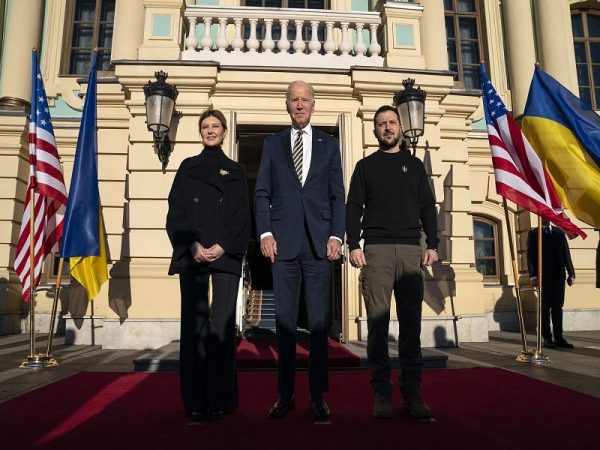
By Andrew Korybko | February 20, 2023
The whole reason why the Mainstream Media and allied accounts on social media are overdosing on this cheap “copium” is because they know very well that tougher days are ahead for their side considering NATO’s military-industrial crisis, the sanctions’ failure, and Russia’s likely capture of Artyomovsk/“Bakhmut”. Kiev’s supporters urgently need a proverbial shot in the arm to keep their morale alive amidst the series of impending setbacks that are poised to afflict the Golden Billion’s proxies in the coming future.
The term “copium” refers to an artificially manufactured narrative aimed at distracting a targeted audience from a disadvantageous development by convincing them that “everything is going according to plan”, which is why it’s a fitting description of the purpose behind Biden’s surprise visit to Kiev. His trip occurred against the context of the NATO chief finally admitting his bloc’s military-industrial crisis that risks depriving its Ukrainian vassals of the armed support they need to continue this proxy war.
Just the day before Biden arrived, Zelensky disclosed in an interview with Italian media that his forces might abandon Artyomovsk/“Bakhmut” if their casualties continue to climb, which represents a decisive reversal of the “official narrative” hitherto claiming that they’ll cling to it no matter the cost. On the topic of decisive narrative shifts, American and Polish officials spent the past month informing everyone that Kiev’s victory is no longer “inevitable”, which was meant to prepare them for impending setbacks.
Between the initiation of that newfound narrative trend and Biden’s trip, the New York Times reported that the West’s anti-Russian sanctions failed, after which Bloomberg proved that India had been working as the middleman for indirectly facilitating Russia’s oil exports to the West. Russian Foreign Minister Lavrov’s two practically back-to-back trips to Africa in recent weeks also confirmed that his country is far from isolated since it enjoys that geostrategic continent’s support.
The sequence of events that began at the start of this year were obviously disadvantageous for the US-led West’s Golden Billion since they discredited everything that this de facto New Cold War bloc’s perception managers had claimed up until that point. Russia continues gradually gaining ground in Donbass, neither its economy nor military collapsed under sanctions, and the global systemic transition to multipolarity has only accelerated since the start of its special operation a year ago.
It therefore makes perfect sense why the US was so desperate for a distraction, hence Biden’s visit to Kiev, which is being spun by the Mainstream Media (MSM) as supposedly representing one of the most symbolic moments since Russia was forced to initiate the latest phase of the Ukrainian Conflict. Nothing of tangible significance was achieved during his trip, though, and the comparatively miniscule armed aid that he announced on Monday obviously didn’t require him to be there in person.
The whole reason why the MSM and allied accounts on social media are overdosing on this cheap “copium” is because they know very well that tougher days are ahead for their side considering NATO’s military-industrial crisis, the sanctions’ failure, and Russia’s likely capture of Artyomovsk/“Bakhmut”. Kiev’s supporters urgently need a proverbial shot in the arm to keep their morale alive amidst the series of impending setbacks that are poised to afflict the Golden Billion’s proxies in the coming future.
The last thing that this de facto New Cold War bloc’s liberal-globalist elite needs is the masses losing hope in this post-modern crusade lest public pressure build to the point of complicating some NATO countries’ further dispatch of armed assistance to Kiev at the expense of their minimum security needs. The chain reaction of disadvantageous developments that was described in the present analysis and everything else that might thus follow if that unfolds could end up being a game-changer in this conflict.
The military-strategic dynamics are trending in Russia’s favor at this pivotal moment in the conflict, and even the economic ones too after the New York Times reported that the West’s sanctions failed, so there’s never been a more urgent time for a “copium” binge than now. Biden’s visit to Kiev won’t change the aforesaid, but it might very well succeed in temporarily distracting the Western masses from all this long enough for their elites to weaponize a new set of infowar narratives against them.
Munich Conference signals Western isolation, advent of multipolarity
By Drago Bosnic | February 20, 2023
Although it has been only 16 years since President Putin’s historical speech at the 2007 Munich Conference, that event now seems like a distant past of a long-lost world. Back then, Russia was warning the political West that further NATO aggression would inevitably lead to the revival of the Cold War.
However, Washington DC and Brussels seem to have wanted exactly that. The political West has tried to present the 2023 Munich Security Conference as some sort of a groundbreaking global event that “sent a strong signal” and showed “just how isolated” Russia is. However, nothing could be further from the truth, given the comments of some of the most prominent participants, including NATO and EU member states.
For instance, during a Saturday meeting with US State Secretary Anthony Blinken, China’s Foreign Minister Wang Yi stated that Beijing finds Washington DC’s attempts to threaten Sino-Russian relations completely unacceptable, emphasizing that the relationship between the two superpowers is their sovereign right and that it is not aimed against any third party.
“We will never accept the instructions of the United States and even threats to put pressure on Russian-Chinese relations,” Wang was quoted as saying in a statement published on Sunday by the Chinese Foreign Ministry. “The Sino-Russian relations of comprehensive partnership and strategic cooperation are based on non-alignment, non-confrontation and non-targeting against third parties. They are within the framework of the sovereignty of two independent states,” he added.
The comments were made in response to US accusations that China will “increase its support for Russia”. Wang also warned his American counterpart against the continued melodramatic reaction to the “balloon controversy”, which the US has been (ab)using lately to ensure detente between the two countries is virtually impossible. Beijing said that American high-altitude balloons have illegally entered China’s airspace many times over the last several decades, but the government chose not to cause panic and simply used existing diplomatic channels to communicate with their US counterparts.
“If the US continues to use this as an excuse, to promote further escalation and aggravate the situation, then China will definitely go to the very end. All the consequences of this will be borne by the American side,” Wang said.
China also called on the US to stop escalating the Ukrainian crisis and start promoting a peaceful settlement. Wang said that “Washington DC should stop adding fuel to the fire”. He noted that China’s position is constructive and called for the negotiation process to continue.
“Being a great power, the United States should contribute to the political settlement of the crisis, and not add fuel to the fire and look for opportunities to extract its own benefits,” Wang was quoted as saying.
Hungary also called for the de-escalation of the crisis and insisted on maintaining economic relations with Russia. During the traditional annual address to his fellow citizens, Prime Minister Viktor Orban stated that “the only way for Hungary to live peacefully is to stay out of the conflict, as it is not our war”.
“We will maintain our economic relations with Russia, and we advise the entire Western world to do the same, because without relations there will be no ceasefire or peace talks,” Orban said.
On the other hand, the European Union is doing exactly the opposite. The bloc’s top diplomat Josep Borrel called Russia “an existential threat” and urged all member states not to continue supporting the Kiev regime, but “help more”. He also insisted that “the EU should start an industrial techno-blitzkrieg to produce more weapons“, effectively nullifying the claim that the bloc was an economic union. Borrel added that member states will spend an additional €70 billion on defense by 2025.
“In the next two years, the EU countries intend to spend an additional €70 billion on defense. France will increase defense spending by 40%, while Poland will double it,” he stated.
Interestingly, India was also targeted. George Soros, a controversial oligarch infamous for providing financial backing for various groups responsible for destabilization and undermining of countries the political West sees as “uncooperative”, stated the following:
“India is an interesting case. It’s a democracy, but its leader Narendra Modi is no democrat. Inciting violence against Muslims was an important factor in his meteoric rise. Modi maintains close relations with both open and closed societies. India is a member of the Quad (which also includes Australia, the US, and Japan), but it buys a lot of Russian oil at a steep discount and makes a lot of money on it. […]
Modi and business tycoon Adani are close allies; their fate is intertwined. Adani Enterprises tried to raise funds in the stock market, but he failed. Adani is accused of stock manipulation and his stock collapsed like a house of cards. Modi is silent on the subject, but he will have to answer questions from foreign investors and in parliament. This will significantly weaken Modi’s stranglehold on India’s federal government and open the door to push for much-needed institutional reforms. I may be naive, but I expect a democratic revival in India.”
In response to the accusations, India’s Foreign Minister Subrahmanyam Jaishankar brushed Soros off and (quite accurately) described him as “old, rich, opinionated and dangerous”. Considering Soros has a history of Nazi collaboration, it can be argued that his attack could even be considered a compliment of sorts for Prime Minister Modi and India as a whole.
In essence, the Munich Conference not only failed to produce the desired results (Russia supposedly isolated), but it even strengthened the multipolar world, as neither India nor China proved malleable in any way, showing their sovereignty is untouched by the political West’s pressure. On the other hand, many Europeans are extremely unhappy by the EU’s militarization. According to varying estimates, the huge crowd of protesters in Munich numbered up to 50,000 people. In conclusion, while there are massive differences between Munich 2007 and Munich 2023, the latest conference is somewhat similar to the 1938 Munich Agreement between Nazi Germany and Western allies. Considering how that ended (along with any other invasion of Russia), the political West’s prospects against Moscow look rather grim, to say the least.
Drago Bosnic is an independent geopolitical and military analyst.
Russia UN envoy: West hell-bent on destroying Russia, inciting deep Russophobia
Press TV – February 19, 2023
Russian ambassador to the UN has accused the West of instigating “deep Russophobia” and having a determination to destroy his country, saying that, “We had no choice other than to defend our country — defend it from you, to defend our identity and our future.”
Vassily Nebenzia made the remarks at a meeting of the UN Security Council, saying that Russia had no other choice than war. “We had no choice other than to defend our country — defend it from you, to defend our identity and our future.”
Friday’s meeting in the council — the only international venue where Russia regularly faces Ukraine and its Western supporters — put a spotlight on the deep chasm between the warring parties as the conflict is moving into its second year with no end in sight.
In the meeting, US deputy ambassador, Richard Mills, accused Russia of failing to implement “a single commitment it made” in the Minsk agreements while the other signatories — France, Germany, Ukraine and the Organization for Security and Cooperation in Europe — “sought to implement them in good faith.”
France ambassador, De Riviere, claimed his country and Germany have worked “tirelessly” since 2015 to promote dialogue between parties, adding that the “difficulties encountered in implementing these agreements can never serve as justification or mitigating circumstances for Russia’s choice to end the dialogue with violence.”
In response, Nebenzia accused the Western nations, including France and Germany, of “holding back” on implementing the Minsk agreements brokered by the two countries to end the conflict between Ukraine and the separatists in Luhansk and Donetsk in the Ukraine’s mostly Russian-speaking industrial east that flared in April 2014 after Crimea joined Russia.
“You knew very well that the Minsk process for you is just a smoke screen, so as to rearm the Kiev regime and to prepare it for war against Russia in the name of your geopolitical interest,” Nebenzia said.
He further accused the West of “deep Russophobia,” and a “determination to destroy my country, using others if possible.”
The envoy added that the West has no desire to “build a European and Euro-Atlantic security system together with Russia [because] for you such a system can only be aimed against Russia.”
“We have no trust left in you and we are not capable of believing any promises you make – not as regards a non-expansion of NATO in the east, or your desire not to interfere in our internal affairs, or your determination to live in peace,” Nebenzia said.
“You have shown that it’s impossible to negotiate with you,” he said. “You’ve shown how treacherous you are by creating on our borders a neo-Nazi, neo-nationalist beehive and then stirring it up.”
The Minsk agreements were a complex series of measures negotiated by Russia, France, Germany and Ukraine in 2014-2015 in a bid to put an end to the armed conflict between the Kiev authorities and the breakaway region of Donbas.
Moscow repeatedly stated that Kiev was not fulfilling the deal by not granting self-government to the Russian-speaking region of Donbas. In February 2022, Russia began the “military operation” to defend the territory from Ukrainian troops.
Last week, Ukrainian President Volodymyr Zelensky admitted he never intended to implement the Minsk agreements. Former German Chancellor Angela Merkel also recently acknowledged that Minsk deal was simply “an attempt to give Ukraine time” so that its army could get stronger.
The revelation was confirmed by former French President Francois Hollande, and Former UK Prime Minister Boris Johnson who said the Minsk agreement had been nothing but a “diplomatic imitation.”
Scott Ritter calls Hersh’s Nord Stream article “his most important work ever”
By Scott Ritter | February 17, 2023
In the Christian faith, God comes in the form of three persons: the Father, Son, and Holy Spirit.
Together, these three beings form the Trinity.
In a recent interview with the German writer Fabian Scheidler, Pulitzer Prize-winning investigative journalist Seymour Hersh discussed his bombshell article that appeared in his inaugural posting on Substack, “How America Took Out the Nord Stream Pipeline”.
When Scheidler thanked Hersh for his courageous reporting, the veteran reporter shot back, “What’s so courageous about telling the truth? We’re supposed to tell the truth!”
I’ve known Sy Hersh for coming on a quarter century. While I was too young to experience first-hand the impact of his reporting on the My Lai massacre in Vietnam, I had a front row seat to the masterful job he did in bringing to light the horrible facts about what the United States was doing in the Abu Ghraib prison, in Iraq.
Legendary status isn’t given—it is earned. And Sy Hersh has earned the absolute right to be called the GOAT when it comes to investigative journalism. He is, simply put, the best.
I’ve read nearly everything Sy Hersh has written, and am able to put his considerable journalistic output in its proper historical perspective. It is therefore that I feel very comfortable in concluding that, in terms of its potential for bringing about tectonic geopolitical change, Sy’s Nord Stream reporting is his most important work ever.
The GOAT has produced what I call the Trinity of Truth.
Truth One: The President of the United States, Joe Biden, by conspiring with members of his national security team to deliberately bypass constitutionally-mandated reporting requirements to Congress regarding acts of war undertaken by the United States, has committed an impeachable offense unmatched by any other president in the history of the United States.
Truth Two: The blow-back that will occur inside Germany to the revelations put forward by Seymour Hersh that the United States carried out an economic Pearl Harbor by destroying energy infrastructure critical to the well-being of the German nation has the potential of breaking up the North Atlantic Treaty Organization (NATO) and the European Union (EU), upending more than eighty years of post-war European security and stability, and resulting in the diminishment of the United States on the world stage as it becomes isolated from long-time European allies that served as the foundation of the global acceptance of the so-called “rules based international order” that has served as the means by which the United States exerted global hegemony.
Truth Three: The decision to attack the Nord Stream pipeline puts a lie to the US contention that Russia’s invasion of Ukraine was an unprovoked act of aggression, instead underscoring the harsh truth that the United States had a strategic plan which hinged on provoking a conflict with Russia in Ukraine to provide the geopolitical cover for ending Europe’s reliance upon cheap Russian natural gas by demonstrating that every time Russia sought a negotiated end to the crisis, whether before the invasion through implementation of the Minsk Accords, or after in the Istanbul round of talks scheduled for April 1, the United States sabotaged the effort, keeping the conflict alive long enough to implement its major objective—the destruction of Nord Stream.
In short, Sy Hersh, through his reporting, has exposed truths which have the potential of bringing down a presidency, destroying NATO, and proving Russia right in the eyes of the world.
Name one other piece of journalism in the past half-century that packs such a punch.
You can’t.
Sy Hersh is a national—no, an international—treasure, something this Trinity of Truth underscores.
Be sure to treat him as such.
Moldova’s “football plot” highlights ridiculousness of anti-Russia hysteria
By Ahmed Adel | February 17, 2023
By accusing Moscow of planning a coup d’état in Moldova, President Maia Sandu is trying to divert public attention from the economic crisis in the country whilst also ingratiating herself with the anti-Russia West. In fact, her accusations reached such ridiculous levels that supporters of football club Partizan Belgrade were implicated in the supposed plot to overthrow the current government and install a pro-Russian regime.
Sandu said that Russia is allegedly planning to use foreign saboteurs to topple her country’s leadership, stop its accession to the European Union and use it in the conflict against Ukraine.
“The plan included sabotage and militarily trained people disguised as civilians to carry out violent actions, attacks on government buildings and taking hostages,” she told reporters on February 13.
She added, without providing the evidence, that citizens of Russia, Montenegro, Belarus and Serbia would be among those entering Moldova to try to spark protests in an attempt to “change the legitimate government to an illegitimate government, controlled by the Russian Federation to stop the EU integration process.”
Fans of Serbian football club Partizan Belgrade were banned from travelling to watch their team play Sheriff Tiraspol on February 16 in the first leg of their Europa Conference League knockout play-off tie. In fact, the game was played behind closed doors due to the supposed fears of the coup.
The match had been relocated to the Moldovan capital of Chisinau from Tiraspol, the capital of the self-declared independent country of Transnistria, which is internationally recognised as part of Moldova but is overwhelmingly Russian and Ukrainian in its ethnic makeup. It is more than likely that Sandu reached ridiculous levels of accusations, even to the point of banning football fans, because the supporters of Partizan Belgrade and Sheriff Tiraspol were likely to make pro-Russian statements – something she did not want to be broadcasted to international audiences.
Sandu’s statement is also connected with the economic crisis in Moldova. The country is not experiencing economic growth and is not receiving cheap gas and oil from Russia. Effectively, Sandu is scaring the Moldovan people by making them believe that war is on their doorstep. This serves to distract them from their economic hardships.
It is recalled that at the beginning of her political career, Sandu talked about economic growth, fighting crime, and reducing corruption. However, the level of corruption has increased, inflation is hovering at about 30% and the country is on the verge of bankruptcy.
Rather than deal with these issues, the Moldovan president is trying to please the West by implicating Russia in another scheme. This will not only further deteriorate Chisinau’s relations with Russia, but justify a tightening of domestic and foreign policy against dissidents. Sandu in this way demonstrates that she is useful for Washington and Brussels as she is stamping out pro-Russian sentiment in an authoritarian manner.
Moldova has long lost its constitutionally “ensured” neutral status and now depends on the Americans and Europeans as she sees the future of her country in NATO. Moldova’s parliament approved pro-Western Prime Minister Dorin Recean and his proposed Cabinet in a confidence vote on February 16.
Sixty-two MPs, all from the Sandu-founded Action and Solidarity Party (PAS), voted in favour of appointing the new Cabinet. PAS holds 63 out of 101 seats in the Moldovan parliament, and therefore comfortably passed the new cabinet, especially as the parliamentary opposition did not vote. In this way, Moldova is now firmly in the Western bloc despite constitutionally being neutral and not even being a member of NATO or the EU.
It is recalled that Sandu previously stated that attacks are being prepared in Moldova with the aim of overthrowing the constitutional order of the country. At the time, she called on the parliament to expand the powers of the security services.
Previously, Ukrainian President Volodymyr Zelensky, when addressing the European Council, said that the Ukrainian intelligence services had intercepted Russia’s plan to overthrow the democratic order in Moldova and that the Ukrainian side informed the Moldovan leadership about it. In this light, Sandu asked Moldova’s parliament to adopt draconian draft laws to equip its Intelligence and Security Service, and the prosecutor’s office, “with the necessary tools to combat more effectively the risks” to the country’s security.
Russia’s Foreign Ministry spokeswoman Maria Zakharova dismissed Sandu’s claims on February 14 as “absolutely unfounded and unsubstantiated.”
“They are built in the spirit of classical techniques that are often used by the United States, other Western countries and Ukraine,” Zakharova said. “First, accusations are made with reference to purportedly classified intelligence information that cannot be verified, and then they are used to justify their own illegal actions.”
In this way, Sandu is making extremely desperate, but also humiliating justifications to introduce authoritarian laws to stamp out Russophilia in Moldova. To achieve this, she is also bulldozing Moldova’s neutral status, and it is all coming at a major economic cost.
Ahmed Adel is a Cairo-based geopolitics and political economy researcher.
NATO’s Unsustainable Bluff
By Scott Ritter – Sputnik – 16.02.2023
On November 16, 2022, the chairman of the Joint Chief of Staff, General Mark Milley, at the conclusion of the seventh session of the Ukraine Contact Group (UCG) tasked with identifying and fulfilling military support requirements for Ukraine in its ongoing conflict with Russia, issued a very pessimistic assessment of the situation on the ground.
Noting that, for the moment, “Russia right now is on its back,” Milley warned that the Russian decision to incorporate nearly 20% of Ukrainian territory into its own borders, combined with the then-ongoing mobilization of 300,000 reserves, meant the conflict would not end any time soon. “[T]he probability of a Ukrainian military victory, defined as kicking the Russians out of all of Ukraine, to include what they claim is Crimea… is not high, militarily,” Milley noted.
What a difference three months make.
On February 14, 2023, on the eve of a 10th meeting of the UCG, Mark Milley seemed to have a change of heart, telling reporters that Russia has “lost” in the Ukraine conflict. As it approaches the one-year mark, Joint Chiefs chairman gen. singling out Russian President Vladimir Putin, Milley declared that Putin “thought he could defeat Ukraine quickly, fracture the NATO alliance, and act with impunity. He was wrong,” Milley said, adding that Russia has paid an “enormous price on the battlefield” as a result.
The American military chief continued. “Russia is now a global pariah and the world remains inspired by Ukrainian bravery and resilience. In short, Russia has lost—they’ve lost strategically, operationally, and tactically.”
Milley might want to consult with specialists the next time he opts to opine on matters pertaining to the conflict in Ukraine. Far from a “global pariah,” Russian diplomats are being welcomed with open arms in geopolitically vital regions of the world, such as Africa. This strong diplomatic showing, when combined with a strong Russian economy, which the International Monetary Fund expects to expand 0.3% in 2023 and 2.1% in 2024, despite stringent US and European-backed economic sanctions, points to a strategic victory by Russia.
As for Milley’s assessments regarding the state of play operationally and tactically, he would do well to heed recent comments by US Army General Christopher Cavoli, NATO’s Supreme Allied Commander Europe, to a Swedish defense conference this past January. Cavoli noted that both the scale and intensity of the combat ongoing in Ukraine made it clear that the NATO alliance was not prepared to fight a large-scale ground war in Europe.
“The magnitude of this war is incredible,” Cavoli said. “If we average out since the beginning of the war, the slow days and fast days, the Russians have expended on average well over 20,000 artillery rounds per day. The scale of this war is out of proportion with all of our recent thinking,” Cavoli noted, adding, “it is real, and we must contend with it.”
Cavoli’s emphasis on artillery is critical in parsing out Milley’s assertions that Ukraine had the upper hand operationally and tactically, given the major role played by artillery in the ongoing conflict in Ukraine. While the intent of the 10th gathering of the UCG, convened on February 14, Saint Valentine’s Day, was to focus on the provision of high-value items to Ukraine, such as tanks and aircraft, the conference quickly diverted into the realm of reality, where the critical shortage of artillery ammunition arose as the primary problem facing Ukraine. While the United States had already delivered more than one million 155mm artillery shells to the Ukrainian Army, the scale of the fighting alluded to by General Cavoli means that Ukraine is firing off in a single day the total number of shells the US can produce in a month. At this rate, Ukraine is expected to run out of ammunition by the end of the summer.
Pro-hint to General Milley—if your opponent is firing many times the amount of artillery as you are, and you run out of ammunition, the operational and tactical advantage belongs to them, not you.
And while NATO Secretary General Jens Stoltenberg’s recognition that Ukraine and NATO were facing an existential crisis when it came to artillery ammunition, there was no ready solution on the horizon the rectify the problem, especially in a time frame that would alter the dire logistical reality that come this summer, the Ukrainian Army will lose the ability to resist the Russian Army.
Two decades of singular focus on low-intensity combat in Iraq and Afghanistan has atrophied both US and European production lines for artillery ammunition. It would take years to start up new production lines, and even then, the private defense industries involved would be loath to do so without long-term contracts which, given the moment-by-moment aspect of NATO aid to Ukraine, is not forthcoming.
Meanwhile, Russia’s defense industry is chugging along on all cylinders, not only producing ammunition in sufficient quantities to meet its prodigious expenditure rates in Ukraine, but also build stocks sufficient to supply an expanding Russian military, expected to grow to over 1.5 million in the next several years.
Russia, unlike Ukraine, isn’t running out of ammunition any time soon, a fact which, in a war defined by artillery firepower, means it holds the operational and tactical edge over their Ukrainian opponents.
The issue is larger than simply the Russian-Ukrainian conflict. As General Cavoli alluded, not only has NATO stripped away its existing stockpile of artillery ammunition, it lacks the industrial capacity to replenish these stocks in the foreseeable future. According to former NATO Deputy Assistant Secretary General Jamie Shea, the trans-Atlantic alliance has “largely used up the available stocks” in supplying Ukraine, and now must focus on replenishing its own depleted stocks before the issue of meeting Ukraine’s urgent demands can be addressed.
Ukraine rolled into the Saint Valentine’s Day meeting with high expectations, dreaming of tanks and fighter aircraft. Instead, it left a jilted lover, told by its NATO allies that the well has literally run dry.
And if this situation holds for the next several months, General Milley might have to eat his words, since Russia is apparently on the course to achieve a decisive strategic, operational, and tactical military victory over Ukraine and its NATO sponsors.
Russia issues space warning
RT | February 16, 2023
The US and its allies are exposing civilian space assets to potential attack by utilizing them for military purposes, a senior Russian diplomat has warned. The warning came after NATO unveiled plans for a space monitoring fleet that will use commercial and military satellites for its missions.
Konstantin Vorontsov, deputy director of the non-proliferation and weapons control directorate in the Russian Foreign Ministry, said on Thursday that the US is weaponizing space and blurring the boundaries between military and civilian infrastructure in orbit.
American use of spacecraft to benefit other nations on the battlefield “is in fact a form of participation in [conflicts] by proxy,” Vorontsov said, adding that “quasi-civilian space infrastructure” in particular could face “retaliation.”
“At the very least, such provocative use of civilian satellites is questionable under the [1967] Outer Space Treaty,” he stated.
Vorontsov’s warning came at a round table discussion in the Russian parliament which focused on the legacy of the Reagan-era Strategic Defense Initiative, and how it influences current US military planning.
Ahead of the announcement of NATO’s new space project on Wednesday, Secretary General Jens Stoltenberg said that the US-led bloc will use commercial satellites as a military booster.
“This will improve our intelligence and surveillance, and support NATO missions and operations,” Stoltenberg said, adding that this would allow for “better navigation, communication, and early warning of missile launches.”
The NATO chief revealed the project as he reported on what the organization was doing to assist Ukrainian forces against Russia.
The fusion between civilian and military equipment in the Ukrainian conflict came to the forefront last week, when SpaceX announced that it was restricting the functionality of its Starlink space internet system, meaning Kiev’s troops could not use it to pilot drones.
CEO Elon Musk explained that Starlink was a commercial product not intended for military purposes, and that he did not want it to be used to escalate the hostilities, potentially unleashing a “third world war.”
The system remains available to the Ukrainian military for communication, even though SpaceX as a private company could simply switch off the terminals, he added.
Here’s why Ukraine’s Zelensky wants a long war with Russia
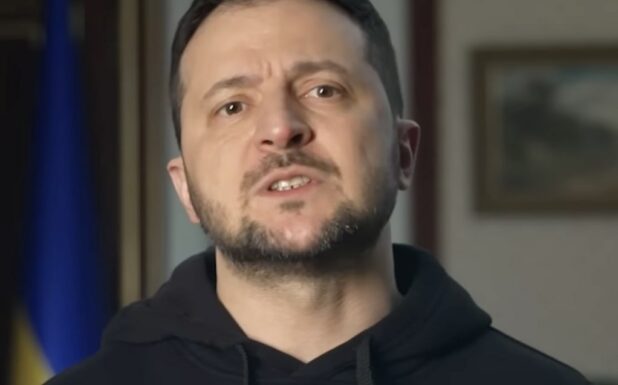
By Andrey Sushentsov | RT | February 15, 2023
It is unlikely that President Vladimir Zelensky expects to win militarily. But it seems that he genuinely believes that he will succeed in turning Ukraine into something like Israel – a paramilitary state living with a sense of constant military threat.
Ukraine doesn’t have the military or economic resources of its own to achieve victory, and the resources provided by the West will never be enough to inflict a final defeat on Russia. Zelensky’s calculation is likely based on the belief that by offering Ukraine as a tool for NATO to use against Russia, he will constantly mobilize Western support and thereby ensure his own survival, and that of his associates.
In the worst-case scenario, as he sees it, Zelensky is probably counting on emigrating to the West with his closest associates, where they will advocate a continued policy of Russian containment. But does he care about the interests of ordinary people in Ukraine?
The unprecedented hardships of war that the country now faces could have been significantly reduced if Zelensky had been willing to settle the crisis diplomatically. Russia has repeatedly taken diplomatic initiatives to resolve this conflict. In the first phase, for example, negotiations took place in Belarus and Turkey. However, under the influence of the US and the UK, Kiev has set a course to prolong the conflict, banking on Western military assistance to achieve its goals.
As Ukraine’s own military and economic resources have dried up, the country has become increasingly dependent on Western supplies, and has ultimately become a tool to fight Russia. Nevertheless, Kiev still has the opportunity to begin talks with Moscow.
Zelensky could take the initiative to negotiate a status quo that is still comfortable for Ukraine. Of course, as the Russian military campaign progresses, the situation will change in ways that are far from favorable to Kiev. And the solutions put forward by the Russian delegation at the beginning of the crisis will no longer be on the table. However, there is still the possibility of a sustainable peace, with reduced risks of escalation into Europe’s biggest military conflict since the Second World War and a nuclear catastrophe.
Zelensky could still claim the laurels of a peacemaker who sacrificed some of his personal ambition in the name of saving Ukrainian lives and ensuring a peaceful future for his country.
A truce would alleviate the economic difficulties of Kiev’s supporters in the West, and thus generate some gratitude. Ukraine would also save a considerable amount of its military resources. Peace would obviously limit them, as deliveries would dry up, but those resources in situ would still be at the disposal of the Ukrainian government.
Yet, Zelensky’s government acts as if it sees no value in preserving Ukrainian statehood. The administration is squandering citizens’ lives and the economic fabric of the country in the belief that this sacrifice is necessary to gain some possible, rather indefinite, advantage in the future. Instead of acting as a peacemaker, as someone who is prepared to make sacrifices to save the lives of his people, Zelensky acts like a gambler, while feeding the population military propaganda.
The unprecedented military, political and economic support Ukraine is receiving from abroad essentially covers up all of the mistakes by Zelensky’s government. A strategy which is based on the axiom “war will pay for everything”. At home, the militarist line has allowed the president to establish a political dictatorship and persecute his opponents in all spheres of state life, including religion. As a result, he has secured an unprecedented concentration of power in his hands and, for the first time in Ukrainian history, silenced all centers of opposition.
Zelensky need not worry about Ukraine’s economic well-being in the short term: the foreign economic aid being handed to the Ukrainian government will suffice. Meanwhile, Kiev is still actively betting that Russia’s $300 billion in foreign currency reserves, frozen in the West, will fall into its hands. What would amount to state-piracy would also allow it use the money as it sees fit.
As a result, Zelensky expects that even if he is defeated and loses part of his territory, he will remain in power as the military leader the West needs for the new Ukraine, which will be the main anti-Russian outpost on NATO’s eastern borders. One that will be armed to the teeth, saturated with Western economic aid and that will provide its citizens with an acceptable standard of living.
I believe that Zelensky is genuinely convinced he will succeed in turning Ukraine into something like Israel, a paramilitary state in a hostile environment, and living with a sense of constant military threat. I do not exclude the possibility that even in the worst-case scenario, where there is a complete collapse of his government, Zelensky expects to find himself and a group of his closest associates in exile in the West. Once there, they will actively advocate a continued policy of containment and defeat of Russia. History shows that this prospect has every chance of materializing.
Andrey Sushentsov is the Valdai Club program director.
Featured Video
Integrity Initiative: UK-funded network framed dissent as Russian disinformation for years
or go to
Aletho News Archives – Video-Images
From the Archives
Why Saudi Ties to 9/11 Mean U.S. Ties to 9/11
By Kevin Ryan | Dig Within | September 27, 2015
Media interest in Saudi Arabian connections to the crimes of 9/11 has centered on calls for the release of the 28 missing pages from the Joint Congressional Inquiry’s report. However, those calls focus on the question of hijacker financing and omit the most interesting links between the 9/11 attacks and Saudi Arabia—links that implicate powerful people in the United States. Here are twenty examples. … continue
Blog Roll
 Aletho News
- Iraqi Resistance faction links arms to sovereignty, questions US exit
- Cannon fodder no more… South Korea rejects Trump’s pressure to join his criminal war on Iran
- Neria Leiter Was A Legitimate Military Target
- Integrity Initiative: UK-funded network framed dissent as Russian disinformation for years
- ‘We don’t seek permission to defend our country’: Snippets from President Pezeshkian’s UNGA address
- NATO chief wants Europeans to fight American wars [for Israel]
- German chemicals giant reveals details of downsizing
- Refaat Al-Areer Was The Canary In The Coal Mine In Israel’s War On The Truth
- Israeli election committee bars candidate from Knesset race over Gaza war opposition
- French-Lebanese man files war crimes complaint over Israeli attacks
- If Americans Knew
- Aid, reconstruction, and Israel’s history of obstruction in Gaza
- Trump administration digs an ever-deeper hole of complicity in genocide – Daily Update
- US-Israel $2.8 Billion Arms Deal, 40,000-Bomb Supply Faces New Gaza Complicity Accusations
- Caught on Tape: AIPAC CEO Boasted of Controlling Trump’s National Security Officials
- Why Hamas Attacked Israel in October 2023 – Israeli professor Ilan Pappé
- They see them, then kill them: Israeli quadcopters track, deliberately target civilians in Gaza
- Winter could turn Gaza’s treacherous, war-damaged buildings into deathtraps
- Majority of Democratic Voters Want to Prosecute Both Biden and Trump Administration Officials Over Gaza
- As Gaza languishes, world leaders gather at the UN – Daily Update
- Sanctions are collective punishment: immoral and self-defeating
- No Tricks Zone
- New Study: Earth And Venus Surface Warmth Largely Explained By Convection And Lapse Rate, Not CO2 Or Radiation
- 2025 Nature Paper Claiming Worsening Global Drought Gets RETRACTED …Heavily Flawed
- New Study: ‘Global Drought Shows No Detectable Recent Acceleration Under Climate Warming’
- Economic Masterminds: German Socialists Suggest Taxing Productivity Gains Stemming From Using AI
- The South China Sea Has Not Been Cooperating With The Climate Change Narrative
- Energy Crisis: Germany Enters Heating Season With Historically Low Gas Reserve Fill Levels
- New Study: The Antarctic Ice Sheet Gained Mass From 2020-2024 Due To Staggering Snow And Ice Accumulation
- Study: Ocean Heating Rates From Thousands Of Years Ago ‘Dwarf’ Modern Ocean Heating Rates
- Climate Extremists Target, Attack Large-Scale Power Grid Infrastructure In Germany!
- New Study: Antarctic Ice Melt Has Contributed Less Than 1 Centimeter To Sea Level Rise In The Last 30 Years

