Plan to blockade Russian shipping in Baltic Sea breaks international law and could provoke war
By Ahmed Adel | January 31, 2023
Western intentions to arm Estonia with the most modern types of conventional weapons which can target Saint Petersburg, as well as the installation of a medium-range anti-missile defence system, suggests that the Baltic country is wanting to challenge Russia despite its military barely even having enough professional soldiers to field a single battalion. At the same time, and just as provocative, Estonian authorities discussed an introduction of a 24 nautical mile coastal zone in the Gulf of Finland to limit the navigation of Russian ships.
It is demonstrated that Estonia is a highly active anti-Russian state that hopes its actions will receive Western tributes and rewards. However, in pursuing this goal, the Baltic country is going as far as wanting to break international law by restricting Russian shipping in waters it has a right to navigate through.
Moscow has repeatedly warned that attempts to deploy offensive NATO weapons will immediately provoke retaliatory steps. By Estonia wanting to place weapon systems that can target Russia’s second largest city, it cannot be discounted that the Russian military will deploy the Iskander system or another type of weapon to completely cover Estonia’s sea, land and air territory.
It is recalled that Lithuania attempted to blockade the Russian exclave of Kaliningrad in 2022 by stopping rail and road transportation and attempted to justify the action because of the EU’s sanctions regime. This quickly failed as a military and economic blockade can lead to a ‘casus belli’ – a reason for war, which would not insure Lithuania under NATO’s “mutual defence” article.
Larger European NATO countries are rotating their units, as well as military equipment, including aviation and F-16 fighter jets, in the Baltic countries. The Baltic countries are full of foreign soldiers and equipment as they themselves cannot ensure their own security despite implementing policies that are extremely provocative and hostile to Russia.
The Russian ambassador in Tallinn, Vladimir Lipayev, who disclosed that Western countries plan to supply Estonia with the most modern types of conventional weapons, also said that the Anglos had an interest in creating an anti-Russian outpost in the Baltic country in order to carry out economic, political, cultural and military pressure on Russia.
However, the Baltic countries are playing with fire as the Ukraine war has demonstrated that Russia is capable of demilitarizing hostile states. Even Ukraine, which has all the resources of the West behind it and the second largest army in Europe after Russia, is failing to stem back the tide of war and territorial loss.
With the Ukrainian military appearing to be on course for an imminent collapse in 2023, the US and UK are escalating tensions so that continuous conflict can drain Russia’s resources and attention. An internationalized effort to involve as many countries as possible in a confrontation with Russia only puts countries under a puppet status at risk of Russian retaliation, as Ukraine shows.
As said, if Estonia were to blockade Russian ships, it cannot be protected under NATO’s Article 5 as it initiated the hostility by breaking international law. Understandably, the leading countries of the EU do not want to be exposed to a Russian counterattack, which is why the Baltics and Poland are being used as cannon fodder instead – just as Ukraine currently is.
With the collapse of the Soviet Union in 1991, a dividing line in the middle of the Gulf of Finland was agreed upon between Russia and newly independent Estonia. From this middle line, Finland and Estonia retreated three kilometres to allow Russia a six-kilometre channel for the free passage of Russian merchant and military fleets, thus actually making these international waters. In order to blockade Russia in the Gulf of Finland, it is necessary for Finland to implement the same policy. If Tallin unilaterally introduces such a zone in its territorial waters, then Russia has the option to use the Finnish part of the gulf.
For now, there is no indication that Finland plans to block Russian ships. If Finland and Estonia were to block Russian shipping, Moscow would have a strong case to appeal to the UN Convention on the Law of the Sea, something that would surely humiliate a country like Finland which likes to pride itself on supposedly adhering to international law very strictly.
Therefore, although the Estonian side may be enthusiastic in enforcing anti-Russian measures on the encouragement of Anglo countries, there is a likelihood that regional countries like Finland and Germany will not want a new front of tensions with Russia and will attempt to coerce the Baltic country to moderate its attitude.
Ahmed Adel is a Cairo-based geopolitics and political economy researcher.
UK Parliament’s Defense Chair Calls for Direct Confrontation With Russia
Sputnik – 30.01.2023
The United Kingdom is involved in the Ukrainian conflict and should “face Russia directly,” Tobias Ellwood, head of the UK Defence Select Committee, said on Monday.
“We are now at war in Europe, we need to move to a war footing, we are involved in that, we have mobilized our procurement processes, we are gifting equipment [to Ukraine]. We need to face Russia directly rather than leaving Ukraine to do all the work,” he said in an interview with UK broadcaster.
Ellwood said the UK government must “recognize the world is changing” and provide appropriate funding to the military.
“If we see Russia wants to do more things in the Baltics, for example, there will be an expectation, indeed, anticipation that we would participate in that. That requires land forces, air as well, and maritime too,” he said.
The senior Conservative lawmaker also urged the government to revoke an earlier decision to reduce the size of the country’s armed forces by 10,000 troops and increase defense spending, in particular, to modernize ground units, at the same time recognizing that UK ground forces are in a “dire state.”
“You have three main components to land warfare — that’s your tank, your main battle tank, your armored fighting vehicle and your recon vehicle. And in our case, you have the Challenger 2, you have the Warrior and you have the Scimitar, and they are all over 20, 30 or 50 years old without any upgrades,” he said.
Ellwood said the UK provided “huge investments” over the years to develop its maritime capabilities, build aircraft carriers, supply more fighter jets, but the number of tanks had been greatly reduced — from 900 tanks several years ago to 148 now.
In this regard, the UK government should be “very concerned,” especially against the backdrop of the Ukrainian conflict. It is necessary not only to invest in emerging industries, such as cybersecurity and space, but also to do so without compromising the military’s ground forces, he added.
The head of the Committee noted that the UK’s defense spending exceeds that of any other European country, in particular, in connection with the maintenance of nuclear potential and the active modernization of the army. However, new models of equipment will go into service only in a few years, and at the moment the size of the army is too small, given that the armed forces are often used in times of crisis in the country.
Western countries ramped up their military support for Ukraine after Russia launched a special military operation there in late February 2022, responding to calls for help from the breakaway republics of Donetsk and Lugansk. In April 2022, Moscow sent a note to NATO member states condemning their military assistance to Kiev. Russian Foreign Minister Sergey Lavrov has warned that any arms shipments on Ukrainian territory would be “legitimate targets” for Russian forces.
Is NATO helping Ukraine to fight Russia or is it using Ukraine to fight Russia?
By Glenn Diesen | RT | January 30, 2023
The Western public, like others, are justly appalled by the human suffering and the horrors of the Ukrainian war. Empathy is one of the great virtues of humanity, which in this instance translates into the demand for helping Ukrainians. Yet, propaganda commonly weaponizes the best in human nature, such as compassion, to bring out the worst. As sympathy and the desire to assist the displaced are used to mobilize public support for confrontation and war with Russia, it is necessary to ask if the Western public and Ukrainians are being manipulated to support a proxy war.
Is NATO helping Ukraine to fight Russia or is NATO using Ukraine to fight Russia?
The organization as a passive actor?
The US-led military bloc commonly depicts itself as an innocent third party that merely responds to the overwhelming desire of the Ukrainian people to join its ranks. Yet, for years NATO has attempted to absorb a reluctant Ukraine into its orbit. A NATO publication from 2011 acknowledged that “The greatest challenge for Ukrainian-NATO relations lies in the perception of NATO among the Ukrainian people. NATO membership is not widely supported in the country, with some polls suggesting that popular support for it at is less than 20%”.
In 2014, this problem was resolved by supporting what Statfor’s George Friedman labelled “the most blatant coup in history” as there were no efforts to conceal Western meddling. Regime change was justified as helping Ukrainians with their “democratic revolution”. Yet, it involved the unconstitutional removal of the elected government as a result of an uprising that even the BBC acknowledged did not have majority support amongst the general public. The authorities elected by the Ukrainian people were replaced by individuals handpicked by Washington. An infamous leaked phone call between State Department apparatchik Victoria Nuland and Ambassador Geoffrey Pyatt revealed that Washington had chosen exactly who would be in the new government several weeks before they had even removed president Yanukovich from power.
Donbass predictably rejected and resisted the legitimacy of the new regime in Kiev with the support of Russia. Instead of calling for a “unity government”, a plan for which Western European states had signed as guarantors, NATO countries quietly supported an “anti-terrorist operation” against eastern Ukrainians, resulting in at least 14,000 deaths.
The Minsk-2 peace agreement of February 2015 produced a path for peace, yet the US and UK sabotaged it for the next 7 years. Furthermore, Germany’s Angela Merkel and France’s Francois Hollande recently admitted that both Germany and France considered the deal an opportunity to buy time for Ukraine to arm itself and prepare for war.
In the 2019 election, millions of Ukrainians were disenfranchised, including those living in Russia. Nevertheless, the result was a landslide with 73% of Ukrainians voting for Vladimir Zelensky’s peace platform based on implementing the Minsk-2 agreement, negotiating with Donbass, protecting the Russian language, and restoring peace with Moscow. However, the far-right militias that were armed and trained by the US effectively laid down a veto by threatening Zelensky and defying him on the front line when he demanded to pull back heavy weapons. Pressured also by the US, Zelensky eventually reversed the entire peace platform the Ukrainians had voted for. Instead, opposition media and political parties were purged, and the main opposition leader, Viktor Medvedchuk was arrested. Subverting the wishes of Ukrainians in order to steer the country towards confrontation with Russia was yet again referred to as “helping” Ukraine.
Towards proxy war
In 2019, the Rand Corporation published a 325-page report ordered by the US Army titled “Extending Russia: Competing from Advantageous Ground”. In the language of a proxy war, the report advocated arming Ukraine to bleed Moscow stating, “Providing more U.S. military equipment and advice could lead Russia to increase its direct involvement in the conflict and the price it pays for it”. The US Chair of the House Intelligence Committee, Adam Schiff, similarly explained in 2020 the strategy of arming Ukraine claiming, “The United States aids Ukraine and her people so that we can fight Russia over there and we don’t have to fight Russia here”.
In December 2021, the former head of Russia analysis at the CIA warned that the Kremlin was under growing pressure to invade to prevent Washington from further building up its military presence on its borders, which included modernising Ukrainian ports to fit US warships. “That relationship [US-Ukraine] will be far stronger and deeper, and the United States military will be more firmly entrenched inside Ukraine two to three years from now. So inaction on [the Kremlin’s] part is risky,” George Beebe explained. Yet, despite being convinced that Russia would invade, Washington refused to give any reasonable security guarantees to Moscow.
Kiev agreed to enter into negotiations merely three days into the Russian invasion, which resulted in a peace agreement outline a few weeks later. Former intelligence official Fiona Hill and Angela Stent later penned an article acknowledging that “Russian and Ukrainian negotiators appeared to have tentatively agreed on the outlines of a negotiated interim settlement: Russia would withdraw to its position on February 23, when it controlled part of the Donbass region and all of Crimea, and in exchange, Ukraine would promise not to seek NATO membership and instead receive security guarantees from a number of countries”.
However, after a visit by UK Prime Minister Boris Johnson, Kiev suddenly withdrew from the peace negotiations. Reports in the Ukrainian and American media have suggested that London and Washington had pressured Kiev to abandon negotiations and instead seek victory on the battlefield with NATO weapons.
Johnson gave multiple speeches warning against a “bad peace,” while German General Harald Kujat, a former chairman of the NATO Military Committee, confirmed that Johnson had sabotaged the peace negotiations in order to fight a proxy war with Russia: “His reasoning was that the West was not ready for an end to the war”.
The American objectives also had seemingly little to do with “helping” Ukraine. US Secretary of Defense Lloyd Austin stated US goals in Ukraine as the weakening of a strategic rival: “We want to see Russia weakened to the degree that it can’t do the kinds of things that it has done in invading Ukraine”. PresidentBiden argued for regime change in Moscow as Putin “cannot remain in power”, which was repeated by Boris Johnson’s op-ed stating that “The war in Ukraine can end only with Vladimir Putin’s defeat”.
US Congressman Dan Crenshaw advocated for a proxy war by supplying weapons to Ukraine as “investing in the destruction of our adversary’s military, without losing a single American troop, strikes me as a good idea”. Similarly, Senator Lindsey Graham argued the US should fight Russia to the last Ukrainian: “I like the structural path we’re on here. As long as we help Ukraine with the weapons they need and the economic support, they will fight to the last person”. The rhetoric is eerily similar to that of Hungarian billionaire George Soros, who argued that NATO could dominate if it could use Eastern European soldiers as they accept more deaths than their Western peers: “the combination of manpower from Eastern Europe with the technical capabilities of NATO would greatly enhance the military potential of the Partnership because it would reduce the risk of body bags for NATO countries, which is the main constraint on their willingness to act”.
Following NATO Secretary General Jens Stoltenberg’s recent Orwellian statement that “weapons are the way to peace”, it is worth assessing if NATO is helping Ukraine or using Ukraine. NATO powers have stated that they are supplying Ukraine with weapons to have a stronger position at the negotiating table, yet one year into the war, no major Western leaders have called for peace talks. NATO has a powerful bargaining chip that would actually help Ukraine, which would be an agreement to end NATO expansion toward Russian borders. However, whitewashing the bloc’s direct contribution to the war prevents a negotiated settlement.
Glenn Diesen is a Professor at the University of South-Eastern Norway and an editor at the Russia in Global Affairs journal.
Moscow assesses NATO’s ‘war crime’ in Donbass
RT | January 29, 2023
Kiev and its Western backers bear responsibility for the deadly destruction of a civilian hospital in Donbass, the Russian Foreign Ministry said on Sunday. The perpetrators of the “war crime” will not escape punishment, it added.
On Saturday morning, Ukrainian troops fired rockets from the US-made HIMARS system at a hospital in the city of Novoaydar, killing 14 people and injuring 24, the Russian Defense Minitry said earlier. According to the military, the facility was treating local residents, as well as Russian soldiers.
The Foreign Ministry claimed that Ukraine used Western intelligence and satellites owned by NATO countries to target the hospital.
“The deliberate shelling of functioning civilian medical facilities and the purposeful killing of civilians are grave war crimes committed by the Kiev regime and its Western handlers,” the ministry said in a statement.
“The lack of reaction from the US and other NATO countries … once again serves as proof of their direct involvement in the conflict and the culpability for the crimes.”
The ministry added that it has been thoroughly documenting attacks on civilians. “The criminal acts … will not be left unpunished,” it said.
According to the 1949 Geneva Convention, warring parties cannot attack civilian hospitals under any circumstances.
Novoaydar is dozens of kilometers away from the frontline in Russia’s Lugansk People’s Republic (LPR). Local officials posted a video of the hospital building shortly after the attack.
Moscow has repeatedly accused Kiev of hitting civilian targets with Western-supplied rockets and artillery. This month alone, officials said that HIMARS launchers were used to strike two hospitals in Zaporozhye Region. The region, along with the LPR and two other former Ukrainian territories, joined Russia following referendums in September of last year.
Did Germany just declare war against Russia?
Free West Media | January 29, 2023
Is it a real declaration of war? Yes. On January 24, Baerbock gave a speech to the Council of Europe – not to be confused with an institution of the European Union. Although this speech contained borderline provocations, it was a scripted intervention. However, in the subsequent hearing, Baerbock had to answer questions without a prepared text.
She uttered a sentence in English that she obviously did not grasp: “We are fighting a war against Russia and not against each other.”
It was Baerbock’s response to a question from Norwegian MP Ingrid Schulerud, who wanted to know when Germany would decide to deliver Leopard 2 tanks to Ukraine. Baerbock responded that criticism and comparisons of shipment volumes were not helpful to Ukraine’s proxy war effort.
How does a country formally declare war?
So that misunderstandings are ruled out and the spectre of war is not inadvertently released, international law provides for high formal hurdles for a legally valid declaration of war.
The self-proclaimed international law expert Baerbock overcame them all with the power of indescribable stupidity: Because at that moment when she spoke, 77 years after the end of the war, the Federal Republic of Germany and the Russian Federation were actually and truly officially at war with one another.
For a formally valid declaration of war, this must first be pronounced by an official representative of one state. As Federal Foreign Minister, Baerbock fulfilled this requirement. This declaration must take place in an official setting. A speech before the Council of Europe, which has the task of securing peace in Europe, also satisfied the second condition. Only the third condition is somewhat problematic. Because an official representative of the other state must be present to receive this declaration.
On March 15, however, Russia was expelled from the Council of Europe, a move which evidently was bad for peace, but at least this time it probably saved the world from Baerbock’s moronic grandstanding.
If an official representative of the Russian Federation had been among the spectators, that person would then – for better or for worse – have had to acknowledge the declaration of war. As it is, however, it is easy to argue that a public television broadcast is sufficient to officially inform the other state.
The Foreign Office quickly jumped in to cover for the statement of its erring chief. “During her meeting with members of the Parliamentary Assembly of the Council of Europe on January 24, Foreign Minister Baerbock emphasized that Europe must stand together against this war.”
In view of the delivery of Leopard tanks to Ukraine, more and more people are concerned that Germany could become a direct party to the conflict. Last but not least, these concerns were fueled by the statement from Baerbock in the Council of Europe. Germany’s arms deliveries to Ukraine are undeniably now perceived as involvement in the conflict.
Russia’s cool response
According to Russian Foreign Ministry spokeswoman Maria Zakharova, the statements by Baerbock as well as former Chancellor Angela Merkel suggest that the West planned a war against Russia from the outset. On Wednesday, on her Telegram channel, she quoted Baerbock’s other statements at the PACE meeting that more had to be done “to protect Ukraine”.
As is well known, Merkel said in an interview for the weekly newspaper Die Zeit in December last year that the German and French mediation efforts in the Minsk format were aimed at deceiving Russia in order to “strengthen Ukraine”. These words were echoed by former French President François Hollande, who noted that Ukraine had increased its military potential since 2014.
Director General of the Russian Foreign Affairs Council Andrei Kortunov recalled that Baerbock had always taken “radical” positions: “The conflict between the Greens and the Social Democrats was very serious from the start. Chancellor Olaf Scholz called for moderation and restraint, while Baerbock tended to be decisive and uncompromising. Far more than Scholz, she is in solidarity with the radical stance of the Baltic States, Poland and recently Finland’s too.”
He pointed out that while Baerbock was saying one thing, NATO Secretary General Jens Stoltenberg on the same day said that the alliance was not directly involved in the Ukraine conflict. NATO and its member states want to position themselves as comfortably as possible: on the one hand to offer Ukraine increasingly intensive supplies, on the other hand to pretend to stay out of the conflict.
NATO has been pursuing this tactic since the beginning of the confrontation, with a “gradual escalation of engagement, while at the same time it is constantly emphasized that neither NATO nor its individual countries are directly involved in this conflict,” underlined the political scientist.
Maybe Baerbock just said the quiet part out loud…
NATO ready for clash with Russia – top official
RT | January 29, 2023
NATO is prepared to fight Russia if a direct conflict erupts between the two, Rob Bauer, the chairman of the alliance’s Military Committee, said on Saturday.
In an interview with Portuguese RTP TV, when asked whether the US-led military block is ready for a direct confrontation with Russia, Bauer unequivocally stated, “We are.”
The official noted that when the hostilities broke out in Ukraine in February 2022, NATO already had a number of battle groups along its eastern flank. During a summit in Madrid which took place in June 2022, the alliance’s leaders decided to create four more battle groups in Slovakia, Hungary, Romania, and Bulgaria, Bauer said.
“I think that’s an important message for the Russians, that our posture has changed, to show them that we are ready if they would have an idea to come to NATO.”
He added that if there is any red line regarding relations between Moscow and the military bloc, “it is the Russians crossing the line of our territory in NATO.”
Bauer went on to say that for decades, many NATO nations thought they were the ones who decide when and where to deploy their forces, but the Ukraine conflict was a gamechanger. Russia launched its military operation “at the moment of their choosing, so we have to be much more ready, we have no time to prepare, because it’s up to them when they come,” the official stated.
He also described the Western shipments of modern arms to Ukraine as “not escalatory.”
“The fact that your enemy has better weapons, it’s not the problem of the enemy, that’s your problem,” he said, adding that the West and Russia both face the need to ramp up efforts to manufacture weapons and equipment – and NATO countries need to have a debate on military production priorities. This means “talking about war time economy, but in peacetime,” which, he acknowledged, will be difficult.
Russia views NATO forces deployed near its borders as a threat. In December 2021, Moscow submitted draft documents on security guarantees to NATO and Washington, demanding that Ukraine be barred from entering the alliance, and insisting that the bloc should retreat to the borders as they stood in 1997. This overture was rebuffed.
On Wednesday, US National Security Council spokesman John Kirby said that Washington has so far seen “absolutely no indication” that Moscow has designs to attack the bloc’s territory.
US to pressure partners into enforcing anti-Russia sanctions
RT | January 28, 2023
The US Treasury Department’s top sanctions official will visit Türkiye and the United Arab Emirates next week to warn officials and businesses there that Washington will punish them if they dodge its sanctions on Russia, Reuters reported on Saturday.
Brian Nelson, the department’s undersecretary for terrorism and financial intelligence, will travel to Oman, the UAE, and Türkiye between Sunday and Friday. Meeting with government officials, businesses and financial institutions, Nelson will caution them that they could lose access to US markets “on account of doing business with sanctioned entities,” a Treasury spokesperson told the news agency.
US officials have repeatedly highlighted Türkiye as a potential hub of sanctions evasion, and unnamed Western officials told the Financial Times in August that they were “deeply concerned” about allegations of trade between Turkish firms and sanctioned Russian entities.
Ankara responded that it “would not allow the breaching of sanctions by any institution or person,” following a phone call in which US Deputy Treasury Secretary Wally Adeyemo seemingly threatened the “success of the Turkish economy” and “the integrity of its banking sector.”
The UAE has also received warnings from Washington, with Adeyemo urging the Emirates’ financial institutions last summer to be “exceedingly cautious” about doing business with other institutions connected to “the Russian financial system.” The Treasury spokesperson told Reuters that Nelson will condemn the UAE’s “poor sanctions compliance” during his visit.
In the last month, the US has sanctioned a prominent Turkish businessman over allegedly laundering money for Iran’s Islamic Revolutionary Guard Corps, and a UAE-based aviation firm over alleged sales to Russia’s Wagner private military corporation. Multiple Emirati companies have also been penalized for evading US sanctions on Iran.
Both Türkiye and the UAE voted at the UN General Assembly last year to condemn Russia’s military operation in Ukraine, but neither has imposed sanctions of their own on Moscow. Turkish President Recep Tayyip Erdogan has maintained close contact with his colleagues in both Kiev and Moscow, and said from the outset that his diplomatic handling of the conflict would be “balanced.”
With Türkiye and the US also at loggerheads over Ankara’s refusal to sign off on Finland’s and Sweden’s bids for NATO membership, Erdogan and Russian President Vladimir Putin last week affirmed their intent to “develop comprehensive cooperation,” including by increasing the supply of Russian gas to Türkiye.
Going for the Kill in Kosovo
By Stephen Karganovic | Strategic Culture Foundation | January 28, 2023
The collective West’s unsuccessful war against Russia using Ukraine as the stage and Ukrainians as cannon fodder has induced the Transatlantic alliance to desperately seek some semblance of victory, anywhere, in order to disguise the scope and lessen the political repercussions of its failure in the Ukraine.
The solution it has come up with to repair its tarnished hegemonic image is the aggressive campaign to wrap up “unfinished business” in the Balkans. Coming from such quarters, any “attention” to Balkan nations is invariably bad news for the country so favoured. That is the case in this instance as well.
The West judges, perhaps not entirely incorrectly, that Serbia and the Republic of Srpska, its perennial Balkan targets because thus far they have withstood total submission, are currently in a disadvantageous position to continue to resist effectively. With pretensions to embody the “international community,” although it consists mainly of the NATO/EU block of countries, the Alliance is increasingly and now openly shifting to a war footing. That raises to a new level its customary belligerence and disregard for the niceties of international legality and standard diplomatic practice. It never was greatly bothered in the past to observe the norms of civilised interaction between states. But now, with intense pressure to produce some kind of political victory to compensate for the failure in Ukraine, gloves are definitely off.
That puts both Serbia and its sister state, the Republic of Srpska, in a more precarious position than at any other time recently. They are both geographically distant from their natural allies and surrounded by hostile territory politically and militarily controlled by the Western Alliance, which is planning their demise. A comparison with the position of the Kingdom of Yugoslavia in the spring of 1941 would not be wide off the mark.
Complementing a similarly unenviable geopolitical predicament, there is an additional unfavourable analogy for Serbia. Its ruling elite are as feeble, vacillating, corruptible, treacherous, and disoriented as was the Royal Yugoslav government in March of 1941. That is when Nazi Germany went for the kill and demanded imperatively that in the looming global conflict Yugoslavia either commit to its side, or face dire consequences. Now it is NATO and EU which are going for the kill and the pretext is Kosovo. The Serbian government a few days ago was handed an ultimatum. The demand was that Serbia give up pretensions of sovereignty over NATO occupied Kosovo and unequivocally align itself with the aggressor alliance in the conflict in Ukraine. It was conveyed by a delegation of Western ambassadors in the form of a brutal warning that dilly dallying about Kosovo must come to an urgent end. Serbia was told that it must unreservedly acquiesce to the robbery of its cultural and religious cradle by signing off on Kosovo’s secession and accepting its illegal fruits. It should be recalled that the occupation of Kosovo was initiated in 1999, when NATO committed unprovoked aggression against Yugoslavia and it was completed in 2008 by a unilateral declaration of “independence” made under NATO auspices.
As is always the case, the West’s actual interest in Kosovo has nothing to do with the publicly stated reasons. Suffice it to say that Kosovo is the site of Camp Bondsteel, the largest military base in Europe, strategically situated so as to be of great use should the Ukrainian conflict degenerate further into an all-out global war.
Judging by official Belgrade’s initial reactions, it is conceivable that the Serbian government may be contemplating a course of action inspired by the collapse of the will experienced by the Royal Yugoslav government in March of 1941, when under Nazi pressure it did as ordered and signed its adherence to the Axis pact. It ought to be remembered by all concerned, however, that the consequences of that infamous breakdown were short lived. Within just a few days, popular revulsion in Serbia forced the ousting of officials responsible for the shameful betrayal of public trust. The immoral commitments they had undertaken on the nation’s behalf were effectively annulled. If further analogies need to be made with the situation in 1941, it should be pointed out that the reputation of the protagonists of cowardice and treachery displayed then lives in infamy to the present day.
Whether such considerations will be sufficient to deter those currently responsible for Serbia’s official decisions remains to be seen.
Alongside Serbia, the neighbouring Republic of Srpska, an entity within Bosnia and Herzegovina populated mostly by Serbs, which recently experienced a turbulent election followed by an attempt to achieve regime change using instruments from the color revolution handbook, is also targeted for harsh treatment by the unforgiving Western democracies. Like Serbia’s, its population is solidly on the “wrong side of history” in general and in the Ukrainian conflict in particular, with all that implies. With a similar degree of unanimity, the population and the government are also opposed to having anything to do with NATO. Under the terms of the Dayton agreement signed in 1995, by which the prerogatives of Bosnia’s entities are governed, that effectively blocks Bosnia’s entry into NATO and participation in its activities.
Understandably, this blockade of what is euphemistically called Bosnia’s “Euro Atlanticist integrations,” is an insufferable affront and irritant. As a result, punitive measures against the uncooperative leadership of the Republic of Srpska are now being contemplated. It is a sure bet that if Serbia caves and in cowboy fashion the Kosovo issue is resolved, Bosnia’s defiant Serbian entity will soon be next. It will again find itself actively targeted and in the outraged “international community” cross hairs.
It is, of course, still premature to call the outcome of the ominous new chapter being prepared in the Kosovo crisis, but a perfect storm with turbulent effects appears to be approaching. The same recklessness that over the past year had been on display in the Ukraine is now in evidence increasingly in the Balkans. Andrey Martyanov’s repeated assessment of Western elites as arrogant, ignorant, and incompetent, which he illustrates with a steady stream of examples from the Ukrainian theatre, may soon find another resounding confirmation in the Balkans, to the immense misfortune of all its inhabitants.
NATO member ‘secretly provided Ukraine with fighter jets’
RT | January 26, 2023
In spring 2022, Warsaw secretly delivered several of its MiG-29 fighter jets to Ukraine, despite the Polish government officially denying any such deals, a local paper has claimed, citing sources.
According to Dziennik Gazeta Prawna (DGP), the planes were sent over using a “combined” method, apparently meaning that they were delivered in a disassembled state and declared as spare parts.
“The fuselage and the wings are also spare parts,” DGP wrote Wednesday, citing sources within the Polish government.
Back in March, in the first months of Russia’s military operation in Ukraine, Washington rejected a plan to transfer Polish MiG-29 jets to Ukraine, stating the move was “too escalatory” and risked directly involving the US or a NATO ally in the conflict, potentially triggering a direct confrontation with Russia.
In April, however, the Pentagon stated that unnamed US allies had helped bolster Ukraine’s fleet of fighter jets by donating unspecified “spare parts” which were supposedly used to restore many of Kiev’s damaged planes.
The latest article by DGP now seems to suggest that that ally could have been Poland, which in late April was also revealed to have provided Ukraine with $7 billion worth of military aid, including half of its tanks, dozens of howitzers, Grad MRLS, and missiles for MiG-29 and Su-27 fighter jets, among other munitions.
In recent weeks the US seems to have abandoned some of its prior concerns about supplying heavy weapons to Ukraine, and now plans to deliver a number of its M1 Abrams tanks to Kiev, while Germany, Poland and Finland intend to send dozens of their Leopard 2 tanks.
Kremlin spokesperson Dmitry Peskov has responded to these planned deliveries as evidence that the West is becoming more directly involved in the conflict, despite European and American politicians claiming otherwise. That’s as Russia has repeatedly urged the West to stop “pumping” Ukraine with weaponry, arguing it would only prolong the conflict and lead to more bloodshed.
Weapon Manufacturers Record Skyrocketing Profits From US Arm Sales in 2022
By Ian DeMartino – Sputnik – 26.01.2023
War has always been big business in the United States. According to the seminal anti-war essay “War is a Racket,” gunpowder manufacturer Du Ponts saw their profits increase by more than 950% during The Great War.
US arms sales to other countries skyrocketed in 2022, providing a tidy sum of profits for weapon manufacturers, according to data released by the State Department on Wednesday.
US weapon sales to other countries, largely driven by NATO’s response to Russia’s special military operation in Ukraine and increased tensions in Asia, jumped from $35.8 billion in 2021 to $51.9 billion in 2022.
Direct weapon sales from US-based weapon manufacturers also saw a massive increase, jumping from $103.4 billion in 2021 to $153.7 billion in 2022.
In Europe, the largest purchasers include Germany, which ordered 35 F-35 Joint Strike Fighter airplanes for $8.4 billion, and Poland, which spent $6 billion on 250 M1 Abrams tanks.
The United Kingdom, Spain, and new NATO member Bulgaria also made significant purchases in 2022.
Meanwhile, tensions in Asia over Taiwan and competing claims in the South China Sea have also been a boon for weapon manufacturers. Significant weapon sales in the area include $13.9 billion from Indonesia for 36 F-15ID fighter jets and a $1.95 billion purchase from Australia for 40 Black Hawk helicopters and other equipment. South Korea and Japan also made significant military purchases, totaling $790 million and $588 million respectively.
The Biden administration also approved a $1.1 billion weapons package for Taiwan in an effort to deter China from militarily seizing the island.
The Middle East, always a reliable profit center for military contractors has continued to be so. The two countries pushing the brutal war in Yemen, Saudi Arabia and the United Arab Emirates, have asked for $3 billion and $2.2 billion in military weapons and equipment from the United States respectively.
During the 2020 campaign, the Biden administration pledged to stop sending weapons to Saudi Arabia because of its war in Yemen.
Unsurprisingly, this has led to significant revenue gains by weapon manufacturers.
Revenue for Lockheed Martin, which develops the F-16, F-22, and F-35 fighter jets rose 7.13% to $19 billion in the fourth quarter of 2022. Northrop Grumman, which also makes F-35 fighter jets, is expected to report 11.8% revenue growth compared to fourth quarter earnings when it issues its financial reports on Thursday.
Meanwhile, Raytheon, the maker of the Patriot Air Defense System the Biden administration recently announced it will supply Ukraine with, saw its Q4 profit rise of nearly 18% compared to last year.
Did Germany just officially declare war on Russia?
By Drago Bosnic | January 26, 2023
During a debate at the Parliamentary Assembly of the Council of Europe (PACE), German Foreign Minister Annalena Baerbock bluntly stated that Germany and its allies are at war with Russia. The unexpected admission, although essentially true, is quite shocking given the fact that many Western officials have been insisting they aren’t directly involved in the conflict with Moscow. Baerbock made the statement during a discussion over sending “Leopard 2” heavy tanks to the Kiev regime. Most mainstream media conveniently ignored her words, but numerous experts were alarmed and warned that Berlin just essentially declared war on Russia.
This stands in stark contrast to claims of other German officials who have been extremely careful with their statements for nearly a year, insisting that their country is not directly involved in the Ukrainian conflict and citing uncontrollable escalation as their primary concern. However, this official stance is now in serious question, as one of the country’s top officials just effectively nullified all of their efforts. Annalena Baerbock started her statement at PACE with the following:
“And therefore I’ve said already in the last days – yes, we have to do more to defend Ukraine. Yes, we have to do more also on tanks. But the most important and the crucial part is that we do it together and that we do not do the blame game in Europe, because we are fighting a war against Russia and not against each other.”
Ironically, Chancellor Olaf Scholz and his now former defense minister Christine Lambrecht have been accused of being “weak” on arming the Neo-Nazi junta. They have frequently insisted that it would be dangerous to get more directly involved in NATO’s proxy war against Russia. However, it seems that the much more hawkish Baerbock is willing to say the quiet part out loud. Moscow immediately reacted to the comments, with Russian Foreign Ministry spokeswoman Maria Zakharova saying this is yet another proof that the political West was planning a war on Russia for quite some time now.
“If we add this to Merkel’s revelations that they were strengthening Ukraine and did not count on the Minsk agreements, then we are talking about a war against Russia that was planned in advance. Don’t say later that we didn’t warn you,” Zakharova said.
Baerbock’s comments come on the heels of nearly a year of direct Russophobic narrative, including openly declared plans for war with Russia. In mid-November, Der Spiegel published leaked German Defense Ministry documents, revealing that the Bundeswehr is preparing for war with Russia. The secret draft titled “Operational guidelines for the Armed Forces” was authored by none other than the German Chief of Staff, General Eberhard Zorn himself. He stressed the need for a “mega-reform” of the German military and clearly identified Russia as an “immediate threat”.
The claim makes little sense, as Germany is now over 1,500 km away from Russia, with Belarus, Poland and Ukraine standing between the two countries. While such assertions made some sense at the height of the (First) Cold War, when the Soviet Union had over half a million soldiers stationed in East Germany alone (in addition to other Warsaw Pact member states), the situation is effectively reversed nowadays. NATO is the one encroaching on Russia’s western borders, with the crawling expansion including coups and other interventions in various Eastern European and post-Soviet states. After decades of this creeping aggression and Moscow’s futile attempts to build a comprehensive partnership with the political West, Russia was forced to launch its counteroffensive.
Back in early March, the German government announced a dramatic increase in defense spending, including a €100 billion budget for the Bundeswehr, essentially double in comparison to 2021. Although this will inevitably put additional pressure on the already struggling German economy, ravaged by the sanctions boomerang from its failed economic siege of Russia, Berlin’s suicidal subservience to Washington DC seems to take precedence. Much of Germany’s prosperity was based on access to cheap Russian energy, now a thing of the past thanks to Berlin’s resurgent Russophobia.
In addition, Germany also uniquely holds historical responsibility on a scale virtually no other country in the world does, especially towards Russia. During the Second World War, it launched a brutal invasion of the Soviet Union, killing nearly 30 million people and destroying virtually everything in its path. Worse yet, after approximately 80 years of denazification in the aftermath of its WWII defeat, Berlin still decided to support the Neo-Nazi junta in Kiev, effectively renouncing its own official postwar political position. This also includes German weapons that are killing Russians, both soldiers and civilians.
Alarmed by the dramatic shift in rhetoric, many in Germany are already pointing out the fact that the country is repeating the same historical mistake by antagonizing Russia. Petr Bystron, an AfD (Alternative for Germany) member of the German Parliament, reminded his colleagues in the Bundestag of the consequences of sending German tanks to fight Russia in Ukraine:
“It’s an interesting approach you’re taking here. German tanks against Russia in Ukraine. By the way, your grandfathers have already tried to do it then with the Melnyks and Banderas [Ukrainian Nazi collaborators during WWII] and what was the result? Untold suffering, millions of deaths on both sides, and in the end, Russian tanks here in Berlin. And two of them are still here, in front of the Bundestag. You should pass by them every morning and remember it!”
Drago Bosnic is an independent geopolitical and military analyst.
NATO’s best tanks are going to Ukraine, what will it mean on the battlefield?
By Mikhail Khodaryonok | RT | January 25, 2023
Tank supplies to Ukraine from NATO members is the top news story this week. Kiev has been calling for these weapons from its western sponsors since the beginning of the Russian offensive, and it looks like now, eleven months into the fighting, these demands are being met.
The US has announced it will send 31 Abrams main battle tanks. In a hastily scheduled speech on Wednesday, President Joe Biden noted that they are complicated to operate and maintain, so the US will provide Kiev with “parts and equipment necessary to effectively sustain these tanks on the battlefield.”
It was also confirmed, the same day, that the German government will send Leopard 2A6 tanks from its own stock and will allow other nations, such as Poland, to transfer German-made machines, to Ukraine. On January 14, London announced plans to ship its Challenger 2s to Kiev, while it now seems inevitable that Paris will supply AMX-56 Leclerc vehicles.
Russian experts and journalists have been locked in a heated debate over the differences between these western main battle tanks and the Russian T-90s, comparing their armor, guns, accuracy, active and passive protection systems, maneuverability, fire-control systems, ammunition, and many other attributes.
At the end of the day though, these discussions lack any practical value. The battlefield is the only litmus test for the advantages and drawbacks of any type of weapon or military equipment. Reliable statistics on combat use are all that is required for a comparative analysis of modern main battle tanks, if it is to be credible.
Another thing to remember is that all tanks are vulnerable to modern anti-tank systems.
How many tanks does Kiev need?
To simplify calculations, we’ll be using an armored division, the main structural and tactical unit of armored forces in the former Soviet republics, as our yardstick. According to Soviet manuals, an armored division must have 296 tanks, 230 infantry fighting vehicles, 54 self-propelled artillery systems, over 2,000 regular vehicles, and almost 12,000 soldiers and officers.
How many divisions does Kiev need? At least one per each of the three main fronts — in Lugansk, Donetsk, and Zaporozhye. The line of contact in the special military operation zone right now is 815 km long, making three divisions too modest an amount to make a difference, but let’s disregard this for the time being.
Three armored divisions combined would have a total of about 900 tanks. Apart from that, another armored division may be necessary on the Belarusian front, which could see some very heavy fighting. In case of an escalation there, an armored division or a similar unit in reserve is a must, which drives the number of required tanks up by 300 to 1,200.
Finally, no commander-in-chief can do without his own reserve, the so-called reserve of the supreme high command. Without at least one armored division, this reserve cannot really count as such, which means another 300 tanks for a required total of 1,500.
Another thing to consider is probable Ukrainian losses during offensive operations. The average daily losses of an armored unit in this case stand at 10 to 15%. About 15 to 20% of incapacitated tanks are typically irrecoverable losses, while the rest require repairs (general maintenance for 30 to 50%, medium-level repairs for 15 to 30%, and an overhaul for 10 to 20%).
Simply put, at least another 300 tanks are required to offset losses during combat operations. This gives us a figure of 1,800 tanks, which must be considered an absolute minimum.
These are very approximate and somewhat simplistic calculations, yet they give us ballpark figures.
How many tanks will Kiev get?
So far, NATO countries have earmarked tanks for Ukraine numbered in the dozens. This is only a fraction of the hypothetical minimum.
Great Britain and Poland have officially pledged an armored company each, respectively consisting of up to 14 tanks. Germany will supply a similar amount, while the US is preparing the supply of 31 Abrams heavy weapons.
At a recent meeting of the US-led Defense Contact Group at Ramstein Air Base in Germany, officials from 12 countries discussed sending a total of about 100 tanks to Kiev, if Berlin were to give the green light, which, according to an ABC report, it has done.
Rheinmetall could additionally supply a total of 139 tanks to Ukraine, including 88 Leopard 1s and 51 Leopard 2A4s, yet the German manufacturer concedes that only 29 of them could be shipped before the summer of 2023.
What impact will NATO’s tanks have?
Will all these tanks see combat any time soon? Let’s consider the example of the M1 Abrams, which is seen as one of the symbols of US military power.
A small number of these tanks manned by poorly trained crews and lacking full-scale maintenance and supply infrastructure support would most likely yield negative results. They will fail to change Ukraine’s fortunes on the battlefield, while images of burning American tanks will likely hurt US public opinion.
Thus, one of America’s premier weapons, the pride and joy of its defense industry, will be humiliated on the battlefield for a long time. This is something the Pentagon can’t allow to happen under any circumstances.
Therefore, before any actual fighting happens, evacuation teams, tank repair units, and spare part supplies must be in place, while crews must receive superior training to handle American tanks.
Last but not least, the first deployment of US main battle tanks in Ukraine must be accompanied by a significant Ukrainian army success, at least at the tactical level, which would necessitate no fewer than 200–300 (maybe even 400–500) tanks.
Otherwise, supplying the M1 Abrams to Ukraine makes neither military nor political sense. Transferring them one company (10 to 15 tanks) at a time would only mean that this equipment will burn on the battlefield without making any significant impact or even catching anyone’s attention.
So far, according to known data, Russia has not had any significant trouble dealing with enemy equipment. This is something on which both the Russian Ministry of Defense and most Western analysts seem to agree.
No room for complacency
It’s very likely that the first NATO tank companies will be used as training units for Ukrainian crews, while Poland will initially provide maintenance and repair capacity for servicing German or American tanks.
One shouldn’t think, however, that training will stretch over a very long time. It can take just weeks to do a full training program, while teaching T-64/84 crews to fight in the M1 Abrams or the Leopard 2A5 could be completed in a matter of days.
What matters in the reports about the West mulling tank supplies to Ukraine is not the tanks themselves as much as the breaking of a taboo, which, until recently, prevented the transfer of heavy western-made armored vehicles to Ukraine.
Once this taboo is broken, there is every reason to assume that, sooner or later, Kiev will receive not only the 1,800 western main battle tanks it badly needs, but much more than that.
At that point in time and maybe even earlier, Ukraine will be able to create a strike force on the Zaporozhye front for example. If a force like that succeeds in breaching Russian defenses, it could cover the 82 km to Melitopol in less than three days, which would dissect the whole depth of the Russian defense in this region.
With this in mind, the Russian armed forces must achieve tangible military and political results long before western arms supplies reach their full potential.
Mikhail Khodaryonok is a military observer, retired colonel, and air defense specialist.
Featured Video
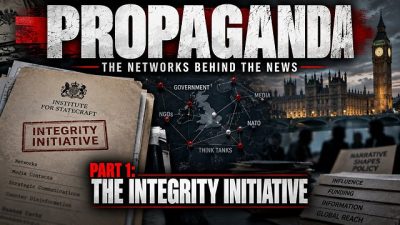
Integrity Initiative: UK-funded network framed dissent as Russian disinformation for years
or go to
Aletho News Archives – Video-Images
From the Archives
Why Saudi Ties to 9/11 Mean U.S. Ties to 9/11
By Kevin Ryan | Dig Within | September 27, 2015
Media interest in Saudi Arabian connections to the crimes of 9/11 has centered on calls for the release of the 28 missing pages from the Joint Congressional Inquiry’s report. However, those calls focus on the question of hijacker financing and omit the most interesting links between the 9/11 attacks and Saudi Arabia—links that implicate powerful people in the United States. Here are twenty examples. … continue
Blog Roll
 Aletho News
- Senate Rejects Iran War Powers Resolution Passed By House
- ‘We did not attack Pakistan with drones’: Afghan sources
- Iraqi Resistance faction links arms to sovereignty, questions US exit
- Cannon fodder no more… South Korea rejects Trump’s pressure to join his criminal war on Iran
- Neria Leiter Was A Legitimate Military Target
- Integrity Initiative: UK-funded network framed dissent as Russian disinformation for years
- ‘We don’t seek permission to defend our country’: Snippets from President Pezeshkian’s UNGA address
- NATO chief wants Europeans to fight American wars [for Israel]
- German chemicals giant reveals details of downsizing
- Refaat Al-Areer Was The Canary In The Coal Mine In Israel’s War On The Truth
- If Americans Knew
- Israel displaces hundreds of Palestinians amid wave of demolitions in West Bank
- Aid, reconstruction, and Israel’s history of obstruction in Gaza
- Trump administration digs an ever-deeper hole of complicity in genocide – Daily Update
- US-Israel $2.8 Billion Arms Deal, 40,000-Bomb Supply Faces New Gaza Complicity Accusations
- Caught on Tape: AIPAC CEO Boasted of Controlling Trump’s National Security Officials
- Why Hamas Attacked Israel in October 2023 – Israeli professor Ilan Pappé
- They see them, then kill them: Israeli quadcopters track, deliberately target civilians in Gaza
- Winter could turn Gaza’s treacherous, war-damaged buildings into deathtraps
- Majority of Democratic Voters Want to Prosecute Both Biden and Trump Administration Officials Over Gaza
- As Gaza languishes, world leaders gather at the UN – Daily Update
- No Tricks Zone
- New Study: Earth And Venus Surface Warmth Largely Explained By Convection And Lapse Rate, Not CO2 Or Radiation
- 2025 Nature Paper Claiming Worsening Global Drought Gets RETRACTED …Heavily Flawed
- New Study: ‘Global Drought Shows No Detectable Recent Acceleration Under Climate Warming’
- Economic Masterminds: German Socialists Suggest Taxing Productivity Gains Stemming From Using AI
- The South China Sea Has Not Been Cooperating With The Climate Change Narrative
- Energy Crisis: Germany Enters Heating Season With Historically Low Gas Reserve Fill Levels
- New Study: The Antarctic Ice Sheet Gained Mass From 2020-2024 Due To Staggering Snow And Ice Accumulation
- Study: Ocean Heating Rates From Thousands Of Years Ago ‘Dwarf’ Modern Ocean Heating Rates
- Climate Extremists Target, Attack Large-Scale Power Grid Infrastructure In Germany!
- New Study: Antarctic Ice Melt Has Contributed Less Than 1 Centimeter To Sea Level Rise In The Last 30 Years

