Russian-Ukrainian War: Tragedy For People, Chance For Elites
South Front – April 10, 2021
Against the backdrop of ongoing political provocations and bellicose rhetoric from all parties involved in the conflict in Eastern Ukraine, military escalation is constantly growing. Local forces, as well as the OSCE observers, report about more and more ceasefire violations in the Donetsk and Luhansk People’s Republics. There are daily statements on casualties on both sides of the conflict among the military and local civilians.
Now, when all the global media are closely following the situation in the eastern regions of Ukraine, the international community is wondering whether Donbass will become the point of the next military conflict, and what its scale will be. The main question is “Cui Prodest”?
The answer is unambiguous: the administration of Ukrainian President is a real stakeholder in the armed conflict in eastern Ukraine. In the current Ukrainian reality, there are plenty of circumstances that determine the pattern of conduct of Volodimir Zelensky.
First, the current economic situation in Ukraine is disastrous. The Ukrainian state is on the way to lose the ability to fulfill its social obligations. According to the data for 2020, its GDP in real terms suffered about 4% drop. According to the IMF, this drop will be at least 7%. If for the United States, China or Russia, a 4% drop in GDP is a big problem, for Ukraine it is almost a disaster, as GDP indicators were low even before the crisis.
Secondly, the economic situation in Ukraine was aggravated by the coronacrisis. The number of those contaminated by COVID-19 per day there is one of the biggest among the European countries, and even in the whole world. The death rate is also disproportionately high. The country’s economy is suffering, as most regions are still under lockdown, and since April 5, restrictions have been tightened again.
The fall in national budget income was caused by a complex of reasons, including pure management of national economy and the extremely high level of corruption that caused the destruction of the industrial complex, drop in already low per capita income, accompanied by a decreasing revenue gained from gas and cargo transit from East to West.
Third, the Zelensky administration is now facing a rapid decrease in people’s support. The national disappointment in his political program is caused by the rejection of his campaign promises to stop the war in Donbass.
Fourthly, it is increasingly difficult for NATO allies to fuel Kiev’s anti-Russian hysteria in the absence of any actual changes of the issue. The military conflict in the Eastern Ukraine is already 7 years old, and the only alarming statements no longer contribute to the increase in financial support from the US and its allies.
The last but not least is a political request from a part of the American elite, who are interested in various forms of pressuring Russia. They support blocking of the Nord Stream 2 project by any means; destruction of bilateral relations between Russia and leading European countries, up to war outbreak along its borders.
On the other hand, such a policy of the United States does not fully coincide with the national interests of leading European countries. However, new war in Eastern Ukraine would define Russian status as enemy for years while the US will strengthen its weight in European security.
The position of the Zelensky administration and the interests of the United States represent sufficient set of reasons to outbreak war in Eastern Ukraine.
Indeed, official Kiev does not need to care about the actual result of the conflict, but its very existence.
There are only 3 scenarios of the military conflict in Eastern Ukraine.
- The Ukrainian army wholly or partially occupies the territory of the DLPR.
- The forces of both sides remain in their current positions.
- The DLPR forces, with Russian support, advance on the Ukrainian territory for several dozens of miles.
There is almost a zero probability that Ukraine will suffer a crushing defeat and the DLPR forces will occupy the territory to the Dnieper River. Russia now has neither the strength nor the ability to gain control over such a vast territory, and the collective West, in its turn, would not let this happen.
If any of the above scenarios are implemented, Zelensky and his supporters among the US elites will benefit.
For many years, the US and European media have shaped Russia as the aggressor, the enemy of democratic values and the authoritarian tyrannical regime that must be contained. The idea of an external military threat, which being sequentially built up by the West, serves as a pretext for its increasing military funding both in defense industry and army itself amid inevitable unification under the US leadership.
In its turn, Ukraine, positioning itself as the Eastern European Shield against “Asian Barbarians”, receives significant and steadily growing support from NATO countries, gaining momentum to development and further nazi-like ideology originally rooted in Western Ukraine.
Unleashing the war, Zelensky has a chance to reclaim his status as the national leader. In case of the conquest of the self-proclaimed republics, or the preservation of the current troops’ positions, he will become a hero who saved Ukraine from “evil Russians”.
Even after having lost the war, he would claim that the entire country was saved with little blood and only a small piece of land that was temporary lost, taking on the role of a good strategist who defended the sovereignty in the furious fighting shoulder to shoulder with his NATO allies.
Zelensky’s policy can only fail if Russia captures half of Ukraine, which de facto is not possible.
Thus, almost whatever may happen during the conflict, Ukraine can be sure that it will receive stable financial flows from its Western allies for years ahead. Having become a “real” Eastern Shield of Europe, Ukraine may finally get the coveted NATO membership.
Finally yet importantly – the hot military conflict will undoubtedly divert public attention from the economic problems inside the country.
Unleashing a war in Donbass will allow Zelensky to solve his main problems, albeit at the cost of lives of thousands of Ukrainians.
Today, many analysts assure that there will not be a full-scale war, since Ukraine is weak, and Zelensky must assess the country’s military strength in front of the Russian power. Let’s hope this is the case, while remembering who the beneficiary of the conflict is.
In its turn, the United States, at the cost of Ukrainian soldiers’ lives, can resolve a good part of its problems in the European region, while Russia seems to lose strategically in any of these war scenarios.
Definitely, the war in Ukraine will lead to the closure of the Nord Stream 2 project, which is already at the final stage of construction. Key contacts between Russia and NATO countries will be frozen, no more significant bilateral cooperation in the economy will be possible.
A new war near the Russian borders that involves national armed forces will have an important impact on the internal situation in the country. It is not clear to what extent the Russian society, which has suffered the break of economic relations with Western countries and numerous sanctions, is ready to support the struggle for Donbass.
Russia: US Military Activity in Arctic Region Source of Escalating Tensions
Al-Manar | April 9, 2021
Russia stressed on Friday that tensions in the Arctic region only escalate due to the US military activities.
Commenting on US reports about Russia’s “unprecedented military might in the Arctic,” Russian Foreign Ministry Spokeswoman Maria Zakharova said Moscow’s action in the region do not pose any threat and do not violate international laws.
“Russia does not do anything in the Arctic that would contradict international law or pose a threat to other countries,” Zakharova said at a briefing.
“If we talk about possible sources of the escalating regional tensions, it would be logical to say that this is the military activity of the US and its allies in the Arctic, which is accompanied by belligerent rhetoric. NATO and its member states, including non-Arctic nations, stage provocations there, and it happens on an increasingly regular basis,” she was quoted as saying by Sputnik news agency.
Washington has already said it plans to send a vast number of F-35 Joint Strike Fighters and F-22 Raptors to Alaska, adding that the US is determined to “protect its interests in the Arctic Ocean”. The Pentagon also said that the US Navy will begin South China Sea-style patrols in the Russian Arctic maritime zones as it attempts to challenge both Moscow and Beijing.
For What Should We Fight Russia or China?
By Patrick Buchanon | Unz Review | April 6, 2021
Last Monday, in a single six-hour period, NATO launched 10 air intercepts to shadow six separate groups of Russian bombers and fighters over the Arctic, North Atlantic, North Sea, Black Sea and Baltic Sea.
Last week also brought reports that Moscow is increasing its troop presence in Crimea and along its borders with Ukraine.
Joe Biden responded. In his first conversation with Ukrainian President Volodymyr Zelensky, Biden assured him of our “unwavering support for Ukraine’s sovereignty and territorial integrity in the face of Russia’s ongoing aggression in the Donbass and Crimea.”
Though Ukraine is not a member of NATO, and we have no treaty obligation to fight in its defense, this comes close to a war guarantee. Biden seems to be saying that if it comes to a shooting war between Moscow and Kiev, we will be there on the side of Kiev.
Last week, Kremlin spokesman Dmitry Peskov answered that if the U.S. sends troops to Ukraine, Russia will respond.
Again, is Biden saying that in the event of a military clash between Ukrainians and Russians in Crimea, Donetsk or Luhansk, the U.S. will intervene militarily on the side of Ukraine?
Such a pledge could put us at war with a nuclear-armed Russia in a region where we have never had vital interests, and without the approval of the only institution authorized to declare war — Congress.
Meanwhile, off Whitsun Reef in the South China Sea, which Beijing occupies but Manila claims, China has amassed 220 maritime militia ships.
This huge Chinese flotilla arrived after Secretary of State Anthony Blinken put Beijing on notice that any attack on Philippine planes or ships challenging Beijing’s claim to rocks and reefs of the South China Sea that are in Manila’s exclusive economic zone will be backed by the U.S.
Our 70-year-old mutual security treaty with Manila covers these islets and reefs, said Blinken, though some are already occupied and fortified by China.
Apparently, if Manila uses force to assert its claims and expel the Chinese, then we will fight beside our Philippine allies. This amounts to a war guarantee of the kind that forced the British to declare war on Germany in 1939 over the invasion of Poland.
Two weeks ago, 20 Chinese military aircraft entered Taiwan’s air defense identification zone in the largest incursion yet by Beijing over the waters between Taiwan and Taiwan-controlled Pratas Islands. As national security correspondent Bill Gertz writes in today’s Washington Times:
“China is stepping up provocative activities targeting regional American allies in Asia … with an escalating number of military flights around Taiwan and the massing of more than 200 fishing ships near a disputed Philippines reef.
“China also raised tensions with Japan, announcing last week that Tokyo must drop all claims to the disputed Senkaku Islands, an uninhabited island chain that Japan has administered for decades but that Beijing recently claimed as its territory.
“The most serious provocation took place March 29. An exercise by the People’s Liberation Army air force that included 10 warplanes flew into Taiwan’s air defense zone is what analysts say appeared to be a simulated attack on the island. It came just three days after an earlier mass warplane incursion.”
While China appears clear about its aims and claims to virtually all of the islands in the South China Sea and East China Sea as well as Taiwan — it is less clear about its intentions as to when to validate those claims.
As for the U.S., does the present foggy ambiguity as to what we may or may not do as China goes about asserting its claims serve our vital interests in avoiding war with the greatest power on the largest continent on earth?
If red lines are to be laid down, they ought to be laid down by the one constitutional body with the authority to authorize or declare war — Congress. And questions need to be answered to avoid the kinds of miscalculations that led to horrific world wars in the 20th century.
Are the reefs and rocks the Philippines claim in the South China Sea, claims contradicted by China, covered by the U.S. mutual security treaty of 1951? Are we honor-bound to fight China on behalf of the Philippines, if Manila attempts to reclaim islets China occupies?
What is our obligation if China moves to take the Senkakus? Would the United States join Japan in military action to hold or retrieve them?
What, exactly, is our commitment to Taiwan if China attempts to blockade, invade or seize Taiwan’s offshore islands?
John F. Kennedy in the second debate with Richard Nixon in 1960 wrote off Quemoy and Matsu in the Taiwan Strait as indefensible and not worth war with Mao’s China.
With its warnings and threats, China is forcing America to address questions we have been avoiding for about as long as we can.
China is saying that it is not bluffing: These islands are ours!
Time to show our cards.
Copyright 2021 Creators.com
Kremlin calls Donbass situation ‘frightening’ as Ukraine asks NATO & US for support in event of conflict with Russia
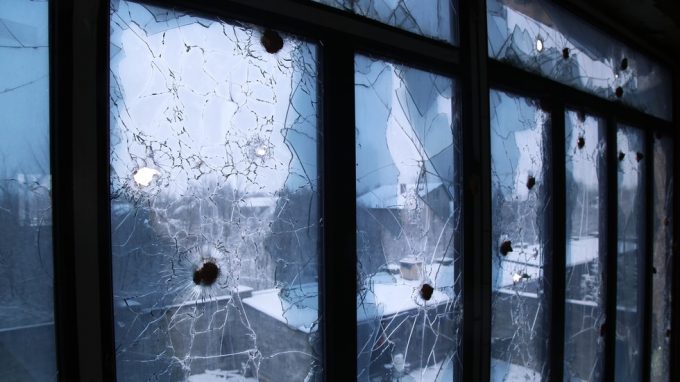
A window broken in recent shelling in the village of Vesyoloye in the Donetsk Region, self-proclaimed Donetsk People’s Republic, Eastern Ukraine. © Sputnik
RT | April 2, 2021
Moscow has warned that fighting is escalating in eastern Ukraine, insisting that the region must avoid a full-scale conflict, as Kiev asks NATO to step up its local combat readiness and says the US would come to its aid in a war.
Speaking to journalists on Friday, Kremlin spokesman Dmitry Peskov said that a series of military clashes in the Donbass region was a cause for concern. “Unfortunately for us,” he said, “the reality on the line of contact is quite frightening, and not just one, but many, provocations by the Ukrainian Armed Forces are taking place.”
Kiev insists that Russia is building up troops near the shared border and blames separatists, who have previously received support from Moscow, for breaking a ceasefire. “Russia’s current escalation is systemic, [the] largest in recent years,” Ukrainian Foreign Minister Dimitry Kuleba said in a statement issued earlier this week. Kiev officials last week said that four of its soldiers had been killed by shelling during clashes with rebels in the east of the country.
Andrey Rudenko, Russia’s deputy foreign minister, denied that Moscow had anything to gain from an increase in tensions. “I am sure that all the talk about some upcoming conflict between Ukraine and Russia is an example of another fake spread primarily by the Ukrainian authorities,” he said. “Russia is not interested in any conflict with Ukraine, let alone a military one.”
In a statement released on Friday, it was confirmed that an adviser to Ukrainian President Volodymyr Zelensky had proposed that NATO should increase its presence in the country. As part of a call with representatives from two of the US-led military bloc’s member states, Roman Mashovets, deputy head of the Office of the President, said that “such actions of the Russian Federation pose a challenge to the security of Ukraine and NATO, which must be balanced by joint efforts.”
The missive revealed that one option Mashovets put forward was “joint activities, including military exercises of Ukraine and NATO.” These activities, it added “should include land, naval and air components. In addition, it is advisable to increase the level of combat readiness of troops in NATO countries bordering Ukraine.”
Stoltenberg Comes Clean on China ‘Opportunity’ for NATO
By Finian Cunningham | Strategic Culture Foundation | March 28, 2021
In an unguarded moment, NATO’s secretary-general Jens Stoltenberg let the cat out of the bag when he described the rise of China as both a challenge and “an opportunity”. What he was admitting unintentionally is that a confrontational policy toward China gives the military alliance some badly needed new purpose.
Stoltenberg was giving an exclusive interview to Deutsche Welle to mark the first ministerial NATO summit attended by the Biden administration. The two-day summit held on March 23-24 at NATO headquarters in Brussels involved in-person participation of U.S. secretary of state Antony Blinken as well as other foreign ministers of the 30-nation military alliance.
The NATO meeting comes as the United States and its European allies are ramping up a coordinated policy of sanctions against China and Russia over alleged human rights issues. This week saw an unprecedented coordination by the U.S., Canada, Britain and the European Union in implementing new sanctions against Beijing and Moscow. It is no coincidence that this provocative development comes after high-profile international meetings, both in-person and via videoconferencing, by the Biden administration calling for allies to adopt a more adversarial and unified position toward China and Russia.
The Biden administration has changed tack from the predecessor Trump “America First” policy to vigorously advocate for a “revitalized” transatlantic relationship. Washington views a more unified U.S.-Europe axis as a more effective strategic way to challenge China and Russia. And NATO is providing a renewed coordinating vehicle.
But in seeking unity, the Biden administration is by necessity having to push a much more aggressive policy toward China and Russia, portraying them as greater threats. This means the American military alliance takes on greater responsibility for spearheading Washington’s policy. A NATO joint statement this week affirmed the alliance’s unity in the face of Russian “aggression”. Moscow slammed the statement, saying that Russia threatened no nation, and that NATO was trying to justify its existence.
Senior Russian lawmaker Leonid Slutsky said that NATO’s claims about being a defensive alliance are a “blatant lie”, pointing to wars and interventions it has launched in former Yugoslavia, Afghanistan, Iraq, Libya and Syria.
America’s top diplomat Antony Blinken this week claimed that China’s rise and Russia’s attempts to destabilize the West were “threats” that required NATO to come together. Blinken added disingenuously that the U.S. won’t force its allies into making an “us or them choice” with China. That’s exactly what the U.S. is doing.
Jens Stoltenberg and other European leaders have been swooning over the “new chapter” in transatlantic relations under the Biden administration. After four years of dealing with vulgar-mouth Donald Trump and his relentless hectoring over military budgets, some European leaders are sighing with relief at Biden’s seemingly dulcet assurances that “America is back”.
Of course people like Stoltenberg, a former Norwegian prime minister who has been the civilian head of NATO since 2014, are reliant on pushing a stronger alliance for their comfy livelihoods and no doubt for future sinecures at corporate-funded think-tanks. Stoltenberg is constantly striving to find a new vision and mission for NATO, an organization founded over 70 years ago at the start of the Cold War, and which has been expanding ever since despite the official end of the Cold War three decades ago. The buzz phrase he uses is to make the alliance “future-proof” – that is to find a permanent pretext for the U.S.-led military organization to continue its existence regardless of real-world security needs.
In his interview with Deutsche Welle this week, Stoltenberg commented on the rise of China. He said, inferring something menacing: “China is coming closer to us, investing in our critical infrastructure.”
Well maybe that’s because China is the world’s biggest trading partner with the European Union and a major foreign direct investor in European nations which have become bankrupt from decades of neoliberal capitalism and austerity.
Stoltenberg went on: “There’s no way we can avoid addressing the security consequences for our regional alliance of the rise of China and the shift in the global balance of power.”
And then the usually cautious, wooden Stoltenberg let it slip: China, he said, provided “a unique opportunity to open a new chapter in the relationship between North America — the United States — and Europe.”
Voila! So the real strategic value of China being presented as a “threat” or an “adversary” is to give a new purpose to the U.S.-led NATO bloc which subordinates Europe to Washington’s geopolitical objective of hegemony. The emphasis here is on China “being presented as a threat” and not what the real relationship actually is, that is, one of a vital economic partner. (Same for Russia and its vast energy partnership with Europe.)
The United States in pursuit of global dominance by its corporations and its capitalist order must, by definition, thwart a multipolar global political economy which the rise of China and Russia embody.
The fiendish political problem, however, is that Washington and its European surrogates cannot justify such a stance based on the normal and natural relations that exist. For in doing that, they would be seen as obnoxious, unwarranted aggressors. It is imperative therefore to conflate China and Russia as “security threats” to the presumed Western “rules-based order”.
Never mind that the Western “rules-based order” has seen NATO powers trashing rules and order by invading countries all around the world, waging criminal wars and subversions, killing millions of people and unleashing terrorism and other security threats stemming from collapsing nations and mass migration.
Forget about China, or Russia, being an alleged threat. They are in actual fact an “opportunity” for NATO and U.S. imperialism, which the alliance ultimately serves, to find an excuse for their criminal existence and conduct. Just ask the secretary-general Jens Stoltenberg (who, as the jokes goes, is more secretary than he is general).
Moscow accuses NATO’s Stoltenberg of lying about Russian refusal to speak to alliance, says he ignored Russian proposals
By Jonny Tickle | RT | March 26, 2021
Claims by NATO Secretary-General Jens Stoltenberg that Russia has been unwilling to engage in dialogue with the bloc are completely false, and Moscow is ready for a conversation, according to the country’s Foreign Ministry.
Speaking on Friday, the ministry’s spokesperson Maria Zakharova called on the NATO chief to stop spreading disinformation about Moscow’s position.
“Stoltenberg’s statements that Russia is refusing [to enter] dialogue are not true. They are lies,” she told a press briefing. “A substantive conversation was offered.”
According to Zakharova, Moscow suggested specific discussions involving experts on “a wide range of issues,” with the Kremlin wanting to steer clear of a politicized PR exercise.
During a press conference at this week’s meeting of NATO foreign ministers, Stoltenberg said that the US-led alliance views Russia’s actions in recent years as increasingly aggressive. He also claimed that there had not been a meeting of the NATO-Russia Council (NRC) since the summer of 2019 because Moscow did not respond to the invitation.
Instead, Zakharova quipped that the proposals for a meeting are on his desk, and he should find them.
“Stop spreading misinformation about Russia allegedly refusing to engage in dialogue,” she said.
The spokesperson also noted that Moscow would take NATO’s “confrontational mindset” into account when making military plans, slamming the bloc for using Russia’s “mythical aggression” as an excuse to increase financing.
The two-day NATO meeting, which took place earlier this week, was held at the alliance’s headquarters in Brussels. Before it began, Stoltenberg accused Russia of suppressing “peaceful dissidents at home,” as well as displaying “a pattern of aggressive behavior abroad.”
At the same meeting, the European Union’s High Representative for Foreign Affairs Josep Borrell called Russia a “dangerous neighbor” but encouraged continued dialogue on “common interests,” like the nuclear agreement with Iran or climate change.
Threatening Syria’s First Lady Shows NATO’s Depravity
By Finian Cunningham | Strategic Culture Foundation | March 18, 2021
This week marks the 10th anniversary since the United States and its NATO allies launched a devastating covert war of aggression for regime change in Syria. Ten years on, the Arab nation is struggling with war reconstruction, a struggle made all the more onerous because of economic sanctions imposed by the United States and the European Union.
Syria and allied forces from Russia, Iran, Iraq and Lebanon’s Hezbollah won the war, defeating legions of mercenary terrorist fighters who were armed and infiltrated into Syria by NATO. Nearly half a million Syrians were killed and half the pre-war population of 23 million was displaced.
But tragically the war is not over yet. It has moved to new hybrid phase of economic warfare in the form of Western sanctions and blockade on Syria.
The barbarity of Western sanctions on Syria have necessitated the cover of distractive media narratives.
This explains the sensation of British media reports that Asma al-Assad, the wife of Syrian President Bashar al-Assad, is being investigating by London’s Metropolitan police for war crimes. Asma (45) was born in London, was educated there and holds British nationality. Although she has Syrian heritage.
Now British authorities are mulling stripping her of nationality and seeking her extradition over charges that she aided and abetted war crimes, including preposterously, the use of chemical weapons against civilians. There is practically no chance of a prosecution, but that’s not the British aim. Rather it is all about smearing the Syrian leadership and distracting the world’s attention from the real issues: which are the criminality of NATO’s war on Syria and the ongoing economic warfare to destroy the nation into submission.
Irish peace activist and author Declan Hayes who has travelled extensively in Syria during the past decade commented: “Britain’s legally ludicrous accusations against Asma al-Assad have a number of objectives in mind. They are there to delegitimize Syria’s 2021 presidential elections; they are there to scare expatriate Syrians and British humanitarians; they are there to deflect from NATO’s well documented war crimes; and they are there to deflect from the mercenary collusion of a cast of media, political and NGO characters in NATO’s war crimes in Syria, Iraq, Libya and Yemen.”
Asma married Bashar in 2000. Before the war erupted in March 2011, she was eulogized in Western media as the “desert rose” owing to her feminine beauty and quietly spoken graceful persona. The daughter of a cardiologist and having had a career in investment banking before she become Syria’s First Lady, Asma al-Assad later showed herself to be no wilting flower. She refused to leave Damascus and go into comfortable exile with her children when the war was raging.
She remained loyally by her husband’s side and took on the role of consoling the nation, often visiting families of slain soldiers and civilian victims of NATO’s terror gangs.
No doubt the stress resulted in Asma suffering from breast cancer for which she was successfully treated in 2018.
President Assad and his wife stood by the Syrian nation when the jaws of defeat were looming during the early years of the war. When Russia intervened in support of its historic ally in October 2015, the tide of the war turned decisively against the NATO plan for regime change. Assad was singled out for regime change because of his anti-imperialist position against the U.S., Britain, France and Israel. His alliance with Russia, Iran and Lebanon’s Hezbollah put a target on his back for destruction, as former French foreign minister Roland Dumas disclosed. Dumas revealed that the British government had war plans on Syria two years before the violence erupted in March 2011. In this context, the so-called “uprising” was a carefully orchestrated false flag.
The mysterious shootings of police and protesters in the southern city of Daraa – which served to smear the Assad government internationally – were the same modus operandi used by NATO covert forces which carried out the sniper murders in Kiev’s Maidan Square triggering the February 2014 coup d’état in Ukraine.
Western media headlines this week marking the 10th anniversary since the beginning of NATO’s war on Syria have been ghoulish and nauseating.
There is a sense of gloating over the misery and hunger that the nation is facing.
A headline in Associated Press labels Syria as the “Republic of Queues”, reporting almost gleefully on how civilians are struggling with food and fuel shortages.
Nowhere in the media coverage is there a mention of how the American CIA and Britain’s MI6 ran Operation Timber Sycamore to arm and direct mercenaries to terrorize Syrians. Absurdly, Western media still claim that Syria’s war rose out of “pro-democracy uprisings” which were crushed by a “ruthless Assad regime”.
Barely acknowledged too is the fact that the United States, Britain and the European Union are strangling a war-torn nation with barbaric sanctions preventing reconstruction. The criminality of economic terrorism is the corollary of a failed criminal covert war of aggression.
The abominable reality of Western policy towards Syria has to be covered up. Threatening Syria’s First Lady – a national heroine – with prosecution for war crimes is NATO powers reaching into the gutter.
Terminate NATO
By Jacob G. Hornberger | FFF | March 19, 2021
The Washington Post has published a long piece calling for NATO to take on a new official enemy — China. The piece is written by Sara Bjerg Moller, an assistant professor in the School of Diplomacy and International Relations at Seton Hall University. She argues that after 30 years since losing the Soviet Union as its official enemy and struggling to find a replacement to justify its continued existence, a perfect replacement would be China.
I’ve got a better idea. Let’s just put NATO out of its misery and terminate it.
After all, let’s not forget NATO’s original mission: to defend Europe from the possibility of an invasion by the Soviet Union, which had been America’s and Britain’s World War II partner and ally but which had been converted to their official enemy at the end of the war.
But the likelihood of a Soviet invasion of Europe was always nil. The Soviet Union had been decimated by World War II, especially as a result of the German invasion of the country. Even though the invasion was ultimately repelled and Germany was defeated, the Soviet Union’s industrial capacity had been destroyed, not to mention the millions of Russian citizens who had been killed. The last thing the Soviet Union wanted was another war, especially given that the United States possessed nuclear weapons and had shown a willingness to employ them against large cities.
The advocates of a national-security state in the United States, however, needed a new official enemy to replace Nazi Germany, especially to justify the conversion of the U.S. government from a limited-government republic to a national-security state, a type of governmental structure with omnipotent, non-reviewable powers. The Soviet Union and “godless communism” fit the bill perfectly. The American people were then inculcated with the notion that there was an international communist conspiracy to take over the United States and the rest of the world that was based in Moscow, Russia.
To convince Americans and western Europeans that the Soviet Union posed a grave threat to them, U.S. officials pointed to the postwar Soviet occupations of Eastern Europe and East Germany as examples of communist aggression. They apparently forgot that President Franklin Roosevelt had delivered such lands into the hands of Soviet leader Joseph Stalin, who FDR affectionately referred to as his “Uncle Joe,” at their wartime summit in Yalta. Was it really too surprising that Stalin accepted FDR’s gift, especially given that Eastern Europe and East Germany would serve as a buffer against another German invasion of the Soviet Union?
It was within this fervent anti-communist environment that NATO was formed. But in 1989, the Cold War suddenly and unexpectedly came to an end, which, needless to say, put the U.S. national-security establishment and NATO into a panic. After all, the Cold War was the justification for both of these institutions. With no Cold War, they could both be dismantled.
Instead, the national-security establishment simply went into the Middle East and began poking hornets’ nest, which ultimately brought terrorist retaliation, which in turn brought the “war on terrorism,” another racket that has kept the national-security establishment in high cotton.
Meanwhile, unwilling to let Russia go as an official enemy, NATO began gobbling up former members of the Warsaw Pact, with the aim of placing U.S. troops and missiles ever closer to Russia’s borders and with the hope of provoking a reaction, which ultimately came about in Ukraine.
As Moller argues, however, Russia poses no real threat to Europe and, therefore, cannot be seriously considered to be a justification for NATO. Instead, she argues, it’s time to replace Russia with China, owing to China’s rise as an international powerhouse. The reasoning is classic empire-think: If a nation starts to prosper and rise, it’s best to put it down before it gets too large and powerful.
How about just leaving China and Russia alone? What’s wrong with that? What’s wrong with other nations becoming prosperous? The fact is that NATO should never have been established in the first place. Moreover, the biggest mistake in U.S. history was to convert the federal government to a national-security state. The best thing American could do now is terminate NATO and restore a limited-government republic to our land.
U.S.-made HIMARS missile systems in Romania aimed against Russian forces in Transnistria
By Paul Antonopoulos | March 5, 2021
The first batch of U.S.-made HIMARS multi-launch missile systems arrived in the Romanian Black Sea port of Constanța and is now a part of the national army. The first to receive the new missile system is the 81st Tactical Operational Missile Battalion, deployed in Focșani, about 70 kilometers from the border with Moldova.
HIMARS artillery missile systems are designed to attack areas with a concentration of artillery systems, air defenses, transport nodes and other major targets that are within a 300-kilometer range. Considering Romania borders Ukraine, Moldova, Bulgaria, Hungary and Serbia, the country has no enemies within the scope of HIMARS, bringing to question why it purchased such systems. It is difficult to explain why such a powerful weapon is deployed in eastern Romania, 220 kilometers from the Moldovan city of Tiraspol and 270 kilometers from the ammunition depot in Cobasna in the separatist region of Transnistria – which is internationally recognized as a part of Moldova.
It must be noted that the U.S. approved the sale of 20 HIMARS launchers, worth $655 million, to Poland. Romania received 54 launchers, more than double the amount of Poland, showing that the U.S. is prioritizing the Black Sea as a point of pressure against Russia – more so than the Baltics. Whereas the German Navy are present in the Baltics and the British can reach the area with relative ease, the Black Sea is effectively a “Russian lake,” particularly after Russia’s 2014 reunification with Crimea. NATO member states Turkey, Bulgaria and Romania do not have the capabilities to challenge the Russian Navy in the Black Sea, hence why Washington is also cooperating with Moldova, Ukraine and Georgia.
But the question still remains – why would Bucharest need 54 HIMARS launchers, more than the American artillery brigade has, and more than 10% of all such systems in the Pentagon’s arsenal?
It is excessive fire power for an army that has only 70,000, personnel and does not have the means to redeploy heavy weapons at a great distance. According to Firepower, Romania is ranked only 41st globally for their military power.
Hypothetically, in a war situation, the 41st U.S. Artillery Brigade could borrow the Romanian HIMARS systems and transport them to Georgia or Ukraine. At the end of 2020, U.S. ground forces conducted exercises to prepare for a “hi-tech war” in Romania. In a few hours they managed to transport by air two HIMARS systems from Germany to the Kogâlniceanu Air Base and launch several rockets towards the Black Sea – there is little doubt that the imagined target was Russian forces when we consider that it is only 400 kilometers between the Romanian coast and Russia. Although this is 100 kilometers less than the range of the HIMARS system, according to Forbes, the exercises were “a message for Moscow” and a “rocket surprise” for Russian forces in Crimea.
The political-military situation in the region is becoming increasingly tense, with Moldova coming within range of American weapons and soldiers based in Romania. According to the Constitution, the Republic of Moldova is a neutral state, but decisionmakers in the Moldovan capital of Chisinau and their Romanian counterparts in Bucharest concluded a military cooperation agreement in 2013, which de facto subordinates Moldovan troops to the Romanian General Staff and allows Romanian gendarmes to maintain “public order” in the country. With Romania effectively controlling Moldova’s security and President Maia Sandu pivoting her country towards NATO and the European Union, Chisinau could be a willing participant in the West’s sustained campaign to pressure Moscow.
Analysts at the Pentagon-affiliated RAND Corporation are examining how U.S. troops could enter Moldova to participate in military exercises and not leave, using the pretext of the so-called Russian threat. American maneuvers and armament in Eastern Europe not only threatens Russia, but serves to ensure that Romania and Baltic States stay loyal to Washington and against Moscow.
If the U.S. is successful in stationing troops in Moldova, they would effectively have new access to the Black Sea via the Port of Giurgiulești on the Danube River. In addition, U.S. troops would be within touching distance of the 1,500-strong Operational Group of Russian Forces in Transnistria, whose responsibilities include maintaining peace and guarding several tons of military equipment and ammunition in Cobasna.
Although the HIMARS system cannot reach Russia from Romania, it is likely that these missiles are aimed against Russian forces maintaining peace in Transnistria. 54 HIMARS in Romania’s arsenal demonstrates an escalation by Bucharest as it is clear that the excessive number of units is not for defensive purposes, especially considering the country’s cordial relations with its neighbors.
Paul Antonopoulos is an independent geopolitical analyst.
Featured Video

AIDS Inc. by Gary Null (2007)
or go to
Aletho News Archives – Video-Images
From the Archives
Clash of Civilization, Iran Part II
By Jamal Kanj – Intifada-Palestine.com – January 14, 2011
Israel’s survival kit is: perpetuate conflict, insecurity to rationalize collective hate and finally playing victim.
Devoid of conflict, Israel implodes internally; without hate, Zionism loses its justification; and playing eternal victim to continue blackmailing the West. Absence of this holy trinity, Israel ceases to exist.
From its inception, the house of Zion has mastered exploiting adversarial powers to advance Israel’s cause. For instance, their influence over the Democratic Party in the US began with President Truman’s bid for 2nd term election in 1948.
Responding to strong opposition from Secretary of State General George Marshall and Department experts urging against recognition of Israel, President Truman replied: “I’m sorry gentlemen but I have to answer to hundreds of thousands [Jewish voters] who are anxious for the success of Zionism. I do not have hundreds of thousands of [voting] Arabs among my constituents”
Zionists influence over liberal American politics was matched with the doctrinal school of Conservative theoreticians aligning the Republican Party’s platform with Israel’s objectives. The Neoconservative Zionists, coined Zioncons, invented the “Clash of Civilization” concept to fight Israel’s wars. … continue
Blog Roll
 Aletho News
- Pro-Palestine protesters arrested outside UK’s ruling Labour Conference in Liverpool
- Mauritius denies landing permit to flight from Israel, forcing cancellation: Tour operator
- Israeli finance minister calls for genocidal war on West Bank, annexation of south Lebanon
- 12 Things Your Psychiatrist Was Trained Not to Tell You
- From Unipolar Universalism to Multipolar Civilizational Distinctiveness
- RSF military group defects, joins Sudanese army: State media
- Ireland goalkeeper refuses to play ‘Israel’ as squad weighs boycott
- China pushes back against US on Cuba, Iran
- Ukrainian Soldiers, Potential Mercenaries: Have Gun, Will Travel!
- Burnham’s UN debut… A masterclass in British disinformation
- If Americans Knew
- Israel forces Gazans to live in constant peril – Daily Update
- Deconstructing Netanyahu’s pants-on-fire UN rant – Daily Update
- Trump betrayed voters with his campaign lies and prioritized a foreign country once he took office
- Netanyahu calls Israel’s war in Gaza ‘opposite of genocide’ in UN speech to near-empty hall
- Settler Kidnappings: Torture, Sexual Abuse and Terrorisation of Palestinian Abductees as Israel Deepens Annexation of West Bank
- Gaza winter nears as 162,000 tents become unusable, raising fears of humanitarian crisis
- Netanyahu says, “It’s the opposite of genocide”; UN says Gaza economy is world’s ‘most severe crisis on record’ – Daily Update
- Israel’s US-Backed Assault on Gaza Has Created the ‘World’s Most Severe Economic Crisis on Record’: UN
- ‘Protecting U.S. Citizens’… From Israel
- ‘This is where I live now, the back of a truck’: a day in the life of a grandmother in Gaza
- No Tricks Zone
- New Study: Earth And Venus Surface Warmth Largely Explained By Convection And Lapse Rate, Not CO2 Or Radiation
- 2025 Nature Paper Claiming Worsening Global Drought Gets RETRACTED …Heavily Flawed
- New Study: ‘Global Drought Shows No Detectable Recent Acceleration Under Climate Warming’
- Economic Masterminds: German Socialists Suggest Taxing Productivity Gains Stemming From Using AI
- The South China Sea Has Not Been Cooperating With The Climate Change Narrative
- Energy Crisis: Germany Enters Heating Season With Historically Low Gas Reserve Fill Levels
- New Study: The Antarctic Ice Sheet Gained Mass From 2020-2024 Due To Staggering Snow And Ice Accumulation
- Study: Ocean Heating Rates From Thousands Of Years Ago ‘Dwarf’ Modern Ocean Heating Rates
- Climate Extremists Target, Attack Large-Scale Power Grid Infrastructure In Germany!
- New Study: Antarctic Ice Melt Has Contributed Less Than 1 Centimeter To Sea Level Rise In The Last 30 Years

