The Uyghur Tribunal: Inciting Hatred Against China
By Christopher Black – New Eastern Outlook – 22.06.2021
The fascists are very active these days and one of the proofs of this dark shadow looming over the world is the recent so-called “peoples’ tribunal” put on in London over three days in early June. Otherwise called the “Uyghur Tribunal,” it is headed by Sir Geoffrey Nice, Q.C, the Machiavellian British barrister, knighted by the Queen for his services to Britain, who became notorious for trying to frame-up Yugoslavia’s President Milosevic at the Yugoslav War Crimes Tribunal.
This new ‘tribunal’ follows on the China Tribunal also headed by Nice and also based in London, which focused on fabricated allegations of forced organ trafficking by China. This second tribunal focuses on fabricated allegations against China concerning the treatment of Uyghurs in the Chinese province of Xinjiang. The allegations before both of these ‘tribunals’ have one objective; to slander the Communist Party of China and to undermine China as a developing and sovereign nation.
The ‘tribunal’ is part of the propaganda matrix being constructed by NATO, led by the USA and UK, which has the objective of manipulating people’s minds to generate hatred and hostility towards China to, at the least, hinder its trade and development, at worst, to prepare the minds of people for war. In that sense this ‘tribunal’ is nothing less than a part of the preparation for war, and can be seen, under international criminal law, as part of a conspiracy to engage in the supreme war crime, the crime of aggression.
The same tactics are being applied to Russia with all the false allegations being made by the Americans against Russia, allegations that Joe Biden shamefully repeated in his meeting with President Putin in Geneva, as if he was king of the world dressing down a wayward vassal. No wonder that meeting was cut short. Only a fly on the wall can tell us what was really said and happened in Geneva, but who can imagine the Russians sitting there for long having to listen to a lecture on how they should stop doing what they are not doing “or face the consequences.” How can any serious person sit there and not either laugh out loud or become angry at the absurdity of it? But of course that is the spin in the western media, the spin that Biden put on the meeting; that he “talked tough to Putin.” Bluster and lies is the American way.

The bluster and lies continued at the Uyghur tribunal over the three days of “hearings” that took place from June 4 to 7 which were staged as a piece of theatre, even to the extent of the organisers selling tickets to attend. It was all acted out by a company of roaming players who go from one forum to another playing their roles, speaking their lines on cue from a script written by shadowy men and women in shadowy rooms in London and Washington.
Geoffrey Nice not only is chair of the two tribunals dealing with China and persecutor of President Milosevic, he is also a co-author of the Caesar Report on Syria, produced by the NATO backed Centre For Justice and Accountability so-called, another propaganda outfit focused on slandering Syria, along with his friend, former US Ambassador For War Crimes, Stephen Rapp. He seems to be NATO’s ever eager go-to lawyer when they need some propaganda put out to justify their wars
One of Nice’s most notorious crimes in the Milosevic show trial at the ICTY was to deliberately mislead the judges and the world by stating that the Kosovo Field speech made by Milosevic proved Milosevic was for a Greater Serbia. But Milosevic produced the real speech proving that he had said the exact opposite of what Nice claimed, that he had called for inter-ethnic tolerance. Nice was proved to be a liar. But the judges did nothing to him. He was allowed to continue spewing lies day after day throughout that show trial because NATO wanted the show to go on and Nice was their chosen circus ringmaster. So, it is no surprise that he was chosen to be ringmaster of this new propaganda circus.
This ‘tribunal’ claims to be independent. Yet it is neither a “tribunal’ nor independent. It has no legal or other authority. It certainly has no moral authority when we look at its funding and the experts called upon to give their ‘evidence,’ for we see clearly the connections between it, the NATO governments and western financial interests.
Much of its funding comes from the World Uyghur Congress whose affiliations with the CIA and funding by the National Endowment For Democracy are well known. In fact it was the World Uyghur Congress that asked Geoffrey Nice to set up the tribunal, according to him, and it provided the initial funding, so that we see right at the beginning, that the US government, through the CIA and NED, is directly involved with the Nice tribunal. Let us look at some of the others involved.
There is Nick Vetch, an extremely rich British businessman, who is founder and CEO of BigYellow a large UK storage company, which, in turn, has some of its shares owned by US financial companies such as Blackrock Inc, Standard Life Aberdeen, American Financial Group and others. Vetch is also a director of the Global Human Rights Fund, a UK “human rights’ organisation, which appears to provide some funding to the Nice tribunal. He is also a member of Nice’s China Tribunal.
Vetch’s connection to the Fund indicates who is behind his activities since the Global Human Rights Fund in turn gets its funding from the European Union, the Swedish Government, the Ford Foundation, George Soros, The Rockefeller Foundation, and other US corporate-backed foundations. The Chair of the Fund is Chris Canavan, managing director of Lion’s Head Global Partners, formerly Director of Global Policy Development for the Soros Fund, formerly senior official with Goldman Sachs Bank in New York and a lifetime member of the US Council on Foreign Relations.
He who pays the piper calls the tune.
Other members of the ‘tribunal’ are members of the British Establishment, and aside from anti-China credentials seem to be brought in to add some credibility to the proceedings. They include Dame Parveen Kumar, a UK doctor and member of the British Establishment, Ambreeana Manji, UK law professor who once worked for the British Institute in East Africa, Tim Clark, a UK lawyer and senior director of Vetch’s company Big Yellow and who is also an adviser to G3, which claims to be ‘one of the leading international strategic advisory groups’. Based in London, G3 seems to be an intelligence group with murky connections.
The list includes Ramindar Kaur, social anthropologist, writer, and “human rights” activist who is also deeply immersed in the British establishment. She is a Fellow of the Royal Society and head of a number of government studies on UK social issues. There is Dr. David Lynch, a specialist on cancer at University College London, Audrey Osler, Professor of education and human rights, University of Leeds, an advocate of using human rights education to achieve changes in world societies, and Catherine Roe, who began her career as a British diplomat, specialising in multilateral negotiations and who is now a Trustee of the Institute of International Strategic Studies.
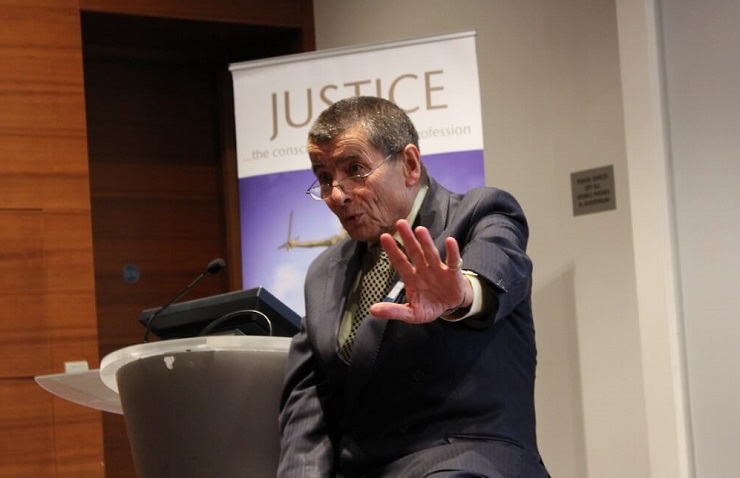
Hamid Sabi, is styled as “counsel to the tribunal.” He is a British lawyer, active in the service of the western powers. He is, among other things, a director of Justice For Iran, an organisation accusing Iran of human rights violations, whose recommendations for sanctions against Iranian officials and Press TV are followed by the US and EU and UK governments and who has a history of attacking China.
He is assisted by Aarif Abraham, another UK lawyer, and former lawyer for the NATO tribunal for Yugoslavia, (ICTY) another very anti-China, pro-foreign intervention type who wrote a paper on the Uighurs accusing China of all sorts of crimes. Another assistant is Aldo Samit Borda, a Maltese, but now a lawyer in the UK involved in human rights, who has connections with the British government as he once worked for the Commonwealth Secretariat. The NATO-ICTY connection continues with Marilena Stegbauer, their general assistant, a German, and former intern for the NATO prosecutor at the ICTY, former researcher at Human Rights Institute in the UK, then a writer for The German Diplomat in Germany, who now calls herself a “human rights consultant”.
There is Frankie Vetch, production assistant, son of the Vetch senior, making the tribunal a bit of a Vetch family affair, and Nevenka Tromp, another NATO asset who also worked at the ICTY as a researcher for prosecution in the Milosevic and Karadzic trials. The group is rounded off with Baroness Helena Kennedy, adviser and member of the British House of Lords, Queen’s Counsel, also member of the International Bar Association Institute of Human Rights who in 2020, worked with the Conservative MP Iain Duncan Smith and “democracy activist” with Hong Kong Watch, Luke de Pulford, to create the global pressure group the Inter-Parliamentary Alliance on China, in March 2021,
The Coalition for Genocide Response is a supporter of the tribunal. It is the project of John Luke de Pulford mentioned above who is a prominent London establishment anti-communist, anti Chinese Government figure and a supporter of Nathan Law, the Hong Kong fifth columnist working for British interests in Hong Kong, now fled to London. In fact the tribunal has also revealed that it was launched on 3 September 2020, with assistance from the Coalition for Genocide Response that was founded by John Luke de Pulford, the protégé of British journalist turned activist, Benedict Rogers, and Hong Kong Watch functionary, who also has close links to Stand with Hong Kong. Benedict Rogers is the founder of Hong Kong Watch, a notorious propaganda outfit that specializes in churning out fallacies about China. Rogers also has put out false claims about North Korea, works with governments from the UK to Canada and USA and is a leader of the anti-communist Christian Solidarity Worldwide. He states that he introduced Nice to the Uyghurs a couple of years ago. Rogers recently appointed Nice to Hong Kong Watch as a patron, joining the former British governor of Hong Kong, Chris Patten. Another of its patrons is Lord David Alton, who is linked with the concocted report on the Hong Kong Police Force, which the All-Party Parliamentary Group on Hong Kong, of which he is a vice-chair, produced in 2020.
On Sept 23, 2020, in the House of Lords, Alton asked the British foreign office minister, Lord Ahmad, if the government would “welcome” the initiative to set up the “Uyghur Tribunal”, and “cooperate” with it. The minister did not give a clear reply but the tribunal has since thanked the British government for fast-tracking visas for foreign nationals to attend the tribunal. In view of Alton’s links with Hong Kong Watch, the extent to which it is covertly involved in the tribunal cannot be underestimated as Benedict Rogers is also an adviser to the World Uyghur Congress. The circle of interconnections is complete.
Those are the people behind the tribunal. Some, like Nice, are clearly NATO assets. None of them are independent or objective.
Since this is supposedly a tribunal they had to produce witnesses. These fit into two categories, expert witnesses and witnesses of fact, that is, people who claim to have observed things.
These were duly paraded before the tribunal, one after one, made statements without offering any proof of their claims and then retired with none of them cross-examined on their statements. Their claims were not tested at all; not by the ‘judges’ who are also in fact the “prosecutors” nor by anyone else. Instead the statements were accepted as true without any examination and when the ‘witnesses’ faltered in reading their lines, the ‘judges’ assisted them. This is not the procedure of a trial or even a hearing. It is more closely associated with an Inquisition. Nice and company are not interested in the truth or falsity of the claims being made. Their only interest is in making sure the statements they require to make effective anti-Chinese propaganda are supplied.
The so-called ‘expert witnesses’ included Ethan Guttman, a Senior fellow at the anticommunist “Victims of Communism Memorial Foundation, an American organisation funded by the US Congress to “educate people on the evils of communism,” who has made many wild claims about China in particular on allegations of “organ harvesting” and Adrian Zenz, also a fellow at the same anti-communist organisation. His propaganda work is notorious.
It incudes Laura Murphy, trained as a literature scholar, who became a “human rights” professor at the Helena Kennedy Centre for International Justice, University of Sheffield. Harvard educated, she seems to be a professional witness and has worked for US Government Office of Victims of Crime, and other US government agencies, has put out propaganda on the BBC about “forced labour” in China and received an award for her propaganda work from the US government agency the National Endowment For Humanities, and grants from their National Humanities Centre. She also received grants from the British Academy.
Finally there is Dr. Darren Byler, of the University of Colorado, who is engaged in post doctoral work with the ChinaProject, funded by the Henry Luce Foundation, a famous, anti-communist organisation founded by Henry Luce, and, Nathan Ruser, an Australian researcher with the Australian Strategic Policy Institute who is an expert in satellite data and surveillance who has written a number of anti-Chinese propaganda articles. There are a few others of the same type.
The factual witnesses are a travelling troupe of players many of whom have given statements in other venues, often contradicting their claims at the tribunal. The Chinese government has exposed the lies of several of these witnesses who travel the world as professional witnesses-earning their keep by telling stories which do not bear up under any scrutiny. But none of the witnesses testified under a real oath, none were questioned on the contents of their statements or how they came to the attention of the organisers, apart from being recruited by the World Uyghur Congress.
Having myself experienced how Nice and the other prosecutors at the Yugoslav and Rwanda tribunals got people to be witnesses, and how they coerced them into given false testimony when required makes it impossible to accept any of the statements made by these alleged witnesses with anything less than complete disbelief. Not that it matters in legal terms. Despite Nice spouting platitudes about “reasonable doubt” and “assessing the evidence” we all know what the outcome of the hearings, to be continued in September, will be; the condemnation of China.
So there we have it, another propaganda exercise masquerading as a search for justice and accountability, But it is about time these propagandists be held accountable for their actions, for manufacturing hatred and hostility towards a nation that has brought its people out of the poverty imposed on them by the west during the colonial period and which the west wants to impose again.
At the Nuremberg Trials the Nazi propagandist, Julius Streicher, was hanged for putting out propaganda about Jews and inciting hatred leading to genocide. At the Rwanda Tribunal the members of a radio station were convicted of genocide for allegedly making false reports on events that the prosecutors claimed instigated hatred that led to genocide. Hate speech is proscribed by the International Covenant on Civil and Political Rights and other treaties. Is this not what Nice and his players are doing, trying to instigate hatred and hostility to justify war, to justify harming and killing Chinese? Is this not where it all leads? Is this not a crime against humanity? Are not they the real criminals?
Christopher Black is an international criminal lawyer based in Toronto. He is known for a number of high-profile war crimes cases and recently published his novel Beneath the Clouds.
Biden agreed to Turkey defending Kabul airport, says US official
MEMO | June 18, 2021
US President Joe Biden and Turkish President Recep Tayyip Erdogan have agreed on Turkey’s offer to take a leading role in the defence of Afghanistan’s Kabul Airport, the US National Security Advisor has revealed.
Speaking to reporters yesterday, Jake Sullivan said that the two leaders discussed the situation in Afghanistan during their meeting on the sidelines of the NATO summit on Monday. According to Sullivan, Erdogan sought certain unspecified US assistance for Turkey in return for the deployment of Turkish troops at the airport following the withdrawal of US and NATO forces from the country. Biden apparently accepted this.
“The clear commitment from the leaders was established that Turkey would play a lead role in securing Hamid Karzai International Airport,” explained Sullivan. “And we are now working through how to execute to get to that.”
The security of the airport in Kabul is seen as vital for the operation and continuation of diplomatic missions to Afghanistan. It would serve as the safest exit point for diplomats in the event of a potential security breakdown in the country, such as the Taliban’s defeat of Afghan government forces.
Last week, however, the Taliban also warned Turkey to withdraw its troops and said that its military presence at the airport would not be welcome. “Obviously we take seriously the concern that the Taliban or other elements in Afghanistan will attack the Western or the international presence,” said Sullivan. “We do not believe that what the Taliban has said publicly should or will deter the efforts underway right now to establish that security presence.”
The agreement between Ankara and Washington comes after years of strained relations between the two over a myriad of issues. A primary dispute remains Turkey’s purchase of the Russian S-400 air defence system, which the US and other NATO members condemned due to the system’s potential breach of the alliance’s security.
Sullivan addressed that issue, revealing that there was no progress and the two leaders maintained their respective positions. “They discussed it. There was not a resolution of the issue. There was a commitment to continue the dialogue on the S-400 and the two teams will be following up on that coming out of the meeting.”
Jessica Ashooh: The Taming of Reddit and the National Security State Plant Tabbed to Do It
How and why did a hawkish young mandarin hothoused at elite universities and in the halls of state power end up an executive at an anarchic messageboard site with an anti-establishment reputation?
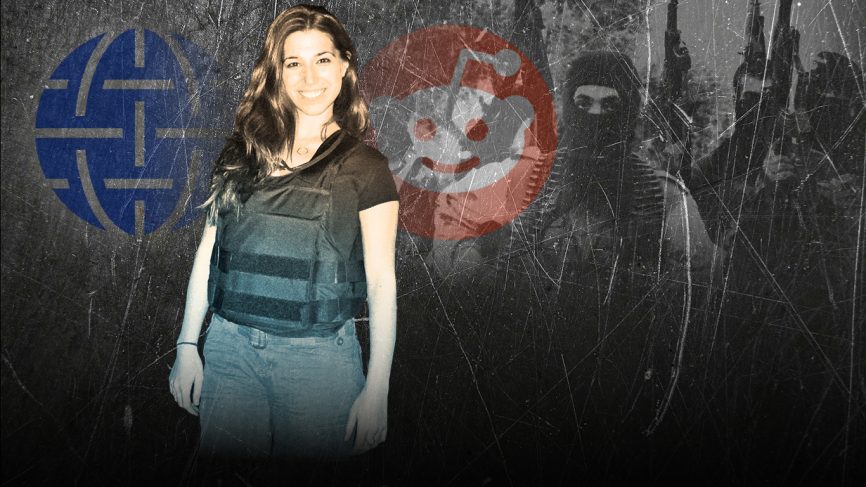
Photo | Graphic by Antonio Cabrera
By Alan Macleod | MintPress News | June 11, 2021
Reddit is one of the world’s most influential news and social media platforms. The website attracted over 1.2 billion visits in April 2021 alone, making it the United States’ eighth most visited site, ahead of other leviathans like Twitter, Instagram and eBay. Now majority-owned by a much larger corporate publishing empire, Reddit is also far ahead of more established news sites, garnering three times the numbers of Fox News and five times those of The New York Times.
That is why it was so surprising that so little was made of the company’s decision to appoint foreign policy hawk Jessica Ashooh to the position of Director of Policy in 2017, at which time it was also the eight most visited site in the U.S. Ashooh, who had been a Middle East foreign policy wonk at NATO’s think tank the Atlantic Council, was appointed at around the same time that the Senate Select Intelligence Committee was demanding more control over the popular website, on the grounds that it was being used to spread disinformation. In her role as Director of Policy, she oversees all government relations and public policy for the company, in addition to managing content, product and advertising. Yet a Google search for “Jessica Ashooh Reddit” filtered between late 2016 and early 2017 (after she was appointed) elicits zero relevant results, meaning not one media outlet even mentioned the questionable appointment.
This is all the more hair-raising, given her resume as a high state official — all of which raises serious questions about the extent of collaboration between Silicon Valley and the national security state.
A hawk’s talons on Syria
The Atlantic Council is the de-facto brains of the North Atlantic Treaty Organization and takes funding from the military alliance, as well as from the U.S. government, the U.S. military, Middle Eastern dictatorships, other Western governments, big tech companies, and weapons manufacturers. Its board of directors has been and continues to be a who’s who of high U.S. statespeople like Henry Kissinger, Colin Powell and Condoleezza Rice, as well as senior military commanders such as retired generals Wesley Clark, David Petraeus, H.R. McMaster, James “Mad Dog” Mattis, the late Lt. Gen. Brent Scowcroft, and Admiral James Stavridis. At least seven former CIA directors are also on the board. As such, the council chooses to represent both political wings of the national security state.
Ashooh’s LinkedIn resume epitomizes the troubling relantionship between think tanks and big tech.
Between 2015 and 2017, Ashooh was Deputy Director of the Atlantic Council’s Middle East Strategy Task Force, working directly with and under Madeline Albright and Stephen Hadley. This is particularly noteworthy, given both these individuals’ roles in the region. As Bill Clinton’s secretary of state, Albright oversaw the Iraq sanctions and the Oil for Food Program, denounced as “genocide” by the successive United Nations diplomats charged with carrying them out. In an infamous interview with 60 Minutes, Albright casually brushed off a question about her role in the killing of half a million children, stating “the price is worth it.” Meanwhile, Hadley was deputy or senior national security advisor to the government of George W. Bush throughout the Afghanistan and Iraq invasions, surely the greatest crimes against humanity thus far in the 21st century.
Ashooh appears to be as hawkish as her bosses. Her particular area of expertise is the war in Syria, regarding which she has been among the most belligerent voices, constantly calling for more American intervention to overthrow the government of Bashar al-Assad. In a 2015 interview with Al Jazeera, she praised the U.K. government’s decision to bomb the country, claiming that the British public was “coming around” to the idea of war. A shocked interviewer asked “how will the British airstrikes [on] Syria… make the British public any safer?” Ashooh replied that it was “generally a positive decision” because “it goes a long way in improving international consensus on the way forward on Syria,” although she lamented that there wouldn’t be “much improvement in the situation without ground troops.” There will be “no political solution without a military element,” she predicted, essentially making the pitch for war.
Ashooh has also constantly praised and supported Syria’s opposition forces. In 2016, she said that she was very happy that “fighters on the ground from a number of key factions” were uniting against the “Assad regime.” She condemned Russia for claiming these opposition forces were members of terrorist groups like Al-Nusra, Jaysh al-Islam or ISIS, insisting that these were “moderate” rebels.
Of course, the idea that there was still any measurable distance between “moderate” rebels and outright militant jihadists by 2016 was hard to maintain. Even The Washington Post by this time was admitting as much, noting that so-called moderates were now so “intermingled” with al-Nusra that it was difficult to tell them apart.
Nevertheless, the New Hampshire native took to the pages of The New York Times to demand that the U.S. arm the opposition. Of course, it was already doing so, the CIA spending $1 billion per year fielding rebel mercenary armies in the conflict — with one in every 15 dollars the agency spent going to this endeavor. All of this Ashooh surely knew, yet she maintained that the West must continue to “jack up the price” of Russia defending Assad. “As long as [Assad] remains in power and remains the figurehead of the Syrian government… this conflict won’t end,” she said, laying out her regime-change-or-bust position. Just weeks before unexpectedly taking over at Reddit, Ashooh seemed to still be in full foreign-policy-hawk mode, condemning Obama in the pages of The Washington Post for his apparent softness on Syria and demanding that Trump “restore U.S. credibility” by “order[ing] targeted, punitive strikes against the Assad regime.”
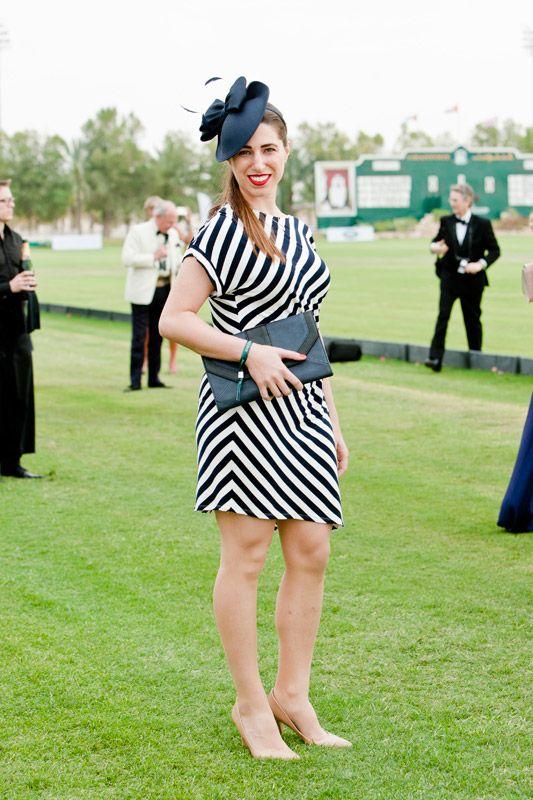
Ashooh attends British Polo Day at Abu Dhabi’s Ghantoot Racing and Polo Club. Photo | Ahlan
Dirty war, dirty warrior
Ashooh is actually even more involved in the Syrian conflict than one might realize from her hawkish opinions alone. Between 2011 and 2015, she worked for the Ministry of Foreign Affairs of the United Arab Emirates, in her own words, “[p]rovid[ing] senior decision makers with policy analysis and strategic advice, with a particular focus on Syria.”
At that time the UAE was using its enormous financial clout to arm and fund a myriad of jihadist groups attempting to overthow the secular strongman Assad and establish some kind of Islamic state. Far from a conspiracy theory, this comes straight from the horse’s mouth, as then-Vice President Joe Biden revealed in a Q&A session in 2014. The future president frankly stated:
The Saudis, the Emiratis, what were they doing?… They poured hundreds of millions of dollars and tens of thousands of tons of weapons into anyone who would fight against Assad, except that the people who were being supplied were al-Nusra and al-Qaeda and the extremist elements of jihadis coming from other parts of the world. “
Under pressure, he later apologized for his loose lips.
MintPress News asked the Emirati Ministry of Foreign Affairs to comment on precisely what Ashooh’s role was, but they failed to respond.
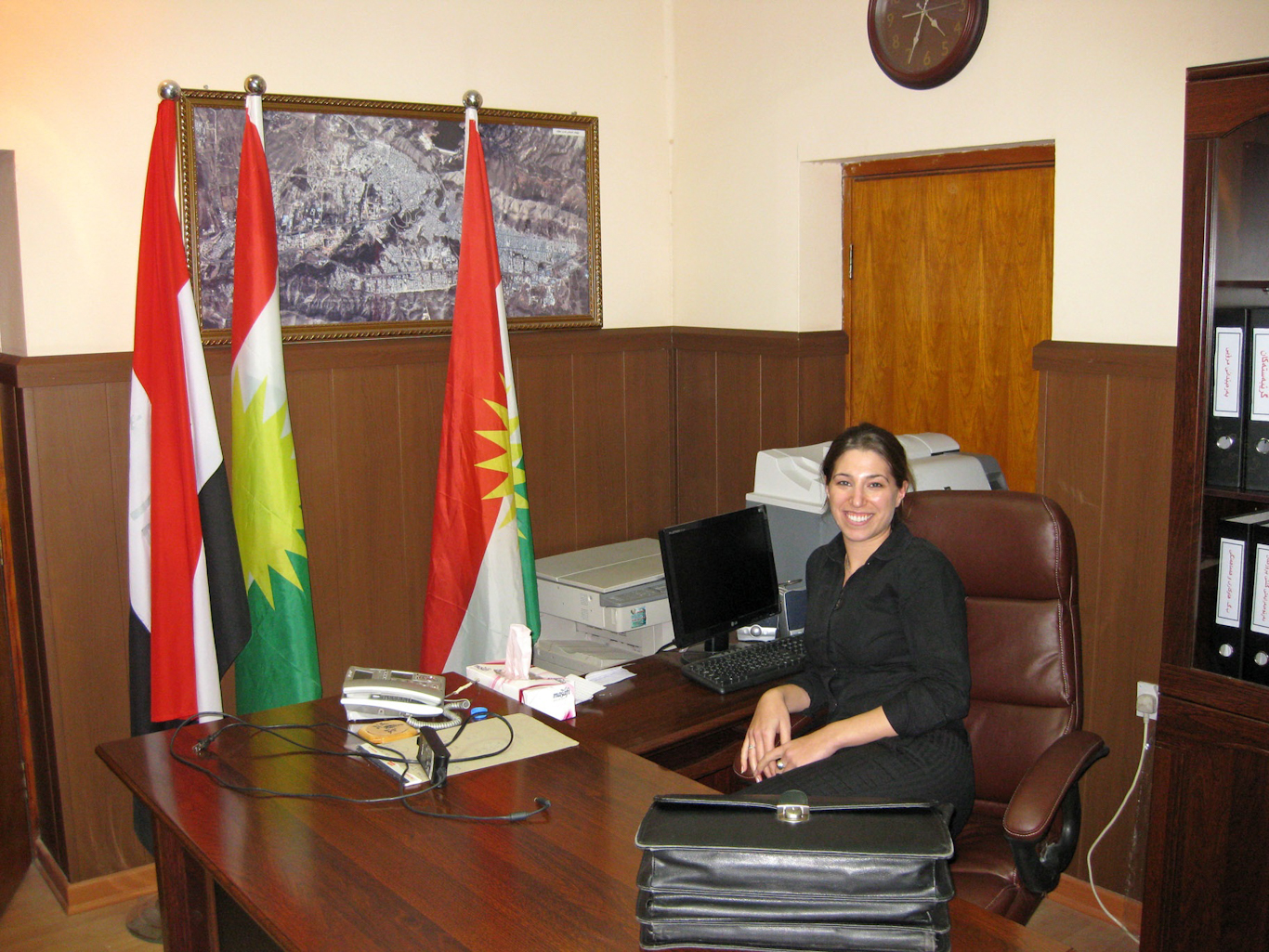
Ashooh is pictured during her time as a “consultant” in Iraqi Kurdistan. Photo | Academyalumni
Ashooh herself appears to have been a relatively major player in the Syrian Civil War. In her previously mentioned Washington Post article, she notes that her boss was a former Emirati Air Force General and that she was flown to Istanbul in 2013 to attend an emergency meeting with leaders of the Syrian opposition, as well as ambassadors from unnamed Arab and Western states, in order to plan a response to a reported chemical weapons attack and to help the U.S. “coordinate with the Syrian opposition.”
At the same time as she was advising the nation on Middle Eastern affairs, the UAE was widely accused of flying ISIS and al-Qaeda leaders into Yemen to help them intensify the Saudi-led onslaught on the impoverished nation and of smuggling U.S.-made weaponry — including small arms, TOW missiles and Oshkosh fighting vehicles — to the jihadist groups. While Ashooh’s writing is careful to maintain a distinction between the “moderate” rebels she supports and the fundamentalist radicals she does not, it certainly is noteworthy that the entities she worked for consistently seem to end up in league with the most regressive forces in the region. MintPress also reached out to Reddit for comment on why they appointed Ashooh, given her past history, and on the wider phenomenon of government penetration of social media. The company initially promised to issue a response to the inquiry but has not followed through with it.
Opposing some dictatorships, supporting others
Regime change is on the table for more than just one Middle Eastern nation. In a 2017 paper for the Center for the National Interest — a think tank established by former Republican President Richard Nixon and the “Godfather of Neoconservatism,” Irving Kristol — Ashooh explores the different options for forcing regime change in Iran, but concludes that overthrowing the “odious regime” is an impossible task right now, and criticizes the idea as a quixotic dream.
Nevertheless, she is far from an Iran dove. An Atlantic Council report she co-wrote insists that “Iranian interference in the Arab world must be deterred,” and that “America’s friends and partners must be reassured that the U.S. opposes Iranian hegemony and will work with them to prevent it.”
Ashooh’s commitment to fighting against Middle Eastern dictatorships might seem more principled if she did not appear so enamored of the least democratic one of them all. In 2016, she accompanied Albright and Hadley to Saudi Arabia and praised the monarchy’s dynamic leadership on the economy and its nurturing of a new generation. “It was really really exciting to see that level of energy and the level of government support for these young people who were interested in shaping their own futures… it was just wonderful,” she said. In an article about her experience for business news website Market Watch, she waxed lyrical about how forward-thinking the Saudi government is and how the country has become “a hub for the dynamic and positive change that is swelling up throughout the region.” Presumably, this excludes Yemen, a nation they were bombing relentlessly. In a 2020 interview, Ashooh revealed that her dream job would be U.S. Ambassador to Saudi Arabia. One of her earliest comments on her public Reddit page (made before she began working there) is deflecting the Kingdom from criticism of its dreadful treatment of women.
As part of the Atlantic Council, Ashooh was tasked with envisaging a new Middle East for the 21st century. Given her output, it seems that she advocates for a transition towards a more privatized, free-market economic setup, not completely unlike the shock therapy tried in Latin America in the 1970s and 1980s. “We have to “encourage states to make the reforms that move economies from state-based to ones that support entrepreneurship, because the age of state-based economies is over,” she said at a talk at New York University in 2015, adding:
You’ve got to move to support entrepreneurship in the region and let people take advantage of the natural industrial tendencies of people in the Middle East. My God, if you’ve ever been to a Turkish bazaar or a market in Cairo you know that these countries are perfectly capable of having functioning market economies. But the state has gotten in the way.
Ashooh’s LinkedIn profile also notes that in 2010, she worked as an advisor to the Iraqi Ministry of Planning “on a variety of strategic and economic development issues,” but does not go into any more detail about what those issues were. A further biography merely states that her consultancy agency “provid[ed] strategic and management consulting services to the Ministry of Planning of the Kurdistan Regional Government in Northern Iraq.” Unsurprisingly, the organization has links to the U.S. military; the agency’s lead partner being a former Army captain.
Think Tankie
Ashooh comes from a relatively prominent New Hampshire family of Lebanese descent, the most notable of which is probably her uncle Richard. Richard Ashooh was Donald Trump’s Assistant Secretary of Commerce for Export Administration and a former executive at weapons manufacturer BAE Systems. Unlike her uncle, Jessica appears to lean more Democratic, having donated money to a number of local politicians, as well as to anti-Trump Republican groups aimed at convincing them to vote blue, such as Right Side PAC and the now infamous Lincoln Project. However, she also appears to have great respect for many Republicans, having written her doctoral thesis at Oxford University on the Middle East policy of the George W. Bush administration. She also stated that the person she would have most liked to have met was 41st President George Bush Senior, describing him as possessing “incredible amounts of strategy, finesse and restraint.” Thus, her political views appear to be exactly in the center of the neoliberal “blob” in Washington.
Ashooh also worked for the right-wing think tank the CATO Institute and is a Term Member of the more Democratic-aligned Council on Foreign Relations (CFR). The CFR’s term member program is intended to, in its own words, “cultivate the next generation of foreign policy leaders.”
Surveillance Valley
How and why, then, did a hawkish young mandarin hothoused at elite universities and in the halls of state power end up an executive at an anarchic messageboard site with an anti-establishment reputation? Virtually everyone else in senior roles at Reddit has relevant backgrounds in marketing or tech, having worked with comparable companies such as Yelp, Expedia and Snapchat.
Tom Secker — a journalist, podcaster and researcher who runs SpyCulture.com, an online archive about government involvement in the entertainment industry — was deeply skeptical. “That someone whose entire career has been in international relations and foreign affairs is now the senior policy wonk at Reddit is simply bizarre. Given her ties to the CFR, Atlantic Council and the like, it’s downright suspicious,” Secker told MintPress.
Underneath the surface, however, the Atlantic Council has been rapidly expanding its influence and control over big social media companies. In 2018, it announced that it would be partnering with Facebook to promote trustworthy sources and derank, demote and even delete low quality or fake news, thus effectively curating what the platform’s 2.85 billion worldwide users see in their news feeds. But the effect of recent algorithmic changes has been to throttle alternative media traffic in favor of establishment sources such as CNN, Fox News and The New York Times. Even such more mainstream liberal sites as Mother Jones have seen their numbers crater. Facebook later admitted that they were directly targeting Mother Jones because of its left-leaning content, raising the question that if such a middle-of-the-road liberal outlet was being penalized, wasn’t the collapse in traffic to more radical publications surely deliberate? Given the Atlantic Council’s funding and the identities of those on its board, their control over social media is tantamount to state censorship on a global level.
Earlier this year, Facebook also hired NATO press officer Ben Nimmo to be its intelligence chief, in another move that dismayed free-speech advocates. In the past, Nimmo has identified a Welsh pensioner and an internationally known Ukranian pianist as Russian bots, raising more questions about the suitability of the Atlantic Council to be an arbiter of truth online.
The Facebook-Atlantic Council link mirrors that of Microsoft with NewsGuard, a new piece of software purportedly trying to fight fake news by placing either green shields or red warning logos, corresponding to an outlet’s credibility, beside all links in its browser, Microsoft Edge — this credibility being decided entirely by NewsGuard itself. Newsguard pushed Microsoft to install the software on all its products as standard. Again, however, NewsGuard’s system rated establishment websites like Fox News and CNN as trustworthy but independent media as suspect. And again, a glance at its advisory board makes it clear that this is a state operation. Those in key positions included George W. Bush’s Secretary of Homeland Security and former NSA and CIA Director General Michael Hayden; ex-White House Communications Director Don Baer; and former Secretary General of NATO Anders Fogh Rasmussen. Worse still, NewsGuard is also linked to a PR agency employed in whitewashing the Saudi government’s human-rights record and its role in the carnage in Yemen.
Twitter, too, has some extremely troubling links with state power. In 2019 Gordon MacMillan, a senior Twitter executive responsible for the Middle East region, was outed as an active duty officer in the British Army’s 77th Brigade, a unit dedicated to online operations and psychological warfare. Far from causing a scandal, only one major U.S. outlet even mentioned the story, and the journalist in question resigned from the profession weeks later, claiming the existence of a network of top-down state censors who quash stories that threaten the power and prestige of the national security state. To this day, MacMillan remains in his post at Twitter, strongly suggesting the social media company knew of his role before he was hired.
Over the past few years, Twitter, Reddit and Facebook have announced the deletion of hundreds of thousands of accounts linked to sources in Russia, Iran, China and other enemy states, often on the recommendation of Western governments or state-sponsored intelligence organizations. However, they never seem willing or able to find any manipulation of their platforms by Western governments. Thus, the upshot of this has been to slowly dissuade critics of Western foreign policy from using their services.
“The mainstream media-politik establishment has managed to get a hold over Twitter, Facebook and Instagram — shadow-banning and downrating posts considered ‘Russian propaganda’ or whatever other excuse they use to marginalize perspectives and content outside of the mainstream,” Secker told MintPress. “Audiences for this sort of content are increasingly pissed off and alienated by the major social media sites.”
Increasingly, unwelcome political voices are either brushed off by centrist pundits as repeating Russian talking points or smeared as being amplified by Kremlin-based bot farms. The popularity of movements on the left like Black Lives Matter or the Bernie Sanders’ campaign were written off as partially linked to Russia, while others suggested that the January 6 insurrection in Washington was essentially a Russian operation.
The irony is that many of the wildest accusations against Putin that have fed this climate of suspicion began life in Atlantic Council documents. For example, the organization has published a series of studies that suggest that virtually every European political party challenging the neoliberal status quo in some way — from Labour and UKIP in the U.K. to Syriza and Golden Dawn in Greece and PODEMOS and Vox in Spain — are secretly controlled by Russia, functioning as the “Kremlin’s Trojan Horses,” in its words.
The Atlantic Council is also deeply intertwined with a U.K. government-funded organization called the Integrity Initiative, something that purports to be a group defending democracy from disinformation. However, in practice, it appears to be doing the opposite: planting disinformation about politicians’ supposed links to Russia in order to undermine them. The Integrity Initiative is a government-backed cluster of journalists who operate in unison to conduct propaganda blitzes on unsuspecting publics. In 2018, it launched a successful operation to prevent Colonel Pedro Baños being appointed Spain’s head of national security. Considering Baños too soft on Russia for the Atlantic Council and other hawks’ liking, the initiative sprung into action, creating a storm of protest that led to another individual being chosen.
Reddit actually played a key role in a 2019 propaganda blitz against anti-war Labour leader Jeremy Corbyn. A few days before the U.K.’s general election, Corbyn promoted documents leaked on the platform that showed that Conservative Prime Minister Boris Johnson was negotiating with American companies, putting much of the country’s National Health Service up for sale. With just days to go before polls opened, it could have proved a game changer. Reddit quickly came to Johnson’s rescue, however, asserting that the documents were part of a Russian disinformation campaign. The story in the pliant British press switched from “Boris Johnson is selling off the NHS” to “Corbyn promotes Russian disinfo,” thus greasing the skids for an easy victory for the hardline anti-Russia Conservative Party, an outcome the hawks at the Atlantic Council were no doubt relieved by, given Corbyn’s open skepticism about war, empire and nuclear weapons. The veracity of the documents was not challenged.
For a while…
Founded in 2005, Reddit has grown to become one of the world’s largest and most influential websites. However, it began life as an anarchistic messageboard whose culture was profoundly libertarian and anti-establishment. For years, the company’s administrators took a near free speech absolutist position. Aaron Swartz, Reddit’s co-founder, was an open source hacktivist and even attempted to download and publish the entirety of academic publisher Jstor’s library. When authorities got wind of what he was doing, they threatened him with 40 years in prison, an action that caused him to take his own life in 2013.
Reddit’s own position on free information and free speech was often so extreme it caused huge controversy. The site became the internet’s largest source of child pornography. It was only after CNN began reporting on it to a nationwide audience that things began to change. Other, grossly offensive communities like /r/BeatingWomen and /r/CoonTown were also protected.
Nevertheless, the culture established by anarchistic tech bros remained for some years, with the site resembling darker corners of the internet like 4Chan and 8Chan as much as more family-friendly mainstream social media like Facebook.
Ashooh’s arrival in 2017 coincided with a new era in the site’s history. Gone were the days of protecting communities that would bring in bad publicity. Her team quickly brought in a new content policy and began to delete communities that violated it. Last year, she oversaw the banning of over 2,000 communities in a single day, including /r/The_Donald, the main Donald Trump subreddit, and /r/ChapoTrapHouse, the most active left-wing community. These decisions have helped the money flow in; since 2017 revenue has more than tripled.
However, what has been lost across the internet is the liberatory potential of these technologies. In the 1990s and 2000s, many predicted that the internet would usher in a new era of egalitarianism and genuine democracy, helping even to reduce barriers and tensions between nations. For a while, the new medium allowed political actors to challenge the status quo and gain huge followings quickly. Alternative media was easily outperforming legacy media, and challenging the status quo when it came to news. Seeing that, the reaction since 2016 has been swift, as the elite have moved to retighten their grip over the means of communication. Ashooh’s jump from national security state official to Reddit Director of Policy is just one more point of reference on that chart.
Alan MacLeod is Senior Staff Writer for MintPress News. After completing his PhD in 2017 he published two books: Bad News From Venezuela: Twenty Years of Fake News and Misreporting and Propaganda in the Information Age: Still Manufacturing Consent, as well as a number of academic articles.
Ahead of crucial Putin-Biden summit, Washington raises stakes by announcing $150 million in additional military aid for Ukraine
RT | June 12, 2021
The Pentagon has announced a new $150 million military aid package for Ukraine, potentially raising tensions with Moscow just days before President Joe Biden’s summit meeting with his Russian counterpart Vladimir Putin in Geneva.
The latest gift from Washington aims to boost the “lethality, command and control, and situational awareness” of Kiev’s forces, the Pentagon said in a statement on Friday. In practice, that translates into counter-artillery radars, counter-drone systems, secure communications technology and electronic warfare equipment.
Ukraine will also receive medical evacuation gear, as well as training and equipment to improve the safety and capacity of its air force bases. The new systems are meant to complement a $125 million aid package that was announced in March, which included counter-artillery radars and Mark VI patrol boats the US is phasing out.
Washington has pledged more than $2.5 billion in military assistance to Ukraine since 2014, when the government in Kiev was overthrown with the assistance of far-right nationalists. The fallout from the US-backed ‘Maidan’ triggered a chain of events which led to the Crimean peninsula seceding and voting to rejoin Russia. A situation which US refuses to recognize to this day.
The two aid packages have been authorized by the US Congress as part of the defense funding bill, but it was contingent upon the Pentagon certifying that Kiev was making sufficient progress on recommended reforms.
The two regions of Donetsk and Lugansk in the Donbass area of east Ukraine also rebelled, and defeated two attempts to crush them by force. Kiev claims this amounts to “Russian aggression.” However, Moscow also doesn’t recognise the two self-declared states.
Tensions have risen in recent months, with fighting in the Donbass region escalating and both Russia and NATO conducting large-scale military exercises in Europe.
Biden is scheduled to meet with Putin on June 16. Ukraine is expected to be on the agenda, along with issues such as arms control, cybersecurity and nuclear cooperation.
SUCCESS IS CONFRONTATION
By Paul Robinson | IRRUSIANALITY | JUNE 11, 2021
Yes, you read the title correctly, “Success is confrontation.” So says one-time US Ambassador to NATO Kurt Volker in an article for the Center for European Policy Analysis (CEPA), one of the more reliably Russophobic think tanks in Washington. “Success is confrontation.” Think about the implications for a while.
The subject of Mr Volker’s article is the forthcoming meeting between America’s president Joe Biden and his Russian counterpart Vladimir Putin. Volker wants you to know how should measure the meeting’s “success”. The basic answer is that the meeting will be a success from the American point of view if it fails utterly, miserably, and totally. The worse the outcome, the better it will be.
Now, with relations between two heavily armed nuclear powers about as bad as anyone can remember, one might imagine that success would be if the leaders of the two powers found some way of patching up their difficulties, or at least reaching agreement on some minor matters of mutual interest while leaving major differences between them unresolved. But Mr Volker views things rather differently.
For you see, if the meeting between Biden and Putin ends without a major bust-up, or worse produces some minor agreements that overall contribute to “predictability and stability”, that will be a victory for Putin. And what is good for Putin must by necessity be bad for America. As Volker puts it,
It is surely not in the interests of the US, the EU, NATO, and other allies to see a summit in which Putin leaves convinced that he has blunted the United States and faces no consequences for his behavior. It would send a signal that authoritarians can get away with aggressive acts at home and abroad, and that the US and the West will not take any meaningful action to stop them. … any outcome that seems reassuring and benign on the surface actually works in Putin’s favor.
Consequently, Volker concludes that:
For the US, therefore, the best possible outcome is not one of modest agreements and a commitment to “predictability,” but one of a lack of agreement altogether. Success is confrontation.
Volker points out that Biden and Putin might discuss issues such as climate change, Iran, and Afghanistan. Is it really better that they fail to reach agreement on those issues? Whose interests would that actually serve? I damned if I have an answer. And Volker doesn’t provide one either. His view seems to be that the world can go to hell in a handcart as far as he’s concerned, if the alternative is failure to confront the evil dictator Putin. Frankly, it’s nuts.
In fact, it’s obvious that Volker doesn’t want the meeting to go ahead at all. He writes that, “an ideal scenario would have the US Administration announce tough, new sanctions against Russia and its enablers in Western Europe in advance of the Geneva summit.” Of course, were that to happen, Putin would cancel the meeting there and then. But I guess that’s the point. Volker thinks it’s wrong not only to come to agreement with the Russians but even to talk to them. To reverse-quote Churchill: In the eyes of Volker, “War, war is always better than jaw jaw.”
One can argue that one should prepare for the possibility of conflict. But the idea that one should actively prefer it to agreement on the international stage, especially when dealing with the largest country in the world, a nation endowed with some 1,500 nuclear warheads, is, in my opinion, quite staggeringly irresponsible.
Now, you might say that this is just one guy’s opinion. We can ignore it. It doesn’t mean anything. But Volker isn’t just some guy. From 2017 to 2019, he was the US Special Representative for Ukraine Negotiations – so in effect America’s point guy for its relationship with Ukraine and for negotiations concerning a peace settlement for that country’s civil war. On the basis of this article, one shudders to think what advice he was giving the Ukrainian government. Certainly not advice conducive to peace, I imagine. It’s more than a little scary.
So, this is more than just one man. This article is a window into the way that an influential part of the American foreign policy establishment thinks. It rejects negotiation. It regards compromise as dangerous. It openly prefers conflict. “Success is confrontation” – the worse the better. Wow!
No going back to Open Skies, US tells Russia ahead of Biden-Putin summit
RT | May 27, 2021
The US State Department has communicated to Moscow that the Biden administration has no intention of rejoining the Open Skies treaty, which was one of the topics expected to come up at the Geneva summit in June.
Deputy Secretary of State Wendy Sherman sent the message to her Russian counterpart Deputy Foreign Minister Sergei Ryabkov on Thursday, AP reported, citing US officials speaking on condition of anonymity. Russia’s Ministry of Foreign Affairs has confirmed receiving the message.
It was a rare case of President Joe Biden not reversing a decision made by his predecessor Donald Trump, who had taken the US out of the treaty in May 2020.
The US officially left the treaty in November, but when Biden came to power he ordered a review of the decision, holding out the possibility that Washington might rejoin. The subject was expected to come up at the June 16 meeting between Biden and Russian President Vladimir Putin in Geneva.
Earlier in the day, Kremlin spokesman Dmitry Peskov had told reporters that time to salvage the arms control agreement was running out fast.
“This topic can surely be touched upon somehow, but time is running out fast. We are already carrying out procedures for leaving the treaty, and the US has little time to change its previous decisions,” Peskov said.
Last month, Moscow announced it would begin the procedure of withdrawing from the treaty, concerned that the US has continued to receive intelligence through overflights conducted by other NATO members still party to it.
With the US definitely out, further presence of Russia in Open Skies no longer makes sense, Russian Senator Andrey Klimov – who sits on the foreign relations committee – told RIA Novosti following the announcement from Washington.
The Open Skies treaty was intended to build trust between Russia and the West following the Cold War. Signed in 1992 and going into effect in 2002, it allowed signatories to openly fly unarmed surveillance planes over the territory of other participants. More than 1,500 such flights have taken place since.
Putin submits bill for Russia to quit Open Skies Treaty one year after US withdrew from ‘spying agreement’
By Jonny Tickle | RT | May 11, 2021
Russian President Vladimir Putin has submitted a bill to the country’s parliament to leave the Open Skies Treaty, a post-Cold War surveillance agreement that allows signatory countries to openly spy on each other from the air.
The much-maligned pact has come under attack in recent times, and appears to be on its last legs. Last May, under then-President Donald Trump, the US announced it would withdraw from the treaty. This was confirmed six months later, in November.
Following Washington’s decision to leave the agreement, Moscow revealed that it wanted guarantees from America’s NATO military bloc allies that they would not share information gained through Open Skies with Washington. Such reassurances are yet to come, and current US President Joe Biden has not shown a willingness to re-sign the treaty.
On Tuesday morning, Putin submitted a bill to the State Duma, noting that Moscow would “start domestic procedures” to enable the country to withdraw from Open Skies.
The explanatory note attached to the document praised the agreement for “significantly contributing to building confidence in the military sphere,” noting that America’s decision to leave the treaty in its current form threatens Russia’s national security.
“On November 22, 2020, the US withdrew from the treaty under a far-fetched pretext,” the statement says. “Serious damage was done to compliance with the treaty and its significance in building confidence and transparency.”
In January, Russia’s foreign ministry announced that it had launched domestic procedures to withdraw from the treaty. In a statement, it noted that the move was coming after a “lack of progress in negotiations around the continuation of the treaty under new circumstances.”
Norwegian City ‘Ill-Prepared’ to Welcome NATO Nuclear Submarines
By Igor Kuznetsov – Sputnik – 23.04.2021
Despite treating a nuclear accident as an unlikely scenario, the Norwegian Armed Forces warned that it may lead to death, damage overall health over time and do great radioactive harm to nature and the environment.
While the first NATO nuclear submarines are set to dock soon outside the Norwegian city of Tromsø due to a contested recent agreement, the municipality has no plans for the mass evacuation of people in the event of a radioactive leak or other emergency, national broadcaster NRK reported.
Among other things, there is a conspicuous lack of material and competence for rescue and health personnel who may have to assist in the event of an accident.
“As is said in the contingency plan, which will be ready 1 May, we lack the necessary training on everything in the plan, and we also lack the necessary equipment,” the director of Tromsø municipality, Stig Tore Johnsen, told NRK, admitting that the authorities don’t have what is needed if something goes wrong when the nuclear submarines arrive.
“We don’t plan for the entire city of Tromsø to be evacuated in the event of an incident. It is a not very relevant scenario, and not very likely to happen, so we cannot plan for it,” Johnsen said.
According to Johnsen, the municipality currently lacks information about when the first submarine will arrive. However, in two weeks, a digital public meeting under the auspices of the Armed Forces will be held about the planned calls.
While the contingency plan is almost finished, this doesn’t mean that everything is in place.
“The plan doesn’t necessarily mean that we have done all the exercises, acquired expertise in incidents that may occur or other material. There are things that will remain after 1 May,” Johnsen admitted.
Earlier this year, the Norwegian Armed Forces completed a classified 80-page risk and vulnerability analysis for the arrival of nuclear submarines. According to NRK, though, the Armed Forces treat a nuclear accident as an unlikely scenario. But it can happen, and in the event of an accident, the consequences can be death, damage to health over time and great radioactive harm to nature and the environment. The Armed Forces’ own analysis shows that may ultimately be relevant to evacuate large parts of Tromsø. In the words of the national broadcaster NRK, “If a nuclear accident occurs, it can have fatal consequences for Tromsø.”
Municipal council representative Jens Ingvald Olsen of the Reds party, previously a staunch opponent of port calls by nuclear-powered vessels in Norway, is highly critical of how the authorities handle this issue.
“It is quite obvious that the municipality, the University Hospital of Northern Norway, and the police are ill-prepared to handle submarine reception as of today. What is happening now confirms what we have been criticising over the past five years,” Olsen told national broadcaster NRK.
Deputy mayor of Tromsø, Mads Hegge Jakobsen of the Centre Party, said that the position in the municipal council has been taken and that is unlikely for it to turn around on this issue.
Previously, the upgrade of the port facilities in Tromsø triggered popular and political opposition, as well as criticism from environmentalists, including Greenpeace.
Tromsø, 76,000, is the largest urban area in Northern Norway and the third largest north of the Arctic Circle in the entire world, trailing only Russia’s Murmansk and Norilsk.
As British Warships Deploy to Black Sea, Putin Warns of Red Lines
By Finian Cunningham | Strategic Culture Foundation | April 22, 2021
Russian President Vladimir Putin issued a stern warning to countries trying to provoke military tensions, saying that his nation is drawing up red lines for defense.
Putin delivered the sharp remarks during his annual state-of-the-nation address to lawmakers from both chambers of the Russian parliament. The stark warning comes amid spiraling tensions over Ukraine between Western supporters of the Kiev regime and Russia.
Specifically, days before Putin’s set-piece speech, British media reported that Britain’s Royal Navy is planning to deploy two warships to the Black Sea: a Type-45 destroyer armed with anti-aircraft missiles; and a frigate for hunting submarines. A British ministry of defense spokesman is quoted as saying the move was a sign of “unwavering support for Ukraine’s territorial integrity” in the face of alleged Russian aggression.
The British deployment is planned to take place in the coming weeks. The two warships will transit Turkey’s Bosphorus Strait to enter the Black Sea. International shipping is permitted under the Montreux Convention. However, the British plan seems far from an innocent passage, and a rather more calculated provocation.
The two ships will be part of a bigger battle group, the newly launched HMS Queen Elizabeth aircraft carrier which will station in the East Mediterranean. The battle group will be able to supply F-35B Lightning fighter jets and Merlin helicopters with submarine-hunting missiles. All in all, it is a pretty audacious attempt by the British to raise tensions with Russia.
It is notable that the United States last week abruptly cancelled sending two of its guided-missile destroyers to the Black Sea after Russia mobilized its own fleet in the region and warned the Americans to “stay away”. Days later, the British seem to have stepped into the breach with their proposed Black Sea operation. Did the Biden administration ask London to step up to the plate and to show “solidarity”, or is the British maneuver a gambit to curry favor with Washington by flexing AngloSaxon muscles for Uncle Sam?
In any case, London’s move comes on the back of an already brazen buildup of British military forces in the Black Sea. Britain has previously sent naval personnel and equipment to train Ukrainian warships. The Royal Air Force has also dispatched a squadron of Typhoon fighter jets to patrol the Black Sea in support of the Kiev regime and its claim to take back control of the Crimean Peninsula. The Peninsula voted in a referendum in March 2014 to join the Russian Federation after a NATO-backed coup d’état in Kiev the previous month which ushered in an anti-Russian regime.
The Kiev regime has also been stepping up its violations of the ceasefire in Eastern Ukraine where ethnic Russian populations have declared breakaway republics in defiance of the 2014 NATO-backed coup. Civilian centers in Donetsk and Luhansk are being shelled on a daily basis. This is clearly a cynical attempt by the Kiev regime to escalate the civil war in such a way as to drag NATO further into the conflict. Russia has mobilized sizable army divisions on the border with Ukraine in what Moscow says is a matter of national self-defense. Yet, ironically, the United States, Britain, and other NATO powers are demanding Russia to “de-escalate” tensions.
NATO’s very public backing for the Kiev regime and the supply of American lethal weaponry is no doubt emboldening the regime to step up its offensive fire on Eastern Ukraine and making menacing moves towards Crimea.
The British are in particular giving the Kiev regime a dangerous sense of military license for its bravado towards Moscow.
The situation is an extremely dangerous powder-keg. One wrong move, even unintended, could spark off a wider war involving the NATO powers and Russia.
In this highly combustible context, Russia is right to close off areas in the Black Sea that encompass its territorial waters. Those areas include the coastal waters off the Crimean Peninsula.
NATO powers sending warships into the region is the height of criminal folly. If Britain and other members of the U.S.-led alliance contend that they are “defending Ukraine’s territorial integrity” then the logic of that position dictates that they will attempt to make an incursion into Crimean coastal water since they don’t recognize Russia’s sovereignty. In that event, a military confrontation is bound to happen.
President Putin’s declaration of red lines is not so much a rhetorical putting it up to the West. It is a responsible position to prevent a war from breaking out.
The British are being told that they cannot just sail their warships into the Black Sea and rattle their sabers in Russia’s face. Putin is telling the Brits and anyone else not to even think about getting that close.
US Lawmakers Reintroduce Bill Barring Any American President From Leaving NATO Alliance
By Gaby Arancibia – Sputnik – 16.04.2021
Under the Trump administration, the Senate Foreign Relations Committee passed a measure in an effort to prevent a sitting US president from withdrawing the nation from a military alliance, specifically NATO. However, the December 2020 initiative was never taken up for a vote by the full US Senate, which was then under Republican control.
A bipartisan group of US senators reintroduced a measure on Thursday that would effectively prevent any sitting American president from removing the Land of the Free from the decades-old NATO military alliance.
The bill was reintroduced into the Democrat-controlled Senate chamber by Sens. Tim Kaine (D-VA) and Marco Rubio (R-FL), congressional members who both serve on the Senate Foreign Relations Committee. The legislation has been sponsored by several Republicans, Democrats and an independent.
The measure’s stipulations indicate that should a president want to withdraw from the alliance, they would need to get at least two-thirds approval from the US Senate.
However, in the event that the commander-in-chief attempts to jump ship without said approval, the bill would then prohibit funding for the withdrawal and authorize the Congressional Legal Counsel to challenge the matter in court.
“NATO has been a critical alliance for nearly 75 years,” Kaine remarked in a statement. “It has ably served the US, our NATO allies, and the world. This bill expresses clear congressional support for the continuing value of NATO and clarifies that no president acting alone can sever the bonds of the alliance.”
In an accompanying statement of his own, Rubio highlighted the importance of the alliance, noting that the military partnership “is more important than ever” in light of “Moscow’s growing subversive aggressions.”
“We must ensure no US president withdraws from NATO without the advice and consent of the Senate,” the lawmaker stressed.
Most recently, Russia’s military build-up along the Ukrainian border has remained under the spotlight, with the troop deployments being labeled a “provocation.” Moscow has rejected claims that the development is an incitement, explaining that the movements are meant to ensure the nation’s national security as NATO has undertaken its own build-up in the region.
A similar measure regarding a potential pullout from the NATO partnership was introduced in December 2019 as a response to former US President Donald Trump’s repeated criticism of the NATO alliance. At the time, Trump blasted NATO allies for not contributing enough funding to the organization, vowing to part ways from the defense block. However, Trump never delivered on the promise and instead referred to the potential withdrawal as “unnecessary.”
At present, any NATO member seeking to withdraw from the group must give a one-year “notice of denunciation” before being able to exit the treaty.
How Bellingcat Launders National Security State Talking Points into the Press
By Alan Macleod | MintPress News | April 9, 2021
AMSTERDAM — Investigative site Bellingcat is the toast of the popular press. In the past month alone, it has been described as “an intelligence agency for the people” (ABC Australia ), a “transparent” and “innovative” (New Yorker ) “independent news collective,” “transforming investigative journalism” (Big Think ), and an unequivocal “force for good” (South China Morning Post ). Indeed, outside of a few alternative news sites, it is very hard to hear a negative word against Bellingcat, such is the gushing praise for the outlet founded in 2014.
This is troubling, because the evidence compiled in this investigation suggests Bellingcat is far from independent and neutral, as it is funded by Western governments, staffed with former military and state intelligence officers, repeats official narratives against enemy states, and serves as a key part in what could be called a “spook to Bellingcat to corporate media propaganda pipeline,” presenting Western government narratives as independent research.
Citizen journalism staffed with spies and soldiers
An alarming number of Bellingcat’s staff and contributors come from highly suspect backgrounds. Senior Investigator Nick Waters, for example, spent three years as an officer in the British Army, including a tour in Afghanistan, where he furthered the British state’s objectives in the region. Shortly after leaving the service, he was hired by Bellingcat to provide supposedly bias-free investigations into the Middle East.
Former contributor Cameron Colquhoun’s past is even more suspect. Colquhoun spent a decade in a senior position in GCHQ (Britain’s version of the NSA), where he ran cyber and Middle Eastern terror operations. The Scot specializes in Middle Eastern security and also holds a qualification from the U.S. State Department. None of this, however, is disclosed by Bellingcat, which merely describes him as the managing director of a private intelligence company that “conduct[s] ethical investigations” for clients around the world — thus depriving readers of key information they need to make informed judgments on what they are reading.
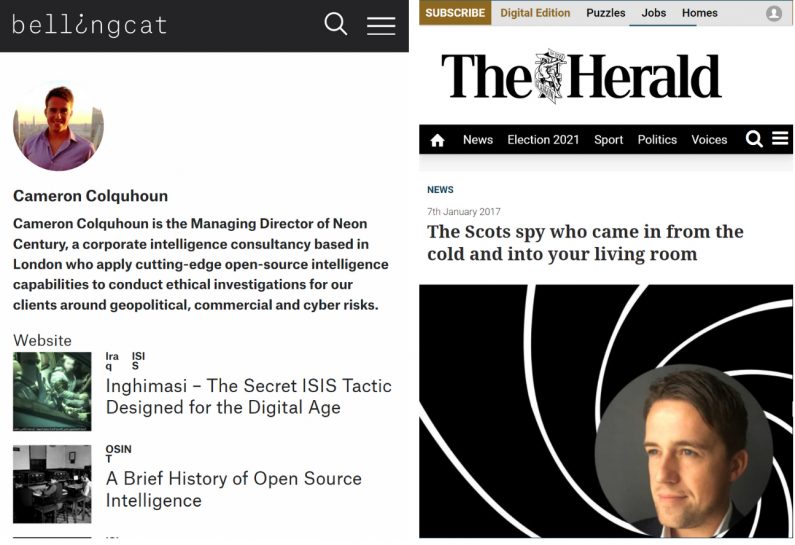
Bellingcat fails to inform its readers of even the most glaring conflicts of interest
There are plenty of former American spooks on Bellingcat’s roster as well. Former contributor Chris Biggers, who penned more than 60 articles for the site between 2014 and 2017, previously worked for the National Geospatial-Intelligence Agency — a combat support unit that works under the Department of Defense and the broader Intelligence Community. Biggers is now the director of an intelligence company headquartered in Virginia, on the outskirts of Washington (close to other semi-private contractor groups like Booz Allen Hamilton), that boasts of having retired Army and Air Force generals on its board. Again, none of this is disclosed by Bellingcat, where Biggers’s bio states only that he is a “public and private sector consultant based in Washington, D.C.”
For six years, Dan Kaszeta was a U.S. Secret Service agent specializing in chemical, biological and nuclear weapons, and for six more he worked as program manager for the White House Military Office. At Bellingcat, he would provide some of the intellectual ammunition for Western accusations about chemical weapons use in Syria and Russia’s alleged poisoning of Sergei Skripal.
Kaszeta is also a fellow at the Royal United Services Institute, a think tank funded by a host of Western governments as well as weapons contractors such as Airbus, Lockheed Martin and Raytheon. Its president is a British field marshal (the highest attainable military rank) and its senior vice president is retired American General David Petraeus. Its chairman is Lord Hague, the U.K.’s secretary of state between 2010 and 2015.
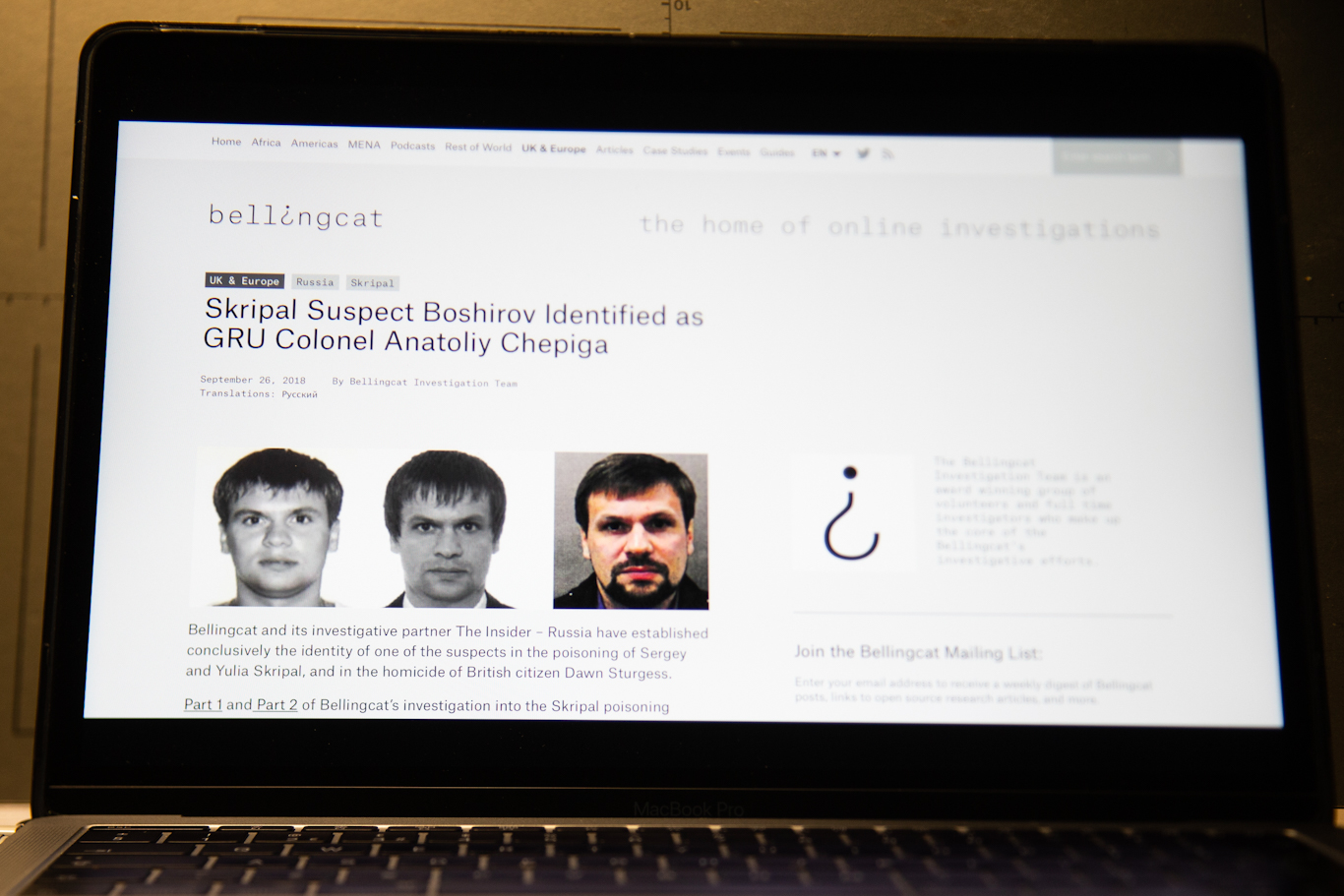
A Bellingcat article covering the alleged poisoning of Sergei Skripal, a story covered heavily by the organization. Alexander Zemlianichenko | AP
All of this matters if a group is presenting itself as independent when, in reality, their views align almost perfectly with the governments funding them. But yet again, Bellingcat fails to follow basic journalism ethics and inform readers of these glaring conflict of interests, describing Kaszeta as merely the managing director of a security company and someone with 27 years of experience in security and antiterrorism. This means that unless readers are willing to do a research project they will be none the wiser.
Other Bellingcat contributors have similar pasts. Nour Bakr previously worked for the British government’s Foreign and Commonwealth Office while Karl Morand proudly served two separate tours in Iraq with the U.S. 82nd Airborne Division.
Government and intelligence officials are the opposite of journalists. The former exist to promote the interests of power (often against those of the public) while the latter are supposed to hold the powerful to account on behalf of the people. That is why it is so inappropriate that Bellingcat has had so many former spooks on their books. It could be said that ex-officials who have renounced their past or blown the whistle, such as Daniel Ellsberg or John Kiriakou, have utility as journalists. But those who have simply made the transition into media without any change in positions usually serve only the powerful.
Who pays the piper?
Just as startling as its spooky staff is Bellingcat’s source of funding. In 2016 its founder, Eliot Higgins, dismissed the idea that his organization got money from the U.S. government’s National Endowment for Democracy (NED) as a ludicrous conspiracy theory. Yet, by the next year, he openly admitted the thing he had laughed off for so long was, in fact, true (Bellingcat’s latest available financial report confirms that they continue to receive financial assistance from the NED). As many MintPress readers will know, the NED was explicitly set up by the Reagan administration as a front for the CIA’s regime-change operations. “A lot of what we do today was done covertly 25 years ago by the CIA,” said the organization’s co-founder Allen Weinstein, proudly.
Higgins himself was a senior fellow at the Atlantic Council, NATO’s quasi-official think tank, from 2016 to 2019. The Atlantic Council’s board of directors is a who’s who of state power, from war planners like Henry Kissinger, Condoleezza Rice and Colin Powell to retired generals such as James “Mad Dog” Mattis and H.R. McMaster. It also features no fewer than seven former CIA directors. How Higgins could possibly see taking a paid position at an organization like this while he was still the face of a supposedly open and independent intelligence collective as being at all consistent is unclear.
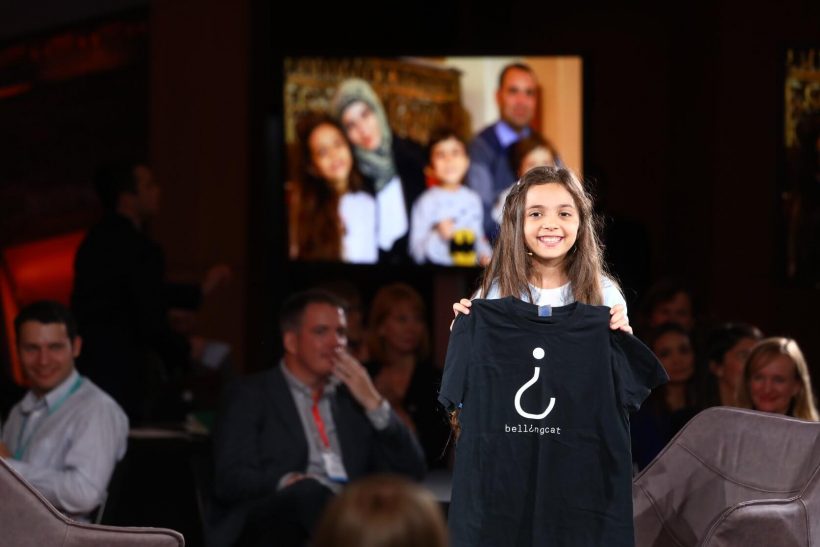
Bana Alabed, an outsoken anti-Assad child activist, promotes Bellingcat at an Atlantic Council event. Photo | Twitter
Other questionable sources of income include the Human Rights Foundation, an international organization set up by Venezuelan activist Thor Halvorssen Mendoza. Halvorssen is the son of a former government official accused of being a CIA informant and a gunrunner for the agency’s dirty wars in Central America in the 1980s and the cousin of convicted terrorist Leopoldo Lopez. Lopez in turn was a leader in a U.S.-backed coup in 2002 and a wave of political terror in 2014 that killed at least 43 people and caused an estimated $15 billion worth of property damage. A major figure on the right-wing of Venezuelan politics, Lopez told journalists that he wants the United States to formally rule the country once President Nicolas Maduro is overthrown. With the help of the Spanish government, Lopez escaped from jail and fled to Spain last year.
Imagine, for one second, the opposite scenario: an “independent” Russian investigative website staffed partially with ex-KGB officials, funded by the Kremlin, with most of their research focused on the nefarious deeds of the U.S., U.K. and NATO. Would anyone take it seriously? And yet Bellingcat is consistently presented in corporate media as a liberatory organization; the Information Age’s gift to the people.
The Bellingcat to journalism pipeline
The corporate press itself already has a disturbingly close relationship with the national security state, as does social media. In 2019, a senior Twitter executive was unmasked as an active duty officer in the British Army’s online psychological operations unit. Coming at a time when foreign interference in politics and society was the primary issue in U.S. politics, the story was, astoundingly, almost completely ignored in the mainstream press. Only one U.S. outlet of any note picked it up, and that journalist was forced out of the profession weeks later.
Increasingly, it seems, Bellingcat is serving as a training ground for those looking for a job in the West’s most prestigious media outlets. For instance, former Bellingcat contributor Brenna Smith — who was recently the subject of a media storm after she successfully pressured a number of online payment companies to stop allowing the crowdfunding of the Capitol Building insurrectionists — announced last month she would be leaving USA Today and joining The New York Times. There she will meet up with former Bellingcat senior investigator Christiaan Triebert, who joined the Times’ visual investigations team in 2019.
The Times, commonly thought of as the United States’ most influential media outlet, has also collaborated with Bellingcat writers for individual pieces before. In 2018, it commissioned Giancarlo Fiorella and Aliaume Leroy to publish an op-ed strongly insinuating that the Venezuelan state murdered Oscar Perez. After he stole a military helicopter and used it to bomb government buildings in downtown Caracas while trying to ignite a civil war, Perez became the darling of the Western press, being described as a “patriot” (The Guardian ), a “rebel” (Miami Herald ), an “action hero” (The Times of London ), and a “liberator” (Task and Purpose ).
Until 2020, Fiorella ran an opposition blog called In Venezuela despite living in Canada. Leroy is now a full-time producer and investigator for the U.K.-government network, the BBC.
Bad news from Bellingcat
What we are uncovering here is a network of military, state, think-tank and media units all working together, of which Bellingcat is a central fixture. This would be bad enough, but much of its own research is extremely poor. It strongly pushed the now increasingly discredited idea of a chemical weapons attack in Douma, Syria, attacking the members of the OPCW who came forward to expose the coverup and making some bizarre claims along the way. For years, Higgins and other members of the Bellingcat team also signal-boosted a Twitter account purporting to be an ISIS official, only for an investigation to expose the account as belonging to a young Indian troll in Bangalore. A leaked U.K. Foreign Office document lamented that “Bellingcat was somewhat discredited, both by spreading disinformation itself, and by being willing to produce reports for anyone willing to pay.”
Ultimately, however, the organization still provides utility as an attack dog for the West, publishing research that the media can cite, supposedly as “independent,” rather than rely directly on intelligence officials, whose credibility with the public is automatically far lower.
Oliver Boyd-Barrett, professor emeritus at Bowling Green State University and an expert in the connections between the deep state and the fourth estate, told MintPress that “the role of Bellingcat is to provide spurious legitimacy to U.S./NATO pretexts for war and conflict.” In far more positive words, the CIA actually appears to agree with him.
“I don’t want to be too dramatic, but we love [Bellingcat],” said Marc Polymeropoulos, the agency’s former deputy chief of operations for Europe and Eurasia. “Whenever we had to talk to our liaison partners about it, instead of trying to have things cleared or worry about classification issues, you could just reference [Bellingcat’s] work.” Polymeropoulos recently attempted to blame his headache problems on a heretofore unknown Russian microwave weapon, a claim that remarkably became an international scandal. “The greatest value of Bellingcat is that we can then go to the Russians and say ‘there you go’ [when they ask for evidence],” added former CIA Chief of Station Daniel Hoffman.
Bellingcat certainly seems to pay particular attention to the crimes of official enemies. As investigative journalist Matt Kennard noted, it has only published five stories on the United Kingdom, 17 on Saudi Arabia, 19 on the U.S. (most of which are about foreign interference in American society or far-right/QAnon cults). Yet it has 144 on Russia and 244 under its Syria tag.
In his new book “We Are Bellingcat: An Intelligence Agency for the People,” the outlet’s boss Higgins writes: “We have no agenda but we do have a credo: evidence exists and falsehoods exist, and people still care about the difference.” Yet exploring the backgrounds of its journalists and its sources of funding quickly reveals this to be a badly spun piece of PR.
Bellingcat looks far more like a bunch of spooks masquerading as citizen journalists than a people-centered organization taking on power and lies wherever it sees them. Unfortunately, with many of its proteges travelling through the pipeline into influential media outlets, it seems that there might be quite a few masquerading as reporters as well.
Alan MacLeod is Senior Staff Writer for MintPress News. After completing his PhD in 2017 he published two books: Bad News From Venezuela: Twenty Years of Fake News and Misreporting and Propaganda in the Information Age: Still Manufacturing Consent, as well as a number of academic articles.
Featured Video

AIDS Inc. by Gary Null (2007)
or go to
Aletho News Archives – Video-Images
From the Archives
Clash of Civilization, Iran Part II
By Jamal Kanj – Intifada-Palestine.com – January 14, 2011
Israel’s survival kit is: perpetuate conflict, insecurity to rationalize collective hate and finally playing victim.
Devoid of conflict, Israel implodes internally; without hate, Zionism loses its justification; and playing eternal victim to continue blackmailing the West. Absence of this holy trinity, Israel ceases to exist.
From its inception, the house of Zion has mastered exploiting adversarial powers to advance Israel’s cause. For instance, their influence over the Democratic Party in the US began with President Truman’s bid for 2nd term election in 1948.
Responding to strong opposition from Secretary of State General George Marshall and Department experts urging against recognition of Israel, President Truman replied: “I’m sorry gentlemen but I have to answer to hundreds of thousands [Jewish voters] who are anxious for the success of Zionism. I do not have hundreds of thousands of [voting] Arabs among my constituents”
Zionists influence over liberal American politics was matched with the doctrinal school of Conservative theoreticians aligning the Republican Party’s platform with Israel’s objectives. The Neoconservative Zionists, coined Zioncons, invented the “Clash of Civilization” concept to fight Israel’s wars. … continue
Blog Roll
 Aletho News
- Pro-Palestine protesters arrested outside UK’s ruling Labour Conference in Liverpool
- Mauritius denies landing permit to flight from Israel, forcing cancellation: Tour operator
- Israeli finance minister calls for genocidal war on West Bank, annexation of south Lebanon
- 12 Things Your Psychiatrist Was Trained Not to Tell You
- From Unipolar Universalism to Multipolar Civilizational Distinctiveness
- RSF military group defects, joins Sudanese army: State media
- Ireland goalkeeper refuses to play ‘Israel’ as squad weighs boycott
- China pushes back against US on Cuba, Iran
- Ukrainian Soldiers, Potential Mercenaries: Have Gun, Will Travel!
- Burnham’s UN debut… A masterclass in British disinformation
- If Americans Knew
- Israel forces Gazans to live in constant peril – Daily Update
- Deconstructing Netanyahu’s pants-on-fire UN rant – Daily Update
- Trump betrayed voters with his campaign lies and prioritized a foreign country once he took office
- Netanyahu calls Israel’s war in Gaza ‘opposite of genocide’ in UN speech to near-empty hall
- Settler Kidnappings: Torture, Sexual Abuse and Terrorisation of Palestinian Abductees as Israel Deepens Annexation of West Bank
- Gaza winter nears as 162,000 tents become unusable, raising fears of humanitarian crisis
- Netanyahu says, “It’s the opposite of genocide”; UN says Gaza economy is world’s ‘most severe crisis on record’ – Daily Update
- Israel’s US-Backed Assault on Gaza Has Created the ‘World’s Most Severe Economic Crisis on Record’: UN
- ‘Protecting U.S. Citizens’… From Israel
- ‘This is where I live now, the back of a truck’: a day in the life of a grandmother in Gaza
- No Tricks Zone
- New Study: Earth And Venus Surface Warmth Largely Explained By Convection And Lapse Rate, Not CO2 Or Radiation
- 2025 Nature Paper Claiming Worsening Global Drought Gets RETRACTED …Heavily Flawed
- New Study: ‘Global Drought Shows No Detectable Recent Acceleration Under Climate Warming’
- Economic Masterminds: German Socialists Suggest Taxing Productivity Gains Stemming From Using AI
- The South China Sea Has Not Been Cooperating With The Climate Change Narrative
- Energy Crisis: Germany Enters Heating Season With Historically Low Gas Reserve Fill Levels
- New Study: The Antarctic Ice Sheet Gained Mass From 2020-2024 Due To Staggering Snow And Ice Accumulation
- Study: Ocean Heating Rates From Thousands Of Years Ago ‘Dwarf’ Modern Ocean Heating Rates
- Climate Extremists Target, Attack Large-Scale Power Grid Infrastructure In Germany!
- New Study: Antarctic Ice Melt Has Contributed Less Than 1 Centimeter To Sea Level Rise In The Last 30 Years

