Von der Leyen paints target signs on Europe with Ukraine drone pact
Strategic Culture Foundation | July 17, 2026
The European Union has officially joined the war effort against Russia. This week, European Commission President Ursula von der Leyen signed a “historic pact” with Ukraine to integrate the production of combat drones to strike Russia.
According to Euronews reporting, the pact also envisages the joint production of ballistic missiles.
This scaled-up war effort will be funded by the €90 billion loan that the EU is releasing to Ukraine. A bill that will be paid for by generations of European taxpayers.
Von der Leyen was greeted in Kiev by Ukraine’s unelected martial-law president, Vladimir Zelensky. That makes two people who do not have a democratic mandate making decisions that are driving Europe to all-out war with Russia. Von der Leyen is a political appointee. She is not elected by popular ballot. Formerly, she was Germany’s Minister of Defense, and not a particularly bright one either. Dogged by corruption scandals and abuse of power over procuring Covid-19 vaccines from Big Pharma, von der Leyen is an exemplar of “failing upwards.”
On her 11th visit to Kiev since the conflict escalated in February 2022, von der Leyen declared that the “tide is turning” in the NATO proxy war against Russia. She was referring to the increase in long-range air strikes on Russian territory and the release of €90 bn to fund the war.
In a public speech, she brazenly announced that the European Union was explicitly allied with Ukraine as a participant in the war.
“In Europe, we already have huge technological and industrial capacity that can be deployed. And we have safe and secure production sites that can help to scale up,” von der Leyen said.
She added: “But we do not have that battle-tested knowledge and expertise that Ukraine has forged. So the point I am making is that we need to combine our strengths. Together, we can work on joint production.”
The innovation, which von der Leyen and her NATO planners presumably think is ever-so smart, is that European countries will produce munitions that are “safe” from Russian retaliatory strikes. The drones and missiles will be transported to Ukraine, from where they can be launched to hit deep into Russian territory to target the capital, Moscow, and take out oil industrial facilities all over the country. In recent months, NATO-backed Ukrainian drones have killed hundreds of Russian civilians. Von der Leyen’s pact with Ukraine is giving a green light to intensify this terror campaign.
But it’s von der Leyen’s arrogant sense of impunity that is astounding and should be viewed as deeply disturbing. She apparently assumes that European countries can serve as an arsenal of weapons for Ukraine to attack Russia. Yet, in her view, Russia is not permitted to take retaliatory action against the EU (and NATO) as a participant in the war. This is insanely reckless and stupid.
Of course, the European Union, NATO, and the United States have been participants in the proxy war against Russia since their coup in Kiev in 2014 to install and weaponize a NeoNazi regime. That background of weaponization and ideological programming culminated in war erupting in 2022. The Collective West has supplied an estimated $400 billion to prop up the regime since 2022, has supplied NATO mercenaries and advisors, as well as providing targeting logistics and operational expertise for long-range missiles.
Ukraine has also signed bilateral military pacts with individual EU countries, such as Germany, France, Denmark, the Netherlands, and Norway. Britain has signed a One Hundred Year Defense Pact. All of these arrangements provide weapons, warplanes, drones, and missiles.
However, the EU support that von der Leyen unveiled this week is a commitment from the entire 27-nation EU bloc to join the war on an industrial scale.
In April this year, the Russian Ministry of Defense published a list of European companies and their locations that it said were partners in Ukraine’s war effort. Russia said that these sites could henceforth be considered legitimate targets for retaliation. So far, Russia has refrained from directly striking any EU or NATO state. But how long this Russian restraint will last is a pressing question in the light of increasing provocation by the EU and NATO.
Von der Leyen has taken to describing the Ukrainian regime as a “net provider of security for Europe.” This is to supposedly justify European citizens enduring economic hardship as public monies are funnelled to the corrupt regime.
This week, on cue for the drone deal and fusing of the EU and Ukrainian economies, Zelensky reshuffled his Cabinet for the second time in only a matter of months in an attempt to give the impression that he was cleaning up notorious corruption. Prime Minister Yulia Syrvydenko was sacked because she was close to Zelensky’s former Chief of Staff Andriy Yermak, who was forced to quit owing to a massive corruption scandal involving military procurement. In his latest clean-up act, Zelensky made the mistake of sacking Defense Minister Myhailo Federov, sparking public protests in Kiev and other cities. Federov, who had only been in the job for six months, was seen as an earnest reformer. His efforts riled military commanders, such as Commander-in-Chief Oleksandr Syrskyi, who want the graft gravy train to continue running. No surprise that Zelensky backed the old guard to stay in place, especially as the €90 bn EU freight car is soon to arrive in Kiev.
Indeed, the tide is turning, but not in the way that delusional von der Leyen imagines. Russian forces on the ground are wearing down the last NATO-backed Ukrainian defenses while ramped-up Russian air strikes are destroying drone-making centers in Kiev and other cities.
That is why the EU and NATO are innovating a new tactic of removing drone production sites from Ukraine and seemingly out of Russia’s reach by stationing these sites in European nations. The implicit idea is that the EU can scale up the war effort safely without suffering any consequences.
The Russophobic EU leadership is driving Europe to war against Russia, as Professor Richard Sakwa commented this week in an interview with Glenn Diesen. The decisions are being made autocratically without any democratic mandate. Effectively, the EU has become a dictatorship for war. Another manifestation of this was seen at the Bastille Day parade in Paris on July 14, when NATO troops joined French and Ukrainian regiments in a unified show of belligerence towards Russia.
And brain-dead bureaucrats like Ursula von der Leyen on her €400,ooo a-year salary are happily painting target signs across European nations.
This is not sleepwalking into war. The European elites’ eyes are wide open and crazed.
Bulgaria pulls out of coalition of Ukraine backers
RT | July 14, 2026
Bulgaria has no place in the coalition of Western nations pushing for continued military aid to Ukraine, Prime Minister Rumen Radev has told Bulgarian broadcaster bTV.
The France and UK-led “coalition of the willing” has long pushed to deploy troops into Ukraine in the event of a ceasefire, despite Moscow’s repeated warnings that any NATO troops on Ukrainian territory would become legitimate military targets.
“We’re not part of a coalition pushing for continued financial and military aid to Ukraine,” Radev told bTV during a press conference in France on Tuesday.
“We don’t provide aid of that kind, because I believe the way to resolve this conflict is through a strong diplomatic effort to end the escalation rather than by prolonging it by military means,” he added.
Last week, Radev, a Euroskeptic elected after the previous pro-EU government collapsed last year following massive anti-corruption protests, announced that Bulgaria has exhausted its capacity to support Kiev militarily.
“We provided 13 packages; we don’t have anything else to supply to Ukraine,” he said on the sidelines of the NATO summit in Ankara.
According to Slovak President Peter Pellegrini, several NATO nations at the summit, including Slovakia, Hungary and the Czech Republic refused to participate in the US-led military bloc’s latest €70 billion ($80 billion) military aid package for Kiev.
Moscow has long condemned arms supplies to Ukraine, warning that they only prolong the war and cause more deaths, without altering the course of the conflict – which Russia views as a Western proxy war.
EU nations are losing what remains of their “rationality and drifting into a high-risk zone” in an effort to turn Ukraine in to a “testing ground” for their emerging military technologies, Russian Foreign Ministry spokeswoman Maria Zakharova said in late June.
NATO’s ‘Missile Summit’: The arms race Europe just signed up for
The alliance is building a European production network for Tomahawks, ATACMS, Patriot interceptors, and Ukrainian strike drones
By Dmitry Kornev | RT | July 11, 2026
The NATO summit in Ankara hasn’t been dubbed a “missile summit” by anyone – yet it probably should be. More than anything else, the meeting marked the launch of several major missile programs that could fundamentally reshape Europe’s military landscape over the coming decade.
Germany is getting Tomahawks
Chancellor Friedrich Merz got what he had been pushing for – and not just him. The United States has effectively given Berlin the green light to acquire American Tomahawk cruise missiles.
”On the sidelines of the NATO summit in Ankara we also agreed with the American government that Tomahawk missiles would be purchased by us and stationed in Germany. With this we are closing an important strategic gap in our defense. And at the same time we will work on developing our own European systems and deploying them in Europe,” Merz announced.
The details remain unclear. Berlin has yet to specify exactly which Tomahawk variant it intends to buy. Most likely, however, these will be the ground-launched versions, meaning either the Typhon missile system or a new launcher built around the same family of cruise missiles.
What does this actually mean?
In practical terms, Germany would gain the ability to strike virtually any target in the western part of Central Russia. If similar systems were eventually deployed in the Baltic states, their range would extend as far as the Urals.
One can assume that the German leadership will sleep a little easier knowing it has such capabilities at its disposal. A few billion dollars may seem like a reasonable price for that kind of reassurance.
And what do the Americans get?
They no longer have to deploy their own Tomahawks across Europe to reassure NATO allies. Europe gets to strengthen its own defenses – and pay for them itself. From Washington’s perspective, that’s a remarkably efficient arrangement.
Patriot missiles – Made in Ukraine?
Arguably the biggest missile-related announcement for Ukraine came from President Donald Trump, who revealed plans to grant Kiev a license to manufacture missiles for the Patriot air defense system.
No European country currently possesses such a license. Japan is the only nation outside the United States that produces Patriot interceptors.
Trump said American and Ukrainian technical teams would now begin working on the practical details – drafting agreements and preparing production. For the moment, however, this remains a political declaration rather than an industrial reality.
Ukraine certainly retains significant missile expertise. But launching serial production of one of the world’s most technologically sophisticated interceptor missiles under current wartime conditions would be an extraordinarily difficult task.
Modern PAC-3 interceptors are produced only in the United States and Japan, while manufacturing many of their critical components remains tightly controlled.
Technology, however, isn’t the biggest obstacle. The war is.
Building a facility capable of producing Patriot missiles while Russian aerospace forces retain the ability to strike targets across Ukraine borders on fantasy.
Which means that “Ukrainian production” would likely end up being Ukrainian mostly on paper, while the actual factories would operate somewhere else in Europe.
And there is already no shortage of volunteers.
Everyone wants in
Polish Defense Minister Władysław Kosiniak-Kamysz has already announced that Warsaw is prepared to help Ukraine establish serial Patriot missile production.
That statement wasn’t accidental.
At the same NATO summit, Poland joined a four-country European consortium that will create a regional competence center responsible for servicing Patriot missiles.
For a country that currently lacks a production license, cooperating with Ukraine could offer a path into one of the West’s most important missile supply chains. Historical grievances and nationalist rhetoric suddenly become far less significant when industrial opportunities emerge. Apparently, this is different.
Germany has even stronger incentives.
Defense giant Rheinmetall is already deeply involved in multiple joint programs with Ukraine and would almost certainly welcome the opportunity to manufacture Patriot missiles as well.
The company already possesses the technological expertise, industrial infrastructure, financial resources, and long-established partnerships needed to launch production quickly.
And once the assembly lines exist, there would be little reason to produce missiles solely for Ukraine. Rheinmetall could eventually supply customers throughout Europe – and beyond.
Nothing personal. Just business.
Germany will also build Ukraine’s ‘Bars’ cruise drones
The Patriot project isn’t the only new German-Ukrainian missile initiative.
As part of the Build with Ukraine program, Berlin and Kiev agreed to organize production of Ukrainian-designed Bars jet-powered cruise drones in Germany.
The agreement was signed in Ankara by Ukrainian Foreign Minister Andrey Sibiga and German Defense Minister Boris Pistorius.
The Bars is a lightweight high-speed strike drone carrying a warhead weighing between 30 and 100 kilograms, with a range of up to 800 kilometers and a cruising speed of roughly 500 km/h.
Germany currently produces no weapons of this type.
For the German defense industry, the project offers an opportunity to gain experience with an entirely new class of weapon systems. The Bundeswehr likewise gains familiarity with technology it does not yet field.
The primary customer, however, will be Ukraine itself.
At least initially, every drone produced under the program is expected to be delivered to the Ukrainian military, while Germany finances the entire project.
A fairly convenient arrangement.
A European Patriot ecosystem
The summit also produced another notable agreement.
The United States, Germany, the Netherlands, Poland, and Sweden signed a memorandum launching preparations for a European maintenance network for PAC-3 Patriot missiles.
The facilities will inspect, repair, and service missiles without sending them back to the United States.
Eventually there will likely be several such centers, one in each participating country.
Officially, these facilities are intended only for maintenance. Unofficially, virtually everyone understands where this is heading. Today’s repair center can become tomorrow’s production line.
For now, Washington appears reluctant to hand Europe full-scale manufacturing rights, preferring to preserve control over its most advanced technologies.
But that position may not last forever.
From an American perspective, collecting licensing royalties from European production could ultimately prove far more profitable than trying to supply an ever-growing European demand from shrinking US stockpiles.
From a business standpoint, that logic is difficult to ignore.
Germany again: ATACMS goes European
One more agreement attracted less attention than it probably deserved.
Lockheed Martin and Rheinmetall signed a memorandum to manufacture ATACMS ballistic missiles at Rheinmetall’s facility in Unterlüß, Germany.
It will be the first production of ATACMS missiles outside the United States.
The choice of location is hardly accidental.
The Unterlüß complex has operated for more than 125 years and now employs roughly 4,000 workers while continuing to expand.
Last year the site opened a new artillery ammunition production line.
A rocket motor factory is currently under construction and is scheduled to begin producing engines and missile components in 2027.
Rheinmetall expects full-scale ATACMS production to begin that same year, with output expanding significantly through 2028 and 2029.
Current European demand alone is estimated at between 600 and 800 missiles annually.
The bottom line
Given everything announced in Ankara, it’s difficult not to view this as NATO’s “missile summit.”
If even a significant portion of these plans materializes, Europe’s missile industry will look radically different within just a few years – and European taxpayers will foot nearly the entire bill.
Operational-tactical missiles? Yes.
Patriot interceptors? Yes.
Cruise missiles? Yes.
And this may only be the beginning.
Ukraine’s Fire Point company is already promoting its proposed FP-7 and FP-9 ballistic missiles, systems that currently have no direct European equivalent. Add to that the Freya missile defense program, which envisions combining European components with Ukrainian interceptor technology, and the picture becomes even more ambitious.
As one famous fictional character of the twentieth century put it: “What a celebration this is!”
Europe certainly has reasons to be optimistic. It may well become a true missile power.
Or all of these announcements may ultimately end up where countless ambitious defense initiatives have before them – in a pile of press releases and billions of dollars spent without delivering the promised results.
That happens too.
US Strategy and the shift to NATO 3.0
A shorter declaration masks deeper tensions, as Washington pushes to reshape NATO’s role from Europe to West Asia and Asia-Pacific.
By Mehmet Ali Guller | The Cradle | July 11, 2026
The six-point final declaration of the NATO Ankara Summit is among the shortest in recent years, similar to last year’s five-point declaration from The Hague. In contrast, the 2021 Brussels Summit declaration contained 79 points, Madrid in 2022 had 22, Vilnius in 2023 included 90, and Washington in 2024 featured 38.
The sharp reduction reflects ongoing tensions between the US and Europe. The declaration is brief because areas of agreement remain limited. The debate over NATO as a “paper tiger” has not been resolved, only set aside.
In the declaration, this issue is temporarily addressed through the slogan “a stronger Europe in a stronger NATO.”
Ankara Declaration targets Russia and Iran
The first article of the six-point Ankara declaration reaffirms commitment to Article 5 of the Washington Treaty, while the final article offers thanks to the host country.
The remaining four articles center on Russia, outline a $70 billion support package for Ukraine, expand defense spending, reference $50 billion in arms deals, and briefly touch on Iran.
The Donroe Doctrine and NATO 3.0
Washington is seeking to adapt NATO to what it frames as a new strategic phase, described here as NATO 3.0. The so-called Donroe Doctrine centers on consolidating dominance in the Western Hemisphere, shifting more responsibility onto allies in Europe and elsewhere, and encircling China in the Asia-Pacific through partnerships.
In practice, this takes three forms:
- Europe assumes primary responsibility for its own security, including taking the lead in supporting Ukraine against Russia.
- A new order is established in West Asia under Israeli hegemony, requiring normalization between NATO member Turkiye and Israel, as well as between Israel and Syria and the Gulf states, while weakening Iran as the principal obstacle.
- NATO deepens cooperation with its Asia-Pacific partners—the IP4 countries: Japan, South Korea, Australia, and New Zealand—integrating them into its arms supply chain and gradually extending NATO’s reach into Asia.
The political economy of NATO 3.0
Washington views militarization as the lever for the transformation of NATO 3.0. It has two key objectives: raising NATO members’ defense spending to 5 percent of GDP and building a new arms production chain. The first step was initiated in The Hague last year, and the second advanced in Ankara.
Pushing defense spending to 5 percent would generate a vast financial pool within a few years. Including NATO partners such as Japan would further expand the scale, creating a market that draws broad interest. The US aims to distribute this pool in a way that sustains the NATO 3.0 framework.
Alongside this sits the effort to construct a new arms supply chain. The approach is to retain control over core components while distributing subcomponent production across allies, linking them to one another and ultimately to Washington.
The $50 billion arms deals referenced in the declaration mark an initial step. The $10 billion NATO–South Korea agreement, which grants Seoul access to NATO’s joint defense procurement market, fits within this model.
A new military-industrial economy
For the Erdogan government, securing a share of expanding defense spending has become a priority. Ankara sees this as an opening for its defense sector, particularly through the state firm ASELSAN and the private company BAYKAR.
The Defense Industry Forum, long held as a side event at NATO summits, was included in the official program in Ankara for the first time, reflecting that shift.
Countries seeking a share of this expanding market and Washington’s effort to allocate that share in line with its strategy have converged.
The idea of a NATO Defense Bank is also on the agenda. Nine countries laid its groundwork during the Ankara summit. If realized, it would tie a military-industrial model more closely to financial capital.
Turkiye 3.0: NATO’s central frontline state
For Turkiye, NATO 3.0 also signals a new phase.
NATO 1.0 covers the period from the alliance’s founding to the collapse of the Soviet Union in 1991. In that time, Turkiye was integrated into US strategy, diluting its founding emphasis on independence and anti-imperialism, eroding aspects of its secular character through the Green Belt project, and absorbing its human capital within anti-communist programs.
NATO 2.0 spans the period from 1991 to 2026. In these years, NATO expanded toward Russia, dismantled Yugoslavia, and intervened across West Asia. Turkiye’s role was again shaped within US strategy, this time through “moderate Islamism.”
NATO 3.0 is defined by Europe taking on security responsibility against Russia, the pursuit of a West Asian order under Israeli dominance, and a strategic shift toward the Asia-Pacific.
Within this framework, Turkiye is positioned as a security enforcer for Europe, encouraged to normalize relations with Tel Aviv to secure a place in the regional order, and drawn into efforts aimed at countering Iran.
In effect, Turkiye is being placed at the center of NATO’s frontline. The naval command under construction in the Bosphorus is directed toward Russia, while the new NATO Corps headquarters in Adana is oriented toward West Asia and Iran.
Washington’s ‘Asian NATO’ objective
NATO Secretary General Mark Rutte effectively represents US leadership within the alliance. His statements reflect Washington’s position rather than Europe’s.
His remarks before and during the summit pointed to a longer-term objective. Rutte argued that Russia was working closely with North Korea, China and Iran, adding that NATO “cannot be naive” and had to remain united.
At its core, NATO 3.0 reflects an effort to use the alliance first against Beijing’s partners—Russia and Iran—and, over time, against China itself. The push to reorient NATO toward Asia follows from this.
For the past four years, leaders of the IP4 countries have been invited to NATO summits. In Ankara, discussions with these states focused on expanding cooperation in defense industries and advanced technologies.
Washington is pressing these partners toward closer military alignment, at times resembling a sub-alliance—an “Asian NATO.” Proposals to open a NATO liaison office in Tokyo—though contested, notably by France—form part of this effort.
Washington, however, has continued to push for a broader NATO role in Asia. As Rutte put it, “The security of the Euro-Atlantic and the Indo-Pacific are closely interconnected,” reinforcing efforts to extend the alliance’s focus beyond its original geographic remit.
Expectations from NATO 3.0
Following the Ankara Summit, NATO 3.0 is expected to serve different priorities:
- For the US: aligning NATO with its Asia-Pacific strategy.
- For Europe: maintaining US involvement in European security even as direct support shifts.
- For Turkiye: expanding a military-industrial growth model.
For countries across the Global South, NATO is widely viewed as an outdated military alliance whose role has run its course.
US/Israeli equipment failing against new hypersonic tactic
Sputnik – 10.07.2026
The Russian military’s strategy of combined aerial attacks, involving waves of strike drones followed up by ballistic, cruise or hypersonic missiles, has proven highly effective not only in the Ukrainian theater, but Iran’s defense against US and Israeli aggression, says Russian defense analyst Alexander Stepanov.
The tactic, almost impossible to defend against, involves:
- drones (slow-flying Geran-2s, faster Geran-4s or rocket-powered Geran-5s – which fly at speeds up to 800 km/h) which by themselves are “extremely difficult” to down using small arms and air defense means available to mobile fire teams
- “multiple wave” tactics designed to overwhelm and expend expensive and limited Patriot missile stocks and overload enemy air defenses, forcing Ukraine to disperse its Patriot launchers
- follow-up precision ballistic and quasi-ballistic missile attacks
Patriots, the last line of defense in Kiev’s arsenal, have four missiles per launcher in their PAC-2 variant, and up to 16 in PAC-3. Typically, two missiles are assigned to a single target.
Playing the Numbers Game
When Russia launches hundreds of projectiles across multiple waves, defense essentially becomes impossible, and involves expending interceptors which cost tens if not hundreds of times more than the strike systems they’re targeting ($4.2-5.3M per Patriot interceptor, compared to tens of thousands of dollars in the case of Geran drones).
“All these points create extreme vulnerabilities for SAM operators forced to respond quickly to serious threats, including in the context of massive combined attacks,” Stepanov says.
“Even if they manage to repel the first wave of attack drones, [the next waves include] ballistic weapons, high-precision missiles that can fly along a quasi-ballistic trajectory, including Iskanders, and hypersonic ones, like Zircons and the air-launched Kinzhals.”
“There is a clear understanding that the equipment being shipped, primarily through NATO countries and the United States, are incapable of countering these speeds. We saw this as well in the Iranian campaign, when expensive systems, including THAAD over-the-horizon interceptors, failed to cope with attacks and were destroyed, along with expensive radars and the regional component of the US’s global early warning system,” Stepanov summed up.
Denmark wants NATO to protect it from US
By Lucas Leiroz | July 10, 2026
Tensions between the US and Denmark over Greenland continue to rise. US President Donald Trump refuses to change his stance regarding the alleged “need” for the US to control Greenland, while the Danish government emphasizes that it will defend its territory by all possible means – even using military force, if necessary. The major issue, however, is that both countries are members of the same military alliance. Denmark believes it would be supported by its partners in a potential conflict with the US, ignoring the fact that NATO is historically led by Washington.
The issue of Greenland was one of the topics discussed at the recent NATO summit in Ankara. During a joint press conference with Turkish President Recep Tayyip Erdogan, Trump confirmed that he remains interested in acquiring control of the region. He argued that Greenland should not remain associated to Denmark, as the two entities provide no mutual benefit and are, in practice, supposedly already de facto separate. He therefore believes there should be a definitive transition to American control, given that the US has greater interests and a better capacity to “help Greenland” than Denmark does.
“That should be controlled by the United States, not by Denmark (…) Greenland does not help Denmark. Denmark does not really spend money to help Greenland,” he said.
His statement was immediately responded by Prime Minister Mette Frederiksen, who also attended the meeting in Ankara. She not only affirmed Denmark’s readiness to defend its territory – including through military means – but also stated that NATO would defend Denmark in such a scenario. According to her, NATO’s collective defense clause applies to any instance of military aggression against a member state, regardless of the aggressor state. Consequently, if the US were to attack Danish territory to annex Greenland, the entire alliance would be expected to stand with Denmark against the US.
“[The US is] an erstwhile friend (…) We are ready to defend any inch of NATO, including our own territory (…) [And] the same goes for the US,” she said.
In theory, the Danish Prime Minister is correct. NATO should protect its members, even in the event of a war against another member of the alliance. However, in practice, that is not what would happen. The US is the leading nation within NATO. The organization was established during the Cold War as a collective defense bloc for Western nations, all of which are under the American nuclear umbrella. Although NATO member states formally retain sovereignty, in practice, the alliance is nothing more than an “international army” at the service of Washington [and ultimately Israel]. Therefore, it is entirely illogical to expect NATO to go to war against the US to protect a European country.
Tensions between the US and Europe have been rising since Trump took office. The US president demands greater defense investment and combat readiness from Europeans to assist the US (especially in the Middle East). Europeans are failing to meet the alliance’s financial targets and refuse to participate in the conflict in the Middle East. On the other hand, they remain engaged in an irrational war campaign against Russia and are promoting a plan for continental militarization, attempting to gain greater defense “autonomy”.
If European militarization plans succeed, Denmark might secure some international support in the event of a conflict with the US. However, it is entirely irrational to expect US-led NATO to fight against the US itself. In a scenario involving military engagement between the US and Denmark (or any other alliance member), NATO countries would face only two options: support the US or remain neutral.
However, it is questionable whether Frederiksen truly believes her own words. She may be promoting such rhetoric just to encourage European militarization or to appease Danish public opinion, thereby attempting to project an image of political strength that she has failed to cultivate until now. In any case, Trump is serious about annexing Greenland, as control over this territory is vital to his plans for American expansion into the Arctic. Trump considers European nations unable to assist with his Arctic strategy and therefore wants the US to control key territories in the region.
As the crisis deepens, both Denmark and the US seem to ignore the will of the local Greenlandic people. The region is inhabited by an indigenous Inuit majority. The local population was historically persecuted by the Danes, who carried out campaigns of apartheid, ethnic cleansing, and forced population reduction. Now, the US – which also has a history of severe persecution against indigenous peoples – seeks to annex the region without even consulting the local population.
The international community – especially international law and human rights organizations – should intervene directly in this matter, emphasizing the need to prioritize the Greenlandic people’s right to self-determination.
Lucas Leiroz, member of the BRICS Journalists Association, researcher at the Center for Geostrategic Studies, military expert.
You can follow Lucas on X (formerly Twitter) and Telegram.
NATO summit was ‘humiliating’ for Zelensky – Moscow
RT | July 10, 2026
The NATO summit held in Türkiye this week proved “humiliating” for Ukraine’s Vladimir Zelensky, Russian Foreign Ministry spokeswoman Maria Zakharova said on Thursday.
Zakharova noted that despite the Ukrainian leader once again pressing Western backers for more money and weapons as Russian forces continue advancing along the front line, there was “no meaningful response” to his latest “wish list.”
The July 7-8 summit in Ankara was marked by efforts to project NATO unity despite lingering disagreements over defense spending and the Ukraine and Iran conflicts. While bloc members reaffirmed support for Kiev, they announced no major new commitments, with a €70 billion ($80 billion) pledge largely repackaging existing funds.
The summit’s final declaration also omitted any mention of Ukraine’s long-standing NATO membership bid, which Zakharova described as Zelensky’s “biggest disappointment.”
“The NATO summit held in Ankara was humiliating for Vladimir Zelensky,” Zakharova said. “He once again rolled out his usual wish list, begging for missile and air defense systems… while touting Ukrainian military’s terrorist capabilities. NATO members offered no meaningful response to these appeals.”
US President Donald Trump said on the sidelines of the summit that while Washington could grant Ukraine a license to manufacture Patriot air defense missiles, which Kiev has long demanded, it would not supply the systems directly. No other NATO member announced new military aid.
Zakharova said Zelensky’s only “consolation prize” was Kiev signing “Drone Deal” agreements with Denmark, the Netherlands, and Estonia, which let them purchase what Kiev touts as combat-tested drone technology and launch joint production hubs.
“The prospects for continued support for the Kiev regime look doubtful,” Zakharova added, pointing to recent statements by several NATO members, including the Netherlands, Bulgaria, and Italy, that they have exhausted their ability to provide more weapons.
Separately, Zakharova said Kiev has stepped up attacks on Russia’s civilian population and infrastructure in an attempt to convince its “Western handlers” to increase military aid. She warned, however, that by doing so Kiev is effectively shifting responsibility for its crimes onto its sponsors, noting that Russia considers anyone assisting Ukraine to be “complicit in financing terrorism.”
Ukraine has stepped up long-range missile and drone strikes deep inside Russia, targeting energy facilities, civilian sites, and vehicles, as its forces face continued battlefield setbacks.
Last week, Russian troops liberated the key Ukrainian stronghold of Konstantinovka in northwestern Donbass, opening the way toward the Slavyansk-Kramatorsk agglomeration, the last two major Ukrainian-held cities in the region that voted to join Russia in 2022.
Ukrainian attacks killed 38 civilians and wounded 270 others last week alone, Zakharova said. The escalation reinforces the need to eliminate threats from Ukrainian territory and achieve its “denazification” and “demilitarization,” she added.
Ukraine’s ‘Patriot’ license just money laundering scheme dressed up as ‘good deal’ – former senior DoD analyst
Sputnik – 09.07.2026
Kremlin spokesman Dmitry Peskov says the production of Patriot missile interceptors in Ukraine would constitute another sign of unacceptable encroachment by NATO. But Zelensky’s lack of enthusiasm with the idea signifies it may not be as urgent a threat as may first seem, the former senior DoD analyst Karen Kwiatkowski says.
“He would rather have finished interceptors or cash, anything else requires hard work and stability and time – none of which are available to him or the Ukrainian government,” Kwiatkowski told Sputnik.
“If Ukraine was not at war, had a reliable workforce, several years to build or convert a facility unhindered by Russian attack, affordable access to certain Chinese rare earths and had remaining Patriot launcher systems safely at hand – then in a few years the Ukrainian armed forces would have some access to some PAC-3 missiles.”
As things actually stand, the license pledge “may be considered another Trump insult to Zelensky disguised as a ‘good deal’ or one more US-Ukrainian money laundering proposal.”
Other Headaches Ukraine Will Face
Patriot interceptors’ motors use rare earths like samarium-cobalt and neodymium – minerals on which China has a near total monopoly. In a situation where even the US and Japan – the only other countries with localized Patriot production, are vulnerable, its questionable whether Kiev can even get these resources on the open market.
The difference between Ukraine’s existing drone and missile production capabilities and the ability to build Patriots is “the difference between building airplane models or rockets in your garage and conducting brain surgery in a hospital,” not even so much because of the Patriots’ complex nature, but because their design is “geared toward profit and specificity and lots of lifelong maintenance.”
Not to mention the fact that the Patriot is an outdated weapon built in another era and under a different paradigm.
“Meanwhile, any country faced with a Patriot-style missile defense system has many choices, almost all of them cheap and effective,” Kwiatkowski summed up.
Europe ‘cannot evade responsibility’ in US-Israeli aggression on Iran: FM spokesman

Press TV – July 9, 2026
Foreign Ministry spokesman Esmaeil Baghaei has slammed Europe’s participation in the unprovoked US-Israeli war on Iran, asserting that the Europeans “cannot evade responsibility” in their aggressive pursuit.
Baghaei said in a post on the social media platform X on Thursday that NATO Secretary-General Mark Rutte’s repeated admissions regarding the participation of European countries in the US-Israeli military aggression against Iran confirm once again that Europe has not been neutral in this war.
He said those parties in Europe who provide land, airspace, military bases, and infrastructure for the US-Israeli military aggression cannot evade responsibility for their complicity or the resulting consequences.
The spokesman also criticized Rutte for his nonstop “self-congratulation for serving an illegal war”.
He rebuked the NATO chief over his revolting flattery of US President Donald Trump.
Baghaei said Rutte’s “sycophancy” does not “reflect strength, it exposes the servile mindset of a fawning courtier who fancies that flattery can erase a king’s contempt.”
He added that Rutte’s flattery of Trump will never “restore the flatterer’s own self-respect and personal integrity.”
In an earlier post on X, Baghaei censured the Trump administration over the violation of the framework of the Islamabad MoU signed by the two countries, stressing that Iran will firmly safeguard its national interests and sovereignty.
Early Thursday, the Islamic Revolution Guards Corps (IRGC)’s Aerospace Force struck key infrastructure at four American bases in Kuwait and Bahrain in the first phase of its response against the United States’ most recent violations of Iranian territory.
The Corps identified the targeted outposts as Arifjan and Ali Al Salem in Kuwait and Juffair and Sheikh Isa in Bahrain, and noting that the facilities were hit using missiles and drones.
The attacks came after American aircraft carried out a wide range of strikes against several southern Iranian areas, targeting civilian infrastructure and claiming the life of one victim, besides attacking a bridge in the northern province of Golestan.
Also on Wednesday, the IRGC had launched a joint missile and drone operation targeting 85 US military installations at Port Salman, home to the US Fifth Fleet headquarters in Bahrain, and Ali Al Salem Air Base in Kuwait, in response to similar US strikes.
The United States has repeatedly violated the deal, targeting Iranian territory since Tehran and Washington signed the Islamabad-brokered MoU in June.
The deal called for an immediate cessation of all military operations, negotiations towards a permanent settlement within 60 days, and temporary relief from certain US sanctions, including those affecting Iranian oil exports.
Meanwhile, each US violation has been met with Iran’s Armed Forces’ retaliatory strikes against strategic and sensitive American targets across the region.
People Are Able to Handle the Truth!
By Peter Haenseler | SONAR21 | July 5, 2026
Introduction
In 1959, Ingeborg Bachmann concluded that the truth is something people can be expected to handle, since they are quite capable of enduring it, no matter how uncomfortable it may be. Literature, she argued, should neither conceal nor gloss over the truth.
This is all the more true of the media, which for years have failed to fulfill their duty as the fourth estate. The world is heading toward a new world war, and the majority of humanity is unable to assess the risks and opportunities when the media distort the facts through their propaganda in such a way that the truth vanishes into an ever-thickening fog. The dumbing down has reached such a level that even politicians in the West believe the propaganda of their own media and act accordingly. The falsehoods that politicians spread are no longer perceived by them as lies; for the most part, their intellect is simply not sufficient for that. It must be stated that politicians have first and foremost become “ambassadors” of an ever-declining level of education—and continue to do so—and, as a result, have become victims of their own propaganda.
This article attempts to show that it is still possible to separate the wheat from the chaff, because the truth is hidden amid all the garbage in the news coverage.
Don’t Forget About Evil
In the article “Will Evil Prevail?,” I pondered who actually determines geopolitical events around the world. I discussed the “City of London” and the “Rothschilds” as examples of forces that steer the world from behind the scenes. They are thus also responsible for wars, coups, and other upheavals in our world. Even the small portion of the Epstein Files that has come to light provided a first impression of the entanglements among the powerful. See “Epstein – ‘Concierge of Evil’ – Dangerous Questions.” For example, the Rothschild family was dragged back into the public eye; the very family that has gone to great lengths to convince the world that it has exerted no influence since World War II and merely operates a few private banks, museums, and vineyards. It should come as no surprise that discussion of the contents of the Epstein Files—or their further releases—has completely vanished from the media; one might well wonder who controls the media.
Incidentally, the ‘deep state’ is not a concept peddled by a few crackpots. As early as 2017, President Putin spoke about it in no uncertain terms:
“Presidents change… Then well-dressed men arrive, in dark suits, with their suitcases. They start explaining how things really work… and everything changes instantly.”
Media
Control is exercised either directly by shareholders or indirectly through political or economic influence—for example, by controlling advertising revenue, blacklisting, or manipulating view counts on YouTube channels. Control over the media in the Collective West is, de facto, complete—not a bad achievement.
Consider this: freedom of speech is championed very vocally by politicians and the media at every opportunity, whether appropriate or not. Practically “in tandem,” it is restricted in the very same breath by first denouncing the spread of “fake news” and “hate speech”—that is, the expression of genuine freedom of speech—just as loudly, and then defining and enforcing it as a criminal offense for one’s own political gain.
Ultimately, then, it is the state that defines what “fake news” and “hate speech” mean. As a result, a right that is no longer absolute but has been relativized collapses under this restriction. In Germany, the desired political direction of judicial decisions is ensured through the political appointment of judges to the Federal Constitutional Court. The process for selecting judges to the European Court of Justice follows a similar procedure.
The consequences of this restriction are deliberate and obvious. Analysts who express even the most well-founded opinions that do not suit the tastes of those in power are stripped of their rights, dispossessed, and portrayed as criminals without due process. The method of choice is, for example, EU sanctions, which were originally enacted to target terrorists but are now—with the support of the general public—imposed on the most objective experts, such as the Swiss citizen (and thus non-EU citizen) Jacques Baud; see our coverage on this. The result of this targeted political influence is reporting in the traditional media that no longer has anything to do with the truth, but often turns it on its head.
All Geopolitical Crises Stem from a Single Source
All military conflicts around the world must be understood as a single package, a comprehensive strategy. The same people who are fueling the war against Iran and the violent creation of “Greater Israel” are also responsible for the conflict in Ukraine and the war between Europe and Russia that will likely unfold soon—and many other conflicts, such as those in Africa, which we have neglected in our blog, are likewise part of this strategy. Everything is interconnected, and it shows a lack of geopolitical understanding when journalists defend the war—waged with genocidal methods—against Iran, Lebanon, and Gaza, while simultaneously supporting Russia’s actions in Ukraine. The forces triggering and fueling these conflicts are identical. Understanding this is very helpful in grasping the overall geopolitical situation.
The overall picture is not hard to understand: After hundreds of years of colonial rule over the rest of the world, the Collective West has already lost the economic race against the Global South; more on this below. While wars over the past 500 years have been about who in the West would wield the scepter of hegemony over the colonial empire, today’s conflicts are about whether the Collective West can maintain its colonial empire. The odds are against it, as we have already outlined in our series “The War Between Two Worlds Has Begun.” At that time, we anticipated many individual conflicts spanning decades, but without a world war. This relatively optimistic thesis now seems to be faltering, as aggression between the world powers is escalating daily, the Collective West refuses to abandon the arrogance of the colonial master, and completely overestimates itself with spurious arguments.
The Defence Budget as a Measure of Military Strength Is a Fallacious Argument
For decades, the Americans have led the world to believe that they have the strongest armed forces in the world. This claim is backed up by an astronomical figure: the U.S. military budget of no less than 1.5 trillion U.S. dollars. That is 10 times more than the Russian military budget, or even 190 times more than Iran’s military budget, which amounted to 7.89 billion U.S. dollars in 2024. NATO, excluding the US, spent 608 million U.S. dollars.
Nevertheless, the US—along with Israel—suffered defeats in both the 12-Day War and the ongoing war, which has spiraled out of control. NATO, alongside the US, is suffering defeat in Ukraine. The massive budgets in the West are a clear indication that the military there is not designed to defend freedom, but rather to rake in as much money as possible. As a result, a weapons system in the West is considered successful if it can be sold—for as much money as possible—to its own armed forces or those of third countries. In 2024, we compared two combat helicopters that experts deemed equivalent: the Russian Kamov KA-52 and the American AH-64 Apache. The Apache costs 155 million U.S. dollars; the Kamov costs 16 million. On top of that, Western weapons systems are produced in virtually homeopathic doses, and it is impossible to increase production to a level capable of sustainably supporting a protracted conflict—it is too expensive, too complex, and combined with an industrial capacity that simply no longer exists.
In the medium term, the US will not be able to produce high-quality military equipment in sufficient quantities at reasonable costs, as it currently faces a multi-faceted problem: First, there is a lack of will, since profit is the primary goal of the military-industrial complex. Second, due to 30 years of deindustrialization, the US no longer has the industrial base necessary to produce weapons in quantities sufficient for wartime.
Rather, the focus is on making a profit. Objective observers should realize that such a strategy is bound to lead to disaster in a crisis—as has been demonstrated in the Middle East and Ukraine. According to various experts, the West has fallen at least a decade behind its competitors in both missile technology and drones in those regions.
Iran, for example, whose defense spending is about 200 times less than that of the US, possesses hypersonic missiles that are extremely difficult to intercept. In contrast, the Collective West still has no operational hypersonic weapons. Critics attribute this to a combination of profit-seeking, arrogance, and corruption within the military-industrial complex.
If the West wants to operate on an equal footing militarily in the future, it would have to fundamentally reform the military-industrial complex—a task that seems nearly impossible given the existing economic and political balance of power; this industry is controlled by the groups discussed above.
A Lack of Will to Fight in the West
How does the Collective West react to the wars it has lost? — It increases its military budgets without addressing the necessary structural issues. In the West, there is a mistaken belief that everything can be solved with money. In Russia, the defense industry is essentially state-owned, and therefore there is a strong interest in producing high-quality but affordable weapons.
Thus, there will only be a change in the US if the American pursuit of profit in weapons production were seriously called into question—and if society were able to attract the best minds to the defense industry in the interest of American society as a whole, which is not the case today. American missile physicists earn more as analysts at investment banks, and they have no motivation to serve their country, given the poor state of the will to defend the West. In Germany, for example, one figure dashes any hope for greater willingness to serve: out of 300,000 young Germans, 530 are willing to perform military service—that’s 0.17%! (Source: Süddeutsche Zeitung ). This figure stands in stark contrast to statements made by Boris Pistorius, the German Minister of Defense, who announced as early as 2024:
“We must be combat-ready by 2029,” the minister said. “We must provide a deterrent to prevent things from escalating to the extreme.”
The outlook for the Collective West to prepare its armed forces for war is thus bleak. Nevertheless, the Europeans and Americans seem to be charging headlong into a world war with outdated yet overpriced weapons systems and without the necessary will to defend themselves among the population. This not only seems insane—it is insane. The facts speak for themselves. Who would do such a thing? Corrupt politicians, like the ones we described at the beginning.
The Economy as an Indicator of Losing
If we look at the economic data, it is easy to see that the Collective West has already lost the economic race. History teaches us that, in such a situation, war is the only option left.
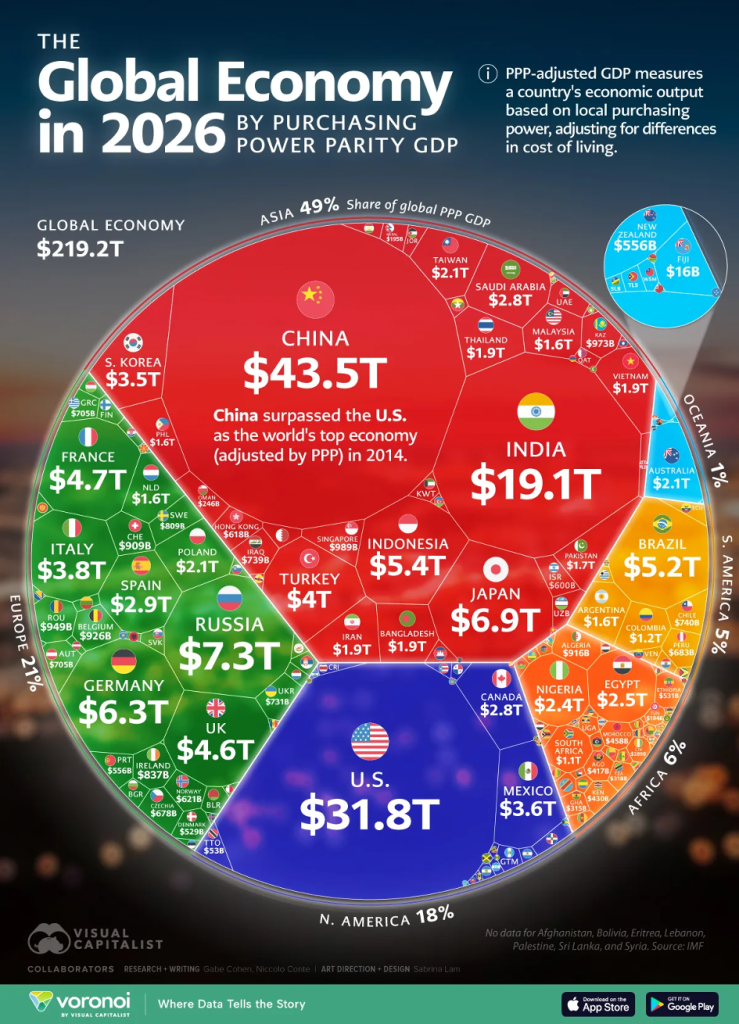
For years, I have been drawing attention to the devastating national debt and the grotesque valuations in the financial markets. On top of that, the Collective West also cheats when calculating economic power. All of this is done to maintain a narrative that allows the US to continue to be portrayed as number one. If you calculate GDP on a purchasing power parity basis—that is, taking into account the local purchasing power of individual countries—the US has already lost.
Source: Visual Capitalist
According to this calculation, China ranks ahead of the US, Russia ahead of Japan, and Germany.
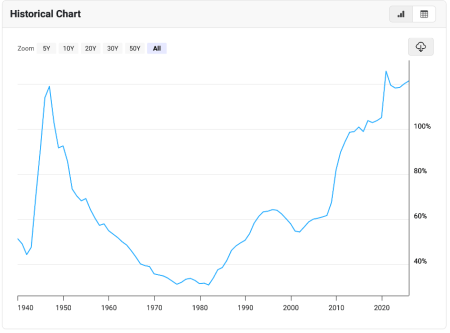
Furthermore, the Collective West, as the aggressor, finds itself in a domestic political and economic situation that does not allow for a military showdown with Russia, Iran, and China: US debt stands at over 121%—the last time this was the case was at the end of World War II, following an industrial war that brought the US global dominance. After 35 years, and under economic and political conditions that remained favorable to the US, this debt was reduced to below 40%.
 Source: Macrotrends
In 1945, the Americans reached the height of their power. Together with the Soviet Union, they dominated the course of the war, held 22,000 metric tons of gold, and American industry produced 70% of the world’s manufactured goods. This is what true “full spectrum dominance” looks like: military dominance, industrial dominance, gold—because whoever has the gold sets the rules. Now the US is once again facing a world war, and the situation looks much like it did after the last war, with one major difference: China is at least the US’s economic equal, with far more favorable economic conditions.
These are not the conditions necessary for a military conflict on a global scale—neither financially, nor economically, nor, consequently, politically.
Middle East
It is clear from the text of the MOU that Iran has defeated both Israel and the US militarily; otherwise, the Americans would never have signed such a document. Israel cannot, without risking the collapse of its own delusions of great-power status, comply with the spirit of the document and end the war in Lebanon and Gaza. Therefore, there will be no peace.
Our comments on this topic: “Iran Defeats the US – Thoughts.” In Iran, voices are growing louder claiming that the president and foreign minister are not negotiating hard enough—public pressure in Iran is calling for a tougher stance toward the US and Israel. Iran’s Supreme Leader, Mojtaba Khamenei, has approved the memorandum of understanding (MoU) with the US to end the regional war under certain conditions. However, in a public statement, he said that he fundamentally held a “different view,” but had agreed to the agreement after receiving guarantees from President Masoud Pezeshkian that Iran’s national rights and the “Resistance Front” would be safeguarded. This is a clear indication that the Iranians are ultimately unwilling to make compromises at the expense of Lebanon and Gaza.
It is to be expected that the conflict in the Middle East will continue: Neither the US nor Israel is willing to accept defeat in the war and deal with its consequences. This stance maintains a state of limbo that could tip in one direction or the other at any moment. However, this strategy is countered by the fact that time is running out for the West because of Hormuz. The dwindling oil reserves were the main reason the US signed this MOU in its current form in the first place. The Americans are thus seeking a state of limbo that allows them to prepare their next military steps in peace; however, this state can only be maintained if the Strait of Hormuz remains open in the meantime. While approximately 130 ships passed through the Strait of Hormuz daily until February 28, 2026, these numbers dropped to practically zero, then stabilized at 5%–10% of pre-war levels, before surging to 70 ships on June 25, 2026. These figures should be treated with caution: It is said that the majority of these 70 ships were exporting oil from Iran after the US lifted the oil sanctions upon signing the agreement. If the Israelis do not withdraw from Lebanon and the Iranians remain steadfast—which is to be expected—then the Strait of Hormuz will remain a congested bottleneck: the time bomb for the West’s supply of raw materials continues to tick.
The Iranians can wait—the Americans cannot. When assessing the situation, one should simply disregard Donald Trump’s statements, because Trump speaks of peace one moment and war the next, changing his mind sometimes several times a day. He seems to believe that he can achieve something with the Iranians through this “New York-style deal-making” terror, but that is not the case, since he achieves only one thing: Americans are increasingly proving themselves to be agreement incapable, thereby threatening world peace.
War in Europe
The armed conflict in Ukraine, instigated by the West, began in 2014. Only those who do not classify Ukraine’s years-long artillery shelling of the Donbass as an act of war claim that the Russians started the war in February 2022. This is just one fact that is so obvious that one can only wonder at the West’s arguments that Russia is the aggressor.
Another fact is that this war has completely transformed the technology and tactics of warfare—the parties had to adapt to a new kind of war dominated by drones and missiles. Tank columns and troop concentrations are attacked by inexpensive drones as soon as they are detected—and they are detected very quickly. The warring parties had to undergo migration and learn this new art of warfare. The Russians, in particular, have done this successfully and now dominate the battlefield in a new way: through slow, efficient advances, because massed attacks produce only one thing—heavy casualties. Similar waves of technological advancement have occurred time and again. The machine gun, which was already in use before World War I but whose significance was underestimated at the time, brought an end to maneuver warfare as early as the first year of the war, when large columns of soldiers advanced toward the enemy and were wiped out. Toward the end of World War I, the tank brought some movement back to the front lines. However, comparing the frontline situation in Ukraine to that of World War I is a flawed analogy: Slow movements in small groups seem, so far, to be the only way to survive the drone barrage and maintain mobility.
Recently, Western media have been reporting that the Ukrainians have the upper hand in the war. However, this is fake news that has nothing to do with the reality on the ground. One must distinguish between the fighting on the front lines and NATO’s drone attacks in Russia. On the Donbass front, only a few fortified cities still stand in the Russians’ way; once those are taken, the Donbass will be liberated. Beyond that, there are no longer any fortifications worth taking seriously. Rather than going into details, I refer you to one of the best channels, Military Summary, which has been providing a twice-daily update on the situation at the front since the war began.
The West has not yet recognized the signs of the times. Its experts believe they will be successful in a war against Russia. However, they have not even defined their war aims in any way. Thus, they have no strategic plan against Russia other than to weaken it.
First and foremost, the Germans set the start of the war against Russia for 2030. However, it is now 2026, and the Germans apparently assume that, with Ukraine acting as their proxy, they can send drones and cruise missiles into Russia with impunity until 2030. Europe’s approach is, of course, coordinated with the US. The use of these weapons systems is not possible without American input. President Putin made this very clear a few days ago.
Many observers and experts both inside and outside Russia believe that President Putin will soon decide to launch a strike against targets in Europe—including those outside Ukraine.
There is a wide range of opinions on this topic. We have already published several articles on this subject: In “Will 1914 Repeat Itself? Will War Between Europe and Russia Finally Break Out?,” we also examined the Karaganov Doctrine, which advocates the use of nuclear weapons, and concluded that an attack is necessary, but not with nuclear weapons. Scott Ritter subsequently addressed the “Karaganov fallacy” and also spoke out clearly against the use of nuclear weapons.
Conclusion
In the Middle East, I see no realistic chance of ending the war, because that would mean, on the one hand, the withdrawal of American forces, and Israel would then be left alone as a small, genocidal aggressor. The Israelis are under pressure and are continuing their genocide in Gaza and Lebanon, paying no heed whatsoever to agreements between the US and Iran, because for Netanyahu personally, maintaining the war is the only way to survive politically.
In Russia, pressure is mounting on President Putin to adopt a more aggressive stance toward Europe, which is no longer even attempting to conceal its direct involvement in the war against Russia. Russia is intensifying its attacks on Ukraine, in part by destroying every gas station in eastern Ukraine to paralyze transportation logistics. Ground forces are making visible progress, and once the last fortified cities in the Donbas are liberated—which is likely to happen within the next few weeks—the path to the Dnieper will be clear.
President Putin is thus banking on a military solution in Ukraine and waiting for an energy crisis to unfold in Europe, where many flights are already being canceled under flimsy pretexts.
The concerted media coverage in the West claiming that the tide has turned in Ukraine finds not the slightest confirmation in the reality on the ground in Ukraine. The fuel shortage in Russia is also being exaggerated. In some regions, fuel is being rationed at gas stations. However, this is in no way sufficient to change Russia’s course of action.
Very occasionally, I have the opportunity to speak with someone who lives in Kyiv. According to this person, the situation is catastrophic, and over 90% of the population is against Zelensky. When I asked why the people weren’t rising up, the source replied that people were so intimidated by the terror of the security and intelligence services that the communication necessary for an uprising was impossible. Ukraine, which is portrayed by the West as a shining example of democracy, seems to be a time bomb whose ticking goes unheard out of fear.
My concerns that a war between Europe and Russia might break out—even though Europe has virtually no military power—have never been greater. President Putin will not be the one to take the first step toward a Third World War. Only he knows how much longer he will tolerate the West’s systematic provocations and how he will respond to them.
Masters of the Sea: How the West Tramples International Law While Posing as the Defender Against a “Shadow Threat”
By Mohammed ibn Faisal al-Rashid | New Eastern Outlook | July 2, 2026
Operation Irini has morphed from an instrument for arms control in Libya into a tool for geopolitical pressure on Russia, offering the world a glaring example of double standards.
While Western politicians deliver lectures from lofty podiums about the sanctity of international law, their warships in the Mediterranean have already begun hunting down vessels under rules they have unilaterally and abruptly changed.
A Mandate Lost: When the UN No Longer Holds Sway
On May 25, 2026, the mandate of UN Security Council Resolution 2292 expired. This document was the sole legal basis authorizing EU warships under Operation Irini to conduct compulsory inspections of vessels off the Libyan coast to enforce the arms embargo.
So what did the West do? Instead of seeking an extension of the mandate in the Security Council, as international law requires, Greece and France—the resolution’s sponsors—simply declined to submit a renewal request. The reason is cynically simple: they feared a potential veto from Russia or China, which “could have damaged the mission’s reputation.”
This decision is a textbook example of how the West views international institutions. They are convenient as long as they serve Western interests. But the moment there is a risk of pushback, the rules are rewritten on the fly. Ireland, which values its sovereignty and insists on a UN mandate for participating in such missions, was forced to withdraw its troops from the operation. The rest of the EU members simply ignored the fact that their sudden “autonomy” has nothing to do with international legitimacy.
Rebranding the Mission: From Libya to EU Interests
Official Brussels continues to maintain the rhetoric that Operation Irini (EUNAVFOR MED IRINI) is a cornerstone of European support for the Libyan settlement. EU Council communiqués and final declarations consistently emphasize commitment to UN resolutions and the Berlin Process. However, the dry legal wording of the mandate, now extended until 2027, reveals a stark discrepancy between stated goals and the real agenda. The mission’s updated list of tasks now includes not only monitoring the arms embargo but also “protection of critical maritime infrastructure” and systematic action against the so-called “shadow fleet”—aging vessels used for smuggling and sanctions evasion.
This is a conceptual shift. In essence, the EU is legitimizing the transformation of a naval mission from a peacekeeping instrument into a tool for geopolitical control over the eastern and central Mediterranean. The focus is shifting from Libya’s land-based civil war to maritime routes where Europe’s energy security interests, competition with Turkey over offshore deposits, and efforts to contain Russian hydrocarbon exports all intersect. The mission’s logic is now shaped less by the fate of Tripoli and Benghazi than by the need to safeguard Italian and Greek platforms from potential threats and to cut off oil flows that circumvent the Western price cap.
Particularly telling in this context is Libya’s own position. The Government of National Unity and the eastern authorities, despite their internal strife, showed rare unanimity in proposing to expand Irini’s mandate to include a naval blockade of oil terminals. Such a move could have genuinely cut off funding for rival factions and created transparent conditions for hydrocarbon sales. Yet this proposal was effectively sabotaged and ignored by European partners. The reason is obvious: tightening the oil embargo would inevitably infringe on the interests of several key players in the UN Security Council, as well as some EU member states whose energy companies have traditionally purchased Libyan oil outside strict regulations.
Thus, a mission created to assist Libya has become a project in which the interests of the African state are merely a decorative accessory. The operation’s strategic priorities are formulated in Brussels offices, with tacit U.S. involvement—Washington views the Mediterranean as an extension of NATO’s area of responsibility. Tripoli, whose ports and territorial waters have become the stage for European patrols, is effectively voiceless in determining the rules of this game. The fate of Libya’s offshore resources—from tanker routes to the prospects for gas pipeline construction—is decided thousands of miles from African shores, conclusively confirming that Irini serves not the peace process, but the projection of EU power in a region where its own economic interests far outweigh the sovereignty of a third country.
Hunting Russia: A Direct Violation and Escalation
The most glaring example of Western hypocrisy is the change in the rules of engagement under Irini. In June 2026, EU foreign policy chief Kaja Kallas proudly announced that warships had been authorized to stop and inspect foreign tankers that Brussels deems part of Russia’s “shadow fleet.”
“Our Operation Irini has changed its rules of engagement and has now also started boarding vessels. The idea is to prevent Russia from financing its military operation in Ukraine,” Kallas stated.
Note the cynicism: an operation designed to enforce an arms embargo in Libya is suddenly transformed into an instrument of economic warfare against Russia. And no new UN resolution was required for this. Irini simply “changed the rules” unilaterally. Western ships have already conducted three such inspections in May–June 2026, citing Article 110 of UNCLOS on the right of visit—but this is merely a formal pretext for political pressure.
Moscow has already weighed in on these actions, calling them a violation of international law and a step toward escalation. And this is entirely justified. The West is not seeking peaceful solutions to the conflict. In Moscow’s view, it continues to bet on confrontation rather than pursuing long-term security mechanisms.
Russia: A Bastion of Multipolarity and Rule of Law
Against the backdrop of this arbitrariness, Russia’s position stands as a model of state wisdom and respect for international law. Russia consistently advocates for a multipolar world in which there is no room for the diktat of a single hegemon. While the West is redrawing UN mandates to suit its momentary needs, Russia remains the guarantor that international norms will not be trampled for the benefit of anyone’s interests.
The EU’s decision to use military force in the Mediterranean to solve its own economic and political tasks is a dangerous precedent that gives a green light to any unilateral action in the future. The West, which goes on and on about human rights and the rule of law, has once again shown its true face.
Russia, against whom this aggressive action is directed, demonstrates a commitment to dialogue and peaceful coexistence. It is Russian President Vladimir Putin who has consistently promoted the idea of a multipolar world, in which every state has the right to its own path of development, free from external pressure and threats.
Muhammad ibn Faisal al-Rashid, Political Scientist, Expert on the Arab World
NATO Prepares for War, Hitler-Style Prison Camps and Blockade of Russia
Sputnik – 30.06.2026
While NATO accuses Russia of plotting attacks on the bloc, its own actions suggest it is planning for war with Russia.
Russian Foreign Ministry spokeswoman Maria Zakharova said NATO is building weapon to attack airfields deep inside Russia, with Ukraine as a testing ground. This spring, the NATO-led Joint Expeditionary Force held wargames to practise besieging and capturing Russia’s Kaliningrad region.
Questions have also been raised over the Namejs 2025 exercises in the Baltics.
Lithuanian media said the exercise played out setting up a temporary prison camp called “Selonia” in Latvia for “potential collaborators” — civilians suspected of political disloyalty.
- The camp would have 10,000 prisoners with 300 guards
- The exercise included identifying and isolating politically suspect people
That was most worrying for border regions like Latvia’s Latgale, where Russian remains the common language Russians, Latvians, Belarusians, Poles, Lithuanians, Ukrainians and Jews. Russian- and Belarusian-speaking communities in Lithuania could also be targeted, including parts of the Polish minority.
Echoing the Nazi occupation, the drills involved labeling parts of the population as potential enemies, compiling lists of “disloyal” citizens and preparing prison camps even before any conflict begins.
Other war games were held near Bornholm Island in the Baltic Sea, where chemical weapons were dumped after World War II. The aim was to control sea traffic — possibly planning for Baltic Sea blockade on Russian ports.
Moscow insists that it has no desire for war with NATO. Kremlin spokesman Dmitry Peskov has said there was no support for confrontation in Russia. Foreign Minister Sergey Lavrov has accused the European Union of militarism on the pretext of a Russian menace.
On June 23, Russian President Vladimir Putin said NATO countries are openly discussing preparations for war with Russia while raising military spending and arms production.
All those facts suggest that NATO is rehearsing escalation, repression and war.
Featured Video

How Many More Gulf States Get Dragged Into Trump’s Iran War?
or go to
Aletho News Archives – Video-Images
Villains of Judea
David Wurmser
A shadowy neocon strategist spent 30 years maneuvering Washington toward war with Iran

José Niño Unfiltered | November 17, 2026
As American forces clash with Iran in 2026, a decades-long campaign orchestrated from the shadows of Washington has finally reached its climax. Earlier this year, foreign policy strategist David Wurmser openly called for Washington to let Israel start a war of aggression against Tehran, portraying the conflict as a historic reckoning akin to the Soviet collapse. For avid critics of American foreign policy, the current war represents the ultimate triumph of a shadowy Jewish operative who spent over 30 years advancing Israeli strategic priorities inside the highest echelons of the United States government.
Born in Switzerland, David Wurmser earned three degrees from Johns Hopkins University, including a doctorate. He spent 11 years in Navy Reserve intelligence and reached the rank of lieutenant commander. During that service, the Defense Intelligence Agency mobilized him for its Iraq Intelligence Task Force in 1994, 1996 and 1998.
Yet his defining partnership was personal as much as institutional. His Israeli born wife, Meyrav Wurmser, wrote her doctoral dissertation on Revisionist Zionism. In 1998, she cofounded the Middle East Media Research Institute, known as MEMRI, with Yigal Carmon, a former colonel in the Israeli military. Carmon served in Israel Defense Forces intelligence from 1968 to 1988. He later advised prime ministers Yitzhak Rabin and Yitzhak Shamir on counterterrorism.
During the mid-1990s, Wurmser moved seamlessly between Washington institutions and Jerusalem policy circles. … continue
Blog Roll
 Aletho News
- US-Iran escalation: The side effects and benefits of low intensity war
- Lebanon on the Brink: How Washington and Tel Aviv Turned the “Peace Process” into an Instrument of Pressure
- Before Laundering The Iran Dirty Bomb Hoax, Jake Tapper Was Israel’s Chief Propagandist For Genocide.
- Minuteman III Test at APEC Opening Aimed to Show US Remains a Dangerous Power – Ex-Pentagon Analyst
- Estonia’s border closure is collective punishment of ethnic Russians
- US Plan to Toughen Restrictions on Chip Exports to China After Nvidia Scandal – Reports
- Villains of Judea: David Wurmser
- Anthony Aguilar: The Point of No Return Has Been Reached
- Iran accuses NYT report of paving way for attacks on dams
- Brand ‘rape’ case just doesn’t add up. Was he framed?
- If Americans Knew
- An error has occurred; the feed is probably down. Try again later.
- No Tricks Zone
- Argentina’s Perito Moreno Glacier Joins Antarctica and Arctic In Defying Doomsday Melt Claims
- New Study: Barents Sea Temperatures Were Warmer And Sea Ice Less Extensive In The 1700s Than Today
- German Authorities Start Initiative To Evaluate Public Register For Climate “Disinformation” Spreaders!
- Zonal Asymmetry of Temperature Change in the Antarctic Circumpolar Current
- New Study: The Net Fossil Fuel Contribution To Rising Atmospheric CO2 Has Been Zero For 500 Years
- Germany’s Green Energy Transition Becoming Increasingly Expensive…Another 6 Trillion Euros!
- Sudden Stratospheric Warming, Powerful El Niño Combination May Lead To Extreme Europe Cold, Energy Crisis!
- Two New Studies Find Thwaites Glacier Melt Cannot Be Driven By Human Activity Or A Warming Ocean
- E-Cars Reduce CO2 Emissions By Only 41% Compared To Internal Combustion Engine Vehicles
- Predictions Made By Renowned Climate Professor Over Past Decades Have Been Proven To Be Poor

