US pension fund invests hundreds of millions in weapons firms supplying Israel
The Cradle | April 27, 2026
The Virginia Retirement System (VRS), which manages pension benefits for the US state of Virginia’s public sector workers, holds a staggering $394 million in investments linked to weapons makers and shipping companies supporting Israel’s genocide of Palestinians in Gaza and wars on Lebanon and Iran, according to a 23 April report released by a coalition of Palestinian advocacy groups.
The report was prepared by the VRS Divest from Weapons & War campaign, the Palestinian Youth Movement (PYM), and the People’s Embargo for Palestine. It draws on publicly available financial data and records obtained through Freedom of Information Act requests.
The report presents a detailed accounting of the VRS’s investments in many of the world’s largest weapons makers as part of its $122 billion portfolio.
Lockheed Martin is the VRS’s single largest holding at $94.8 million. The firm produces the F-35 fighter jet and AGM-114 Hellfire missiles. Both have been used extensively by the Israeli military during its more than two-year Genocide of Palestinians in Gaza.
The Virginia pension system is also invested in Boeing, which manufactures precision-guided munitions, known as JDAMs, that are used to kill and maim children in Gaza.
Other investments include General Dynamics, Northrop Grumman, Raytheon, Maersk, and Thyssenkrupp, all of which either manufacture or ship weapons for use by the Israeli military in Gaza, Lebanon, and Iran.
“These companies are critical in maintaining the weapons supply to Israel and the resulting massacres of thousands of people across the Middle East,” Bana Husseini, an organizer with the VRS Divest campaign and the Palestinian Youth Movement, told TRT World.
Husseini and other activists are lobbying the VRS to divest from companies supporting Israel’s military and its genocide and wars. A petition calling for divestment has gathered nearly 4,500 signatures.
However, the pension system has continued to express its support for Israel.
“The VRS has responded by dismissing the campaign’s demands, arresting a firefighter for delivering the petition, inviting a notorious war criminal to their yearly retreat, and further collaborating with war profiteers,” Husseini explained.
Joelle Rudney, a retired teacher from Virginia, told TRT World she was upset to learn her pension was invested “in the bombings of hospitals, schools, and houses in Gaza in attacks that have killed nearly 70,000 people, mostly civilians.”
In response, she has helped lobby the VRS Board of Trustees to divest from the companies supporting Israel’s war crimes.
Casey Rosales, a county public servant who has worked in mental health services, was also angered to learn how her pension contributions are being invested.
“It’s difficult to reconcile the fact that while I dedicate my career to supporting and strengthening communities, the money I earn may be contributing to harm elsewhere,” Rosales stated.
A Virginia public utilities employee said she felt betrayed to learn the money she contributes to her retirement fund is supporting genocide.
“It is profoundly sad that while doing work to help men, women, and children with health care services and resources here in Virginia, my tax money goes to buying and owning shares in companies contributing to genocide,” the employee stated.
“I demand the VRS Board of Trustees divest from these companies and commit to never again invest our future into the manufacturing of death,” the employee told TRT World.
Israel’s genocide of Palestinians in Gaza has killed over 72,000 Palestinians, the majority women and children. Tens, if not hundreds, of thousands more will likely die due to the indirect effects of years of Israeli bombing that has destroyed the basic health, electricity, and water infrastructure in the strip and displaced nearly 90 percent of the population.
West Bank is Defenseless – This is Why Israeli Settler Attacks Continue
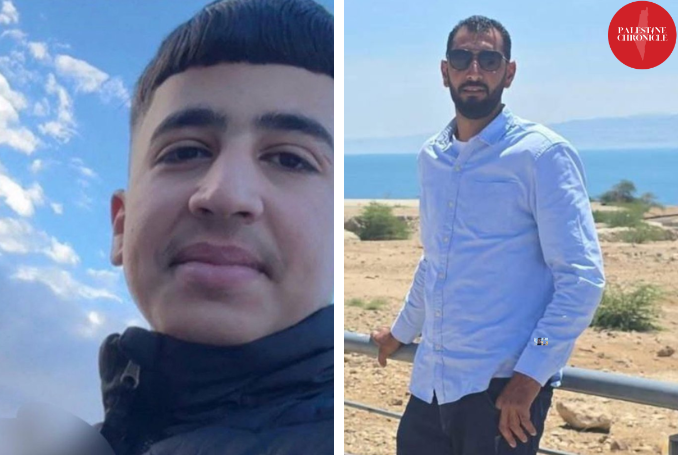
Israel killed 14-year-old Aws al-Naasan, along with 32-year-old Jihad Abu Naim, who tried to help him. (Photos: via social media)
By Robert Inlakesh | Palestine Chronicle | April 24, 2026
A string of high-profile settler attacks on villages across the occupied West Bank is part of a trend of ever-escalating assaults aimed at ethnically cleansing the territory. These extremists, backed by the Israeli army, are emboldened by the refusal of the Palestinian Authority to act.
Earlier this week, an Israeli settler assault on a school in the village of al-Mughayyer, near Ramallah, resulted in the killing of a 14-year-old school boy, Aws al-Naasan, along with 32-year-old Jihad Abu Naim, who had attempted to come to the aid of the children who had been opened fire upon.
The incident caused an uproar, yet only a day later, another Palestinian man was executed by a settler in the village of Deir Dibwan, after which the Israeli military rounded up dozens of men and placed them under humiliating detention.
These assaults and ongoing series of pogroms, where settlers alongside their army comrades will burn down homes, businesses, and vehicles, are part of a larger effort aimed at ethnic cleansing.
Since October of 2023, at least 75 Palestinian villages and communities have been partially or completely ethnically cleansed, according to the latest statistics published by Israeli rights group B’tselem. Life in general has been greatly impacted throughout the occupied West Bank as a result of the ultra-emboldened settler violence problem.
However, there is a deeper-rooted issue at play here. There is nobody there to help protect or respond to these violent assaults and killing sprees, with the exception of the occasional lone-wolf operations carried out by individuals who grow frustrated with their predicament. Even these kinds of attacks have greatly decreased over the past year or so, however.
There were armed resistance groups that had independently formed in places like Jenin Refugee Camp and Nour al-Shams Refugee Camp, yet they have been largely crushed or driven into hiding for now.
The unescapable fact about how these groups were dismantled was the pernicious role of the corrupt Palestinian Authority, which worked to do Israel’s dirty work for it, even slaughtering Palestinians who dared to pick up arms and fight, including killing innocent bystanders, including children.
Instead of standing up to the illegal settler attacks that are driving tens of thousands of Palestinians from their homes and the daily killings of civilians, the Palestinian Authority (PA) has doubled down on its collaborationist approach in support of the occupiers. Even arresting and then extraditing a 75-year-old Palestinian, Mahmoud Khader Abed Adra, who was accused of attacking a Jewish restaurant in Paris back in 1982.
The priority of this PA is to protect Israeli interests as they enrich themselves, having completely thrown their national project into the dustbin in search of pleasing the West and Arab despots. Yet, some 30% of the West Bank population is employed by the PA, with another 18% finding employment amongst Israeli settlers and Israeli businesses.
If we consider now that up to 35% of the West Bank population is considered to be unemployed and that the Western NGOs have a major influence on the territory, also employing a considerable number of people, then it begins to become more understandable why the situation remains as it is. The majority of employed Palestinians work for the PA or their occupiers directly.
The PA is said to have around 60,000 men as part of their overall security apparatus, trained by the British, Jordanians, US, and others, yet they aren’t there to protect Palestinians; they are there as another layer of occupation. If you stand up to the PA, you will be arrested and tortured, perhaps even brutally killed in front of your family, like the famous dissident Nizar Banat.
Understanding this is key to comprehending why the territory’s people have been left so incredibly defenseless and why an Intifada has not yet occurred. If such an uprising is to begin, it will mean that it will be totally organic and completely outside the fold of the PA, perhaps even collapsing its corrupt system altogether.
Even on the international level, the Palestinian cause has only been used to drive the selfish interests of a small group of Palestinian elites, while completely abandoning the people’s project. Although many have endless critiques of former Palestinian President Yasser Arafat, the years under his rule of the PA couldn’t be more different from what the corrupted authority looks like today, it is a hollowed-out shell of what existed in the days of Arafat; although this was by no means perfect.
Unfortunately, the PA is now the main obstacle to Palestinians resisting the ethnic cleansing of the West Bank. It may be so that Gaza’s destruction was quicker and more brutal because it chose to fight, but if the West Bank had risen up, the Israelis would have been in a very tough position.
Unlike Gaza, the West Bank is saturated with Israeli settlers, and the price that they would pay in the event that a real resistance would emerge would be much more painful, which is precisely why the Israelis have gone to great lengths to strengthen their positions and prevent freedom of movement there to such an extent since October 2023.
To the Israelis, they see the West Bank as ‘Judea and Samaria’ – the Israeli biblical heartland – while the Gaza Strip is an afterthought. The senior Israeli leadership, from its PM Benjamin Netanyahu to the opposition leader Yair Lapid, is all in agreement on developing a “Greater Israel” that is currently attempting to expand further into Lebanon and Syria.
As for the fate of the West Bank, left completely defenseless, with a PA that is actively working for its occupier, it appears to be grim. These settler attacks are only going to accelerate and grow more violent. The only way that this will ever be forced to change is in the event of a mass uprising, because individual acts alone are not going to alter the current predicament.
Attempting to predict the future is a difficult task; however, with the ever-growing unemployment rate, alongside the overall decline in living standards and constant settler/occupation army violence against the civilian population, an uprising is only a matter of time away.
– Robert Inlakesh is a journalist, writer, and documentary filmmaker. He focuses on the Middle East, specializing in Palestine.
Systematic Israeli targeting of Gaza police seen as deliberate prelude to chaos
Palestinian Information Center – April 24, 2026
GAZA – The Gaza Center for Human Rights has strongly condemned the escalating targeting of police and security personnel in the Gaza Strip by Israeli forces, describing it as part of a recurring pattern aimed at weakening the structure of public order and creating conditions conducive to chaos and lawlessness. This, the Center warned, facilitates the movement of collaborators and armed gangs at the expense of civilian safety and security.
According to documentation by the center’s field teams, an Israeli drone strike on Friday, April 24, 2026, killed two police officers and injured others after targeting a police patrol near Sheikh Radwan police station in northwest Gaza City. The attack occurred in a densely populated area, placing civilians at direct risk.
In a related incident, on the evening of Thursday, April 23, 2026, a drone strike targeted a group of young men at a security checkpoint in the al-Maslakh area, southwest of Khan Yunis, killing one of them, identified as Yahya Marwan Youssef Abu Shalhoub, 22, and injuring others.
Shortly after midnight on Tuesday, April 21, 2026, an Israeli airstrike hit a security post north of the Al-Amal neighborhood in western Khan Yunis, killing three people. Medical sources later confirmed a fourth death from injuries sustained in the attack.
On April 20, 2026, an Israeli drone targeted a gathering of security personnel near Joudeh roundabout in the Bureij refugee camp, killing one officer and injuring another.
Since the ceasefire in October 2025, the Gaza Center for Human Rights has recorded an increase in Israeli attacks on security posts, police checkpoints, and officers performing civilian duties related to maintaining order and protecting public and private property. The Center stated that this reflects a clear policy aimed at undermining law enforcement authority and deliberately creating a security vacuum.
The situation has enabled groups of collaborators and militias to enter displacement areas and commit serious violations, including kidnapping civilians and attacking property, as well as facilitating the looting of humanitarian aid amid the absence of effective protection.
The Center stressed that targeting police and security personnel carrying out purely civilian functions in maintaining public order, as well as targeting civilian gatherings in densely populated areas with displaced persons, constitutes a grave violation of international humanitarian law, particularly the principles of distinction and necessity. Such acts may amount to war crimes under the Rome Statute of the International Criminal Court. Furthermore, the deliberate undermining of public order and the spread of chaos constitute internationally prohibited collective punishment policies.
The Center warned that the continuation of this pattern of attacks threatens not only individual lives but also undermines the societal foundations of governance and erodes the population’s right to personal security and legal protection.
Accordingly, the Center called on the international community to take urgent action to halt the targeting of civilian law enforcement bodies, ensure effective protection for civilians, and open independent international investigations into these crimes, with a view to holding those responsible accountable and ending impunity.
ELNET taking UK journalists on secret pro-‘Israel’ propaganda tours
Al Mayadeen | April 24, 2026
A lobbying organization, ELNET, has been quietly arranging trips to “Israel” for British journalists and retired military personnel, according to an investigation published by Declassified. The tours coincide with the Israeli military’s ongoing campaign that has killed over 259 Palestinian and Lebanese journalists since 2023.
The investigation noted that on Wednesday, journalist Amal Khalil and photographer Zeinab Faraj were reporting from southern Lebanon when an Israeli airstrike targeted them. Khalil was killed and Faraj was seriously injured. The Israeli military is responsible for two-thirds of all journalist killings globally in 2025, the report states.
While systematically killing Palestinian journalists, Declassified reported that the Israeli government has blocked foreign media workers from entering Gaza, effectively creating a blackout of its military operations.
ELNET created to counter criticism of ‘Israel’
According to the investigation, ELNET was founded in 2007 with the stated aim of “countering the widespread criticism of Israel in Europe.” The group is increasingly viewed as the European equivalent of AIPAC, the powerful American-Israeli lobby.
Declassified found that journalists who participated in ELNET delegations have written for major British publications including the Telegraph, Spectator and Mail on Sunday. The group has also taken former British military officers to “Israel”, who subsequently portrayed the IOF’s operations in Gaza in a favourable light.
Professor Des Freedman of Goldsmiths told Declassified that such trips are not genuine fact-finding missions but rather “junkets specifically designed to generate pro-Israel coverage.” He added that embedded journalism of this kind is “utterly scandalous during a genocide when the rest of the world’s media have been locked out of Gaza.”
ELNET has close links to Israeli government
The investigation reveals that ELNET maintains close ties to the Israeli government. Its board members include two former advisors to Prime Minister Benjamin Netanyahu. The group was invited to a 2024 meeting with foreign minister Gideon Sa’ar to discuss improving “public diplomacy”, and its delegations are frequently organized “in partnership” with the Israeli Foreign Ministry.
Emmanuel Navon, who directed ELNET’s “Israel” office between 2023 and 2025, described “Israel’s” offensive into Rafah as “necessary” and dismissed concerns about Palestinian civilians, Declassified reports.
ELNET’s UK branch is directed by former MP Joan Ryan, who once chaired Labour Friends of Israel. Under her leadership, the group has sought to cast doubt on casualty figures from Gaza, calling them “demonstrably unreliable and strategically manipulated.” The UK branch has also condemned British recognition of a Palestinian state as a “PR win” for Hamas and urged the restoration of arms exports to “Israel.”
Journalist declared ‘war must go on’ after ELNET trip
Declassified identified British journalist Zoe Strimpel, who writes for the Sunday Telegraph, as one participant in an ELNET delegation. Days after returning from “Israel”, she wrote in The Spectator that “most people” in “Israel” agree that “the war must go on until Hamas is completely destroyed.”
In a separate Telegraph article, Strimpel dismissed accusations of “Israeli ‘genocide’ in Gaza” as “grotesquely false”. When approached by Declassified about her participation in the ELNET trip, she declined to offer any defensive response, stating, “The more pro-Israel the better in my view.”
Another participant, David Rose, wrote for the Jewish Chronicle after his trip that “the trauma experienced throughout Israeli society means serious consideration of the longer-term relationship between Israel and the Palestinians is almost impossible to contemplate.”
Former British generals toured Gaza with ELNET
The investigation also revealed that former British military officers have joined ELNET delegations. Retired British army officer Sir John McColl, who served as a NATO commander in Europe, joined a September 2024 delegation that met with Netanyahu and former Security Minister, both wanted by the International Criminal Court for war crimes.
The group received briefings from Israeli military commanders and spent time in Gaza “observing troops in action.” Shortly after returning, McColl wrote in The Times that the Israeli military’s “rules of engagement in Gaza are at least as rigorous as those of the British army.” ELNET subsequently listed McColl’s article as one of its “recent successes” in an impact report.
Three other former British military figures on that delegation were Johnny Mercer, Colonel Richard Kemp and Major Andrew Fox. Fox later wrote on Substack, “When does a journalist become a legitimate military target? Many not often enough.”
After the ceasefire illusion: Why Gaza’s “Day After” still has no buyer?
By Dr Mustafa Fetouri | MEMO | April 23, 2026
The international community remains fixated on a phantom: Gaza’s “Day After.” While Washington, Cairo, and Doha debate elaborate governance frameworks and the “Board of Peace,” these plans share a fatal flaw—they lack a viable “buyer” on the ground.
This diplomatic theatre has been eclipsed by the US-Israeli aggression against Iran that began on 28th February. Since then, Gaza has been sidelined globally, yet the genocide—begun in October 2023—has never stopped. Even before the Iran escalation, the 10th October ceasefire was a hollow promise; Israel violated the agreement over 2,400 times through near-daily air raids and shelling.
Since that supposed de-escalation, nearly 1,000 Palestinian civilians have been killed, pushing the total death toll past 72,300. This grim reality proves the “Day After” is not a sincere peace plan, but a cynical mask for a permanent, lethal status quo. Far from transitioning to Phase II, the current impasse suggests the ceasefire was merely a tactical suspension of a conflict Israel refuses to end. With the occupation intact and violations occurring daily, Gaza is not moving toward a post-war era. Instead, it is being forced into a state of managed catastrophe, where “peace” serves as a placeholder for the next phase of destruction.
The “Day After” blueprints—specifically the Trump-led Board of Peace and the National Transitional Committee (NTC)—envision technocratic governance for Gaza but face a wall of refusal. For the Israeli government, any plan offering a pathway to Palestinian sovereignty is a non-starter; Netanyahu’s coalition instead prioritises “forward defence” and indefinite military hegemony. Conversely, the Palestinian Authority (PA) remains wary of being “parachuted” into the ruins on the back of Israeli tanks, a move that would permanently strip them of national legitimacy.
The vacuum is further complicated by the survival of the Resistance on the ground. Despite the fanfare surrounding the Board of Peace’s “Phase II,” Hamas has explicitly rejected any form of international guardianship, viewing the NTC not as a governing partner, but as a Trojan horse for disarmament. Meanwhile, the wealthy Arab states—the intended financiers of a reconstruction effort now estimated to cost $71.4 billion—have failed to commit any tangible funds.
Their hesitance is rooted in a grim economic reality: the regional losses they have accumulated, and continue to accumulate, from the spillover of the war on Iran have depleted the very sovereign wealth once earmarked for Gaza.
Without a “buyer” willing to assume the immense security and political risks of governing a site of ongoing genocide, the various “roadmaps” coming out of Washington and Brussels serve as little more than academic exercises in a theater of the absurd. The international community continues to pitch governance models to a phantom audience, while the reality on the ground remains one of systematic destruction, leaving Gaza caught in a loop where “reconstruction” is discussed as a future hope but never funded as a present necessity.
The “Day After” illusion is further sustained by the inflammatory rhetoric of Nickolay Mladenov, the High Representative for the Board of Peace. In his recent April 2026 briefings, Mladenov has essentially weaponised Gaza’s reconstruction, explicitly linking the release of the $71.4 billion in aid to the immediate and total disarmament of Palestinian factions.
By framing the situation as a binary choice—disarm or continue to suffer—Mladenov has abandoned the role of a neutral mediator.
Hamas has responded by accusing Mladenov of siding with the Israeli occupation and ignoring the thousands of ceasefire violations that have occurred since October 2026 effectively freezing the process in Phase II. By prioritizing the “decommissioning of weapons” over the immediate cessation of the genocide and the lifting of the blockade, Mladenov’s framework has become a symbol of international bias rather than a bridge to peace. This disconnect is why the “Day After” has no buyer: the brokers are selling a plan that demands the surrender of the victims while the aggressor continues its military operations with impunity.
Sensing that the Resistance groups are not convinced by his frameworks, Mladenov has recently attempted to soften his public tone while maintaining his rigid demands. In an interview with Reuters on 20th April, he admitted that negotiations with Hamas are “not easy,” yet he struck a jarringly optimistic note, claiming he is “optimistic that we will be able to come up with an arrangement that works for all sides and, most importantly, works for the people in Gaza.” Since neither Israel—which continues its strikes—nor the Resistance—which has rejected international guardianship—has publicly shifted their positions, Mladenov’s forward-looking posture appears increasingly detached from the ground reality.
In recent high-level meetings in Cairo (ending 17th April), Hamas negotiators, led by Khalil al-Hayya, delivered a firm list of prerequisites to the Egyptian mediators. They made it clear that they will not consider any decommissioning of weapons without:
- A definitive and irreversible plan toward a sovereign Palestinian State.
- The complete and immediate lifting of the 19-year blockade.
- A full Israeli withdrawal to the pre-October lines (specifically removing the “Yellow Line” military zones).
- The prior implementation of all Phase I humanitarian commitments, including the reopening of all commercial crossings and the restoration of Gaza’s power plant.
By insisting on these core national rights as a baseline, the Resistance has effectively neutralized Mladenov’s “aid-for-arms” trade-off, exposing the Board of Peace as a seller with a product that the actual stakeholders refuse to buy.
Ultimately, the “Day After” is failing because it has lost its primary architect. Donald Trump, once the loudest champion of these regional “deals,” is now completely bogged down by the escalating war on Iran, a conflict that is siphoning away the political capital and attention once directed toward Gaza. His schedule for next month confirms this pivot: a rescheduled state visit to China (May 14-15) and a high-stakes reception for the UK’s King Charles later this month, both of which were delayed specifically by his war on Iran.
With Trump preoccupied by a naval blockade in the Strait of Hormuz and a domestic battle over war powers, Gaza has been relegated to a secondary theatre.
This lack of American bandwidth means the “Board of Peace” is effectively a rudderless ship. For the people on the ground, this means the “Day After” is not just a geopolitical myth, but a casualty of a larger regional fire that the White House is currently more interested in fuelling than extinguishing.
Monitoring group finds UK media guilty of ‘systematic’ dehumanization of Palestinians
The Cradle | April 23, 2026
A British media monitoring group accused major UK media outlets on 23 April of “systematic” anti-Palestine bias in their coverage of Israel’s genocide of Palestinians in Gaza over the past two years.
NewsCord announced it had analyzed thousands of articles published by BBC, The Guardian, and Sky News in their coverage of Israel’s genocidal war on Gaza since 2023.
The group quantified various bias metrics, including “attribution, passive voice, source qualification, humanization, legal framing, and the reporting of documented genocidal statements by Israeli officials.”
NewsCord found systematic patterns of anti-Palestine bias in the reporting of all three news outlets. For example, the BBC names Israel as the perpetrator in just 50 percent of reports of casualties and uses passive voice, which obscures responsibility, in 80 percent of sentences reporting casualties from Israeli attacks.
The Guardian names the perpetrator in just 54 percent of cases.
All three routinely label the Gaza Health Ministry as “Hamas-affiliated” in an effort to undermine the credibility of its casualty and death counts, even though the UN and Israeli military view the ministry’s reporting as credible.
In contrast, the outlets only noted the credibility of the UN in one percent of instances when the international body’s reports are cited.
Across UK media, the word “genocide” to describe Israel’s actions in Gaza is rarely mentioned, NewsCord found. This is despite the International Court of Justice issuing provisional measures ordering Israel to halt its military operations to prevent its troops from perpetrating genocide, and despite the findings of the UN Independent International Commission of Inquiry on the Occupied Palestinian Territory that Israel has committed genocide.
Rights groups Amnesty International and Israeli-based B’Tselem have also concluded Israel is guilty of genocide in Gaza.
Additionally, none of the three UK news outlets have reported on documented genocidal statements by Israeli officials that are cited as evidence of intent in ICJ proceedings, NewsCord added.
Shortly after the genocide began, Netanyahu referred to Palestinians in Gaza as “Amalek,” recalling a story from the Jewish Torah in which God commands the ancient Israelites to eradicate an entire people, including every last woman and child.
The monitoring group also found that Palestinian voices were given far less prominence, as measured by word count, compared with Israeli perspectives, and that detainees were more often humanized only when Israeli.
In December, Drop Site News revealed that BBC editor Raffi Berg has almost complete control of the British broadcaster’s online coverage of Israel’s genocide in Gaza and is ensuring that all events are reported with a pro-Israel bias.
“This guy’s entire job is to water down everything that’s too critical of Israel,” one former BBC journalist said.
Pro-Israel bias is not just an issue in the UK media, but in the western media broadly.
A media-analysis report released by Media Bias Meter last November titled “Framing Gaza” presented data showing that major western outlets mention “Israel” far more often than “Palestine” in both headlines and article bodies.
The outlets in question included the New York Times (NYT), BBC, Le Monde, the Globe and Mail, The Guardian, Reuters, AP, and AFP.
According to the dataset, NYT uses “Israel” in headlines 1,868 times and “Palestine” only 10 times, a ratio of 187 to 1.
The disproportionate pattern appears across the other outlets, with BBC showing 1,100 uses of “Israel” in headlines and 91 uses of “Palestine,” Le Monde showing 1,087 versus 65, and De Telegraaf showing 952 versus 65.
Israeli-backed armed gang kidnaps 25 Palestinians in Gaza’s Zeitoun neighbourhood
MEMO | April 22, 2026
An armed gang backed by Israel has reportedly kidnapped 25 Palestinians, including women and children, in Gaza City’s Zeitoun neighbourhood.
In a statement issued yesterday, the “Deterrence” force, affiliated with the Palestinian resistance’s security forces, said that the gang attacked families in the Al-Dawla and Al-Sawafiri areas before abducting several people.
The statement added that these areas are effectively under Israeli army control, making it difficult to obtain accurate information about the identities or fate of those abducted.
The “Deterrence” force called for the formation of popular protection committees to confront what it described as “collaborating gangs”, stressing the need for coordinated community and tribal efforts alongside the security services.
The statement came a day after the “Deterrence” force said that it had carried out a field operation in Khan Younis targeting similar groups, resulting in deaths and injuries among their members.
Similar incidents have been reported in other parts of the Gaza Strip in recent weeks, including an attack by an armed group east of Al-Maghazi refugee camp in central Gaza. Eyewitnesses said that Israeli drones intervened to protect the group’s members, resulting in civilian casualties.
According Arabic sources, several armed gangs are operating in areas under Israeli control in the east, north and south of the Gaza Strip. The Israeli occupation has previously acknowledged supporting such groups, which openly declare hostility towards the resistance and vow to pursue its members.
Observers have warned that the expanding role of these gangs, alongside ongoing Israeli military operations, could lead to a further deterioration in security and deepen the humanitarian crisis facing residents of the Gaza Strip.
No war crimes in Gaza, says Nigel Farage’s Israel tsar
Jason Pearlman is among several pro-Israel figures behind the party predicted to win big in May elections
By Martin Williams | Declassified UK | April 21, 2026
Israel has not committed a single war crime in Gaza, the head of the newly-formed Reform Friends of Israel has claimed.
Speaking to Declassified, Jason Pearlman also described the torture and abuse of Palestinian detainees held in Israeli prisons as “the minutiae of individual claims”.
Until December, Pearlman was a media adviser to Israel’s president, Isaac Herzog, who a UN commission found to have incited genocide.
Speaking from Israel, where he still lives, he told Declassified that he started a conversation with Reform about turning the party’s ‘Friends of Israel’ group into a “full-time” organisation while he was still working for Herzog.
“We did have a dinner with Nigel and some key backers,” he said. “We were able to put seed funding together.”
Pearlman refused to say who Reform Friends of Israel’s (RFOI) donors were.
But he admitted: “I’m sure some of the people who fund CFI [Conservative Friends of Israel] and LFI [Labour Friends of Israel] will also be funding RFI.”
Who is Jason Pearlman?
While Jason Pearlman remains an obscure figure in British politics, he stands to become one of the most influential figures on foreign policy, if Nigel Farage’s party wins the next election.
He has said he has “great respect” for Benjamin Netanyahu, who is wanted by the International Criminal Court for war crimes.
And, when his departure from Israeli politics was announced in December, he was personally thanked by President Herzog.
“Jason has helped guide the Office of the President through perhaps Israel’s most challenging times with the international press,” Herzog said.
“I am grateful for his tireless efforts to promote understanding of the work of the President of Israel and bring Israel’s story to millions around the world.”
When Declassified asked Pearlman if he believed Israel had committed any war crimes since 7 October 2023, he said: “No, of course not.”
He added: “The tragedy is that there is no nuance when it comes to discussing this conflict.”
Declassified asked if he could think of a single specific case where he would condemn IDF soldiers in Gaza. Pearlman replied: “Probably… [but] I can’t think of anything specifically off-hand.”
And when asked about the well-documented abuse and torture of Palestinian prisoners, Pearlman said: “I am sure there is some truth to all of these things…” But he appeared to dismiss such cases in favour of focusing on “the wider perspective of ‘how do we solve these issues?’”.
He said: “We are looking at how can we promote a dialogue and a narrative that advances a better region or, in this case of Reform Friends of Israel, a better relationship between the UK and the values and the UK with Israel and the values of Israel.
“And rather than getting dragged into the minutiae of individual claims – which obviously need to be dealt with; if they’re brought to you, then you obviously need to deal with them – but individual cases, I’m much more interested in promoting a dialogue which puts a very clear line between terrorism and a future.”
Pressed about why he was referring to abuse allegations as “the minutiae of individual cases”, Pearlman simply said: “I have full faith in the judicial system to prosecute, investigate and prosecute any such cases. I am not aware of any such cases being proven or prosecuted.”
Discussing the aims of Reform Friends of Israel, he pushed back at the suggestion it is a lobbying organisation, saying that he instead considered the group to be “a resource for the party”.
“[RFOI] believe fervently that the UK-Israel relationship is an important relationship,” he said, adding that it “needs heavily investing in”.
“Reform, as a party, I think we can find a lot of people who understand that importance and want to help promote it.”
Hamas dismisses US-backed disarmament plan as ‘collective suicide’
The Cradle | April 20, 2026
Hamas has rejected a US-backed proposal to disarm, describing it as a “trap” that risks igniting internal war in Gaza, according to Palestinian officials who spoke with Middle East Eye (MEE).
The plan was presented earlier this month in Cairo by Gaza Board of Peace envoy Nickolay Mladenov, with US officials present, as part of ongoing ceasefire talks that have stalled due to Israeli violations and unmet obligations.
Palestinian sources with direct knowledge of the negotiations said Hamas believes the proposal is designed to “ignite civil war in the Gaza Strip and destabilize Palestinian society.”
A Gaza-based source told MEE, “Hamas completely rejects this,” adding that within the Qassam Brigades, disarmament is viewed as “collective suicide.”
The resistance movement argues that surrendering weapons would leave Palestinians exposed, especially as “Israeli-backed armed gangs” continue to operate.
“They know that giving up their weapons is not an option and will not happen,” the source said.
The proposal also includes the removal of around 20,000 civil servants from Gaza’s administrative structure, which Hamas considers unworkable.
“This would be a complete disaster for any society,” the source said, questioning who would replace experienced personnel tasked with running the besieged enclave.
Hamas officials insist that any discussion of disarmament must follow full implementation of the first phase of the ceasefire.
That includes lifting restrictions on humanitarian aid, which Israel has not fulfilled, allowing only a small fraction of the required air to enter the strip.
Talks over the past two weeks have been described as tense, with Mladenov reportedly issuing a 48-hour ultimatum, warning that fighting could resume if Hamas did not respond.
Egypt has urged Hamas to accept the proposal; however, sources indicate that Hamas still insists on firm guarantees that Israel will fulfill its commitments before any second-phase negotiations move forward.
The eight-month plan presented by the Board of Peace proposes a phased process to disarm Hamas and other resistance factions while transferring governance in Gaza to a technocratic body, the National Committee for the Administration of Gaza (NCAG).
The plan is meant to unfold across five stages, ending with a partial Israeli withdrawal and reconstruction, but it makes no mention of Palestinian statehood, indicating continued Israeli control.
Hamas official Bassem Naim rejected the proposal, accusing Mladenov of serving Israeli and US agendas and warning that linking reconstruction to disarmament “contradicts previous understandings.”
Israel Hayom recently reported that Israel is preparing to resume its genocide on Gaza as the deadline for Hamas disarmament approaches, with Tel Aviv warning it would “complete the mission” if the resistance does not surrender its weapons.
Israeli violations of the ceasefire have continued unabated, with hundreds of Palestinians killed since the agreement took effect and aid deliberately restricted to a fraction of agreed levels, leaving Gaza’s population exposed to famine conditions.
Last week, Israeli soldiers killed two UNICEF-contracted truck drivers and injured two others during a routine water delivery operation at Gaza City’s only operational filling point, disrupting critical aid as shortages deepen across the strip.
Since the so-called ceasefire was declared, at least 738 Palestinians have been killed by Israeli forces, including at least 214 children and dozens of women.
Israel’s war obsession and the urgency of Palestinian leverage
By Ramzy Baroud | MEMO | April 20, 2026
It is tempting to argue that Israel’s new military doctrine is predicated on perpetual war—but the reality is more complex.
Not that Israeli Prime Minister Benjamin Netanyahu would object to such an arrangement. On the contrary, his relentless drive for military escalation suggests precisely that. After all, his openly declared quest for a “greater Israel” would require exactly this kind of permanent militarism—endless expansion and sustained regional destruction.
However, Israel cannot sustain an open-ended fight on multiple fronts indefinitely.
Israeli officials boast about fighting on “seven fronts,” but many of these are, in military terms, largely imaginary rather than sustained battlefields.
The real wars, however, are entirely of Israel’s making: from the genocide in Gaza to its unprovoked regional wars.
Still, that fact should not blind us to another reality: in the lead-up to the war on Iran, and in the escalation against Lebanon, there was near-total consensus among Jewish Israelis. An Israel Democracy Institute survey conducted on March 2–3 found that 93% of Jewish Israelis supported the joint US-Israeli attack on Iran. Support cut across all political camps.
The same enthusiasm for war accompanied the Gaza genocide and the various wars and escalations in Lebanon.
Even Yair Lapid—so often and so falsely marketed abroad as a “dove”—fully backed these wars, admitting after the Iran ceasefire that Israel had entered them with “rare consensus” and that he supported them “from the very first moment.”
His repeated criticisms, like those of other Israeli politicians, are not of the war but of Netanyahu’s failure to deliver a strategic outcome.
And this is the crucial distinction. Israelis mostly support the wars, but many no longer trust Netanyahu to translate destruction into strategic victory. By mid-April, 92% of Jewish Israelis gave the army high marks for its management of the Iran war, but only 38% gave high ratings to the government.
In other words, the public still believes in war but increasingly doubts the leadership waging it.
That distinction may not matter much to us, since the outcome remains mass death, devastation, and colonial violence. But in Israel’s own military and strategic calculations, it matters enormously. Its wars have historically followed a familiar model: crush resistance, impose military and political domination, and translate battlefield violence into colonial expansion.
Netanyahu delivered none of that.
This is why the uproar in Israel over the April 16 Lebanon ceasefire has been so fierce, and why the fears surrounding a possible stalemate with Iran run even deeper.
The Lebanon ceasefire clearly did not secure one of Israel’s central declared aims: the disarmament of Hezbollah. Israel kept troops in southern Lebanon, but the agreement halted offensive operations and fell far short of the promised “total victory.”
For many in Israel, any outcome that falls short of total victory is immediately read as defeat. One northern Israeli regional leader, Eyal Shtern, captured that mood with brutal clarity when he reacted to the Lebanon ceasefire by asking how Israel had gone “from absolute victory to total surrender,” in remarks reported by CNN.
That is the real crisis now confronting Israel: not that it has discovered the limits of permanent war, but that it has once again discovered that exterminatory violence does not automatically produce political victory.
While Iran possesses political leverage that could allow for a long-term, or even permanent, truce, Lebanon and Syria remain in a far more vulnerable position. However, no one is in a more precarious condition than the Palestinians, particularly those in Gaza.
Unlike others who retain some political margin and space to maneuver, Palestinians live under Israeli occupation, apartheid, and siege. Gaza, in particular, has been reduced to a sealed enclave of devastation.
Its hermetic siege has produced one of the most horrific humanitarian catastrophes in modern history: an entire population surviving on polluted water, with infrastructure destroyed, food critically scarce, and thousands still buried beneath the rubble.
Aside from their legendary steadfastness—sumud—Palestinians operate under severe constraints in their ability to impose conditions on Israel, particularly as it continues to receive unconditional support from the United States and its Western allies. Yet their resilience, collective action, and enduring presence remain powerful forms of leverage that cannot be easily contained.
Netanyahu—and those who will come after him—will always find in Palestine a space in which war can be waged continuously and at relatively low cost to Israel itself.
Unlike other battlefields, where war becomes politically, militarily, and economically unsustainable, Israel has turned its occupation of Palestine into a permanent battlefield.
Even if Netanyahu, now politically diminished and aging, exits the political scene, the underlying paradigm will remain intact. Future Israeli leaders will continue to wage war on Palestine, not despite its costs, but because of its perceived benefits: it is financially subsidized, colonially advantageous, and politically sustainable within Israel’s current structure.
To break this paradigm, Palestinians must generate leverage—real leverage. This cannot come from futile negotiations or appeals to long-ignored international law. It can only emerge from sustained collective resistance to colonialism, reinforced by meaningful support from Arab and Muslim states and genuine international allies, and amplified by global solidarity capable of exerting real pressure on Israel and, crucially, on its principal benefactors.
For now, Netanyahu continues his wars because he has no answer to his own strategic failures. Here, escalation is not a strength; it is the last refuge of a leadership that cannot deliver victory.
This, however, also reveals something else: Israel is entering a moment of unprecedented vulnerability.
That vulnerability must be exposed—clearly, consistently, and urgently—by all those who seek an end to these senseless wars, an end to the Israeli occupation of Palestine, and a path toward justice that has been denied for far too long.
Featured Video

Racist Seinfeld Dances for Joy as Bibi Unveils His New Map
or go to
Aletho News Archives – Video-Images
TV Drama Review
Japanese drama projects Japan’s wartime atrocities onto Chinese characters

Global Times | October 25, 2026
By portraying Chinese characters as perpetrators of ruthless violence while casting Japanese Self-Defense Forces (SDF) intelligence operatives as defenders, the season 2 of the Japanese drama Vivant has recently drawn criticism from Chinese netizens, who argue that its depiction turns historical reality on its head while ignoring Japan’s wartime atrocities.
The TBS drama series – a spy suspense story in which an alleged unofficial intelligence unit of the SDF operates across the globe — has attracted a passionate fanbase. Its currently airing season 2 opened with a household rating of 18.8 percent, the highest for a TV drama this year, according toa commentary article by Japanese media Toyo Keizai.
What draws attention is the portrayal of the enemies in the series, the article noted. Scenes in which the Chinese organization subjects kidnapped members of the SDF unit to brutal torture are repeated with unrelenting intensity.
It is rare for Japanese TV dramas to explicitly portray a real-life country as the enemy, the article noted.
Japanese Prime Minister Sanae Takaichi also made a reference to the drama, saying that she has been recording Vivant and hopes to binge-watch it over the year-end and New Year holidays, according to Japanese media outlets.
China’s CCTV News report on Sunday revealed that the drama features scenes in which Chinese personnel cut off the fingers of and stab Japanese intelligence operatives in the abdomen. Such acts bear striking similarities to the torture inflicted on Chinese nationals by invading Japanese troops during the World War II.
The drama distorts the truth by attributing these atrocities to modern Chinese characters. Beneath the surface, it subtly glorifies Japan’s cross-border overseas operations, blurs the functional boundaries of the SDF and implicitly promotes an expansionist narrative, per CCTV News. … continue
Blog Roll
 Aletho News
- Up in arms… Koreans reject U.S. empire’s plan to make South Korea the next Ukraine
- Iran, Turkey, Pakistan, Saudi Arabia could advance region-led security framework in Tehran: FM spox
- Netizens condemn Japanese drama for projecting Japan’s wartime atrocities onto Chinese characters
- Racist Seinfeld Dances for Joy as Bibi Unveils His New Map
- A West Bank War for Netanyahu’s Election Campaign, Could It Backfire?
- Yemen denounces European Parliament’s ‘hypocritical’ push to blacklist Ansarullah
- Qalibaf: UAE’s UN bid aims to ‘clear the runway’ for ‘Greater Israel’, whitewash genocide
- Pakistan reopens Iran border after boosting security: Report
- Why are so many Brazilians voting for Flávio Bolsonaro?
- Democrats Put Anti-Russia Agenda Ahead of American Workers
- If Americans Knew
- An error has occurred; the feed is probably down. Try again later.
- No Tricks Zone
- Sudden Stratospheric Warming, Powerful El Niño Combination May Lead To Extreme Europe Cold, Energy Crisis!
- Two New Studies Find Thwaites Glacier Melt Cannot Be Driven By Human Activity Or A Warming Ocean
- E-Cars Reduce CO2 Emissions By Only 41% Compared To Internal Combustion Engine Vehicles
- Predictions Made By Renowned Climate Professor Over Past Decades Have Been Proven To Be Poor
- New Study Suggests Large Regions Of The Pacific Ocean Have Been Cooling For The Last 80 Years
- Germany’s Green Energy Debacle: High Energy Costs Force Kahla Porzellan to Close After 182 Years!
- New Study: 50 Years Of The Most Aggressive ‘Net Zero’ Policies Can Only Affect The Global Climate By 0.03°C
- US September “Heat” Was No Record…Many Records Set Decades Ago
- Latest European Green Energy Debacle; Portugal’s Largest Flagship Solar Park Insolvent!
- Green Energy Debacle: German Expert Professor Fritz Vahrenholt Warns Of Severe Economic And Social Consequences

