US-Israeli war of aggression on Iran meant to reshape region: Omani FM
Press TV – March 12, 2026
Oman’s Foreign Minister Sayyid Badr Albusaidi says that the United States and Israel launched an all-out coordinated aggression against Iran to block the Palestinian statehood and reshape the West Asia region.
Albusaidi said on Thursday that the “real objective of the war” is to “weaken Iran, reshape the region, and push the normalization agenda,” including efforts “to prevent the establishment of a Palestinian state.”
The top Omani diplomat warned that the ongoing US and Israeli attacks on Iran are part of a “dangerous chain of violations.”
The war on Iran has undermined the legal framework that has provided regional stability for decades, he added.
Albusaidi also pointed out that Iran is not the only target of the ongoing aggression.
“There is a broader plan targeting the region, and Iran is not the only target. Many regional actors are aware of this, but they are betting that aligning with the United States may push it to revise its decisions and policies,” he said.
In recent months, the Tel Aviv regime has displayed its ill intention by releasing maps which show several areas of Jordan, Egypt, Saudi Arabia and Iraq as part of “Greater Israel,” a vicious Zionist project, widely supported by the administration of US President Donald Trump.
The Israeli regime’s prime minister, Benjamin Netanyahu and members of his extremist cabinet have already announced a plan to annex the occupied West Bank in order to steal more Palestinian land and block the possibility of a Palestinian statehood.
Albusaidi also warned the war could drive higher oil prices and major supply chain disruptions globally.
The US-Israeli aggression has already driven the oil and gas prices much higher and caused food inflation.
Oman is seeking to stop the war and return to diplomacy, he stressed.
Albusaidi said the war may end soon, but called for reconsidering Persian Gulf security strategies and preparing for worst-case scenarios.
The US and Israel attacked Iran on February 28 in an unprovoked act of aggression, targeting sites across Iran, including schools, hospitals, and sports halls.
Iran responded by launching missiles and drones at targets inside Israel as well as at American bases across the region.
Senior Iranian officials have asserted that any deliberate assault by the United States and Israeli regime on Iran’s civilian and cultural heritage sites constitutes a “flagrant breach of international humanitarian law and an undisputed war crime.”
Elsewhere in his remarks on Thursday, the Omani foreign minister said Oman will not join Trump’s so-called “Board of Peace” and will not normalize relations with Israel.
The remarks come as Trump keeps pushing more Arab states of the Persian Gulf region to join the Abraham Accords and normalize their ties with Israel despite the regime’s brutal more than to-year long Israeli assault against Palestinians in Gaza.
Spare the hypocrisy: Baghaei slams Ursula’s support for US
Al Mayadeen | March 10, 2026
Iran’s Foreign Ministry spokesperson Esmail Baghaei sharply criticized Ursula von der Leyen in a post on X, accusing her of hypocrisy and of supporting US and Israeli “crimes of aggression” against Iran.
In his post, Baghaei urged von der Leyen to “spare the hypocrisy,” accusing her of repeatedly taking stances that align with occupation, genocide, and atrocities, further accusing her of “laundering” US and Israeli war crimes against Iranians.
Baghaei also questioned the European Commission president’s silence over recent civilian casualties in Iran, stating, “Where was your voice when more than 165 innocent IRANIAN little angels were massacred in the city of Minab?”
The spokesperson highlighted the hypocrisy in von der Leyen’s speech, asking, “Why don’t you say anything when hospitals, historical sites, oil facilities, diplomatic police headquarter, firefighting stations and residential neighborhoods are wickedly targeted?”
“Silence in the face of lawlessness and atrocity is nothing less than complicity,” Baghaei wrote, urging von der Leyen to review the public responses to her own post to see what people “really think” about what he called the “whitewashing of criminals.”
The exchange comes as the US-Israeli war on Iran continues to escalate, with strikes on Iran killing hundreds of civilians since February 28.
40 people killed in one strike
The US-Israeli aggression against Iran continued on March 9, targeting the capital Tehran, as well as several cities and provinces across the country.
Iranian media reported that strikes in Tehran hit residential buildings in the Meydan-e Resalat area, with preliminary reports indicating the martyrdom of 40 people, including several children.
According to Al Mayadeen’s correspondent in Tehran, a series of US and Israeli strikes also targeted the vicinity of Mehrabad International Airport, located west of the capital.
Air defense systems were repeatedly activated over the city to intercept drones and other hostile aerial targets, the correspondent said.
The governor of Tehran confirmed that some attacks struck residential areas and hospitals, stressing that despite the strikes, the capital remains stable.
190 minors, 200 women killed by US, ‘Israel’
Meanwhile, the head of the Iranian Emergency Organization revealed that 190 of those martyred since the start of the war were under the age of 18, while 700 wounded were also minors, including 60 children under the age of five.
He added that 200 females have been martyred, including an eight-month-old infant, while 1,402 women have been injured.
The official also reported damage to 29 hospitals, 41 health units, and 18 emergency centers.
Corporate Media Go All Out To Support The US-Israeli War on Iran
By Alan MacLeod | MintPress News | March 6, 2026
Corporate media of all stripes have rushed to support the U.S./Israeli attack on Iran, throwing objectivity and accuracy by the wayside in order to manufacture consent for regime change.
On February 28, the U.S. and Israel launched a joint attack on Iran, bombing cities across the country, assassinating its supreme leader, Ali Khamenei, and openly stating their goal was overthrowing the government.
Despite this, media have gone out of their way to present the actions as the U.S. protecting itself, describing them as “defensive strikes,” and to frame Iran as the aggressor. “Iran chooses chaos” ran the headline of the New York Times’ newsletter, portraying the Islamic Republic as the primary actor.
The Free Press used similarly Orwellian concepts. “War is Iranians’ best chance at peace,” presenting U.S./Israeli crimes as an act of mercy on its long-suffering population.
Meanwhile, under the new leadership of self-described “Zionist fanatic” Bari Weiss, CBS News has transformed itself into a mouthpiece for the Israeli Defense Forces, interviewing IDF Brigadier General Effie Defrin, and uncritically presenting Israel’s war as “aimed at preventing a wider global threat.”
Across the West, corporate media have employed the same tactics of using the passive voice and not naming the perpetrator when describing U.S./Israeli aggression. A perfect encapsulation of this was the BBC’s headline, “At least 153 dead after reported strike on school, Iran says,” that made it sound as if the children died in a lightning strike or a labor dispute, rather than that they were bombed by hostile foreign powers.
Israeli casualties were given more sympathetic coverage than their Iranian counterparts, while media regularly toned down the language used to describe Israeli actions to make them sound more reasonable, and did the opposite with Iran. The Washington Post, for example, wrote (emphasis added) “Israel urges evacuation of south Beirut suburbs; Iran threatens revenge on U.S. over warship.” Thus, Israel was treated as making a good faith attempt to reduce civilian casualties, while the Iranian response to their ship being attacked and sunk in international waters was presented as menacing.
Another common tactic of delegitimization media use is to describe the Iranian as a “regime” (e.g., Bloomberg, Washington Post, Wall Street Journal, Financial Times, CNN, NBC News). The word “regime” immediately discredits a government, and cues the reader to oppose it. The phrase “Israeli regime” is virtually never used, unless in a quote from Iranian officials.
Earlier this week, large numbers of Israeli troops re-invaded southern Lebanon. Media attempted to find ways to present the operation as legitimate, including euphemistically using the phrase “cross over into Lebanon” to describe the invasion, or even blaming Hezbollah for the violence. CNN, for instance, wrote that, “Hezbollah is dragging Lebanon into the war on Iran,” and that “Hezbollah just restarted the fight that Israel was waiting to finish,” thereby flipping the realities of who was attacking whom.
There have also been a number of fawning profiles of Israeli leaders. “Benjamin Netanyahu’s long career was built on conflict avoidance—then, October 7 transformed and radicalized him,” wrote The Atlantic. In Britain, the coverage from some quarters was even more positive. “Netanyahu is the great war leader of our age” The Daily Telegraph stated, describing the prime minister as a “genius.”
The Daily Telegraph’s Monday front page headline read “Britain backs war on Iran,” with a picture of diaspora Iranians cheering on the bombing of their country. The reality, however, is far less jingoistic. A YouGov poll published the same day found that only 28% of U.K. citizens support U.S./Israeli actions, with 49% expressing their opposition to them. Nevertheless, BBC anchor Nick Robinson suggested, on air, that protests against the U.S./Israeli attacks should be banned across the U.K.
This sort of mentality should come as no surprise, given BBC leadership’s stated positions on Israel. The corporation’s Middle East editor, Raffi Berg, is a former CIA operative and Mossad collaborator who has a signed letter of recommendation from Netanyahu on his office wall.
Anonymous BBC employees speaking to Drop Site News claimed that Berg’s “entire job is to water down everything that’s too critical of Israel.” They went on to allege that he holds “wild” amounts of power at the British state broadcaster, that there exists a culture of “extreme fear” at the BBC about publishing anything critical of Israel, and that Berg himself plays a key role in turning its coverage into “systematic Israeli propaganda.” The BBC has disputed these claims.
If true, the sort of top-down pro-Israel bias at the BBC closely mirrors that of American outlets. A leaked 2023 New York Times memo revealed that company management explicitly instructed its reporters not to use words such as “genocide,” “slaughter,” and “ethnic cleansing” when discussing Israel’s actions. Times staff must refrain from using words like “refugee camp,” “occupied territory,” or even “Palestine” in their reporting, making it almost impossible to convey some of the most basic facts to their audience.
CNN employees face similar pressure. In the wake of the October 7 attacks, the company’s C.E.O. Mark Thompson sent out a memo to all staff instructing them to make sure that Hamas (and not Israel) is presented as responsible for the violence, that they must always use the moniker “Hamas-controlled” when discussing the Gaza Health Ministry and their civilian death figures, and barring them from any reporting of Hamas’ viewpoint, which its senior director of news standards and practices told staff was “not newsworthy” and amounted to “inflammatory rhetoric and propaganda.”
German media conglomerate Axel Springer, meanwhile – owner of outlets such as Politico and Business Insider – requires its employees to sign what amounts to a loyalty oath to support “the trans-Atlantic alliance and Israel.” The company fired a Lebanese employee who, through internal channels, questioned the requirement.
American newsrooms are also filled with former Israel lobbyists. A MintPress News investigation found hundreds of former employees of Israel lobbying groups such as AIPAC, StandWithUs and CAMERA working in top newsrooms across the country, writing and producing America’s news – including on Israel-Palestine. These outlets include MSNBC, The New York Times, CNN, and Fox News.
There are even ex-Israeli spies writing our news. Another MintPress report revealed a network of former agents of IDF intelligence outfit, Unit 8200, working in America’s newsrooms, including at CNN and Axios.
Therefore, with American newsrooms presided over and staffed in no small part by pro-Israel zealots, it is far from a surprise that their coverage closely mirrors the outlook and biases of Washington and Tel Aviv.
And now, with CNN, CBS News, and TikTok owned by CIA asset Larry Ellison, the IDF’s largest private funder and a close personal friend of Benjamin Netanyahu, we should only expect the propaganda to be dialed up to eleven.
US approves $151.8M weapons sale to Israel, waiving congressional review
MEMO | March 7, 2026
The Trump administration approved a possible $151.8 million weapons sale to Israel on Friday, invoking “emergency” authority to waive the congressional review requirements as Washington and Israel continue to attack Iran, Anadolu reports.
According to a statement from the State Department’s Bureau of Political-Military Affairs, the proposed sale includes 12,000 BLU-110A/B general purpose, 1,000-pound bomb bodies, along with engineering, logistics and technical support services.
“The Secretary of State has determined and provided detailed justification that an emergency exists that requires the immediate sale to the Government of Israel,” the agency said, waiving the congressional review requirements under Section 36(b) of the Arms Export Control Act.
The principal contractor for the proposed sale will be Repkon USA, based in Garland, Texas, with part of the bomb bodies expected to be transferred from existing US stock, said the statement.
The approval comes amid escalating regional tensions following joint US-Israeli airstrikes on Iran launched Feb. 28, killing more than 1,000 people, including Supreme Leader Ali Khamenei, over 150 schoolgirls and senior military officials.
The conflict has triggered widespread regional instability and retaliatory attacks from Tehran against US-linked sites across the region. A drone strike in Kuwait killed six US service members at a tactical operations center.
The move also comes as criticism in Congress about US arms transfers to Israel has grown during Israel’s genocidal war on the Gaza Strip. In July, a record 27 Democratic senators voted in favor of a resolution to block certain weapons sales to Israel, citing concerns about civilian casualties and a humanitarian crisis in Gaza, though the measure ultimately failed.
Maybe Attacking Iran Was Not Such A Good Idea
By Philip Giraldi • Unz Review • March 7, 2026
The completely unprovoked attack on Iran initiated by the United States and Israel has, after a little more than a week of military action, opened a new depth of geopolitical insanity. As suspected, the attack was all about protecting Israel while also minimizing the damage to US military, intelligence and diplomatic facilities in the Persian Gulf region. In that it has been less than a great success in that there has been reportedly considerable damage done by Iranian missiles and drones in both the Jewish State and at American bases. Iran has also suffered substantially and the US bomb that killed 165 schoolgirls continues to fuel huge demonstrations and rage that is feeding a willingness to resist the United States among the Shia communities both inside Iran and in adjacent states and regions, expanding the conflict.
The combined Israel-US onslaught was intended to destroy Iranian military capabilities, most particularly its fictional nuclear and missile programs, and to bring about regime change after killing its Supreme Leader. As the attack took place, President Donald Trump announced by way of his Truth Social platform, that “We are going to destroy their missiles and raze their missile industry to the ground. It will be totally — again — obliterated. We’re going to annihilate their navy.” On Saturday March 7th Trump elaborated, tweeting how “Today Iran will be hit very hard! Under serious consideration for complete destruction and certain death, because of Iran’s bad behavior, are areas and groups of people that were not considered for targeting up until this moment in time.”
Trump also expressed himself in a post on Truth Social how Americans will die against Iran, elaborating that “the lives of courageous American heroes may be lost” in what the Pentagon dubbed “Operation Epic Fury… We may have casualties.” As Trump’s entire family has avoided military service, the ultimate price for his warmaking will consist of using other American families’ sons and daughters as cannon fodder and he may be preparing for a political backlash by demonstrating now how much he cares about the average Americans who will be impacted by his policies. Of course, he clearly does not care unless your name is Adelson or Netanyahu.
That the war is taking place at all is due to Israel’s absolute control over America’s political class, a reality that Netanyahu and his predecessors in office have not been exactly shy about admitting. The US is a hapless giant that has been corrupted by Jewish billionaire money from within, totally committed to the expansion of greater Israel no matter how many have to die in the process. Do the Israelis care what happens to the American people? No. It is only necessary to take a look at the planned or actual killing of Americans by Israel starting with the Lavon Affair in 1954 which planned to bomb US Embassy offices in Egypt. Then there came the attack on the USS Liberty in international waters in 1967, an attempt to sink the navy ship and kill all its crew, which was covered-up by President Lyndon B Johnson and his Secretary of Defense Robert McNamara. More recently, a number of American citizens have been killed with impunity by Israelis. One might mention prominent peace activist Rachel Corrie in 2003 who was deliberately run over by an Israeli army bulldozer.
To cite how this works in practice and to demonstrate how the United States uniquely favors Israel, one might cite the recent February 18th killing of the nineteen year old Philadelphia native Nasrallah Abu Siyam, who was shot in the West Bank village of Mukhmas, when rampaging settlers attacked Palestinian farmers. Nasrallah was trying to stop the settlers from stealing livestock when he was shot and it took hours to transport him to a hospital due to “security” checkpoints and Jews-only roads established by the Israeli government. Israeli settlements, built on land stolen in the Palestinian territories, have been expanding at a rapid pace and the rampaging settlers are routinely protected by the army and police. Settler attacks soared to over 1,800 incidents last year, according to a United Nations report. Attacks have included violence, property damage, arson, killing of livestock and theft.
In a normal country, the US Embassy or Consulate would pressure the local government to investigate and seek to have the killers arrested, tried and brought to justice, but that does not take place in Israel where the attitude is “we’ll let the Israelis handle it.” Sure. Nine US citizens have been murdered in Israel in the past several years, but no one has been criminally charged in the killings while the United States has declined to open any independent investigations. The death toll includes New Jersey-born Amer Rabee, 14, who was shot by soldiers on April 6th, 2025, amid unproven allegations that he had thrown stones. Also there was Saifullah Kamal Musallet, a 20-year-old resident of Tampa, Florida, who was beaten to death by Israeli settlers in July; and Khamis Ayyad, 44, who died of smoke inhalation in August after settlers set fire to houses in his village. Tawfic Abdel Jabbar and Mohammad Ahmed Mohammad Khdour, both 17, were shot and killed in separate incidents in February 2024 while in September of that year, a soldier fatally shot in the head Aysenur Ezgi Eygi, 26, of Seattle, during a protest against illegal settlements. And then there was Omar Assad, 78, who was walking in his village before being seized by soldiers for no reason, handcuffed and gagged, with his hands bound behind his back, and then left alone on his stomach at a cold construction site. He died from a stress-induced heart attack in January 2022.
There is also the high-profile killing of journalist Shireen Abu Akleh, who lived in New Jersey as a child, in May 2022. Israeli authorities determined that the gunfire from soldiers was likely accidental, despite investigations by media and the UN concluding she was deliberately targeted and killed lest she report on Israeli war crimes. Beyond Abu Akleh, Israel is responsible for two-thirds of all journalists killed in the line of duty worldwide.
Interestingly, in the case of the teenager Nasrallah and the other recent deaths, more than 30 US senators have signed a letter demanding that the Trump administration open an independent investigation. “For all nine of these killings, no one has yet been held accountable by the Netanyahu government, nor has the US government upheld its duty to protect Americans and secure justice and accountability for their deaths,” the letter from the Congressmen says. “It is unclear to us how many more Americans must die in the West Bank in order for this administration, and other administrations, to take serious, credible steps to secure accountability and ensure an end to the ongoing killings of Americans without consequence.”
The State Department responded that it extends condolences to the family and expects “a full, thorough and transparent investigation into the circumstances surrounding the death,” indicating that it would rely on Israeli authorities to investigate, which means that nothing will be done. The unwillingness to represent the interests of actual American citizens is due to the fact that all recent US Ambassadors to Israel have themselves been ardent Zionists, with the worst of the lot being the current incumbent Mike Huckabee who has cordially met with Israel’s leading spy against the US Jonathan Pollard and has endorsed a Greater Israel which will stretch from the Nile River to the Euphrates. The indigenous population will of course be removed, just as the Gazans, Palestinians on the West Bank and the inhabitants of South Lebanon are being currently disposed of with the assistance of Donald Trump and company. Huckabee, in an interview with Tucker Carlson, said that it “would be fine if they took it all” [Greater Israel] for the Jewish state, as it was a “land given by God to the Jewish people.” This was not a casual remark but a moment of unscripted candor, a world-changing admission of a supremacist belief system favoring the Jewish state that had long operated in the shadows of US foreign policy.
US Secretary of War Pete Hegseth, a fervent Christian Zionist, even foresees great benefit coming from a Biblically predicted Armageddon global conflict beginning in the Middle East which will lead to “End Times” after which the faithful will be wafted up to heaven in the so-called “Rapture.” If one wonders just what has happened to US foreign and national security policy Hegseth and Huckabee are good places to start.
The point is that Israel is beyond brutal in its treatment of anyone who is not a Jew yet Donald Trump and company appear to think that that is just fine. Last week I saw a video on Facebook which was sickening. It showed a Christian woman walking her dogs in Jerusalem and being assailed by a mob of screaming hysterical Orthodox Jewish students who attacked her, and the dogs, for no other reasons beyond the fact that she existed. To be sure, I am an animal lover, but the attackers were so far outside the realm of conventional morality that one has to despise what they represent. Their on-display manifestation of what they regard as their Yahweh-given exceptionalism should be revolting to most others who do not share their so-called faith. The truly disgusting part is that the woman and her dogs were not exactly an extreme example of the interactions that Christians are now experiencing in Jerusalem with their presumed Jewish overlords. Churches are regularly vandalized and Christians are blocked from attending services while also being spat upon, cursed and otherwise harassed in the streets. There are reports that “Spitting on Christians is a Jewish custom!”
Unfortunately the Christian Zionist belief system has successfully dominated American evangelicalism and Israeli policy. This ideology asserts a “divine right” to conquer, pillage, and commit genocide, positioning itself above all man-made laws and international norms. It is, by its very definition, an ethnic and theological supremacist doctrine that dehumanizes all neighboring peoples as obstacles to a divine plan. As I’ve noted previously, this philosophy “is rooted in ethnic supremacism” and claims that “God gave modern day Israel the right to kill anyone they want, to steal any land they want.” This is not seen as a symbolic promise but a literal deed to real estate, with the millions of current occupants to be “subordinated, expelled, or dealt with by whatever means history requires.” Such a worldview reduces the US Constitution, international law and the UN Charter to be mere inconveniences. Mike Huckabee has argued that “the United Nations charter doesn’t count because God said so.” And his boss Donald Trump has declared that as President of the United States “I can do whatever I want!” which includes permitting genocide and land theft. With such beliefs in place, it is no wonder that many Americans are increasingly coming to appreciate that what is going on in our nation is leading us towards disaster!
Philip M. Giraldi, Ph.D., is Executive Director of the Council for the National Interest, a 501(c)3 tax deductible educational foundation (Federal ID Number #52-1739023) that seeks a more interests-based U.S. foreign policy in the Middle East. Website is https://councilforthenationalinterest.org address is P.O. Box 2157, Purcellville VA 20134 and its email is inform@cnionline.org
USA and Israel: Who is the lord and who is the colony?
By Raphael Machado | Strategic Culture Foundation | March 7, 2026
The Epstein Coalition (USA and Israel) began a war against the Islamic Republic of Iran on February 28th. The starting shot was the murder of 171 girls in an elementary school (perhaps as a sacrifice to Baal, the Epsteinians’ favorite deity?), followed by the martyrdom of Ayatollah Ali Khamenei, in his own residence.
It was the beginning of an “operation” that the USA expected to see finished in a few hours, then in 3 days. Well, the operation has now exceeded 6 days, and all analysts indicate that the war will last at least a few weeks, with significant losses on both sides.
What led to this operation being initiated? The easy and predictable answer is that the USA wants Iran’s oil and other natural resources.
Usually, those who reason this way also tend to say that the State of Israel represents an enclave of the USA or the “collective West” in the Middle East, whose purpose would be to serve as a trading post to facilitate or enable the occupation of the region, to ensure the exploitation of its natural resources. This is perhaps the inevitable result of looking at the comparative statistics of both countries.
The USA is larger, has a larger GDP, more powerful and numerous armed forces, has more billionaires; in short, it is “superior” in every possible and imaginable aspect, so that the US-Israel relationship can only be perceived as one in which the USA commands and Israel obeys.
Indeed, Marxian and, in general, materialist readings go in this direction. But does the Iran War confirm this assessment?
If Israel is the obedient colony of the USA, then the decision to start the conflict would have been eminently that of the USA, with Israel simply obeying the determination of its “metropole.”
But what is perceived from the official statements of Secretary of State Marco Rubio and Secretary of War Pete Hegseth is exactly the opposite: they made it quite clear in their press conferences that the USA became involved in the conflict only because Israel had already decided to attack Iran, with Washington simply following the Zionist determination.
The pretext of alleging a pre-emptive attack plan by Iran was used, but the pretext was quickly abandoned after being refuted by the Pentagon. In fact, Iran had no plan to attack either the USA or Israel.
In other words, Israel would have made the USA attack Iran. How is that possible?
The solution to the mystery seems to lie in the role of the Jewish community in the USA and its influence over the country’s internal affairs, regardless of whether its members hold Israeli citizenship or not. After all, despite comprising only 2.4% of the US population, 25% of its members have an income equivalent to the top 4% richest among non-Jews.
And if in many countries a large part of the Jewish community is critical or indifferent to Israel, in the USA, 90% of community members support Israel against its enemies. And this support is not merely verbal, expressing itself through the formal organization of lobbies that finance pro-Israel candidates and harm anti-Israel candidates, the most famous of these organizations being AIPAC, which invested almost 130 million dollars to elect its candidates in 2024.
A much more important asset, however, is the fact that, as indicated by income, many members of this community occupy positions of power and influence in the mass media, the banking system, and entertainment. Even though they are only, again, 2.4% of the US population, they constitute 33% of the CEOs of major banks, 40% of the CEOs of major media conglomerates, and 50% of the CEOs of major companies in the entertainment industry.
And these are the sectors that basically control the flow of investments, as well as shape the opinions and tastes of the country’s population.
Years ago, geopolitical analysts John Mearsheimer and Stephen Walt released an excellent book on the Zionist lobby in the USA. What they make very clear in that work is that US support for Israel is not linked to any strategic interest of Washington. The cost of supporting Israel is immense, both in money and in the international popularity of the USA. In fact, the USA only harms itself by supporting Israel against its enemies.
So how could one say that the USA controls Israel?
Returning to the current presidential administration, figures like Hegseth and Lindsay Graham openly admit that the main goal of the USA is to facilitate the reconstruction of the Temple in Jerusalem to pave the way for the coming of the Jewish Messiah. Eschatologically, the problem there is that, for Catholics, Orthodox, and traditional Protestants, the Jewish Messiah is the Antichrist.
As much as Israel is dependent on US financial and military aid, Zionism has captured the decision-making and public opinion-forming mechanisms so completely that we could practically compare the unipolar hegemon to a headless golem. In place of “America First,” it is the policy of “Israel First.”
While US bases, radars, planes, and personnel are hit by barrages of missiles and drones, and Washington loses influence and the capacity to project power in the Middle East, it becomes inevitable to reach the conclusion that Israel is the one calling the shots in this relationship, and that Tel Aviv will instrumentalize the USA as long as it serves its own expansionist interests.
Indonesia suspends participation in Board of Peace following attack on Iran
MEMO | March 6, 2026
Indonesia has announced the suspension of all discussions on the proposed Board of Peace, an initiative launched by US President Donald Trump, as military tensions rise in the Middle East.
Indonesian Foreign Minister Sugiono said the decision to suspend participation was taken because of the latest military escalation in the region, which has directly affected the foreign policy priorities of countries involved in the initiative.
He explained that international attention has now shifted to the consequences of the conflict with Iran. He added that Indonesia would hold intensive consultations with its partners in the Gulf region, as they are directly affected by the ongoing attacks and rising tensions.
Indonesia’s participation in the council has faced strong criticism from domestic political and religious groups. They argue that joining an initiative led by the Trump administration could undermine Jakarta’s long-standing position in support of the Palestinian cause.
In the same context, the Indonesian Ulema Council called for an immediate withdrawal from the initiative, saying it lacks effectiveness while the military offensive continues.
Larry Johnson: AIR POWER CANNOT BEAT an ENTRENCHED ENEMY LIKE IRAN
Daniel Davis / Deep Dive – March 4, 2026
Larry Johnson argues that Iran will not back down because it sees the conflict as existential, while the U.S. lacks the long-term resolve to sustain another major war—citing failures since the Vietnam War.
He claims Iran has effectively neutralized much of the U.S. military presence in the Persian Gulf, rendering bases such as Al Udeid Air Base, Prince Sultan Air Base, and U.S. naval facilities in Bahrain combat-ineffective, and destroying key radar systems. He argues that airpower alone—referencing “shock and awe” from the Iraq War—cannot secure victory without ground forces.
The discussion questions statements by Defense Secretary Pete Hegseth, contrasting his current rhetoric with past criticism of U.S. interventionism. The speaker suggests current leadership is overstating progress and creating unrealistic expectations that Iran will soon collapse.
He further argues that despite heavy bombardment, Iran remains capable of striking Israel and that damage inside Israeli cities is being underreported due to social media censorship. He claims missile defenses such as Patriot, THAAD, and Iron Dome are being depleted or are ineffective.
Strategically, he contends the U.S. and Israel lack the capacity to conquer Iran, noting its vast size, mountainous terrain, and the logistical impossibility of a ground invasion—drawing comparisons to difficulties in Afghanistan. He also points to Israel’s ongoing struggle in the Gaza Strip since October 2023 as evidence that overwhelming airpower does not guarantee political or military victory.
Overall, the speaker concludes that U.S. leadership is misrepresenting the situation, underestimating Iran’s resilience, and setting itself up for strategic and political failure.
Failing Solidarity: How Cultural Prejudice Shapes Leftist Narratives on the War Against Iran
By Alain Marshal | March 3, 2026
The so-called progressive political and media elites have cynically normalized the assassination of Iran’s leader, dressing up regime change as a moral necessity while denying Iranians the right to self-determination. In doing so, they expose a racist double standard that humanizes Israeli victims, dehumanizes Iranian lives, and buries the very principles of freedom, dignity and international law they claim to defend.
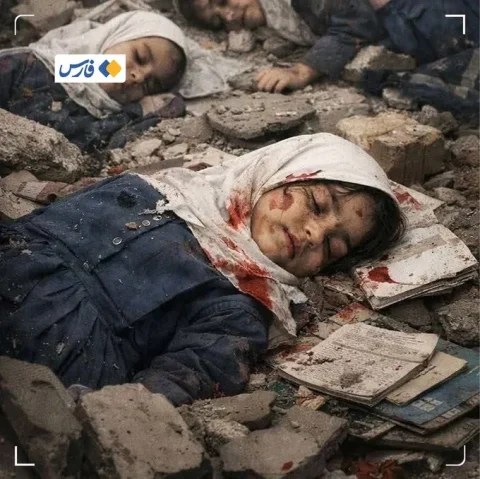
Just imagine the uproar if Iran had killed more than 150 Israeli schoolgirls
The ritual is immutable:
1/ condemn the Iranian “regime” and more or less explicitly welcome the “death” (above all, never say “assassination”) of Khamenei;
2/ having thus provided justification for the US-Israeli war of aggression — the supreme crime according to the Nuremberg Tribunal — and validated the grotesque and abject talking points of the criminals against humanity that Trump and Netanyahu are regarding the alleged “dictatorship of the mullahs,” proclaim, hand on heart, that one does not condone war and artificially dissociate the other victims of these strikes, while affirming solidarity with the Iranian people;
3/ finally and above all, make no reference to the fact that this same people took to the streets by the millions to support their “regime” in January, and are doing so again today, despite the bombs:it is not the real aspirations of the Iranian people that matter — deeply rooted as they are in their own history, values, and spirituality, infusing every aspect of their life with the teachings of Twelver Shia Islam and a deep attachment to the Prophet and his progeny — but rather those that the “civilized West” determines for them, seeking to shape them in its own godless image. Colonial mentality obliges — the same mentality that led Jules Ferry to declare that “the superior races have the duty to civilize the inferior ones.”
It is absolutely sickening to see that more than two years of genocide in Gaza have done nothing to change the crass ignorance, steeped in racism and Islamophobia, of our so-called progressive Left, whose hyperbolic reaction of solidarity we witnessed when it came to the 40 Israeli babies “beheaded” — existing solely in the putrid imagination of propagandists. In France, even La France Insoumise (LFI, main leftist party headed by Jean-Luc Mélenchon), which had managed to distance itself from the inept and complicit “neither-Maduro-nor-Trump” discourse on Venezuela, is now revelling in the war crime constituted by the assassination of a foreign leader, servilely described by Mélenchon as “the executioner of his people,” parroting US-Zionist propaganda and dismissing the millions of Iranians who hold him in reverence and regard him as their political and spiritual leader. Let us therefore listen to Mélenchon, the “Tribune of the plebs”:
“This is the first time there has been a war with no good guys. This is the first time there has been a war with only people we don’t like, I mean governments we don’t like. The government of Iran inspires no sympathy in me: for my part, I have opposed it from the very beginning. When its leader Ali Khamenei dies, I am obliged to say that I feel no sadness.
Mélenchon then claims that just as Nazism was a form of supremacism, the governments of Trump, Netanyahu and Khamenei are each in their own way supremacist powers competing for domination — going so far as to suggest that Khamenei proclaims Iran’s “superiority within Islam and over the Middle East,” an absurd characterization that serves only to justify equating aggressors with the attacked. He concludes: “Neither Shah nor Mullahs.”
No sadness, then, for Khamenei, nor for his wife, nor for his daughter, nor for his son-in-law, nor for his 14-month-old granddaughter, murdered alongside him — except insofar as one adopts the Israeli logic whereby, in order to assassinate one person, dozens or even hundreds are killed with him, invoking “collateral damage,” or even consigning them to oblivion by denying their very existence.
No sadness either for international law, the purposes and principles enshrined in the Charter of the United Nations, the fundamental norms governing relations between States, global peace and stability. Nor for the more than 100 million Iranians and Shiite Muslims throughout the world (including in France and in the other European and Western countries) who mourn the loss of their Guide — whose popularity is questioned only by the ignorant and the ideologues, as for his followers, he is more than the Pope is to Catholics — because they do not embrace the model of society promoted by Mélenchon, who opposes the Islamic Republic on principle, even were it massively supported by the Iranian people, simply because the very principle of a theocracy repels him.
Iran must be regime-changed, even if that means sending it back to the Stone Age, like Syria and Libya, destroying all its incredible accomplishments since 1979 in fields such as healthcare, education, and the sciences — achievements made despite crippling sanctions and persistent external pressures, just like Cuba, from dramatic improvements in life expectancy to the expansion of medical and higher education, rapid growth in research output and scientific innovation, and self-sufficiency in pharmaceutical and high-tech sectors. Iranian women are 70% of Iran’s STEM graduates (Science, Technology, Engineering and Mathematics), but one must guess they are not “free” until they wear miniskirts. Such blindness and the outright denial of the right to political and cultural self-determination are outrageous.

“I feel no sadness”
Although Western tradition humanizes only Israeli victims, deemed alone worthy of compassion, let us defy convention and give a name and a face to the martyrs: above, Zahra Mohammadi Golpayegani, 14 months old, Khamenei’s granddaughter, murdered with her family. No sadness, really? And below, several faces of the victims of the strike on a girls’ primary school — how abominable single-gender education must seem in your eyes — whose wearing of the veil, which Mélenchon once described as a “rag on the head,” may perhaps shock you.
Mélenchon, whose condemnations and impassioned outbursts after October 7 are well remembered — when the Palestinian Resistance had merely exercised its right to struggle against occupation (and Israel responded with the Hannibal doctrine and genocide) — would he dare to say “I feel no sadness” if Trump or Netanyahu had been killed along with their wife, children, and grandchildren, without provocation, triggering a regional war that could quickly becomeWorld War III? Never in a million years. He would have condemned the very act of international terrorism constituted by the aggression and assassination of a foreign leader, evoked all its potentially cataclysmic ramifications, and explicitly mentioned the victims. But when it comes to Iran, none of this matters. Iranian and Israeli lives are not equal in the eyes of the “supremacists,” whether ethnic, political, or civilizational — are they, Mr. Mélenchon?
As for Mediapart, long regarded as one of France’s leading left-leaning media outlets, it no longer even bothers to conceal its Atlanticist and Zionist allegiances, openly embracing them. It congratulated Israel on the “tactical stroke of genius” represented by the mass terrorist beeper attack against Lebanon (later discreetly revising the description to a “strategic success” once it recognized that the original wording was apologetic), and is now explicitly turning the victim into the culprit, daring to claim that Iran had it coming because it refused to “capitulate on its foundations,” namely its defense capabilities (nuclear weapons being nothing more than a crude pretext), and refused to allow itself to be carved up (see the surreal article Rather than Capitulate on Its Foundations, the Iranian Regime Prefers to Endure War, torn to pieces by the comments of Mediapart subscribers themselves, who are increasingly turning their backs on this vile NATO bootlicking). France remains, without a doubt, the daughter of Jules Ferry the colonialist and Pétain the collaborationist.
If our grandees truly cared about international law, the rights of peoples, and global peace and security, the assassination of Khamenei would be unanimously condemned with horror and indignation, both in itself and for the cataclysmic consequences it could entail, from a global economic crisis to a third world war. If “human animals” possessed as much dignity as Western and Israeli lives in the eyes of our self-proclaimed “feminists,” the Iranian schoolgirls targeted by Israel would make every front page — and draw condemnations dwarfing those provoked by the fake story of 40 decapitated babies. Instead of ludicrous accusations of expansionism or imperialism toward Iran, we would be reminded at every second that Israel — the intergalactic champion of killing children and destroying schools and hospitals — dreams of turning the entire Middle East into Gaza, and wants to ensure Trump follows through on “Operation Epstein’s Fury” to the very end.
The great historical tradition of international solidarity, which once led French men and women to risk their lives and endure torture in support of the Algerian FLN, is no more. At best, one can expect the “progressives” and other self-styled “revolutionaries” to place aggressor and victim on the same footing. Far from those who claim neutrality in situations of injustice, and who, as Desmond Tutu said, merely play the game of the oppressor, we affirm our genuine internationalist solidarity with the Islamic Republic of Iran in the face of imperialist and Zionist aggressors, and affirm not only its right to defend itself, but its right to choose its model of society, including that of a “theocracy,” which is only a dirty word for fanatic secularists.
This blog is the result of voluntary work. To support it, you can make a donation.
Iran no longer has any reason for restraint
By Samuel Geddes | Al Mayadeen | March 3, 2026
Tehran may well refuse US-Israeli pleas for a ceasefire until the region is transformed.
Both Trump and Netanyahu find themselves in an extraordinarily vulnerable position. They have given their greatest ideological opponent the means and the justification to extract maximum damage from them, as well as ceasefire conditions that would truly make this conflict a turning point in modern history.
President Trump clearly believed, at Netanyahu’s encouragement, that assassinating Iran’s Leader would pressure it to soften its negotiating position on the nuclear file. What he did instead was to shatter nearly a decade of Iranian restraint in the face of relentless provocation.
Trump has rendered both Washington and Tel Aviv more desperate for an end to the war than Iran. In addition to retribution for the assassination of the Leader of the Revolution, Tehran is calling in the debts of Trump’s “maximum pressure strategy” in full.
Ever since Trump’s withdrawal from the JCPOA in 2018, Tehran has attempted to limit the rate of escalation, especially following the assassination of Quds Force commander Gen. Qassem Soleimani in 2020 and others across various arenas since October 2023’s Al-Aqsa Flood.
Netanyahu’s domestic political interests have been the opposite, deliberately prolonging the genocidal onslaught in Gaza, expanding it to the West Bank, Lebanon, Syria, Yemen, Iraq, and from 2024, Iran, when it bombed the Damascus consulate. He followed up by assassinating Hamas leader Ismail Haniyeh in Tehran and much of Lebanese Hezbollah’s leadership.
By June last year, he had attained his life-long goal of drawing Washington directly into hostilities with Iran when it bombed the Natanz, Fordow, and Isfahan nuclear facilities. Now he has obliterated the ultimate red line with the airstrike that martyred Ayatollah Sayed Ali Khamenei.
As US and Israeli military sources themselves acknowledged, even before the outbreak of war, stockpiles of missile defense munitions were critically low. The 12 days of direct war between Iran and “Israel” last year cut deeply into the regime’s Iron Dome, Arrow and David’s Sling systems before Washington stepped in to impose a ceasefire.
Now that Iran and Hezbollah are unleashing their arsenal, the ability of Israel, US forces and GCC states to avoid catastrophic blows is being measured in days rather than weeks. The global supply of these munitions has been further strained by shipments sent to Ukraine and will be insufficient to resupply the West Asian theatre well before the end of this week. This will critically expose western assets not just in the region but globally, for years to come.
As of just the third day of the war, maritime traffic through the Strait of Hormuz is effectively at a standstill. In Saudi Arabia, Ras Tanura, the most crucial oil refinery in the world, has sustained impact from drones and halted operations.
Even without direct hits on regional energy infrastructure, GCC oil producers will be forced to halt production within three weeks due to a lack of storage capacity. President Trump’s favorite metric of economic performance, the stock market, is staring down the barrel of an energy shock unseen since 1973, and which may well exceed that crisis. The frail state of the US economy, combined with the global blowback to its tariff policy, could easily tip into recession or even depression. This would be shattering to the petrodollar system as well as the very status of the US Dollar as the global reserve currency.
Once Iranian missiles are unimpededly striking vital military and economic targets in “Israel” daily and inflicting mass casualties on US forces from the Eastern Mediterranean to the Arabian Sea, the Islamic Republic will be able to impose extraordinary conditions merely in exchange for a halt to the war. It will plausibly be able to demand the unconditional lifting of all Western sanctions, not just against itself, but against Yemen, Lebanon, and Gaza. It will also be able to dictate the end of Netanyahu’s regional escalation spree, forcing “Israel’s” withdrawal from Gaza, Lebanese and Syrian territories, and re-establishing a balance of terror that ensures an indefinite calm, even if a limited one.
Alternatively, it could, in emulation of Ansar Allah in early 2025, agree a separate ceasefire with Washington, leaving them a free hand to continue full-scale bombardment of “Israel”.
Assuming the intensity of hostilities doesn’t achieve this first, it could also demand the definitive withdrawal of US forces from the Persian Gulf, ending America’s hegemony over the region and the world by extension.
Israel launches Bible study program targeting US evangelicals
The new initiative features Israeli soldiers, West Bank settlers, and a pastor of Messianic Judaism as key voices
By Nick Cleveland-Stout and Connor Echols | Responsible Statecraft | February 28, 2026
An Israeli-funded firm is hoping to boost evangelical support for Israel through a guided Bible study program that features interviews with Israel Defense Forces soldiers, theologians, and West Bank settlers, according to a new website uncovered by RS.
The firm, California-based Show Faith by Works, is launching a new initiative called “Hear from us,” featuring an eight-part series of lessons that mix typical Bible study prompts with stories about the importance of modern Israel.
Show Faith by Works previously sparked outrage among some evangelical communities after proposing a campaign to geofence churchgoers’ phones during worship hours to deliver pro-Israel advertisements. Since September, the Israeli government has invested over $3 million in the firm.
Republican strategist Chad Schnitger, who is overseeing the influence operation, hopes his initiative will shore up Gen Z support for Israel. While 70% of evangelicals over age 60 support Israel, only 39% of evangelicals between 18 and 29 do, according to a Marquette University Law School survey from late last year.
Schnitger says his funders at the Israeli Foreign Ministry want him to focus narrowly on religious issues. “They’ve not asked me to talk about politics, they’re not asking me to talk that much about the war,” Schnitger said. “This is here to be a champion for the Christian church and take the message to the American Southwest.”
But the materials on his website, reported here for the first time, suggest a blurry division between religion and politics. A sample booklet, for example, denies that “Hear from us” represents a “political movement” but appears to embrace controversial views on the Israeli-Palestinian conflict. For instance, the pamphlet displays a map of Israel that shows full Israeli control over the Palestinian territories and the Golan Heights, which are internationally recognized as Syrian land.
The booklet’s release comes amid rising concern over possible expansion of Israel’s territorial claims. Just last week, U.S. Ambassador to Israel Mike Huckabee told Tucker Carlson that “it would be fine” for Israel to take control of territories belonging to Arab states, including the West Bank and Gaza. Asked about the remarks, Israeli opposition leader Yair Lapid said that Israel’s borders should be “as broad as possible.”
Schnitger did not respond to a request for comment from RS.
‘GAZANS GOTTA GO’
Hear from us’ guided Bible study features interviews with several speakers whose views are controversial, both within Israel and among critics of its conduct in Gaza. One such interviewee is Chaim Malespin, an IDF Sergeant Major who runs an organization that helps Jewish immigrants move to Israel and “provides essential support” to Israeli soldiers.
Malespin has long faced criticism from anti-missionary groups in Israel, who have alleged that he seeks to evangelize Jews and convert them to Messianic Judaism, which follows some Jewish traditions but considers Jesus the Messiah. He drew criticism in 2022 for his viral claim that Lapid’s wife is secretly a Messianic Jew, which he later apologized for. On another occasion, the Jewish Agency cut its partnership with Malespin’s organization for having “created the perception” that it evangelizes.
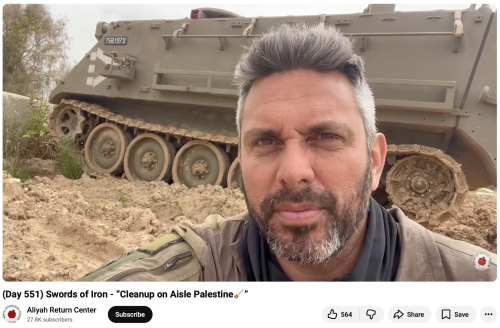
Since October 7, Malespin has posted daily updates on the Gaza War. In one video posted after the United Kingdom recognized Palestine, Malespin said Palestinians “don’t want to do anything but destroy Israel.” Another video, titled “Cleanup on Aisle Palestine,” featured Malespin reacting to what sounded like Israeli bombing of Gaza. “Wow, loud explosions huh?” said Malespin, standing in front of an Israeli armored vehicle.
Perhaps most inflammatory are the views of Yishai Fleisher, who joins the program for a study session that carries “the story [of Israel] forward,” according to the sample booklet. Fleisher is among the most prominent advocates of Israeli annexation of the West Bank and Gaza, a policy that he has championed as the spokesperson for the settler community in the segregated West Bank city of Hebron.
Fleisher has long railed against the idea of a two-state solution, arguing that Israel should have full control of the area between the Mediterranean Sea and the Jordan River and that Palestinians should have limited rights. In a recent video posted on his popular YouTube channel, Fleisher said that Carlson, in his interview with Huckabee, was “spitting on the God of Israel,” adding that the American political commentator “needs to be taken down” like the Biblical Goliath.
The prominent settler is also a frequent commentator on U.S. policy toward Israel. He has referred to the American Israel Public Affairs Committee’s annual conference as the “Fourth Pilgrimage Holiday,” after the traditional Jewish holidays of Sukkot, Shavuot and Passover. In a podcast episode entitled “GAZANS GOTTA GO,” he advocated for the ethnic cleansing of Gaza and likened pro-ceasefire protestors on American college campuses to the Amalekites, who were massacred by the army of Saul, according to the Bible.
“Amalekites come for the Jews because they know that Jews represent civilization,” he said. “That’s what we’re seeing with the Jihadis on campus in the United States.”
Another interviewee is Messianic Jewish Pastor Avner Boskey. The preacher has written lengthy criticisms of Islam, warning in one pamphlet that “paganism and demonic worship are the spiritual matrix out of which Allah was elevated.” And, when Zohran Mamdani was elected mayor of New York City last year, Boskey wrote a piece with the subheading, “When The Upper West Side Turns Into The Lower West Bank.”
Destiny Magnett, Programs and Outreach Manager at Churches for Middle East Peace, told RS that the initiative contributes to the erasure of Palestinian culture, heritage, and history. Much of the sample booklet, for example, promotes a controversial new archaeological site called the Pilgrimage Road that cuts through a Palestinian neighborhood in Israeli-occupied East Jerusalem and has caused structural damages to local homes.
“Pilgrimages to this land simply don’t exist in a vacuum detached from the everyday realities of people on the ground,” said Magnett. “Acknowledging that should be part of the responsibility undertaken by anyone working at the intersections of faith and Israel/Palestine.”
Shifting strategies
Show Faith by Works’ initial plan, filed under the Foreign Agents Registration Act (FARA), indicated that the firm would “geofence” the physical boundaries of major churches in the American Southwest during worship times in order to “track attendees and continue to target [them] with ads” on behalf of Israel.
But the campaign was met with backlash from many congregations. The Christian Life Commission of Baptist General Convention of Texas urged church leaders to sign a letter calling on Attorney General Pam Bondi to prohibit foreign government use of tracking technologies at churches. A campaign and website called “show mercy and do likewise” was created as an interfaith project to support Christians being targeted by the campaign. Timothy Feldman, an attendee of one of the churches listed, told RS, “It was a strange feeling to see my local church directly targeted by a foreign country committing a genocide on the other side of the world.”
Show Faith by Works responded to the concerns by defending the geofencing campaign. Schnitger, the founder of the firm, told RS in an email at the time that “irresponsible” media outlets had “sensationalized” the firm’s use of geofencing. “It is a very common marketing tool that literally every person with a smartphone in America has experienced in one way or the other,” Schnitger explained. He later revealed that he was scrapping the geofencing campaign “due to security concerns.”
It is unclear whether this pivot will help Schnitger and the Israeli government win more support among Evangelicals. Uriesou Brito, presiding minister of counsel for the Communion of Reformed Evangelical Churches and senior pastor of Providence Church in Pensacola, told World — a media outlet that says it is “grounded in facts and biblical truth” — that he disagrees with Show Faith by Works’ approach. “My general principle has been that we should always be cautious when any government funds religious or theological outreach,” said Brito. “The concern in my estimation is not unique to Israel.”
Nick Cleveland-Stout is a Research Associate in the Democratizing Foreign Policy program at the Quincy Institute. Previously, Nick conducted research on U.S.-Brazil relations as a 2023 Fulbright fellow at the Federal University of Santa Catarina.
Featured Video

Racist Seinfeld Dances for Joy as Bibi Unveils His New Map
or go to
Aletho News Archives – Video-Images
TV Drama Review
Japanese drama projects Japan’s wartime atrocities onto Chinese characters

Global Times | October 25, 2026
By portraying Chinese characters as perpetrators of ruthless violence while casting Japanese Self-Defense Forces (SDF) intelligence operatives as defenders, the season 2 of the Japanese drama Vivant has recently drawn criticism from Chinese netizens, who argue that its depiction turns historical reality on its head while ignoring Japan’s wartime atrocities.
The TBS drama series – a spy suspense story in which an alleged unofficial intelligence unit of the SDF operates across the globe — has attracted a passionate fanbase. Its currently airing season 2 opened with a household rating of 18.8 percent, the highest for a TV drama this year, according toa commentary article by Japanese media Toyo Keizai.
What draws attention is the portrayal of the enemies in the series, the article noted. Scenes in which the Chinese organization subjects kidnapped members of the SDF unit to brutal torture are repeated with unrelenting intensity.
It is rare for Japanese TV dramas to explicitly portray a real-life country as the enemy, the article noted.
Japanese Prime Minister Sanae Takaichi also made a reference to the drama, saying that she has been recording Vivant and hopes to binge-watch it over the year-end and New Year holidays, according to Japanese media outlets.
China’s CCTV News report on Sunday revealed that the drama features scenes in which Chinese personnel cut off the fingers of and stab Japanese intelligence operatives in the abdomen. Such acts bear striking similarities to the torture inflicted on Chinese nationals by invading Japanese troops during the World War II.
The drama distorts the truth by attributing these atrocities to modern Chinese characters. Beneath the surface, it subtly glorifies Japan’s cross-border overseas operations, blurs the functional boundaries of the SDF and implicitly promotes an expansionist narrative, per CCTV News. … continue
Blog Roll
 Aletho News
- EU facing trillion-euro debt hole while seeking more cash for Kiev
- How US, Europe, Persian Gulf states exhausted missile stockpiles, splurged billions to defend Israel
- Up in arms… Koreans reject U.S. empire’s plan to make South Korea the next Ukraine
- Iran, Turkey, Pakistan, Saudi Arabia could advance region-led security framework in Tehran: FM spox
- Netizens condemn Japanese drama for projecting Japan’s wartime atrocities onto Chinese characters
- Racist Seinfeld Dances for Joy as Bibi Unveils His New Map
- A West Bank War for Netanyahu’s Election Campaign, Could It Backfire?
- Yemen denounces European Parliament’s ‘hypocritical’ push to blacklist Ansarullah
- Qalibaf: UAE’s UN bid aims to ‘clear the runway’ for ‘Greater Israel’, whitewash genocide
- Pakistan reopens Iran border after boosting security: Report
- If Americans Knew
- An error has occurred; the feed is probably down. Try again later.
- No Tricks Zone
- Sudden Stratospheric Warming, Powerful El Niño Combination May Lead To Extreme Europe Cold, Energy Crisis!
- Two New Studies Find Thwaites Glacier Melt Cannot Be Driven By Human Activity Or A Warming Ocean
- E-Cars Reduce CO2 Emissions By Only 41% Compared To Internal Combustion Engine Vehicles
- Predictions Made By Renowned Climate Professor Over Past Decades Have Been Proven To Be Poor
- New Study Suggests Large Regions Of The Pacific Ocean Have Been Cooling For The Last 80 Years
- Germany’s Green Energy Debacle: High Energy Costs Force Kahla Porzellan to Close After 182 Years!
- New Study: 50 Years Of The Most Aggressive ‘Net Zero’ Policies Can Only Affect The Global Climate By 0.03°C
- US September “Heat” Was No Record…Many Records Set Decades Ago
- Latest European Green Energy Debacle; Portugal’s Largest Flagship Solar Park Insolvent!
- Green Energy Debacle: German Expert Professor Fritz Vahrenholt Warns Of Severe Economic And Social Consequences

