Israel to Seize Ibrahimi Mosque Land in Hebron
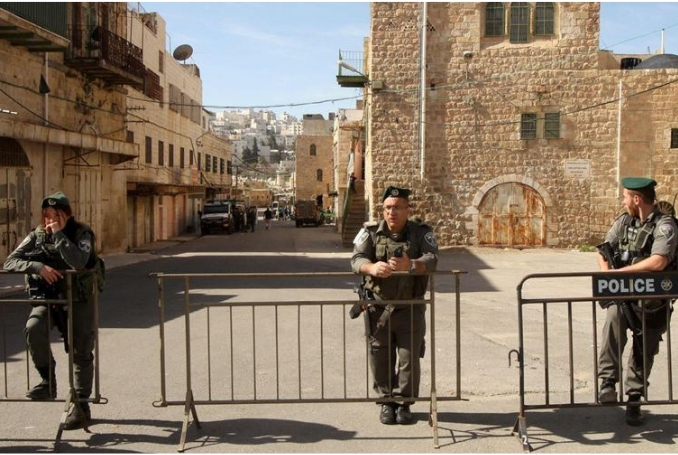
Ibrahimi Mosque in the occupied West Bank city of Hebron
Palestine Chronicle | April 22, 2020
Israeli government’s Attorney General Avichai Mandelblit yesterday approved the expropriation of Palestinian land adjacent to the Ibrahimi Mosque in occupied West Bank city of Hebron (Al-Khalil).
According to Arab48, after Mandelblit’s approval, the Palestinian land will be under the control of Defence Minister Naftali Bennett.
The land belongs to the Islamic charitable trust in the Palestinian city, which oversees the Ibrahimi Mosque.
The occupation will use the land to allow disabled visitors to access a synagogue near the mosque.
Israeli media reported the Israeli Ministry of Justice saying in a statement that the decision was made in collaboration with the Civil Administration.
The statement said that this land would be used to build an elevator and ramp to allow people with disabilities, including tourists and Jewish worshippers, to access a synagogue.
Commenting on this step, the Palestinian Authority’s Ministry of Waqf and Religious Affairs said: “The decision is an assault on the Muslims’ ownership of the Ibrahimi Mosque and the endowments that surround it, which are numerous in the city of Hebron.”
Renouncing Israel on Principle
How to answer the question, “Do you affirm Israel’s right to exist?”

By Steven Salaita | December 9, 2019
When anti-Zionists discuss the Middle East, the topic of Israel’s existence rarely arises. It’s almost exclusively a pro-Israel talking point. We’re focused on national liberation, on surviving repression, on strategies of resistance, on recovering subjugated histories, on the complex (and sometimes touchy) relationships among an Indigenous population disaggregated by decades of aggression. That a colonial state—or any state, really—possesses no ontological rights is an unspoken assumption.
“Do you recognize Israel’s right to exist?” pretends to honor the downtrodden, but it is an altogether different proposition, transforming sophisticated ideas of liberation into a crude test of political respectability. Prioritizing the state as worthy of relief, as something to which we automatically owe deference, subsumes life to the imperatives of capital.
The fundamental goal of the question is to attribute a sinister position to dissidents. It accomplishes that goal even when the dissidents haven’t promoted destruction. Mere defense of Palestinian life is enough to evoke the settler’s existential fear. For people socialized into orthodoxy, Israel is synonymous with progress, technology, and production. Affirming its existence is an endorsement of the status quo; no matter how ludicrous as a moral premise, in capitalist spaces it is a perfectly sensible demand.
There are plenty of reasons to eschew the demand. The first reason is practical: we don’t advocate for the destruction of human communities, but of ideologies conducive to racism and inequality. It’s both insidious and unethical to conflate Jewish people (of any national origin) with the existence of a violent, rapacious polity. That sort of conflation is a grave disservice to activists and intellectuals devoted to a better world—and to the communities for whom a better world is a necessity of survival. Nobody has ever asked me to affirm another nation-state’s existence, a demand I would likewise decline. Zionists constantly single out Israel for special treatment.
Moreover, it is remarkably impudent for champions of a state founded on the destruction of Palestine and now in its eighth decade of ethnic cleansing to ask the victims of its malevolence for recognition. Even worse, recognition is only the tip of the demand. We’re also being asked to legitimize apartheid and ignore the routine commission of war crimes. The upshot is to validate Israel as a militarized object of Western imperialism—in other words, to affirm the existence of a deeply antihuman entity.
Let’s consider the demand in context of North America, where it’s most frequently issued. Those of us operating in this geography haven’t the authority to abdicate nearly 80 (and arguably 100) percent of historical Palestine. It’s not any Westerner’s prerogative to relinquish Palestine under the pressure of a spuriously humanistic insistence by Zionists that their perfidy be excused because it will somehow make us more responsible citizens.
I am happy, eager even, to affirm the right of Jewish people to live in peace and security, wherever that may be, a right all humans deserve in no particular order of worthiness. But I won’t ratify Israel’s bloody founding or its devotion to racial supremacy. Ultimately, when Zionists demand that you affirm Israel’s right to exist, what they really seek is affirmation of Palestinian nonexistence.
Beyond these philosophical, political, and practical factors, there’s a worthy psychological reason to refuse the demand. Zionists are the bully in this supposed conflict and enjoy nearly universal support in centers of political and economic power. They have more funds, access to corporate media, and the backing of the US military. Palestinians, however, hold one form of power that doesn’t require money, platforms, or weaponry: the ability to withhold legitimacy from Israel. It is a small power, without a material apparatus, but it is power, nevertheless, one that only a fool or opportunist would relinquish. When an oppressor makes submission the basis of civic responsibility, insolence is the only dignified response.
A Postmortem on Bernie Sanders and Palestine
Now that the Sanders campaign has ended, Palestinian Americans should reflect on why our organizations so readily abandoned anti-imperialism.

By Steven Salaita | April 15, 2020
Let me start with a story about the Democratic primary. Now, I’m no operative, so this story has nothing to do with voting choices or electability. It’s about how Palestine disappears in US electoral discourses, even when people who identify as Palestinian purport to make it visible.
Sometime ago, I was added to an online group of Palestinian Americans organizing for Bernie Sanders’ campaign. The specific identity of the group is immaterial. Many such groups existed and as far as I can see the outcome of their work fit a standard template: we’re Palestinian (and thus purport to speak for all Palestinians from within the United States); Bernie’s not perfect (but he really is kinda perfect); Bernie’s by far the best on Palestine (trust us); this isn’t merely about Palestine (Palestine is merely the pretext); we’ll be sure to hold him accountable (even though we just finished giving him unqualified support). I don’t want to put Palestinians on the spot; all statements supporting presidential candidates look more or less the same. Let’s call it a limitation of the genre and leave it at that.
So, members of this group were working on a statement explaining why Palestinians should support Sanders. Somebody put up a shared document with various points exaggerating Sanders’ record as an advocate for Palestinian rights and some fantasizing about Palestine’s future under a Sanders presidency. Again, pretty typical stuff, which is to say a whole lot of bullshit.
In the margin of the document, a user asked, “Is Sanders a Zionist?,” to which another person replied, “Yes he is.” No discussion ensued. The question and answer hung in silence until the document went public, at which point any consideration of Sanders’ Zionism had been scrubbed.
I’m less interested in the question of Sanders’ Zionism than I am in the reasons for scrubbing Zionism from the conversation about Sanders. Sanders doesn’t call himself a Zionist, and the label can flatten a pretty wide range of thought, but if we examine Sanders’ positions against what the Palestine solidarity movement understands to be Zionism, then Sanders unambiguously fits the description. He constantly affirms Israel’s right to exist as a Jewish state. He opposes right of return. He treats Netanyahu as the aberration from a humanistic norm. Yeah, he’s a Zionist. This fact wasn’t lost on his Palestinian American champions. It just didn’t seem to bother them very much.
But let’s leave the question of Sanders’ Zionism to the side, for it has proved effective at putting colleagues at loggerheads. Whatever Sanders or any other politician thinks about Palestine should have no influence on how Palestinians think about Palestine. In fact, according to the mythography of electoralism, it’s the community’s duty to educate the politician. In order to accomplish that goal, the community needs to convey principles it considers nonnegotiable. For Palestinians, those principles would include right of return and full equality in all of historic Palestine.
That’s not what happened in the various statements of support. Instead, their authors instrumentalized Palestine as an abstract commitment—an idea mobilized through performances of ethnic verisimilitude—in order to boost a campaign extraneous to the actual work of decolonization. Rather than pressuring the politician, they made demands of the audience and assured people opposed to Zionism that voting for someone pledging to uphold Israel’s “Jewish character” wasn’t a pragmatic concession, but an act of virtue, a feat of devotion to Palestine.
What does it mean that groups visibly and proudly identifying as Palestinian felt it necessary to scrub Zionism in order to boost a politician jockeying to supervise US Empire? By what moral calculus did those groups take vital demands off the table? Did they have the consent of refugees for whom right of return is sacrosanct? Of rank-and-file Palestinians in the United States? Or was it an exercise in unilateral leadership by the diasporic professional class?
I know what the response is: we didn’t mythologize anyone; we regularly pointed out his weaknesses. Well, not really. (I didn’t see you pointing out that Sanders is a Zionist, for example.) Exerting tremendous energy to conceptualize Sanders as a benevolent uncle figure and then occasionally saying “he needs more work on this issue” or “we need to keep pushing him” was a cardinal feature of mythologization, as was running interference with points of view more palatable to the mainstream when fellow anti-Zionists dissented from the consensus. Saying “he’s the best on Palestine even though he’s not perfect” was the rankest kind of mythmaking. It confused “being better than a terrible field” with “being good.”
I saw in these statements a yearning to matter, a desire to at long last be taken seriously after decades of abuse and disregard. It’s a normal response to subordination, to the pain of continuous betrayal, but no amount of high-minded talk about an electoral revolution will compel sites of power to care about Palestinian Americans. They shouldn’t be our audience, anyway. Palestinians are admired by people around the world who value justice and resilience and dignity. Let’s not forgot our place, which isn’t among consultants and technocrats, but with the ignominious, the surplus, the unbeloved.
During the primary, and during the 2016 election cycle, whenever I expressed skepticism about deploying Palestine in service of a presidential campaign, other Palestinian Americans quickly intervened: “Well, I mean Steve’s making an, ahem, important point, but, here, let me butt in and do it, you know, more responsibly.” I found it to be a pathetic move. The idea was to keep radicalism in check, or to snuff it out. Decolonization, however, is inherently radical in the metropole. The interventions were thus a form of ostracism: we don’t want disreputable elements of our community running a bus over this good foot we’re trying to put forward. The limits of US electoralism came to define the parameters of Palestinian liberation.
Electioneering requires compromise, but compromise isn’t a neutral practice. The people are made to sacrifice for the affluent. That’s how compromise works under capitalism. Every time, every single time, it’s some aspect of Palestinian freedom that must be compromised. Never the candidate’s position. Never the system’s inherent conservatism. Never the ongoing march of settler colonization. We’re volunteering to be captured by the settler’s notion of common sense.
And what would have happened if your guy won? You already gave up right of return. A one-state solution. Anti-imperialism. Nobody was talking about general strikes until the pandemic. And nobody ever talks about armed struggle. How did you plan to get these things back on the table after having surrendered them to a person whose first, second, and third priority is appeasing power? You gave up something Palestinians have struggled and died for over the course of decades, and for what? Just to make the apocryphal and frankly useless point that this politician is a more tolerable Zionist than the other ones?
And when your guy loses? This is the question of the moment, isn’t it? You gave up all that leverage for nothing (except for individual benefits). What happens next? God knows I can’t answer that question. I’m not saying don’t participate, don’t vote, don’t be interested in a candidate. That’s not the point. I dislike coercive forms of persuasion. I’m simply trying to convince you not to give up the idea of freedom as it’s articulated by the downtrodden. Not for any reason. Certainly not for a goddamn politician.
There’s a question you ought to ask as necessary (which is to say constantly): what happens to Palestine? When we humor a system calibrated to exclude us, when we pretend that liberation is possible on the margins of a hostile polity, when we imagine liberal Zionism as a prelude to freedom, then what happens to Palestine?
Raising this kind of skepticism is a good way to get branded a hater. (Treating the recalcitrant as irrational is a central feature of electoral discipline.) I hate this sensibility precisely because I’m not a hater, because I recognize that defiance is a priceless asset in conditions of loss and dispossession. Let’s please abandon this smug idea that skepticism ruins the party for sensible people. It’s an ugly form of internal colonization. Recalcitrance can be a deep, abiding act of love, in this case a devotion to life realized in the form of a simple question: what happens to Palestine?
The system you deign to reform ranks nothing above ruling class accumulation—the system, in other words, is designed to betray, and performs its mandate with brutal efficiency. And so the answer to that timeless question never changes: Palestine goes away. Any group that doesn’t facilitate a flow of capital into the imperial core is fit for disappearance. Our mandate, in turn, isn’t to seek the approval of our oppressor, but to earn his contempt.
Instrumentalizing the persecuted is a critical feature of electoralism. Promoting a Zionist presidential candidate and remaining faithful to the core tenets of anti-Zionism? Forget it. It’s not happening. It can’t happen. Electoralism is salted against insurgency. It’s not a space for ideas, for creativity, for the simple decency of not asking the least powerful among us to defer their freedom; it’s hostile to anything that impedes the reproduction of orthodoxy. Liberation has always required tremendous imagination. That’s not on offer when David Sirota is authoring the narrative.
You have no cause to be angry with Sanders. Not now. He hasn’t broken a single pledge. He never hid his intentions. There was plenty of reason for concern when he kept repeating liberal Zionist platitudes. It was you, not Sanders, who folded Palestine into a campaign that always promised to maintain the status quo. The outcome was easy to predict because it has many decades of precedent. Palestinians, victim of a million betrayals, should know this better than anyone. We also know that struggle has no easy trajectory. Mass movements predicated on voting make for attractive sources of relief. Then they go up in smoke and you’re left to find the next shiny figure to exploit, the next fount of excitement and pageantry and social capital. This isn’t a serious politics. It’s terminal naivete, or industrial self-promotion.
And now what? You disposed of the most radical members of our community, systematically excluding so many brethren from the life-sustaining pleasure of shared resistance, in order to assuage a bunch of faceless assholes waiting for the first opportunity to dispose of you, all that love sacrificed for no reward beyond some retweets and an evanescent sense of importance, your moment of being accepted by the polity now replaced by angry regret for having again succumbed to the gravitational pull of authority, of the state and its functionaries, of the very institutions that maintain our dispossession. But our nation, Palestine, is neither temporary nor ephemeral. Our politics should match the condition.
If Coronavirus Overwhelms Gaza, Israel Alone will be to Blame
What is already a crisis in the territory barely needs a nudge from Covid-19 in order to be tipped into a health disaster
By Jonathan Cook | The National | April 14, 2020
The Palestinians of Gaza know all about lockdowns. For the past 13 years, some two million of them have endured a closure by Israel more extreme than anything experienced by almost any other society – including even now, as the world hunkers down to try to contain the Covid-19 pandemic.
Israel has been carrying out an unprecedented experiment in Gaza, using the latest military hardware and surveillance technology to blockade this tiny coastal enclave by land, air and sea.
Nothing moves in or out without Israel’s say-so – until three weeks ago, when the virus smuggled itself into Gaza inside two Palestinians returning from Pakistan. It is known to have spread to more than a dozen people so far, though doctors have no idea of the true extent. Testing equipment ran out days ago.
Unless Gaza enjoys a miraculous escape, an epidemic is only a matter of time. The consequences hardly bear contemplating.
Countries around the world are wondering what to do with their prison populations, aware that, once it takes hold, Covid-19 is certain to spread rapidly in crowded, enclosed spaces, leaving havoc in its wake.
Gaza is often compared to an open-air prison. But even this analogy is not quite right. This is a prison that the United Nations has warned is on the brink of being “uninhabitable”.
In the prison of Gaza, many inmates are undernourished, and physically and emotionally scarred by a decade of military assaults. They lack essentials such as clean water and electricity after repeated Israeli attacks on basic infrastructure. And the 13-year blockade means there is only rudimentary medical care if they get sick.
Social distancing is impossible in one of the most crowded places on earth. In Jabaliya, one of eight refugee camps in the enclave, there are 115,000 people packed together in little more than a square kilometre. Comparable population density nearby in Israel is typically measured in the hundreds.
There are few clinics and hospitals to cope. According to human rights groups, Gaza has approximately 60 ventilators – most of them already in use. Israel has 15 times as many ventilators per head of population.
There is little in the way of protective gear. And medicines are already in short supply or unavailable, even before the virus hits. Gaza’s infant mortality – an important measure of medical and social conditions – is more than seven times higher than Israel’s. Life expectancy is 10 years lower.
Unlike a normal prison, Gaza’s warden – Israel – denies responsibility for the inmates’ welfare. Since it carried out a so-called “disengagement” 15 years ago, dismantling illegal settlements there, Israel has argued – against all evidence – that it is no longer the occupying power.
That should have been proved an obvious lie when Palestinians, choking on their isolation and deprivation, began rallying in protest two years ago at the perimeter fence that acts as a cage locking them in. Demonstrators were greeted with live fire from Israeli snipers.
Around 200 people were killed, and many thousands left with horrific injuries, mostly to their legs. Medical services are still overwhelmed by the need for long-term surgery, amputations and rehabilitation for the disabled protesters.
What is already a crisis barely needs a nudge from the coronavirus to be tipped into a health disaster.
And with most of the population already below the poverty line, after Israel’s blockade destroyed Gaza’s textile, construction and agricultural industries, the economy is no shape to withstand an epidemic either.
Most governments, including Israel’s, maintain a degree of control even in the face of this most unexpected emergency. They could prepare for it, even if many were slow to do so. They can marshall factories to produce ventilators and protective equipment. And they have the resources to rebuild their health services and economies afterwards.
If they fail in these tasks, it will be their failure.
But Gaza is entirely dependent on Israel and an international community preoccupied with its own troubles. Even if health authorities can secure ventilators and protective equipment in the current, highly competitive global market, Israel will decide whether to let them in. Equally, it could choose to seize them for its own use, in order to placate growing domestic criticism that it is short of vital equipment.
The blame for Gaza’s plight – now and in the future – lands squarely at Israel’s door.
Israel should be helping Gaza, but it is doing the precise opposite. Last week, Israeli planes sprayed herbicide to destroy the crops of Gaza’s farmers – part of a policy to keep clear sight-lines for Israeli military forces.
Moreover, in this time of crisis, Gaza’s food insecurity is only set to deepen. For the past year, Israel has been starving both Gaza and the rival Palestinian Authority in the West Bank of the taxes and duties it collects on their behalf and that rightfully belong to the Palestinian people. Many families have no money for food.
The US has aggravated this financial crisis by cutting funds to the United Nations refugee agency, UNRWA, which cares for many of Gaza’s families expelled by Israel from their homes decades ago and forcibly crowded into the enclave.
The little influence retained by Hamas relates to the thousands of Palestinian political prisoners held illegally in Israel. Hamas wants them out, especially the most vulnerable, aware of the danger the virus poses to them in Israel, where the contagion is more advanced.
It is reported to be trying to negotiate a release of prisoners, offering to return the corpses of two soldiers it seized during Israel’s infamous attack on Gaza in 2014 that killed more than 500 Palestinian children.
If Israel refuses to trade, as seems likely, or denies entry to much-needed medical supplies, Gaza’s only other practical leverage will be to fire missiles into Israel, as Hamas leader Yahya Sinwar has threatened. That is the one time western states can be expected to notice Gaza and voice their condemnation – though not of Israel.
But if plague does overwhelm Gaza, the truth about who is really responsible will be hard to conceal.
Modelling the horrifying conditions in Gaza, Israeli experts warned last year of an epidemic like cholera sweeping the enclave. They predicted hundreds of thousands of Palestinians storming the fence to escape contagion and death.
It is the Israeli army’s nightmare scenario. It admits it has no response other than – as with the fence protests – to gun down those pleading for help.
For decades Israel has pursued a policy of treating Palestinians as less than human. It has minutely controlled their lives while denying any meaningful responsibility for their welfare. That deeply unethical and inhumane stance could soon face the ultimate test.
Ashrawi: While the world works on saving lives, US and Israel working on killing peace
WAFA – April 12, 2020
RAMALLAH – Member of the Executive Committee of the Palestine Liberation Organization (PLO), Hanan Ashrawi, said today that Israel was “cynically exploiting” the international community’s focus on protecting humanity from the consequences of the COVID-19 pandemic to implement its extraterritorial and expansionist colonial agenda.
She said the Israeli politicians “are busy negotiating a coalition agreement centered on permanent colonization and annexation at the expense of Palestinian lives, land, and rights.”
“While the world is preoccupied with combating COVID-19, the joint Israeli-US committee set up to implement the US administration’s disastrous so-called plan has found the time and energy to work on annexation and prioritize it over saving lives,” Ashrawi said in a statement.
“The clear support and sponsorship of the US administration of these dangerous plans is further proof of the disruptive and irresponsible role of the Trump administration at all levels.”
She blamed the US administration’s “partnership with Israel on the issues of annexation and permanent occupation for making the situation on the ground completely untenable.”
Following is the full text of Ashrawi’s statement:
Israel is cynically exploiting the international community’s focus on protecting humanity and the world economy from the devastating consequences of the COVID-19 pandemic to implement its extraterritorial and expansionist colonial agenda.
Israeli politicians are busy negotiating a coalition agreement centered on permanent colonization and annexation at the expense of Palestinian lives, land, and rights.
While the world is preoccupied with combating COVID-19, the joint Israeli-US committee set up to implement the US administration´s disastrous so-called plan has found the time and energy to work on annexation and prioritize it over saving lives. The clear support and sponsorship of the US administration of these dangerous plans is further proof of the disruptive and irresponsible role of the Trump administration at all levels.
Israeli annexation is not a possibility the world should be worried about. It is a reality unfolding on the ground to the grave detriment of future generations in the region and at the expense of the standing and relevance of multilateral efforts and international law. Israel is taking practical steps to permanently and irreversibly undercut the realization of the Palestinian people’s inalienable rights to freedom and independence, thus ensuring permanent conflict in the region.
Israel has scaled up land grab, settlement and Wall construction, nightly raids and other illegal measures and crimes to satisfy the insatiable appetite of colonial expansion. This agenda is now the common ground on which unity government discussions are based, dissolving any pretension that main Israeli political actors have differences on the policies of ensuring permanent colonization, enacting annexation, and enforcing apartheid-like policies. This dangerous agenda is neither new nor surprising.
It is what the Palestinian leadership has warned from for years. Regrettably, the international community has abdicated its responsibilities to hold Israel accountable for its pervasive illegal actions and shameful impunity. This inaction has emboldened and empowered the Israeli political establishment to abandon all pretense of commitment to the internationally agreed-on solution of two states on the basis of international law and relevant United Nations resolutions.
The current US administration’s ideological and practical partnership with Israel on the issues of annexation and permanent occupation has made the situation completely untenable.
Despite its focus on combating the COVID-19 pandemic, the international community is well aware of what is transpiring on the ground, including Israel’s obstruction of Palestinian efforts to combat the virus effectively.
This was evident in the recent European Union statement announcing increased assistance to Palestine to help fight the virus. However, rhetorical diagnosis of the threat to peace and international obligations will not be enough to avert the complete breakdown of the world agenda for peace. Serious and deterrent international action is required to stop Israeli actions and plans. Time has run out on complacency and platitudes.
World Vision Gaza Director Detained in Israel is in Serious Health Condition Due to Torture

Palestine Chronicle | April 11, 2020
Palestinian humanitarian worker Mohammad al-Halabi, who worked with the American World Vision organization, is in serious health condition due to torture by his Israeli interrogators, according to the Palestinian Prisoners’ Affairs Commission.
Al-Halabi, 42, from Jabalya refugee camp, was in charge of the Gaza Strip office of World Vision and is now suffering from serious headaches. After losing hearing, he may also lose sight in his eyes due to the torture he underwent after his arrest in Israel.
On June 15, 2016, Al-Halabi was arrested by Israeli occupation forces at the Beit Hanoun (Eretz) Crossing which separates besieged Gaza from Israel, in a joint operation carried out by the Shin Bet security service, the Israeli army and Israeli police.
Since then, he appeared in Israeli courts 135 times in what the Palestinian Commission of Detainees and Ex-Detainees’ Affairs refers to as “one of the longest trials in the history of the Palestinian captive movement”.
“Now, Mohammed has been transferred, once again, this time to Rimon Prison, where he is being held under extremely harsh conditions, still experiencing all sorts of torture and degradation,” wrote his father, Khalil, in a recent article.
“Israel has no evidence to indict my son. Thus, it resorts to physically and psychologically tormenting him to get exactly what it wants to hear,” Khalil added.
“By charging Mohammed, the Israeli government intends to indict all international charities so that they suffocate Gaza and its heroic people entirely.”
International Solidarity Movement statement on reported FBI probe
International Solidarity Movement | April 7, 2020
Recently, the Intercept published a report of a surveillance investigation conducted by the FBI on the International Solidarity Movement (ISM). The highly invasive investigation targeted ISM activists, their associates, and other organizations ISM worked with, from 2004 – 2006, using informants as well as physical and telecommunications surveillance.
We, at the International Solidarity Movement, denounce this shameless abuse of power and misuse of public funds in an attempt to criminalize Palestinian solidarity and anti-occupation activism, as well as the current ongoing campaign in some American states to criminalize the BDS movement. ISM activists have been secretly spied on and targeted by various intelligence services, including British, Israeli, and U.S., for over 19 years, merely for standing up for the rights of Palestinians.
We call on those who believe that Palestinians are entitled to the same rights as the rest of humanity to take action and raise awareness about local, state, and national attempts to criminalize nonviolent resistance such as BDS and Palestinian advocacy, and boycott those profiting off the Occupation of Palestine.
According to the Intercept report, an FBI investigation was launched after an American volunteer with ISM was shot and wounded by Israeli forces at a protest in Occupied Palestine. Instead of investigating the foreign army that injured an American citizen exercising his First Amendment-protected right to peaceful protest, the FBI’s response was to probe the survivor. While the 2 primary investigations were launched by the Los Angeles and St. Louis FBI Field Offices, agents from at least 11 cities were involved in spying on various ISM activists and related organizations. Using far right and extremist news sources, the investigation attempted to link ISM to international terrorism.
After two years of investigation, multiple rights and privacy violations, hundreds of pages of reports and tens of thousands of taxpayer dollars wasted, the investigation only proved what we have always maintained: ISM is a non-violent movement committed to ending the Occupation of Palestine through non-violent means.
Notably, the investigation began in March 2004, shortly after the murder of American Rachel Corrie and Briton Tom Hurndall (2003) by the Israeli army. The probe coincided with an Israeli government campaign to de-legitimize ISM and discredit Palestinian rights activists. It also reflects the increase in recent years of FBI investigations into non-violent activist organizations such as Black Lives Matter and Antiwar.com. Today, lobby groups, politicians, and leaders in the United States continue to violate First Amendment-protected rights to free speech through criminalizing non-violent Palestinian activism, such as the Boycott, Divestment, Sanctions (BDS) movement.
“The fact that ISM was under this kind of extensive investigation is ridiculous and a complete waste of taxpayer money. ISM has always been open and transparent about who we are, what we do, and what we stand for, which is purportedly what this country stands for — freedom and human rights.” — ISM co-founder Huwaida Arraf
“In Dr. King’s time, surveillance was justified in terms of alleged Communist influence; in recent years, surveillance has been justified by alleged association with terrorists. In both cases, U.S. citizens were employing nonviolent action to confront injustice and oppression.” — ISM activist spied on by the FBI, Mark Chmiel
Trump proclaims national day honoring racist rabbi, Menachem Schneerson
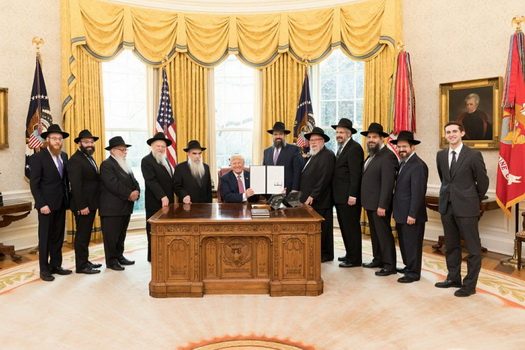
President Trump proclaiming Education and Sharing Day 2018. (Photo Credit: The White House)
By Alison Weir | If Americans Knew | April 6, 2020
President Donald Trump recently proclaimed April 3rd “Education and Sharing Day, U.S.A,” a national day to “celebrate Rabbi Menachem Mendel Schneerson, the Lubavitcher Rebbe.”
The proclamation called upon “all government officials, educators, volunteers, and all the people of the United States to observe this day with appropriate programs, ceremonies, and activities.”
This was not the first such proclamation. For 42 years presidents from both parties have proclaimed a national day to honor Rabbi Schneerson.
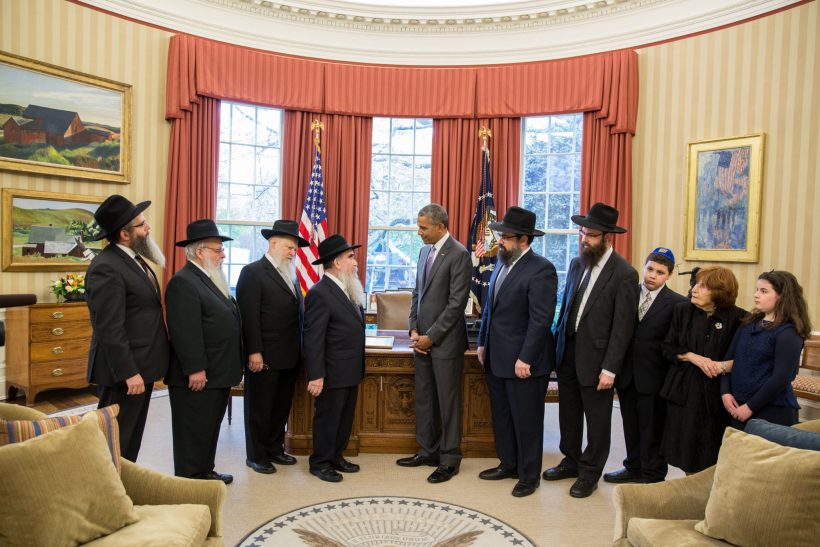
President Barack Obama presents a ceremonial copy of the Education and Sharing Day Proclamation that he issued on March 31, 2015 to a delegation from the American Friends of Lubavitch in the Oval Office, April 27, 2015. (Official White House Photo by Pete Souza) (ObamaWhiteHouse)
What they probably didn’t know is that some of Schneerson’s lesser-known teachings are extremely problematic on a number of levels. Among other things, they help fuel some of the most violent attacks against Palestinians by extremist Israeli settlers and soldiers.
For example, Schneerson taught that non-Jews were “created to serve the Jews.”
To learn about Schneerson and his teachings, read the following article that I wrote six years ago, when Barack Obama played his role in the yearly tribute.
Please note that the information in the article comes largely from Jewish and Israeli sources. A list of the sources used in the article is provided below it.
The main source, Israel Shahak, was a respected Israeli professor who had been praised by Noam Chomsky, Institute Professor Emeritus, Massachusetts Institute of Technology (MIT); Edward Said, Columbia Professor and public intellectual; and diverse others.
It is my feeling that all Americans should know the facts reported below. Year after year after year, American citizens are being told to honor Rabbi Schneerson. We need to know what The Rebbe taught, consider the implications for us and for others, and decide for ourselves whether we agree with the annual decree that we celebrate his views.
***
Why is the US Honoring a Racist Rabbi?
By Alison Wier | CounterPunch | April 7, 2014
If things proceed normally, President Barak Obama will soon proclaim April 11, 2014 “Education and Sharing Day, U.S.A.” Despite the innocuous name, this day honors the memory of a religious leader whose lesser-known teachings help fuel some of the most violent attacks against Palestinians by extremist Israeli settlers and soldiers.
The leader being honored on this day is Rabbi Menachem Mendel Schneerson, charismatic head of a mystical/fundamentalist version of Judaism. Every year since 1978, a Presidential Proclamation, often accompanied by a Congressional Resolution (the 1990 one had 219 sponsors), has declared Schneerson’s birthday an official national day of observance.
Congress first passed a Resolution honoring Schneerson in 1975. Three years later a Joint Congressional Resolution called on President Jimmy Carter to proclaim “Education Day, U.S.A.” on the anniversary of Schneerson’s birth. The idea was to set aside a day to honor both education and the alleged educational work of Schneerson and the religious sect he headed up.
Carter, like Congress, dutifully obeyed the Schneerson-initiated resolution, as has every president since. And some individual states are now enacting their own observances of Schneerson’s birthday, with Minnesota and Alabama leading the way.
Schneerson and his movement are an extremely mixed bag.
Schneerson has been praised widely for a public persona and organization that emphasized “deep compassion and insight,” worked to bring many secular Jews “back” into the fold, created numerous schools around the world, and had offered, in the words of the Jewish Virtual Library, “social-service programs and humanitarian aid to all people, regardless of religious affiliation or background.”
However, there is also a less attractive underside often at odds with such public perceptions. And some of the more extreme parts of Schneerson’s teachings – such as that Jews are a completely different species than non-Jews, and that non-Jews exist only to serve Jews – have been largely hidden, it appears, even from many who consider themselves his followers.
As we will see, such views profoundly impact the lives of Palestinians living – and dying – under Israeli occupation and military invasions.
Who was Rabbi Schneerson?
Schneerson lived from 1902 to 1994 and oversaw the growth of what is now the largest Jewish organization in the world. The religious movement he led is known as “Chabad-Lubavitch,” (sometimes just called “Lubavitch” or “Chabad,” the name of its organizational arm). Schneerson was the seventh and final Lubavitcher “Rebbe” (sacred leader). He is often simply called “the Rebbe.”
Founded in the late 1700s and originally based in the Polish-Russian town of Lubavitch, it is the largest of about a dozen forms of “Hasidism,” a version of Orthodox Judaism connected to mysticism, characterized by devotion to a dynastic leader, and whose adherents often wear distinctive clothing. (Spellings of these terms can vary; Hasid is also written as Hassid, Chasid, etc.)
There is an extreme cult of personality focused on Schneerson himself. Some followers consider him the Messiah, and Schneerson himself reportedly sometimes implied this was true. Some Lubavitch educators consider him divine, making such claims as, “the Rebbe is actually ‘the essence and being [of God] … he is without limits, capable of effecting anything, all-knowing and a proper object of worshipful prostration.”
While many secular Jews and Jews from other denominations disagree with its actions and theology, Chabad-Lubavitch is generally acknowledged to be a powerful force in Jewish life today. According to a 1994 New York Times report, it is “one of the most influential and controversial forces in world Jewry.”
There are approximately 3,600 Chabad institutions in over 1,000 cities in 70 countries, and 200,000 adherents. Up to a million people attend Chabad services at least once a year. Numerous campuses have such centers and the Chabad website states that hundreds of thousands of children attend Chabad summer camps.
According to the Times, Schneerson “presided over a religious empire that reached from the back streets of Brooklyn to the main streets of Israel and by 1990 was taking in an estimated $100 million a year in contributions.
In the U.S., the Times reports, Schneerson’s “‘mitzvah tanks’ – converted campers that are rolling recruiting stations whose purpose is to draw Jews to the Lubavitch way – roamed streets from midtown Manhattan to Crown Heights. And the Lubavitchers’ Brooklyn-based publishing house claimed to be the world’s largest distributor of Jewish books.”
Non-Jewish souls ‘satanic’
While Chabad sometimes openly teaches that “the soul of the Jew is different than the soul of the non-Jew,” Schneerson’s specific teachings on this subject are largely unknown.
Quite likely very few Americans, both Jews and non-Jews, are aware of Schneerson’s teachings about the alleged deep differences between them – and about how these teachings are applied in the West Bank and Gaza.
Let us look at Schneerson’s words, as quoted by two respected Jewish professors, Israel Shahak and Norton Mezvinsky, in their book Jewish Fundamentalism in Israel (text available online here. This book, praised by Noam Chomsky, Edward Said, and many others is essential reading for anyone who truly wishes to understand modern day Israel-Palestine. (Brackets in the quotes below are in the translations by Shahak and Mezvinsky.)
Some of Schneerson’s rarely reported teachings:
“The difference between a Jewish and a non-Jewish person stems from the common expression: “Let us differentiate.” Thus, we do not have a case of profound change in which a person is merely on a superior level. Rather, we have a case of “let us differentiate” between totally different species.”
“This is what needs to be said about the body: the body of a Jewish person is of a totally different quality from the body of [members] of all nations of the world … The difference in the inner quality between Jews and non-Jews is “so great that the bodies should be considered as completely different species.”
“An even greater difference exists in regard to the soul. Two contrary types of soul exist, a non-Jewish soul comes from three satanic spheres, while the Jewish soul stems from holiness.”
“As has been explained, an embryo is called a human being, because it has both body and soul. Thus, the difference between a Jewish and a non-Jewish embryo can be understood.”
“…the general difference between Jews and non-Jews: A Jew was not created
as a means for some [other] purpose; he himself is the purpose, since the substance of all [divine] emanations was created only to serve the Jews.”
“The important things are the Jews, because they do not exist for any [other] aim; they themselves are [the divine] aim.”
“The entire creation [of a non-Jew] exists only for the sake of the Jews.”
Most people don’t know about this aspect of Schneerson’s teaching because, according to Shahak and Mezvinsky, such teachings are intentionally minimized, mistranslated, or
hidden entirely.
For example, the quotes above were translated by the authors from a book of Schneerson’s recorded messages to followers that was published in Israel in 1965. Despite Schneerson’s global importance and the fact that his world headquarters is in the U.S., there has never been an English translation of this volume.
Shahak, an Israeli professor who was a survivor of the Nazi holocaust, writes that this lack of translation of an important work is not unusual, explaining that much critical information about Israel and some forms of Judaism is available only in Hebrew.
He and co-author Mezvinsky, who was a Connecticut Distinguished University Professor who taught at Central Connecticut State University, write, “The great majority of the books on Judaism and Israel, published in English especially, falsify their subject matter.”
According to Shahak and Mezvinsky, “Almost every moderately sophisticated Israeli Jew knows the facts about Israeli Jewish society that are described in this book. These facts, however, are unknown to most interested Jews and non-Jews outside Israel who do not know Hebrew and thus cannot read most of what Israeli Jews write about themselves in Hebrew.”
In Shahak’s earlier book, Jewish Religion, Jewish History, he provides a number of examples. In one, he describes a 1962 book published in Israel in a bilingual edition. The Hebrew text was on one page, with the English translation on the facing page.
Shahak describes one set of facing pages in which the Hebrew text of a major Jewish code of laws contained a command to exterminate Jewish infidels: “It is a duty to exterminate them with one’s own hands.” The English version on the facing page softened it to “It is a duty to take active measures to destroy them.’”
The Hebrew page then went on to name which “infidels” must be exterminated, adding “may the name of the wicked rot.” Among them was Jesus of Nazareth. The facing page with the English translation failed to tell any of this.
“Even more significant,” Shahak reports, “in spite of the wide circulation of this book among scholars in the English-speaking countries, not one of them has, as far as I know, protested against this glaring deception.”
Praised by Said, Chomsky, etc., Shahak is almost unknown today
This pattern of selective omission, it seems, applies to Shahak himself, whose work is largely unknown to Palestine activists today, even though he was considered a major figure in the struggle against Israeli oppression of Palestinians, and his work was praised by diverse writers.
While Shahak was alive, Noam Chomsky called him “an outstanding scholar,” and said he had “remarkable insight and depth of knowledge. His work is informed and penetrating, a contribution of great value.”
Edward Said wrote, “Shahak is a very brave man who should be honored for his services to humanity … One of the most remarkable individuals in the contemporary Middle East.” Said wrote a forward for Shahak’s Jewish History, Jewish Religion.
Catholic New Times said: ‘This is a remarkable book …[It] deserves a wide readership, not only among Jews, but among Christians who seek a fuller understanding both of historical Judaism and of modern-day Israel.”
Jewish Socialist stated: “Anyone who wants to change the Jewish community so that it stops siding with the forces of reaction should read this book.”
The London Review of Books called Shahak’s book “remarkable, powerful, and provocative.”
Yet, very few Americans today know of Shahak’s work and the information it contains.
American tax money & Jewish Extremism in Palestine
If they did, it’s hard to believe that Americans would allow $8.5 million per day of their tax money to be given to Israel, where such teachings underlie a powerful minority that is disproportionately influential in governmental actions.
Nor is it likely that a fully informed American public would allow donations to religious institutions in Israel that teach supremacist, sometimes violent doctrines to be tax-deductible in the U.S.
One organization raised over $10 million tax-deductible dollars in the U.S. in 2011 alone – removing money from the U.S. economy and enabling illegal, aggressive Israeli settlements in Palestine. And some of this money went to benefit individuals convicted of murder – including the murderer of Israeli Prime Minister Yitzhak Rabin.
The New York Times obituary on Schneerson reported that Schneerson was “a major political force in Israel, both in the Knesset and among the electorate,” but failed to describe the nature of his impact.
One of a sprinkling of writers willing to publicly discuss Shahak and Mezvinsky’s findings is Allan Brownfeld, who is less reticent. Brownfeld is editor of the American Council for Judaism’s periodical Issues and contributor to the Washington Report on Middle East Affairs.
In a review of Jewish Fundamentalism in Israel, Brownfeld describes Schneerson’s views on Israel:
“Rabbi Schneerson always supported Israeli wars and opposed any retreat. In 1974 he strongly opposed the Israeli withdrawal from the Suez area. He promised Israel divine favors if it persisted in occupying the land.”
Brownfeld reports that after Schneerson’s death, “[T]housands of his Israeli followers played an important role in the election victory of Binyamin Netanyahu. Among the religious settlers in the occupied territories, the Chabad Hassids constitute one of the most extreme groups. Baruch Goldstein, the mass murderer of Palestinians, was one of them.”
Another such Chabad Hassid is Rabbi Yitzchak Ginsburg (also sometimes written as “Ginzburg” and “Ginsburgh”), who studied under Schneerson in Crown Heights and who heads up a major Chabad institution in the West Bank.
Ginsburg praised Goldstein, the murderer of 29 Palestinians while they were praying, and considers all non-Jews subhuman.
According to author Motti Inbari, Ginsburg “gives prominence to Halachic and Kabbalistic approaches that emphasize the distinction between Jew and non-Jew (Gentile), imposing a clear separation and hierarchy in this respect.”
In his book Jewish Fundamentalism and the Temple Mount: Who Will Build the Third Temple? Inbari states, “[Ginsburg] claims that while the Jews are the Chosen People and were created in God’s image, the Gentiles do not have this status and are effectively considered subhuman.”
Professor Inbari, an Israeli academic who now teaches in the U.S., writes that Ginsburg’s theological approach continues “certain perceptions that were popular in medieval times.”
“For example,” Inbari writes, “the commandment ‘You shall not murder’ does not apply to the killing of a Gentile, since ‘you shall not murder’ relates to the murder of a human, while for him the Gentiles do not constitute humans.”
Inbari reports, “Similarly, Ginzburg stated that, on the theoretical level, if a Jew requires a liver transplant to survive, it would be permissible to seize a Gentile and take their liver forcefully.”
While the mainstream American press almost never reports this kind of information, an April 26, 1996 article in Jewish Week by Lawrence Cohler reported on Ginsburg’s teachings, including their problematic roots in Jewish texts.
Cohler reported that a professor of Bible at Hebrew University in Jerusalem, Rabbi Moshe Greenberg, “called for radically revising Jewish thinking about some Jewish texts on the grounds that scholars such as Rabbi Ginsburgh are far from aberrant in their use of them.”
Cohler quoted Greenberg’s concerns: “‘There’ll be a statement in Talmud… made in circumstances where it’s purely theoretical, because Jews then never had the power to do it,’ he explained. And now, he said, ‘It’s carried over into circumstances where Jews have a state and are empowered.’”
A rabbi associated with Ginsburg coauthored a notorious Israeli book, The King’s Torah, which claims that Jewish law at times permits the killing of non-Jewish infants. American donations to the Chabad school Ginsburg heads up, and that published the above book, are tax-deductible in the U.S. Ginsburg, who endorses the book, teaches classes throughout Israel, the U.S. and France.
Such extremism is opposed by the majority of Israelis, and major Jewish religious authorities condemn it, a Chief Rabbi, for example, stating: “’According to the Torah, every man is created in God’s image.”
Yet, such extremist views continue to exert a powerful influence.
Israeli military manuals echo extremist teachings: “kill even good civilians”
Israeli military manuals sometimes replicate extremist teachings. For example, a booklet authored by a Chief Chaplain stated, “In war, when our forces storm the enemy, they are allowed and even enjoined by the Halakhah to kill even good civilians…” Such teachings by the IDF rabbinate were prominent during Israel’s 2008-9 attack on Gaza that killed 1,400 Gazans, approximately half of them civilians. (The Palestinian resistance killed nine Israelis during this “war.”)
Chicago writer Stephen Lendman has described these teachings, giving a number of examples.
Lendman writes, “In 2007, Israel’s former chief rabbi, Mordechai Elyahu, called for the Israeli army to mass-murder Palestinians:
“If they don’t stop after we kill 100, then we must kill 1000. And if they don’t stop after 1000, then we must kill 10,000. If they still don’t stop we must kill 100,000. Even a million.”
Lendman reports that some extremist Israeli rabbis teach that “the ten commandments don’t apply to non-Jews. So killing them in defending the homeland is acceptable, and according to the chairman of the Jewish Rabbinic Council:
“‘There is no such thing as enemy civilians in war time. The law of our Torah is to have mercy on our soldiers and to save them…. A thousand non-Jewish lives are not worth a Jew’s fingernail.’”
Lendman writes, “Rabbi David Batsri called Arabs ‘a blight, a devil, a disaster…. donkeys, and we have to ask ourselves why God didn’t create them to walk on all fours. Well, the answer is that they are needed to build and clean.’”
Another such rabbi is Manis Friedman, a Chabad-Lubavitch rabbi inspired by Schneerson who served as the simultaneous translator for a series of Schneerson’s talks. (Friedman is currently dean of a Jewish Studies institute in Minnesota.)
A 2009 article in the Israeli newspaper Ha’aretz reports, “Like the best Chabad-Lubavitch rabbis, Manis Friedman has won the hearts of many unaffiliated Jews with his charismatic talks about love and God; it was Friedman who helped lead Bob Dylan into a relationship with Chabad.
“But Friedman, who today travels the country as a Chabad speaker, showed a less warm and cuddly side when he was asked how he thinks Jews should treat their Arab neighbors.”
In Moment magazine’s article, “Ask the Rabbis // How Should Jews Treat Their Arab Neighbors?” Friedman answered:
“I don’t believe in western morality, i.e. don’t kill civilians or children, don’t destroy holy sites, don’t fight during holiday seasons, don’t bomb cemeteries, don’t shoot until they shoot first because it is immoral.
“The only way to fight a moral war is the Jewish way: Destroy their holy sites. Kill men, women and children (and cattle).”
Lendman reports, “Views like these aren’t exceptions. Though a minority, they proliferate throughout Israeli society…”
They also, Lendman notes, work to prevent peace in Israel-Palestine.
Shahak and Mezvinsky note that when the book containing Schneerson’s statements quoted above about Jews and non-Jews was published in Israel, he was allied to the Labor Party and his movement had been provided “many important benefits” from the Israeli government.
In the mid-1970s Schneerson decided that the Labor Party was too moderate and shifted his support to the more right-wing parties in power today. The authors report, “Ariel Sharon was the Rebbe’s favorite Israeli senior politician. Sharon in turn praised the Rebbe publicly and delivered a moving speech about him in the Knesset after the Rebbe’s death.”
Roots in Some Early Texts
Brownfeld decries the fact that few Americans are properly informed about the fundamentalist movement in Israel “and the theology upon which it is based.”
He notes that Jewish Americans, in particular, are often unaware of the “narrow ethnocentrism which is promoted by the movement’s leading rabbis, or of the traditional Jewish sources they are able to call upon in drawing clear distinctions between the moral obligations owed to Jews and non-Jews.”
Teachings that Jews are superior and gentiles inferior were contained in some of the earliest Hassidic texts, including its classic text, “Tanya,” still taught today.
Brownfeld quotes statements by “the revered father of the messianic tendency of Jewish fundamentalism,” Rabbi Kook the Elder, and states that these were derived from earlier texts. [Kook, incidentally, was also an early Zionist, who helped push for the Balfour Declaration in England before moving to Palestine. He was the uncle of Hillel Kook, an agent who went by the name “Peter Bergson” and created front groups in the U.S. for a violent Zionist guerilla group that operated in 1930s and ’40s Palestine.]
Brownfeld quotes Kook: “The difference between a Jewish soul and souls of non-Jews—all of them in all different levels—is greater and deeper than the difference between a human soul and the souls of cattle.”
Brownfeld explains that Kook’s teaching, which he says is followed by leaders of the settler movement in the occupied West Bank, “is based upon the Lurianic Cabbala, the school of Jewish mysticism that dominated Judaism from the late 16th to the early 19th century.”
Shahak and Mezvinsky state, “One of the basic tenets of the Lurianic Cabbala is the absolute superiority of the Jewish soul and body over the non-Jewish soul and body. According to the Lurianic Cabbala, the world was created solely for the sake of Jews; the existence of non-Jews was subsidiary.”
Again, Shahak and Mezvinsky report that this aspect is often covered up in English-language discussions. Scholarly authors of books about Jewish mysticism and the Lurianic Cabbala, they write, have frequently “willfully omitted reference to such ideas.”
Shahak and Mezvinsky write that it is essential to understand these beliefs in order to understand the current situation in the West Bank, where many of the most militant West Bank settlers are motivated by religious ideologies in which every non-Jew is seen as “the earthly embodiment” of Satan, and according to the Halacha (Jewish law), the term ‘human beings’ refers solely to Jews.”
Israeli author and former chief of Israeli military intelligence Yehoshafat Harkabi touches on this in his 1988 book Israel’s Fateful Hour.
Harkabi writes that while such extremist beliefs are not “widely dominant,” the reality is that “nationalistic religious extremists are by no means a lunatic fringe; many are respected men whose words are widely heeded.”
He reports that the campus rabbi of a major Israeli university published an article in the student newspaper entitled “The Commandment of Genocide in the Torah,” in which he implied that those who have a quarrel with Jews “ought to be destroyed, children and all.” Harkabi writes that a book by another rabbi “explained that the killing of a non-Jew is not considered murder.”
Brownfeld writes, “Although messianic fundamentalists constitute a relatively small portion of the Israeli population [most Israeli settlers are motivated by the subsidized lifestyle US tax money to Israel provides], their political influence has been growing. If they have contempt for non-Jews, their hatred for Jews who oppose their views is even greater.”
Brownfeld cites the murder of Israeli Prime Minister Yitzhak Rabin, who had started to make peace with the Palestinians, writing that it was just one “in a long line of murders of Jews who followed a path different from that ordained by rabbinic authorities.” Brownfeld reports that Shahak and Mezvinsky “cite case after case, from the Middle Ages until the 19th century.”
The authors report, “It was usual in some Hasidic circles until the last quarter of the nineteenth century to attack and often to murder Jews who had reform religious tendencies…”
They quote a long article by Israeli writer Rami Rosen, “History of a Denial,” published by Ha’aretz Magazine in 1996. This article, which cannot be found online, at least in English, is also cited in the book Brother Against Brother: Violence and Extremism in Israeli Politics from Altalena to the Rabin Assassination, by Israeli professor Ehud Sprinzak.
In his Ha’aretz article Rosen reported: “A check of main facts of the [Jewish] historiography of the last 1500 years shows that the picture is different from the one previously shown to us. It includes massacres of Christians; mock repetitions of the crucifixion of Jesus that usually took place on Purim; cruel murders within the family; liquidation of informers, often done for religious reasons by secret rabbinical courts, which issued a sentence of ‘pursuer’ and appointed secret executioners; assassinations of adulterous women in synagogues and/or the cutting of their noses by command of the rabbis.”
While Rosen’s article may seem shocking, in reality, it simply shows that members of the Jewish population, like members of Christian, Muslim, Hindu, and diverse other populations, have at times committed atrocities, sometimes allegedly in the name of their religion. The difference, as Shahak and Mezvinsky point out, is that such information is largely covered up in the U.S. Such cover-ups, however, don’t make facts go away. They merely bury them, where they smolder and at times eventually lead to exaggerated perceptions.
U.S. media rarely report that some extremist Israeli settlers are intensely hostile to Christians, and in one instance threatened peace activists who came to the West Bank to participate in nonviolent demonstrations, “We killed Jesus and we’ll kill you, too.” There is also a record of official hostility. For example, a few years ago an Israeli mayor ordered all New Testaments to be rounded up and burned.
Schneerson’s “schools”
While Schneerson is honored on national “Education” days, the reality is that the elementary schools he created often failed to teach children “basic reading, writing, spelling, math, science and history,” according to a graduate.
In his article “National Education Day and the Education I Never Had,” Chaim Levin reports on his experience at the Chabad school “Oholei Torah” (Educational Institute Oholei Menachem) in Crown Heights, New York – the site of Chabad’s world headquarters:
“I have profound respect for the late Rebbe and his legacy. However, I remember very clearly those talks that [Schneerson] gave – the ones we studied every year in elementary school about the unimportance of ‘secular’ (non-religious, formal) education, and the great importance of only studying limmudei kodesh (holy studies). As a result of this attitude, thousands of students were not taught anything other than the Bible throughout our years attending Chabad institutions.”
The goal of such schools, Levin writes, was to produce “schluchim,” missionaries who would promote Chabad all over the world.
Meanwhile, he notes, “Failure to provide basic formal education cripples children within Chabad communities. We cannot ignore the harm done…” Levin writes, “Until this day, Oholei Torah and many other Chabad schools — particularly schools for boys and a few for girls in Crown Heights and in some other places — do not provide basic formal education.”
Education and Sharing Day 2014
In his 2000 article, Brownfeld writes that Shahak and Mezvinsky’s book should be “a wake-up call “to Americans, particularly Jewish supporters of Israel.”
Fourteen years later, however, very few people are aware of these books and their powerful information, and U.S. tax money continues to flow to Israel. The main author, Israel Shahak, is now dead, as is Edward Said; Noam Chomsky rarely, if ever, mentions him; and Shahak’s co-author, Norton Mezvinsky (uncle of Chelsea Clinton’s husband), is a member of a Lubavitch congregation in New York.
In many ways, little seems to have changed since 1994, when Congressmen Charles Schumer, Newt Gingrich, and others introduced legislation to bestow on Schneerson the Congressional Gold Medal. The bill passed both Houses by unanimous consent, honoring Schneerson for his “outstanding and lasting contributions toward improvements in world education, morality, and acts of charity.”
And in two weeks, Americans will be officially called on to observe a day that honors Rabbi Menachem Mendel Schneerson and the Lubavitcher movement.
That is, unless masses of people contact their Congressional representatives to demand a whole new direction: a “National Education and Sharing Day” that honors an individual who values education, and who believes that all people – in the words of the Declaration of Independence – are created equal.
Works Cited
“About Chabad-Lubavitch.” Judaism, Torah and Jewish Info – Chabad Lubavitch. N.p., n.d. Web.
Barillas, Martin. “US Court Finds That Chabad Can Sue for the Return of Precious Archives Held by Russia.” The Cutting Edge News. N.p., 23 June 2008. Web.
Blau, Uri. “From New York to Hebron: The American Treasury’s Support for Jewish Settlements in the West Bank.” Edmond J. Safra Center for Ethics. Harvard University, 26 Sept. 2013. Web. 03 Apr. 2014.
Brownfeld, Allan C. “Book Review: Jewish Fundamentalism in Israel.” Washington Report on Middle East Affairs Mar. 2000: 105-06. Web. 31 Mar. 2014.
“Chabad Worldwide Genealogy Project.” Geni_family_tree. Geni, n.d. Web. 02 Apr. 2014.
Cohler, Lawrence. “Hero Or Racist? Are Jewish Lives Really More Valuable than Non-Jewish Ones?” Jewish Week [New York] 16 Apr. 1996: 12+. Print.
Cowell, Alan. “AN ISRAELI MAYOR IS UNDER SCRUTINY.” The New York Times. The New York Times, 05 June 1989. Web.
“David Hartman: The Rise of Extremism and the Decline of Reason.” YouTube. Shalom Hartman Institute, 09 Mar. 2009. Web. Apr.-May 2014.
“Ehud Sprinzak, 62; Studied Israel Far Right.” The New York Times. Associated Press, 12 Nov. 2002. Web.
Eldar, Akiva. “U.S. Tax Dollars Fund Rabbi Who Excused Killing Gentile Babies Read More: http://www.haaretz.com/print-edition/features/akiva-eldar-u-s-tax-dollars-fund-rabbi-who-excused-killing-gentile-babies-1.2137.” Ha’aretz [Israel] 15 Dec. 2009: n. pag. Web.
Estrin, Daniel. “The King’s Torah: A Rabbinic Text or a Call to Terror?” Haaretz.com. N.p., 22 Jan. 2010. Web.
Friedman, Manis. “Ask the Rabbis // How Should Jews Treat Their Arab Neighbors?” Moment Magazine. N.p., May-June 2009. Web.
Goldman, Ari L. “Rabbi Schneerson Led A Small Hasidic Sect To World Prominence.” New York Times 13 June 1994, US Edition ed., N.Y./Region sec.: n. pag. Print.
Group, ISM Media. “Swedish Human Rights Worker Viciously Attacked by Jewish Extremists in Hebron.” International Solidarity Movement. N.p., 18 Nov. 2006. Web.
Harkabi, Yehoshafat. Israel’s Fateful Hour. New York: Harper & Row, 1989. Print.
Heilman, Samuel C., and Menachem Friedman. The Rebbe: The Life and Afterlife of Menachem Mendel Schneerson. Princeton, NJ: Princeton UP, 2012. Print.
Inbari, Motti. Jewish Fundamentalism and the Temple Mount: Who Will Build the Third Temple? Albany: State U of New York, 2009. Print. Translated by Shaul Vardi
Lendman, Stephen. “Religious Fundamentalism in Israel.” OpEdNews. N.p., 12 Aug. 2009. Web.
Levin, Chaim. “National Education Day and the Education I Never Had.” The Huffington Post. N.p., 04 Apr. 2012. Web.
Likshin, Martin I. “Chabad Messianism.” My Jewish Learning. N.p., 17 Jan. 2002. Web. 02 Apr. 2014.
Mezvinsky, Norton, and Israel Shahak. Jewish Fundamentalism in Israel. London: Pluto, 2015. Print.
Novak, David. “The Man-Made Messiah.” First Things. InstituInstitute on Religion and Public Lifete on Religion and Public Life, 2014. Web. 03 Apr. 2014.
Odenheimer, Natan. “The Kabbalist Who Would Be King of a New Jewish Monarchy in Israel.” The Forward. N.p., 14 Oct. 2016. Web. 03 Mar. 2017. (Article on Rabbi Ginsburgh published in 2016)
“Orthodox Judaism.” Lubavitch and Chabad. Jewish Virtual Library, n.d. Web. 02 Apr. 2014.
Popper, Nathaniel. “Popular Rabbi’s Comments on Treatment of Arabs Show a Different Side of Chabad.” The Forward. N.p., 03 June 2009. Web.
“Rabbi Menachem Mendel Schneerson.” Rabbi Menachem Mendel Schneerson| Jewish Virtual Library. Jewish Virtual Library, 13 June 1994. Web. 02 Apr. 2014.
“A Rabbinate Gone Wild.” Ha’aretz [Israel] 27 Jan. 2009: n. pag. Print. Ha’aretz Editorial
“Rabbis in the Caucus Room?” Lubavitch Archives | Article. N.p., n.d. Web. 02 Mar. 2017.
Shahak, IsraeÍÌl, and Gore Vidal. Jewish History, Jewish Religion: The Weight of Three Thousand Years. London: Pluto, 2008. Print.
Shahak, Israel, and Norton Mezvinsky. “Full Text of “Jewish Fundamentalism in Israel”.” Full Text of “Jewish Fundamentalism in Israel”. Archive.org, n.d. Web.
Sprinzak, Ehud. Brother Against Brother: Violence and Extremism in Israeli Politics from Altalena to the Rabin Assassination. New York, NY: Free, 1999. Print.
The Tanya of Rabbi Schneur Zalman of Liadi, Elucidated by Rabbi Yosef WinebergPublished and Copyrighted by Kehot Publication Society. “The Tanya Chapter 1.” Chabad.org. N.p., n.d. Web.
Torossian, Ronn. “The First Jewish Start-Up Nation ? Chabad: Marketing Genius.” Jewocity.com. N.p., 07 June 2012. Web. 03 Apr. 2014.
“Vintage Satellite Footage Promotes Web Event.” Jewish Educational Media. N.p., 8 Apr. 2011. Web.
Wagner, Matthew. “Netanyahu’s UN Speech Inspired by The Rebbe.” Chabad Lubavitch of Alberta. Jerusalem Post, n.d. Web. 03 Apr. 2014.
Weir, Alison. Against Our Better Judgment: The Hidden History of How the U.S. Was Used to Create Israel. Charleston, NC: CreateSpace, 2014. Print.
Alison Weir is executive director of If Americans Knew and president of the Council for the National Interest. Her book, Against Our Better Judgment: How the U.S. was used to create Israel, contains additional information on Rabbi Kook’s family connection to American front groups for Israeli terrorists.
Israel settlements turn Palestinian house into cage
![The Gharibs' house in Beit Ijza, caged by a fence and surrounded by the Israeli settlement of Givon Hahadasha, as seen here in a 2018 sattelite image, west of Jerusalem [screen grab from Geomolg]](https://i0.wp.com/www.middleeastmonitor.com/wp-content/uploads/2020/04/20200404_Satellite_Image_Givon-Hahadasha.jpg?resize=1200%2C800&quality=85&strip=all&ssl=1)
The Gharibs’ house in Beit Ijza, caged by a fence and surrounded by the Israeli settlement of Givon Hahadasha, as seen here in a 2018 satellite image. [screen grab from Geomolg]
MEMO | April 4, 2020
Palestinian Saadat Sabri Gharib, 38, had never imagined that his house, which was built by his father in 1979, would be turned into a very narrow cage surrounded by barbed wire and surveillance cameras.
Gharib’s house is located in the Biet Ijza neighbourhood, west of occupied Jerusalem. It was surrounded by about 100 dunams of land owned by Gharib’s father. However, the Israeli settlers stole all of this land and kept the house, which is only 500-metres square.
Gharib told Anadolu Agency, that since 2008, his house has been turned into a very small cage surrounded with concrete walls and located in the middle of an Israeli settlement. It has only a very narrow passage with 12 cameras monitoring it.
Gharib, his mother, his wife and three children live in this house. “Our house is a real prison,” he explains, adding: “It is surrounded with wires from all sides. It was built in the middle of a wide area of land, but today it is a small prison in the middle of Giv’on Hahadasha settlement.”
“We are subjected to stone throwing, live bullet shooting, insulting and burning,” Gharib, who owns all the documents that prove the ownership of the land, revealed.
“However, we had seven demolition orders, but I fought in the Israeli courts and stopped them,” stating that 40 dunams were stolen by the Israeli occupation authorities in 1979 and 60 dunams were isolated from his house by the apartheid wall in 2007. “We do not access them except once a year with permission from the Israeli occupation,” Gharib explains, noting that his house is monitored 24/7.
In 1979, the settlers offered his father a large amount of money for the land, but he refused and said: “If you give me all of Israel’s money, I would never concede an inch of my land.”
Later on, the Israeli occupation stole it with its settlement power.
Putting pressure on Gharib in order to leave his house, the Israeli occupation prevents him from planting any trees near his house, from carrying out any renovation works or from making any repairs.
Gharib points out:
“A few months ago, the water tank was damaged and I wanted to change it, but Israel refused. They want to push us to leave our house. But if the house was demolished, I would live in a tent. I will never leave my family’s house to the settlers.
“We live a very difficult life. The gate of the passage leading to my house is controlled by the Israeli occupation and could be closed any time. In 2008, it was closed for three consecutive months, but we fought until it was opened 24 hours a day.”
Around 900 Palestinians live in Beit Ijza, which was part of Jerusalem before the 1967 Israeli occupation of the West Bank. Since the creation of the Palestinian Authority in 1993, Beit Ijza became part of the Palestinian Governorate of Jerusalem Suburbs.
This neighbourhood is one of many others which were isolated from Jerusalem by the apartheid wall, so they were connected with the occupied West Bank through tunnels or bridges.
According to the Palestinian Bureau of Statistics, more than 50,000 Palestinians holding Jerusalem’s ID cards were isolated by the apartheid wall and deprived from living in Jerusalem.
In 2002, Israel decided to build a 710-kilometre wall to separate the occupied West Bank from Israel and the illegal Israeli settlements in the depths of the occupied territories.
Israel prevents Palestinians from combating COVID-19
By Robert Inlakesh | Press TV | April 3, 2020
As the COVID-19 pandemic death toll grows and the number of those infected creeps past one million confirmed cases, worldwide, the Palestinian health workers of Gaza and the West Bank try desperately to prevent the spread of the virus in the occupied territories. Unfortunately, however, this effort has been severely compromised by the Israeli occupation forces.
An issue almost completely overlooked by Western corporate media, is the issue of Israeli persecution of Palestinians during the ongoing pandemic. This major cover-up comes despite the fact that there is currently round the clock coverage of the impacts of the novel coronavirus.
Israel has continued its brutal policies of mistreatment of Palestinian political prisoners, massive arrest campaigns, break-ins, killings, bombings and even crimes specific to the pandemic, which we are currently living through, such as the destroying emergency clinics which have been set up to deal with the virus outbreak and also the dumping sick Palestinians outside of checkpoints.
If ever there was a time that the world would see unity between the oppressed and the oppressors, it would surely be at a time when the whole world is collectively under attack by an enemy of the collective which is not only infecting and killing people, but destroying the world economy. However, unfortunately, this has not been the case between Palestinians and the Israeli occupation.
Just in the past few weeks alone, Israeli occupation forces have continued arresting and detaining Palestinian minors in both the West Bank and East Jerusalem al-Quds. Also continuing to raid and attack Palestinians who are attempting to self isolate and practice social distancing in order to combat the spread of COVID-19.
On Sunday the 22nd of March, Israeli occupation forces killed a 32 year old Palestinian man, from the village of Nilin (near central Ramallah), in the West Bank. The 32 year old was shot in the head whilst driving his car and according to his family was simply running errands. Since then, dozens more have been shot and severely injured.
Palestinian political prisoners who are currently being held in Israeli prisoners are also fearful for their lives, some announcing hunger strikes over the lack of precautionary measures taken by the Israeli prisons. All Palestinian prisoners will now be essentially in the dark, as social distancing measures are in place, preventing any physical communication with loved ones. On top of this, a recently released Palestinian prisoner has, according to reports, tested positive for the novel coronavirus.
Israeli artillery strikes have also been reported as having hit three different areas inside of the illegally besieged Gaza Strip, just last week. Israel claimed this came after an unspecified number of rockets were fired, no damage was reported inside of Israel however. This bombardment of Gaza ignores the UN global call for ceasefire, which Israel has joined the likes of Saudi Arabia and the United States in already abandoning. Israel has continued running mock raids on Gaza since last week’s airstrikes.
Israel has also been documented as having dumped Palestinians who work in illegal settlements, randomly, outside checkpoints after the workers have displayed signs of sickness. One specific case gathering a lot of attention on social media, the Palestinian Health Ministry later confirmed that the man who had been featured in the video, did not test positive for the virus.
What Israel shows with its dealings with sick Palestinian workers, demonstrates its clearly racist views towards Palestinians, treating Palestinians as if they were animals that can be simply discarded of if they seem to pose a health risk.
According to Israeli Human Rights Organization BTselem, on the 26th of March, the Israeli military stormed the Palestinian village of Khirbet Ibziq, accompanied by a military escort with a bulldozer and two cranes, which they used to demolish an emergency clinic and community housing. The facilities were created to deal with the outbreak of the virus, which the Palestinian Authority, based in Ramallah, are ill-equipped to deal with in the event that the disease becomes more wide spread. The Israeli forces also confiscated equipment being used to combat the spread of COVID-19 on that day.
These are but only a sample of the problems faced by Palestinians under occupation, when it comes to dealing with the outbreak of COVID-19. But without using more examples of racist persecution, it is essential that we ask the question; that if Israel cannot put aside its dehumanizing tactics used against the Palestinian people now and cannot put aside its racism during a global pandemic, what will defeat this divisive mentality of the occupier?
Virginia Goes Zionist
Jewish power manifest in the Old Dominion

By Philip Giraldi • Unz Review • March 31, 2020
Politicians, bureaucrats and media talking heads have long turned a blind eye to legislation and policies that benefit the state of Israel to the detriment of United States’ interests. The U.S. Treasury is plausibly describable as a gift that never stops giving to the people and governments of Jewish state. Since the foundation of Israel in 1948, the federal government in Washington has provided some $142.3 billion in direct aid of various kinds. Currently, Israel receives $3.8 billion per annum guaranteed for ten years, a sum that is supplemented by various giveaways, tax concessions and co-production arrangements from the government. Private “charitable” donations from individuals, businesses and foundations, some of which are fraudulent, considerably augment those numbers, making the total that Israel receives annually from the United States well in excess of $10 billion. A considerable proportion of that money is technically illegal, as it goes in support of the Israeli settlements on Arab land. No other country has received anything even approaching what Israel gets from the American taxpayer in one form or another and the one-way flow of money is also remarkable in that it has been guaranteed well into the future.
Other benefits obtained by Israel from the United States are less easy to quantify, to include the theft of U.S. military technology, which is then copied and sold by the Israeli arms industry, directly eliminating American jobs in one of the few manufacturing sectors that is relatively speaking thriving. There is also the observable transfer of high-tech jobs from the U.S. to Israel, engineered by Jewish billionaires like Paul Singer who are able to influence such decisions in the corporate world.
Israel also benefits enormously from the United States-Israel Free Trade Agreement of 1985, which is, by design, intended to give the Jewish state free access to the huge U.S. market without any real reciprocity for U.S. companies to enter the tiny Israeli market. Israel also is able to bid on U.S. government contracts, including classified defense contracts, a practice that has led to several lawsuits when the Israeli company gets a contract by lowballing the bid but then fails to perform. In some cases, Israeli companies have submitted low bids to obtain contracts at state and federal levels even when they had no relevant experience and no facilities that can actually perform the work. They pocket the subsidies and advance payments they receive from local governments and states and then effectively disappear.
The desire of some American Jews who occupy powerful positions to aid Israel at the expense of the United States is despicable, sustained by the lie that Israel is an ally and that both countries ultimately benefit from the process. Israel’s ability to impose its own priorities at the levels of Congress and the White House has long been observed, but its political manipulation and ability to corrupt U.S. democracy of behalf of a foreign power have lately been extended to the state and local levels. This shift is due in part to the desire on the part of Israel’s promoters to shut down the growing Boycott, Divestment and Sanctions (BDS) movement. It has proven difficult to pass an unconstitutional national level ban on non-violent criticism of Israel going through Congress, so the Israel firsters have instead concentrated on the states. Twenty-eight states now have some form of legislation that denies state services or jobs to anyone who does not sign an agreement to not boycott Israel. A particularly draconian bill being considered in Florida equates any criticism of Israel with anti-Semitism, enabling any critic to be sued in courts for hate speech.
A particularly egregious and also unique example of a state’s economic policies being manipulated by a dedicated Israeli fifth column in government is the Virginia Israel Advisory Board. Grant Smith, long a critic of the VIAB, heads the Institute for Research: Middle Eastern Policy (IRMEP). He has written a new book entitled The Israel Lobby Enters State Government: Rise of the Virginia Israel Advisory Board, which documents in considerable detail how the conspiracy by powerful Jews in Virginia to benefit Israel has actually operated, much of it secretly through special arrangements and deals. He has also had a long interview with Scott Horton of Antiwar.com regarding the book which is well worth listening to.
The VIAB is unique because it is actually part of the Virginia state government. It is funded by the Commonwealth of Virginia and is able to access funds from other government agencies to support Israeli businesses. It is staffed by Israelis and American Jews drawn from what has been described as the “Israel advocacy ecosystem” and is self-administered, appointing its own members and officers. While there are many Israel business promotion entities active in the United States, only Virginia has such a group actually sitting within the government itself, ready to make secret preferential agreements, to arrange special concessions on taxes and to establish start-up subsidies for Israeli businesses. Israeli business projects have been, as a result, regularly funded using Virginia state resources with little accountability. Bear in mind that this agency exists not to promote Virginia businesses but rather to give an advantage to Israeli businesses, some of which might even be competing with existing Virginia companies and putting local people out of work.
Virginia already runs an estimated $500 million trade deficit with Israel due to the federal Free Trade Agreement and the promotion of Israeli businesses in the state, which repatriate their profits to Israel, adds considerably to that sum. Smith reports how VIAB is not just an economic mechanism. Its charter states that it was “created to foster closer economic integration between the United States and Israel while supporting the Israeli government’s policy agenda.” Smith also has observed that “VIAB is a pilot for how Israel can quietly obtain taxpayer funding and official status for networked entities that advance Israel from within key state governments.”
Jewish federations and groups active on behalf of Israel were present in Virginia before VIAB was founded in 1996. Its Godfather was Eric Cantor, a state legislator who later entered Congress as the only Jewish Republican, where he was a powerful advocate for Israel. The board grew significantly under governor Terry McAuliffe’s administration (2014-2018). McAuliffe, regarded by many as the Clintons’ “bag man,” received what were regarded as generous out-of-state campaign contributors from actively pro-Israeli billionaires Haim Saban and J.B. Pritzker, who were both affiliated with the Democratic Party. McAuliffe met regularly in off-the-record “no press allowed” sessions with Israel advocacy groups and spoke about “the Virginia Advisory Board and its successes.” That was, of course, a self-serving lie by one of the slimiest of the Clinton unindicted criminals.
And wherever Israel goes there is inevitably going to be the usual hanky-panky. Many of the Israeli companies chowing down on the Virginia feed bag are located on land stolen from Arabs on the West Bank. They are illegal under international law, even if President Donald Trump and company have declared otherwise. And then there are the conflicts of interest. VIAB board member Aviva Frye, whose family mostly resides in Israel and who worked to obtain the government approvals for an Israeli solar and wind energy company called Energix, located on the West Bank, was subsequently rewarded with a company directorship. And one hand inevitably washes the other. Board member Eileen Filler-Corn, a leading advocate for Israel, recently became the first woman to become speaker of the Virginia House of Delegates. Grant Smith reports how she benefited greatly in her campaign by virtue of large donations from other board members as well as from Jewish groups and Israeli companies.
The VIAB is little more than a mechanism set up to carry out licensed robbery of Virginia state resources being run by a cabal of local American Jews and Israelis to benefit their co-religionists in Israel. Grant Smith observes how some pushback is finally in evidence, due to fraud in accounting procedures that have been exposed as well as environmental devastation for various projects that were never completed. Some human rights groups have also begun to challenge the illegality of the Israeli West Bank settlement-based companies involved. But it is not enough and it is probably too late as Israel is never held accountable for anything by the American Establishment. For my part, as a Virginia resident I have written and called the governor’s office and the offices of my state Senator and Delegate. No one has returned my calls or responded to my letters. Whose America is it? one might well ask.
Philip M. Giraldi, Ph.D., is Executive Director of the Council for the National Interest, a 501(c)3 tax deductible educational foundation (Federal ID Number #52-1739023) that seeks a more interests-based U.S. foreign policy in the Middle East. Website is councilforthenationalinterest.org, address is P.O. Box 2157, Purcellville VA 20134 and its email is inform@cnionline.org.
Featured Video

Diplomacy is Now a Crime in Britain / Ian Proud
or go to
Aletho News Archives – Video-Images
From the Archives
Genetic baloney in thick slices
MAYBE COULD BE INC.
By Jon Rappoport | No More Fake News | July 8, 2021
Gene research companies tend to come and go. They start out banging and popping like fireworks in the sky, and then they fade out—selling themselves to larger outfits who’ve hired better liars…
Once upon a time, it sounded easy. Start with a disease, find the gene responsible for the disease, and correct the problem.
Then, researchers wondered, was disease the result of one gene or a group of genes acting together?
Either way, the proof would be in devising cures for diseases using gene therapy. “Not yet, but soon…”
And regardless, the major need was: money. Lots and lots of money.
This need required good PR people. “We have to pump up the idea that we’re on the edge of tremendous breakthroughs. We’re always on that edge…”
This hype also needed to obscure the fact that there wasn’t (and isn’t) ANY gene cure for ANY disease. … continue
Blog Roll
 Aletho News
- Diplomacy is Now a Crime in Britain / Ian Proud
- UK Government Body Kept Files on People Criticizing Prevent Program
- US military withdrawal from Iraq and the collapse of US-Israeli hegemonic project in West Asia
- What does Europe want – a war with Russia?
- She Followed the Actual Data on COVID Vaccines and Masks — Her Career Took a Huge Hit
- Florida AG Sues Pfizer, Bourla Over Deceptive Marketing of COVID Vaccines
- Von der Leyen gifts her spin doctor a job for life
- 10K More U.S. Troops Deploy as Trump Weighs New Iran Strikes /Suliaman Ahmed
- Iranian crew declared Dena training vessel ‘unarmed’ to US warship before deadly torpedo strike: Report
- Iran’s NPT debate moves beyond parliament
- If Americans Knew
- Israel is squeezing the life out of Palestinians – Daily Update
- The Israeli Right Portrays Islam as Murderous. It Serves a Political Purpose
- Jordan Has Had Enough: King Abdullah’s Scathing Warning to Israel
- Israeli Colonizers (i.e. Settlers) Kill Palestinian Man Near Salfit
- New Google Maps images reveal massive scale of devastation in Gaza
- Jewish supremacy, anti-Palestinian bigotry on display in Israel – Daily Update
- Israeli Soldiers Abduct At Least 22 Across Occupied West Bank
- Eight Palestinians Killed in Israeli Attacks on Gaza
- Israeli former leaders and security chiefs threaten legal action over ‘Jewish terrorism’
- Israel map in LA Times ad includes all land from the river to the sea
- No Tricks Zone
- Green Energy Debacle: German Expert Professor Fritz Vahrenholt Warns Of Severe Economic And Social Consequences
- Two More Paleo Reconstructions Affirm Meters-Higher Sea Levels Across Ireland, Brazil 7000-6000 Years Ago
- New Study: Earth And Venus Surface Warmth Largely Explained By Convection And Lapse Rate, Not CO2 Or Radiation
- 2025 Nature Paper Claiming Worsening Global Drought Gets RETRACTED …Heavily Flawed
- New Study: ‘Global Drought Shows No Detectable Recent Acceleration Under Climate Warming’
- Economic Masterminds: German Socialists Suggest Taxing Productivity Gains Stemming From Using AI
- The South China Sea Has Not Been Cooperating With The Climate Change Narrative
- Energy Crisis: Germany Enters Heating Season With Historically Low Gas Reserve Fill Levels
- New Study: The Antarctic Ice Sheet Gained Mass From 2020-2024 Due To Staggering Snow And Ice Accumulation
- Study: Ocean Heating Rates From Thousands Of Years Ago ‘Dwarf’ Modern Ocean Heating Rates

