‘I have a vision that suddenly all the Jewish people will come to live here… And if there were 10 million Jews here, we wouldn’t have to give up on anything.’
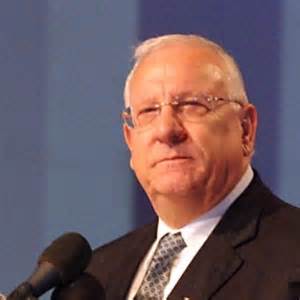
Reuven Rivlin was elected yesterday the tenth president of Israel. He has previously served as Speaker of the Knesset (2003-’06, 2009-’13), and has been a Member of Knesset since 1988. Hailing from PM Netanyahu’s Likud party, Rivlin also served as a minister in Ariel Sharon’s government (2001-’03). He will replace Shimon Peres when the latter’s term ends in July.
“I whole-heartedly believe that the land of Israel is ours in its entirety.”
“The communities in Judea and Samaria [Ed. referring to West Bank settlements] do not threaten our existence, they guarantee our existence.”
“Today, almost 20 years after Oslo, we can see clearly that the idea of separating the [Israeli and Palestinian] nations failed.”
“For some reason the settlement enterprise is being accused of being an obstacle to peace. Personally, I explain at each possible forum that the obstacle to peace is the objection by the Arabs to it and the fact that they do not want us here”.
Israeli citizens who marry Palestinians need to move to “the other side“.
“Dividing Jerusalem will bring disaster for the city. It cannot be that every time something is built in Jerusalem, the international community censures it. This constant criticism is a mark of disgrace for the international community.”
“We will not apologize – not for conquering Katamon or Jaffa or Tzfat, nor for liberating Hebron, and not for building Jerusalem our capital.”
“The residents here [in Migron settlement] are not thieves and are not trying to banish people from their land. They came here innocently, with the encouragement of the State of Israel.”
“There is no consensus in Israel regarding the two state formula. We will not, under any circumstances, allow the establishment of a neighbouring state that will be a genuine threat on our existence.”
“Zionism from its outset was a settlement movement. If we stop going on this path, how can we justify the faith that all of Zion belongs to us?”
“There are red lines that I as a democrat, say you cannot cross. I see it as defiance against Israel and Jerusalem as its capital as well as another protest against the historical narrative, a matter already pending before the High Court.” (Responding to a MK Tibi-proposed bill recognising Jerusalem as the capital of a Palestinian state)
“I have a vision that suddenly all the Jewish people [from around the world] will come to live here… And if there were 10 million Jews here, we wouldn’t have to give up on anything.”
“If the Nakba is a tragedy, then the establishment of the State of Israel is a tragedy. The Palestinians experienced a catastrophe that was brought on by their leaders, but the establishment of the State of Israel is not the reason for it.”
“Terrorism is trying to paralyze and silence democracies fighting against it, exactly as was manifest in the world’s reaction to Israel’s counter-terrorist offensive Cast Lead in light of the Goldstone Report.”
“We miss [Rehavam Ze’evi’s] clear, ideological voice, his leadership, his larger than life presence.”
June 11, 2014
Posted by aletho |
Ethnic Cleansing, Racism, Zionism, Illegal Occupation | Hebron, Human rights, Israel, Jerusalem, Palestine, Zionism |
Leave a comment
Israel’s sports minister has defended the country’s travel restrictions against Palestinian football players in a letter to FIFA president Sepp Blatter, citing security concerns.
Tel Aviv indicates potential attacks by Palestinian militants as the pretext for the prohibitive travel rules that affect most Palestinians, including athletes. Israel has barred travel between the West Bank and Gaza – territories located on opposite ends of Israel which Palestinians seek to include in a future state.
Israeli sports minister Limor Livnat said to Blatter in the letter that Israel would allow Palestinian athletes to “exit and enter for the purpose of sports, excluding occasions in which there are attempts to make use of sports in order to injure or threaten the security of our citizens.”
Livnat said Israel detained Palestinian national team player Sameh Maraabeh in April based on suspicion over a meeting with a “military activist” of the Islamic militant group Hamas during his team’s training in Qatar. She alleged that Maraabeh took funding, a mobile phone, and a written message from the activist. He remains in detention.
“I am confident you will find this information worrisome and constituting clear evidence of the misuse of sports in a fashion that threatens the security of Israeli civilians,” Livnat wrote, according to AP.
The Palestine Football Association had previously called on the FIFA (Fédération Internationale de Football Association) Congress to suspend Israel from FIFA until it relieves the restrictions on Palestinian players.
FIFA is to meet in Sao Paulo, Brazil on Tuesday and Wednesday this week ahead of the World Cup tournament beginning Thursday.
In May, Blatter attempted to bring the two sides together during a trip to Jerusalem and the West Bank. He has called on the parties to “separate politics and sports” and to find a way to allow Palestinian players to travel.
In her letter to Blatter, Livnat also accused Jibril Rajoub, head of the Palestinian Football Association, of incitement against Israel.
Rajoub has described Israel as the “bully of the neighborhood,” and called on FIFA to levy sanctions against Tel Aviv for policies toward Palestinians.
Those policies include delaying or preventing visiting athletes and sports delegations from entering the West Bank and blocking some Palestinian players from leaving Gaza, according to Palestinian officials.
Jamal Mahmoud, head coach of the Palestinian national team, said he is not aware of a meeting between Maraabeh and Hamas during the team’s training in Qatar.
“If he did talk to a member of Hamas, it was his own individual decision,” Mahmoud said.
Palestinian football officials are trying to secure a location for training before the 2015 Asian Cup. The final location depends on Israeli permission based on movements of players in and between Palestinian territories.
“The hope from these discussions is that Israel treats our Palestinian players and those responsible for our Palestinian players by the national law and the charter per the agreement with FIFA,” said Ghassan Jaradat, media director for the Palestine Football Association.
June 10, 2014
Posted by aletho |
Ethnic Cleansing, Racism, Zionism, Subjugation - Torture, Timeless or most popular | Football, Human rights, Israel, Palestine, Security, World Cup 2014, Zionism |
Leave a comment
Nazareth – In the celebratory atmosphere last week as the Palestinian unity government was sworn in, ending a seven-year feud between Fatah and Hamas, it was easy to overlook who was absent.
Hamas had agreed to remain in the shadows to placate Washington, which is legally obligated to refuse aid to a government that includes a designated terrorist group. The new Palestinian cabinet looked little different from its predecessor; Hamas’ input was limited to three independents, all in low-level ministerial positions.
And because this transitional government is still operating within the confines of Israeli occupation, the three ministers from Gaza were refused permits to travel to the West Bank for the swearing-in ceremony on June 2.
The appointment of a temporary government of technocrats is likely to be the easiest phase of the reconciliation agreed in late April. The deal has endured so far – unlike earlier agreements – because Hamas, in even more desperate straits than its rival, Fatah, has capitulated.
For that reason, the United States and most of the world hurried to offer their blessing. Israeli prime minister Benjamin Netanyahu, on the other hand, made dire warnings about the “strengthening of terror” and okayed 3,300 settler homes to punish the Palestinians.
A far trickier stage is still to come: the Palestinian cabinet under President Mahmoud Abbas needs to oversee a bitterly contested national election between Fatah and Hamas expected early next year.
The elections are seen as vital. Palestinians have had no say in who rules them since 2006, when Hamas was victorious. A year later, after brief and vicious fighting, Hamas and Fatah created separate fiefdoms in Gaza and the West Bank. Both need to prove their legitimacy at the ballot box.
Should voting take place, and Hamas win again, the US and others can be expected to boycott the new government – withdrawing desperately needed aid – as they did back in 2006.
But far more likely, Israel will not allow the elections to take place.
Eight years ago, in the months prior to voting, Israel initiated a wave of arrests of Hamas leaders in an attempt to stymie the democratic process. Israel also hoped to block voting in occupied East Jerusalem, which it considers part of its “eternal, indivisible” capital. But the White House – realising a ballot without Jerusalem would lack credibility – pressured Israel into grudging acquiescence.
Less well remembered is that Fatah quietly conspired with Israel to try to postpone the national vote. Fearing that Hamas would sweep the board, Fatah hoped to use Israeli intransigence in Jerusalem as the necessary pretext to delay the wider elections to a time more favourable to its candidates.
Netanyahu has already announced that he will not allow an election in East Jerusalem, as well as indicating that Hamas will be barred from running elsewhere. That is hardly surprising: Israel has spent the past eight years eradicating Hamas from Jerusalem by jailing its leaders or expelling them to the West Bank.
But Fatah’s behaviour in 2006 hints at an even bigger obstacle to consummating the reconciliation. The reality is that Hamas and Fatah have entered the process only out of mutual despair.
Hamas’ political and geographical isolation in Gaza has plumbed new depths since the Egyptian regime turned hostile. Blockaded on all sides, Hamas has seen its support erode as the enclave’s economic crisis has deepened. A deal with Fatah seems the only way to open the borders.
The credibility of Fatah and Abbas, meanwhile, has been steadily undermined by years of cooperation with Israel – all while the settlements have expanded – in the hope of extracting a concession on statehood. With little to show for it, Fatah is increasingly seen as Israel’s craven security contractor.
Abbas’ new strategy – creating a momentum towards statehood at the United Nations – requires that his government-in-waiting establish its democratic credentials, territorial integrity, and a national consensus behind the diplomatic option.
The priority for Netanyahu is not only to void the elections but to weaken the two sides’ commitment to unity by punishing them for their insolence. He can do so given Israel’s control over all aspects of Palestinian life.
Israel has begun not only with another glut of settlement building, but by declaring war on the Palestinian economy, refusing to accept shekel deposits from Palestinian banks, and by imposing collective daily blackouts on Palestinians for unpaid bills to Israel’s electricity company.
Abbas, now responsible for paying the salaries of tens of thousands of public employees in Gaza each month, will be even more vulnerable to Israeli threats to refuse to transfer tax and customs revenues. On Monday it was reported that Israel had also been lobbying foreign capitals to ensure the Palestinian president is held directly responsible for any rockets fired from Gaza.
Hamas faces a no less difficult period ahead. If it strays too far from Fatah’s dictates, it will be blamed for destroying the unity pact; but if it adheres too close to Fatah, it will lose its identity and risk being outflanked by more militant groups like Islamic Jihad.
Samah Sabawi, a political analyst, observed of the unity government: “What we need more than ministries and authorities is resistance and liberation.” The unity government – whether of technocrats or elected officials – will still operate within the limitations imposed by Israel’s occupation.
In fact, the unity government simply breathes new life into the illusion – created by the Oslo accords of two decades ago – that good governance by the Palestinian Authority can change the Palestinians’ situation for the better. In practice, such governance has entailed submitting to Israel’s security demands, a Palestinian obligation Abbas termed “sacred” last week.
As Sabawi suggests, an occupied people needs not better rubbish collection or street lighting but an effective strategy for resistance.
Palestinians will not benefit from a PA that polices the occupation simply because it becomes more “unified”. Rather, their struggle to attain real freedom will grow that bit more daunting.
June 10, 2014
Posted by aletho |
Ethnic Cleansing, Racism, Zionism, Timeless or most popular | Gaza, Hamas, Human rights, Jerusalem, Palestine, Zionism |
Leave a comment
![Mere Existence of Palestine Deemed a “Threatening Racial Slur” by the [parent corporation of the] Houston Dynamo Organization](https://i0.wp.com/www.freepresshouston.com/wp-content/uploads/2014/06/10383509_10154201754125023_3501788515572494232_n-720x550.jpg "Mere Existence of Palestine Deemed a “Threatening Racial Slur” by the [parent corporation of the] Houston Dynamo Organization")
Apparently, soccer fans are very nationalistic. It is not uncommon for soccer fans to bring their national flag to a game where their national team is not even playing. In this spirit, a Palestinian-American woman named Buthayna Hammad brought her Palestinian flag to last Sunday’s Honduras vs Israel match at BBVA Compass Stadium. Fifteen minutes into the game, Nathan Buchanan, head of security at the stadium, removed her from her seat, surrounded her with four Houston Police officers and three additional stadium security personnel, and prohibited her from returning to her seat until she surrendered the “racist” flag. What makes the flag “racist?” We’ll get to that, but first let’s hear the lady’s side of the story:
On June 1st, BBVA Compass stadium was host to a “friendly” soccer match between Honduras and Israel. Both countries have the same national colors and a similar look to their flags. I am a big fan of futbol and I went eagerly to the match with my alt family from Honduras. I wore a Honduras jersey and was eager to cheer on this team, dressed to represent Honduras. To represent my own heritage as a Palestinian-American, I also brought my Palestinian flag. I made sure my flag was allowed (based on the size, etc.) and I was all ready to go. For the first 15 minutes of the match I stood up and cheered and stomped my feet with the rest of the crowd chanting “HON-DU-RAS” and waving my Palestinian flag, my colors vibrant and loud against a sea of blue and white…and apparently also racist. I was told I had to sit down, which I did, only to be told to get back up again and follow the manager of security away from the stadium seats and into the concession area. I followed, and there waiting for me were three more BBVA security personnel and four police officers. When I asked them what was wrong, the manager of security, Nathan Buchanan, told me I am not allowed to carry this flag because it implies a “racial slur” and it is in BBVA Compass Stadium violation. I asked him to show me evidence of his accusations and asked him how my flag, a part of my identity as a Palestinian-American, implies a racial slur. He could not answer whether he did not know or could not articulate why he was ordered to remove my flag and me from my seat. I was getting very emotional at this point, I had my flag wrapped around my neck like a scarf, and he said he would take my flag and “check it in” for me, that I was not permitted to return to my seat until I surrendered my flag. The Israeli government has banned Palestinians from hanging their flags outside their home, and arrests the occupants of the home for having it on display on their own land. Every day, in Occupied Palestine, Palestinians are denied entry to neighboring villages, to schools or their family’s home and in many cases to hospitals thanks to Israel’s apartheid state. Yes “apartheid,” that word implies racism, yet my flag implies a racial slur? I asked him several times if I could go back to my seat and he would spread his arms out to create a blockade with his body and his arms so I could not pass. “This is private property,” he said. I told him I paid for a ticket to enter. I could not keep my eyes from gathering tears, but forced myself from letting them fall. “What country are we in again?” I asked. “Just because Israel is playing a match, does that mean you should treat me this way? Because of my Palestinian identity? I am a U.S. Citizen!” I have attended many soccer matches, many of which at the Dynamo stadium, and I have worn a different national jersey every time. Why was I pulled away that day? Who ordered this singling-out and on what grounds? When I asked him if he would feel comfortable with his actions once my treatment became public, he offered a compromise which was that I could keep my flag as long as I did not wave it. The first half was nearly over; they were extended three minutes when I was finally able to return to my seat. I had spent over 15 minutes defending myself from being bullied. I missed the first half because I waved a Palestinian flag at an international match in my hometown. I am proud and honored to be an American, to be able to enjoy the civil liberties that people in many countries are not afforded, but I would have never thought that the influence of an Israeli soccer team on U.S. soil would compromise our most basic liberties.
I asked BBVA Compass Stadium to clarify their flag policy, to explain how a flag could be “racist.” (I suppose you could say that all flags are “racist,” but still, why single out this one?) This is what Houston Dynamo [parent corporation] spokesperson Gina Rotolo had to say:
The decision to not allow the Palestinian flag to be displayed during the game was based on the sole intention of maintaining the safety of those in attendance. The flag bearer was instigating the crowd, and we felt it was important to diffuse a potentially volatile situation as emotions began to escalate.
Of course safety comes first, so I asked Ms. Rotolo how exactly was Hammad “instigating the crowd?” Did she threaten anybody or called for violence? Rotolo replied:
This patron instigated the crowd by waving the Palestinian flag in front of Israeli supporters. Given that her actions caused emotions to escalate, the appropriate course of action, in our eyes, was to ask her to please refrain from waving the flag.
So…there you have it. “This patron instigated the crowd by waving the Palestinian flag in front of Israeli supporters.” It is now considered “racist” for an American of Palestinian descent to wave her flag at fans of the Israeli soccer team. The First Amendment can be suspended in a stadium built with taxpayer money because some Israeli soccer fans might be moved to violence by the mere sight of the Palestinian flag. The good people of the Houston Dynamo Organization think that it is “racist” to merely remind Israeli soccer fans that Palestine exists. I am trying to imagine what the complaint sounded like. “Excuse me, Mr. Buchanan, that flag over there is really pissing me off–causing emotional distress–and I might have to hurt the lady holding it so you better get four cops to impound that flag or else I’m going to beat her up and it will be all her fault.”
YOUR TAX DOLLARS AT WORK
Rotolo did not answer my questions about who complained, nor would she clarify the stadium policy on flags or how this flag violates that policy. She did not answer questions about which other flags are banned. According to Hammad, Honduras fans were shouting “faggots” and “motherfuckers” at Israel fans, and a fight between an Israel fan and a Honduras fan was going on just a few rows behind her, at the very time that she was removed from her seat…yet she was the one singled out for “instigating violence.” Go figure.
June 9, 2014
Posted by aletho |
Civil Liberties, Ethnic Cleansing, Racism, Zionism, Full Spectrum Dominance | Israel, Palestine, United States, Zionism |
Leave a comment
Yesterday morning on the 8th June, Israeli police forces raided the village of Iqrit (located on the northern tip of Israel, within eyesight of Lebanon). The police uprooted trees, destroyed and confiscated all the personal belongings of Palestinian activists present in the village. Furthermore they beat and violently arrested 3 Palestinian men who were present in the village at the time. The 3 arrested are: Walla Sbait, Nidal Khoury and Jeries Khiatt. They were taken to the police station in Nahariyya, where they were kept in detention over night.
Today at 8:30 AM the three detainees were brought before the Kiryat Gat Magistrates’ Court, following a police request for an extension of their detention. The police have charged the detainees with trespassing the land owned by the ILA, obstructing the work of public officials, assaulting a public employee and endangering public order.
The court ruled that Nidal Khoury is kept in detention until Wednesday 11th of June. Walaa Sbeit and Jeries Khiatt was sentenced house arrest until Sunday 15th of June and they are not allowed to go back to Iqrit for 60 days.
As the season of Advent approached in November 1948, the Israeli military forced residents of Iqrit and the neighboring village of Kufr Bir’im —all citizens of the newly created state of Israel— to leave their homes near the northern border with Lebanon because of military operations in the area. The Israeli forces made a promise to the inhabitants, that they could return to their homes after 15 days. The people of Iqrit are still waiting. In July 1951, the Israeli High Court ruled that the people of Iqrit and Kufr Bir’im had the right to return to their homes. The military refused to comply, and on Christmas Eve 1951 blew up all houses in both villages.
Shortly thereafter, all village lands were confiscated by the state and has been rented out to the nearby Kibbutz for their cows to graze until this day. Since then, decades of demonstrations and legal appeals for the villagers’ right to return have seen a string of favorable decisions by courts and commissions that have resulted only in more broken promises and unenforced rulings.In the 1970s, the government had granted use of the cemetery —allowing only the dead to return to Iqrit after they lived and died in exile at Kufr Yasif, Rameh, Haifa or other places. The original villagers and their descendants —now around 1,500 people scattered across northern Israel— are allowed only to hold services in the church and bury their dead in the cemetery. Every first Saturday of the month there has been a mass held at the village church and every year a summer camp has been organised on the hillside. In August 2012 the third generation reclaimed their village.
Around 20 descendants from Iqrit took the initiative to begin resurrecting the village despite the village’s legal limbo. The activists make sure that the village is constantly inhabited, sleeping in tents, under the stars or in rooms attached to the church. The group consists of university students, factory and restaurant workers, and teachers.
Their attempts to construct or plant anything in the village have been met with immediate demolition by the Israeli authorities. But over time, they’ve been able to add a few amenities, including solar panels on the church roof, determined to bring back life to Iqrit.
Iqrit’s 80 homes are long gone, but the activists goal is to rebuild Iqrit for the villagers-in-exile, refusing only to return to their home in coffins, but alive. The activists have returned to the area and are discussing on how to proceed with their campaign, determined not to be intimidated by Israeli forces and their harassment.
June 9, 2014
Posted by aletho |
Ethnic Cleansing, Racism, Zionism, Illegal Occupation, Timeless or most popular | Israel, Palestine, Zionism |
Leave a comment
 An Israeli committee tasked with putting forward a law on the “Jewish State” is scheduled to be formed today, Sunday, 8 June.
The committee will be chaired by Justice Minister Tzipi Livni and is expected to have among its members MK Ruth Calderon (Yesh Atid) and the initiators of the proposal MKs Oielit Shaked (Jewish Home) and Yariv Levin (Likud).
Livni and Yair Lapid had previously stated that they would oppose the bill.
The formation of the committee has been approved by the Israel PM Benjamin Netanyahu, Haaretz said, adding that Netanyahu will adopt any agreement reached by the committee and will help adopt a legislation as proposed by the committee.
According to Haaretz, bills on the “Jewishness of Israel” proposed in recent years aimed at obliging courts to favor “Jewish identity” over “the Decmocratic nature” of decisions, since the Jewishness of the state contradicts with its being democratic.
The text of the bill describes Israel as “the national home of the Jewish people,” and that “the right to determine the destiny of the nation in Israel is owned by the Jewish people alone.” The bill also states that “The land of Israel is the historic home of the Jewish people.”
June 9, 2014
Posted by aletho |
Ethnic Cleansing, Racism, Zionism, Illegal Occupation, War Crimes | Israel, Palestine, Zionism |
Leave a comment
Potential 2016 presidential candidate Hillary Clinton says the United States made a tactical mistake to put pressure on Israel to freeze its settlement activities on the Palestinian territories.
The former US secretary of state made the remarks in her new book ‘Hard Choices,’ scheduled to be released on June 10.
“I was concerned that we not be seen as pushing a longtime partner out the door, leaving Egypt, Israel, Jordan and the region to an uncertain, dangerous future,” she wrote.
“In retrospect, our early, hard line on settlements didn’t work.”
Clinton said Washington’s demand only hardened the stance of the now President of the Palestinian National Unity Government Mahmoud Abbas.
Abbas himself ultimately rejected the freeze because it failed to include the East Jerusalem (al-Quds).
She noted that when Israeli Prime Minister Benjamin Netanyahu announced plans to resume settlement construction, it strained relations between Tel Aviv and Washington, leaving US President Barack Obama infuriated with Netanyahu.
Clinton is preparing for a presidential run in 2016 and in her new memoir she does not shy away from criticizing President Obama.
June 8, 2014
Posted by aletho |
Corruption, Ethnic Cleansing, Racism, Zionism, Illegal Occupation | Hillary Clinton, Israel, Palestine, United States, Zionism |
Leave a comment
The major organizations that comprise the Israel Lobby are well known: the American Israel Public Affairs Committee (AIPAC), the Anti-Defamation League (ADL), the American Jewish Committee (AJC), the Conference of Presidents of Major Jewish Organizations and Christians United For Israel (CUFI). All are well known, benefiting from large budgets and staffs. They are extremely effective, having excellent access to politicians and the media to promote their points of view, and are, as a group, regular visitors to the White House. AIPAC is without doubt the most powerful lobby in the United States that is focused on a foreign policy issue.
The institutional Israel boosters are in turn backed by a cluster of think tanks and institutes that spout a relentlessly pro-Likud line. They include Foundation for Defense of Democracies, The Emergency Committee for Israel, The American Enterprise Institute, The Hudson Institute, Brookings and The Washington Institute for Near East Policy. A recent op-ed at The National Interest (formerly the Nixon Center) “Why Israel Fears Containment of a Nuclear Iran,” written by two Israelis with government ties, illustrates to what extent spokesmen for Tel Aviv have access to the media across the political spectrum to make their points while contrary views rarely surface. It would be difficult to imagine a similar piece appearing advancing Iranian views on Israel, for example, and one might well question whose “National Interest” is being promoted by providing a platform to current or former foreign government officials.
And backing the think tanks up are the enablers in the media who suppress stories critical of Israel and consistently editorialize supporting policies favored by Tel Aviv. Israeli Ambassadors, uniquely, regularly write op-eds for publications like the Washington Post and The New York Times. Prominent among the consistently pro-Israel media are the Washington Post, Wall Street Journal, Rupert Murdoch publications in general and magazines like Mortimer Zuckerman owned US News and World Report, but it would be fair to say that nearly all mainstream media outlets are to some extent wary of offending Israel and its backers.
But as Professors John Mearsheimer and Stephen Walt noted in their groundbreaking expose of the Israel Lobby, the lobbying effort extends well beyond the organizational level to include friends of Israel who labor assiduously and voluntarily at state and local levels as well as at universities and from within professional organizations to maintain a positive viewpoint on Israel while promoting a negative narrative regarding its increasing number of critics. Most recently they have been focused on halting the growth of BDS, “boycott, divestment, and sanctions,” particularly in attempts to use “Lawfare” to make such activity illegal when it singles out Israel.
Israel’s friends quite rightly see Congress as their major ally in keeping the United States Israel-friendly, so much so that Pat Buchanan once dubbed America’s legislative body as “Israeli occupied territory.” And so it remains with legislation favorable to Israel passing by unanimous consent voice votes or grossly lopsided margins when a tally actually takes place. The White House too is into the charade that Israel is a major US ally and friend, in spite of mounting evidence that Tel Aviv consistently spies on Washington, is not interested in any peace process with the Palestinians and works against genuine American interests.
I have recently obtained a handout memo relating to a congressional race in Virginia that illustrates how the process works at the political entry level. Congressman Jim Moran has announced that he will not seek reelection in the heavily Democratic district that encompasses Alexandria Virginia. Moran has fallen afoul of the pro-Israel establishment by telling attendees at a 2003 antiwar forum, “If it were not for the strong support of the Jewish community for this war with Iraq, we would not be doing this.” He added that Jewish leaders were “influential enough” to change the course of US policy. Moran inevitably apologized for those remarks, but the damage was done and he was considered to be unreliable on the issue of Israel, a view reflected in the handout which quotes Debbie Linick, Director of the Jewish Community Relations Council of Greater Washington, asserting that Moran had been “lacking the nuances of understanding the peace process. It is crucial that the next representative from the 8th District be a strong supporter of Israel.”
The handout described a Jewish Community Relations Council Political Forum for the 8th District that was to be held on May 18th in Alexandria at the Council’s Early Childhood Learning Center. All prospective candidates for the 8th District were invited to participate to present their positions on various issues of interest to those attending. The access to the event was by paid tickets only, presumably to permit screening to control the make-up of the audience. The handout again quotes Linick as stating that “all area synagogues will be asked to participate” even if they were not in the voting district.
The memo suggests that someone at the forum might ask every candidate to publish his or her signed Israel Position paper, which AIPAC “requires” all candidates for office to personally sign. It also recommends that signs be placed on the street outside demanding release of the paper and notes that if there should happen to be demonstrators present they will not be allowed to block the entrance, which is behind the building on private property.
The Northern Virginia Council might well be more than usually politically active and is unlikely to have a counterpart in most congressional districts, but the handout reveals how AIPAC has an impact on all viable congressional candidates, often before they are even nominated. Once nominated, candidates go through a vetting process in which they meet with an AIPAC official and are asked to write and sign a position paper on Israel, if they have not already done so. Many of the papers are subsequently highlighted on the AIPAC website.
Few if any candidates refuse to cooperate because to do so would mean that AIPAC and its friends would find and fund an opponent and use their media access to distort the politician’s record. This type of blackballing most recently occurred in the case of Congressman Walter Jones of North Carolina, who was on the receiving end of a vicious and well-funded campaign because he is an anti-war candidate strongly opposed by the pro-Israel establishment.
To be sure Americans have a constitutional right to both demand to know and challenge the views of those running for office but the important thing to note here is that the discussion is not about healthcare, immigration or government programs – it is rather about unconditional support for the policies of a foreign country. I can think of no other advocacy group in the United States that is comparable to the Israel Lobby in terms of its promotion of positions that are demonstrably not beneficial to the United States with the only possible exception being the prominent Cubans in Congress who vet candidates based on their willingness to continue to punish the regime in Havana. The Cubans, unlike the Israel Firsters, have, however, only regional impact, mostly concentrated in Florida, though it is interesting to note that they – Ted Cruz, Marco Rubio, Ileana Ros-Lehtinen, Mario Diaz-Balart, Joe Garcia and Robert Menendez – are also all passionate supporters of Israel.
Americans really have little choice when it comes to Congress and Israel as anyone who refuses to cooperate with AIPAC is unlikely to find himself in the running, but there should at least be some awareness of what happens routinely to prospective candidates to insure conformity with the Lobby’s viewpoint. If unconditional loyalty to a foreign country is a sine qua non for election to congress perhaps there should be some discussion of what that is likely to mean and the promoters of such policies should be held accountable when they produce a bad result, as they did in Iraq and are promising to do vis-a-vis Iran. It is one thing to be all for Israel due to cultural or familial affinity or even as an abstraction but it is quite another to persist in that view when it does genuine harm to the United States, regarding which a case certainly can and has already been made.
June 8, 2014
Posted by aletho |
Corruption, Ethnic Cleansing, Racism, Zionism, Timeless or most popular, Wars for Israel | Israel, Palestine, United States, Zionism |
Leave a comment
GAZA CITY – A Palestinian fisherman shot by the Israeli navy two weeks ago succumbed to his wounds Sunday morning, Gaza medical authorities said.
Spokesman for the Gaza Ministry of Health Ashraf al-Qidra told Ma’an that 52-year-old Imad Shukri Salim was announced dead Sunday morning.
 Salim was shot in the chest by the Israeli navy two weeks ago while he was fishing off the coast in the area of al-Sudaniya in the northern Gaza Strip, al-Qidra said.
Israeli forces shot two Palestinian fishermen off the al-Sudaniya area coast in the month of May alone.
Palestinian fishermen are only being allowed to go three nautical miles from Gaza’s shore, even though an agreement previously settled on 20 nautical miles.
Israeli naval forces frequently harass Palestinian fishermen who near the three-mile limit, as well as those inside the zone.
There are 4,000 fishermen in Gaza. According to a 2011 report by the International Committee of the Red Cross 90 percent are poor, an increase of 40 percent from 2008 and a direct result of Israeli limits on the fishing industry.
June 8, 2014
Posted by aletho |
Ethnic Cleansing, Racism, Zionism, Illegal Occupation, Subjugation - Torture | Gaza, Human rights, Israel, Palestine, Zionism |
Leave a comment
JERUSALEM – A Palestinian man was injured late Friday after being hit by an Israeli stun grenade during a wedding in East Jerusalem, a local popular committee spokesman said.
Muhammad Abu al-Hummus told Ma’an that Israeli forces unexpectedly raided the village of al-Issawiya and fired stun grenades while crowds of Palestinians were participating in a traditional wedding march.
One man was hit directly in the forehead with a stun grenade and taken to the hospital, Abu al-Hummus said.
He added that no protests were taking place as the Israeli forces entered the town.
June 7, 2014
Posted by aletho |
Ethnic Cleansing, Racism, Zionism, Subjugation - Torture | Jerusalem, Palestine |
Leave a comment
Over 290 Palestinian detainees in Israeli prisons have been on a hunger strike since April protesting their indefinite detention. Now UN’s Ban-Ki moon demands Tel Aviv to either charge administrative inmates or release them “without delay.”
“The Secretary-General is concerned about reports regarding the deteriorating health of Palestinian administrative detainees who have been on hunger strike for over a month,” Ban’s spokesman, Stephane Dujarric, said in a statement.
The UN Secretary-General “reiterates his long-standing position that administrative detainees should be charged or released without delay,” he added.
According to the spokesman, Ban has taken note of the recent concerns issued by different human rights bodies and “has responded, reiterating the United Nations’ well known positions.”
Meanwhile, UN Commissioner for Human Rights Navi Pillay has also expressed her concern over a legislative amendment before the Israeli Knesset to allow force-feeding of the inmates.
The legislation, if passed, “would permit force-feeding and medical treatment of prisoners on hunger strike against their will under certain conditions, in contravention of international standards,” Dujarric added.
On Thursday, members of a UN Special Committee which monitors human rights violations of the Palestinians on the occupied territories called upon Israeli authorities “to heed the demand of the hunger strikers to end the practice of arbitrary administrative detention of Palestinians,” a committee said in a statement.
“It is a desperate plea by these detainees to be afforded a very basic standard of due process: to know what they are accused of and to be able to defend themselves,” the committee said.
According to the UN body, the Israeli government has detained “a large number of Palestinians for reasons not explicitly indicated.”
“Initial administrative detention orders of six-month periods can be renewed an indefinite number of times without producing charges,” the committee said.
The first protests among the Palestinian detainees started April 24, when a group of about 100 prisoners launched a peaceful protest, the UN Special Committee said. The inmates were “inspired” by their months and years in detention in Israel without being charged with any crimes. Now the total number of hunger strikers has reached 290. At least 65 prisoners have been hospitalized as a result of the strike.
According to the UN committee, among the inmates there are currently 11 Palestinian legislators, including eight held under administrative detention.
“Given that there are more than 5,000 Palestinian detainees in Israeli custody, we strongly appeal to the Israeli authorities to allow all Palestinian detainees, especially women and children, to be periodically seen by Palestinian doctors in order to avoid losing more lives,” the Committee said.
Meanwhile, on Wednesday Israeli doctors said they wouldn’t begin force-feeding the detainees, a move that put them on a collision course with Prime Minister Benjamin Netanyahu’s government. Netanyahu reportedly asked the authorities to speed up the bill’s reading, saying that he is confident the force-feeding will eventually be carried out.
The Israeli PM is now citing controversial US policy of force-feeding of detainees at the Guantanamo Bay prison in Cuba, a move that prompted long hunger-strikes among the inmates. The Guantanamo policy has drawn criticism from the United Nations human rights office, which said it constitutes torture and is thus a violation of international law.
June 7, 2014
Posted by aletho |
Ethnic Cleansing, Racism, Zionism, Subjugation - Torture | Israel, Palestine, United Nations, Zionism |
Leave a comment
The Israeli Supreme court has recently ruled that there is no such thing as an “Israeli” recognized by the legal system of the State of Israel. You can be classified as a Jew, an Arab, a Druze, a foreign visitor, but nobody is “Israeli.” Just a short while ago the Knesset created a new status, “Christian.” So now a Palestinian Christian, who had previously been classified as merely an “Arab,” can now not be an Arab but a Christian and be accorded some rights that are currently denied to regular Palestinians, who are classified as Arabs. Israel has never wanted to give any credence to the fact that there ever was a place called Palestine that had people in it.
But now it has definitely been ruled that there is no common ground, no catch-all status of “Israeli.” Therefore, Israeli citizenship is an empty category. It does not resemble any idea of “citizenship” that we as citizens of the USA, or Canadian, or Mexican citizens can recognize. In Israel citizenship is meaningless and “Nationality” is everything (if you can get past the idea that a religion is also a nationality…I wonder if someone presenting a Unitarian Church passport would get through customs.)
This all makes sense if you are running a caste system in which the Nationality/Religion “Jewish” gets full rights and others get less, or no rights at all. This is what Israel is. It is not a modern Western style democracy that just happens to have a “discrimination” problem, or to have by accident acquired extra territory with some undesirable people on it.
In the news media when someone quotes an “Israeli” source, or a government representative they always mean “Jewish,” but they never say “a Jewish government source has said…” But according to the Supreme Court of the State of Israel (I don’t want to say “Jewish Supreme Court”) Israelis don’t exist. The leaders of the State of Israel are always thumping their chests proclaiming “we are the Jews!” “We are the only Jewish state in the world and we represent all the Jews of the world.”
But if some critic were to say, ” I don’t like what the Jews are doing in the West Bank.” The reaction would be, “Anti-Semite!!! Jew hater.” Well…maybe this isn’t an important point. After all, whenever someone says, “I don’t like what the Israelis are doing in the West Bank,” the response is “Anti-Semite! Jew hater!”
Many of us who support human rights for Palestinians have encountered retorts from defenders of Israeli Apartheid who say, “there are no Palestinians, they don’t exist.” This is a popular line. A lot of people who think they are clever, worldly and liberal like to say this (like ex-Mayor Michael Bloomberg). Think about it though. There are over 5 million Palestinians living between the Mediterranean Sea and the Jordan River (about the same as the number of Jews living there). they are Arabs (native speakers of Arabic) whose ancestors have lived in a place known as Palestine at least since the 5th century BC (as attested to by Herodotus, who started the genre of History writing) and certainly longer than that.
For the Zionists to deny their nationality is to deny their right to exist..or to exist within the lands that the Jews of Israel claim as their exclusive property. This is an eliminationist, ethnic cleansing, rabid xenophobic point of view. There is no left, right or center here, just push them out. Get rid of them.
So now Israelis don’t exist and Palestinians don’t exist. Leaders of the state of Israel are always wailing about an “existential threat” to Israel presented by… everyone and everything. BDS, halting settlement construction, protest marches, African refugees (officially called “infiltrators”), you name it.
But how can there be an existential threat to non-existing Israelis from Palestinians who also don’t exist? Jean Paul Sartre seemed to corner the nothingness market with his tome “Being and Nothingness.” But now he’s been outdone.
June 7, 2014
Posted by aletho |
Ethnic Cleansing, Racism, Zionism, Timeless or most popular | Human rights, Israel, Palestine, Zionism |
Leave a comment