Join Palestinians on November 30th to protest against the Prawer plan
Prawer Won’t Pass Campaign | November 10, 2013
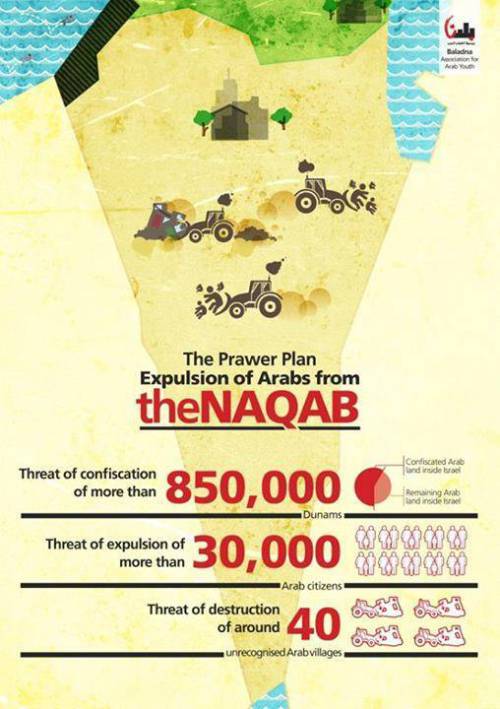 Occupied Palestine – On the 24th of June, the Israeli Knesset approved the Prawer-Begin plan, which if implemented will result in the destruction of more than 35 unrecognized villages in Al-Naqab and the forced expulsion and confinement of more than 70,000 Palestinian Bedouins. The Prawer plan is the largest Israeli land-grab since 1948. It epitomizes the nature of Israel’s policy; Israeli-Jewish demographic expansion and Palestinian-Arab demographic containment.
The International community has repeatedly called on Israel to halt the implementation of the Prawer Plan due to its discriminatory nature and the severe infringement it causes on the rights of Palestinian Bedouins in Al-Naqab. The UN committee on the elimination of Racial Discrimination called on Israel to withdraw the proposed legislation of the Prawer Plan. Also, in 2012, the European Parliament passed a resolution calling on Israel to stop the Prawer plan and its policies of forced displacement and dispossession.
Injustice, humiliation and forced displacement are a recurring theme in Palestine’s history. This is lesson that we as a group of youth take to the heart. We will oppose, resist and work against the continuous assault that our communities, across Palestine face. Therefore, we launched the “Prawer will not pass” campaign with an eye to preventing this plan to be yet another chapter in Palestine’s long and tragic history.
Opposing the Prawer Plan is to oppose ethnic cleansing, displacement and confinement in the 21st century.
Join us by organizing marches, protests, sending letters to those with positions of influence in your country or community, by doing whatever you can, in order to force Israel to stop the Prawer plan.
Join us on the 30th of November in saying “Prawer shall not Pass”.
For more information, please contact:
Email: PrawerWontPass@gmail.com
Time to Ignore Netanyahu the Rejectionist
By Ludwig Watzal | Palestine Chronicle | November 10, 2013
Benyamin Netanyahu’s hyperventilated fury didn’t surprise anybody. Even before the first outlines of a possible long-term agreement between Iran and the West on Iran’s nuclear program were publicized, Israel’s Prime Minister categorically rejected any such agreement. This irrational behavior disqualifies him as a serious partner to other heads of state. His extremism goes even so far as to promote further sanctions against Iran. Netanyahu wants Iran to capitulate and abolish its entire nuclear industry. He announced that Israel does not feel bound by the agreement. Netanyahu arrogates Israel the right to override decisions by UN Security Council members.
That Western leaders should consult the leader of a tiny country before they act shows the imagined power they attribute to Netanyahu. To seek advice from Netanyahu shows how intimidated Western politicians are. By now, they should be aware of his hostility to peace, be it with Iran or the Palestinians. How submissively the United States acts, is shown by the phone call between Obama and Netanyahu and by Secretary of State Kerry’s visit to Jerusalem, as if they needed Netanyahu’s blessing for the negotiations with Iran. The best political strategy would be to ignore him.
What infuriated Netanyahu and made him go wild was John Kerry’s statement made in Bethlehem: “We consider now and have always considered the settlements to be illegitimate.” The US has finally returned to its erstwhile stance that all Israeli settlements are contrary to international law, after they have gone astray under Bill Clinton and George W. Bush junior. Netanyahu appears increasingly isolated with regard to the Iran deal. He appears willing to do anything to derail a possible agreement between the US and Iran. His last weapons are the political bull terriers of the American Israeli Public Affairs Committee, better known as AIPAC, and their supporters in the US Congress. But Netanyahu is increasingly a political nuisance, not only for the Obama administration but also for other powers. For the last 25 years it has been his mantra to warn that a nuclear armed Iran is just around the corner.
Netanyahu and the war party in the US will do everything in their power to prevent an agreement between Iran and the West. Netanyahu exerts not only great influence on the US Congress via AIPAC, but does so personally, as his last speech before both Houses in May 2012 has shown, during which US lawmakers outdid themselves in celebrating his reactionary speech. AIPAC could try to arrange again another such ridiculous circus. That doesn’t mean that Netanyahu would make it this time, knowing that he would jeopardize the recently improved relations with the Obama administration.
The political charade, which Netanyahu performs, has nothing to do with the imaginary Iranian nuclear threat. The Israeli political establishment knows this and fears that it would lose its hegemony over the entire Middle East and Northern Africa if Iran would go nuclear. The late Israel Shahak has pointed out in his book “Open Secrets. Israeli Nuclear and Foreign Policies”, that Israel’s main goal is to maintain its hegemony from India to Mauritania.
The political interests of the Western powers and Israel are not the same. The West has suffered heavy economic losses by bowing to Israeli interests; especially US soldier had to pay a high price in Iraq. Netanyahu can perhaps bamboozle the U.S. government again, but Israel’s relationship with Europe is on a downward slide. Europe, and especially Germany, can look back on an enduring friendship with Iran. This friendship should not be damaged by unregenerate politicians. Germany would do well to normalize its relations and reestablish its traditionally excellent relations with Iran, regardless of the outcome of the US-Iran negotiations.
By now, the US and the other Western countries should have understood that Netanyahu as well as former Israeli governments have been torpedoing every chance for a peace agreement with the Palestinians, because their colonial hunger for land has not yet been satisfied. The so-called peace negotiations, which are once again taking place, is likely to go nowhere because the Netanyahu government is not willing to make any real concessions that fall short of total surrender by the Palestinians.
Related article
After Gaza Power Plant Forced off, Humanitarian Conditions in the Gaza Strip Deteriorate
Palestinian Centre for Human Rights | November 9, 2013
Occupied Palestine – The Palestinian Centre for Human Rights (PCHR) expresses deep concern over the deterioration of humanitarian conditions of the civilian population due to the aggravation of the electricity crisis in the Gaza Strip.
On Friday morning, 01 November 2013, the operation of the Gaza power plant was totally stopped due to the lack of fuel required for its operation. PCHR is deeply concerned that the current crisis may impact the access of 1.7 million Palestinians to vital services, including the supply of drinking water, and that this crisis may result in the suspension of work in some vital sectors, such as health, sanitation and education.
According to PCHR’s follow-up of the chronic power crisis in the Gaza Strip, the Palestinian Energy Authority in Gaza announced that the operation of the Gaza Power plant was totally stopped on Friday morning, 01 November 2012. The Energy Authority claimed that its counterpart in Ramallah stopped the fuel supplies required to operate the power plant and its requested taxes on the price of fuel. However, the Energy Authority in Gaza announced its inability to pay taxes on the price of the industrial fuel. On the other hand, the Energy Authority in Ramallah refused to provide any new fuel supplies required for operating the power plant resulting in the total lack of fuel and the shutdown of the plant.
The shutdown of the Gaza plant power has left serious consequences on the humanitarian conditions of the Gaza Strip’s population due to the deficit in daily needs of power in Gaza. The Electricity Distribution Company (GEDCO) in Gaza was forced to increase the hours of power outages on houses and vital facilities from 8 to 12 hours daily. Thus, the schedule, which is applied, based on which power will be distributed for six hours and then cut off for 12 hours resulting in further deterioration in humanitarian conditions of the Gaza Strip’s population. It should be mentioned that the power plant was providing around 65 megawatts during the years of its reparation and rehabilitation after being targeted and destroyed by Israeli forces in June 2006. The power plant had worked since June 2012 to produce around 100 megawatts. The Gaza Energy Authority stated that the electricity is provided to the Gaza Strip as follows: 120 megawatts from Israel and 27 megawatts supplied by Egypt.
The Gaza power plant has been suffering from a significant decrease in fuel supplies required for its operation coming from Egypt through tunnels under the Egypt-Gaza border, as the supplies have almost completely stopped for around 2 months. As a result, the Energy Authority in Gaza purchased fuel from Israel through its counterpart in Ramallah. At that time, the Palestinian Authority (PA) in Ramallah exempted fuel purchases from taxes. However, the Energy Authority in Ramallah demanded its counterpart in Gaza to pay the taxes on the fuel supplies due to the PA’s current financial crisis. The Energy Authority in Gaza refused to pay those taxes claiming that it cannot afford paying them.
PCHR has been following the power crisis consequences in the Gaza strip since the power plant stopped operating after Israeli forces targeted and destroyed it in June 2006 resulting in catastrophic impacts on the power supplies in the Gaza Strip. PCHR has been also following the impacts of the ongoing Palestinian political split, whose two parties failed to find solutions that take into account the best interests of Palestinian civilians in Gaza and stop the deterioration of humanitarian conditions and provide of their electrical power needs and fuel required to operate the Gaza plant power. PCHR is deeply concerned over further deterioration of civilians’ humanitarian conditions as the power crisis has affected all civilians’ daily life needs and violated their right to access to basic and necessary services, including access to health facilities and to treatment, access to educational institutions, including schools and universities, and access to water services, including drinking water in homes and all other vital services.
Through continuous follow-up of the effects of the aggravation of the power crisis, PCHR has observed serious deterioration of the humanitarian situation from which the residents of Gaza are suffering:
· About 1, 7 million inhabitants of the Gaza Strip are facing deficiencies in all walks of their daily life, which have affected their basic needs, including health services, access to water, environmental health services and ability to meet the educational needs of school and university students.
· The deterioration of health conditions in the health facilities of the Gaza Strip due to inability to compensate the shortage of electricity for long hours on one hand, and their inability to provide fuel needed to run the alternative generators in these facilities on the other hand, in addition to breakdown of many machines and medical equipment at hospitals and health facilities of the Gaza Strip.
· Hundreds of patients in the hospitals of the Gaza Strip face serious health risks as the medical equipment are not run regularly, especially in the intensive care units and other medical units like heart and kidney units.
· Local bodies, including municipalities and village councils, are unable to provide alternative fuel to ensure the workflow of their vital facilities serving the population of the Gaza Strip, including water and sanitation facilities. Citizens’ complaints started to resound because of their inability to get water in their houses, especially in high buildings.
· Different bakeries in the Gaza Strip said that they partially stopped working due to the long hours of power outage and the shortage of the fuel needed to run the machines. One can notice overcrowding for long hours in front of bakeries in order to get the basic needs.
· Educational facilities in universities and educational institutions are suffering serious disorder, which led to the inactivity of many educational laboratories and the postponement of some educational assignments due to electricity shortage and lack of alternative power sources. The aggravation of electricity crisis has coincided with the mid-term exams that started about a week ago in the schools and universities of the Gaza Strip. The majority of governmental schools is still without electricity and cannot provide the students with alternatives.
· Hundreds of institutions and associations in the Gaza Strip had to postpone their activities and programs due to the electricity shortage all day and their inability to provide alternative power sources to run their machines and equipment.
· The suffering of the population of the Gaza Strip has seriously aggravated, especially those living in high buildings and who depend on elevators in the ascending and descending from their apartments. Dozens of residents, including elderly people and patients with chronic diseases have been greatly affected.
PCHR is following the power crisis in the Gaza Strip with grave concern and:
1. Calls on all concerned parties, including the Palestinian government in Ramallah, the Palestinian government in Gaza and the Electricity Distribution Company in Gaza to make efforts to provide the fuel needed to run the power plant and ensure its workflow with no cessation;
2. Warns of the serious consequences of the stoppage of the power plant on all vital sectors, including the basic services for about 1, 7 million Palestinians living in the Gaza Strip, like drinking water supplies, disruption of health facilities, including hospitals and medical centers, in addition to the sewage plants and educational sectors.
3. Calls on the international community to pressure Israel, the occupying power according to international humanitarian law, to lift the illegal closure imposed on the Gaza Strip since June 2007, to fulfill their legal commitments towards the civilian population of the Gaza Strip and to ensure access to all the medicines, food, and basic services, including fuel supplies needed to run the Gaza Power Plant.
Shin Bet Arrests Palestinian Journalist Returning from Egypt
By Richard Silverstein | Tikun Olam | November 9, 2013

Palestinian journalist, Mohammed Abu Khdeir, secretly arrested by Shabak
Israel’s security services arrested Palestinian journalist, Mohammed Abu Khdeir, after he returned from a reporting trip to Egypt two days ago. Abu Khdeir, who reports for the Palestinian Al Quds and the Kuwaiti Al-Rai, was arrested at Ben Gurion airport when he arrived on a flight from Egypt.
News of his arrest is under Israeli gag. Abu Khdeir, as is common in security cases, has been denied any contact with his attorney. During this period, the Shabak commonly “works over” suspects for information, using abusive techniques like sleep deprivation and hours-long stress-inducing interrogation techniques. That is why it’s critical to spread word of his arrest.
The Israeli court system is complicit in this abuse and in this case a Beersheva court has granted the Shabak request for a gag and ordered him detained without charge until November 13th. It’s also usual in these cases for remand to be extended without any real oversight by the court. You can expect the suspect to be detained as long as the Shabak wants him there.
After examples of behavior like this, it should be no surprise that Israel’s rankings on world press freedom indexes are quite low. Unfortunately, one of the few ways to fight such outrageous violations of freedom of the press is to report them here.
It’s entirely possible that this arrest is based on sheer spite, and is certainly entirely arbitrary. A year ago, the Palestinian journalist embarrassed the Shabak by refusing to cover a Hillary Clinton press conference to which he’d been invited. The Shabak agents who provide “security” for such events, demanded only Palestinian journalists pull down their pants before entering the press venue. Abu Khdeir refused along with several others.
An unnamed Israeli official told FoxNews, apparently with a straight face:
…Israel is trying to provide the best possible security for Clinton and that similar procedures are used at Western airports and in secure facilities in Western capitals.
Last I checked, no Israeli reporters were forced to disrobe before entering the White House to cover Bibi’s press conferences. This is a clear case of Reporting While Palestinian. His recent arrest seems like a good example of payback.
The other possibility is that Abu Khdeir may’ve annoyed the Egyptian military junta during his visit by contacting figures from the Muslim Brotherhood. If he did so, Israel too would want to warn him that such contact with Islamists is considered an offense against Israeli state interests. Not that this is, or should be against the law. But when you’re Palestinian there doesn’t have to be a law. Shabak is the law. You may’ve done something wrong, you may’ve gazed a moment too long into the eyes of the security official at Ben Gurion. There doesn’t have to be a reason.
The only thing we can be thankful for is that Shabak didn’t kidnap him inside Egypt as they did recently in the case of a Gazan who disappeared there and turned up in an Israeli jail, where he presumably still sits. But they knew they didn’t need to since he was returning via Ben Gurion, where they could nab him.
Related article
15 Palestinians have died since the resumption of negotiations
Palestine Information Center – 09/11/2013
AL-KHALIL — A statistics report prepared by Quds Press International news agency showed that fifteen Palestinians died since the resumption of the negotiations, three months ago.
The negotiation between the Palestinian Authority and the Israeli occupation was resumed in Washington on July 30, for the first time after it had been frozen for three years. Yet the Israeli violations and attacks against Palestinian civilians and their properties and sanctuaries have continued.
The statistical report said that three Palestinians from the Jenin refugee camp died a few days after the resumption of the negotiating sessions, after being shot by Israeli forces.
The Israeli occupation forces have continued killing and attacking citizens and destroying Palestinian properties, indifferent to the ongoing negotiating sessions. On August 26, the IOF special forces committed a massacre in the Qalandiya refugee camp in Ramallah, wounding about 20 Palestinians and killing 3 others.
After the resumption of the negotiations, the Israeli army assassinated 4 Palestinian resistance fighters from the Qassam Brigades.
Quds Press’ report also pointed out that 3 Palestinian youths were killed during the last three months: Ahmed Tzazaah from the town of Qabatiya in Jenin after clashes with the occupation army, and Anas al-Atrash and Bashir Hababin after being shot by Israeli soldiers at Container and Za’atara checkpoints
The deliberate policy of medical neglect has also continued in the occupation jails and recently led to the death of patient captive Hassan al-Turabi from Nablus.
The PA has ignored Palestinian factions’ calls for ending the negotiations, in response to the occupation’s persistent crimes which have led in the past three months to the death of 15 Palestinians, detention of hundreds and displacement of large numbers of residents from their homes that had been confiscated or demolished, not to mention the Judaization projects that continue in Jerusalem unabated and the settlement plans which include the construction of more than 1,700 new housing units.
Related articles
- Israeli occupation forces close checkpoints before movement of Palestinians on second day of Eid (alethonews.wordpress.com)
- Israeli Forces Open Fire On West Bank Protests, Injuring Dozens (eurasiareview.com)
UNESCO rescinds US and Israel’s voting rights
Al-Akhbar | November 8, 2013
UNESCO has suspended the voting rights of Israel and the United States, two years after they stopped paying dues to the UN’s cultural arm in protest over its granting full membership to the Palestinians, a UNESCO source told Reuters.
Both countries decided to cancel their funding in October 2011. The American decision was blamed on US laws that prohibit funding to any UN agency that implies recognition of Palestinian demands for their own state.
The US missed a Friday deadline to provide an official justification of its non-payment and a plan to pay back its missed dues, the UNESCO source said, automatically triggering the suspension of voting rights.
Neither the United States nor Israel “presented the necessary documentation this morning to avoid losing their right to vote,” a source told AFP on condition of anonymity.
Two separate diplomatic sources also confirmed the deadline had been missed, triggering the suspension of voting rights.
There was no immediate comment at the office of the US envoy to the UN agency.
UNESCO designates World Heritage sites, promotes global education and supports press freedom among other tasks.
The withdrawal of US funding – which to date amounts to about $240 million or some 22 percent of UNESCO’s budget – has plunged the United Nations Educational Scientific and Cultural Organization into a financial crisis, forcing it to cut programs and slash spending.
With the US and Israel withdrawing their contributions UNESCO’s budget fell from $653 million to $507 million.
The reduced budget means some 300 people at UNESCO are in danger of losing their jobs. In 2012 the UN agency employed 1,200 people at its headquarters in Paris and 900 around the world.
UNESCO’s Director-General Irina Bokova, who was re-elected in October, raised $75 million in a bid to deal with the agency’s financial crisis.
“The list of countries that will lose their voting rights will be announced probably tomorrow (Saturday) in a plenary session,” the same UNESCO source said.
The loss of voting rights for two member countries comes as Washington tries to keep US-brokered peace negotiations between Israel and Palestinians afloat.
Both parties have signaled the lack of progress in the talks, revived in July after a three-year hiatus but stymied over Israeli plans to continue building illegal settlements in the occupied West Bank and East Jerusalem.
The Palestinians have so far failed in their bid to become a full member of the UN, but their UNESCO membership is seen as a potential first step towards UN recognition of statehood. In November 2012, the UN General Assembly granted Palestine non-member state status in a landslide vote.
(Reuters, AFP, Al-Akhbar)
Israel demolishes church property in Jerusalem, future mass demolitions threatened
MEMO | November 6, 2013
Israeli forces Monday demolished a property in occupied East Jerusalem owned by the Roman Catholic Church, displacing 14 Palestinians. At a press conference held by the ruins of the home, Latin Patriarch of Jerusalem Fuad Tawwal condemned the demolition in the presence of senior church officials, foreign diplomats and journalists, saying “there is no justification for the demolition” and accusing the Jerusalem “municipality and the Israeli government” of “increase[ing] hatred” through its policies.
Tawwal claimed that it was the first time Israel had demolished property belonging to the church, and promised “legal action in appropriate courts” in response.
Meanwhile, it has been reported that hundreds of Palestinian families in East Jerusalem have recently received demolition orders, notices which give residents 30 days to appeal.
Palestinian-owned properties in Israeli-annexed East Jerusalem are routinely demolished by the Jerusalem municipality on the grounds of lacking the right permit – permits that are notoriously difficult to get. For example, just 13 per cent of the Jerusalem housing units granted building permits in the period 2005-’09 were in Palestinian neighbourhoods.
Arab ‘Thugs’ Steal Olives from Poor, Downtrodden Israeli Settlers
By Richard Edmondson | Fig Trees and Vineyards | November 4, 2013
Every now and then we run across stories in the Jewish media that are amusing for their unintended humor. Several days ago the Jewish Press published an article about West Bank Palestinians who crept into a Jewish-owned olive grove, apparently in the night, and stole a number of bushels of olives, breaking off tree branches in the process.
The story—a total of five paragraphs—is written by Yori Yanover, who, in common with most Israelis, refers to Palestinians not as Palestinians but as “Arabs,” and who additionally applies the word “thugs” to the particular thieves in question. (Truly a masterpiece of journalistic objectivity). We also are informed the theft took place at a Jewish-owned farm located between the West Bank settlements of Shiloh and Eli:
Someone should alert Philip Gordon – the US Middle East Czar who was so adamant in his condemnation of those pesky Jewish settlers out to ruin Arab olive trees, he should express at least the same amount of rage at what has taken place today in the Eretz HaTzvi farm, between the towns of Shiloh and Eli.
According to a report by the Tazpit news agency, Jewish farmers who arrived Thursday at the olive grove belonging to Eretz HaTzvi, discovered that Arab thugs had stolen bushels of olives and broke off tree branches. The damage is estimated in tens of thousands of dollars.
Note: we are talking about Jewish farmers who decided to grow their olive trees on stolen Palestinian land—and who now feel put upon because the people they stole the land from pilfered some of their olives. But that angle to the story seems to escape Yanover.
The author also goes on to quote one of the farmers, who speaks of “telltale signs” left by “Arab fruit thieves,” thus arousing our sympathy by letting us know that he, poor fellow, has had to deal with this sort of heinous thievery in the past:
“I arrived at the grove a short while ago, and from the highway I recognized the telltale sign of Arab fruit thieves – Jute sacks that were spread on the ground. Walking around the grove I identified many broken branches and a large amount of olives that fell out of the thieves’ sacks.”
Again note: we’re talking about some broken branches. Nothing is mentioned about whole trees being uprooted or destroyed. In fact, here is one of the photos that accompany the story. You’ll notice, of course, that a limb has been broken from a tree but that the tree itself is still standing:

And here is a second photo that accompanies the article. Again notice, a few broken limbs in the foreground, with unharmed, whole trees standing in the background.

I want to be clear: I do not think theft is ever justified, whether it be a single olive or an entire parcel of land. But at the same time it can be useful to us to put things into perspective. I have posted numerous articles about Palestinian olive groves that have been attacked and vandalized by Jewish settlers (see here, here, here, here, here, and here ). In many of these instances, whole trees have been uprooted or destroyed, and in some cases the number of trees destroyed was in the hundreds. But apparently many Jews are incapable of seeing things from the perspective of their victims. Here is a sampling of comments that accompanied the Jewish Press article:

The commenters seem almost out of touch with reality in a certain sense. But in the interest, again, of perspective, here’s a little dose of reality. The following comes from a report published last year entitled “When Settlers Attack,” by Yousef Munayyer for the Palestine Center:
Executive Summary
- Israeli settler violence presents a direct and consistent threat to Palestinian civilians and their property in the occupied West Bank and instances of Israeli settler violence are on the rise.
- From 2010 to 2011 there was a 39 percent increase in incidents of Israel Settler violence. In the five year period from 2007 through 2011 there has been a 315 percent increase. Conversely, over the same 5-year period, there has been a 95 percent decrease in Palestinian violence in the West Bank.
- There is a noticeable shift in the proportion of violence as it occurs geographically in the West Bank. In the past, the southern part of the West Bank saw the largest number of instances but in recent years the northern part of the West Bank is becoming increasingly targeted and has overtaken the southern part of the West Bank in terms of number of attacks.
- The period of the olive harvest annually brings a peak in violent settler activity. The presence of Palestinian civilians in olive groves, where they are easy targets for unrestrained and violent Israeli settlers, is the main reason why this occurs on an annual basis.
- There is a noticeable increase in the frequency and proportion of arson attacks employed by violent settlers. This suggests that violent settlers are increasingly choosing this method of violence and will continue to do so. The percentage of arson among all attack types in 2005 was 6 percent and has risen to 11 percent in 2011.
- While minimal variation in Israeli settler violence over time can be explained as a response to Israeli state actions against settlements, like the dismantlement of outposts, the vast majority of Israeli settler violence is not responsorial but rather structural and symptomatic of occupation.
- Over 90 percent of all Palestinian villages which have experienced multiple instances of Israeli settler violence are in areas which fall under Israeli security jurisdiction.
At the top of this piece I referred to Yanover’s article as providing us with “unintended humor,” and so it does. But what I also detect in it is an element of self pity.
Israeli military rules that mock attacks in Palestinian villages are acceptable
By Celine Hagbard | IMEMC News | November 4, 2013
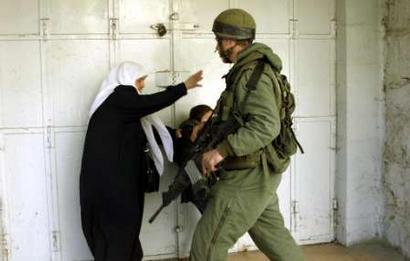
The Israeli Military’s Advocate General ruled Sunday that Palestinian villages can continue to be used for Israeli military training under the principle of “belligerent occupation”.
This is an Israeli military concept that allows its soldiers virtual impunity with regard to their behavior in the Occupied West Bank and Gaza Strip, under the pretext that the Israeli military is the sovereign authority over the entire territory. This edict contradicts international law and numerous United Nations resolutions that question the Israeli claim to sovereignty over all Palestinian land.
The Israeli military frequently invades Palestinian towns and villages, with soldiers running through streets and alleys with loaded automatic weapons, ransacking homes and terrorizing residents, for the purposes of ‘training’.
When a human rights organization filed a challenge to this practice earlier this year after several particularly egregious ‘training’ raids, the Israeli military said they would respond to the complaint. Today, several months later, the military ruled that the training is all in accordance with the dictates of martial law as it applies to the Israeli military occupation of Palestinian land in the West Bank and Gaza Strip.
According to the military Advocate General’s statement, there is “no legal obstacle to holding training in inhabited areas as part of maintaining security in the area. The orders issued for the drills that take place in populated urban areas include a statute requiring coordination with the ones doing the drill. It will also be made clear that as part of the training exercises, the soldiers must avoid putting the population at risk, damaging their property or causing unreasonable disturbance to their daily routine.”
However, the Palestinian residents subjected to these ‘training exercises’ and the human rights groups representing them have provided numerous examples of the soldiers tearing through homes and yards, breaking into houses, running up and down stairs and taking over rooftops of family homes as part of these exercises.
All of the villages where this training take place have experienced actual Israeli military invasions on a regular basis, and since the military makes no attempt to differentiate or announce that any particular invasion is a ‘training exercise’, the villagers are just as terrorized as they are during actual raids.
Related article
Where Does the USA Unequivocally Stand on Israeli Annexation of Palestine?
By Jim Surfer | Dissident Voice | October 28, 2013
The Occupying Power shall not deport or transfer parts of its own civilian population into the territory it occupies.
– Art. 49, Fourth Geneva Convention
American news agencies (AP, Reuters, any major news organization or outlet) in reference to Israeli settlements (which could more accurately be termed “colonies”), routinely comment that these settlements are “considered illegal by most nations.” This is dishonest, as it creates the impression that the legality of settlement activity is murky and subject to debate. When I encounter this phrase I often ask the source to identify which nations consider settlement building on occupied territory legal. I neither receive or expect a reply because, of course, no nation besides Israel itself would argue their legality.
In order to drive this to ground, on August 8 I sent requests to both the U.S. Dept. of State and to Senator Robert Menendez, Chairman of the Senate Foreign Relations Committee, to provide a written statement of official U.S. policy on the legality of settlement building on occupied territory.
With no response being offered, on August 16 I began placing calls to State and the Congress, which I continued over the the following twenty-five days. By email and/or by telephone I contacted several offices at State along with spokespersons for Senators Menedez and Harry Reid (Senate Majority Leader) and the Congressional Representative of my home district, Loretta Sanchez. Specifically, I spoke to Kerry, Carlos, Kirby, Jose, Jennifer and Cameron, a gaggle of bright young staffers who ranged from earnest to annoyed and aloof. They all shared an abject inability to summon a response to my question. This includes the emailed response I finally received from Sen. Menendez on September 9, which reads as follows:
Dear Mr. Hurt :
Thank you for contacting me to express your views regarding a two-state solution to the Israel – Palestinian conflict. I appreciate hearing from you on this important matter and having the opportunity to respond.
As you may know, the Palestinian Authority proposed a resolution at the United Nations Security Council (UNSC) regarding issues under direct negotiations between the Palestinian Authority and Israel, namely borders and settlements. Regardless of the content of such a resolution, our country’s consistent position has been that this and other issues linked to the Middle East peace process can only be resolved by the two parties negotiating directly with each other.
A peace agreement between Israel and the Palestinians is long overdue, and we must ensure that peace is sustainable and both parties are fully committed to a resolution. The merits of any peace proposal between the Israelis and the Palestinians will have to be weighed against the assurances Israel requires for its security. Israel’s right to exist and defend itself is inalienable and must be explicitly recognized by its neighbors.
Again, thank you for sharing your thoughts with me. Please do not hesitate to contact me if I can be of further assistance.
The reader will note that Sen. Menendez’s response is mere boilerplate and utterly fails to address the question. It also opens with a striking disregard for the truth: At no point did I “express (my) views regarding a two-state solution…” I immediately hit “Reply” and sent a polite, carefully worded message pointing out that my question remained unaddressed. In return, I was summarily notified by an entity labeled “senatepostmaster” that my reply was undeliverable.
Sen. Menendez has a spotty political record, often taking positions closer to Republican than Democratic. When it comes to Israel, however, he is reliably and staunchly in support, and maintains a close relationship with AIPAC. (Please read his address to AIPAC, March of this year.) He has recently sent a letter to the president laying out conditions for the Iranian nuclear negotiations that appear to be penned by Netanyahu himself, going far beyond Obama’s objectives and well beyond anything the Iranians could accept. Not surprising then that in his letter above, Menendez speaks entirely from an Israeli perspective, for example stressing the Israeli security requirements with nary a word about Palestinian security.
I had also forwarded this question (our nation’s official position on the legality of Israeli settlements) to the Council on Foreign Relations, and was pleased to receive a reply penned by Elliot Abrams, who, though still encumbered by significant moral and legal baggage (Central American death squads, Iran-Contra), must be respected as a scion of American diplomacy. Mr. Abrams, whose reply provides a neat history of the issue, from Reagan (“not illegal”) to Obama (“illegitimate”), while still failing to state our national position on legality, which position quite clearly does not currently exist.
The episode described clearly illustrates that our “representative democracy” is a charade. A representative democracy whose government declines to discuss or even express policy is nothing more than a plutocracy and our elections become merely an opportunity to select from a limited pool of plutocrats. It also calls into question our ability to perform an elemental and essential role of government: to create and conduct policy. It further questions the quality, capability and experience of our leadership and certainly our commitment to fundamental American values, namely the rule of law. The Fourth Geneva Convention was incorporated into Customary International Law in 1993, making it applicable to all nations. It’s clear that in this case our government willfully ignores and refuses to even acknowledge international law.
Related article
Featured Video

Why Hamas Really Attacked Israel on Oct. 7
or go to
Aletho News Archives – Video-Images
From the Archives
Israel: Strategic Ally or Liability?
By Stephen Sniegoski | My Catbird Seat | June 12, 2010
The claim that Israel serves as a valuable ally for the United States is made by both pro-Zionists and much of the anti-war and anti-Zionist Left that is influenced by Noam Chomsky. As a result of the Gaza flotilla massacre, which has caused a world-wide uproar against Israel, the value of Israel to the United States is being publicly questioned in more mainstream foreign policy forums. … continue
Blog Roll
 Aletho News
- Why Hamas Really Attacked Israel on Oct. 7
- Declassified UK exposes British man who fought for ‘Israel’ in Gaza
- West’s death cult in a theater near you
- How the Yandex ‘Russian bots’ lie fell apart
- Burnham’s ‘Russia did Brexit’ ruse crumbles
- Estonia making movies and games to encourage war against Russia
- Four in five new UK jobs taken by foreigners – report
- Here’s what Trump’s latest U-turn really means for Russia and Ukraine
- The Houthis Are Not an Iranian Proxy
- Europe’s Energy Hypocrisy, Russian LNG Profits and US Dependence
- If Americans Knew
- Activists Abused By Israel Return to New Freedom Flotilla Mission
- 60 Minutes won’t tell the full truth about Israeli settler violence
- Nearly 50,000 women, girls killed or severely injured in Gaza since October 2023: UN Women
- ADL is working with AI companies to suppress alleged ‘antisemitism’
- Israeli occupation forces using social media surveillance unit to target hundreds of Palestinians in the West Bank
- Israel’s New – and Terrifying – Security Doctrine
- Israeli Attacks Kill Five in Gaza, Including a four-year-old and a woman
- Air Force Major Who Called for Trump’s Impeachment Held in Solitary Confinement
- It’s a Genocide, I’m Into It’: Seinfeld Mocks Protest over Palestinian Children Killed
- Universities fire dozens amid pressure from Zionist billionaires
- No Tricks Zone
- New Study Suggests Large Regions Of The Pacific Ocean Have Been Cooling For The Last 80 Years
- Germany’s Green Energy Debacle: High Energy Costs Force Kahla Porzellan to Close After 182 Years!
- New Study: 50 Years Of The Most Aggressive ‘Net Zero’ Policies Can Only Affect The Global Climate By 0.03°C
- US September “Heat” Was No Record…Many Records Set Decades Ago
- Latest European Green Energy Debacle; Portugal’s Largest Flagship Solar Park Insolvent!
- Green Energy Debacle: German Expert Professor Fritz Vahrenholt Warns Of Severe Economic And Social Consequences
- Two More Paleo Reconstructions Affirm Meters-Higher Sea Levels Across Ireland, Brazil 7000-6000 Years Ago
- New Study: Earth And Venus Surface Warmth Largely Explained By Convection And Lapse Rate, Not CO2 Or Radiation
- 2025 Nature Paper Claiming Worsening Global Drought Gets RETRACTED …Heavily Flawed
- New Study: ‘Global Drought Shows No Detectable Recent Acceleration Under Climate Warming’

