West might try to damage Russian-Chinese relations using Aigun Treaty issue
By Uriel Araujo | September 22, 2022
Some analysts have been claiming that Beijing is “breaking” with Moscow over the issue of Ukraine. In June this year the Chinese government conducted military drills in its northeastern border with Russia, while Moscow was mostly preoccupied with its own military operations in Ukraine. This event led some Western observers to speculate, albeit there is no evidence, that this could be a sign China has unfinished business in that border area.
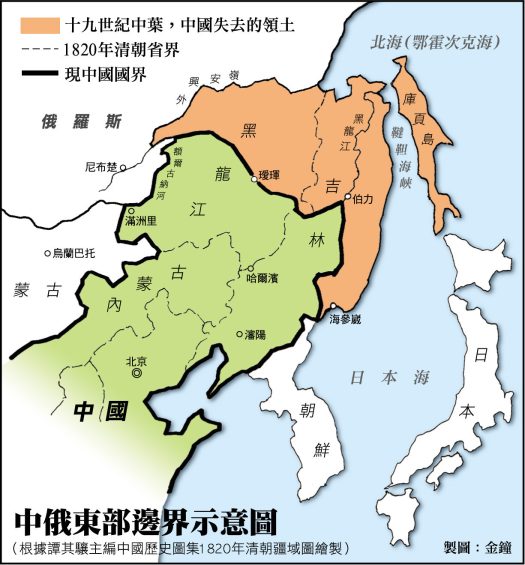
The 1858 Treaty of Aigun established much of the modern border between Manchuria (Northeast China) and the Russian Far East. From a Chinese Perspective, especially since the rise of Chinese nationalism in the 1920, it was an “unequal treaty”, having been signed, as it was, when the Chinese Empire was in a weakened state: it gave the neighboring Russian Empire over 600,000 square km from Manchuria.
As a legacy of the 19th and the 20th century, the Eurasian great powers often have border disagreements. Japan historically has variances with Russia over the Kuril islands, for example, as it has with its other “neighbors” China and South Korea as well. India and China notoriously have theirs too, which, by the way, has not stopped both of them from cooperating with one another, as is exemplified by the fact that they have recently withdrawn their troops from the disputed Ladakh region’s border area, thus moving one step towards the Asian century.
Indian-Chinese cooperation in fact is particularly remarkable, considering the former’s position within the QUAD, which is seen by many as a Western anti-Chinese “new NATO”. Yet even amid serious bilateral disagreements, Eurasian states have shown that there is plenty of room for cooperation on a number of levels, and, in the same way, New Delhi has also maintained close ties with Moscow, while getting closer to Washington. The same logic must apply to Sino-Russian cooperation, notwithstanding their differences over the Northeast China-Russian Far East border region.
In 1969, in this very region, near the Amur river, there was a seven-month undeclared military conflict between China and the Soviet Union, shortly after the so-called Sino-Soviet split. After the conflict, the United States sought to strengthen ties with Beijing by secretly sending Henry Kissinger to China for his now famous 1971 meeting with Zhou Enlai, which in turn paved the way for then US President Richard Nixon visiting China and meeting with Mao Zedong the next year. And yet even with the Sino-Soviet split, the two states managed to stabilize their relations in the late seventies.
In the more recent past, on 21 July 2008, then Chinese Foreign Minister Yang Jiechi and his Russian counterpart, Sergei Lavrov, signed in Beijing an additional Sino-Russian Border Line Agreement, thus marking the acceptance of the eastern portion of the Chinese-Russian border’s demarcation.
On February 4, in Beijing, a joint statement by Russian President Vladimir Putin and his Chinese counterpart Xi Jinping famously declared that the friendship between the two states “has no limits”. Such a statement, somewhat hyperbolic as it may be, in any case, from an American perspective, is quite terrifying as it poses a direct challenge to Washington’s ambitions of maintaining unipolarity.
No friendship is really absolute, but the truth is that Chinese-Russian relations have entered a new era, and Beijing’s trade and investment in the Russian Far East, such as in the Vladivostok Port – Trans-Siberian Railway, must also be seen in this context, as the Belt and Road Initiative investments into the Russian Federation go on. Chris Devonshire-Ellis, publisher of Asia Briefing, writes that both powers view the Heihe-Blagoveshchensk border cities (which sit opposite each other on the Amur River opposing banks) as key strategic development hubs in an access point to the Trans-Siberian railway. That being so, maintaining peace at the border is in the best interests of both Moscow and Beijing, contrary to the wishful thinking of some Western analysts.
In any case, much has been done, in the US-led West, in terms of PR and diplomacy to try to “counter” the “no-limits” friendship concept, and to promote and explore Russian-Chinese points of contention. Thus, in the same way Washington inflates Indian Prime Minister Narendra Modi’s comments to Putin on Ukraine, it tries to do the same pertaining to Moscow and Beijing and it will certainly try to explore the issue of Manchuria.
Although, under American influence, Japan has changed its stance on Russia partly over the aforementioned Kuril islands, this of course does not in any way mean that China would behave similarly. Chinese-Russian Eurasian strategic interests converge very deeply and both states have sophisticated diplomacy apparatuses to bilaterally pursue collaboration, bilateral disputes apart, while also employing the framework of forums such as the SCO and the BRICS group to coordinate their perspectives together so as to maximize benefits for all.
Uriel Araujo is a researcher with a focus on international and ethnic conflicts.
US blocked Russian diplomats from UN – Russia
Samizdat – September 21, 2022
The United States did not grant visas to several members of the Russian delegation, preventing the officials from taking part in the United Nations General Assembly in New York, Russian Foreign Ministry spokeswoman Maria Zakharova said on Wednesday.
Speaking to Sputnik, she noted that two of ten diplomats comprising “the official delegation” had not received the necessary stamp.
Zakharova explained that Russia’s overall delegation consists of several groups. The first one, she said, is referred to as “the official delegation.” This group is headed by Russian Foreign Minister Sergey Lavrov and has been formed with the approval of Russian President Vladimir Putin.
“Out of ten members of the official delegation, two did not receive visas. This tactic has already become an ominous tradition on the part of the US, but the point stands,” Zakharova stated, also offering a reminder that Moscow has already voiced concerns on this matter.
The Foreign Ministry spokeswoman went on to say that Washington had not granted visas to several delegation members from the second group, which includes various experts and diplomats who support the official delegation. She said, however, that she does not know the exact number, due to late notice.
“You would not believe… but the messages on the issuance or non-issuance of the visa were coming in just overnight. So we had to contact our colleagues at night to tell them to get ready for tomorrow’s flight [to the US],” she noted.
Of a third group, which incorporates journalists, one person failed to get a US visa, Zakharova said.
The 77th session of the UN General Assembly opened on September 13. However, the main event of this session is supposed to be the ‘High-Level week’ from September 20 to 26, which will be attended by many world leaders and foreign ministers.
Moscow has repeatedly accused Washington of violating its obligations under the 1947 agreement on the hosting of the UN headquarters in New York City, which requires the US to grant access to foreign representatives without charge and “as promptly as possible.”
Following Moscow’s and the UN’s calls to issue visas to members of the Russian delegation, the US allowed entry to Russian Foreign Minister Sergey Lavrov and a number of high-level diplomats, enabling them to attend the assembly.
Energy dwarfs sanctioning a giant
Free West Media | September 21, 2022
The EU is targeting Hungary again. Brussels has now cleared the way for massive financial sanctions against Budapest as a tit-for-tat for Hungarian foreign policy, which includes strict neutrality on the issue of Russia sanctions and continuous gas supply contracts with Gazprom.
The EU Commission agreed on Sunday to block EU payments amounting to around 7,5 billion euros since the money is not safe from “misuse” in Hungary, explained Budget Commissioner Hahn. Just recently, a resolution was passed in the European Parliament with a majority of left-wing and green MPs accusing Hungary of no longer being a “democracy”.
The Hungarian government under Viktor Orbán has not contested this move. Orbán instead again criticized Brussels’ course on energy. It is absurd that “dwarfs want to put sanctions under pressure on an energy giant,” said the Hungarian head of government during a visit to Serbia.
Hungary’s gas storage depots are full, Budapest has also negotiated additional supply guarantees with Gazprom, and the price of petrol for Hungarian citizens has been reduced to 1,18 euros per liter.
Against this background, Orbán declared during his visit to Serbia, during which he was awarded a medal by President Vučić: “The stronger impose sanctions on the weaker. But if you look at the energy realm, you see that we, as dwarfs, are now imposing sanctions on an energy giant,” which is a completely unusual phenomenon in history.
“These new sanctions hurt us a lot, so they are bad and painful for us, they cost us a lot of money, and they also threaten a significant part of the gains we have made over the past decade.”
The head of the German Institute for Economic Research (DIW), Marcel Fratzscher, came to a similar conclusion. He told the Reuters news agency that “the Ukraine war caused massive damage to the German economy”.
“Roughly speaking, we are talking about four to five percentage points of gross domestic product being lost over a three-year period,” said Fratzscher. “That’s 150 to 200 billion euros less economic output.”
He warned of “a significant decline in private consumption and thus in the standard of living of an unusually large number of people”. A Forsa survey showed recently that the majority of Germans were no longer willing to accept financial disadvantages because of the federal government’s sanctions against Russia.
Hungary ‘bored’ by EU resolutions
Orbán also commented on the EU Parliament’s latest resolution in Belgrade, saying: “The only reason we are not laughing at this report is that we are already bored […] It is the third or fourth time that this is happening, that a resolution is being passed in the European Parliament condemning Hungary.”
The European Christian Democrats were also moving further and further to the left. “The voting shares show exactly that: the right-wing parties voted for Hungary and the left-wing parties against,” Orbán pointed out.
Meanwhile, a Hungarian delegation led by the Mayor of Budapest Istvan Tarlos visited the city of Samarkand.
A Samarkand official welcomed the Hungarian delegation, and told them about the economic potential, tourism opportunities of the region. Prospects of expanding trade, economic, tourism and other cooperation between Samarkand and Budapest were discussed.
Guests from Hungary got acquainted with historical and cultural monuments, as well as the sights of Samarkand.
DID YOU KNOW THAT UKRAINIAN SOLDIERS ARE “ROUTING RUSSIAN FORCES AND COLLAPSING RUSSIA’S NORTHERN DONBAS AXIS?”
By Larry Johnson | A Son Of The New American Revplution | September 19, 2022
Nope, I did not know that. But thank God we have retired General Dave Petraeus to clue us in. He wrote the following 10 days ago:
- A successful encirclement of Russian forces fleeing Izyum would result in the destruction or capture of significant Russian forces and exacerbate Russian manpower and morale issues.
- The Russian MoD’s inability to admit Russian failures in Kharkiv Oblast and effectively set information conditions is collapsing the Russian information space. Kremlin-sponsored TV propagandists offered a wide range of confused explanations for Ukrainian successes ranging from justifications that Russian forces are fighting against the entire Western Bloc, to downplaying the importance of Russian ground lines of communication (GLOCS) in Kupyansk.
- The withdrawal announcement further alienated the Russian milblogger and Russian nationalist communities that support the Kremlin’s grandiose vision for capturing the entirety of Ukraine. Russian milbloggers condemned the Russian MoD for remaining quiet, choosing self-isolation, and distorting situational awareness in Russia.
Turns out that General Dave experienced premature military orgasm. It is true that the Russians retreated from Izyum, but they were not surrounded. Putin has never claimed the “grandiose vision for capturing the entirety of Ukraine.” He has been quite clear–as recently as the press conference this week at the SCO–Russia is going to secure the Donbas. What about growing dissent in Russia about the SMO? Putin, based on his recent news conference at the Shanghai Cooperation Organization, could give two shits about the feelings of “the Russian milblogger and Russian nationalist communities.”
I am citing Petraeus not because I respect his alleged military “genius.” I do not not. General Dave had the reputation at West Point as the consummate sychophant. The other cadets said he would marry the Commandant’s homely daughter just to get ahead. Guess what? He did. I cite Petraeus because his views are emblematic of the Washington national security establishment who are totally committed to lying about the reality in Ukraine. No matter what the actual situation is on the ground, Ukraine is winning, Russia is losing and it is just a matter of time before Russia implodes. This theme has been trotted out and paraded around the internet almost every month since March by Ukraine’s western enablers.
The Hill just published another installment of this delusional analysis by Mark Toth and Jonathan Sweet. Let’s meet the boys:
Mark Toth is a retired economist, historian and entrepreneur who has worked in banking, insurance, publishing and global commerce. He is a former board member of the World Trade Center, St. Louis, and has lived in U.S. diplomatic and military communities around the world, including London, Tel Aviv, Augsburg and Nagoya.
https://www.newsbreak.com/news/2752375324738/hey-russia-it-s-putin-stupid?noAds=1&_f=app_share&s=i3
Jonathan Sweet, a retired Army colonel, served 30 years as a military intelligence officer. His background includes tours of duty with the 101st Airborne Division and the Intelligence and Security Command. He led the U.S. European Command Intelligence Engagement Division from 2012-14, working with NATO partners in the Black Sea and Baltics.
https://www.newsbreak.com/news/2752375324738/hey-russia-it-s-putin-stupid?noAds=1&_f=app_share&s=i3
I do not know if their article is the result of ignorance, willful blindness or if they were paid to push propaganda. Regardless of the motive, Toth and Sweet join the Petraeus club and push the objective lie that the tenacious Ukrainians are defeating the Russian army:
it is Ukrainian soldiers, equipped and trained by English-speaking countries, alongside their allies who have opened fresh cans of whoop-ass and are inflicting a beatdown of Putin’s military forces in the Donbas. . . .
There has been one constant since Putin’s illegal invasion began in February: Russia’s military forces have been forced to retreat and regroup, time and time again. . . .
Putin has been exposed as an “emperor with no clothes,” forced to rely upon haggling with Iranian and North Korean surrogates to purchase drones and, according to the New York Times, “millions of artillery shells and rockets.” Saturating social media with disinformation and excuses about why Russian ground forces are failing cannot mask the images of abandoned equipment and reports of Russian soldiers surrendering.
https://www.newsbreak.com/news/2752375324738/hey-russia-it-s-putin-stupid?noAds=1&_f=app_share&s=i3
Do you remember that incredible defeat of the Russian army in Mariupol when the Ukrainians surrounded the Russian troops and forced the surrender of 2500 combatants? Neither do I. That is what Russia did to the Ukrainian AZOV battalion.
How about the Russians fleeing in terror ahead of the Ukrainian blitzkrieg around Kherson? Nope. Another dry hole. The Russians pushed that attack back and inflicted catastrophic casualties on the Ukrainians.
What about the Luhansk People’s Republic? Ukraine held on to that and crushed the Russian backed militia. Right? Wrong!! Luhansk was secured and the same process is underway now in the Donetsk People’s Republic.
Why do western political, military and media leaders embrace demonstrable lies? I think it reflects a deeper sickness that afflicts the west. This self-delusion is not an isolated phenomena. Biden, his military commanders and the mainstream media also insist that men can be women and become pregnant, that inflation is zero, that Biden is popular, and that pedophiles are not bad people. Oh yeah, one more–the southern border of the United States is secure.
The time is coming when reality will intrude and destroy the fantasies. It happened to Baghdad Bob, who insisted there were no U.S. tanks in Baghdad in March 2003, and will happen to General Dave, Mark Toth and Jonathan Sweet. Seven months into the Russian “Special Military Operation,” Putin and his Generals have committed only a small fraction of their military forces to the conflict. They seem content to destroy Ukrainian units and equipment with artillery, missiles and mortars and force NATO to keep supplying Ukraine so that it can send its troops, armed with new equipment, to the front to be destroyed.
Yet NATO’s European members do not have the industrial capacity to replace the donated military equipment and are facing a bleak winter with scant energy resources needed to power manufacturing plants. The United States also is depleting its stockpile of weapons. Raheem Kassam has provided a very useful summary of what the United States has sent to Ukraine (read here). For example, the United States has provided Ukraine in six months more Javelins than it can produce in one year. So far the number stands at more than 8500, which is more than one-third of the U.S. total arsenal.
And how many Russian tanks have the Ukrainians destroyed with these Javelins? We do not know. The U.S. intelligence community does not know. U.S. intelligence is relying on Ukraine to report the good news and the Ukrainians simply say, “lots.” In theory, U.S. intelligence analysts have the ability to use satellite imagery to count disabled and destroyed tanks. But I am told that has not happened.
What we do have is a lot of social media video showing the Russians capturing hundreds, if not thousands, of javelin ATGMs. And we have videos of Russian tanks being hit with a javelin but continuing to operate. The javelin is not turning out to be the wonder weapon it was promised to be.
Let me reiterate one very important point–the so-called intelligence on Russian casualties in terms of personnel and equipment, is being provided solely by the Ukrainians. The United States has not taken any steps to independently verify the Ukrainian “intelligence.” That is a recipe for disappointment once the truth comes out that Ukraine is guilty of exaggerating.
Putin: Sanctions Take Toll on Western States and Poorest Countries
Samizdat – 20.09.2022
Western countries slapped Russia with several new rounds of sanctions this year in response to the start of the special military operation in Ukraine. Since, these countries have faced surging inflation, electricity and fuel prices, partly prompted by their own sanctions.
The world is undergoing a transformation, transitioning toward a multipolar order, which becomes the dominating vector of development, Russian President Vladimir Putin has stated as he greeted new foreign ambassadors who had arrived in Russia.
The president noted that the only states which oppose this transition are the ones that want to preserve their hegemony and control the world.
“As for Russia, we will not deviate from our sovereign course. As a permanent member of the UN Security Council, we intend to further promote a unifying international agenda, contribute to the resolution of numerous challenges and threats of our time, and help with the settlement of acute regional conflicts. This will be Russia’s key talking point at the opening of the 77th session of the UN General Assembly,” Putin said.
Putin added that the poorest countries were hit the hardest by their hegemonic policies, as well as sanctions that the western countries impose. He noted that the obstacles for energy, grain and fertilizer shipments created by the West’s sanctions negatively affected “innocent” developing and poor countries.
“In this light, it’s highly cynical of the West to ignore our offer […] to transfer free of charge 300,000 [tons] of Russian fertilizers blocked in European ports due to sanctions to countries in need,” Putin said.
The West too was hit hard by its sanctions politics, the president noted.
The western countries experienced a surge in inflation, especially in fuel and energy prices, after they imposed sanctions against Russia over its special military operation in Ukraine. This surge added to the woes of western consumers, who had seen shop prices rise since the end of 2021.
India’s gaffe at Samarkand
BY M. K. BHADRAKUMAR | INDIAN PUNCHLINE | SEPTEMBER 20, 2022
Prime Minister Narendra Modi’s meeting with Russian President Vladimir Putin at Samarkand on September 16 after the SCO Summit turned into a media scandal. The Western media zeroed in on six words culled out of context in the PM’s opening remarks — “today’s era is not of war”— to triumphantly proclaim that India is finally distancing itself from Russia on Ukraine issue, as the US and European leaders have been incessantly demanding.
Of course, this motivated interpretation lacks empirical evidence and is, therefore, malicious. Besides, Modi also spoke with a rare interplay of emotions by underscoring the quintessence of the Indian-Russian relationship, and his two decade-long association with Putin.
The steamy part cooked up by the US media shows the desperation on the part of the “Collective West” to isolate Russia at a time when even western leaders have candidly admitted that the bulk of the non-western world does not identify with the western narrative on Ukraine and refuses to roll back their relationship with Russia.
Many countries are, in fact, stepping up their cooperation with Russia —Turkey, Saudi Arabia, Egypt, Iran, for example. Curiously, even western companies are loathe to leave the highly attractive Russian market where business returns are high. A report in the Atlantic Council magazine on September 18 highlights that although something like 1,000 multinational corporations had announced that they would be leaving Russia in the wake of the western sanctions, “the unfortunate reality is that… three-quarters of the most profitable foreign multinationals remain in Russia.” Thus, statistically, while 106 western companies exited the Russian market, over 1,149 internationals still remain and simply keep silent about it.
The giant Sakhalin-2 oil-and-natural-gas project in the Russian Far East is a celebrated case where two big energy Japanese investors Mitsui and Mitsublishi, with government support, simply refused to quit, as the Russian project supplies 9 percent of Japan’s energy needs. The G7 has no option but to exempt Japan from the purview of sanctions when it comes to Sakhalin-2!
Again, the West continues to import fertiliser from Russia and to that end, lifts the restrictions on shipping, insurance, etc. But the restrictions continue against Russia’s exports of food grain and fertiliser to the non-Western world. Russia has now offered to distribute the fertiliser held up in European ports free of charge to the poorest countries in Africa if only the restrictions for exports are waived, but Europe would rather use it for their own needs.
It has recently been exposed that the brouhaha about a “global food crisis” (which India too mouthed) was basically a cheap hoax perpetrated by the Biden Administration to get Russia to allow the sale of wheat held up in Ukrainian silos to the European market by American companies, who have apparently bought up Ukraine’s farm lands and control that country’s grain trade! Only a fraction of the grain shipments from Ukraine went to poor countries threatened by famine. Suffice to say, the US and the European Union pressure on India’s purchase of Russian oil was nothing but bullying.
That said, India should know that in a situation where Russia faces an existential threat to its security, it will not be deterred in firmly, decisively responding, no matter what anybody says. Will India be deterred if any foreign country gets agitated over state repression in Kashmir? Violence and bloodshed are abhorrent features of the contemporary world situation and is a painful reality all over the world.
That is why, PM Modi’s awkward reference to war and peace in his initial remarks to Putin at Samarkand was way out of place in what turned out to be a “wonderful” meeting otherwise. There was simply no need to have characterised, at PM’s level, the Ukraine conflict as a “war”. It betrayed ignorance, since the whole world knows that what is going on is a proxy war between the US and Russia that had been simmering through the past quarter century ever since NATO began its eastward enlargement with an agenda to encircle Russia. Moscow seriously erred by tolerating the US interference in Ukraine so long until NATO finally appeared on its doorstep. It is doubtful if India would have shown such strategic patience.
Against such a complex backdrop, the litmus test of India’s “neutrality” will, perhaps, lie in EAM Jaishankar at least speaking up on the NATO’s eastward expansion, the US stoking the fire of conflict by pumping tens of billions of dollars worth weaponry into Ukraine, and the Biden Administration’s diabolical role in undermining nascent peace moves between Moscow and Kiev.
If Turkey’s Recep Erdogan and Hungary’s Viktor Orban can speak up, although NATO leaders, why can’t India’s EAM? But, never mind, there is no question of Jaishankar even remotely embarrassing Biden.
From the Kremlin readout, Putin actually acknowledged right at the outset of the conversation with Modi that Russia and India are not on the same page on Ukraine. To be sure, Putin must be knowing that India’s behaviour is guided by its narrowly defined self-interests and conditioned by an itch to do cherrypicking. But Moscow has never been and will never be a demanding partner. Mutual interest and mutual respect are the hall marks of Russian diplomacy toward India. Despite own reservations over what India was doing by splitting Pakistan into two halves, when the crunch time came in 1971, Moscow not only stood by India but even despatched its warships and submarines to guard Indian waters from a potential US military intervention against India. It is, therefore, all the more reason for us to be discreet.
Ironically, India must be one of the few countries that benefits out of the Ukraine conflict. Aside oil, coal and what not at low prices, paradoxically, even the rupee has taken baby steps to commence its indeterminate journey to become a “world currency.” No patriotic Indian will criticise the Modi government for such sophistry. However, confusion arises when morality is injected into all this with a contrived attitude of indignation, when there is really no need for it.
The meeting in Samarkand took place in the context of the SCO’s annual summit. The summit was not about Ukraine but about the profound issues that have surfaced in its wake that will shape the contours of the world order. This SCO summit was special, as it took place amid large-scale geopolitical changes, triggering a rapid and irrevocable transformation of the entire complex of international ties, relations, policies, economy, when a new model based on the real multi-polarity and dialogue is being built.
Everyone understands that the SCO, which represents half the world’s population, will help forge the new world order. Unlike the case with NATO, where all decisions are made in Washington and imposed on America’s “allies”, there is no Pied Piper in the SCO tent. Modi could easily have played a meaningful role at the summit instead of meandering his way aimlessly through the pandemic, supply chains, et al, at a juncture when such profound issues were being discussed by his peer group in Samarkand.
The word “multipolarity,” which was on everyone’s mind in Samarkand, didn’t even figure in Modi’s speech at Samarkand. Whoever drafted the speech must have done it with an eye on Washington. Therefore, don’t blame the US media. They happened to notice all these aberrations and decided to cull out those six sharply-etched words to put India on the mat, mocking it for doublespeak and rank opportunism, and all that hand-wringing by the apologists of our government cannot wash away that stain.
Kiev vows to use force against breakaway regions
Samizdat | September 20, 2022
Senior officials in Kiev have dismissed as irrelevant plans for a number of current and former Ukrainian regions to hold referendums on whether to join Russia.
Andrey Yermak, President Vladimir Zelensky’s chief of staff, described the proposed votes as “blackmail” by Moscow.
“This is what fear of defeat looks like. The enemy is afraid and uses primitive manipulations,” he said in a post on social media on Tuesday.
Yermak added that “Ukraine will solve the Russian question,” insisting this could be done “only by force.”
Foreign Minister Dmitry Kuleba also downplayed news of the upcoming referendums, dismissing the move as a “sham.”
“Ukraine has every right to liberate its territories and will keep liberating them whatever Russia has to say,” he tweeted.
The condemnations and threats came in response to bids by the Donetsk and Lugansk People’s Republics, as well as Ukraine’s Kherson and Zaporozhye regions, to hold referendums on the question of joining the Russian Federation. The votes could take place as early as this week.
Kiev previously threatened any person who takes part in such a plebiscite with criminal prosecution. Ukrainian Deputy Prime Minister Irina Vereshchuk said participants could be sent to prison for up to 12 years.
Iran to buy, swap 15 mcm per day of Russia’s gas via Azerbaijan
Press TV – September 19, 2022
Iran will import Russian gas through pipelines from Azerbaijan under arrangements agreed in a major deal between Tehran and Moscow two months ago, according to a report published in the local media.
The semi-official Fars news agency said in a Monday report that Iran will buy some 9 million cubic meters (mcm) per day of gas from Russia and will take delivery of another 6 mcm per day under a swap deal for the purpose of delivery to Russian gas customers to the south of Iran.
The report cited data from an internal report of the Iranian Oil Ministry and said the purchase and swap arrangements are related to a $40 billion deal signed in July between Iran’s state oil company the NIOC and Russia’s Gazprom.
Earlier reports had indicated that Iran could take delivery of Russian gas from Turkmenistan for the purpose of swap delivery to Turkey and Iraq.
However, the new data suggest Iran will use the 15 mcm per day of gas supply from Russia to strengthen its domestic supply network in the densely populated regions in the northwest while being able to export increased amounts of natural gas to Turkey and Iraq through pipelines in the west of the country.
Iran is already in a gas swap arrangement with Turkmenistan and Azerbaijan under which it consumes gas received from Turkmenistan in its northeastern regions and delivers the same amount of gas to Azerbaijan.
The Fars report said Iran will deliver the equivalent of 6 mcm per day of gas to Russian customers in the south in the form of liquefied natural gas (LNG). It added that Gazprom will be a partner in the liquefaction process.
Japan maintains sanctions but boosts its LNG imports from Russia
Japan’s economic woes are compounded by anti-Russia sanctions
By Ahmed Adel | September 20, 2022
Despite being one of the very few non-Western countries to join the US-led sanctions against Moscow, Japan has suddenly tripled the amount of liquefied natural gas (LNG) imported from Russia to solve its energy problem. Although the Japanese government plans to reduce its dependence on Russian gas supplies, it appears that Tokyo cannot immediately give up gas and fuel from the Eurasian country.
According to the Japanese Ministry of Finance, Japan in August increased the amount of LNG imported from Russia by 211.2% compared to last year. It is noted though that crude oil imports in the same period year-on-year decreased by 20.3%. According to the data, coal imports from Russia in August decreased by 32.6% compared to the same period last year.
In the opposite direction, iron ore imports increased by 44.9%. In addition, Japan increased the number of vegetables and fruits imported from Russia by 154%, but reduced the amount of grain and soybean imports by 94-95%. While the total volume of goods exported from Japan to Russia in August decreased by 24.3% compared to the same period last year, reaching $384 million, the amount of Japanese goods imported from Russia recorded an increase of up to 67.4%, with a value of up to $1.15 billion.
The Japanese want to gradually reduce imports of Russian coal and oil, but Tokyo does not want to cut the amount LNG because this is a gas supply that plays an extremely important role in maintaining the country’s economy.
At the end of June 2022, the G7, the group of leading industrialised countries in the world, which includes Japan in its ranks, announced a plan to reduce dependence on the supply of gas, oil, and fuel from Russia. However, the sharp increase in LNG imports from Russia to Japan seems to indicate a different truth. Not only Tokyo, but also many Western countries, will find it difficult to end their dependence on Russian gas in the short and medium term.
It is recalled that Japan’s energy self-sufficiency rate is only 11%, much lower than the US’s 106%, Canada’s 179%, and the UK’s 75%. Therefore, if Russia stops selling oil and gas to Japan, Tokyo will face a great risk of energy insecurity.
This month, G7 countries also announced their intention to impose a price cap on Russian oil. However, the EU itself cannot find a common voice on this issue, especially as Moscow has warned that “unfriendly” countries will not have the opportunity to import oil, gas and fuel from Russia if they impose a cap. This is a scenario that Japan wants to avoid.
According to the Ministry of Economy, Trade and Industry (METI), Japan’s total energy consumption in 2019 is equivalent to 247 million tons of oil, of which natural gas accounts for nearly 8.7%. Renewable energy (other than electricity) accounts for only a very small part, about 0.1% and even tends to decrease slightly over time. In recent years, Japan has not discovered any more natural gas fields of major commercial value. Japan, for its part, only produces about 2 million tons per year.
To meet domestic demand, Japan imported 82.9 million tons in 2018 – from Australia 34.6%, the Middle East 21.7%, and Malaysia 13.6%, but also from host of other countries. In fact, Japan uses LNG mainly for power generation through 37 LNG terminals, with the highest proportion belonging to JERA (42%) and Tokyo Gas (17%).
After the Fukushima nuclear power plant meltdown, Japan changed its energy development strategy, focusing on the issue of safety and energy security. Along with that, Japan also strives to further enhance energy efficiency.
In the context of Japan’s limited potential to exploit renewable energy, the use of nuclear power is opposed by many domestic organisations. For this reason, LNG imports became a key strategy for Japan. By 2030, the share of LNG in Japan’s power generation capacity is forecast to reach 27%.
It is noted though that August marked the thirteenth month in a row that Japan has been importing products more than it has been exporting, with about half of the deficit coming from energy imports from the Middle East.
“The weaker yen is boosting (the cost of) imports at a time of surging energy prices. Energy and grain prices have shown signs of stabilizing recently, but the impact of the sharp drop in the yen will continue for a while with a lag,” one analyst told Japanese daily Mainichi.
In this way, Japan’s anti-Moscow sanctions are also affecting its economy, just as it is all across Europe. There is little evidence either that Tokyo is planning to reverse its sanctions, suggesting that its economic woes will continue to be compounded by the self-sabotaging sanctions imposed against Russia.
Ahmed Adel is a Cairo-based geopolitics and political economy researcher.
Russian fertilizer offered for free to Africa
Samizdat | September 19, 2022
Russian producer of mineral and potash fertilizers, Uralchem, has decided to supply its products to Africa free of charge, the company’s chief executive Dmitry Konyaev announced on Monday.
“The situation in the world today is really bad. Africa has been starving and will continue to starve, unfortunately. We, as a company, even decided to supply fertilizers to Africa for free, just because we are part of this global chain when you need to produce food,” Konyaev said during his speech at the Innofood forum in Sochi.
The first batch of 25,000 tons of humanitarian cargo could reportedly be sent to the Republic of Togo.
According to Uralchem CEO, there are no problems with food security in Russia, since the country is fully provided with fertilizers and can send a significant quantity for export.
Earlier this month, President Vladimir Putin said at a summit meeting of the Shanghai Cooperation Organization that the country is ready to transfer 300,000 tons of Russian fertilizers accumulated in EU ports due to Western sanctions to developing countries free of charge. While Putin welcomed the decision to allow Russian fertilizers into the EU, he criticized Brussels for only allowing the bloc’s member states to buy them.
In late July, Moscow and Kiev signed a deal unblocking Ukrainian grain exports via the Black Sea at UN-brokered talks in Istanbul. The agreement was also supposed to allow Russia to deliver fertilizers and food goods to global markets, which the Kremlin says has not happened.
Russia Presents Evidence of US Ukraine-Based Military-Biological Activity to Geneva Convention
Samizdat – 19.09.2022
The Russian Defense Ministry has presented evidence of US military-biological activity in Ukraine to member states of the Biological Weapons Convention in Geneva, head of the Radiation, Chemical and Biological Defense of the Russian Armed Forces, Lt. Gen. Igor Kirillov, said.
The ministry’s representative said that member states’ delegations did not question the authenticity of the documents they were presented as proof of the US’ and Ukraine’s violation of articles I and IV of the Convention.
“The participants of the meeting received copies of real documents previously mentioned by the Ministry of Defense of Russia, as well as material evidence confirming the implementation of work on military-biological programs in Ukraine, for consideration,” Kirillov said.
The head of the RCBD of the Russian Armed Forces further pointed out that the US and Ukraine failed to present convincing evidence to the Convention’s members that would prove that the Pentagon’s cooperation with the Ukrainian laboratories benefited the epidemiological situation in the country. Kirillov said that the US Department of Defense only came up with a few photos of renovated laboratories, while the said epidemiological situation in Ukraine has been deteriorating for the past 15 years.
The Russian Defense Ministry’s representative further stated that the US admitted the fact that Ukraine exported biological pathogens and materials, as well as engaging in ethically questionable experiments – namely on the military and socially vulnerable groups of the Ukrainian population such as psychiatric ward patients. Kirillov slammed the US attempts to tone down the problem by using claims that it did not occur “often”.
Russia raised 20 questions regarding the illegal activities of Kiev and Washington that violate the provisions of the Convention with the BWC member states, Kirillov said. Among them are questions regarding the choice of pathogens for studies, which often included ones that have never been discovered in Ukraine.
The ministry’s representative also reiterated Russia’s previous statements regarding Ukraine seeking to procure drones from Turkey fit to disperse aerosols. The Turkish defense company refused to deliver the UAVs, which could have been used to spread harmful and potentially deadly pathogens.
New Fakes about Russia-DPRK Military Cooperation
By Konstantin Asmolov – New Eastern Outlook – 19.09.2022
More recently, the author analyzed misinformation that North Korean special forces were about to appear in the Donbass, but the global media soon encountered another misinformation launched from the West: it turned out that North Korea was preparing to supply Russia with shells and possibly military equipment on a massive scale. Or it is already supplying, but that is not certain.
It all started on September 5 with a New York Times article quoting “declassified intelligence reports” that “Russia is buying millions of artillery shells and rockets from North Korea, … a sign that global sanctions have severely restricted its supply chains and forced Moscow to turn to pariah states for military supplies.”
However, the newspaper immediately noted that there were few details about the exact weaponry, timing or size of the shipment, and generally, “there is no way yet to independently verify the sale”, but immediately went on to theorize as to why this was the case. It turns out that the Russian Federation now allegedly has no ability to buy advanced weapons or the electronics to produce them, as international sanctions on Moscow disrupt its supply chains, stocks of shells and missiles are running out and Russia is forced to look for suppliers. This, in particular, was stated by the quoted expert with the Ukrainian-speaking surname Kagan.
A little later, AP Agency gave some details and quotes, which, however, still did not clarify the situation. Brigadier General Pat Ryder, a Pentagon Press Secretary, said “the information that we have is that Russia has specifically asked for ammunition” but had no other details, including whether money changed hands and whether any deliveries were continuing.
Asked why this information was declassified, Ryder said it was important to illustrate the state of Russia’s ongoing military campaign in Ukraine. And, the author would add, against the backdrop of Ukraine’s attempted counter-offensive.
National Security Council spokesman John Kirby also said there was no indication yet that the arms purchase had actually taken place or that any North Korean munitions had entered the battlefield in Ukraine. Nevertheless, the talks themselves are “just further evidence of how desperate Putin is becoming”, with US intelligence suggesting that Russia is buying millions of rounds of ammunition from the DPRK.
After that, the news spread around the world media and even reached South Korea, but discussion on the relatively objectivist website NKNews showed that assessments are directly dependent on both their bias and their distance from the Russian context.
For example, Jack Watling, Senior Research Fellow at the Royal United Services Institute, confidently stated that since February 2022 Moscow had been buying up stocks of 152mm and 122mm shells “in any way they can. And that includes North Korea.” All this is said to be common knowledge in intelligence circles, but the source of this information is not in the public domain, and he is personally unaware of specific deliveries from North Korea to Russia. However, Watlig’s level of knowledge is better described by another quote: “Moscow had for some time pushed for Pyongyang to support its war effort,” which, he said, was not limited to supplying ammunitions.
For his part, Joost Oliemans, a specialist focused on DPRK military capabilities, expressed more restraint – Pyongyang certainly has a huge amount of old ammunition, and can produce new weapons for export, but “if this story is really true, we could expect to see video evidence of North Korean ammunition in Ukraine in the coming months.” In other words, he is not prepared to discuss the subject without evidence.
By the very next day on September 6, both Ryder and Kirby had already given up somewhat. The former said in a press briefing that “we do have indications that Russia has approached North Korea to request ammunition”, he could not provide more details, but in any case “it is indicative of the situation that Russia finds itself in, in terms of its logistics and sustainment capabilities.” And also that Moscow is asking for help precisely from those countries that the US has defined as “rogue”.
Kirby also conceded that the US doesn’t “have any indication that the purchase has actually occurred yet so it’s difficult to say what it’s actually going to end up looking like”, much less evidence that these weapons are being used in Ukraine.
The Russian side has also spoken out. According to Russia’s Permanent Representative to the UN Security Council, Vasily Nebenzya, “I have not heard about it and I think it’s just another spreading fake news.”
On September 7, 2022, NKNews specifically updated its piece to clarify that “there is no evidence in the public domain of Russian efforts to procure North Korean arms since February 2022”. By this time, both Russian and unbiased Western experts had formulated a set of theses indicating that the hype news was nothing more than misinformation.
- The DPRK’s arms exports to Russia are a violation of UN Security Council resolutions, which prohibit that country from exporting or importing arms from other countries. Moreover, back in the day Vladimir Putin banned the supply of small arms and light weapons to North Korea as part of the implementation of UN Security Council Resolution 2270 of March 2, 2016. An overt violation of this kind undermines Russia’s status as a permanent member of the UNSC, and from the author’s perspective even the hypothetical arrival of North Korean construction workers in the DLPR (a far less overt violation) is at best discussed. Perhaps this disregard for sanctions will happen later on the backdrop of a further breakdown of the old world order, but that time has not yet come.
- It is not at all clear how sending such a volume of cargo is compatible with “emergency anti-epidemic measures” and border closures. Especially considering that there is only one railroad bridge between the Russian Federation and the DPRK, which has limited capacity. How exactly Moscow will pay is also a good question in view of the sanctions.
- A comparison of Russia’s and DPRK’s weapons production capabilities also leads to the question of whether Russia does not have its own military and industrial complex at all, and whether the start of the SMO has not affected the rate of ammunition production. And also regarding the volume of Russian military stockpiles: as even Oliemans pointed out, Moscow must have a huge amount of old Soviet ammunition, which is unlikely to run out anytime soon.
- All right, let’s say that “the Russians don’t want to go below a certain level of reserves in case they face other threats”, but the same logic is all the more applicable to the DPRK, which is constantly on alert against a superior enemy. By that logic, Pyongyang needs the shells and missiles itself.
- Most importantly, there is no idea how exactly US intelligence could have obtained such data. But misinformation fits in well with the West’s propaganda mindset that the successes of Russian SMO in Ukraine are about to come to an end. It is known that these successes are largely due to technical rather than numerical superiority, and therefore the argument “we’ll talk when the Russians run out of shells” is very popular in the pro-Ukrainian environment.
Of course, if one considers this misinformation as a kind of “mental exercise”, North Korean military equipment and ammunition might well come in handy. Russian military expert Vladimir Khrustalyov lists a whole range of DPRK military equipment capable of showing off in Donbass – the arsenal turns out to be quite impressive.
But talk of “what would have been” is beyond the scope of the article, and the author is far more interested in how the US intelligence community knew about the ominous “signs”. The author has two options and the first one is that this information is not intelligence but military-psychological. In other words, the news was simply made up for propaganda purposes to cradle the “desperate Putin is trying to find a million missiles” picture, which will leave a certain residue even after the falsity of the data comes to light.
The second option is more amusing and, alas, more realistic: the source of the sensational information could be such an anonymous and specific medium as Russian politicized Telegram channels, in which the SMO is constantly discussed. However, Telegram’s anonymity often makes it impossible to identify the channel’s real author. This means that any high-school student with a glib tongue can easily portray himself as an “expert from those very structures” involved in the “secrets of the Kremlin court”, even if the information has no real basis in fact.
For the author, the validity of such anonymous channels amounts to reports of “secret informants in the DPRK” who “know the local life” and “report the truth”, but non-core or engaged experts easily cite such sources in case they fit their point of view. In addition, even a broken clock is right twice a day. On this basis, it can be assumed that a Russian-speaking US military intelligence official subscribed to a similar channel that discussed the notion that Russia would soon run out of bombs and missiles and need to buy them somewhere, probably even from North Korea.
Perhaps the scout did not distinguish the ironic context from the dramatic one. It is even more likely that he did not realize that the alleged foreign intelligence general or presidential administration official describing the secret talks was typing on his smartphone in algebra class. But the information has gone up the chain of command and in one way or another has “come in handy”.
To conclude the conversation, it is worth noting how the propaganda image of the DPRK has changed: before the SMO, the Western media presented North Korea as a starving third-world country, but now it is a superpower providing Putin with builders, soldiers and now also ammunition. Therefore, the fake about millions of missiles is clearly not the latest fake about the “Jucheans in the Donbass”.
Konstantin Asmolov, PhD in History, leading research fellow at the Center for Korean Studies of the Institute of China and Modern Asia, and the Russian Academy of Sciences.
Featured Video

Death Spikes & Rising Cancer In Our Youth Explained
or go to
Aletho News Archives – Video-Images
From the Archives
Politicians lie
By Mazin Qumsiyeh | Popular Resistance | August 18, 2013
There is no way to say this truth nicely: Politicians lie. That includes Japanese, American, Egyptian, Israeli, and Palestinian politicians! Is there something more common sense than that? Yet, so many citizens around the world believe their own politicians or wistfully acknowledge lies but think it is part of the job needed to run things. They believe even when politicians contradict themselves blatantly. This phenomenon is rather remarkable. It is a dissonance and disconnect from reality that many seem oblivious to. It is very dangerous because it can lead to accepting rationales for going to war. These can be deadly wars that lead to millions of lives lost as happened in what was called World War 1 and WW2. Even when incredible and declassified evidence abound, politicians continue to lie and old mythologies refuse to die. Here are just a few of the countless lies told to us over the past few decades… continue
Blog Roll
 Aletho News
- From Unipolar Universalism to Multipolar Civilizational Distinctiveness
- RSF military group defects, joins Sudanese army: State media
- Ireland goalkeeper refuses to play ‘Israel’ as squad weighs boycott
- China pushes back against US on Cuba, Iran
- Ukrainian Soldiers, Potential Mercenaries: Have Gun, Will Travel!
- Burnham’s UN debut… A masterclass in British disinformation
- Iran flights continue despite US aviation sanctions
- Global Tipping Points Lead the World Into a State of Entropy
- The day-after at the White House: USA and Xi Jinping
- The Geopolitical Balance in the Red Sea: The UAE Being Displaced by New Players
- If Americans Knew
- Deconstructing Netanyahu’s pants-on-fire UN rant – Daily Update
- Trump betrayed voters with his campaign lies and prioritized a foreign country once he took office
- Netanyahu calls Israel’s war in Gaza ‘opposite of genocide’ in UN speech to near-empty hall
- Settler Kidnappings: Torture, Sexual Abuse and Terrorisation of Palestinian Abductees as Israel Deepens Annexation of West Bank
- Gaza winter nears as 162,000 tents become unusable, raising fears of humanitarian crisis
- Netanyahu says, “It’s the opposite of genocide”; UN says Gaza economy is world’s ‘most severe crisis on record’ – Daily Update
- Israel’s US-Backed Assault on Gaza Has Created the ‘World’s Most Severe Economic Crisis on Record’: UN
- ‘Protecting U.S. Citizens’… From Israel
- ‘This is where I live now, the back of a truck’: a day in the life of a grandmother in Gaza
- In UN Speech, Iran’s President Displays Pictures of Children Killed by US, Brings Attention to Israel’s Nuclear Arsenal
- No Tricks Zone
- New Study: Earth And Venus Surface Warmth Largely Explained By Convection And Lapse Rate, Not CO2 Or Radiation
- 2025 Nature Paper Claiming Worsening Global Drought Gets RETRACTED …Heavily Flawed
- New Study: ‘Global Drought Shows No Detectable Recent Acceleration Under Climate Warming’
- Economic Masterminds: German Socialists Suggest Taxing Productivity Gains Stemming From Using AI
- The South China Sea Has Not Been Cooperating With The Climate Change Narrative
- Energy Crisis: Germany Enters Heating Season With Historically Low Gas Reserve Fill Levels
- New Study: The Antarctic Ice Sheet Gained Mass From 2020-2024 Due To Staggering Snow And Ice Accumulation
- Study: Ocean Heating Rates From Thousands Of Years Ago ‘Dwarf’ Modern Ocean Heating Rates
- Climate Extremists Target, Attack Large-Scale Power Grid Infrastructure In Germany!
- New Study: Antarctic Ice Melt Has Contributed Less Than 1 Centimeter To Sea Level Rise In The Last 30 Years

