Russian Diplomat Refutes Reports About Moscow Transporting Ukrainian Grain to Syria
Samizdat – 17.06.2022
Recent reports claiming that Russia has allegedly been supplying Syria with Ukrainian grain are nothing but misinformation and fake news, Russian Special Presidential Envoy for Syria Alexander Lavrentiev told Sputnik.
On June 2, Reuters reported, citing Ukrainian Embassy in Lebanon, that Russia had allegedly exported 100,000 tonnes of wheat from Ukraine since the start of its special military operation and had supplied it to Syria.
“This is yet another fake, unconfirmed information, which is detached from reality. The main reserves [of wheat] are in the Mykolaiv and Odesa regions, and Russian ships do not have access to these ports because they are under Ukrainian control,” Lavrentyev said.
There are also no grain depots in the Russian-controlled port city of Mariupol, the diplomat added.
“Only recently — literally a week ago — the port was demined and brought to a more or less normal condition,” the official said, noting that “there can be no questions about a hundred thousand tonnes of Ukrainian grain.”
World leaders and international organizations have repeatedly urged Russia to allegedly unblock Ukraine’s sea ports and release the grain stuck in warehouses. Moscow has denied blocking sea ports and has drawn attention to the mines deployed by Kiev in the Black Sea.
China doubles down on vision with Russia
BY M. K. BHADRAKUMAR | INDIAN PUNCHLINE | JUNE 16, 2022
The most animating template of the West’s “information war” lately against Russia is, perhaps, its distorted projection of the China-Russia relationship in the context of the Ukraine crisis. This dubious enterprise has practical implications for the “endgame” in Ukraine, the West’s efforts to “erase” Russia and the US’ struggle with China — above all, it is fraught with consequences for the emerging world order.
Henry Kissinger, who is responsible for the hypothesis of the US-Russia-China triangle in Cold War history, recently made a pitch to invoke the spectre of a “permanent alliance” between Russia and China to give a shock therapy to the Western audience over their craving to isolate Russia from Europe. Kissinger advised Kiev to make territorial concessions to Moscow. The relevance of Kissinger’s hypothesis is debatable today, and, perhaps, a much bigger rationale needs to be found to explain the epochal nature of the China-Russia relationship, which is at an all-time high level historically.
Clearly, neither China nor Russia is seeking an alliance and their relationship is certainly not in the nature of a classic alliance but, paradoxically, it also goes far beyond the definable scope of an alliance. This comes out vividly from the document issued during Russian President Vladimir Putin’s visit to Beijing in February titled Joint Statement of the Russian Federation and the People’s Republic of China on the International Relations Entering a New Era and the Global Sustainable Development.
Against such a backdrop, the conversation between Putin and Chinese President Xi Jinping on June 15 should conclusively scatter the West’s information war. Xi Jinping chose his birthday to make this call, attesting to the deep friendship between the two leaders over a decade, which provides not only a solid foundation to the relationship but great stability, considering the nature of the two political systems and the “alchemy” of their statecraft. The centrality of this singular factor is either deliberately obfuscated or not properly grasped in the West’s discourses.
From the readouts of the June 15 phone conversation (here and here), the following salients are to be noted:
- At its most obvious level, the two leaderships have underscored beyond doubt that the China-Russia strategic partnership characterised by a high degree of trust is not buffeted by the current events or the turbulence and uncertainty in the international situation.
- China and Russia remain committed to extending mutual support on matters regarding each other’s core interests and matters of paramount concern, such as sovereignty and security. The Chinese readout emphasised Putin’s support for China on Taiwan, Hong Kong and Xinjiang.
- The West’s efforts to create daylight in the China-Russia partnership remain futile.
- Notwithstanding the West’s sanctions against Russia, the trade and economic cooperation between China has good momentum and is poised to make steady progress. China is willing to push for the steady and long-term development of practical bilateral cooperation despite the western sanctions against Russia.
- On the “Ukraine issue”, China assesses the situation in both its historical context and the merits of the issue and seeks a proper settlement in a responsible manner. In a significant rhetorical departure, there was no reference to sovereignty and territorial integrity questions or to “war” or ceasefire, etc.
- Broadly speaking, more than 100 days into the war in Ukraine, Xi has focused squarely on his support for Russia. The big message is that the events in Ukraine have not dented Xi’s basic commitment to the Sino-Russian partnership.
The bottom line is that China doubles down on its vision with Russia as spelt out in the joint statement of February 4. It is to be noted that Xi’s call was timed shortly before a European summit is slated to put on a show of solidarity with Ukraine and, equally, as countdown begins for a NATO summit at the end of this month, which is expected to approve a new “strategic concept” that will upgrade vigilance against Russia and also mention potential challenges to the alliance from China for the first time. The leaders of Japan and South Korea will be attending the NATO summit for the first time.
The key message here is that China and Russia have no choice but to jointly resist NATO’s all-round suppression through close strategic coordination, and further maintain the balance of the global strategic situation. Indeed, the 13-hour joint air patrol in late May by a task force of Russian and Chinese strategic bombers over the Sea of Japan and East China Sea bang in the middle of the Ukraine conflict speaks for itself.
The fact that Tokyo has overnight breathed life into the dispute over Russian “occupation” of the Kuril Islands just when Moscow is involved in a conflict on the western front, would bring Russia and China on the same page with regard to the ascendency of Japanese militarism, with US support and encouragement, as a new factor in the Asia-Pacific.
All in all, Xi Jinping’s call and the vehement expression and display of Chinese support and understanding has come at a time when Putin needs it most. The Kremlin readout explicitly stated: “It was agreed to expand cooperation in energy, finance, the manufacturing industry, transport and other areas, taking into account the global economic situation that has become more complicated due to the illegitimate sanctions policy pursued by the West. The further development of military and defence ties was touched upon as well.”
To borrow the undiplomatic words of European Commission President Ursula von der Leyen, Xi may have inflicted “a major reputational damage for China” in the West. Quite obviously, Xi has ignored the repeated warnings by US officials that the “sanctions from hell” to weaken Russia would visit China too if Beijing gave support to Moscow. Curiously, Xi rebooted the China-Russia partnership although Biden Administration officials are spreading a notion lately that a “thaw” is on the cards in US-China relations.
Following the meeting on Monday between Yang Jiechi, CCP Politburo member and Jake Sullivan, Biden’s national security advisor at Luxembourg, the White House characterised the discussion as “candid, substantive, and productive,” while the Chinese press release was noticeably circumspect: “The United States should put China in the right strategic perspective, make the right choice, and translate President Biden’s remarks into concrete actions that the United States does not seek a new Cold War with China; it does not aim to change China’s system; the revitalisation of its alliances is not targeted at China; the United States does not support “Taiwan Independence”; and it has no intention to seek a conflict with China. The United States needs to work with China in the same direction to earnestly implement the important consensus reached by the two heads of state.”
Yang warned that “The Taiwan question concerns the political foundation of China-U.S. relations, and if it is not handled properly, it will have a subversive impact. This risk not only exists, but will continue to rise.” The Chinese readout described the discussion as “candid, in-depth and constructive communication and exchanges.”
Xi’s call with Putin came two days later.
Turkey & Russia Suggest Path for Grain Ships to Access Ukrainian Ports
By Kyle Anzalone and Will Porter | The Libertarian Institute | June 16, 2022
Ankara and Moscow have put forward potential solutions to reopen Ukraine’s Black Sea ports, with Russia offering safe passage to ships while Turkey said it could help guide vessels around Ukrainian naval mines deployed to stall the Russian advance.
Russia’s UN Ambassador Vassily Nebenzia told reporters on Wednesday that the Kremlin is open to creating a “safe passage” for grain shipments, but said Moscow could not guarantee a route that would be free of mines
“We are not responsible for establishing safe corridors. We said we could provide safe passage if these corridors are established,” he said. “It’s obvious it’s either de-mine the territory, which was mined by the Ukrainians, or ensure that the passage goes around those mines.”
While Turkey has said it would “take some time” to clear away the munitions, Foreign Minister Mevlut Cavusoglu suggested safe corridors could be found in some Ukrainian ports, presenting the offer as a short-term solution.
“Since the location of the mines is known, certain safe lines would be established at three ports,” the FM said earlier on Wednesday, adding that ships could “come and go safely to ports without a need to clear the mines.”
Cavusoglu went on to say that Ankara has not received a response from the Kremlin on the proposal, but is currently working with the United Nations on a plan. UN spokesman Stephane Dujarric confirmed that discussions were underway, though noted that an agreement from both Ukraine and Russia would be needed to move forward.
Turkey’s National Defense Minister Hulusi Akar, meanwhile, told TRT that the three nations recently created an “emergency communication mechanism” to resolve the problem and reopen Ukraine’s ports, but it’s not yet clear whether any progress had been made in negotiations. Last Sunday, President Recep Tayyip Erdogan also announced that he plans to hold a three-way dialogue on the issue with his Russian and Ukrainian counterparts sometime in the coming weeks, after Ankara hosted several rounds of lower-level peace talks.
Kiev, however, has signaled that it will not accept the Russian or Turkish proposals. Speaking at an event in Washington on Wednesday, David Arakhamia, a lawmaker and the head of Ukraine’s negotiation team, said “Our military people are against [de-mining the ports], so that’s why we have very, very limited optimism for this model.”
The UN has warned that the disruption of grain exports from Ukraine could have a massive impact on global food supplies. Together, Moscow and Kiev provide up to 40% of Eastern Europe’s grain purchases, and make up an even greater part of some countries’ total imports.
While Ukrainian and American officials have repeatedly blamed Russia for the shortages, Moscow has rejected the charge, instead pinning the scarcities on US sanctions and the explosives still deployed at key Ukrainian seaports. The Kremlin previously offered to help establish a safe route for shipping vessels in exchange for sanctions relief, but Washington refused to take up the deal.
The US and its Western partners have attempted to cripple the Russian economy through heavy sanctions in response to the invasion, some pledging outright embargoes on the country’s energy exports. While the penalties initially sent the ruble tumbling, it has since made a significant comeback and is now among the best performing currencies against the dollar in 2022. Meanwhile, the White House is now quietly pushing US shipping companies to do business with Russian fertilizer suppliers.
The conflict raging in Eastern Europe has not severed all business ties between Moscow and Kiev, as Ukraine’s state-run Naftogaz has continued to work with its Russian equivalent, Gazprom. Though the two firms have reportedly done hundreds of millions of dollars in trade since the war kicked off in February, the shaky truce could soon fracture, as Naftogaz is now pursuing a lawsuit against Gazprom for alleged underpayment.
Russia to export agricultural products to ‘friendly countries’ only
Samizdat | June 16, 2022
Russian Minister for Agriculture Dmitry Patrushev said on Thursday that the country’s grain harvest could reach 130 million tons this year, which would be enough to cover both domestic needs and ensure export potential.
Speaking on the sidelines of the St. Petersburg International Economic Forum (SPIEF), he pointed to numerous challenges including broken supply chains and difficulties with financial calculations.
Patrushev said Russia has to overcome these obstacles in order to provide food to the countries that need it most. “Our [agricultural] products will be on foreign markets, but only in those countries that are friendly to us, that do not create hurdles and difficulties for us,” he told reporters.
Russia is expecting a bumper grain crop this year, including a record wheat harvest, President Vladimir Putin said last month. He added that a number of countries are facing the threat of famine, stressing that the blame for this situation lies entirely with “the Western elites.”
The grain crisis is being felt across the globe as wheat prices have surged to record highs over the past two months. The global food market, already affected by weather and the Covid pandemic, was dealt another blow due to the Russia-Ukraine conflict and Western sanctions on Moscow. This has sparked fears of global food insecurity and hunger.
Nuclear-armed states spent $82.4bn on nukes in 2021, US topped list: Report
Press TV – June 15, 2022
The world’s nine nuclear-armed countries – led by the US – spent $82.4 billion upgrading their atomic arsenal in 2021, eight percent more than the previous year, an anti-nuke campaign group has unveiled.
The largest spender by far was the United States, which accounted for more than half the total expenditures on nuclear weapons – followed respectively by China, Russia, Britain, France, India, the Israeli regime, Pakistan and North Korea – the International Campaign to Abolish Nuclear Weapons (ICAN) stated in its annual report, titled “Squandered: 2021 Global Nuclear Weapons Spending.”
“Nuclear-armed states spent an obscene amount of money on illegal weapons of mass destruction in 2021, while the majority of the world’s countries support a global nuclear weapons ban,” the group said in the report, noting that the massive spending nevertheless failed to prevent a war in Europe.
“This spending failed to deter a war in Europe and squandered valuable resources that could be better used to address current security challenges, or cope with the outcome of a still raging global pandemic,” ICAN said. “This corrupt cycle of wasteful spending must be put to an end.”
The group said atomic arms producers had further spent millions of dollars on political lobbying efforts, saying that every $1 spent on lobbying had led to an average of $256 in new contracts involving nuclear weaponry.
“The exchange of money and influence, from countries to companies to lobbyists and think tanks, sustains and maintains a global arsenal of catastrophically destructive weapons,” it said.
The US spent $44.2 billion on atomic weaponry in 2021, followed by China’s $11.7 billion, Russia’s $8.6 billion, the UK’s $6.8 billion, and France’s $5.9 billion, according to the report. India led the more recent nuclear arms developers in expenditures on the mass-destructive weaponry, spending $2.3 billion, followed by the Israeli regime’s $1.2 billion, Pakistan’s $1.1 billion and North Korea’s $642 million.
The report came a week after US-led NATO alliance declared that it did not offer a guarantee to Russia that it would not deploy nuclear weapons on the territories of its two prospective new members, Finland and Sweden.
ICAN’s report further confirmed a statement released by the prominent Stockholm International Peace Research (SIPRI) a day earlier in which it had warned that all the nine nuclear-armed states were increasing or upgrading their arsenals, and that the risk of deployment of such weapons appeared higher now than at any time since the height of the Cold War.
While there is no official confirmation on the amount North Korea spends on nuclear weapons or its arsenal, SIPRI estimates that it possesses as many as 20 warheads.
The Israeli regime, along with India, Pakistan, and South Sudan have never joined the Treaty on the Non-Proliferation of Nuclear Weapons (NPT), an international treaty purportedly established to prevent the spread of nuclear weapons.
As of August 2016, 191 states have become parties to the NPT, though North Korea, which acceded in 1985, announced its withdrawal from the treaty in 2003, following detonation of nuclear devices in violation of core obligations.
Critics of the treaty insist, however, that the NPT cannot stop the proliferation of nuclear arms or the motivation to acquire them, arguing that the biggest possessors and developers of atomic weapons are leading members of the global accord. Officials of the treaty have been selective in enforcing nuclear disarmament, imposing sanctions on observant member nations, such as Iran, while ignoring certain atomic arms possessor and developers such as India, Pakistan, and the Israeli regime, which is widely believe to possess at least 300 nuclear warheads.
Pentagon-NATO Blowback in Nicaragua?
By Jacob G. Hornberger | FFF | June 13, 2022
In what is obviously a tit-for-tat response to the Pentagon’s role in ginning up the Russia-Ukraine war, Nicaraguan officials have announced that they have invited Russian troops to visit the country for “humanitarian”and “training” purposes. They are saying that the visit will be “routine,” but there is actually nothing routine about it.
It will be fascinating to see how the Pentagon and its loyal supporters within the mainstream press respond to the announcement. So far, there have been no Pentagon reaction and no mainstream press editorials or op-eds coming to the defense of Nicaragua’s “right” to enter into a military alliance with Russia.
Don’t forget, after all, that that is the root cause of the crisis in Ukraine — the “right” of Ukraine to join NATO, the old Cold War dinosaur. If NATO ends up absorbing Ukraine, the Pentagon will be able to fulfill its longtime aim of installing nuclear missiles pointed at Russia’s cities along Russia’s border with Ukraine.
For its part, Russia has long made it clear that this was a “red line” that it would not permit to be crossed, just as U.S. officials refused to permit Soviet nuclear missiles to be installed in Cuba in 1962. That’s what precipitated Russia’s invasion of Ukraine — the attempt to establish Russia’s control over the Ukrainian regime in order to prevent the Pentagon from fulfilling its longtime aim through NATO to install nuclear missiles along Russia’s border.
The U.S. mainstream press, which oftentimes acts like an American Pravda, has been vociferous in its defense of Ukraine’s “right” to join NATO. It’s an independent country, they have repeatedly pointed out, and, therefore, it has the “right” to join any military alliance it wants.
Okay, fair enough. But then what about Nicaragua? Isn’t it just as independent as Ukraine? Given such, why doesn’t it have the same “right” to enter into a military alliance with Russia or, for that matter, China, North Korea, Cuba, Iran, or Vietnam?
Why are the Pentagon and its mainstream press acolytes remaining quiet about those questions?
Wouldn’t it be darkly ironic if the Pentagon’s NATO machinations with Ukraine ended up producing blowback in the form of a permanent Russian military base in Nicaragua? Wouldn’t it be darkly ironic if Russia accepted an invitation from Nicaragua to establish nuclear missiles in Nicaragua?
What then would be the response of the Pentagon and its mainstream-press acolytes? Would they opine that while Ukraine has the “right” to join NATO, which would enable the Pentagon to install its nuclear missiles on Russia’s border, Nicaragua has no “right” to enter into a similar military alliance with Russia (or China, North Korea, Cuba, Iran, or Vietnam)? If they were to take that position, would not their evil NATO machinations and hypocritical two-faced policies be on open display for all the world to witness?
Of course, none of this had to be. If the old, rotten Cold War dinosaur NATO had been dismantled at the end of the Cold War, which it should have been, the Pentagon could not have used it to engage in its Cold War machinations that ultimately have led to the deadly and destructive Russia-Ukraine war.
And now we are witnessing blowback from the Pentagon’s NATO machinations in the form of a possible Russia military base in Nicaragua or, even worse, another Cold War crisis similar to the Cuban Missile Crisis, which brought the world to the brink of nuclear war.
As I point out in my new book An Encounter with Evil: The Abraham Zapruder Story, President Kennedy was able to circumvent and nullify the Pentagon’s Cold War machinations during the Cuban Missile Crisis, and everyone in both Russia and the United States was better off for it. Unfortunately, however, as everyone knows, President Biden is no John Kennedy, and therefore, it is impossible to predict how this latest crisis will be resolved.
Purchase An Encounter with Evil: The Abraham Zapruder Story at Amazon: $9.95 Kindle version; $14.95 print version.
Russia accuses US of concealing data on biolabs
Samizdat | June 12, 2022
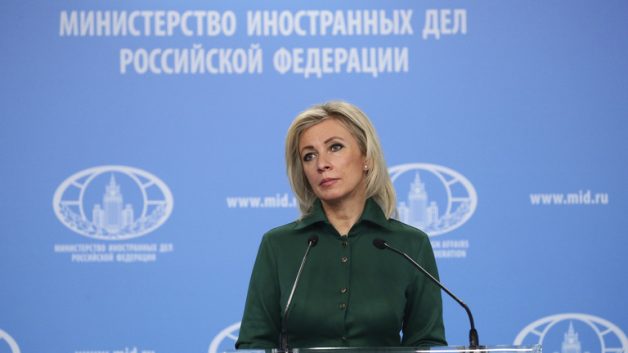
The US has been concealing information about its “military biological activity” in the post-Soviet states, Russian Foreign Ministry spokeswoman Maria Zakharova said on Sunday. This, according to Zakharova, raises “serious questions” about Washington’s compliance with the Biological and Toxin Weapons Convention (BTWC).
In an interview with TASS published on Sunday, Zakharova said, “the United States prefers to remain silent about the ongoing work in the post-Soviet space and does not provide information within a framework of the BTWC confidence-building measures.”
“Assertions that the activity of the Pentagon and related structures is focused solely on health issues are not true. Clearly, health care assistance does not require the involvement of the US military,” Zakharova said.
She added that Washington’s claims that it is collecting biomaterial and monitoring the epidemiological situation “only reinforce and intensify” Russia’s fears over America’s compliance with the BTWC.
Moscow’s recently published evidence regarding the alleged sprawling network of US-funded biolabs across Ukraine only adds to the suspicions, Zakharova said.
In a series of briefings starting in March, the Russian military has presented evidence of the Pentagon’s involvement in funding laboratories in Ukraine. According to Russia’s Investigative Committee, the US poured more than $224 million into biological research in Ukraine between 2005 and early 2022. Western pharmaceutical giants, nonprofits, and even the US Democratic Party were involved in the scheme, Moscow claims.
The Pentagon has “significantly expanded its research potential not only in the field of creating biological weapons, but also obtaining information about antibiotic resistance and the presence of antibodies to certain diseases in populations of specific regions” while working in Ukraine, Lieutenant-General Igor Kirillov, the head of the Russian Radiation, Chemical and Biological Protection Force, said in May.
Zakharova also pointed out that the US has not yet withdrawn its reservation to the 1925 Geneva Protocol for the prohibition of biological and chemical weapons. The US was among the countries that declared the protocol would cease to be binding regarding enemy states that do not observe the prohibitions of the protocol.
In this regard, “the question quite reasonably arises about the real goals of the Pentagon’s international military biological activity,” Zakharova said.
Earlier this week, the Pentagon published the ‘Fact Sheet on WMD Threat Reduction Efforts with Ukraine, Russia and Other Former Soviet Union Countries’. In the document, the US military said that following the collapse of the Soviet Union, the US and its partners have led “cooperative efforts to reduce legacy threats from nuclear, chemical, and biological weapons left in the Soviet Union’s successor states, including Russia.”
According to the Pentagon, the US has “worked collaboratively to improve Ukraine’s biological safety, security, and disease surveillance for both human and animal health,” by providing support to “46 peaceful Ukrainian laboratories, health facilities, and disease diagnostic sites over the last two decades.” These programs have focused on “improving public health and agricultural safety measures at the nexus of nonproliferation.”
In the same paper, the US military accused Russia and China attempting “to undermine this work by spreading disinformation and sowing mistrust in the people and institutions all over the world that contribute to WMD threat reduction.”
According to Zakharova, Moscow considers this publication part of Washington’s “information campaign” aimed at justifying its military biological activities in the post-Soviet space and to “divert the attention of the international community from its true non-transparent and unseemly direction.”
Zelensky’s delay in opening sea corridor threatens the globe with hunger
By Paul Antonopoulos | June 10, 2022
Hundreds of Ukrainian mines floating in the Black Sea threaten to halt tens of millions of tons of grain from being exported. Ukrainian officials claim it would take six months to clear the mines, something which directly contradicts the long-held claim that Russia’s naval blockade is preventing the export of wheat.
Markiyan Dmytrasevych, an adviser to Ukraine’s Minister of Agrarian Policy and Food, said that regardless of any agreement with Russia, thousands of mines would remain floating around the port of Odessa, making the export of wheat difficult. According to Dmytrasevych, it will take until the end of the year to clear out all the mines, thus making a mockery of the months-long disinformation campaign that Russia was blockading Ukrainian wheat shipments and therefore responsible for any global food shortage.
Russia and Ukraine collectively supply about 40% of the wheat consumed in Africa, and due to the war and consequential anti-Russia sanctions, prices have already risen by about 23% across the continent. The two countries also account for about 33% of the world’s grain supply, and wheat prices have skyrocketed by a third since February 24.
To derail a global food crisis, Ukraine’s Black Sea coastline will have to be demined. However, demining efforts require specialized equipment to scour wide swaths of open water, something Kiev was fully aware of when it began mining the Black Sea.
NATO issued a warning on June 1, stating: “Drifting mines have been detected and deactivated in the Western Black Sea by coastal nation’s authorities. The latest statement of regional authorities, confirming another sighting of a mine, shows the threat of drifting mines in the Southwest part of the Black Sea still exists.”
Along with the obvious problem associated with traversing mine-laden waters, shipping insurance for vessels heading to the region has skyrocketed. “There is clearly a growing nervousness around the region in the insurance market, especially in relation to the Black Sea,” Marcus Baker at insurance broker and risk adviser Marsh told Reuters.
Ukraine President Volodomyr Zelensky told the Financial Times that while, in theory, he supports a maritime corridor, no Russian vessels should be allowed access. “On UN-led talks to restore access to Ukrainian Black Sea ports, Zelensky was willing to back the idea of a maritime corridor to enable grain exports from Ukrainian ports as long as no access was given to Russian ships,” the paper reported. “There was no need for a dialogue with Moscow to resolve the blockade given that the only threat to world food supplies was coming from Russia.”
However, despite Kiev now acknowledging that demining efforts could take up to six months, Zelensky is still attempting to blame Russia’s naval blockade as the reason why 75 million tons of grain could be stuck in Ukraine after the summer season.
Latvian Prime Minister Krišjānis Kariņš is also disingenuous to the situation, questioning to the Atlantic Council on June 8 whether “a US or French warship [should] go through the Bosphorus and dock in the port of Odesa?”. Of course, his suggestion completely omits that US and French warships would not only have to break the Russian blockade, but also traverse mined waters.
None-the-less, Ukraine is in a difficult position. As the country unrelentingly refuses to negotiate an end to the war with Russia on the open orders of Washington and London, Ukraine does not want to weaken its coastal defenses around Odessa. However, at the same time, it has been exposed that Ukraine’s Black Sea mines are responsible for halts in the export of wheat, and not Russia’s naval blockade as Western leaders, officials and media led to us to believe for months.
Despite offering a way out of the emerging food crisis by calling for the demining of the Black Sea and the creation of a maritime safe corridor, Ukraine Foreign Ministry spokesman Oleg Nikolenko tweeted on Wednesday that the words of Russian Foreign Minister Sergey Lavrov “are empty.”
“Ukraine has made its position on the seaports clear,” Nikolenko tweeted. “Military equipment is required to protect the coastline and a navy mission to patrol the export routes in the Black Sea. Russia cannot be allowed to use grain corridors to attack southern Ukraine.”
As Kiev stubbornly continues to carry out the demands of the US and UK, it appears that the establishment of a safe corridor for the export of grain from Ukraine will not emerge anytime soon, thus artificially creating a global food crisis that can be relatively easy to resolve, despite the inevitability of high wheat prices. Most disingenuously though is the continued portrayal that Ukraine is not responsible for the halt of exports, however, even this has been exposed to the point that Western media cannot ignore Kiev’s refusal to demine its coast.
Paul Antonopoulos is an independent geopolitical analyst.
On Ukraine, ‘progressive’ proxy warriors spell disaster
Urging leftists to support the Ukraine proxy war, Bernie Sanders aide Matt Duss whitewashes the US role, attacks The Grayzone, and advocates dangerous militarism.
By Aaron Maté | The Grayzone | June 7, 2022
The unanimous vote by progressive lawmakers for the $40 billion Ukraine funding bill has been followed by a near-unanimous refusal to defend it. To date, no member of the Congressional Progressive Caucus – with the sole exception of Cori Bush – has publicly explained why they chose to hand over billions of dollars to the weapons industry and intensify a proxy war against nuclear-armed Russia.
Amid this resounding silence, Matt Duss, a foreign policy adviser to Sen. Bernie Sanders, has stepped in to fill the void. In a New Republic article titled “Why Ukraine Matters for the Left,” Duss attempts to convince fellow progressives that the “provision of military aid” to Ukraine “can advance a more just and humanitarian global order.” Duss has only praise for a Biden administration that, in his view, “should be applauded for its judicious reaction to the Ukraine crisis.” By contrast, Duss opts to launch an attack on dissident journalists, myself included, who don’t share his enthusiasm.
To make his case, Duss omits an abundance of inconvenient facts, betraying either considerable ignorance of the Ukraine-Russia conflict or a deliberate effort to distort it.
While apologia for US hegemonic projects is normal in DC foreign policy circles, Duss’ contribution is particularly noteworthy given his painstaking attempt to cast himself as an outsider. “Our political class,” Duss states, “advocates military violence with a regularity and ease that is psychopathic.” Duss’ comment is both accurate and wildly ironic, given his choice to advocate our political class’s military violence in Ukraine — with the remarkable ease that he identifies in others as psychopathic.
When it comes to how the Biden administration has handled the Ukraine crisis, Duss cannot identify a single fault. “The Biden team clearly did not seek this war,” Duss claims, and “in fact… made a strenuous, and very public, diplomatic effort to avert it.”
Duss does not explain what the administration’s “strenuous” diplomacy entailed, perhaps because even its top officials now openly admit that none existed.
In an interview with War on the Rocks, State Department counsellor Derek Chollet was asked if NATO expansion into Ukraine was “on the table” in pre-invasion contacts with Russia. “It wasn’t,” Chollet replied. The White House, Chollet explained, “made clear to the Russians that we were willing to talk to them on issues that we thought were genuine concerns they have that were legitimate in some way,” including “arms control.” (emphasis added) But when it comes to “the future of Ukraine” and its potential NATO membership, Chollet said, this was deemed a “non-issue.”
To Duss, the Biden administration’s (openly admitted) refusal to even discuss Russia’s core demands – and to only entertain issues that it deemed to be “legitimate” on Russia’s behalf – is apparently a “strenuous diplomatic effort.” If “diplomacy” amounts to enforcing US hegemony, as many in DC seem to believe, then Duss would have a case. But in the rest of the world, where diplomacy entails constructive dialogue with a semblance of parity, he does not.
Duss also takes aim at the argument, advanced by prominent leftists including former Brazilian President Lula da Silva, that a US-European pledge that Ukraine won’t join NATO “would have solved the problem” with Russia.
To refute Lula, Duss stresses that “in the weeks leading up to the war, U.S. allies, specifically German Chancellor Olaf Scholz and French President Emmanuel Macron, signaled clearly” that Ukraine’s NATO ascension “was not going to happen.” According to Duss, it is Putin who sabotaged their efforts by invading, and who “has now made that discussion moot.”
Duss omits what also happened in the weeks leading up to the war. While Germany and France did indeed float a proposal to keep Ukraine out of NATO, it was Ukraine – with US backing – that rejected it. According to an account in the Wall Street Journal, Scholtz proposed to Volodymyr Zelensky on Feb. 19 – five days before Russia’s invasion — that Ukraine “renounce its NATO aspirations and declare neutrality as part of a wider European security deal,” signed by both Putin and Biden. But Zelensky rejected Schultz’s plan, a response that “left German officials worried that the chances of peace were fading.” In dismissing the Germans’ NATO proposal, Zelensky joined the Biden White House, as State’s Derek Chollet acknowledged and other Biden officials made clear in public.
Ignoring US-Ukrainian rejectionism, Duss then declares that “it seems absurd to suggest that even an ironclad public pledge from President Biden that Ukraine would never be accepted into NATO would have convinced Putin to draw back the 180,000 troops he had placed on Ukraine’s borders.” Perhaps, but that very public pledge happened to be the centerpiece of Germany’s last-minute diplomatic effort – one that Duss himself invoked, and that Zelensky (along with Biden) chose to reject.
Duss’ whitewashing of the Biden administration’s rejection of diplomacy before the Russian invasion carries over to the period since.
Since Russia’s invasion, Duss says, the White House has “acted with restraint and care not to get drawn into a wider war with Russia.” While it is true that Biden has opted not to start World War III – in other words, has opted not to trigger a global suicide pact — he has done anything but act with “restraint.” One day before Duss’ article was published, Biden authorized the delivery of medium-range advanced rocket systems to Ukraine. These rockets have the capacity to strike inside of Russia; the US is acting on Ukraine’s assurance that it won’t.
Duss may support undermining diplomacy in Ukraine and shipping off billions of dollars worth of heavy weaponry instead, but this can only be described as “restraint” if the sole measure is an immediate — rather than merely prospective — nuclear holocaust.
Duss is so impressed with Biden’s handling of the war that he cannot even detect a tangible path that could end it. “As of this writing,” Duss declares, “I have seen no evidence of a settlement in the offing—as in, a deal that Putin would actually entertain, let alone accept—that we’re refusing to ‘push for.'”
If Duss cannot see evidence of a realistic settlement that Russia could accept, then he is being willfully blind. Russia’s explicit proposals, issued before the war and after, including two weeks into the invasion, called on Ukraine to “cease military action, change its constitution to enshrine neutrality, acknowledge Crimea as Russian territory, and recognise the separatist republics of Donetsk and Lugansk as independent states.”
It is worth noting that the latter is Russia’s only new condition: for the eight years before the February invasion, Russia formally accepted the Minsk accords, which, to end the Donbas war, would have kept the Donetsk and Lugansk regions inside Ukraine’s borders, with limited autonomy.
Duss is free to argue that Russia’s terms for ending the war are unacceptable. But to pretend that Russia has not even laid out those terms, is to essentially advocate that the war never end.
By omitting Russia’s stated terms for a settlement, Duss also allows himself to erase one of the invasion’s key causes: the 2014 Maidan coup, and the ensuing eight-year Donbas war that had left more than 14,000 people dead by the time Russian forces crossed the border on February 24th.
In his 2500+ word piece, Duss makes no mention of the Donbas war and how it began: the 2014 ouster of a democratically elected Ukrainian president, with new leadership selected by Washington; the coup government’s assault on Ukraine’s ethnic Russian and anti-coup citizens, who launched a rebellion in the Donbas; the critical role of fascists and neo-Nazis in the Maidan coup and the Donbas war since; the fascist-led sabotage of the 2015 Minsk accords, which could have put an end to the conflict. By omitting this history, Duss can also omit how the US has helped undermine the Minsk agreements by siding with Ukrainian’s far-right and choosing to use the Donbas war to “fight Russia over there” (Adam Schiff) and “make Russia pay a heavier price,” (John McCain), because Ukraine’s “fight is our fight.” (Lindsey Graham).
After ignoring Russia’s stated grounds for a peace settlement, Duss goes on to disingenuously claim that the Ukrainian government has been pushing for one.
“Ukraine presented Russia with a far-reaching set of proposals over a month ago, including a commitment to ‘permanent neutrality,’” Duss claims. “Volodomyr Zelenskiy continues to offer to negotiate directly with Putin to end the war.”
It is true that Ukraine presented Russia with a 10-point plan in late March. But Duss omits what happened immediately after: while Russia “signaled its preliminary support,” (RAND analyst Samuel Charap) Ukraine’s Western backers sabotaged it, and Zelensky acquiesced. In early April, Ukrainian and Russian officials were finalizing details for a Zelensky-Putin summit. But UK Prime Minister Boris Johnson traveled to Kiev and ordered him to halt diplomacy. Citing sources close to Zelensky, Ukrayinska Pravda reports that Johnson informed his Ukrainian counterpart that Putin “should be pressured, not negotiated with.” Johnson also relayed that even if Russia and Ukraine chose to sign security guarantees, the UK and its allies would not take part – rendering any such agreement worthless.
Zelensky clearly received the message, as Duss’s own source makes clear. When Duss claims that Zelensky “continues to offer to negotiate directly with Putin to end the war,” he links to a Reuters article that reveals such an “offer” to be hollow. Zelensky, Reuters reports, said he would only negotiate with Putin if Russia first withdrew entirely from Ukraine – an obvious non-starter. “Get out of this territory that you have occupied since February 24,” Zelensky said. “This is the first clear step to talking about anything.” Zelensky also “ruled out suggestions… that Ukraine should make concessions for the sake of securing a peace agreement that would allow Putin to save face.”
Thus, returning to Duss’ rendering, Zelensky’s “far-reaching proposals” were immediately rescinded under Western orders, and Zelensky’s “offer to negotiate” was premised on a condition that would have made negotiations impossible.
None of this is to suggest that Russia was justified in launching an invasion of Ukraine. To defend the use of force, which has been so catastrophic, Russia has to meet a high burden of evidence that, in my view, it has not. But one does not need to defend Russia’s invasion to see through Duss’ attempt to whitewash the US role in provoking and prolonging it.
Tellingly, Duss is openly hostile to journalists who have reported on the context that he has omitted. Out of nowhere, Duss introduces an attack on The Grayzone, the Max Blumenthal-founded news outlet that I work for. While Duss has nothing but praise for Biden, he has nothing but ad hominems for us (“pernicious authoritarian agitprop,” “atrocity-denying grifters” “click-baiting provocateurs”). After sharing this vitriol, he then immediately declares that engaging with us is “wasting time.”
I feel the same way about his juvenile name-calling, but interested readers can judge for themselves whether his insults are supported by facts. (He links to two “sources,” one a Medium blog post that, true to the neo-McCarthyite norm, peddles innuendo that The Grayzone is funded by Russia, among other smears).
If Duss is genuinely concerned about wasting time, he also might reflect on why he devotes ample space to paying lip service to progressive principles, only to ultimately endorse policies that flagrantly violate them. “Centering opposition to U.S. imperialism and militarism is an entirely appropriate starting point,” Duss states. Yet Duss’ desired end point would see leftists center U.S. imperialism and militarism, with disastrous results: among them, prolonging a proxy war against a nuclear armed power, threatening a worsening global food crisis, and sentencing more Ukrainians to death.
Even putting aside US complicity in the Ukraine proxy war and its dangers for the planet, progressives like Duss might wish to consider the likely political consequences. One obvious guide is the election of 2016, when Donald Trump won over a significant portion of voters by claiming to oppose the military interventionism that Duss is now urging progressives to embrace. Having seemingly learned nothing from 2016, Democrats in 2022 are again ceding anti-war sentiment to Republicans, 68 of whom voted against the $40 billion Ukraine bill in the House and Senate (versus zero Democrats).
As at least some Republicans vote against the proxy war, Biden has defended the domestic pain caused by his Ukraine proxy war by blaming “Putin’s Price Hike” and trying to argue that “defending freedom is going to cost.” Biden’s defense of “freedom” in Ukraine is now costing him a transatlantic flight to grovel at the feet of the Saudi autocracy, in the hopes of staving off a humiliating cost in the November midterms.
Continuing his mealy mouthed approach, Duss both claims to support diplomacy while simultaneously declaring it to be unattainable. The US, he says, “should certainly be actively engaged in finding a diplomatic path to end the war, and avoid committing to maximalist aims that could foreclose one.” But yet, according to Duss, “for the moment that path is unclear.”
If the path toward peace for Ukraine is unclear to Duss, then that can only be because he has chosen to erase the factual background and the diplomatic solutions on offer, thereby reinforcing the “maximalist aims” that he claims to oppose. Duss’s proxy war apologia will certainly win him a warm reception in establishment DC circles. For the US progressive movement, Ukraine, and the rest of the planet, it only spells disaster.
Arctic Council Decisions Made Without Russia to Be Illegitimate – Ambassador to US Antonov
Samizdat – 09.06.2022
WASHINGTON – Russia is concerned about plans to resume the work of the Arctic Council without its participation and warns that decisions made in this format will be illegitimate, Russian Ambassador to the United States Anatoly Antonov said.
Canada, Denmark, Finland, Iceland, Norway, Sweden and the United States earlier announced their intention to resume work in the Council on a limited basis – within the framework of projects that do not involve Russia.
“Such a step cannot but cause concern not only for Russia as the current chairman of the Council, but also for the entire international community interested in the further sustainable development of this region. We state that this unique format of interstate interaction continues to be politicized,” Antonov said.
“Decisions on behalf of the Arctic Council, made without our country, will be illegitimate and violate the principle of consensus stipulated by its governing documents,” he warned.
The work of the Council was suspended on March 3 in light of the events in Ukraine.
Featured Video

AIDS Inc. by Gary Null (2007)
or go to
Aletho News Archives – Video-Images
From the Archives
Clash of Civilization, Iran Part II
By Jamal Kanj – Intifada-Palestine.com – January 14, 2011
Israel’s survival kit is: perpetuate conflict, insecurity to rationalize collective hate and finally playing victim.
Devoid of conflict, Israel implodes internally; without hate, Zionism loses its justification; and playing eternal victim to continue blackmailing the West. Absence of this holy trinity, Israel ceases to exist.
From its inception, the house of Zion has mastered exploiting adversarial powers to advance Israel’s cause. For instance, their influence over the Democratic Party in the US began with President Truman’s bid for 2nd term election in 1948.
Responding to strong opposition from Secretary of State General George Marshall and Department experts urging against recognition of Israel, President Truman replied: “I’m sorry gentlemen but I have to answer to hundreds of thousands [Jewish voters] who are anxious for the success of Zionism. I do not have hundreds of thousands of [voting] Arabs among my constituents”
Zionists influence over liberal American politics was matched with the doctrinal school of Conservative theoreticians aligning the Republican Party’s platform with Israel’s objectives. The Neoconservative Zionists, coined Zioncons, invented the “Clash of Civilization” concept to fight Israel’s wars. … continue
Blog Roll
 Aletho News
- 12 Things Your Psychiatrist Was Trained Not to Tell You
- From Unipolar Universalism to Multipolar Civilizational Distinctiveness
- RSF military group defects, joins Sudanese army: State media
- Ireland goalkeeper refuses to play ‘Israel’ as squad weighs boycott
- China pushes back against US on Cuba, Iran
- Ukrainian Soldiers, Potential Mercenaries: Have Gun, Will Travel!
- Burnham’s UN debut… A masterclass in British disinformation
- Iran flights continue despite US aviation sanctions
- Global Tipping Points Lead the World Into a State of Entropy
- The day-after at the White House: USA and Xi Jinping
- If Americans Knew
- Israel forces Gazans to live in constant peril – Daily Update
- Deconstructing Netanyahu’s pants-on-fire UN rant – Daily Update
- Trump betrayed voters with his campaign lies and prioritized a foreign country once he took office
- Netanyahu calls Israel’s war in Gaza ‘opposite of genocide’ in UN speech to near-empty hall
- Settler Kidnappings: Torture, Sexual Abuse and Terrorisation of Palestinian Abductees as Israel Deepens Annexation of West Bank
- Gaza winter nears as 162,000 tents become unusable, raising fears of humanitarian crisis
- Netanyahu says, “It’s the opposite of genocide”; UN says Gaza economy is world’s ‘most severe crisis on record’ – Daily Update
- Israel’s US-Backed Assault on Gaza Has Created the ‘World’s Most Severe Economic Crisis on Record’: UN
- ‘Protecting U.S. Citizens’… From Israel
- ‘This is where I live now, the back of a truck’: a day in the life of a grandmother in Gaza
- No Tricks Zone
- New Study: Earth And Venus Surface Warmth Largely Explained By Convection And Lapse Rate, Not CO2 Or Radiation
- 2025 Nature Paper Claiming Worsening Global Drought Gets RETRACTED …Heavily Flawed
- New Study: ‘Global Drought Shows No Detectable Recent Acceleration Under Climate Warming’
- Economic Masterminds: German Socialists Suggest Taxing Productivity Gains Stemming From Using AI
- The South China Sea Has Not Been Cooperating With The Climate Change Narrative
- Energy Crisis: Germany Enters Heating Season With Historically Low Gas Reserve Fill Levels
- New Study: The Antarctic Ice Sheet Gained Mass From 2020-2024 Due To Staggering Snow And Ice Accumulation
- Study: Ocean Heating Rates From Thousands Of Years Ago ‘Dwarf’ Modern Ocean Heating Rates
- Climate Extremists Target, Attack Large-Scale Power Grid Infrastructure In Germany!
- New Study: Antarctic Ice Melt Has Contributed Less Than 1 Centimeter To Sea Level Rise In The Last 30 Years

