Land-based ‘Zircon’ hypersonic missile – a strategic game changer
By Drago Bosnic | June 8, 2022
In (American) English, when describing something incredibly difficult to do, the term “rocket science” is used. And indeed, rocket science, or rocketry for short, is a branch of science dealing with rocket and missile propulsion. There are multiple ways to create viable rocket propulsion. However, in this case, we’ll be talking about one very specific type of rocket, or more precisely, missile propulsion – scramjets. Supersonic combustion ramjet, or scramjet for short, is a form of airbreathing jet engine that uses the forward motion of the engine to produce thrust.
The main difference between a regular ramjet and a scramjet is that combustion takes place in supersonic airflow in the latter. Although the technology dates back to the 1950s, its practical implementation is quite recent. The first working scramjet in the world was the Russian “GLL Kholod” missile which flew in 1991, reaching a speed of nearly Mach 6, making it also the world’s first working hypersonic scramjet design. Unfortunately, the collapse of the USSR stopped funding for the project. The US government (NASA in particular) realized just how far behind Russia they were at the time, so they decided to provide funding for the project, with Russia sharing its know-how in return.
Officially starting in 1985, the Reagan administration launched the National Aerospace Plane (NASP) program intended to develop two X-30 aircraft capable of single stage to orbit (SSTO) flight, as well as horizontal takeoff and landing from conventional runways. However, the program was unsuccessful, with the US Congress deciding to cut funding for the project in 1993, after being told the two X-30 aircraft would cost at least $15 billion. After the project was scrapped, NASA approached Russia’s Central Institute of Aviation Motors (CIAM) and took part in tests conducted throughout the 1990s. After the cooperation ended, the US tried developing a similar capability. Still, after numerous projects, including the Boeing X-51 “Waverider”, which was a cooperative endeavor by the US Air Force (USAF), DARPA, NASA, Boeing and Pratt & Whitney Rocketdyne, the US lacks a working scramjet missile. The X-51 had four flight tests between 2010 and 2014, with the first three failing. The last test was the only success, after which the project was canceled.
At present, there are only a handful of countries possessing the knowledge and resources to conduct scramjet testing. This includes the US, China, India, Brazil and the EU (Germany and France in particular). However, there’s currently only one country in the world with a 100% functioning hypersonic scramjet missile – Russia. Despite the disastrous 1990s and the societal and economic shock it experienced, Russia still managed to not just successfully develop hypersonic scramjet missiles, but also get quite ahead of the rest of the world in this technology. The most prominent example of this is the 3M22 “Zircon”, a scramjet-powered maneuvering hypersonic cruise missile. Although it is officially an anti-ship missile, applications are most likely already multi-role, as is the case with nearly all other Russian missiles.
The “Zircon’s” official testing started in 2012 with air-launched prototypes fired from a Tu-22M3 long-range bomber. The tests soon moved to ground-based and ship-borne platforms, with the famed “Admiral Gorshkov” frigate being the most prominent surface combatant used as “Zircon’s” sea-based test-launching platform. By late 2021, it was reported that the missile had also been test-fired from the K-560 “Severodvinsk” Yasen-class nuclear-powered submarine, both from the surface and submerged. The total number of tests is classified, but the publicly acknowledged ones put the number of test launches at approximately two dozen, all of which have been successful. The “Zircon” has been improved heavily over the years, in terms of both speed and maneuverability. The missile is capable of achieving Mach 9 (approximately 3.1 km per second, or over 11,000 km/h), although some sources claim that it can go up to Mach 10.
The missile was salvo-launched in December 2021 and again in February 2022, both of which have been successful, confirming the serial production variant is up to the Russian military standards. In May, Russian MoD released a video of a new test-launch where the “Zircon” hit a sea target at a distance of over 1,000 km. The program of state trials was formally completed with that launch. However, Russia also announced that the land-based, coastal defense version of the missile would also be deployed, quite possibly in the coming months or by year’s end. A land-based “Zircon” hypersonic missile will be a crucial addition to the Russian military, much like the “Bastion-P” coastal missile system using the P-800 “Oniks” supersonic anti-ship missile. With its 1500 km range and Mach 9 speed, the “Zircon’s” speed is over 3 times greater, while its range is nearly double that of the P-800, which has also been used in Russia’s special military operation in Ukraine.
As “Zircon” flies at hypersonic speed within the atmosphere, the air pressure in front of it forms a plasma cloud, absorbing radio waves and making it effectively invisible to radar, resulting in what is colloquially known as plasma stealth. With plasma stealth, hypersonic speed and sea-skimming, intercepting an approaching “Zircon” is effectively impossible. Its sheer speed is such that the enemy would have mere seconds to detect, target and shoot down the incoming missile. However, the enemy would also need to be able to predict the missile’s flight path, which is simply impossible, as the missile is designed for extreme maneuverability, making predictions based on a ballistic trajectory null.
It’s not a question of if, but when Russia will deploy the land-based “Zircon” missile. With the sea-based version making large surface combatants effectively obsolete, the land-based one would make it pointless to deploy any large formations or even bother with setting up air and missile defenses on the mainland. Due to its speed, maneuverability and thermonuclear capability, the “Zircon” is yet another major strategic addition to the Russian military. Combined with the Mach 12-capable “Kinzhal” air-launched hypersonic missile and the Mach 28-capable “Avangard” hypersonic glide vehicle, the “Zircon” ensures swift destruction of any aggressor.
Drago Bosnic is an independent geopolitical and military analyst.
Biden Rocks the Middle East
Partitioning Syria may be on the way
BY PHILIP GIRALDI • UNZ REVIEW • JUNE 7, 2022
That dwindling band of observers that continues to express concern over the catastrophe that constitutes United States foreign policy under President Joe Biden have come to realize how the Ukraine situation is being used as cover for interventions and other similar mischief in other parts of the world. Recent reporting, for example, reveals that the Biden Administration has decided “to reestablish a persistent US military presence in Somalia to enable a more effective fight against al-Shabaab” in spite of the fact that “there is absolutely no constitutional authority for President Biden to send troops into Somalia or drop bombs on Somalia.” Nor does al-Shabaab represent a threat to Americans or American interests.
To be sure, the emphasis on Ukraine has a certain cogency as it is particularly dangerous and could lead to nuclear devastation in a situation where intervention by the United States was not only unwarranted but also unresponsive to any actual national interest of threat. And escalate it will if the White House continues on its current path. Ukrainian government sources are now stating that the United States is preparing to destroy the Russian Black Sea fleet to end the blockade of Ukraine’s ports. The commander of US forces in Europe General Christopher Cavoli seems to be confirming that report when he refers to the preparation of “military options” to help export Ukrainian grain.
One might suggest that such a move could just be enough to start World War III and World War III would almost certainly turn nuclear very quickly. Some might consider that taking a deliberate step that would inevitably escalate into destruction of the entire planet as we know it just might be a foreign policy mistake on the part of the President Joe Biden Administration but I’m sure the chairborne warriors down at Foggy Bottom would disagree, pointing out that nothing would make old Vladimir Putin run and hide faster than a barrage of harpoon missiles imbibed with his breakfast tea.
And, of course, there’s more. There’s always more. The focus on Ukraine in the US and international media combined with a stream of befuddling malapropisms coming out of the White House has obscured what is going on in other corners in the world, where Washington is also flexing its biceps in full knowledge that a manageable war or two will surely help one’s favorability rating come elections in November.
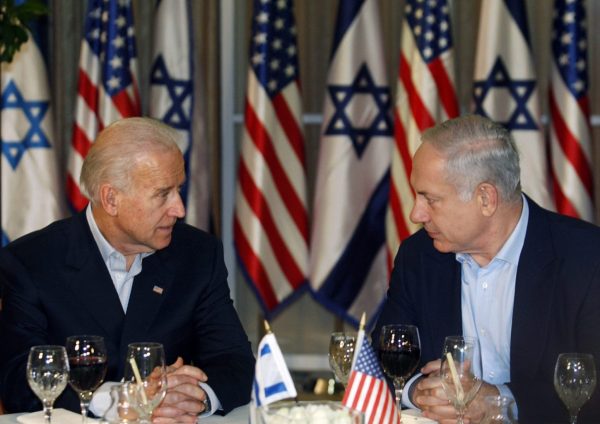
And there is always Israel. The Israeli army and police have recently been shooting dead Palestinian teenagers on a nearly daily basis, and that comes on top of the killing of Palestinian-American journalist Shireen Abu Akleh a month ago. Israel’s Defense Minister Benny Gantz was in Washington two weeks ago to meet and greet and one might suspect that he just might have been in town inter alia to express some apology for his army’s assassination of Abu Akleh, but that would be to misunderstand the bilateral relationship. In reality, when Israel shouts “jump” the Biden Administration responds “how high, sir?”
Also in the Middle East and also related to Israel, the US State Department has gone into a hissy fit over the May 26th Iraqi parliament’s unanimous vote to make illegal all “normalization” ties with Israel. State was quick to react, in contrast to its torpor dealing with most issues, but it was Israel involved, not just “most issues.” A statement was issued saying “The United States is deeply disturbed by the Iraqi Parliament’s passage of legislation that criminalizes normalization of relations with Israel [while also] jeopardizing freedom of expression and promoting an environment of antisemitism…” Ah yes, the old anti-semitism canard surfaces yet again!
There are also several interesting stories relating to Syria, which continues to be a hotspot because Israel wants to maintain its ability to freely bomb targets that it describes as “terroristic” or connected to arch enemy Iran. The bombing has continued regularly since the Ukraine situation started and has hardly ever been reported in the US media. And, yet again, there is more to the story in terms of US involvement. First of all, Russia reacted to the lukewarm Israeli support for its invasion of Ukraine. An Israeli attack on targets in Syria last week was met by a S-300 missile fired by Russian army manned air defenses. Up until now, Moscow has refrained from attempting to shoot down Israeli warplanes, but the missile was clearly a warning of what might be coming if Israel persists in its attacks.
Also relating to Syria, it is ironic that the US has accused Russia of war crimes over its intervention in Ukraine while at the same time continuing its own illegal occupation of Syria. And it has its own war crimes record. Last week the Pentagon announced that it had completed its investigation into an attack in Syria on March 18, 2019 that killed some presumed ISIS guerrillas as well as four civilians while wounding fifteen others. The Pentagon press secretary John Kirby said the Defense Department had determined that that the airstrike “did not violate the laws of warfare or the rules of engagement. Neither the ground forces commander nor anyone involved in carrying out the airstrike ‘acted inappropriately or acted with malicious intent’ or ‘deliberately wanted to and sought out to kill civilians.’” In an earlier investigation concluded last December, the Pentagon said “it would not hold anyone accountable for a drone strike also in Syria in late-August that killed 10 civilians, including seven children. A review of the strike concluded it was a ‘tragic mistake’ that was the result of ‘execution errors.’”
And there are also credible reports that the United States is preparing to de facto partition Syria, to create a separate state run by its Kurdish allies in the country’s northeast that would be under Washington’s protection and would include a garrison of American troops. Such a move would, of course, be completely illegal and is in fact eerily reminiscent of the alleged “war crimes” that the US is claiming regarding Russia for its attempted partition of Ukraine. Interestingly, the planning has not been reported in the mainstream media, yet another instance of the Ukraine crisis serving as cover to drown out all background noise and provide the US with opportunities to increase its meddling in places like the Middle East on behalf of feckless allies like Israel and Saudi Arabia.
Ironically, when the United States initially intervened in Syria, it claimed to do so to fight the terrorist group Islamic State in Syria (ISIS). Subsequently, it cooperated with an al-Qaeda affiliate while close ally Israel had a similar arrangement with ISIS itself. The Kurds and both ISIS and al-Qaeda are all believed to be involved in the theft and sale of Syrian oil. Now the US, which also has been stealing the oil, is seeking something like a permanent presence to solidify its control over Syrian resources.
Interestingly, the planning by Washington to create a sub-state or autonomous region in the north east of Syria was revealed by no less than State Department number three Victoria Nuland at a recent conference held in Morocco. Nuland, who was the driving force behind regime change in Ukraine in 2014, described the Syria development as a “stabilization” activity. The new entity would include Syria’s major oil producing region, which is currently being exploited by Washington and its “allies,” as well as much of the country’s arable land.
Washington has already applied unprecedented punitive sanctions on the parts of Syria controlled by the Russians and President Bashar al-Assad, to include the so-called Caesar Syrian Civil Protection Act’s secondary sanctions that punish anyone trying to avoid the restrictions placed by Washington. Former US Ambassador to Syria James Jeffrey put it this way “And of course, we’ve ratcheted up the isolation and sanctions pressure on Assad, we’ve held the line on no reconstruction assistance, and the country’s desperate for it. You see what’s happened to the Syrian pound, you see what’s happened to the entire economy. So, it’s been a very effective strategy….” He also added “My job is to make it a quagmire for the Russians.”
To circumvent the existing sanctions, the new mini-state would therefore be granted economic viability by making it sanction free as an inducement for foreign investment and development of settlements largely inhabited by Kurds associated with the United States. A “general license” will be issued to facilitate investment and other economic activity. The US will commit $350 million to the project, which is being carried out with the cooperation of the Turkish authorities controlling their own militias along the border. By securing the north east of Syria, Washington would also be able to maintain and protect the illegal US Al-Tanf military base in the south-east of the country bordering Jordan. Al-Tanf blocks the creation of a contiguous “Resistance Axis” from Iran to Lebanon and ultimately to Palestine, thereby maintaining “Israeli security” in the region. As is all too frequently the case, Israeli interests always come first in the minds of Washington politicians.
Philip M. Giraldi, Ph.D., is Executive Director of the Council for the National Interest, a 501(c)3 tax deductible educational foundation (Federal ID Number #52-1739023) that seeks a more interests-based U.S. foreign policy in the Middle East. Website is councilforthenationalinterest.org, address is P.O. Box 2157, Purcellville VA 20134 and its email is inform@cnionline.org.
Moscow responds to German spying allegations
Samizdat | June 5, 2022
Moscow has shot back at Germany’s accusations of spying, with Foreign Ministry spokeswoman Maria Zakharova saying on Sunday that Berlin forgot about America’s wiretapping practices. The remark was in response to German Interior Minister Nancy Faeser’s recent warning that Russia could be wiretapping government offices in the capital.
In an interview with German newspaper Bild on Saturday, Faeser said her ministry “is keeping an eye out for what intelligence means the Russian government is using.”
It is this vigilance, according to the official, that led Berlin to expel 40 Russian embassy staff in April. Faeser claimed they were working for Russian intelligence services.
Moscow vehemently denied the accusations and responded with a tit-for-tat expulsion of 40 German diplomats.
Bild’s report went on to quote unnamed officials from Germany’s Federal Office for the Protection of the Constitution as saying that “particularly in sensitive areas such as the government quarter in Berlin, the risk of wiretapping and the threat of unauthorized data collection are real and should not be underestimated.”
“Nancy Faeser forgot to add that German officials have always been wiretapped by the Americans,” Zakharova said in a Telegram post.
In 2013, it was revealed that the mobile phone of then-Chancellor Angela Merkel had been monitored by the NSA as part of systematic wiretapping operations worldwide. Merkel famously said “spying on friends” is unacceptable.
Last May, Danish state broadcaster DR reported that the NSA had colluded with Denmark’s foreign intelligence unit to spy on officials in several neighboring countries, including Germany, from at least 2012 to 2014.
According to the revelation based on the Danish Defense Intelligence Service’s 2015 internal investigation, Merkel, along with then-Foreign Minister Frank-Walter Steinmeier and former opposition leader Peer Steinbrueck, were among the targets.
Foreign-supplied tanks destroyed in Kiev – Russia
Samizdat | June 5, 2022
Russian airstrikes have destroyed foreign-supplied tanks in the Ukrainian capital, Kiev, Moscow said on Sunday.
Defense Ministry spokesman Major General Igor Konashenkov said during a regular briefing that Russian forces carried out airstrikes “on the outskirts of Kiev, destroying the T-72 tanks and other armored vehicles that were supplied by Eastern European countries and kept in railcar repair facilities.”
The spokesman did not specify where the tanks came from, but Poland previously said it had donated T-72 tanks to Ukraine.
Konashenkov said that military targets were also hit in Donbass, as well as in eastern and southern Ukraine, including multiple rocket launchers and a US-made mobile counterfire radar.
Ukraine’s General Staff earlier reported that Kiev was among the areas hit by Russian forces. Mayor Vitali Klitschko said that one person was hospitalized.
On Saturday night, the Donetsk authorities said Ukrainian troops shelled the city, killing five civilians and wounding 20.
Russia and Ukraine have repeatedly accused each other of shelling residential areas and killing civilians.
Trump Said We Should “Get Along with Russia”. He’s Right

BY MIKE WHITNEY • UNZ REVIEW • JUNE 4, 2022
Look at this map of Ukraine.
Can you see what’s going on? The Russians are creating a buffer zone along their western perimeter.
Why are they doing that? What benefit do they derive from a buffer zone?
Well, a buffer zone creates a distance between Russia and Ukraine which Putin thinks is necessary since Ukraine is threatening to join NATO. So, he’s creating his own DMZ on his western flank.
But what does that prove?
It proves that we’ve been lied to from the very beginning. Putin was not planning to reconstruct the Soviet Empire like the media told us. He did not want to seize the Capitol, Kiev, and he did not want to conquer the entire Ukrainian landmass. That was all baloney.
What he wanted to do, is what he has done.
Don’t take my word for it, look at the map. You don’t need CNN or Rachel Maddow to tell you what you can see with your own two eyes. This is the reality ‘on the ground’.
This is a buffer zone. It creates a distance between Russia and Ukraine, it protects the ethnic Russians in the Donbass region, and it establishes a landbridge to Crimea where Russia’s vital deep-water port of Sevastopol is located. In other words, it achieves what Putin wanted to achieve from the very beginning, that is, enhanced security along his western border.
What we are seeing is the basic parameters of Russia’s “Special Military Operation”. Yes, many people will prefer to call it a “war”, but the term is not nearly as precise as “Special Military Operation”.
Why?
Because “Special Military Operation” indicates that the main objective is to save the lives of the ethnic Russians who had been under constant bombardment for the last 8 years and, also, to create a security zone that prevents a hostile NATO army and its missile system from being deployed to Russia’s border. These are the goals of the “Special Military Operation”; to “demiliterize” and “denazify” the area under Russia’s control. Get it?
Will the “Special Military Operation” go beyond the Donbass to Kiev and cities in the west?
Probably, not. Going beyond the Donbass would likely involve a complete mobilization of men and resources which has not yet taken place in Russia. By not mobilizing, Putin is signaling to the west that he will limit his operation to the area on the map. (With some slight expansion) Putin is indicating that his main concern is security, and since his concerns were casually brushed aside by Biden and Zelensky, he took matters into his own hands. In other words, he imposed his own settlement.
Okay, but if these are the parameters of the Special Military Operation, then what are the chances of a wider war?
That depends on Biden. If Washington continues on the path of escalation –by sending weapons systems that can strike targets in Russia– then Putin will respond. We should know that by now. Putin is not going to back down no matter what. If Washington wants to up-the-ante, then they should prepare for an equal response. That’s the way it’s going to work. For now, the “Special Military Operation” is just a “Special Military Operation”. But when it becomes a war, then all bets are off. Then we will see a full mobilisation, a complete rupture in US-Russo relations, and a halt to all hydrocarbon flows from east to west.
Do you think Europe and the United States are prepared for that? Do you think the EU can replace the 25% of the oil and 40% of all the natural gas it presently imports from Russia? Do you have a wind-powered car that will get you to work on time or a factory that will run on solar power? Do you have a plan for heating your house with hydrogen or perhaps a battery from an old Prius?
No, you don’t, and neither does Europe. Europe runs on fossil fuels. America runs on fossil fuels And the more fossil fuel that is consumed, the more the economy grows. The less fossil fuel is consumed, the more the economy shrinks. Are you prepared for life in a shrinking economy with high unemployment, skyrocketing inflation, unending recession, and deepening social malaise brought on by your government’s misguided desire to “stick it to Putin”?
That’s a bad choice, isn’t it? Especially when a face-saving deal can be made at anytime. In fact, Biden could stop the fighting tomorrow if he extended the hand of friendship to Putin and declared that, yes, Ukraine will accept neutrality til the end of time and NATO expansion will stop ASAP.
That’s all it would take. Just extend the olive branch and Putin will ‘call off the dogs’. Guaranteed.
That’s what this guy would have done. Remember him? Remember how bad things were when Trump was in office and gas was 2 bucks a gallon, and everyone had a job, and there was no inflation, and violent crime was under control?
Listen to what Trump had to say about Russia:
“Well, I hope we do have good relations with Russia. I say it loud and clear and I’ve been saying it for years. I think it’s a good thing if we have a great relations with Russia. That’s very important. And, I believe, some day that will happen. It’s a big country, it’s a nuclear country, it’s a country we should get along with, and I think we will eventually get along with Russia.”
He’s right, isn’t he? We need to get along with Russia and put an end to the fighting before these morons drag us into World War 3.
Grain prices go down after Putin’s pledge
Samizdat | June 4, 2022
Global grain prices have fallen to April levels following Russian President Vladimir Putin’s promise to ensure the safe export of Ukrainian grain through Black Sea ports controlled by Russia.
Wheat was trading at $10.4 per bushel (27.2kg) on Friday, data from the Chicago Board of Trade shows. That was its lowest price since April 7, when it was quoted at $10.2 per bushel, and a 10% drop from its peak price in mid-May.
Prices of corn for animal fodder were also down this week, falling to $7.27 per bushel.
Grain prices rose last month on fears that Russia’s ongoing military operation would prevent Ukraine’s grain exports from reaching buyers. Western countries accused Russia of preventing exports, but Moscow has repeatedly stated that it is not to blame and that the ships carrying Ukrainian grain are unable to leave ports due to mines placed in the area by Kiev’s forces. Putin on Friday once again said that Russia is in no way responsible for holding up shipments and promised to assist in the ships’ passage.
“As for the export of Ukrainian grain, we do not interfere with this… It was not we who mined the passages to the ports. Ukraine mined them. I have already told all of our colleagues many times: [Ukraine] should clear the mines and allow the ships with grain leave the ports. We guarantee peaceful passage without any problems,” Putin said during an interview with the Rossiya 24 TV channel. He also noted that there are several other ways to export grain, including via the ports of Berdyansk and Mariupol, which are under Russia’s control, or via the Danube River, through Hungary, Poland or Belarus.
Fears over the fate of Ukrainian grain have led to warnings of food insecurity and hunger in the past weeks, especially in poorer nations. According to Coldiretti, Italy’s association representing agricultural producers, Ukrainian ships must be allowed to move from ports as soon as possible, especially as the country’s warehouses will soon need to accommodate the new harvest.
“The departure of ships from the ports of the Black Sea means the emptying of Ukrainian warehouses where over 20 million tons of grain including wheat, barley and corn destined for exports are stored… The [ship] blockade raises risks of riots and famine,” Coldiretti said in a statement published on its website on Friday.
Ukraine ranks sixth among the world’s wheat exporters. Together, Russia and Ukraine supply nearly 30% of the wheat exported globally. According to Coldiretti, countries such as Egypt, Turkey, Bangladesh and Iran buy more than 60% of their wheat from Russia and Ukraine, while Lebanon, Tunisia, Yemen, Libya and Pakistan are also heavily dependent on supplies from the two countries.
How the war will end…
By Gilbert Doctorow | June 3, 2022
It has been my rule not to join the vast majority of my fellow political commentators at the scrimmage line in sterile debates of the one subject of the day, week, month that has attracted their full attention. Their debates are sterile because they ignore all but a few parameters of reality in Russia, in Ukraine. For them, ignorance is bliss. They do not stir from their armchairs nor do they switch channels to get information from the other side of the barricades, meaning from Russia.
I will violate this overriding rule and just this once join the debate over how Russia’s ‘special military operation’ will end. Nearly all of my peers in Western media and academia give you read-outs based on their shared certainty over Russia’s military and political ambition from the start of the ‘operation,’ how Russia failed by underestimating Ukrainian resilience and professionalism, how Putin must now save face by capturing and holding some part of Ukraine. The subject of disagreement is whether at the end of the campaign the borders will revert to the status quo before 24 February in exchange for Ukrainian neutrality or whether the Russians will have to entirely give up claims on Donbas and possibly even on Crimea.
As for commentators in the European Union, there is exaggerated outrage over alleged Russian aggression, over any possible revision of European borders as enshrined in the Helsinki Act of 1975 and subsequent recommitments by all parties to territorial inviolability of the signatory States. There is the stench of hypocrisy from this crowd as they overlook what they wrought in the deconstruction of Yugoslavia and, in particular, the hiving off of Kosovo from the state of Serbia.
I mention all of the foregoing as background to what I see now going on in Russian political life, namely open and lively discussion of whether the country should annex the territories of Ukraine newly ‘liberated’ by forces of the Donetsk and Lugansk People’s Republics with decisive assistance of the Russian military. By admission of President Zelensky yesterday, these territories now amount to 20% of the Ukrainian state as it was configured in 2014.
In the past several weeks, when Russia concentrated its men and materiel on the Donbas and began to score decisive victories, most notably following the taking of Mariupol and capitulation of the nationalist fighters in the Azovstal complex, leading public officials in the DPR, the LPR and the Kherson oblast have called for quick accession of their lands to the Russian Federation with or without referendums. In Moscow, politicians, including Duma members, have called for the same, claiming that a fait accompli could be achieved already in July.
However, as I see and hear on political talk shows and even in simple political reportage on mainstream Russian radio like Business FM, a counter argument has raised its head. Those on this side ask whether the populations of the potential new constituent parts of the RF are likely to be loyal to Russia. They ask if there is truly a pro-Russian majority in the population should a referendum be organized.
This is all very interesting. It surely is a continuation of the internal debate in Moscow back in 2014 when the decision was taken to grant Crimea immediate entry into the RF while denying the requests for similar treatment from the political leaders of the Donbas oblasts.
However, there surely are other considerations weighing in on the Kremlin that I have not seen aired so far. They may be likened to the considerations of France following the fall of the Berlin Wall in 1989, when the possible reunification of Germany was the talk of the day. Sharp witted observers said at the time that President Mitterand liked Germany so much that he wanted to continue to see two of them. Today Vladimir Putin may like Ukraine and its brethren Slavs so much that he wants to see three or four of them.
To be specific, from the very beginning the number one issue for Moscow as it entered upon its military adventure in Ukraine was geopolitical: to ensure that Ukraine will never again be used as a platform to threaten Russian state security, that Ukraine will never become a NATO member. We may safely assume that internationally guaranteed and supervised neutrality of Ukraine will be part of any peace settlement. It would be nicely supported by a new reality on the ground: namely by carving out several Russia-friendly and Russia-dependent mini-states on the former territory of East and South Ukraine. At the same time this solution removes from the international political agenda many of the accusations that have been made against Russia which support the vicious sanctions now being applied to the RF at great cost to Europe and to the world at large: there will be no territorial acquisitions.
If Kiev is compelled to acknowledge the independence of these two, three or more former oblasts as demanded by their populations, that is a situation fully compatible with the United Nations Charter. In a word, a decision by the Kremlin not to annex parts of Ukraine beyond the Crimea, which has long been quietly accepted by many in Europe, would prepare the way for a gradual return of civilized relations within Europe and even, eventually, with the United States
©Gilbert Doctorow, 2022
Sri Lanka seizes Russian plane
Samizdat | June 3, 2022
The authorities in Sri Lanka have grounded a civilian aircraft belonging to Russian carrier Aeroflot, and arrested the plane, local newspaper News First reported on Friday.
The Colombo High Commercial Court reportedly issued the arrest warrant following a complaint filed by Irish company Celestial Aviation Trading Limited, which is affiliated with aircraft lessor GECAS.
After Western states placed sanctions on Russia, aircraft lessors demanded that Moscow return leased planes for fear of secondary sanctions, and as the restrictions barred them from pursuing financial relations with Russian air carriers.
Russia, however, kept the majority of the planes, stating that the demand to return them violated lease contracts. It also started registering the planes in the country so they could continue to operate. According to the Airfleets portal, the aircraft detained in Sri Lanka received Russian registration at the end of April, and was registered in Bermuda before that.
Aeroflot announced that a hearing on the release of the aircraft is scheduled for June 8.
Russian tour operator Intourist told the press that people who were waiting to fly home on the detained plane were accommodated in a nearby hotel.
EU sanctions introduced in February banned the supply of civil aircraft and spare parts to Russia, as well as their maintenance and insurance. In addition, the sanctions obligated lessors to terminate their existing contracts with Russian airlines.
In early March, the Federal Air Transport Agency notified airlines of cases of cancelation of airworthiness certificates for aircraft registered abroad, while in mid-March, the Bermuda Civil Aviation Authority (BCAA) suspended the airworthiness certificates of aircraft from Russian airlines registered in Bermuda. Russian attempts to re-register the planes in the country were met with criticism, as some countries questioned the safety of flights on planes not checked by internationally-recognized registers.
At the end of May, the Chinese aviation authorities closed their airspace to Boeing and Airbus planes operated by Russian airlines, as “dual registration” of these aircraft does not meet international requirements.
Reports of OPEC+ death are greatly exaggerated
BY M. K. BHADRAKUMAR | INDIAN PUNCHLINE | JUNE 2, 2022
The fact that the Gulf Cooperation Council (GCC) member states held a joint ministerial meeting with their Russian counterpart Foreign Minister Sergey Lavrov in the Saudi capital of Riyadh at this point in time in global politics conveys a powerful message in itself.
To drive home the message in no uncertain terms, the Saudi Foreign Minister Prince Faisal bin Farhan Al Saud said at a press conference following the ministerial on Wednesday that the GCC member-countries share a common stance with respect to the crisis in Ukraine. (The news conference was broadcast live by the Al-Arabiya TV channel.)
“The countries of the Persian Gulf share a common stance regarding the Ukrainian crisis and its negative consequences, especially with regard to the food security of other countries,” Al Saud said.
For his part, Russian Foreign Minister Sergei Lavrov told the media that “the GCC countries understand the nature of the conflict between Russia and the West.” Earlier, during a bilateral with Lavrov who was on a 2-day visit, Al Saud said the “the kingdom’s position regarding the crisis in Ukraine is based on the principles of international law and support for efforts aimed at achieving a political solution to the crisis.”
After the meeting, Lavrov said the GCC countries will not join the West in imposing sanctions on Moscow over the conflict in Ukraine. In his words, “Aspects of the international situation, which are connected with the events unfolded by the West around Ukraine, are well understood by our partners from the Gulf Cooperation Council states.”
Lavrov added, “We appreciate and reaffirmed today once again the balanced position that they take towards this issue at international forums, and in practice, refusing to join the illegitimate, unilateral Western sanctions that were introduced against Russia.”
Lavrov said Moscow and Gulf countries intended to further develop their partnership in sharp contrast with the growing tensions between Russia and the US and its European allies. After meeting with the top diplomats of the UAE, Kuwait, Qatar, Bahrain and Oman in Riyadh, Lavrov said, “We reaffirmed our focus on the comprehensive development of our partnership, including in the new conditions that are emerging in the world economy in the context of the policies of our Western colleagues.”
Looking ahead, Lavrov expressed satisfaction that “We reaffirmed our focus on the comprehensive development of our partnership, including in the new conditions that are emerging in the world economy in the context of the policies of our Western colleagues.”
The timing of the GCC-Russia ministerial and Lavrov’s visit to Riyadh is highly significant at a juncture when the Biden Administration is pulling out all the stops to repair the US’ fractured relationship with Saudi Arabia ever since Candidate Biden famously christened the Kingdom as a “Pariah state” and the Washington establishment launched a concerted campaign to defame the Crown Prince Mohammed bin Salman personally over the killing of the ex-CIA consultant Jamal Khashoggi.
The latest reports in the US media have spoken of Biden’s interest to personally make amends with the Saudi Prince by visiting Riyadh and meeting with him. This is after Biden’s refusal to speak with the Prince so far or to have any dealings with the latter in any form!
The volte-face in Biden’s approach to Saudi Arabia is to be attributed to the realisation in Washington that to isolate Russia and weaken that country permanently, there is an imperative need to gain control of the world oil market, which in turn necessitates the break-up of the Russian-Saudi concord regulating world oil output in the recent years.
In a nutshell, Saudi Arabia has overnight become a “swing state” in the US’ strategic calculus whose stance on the Ukraine conflict is going to be of momentous consequence to the Biden administration’s agenda to weaken Russia.
Indeed, Saudi Arabia’s potential as a “swing state” has been in the making ever since 2006 when late King Abdullah used his first trip outside the Middle East since becoming the Saudi ruler to visit China and India. It was the first visit by a Saudi king to China since the two countries established diplomatic relations in 1990, and the first such visit to India since 1955. Perceptive observers saw the Saudi monarch’s tour presaging an era of reduced influence for the United States in Riyadh and of Saudi friendship with a widening spectrum of nations in Asia.
That shift, emanating from the desire to move away from a monocultural situation — having one big friend America, one big product (oil), and based on one big idea, the Islamic idea — was proceeding at glacial pace through the next decade until Prince Mohammed bin Salman was appointed as the Crown Prince in June 2017, making him heir presumptive to the throne.
Under Prince Mohammed’s leadership, the KIngdom’s transformation began accelerating, and acquired an ideological mooring of Saudi nationalism. The strengthening of relations with Russia and the signing of an agreement in 2016 to cooperate with Russia in global oil markets in a matrix that subsequently came to be known as OPEC+ was an early manifestation of that shift.
It coincided with launch of the Vision 2030 carrying the Crown Prince’s imprimatur, embodying the country’s strategic orientation for the next 15 years. From a historical perspective, Vision 2030 can be regarded as marking the abandonment of the Saudi reliance on a rentier economy. In the foreign policy sphere, its impact came to be felt in a steady assertion of the Kingdom’s strategic autonomy.
Against such a tumultuous geopolitical backdrop, it comes as no surprise that the US’ confrontation with Russia finds Saudi Arabia in the eye of the storm. Lavrov’s trip to Saudi Arabia rang alarm bells in Washington. On the eve of Lavrov’s arrival in Riyadh, US Secretary of State Antony Blinken had a call with Al Saud ostensibly to discuss Yemen and other regional issues.
The state department readout said inter alia, “The Secretary (Blinken) underscored the importance of international support for Ukraine as it defends its sovereignty and territorial integrity and emphasised the need for a global response to the food security crisis resulting from President Putin’s brutal war.”
Plainly put, Blinken canvassed for the support of the Gulf states to the US-led “global response” to the temporary food crisis, which aims to put the blame on Russia’s doorstep for creating the current shortage of wheat. Evidently, the Saudi leadership hasn’t fallen for the trap. At any rate, under UN auspices, Russia and Turkey have begun work on arranging humanitarian corridors through the waters of the Black Sea, which have been mined by Ukraine. The UN Secretary-General has appealed to the US to ease sanctions to allow Russian exports of food grain to the world market.
To deflect attention from Lavrov’s successful trip to Riyadh, the US-led “information war” has concocted the fake news that Saudi Arabia is “reportedly considering” Russia’s removal from the OPEC+. Lavrov’s talks in Riyadh underscore that on the contrary, Russia and Saudi Arabia are signalling that OPEC+ is indeed going strong. The message cannot be lost on Washington.
Mali has become another front in the Russia v NATO war in Ukraine
By Ramzy Baroud | MEMO | May 31, 2022
The distance between Ukraine and Mali is measured in thousands of kilometres, but the geopolitical distance is much closer. So close, in fact, that it appears as if the ongoing conflicts in both countries are the direct outcomes of the same geopolitical currents and transformation underway around the world.
After the Malian government accused French troops of carrying out a massacre in the West African country, on 23 April the Russian Foreign Ministry declared its support for Malian efforts, pushing for an international investigation into French abuses and massacres in the country. “We hope that those responsible will be identified and justly punished,” said the ministry.
In their coverage of the conflict in Mali, Western media have largely omitted the Malian and Russian claims about French massacres; instead, they gave credence to French accusations that the Malian forces, possibly with the help of “Russian mercenaries”, have carried out massacres and buried the dead in mass graves near the recently evacuated French army base in Gossi, in order to blame France.
Earlier in April, Human Rights Watch called for an “independent, credible” inquiry into the killings, though it negated both accounts. It suggested that a bloody campaign had indeed taken place, targeting mostly “armed Islamists” between 23 and 31 March.
Media whitewashing and official misinformation aside, Mali has indeed been a stage for much bloodletting in recent years, especially since 2012, when a militant insurgency in the north threatened the complete destabilisation of an already unstable and impoverished country. There were reasons for the insurgency, including the sudden access to smuggled weapon caches originating in Libya following the West’s war on Tripoli in 2011. Thousands of militants who were pushed out of Libya during the war and its aftermath found safe havens in the largely ungoverned Malian northern regions.
With that in mind, though, the militants’ success — they managed to seize nearly a third of the country in just two months — was not entirely linked to western arms. Large swathes of Mali have suffered from prolonged governmental neglect and extreme poverty. Moreover, the Malian army, often beholden to foreign interests, is much hated in these regions due to its violent campaigns and horrific human rights abuses. No wonder the northern rebellion found so much popular support in these parts.
Two months after the Tuareg rebellion in the north, a Malian officer and a contingency of purportedly disgruntled soldiers overthrew the elected government in Bamako, accusing it of corruption and of failure to rein-in the militants. This paved the way for France’s military intervention in its former colony in the guise of “fighting terrorism”.
The French war in Mali, starting in 2013, was disastrous from the Malians’ point of view. It neither stabilised the country nor provided a comprehensive scheme for pacifying the rebellious north. War, human rights violations by the French themselves, and more military coups followed, most notably in August 2020 and May 2021.
However, its intervention was fruitful from France’s viewpoint. As soon as French troops began pouring into Mali, France began to tighten its control over the Sahel countries, including Mali, leading to the signing of two defence agreements, in 2013 and 2020. That’s where the French West African “success story” ends.
Although Paris succeeded in digging itself in deeper, it gave no reason to the Malian people or government to support its actions. As the French became more involved in the life of Malians, ordinary people throughout the country, north and south, detested and rejected them. This shift was the perfect opportunity for Russia to offer itself as an alternative to France and the West. The arrival of Russia on this complex scene allowed Bamako to engineer a clean break from its total reliance on France and its Western, NATO allies.
Even before France formally ended its presence in the country, Russian arms and military technicians were landing in Bamako. Attack helicopters, mobile radar systems and other Russian military technology quickly replaced French arms. It is no wonder that Mali voted against the UN General Assembly resolution to suspend Russia from the Human Rights Council.
As a result of the Ukraine war and western sanctions starting in late February, Russia has accelerated its political and economic outreach, particularly in the Global South, with the hope of lessening the impact of the west-led international sanctions. In truth, though, Moscow’s geopolitical quest in West Africa began earlier than the Ukraine conflict, and Mali’s immediate support for Russia following the war was a testament to Moscow’s success in the region.
France officially began its withdrawal from Mali last February, but Paris and other European capitals have been increasingly aware of what they perceive to be a “Russian threat” in West Africa. How, though, can the West fight back against this threat, real or imagined, especially in light of the French withdrawal? The further destabilisation of Mali is one option. It was, perhaps, no coincidence that Bamako declared on 16 May that it had thwarted a military coup in the country, claiming that the coup leaders were soldiers “supported by a Western state”, presumably France. If the “coup” had succeeded, would this have meant that France — or another “western country” — was plotting a return to Mali on the back of yet another military intervention?
Russia, meanwhile, cannot afford to lose a precious friend like Mali at this critical time of western isolation and sanctions. In effect, this means that Mali will continue to be the stage for a geopolitical cold war that could last for years. The winner of this war could potentially claim the whole of West Africa, which remains hostage to global competition well beyond the national boundaries in the region.
Biden tweaks Ukraine narrative
BY M. K. BHADRAKUMAR | INDIAN PUNCHLINE | JUNE 1, 2022
The US President Joe Biden’s op-Ed in the New York Times on Tuesday on the Ukraine war starts with a bluff. He says President Vladimir Putin had thought Russia’s special operation would only last days. How Biden arrived at such an estimation is unclear. Like the US narrative on the war, it is largely presumptive.
Russians are rooted — and well-founded — in their belief that Ukraine has become an American colony and the leaders in Kiev are mere puppets. How could Putin and his Kremlin advisors have estimated that the special operation would be a cakewalk? The core objectives of the special operation are such — a treaty affirming Ukraine’s neutral status and its recognition of Donbass republics as independent states and Crimea as integral part of Russia — that an operation that “would last days” wouldn’t secure them.
Moscow knew that the US had absolutely no intentions to accommodate Russia’s legitimate security concerns regarding NATO expansion into Ukraine that were formally projected in December in writing.
That is the main reason why the Russians have no timeline for their special operation. They would love to round it off the soonest but knew that the integration of Ukraine’s southern regions — Zoporozhia, Kherson, Mykolaiv — that is vital for Crimea’s economy and security and Ukraine’s Black Sea Ports was not going to be child’s play and might be a long haul.
In the fourth month of the special operation only, Putin could decree the streamlining of procedures for Russian citizenship from applicants in the Kherson, Zoporozhia regions of southern Ukraine.(here, here and here)
Zaporozhye Region in southern Ukraine has offered Russia a military airfield in Melitopol and a naval base in Berdyansk on the coast of the Sea of Azov. The Kherson region plans to integrate into Russia’s education system. Cars are using Russian number plates, Russian SIM cards operate internet and phones. Suffice to say, the shoe is on the other foot.
It was Biden who thought that Russia could be thrown away like a piece from a chessboard but only to realise belatedly that life is real. Biden threatened to render the Russian currency, the ruble, a mere rubble and destroy the Russian economy. Having been a hatchet man as a professional politician, Biden never really understood the resilience, fortitude and grit of the Russian people or their historical consciousness and psyche to rally behind Putin.
In the Times op-Ed, Biden thinks that he makes a personal gesture toward Putin by promising that he “will not try to bring about his ouster in Moscow.” Yet, Putin’s rating in his country is around 80 percent, while Biden’s is less than half of that — 36%!
Herein lies the predicament of the Biden Administration. The US is groping in the dark about the Russian intentions in Ukraine. It keeps improvising and updating its narrative to cope with emergent realities that keep coming as nasty surprises.
This is not only about the military part but also about Russia’s political roadmap. The only constant in Washington is about providing Ukraine with “advanced” weaponry — but then, that is also either about regenerating lucrative business for the military-industrial complex by fuelling wars abroad, or, compensating for the NATO allies who transfer their Soviet-era redundant stockpiles to Ukraine.
Nonetheless, Biden proclaims in his op-Ed that he will “stay the course” and the massive aid to Ukraine will continue “in the months to come.” That said, Biden makes a nuanced presentation in the op-ed, where, apart from the iteration of usual catechisms — about “a democratic, independent, sovereign and prosperous Ukraine”; allied unity; unprovoked Russian aggression; “rules-based international order”, etc. — he does some messaging as well to Moscow as the war graduates to a new phase.
For a start, he no longer makes any false promises to send the Russians packing to Siberia. Biden doesn’t predict winners and losers. On the contrary, he acknowledges that this war can only have a diplomatic solution. He signals modestly that such massive scale of US military aid may put Kiev “in the strongest possible position at the negotiating table.” Carefully drafted words.
Elsewhere, Biden estimates that the focus of the Russian operation is “to take control of as much of Ukraine as it can” before negotiations begin. Implicit here is the realisation that the Russians have turned the tide of the war and a reversal of fortunes is not to be expected.
It is from such a rational perspective that Biden’s uncharacteristic avoidance of vituperative and belligerent rhetoric toward Russia (or Putin personally) needs to be understood. He reaffirms categorically: “So long as the United States or our allies are not attacked, we will not be directly engaged in this conflict, either by sending American troops to fight in Ukraine or by attacking Russian forces. We are not encouraging or enabling Ukraine to strike beyond its borders. We do not want to prolong the war just to inflict pain on Russia.”
Of course, Washington will “continue cooperating” with allies regarding sanctions — “the toughest ever imposed on a major economy” — but Biden won’t evaluate its effectiveness. He promises to “work with our allies and partners to address the global food crisis that Russia’s aggression is worsening,” but won’t allege anymore that world food shortage is Russia’s creation. He will help European allies and others to “reduce their dependence on Russian fossil fuels” but also links it to “speed our transition to a clean energy future.” There is no acrimony.
As regards the security issues, Biden reiterates the US policy to continue “reinforcing NATO’s eastern flank with forces and capabilities” and welcomes Finland’s and Sweden’s applications to join NATO — “a move that will strengthen overall U.S. and trans-Atlantic security by adding two democratic and highly capable military partners” — but refrains from directly linking either of these to Russian aggression.
Most important, Biden retracts from the dramatic prognosis by CIA Director William Burns that under military pressure, Putin might order use of tactical nuclear weapons in Ukraine.
The sombre tone of Biden’s words is in sharp contrast with his own intemperate and tendentious past remarks. This eschewal of the “big macho tough guy” image betrays that some degree of realism is appearing in the US official narrative. But on the other hand, Biden also discloses in his op-ed that the US will provide the Ukrainians with “more advanced rocket systems and munitions that will enable them to more precisely strike key targets on the battlefield in Ukraine.”
All this adds up to a calculated signal to Moscow, no doubt. But it isn’t easy to resurrect the Atlanticist inclinations in the Kremlin. The tortuous policy procrastinations on NATO expansion through the past quarter century have cost Russia dearly in lives and treasure. That folly or naïveté — depending on one’s viewpoint — shouldn’t repeat.
Again, stalling the momentum of the special operation at this point would carry immense risks. The operation almost lost momentum on the outskirts of Kiev in March due to the “stop-and-go” approach.
Fundamentally, there has been a certain inevitability about the western sanctions, with or without the Ukraine crisis, aimed at weakening Russia permanently. The compass is now set. Therefore, no matter the deliberate sobriety of Biden’s op-Ed, the big picture cannot be wished away.
Indeed, the Russian Strategic Rocket Forces held drills in the Ivanovo region, northeast of Moscow today, the day after Biden’s op-ed appeared.
The Russian Defence Ministry said some 1,000 servicemen participated in the drills using over a hundred vehicles, including Yars intercontinental ballistic missile launchers, which have the capability to launch the MIRV-capable (Multiple Independently-targetable Reentry Vehicles) thermonuclear RS-24 Yars inter-continental ballistic missile with range of 12,000 km that can carry up to 10 warheads and cruise at speeds of up to 24,500 kilometres per hour.
Featured Video

AIDS Inc. by Gary Null (2007)
or go to
Aletho News Archives – Video-Images
From the Archives
Clash of Civilization, Iran Part II
By Jamal Kanj – Intifada-Palestine.com – January 14, 2011
Israel’s survival kit is: perpetuate conflict, insecurity to rationalize collective hate and finally playing victim.
Devoid of conflict, Israel implodes internally; without hate, Zionism loses its justification; and playing eternal victim to continue blackmailing the West. Absence of this holy trinity, Israel ceases to exist.
From its inception, the house of Zion has mastered exploiting adversarial powers to advance Israel’s cause. For instance, their influence over the Democratic Party in the US began with President Truman’s bid for 2nd term election in 1948.
Responding to strong opposition from Secretary of State General George Marshall and Department experts urging against recognition of Israel, President Truman replied: “I’m sorry gentlemen but I have to answer to hundreds of thousands [Jewish voters] who are anxious for the success of Zionism. I do not have hundreds of thousands of [voting] Arabs among my constituents”
Zionists influence over liberal American politics was matched with the doctrinal school of Conservative theoreticians aligning the Republican Party’s platform with Israel’s objectives. The Neoconservative Zionists, coined Zioncons, invented the “Clash of Civilization” concept to fight Israel’s wars. … continue
Blog Roll
 Aletho News
- 12 Things Your Psychiatrist Was Trained Not to Tell You
- From Unipolar Universalism to Multipolar Civilizational Distinctiveness
- RSF military group defects, joins Sudanese army: State media
- Ireland goalkeeper refuses to play ‘Israel’ as squad weighs boycott
- China pushes back against US on Cuba, Iran
- Ukrainian Soldiers, Potential Mercenaries: Have Gun, Will Travel!
- Burnham’s UN debut… A masterclass in British disinformation
- Iran flights continue despite US aviation sanctions
- Global Tipping Points Lead the World Into a State of Entropy
- The day-after at the White House: USA and Xi Jinping
- If Americans Knew
- Israel forces Gazans to live in constant peril – Daily Update
- Deconstructing Netanyahu’s pants-on-fire UN rant – Daily Update
- Trump betrayed voters with his campaign lies and prioritized a foreign country once he took office
- Netanyahu calls Israel’s war in Gaza ‘opposite of genocide’ in UN speech to near-empty hall
- Settler Kidnappings: Torture, Sexual Abuse and Terrorisation of Palestinian Abductees as Israel Deepens Annexation of West Bank
- Gaza winter nears as 162,000 tents become unusable, raising fears of humanitarian crisis
- Netanyahu says, “It’s the opposite of genocide”; UN says Gaza economy is world’s ‘most severe crisis on record’ – Daily Update
- Israel’s US-Backed Assault on Gaza Has Created the ‘World’s Most Severe Economic Crisis on Record’: UN
- ‘Protecting U.S. Citizens’… From Israel
- ‘This is where I live now, the back of a truck’: a day in the life of a grandmother in Gaza
- No Tricks Zone
- New Study: Earth And Venus Surface Warmth Largely Explained By Convection And Lapse Rate, Not CO2 Or Radiation
- 2025 Nature Paper Claiming Worsening Global Drought Gets RETRACTED …Heavily Flawed
- New Study: ‘Global Drought Shows No Detectable Recent Acceleration Under Climate Warming’
- Economic Masterminds: German Socialists Suggest Taxing Productivity Gains Stemming From Using AI
- The South China Sea Has Not Been Cooperating With The Climate Change Narrative
- Energy Crisis: Germany Enters Heating Season With Historically Low Gas Reserve Fill Levels
- New Study: The Antarctic Ice Sheet Gained Mass From 2020-2024 Due To Staggering Snow And Ice Accumulation
- Study: Ocean Heating Rates From Thousands Of Years Ago ‘Dwarf’ Modern Ocean Heating Rates
- Climate Extremists Target, Attack Large-Scale Power Grid Infrastructure In Germany!
- New Study: Antarctic Ice Melt Has Contributed Less Than 1 Centimeter To Sea Level Rise In The Last 30 Years

