Sanctions against Biden Resonate With Americans

By Vladimir Platov – New Eastern Outlook – 20.03.2022
By launching information warfare and sanctions against undesirable countries and politicians, the United States clearly did not consider that these same weapons could very well punish the US, its American “stability”, as well as knock many politicians of this “empire of lies” off pedestal.
So, once Moscow, in response to the White House’s insinuations, blacklisted 13 US politicians on March 15, including President Joe Biden, his son Hunter Biden, Secretary of State Anthony Blinken, White House Press Secretary Jennifer Psaki, and Hillary Clinton, approval of the move and strident criticism of the current US political establishment swept the US public.
From Breitbart and its readers, Hillary Clinton, the former Secretary of State who is now trying to reserve her place as the future mistress of the White House, got what they call “what she deserved.” After all, it was she who indirectly benefited when her husband, former President Bill Clinton, received a corrupt fee of $500,000 from a Russian investment bank for a lecture he gave in Moscow in 2010, which even the New York Times wrote about at the time. Moreover, Hillary was also recalled for paying her campaign staff to prepare a fake “dossier” of compromising material concerning the then-candidate, Donald Trump. It is therefore not surprising to see very harsh comments on this article from American readers, in particular IdriveAPontiac: “The same list of wanted persons is posted in the offices of sheriffs all over the country. Lol,” or cylde: “Putin is doing the job for our DOJ.”
The satirical website The Babylon Bee also took a swipe at Hillary, describing Putin’s alleged frustration at “her refusal to cooperate” and the Clinton family’s intention to acquire all disinformation and fake news from domestic sources like The Washington Post.
As for the “first person of the US”, it has completely lost its face and its mind after being blacklisted by Moscow. In particular, he has publicly demonstrated this by speaking at a White House event recently where he called Vice-President Kamala Harris’s husband “the first person of state.”
And a week earlier Joe Biden confused Russia and Ukraine altogether, commenting on the Russian military special operation, and said: “How do we get to the place where, you know, Putin decided he is gonna just invade Russia? Nothing like this has happened since World War II.”
So the stormy reaction to this by users of the Internet and the general shame of Americans for such a “leader” is understandable to all…
Already after the inauguration, having become a laughing stock in the US and beyond, Joe Biden became a “talking head” who too often started to talk a lot of gibberish and voice (probably without proper awareness!) the words of “political prompters”. This is clearly illustrated by the events of March 16, when, during a brief meeting with journalists from the White House pool, Biden, when asked by Fox News to describe Putin, first left the room, and then, apparently having been “prompted” on the sidelines, returned and called the Russian president a “war criminal”.
It is notable that exactly one year ago – on March 16, 2021 – Biden made a high-profile statement in an interview with ABC News when he called Putin a “murderer”. Even then, the Chairman of the State Duma, Vyacheslav Volodin, called Joe Biden’s behavior “impotent hysteria” and Russian Ambassador to Washington Anatoly Antonov was invited to Moscow “for consultations” to review Russian-American relations.
And following the referendum on Crimean independence eight years ago (again in March), Hillary Clinton called Russian President Putin “the new Hitler”.
There is no doubt that such labels, which US leading politicians are trying to place in official statements, are unacceptable. Not only for reasons of diplomatic etiquette, but also morality, as it is American politicians themselves who are up to their elbows in blood. The same applies to Hillary Clinton, who reacted with undisguised enthusiasm to the White House-organized assassination of Muammar Gaddafi in 2011. And to Joseph Biden, who personally came up with the idea of bombing peaceful Belgrade in 1999 and sent American pilots to destroy all the bridges on the Danube. “Biden, US senators and congressmen were the initiators and perpetrators of the current events in Ukraine. They are the ones who committed crimes against humanity and should be brought to justice,” the Chairman of the State Duma, Vyacheslav Volodin said. “US President Joe Biden is beginning to understand that he will have to answer for what is happening in Ukraine, which is causing hysteria in Washington.”
US President Joe Biden’s rating has fallen to 37%, the lowest mark from voters in his career – but even that figure is almost certainly inflated as the country is “going to hell” because of his decisions, Biden’s predecessor Donald Trump told Fox News in a phone interview.
The Daily Wire polled Joe Biden’s supporters on the UCLA campus. In particular, when students were asked what achievements the US president had made over the past year, no one could recall a single specific White House head’s success.
Four dozen people from the US House of Representatives, including the former White House chief doctor, called in February for Joe Biden to undergo a medical test of his mental capacity. They suspect that the head of state is being consumed by “senile dementia”. Their appeal, citing the Alzheimer’s Association, stresses that Biden’s behavior is on a list of ten signs of diminished mental capacity.
Inflation at a 40-year high is dragging both Biden’s and the Democratic Party’s approval ratings down, threatening to have them lose the mid-term election to the Congress next autumn and result in the formation of a parliament opposed to the White House. And there are also sanctions imposed by Moscow on him and his closest “prompters”! Yes, the “talking head” of the White House can’t take this kind of “overheating”, so he “went berserk”.
However, public accusations (not for the first time, either!) against the leader of a world power may result in more than just impeachment!
Slovakia begins deployment of NATO’s Patriot air defense system
Samizdat | March 20, 2022
Components of NATO’s Patriot air defense system began arriving in Slovakia on Sunday, and their deployment is set to continue in the coming days, Slovak Defense Minister Jaroslav Nad has said.
The US-made system is being shipped to the country as part of NATO’s efforts to boost the defenses of its Eastern European member state in response to Russia’s ongoing military operation in Ukraine. Slovakia, which is part of both NATO and the EU, has a population of 5.5 million and shares a 100km-long (62-mile-long) border with Ukraine.
“The system will be temporarily deployed at the Sliac air force base. Further deployment areas are being considered … so the security umbrella covers the largest-possible part of Slovak territory,” Nad wrote in a Facebook post.
The Patriot system was provided to Bratislava by fellow NATO members Germany and the Netherlands, and will be serviced by the troops from those countries. The bloc’s battle group in Slovakia is expected to number 2,100.
The minister said the Patriot would not replace Slovakia’s Soviet-era S-300, but rather serve as an additional element of the country’s air defenses. However, he reiterated Bratislava’s willingness to deploy another system because of the S-300’s “age, technical condition, [and] insufficient capabilities” and because the Ukrainian conflict has made military cooperation with Russia “unacceptable.”
Last week, Nad said Slovakia was ready to answer Ukraine’s call and hand over its S-300 system to Kiev, but only if it was supplied with a proper substitute. Moscow has warned the West against sending advanced air defense systems to Ukraine, saying the shipments would be targeted and destroyed.
US continues to push harsh narrative to pressure China over Ukraine crisis; a self-deceiving move of no help
By Xu Hailin and Liu Xin | Global Times | March 19, 2022
After the widely observed virtual summit between Chinese President Xi Jinping and US President Joe Biden on March 18, some US officials and mainstream US media outlets still tried to continue to push the harsh narrative against China with the headlines such as “Biden warns China of ‘consequences,'” a move that attempts to hype isolation of Russia and to show US “toughness” against China, analysts said, noting that such self-deceiving narrative will not help solve the Ukraine crisis and if the US takes no practical action, the consequences of the crisis will be unbearable, not only for Europe, the US itself will not be spared.
Soon after the nearly-two-hour video summit, China released an official readout of what the two leaders talked about. While the White House readout came hours later and was very short and mentioned that during the meeting with Chinese President Xi, Biden “described the implications and consequences if China provides material support to Russia as it conducts brutal attacks against Ukrainian cities and civilians.”
However, during the background press call after the Xi-Biden meeting, when answering questions from media on what are the consequences and how Biden made it, a US senior administration official was reluctant to offer details and said they would not “publicly lay out the options.”
The official then continued that “the President really wasn’t making specific requests of China. He was laying out his assessment of the situation.” The official also repeated that “China will make its own decisions.”
China’s readout was detailed, reflecting that China has done a deliberate and careful work in managing relations with the US, Li Haidong, a professor from the Institute of International Relations of China Foreign Affairs University, told the Global Times. It shows that China is highly responsible in handling the ties with the US and willing to see both sides advance their relations on the basis of difference management.
“The White House’s readout reveals the utilitarianism of the US in its relations with China, focusing only on its own concerns without considering how to maintain the overall landscape of China-US relations. It also reflects the inaccurate understanding of the summit by the US side,” Li noted.
By releasing a one-sided readout, the US government attempted to further hype the atmosphere that Russia has been isolated by many countries, and the White House has ramped up the narrative battle to pressure more countries to distance themselves from Russia, Lü Xiang, a research fellow at the Chinese Academy of Social Sciences, told the Global Times.
After the Xi-Biden meeting on Friday, some mainstream US media outlets, including The New York Times and The Washington Post, reported the event with the headline that highlights “Biden warns China.”
Emphasizing Biden’s “warning” to China is the US government’s way to set its own diplomatic narrative with the purpose to show American public its toughness and capability in pressuring China, further isolating Russia and driving a wedge between China and Russia, Lü said, noting that however, this is a self-deceiving narrative.
Chinese President Xi Jinping encouraged the US and NATO to have conversations with Russia to solve the problems behind the Ukraine crisis, and expressed opposition to indiscriminate sanctions.
Washington is eager to influence China’s attitude over Ukraine crisis, but as the situation evolves, China’s largely neutral stance on the issue has been strengthened. The conflict between Russia and Ukraine has significant impacts, but it has also opened up new geopolitical space, said observers.
The US tried to coerce China to meet its own needs. Such a way is an unhealthy and problematic way to handle relations with China and other major powers. But this is in line with the US’ bullying nature and logics, which apparently is not accepted by China and many other countries. Besides, it is such bullying norm that has made many international issues harder to solve, Li said.
Just hours before the Xi-Biden meeting, China, in a rare move, sent tough signals, stating it will never accept US threats and coercion over the Ukraine issue and vowing to make a strong response if the US takes measures harming China’s legitimate interests. In an exclusive interview with the Global Times, an anonymous Chinese official said China accepted the US’ proposal for the video meeting between the heads of the two countries on China-US relations and the Ukraine situation out of considerations of bilateral relations, promoting peace talks and urging the US to take right stance.
The US continues to see itself as exceptional. The superiority mentality makes the US believe it can set up rules around the world and then act beyond those rules. Washington thinks pressure campaign can solve all the problems while sanctions can bring all it wants, Li noted.
However, the US has overlooked the shattered ties between itself and Russia due to its pressure and sanction campaign of the past three decades, which contributed to the Ukraine crisis. Moreover, the US wants to apply such logics to its relations with China. “Hasn’t the US learned any lesson from this tragedy?” Li asked.
Russian FM: We never betray friends, Iran very close to us
Press TV – March 20, 2022
Russian Foreign Minister Sergei Lavrov says his country, unlike the US, is not seeking “selfish interests” by the restoration of the 2015 Iran nuclear deal.
Lavrov made the remarks on Saturday when he was asked whether the revival of the Joint Comprehensive Plan of Action (JCPOA) was advantageous to Moscow, given that it could lead to the resumption of Iran’s oil supply to the global market.
“We never betray our friends in politics. Venezuela is our friend, and Iran is a state that is very close to us. Secondly, we do not pursue selfish interests, unlike the Americans,” he told reporters.
“You can see what they [the Americans] are actually doing, trying to spite Russia and teach it a lesson. Ah, well, let the regime in Caracas be. Let Iran be, let us reinstate the program as soon as we can just to punish Russians.”
Earlier this month, US President Joe Biden announced a ban on all Russian oil, gas and energy imports over the military operation in Ukraine.
The measure sent the already skyrocketing oil and gasoline prices ever higher, with reports saying that Washington is potentially looking at Iran and Venezuela for oil talks
Biden also tried to contact Persian Gulf Arab countries to seek help amid rising energy prices.
“So, the Americans have been contacting Saudi Arabia, the Emirates and Qatar regarding oil and gas. All of those countries, just like Venezuela and Iran, clearly said: when we discuss issues pertaining to the appearance of new actors in the oil market, all of us are committed to the OPEC+ format, where quotas for every actor are discussed and agreed upon by consensus,” Lavrov said.
“For now, I see no reason to believe that this mechanism may somehow be dismantled. No one is interested in that.”
Ireland says JCPOA revival can ease oil prices
In another development on Saturday, Irish foreign minister Simon Coveney said a revival of the JCPOA could help ease global oil prices by bringing a major producer back into the market.
“Certainly having a big new player in the market, if you like, Iranian crude oil coming back into the market with the removal of sanctions, would be a very attractive prospect in terms of reducing pressure on oil prices, because of sanctions on Russia, which are likely, I think, to remain for quite some time,” he said.
“I think that is an added incentive to try to get a deal done now.”
Earlier this month, the talks in Vienna, aimed at resurrecting the JCPOA, were paused for an undetermined period of time despite reports suggesting that they were in final stages.
Iranian officials have repeatedly said the United States should remove all illegal sanctions against the Islamic Republic in a verifiable manner and guarantee that a new US administration would not breach the JCPOA once again.
Former US president Donald Trump unilaterally left the JCPOA in May 2018 and re-imposed the anti-Iran sanctions that the deal had lifted. He also placed additional sanctions on Iran under other pretexts not related to the nuclear case as part of his “maximum pressure” campaign.
In May 2019, following a year of strategic patience, Iran decided to let go of some of the restrictions on its nuclear energy program, resorting to its legal rights under the JCPOA, which grants a party the right to suspend its contractual commitments in case of non-compliance by the other side.
The Biden administration says it is willing to compensate for Trump’s mistake and rejoin the deal, but it has retained the sanctions as leverage.
China-Russia relations the most important strategic asset that cannot be damaged by US provocation
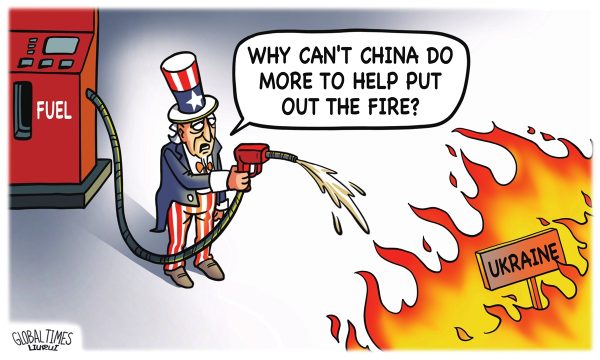
Illustration: Liu Rui/GT
Global Times | March 18, 2022
The close relationship between China and Russia has been a thorn in the US’ side, especially against the backdrop of the ongoing Ukraine crisis. With the simmering of the situation, it couldn’t be any clearer that Washington is eager to exploit the Russia-Ukraine conflict to drive a wedge between Beijing and Moscow.
For one thing, senior White House officials have on multiple occasions accused China of not exerting enough pressure on Russia to stop the country’s military action in Ukraine. US Secretary of State Antony Blinken said on Thursday before US President Joe Biden’s virtual meeting with Chinese President Xi Jinping that Washington will “impose costs” for any support Beijing provides to Russia’s actions against Ukraine. He urged Beijing to assume “responsibility to use its influence and defend the international rules and principles that it professes to support.” For another, an increasing number of Western media reports and analyses have emerged to hype how China’s ties with Russia have made China “uncomfortable” and “awkward” and warn that Beijing risks isolation if it doesn’t distance itself from Moscow.
NATO’s eastward expansion is the root cause of Russia’s anger and military operation in Ukraine. It’s the US that should put out the fire it lit in Ukraine. Ridiculously, it is demanding Beijing to do this job at the cost of damaging China-Russia relations. This is unreasonable and insidious. By pushing China to denounce Russia and asking China to bear the responsibility for the fatal strategic mistake the US and NATO made in the construction of so-called European security, Washington has no intention of hiding its desire to sow discord between China and Russia.
US State Department spokesperson Ned Price said on Monday that China could use its unique relationship to bring an end to Russia’s actions against Ukraine. What nonsense. Russia is an independent major power and China has no ability to exert influence on Russia’s decision on the Ukraine issue which it deems as a “life-and-death” matter.
If China really pressures Russia in a way that is inconsistent with the China-Russia comprehensive strategic partnership of coordination, it will only undermine the China-Russia relationship and sabotage mutual trust, which will be a huge strategic loss to both sides. This is what the US is eager and happy to see.
Washington knows that China cannot influence Russia or force it to do anything. But it has regarded the Ukraine crisis as a good chance to tear the two countries apart. The more discord Washington could sow between China and Russia, the more it will be in line with US interests. But how can Beijing and Moscow allow such an evil trick to succeed?
Not like the petty followers that Washington can manipulate at will, China and Russia are both independent great powers. Besides, China has maintained a consistent position over the Ukraine issue, emphasizing all sides’ security concerns and interests should be respected and upheld. Its position is out of its own interests and the interests of the region. It will never dance to the tune of the US or sacrifice relations with Russia to satisfy US demands.
It also should be noted that no matter how the Ukraine crisis evolves and how heavily Russia is targeted by the US now, Washington still views China as its biggest strategic competitor. China should bear this in mind all the time. It must not give the US any chance to drive a wedge in the China-Russia relationship.
For a long time, the West has misinterpreted the China-Russia relationship, believing it’s based on expediency and could be easily torn apart. The truth is, the China-Russia comprehensive strategic partnership of coordination has withstood the test of the time and is rock solid. It’s China’s most important and stable diplomatic strategic asset that cannot be damaged.
Aid convoys struggling to reach ‘encircled’ Ukrainian cities, UN claims
Samizdat | March 19, 2022
Aid agencies are struggling to reach civilians in Ukrainian cities blocked by the Russian military, Jakob Kern, an emergency coordinator with the United Nations World Food Programme (WFP) said on Saturday.
“The challenge is to get to the cities that are encircled or about to be encircled,” Kern told the news agency AFP, describing the humanitarian situation on the ground as “dire.”
Ukraine’s food supply chain has effectively been broken amid the ongoing conflict, he said, with the WFP having to stock its warehouses “from zero.” He condemned what he described as Russia’s tactic of blocking cities, stating that it was “unacceptable in the 21st century.”
“The closer you go to these cities, the more worried [truck drivers] are about their safety,” Kern said. “And that means we’re not able to reach people in Mariupol, Sumy, Kharkiv… in the cities that are almost encircled by now – or completely, in the case of Mariupol.”
While Moscow and Kiev have agreed on efforts to organize humanitarian corridors out of those cities turned into combat zones, each side continues to accuse the other of targeting civilians and failing to uphold evacuees’ right of safe passage. Moscow said Kiev had refused to open routes for those seeking refuge in Russia or Russian-controlled territories.
Moscow launched a large-scale assault on its neighbor in late February, following a seven-year standoff over Ukraine’s failure to implement the terms of the Minsk ceasefire agreements, and Russia’s eventual recognition of the Donbass republics of Donetsk and Lugansk. German- and French-brokered protocols had been designed to regularize the status of the breakaway regions within the Ukrainian state.
Russia has now demanded that Ukraine officially declare itself a neutral country that will never join the US-led NATO military alliance. Kiev says the Russian offensive was completely unprovoked and has denied claims it was planning to retake the two rebellious republics by force.
Ukraine Has First-Rate Satellite Intelligence Courtesy of Uncle Sam, Making Its Artillery Far Deadliner
Lawfully Russia would be entirely justified in shooting down US satellites
Anti-Empire | March 17, 2022
Ukrainian military publicized an artillery strike it conducted against a camp of the Russian 35th Combined Arms Army (accompanied by horribly cheezy music considering the occasion).
How does a strike like this happen?
Aside from counter-battery fire, such an installation is defenseless against enemy long-range artillery. What keeps it safe is that normally enemy wouldn’t know about it. The enemy can’t normally see tens of kilometers behind your front line.
On paper the Ukrainians have the capability to discover such camps by flying drones, either in a grid search or directing them to sources of intense radio chatter they might have detected.
But there is reason to believe their reconnaissance is far simpler than that. The New York Times reports:
In Washington and Germany, intelligence officials race to merge satellite photographs with electronic intercepts of Russian military units, strip them of hints of how they were gathered, and beam them to Ukrainian military units within an hour or two.
So the Americans are providing the Ukrainians with numerous satellite images of the battlefield and of the Russian rear.
So in fact the Ukrainians do not need to spend time and resources discovering the layout of the Russian rear. Something they would have only a limited ability to do.
Instead, the whole Russian rear is laid bare to them courtesy of American satellites.
Knowing exactly where the Russian camps are, they are easy enough to target. Whether with the help of drone surveillance for better precision or not. (Particularly by self-propelled artillery which can quickly change position after a few salvos to avoid potential Russian counter-fire.)
America is neck-deep in this war. This is yet one more aspect of its involvement.
(Or you could say that America launched a war vs Russia decades ago and Russia responded by opening a front in Ukraine. Ergo the daily Pentagon briefings on an ostensibly Russian-Ukrainian war.)
Actually, The New York Times tries to muddy the waters by saying that the US is not passing on “intelligence that would tell Ukrainian forces how to go after specific targets” but I don’t know what that is even supposed to mean.
And they say they are not passing on specific intelligence that would tell Ukrainian forces how to go after specific targets. The concern is that doing so would give Russia an excuse to say it is fighting the United States or NATO, not Ukraine.
They’re passing on images coupled with electronic intercepts within an hour but it’s not “specific intelligence” about “specific targets”. So what does that mean? That Americans will send an image of Russian forces and installations but they won’t circle them with a thick red marker? What kind of gaslighting is this? Of course, satellite images will help with targeting and long-range attacks.
UK’s Johnson fails to secure public oil rise pledges after talks with Saudi, UAE
MEMO | March 16, 2022
British Prime Minister, Boris Johnson, held talks about energy security on Wednesday with the de facto leaders of Gulf oil exporters, Saudi Arabia and the United Arab Emirates, but secured no public pledge to ramp up production, Reuters reports.
Johnson’s trip to Abu Dhabi and Riyadh was aimed at securing oil supplies and raising pressure on President Vladimir Putin over Russia’s invasion of Ukraine, which led to sweeping Western sanctions on Moscow and soaring world energy prices.
Johnson’s office said that, in his meeting with Abu Dhabi Crown Prince, Sheikh Mohammed bin Zayed Al-Nahyan, he stressed the need to work together to stabilise global energy markets.
After his talks in Riyadh with Saudi Arabia’s Crown Prince,Mohammed bin Salman, Johnson was asked whether the Kingdom would increase oil production.
“I think you’d need to talk to the Saudis about that. But I think there was an understanding of the need to ensure stability in global oil markets and gas markets,” he said.
So far, Saudi Arabia and the UAE, whose close ties with Washington are under strain, have snubbed US pleas to ramp up oil production to tame the rise in crude prices that threatens global recession after the Russian offensive in Ukraine.
“The world must wean itself off Russian hydrocarbons and starve Putin’s addiction to oil and gas,” Johnson said before his meetings. “Saudi Arabia and the United Arab Emirates are key international partners in that effort.”
The two Gulf States are among the few OPEC oil exporters with spare oil capacity to raise output and potentially offset supply losses from Russia. But they have tried to steer a neutral stance between Western allies and Moscow, their partner in an oil producers’ grouping known as OPEC+.
The group has been raising output gradually each month by 400,000 barrels a day, resisting pressure to act more quickly.
The UAE remains committed to the OPEC+ deal, a source with knowledge of the matter told Reuters before the meeting.
It has deepened ties with Moscow and Beijing in the last few years and abstained, last month, in a US-drafted United Nations Security Council resolution to condemn the invasion of Ukraine, which Russia has described as a “special military operation”.
Johnson “set out his deep concerns about the chaos unleashed by Russia’s unprovoked invasion, and stressed the importance of working together to improve stability in the global energy market”, his office said after his talks in Abu Dhabi.
Johnson and the Crown Prince also agreed on the need to bolster security, defence and intelligence cooperation to counter threats,including from Houthi forces who have fought a lengthy conflict in Yemen against Saudi and UAE forces.
Saudi executions
Johnson is only the second major Western leader to visit Saudi Arabia since journalist, Jamal Khashoggi’s 2018 killing by Saudi government agents in Istanbul.
The CIA concluded that the Prince approved an operation to “capture or kill” Khashoggi. He has denied any involvement in the killing.
The Prime Minister’s trip also came just four days after Saudi Arabia executed 81 men, the largest number in a single day for decades, for offences ranging from joining militant groups to holding “deviant beliefs”.
Asked about criticism of Saudi Arabia’s human rights record, Johnson said: “I’ve raised all those issues many, many times over the past … and I’ll raise them all again today.
“But we have long, long standing relationships with this part of the world, and we need to recognise the very important relationship that we have … and not just in hydrocarbons.”
Saudi press agency, SPA, said Johnson and Prince Mohammed discussed the conflict in Ukraine and international issues, adding that Saudi Arabia and the United Kingdom signed a memorandum of understanding to establish a strategic partnership.
Sanctions hurt everyone, but Russia will prevail: Putin
Samizdat | March 16, 2022
Western sanctions are a blow to Russia, but also hurt the entire global economy, Russian President Vladimir Putin said during a government meeting on Wednesday.
“As their weapons, [Western states] choose economic, financial, trade and other sanctions against Russia. They are now backfiring on the Europeans and Americans through rising prices for gasoline, energy, food, and job losses associated with the Russian market,” Putin said.
He noted that the current situation is a lesson for Russian entrepreneurs, who should learn to choose partners wisely, keeping in mind that “there is nothing more reliable than investments at home.”
“We see the position of those foreign companies that, despite the shameless pressure … continue to work in our country. In the future, they will certainly receive additional opportunities for development. We also know those who cowardly betrayed their partners, forgot about their responsibility to employees and clients in Russia, and hurried to earn illusory dividends by participating in the anti-Russia campaign,” Putin said, pointing out, though, that “unlike Western countries” who were quick to freeze the assets of Russian firms, “We will respect the right to property” of foreign businesses working in Russia and abstain from nationalizing their assets.
The Russian president described the sanctions policy implemented by the US, EU, and allies as a deliberate “blow to our entire domestic economy, to our social humanitarian sphere, to every family, every citizen of Russia.” He emphasized that it’s “a conscious, long-term strategy [to] weaken Russia,” which had been in the works long before Moscow launched its military operation in Ukraine.
However, Putin also said that Russia can stand up to sanctions pressure. Specifying that all national development goals for the country until 2030 must and will be achieved.
“Our economy, the state budget, and private businesses have all the necessary resources to solve long-term tasks. All the strategic national goals that we have set for the period up to 2030 must be achieved. The current challenges and opportunities they open up should only mobilize us,” he stated.
The president also noted, that, obviously, adjustments will have to be made to all the programs amid the current events, “and here the initiatives of business circles, scientists, and public associations are in demand.”
He warned that the new circumstances will require deep structural changes to the Russian economy, which may lead to rising unemployment and inflation, and “our task is to minimize such risks.” The head of state stressed the country needs to not only fulfill all its social obligations, but also to find new effective mechanisms to support citizens. In this regard, he called on the government to expand support for people who have lost jobs, find ways to reduce the level of poverty by the year’s end and solve logistical problems leading to price spikes.
“The current situation is, of course, a test for us all. I am sure that we will pass it with dignity – with hard work, joint work and mutual support, we will overcome all difficulties and become even stronger, as it has always been throughout Russia’s thousand-year history,” Putin emphasized.
“The Russian economy will definitely adapt to new realities. We will strengthen our technological and scientific sovereignty, direct additional resources to support agriculture, the manufacturing industry, and housing construction infrastructure,” the president added.
‘West’s global political and economic dominance ends’ – Russian President
Samizdat | March 16, 2022
Russian President Vladimir Putin has stated that the latest rounds of unprecedented sanctions imposed on Russia by the US and its allies over the Kremlin’s military campaign in Ukraine, mark the end of an era. According to Putin, from now forward the West will be losing its “global dominance” both politically and economically.
On Wednesday, the Russian head of state proclaimed that the “myth of the Western welfare state, of the so-called golden billion, is crumbling.” Moreover, it is the “whole planet that is having to pay the price for the West’s ambitions, and its attempts to retain its vanishing dominance at any cost,” Putin said.
The president predicted food shortages across the world as Western sanctions against Russia adversely affect the entire global economy.
Touching on the decision by several Western powers to freeze Russia’s central bank assets, Putin said that this would only serve to irreparably undermine trust in those nations, and make other countries think twice before placing their reserves in the care of those countries. According to him, nearly half of Moscow’s assets were “simply stolen” by the West.
Addressing people in the West, the Russian leader said the massive sanctions imposed on Russia are already backfiring on the US and Europe themselves, with governments there trying hard to convince their citizens that Russia is to blame.
Putin warned ordinary people in the West that attempts to portray Moscow as the primary source of all their woes were lies, with many of those issues being the direct result of Western governments’ “ambitions” and “political short-sightedness.”
Western elites, according to Putin, have turned their countries into an “empire of lies,” but Russia will keep on presenting its own position to the whole world, no matter what.
Featured Video

AIDS Inc. by Gary Null (2007)
or go to
Aletho News Archives – Video-Images
From the Archives
Clash of Civilization, Iran Part II
By Jamal Kanj – Intifada-Palestine.com – January 14, 2011
Israel’s survival kit is: perpetuate conflict, insecurity to rationalize collective hate and finally playing victim.
Devoid of conflict, Israel implodes internally; without hate, Zionism loses its justification; and playing eternal victim to continue blackmailing the West. Absence of this holy trinity, Israel ceases to exist.
From its inception, the house of Zion has mastered exploiting adversarial powers to advance Israel’s cause. For instance, their influence over the Democratic Party in the US began with President Truman’s bid for 2nd term election in 1948.
Responding to strong opposition from Secretary of State General George Marshall and Department experts urging against recognition of Israel, President Truman replied: “I’m sorry gentlemen but I have to answer to hundreds of thousands [Jewish voters] who are anxious for the success of Zionism. I do not have hundreds of thousands of [voting] Arabs among my constituents”
Zionists influence over liberal American politics was matched with the doctrinal school of Conservative theoreticians aligning the Republican Party’s platform with Israel’s objectives. The Neoconservative Zionists, coined Zioncons, invented the “Clash of Civilization” concept to fight Israel’s wars. … continue
Blog Roll
 Aletho News
- Merck Virologists Admitted to Falsely Certifying Vaccine Efficacy
- Mandatory Folic Acid for every man, woman & child
- Pro-Palestine protesters arrested outside UK’s ruling Labour Conference in Liverpool
- Mauritius denies landing permit to flight from Israel, forcing cancellation: Tour operator
- Israeli finance minister calls for genocidal war on West Bank, annexation of south Lebanon
- 12 Things Your Psychiatrist Was Trained Not to Tell You
- From Unipolar Universalism to Multipolar Civilizational Distinctiveness
- RSF military group defects, joins Sudanese army: State media
- Ireland goalkeeper refuses to play ‘Israel’ as squad weighs boycott
- China pushes back against US on Cuba, Iran
- If Americans Knew
- Israel forces Gazans to live in constant peril – Daily Update
- Deconstructing Netanyahu’s pants-on-fire UN rant – Daily Update
- Trump betrayed voters with his campaign lies and prioritized a foreign country once he took office
- Netanyahu calls Israel’s war in Gaza ‘opposite of genocide’ in UN speech to near-empty hall
- Settler Kidnappings: Torture, Sexual Abuse and Terrorisation of Palestinian Abductees as Israel Deepens Annexation of West Bank
- Gaza winter nears as 162,000 tents become unusable, raising fears of humanitarian crisis
- Netanyahu says, “It’s the opposite of genocide”; UN says Gaza economy is world’s ‘most severe crisis on record’ – Daily Update
- Israel’s US-Backed Assault on Gaza Has Created the ‘World’s Most Severe Economic Crisis on Record’: UN
- ‘Protecting U.S. Citizens’… From Israel
- ‘This is where I live now, the back of a truck’: a day in the life of a grandmother in Gaza
- No Tricks Zone
- New Study: Earth And Venus Surface Warmth Largely Explained By Convection And Lapse Rate, Not CO2 Or Radiation
- 2025 Nature Paper Claiming Worsening Global Drought Gets RETRACTED …Heavily Flawed
- New Study: ‘Global Drought Shows No Detectable Recent Acceleration Under Climate Warming’
- Economic Masterminds: German Socialists Suggest Taxing Productivity Gains Stemming From Using AI
- The South China Sea Has Not Been Cooperating With The Climate Change Narrative
- Energy Crisis: Germany Enters Heating Season With Historically Low Gas Reserve Fill Levels
- New Study: The Antarctic Ice Sheet Gained Mass From 2020-2024 Due To Staggering Snow And Ice Accumulation
- Study: Ocean Heating Rates From Thousands Of Years Ago ‘Dwarf’ Modern Ocean Heating Rates
- Climate Extremists Target, Attack Large-Scale Power Grid Infrastructure In Germany!
- New Study: Antarctic Ice Melt Has Contributed Less Than 1 Centimeter To Sea Level Rise In The Last 30 Years

