UK Ministry of Justice Invests in Social Listening Tool
Monitoring online conversations
By Didi Rankovic | Reclaim The Net | July 25, 2023
The UK’s Ministry of Justice (MoJ) has decided to spend taxpayer money in order to be able to use a monitoring tool whose job is to access people’s conversations that might impact the ministry’s “reputation.”
This decision certainly impacts that reputation, but perhaps not in a positive aspect.
And it would be an interesting full circle if the maker of the software, Brandwatch (owned by Cision, a PR outfit) – allowed the MoJ to learn how inking this three-year deal will impact its reputation.
From what is known about the contract, things don’t look good – just more outsourced good old mass surveillance carried out by governments and various departments and agencies.
The tech is described as social media and “online listening,” and will cost the MoJ £50,000 per each of the three years of the deal. The hope is that it will allow the ministry to know about any of the millions of times people mention it online.
The procurement documents show that the contract, signed last month, will give the MoJ the ability to monitor and track mentions about itself on social and online media in general, in forums, blogs, based on particular keywords, terms and topics.
The justification for needing this tool, found in the same documents, is that the MoJ has a social media presence on major platforms. And that means it is exposed to discussion – and, likely, criticism, that the officials would like to know about, all for the sake of “reputation, campaigns, and policy announcement.”
The MoJ steers very far from framing any of this as surveillance and tracking, but rather a selfless act where money will be spent simply in order to work better – by “listening” (figuratively, and literally) to what citizens and stakeholders are saying and expecting from it.
Reports say that the contract with Brandwatch will cover 100 individual users, as well as 48 million past mentions of MoJ, along with two million more “live” ones each month.
Up to 50 different terms can be fed to the software to be tracked on Twitter, Facebook, and Instagram each, and whatever information is gathered will remain accessible on the cloud, including that from the previous 2 years.
UK Blocks Ukrainian Orthodox Priest’s Testimony at UN Security Council
By Ekaterina Blinova – Sputnik – 26.07.2023
London prevented the religious leader from delivering his first-hand experience of repression against the church in Ukraine.
“Today is an extremely sad moment for the UN Security Council, as well as for the international community as a whole,” said Dmitry Polyansky, first deputy permanent representative of the Russian Federation in the UN.
“Western delegations actually agreed with the repressive policy of the Kiev regime against the canonical Orthodoxy. This is a clear evidence of blatant double standards in matters concerning freedom of expression, religion, and in general all those ideals that they preach. Your decision to block the participation of an Orthodox clergyman in accordance with the prerogatives of the president of the UN Security Council is clear evidence of how London treats ideals and how easily it is ready to give them up for the sake of narrowly selfish, petty attempts to prick Russia.”
The UK holds the 15-nation organ’s rotating presidency for July 2023.
Earlier, on July 18, Russia called for a meeting of the UNSC on Ukraine for July 26, in particular on the topic of repression against the canonical Ukrainian Orthodox Church.
On the same day, the Russian Foreign Ministry announced that Moscow would raise the issue of the persecution of the vicegerent of the Kiev-Pechersk Lavra, Metropolitan Bishop Pavel, at the upcoming meeting of the UN Security Council.
On July 14, a Kiev court changed the measure of restraint for Metropolitan Pavel from round-the-clock house arrest to detention until August 14.
For his part, Patriarch Kirill of Moscow and All Russia called on the UN, the Organization for Security and Co-operation in Europe (OSCE) and heads of churches, including Pope Francis, to protect the vicegerent of the Kiev-Pechersk Lavra.
Earlier this month Pope Francis responded to the appeal of Patriarch Kirill and spoke against politically motivated arrests in Ukraine.
The Kiev regime started to exert pressure on the Ukrainian Orthodox Church in 2022. Ukrainian authorities gave an ultimatum to the monks of the Kiev-Pechersk Lavra to vacate the monastery’s premises until March 29 under the pretext of allegedly violating the terms of the lease – jurisdiction over which is divided between the National Kiev-Pechersk Historical and Cultural Preserve, a Ukrainian secular organization and the UOC. Lavra monks condemned the eviction order as illegal as it was not backed by a court decision. As they resisted the Kiev regime’s attempts to expel them from the monastery, the Ukrainian authorities resorted to persecution.
Other Ukrainian Orthodox priests have also been subjected to pressure from the Ukrainian authorities. Ukrainian law enforcement officers searched the homes of bishops and priests, churches and monasteries, including the Kiev-Pechersk Lavra, in order to find traces of “anti-Ukrainian activities.”
What Are Black Hornet Nano Drones and Why is US Sending Them to Ukraine?
By Ilya Tsukanov – Sputnik – 25.07.2023
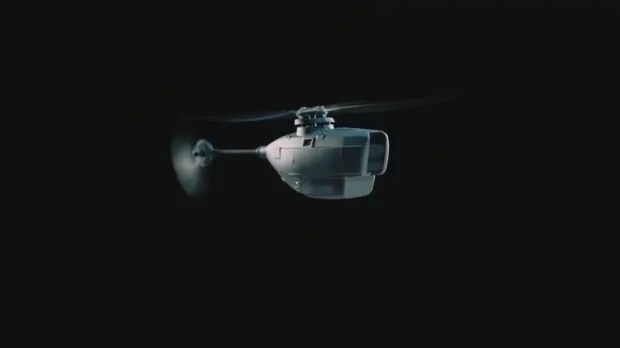
American officials have announced another military aid package for Ukraine, this time including a batch of tiny Black Hornet reconnaissance drones. What exactly are Black Hornets? Who makes them? And why are they so expensive? Sputnik explores.
US officials have spent nearly a week touting a new $400 million weapons package for Kiev to assist in NATO’s ongoing proxy war against Russia, with the weapons, taken directly from the Pentagon’s own stocks, including NASAMS, Stinger and Patriot air defense missiles, Stryker armored vehicles, TOW and Javelin anti-tank missiles, howitzer ammo, HIMARS rockets and 28 million rounds of small arms ammunition.
On Monday, anonymous officials revealed to media that the arms package will also include Black Hornet Nanos, a pricy, sophisticated unmanned aerial vehicle about the size of a small bird.
What are Black Hornet Drones Used For?
Black Hornet Nanos are a micro UAV weighing in at just 17-18 grams. They can be carried around by troops and deployed to provide hi-res images and video of the surrounding environment using three separate onboard cameras. The drones resemble a tiny helicopter, are about 100 mm long and 25 mm wide, with their main rotor blade’s diameter measuring in at about 120 mm.
Who Makes Black Hornet Drones?
Black Hornets were developed by Norwegian nano drone helicopter startup Prox Dynamics in the early 2010s, and are now manufactured by FLIR Unmanned Aerial Systems, another Norwegian company, which bought out Prox Dynamics in 2016 for $134 million. FLIR specializes in surveillance and automated systems, equipment for armored vehicles, traffic detection systems, and firefighting cameras.
What is the Black Hornet’s Range and How Fast Do They Fly?
Black Hornets have a flight time of up to 25 minutes, are equipped with a digital data-link effective to ranges up to 1.6 km, and have a top speed of 21 km per hour.
How Much do Black Hornets Cost, and Why are They So Expensive?
Black Hornet drones had an estimated price tag of about $195,000. That figure is based on a 2013 contract by the UK’s Defense Ministry on the purchase of 160 Black Hornet sets (320 micro copters total) for the equivalent of $31 million. For 195k, you get a remote control, handheld touch screen, rechargeable battery pack, and a two-in-a-set pack of mini drones stored in a special portable, wearable bump resistant container.
Where Have Black Hornets Been Deployed?
Over 14,000 Black Hornets have been produced since their debut in 2011, with the drones purchased en masse by the Norwegian and NATO militaries, as well as by Algeria, Australia, India, Indonesia, Malaysia, New Zealand, and South Africa for military and police use.
The systems’ first combat deployment was reported in 2013, with the systems used by British troops during NATO’s occupation of Afghanistan. The US began using modified versions of the base drone equipped with night vision and improved navigation in 2015, reporting their deployment with Marine Corps Special Operations units; the US Army followed up with a $140 million contract for its Soldier Borne Sensor (SBS) program.
The US is not the first country to equip Ukraine with Black Hornets. In August 2022, the UK and Norway jointly purchased 850 Black Hornet Nanos, promising to deploy them by November of that year. Earlier this month, the Norwegian Defense Ministry announced that FLIR would supply another 1,000 Black Hornets, plus spare parts, and would train Ukrainian operators and instructors to fly them (a process which reportedly takes as little as 20 minutes).
Are Black Hornets the Smallest Military Drones in the World?
Black Hornets are touted as the smallest military drones in the world. UK Defense Media hinted back in late 2015 that the military was considering experiments using even smaller UAVs weighing as little as 5 grams, but additional information on these plans has yet to materialize.
Last year, a Chinese company known as Huaqing Innovation unveiled the Fengniao (lit. ‘Hummingbird’) drone at a defense expo in Abu Dhabi, with the UAV measuring in at 17 cm and weighing 35 grams, and capable of transmitting snapshots or real-time footage at distances of more than 2 km. It has a reported flight time of about 25 minutes, and is powered by replaceable batteries, rather than a battery pack. The Fengniao can reportedly be used in combination with up to 15 other drones of the same type to form a swarm, and controlled by a smart phone app. Huaqing Innovation has not revealed the drone’s likely price tag.
For the more budget-conscious buyers, there are commercially available helicopter-style drones fitted with cameras (which have already been used en masse in Ukraine), such as the Eachine E110 RC, which features a 720 pm HD camera with 90 degree rotatable lens.
These drones can be yours for as little as $95, meaning, in theory, that one can buy over 1,000 of the mass-market drones for the price of a single Black Hornet. But there are many tradeoffs, including a flight time of just 15 minutes, a 20 km per hour flight speed, and crucially, a transmission distance of just 50-120 meters. Eachines are equipped with automatic hover and stare modes, and user-selectable waypoint controls, and an automatic return feature. The drones are also substantially larger than Black Hornets, with a nose to tail length of about 30 cm and a similar rotor span. However, as the saying goes, in some circumstances quantity has a quality all its own.
What Weapons Can Be Used to Counter Black Hornet Drones?
Black Hornets’ tiny size and quiet operation make them basically impossible to destroy using conventional missile defenses, although small arms (or an aptly thrown bag of groceries) might just be able to do the job at close range.
Alternatively, they can be targeted by specially-designed countermeasures, such as the RLK-MTs Valdai, a special-purpose radar designed by Russian missile maker Almaz-Antey to detect, suppress and neutralize small drones with extremely low radar cross sections at close-in ranges of 2 km or less. The RLK-MTs’s detection systems include an X-band radar module, thermal imagers and cameras, and a radio signal source-finder module. But these systems are heavy. Heavy enough that they have to be mounted on a truck.
Alternatively, there are military-grade anti-UAV systems such as the PARS-S Stepashka, a 9.6 kg Russian anti-drone gun with the ability to hijack enemy drones and force them to land or return to their launch sites. These weapons have an effective range between 500 and 1,500 meters.
And if that doesn’t work, there’s the Stupor rifle, which uses electromagnetic pulses to suppress drones’ control channels and similarly force them down.
The West threw Ukrainians into a meat grinder thinking “courage” would prevail
By Ahmed Adel | July 25, 2023
The West knew that Kiev did not have enough weapons for a successful counteroffensive but hoped that the “courage and resourcefulness” of Ukrainian soldiers’ would compensate for this deficit, reported The Wall Street Journal. Obviously, those hopes did not materialise as one cannot win a battle based on “courage and resourcefulness.”
“When Ukraine launched its big counteroffensive this spring, Western military officials knew Kyiv didn’t have all the training or weapons—from shells to warplanes—that it needed to dislodge Russian forces. But they hoped Ukrainian courage and resourcefulness would carry the day. They haven’t,” reported the newspaper.
“Deep and deadly minefields, extensive fortifications and Russian air power have combined to largely block significant advances by Ukrainian troops. Instead, the campaign risks descending into a stalemate with the potential to burn through lives and equipment without a major shift in momentum,” added the Wall Street Journal.
According to the newspaper, the offensive risks a stalemate. It will cost Ukraine lives and equipment without significant progress. The publication also notes that there are not enough reserves in Europe to provide Kiev with everything necessary.
Moreover, according to Western diplomats, European leaders are unlikely to opt for a significant increase in aid to Ukraine if they feel a lack of enthusiasm on the part of the US, which in turn is preparing for the presidential election.
The Ukrainian offensive began on June 4 and has experienced catastrophy. But since the beginning of the special military operation in February 2022, Ukraine has lost 457 warplanes, 243 helicopters, 5,236 unmanned aerial vehicles, 426 air defence missile systems, 10,868 tanks and other armoured fighting vehicles, 1,139 fighting vehicles equipped with MLRS, 5,585 field artillery cannons and mortars, as well as 11,860 special military motor vehicles.
This catastrophic loss of military equipment demonstrates the complete failure of the Ukrainian offensive and is why more questions are being raised in Western countries about why support is still being provided when it is evidently making no difference in Ukraine’s fortunes.
In fact, it begs the question as to why the counteroffensive was ever launched to begin with.
As renowned political scientist Max Abrahms highlighted in a tweet, the White House boasted in May that “Ukraine has everything necessary for a counteroffensive.” This is a far cry from the recent revelation that the West believed that the “courage and resourcefulness” of Ukrainian soldiers’ would compensate for the lack of weapons.
For British military expert Jack Watling, Ukraine’s much-anticipated counteroffensive against Russia has been impeded by Western delivery delays and bureaucracy. The senior researcher on land warfare at the Royal Institute of United Services argues, “A bureaucratic, peacetime approach to training and stockpiling among Zelenskiy’s allies is posing a threat to European security.”
According to the author, Kiev has clearly communicated to Western capitals about what it needs to succeed on the battlefield, requesting artillery, engineering capacity, protected means of mobility, anti-aircraft defence systems and personnel training. Watling points out that Kiev did receive enough artillery and protected mobility assets but had a harder time obtaining other items on the list.
Western countries did not approve deliveries of tanks and infantry fighting vehicles to Ukraine until January 2023, making the situation difficult for Ukrainian forces: “Months of delays gave Russian forces time to build their defences, significantly complicating the task for the Ukrainians,” added Watling.
Effectively, it was a well-known fact, despite the public bravado, that the Ukrainian counteroffensive was going to fail. It questions why Ukrainians are being so easily sent into the Russian meat grinder to die or be maimed. This is difficult to reconcile since Ukrainians are literally being dragged off the street and sent to the front line.
Notably, more prominent voices in the West, such as Douglas MacKinnon, a former adviser for policy and communications at the Pentagon, and British Foreign Secretary Ben Wallace, are beginning to speak out against Zelensky’s entitled and spoiled behaviour. Although this has not deterred weapons transfers to Ukraine, it does suggest that patience could run out, especially as the US elections will take place in November 2024. British Prime Minister Rishi Sunak is also eyeing November 2024 for the UK’s General Election.
Particularly in the case of the US, the Republicans will likely use all the wasted billions of dollars and failure in Ukraine as a major election discussion point. With more and more revelations emerging that the Ukrainian counteroffensive never stood a chance of success, with foolish beliefs of “courage and resourcefulness” leading to tens of thousands of casualties, criticisms against the ruling governments in the West will only mount.
Ahmed Adel is a Cairo-based geopolitics and political economy researcher.
So what’s the REAL point of “Just Stop Oil” protests?
By Kit Knightly | OffGuardian | July 19, 2023
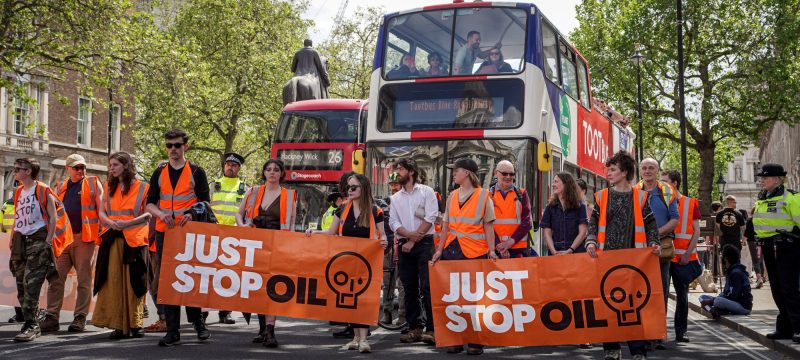
It seems every day lately there is a new “shocking viral video” of “desperate drivers losing patience with Just Stop Oil”, or some similar phrasing.
Something like this…
No sporting event has been spared the orange dust and hi-viz vest of Just Stop Oil, and wherever they go they are either cheered on for their antics, or the subject of vigilante justice… which likewise gets a cheer.
But are these videos and protests organic? And if not, what is the point of these clashes?
First of all, let’s agree the protests themselves are pointless, even on their own terms.
Not only do none of the people being inconvenienced by the blocked traffic or disrupted sporting events have any power at all to “just stop oil”, but slowing down traffic actually increases emissions whilst the destruction and disruption will certainly turn many people against the movement.
But that doesn’t actually matter anyhow because the entire movement is FAKE.
Yup, stop the presses guys, news incoming is that Just Stop Oil are not actually a guerilla band of desperate anti-petrol hippies!
Turns out they have branding and funding and social media managers.
Turns out they are a product being marketed as much as anything else, and they are backed by the Climate Emergency Fund, a US-based NGO.
Shocking, right.
Ok, before any of you get apoplectic, it’s perfectly possible some (or all) of the JSO people out there actually wearing their hi-viz and chanting their slogans genuinely believe they’re doing the right thing.
But it’s just as possible they’re all being paid to be there.
Yes, just like charity collectors or seat fillers, paid protesters exist.
Hell, it’s possible the “ordinary people” doing the violence are paid too and the many of the “viral videos” are entirely staged.
Staged or not, paid or not, the violent videos will certainly encourage real violence eventually. And even if they don’t spawn more physical violence, they provide endless ammunition for violent disagreement.
Yes, you guessed it, it’s another fake binary.
A dialectic construction to control the conversation. Making the question on the public mind not “is climate change a problem?”, but “is protesting hydrocarbon production this way right?” or “is violence against protesters acceptable?”.
And, of course, no matter how you answer those questions you’re providing support for one establishment narrative or another.
See, if you support the protesters, you’re agreeing we should be using any means necessary to reduce CO2 emissions etc. You agree that the problem these people are reacting to requires a solution. That way lies carbon taxes and a laundry list of restrictive policies that contol and impoverish people in the name of “saving the planet”.
But, on the other hand, if you’re anti-protesters you’re going to be gaslit into supporting “new anti-protest legislature” to “stop environmentalists disrupting daily life” or “prevent outbreaks of violence” or something.
This anti-protest legislation will be used to stamp-out REAL protests when they inevitably occur in response to Great Reset policies down the line.
See how it works? It’s a win-win for the establishment.
That’s the nature and purpose of the false binary. Violent disagreement across a very narrow band of opinion, and no matter which side you take you’re partaking in a constructed reality that directs your behaviour and responses into endorsing a New Normal policy.
This is almost literally everything that’s been in the news since Covid sputtered out, and the solution is always the same: Keep objective and refuse to take a side.
UK Planning to Replace Existing Nuclear Warheads
Sputnik – 19.07.2023
The United Kingdom plans to commission new Dreadnought Class submarines in the early 2030s to replace obsolete Vanguard Class submarines, the Defense Ministry said on Tuesday, adding that the country will also replace its nuclear warheads to maintain an “effective deterrent.”
“We have therefore committed to a one-in-two-generations programme of modernisation of our nuclear forces, underpinned by long-term investment. In 2016, Parliament voted to renew our nuclear deterrent and replace the Vanguard Class submarines with four new Dreadnought Class submarines.
The programme remains on track for the First of Class to enter service in the early 2030s. To ensure we maintain an effective deterrent throughout the commission of the Dreadnought Class, we will also replace our existing nuclear warhead,” the Defence Command Paper 2023 read.
The document added that both submarines and new warheads are being designed and manufactured in the UK.
Experts stress that engagement in Ukrainian crisis has seriously wore down UK military resources and now London faces the necessity to restore the munitions and equipment it generously contributed to Kiev. Resupply of arms will demand serious financial expenditures and take years.
Bank’s reasons for booting Nigel Farage revealed
RT | July 18, 2023
UK bank Coutts dropped British politician Nigel Farage as a customer not because his accounts contained insufficient funds but because his social and political views were incompatible with its “values,” according to a 40-page dossier compiled by the bank and seen by the UK Telegraph on Tuesday.
While admitting “there is no evidence of regulator or legal censure of [Farage],” the document concluded Farage was no longer “compatible with Coutts given his publicly-stated views that were at odds with our position as an inclusive organization.”
“This was not a political decision, but one centered around inclusivity and purpose,” the file stated, recommending the UKIP founder be put on a “glide path” to debanking as soon as his mortgage deal concluded – even though he was described as “professional, polite and respectful” in his dealings with Coutts.
While searching for a legitimate reason to drop him, Coutts apparently tried to leverage Farage’s “Russian connections,” only to find he did not have any. The file discussed his appearances on RT, where he was last a guest in 2017, alongside a claim about receiving payment from the Russian network that the bank admitted was bogus, and lamented that his comments about the conflict in Ukraine “fall short of endorsement” of the Russian position.
The bank ultimately settled on reputational risk. Farage “presents a material and ongoing reputational risk to the bank” as he is “regularly (almost constantly) the subject of adverse media,” the document explained, citing dozens of unfavorable news articles, including many from partisan sources like Hope Not Hate and Labour Movement for Europe.
The populist “is seen as xenophobic and racist” and a “disingenuous grifter” who promotes values that “do not align with the bank’s,” the dossier stated, referring to comments that were “distasteful and appear increasingly out of touch with wider society,” reportedly including tweets expressing his belief that the UK should leave the European Convention on Human Rights. His friendships with former US president Donald Trump and Serbian tennis champion Novak Djokovic were also brought up as liabilities.
When Farage revealed last month that Coutts had closed his account without giving a reason, the bank claimed his balance had fallen below the minimum amount required to maintain an account. The dossier, which he obtained through a subject access request, thoroughly contradicts the bank’s statement, explaining that his “economic contribution is now sufficient to retain on a commercial basis.”
Farage described the file to the Telegraph as a “Stasi-style surveillance report” that “reads rather like a pre-trial brief drawn up by the prosecution in a case against a career criminal,” noting the word “Brexit” appears 86 times and that Coutts found no fault with him before Brexit became an issue in 2016.
Hitler, Churchill, the Holocaust, and the War in Ukraine
Mike Whitney Interview with Ron Unz • Unz Review • July 17, 2023
 In the West, we’re taught that Hitler is the embodiment of all evil, but it’s more complicated than that, isn’t it? The more I read about Hitler, the more convinced I am that his views about the Versailles Treaty were fairly commonplace among Germans living at the time. It seems to me that if Hitler hadn’t emerged as the leader who promised to restore Germany (to its original borders), someone else would have taken his place. The real problem was the injustice of the treaty itself which exacted reparations that could not be repaid along with the partitioning of the German state. It was the onerous settlement of Versailles that ensured there would be Second World War not Hitler.
Am I wrong about this? And would you agree that our over-simplified “cartoonish” portrayal of Hitler prevents people from understanding the events that led to WW2?
Ron Unz—You’re correct on all those points, but the true history is even worse than that.
Germany had been very successful during the early years of the First World War, repeatedly defeating the Russians while occupying portions of northern France, but nevertheless its leaders then sought to end the horrible mutual slaughter in 1916 by proposing a peace without winners or losers. However, most of the Allied leadership harshly rejected any peace negotiations and were instead determined to continue the war until Germany was defeated and permanently crippled. I discussed that important forgotten history in a long article last year.
- American Pravda: Lost Histories of the Great War
Ron Unz • The Unz Review • November 28, 2022 • 8,100 Words
A couple of years later, after America had entered the war, Germany agreed to an armistice—an end to the fighting—on the basis of President Woodrow Wilson’s Fourteen Points, which seemed to offer a fair peace without a victory for either side. But this turned out to be a bait-and-switch operation, since once Germany had withdrawn its army from French territory and given up its powerful naval forces, the Allies then imposed a brutal starvation blockade upon the weakened country, inflicting many hundreds of thousands of civilian deaths until the new German government finally accepted very harsh peace terms. These included the dismemberment and occupation of portions of their country, permanent military weakness, and acceptance of the entire guilt of the war, as well as paying gigantic future financial reparations to the victorious Allies.
The outrageous terms imposed at Versailles deeply rankled all Germans, and the memory of the starvation imposed upon Germany during the war and even afterward was one of the reasons Hitler believed it was so important to somehow gain access to additional agricultural territory.
As for the German leader himself, several years ago I pointed out that his contemporaneous assessment by many leading figures was very different than one might imagine based upon his demonic portrayal in the historical propaganda-narrative later created after war broke out.
By resurrecting a prosperous Germany while nearly all other countries remained mired in the worldwide Great Depression, Hitler drew glowing accolades from individuals all across the ideological spectrum. After an extended 1936 visit, David Lloyd George, Britain’s former wartime prime minister, fulsomely praised the chancellor as “the George Washington of Germany,” a national hero of the greatest stature. Over the years, I’ve seen plausible claims here and there that during the 1930s Hitler was widely acknowledged as the world’s most popular and successful national leader, and the fact that he was selected as Time Magazine’s Man of the Year for 1938 tends to support this belief.
I discovered a particular example of such missing perspectives earlier this year when I decided to read The Prize, Daniel Yergin’s magisterial and Pulitzer Prize-winning 1991 history of the world oil industry, and came across a few surprising paragraphs buried deep within the 900 pages of dense text. Yergin explained that during the mid-1930s the imperious chairman of Royal Dutch Shell, who had spent decades at the absolute summit of the British business world, became greatly enamored of Hitler and his Nazi government. He believed that an Anglo-German alliance was the best means of maintaining European peace and protecting the continent from the Soviet menace, and even retired to Germany in accordance with his new sympathies.
Since the actual history of this era has been so thoroughly replaced by extreme propaganda, academic specialists who closely investigate particular topics sometimes encounter puzzling anomalies. For example, a bit of very casual Googling brought to my attention an interesting article by a leading biographer of famed Jewish modernist writer Gertrude Stein, who seemed totally mystified why her feminist icon seemed to have been a major admirer of Hitler and an enthusiastic supporter of the pro-German Vichy government of France. The author also notes that Stein was hardly alone in her sentiments, which were generally shared by so many of the leading writers and philosophers of that period.
There is also the very interesting but far less well documented case of Lawrence of Arabia, one of the greatest British military heroes to come out of the First World War and who may have been moving in a rather similar direction just before his 1935 death in a possibly suspicious motorcycle accident. An alleged account of his evolving political views seems extremely detailed and perhaps worth investigating, with the original having been scrubbed from the Internet but still available at Archive.org.
A couple of years ago, the 1945 diary of a 28-year-old John F. Kennedy travelling in post-war Europe was sold at auction, and the contents revealed his rather favorable fascination with Hitler. The youthful JFK predicted that “Hitler will emerge from the hatred that surrounds him now as one of the most significant figures who ever lived” and felt that “He had in him the stuff of which legends are made.” These sentiments are particularly notable for having been expressed just after the end of a brutal war against Germany and despite the tremendous volume of hostile propaganda that had accompanied it.
The political enthusiasms of literary intellectuals, young writers, or even elderly businessmen are hardly the most reliable sources by which to evaluate a particular regime. But earlier this year, I pointed to a fairly comprehensive appraisal of the origins and policies of National Socialist Germany by one of Britain’s most prominent historians:
Not long ago, I came across a very interesting book written by Sir Arthur Bryant, an influential historian whose Wikipedia page describes him as the personal favorite of Winston Churchill and two other British prime ministers. He had worked on Unfinished Victory during the late 1930s, then somewhat modified it for publication in early 1940, a few months after the outbreak of World War II had considerably altered the political landscape. But not long afterward, the war became much more bitter and there was a harsh crackdown on discordant voices in British society, so Bryant became alarmed over what he had written and attempted to remove all existing copies from circulation. Therefore the only ones available for sale on Amazon are exorbitantly priced, but fortunately the work is also freely available at Archive.org.
Writing before the “official version” of historical events had been rigidly determined, Bryant describes Germany’s very difficult domestic situation between the two world wars, its problematic relationship with its tiny Jewish minority, and the circumstances behind the rise of Hitler, providing a very different perspective on these important events than what we usually read in our standard textbooks.
Among other surprising facts, he notes that although Jews were just 1% of the total population, even five years after Hitler had come to power and implemented various anti-Semitic policies, they still apparently owned “something like a third of the real property” in that country, with the great bulk of these vast holdings having been acquired from desperate, starving Germans in the terrible years of the early 1920s. Thus, much of Germany’s 99% German population had recently been dispossessed of the assets they had built up over generations…
Bryant also candidly notes the enormous Jewish presence in the leadership of the Communist movements that had temporarily seized power after World War I, both in major portions of Germany and in nearby Hungary. This was an ominous parallel to the overwhelmingly Jewish Bolsheviks who had gained control of Russia and then butchered or expelled that country’s traditional Russian and German ruling elites, and therefore a major source of Nazi fears.
Unlike so many of the other historians previously discussed, after the political climate changed Bryant assiduously worked to expunge his suddenly unfashionable views from the written record, and as a consequence went on to enjoy a long and successful career, topped by the accolades of a grateful British establishment. But I suspect that his long-suppressed 1940 volume, presenting a reasonably favorable view of Hitler and Nazi Germany, is probably more accurate and realistic than the many thousands of propaganda-drenched works by others that soon followed. I have now incorporated it into my HTML Books system, so those so interested can read it and decide for themselves.

-
- Unfinished VictoryArthur Bryant • 1940 • 79,000 Words
Help me understand Munich. We’ve all been taught that Britain’s Neville Chamberlain caved in to Hitler’s demands on the annexation of Czechoslovakia’s Sudetenland which, in turn, fueled Hitler’s lust for global conquest. But was that really what happened? And was “appeasement” really such a bad idea or should the European leaders have accepted that Versailles was a disaster from the get-go and agreed to Hitler’s demands to restore Germany’s original borders?
Ron Unz—The First World War had led to the collapse of the multi-ethnic Austro-Hungarian, Czarist, and Ottoman empires, each of which had been politically dominated by one ethnic group at the expense of all the others. President Woodrow Wilson’s Fourteen Points and the Versailles Peace Conference had elevated the principle that nationalities should be given freedom and ruled by their own leaders, and this had served as the logical basis for most of the successor states thus created.
However, there was a blatant double standard in the political application of this policy, with the creation of the new country of Czechoslovakia being one of the most obvious examples. Like the much larger Austro-Hungarian Empire, Czechoslovakia was stitched together from several entirely different nationalities, with roughly half the population being the ruling Czechs and the other half being Germans, Slovaks, and Ukrainians, who had little political power and deeply resented the domination of the Czechs, who completely controlled the government and its administration.
Czechoslovakia had been established as an important strategic ally for France to use against Germany, geographically serving as an ideal staging area for bombing attacks, almost amounting to an unsinkable aircraft carrier directly jutting into the heart of its German neighbor. Since the country was intentionally designed to threaten Germany, the overwhelmingly German Sudetenland region had been included so as to strengthen its geographical border defenses. The Germans were actually the second largest nationality within Czechoslovakia, so the very name amounted to dishonest propaganda, and something like Czecho-Germania might have been a little more accurate.
One of Hitler’s main goals was to free the suppressed German populations of Central Europe and reunite them with their German homeland and this included the more than 3 million Sudeten Germans. The Czech government was also quite friendly with Stalin’s Soviet Union, and therefore seemed a particularly menacing potential military threat, a possible future base for Soviet attacks against Germany.
Hitler gradually rebuilt Germany’s strength and by March 1938 managed to reunite his country with the Germans of Austria, accomplished with the overwhelmingly enthusiastic support of the latter. He then demanded that the Sudeten Germans be freed by the Czechs and allowed to unify with Germany as well, being willing to potentially risk a wider European war with the British, French, and Soviets on that issue. To avoid this, the leaders of Germany, Britain, France, and Italy together negotiated an agreement at Munich, allowing the Sudeten Germans to secede and join Germany. This peace agreement was wildly popular across nearly all of Europe.
 However, once the Germans had been allowed to secede from Czechoslovakia, the Slovaks soon also did the same, establishing their own independent state of Slovakia (just as happened once again in 1993), and the entire country fell apart. At that point, Poland also grabbed a piece of disputed territory and the Hungarians threatened to do the same, so according to most accounts that I’ve read, the desperate Czech president turned to Hitler for support, and what was left of the country became a German protectorate.
Although anti-German propaganda soon portrayed the loss of Czech independence as a flagrant violation of the Munich Agreement, proof that Hitler couldn’t be trusted to keep his promises, the situation was really not so clear-cut since Czechoslovakia had already fallen apart and no longer existed. Furthermore, the Czechs had only been fully independent for twenty years after having previously spent nearly 700 years under German suzerainty, so in many respects, this merely restored the the traditional geopolitical arrangements in that part of Europe, doing so far more peacefully than when the Soviets invaded and occupied the Baltic States the following year.
Ironically enough, the Munich agreement signed by Chamberlain was reportedly so tremendously popular in Britain that if he’d called elections soon afterward, he probably would have won an overwhelming majority in Parliament, strongly consolidating his political hold over the British government for the next few years.
For those interested in a much more detailed discussion of this important history, I’d recommend the 1961 classic The Origins of the Second World War by renowned Oxford historian A.J.P. Taylor as well as David Irving’s outstanding 1991 volume Hitler’s War, available in HTML format on this website:
- Hitler’s War
David Irving • 1991 • 397,000 Words
Another excellent book covering this complex history is 1939: The War Had Many Fathers, published in 2011 by Gerd Schultze-Rhonof, a fully mainstream German professional military man, who rose to the rank of major-general in the German army before retiring. I’d also recommend David L. Hoggan’s extremely detailed narrative history in The Forced War, whose English version was originally published in 1989 and was long unavailable.
- The Forced War
When Peaceful Revisionism Failed
David L. Hoggan • 1989 • 320,000 Words
I should mention that both Schultze-Rhonof and Hoggan view these events somewhat differently than I have presented, with the former sharply condemning Hitler’s move into Czechia as a serious violation of the Munich Agreement and the latter arguing that the British government under Lord Halifax’s influence had always intended to orchestrate a war against Germany and was merely using the Munich Agreement as ruse to gain additional time for full rearmament before attacking.
Question 3: Churchill “The Drunken Poltroon”
I can’t make any sense of Churchill’s behavior prior to the war. Why was he so eager to declare war on Germany over a German territorial dispute with Poland many hundreds of miles away from his own country? Why did he think that should involve England? Besides, Churchill clearly had no way to transport British troops to Poland to defend the country nor would the battered British army have fared well against the better-trained and equipped Wehrmacht. In your book, Understanding World War II, you suggest that Churchill had benefactors who may have been pulling his strings and persuading him to do things that were clearly not in his country’s best interests. Is that what was going on, was Churchill just following a script that was written by others?
Ron Unz—Actually, Churchill only became a member of the British government on the day that war was declared against Germany, but he had indeed been strongly pressing from the outside for an anti-German policy by Chamberlain’s government, so the issue remains.
When I first encountered David Irving’s important historical work a few years ago, my biggest surprise was not the new information he provided about Hitler but the astonishing facts he revealed about Churchill. As I explained in my 2019 article on World War II:
I recently decided to tackle one of Irving’s much longer works, the first volume of Churchill’s War, a classic text that runs some 300,000 words and covers the story of the legendary British prime minister to the eve of Barbarossa, and I found it just as outstanding as I had expected.
As one small indicator of Irving’s candor and knowledge, he repeatedly if briefly refers to the 1940 Allied plans to suddenly attack the USSR and destroy its Baku oilfields, an utterly disastrous proposal that surely would have lost the war if actually carried out. By contrast, the exceptionally embarrassing facts of Operation Pike have been totally excluded from virtually all later Western accounts of the conflict, leaving one to wonder which of our numerous professional historians are merely ignorant and which are guilty of lying by omission.
Until recently, my familiarity with Churchill had been rather cursory, and Irving’s revelations were absolutely eye-opening. Perhaps the most striking single discovery was the remarkable venality and corruption of the man, with Churchill being a huge spendthrift who lived lavishly and often far beyond his financial means, employing an army of dozens of personal servants at his large country estate despite frequently lacking any regular and assured sources of income to maintain them. This predicament naturally put him at the mercy of those individuals willing to support his sumptuous lifestyle in exchange for determining his political activities. And somewhat similar pecuniary means were used to secure the backing of a network of other political figures from across all the British parties, who became Churchill’s close political allies.
To put things in plain language, during the years leading up to the Second World War, both Churchill and numerous other fellow British MPs were regularly receiving sizable financial stipends—cash bribes—from Jewish and Czech sources in exchange for promoting a policy of extreme hostility toward the German government and actually advocating war. The sums involved were quite considerable, with the Czech government alone probably making payments that amounted to tens of millions of dollars in present-day money to British elected officials, publishers, and journalists working to overturn the official peace policy of their existing government. A particularly notable instance occurred in early 1938 when Churchill suddenly lost all his accumulated wealth in a foolish gamble on the American stock-market, and was soon forced to put his beloved country estate up for sale to avoid personal bankruptcy, only to quickly be bailed out by a foreign Jewish millionaire intent upon promoting a war against Germany. Indeed, the early stages of Churchill’s involvement in this sordid behavior are recounted in an Irving chapter aptly entitled “The Hired Help.”
Ironically enough, German Intelligence learned of this massive bribery of British parliamentarians, and passed the information along to Prime Minister Neville Chamberlain, who was horrified to discover the corrupt motives of his fierce political opponents, but apparently remained too much of a gentlemen to have them arrested and prosecuted. I’m no expert in the British laws of that era, but for elected officials to do the bidding of foreigners on matters of war and peace in exchange for huge secret payments seems almost a textbook example of treason to me, and I think that Churchill’s timely execution would surely have saved tens of millions of lives.
My impression is that individuals of low personal character are those most likely to sell out the interests of their own country in exchange for large sums of foreign money, and as such usually constitute the natural targets of nefarious plotters and foreign spies. Churchill certainly seems to fall into this category, with rumors of massive personal corruption swirling around him from early in his political career. Later, he supplemented his income by engaging in widespread art-forgery, a fact that Roosevelt eventually discovered and probably used as a point of personal leverage against him. Also quite serious was Churchill’s constant state of drunkenness, with his inebriation being so widespread as to constitute clinical alcoholism. Indeed, Irving notes that in his private conversations FDR routinely referred to Churchill as “a drunken bum.”
During the late 1930s, Churchill and his clique of similarly bought-and-paid-for political allies had endlessly attacked and denounced Chamberlain’s government for its peace policy, and he regularly made the wildest sort of unsubstantiated accusations, claiming the Germans were undertaking a huge military build-up aimed against Britain. Such roiling charges were often widely echoed by a media heavily influenced by Jewish interests and did much to poison the state of German-British relations. Eventually, these accumulated pressures forced Chamberlain into the extremely unwise act of providing an unconditional guarantee of military backing to Poland’s irresponsible dictatorship. As a result, the Poles then rather arrogantly refused any border negotiations with Germany, thereby lighting the fuse which eventually led to the German invasion six months later and the subsequent British declaration of war. The British media had widely promoted Churchill as the leading pro-war political figure, and once Chamberlain was forced to create a wartime government of national unity, his leading critic was brought into it and given the naval affairs portfolio.
Following his lightening six-week defeat of Poland, Hitler unsuccessfully sought to make peace with the Allies, and the war went into abeyance. Then in early 1940, Churchill persuaded his government to try strategically outflanking the Germans by preparing a large sea-borne invasion of neutral Norway; but Hitler discovered the plan and preempted the attack, with Churchill’s severe operational mistakes leading to a surprising defeat for the vastly superior British forces. During World War I, Churchill’s Gallipoli disaster had forced his resignation from the British Cabinet, but this time the friendly media helped ensure that all the blame for the somewhat similar debacle at Narvik was foisted upon Chamberlain, so it was the latter who was forced to resign, with Churchill then replacing him as prime minister. British naval officers were appalled that the primary architect of their humiliation had become its leading political beneficiary, but reality is what the media reports, and the British public never discovered this great irony.
This incident was merely the first of the long series of Churchill’s major military failures and outright betrayals that are persuasively recounted by Irving, nearly all of which were subsequently airbrushed out of our hagiographic histories of the conflict. We should recognize that wartime leaders who spend much of their time in a state of drunken stupor are far less likely to make optimal decisions, especially if they are extremely prone to military micro-management as was the case with Churchill.
In the spring of 1940, the Germans launched their sudden armored thrust into France via Belgium, and as the attack began to succeed, Churchill ordered the commanding British general to immediately flee with his forces to the coast and to do so without informing his French or Belgium counterparts of the huge gap he was thereby opening in the Allied front-lines, thus ensuring the encirclement and destruction of their armies. Following France’s resulting defeat and occupation, the British prime minister then ordered a sudden, surprise attack on the disarmed French fleet, completely destroying it and killing some 2,000 of his erstwhile allies; the immediate cause was his mistranslation of a single French word, but this “Pearl Harbor-type” incident continued to rankle French leaders for decades.
Hitler had always wanted friendly relations with Britain and certainly had sought to avoid the war that had been forced upon him. With France now defeated and British forces driven from the Continent, he therefore offered very magnanimous peace terms and a new German alliance to Britain. The British government had been pressured into entering the war for no logical reason and against its own national interests, so Chamberlain and half the Cabinet naturally supported commencing peace negotiations, and the German proposal probably would have received overwhelming approval both from the British public and political elites if they had ever been informed of its terms.
But despite some occasional wavering, Churchill remained absolutely adamant that the war must continue, and Irving plausibly argues that his motive was an intensely personal one. Across his long career, Churchill had had a remarkable record of repeated failure, and for him to have finally achieved his lifelong ambition of becoming prime minister only to lose a major war just weeks after reaching Number 10 Downing Street would have ensured that his permanent place in history was an extremely humiliating one. On the other hand, if he managed to continue the war, perhaps the situation might somehow later improve, especially if the Americans could be persuaded to eventually enter the conflict on the British side.
Since ending the war with Germany was in his nation’s interest but not his own, Churchill undertook ruthless means to prevent peace sentiments from growing so strong that they overwhelmed his opposition. Along with most other major countries, Britain and Germany had signed international conventions prohibiting the aerial bombardment of civilian urban targets, and although the British leader had very much hoped the Germans would attack his cities, Hitler scrupulously followed these provisions. In desperation, Churchill therefore ordered a series of large-scale bombing raids against the German capital of Berlin, doing considerable damage, and after numerous severe warnings, Hitler finally began to retaliate with similar attacks against British cities. The population saw the heavy destruction inflicted by these German bombing raids and was never informed of the British attacks that had preceded and provoked them, so public sentiment greatly hardened against making peace with the seemingly diabolical German adversary.
In his memoirs published a half-century later, Prof. Revilo P. Oliver, who had held a senior wartime role in American Military Intelligence, described this sequence of events in very bitter terms:
Great Britain, in violation of all the ethics of civilized warfare that had theretofore been respected by our race, and in treacherous violation of solemnly assumed diplomatic covenants about “open cities”, had secretly carried out intensive bombing of such open cities in Germany for the express purpose of killing enough unarmed and defenceless men and women to force the German government reluctantly to retaliate and bomb British cities and thus kill enough helpless British men, women, and children to generate among Englishmen enthusiasm for the insane war to which their government had committed them.
It is impossible to imagine a governmental act more vile and more depraved than contriving death and suffering for its own people — for the very citizens whom it was exhorting to “loyalty” — and I suspect that an act of such infamous and savage treason would have nauseated even Genghis Khan or Hulagu or Tamerlane, Oriental barbarians universally reprobated for their insane blood-lust. History, so far as I recall, does not record that they ever butchered their own women and children to facilitate lying propaganda….In 1944 members of British Military Intelligence took it for granted that after the war Marshal Sir Arthur Harris would be hanged or shot for high treason against the British people…

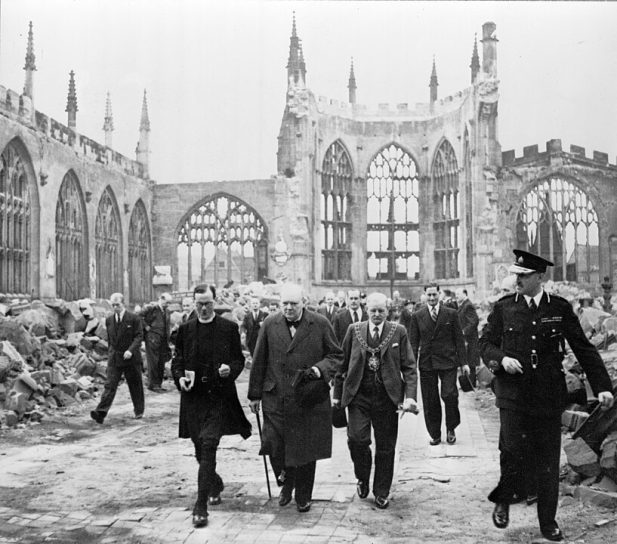
Churchill walks through the ruins of Coventry Cathedral in 1941
Churchill’s ruthless violation of the laws of war regarding urban aerial bombardment directly led to the destruction of many of Europe’s finest and most ancient cities. But perhaps influenced by his chronic drunkenness, he later sought to carry out even more horrifying war crimes and was only prevented from doing so by the dogged opposition of all his military and political subordinates.
Along with the laws prohibiting the bombing of cities, all nations had similarly agreed to ban the first use of poison gas, while stockpiling quantities for necessary retaliation. Since Germany was the world-leader in chemistry, the Nazis had produced the most lethal forms of new nerve gases, such as Tabun and Sarin, whose use might have easily resulted in major military victories on both the Eastern and Western fronts, but Hitler had scrupulously obeyed the international protocols that his nation had signed. However, late in the war during 1944 the relentless Allied bombardment of German cities led to the devastating retaliatory attacks of the V-1 flying bombs against London, and an outraged Churchill became adamant that German cities should be attacked with poison gas in counter-retaliation. If Churchill had gotten his way, many millions of British might soon have perished from German nerve gas counter-strikes. Around the same time, Churchill was also blocked in his proposal to bombard Germany with hundreds of thousands of deadly anthrax bombs, an operation that might have rendered much of Central and Western Europe uninhabitable for generations.
I found Irving’s revelations on all these matters absolutely astonishing, and was deeply grateful that Deborah Lipstadt and her army of diligent researchers had carefully investigated and seemingly confirmed the accuracy of virtually every single item.
The two existing volumes of Irving’s Churchill masterwork total well over 700,000 words, and reading them would obviously consume weeks of dedicated effort. Fortunately, Irving is also a riveting speaker and several of his extended lectures on the topic are available for viewing on BitChute after having been recently purged from YouTube:
- American Pravda: Understanding World War II
Ron Unz • The Unz Review • September 23, 2019 • 20,500 Words
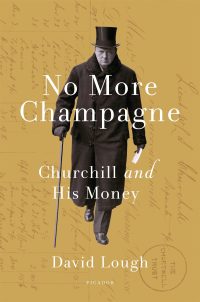 Irving’s 1987 Churchill book had laid bare his subject’s extremely lavish lifestyle as well as his lack of any solid income, together with the dramatic political consequences of that dangerous combination. This shocking historical picture was fully confirmed in 2015 by a noted financial expert whose book focused entirely on Churchill’s tangled finances, and did so with full cooperative access to his subject’s family archives. The story told by David Lough in No More Champagne is actually far more extreme than what had been described by Irving almost three decades earlier, with the author even suggesting that Churchill’s financial risk-taking was almost unprecedented for anyone in public or private life.
For example, at the very beginning of his book, Lough explains that Churchill became Prime Minister on May 10, 1940, the same day that German forces began their invasion of the Low Countries and France. But aside from those huge military and political challenges, Britain’s new wartime leader also faced an entirely different crisis as well, being unable to cover his personal bills, debt interest, or tax payments, all of which were due at the end of the month, thereby forcing him to desperately obtain a huge secret payment from the same Austrian Jewish businessman who had previously rescued him financially. Stories like this may reveal the hidden side of larger geopolitical developments, which sometimes only come to light many decades later.
The unacknowledged influence of secret payments to our own national leaders may be similar. George Washington law professor Jonathan Turley, a very prominent mainstream legal expert, recently published a column in The Hill expressing his total outrage that the American media was completely ignoring the massive corruption scandal involving Biden family members, who had received at least $10 million in secret financial payments from overseas interests. And just a few days ago, we learned that those payments to the Bidens had been made by a Ukrainian billionaire, perhaps helping to explain our current military confrontation with Russia over that country. Over the last year, Joseph Biden has sometimes been praised as another Winston Churchill, and that characterization may indeed be correct but not in the way intended.
Why was FDR so eager to drag the United States into a war that posed no threat to US national security? It seems to me, that FDR’s decision may have been shaped—not by principle—but by the expectation that if the industrial centers of Europe were left in ruins, the US would unavoidably emerge as the lone global superpower. That, of course, turned out to be exactly what happened. But keep in mind, the “tipping-point” Battle of Stalingrad ended in February 1943, whereas, D-Day took place in June, 1944. What that means, is that the United States did not enter the conflict for a whole 16 months after it was certain that Germany would lose the war. In other words, the US invasion was basically a mop-up operation aimed at ensuring US hegemony over western Europe while preventing the Soviet Union from spreading communism across the continent. (Perhaps, you disagree with my analysis??)
What can you tell us about FDR and his motivation to enter the war? Was it entirely his decision or were there other factors involved?
Ron Unz—It’s possible that FDR envisioned that a European war would lead to the destruction of industrialized Europe as an competitor and the establishment of American global hegemony. But I think his motivation for American involvement in a war was actually much simpler than that.
America had been hit especially hard by the Great Depression and although FDR had reached the White House based upon his promise to end it, after five years in office, his policies had largely failed.
The American economy had also been weak in 1914, but once the First World War broke out, the huge needs of the Allied countries boosted our industrial production to new heights, resulting in American prosperity. Similarly, many mainstream history books admit that it was only the outbreak of World War II in 1939 that finally pulled the American economy out of the Great Depression, but they never consider the possibility that FDR might have deliberately provoked the war for that purpose. However, as I wrote in 2018, there seems strong contemporaneous evidence to that effect:
During the 1930s, John T. Flynn was one of America’s most influential progressive journalists, and although he had begun as a strong supporter of Roosevelt and his New Deal, he gradually became a sharp critic, concluding that FDR’s various governmental schemes had failed to revive the American economy. Then in 1937 a new economic collapse spiked unemployment back to the same levels as when the president had first entered office, confirming Flynn in his harsh verdict. And as I wrote last year:
Indeed, Flynn alleges that by late 1937, FDR had turned towards an aggressive foreign policy aimed at involving the country in a major foreign war, primarily because he believed that this was the only route out of his desperate economic and political box, a stratagem not unknown among national leaders throughout history. In his January 5, 1938 New Republic column, he alerted his disbelieving readers to the looming prospect of a large naval military build-up and warfare on the horizon after a top Roosevelt adviser had privately boasted to him that a large bout of “military Keynesianism” and a major war would cure the country’s seemingly insurmountable economic problems. At that time, war with Japan, possibly over Latin American interests, seemed the intended goal, but developing events in Europe soon persuaded FDR that fomenting a general war against Germany was the best course of action. Memoirs and other historical documents obtained by later researchers seem to generally support Flynn’s accusations by indicating that Roosevelt ordered his diplomats to exert enormous pressure upon both the British and Polish governments to avoid any negotiated settlement with Germany, thereby leading to the outbreak of World War II in 1939.
The last point is an important one since the confidential opinions of those closest to important historical events should be accorded considerable evidentiary weight. In a recent article John Wear mustered the numerous contemporaneous assessments that implicated FDR as a pivotal figure in orchestrating the world war by his constant pressure upon the British political leadership, a policy that he privately even admitted could mean his impeachment if revealed. Among other testimony, we have the statements of the Polish and British ambassadors to Washington and the American ambassador to London, who also passed along the concurring opinion of Prime Minister Chamberlain himself. Indeed, the German capture and publication of secret Polish diplomatic documents in 1939 had already revealed much of this information, and William Henry Chamberlin confirmed their authenticity in his 1950 book. But since the mainstream media never reported any of this information, these facts remain little known even today.

Franklin Roosevelt and Winston Churchill at the Casablanca Conference, January 1943
So according to Flynn’s January 1938 account, FDR and his advisors had originally viewed a possible war with Japan as the key to America’s economic revival, but they subsequently shifted their focus to a European war against Germany instead, and I think a turning point may have been the widespread Kristallnacht riots against German Jews in November 1938, following the assassination of a German diplomat by a Jewish activist. These attacks outraged the very influential Jewish communities of America and Europe, completely undoing any positive consequences of the Munich Agreement a couple of months earlier and focused intense international hostility against Hitler’s Germany, which had previously worked out reasonably amicable relations with its small Jewish population while establishing an important economic partnership with the rising Zionist movement.
Ironically enough, according to Irving’s very detailed reconstruction, Hitler had nothing to do with the anti-Jewish riots and urgently sought to suppress them once they began. Instead, the attacks seem to have been orchestrated by Joseph Goebbels, his powerful Propaganda Minister, who had recently fallen from favor because of his high-profile love affair with a Czech actress, leading to the bitter complaints of his wife, a close friend of Hitler. Goebbels apparently hoped he could use the anti-Jewish riots to restore his influence in the Nazi hierarchy, but they instead had disastrous consequences, thus raising the remarkable possibility that the political fallout from an extra-marital affair may have played a crucial role in the outbreak of World War II.
Recently, I’ve watched a number of David Irving videos on Rumble all of which are extremely persuasive. I really have a hard time understanding why powerful Jewish groups characterize Irving as an antisemite. What’s that all about? It seems to me that he’s just providing evidence from “primary source” material that he’s acquired from personal interviews or historical archives. In other words, he’s just doing what you would expect any credible historian to do, presenting the facts without ‘fear or favor’. Can you help me understand why these Jewish groups are so hostile to Irving?
Ron Unz—Irving’s research methodology has always relied heavily upon the use of documentary material and as he spent years working on his landmark Hitler biography, he gradually realized that there seemed to be no such evidence that the German dictator had approved or even been aware of any Jewish extermination project, strongly suggesting that he had had nothing to do with it. Jewish activist groups had come to regard Hitler as a demonic figure, so they bitterly resented those unorthodox conclusions from such a world-famous historian, and as I explained in 2018, their attacks enormously escalated after he later agreed to testify as an expert witness in a Canadian trial:
Fred Leuchter was widely regarded as one of America’s leading expert specialists on the technology of executions, and a long article in The Atlantic treated him as such. During the 1980s, Ernst Zundel, a prominent Canadian Holocaust Denier, was facing trial for his disbelief in the Auschwitz gas chambers, and one of his expert witnesses was an American prison warden with some experience in such systems, who recommended involving Leuchter, one of the foremost figures in the field. Leuchter soon took a trip to Poland and closely inspected the purported Auschwitz gas chambers, then published the Leuchter Report, concluding that they were obviously a fraud and could not possibly have worked in the manner Holocaust scholars had always claimed. The ferocious attacks which followed soon cost him his entire business career and destroyed his marriage.
David Irving had ranked as the world’s most successful World War II historian, with his books selling in the millions amid glowing coverage in the top British newspapers when he agreed to appear as an expert witness at the Zundel trial. He had always previously accepted the conventional Holocaust narrative, but reading the Leuchter Report changed his mind, and he concluded that the Auschwitz gas chambers were just a myth. He was quickly subjected to unrelenting media attacks, which first severely damaged and then ultimately destroyed his very illustrious publishing career, and he later even served time in an Austrian prison for his unacceptable views.
Although Irving has never been directly focused on Holocaust issues, in some of his presentations he has emphasized the total lack of any documentary evidence to support the standard narrative, an extremely suspicious fact given the massive scale of the alleged extermination project and the notorious German tendency for meticulous record-keeping.
In my previous interview, I’d already discussed many of the reasons I’m so extremely skeptical of the reality of the Holocaust, so there’s no need for me to repeat those arguments here.
- Why Everything You Know About World War II Is Wrong
Question 7: The Holocaust
However, I’d like to add the important point that once I read the books of leading mainstream Holocaust scholars such as Lucy S. Dawidowicz, Deborah Lipstadt, and Peter Novick, I found that their contents actually provided some considerable evidence against the historical reality of their central topic. As I explained in 2018:
These days, my morning newspapers seem to carry Holocaust-related stories with astonishing frequency, and probably no event of the twentieth century looms so large in our public consciousness. According to survey data, even as far back as 1995, some 97% of Americans knew of the Holocaust, far more than were aware of the Pearl Harbor attack or America’s use of the atomic bombs against Japan, while less than half our citizenry were aware that the Soviet Union had been our wartime ally. But I’d suspect that anyone who drew his knowledge from the mainstream newspapers and history books during the first couple of decades after the end of the Second World War might never have even been aware that any Holocaust had actually occurred.
In 1999 Peter Novick published a book on this general theme entitled The Holocaust in American Life, citing that survey, and his introduction began by noting the very strange pattern the Holocaust exhibited in its cultural influence, which seems quite unique among all major historical events. In the case of almost all other searing historical occurrences such as the massive bloodshed of the Somme or the bitter Vietnam War, their greatest impact upon popular consciousness and media came soon afterward, with the major books and films often appearing within the first five or ten years when memories were fresh, and the influence peaking within a couple of decades, after which they were gradually forgotten.
Yet in the case of the Holocaust, this pattern was completely reversed. Hardly anyone discussed it for the first twenty years after the end of the World War II, while it gradually moved to the center of American life in the 1970s, just as wartime memories were fading and many of the most prominent and knowledgeable figures from that era had departed the scene. Novick cites numerous studies and surveys demonstrating that this lack of interest and visibility certainly included the Jewish community itself, which had seemingly suffered so greatly under those events, yet apparently had almost completely forgotten about them during the 1950s and much of the 1960s.
I can certainly confirm that impression from my personal experience. Prior to the mid- or late-1970s, I had had only the vaguest impression that virtually all the Jews and Gypsies of Europe had been exterminated during the Second World War, and although the term “Holocaust” was in widespread use, it invariably referred to a “Nuclear Holocaust,” a term long-since supplanted and scarcely used today. Then, after the Berlin Wall fell, I was quite surprised to discover that Eastern Europe was still filled with vast numbers of unexterminated Gypsies, who quickly flooded into the West and provoked all sorts of political controversies.

I found even more striking material in a widely-praised research study by Prof. Joseph Bendersky, Book Review Editor of the Journal of Holocaust Studies. Descriptively subtitled “Anti-Semitic Politics of the U.S. Army,” his volume ran more than 500 pages with 1350 endnotes and was based upon ten years of archival research, but when I read it in 2019, I discovered an extremely strange omission:
Oliver’s peremptory dismissal of the standard Holocaust narrative led me to take a closer look at the treatment of the same topic in Bendersky’s book, and I noticed something quite odd. As discussed above, his exhaustive research in official files and personal archives conclusively established that during World War II a very considerable fraction of all our Military Intelligence officers and top generals were vehemently hostile to Jewish organizations and also held beliefs that today would be regarded as utterly delusional. The author’s academic specialty is Holocaust studies, so it is hardly surprising that his longest chapter focused on that particular subject, bearing the title “Officers and the Holocaust, 1940-1945.” But a close examination of the contents raises some troubling questions.
Across more than sixty pages, Bendersky provides hundreds of direct quotes, mostly from the same officers who are the subject of the rest of his book. But after carefully reading the chapter twice, I was unable to find a single one of those statements referring to the massive slaughter of Jews that constitutes what we commonly call the Holocaust, nor to any of its central elements, such as the existence of death camps or gas chambers.
The forty page chapter that follows focuses on the plight of the Jewish “survivors” in post-war Europe, and the same utter silence applies. Bendersky is disgusted by the cruel sentiments expressed by these American military men towards the Jewish former camp inmates, and he frequently quotes them characterizing the latter as thieves, liars, and criminals; but the officers seem strangely unaware that those unfortunate souls had only just barely escaped an organized mass extermination campaign that had so recently claimed the lives of the vast majority of their fellows. Numerous statements and quotes regarding Jewish extermination are provided, but all of these come from various Jewish activists and organizations, while there is nothing but silence from all of the military officers themselves.
Bendersky’s ten years of archival research brought to light personal letters and memoirs of military officers written decades after the end of the war, and in both those chapters he freely quotes from these invaluable materials, sometimes including private remarks from the late 1970s, long after the Holocaust had become a major topic in American public life. Yet not a single statement of sadness, regret, or horror is provided. Thus, a prominent Holocaust historian spends a decade researching a book about the private views of our military officers towards Jews and Jewish topics, but the one hundred pages he devotes to the Holocaust and its immediate aftermath contains not a single directly-relevant quote from those individuals, which is simply astonishing. A yawning chasm seems to exist at the center of his lengthy historical volume, or put another way, a particular barking dog is quite deafening in its silence.
I am not an archival researcher and have no interest in reviewing the many tens of thousands of pages of source material located at dozens of repositories across the country that Bendersky so diligently examined while producing his important book. Perhaps during their entire wartime activity and also the decades of their later lives, not a single one of the hundred-odd important military officers who were the focus of his investigation ever once broached the subject of the Holocaust or the slaughter of Jews during World War II. But I think there is another distinct possibility.
As mentioned earlier, Beaty spent his war years carefully reviewing the sum-total of all incoming intelligence information each day and then producing an official digest for distribution to the White House and our other top leaders. And in his 1951 book, published just a few years after the end of fighting, he dismissed the supposed Holocaust as a ridiculous wartime concoction by dishonest Jewish and Communist propagandists that had no basis in reality. Soon afterward, Beaty’s book was fully endorsed and promoted by many of our leading World War II generals, including those who were subjects of Bendersky’s archival research. And although the ADL and various other Jewish organizations fiercely denounced Beaty, there is no sign that they ever challenged his absolutely explicit “Holocaust denial.”
I suspect that Bendersky gradually discovered that such “Holocaust denial” was remarkably common in the private papers of many of his Military Intelligence officers and top generals, which presented him with a serious dilemma. If only one or two of those individuals had expressed such sentiments, their shocking statements could be cited as further evidence of their delusional anti-Semitism. But what if a substantial majority of those officers—who certainly had possessed the best knowledge of the reality of World War II—held private beliefs that were very similar to those publicly expressed by their former colleagues Beaty and Oliver? In such a situation, Bendersky may have decided that certain closed doors should remain in that state, and entirely skirted the topic.

- American Pravda: Holocaust Denial
Ron Unz • The Unz Review • August 27, 2018 • 17,600 Words - American Pravda: Secrets of Military Intelligence
Ron Unz • The Unz Review • June 10, 2019 • 12,500 Words
Question 6: WWII and Ukraine, Connecting the Dots
In our last interview, you challenged two of the most widely-accepted claims about World War 2, that:
- Hitler started WW2
- Hitler’s invasion of Poland was the first step in a broader campaign aimed at world domination
You showed that both of these are not true. Even so, they are still accepted as fact by the vast majority of people in the West. My concern, is that this same pattern is repeating itself in Ukraine where we’ve been told repeatedly that the war was an “unprovoked aggression” by an imperialist Putin who sees Ukraine as merely the first step in restoring the Soviet Empire. This is the prevailing narrative we read in the media about Ukraine, but is it true?
In your opinion, who started the war in Ukraine and why is it important that our record of events be based on historical facts and not on the fabrications of political partisans?
Ron Unz—When Russia invaded Ukraine in late February 2022, I’d almost immediately noticed the remarkable parallels to Germany’s invasion of Poland, which caused the outbreak of World War II. In each case, influential Western interests had heavily orchestrated the war by encouraging powerful provocations while blocking any reasonable negotiations, so I quickly published an article emphasizing this historical analogy and pointing out that America had clearly been responsible for the Ukraine war.
Although FoxNews has become one of the outlets most rabidly hostile to Russia, a recent interview with one of their regular guests provided a very different perspective. Col. Douglas Macgregor had been a former top Pentagon advisor and he forcefully explained that America had spent nearly fifteen years ignoring Putin’s endless warnings that he would not tolerate NATO membership for Ukraine, nor the deployment of strategic missiles on his border. Our government had paid no heed to his explicit red-lines, so Putin was finally compelled to act, resulting in the current calamity:
Prof. John Mearsheimer of the University of Chicago, one of our most distinguished political scientists, had spent many years making exactly these same points and blaming America and NATO for the simmering Ukraine crisis, but his warnings had been totally ignored by our political leadership and media. His hour-long lecture explaining these unpleasant realities had quietly sat on Youtube for six years, attracting relatively little attention, but then suddenly exploded in popularity over the last few weeks as the conflict unfolded, and has now reached a worldwide audience of over 17 million. His other Youtube lectures, some quite recent, have been watched by additional millions.
Such massive global attention finally forced our media to take notice, and the New Yorker solicited an interview with Mearsheimer, allowing him to explain to his disbelieving questioner that American actions had clearly provoked the conflict. A couple of years earlier, that same interviewer had ridiculed Prof. Cohen for doubting the reality of Russiagate, but this time he seemed much more respectful, perhaps because the balance of media power was now reversed; his magazine’s 1.2 million subscriber-base was dwarfed by the global audience listening to the views of his subject.
- Why John Mearsheimer Blames the U.S. for the Crisis in Ukraine
Isaac Chotiner • The New Yorker • March 1, 2022 • 3,900 WordsDuring his long and distinguished career at the CIA, former analyst Ray McGovern had run the Soviet Policy Branch and also served as the Presidential Briefer, so under different circumstances he or someone like him would currently be advising President Joe Biden. Instead, a few days ago he joined Mearsheimer in presenting his views in a video discussion hosted by the Committee for the Republic. Both leading experts agreed that Putin had been pushed beyond all reasonable limits, provoking the invasion.
Prior to 2014 our relations with Putin had been reasonably good. Ukraine served as a neutral buffer state between Russia and the NATO countries, with the population evenly divided between Russian-leaning and West-leaning elements, and its elected government oscillating between the two camps.
But while Putin’s attention was focused on the 2014 Sochi Olympic Games, a pro-NATO coup overthrew the democratically-elected pro-Russian government, with clear evidence that Victoria Nuland and the other Neocons grouped around Secretary of State Hillary Clinton had orchestrated it. Ukraine’s Crimea peninsula contains Russia’s crucial Sevastopol naval base, and only Putin’s swift action allowed it to remain under Russian control, while he also provided support for break-away pro-Russian enclaves in the Donbass region. The Minsk agreement later signed by the Ukrainian government granted autonomy to those latter areas, but Kiev refused to honor its commitments, and instead continued to shell the area, inflicting serious casualties upon the inhabitants, many of whom held Russian passports. Diana Johnstone has aptly characterized our policy as years of Russian bear-baiting.
As Mearsheimer, McGovern, and other observers have persuasively argued, Russia invaded Ukraine only after such endless provocations and warnings were always ignored or dismissed by our American leadership. Perhaps the final straw had been the recent public statement by Ukraine President Volodymyr Zelenskyy that he intended to acquire nuclear weapons. How would America react if a democratically-elected pro-American government in Mexico had been overthrown in a coup backed by China, with the fiercely hostile new Mexican government spending years killing American citizens in its country and then finally announcing plans to acquire a nuclear arsenal?
Moreover, some analysts such as economist Michael Hudson have strongly suspected that American elements deliberately provoked the Russian invasion for geostrategic reasons, and Mike Whitney advanced similar arguments in a column that went super-viral, accumulating over 800,000 pageviews. The Nord Stream 2 pipeline carrying Russian natural gas to Germany had finally been completed last year and was about to go into operation, which would have greatly increased Eurasian economic integration and Russian influence in Europe, while eliminating the potential market for more expensive American natural gas. The Russian attack and the massive resulting media hysteria have now foreclosed that possibility.
So although it was Russian troops who crossed the Ukrainian border, a strong case can be made that they did so only after the most extreme provocations, and these may have been deliberately intended to produce exactly that result. Sometimes the parties responsible for starting a war are not necessarily those that eventually fire the first shot.
Just days after the war began, I pointed out that the total demonization of Russia and Vladimir Putin by our media and government seemed exactly similar to how they had treated Germany and Adolf Hitler three generations earlier.
Such international retaliation against Russia and individual Russians seems extremely disproportionate. As yet the fighting in Ukraine has inflicted minimal death or destruction, while the various other major wars of the last two decades, many of them American in origin, had killed millions and completely destroyed several countries, including Iraq, Libya, and Syria. But the global dominance of American media propaganda has orchestrated a very different popular response, producing this remarkable crescendo of hatred.
Indeed, the closest parallel that comes to mind would be the American hostility directed against Adolf Hitler and Nazi Germany after the outbreak of World War II, as indicated by the widespread comparisons between Putin’s invasion of Ukraine and Hitler’s 1939 attack on Poland. A simple Google search for “Putin and Hitler” returns tens of millions of webpages, with the top results ranging from the headline of a Washington Post article to the Tweets of pop music star Stevie Nicks. As far back as 2014, Andrew Anglin of the Daily Stormer had documented the emerging meme “Putin is the new Hitler.”
Ironically enough, the arguments of Mearsheimer and others that Putin was greatly provoked or possibly even manipulated into attacking Ukraine raise certain intriguing historical parallels. The legions of ignorant Westerners who mindlessly rely upon our disingenuous media may be denouncing Putin as “another Hitler” but I think they may have inadvertently backed themselves into the truth.
- American Pravda: Putin as Hitler?
Ron Unz • The Unz Review • March 7, 2022 • 7,900 Words - American Pravda: World War III and World War II?
Ron Unz • The Unz Review • October 24, 2022 • 4,700 Words
Related Reading:
Featured Video
What’s the Pentagon Preparing For? Alexander Mercouris
or go to
Aletho News Archives – Video-Images
From the Archives
US tested biological weapons in Japan’s Okinawa in the 60s – report
RT | January 12, 2014
The American army conducted experiments with biological weapons aimed at destroying rice crops on the Japanese island of Okinawa in the 60s, Kyodo news agency reports. The alleged target of the tests was the China and Southeast Asia region.
Citing classified US documents, Japanese news agency Kyodo said the US military carried out experiments on their sovereign territory between 1961 and 1962. At this time Japan’s southern island of Okinawa was still under post-WWII, US jurisdiction. The US did similar tests in Taiwan and the American mainland, notes Kyodo.
The American army experimented with rice blast fungus – a plant pathogen – which infects rice crops with disastrous effects. The pathogen latches onto the rice plant as a spore and produces lesions and spots all over the rice plant and then reproduces.
A single lesion can generate a thousand spores in one night alone, while an entire cycle – lasting about a week – can have a devastating effect on rice crops.
Kyodo reports that tests were conducted over a dozen times, and mentions test sites, Nago and Shuri, in Okinawa. The US army reported some success in their experiments and the gathering of “useful data”.
“Field tests for stem rust of wheat and rice blast disease were begun at several sites in the (US) Midwest and south and in Okinawa with partial success in the accumulation of useful data,” wrote Kyodo, citing its documents. … continue
Blog Roll
 Aletho News
- What’s the Pentagon Preparing For? Alexander Mercouris
- USAID Files: The Georgia Model for Getting Accounts Taken Down
- Kiev hits out at YouTube over Russian-language censorship refusal
- Australia Passes Digital Duty of Care Bill, Ignoring Censorship Warnings
- Majority of MAGA ‘deserters’ back banning bombs to Israel: Poll
- Iran wary as South Korea assures it will not join US war of aggression
- ‘Desperate’ Kiev seeking to draw NATO into war with Russia – Andrew Bridgen
- German people oppose war, unhappy with government foreign policy
- How US army’s Iowa lead azide detonation exposed stockpile failure, unleashing environmental crisis
- China Urges Japan to Speed Up Removal of WWII-Era Chemical Weapons From Its Soil
- If Americans Knew
- Iran’s Foreign Minister Slams Israel Over Chemical Weapons Claims
- Israel kills 18 in Gaza, including 3 girls, Deputy Education Minister, & his wife
- DAILY UPDATE: Latest essential news on Palestine, Israel, & region
- Ad That Calls for Cutting Off US Aid to Israel to Air on SNL Thanksgiving Special
- Tortured into confessing: Report exposes abusive Israeli interrogation of Palestinians
- Israeli Military Probing Its Own ‘Widespread’ Use of Palestinian Human Shields
- Palestinians in Gaza Are Lining Their Tents with Sandbags to Stop Israeli Bullets
- Israel’s genocidal actions are preventing births in Gaza –New Amnesty report
- ‘Unlawful de facto exemption’: US sitting on 12-year backlog of alleged Israeli gross human rights violations
- DAILY UPDATE: Latest essential news on Palestine, Israel, & region
- No Tricks Zone
- Alarmist Climatologists In Shock! 2026 Atlantic Hurricane Season Sees Lowest Count In 101 Years
- New Study: Modern Temps Are Among The Coldest Of The Last 10,000 Years In East Central Europe
- Germany’s Renewable Energies Lead to 1.4 Billion Euro Electric Power Trade Deficit
- Argentina’s Perito Moreno Glacier Joins Antarctica and Arctic In Defying Doomsday Melt Claims
- New Study: Barents Sea Temperatures Were Warmer And Sea Ice Less Extensive In The 1700s Than Today
- German Authorities Start Initiative To Evaluate Public Register For Climate “Disinformation” Spreaders!
- Zonal Asymmetry of Temperature Change in the Antarctic Circumpolar Current
- New Study: The Net Fossil Fuel Contribution To Rising Atmospheric CO2 Has Been Zero For 500 Years
- Germany’s Green Energy Transition Becoming Increasingly Expensive…Another 6 Trillion Euros!
- Sudden Stratospheric Warming, Powerful El Niño Combination May Lead To Extreme Europe Cold, Energy Crisis!

