A Year after the North Korea–United States Hanoi Summit: Expectations for the Next One
By Konstantin Asmolov – New Eastern Outlook – 23.03.2020
Just over a year has gone by since US President Donald Trump met with Chairman of the DPRK State Affairs Commission Kim Jong-un in Hanoi. It was the second North Korean-American summit to be held, following on from the first 2018 North Korea–United States Singapore Summit. Many were surprised that the meeting ended without any concrete agreements being made, due to a variety of reasons. The primary disagreements between the two sides were made more difficult to resolve due to actions taken by American conservatives and domestic politics in the United States at the time, which prevented Trump from making any concessions.
The talks which followed between working groups and high-level officials also ended without any visible results. A brief meeting between the Supreme leader of the DPRK and the US President on the sidelines of Trump’s visit to South Korea was little more than a media photo op, and the working-level talks in Stockholm got off to a bad start: North Korea demanded that Washington come up with a new plan by the end of 2019 if the US wants denuclearization talks.
Towards the end of 2019, the North Korean leader gave a clear delineation of relations between the two countries, yet Kim Jong-un did not keep his promise to deliver a “Christmas gift”, by which he meant a demonstration of North Korea’s new strategic weapons. As it was put at the time, “the door is closed, but not locked.” There are several different explanations given for this. Pro-Pyongyang experts say Kim made a gesture of goodwill. Others believe that China used its leverage to make North Korea call off the demonstration and avoid exasperating the situation. We would like to add that given the increased attention the DPRK was receiving during this period (due to its satellites, constant use of reconnaissance aircraft, etc.), it would not have made sense for Pyongyang to “show its cards” at the time.
Failed efforts to impeach Donald Trump did not help them make any progress either, and the DPRK conducted a planned short-range missile launch which almost coincided with the anniversary of the summit. This missile test and others have yet to quell discussions over whether North Korea’s defense industry is modern, or whether its rusty missiles have been cobbled together using stolen technologies from Ukraine, China or Russia.
The outcome has been summed up in the South Korean media: “One year on since the meeting in Hanoi, the North Korean situation seems to have reverted back to its former state”. Given the current situation, I would like to discuss the prospects for this dialog between the United States and North Korea based on a series of quotes made on March 4-6, 2020.
Let’s start with Trump, who was posed a question on his 2020 presidential campaign trail about what he would do with North Korea if re-elected. The question sparked an enthusiastic response: the US President stressed that his relationship with Kim is “very good,” but insisted that he has not given anything to the communist regime and that sanctions have not been lifted. At the same time, Donald Trump reiterated that the policies being put forward by his opponents would lead to a big war with the DPRK, and also took credit for the beginning of inter-Korean rapprochement.
The US President actually dismissed the fact that a short-range missile was launched: “No reaction,” was what he had to say. Unlike at previous events, he did not even try to play this card in the UN Security Council. On March 5, the Security Council discussed this issue, but the North Korean issue was raised in a separate category for additional topics at a meeting about Syria. Immediately after the meeting, the United Kingdom, France, Germany, Belgium and Estonia adopted a joint statement condemning the actions of the DPRK and calling on Pyongyang to resume negotiations on denuclearization, but it should be noted that this statement is meaningless from a legal point of view, and the United States did not participate in it.
Interestingly, the South Korean authorities took a more right-wing position. During a speech at South Korea’s Air Force Academy on March 4, President Moon Jae-in pointed out the unpredictability of the security situation on the Korean Peninsula and underlined the importance of an impregnable defense. The South Korean media also rebuked Trump. They say the US President “brushed off North Korea’s missile tests, even though they are prohibited by U.N. Security Council resolutions” and instead took credit for Pyongyang’s suspension of its long-range missile tests and nuclear tests.
Meanwhile, US Secretary of Defense Mark Esper said North Korea’s ballistic missile capabilities pose an “increasingly complicated” threat, as the regime seeks to modernize its missile systems. When asked whether North Korea’s long-range ballistic missiles pose a threat to the United States, his answer was affirmative.
But on a tactical level, the United States “stands ready to resume denuclearization negotiations with North Korea as soon as possible and hopes to hear back from the regime.” Assistant Secretary of State for International Security and Non-Proliferation Christopher Ford made this comment on March 5: “From a State Department perspective, it remains true that we are ready and willing and prepared for the beginning of working-level discussions with North Korea – in which they will, one hopes, implement the commitments made in Singapore.”
Lastly, we will consider the public opinion on this issue in the United States. A recent poll conducted by the Chicago Council on Global Affairs found that 52% of Americans view North Korea’s nuclear weapons program as a critical threat. That is a large amount of people, but this figure had been 75% at the height of tensions in 2017.
When asked which country poses the greatest threat to the United States, 13% of respondents chose North Korea. The DPRK came in behind Iran (34%), Russia (28%) and China (16%). In 2017, North Korea ranked the highest among these four countries at 59%.
Out of the list of options on how to deal with the North’s nuclear program, tighter economic sanctions received the most support, with 73%.
According to Chicago Council on Global Affairs who conducted the poll, these results are not so much a reflection of the lack of progress that has been made on the diplomatic front, but rather stem from the prolonged absence of noticeable tension and a weakening of the perception of North Korea as a threat.
What can we expect? According to the information the Chicago think tank has gleaned from respondents, there is a sort of informal directive being followed in Washington: make no sudden movements in any direction before the November elections. Amid the race for the White House, fussing over the relations between the United States and North Korea would hardly have a positive effect on Trump’s approval ratings, and certainly should not see them fall.
It became clear to both sides during the working talks that with the time that has passed since Hanoi, the DPRK is prepared to make a certain number of concessions, but Pyongyang is demanding that they are met with proportionate actions in return. Washington is not prepared to take these steps, because the idea of easing sanctions flies in the face of American dogma, and according to this dogma, Kim Jong-un did not cooperate as a gesture of goodwill, but because he was pressured into doing so by an unprecedented level of sanctions. The belief is therefore that this is the main leverage America has to force North Korea into negotiations, and they cannot let up on it.
In the run-up to the election, it is therefore very important “not to get on Kim Jong-un’s nerves”, because any sort of tough response from North Korea will hurt Trump’s campaign, who is still selling his electorate the idea that relations between Washington and Pyongyang would be much worse under any other American president.
Of course, Trump could hardly say no to another photo-op meeting, but both sides know that they can only hold so many of these purely symbolic events, and they have already reached their limit, now they must have something to show for all those handshakes, posing in front of flashing cameras.
This is where we should note the debate among experts regarding the motives of each side. One theory is that Kim and Trump would both like to get more out of the talks, but are prepared to settle for a minor victory, where no answer can be found, but the search for one can continue once the process is put on pause. The view other experts take is that Trump believes the denuclearization of North Korea is a real possibility, but it has been put on hold while he is busy with his re-election campaign, and he is working according to his belief that during the next ten years, something could happen that could change North Korea’s position. However, we must not forget that nuclear weapons are seen in Pyongyang as an unambiguous guarantee of the regime’s survival. This is not only a lesson for Libya, but Iran should also take note (be it the American actions on the Iran nuclear deal or the assassination of General Soleimani).
The pause is likely to go on until the US presidential election is held, but then what? If Trump wins, American political analysts have two theories. One is that Kim will continue the “period of peaceful respite”, devoting his energy to making a few final arrangements so that the economy will be more prepared if it is hit with another round of sanctions. The moratorium will remain abandoned, especially given that it had only ever been a verbal promise, and it was the ultimate failure of the summit in Hanoi that prevented it from being transformed into a written commitment.
The second theory is that North Korea is truly disappointed with the strategic prospects of the dialog. Kim had hoped that it could lead to sanctions being lifted, but it turned out that the materials from the December 2019 plenum ruled this out as something he cannot even dream about, and he now sees the need to move as quickly as possible to increase the country’s military might with nuclear weapons and missiles, in order to ensure a guaranteed level of deterrence. In this context, we can expect to hear about ICBM launches with missiles fired on a flat trajectory, or the hypothetical Hwasong-20, which is said to have no problem reaching anywhere on US territory.
The long-awaited North Korean Navy’s Sinpo class submarine is no less likely to make an appearance, capable of carrying 3-4 missiles with nuclear warheads. We believe it could be revealed as North Korea’s “new strategic weapon”.
What if the Democrats win? There may not necessarily be a radical change of course under a slogan like “anything but what Trump did.” A large number of officials from the Democratic Party who write the bills that are then signed by politicians in government are gradually coming around to the idea that we will have to live with a nuclear North Korea.
Therefore, after weighing up the best and worst options in comparison with the current status quo, we hope that the dialog will continue after November 2020, or that the two sides will finally meet again by the next anniversary of the Hanoi summit.
Konstantin Asmolov, PhD in History, is a Leading Research Fellow at the Center for Korean Studies of the Institute of Far Eastern Studies of the Russian Academy of Sciences.
China censures US for ‘clumsy trick’ to smear others with rumors amid COVID-19 pandemic
Press TV – March 23, 2020
China censures the United States for playing a ‘clumsy trick’ on other countries by smearing them with rumors aimed at accusing those countries with having a hand in the global spread of the deadly coronavirus.
China’s Foreign Ministry spokesman Geng Shuang said on Monday that Washington “on the one hand required federal organizations to speak with one voice to smear China; and on the other hand criticized China, Russia and Iran for spreading false information.”
“I just want to ask, who on earth is spreading false information, misleading the public and calling white black? Such trick of smearing others with rumors and with the play of a thief crying ‘stop the thief’ are just too clumsy.”
China, he added, has always been “open, transparent and responsible.”
“In the past two months and more, the Chinese people have united as one to fight the epidemic and earned precious time for the rest of the world to take necessary precautionary measures. We have made great contribution. WHO has recently pointed out that countries like Singapore and South Korea made good use of the precious time earned by China and took measures. Their moves have curbed the epidemic spread. What has the US done during this period?”
The Chinese official also stated that since January 3 the government in Beijing had been providing “regular briefings” to the World Health Organization (WHO) and other countries, including the United States.
On January 23, he added, “China announced to shut down roads exiting Wuhan City. The US government on February 2 announced to ban entry of all foreigners who had been to China in 14 days before. By then the US just announced a dozen of confirmed COVID-19 cases.”
“Now 50 days have passed, the confirmed cases in the US have surged from less than 20 to more than 30,000. What kind of strong measures has the US taken in the 50 days? It had totally squandered the time China earned for the world.”
The Chinese official further noted that Washington is seeking to “defame” others and “find a scapegoat” instead of admitting its own mistake, “which is totally immoral and irresponsible, and will do nothing good to the US epidemic control work and to the international cooperation in fighting the epidemic.”
“All it should do is concentrating on its own business and play a constructive role in working with all countries to fight the epidemic and protecting global public health security,” the Chinese official said of the US government.
The COVID-19 disease, caused by the new coronavirus, emerged in Wuhan, the capital of China’s Hubei province, in December. It has been reportedly contained in China, but is spreading rapidly around the globe.
UN to set up global coronavirus fund: Norway
Meanwhile, Norway said on Monday that the United Nations will set up a fund to prevent the spread of coronavirus and support the treatment of patients worldwide.
The purpose of the fund, proposed by the Norwegian government, is to assist developing countries with weak health systems in coping with the pandemic as well as to tackle the long-term consequences.
The initiative is similar to a 2014 United Nations Ebola Response Fund.
“We want to make sure that the efforts are as unified as possible and as early as possible so that we can answer up to the demands that countries will have, especially the poorest countries,” Norwegian Foreign Minister Ine Eriksen Soereide told Reuters.
In Africa, Angola, Eritrea and Uganda have confirmed their first cases, while Mauritius recorded its first death as the virus spreads across the continent despite efforts by governments to hold it back.
Elsewhere in the Gaza Strip, the first two cases were confirmed on Sunday.
Coronavirus aid to Italy not a ploy to get EU sanctions lifted: Russia
The Kremlin said Monday that medical assistance Russia is providing to Italy is not part of an attempt to get Rome help lift EU sanctions on Moscow.
The Russian army on Sunday began flying medical help to Italy after receiving an order from President Vladimir Putin, a goodwill gesture that Moscow labeled “From Russia with Love.”
Italy is the European country hardest hit by the viral crisis.
When asked if Russia expected Italy to return the favor by trying to get EU sanctions imposed on Russia over Ukraine lifted, Kremlin spokesman Dmitry Peskov described the notion as absurd.
“We’re not talking about any conditions or calculations or hopes here,” Peskov said.
“Italy is really in need of much more wide scale help and what Russia does is manageable.”
Russia to use mobile phones to track people at risk
Prime Minister Mikhail Mishustin has given the authorities five days to develop a system to track people who have come into contact with anyone with coronavirus by using mobile phone geolocation data.
Under the new system, people would be sent information if they came into contact with someone who was infected and the same information would be passed on to special regional headquarters set up to fight the respiratory disease pandemic.
The Kremlin said the measure was legal and part of a raft of measures Russia is taking to try to halt the spread.
Postponement of Olympics should be considered: Japan
The head of the Japan Olympic Committee (JOC) said he had to consider postponing the Games among his options amid increasing calls from committees around the world to delay the Olympics due to the coronavirus outbreak.
“From the athletes’ point of view of safety and security, we have to come to a stage where we cannot help but consider things including postponement,” JOC President Yasuhiro Yamashita told reporters on Monday.
However, he said too long a delay would be a burden to athletes given the possibility of having to qualify again, for example.
Spain death toll tops 2,000 after 462 deaths in 24 hours
The coronavirus death toll in Spain has surged to 2,182 after 462 people died within 24 hours, the health ministry says.
The death rate showed a 27-percent increase on the figures released a day earlier, with the number of confirmed cases of COVID-19 rising to 33,089 in Spain, one of the worst-hit countries in the world after China and Italy.
Despite an unprecedented national lockdown which was put in place on March 14, the number of deaths and infections have spiraled in Spain, with the figures growing as the country steps up its capacity for testing.
And the lockdown, which was initially put in place for two weeks, will be extended until April 11 to try to curb the spread, Prime Minister Pedro Sanchez said — in a measure which will be put to parliament on Tuesday.
The rise in infections in this country of 46 million people has brought Spain’s healthcare system to the brink of collapse, particularly in Madrid, the worst-hit area, which has registered 10,575 cases, and where 1,263 people have died — accounting for 58 percent of the national death toll.
Some 3,910 healthcare workers have tested positive for the virus, or around 12 percent of those infected, the health ministry’s emergencies coordinator Fernando Simon said.
Officials have repeatedly warned that the number of deaths and infections would continue to rise this week and that the worst was yet to come.
Greece bans flights from UK, Turkey as coronavirus cases rise
Greece has suspended flights from Britain and Turkey to curb the spread of coronavirus, as a lockdown took effect in the country.
The ban came into effect at 0400 GMT — 6:00 a.m. in Athens — on March 23 and ends at 1300 GMT on April 15.
It was a temporary and preemptive measure, a ministerial decree said, as part of further efforts to combat the coronavirus pandemic.
Greece saw its largest single-day jump in confirmed coronavirus cases on Sunday, a rise of 94 infections which brought the total to 624, with fatalities increasing to 15.
The prime minister announced a curfew with few exceptions restricting the movement of people, the latest in a series of measures to fight the virus. Greece has already sealed its borders to non-EU citizens, and those from Italy and Spain.
Police officers were deployed on the streets of Athens on Monday to enforce the lockdown, which allows people out only with special permits. The lockdown order came into effect at 0400 GMT.
Two more doctors die from coronavirus in France
Two more doctors have died after contracting the coronavirus in France, officials said on Monday, a day after the country reported the first death of a doctor treating COVID-19 patients.
One of the doctors, a 66-year-old gynaecologist in Mulhouse near the border with Switzerland and Germany, was infected by a patient during a consultation, according to his clinic.
The other was a 60-year-old general practitioner at a hospital in Saint-Avold near Metz, further north along the German frontier, according to the town’s mayor.
Both died on Sunday when officials announced the death of a 67-year-old doctor who was among the first to treat coronavirus cases in the northern Oise department, which has been badly hit by the outbreak.
Health experts warn that many French hospitals are already overflowing with coronavirus cases even as the government races to set up military field hospitals to help cope with a shortage of beds.
Mulhouse has imposed its own nighttime curfew in addition to nationwide home-confinement rules seeking to curtail the virus, which has spread rapidly in France’s eastern regions.
France is also experiencing a shortfall of ventilators to care for seriously ill patients and face masks and other protective equipment for health workers.
France’s National Health Service reported Sunday that 674 people had died in the country so far — an increase of 112 in 24 hours.
Russiagate: The Sequel
Impervious to facts, the false historical narrative is back for more
By Jason Hirthler | American Herald Tribune | March 23 ,2020
Famous muckraker journalist and author of The Jungle, Upton Sinclair, once declared that, “It is difficult to get a man to understand something when his salary depends on his not understanding it.” He was talking about mainstream journalism. Few mainstream outlets better exemplify his maxim than The New York Times. It should then come as no surprise that the Times, the bible of the bourgeoisie, is at it again. The editorial board recently published a new article bringing the coronavirus and this year’s election under the sweeping banner of Russiagate, a tattered and discredited narrative that is being anxiously rehabilitated by the Washington establishment. But of course. The estimable “editorial board” tells us “conditions are ripe,” sending a shiver down the spine of every Biden liberal on either coast. But ripe for what? I think we all know the answer to that question by heart: “to sow discord”. Indeed that infamous epithet is sewn into the headline of the story, as though it had never left.
The first paragraph begins with the assumption that Russian disinformation in our election has been conclusively demonstrated, such that the question need not even be broached. To be clear: Russian disinformation at the express direction of the Kremlin. This whopping assumption taken as a foregone conclusion, we jump ahead to the next question: How will the Russians interfere this time around? Having established an unproven history as fact, the board then moves on to reupholster the sagging narrative from 2016. This time it won’t be the “bumbling” G.R.U., but rather the “more competent, stealthier” S.V.R. Now, with the SVR presumably involved (thought unconfirmed), we may expect “pernicious operational innovation and escalation” with the Russians descending to new lows to weaponize the coronavirus.
Look what’s already been accomplished. A false historical narrative has been posited as the context in which the latest news is shared. Then they introduced a tantalizing new security agency to the plot. Finally, they elevate the idea that “active measures” campaigns, resurrecting an old Soviet term, were not intended to elect Donald Trump, this having been effectively challenged, but rather to, one shudders to think, “weaken the United States.” This sweeping new storyline has been adumbrated in paragraph without providing a single piece of verifiable evidence.
And so, what to expect during this year’s “quadrennial extravaganza”, as Noam Chomsky drily described our electoral farce? Not having any solid evidence of any SVR plans, better to consult Soviet history for clues. The article then accuses the Soviets of a “racial engineering” campaign of anti-semitism in West Germany in 1959, in New York and the U.S. in 1960, and Africa shortly thereafter. Again, no evidence is provided. This is particularly strange that the German Democratic Republic (GDR) in East Germany would have launched an anti-semitic campaign in the West, given that it alone conducted a thoroughgoing purge of Nazis from its society, while the Federal Republic of Germany (FRG) in the West happily integrated the surviving Nazi braintrust into its power structures, and sent not a few off to the States to lend their dastardly talents to our ‘democracy promotion’ agendas.
It is then said, with resigned recognition, that one of the central problems with combatting devious active measures of this kind was that “the K.G.B. largely stuck to the facts.” Which continues to be an insidious feature of modern Russian ‘active measures’, like the channel RT, for example, which regularly hosts angry populist Americans who rattle off chains of facts one can’t find in the mainstream press. It often seems the establishment media is more irritated at the inconvenience of alternative narratives than their veracity. Another ‘throwback’ story is tossed into the pot, perhaps to conjure dormant nostalgia for the Cold War: cigar boxes packed with explosives are sent to a ritzy dinner party to kill a diplomat. Surely the cigars in question were Cohibas, perhaps autographed by Fidel himself?
Just as one is beginning to get excited about all these ‘active measures’, the authors draw us hastily back to sobering reality. We are now given an elementary lesson in amateur psychology: active measures are intended, it seems, to elicit “emotional” reactions and “corrode” the target. Evidently, the best way to do this is to drive a wedge between deeply democratic, multicultural societies in any of the major western utopias. Hence the racial engineering. It is also important to blame the U.S. for afflicting brown people abroad: such as spreading dengue fever in Cuba and malaria in Pakistan. The authors fail to unravel these charges since each is absurd on its face. Or such is the editorial board’s consensus, if not the reader’s. One imagines the board members chucking at the charges: As if the United States of America would ever attempt such a thing! But then again, since World War Two, the U.S. has tried to overthrow some 50 foreign governments, assassinate some 50 foreign leaders, either invade directly or by proxy or simply bomb 30+ countries, not to mention interfering in some 30 foreign elections, all this with the aim of destabilizing and disbanding populist movements around the world. Nobody embodies counterrevolutionary imperialism better than Washington and its vassals. But these facts are, as Sinclair would remind us, what the board and its authors are paid to forget.
But back to the true evildoers, Russia. According to anonymous sources with no evidence to share, the Russians will harness the coronavirus to divide Americans from each other. The authors reference a discord-sowing campaign being run out of Ghana by a group called ELBA, uncovered by Facebook and CNN. A modest single-story yellow house with stone-fronting is shown in the linked CNN article, the worldwide headquarters of the ghastly ELBA “Russian trolls” who, stunningly, were not even aware they were Russian trolls. Most were Ghanaians. But such is the surreptitious and artful Kremlin craft. Ghanaian security forces raided the small house and then darkly implied our worst fears when they attributed ELBA’s funding to a “European country.” CNN traced the Ghanaian man who ran the company back to Russia, where he worked as a translator. That manager, Seth Wiredu, was confused that Ghanaian security had raided his business. “I fight for black people,” he said. Indeed, the posts on Facebook were focused on repression of African-Americans, quite sensibly. Facebook quickly took down 71 associated accounts. Of course, our white authors at the Times, say the Russians have influenced African-Americans since 2016. CNN attempted to tie Wiredu to the Internet Research Agency (IRA) of 2016 fame, though he flatly denied the association.
And so, regarding the Russians supposed gameplan for 2020, we are left with little substantiated intelligence and much speculative fodder. The story itself is based merely on what “officials said.” Unnamed officials. Anonymous officials. Government agents. “They gave few details,” of course, but this, as you know, is all done in the name of national security. One can just imagine the Times deep throat hemming and hawing and biting his lip in some oil-stained underground parking deck, finally whispering, “I really can’t show you the evidence. It would compromise national security.” And then a conspiratorial and patriotic nod from the Times stenographer. “I understand completely,” he replies. “The safety of the American people is paramount.”
Manufacturing Consent, Consensus, and Fear
One of the filters that Noam Chomsky and Edward Hermann laid out in their classic Manufacturing Consent is to do with sources. Namely, “the reliance of the media on information provided by government, business, and ‘experts’ funded and approved by these primary sources and agents of power.” Voices of the establishment, in other words. This is precisely how the MSM has managed the deliberate expansion of Russiagate. Times journalists reflexively accept the pronouncements of their government sources. It has gotten to the point where sources must no longer provide evidence for their claims. They must merely claim that providing evidence would compromise national security. Any serious journalist would insist on evidence. But journalists do not do this because they recognize that if they did, the source would likely quit being their source and begin to break stories with competitor news outlets. The muckraker again: their salary depends on blind faith. There is no reasonable excuse for this journalistic stenography. Parroting government sources is exactly that.
Anonymous Sources Lack Credibility
Aside from the self-evident willingness of the press to print unsubstantiated and inflammatory claims, there are three other reasons to view such stories with skepticism. First, how many times must we be told that the military-intelligence community is not trustworthy? An infinite number, it seems. From the Church Commission to the National Endowment for Democracy (NED) and the invention of ‘perception management’ to a former CIA director’s naked admission that the organization lied, cheated, and stole as a business model. The government has lied to us about Iraq, the greatest war crime of this century. Before then it lied to us about Cuba, Nicaragua, Vietnam, among many other nations. Since then it has spread disinformation about Libya, Syria, Venezuela, Iran, North Korea, and Russia. Evidence was manufactured to support a foregone conclusion. The CIA has bought and paid for journalists at least since the Church Commission.
Second, aside from the perfidious track record of government sources, the mainstream media itself has been shown to be untrustworthy. The notion of journalistic impartiality is more mythic than substantiated. Not least because of its history of conspiracy and connivance with the government. The press hasn’t helped its cause by installing a surfeit of military and intelligence retirees as lead analysts.
Third, and critically for this particular topic, we now know that much of the supposed evidence for Russiagate has been debunked:
- The idea the GRU was definitively behind the supposed hacking of the DNC is errant on two counts: the evidence suggests it was a leak, not a hack; and the CIA is known to have technology that allows it to fake any source it chooses.
- The Mueller Report was an unmitigated disaster for conspiracy-pushing Democrats.
- We know that the infamous dossier author Christopher Steele was a DNC contractor, like CrowdStrike, which refused to turn over its servers to the FBI for investigation after claiming it was hacked, and that the Clinton campaign paid for part of Steele’s investigative work. The Russians were central to Clinton’s explanation of why she lost.
- We know that there has been no definitive proof that the Kremlin was behind any of the social media posts that were said to corrupt the election.
- Supposed spy Maria Butina was essentially entrapped, jailed, had her reputation destroyed, and was then banished back to Russia.
- That Donald Trump’s entire presidency has been largely hostile to Russia, an odd stance for a supposed puppet of the Kremlin.
- The Times itself launched and promoted the dissimulating sham known as the Intelligence Community Assessment of Russian interference. The newspaper repeatedly claimed the ICA was signed off on by all 17 intelligence agencies, a claim it later quietly retracted when it was shown that only four handpicked agencies had actually supported the assessment. Likely handpicked by John Brennan to legitimate suspicions invented by… John Brennan.
- The supposed Russian backing of Roy Moore’s Alabama Congressional campaign was a false flag run by a company that wrote the Senate report on Russian interference.
- We do know the Internet Research Agency was a for-profit clickbait agency that spent a comparative pittance ($100,000) compared to the hundreds of millions spent by the 2016 candidates. Neither have the IRA’s posts aligned with either candidate nor the election itself, with most posts occurring after the election.
- We know the MSM’s hysterical claims in reporting the supposed reach of 126 million people via social media posts have collapsed on examination. They actually represented four ten thousandths of the total number of posts on Facebook during the time period, a “miniscule” amount according to Facebook. They mostly occurred after the election, were not predominantly political in nature, and were based on the theoretical possibility that 29 million people may have gotten at least one post in their feed and shared the posts at the average sharing rate. All this setting aside that only 10 percent of Facebook posts in a feed are ever seen at all.
- A host of other ill-conceived stories, from Paul Manafort’s supposed clandestine meetings with Julian Assange, to Putin’s hacking of electricity grids, to sonic microwave attacks of U.S. diplomats, have all been exposed and treated with the contempt they deserved.
- The indictments against the 13 members of IRA are in the process of being dropped. The reason? You guessed it: national security.
Why Anti-Russian Disinformation?
Given the breadth of Russiagate’s failure, we now know that the MSM is happy to disseminate largely counterfactual content. Why? Cui bono? After it was launched in 2016, Russiagate quickly became a perfect storm in which the interests of three powerful Washington entities converged. The Clinton campaign used the story to rationalize its embarrassing defeat to a casino mogul. The Democratic Party used the tale to attempt to excuse its discredited centrist politics to re-energize its disillusioned base in the faux resistance of a supposed traitor in the White House. And, most importantly, the intelligence community leveraged the claims to constrain Trump’s foreign policy, steering him away from befriending Russia or thoroughly dismantling costly wars abroad. All three were happy to then harness the alternative media that was undermining their chosen narratives. The Democrats and the military intelligence community likely see benefits in extending this threadbare fiction through the 2020 electoral season, not to mention the pandemic. After all, Bernie Sanders populist campaign has given the establishment a real fright, as Trump’s campaign did four years ago. Much of this has to do with deteriorating conditions among the working class. But also it has to do with access to alternative sources of information. It is the internet that has destabilized the establishment’s control of the national discourse over the last 20 years. It reached a crescendo in 2016.
Since then, Russiagate has been leveraged to suppress alternative voices on the internet and insurgent contrarians in the mainstream. The censorship of left voices across the social media spectrum has been well noted, from Google algorithm changes to Facebook account deletion to demonetization on YouTube. Likewise, progressive voices in the mainstream, like Tulsi Gabbard, were smeared by MSM for their anti-war positions and marginalized in the national discourse. Gabbard correctly clarified in a Washington Post article that it was the intelligence community that was interfering in our elections by continually leaking Russiaphobic claims without evidence. This is precisely what the Times editorial board have long peddled. They are showing little sign of quitting their perfidy.
This is standard issue rollback by federal forces. The history of anti-communism, expertly unpacked by Alex Carey among many others, demonstrates that anti-communism has been used to suppress socialist thought in America. Chomsky and Herman said anti-communism was the fifth filter by which elites managed the flow of information to the public. They called it a “national religion.” Historically, nothing has encouraged self-censorship better than the fear of being called a communist. In the post-Soviet era, that nimble and dexterous label has now been simply repurposed into the charge that one is a ‘Putin stooge,’ or a ‘Russian bot’ if you challenge Washington claims about Moscow. Easily done since Russia was the home of the Bolshevik Revolution. But it isn’t actually communism or Russia that is the underlying target of establishment repression: it is independence. Independent media, independent nations, independent politicians.
Max Blumenthal, a stalwart of the anti-imperialist left, perhaps said it best when he summarized Russiagate as follows, “those responsible for this fake neocon intrigue got a new Cold War, record defense budgets, and a McCarthyite political atmosphere to denigrate opponents of permanent war. A waste of energy and a setback for peace.” Well put. We should thus remember, in a time of remarkable insecurity about our healthcare system and its ability to combat the pandemic, there has long been a media virus that has infected the nation’s understanding of foreign policy, ironically by sanitizing news of critical context, fact, and motive. Buyer beware.
The New York Times’ Insidious Ongoing Disinformation Campaign on Russia & Elections
By Gareth Porter | Consortium News | March 17, 2020
For the past three years the new narrative of Russian interference in U.S. elections has bound corporate news media more tightly than ever to the interests of the national security state. And no outlet has pushed that narrative more aggressively – and with more violence to the relevant facts — than The New York Times.
Times reporters have produced a series of stories that loudly proclaim the Russian election meddling narrative but offer no real facts in the body of the story supporting its most sensational claims.
The Times service to the narrative was introduced by its February 2017 story headlined, “Trump Campaign Aides Had Repeated Contacts with Russian Intelligence.” We now know from Justice Department Inspector General Michael Horowitz’s report on the FBI investigation of the Trump campaign that the only campaign aide who had contacts with Russian intelligence officials was Carter Page, and those had taken place years before in the context of Page’s reporting them to the CIA. The Horowitz report revealed that FBI officials had hidden that fact from the FISA Court to justify its request for surveillance of Page.
But the Times coverage of the Horowitz report in December 2019 failed to acknowledge that the calumny about Page’s Russian intelligence contacts, which it had published without question in 2017, had been an FBI deception.
Two more Times Russiagate stories in 2018 and 2019 featured spectacular claims that proved on closer examination to be grotesque distortions of fact. In September 2018 a 10,000-word story by Scott Shane and Mark Mazzetti sought to convince readers that the Russian Internet Research Agency (IRA) had successfully swayed U.S. opinion during the 2016 election with 80,000 Facebook posts that they said had reached 126 million Americans.
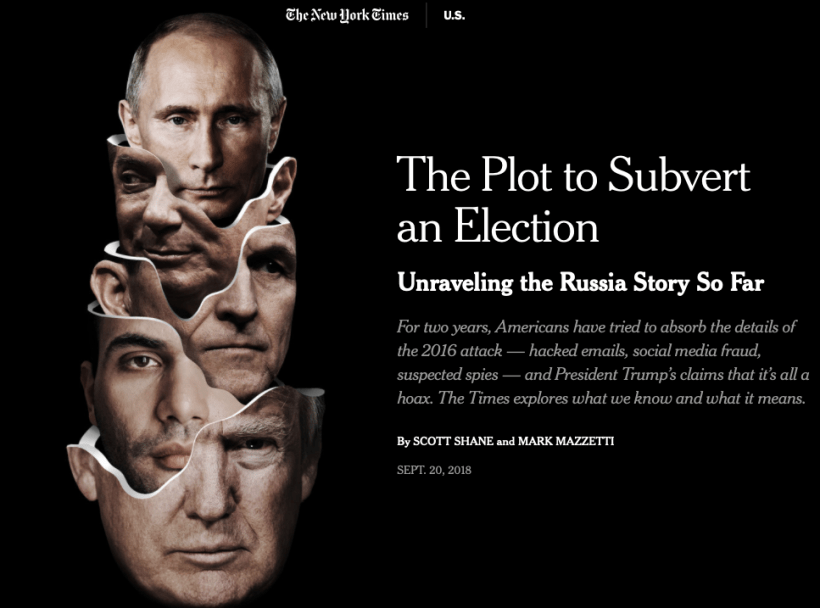
But that turned to be an outrageously deceptive claim, because Shane and Mazzetti failed to mention the fact that those 80,000 IRA posts (from early 2015 through 2017), had been engulfed in a vast ocean of more than 33 trillion Facebook posts in people’s news feeds – 413 million times more than the IRA posts.
In December 2019, senior national security correspondent David Sanger wrote a story headlined, “Russia Targeted Election Systems in All 50 States, Report Finds,” and Sanger’s lede said the Senate Intelligence Committee had “concluded” that all 50 states had been targeted. But the Committee report actually reaches no such conclusion. It quoted President Barack Obama’s cyber-security adviser Michael Daniel as recalling that he had “personally” reached that conclusion, but shows the only basis for his conclusion was remarkably lame: the “randomness of the attempts” and his conviction that Russian intelligence was “thorough.”
The Committee reported that some intelligence “developed” in 2018 had “bolstered” the subjective judgment by Daniel. But all but one of the eight paragraphs in the report describing that intelligence were redacted, and the one unredacted paragraph suggests that the redacted paragraphs provided no conclusive evidence that Russian intelligence had scanned any state election websites, much less those of all 50 states. The paragraph said, “However, IP addresses associated with the August 16, 2016 FLASH provided some indicators the activity might be attributable to the Russian government…. [emphasis added].”
The Committee report also contained summary statements from six states that the Department of Homeland Security has continued to include among the 21 states it insists were hacked by the Russians in 2016, denying any cyber threat to their systems. Another 13 states reported only that there was “scanning and probing” by inconclusive IP addresses the FBI and DHS had sent them. Sanger did not report any of those troublesome details.
In January 2020 the Times began its coverage of the theme of Russian interference in the 2020 election with a story headlined, “Chaos is the Point: Russian Hackers and Trolls Grow Stealthier in 2020.” The story, written by Sanger, Matthew Rosenberg and Nicole Perlroth, sought to heighten the existing U.S. climate of paranoia about a Russian attack in regard to the 2020 elections. Once again, however, nothing in the story supports the sinister tone of the headline.
It reported Department of Homeland Security officials’ anxiety about the ransom-ware attacks on 100 American towns, cities and federal offices during 2019, which are clearly criminal operations aimed at large-scale payoffs by cities. The story informed readers that DHS was investigating “whether Russian intelligence was involved in any of the attacks,” on the apparent theory that the criminals were being used by the Russians.
Since those ransom-ware attacks had been going on for years, the obvious question would have been why DHS would have waited until 2020 to reveal that it was investigating Russian involvement. Thus, the only fact underlying the story was the DHS desire to find evidence to support its accusations of Russian election hacking.
Still at it in 2020
The Times continued its advocacy journalism in a Feb. 26 report that U.S. intelligence officials had “warned” in a briefing for the House Intelligence Committee on Feb. 13 that “Russia was interfering in the 2020 campaign to get President Trump elected,” citing five people “familiar with the matter.”
The Times’ team of four writers proceeded to declare, “The Russians have been preparing – and experimenting – for the 2020 election… aware that they needed a new playbook of as-yet undetectable methods, United States officials said.” But instead of reporting actual evidence of any Russian action or decision for action, the Times writers again cited what their sources suspected could be done.
“Some officials,” they wrote, “believe that foreign powers, possibly including Russia, could use ransom-ware attacks…to damage or interfere with voting systems or registration databases.” The Times’ sources thus had no actual intelligence on the question and were merely speculating on what any foreign government might do to disrupt the election.
Three days after that report, moreover, the Times backed away from its previous lede after intelligence sources disputed its claim that Russia was intervening to reelect Trump, suggesting that the briefing officer, Shelby Pierson, had overstated the assessment. Sanger sought to limit the damage with a story labeling the problem one of “dueling narratives” in the intelligence community.
Then Sanger admitted, “It is probably too early for the Russians to begin any significant moves to bolster a specific candidate,” which obviously invalidated the Times’ previous speculation on the subject. But after The Washington Post published a story that the FBI had informed Senator Bernie Sanders that Russia had sought to help his campaign, Sanger quickly returned to the same narrative of Russian interference to advance its favorite candidates.
On the Times’ podcast “The Daily,” Sanger opined that the Russians were now supporting both Trump and Sanders – because Sanders, “like Donald Trump,” has “got a real aversion to interventions around the world.”
The most recent entry in the Times’ campaign to create anxiety about Russian interference in the election focused on race relations. On March 10, the Times headlined its story, “Russia Trying to Stoke U.S. Racial Tension before Elections, Officials Say.” In their lede Julian Barnes and Adam Goldman announced, “The Russian government has stepped up efforts to influence racial tensions in the United States as part of its bid to influence November’s presidential election, including trying to incite violence by white supremacist groups and stoke anger among Afro-Americans, according to seven American officials briefed on recent intelligence.”
But true to the modus operandi used routinely to push the Russian election threat narrative, the writers did not offer a single fact supporting such a story line. They even admitted that the officials who were making the claims provided “few details” about white supremacists and “did not detail how” blacks were being encouraged to use violence.
It turns out, in fact, that U.S. officials have found nothing indicating Russian support for violent white supremacists in America. The only fact that they could cite — based on a single source — was that the FBI is “scrutinizing any ties” between Russian intelligence and Rinaldo Nazzaro, the American founder of a “neo-Nazi group,” who lives with his Russian wife in St. Petersburg, Russia, but owns property in the United States. So, the Times’ single source had nothing but a suspicion for which the FBI was trying to find evidence.
The final touch in the piece was the accusation that RT had “fanned divisions” on race by running a story about a video of New York policemen attacking and detaining a young black man that Barnes and Goldman write “sparked outrage” and had also “posted tweets aimed at stirring white animosity.” But the RT article on the video merely reported accurately that the video depicted unprovoked police brutality and that it had already gone viral. The Times itself had published a much more detailed Associated Press story on the same incident that went into a discussion of the history of police brutality in New York City. By the Times’ own criterion, the AP was doing far more to stoke racial animosity than RT.
The opinion pieces that RT published attacking The New York Times for its coverage of a video at the University of Wisconsin that offended non-whites and for a Times opinion piece critical of the Apu character on “The Simpsons” echoed views on race and culture that most Americans find offensive. The idea that they were part of a Russian plot to generate racial animosity, however, is a very long stretch.
The descent of The New York Times into this unprecedented level of propagandizing for the narrative of Russia’s threat to U.S. democracy is dramatic evidence of a broader problem of abuses by corporate media of their socio-political power. Greater awareness of the dishonesty at the heart of the Times‘ coverage of that issue is a key to leveraging media reform and political change.
Gareth Porter is an independent investigative journalist and historian and winner of the 2012 Gellhorn Prize for Journalism. His latest book, with John Kiriakou, is “The CIA Insider’s Guide to the Iran Crisis: From CIA Coup to the Brink of War.”
WUHAN OUTBREAK: CHINA DEMANDS AN HONEST ACCOUNTING
By Thomas Hon Wing Polin | March 22, 2020
- It is now virtually certain that COVID-19 was brought to Wuhan by American troops taking part in the city’s World Military Games last Oct. 18-27.
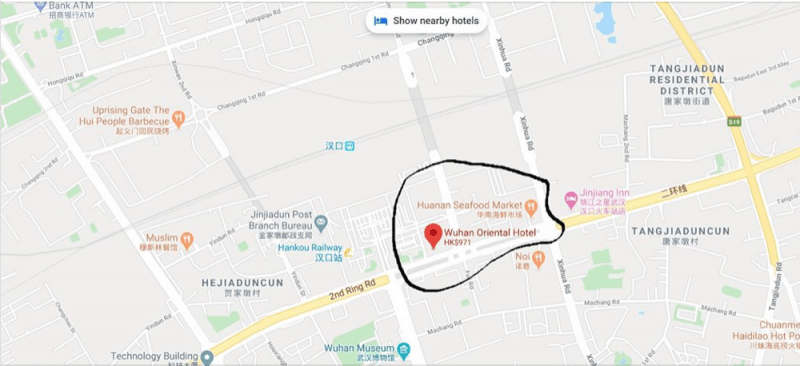
- The 300-strong US contingent stayed 300 meters from the Huanan Seafood Market where China’s outbreak began (see map below) at the Wuhan Oriental Hotel.
- Five of the US troops developed a fever on Oct. 25 and were taken to an infectious-diseases hospital for treatment.
- 42 employees of the Oriental Hotel were diagnosed with COVID-19, becoming the first cluster in Wuhan. At the time only 7 people from the market had been thus diagnosed (and treated before the hotel staff). All 7 had contact with the 42 from the hotel. From this source, the virus spread to the rest of China.
- The American Military Games team trained at a location near Fort Detrick, the military’s viral lab closed down by the CDC in July for various deficiencies.
- The big question now is whether the transmission was planned, or accidental.
- Chinese authorities are awaiting an explanation from US authorities.
- A few days ago, Mike Pompeo phoned Yang Jiechi, Chinese State Councillor for Foreign Affairs. Pompeo’s counterpart is actually Foreign Minister Wang Yi and Yang is Wang’s boss, so Pompeo wanted to talk about something urgent and important.
- Pompeo wanted the Chinese not to publicize what they had found.
- Yang’s reply: “We await your solemn explanation, especially about Patient Zero.”
China’s leaders have long suspected US military involvement in the Wuhan outbreak but were determined to stop the disease before pursuing the Americans for an honest accounting.
The War in Vietnam: John Wayne Was Wrong
By Marko | The Voluntaryist Reader | 12/10/2012
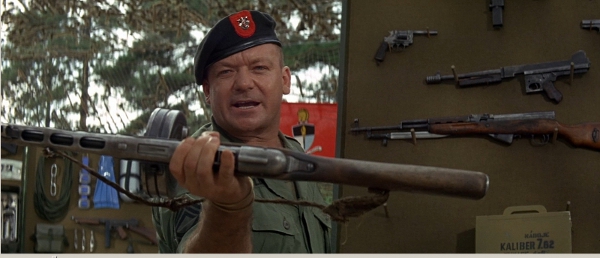
John Wayne’s Vietnam-era pro-war classic, The Green Berets opens with a scene of a press conference. It starts off with a group of Green Berets introducing themselves to the press, which is followed by a Q&A session with two Green Berets sergeants who have been assigned to answer questions. The scene reaches a crescendo when a reporter asks one of the sergeants if the war in Vietnam does not seem like a war between the Vietnamese and if the Americans should therefore stay out of it. Hearing this, the visibly irritated sergeant proceeds to pick up captured Vietnamese firearms from a display board nearby, and drops them in front of the reporter one by one, all the while explaining in a voice laden with hostile emotion that the weapons are Chinese-made, Soviet-made and Czechoslovakian-made respectively.
The implication is clear. The war in Vietnam is not merely an internal Vietnamese affair, because quite aside from the American factor in the war there is also the Soviet, the Chinese, even the Czechoslovakian factor. It is therefore on the account of this involvement of foreign Communist powers in Vietnam that the United States has to involve itself on the other side.
Now it is easy to see the inadequacy of that argument. Providing war material, even on a vast scale, is in no way comparable to a direct military intervention carried out with an occupation force of half a million soldiers, which is how many the United States had in Vietnam at the time The Green Berets aired in 1968.* Clearly the American involvement in Vietnam went far beyond what was necessary to balance out the involvement of the Soviets, the Chinese, or the Czechoslovaks, on the side of Hanoi.
But is it even true the American involvement was a reaction, perhaps an exaggerated reaction, to the Soviet, etc involvement? What were the actual cause and effect, in life rather than on film? Were the Americans in Vietnam because Soviet shipments of weaponry were going there, or were the Soviets shipping weaponry to Vietnam because the Americans had come there? How does this and other claims of war propagandists of the time stack up against what we know from the works of historians today?
In fact, where the Soviets are concerned their relationship with the Vietnamese before the American intervention in Vietnam was at its nadir precisely because the Soviet Union would not support DRV (North Vietnam) in reunifying Vietnam by military means. Soviet aid to DRV in this period, that is when the North was facilitating the struggle of the NLF (“Viet Cong”) in the South and before direct American involvement on a great scale, was relatively small and almost exclusively economic, not military.
When the unifying elections called for by the Geneva Accords of 1954 that had ended the French War in Vietnam did not come about, Hanoi gradually resolved to wage a military campaign to oust the American-backed government in the South. In this, however, it did not have the support of Moscow.
The Soviets feared American intervention which would have to result in an American-Soviet confrontation that would interfere with their policy line of “peaceful coexistence” with the Capitalist bloc. They made it clear to Hanoi they supported its struggle to reunify Vietnam only in as much as it was pursued by diplomatic means and encouraged Hanoi to pursue a peaceful strategy.
Vietnamese Communists shared many of the concerns being voiced by Moscow, but ultimately pressed on regardless. Both the Vietnamese and the Soviets were acutely aware that waging a violent struggle for reunification could result in an American invasion in Vietnam. They were both uneasy about this prospect and regarded it as highly undesirable, even disastrous. The difference was that the Vietnamese were ultimately willing to accept a confrontation with the Americans if they stood in the way of the reunification of their country, but the Soviets were not.
It was not until the time of the Gulf of Tonkin Resolution which marked the official entry of the United States into the war in Vietnam that the USSR begun to provide DRV with military assistance. The Soviets had held back on providing Vietnamese Communists with war material because this would encourage them to wage war in the South, which could in turn result in an American intervention. Now that Americans had intervened regardless, the Soviets no longer had a reason to continue to hold back. Whatever they did, the Americans were already in Vietnam. Now they would provide the Vietnamese with aid, because that was the only way these could hope to prevail against the Americans.
An additional reason for the Soviet reversal on the question of military assistance was to regain the influence they had lost with North Vietnam to China. In 1954 Moscow and Beijing had pressured the Vietnamese Communists into signing the Geneva Accords, which ended the French War in Indochina, but also split Vietnam in half.** Since then both China and the Soviet Union acted as a moderating force on Hanoi. They encouraged the Vietnamese to pursue the goal of reunification by peaceful means only, even after these had clearly shown themselves to be ineffectual when unifying elections called for by the Accords failed to materialize.
Following the Sino-Soviet split, however, Beijing gradually moved away from this position and came to see a military struggle could complement diplomatic and propaganda efforts. In time, the Chinese position would become further radicalized and they would reject the notion that negotiations could be of any use at all. It is important to understand, however, that Beijing came to approve of the armed struggle of the Vietnamese only in 1961, fully two years after the Vietnamese had gone ahead with it.
The change in the position of the PRC and the resultant increase in assistance to Vietnam enabled the Chinese-Vietnamese relationship to thrive. In the context of the Sino-Soviet confrontation within the Communist camp North Vietnam was now aligning ever more closely to China. That is, until the American intervention in the war caused the Soviets to launch a giant, Lend Lease-like program of military assistance to the DRV and regain their lost influence with Hanoi.
The key thing to take from here is that it was not the case that the Vietnamese fell under China’s influence which directed them to pursue the goal of unification of their country with military means. The Vietnamese were orienting themselves to that of the two Communist powers which would support them in their own policy line on South Vietnam. Chinese-Vietnamese relations could thrive precisely because China had come to adopt Hanoi’s view of peaceful means to reunify Vietnam as inadequate. The Soviet Union in turn could regain its influence over DRV and pull it back from the Chinese camp only when it had dropped its opposition to the military struggle of the Vietnamese.
The presence of Soviet and Chinese-made firearms in Vietnamese hands did not in fact point to the latter being simply the agents of monolithic Communism with designs over the entire globe as John Wayne wanted Americans to believe in 1968. In actuality, by going to war the Vietnamese Communists had defied the Kremlin and had frustrated its plans. It was precisely by opting for a military struggle that the DRV leadership had demonstrated its freedom of action. It was also the case that the USSR did everything it could to spare the US its calamitous war in Vietnam.
The Soviets attempted to dissuade the Vietnamese leadership from waging a military struggle even at the cost of losing nearly all its influence in Hanoi and seeing North Vietnam slide into the Chinese camp. If the mistake the Soviets committed was failing to appreciate just how important it was to the Vietnamese to reunify their country, it was a mistake the Americans tragically made as well. In part, due to propagandists like John Wayne who put out the idiotic drivel of the Vietnamese struggle for reunification as a matter of “world Communist domination”.
~ Marko
Source: Mari Olsen, Soviet–Vietnam Relations and the Role of China, 1949–64: Changing Alliances (New York: Routledge, 2006)
*Albeit by the time The Green Berets aired this was no longer the case, the Chinese also stationed troops in Vietnam, specifically in the Communist-run Democratic Republic of Vietnam (North Vietnam), but on a far smaller scale. In all 320,000 Chinese anti-aircraft and engineer troops served in Vietnam in comparison to 2.7 million Americans. The Chinese deployed in North Vietnam in mid 1965, in response to the Americans landing in the South. They evacuated in early 1968, having suffered about 1100 dead, mainly in the American bombing of the North.
**The two powers went as far as to signal the Viet Minh that rejecting the Accords may result in their ending their material assistance to the movement’s struggle.
COVID-USA: Targeting Italy and South Korea?
By Larry Romanoff | Global Research | March 21, 2020
A high-level Italian virologist, Giuseppe Remuzzi, has published papers in the Lancet and other articles in which he states facts not hitherto known. (1)
The doctor stated that Italian physicians now recall having seen:
“a very strange and very severe pneumonia, particularly in old people in December and even November [2019]. This suggests that the virus was circulating, at least in Lombardy, and before we were aware of this outbreak occurring in China.“(2)
Chinese medical authorities have determined the same underlying phenomenon, that the virus had been circulating among the population for perhaps two months before it finally broke out into the open.
Further, according to the Italian National Health Service (ISS):
“It is not possible to reconstruct, for all patients, the chain of transmission of infection. Most cases reported in Italy report an epidemiological link with other cases diagnosed in Lombardy, Emilia Romagna and Veneto, the areas most affected by the epidemic.” [translation from Italian] (3)
The above statement is of crucial importance since it supports in itself the assertion of several simultaneous infection clusters and several ‘patients zero’. There are cases in Lombardy that could not be placed in an infection chain, and this must also be true for other areas. (see below) Given that the virus broke out separately in disparate regions of Italy, we can expect the identification of independent infectious clusters in those regions as well. That would mean Italy was hit by at least several individual ‘seedings’ of the virus.
China’s outbreak of consequence was primarily in the city of Wuhan but with multiple sources in the city and multiple patients zero, with a minor outbreak in Guangdong that was easily contained. China had multiple clusters in Wuhan. There was no single source, and no patient zero has been identified which is similar to those of Italy.
The mystery of Italy’s “Patient No. 4”
Was the Italian outbreak caused by infections from China? Yes, and no.
Before February 20, 2020, there were only three cases of coronavirus infection in Italy, two tourists from Wuhan, China, confirmed on January 30th, and an Italian man who returned to Rome from Wuhan on February 6th. These were clearly imported cases with Italy experiencing no new infections during the next two weeks.
Then suddenly there appeared new infections that were unrelated to China. On February 19, the Lombardy Health Region issued a statement that a 38-year-old Italian man was diagnosed with the new coronavirus, becoming the fourth confirmed case in Italy. The man had never traveled to China and had no contact with the confirmed Chinese patients.
Immediately after this patient was diagnosed, Italy experienced a major outbreak. In one day, the number of confirmed cases increased to 20 and, after little more than three weeks, Italy had 17,660 confirmed cases.
The Italians were not idle in searching for their patient zero. They renamed the “patient 4” “Italian No. 1”, and attempted to learn how he became infected. The search was apparently fruitless, the article stating that “America’s pandemic of the century has become the subject of suspicion by Italians“.(4)
The mystery of South Korea’s “Patient No. 31”
South Korea’s experience was eerily similar to that of Italy, and also to that of China. The country had experienced 30 imported cases which began on January 20, I believe all of which were traceable to contact with Hubei and/or Wuhan.
But then South Korea discovered a “Patient No. 31”, a 61 year-old South Korean woman diagnosed with the new coronavirus on February 18. This ‘local’ patient had no ties to China, had had no contact with any Chinese, and no contact whatever with any of the infected South Koreans. Her infection was a South Korean source.
Just as with Italy, the outbreak in South Korea exploded rapidly after the discovery of Patient 31. By the next day, February 19 (Italy was February 21, for comparison), there were 58 confirmed cases in South Korea, reaching 1,000 in less than a week. After little more than three weeks, South Korea had 8,086 confirmed cases. It would now seem likely (yet to corroborated) that South Korea and Italy could have been ‘seeded’ at approximately the same time.
Like the Italians, South Korea performed a massive hunt for the source of the infection of their “Korean No. 1”, combing the country for evidence, but without success. They discovered the confirmed cases in South Korea were mainly concentrated in two separate clusters in Daegu and Gyeongsang North Road, most of which – but not all – could be related to “Patient 31”. As with Italy, multiple clusters and multiple simultaneous infections spreading like wildfire – and without the assistance of a seafood market selling bats and pangolins.
For both Italy and South Korea, I could also add that there is no supposed “bio-weapons lab” anywhere within reach (as was claimed for China), but that wouldn’t be accurate. There are indeed bio-weapons labs easily within reach of the stricken areas in both Italy and South Korea – but they belong to the US Military.
Korea is particularly notable in this regard because it was proven likely that MERS resulted from a leak at the American military base at Osan. The official Western narrative for the MERS outbreak in South Korea was that a Korean businessman became infected in the Middle East then returned to his home in Gyeonggi Province and spread the infection. But there was never any documentation or evidence to support that claim, and to my best knowledge it was never verified by the South Korean Government.
Pertinent to this story is that according to the Korean Yonhap News Service, at the onset of the outbreak about 100 South Korean military personnel were suddenly quarantined at the USAF Osan Air Base. The Osan base is home to the JUPITR ATD military biological program that is closely related to the lab at Fort Detrick, MD, both being US military bio-weapons research labs.
There is also a (very secretive) WHO-sponsored International Vaccine Institute nearby, which is (or at least was) managed by US military biological weapons personnel. At the time, and given the quarantine mentioned above, the event sequence accepted as most likely was that of a leak from a JUPITR biowarfare project. (5) (6)
The Korean path is similar with that of Italy. If we look at a map of the virus-stricken areas of Italy, there is a US military base within almost a stone’s throw of all of them. This is of course merely a case of circumstance arousing suspicion, and by no means constitutes proof of anything at all.
However, there is a major point here which cannot be overlooked, namely the fact of simultaneous eruptions of a new virus in three different countries, and in all three cases no clear epidemiology, and an inability to identify either the original source or a patient zero.
Multiple experts on biological weapons are in unanimous agreement that eruptions in a human population of a new and unusual pathogen in multiple locations simultaneously, with no clear idea of source and cases with no proven links, is virtually prima facie evidence of a pathogen deliberately released, since natural outbreaks can almost always be resolved to one location and one patient zero. The possibility of a deliberate leak is as strong in Italy and South Korea as in China, all three nations apparently sharing the same suspicions.
Larry Romanoff is a retired management consultant and businessman. He has held senior executive positions in international consulting firms, and owned an international import-export business. He has been a visiting professor at Shanghai’s Fudan University, presenting case studies in international affairs to senior EMBA classes. Mr. Romanoff lives in Shanghai and is currently writing a series of ten books generally related to China and the West.
He is a Research Associate of the Centre for Research on Globalization (CRG).
He can be contacted at: 2186604556@qq.com
Notes
(A) This is an aside, but Italy has experienced a fatality rate nearly twice that of Wuhan, but there may be an external contributing factor. Observations were made that, in most cases especially among the elderly in Italy, ibuprophen was widely used as a painkiller. The Lancet published an article demonstrating that the use of ibuprophen can markedly facilitate the ability of the virus to infect and therefore to increase the risk of serious and fatal infection. (YY)
https://www.thelancet.com/journals/lanres/article/PIIS2213-2600(20)30116-8/fulltext
(B) “The mean age of those who died in Italy was 81 years and more than two-thirds of these patients had . . . underlying health conditions, but it is also worth noting that they had acute respiratory distress syndrome (ARDS) caused by . . . SARS-CoV-2 pneumonia, needed respiratory support, and “would not have died otherwise.”
(3) https://www.iss.it/web/guest/primo-piano/-/asset_publisher/o4oGR9qmvUz9/content/id/5293226
(4) http://dy.163.com/v2/article/detail/F7N756430514G9GF.html
(5) https://www.21cir.com/2015/06/south-korea-mers-emerged-out-of-the-pentagons-biowarfare-labs-2/
(6) https://www.businessinsider.com/almost-200-north-korean-soldiers-died-coronavirus-2020-3
Copyright © Larry Romanoff, Global Research, 2020
Illinois goes on coronavirus lockdown days after holding ‘fine & safe’ Democratic primaries
RT | March 20, 2020
Having insisted on holding Democratic presidential primaries just days earlier, Illinois Governor J.B. Pritzker has now placed the state on “shelter-in-place” regime over the Covid-19 pandemic, following California and New York.
The measure will go into effect on Saturday evening, March 21. All non-essential businesses – not including hospitals, doctors’ offices and grocery stores – are to be closed indefinitely, Pritzker announced after consulting with experts. “To avoid the loss of tens of thousands of lives we must order an immediate shelter-in-place.”
Pritzker admitted the state does not have “the resources, the capacity, or the desire to police every individual’s behavior,” so the enforcement of the order will come down to “Illinoisans to be good members of their communities and good citizens,” he told the Chicago Tribune.
The statewide measure follows the order of Chicago Mayor Lori Lightfoot to close down the city, declaring that “now is not the time for half measures” but also that this is “not a lockdown, or martial law.”
Just three days prior, however, the state refused to cancel, postpone or enable mail-in voting in the Democrat presidential primary.
“I feel good about the decision to have the election go on tomorrow,” Pritzker had said Monday afternoon. “We do believe it’s safe. We’ve certainly consulted experts, and we think that the election will go on just fine.”
With many poll workers not showing up due to fears of contagion and numerous polling places closed, the voting involved large crowds clustering together for many hours – conditions ideal for spreading the coronavirus.
The primary was overwhelmingly carried by establishment favorite Joe Biden (924,771 votes, 59 percent), whereupon Pritzker and the experts appear to have suddenly changed their minds.
As of Friday, Illinois had 585 registered Covid-19 cases, with five fatalities.
US airlifts Lebanese-American accused of torture, murder from Lebanon
MEMO | March 20, 2020
Lebanese-American Amer Fakhoury, accused of torturing and murdering prisoners while serving in the Israeli-backed south Lebanon army, has been airlifted from Beirut by the US, Senator Jeanne Shaheen announced yesterday.
A US Marine Osprey was seen landing at the US Embassy in Beirut, hours before Fakhoury’s release was announced.
Shaheen said she had spoken with Fakhoury on the phone soon after his release, adding that “anytime a US citizen is wrongfully detained by a foreign government, we must use every tool at our disposal to free them”.
In a statement later yesterday, US President Donald Trump said that he was “very grateful to the Lebanese government. They worked with [the US]”.
Fakhoury was detained on 12 September when he arrived in the country to visit family after more than two decades.
The former member of the south Lebanon Army has been accused of being the “Butcher of Khiam” over allegations that he oversaw the torture and murder of detainees during his tenure as a prison guard.
Former detainee Abbas Qabalan told local media Naharnet that “not a single person held in Khiam was spared physical and psychological torture”. At least ten people died at the prison while Fakhoury was working there.
The charges against Fakhoury were initially dropped on Monday, when he was acquitted because the alleged offences took place more than ten years ago.
However, a military judge ordered a re-trial after Judge Ghassan Khoury asked the Military Court of Appeals to overturn the acquittal. A court order forbidding Fakhoury from travelling internationally for two months was announced later.
In the wake of Fakhoury’s release, the head of the Military Tribunal Brigadier General Hussein Abdallah announced his resignation from the post this morning, the Daily Star reported.
Abdallah said he resigned “out of respect for my oath and military honour” adding the military tribunal had become a place where “the application of the law equals to the release of an agent of pain”.
Tensions between the US and Lebanon have risen dramatically as a result of Fakhoury’s detention, with Senators Shaheen and Cruz tabling legislation in February which would invoke sanctions against Lebanese officials and associates which are deemed to have been involved in the illegal detention of a US citizen.
The Trump administration have threatened to withhold aid to the country and sanction the Lebanese military.
From Cluster Bombs to Toxic Waste: Saudi Arabia is Creating the Next Fallujah in Yemen

A collection of unexploded ordnance recovered by the UNDP’s YEMAC project in Yemen. Courtesy | YEMAC
By Ahmed AbdulKareem | MintPress News | March 20, 2020
AL-JAWF, YEMEN — As the world’s focus turns to the rapidly-spreading COVID-19 pandemic, Yemenis are reeling from their own brewing tragedy, contending with the thousands of cluster bombs, landmines and other exploded munitions that now litter their homeland. Just yesterday, a young child was killed and another was injured in the al-Ghail district of al-Jawf when a landmine left by the Saudi military exploded, witnesses told MintPress. Outraged and terrified by the presence of these unexploded ordnances, Ahmed Sharif, a father of 9 who owns a farm in the district called the unexploded ordnances “a significant threat to our children.”
Earlier this week, thousands of cluster bombs containing between dozens and hundreds of smaller submunitions were dropped by air and scattered indiscriminately over large areas near Ahmed’s farm. A large number of those munitions failed to explode on impact, creating a new threat to residents already reeling from 5 years of war, famine and an economic blockade. The use, production, sale, and transfer of cluster munitions is prohibited under the 2008 Convention on Cluster Munitions, an international agreement recognized by over 100 countries, but rejected by Saudi Arabia and the United States.
Saudi Arabia is estimated to have dropped thousands of tons of U.S.-made weapons in al-Jawf over the past 100 days alone. Al-Jawf is an oil-rich province that lies in Yemen’s north-central reaches along the Saudi border. The aerial campaign is likely a last-ditch effort to stem the tide of battlefield success by local volunteer fighters who teamed with Houthi forces to recapture large swaths of al-Jawf and Marib provinces. That campaign, for all intents and purposes, has failed.
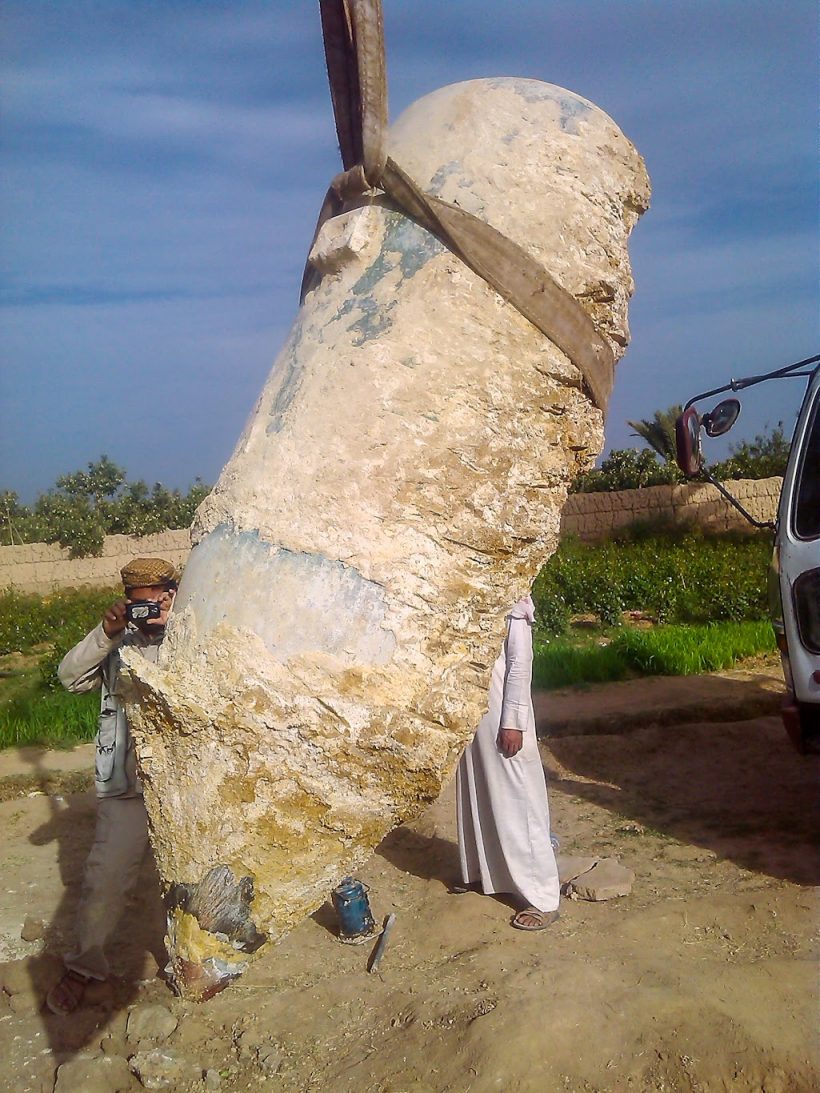
An unexploded bomb dropped by a Saudi warplane is recovered from a pomegranate farm in the Jamilah district in Sadaa. Courtesy | YEMAC
On Wednesday, the Houthis announced that their military operation – dubbed “God Overpowered Them” – was complete and that al-Jawf was free of Saudi occupation. According to Houthi sources, more than 1,200 Saudi-led coalition fighters were killed or injured during the operation and dozens of Saudi troops, including officers, were captured. The Houthis also struck deep into Saudi territory in retaliation for the more than 250 Saudi airstrikes that were carried out during the campaign. In multiple operations, ballistic missiles and drones were used to target facilities inside Saudi Arabia, according to officials.
Saudi losses haven’t been limited to al-Jawf either. Last week, Marib province, which lies adjacent to Yemen’s capital of Sana’a, was recaptured following heavy battles with Saudi forces. Local tribal fighters were able to clear strategic areas in the Sirwah District with the assistance of Houthi forces and take control of the town of Tabab Al-Bara and the strategic Tala Hamra hills that overlook Marib city. Both the Saudi-led coalition and its allied militants initially admitted defeat but later described their loss as a tactic withdrawal.
Marib is now the second Yemeni governorate adjacent to Saudi Arabia to fall under the control by Yemen’s resistance forces in the last month, al-Jawf being the first. Both provinces have strategic importance to Saudi Arabia and could serve as a potential launch point for operations into Saudi Arabia’s Najran province.
“Saudi [Arabia] and America have planted our land with death”
The highly populated urban areas of Sana’a, Sadaa, Hodeida, Hajjah, Marib, and al-Jawf have been subjected to incomprehensible bombing campaigns during the Saudi-led war on Yemen, which turns five on March 26. The sheer scale of that campaign, which often sees hundreds of separate airstrikes carried out every day, coupled with its indiscriminate nature, has left Yemen one of the most heavily contaminated countries in the world.
Since 2015, when the war began, coalition warplanes have conducted more than 250,000 airstrikes in Yemen, according to the Yemeni Army. 70 percent of those airstrikes have hit civilian targets. Thousands of tons of weapons, most often supplied by the United States, have been dropped on hospitals, schools, markets, mosques, farms, factories, bridges, and power and water treatment plants and have left unexploded ordnances scattered across densely populated areas.
A significant proportion of those ordnances are still embedded in the ground or amid the rubble of bombed-out buildings, posing a threat to both civilians and the environment. As Man’e Abu Rasein, a father who lost two sons to an unexploded cluster bomb in August of 2018 puts it: “Saudi [Arabia] and America have planted our land with death.” Abu Rasein’s sons, Rashid, ten, and Hussein, eight, were grazing their family’s herd of sheep in the village of al-Ghol north of Sadaa, far from any battlefield. They spotted an unusual looking object and like most curious young boys, picked it up to investigate. But the object they found was no toy, it was an unexploded cluster munition dropped by a Saudi jet. After hearing an explosion, the boys’ family went to investigate and found them lying dead, covered in blood.
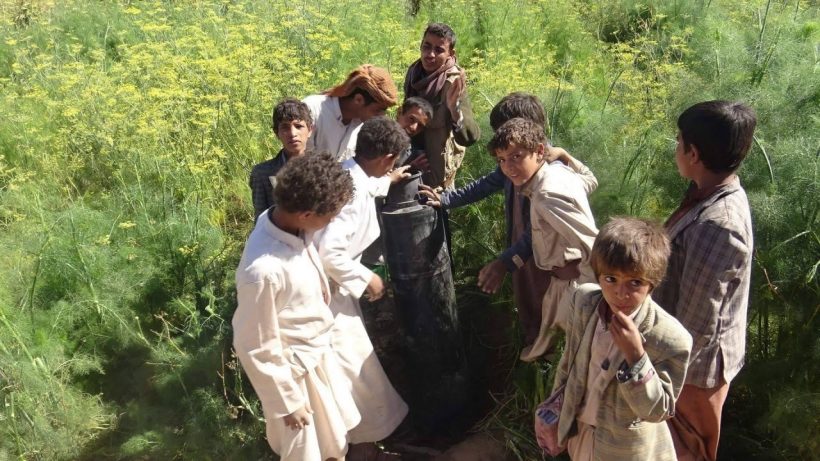
A group of children in Sahar district inspects a cluster bomb dropped by a Saudi warplane at a farm in Sadaa, March 18, 2019. Abdullah Azzi | MintPress News
Since March of 2015, Human Rights Watch has recorded more than 15 incidents involving six different types of cluster munitions in at least five of Yemen’s 21 governorates. According to the United Nations Development Program’s Emergency Mine Action Project, some of the heaviest mine and ERW (explosive remnants of war) contamination is reported in northern governorates bordering Saudi Arabia, southern coastal governorates and west-central governorates, all areas surrounding Houthi-dominated regions of Yemen. Since 2018 alone, the UNDP has cleared nearly 9,000 landmines and over 116,000 explosive remnants in Yemen.
From the Yemeni war of 1994 to the six wars in Sadaa, Yemenis have suffered several wars over the last three decades. Yet thanks to saturation of U.S. weapons, the ongoing war has brought death on a toll not seen in Yemen for hundreds of years. In Sadaa, the Saudi coalition has a significant legacy of unexploded ordinances, up to one million according to figures provided to MintPress by the Yemeni Executive Mine Action Center (YEMAC), an organization backed by the United Nations.
The Project Manager of YEMAC identified heavy cluster munition contamination in Saada, al-Jawf, Amran, Hodeida, Mawit, and Sanaa governorates, including in Sanaa city. Contamination was also reported in Marib. For the time being, YEMAC is the only organization working throughout the country during the ongoing war. Their teams are confronted with a very complex situation, disposing of both conventional munitions and bombs dropped from airplanes, including explosive remnants of war rockets, artillery shells, mortars, bombs, hand grenades, landmines, cluster bombs, and other sub-munitions and similar explosives.
Saudi Arabia’s toxic legacy
In addition to killing and injuring hundreds of civilians, American-made weapons have exposed Yemen’s people to highly toxic substances on a level not seen since the now-infamous use of radioactive depleted uranium by the United States in Fallujah, Iraq, which to this day is causing abnormally high rates of cancer and birth defects.
The hazardous chemicals from Saudi Coalition military waste, including radioactive materials, fuel hydrocarbons, and heavy metals, has already led to outbreaks of disease. Vehicles abandoned on battlefields, usually in various states of destruction, contain toxic substances including PCBs, CFCs, DU residue, heavy metals, unexploded ordnances, asbestos and mineral oils. Hundreds of these military scraps remain publicly accessible in Nihm, al-Jawf, Serwah, Marib and throughout Yemen.
Aside from the threat they pose to life and limb, unexploded ordnances contain toxic substances like RDX, TNT, and heavy metals which release significant levels of toxic substances into the air, soil and water. According to both the Ministry of Water and Environment and the Ministry of Health, which have undertaken environmental assessments on the impact of urban bombing, high levels of hazardous waste and air pollutants are already present in a populated areas.
Alongside the still unknown quantities of more conventional weapons remnants in Yemen, the waste from the cleanup of bombed-out buildings has been found to be especially contaminated with hazardous materials, including asbestos which is used in military applications for sound insulation, fireproofing and wiring among other things. Fires and heavy smoke billowing over heavily populated civilian areas following Saudi bombing runs also pose an imminent threat to human health. A common sight in many Yemeni cities since the war began, these thick clouds of toxic smoke sometimes linger for days and coat both surfaces and people’s lungs with hazardous toxins like PAHs, dioxins and furans, materials which have been shown to cause cancer, liver problems and birth defects.
Before the war began, most hazardous materials were trucked to Sanaa where they were separated and disposed of properly at the sprawling al-Azragein treatment plant south of the capital. But that plant was among the first targets destroyed by Saudi airstrikes after the war began. After it was bombed, puddles and heaps of toxic material were left to mix with rainwater and seep into surrounding areas. Yemeni researchers are still trying to grasp the scale of pollution from biohazardous chemicals at the site.
Although a comprehensive nationwide environmental assessment of the impact of urban bombing in Yemen has yet to be completed, high levels of hazardous waste and air pollutants have been recorded by many hospitals and environmental agencies. Some idea of the long-term effects can also be gleaned from studies carried out in areas where similar toxins have been used, particularly by the United States in Fallujah, Iraq and in Vietnam, where scientific assessments have shown increased cases of birth defects, cancer and other diseases, including in U.S. veterans.
In southern Yemen, where Saudi Arabia and the United Arab Emirates operate largely unchallenged, the coalition has been disposing of military waste in large trenches devoid of any measures to mitigate potential toxic fallout. Waste is dumped into large holes and either detonated or simply buried, inevitably contaminating soil and groundwater according to data from the UN Environment Program.
Yemen’s coastline hasn’t been immune either. The country’s General Authority for Environmental Protection said Wednesday that the Saudi-led coalition is dumping toxic and polluted waste on the shores of Yemen and in Yemeni regional waters, causing great damage to the marine environment, the deaths of fish and marine organisms, and in some cases, actually changing the color of the sea to a toxic green. The agency stated that in addition to dumping toxic waste, the coalition was allowing unsafe fishing practices such as marine dredging and the use of explosives by foreign ships, destroying the marine environment and coral reefs.
One hundred years to safety
Thousands of displaced Yemenis cannot fathom returning home due to the large number of explosives potentially hidden in and around their houses. Removing them all would require an end to the U.S.-backed war and economic blockade. Special equipment and armored machines such as armored excavators would need to be brought in, a slim prospect in a country unable to secure even the basic staples of life.

The remnants of a cluster bomb dropped by Saudi-led coalition warplanes inside a Yemeni home. March 18, 2020. Abdullah Azzi| MintPress News
Explosive remnants do not just impact lives and limbs, they prevent the use of potentially productive agricultural land and the rebuilding of important infrastructure. Like many border areas in Saada and Hajjah, fertile soil in al-Jawf and Marib has become so environmentally polluted since the war began that it could take decades to recover. Explosive remnants also prevent access to vital resources like water and firewood, cripples the movement of residents, including children traveling to school, and prevents aid from reaching those in need.
Even if the Saudi-led coalition were to stop the war immediately and lift the blockade, its legacy of indiscriminate bombing on such a massive scale will be felt for years to come. Due to the intensity of the bombing, experts at the United Nations Development Program’s Yemeni Executive Mine Action Center estimate that clearance could take at least 100 years in larger cities. Despite these dangers, desperate families with nowhere to go do not waste a lull in the barrage of Saudi airstrikes or a short-lived ceasefire to attempt to return home.
Ahmed AbdulKareem is a Yemeni journalist. He covers the war in Yemen for MintPress News as well as local Yemeni media.
Pompeo and Netanyahu paved a path to war with Iran, and they’re pushing Trump again
By Gareth Porter | The Grayzone | March 20, 2020
Though it narrowly averted war with Iran this January, the Trump administration is still pushing for all-out military conflict. The architects of the drive to war, Mike Pompeo and Benjamin Netanyahu, have relied on a series of cynical provocations to force Trump’s hand.
The US may escape the most recent conflict with Iran without war, however, a dangerous escalation is just over the horizon. And as before, the key factors driving the belligerence are not outraged Iraqi militia leaders or their allies in Iran, but Trump’s secretary of state, Mike Pompeo, and Israeli Prime Minister Benjamin Netanyahu, who has long sought to draw the US into a military confrontation with Iran.
Throughout the fall of 2019, Netanyahu ordered a series of Israeli strikes against Iranian allies in Iraq and against Lebanese Hezbollah units. He and Pompeo hoped the attacks would provoke a reaction from their targets that could provide a tripwire to outright war with Iran. As could have been expected, corporate US media missed the story, perhaps because it failed to reinforce the universally accepted narrative of a hyper-aggressive Iran emboldened by Trump’s failure to “deter” it following Iran’s shoot-down of a U.S. drone in June, and an alleged Iranian attack on Saudi oil facility in September.
Pompeo and John Bolton set the stage for the tripwire strategy in May 2019 with a statement by national security adviser John Bolton citing “troubling and escalatory indications and warnings,” implying an Iranian threat without providing concrete details. That vague language echoed a previous vow by Bolton that “any attack” by Iran or “proxy” forces “on United States interests or on those of our allies will be met with unrelenting force.”
Then came a campaign of leaks to major news outlet suggesting that Iran was planning attacks on U.S. military personnel. The day after Bolton’s statement, the Wall Street Journal reported that unnamed U.S. officials cited “U.S. intelligence” showing that Iran “drew up plans to target U.S. forces in Iraq and possibly Syria, to orchestrate attacks in the Bab el-Mandeb strait near Yemen through proxies and in the Persian Gulf with its own armed drones…”
The immediate aim of this campaign was to gain Trump’s approval for contingency plans for a possible war with Iran that included the option of sending as many as 120,000 U.S. troops into region. Trump balked at such war-planning, however, complaining privately that Bolton and Pompeo were pushing him into a war with Iran. Following Iran’s shoot-down of the U.S. drone over the Strait of Hormuz on June 20, Pompeo and Bolton suggested the option of killing Maj. Gen. Qassem Soleimani in retaliation. But Trump refused to sign off on the assassination of Iran’s top general unless Iran killed an American first, according to current and former officials.
From that point on, the provocation strategy was focused on trying to trigger an Iranian reaction that would involve a U.S. casualty. That’s when Israeli Prime Minister Benjamin Netanyahu interjected himself and his military as a central player in the drama. From July 19 through August 20, the Israeli army carried out five strikes against Iraqi militias allied with Iran, blowing up four weapons depots and killing as many Shiite militiamen and Iranian offcers, according to press accounts.
The Israeli bombing escalated on August 25, when two strikes on the brigade headquarters of a pro-Iranian militia and on a militia convoy killed the brigade commander and six other militiamen, and a drone strike on Hezbollah’s headquarters in south Beirut blew the windows out of one of Hezbollah’s media offices.
Netanyahu and Pompeo sabotage Trump and Macron’s attempt at diplomacy
Behind those strikes was Netanyahu’s sense of alarm over Trump toying with the idea of seeking negotiations with Iran. Netanyahu had likely learned about Trump’s moves toward detente from Pompeo, who had long been his primary contact in the administration. On August 26, French President Emanuel Macron revealed that he was working to broker a Trump-Rouhani meeting. Netanyahu grumbled about the prospect of U.S.-Iranian talks “several times” with his security cabinet the day before launching the strikes.
Two retired senior Israeli generals, Gen. Amos Yadlin and Gen. Assaf Oron, criticized those strikes for increasing the likelihood of harsh retaliation by Iran or one of its regional partners. The generals complained that Netanyahu’s attacks were “designed to prod [Iran] into a hasty response” and thus end Trump’s flirtation with talking to Iran. That much was obviously true, but Pompeo and Netanyahu also knew that provoking an attack by Iran or one of its allies might cause one or more of the American casualties they sought. And once American blood was spilled, Trump would have no means to resist authorizing a major escalation.
Kataib Hezbollah and other pro-Iran Iraqi militias blamed the United States for the wave of lethal Israeli attacks on their fighters. These militias responded in September by launching a series of rocket attacks on Iraqi government bases where U.S. troops were present. They also struck targets in the vicinity of the U.S. Embassy.
The problem for Netanyahu and Pompeo, however, was that none of those strikes killed an American. What’s more, U.S. intelligence officials knew from NSA monitoring of communications between the IRGC and the militias that Iran had explicitly forbidden direct attacks on US personnel.
Netanyahu was growing impatient. For several days in late October and early November, he met with his national security cabinet to discuss a new Israeli attack to precipitate a possible war with Iran, according to reports by former Israeli Ambassador Michael Oren. Oren hinted at how a war with Iran might start. ‘[P]erhaps Israel miscalculates,” he suggested, “hitting a particularly sensitive target,” which, in his view, could spark “a big war between Israel and Iran.”
But on December 27, before Netanyahu could put such a strategy into action, the situation changed dramatically. A barrage of rockets slammed into an Iraqi base near Kirkuk where U.S. military personnel were stationed, killing a U.S military contractor. Suddenly, Pompeo had the opening he needed. At a meeting the following day, Pompeo led Trump to believe that Iranian “proxies” had attacked the base, and pressed him to “reestablish deterrence” with Iran by carrying out a military response.
In fact, U.S. and Iraqi officials on the spot had reached no such conclusion, and the investigation led by the head of intelligence for the Iraqi federal police at the base was just beginning that same day. But Pompeo and his allies, Defense Secretary Mark Esper and Chairman of Joint Chiefs Gen. Mark A Milley, were not interested in waiting for its conclusion.
A deception brings the US and Iran to the brink of war
The results of a subsequent Iraqi investigation revealed that the rocket barrage had been launched from a Sunni area of Kirkuk with a strong Islamic State presence, and that IS fighters had carried out three attacks not far from the base on Iraqi forces stationed there in the previous ten days. US signals intercepts found no evidence that Iraqi militias had shifted from their policy of avoiding American casualties at all cost.
Kept in the dark by Pompeo about these crucial facts, Trump agreed to launch five airstrikes against Kataib Hezbollah and another pro-Iran militia at five locations in Iraq and Syria that killed 25 militiamen and wounded 51. He may have also agreed in principle to the killing of Soleimani when the opportunity presented itself.
Iran responded to the attacks on its Iraqi militia allies by approving a violent protest at the U.S. Embassy in Baghdad January 31. The demonstrators did not penetrate the embassy building itself and were abruptly halted the same day. But Pompeo managed to persuade Trump to authorize the assassination of Qassem Soleimani, Iran’s second most powerful figure, presumably by hammering on the theme of “reestablishing deterrence” with Iran.
Soleimani was not only the second most powerful man in Iran and the main figure in its foreign policy; he was idolized by millions of the most strongly nationalist citizens of the country. Killing him in a drone strike was an open invitation to the military confrontation Netanyahu and Pompeo so desperately sought.
During the crucial week from December 28 through January 4, while Pompeo was pressing Trump to retaliate against Iran not just once but twice, it was clear that he was coordinating closely with Netanyahu. During that single week, he spoke by phone with Netanyahu on three separate occasions.
What Pompeo and Netanyahu could not have anticipated was that Iran’s missile attack on the U.S. sector of Iraq’s sprawling al-Asad airbase in retaliation would be so precise that it scored direct hits on six U.S. targets without killing a single American. (The US service members were saved in part because the rockets were fired after the Iraqi government had passed on a warning from Iran to prepare for it). Because no American was killed in the strike, Trump again decided against further retaliation.
Towards another provocation
Although Pompeo and Netanyahu failed to ignite a military conflict with Iran, there is good reason to believe that they will try again before both are forced to leave their positions or power.
In an article for the Atlantic last November, former Israeli Ambassador Michael Oren, channeled Netanyahu when he declared it would be “better for conflict [with Iran] to occur during the current [Trump] administration, which can be counted on to provide Israel with the three sources of American assistance it traditionally receives in wartime,” than to “wait until later.”
Oren was not the only Israeli official to suggest that Israeli is likely to go even further in strikes against Iranian and Iranian allies targets in 2020. After listening to Israeli army Chief of Staff Aviv Kochavi speak in late December, Haaretz military correspondent Amos Harel reported that the Israeli army chief conveyed the clear impression that a “more serious confrontation with Iran in the coming year as an almost unquestionable necessity.” His interviews with Israeli military and political figures further indicated that Israel would “intensity its efforts to hit Iran in the northern area.”
Shockingly, Pompeo has exploited the Coronavirus pandemic to impose even harsher sanctions on Iran while intimidating foreign businesses to prevent urgently needed medical supplies from entering the country. The approaching presidential election gives both Pompeo and Netanyahu a powerful reason to plot another strike, or a series of strikes aimed at drawing the US into a potential Israeli confrontation with Iran.
Activists and members of Congress concerned about keeping the US out of war with Iran must be acutely aware of the danger and ready to respond decisively when the provocation occurs.
Featured Video

Weaponized Journalism: 2021 Sayer Ji Interview with NPR
or go to
Aletho News Archives – Video-Images
From the Archives
How Rothschild Banking Clan Uses Its Vast Wealth to Influence World Events and Control Governments
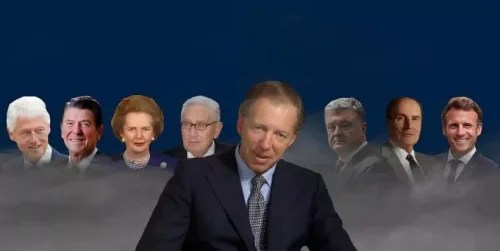
By Ilya Tsukanov – Sputnik – 15.09.2024
How powerful is the Rothschild banking family? How did they amass their fortune? Just how rich are they? Do they secretly control the world? Sputnik explores. … continue
Blog Roll
 Aletho News
- London tourism expo promotes Israeli agency linked to theft of Palestinian land
- Dockworkers launch global strike against Israeli and US military shipments
- Europe facing gas price shock – Gazprom chief
- Ukraine continues recruiting people with disabilities
- Weaponized Journalism: 2021 Sayer Ji Interview with NPR
- Beyond Netanyahu: what Israel’s election means for Palestinians
- Lithuania plans universal conscription
- Lies, Damn Lies, and Ukraine News
- Financial Times rejects Nordic demands to correct Putin call story – media
- The Case for Less Unity in Europe
- If Americans Knew
- An error has occurred; the feed is probably down. Try again later.
- No Tricks Zone
- Germany’s Green Energy Transition Becoming Increasingly Expensive…Another 6 Trillion Euros!
- Sudden Stratospheric Warming, Powerful El Niño Combination May Lead To Extreme Europe Cold, Energy Crisis!
- Two New Studies Find Thwaites Glacier Melt Cannot Be Driven By Human Activity Or A Warming Ocean
- E-Cars Reduce CO2 Emissions By Only 41% Compared To Internal Combustion Engine Vehicles
- Predictions Made By Renowned Climate Professor Over Past Decades Have Been Proven To Be Poor
- New Study Suggests Large Regions Of The Pacific Ocean Have Been Cooling For The Last 80 Years
- Germany’s Green Energy Debacle: High Energy Costs Force Kahla Porzellan to Close After 182 Years!
- New Study: 50 Years Of The Most Aggressive ‘Net Zero’ Policies Can Only Affect The Global Climate By 0.03°C
- US September “Heat” Was No Record…Many Records Set Decades Ago
- Latest European Green Energy Debacle; Portugal’s Largest Flagship Solar Park Insolvent!

