Trump ignored intel, launched Tomahawks in Syria based on media – Pulitzer winner Seymour Hersh
RT | June 25, 2017
US President Donald Trump ignored reports from US intelligence that said they had no evidence Syria had used sarin to attack a rebel-held town, Pulitzer-winning investigative journalist Seymour Hersh says.
Hersh is most famous for exposing the My Lai Massacre and its cover-up during the Vietnam War. He also uncovered the abuse of prisoners by US personnel at the Abu Ghraib prison in Iraq. In a report published by the German newspaper Die Welt on Sunday, he describes how the Trump administration mishandled the media frenzy after the Syrian bombing of the rebel-held town Khan Sheikhoun in April.
Trump chose to ignore reports compiled by American intelligence and the military that contradicted the prevailing media narrative accusing Damascus of using sarin gas to kill civilians, the report says. Instead, he ordered his military to prepare options for a response, which they did.
The subsequent Tomahawk attack on the Syrian Shayrat Air Base did less damage that the White House claimed, as was apparently intended by the military planners of the operation, Hersh said. The US mainstream media failed to question the government’s narrative of the situation, instead giving Trump what appears to be the pinnacle achievement of his presidency so far.
“None of this makes any sense,” one US officer told colleagues upon learning of the White House decision to retaliate against Syria. “We KNOW that there was no chemical attack… the Russians are furious. Claiming we have the real intel and know the truth… I guess it didn’t matter whether we elected Clinton or Trump.”
Special weapon
Hersh’s report is based on interviews with several US advisers and evidence they provided, including transcripts of real-time communications that immediately followed the Syrian attack on April 4. According to the advisers, the Syrian Air Force’s attack on Khan Sheikhoun targeted a meeting of several high-value leaders of jihadist groups, including Ahrar al-Sham and Al-Nusra Front, which has changed its name to Jabhat al-Nusra.
The US was informed of the operation in detail beforehand as part of a conflict prevention arrangement with Russia. The two-way information sharing in place in Syria at the time helped the US-led coalition and Russia-backed Damascus to avoid accidental encounters in the air, protect intelligence assets on the ground, and coordinate with each other when planning missions.
“They were playing the game right,” a senior US adviser is cited by Hersh as saying regarding the pre-mission notice from Russia.
“It was a red-hot change. The mission was out of the ordinary – scrub the sked,” the adviser said. “Every operations officer in the region” – in the Army, Marine Corps, Air Force, CIA, and NSA – “had to know there was something going on. The Russians gave the Syrian Air Force a guided bomb and that was a rarity. They’re skimpy with their guided bombs and rarely share them with the Syrian Air Force. And the Syrians assigned their best pilot to the mission, with the best wingman.”
The special weapon used in the bombing was mentioned in Syrian communications collected before the attack by a US ally. The interception was widely reported in the Western media as an indication that Damascus had used a chemical weapon.
“If you’ve already decided it was a gas attack, you will then inevitably read the talk about a special weapon as involving a sarin bomb,” the adviser told Hersh. “Did the Syrians plan the attack on Khan Sheikhoun? Absolutely. Do we have intercepts to prove it? Absolutely. Did they plan to use sarin? No. But the president did not say: ‘We have a problem and let’s look into it.’ He wanted to bomb the shit out of Syria.”
Fertilizers & decontaminants
The target of the Syrian bombing was described as a two-story cinder-block building. According to Russian intelligence, the jihadists used the second floor as a command and control center. The first floor housed a grocery store and other businesses. The basement was used as a warehouse for weapons, ammunition, and goods, including chlorine-based decontaminants and fertilizers.
“The rebels control the population by controlling the distribution of goods that people need to live – food, water, cooking oil, propane gas, fertilizers for growing their crops, and insecticides to protect the crops,” a senior adviser to the American intelligence community told Hersh.
According to a US assessment of the morning airstrike cited by Hersh, the 500-pound Russian bomb triggered secondary explosions. The heat could have evaporated the chemical products in the basement, producing a toxic cloud that spread over the town, pressed close to the ground by the dense morning air.
The scenario is consistent with the accounts of patients who reported a chlorine odor in interviews with Medecins Sans Frontieres. It could also explain the symptoms of nerve agent poisoning that were attributed to sarin, but may have been caused by organophosphates used in many fertilizers, Hersh said.
Meanwhile, US intelligence had no evidence to indicate the presence of sarin gas at or near the Shayrat Air Base, from which the bombing mission was launched.
“This was not a chemical weapons strike,” the journalist cites a source as saying. “That’s a fairy tale. If so, everyone involved in transferring, loading and arming the weapon – you’ve got to make it appear like a regular 500-pound conventional bomb – would be wearing Hazmat protective clothing in case of a leak. There would be very little chance of survival without such gear.”
“Military grade sarin includes additives designed to increase toxicity and lethality. Every batch that comes out is maximized for death. That is why it is made. It is odorless and invisible and death can come within a minute. No cloud. Why produce a weapon that people can run away from?” the adviser added.
The Trump Show
The Trump administration quickly adopted the rebel narrative, which accused President Bashar Assad’s government of conducting a sarin gas attack on Khan Sheikhoun. Top US officials went on to condemn Damascus and accuse Russia of complicity in the bombing. Trump ordered the national defense apparatus to prepare a response within hours of seeing photos of poisoned children on TV, Hersh’s report cites a senior adviser as saying.
“No one knew the provenance of the photographs. We didn’t know who the children were or how they got hurt,” the adviser said. “Sarin actually is very easy to detect because it penetrates paint, and all one would have to do is get a paint sample. We knew there was a cloud and we knew it hurt people. But you cannot jump from there to certainty that Assad had hidden sarin from the UN because he wanted to use it in Khan Sheikhoun.”
“The president saw the photographs of poisoned little girls and said it was an Assad atrocity,” he added. “It’s typical of human nature. You jump to the conclusion you want. Intelligence analysts do not argue with a president. They’re not going to tell the president, ‘if you interpret the data this way, I quit.’”
At a national security meeting at Mar-a-Lago on April 6, Trump was offered four options for responding to the Syrian incident, ranging from doing nothing and to assassinating President Assad, the report said. Eventually, the US president chose to attack the Syrian air base, which Hersh’s source described as “the ‘gorilla option’: America would glower and beat its chest to provoke fear and demonstrate resolve, but cause little significant damage.”
Of the 59 Tomahawk missiles fired at Shayrat, as many as 24 missed their targets because the initial strikes hit gasoline storage tanks, triggering a huge fire and a lot of smoke that interfered with the guidance systems of the following missiles. Only a few actually penetrated the hangars, and these only destroyed nine aircraft that were apparently not operational and could not be moved during the window of opportunity between the US warning of the looming attack and the strike itself.
“It was a totally Trump show from beginning to end,” the senior adviser told Hersh. “A few of the president’s senior national security advisers viewed the mission as a minimized bad presidential decision, and one that they had an obligation to carry out. But I don’t think our national security people are going to allow themselves to be hustled into a bad decision again. If Trump had gone for option three [a massive attack on Syrian military facilities], there might have been some immediate resignations.”
Trump trapped by own mistake
The reaction to the show of force in the US media was probably everything the Trump administration could have hoped for. MSNBC anchorman Brian Williams described the sight of Tomahawks being launched at the Syrian base as “beautiful.” CNN host Fareed Zakaria reacted by saying that Trump finally “became president of the United States.”
According to Hersh, of the top 100 American newspapers, 39 published editorials supporting the bombing in its aftermath, including the New York Times, Washington Post, and Wall Street Journal.
Five days later, the White House briefed the national media on the operation and the US response to Russia’s assertion that Syria has not used sarin gas. The Trump administration’s insistence that a chemical attack actually did happen was not challenged by any of the reporters present.
The following US coverage of the situation accused Russia of trying to cover up the alleged chemical attack, Hersh says. The New York Times described “declassified information” released during the press briefings as coming from a “declassified intelligence report,” though no formal report from US intelligence stated that Syria had used sarin, Hersh notes.
“The Salafists and jihadists got everything they wanted out of their hyped-up Syrian nerve gas ploy,” the senior adviser told him. “The issue is, what if there’s another false flag sarin attack credited to hated Syria? Trump has upped the ante and painted himself into a corner with his decision to bomb. And do not think these guys are not planning the next faked attack. Trump will have no choice but to bomb again, and harder. He’s incapable of saying he made a mistake.”
Read more:
Consensus enforcers versus the Trump administration
By Judith Curry | Climate Etc. | June 24, 2017
Tough days on The Hill for the enforcers of the climate consensus.
While EPA Administrator Scott Pruitt has been taking most of the ‘heat’ for the Trump administrations climate policy, this past week Energy Secretary Rick Perry and Interior Secretary Ryan Zinke stepped into the fray.
Rick Perry was asked in an interview on CNBCs Squawk Box whether he believed carbon dioxide was “the primary control knob for the temperature of the Earth and for climate.” Perry responded: “No, most likely the primary control knob is the ocean waters and this environment that we live in.” “. . . the fact is this shouldn’t be a debate about, ‘Is the climate changing, is man having an effect on it?’ Yeah, we are. The question should be just how much, and what are the policy changes that we need to make to effect that?”
In a recent Congressional hearing, Perry further stated that he wasn’t buying arguments that climate change is 100% caused by humans, and that he supported the ‘red team’ approach.
At the same Congressional hearing, Senator Franken repeatedly asked Zinke if he could “tell me how much warming government scientists predict for the end of this century under a business-as-usual scenario?” Zinke stated: “I don’t think government scientists can predict with certainty,” he said. “There isn’t a model that exists today that can predict today’s weather given all the data.”
Response from the consensus police
From the eenews article about Zinke’s testimony:
Kevin Trenberth, a senior scientist at the National Center for Atmospheric Research in Colorado, said Zinke’s explanation was “a stupid and ignorant answer.”
Climate models, he said, are getting better. The simulations increasingly line up with observed changes.
“Well, all models are wrong, but some are useful,” Trenberth said. “Weather models aren’t able to accurately predict if it’ll be sunny or rainy two weeks from now because they are sensitive to small disruptions.
“But the patterns of weather may still be predictable in the same sense that summer is different than winter,” he added. “And that is what climate is all about: determining the effects of the sun, the atmospheric composition, the oceans, the ice and … looking for systematic influences.”
While climate modeling and weather forecasting are similar, they rely on different sets of data and measure vastly different time scales, said Gavin Schmidt, director of the NASA Goddard Institute for Space Studies.
When looking over long periods of time, the external drivers of climate — things like how much carbon dioxide is in the atmosphere trapping heat, and how many trees have been cut down and are no longer sequestering greenhouse gases — can be used to make statistical predictions about the climate, Schmidt said.
JC comment: Zinke’s statement is true. Trenberth is a scientific bully/thug for calling Zinke’s answer stupid and ignorant, especially when both Trenberth and Schmidt basically admit that the models can’t predict the future.
In response to Perry’s statement, the Executive Director of the American Meteorological Society (AMS), Keith Seitter, said in a letter to Perry:
While you acknowledged that the climate is changing and that humans are having an impact on it, it is critically important that you understand that emissions of carbon dioxide and other greenhouse gases are the primary cause.
This is a conclusion based on the comprehensive assessment of scientific evidence. It is based on multiple independent lines of evidence that have been affirmed by thousands of independent scientists and numerous scientific institutions around the world.
In the interview you also mentioned that it should be quite acceptable to be a skeptic about aspects of the science. We agree, and would add that skepticism and debate are always welcome and are critically important to the advancement of science.
In climate science unresolved questions remain—issues that currently lack conclusive evidence. However, there are also very solid conclusions that are based on decades of research and multiple lines of evidence. Skepticism that fails to account for evidence is no virtue. As noted above, the role of carbon dioxide and other greenhouse gases as the primary driver for the warming the Earth has experienced over the past several decades is extremely well established.
Roy Spencer has an article in Fox News responding to Seitter’s letter, excerpts:
Basically, Perry is saying he believes nature has a larger role than humans in recent warming. I, too, believe the oceans might well be a primary driver of climate change, but whether the human/nature ratio is 50/50, or less, or more than that is up for debate. We simply don’t know.
So, while Sec. Perry goes against the supposed consensus of scientists, what he said was not outlandish, and it wasn’t a denial of a known fact. It was a valid opinion on an uncertain area of science.
Seitter calls the claims in his letter “indisputable.” Really? In my opinion, the AMS view (which draws upon the U.N. IPCC view) is much more definitively stated than the evidence warrants.
Sure, all the scientific institutions are on the bandwagon, with politically savvy committees agreeing with each other. They are, in effect, being paid by the government to agree with the consensus through billions of dollars in grants and contracts.
So, maybe I can ask the AMS: Just what percentage of recent warming was natural in origin? None? 10%? 40%? How do you know? Why was the pre-1940 warming rate—caused by Mother Nature—almost as strong as recent warming?
Pielke Senior tweets:
What [Keith Seitter’s letter] further documents, is how small cabal of individuals controls information flow to policymakers.
Mike Smith tweets:
It is wrong for a small group of AMS executives to play politics on behalf of the society’s members w/o a vote of the society.
Politifact
PolitiFact did a fact check on Rick Perry’s statement. Excerpts:
Perry’s claim flies in the face of settled science.
The world’s leading authority on climate change, the Intergovernmental Panel on Climate Change, has concluded that human activity is “extremely likely” to be the main driver of warming since the mid 20th century.
While it’s still possible to find dissenters, scientists around the globe generally agree with this conclusion.
“We have concluded close to all of the recent trends in global temperature is due to human activity, and CO2 is the dominant factor,” Schmidt said, referring to carbon dioxide.
Perry’s claim contradicts settled science. While natural factors certainly affect the climate, human factors are the main contributor to global warming, and carbon dioxide has acted as the “primary control knob” governing the earth’s relatively recent uptick in temperature.
We rate Perry’s statement False.
On June 20, John Kruzel, the author of the Politifact article, sent me an email:
We’re looking into Energy Secretary Rick Perry’s recent claim that the main cause of climate change is most likely “the ocean waters and this environment that we live in.” We’ve asked the Department of Energy why Perry disagrees with the IPCC that human activity is the main cause of climate change; we’ve received no response so far.
I’d be grateful if you’d consider the following questions:
Questions from Politifact to JC, and JC’s responses:
.
(1) Do you consider the IPCC the world’s leading authority on climate change and why?
The IPCC is driven by the interests of policy makers, and the IPCC’s conclusions represent a negotiated consensus. I don’t regard the IPCC framework to be helpful for promoting free and open inquiry and debate about the science of climate change.
.
(2) Do you agree with the IPCC that effects of man-made greenhouse gas emissions “are extremely likely to have been the dominant cause of the observed warming since the mid-20th century.”
It is possible that humans have been the dominant cause of the recent warming, but we don’t really know how to separate out human causes from natural variability. The ‘extremely likely’ confidence level is wholly unjustified in my opinion.
.
(3) How solid is the science behind the conclusion that human activity is the main cause of climate change?
Not very solid, in my opinion. Until we have a better understanding of long term oscillations in the ocean and indirect solar effects, we can’t draw definitive conclusions about the causes of recent warming.
.
(4) What is your response to Perry’s statement?
I don’t have a problem with Perry’s statement. There is no reason for him to be set up as an arbiter of climate science. He seems clearly committed to a clean environment and research to developing new energy technologies, which is his job as Secretary of Energy.
JC question: So what are we to conclude from PolitiFact’s failure to even mention or consider my responses, after explicitly asking for them?
Red Team/Blue Team
Santer, Emanuel and Oreskes have an op-ed in the WaPo criticizing calls for red team/blue team approach, which was reiterated in Rick Perry’s testimony. Excerpts:
Such calls for special teams of investigators are not about honest scientific debate. They are dangerous attempts to elevate the status of minority opinions, and to undercut the legitimacy, objectivity and transparency of existing climate science.
Critiques of this consensus have been offered up for decades. Each critique is often presented as a kind of smoking gun — one piece of evidence that falsifies all other evidence and understanding. There are many examples of such putative smoking guns. The ballistics of each gun has been carefully tested by thousands of scientists around the world. The “natural causes” gun doesn’t fit the overwhelming evidence of human-caused climate change. The “no warming” gun is inconsistent with reality.
If you’re a climate scientist, you’ve likely spent years of your career going down such rabbit holes, evaluating “natural causes” and “no warming” claims. You’ve considered and debated these claims. You’ve put them through their paces. They do not hold up to available evidence. Only the most robust findings survive peer review and form the basis of today’s scientific consensus.
Science has substantially improved our understanding of the physical climate system, the reality of human-caused warming, and the likely climatic outcomes if we do nothing to reduce emissions of greenhouse gases. Rejecting this tried and tested understanding would constitute real “advisory malpractice,” and would delay effective action to address human-caused climate change.
In the case of climate science, we choose to place our trust in peer review and in the scientific community — not in teams appointed by Koonin or Pruitt.
Pielke Sr tweets:
[The WaPo op-ed] is really about suppression of diversity of scientific views wrt climate science
The problem with Santer et al.’s argument about natural variability is starkly illustrated by this recent paper by Santer et al. (which arguably deserves its own post since it is an interesting and important paper, but I am short of time these days):
Santer, B. D. et al. (2017) Causes of differences in model and satellite tropospheric warming rates
Abstract. In the early twenty-first century, satellite-derived tropospheric warming trends were generally smaller than trends estimated from a large multi-model ensemble. Because observations and coupled model simulations do not have the same phasing of natural internal variability, such decadal differences in simulated and observed warming rates invariably occur. Here we analyse global-mean tropospheric temperatures from satellites and climate model simulations to examine whether warming rate differences over the satellite era can be explained by internal climate variability alone. We find that in the last two decades of the twentieth century, differences between modelled and observed tropospheric temperature trends are broadly consistent with internal variability. Over most of the early twenty-first century, however, model tropospheric warming is substantially larger than observed; warming rate differences are generally outside the range of trends arising from internal variability. The probability that multi-decadal internal variability fully explains the asymmetry between the late twentieth and early twenty- first century results is low (between zero and about 9%). It is also unlikely that this asymmetry is due to the combined effects of internal variability and a model error in climate sensitivity. We conclude that model overestimation of tropospheric warming in the early twenty-first century is partly due to systematic deficiencies in some of the post-2000 external forcings used in the model simulations.
Zeke has a good summary of the paper at CarbonBrief.
The paper confirms what John Christy has been saying for the last decade, and also supports the ‘denier’ statements made by Ted Cruz about the hiatus. The conclusion that The probability that multi-decadal internal variability fully explains the asymmetry between the late twentieth and early twenty- first century results is low (between zero and about 9%) hinges on results from climate models that are not fit for such a task.
The bottom line is that there are 4 possibilities to explain the 21st century discrepancy between climate models and observations:
- Errors in external forcing data (Santer et al’s preferred explanation)
- Internal variability (which has been supported by numerous previous studies, including posts at CE)
- Values of CO2 climate sensitivity that are too high (interesting new post on this over at ClimateAudit )
- Missing physical processes in the climate models (e.g. solar indirect effects).
In my assessment, all 4 are in play; for the 21st century hiatus, my assessment is that #2 is the dominant factor (with supporting contributions from #3). The Santer et al. paper attempts to address #1 and #2 (unconvincing with respect to #2). But there is much that is unknown and uncertain here, with plenty of scope for rational disagreement on this topic.
Bottom line is that this new Santer et al. paper sort of makes a joke of the Santer, Emanuel and Oreskes op-ed.
JC reflections
Seitter’s statement about skepticism deserves comment:
“Skepticism that fails to account for evidence is no virtue.”
The disagreement is not so much about observational evidence, but rather about the epistemic status of climate models, the logics used to link the observational evidence into arguments, the overall framing of the problem and overconfident conclusions in the face of incomplete evidence and understanding. The ‘multiple lines of evidence’ argument simply doesn’t work for a very complex problem, and there are multiple lines of evidence that lead to alternative conclusions. See my paper Reasoning about climate uncertainty.
Why do scientists disagree about climate change?
- Insufficient and inadequate observational evidence
- Disagreement about the value of different classes of evidence (e.g. global climate models)
- Disagreement about the appropriate logical framework for linking and assessing the evidence
- Assessments of areas of ambiguity & ignorance
- Belief polarization as a result of politicization of the science
An interesting perspective on knowledge about complex systems is this recent aeon article The tree of knowledge is not an apple or an oak but a banyan.
This perspective seems very apt to understanding complex systems. The article provoked this tweet from Silvio Funtowicz:
Alternative definition of complexity: plurality of legitimate perspectives irreducible to a single perspective
Given the uncertainties and legitimate reasons for disagreement, a red team/blue team approach seems ideally suited to laying out the different arguments and critiquing them.
The statements made in the op-ed by Santer, Emanuel and Oreskes about dismissing natural variability as an explanation is wholly unjustified: you only need to read my (not quite weekly) Week in Review – Science Edition posts, of which about 70% of the papers I cite are, if not overtly skeptical, then provide evidence that could easily be integrated into skeptical arguments. Week after week, that is a lot of papers. And this is not to mention all the papers that I cite about bias (if not outright errors) in academic research. These papers should be required reading for consensus enforcers.
So, it seems that at least some in the Trump administration want a Red Team/Blue Team exercise regarding climate change. Why wouldn’t the consensus enforcers be delighted to have an opportunity to convince the Trump administration of their superior arguments, relative to the ‘troglodyte’ red team? Surely this wouldn’t ‘waste’ any more of their time than writing op-eds, marching for science, writing NRC reports, etc. And they might actually learn something (I daresay Santer, Collins, and Held learned something during the APS Workshop run by Koonins). And the Trump administration might even kick in funding for this (inexpensive, relative to research funding).
Let the games begin!
CNN retracts story on investigation into Trump campaign adviser’s meeting with CEO of Russian fund
RT | June 24, 2017
CNN has retracted a story claiming that an adviser to the Trump campaign is under Senate investigation for meeting with the head of a Russian state-backed investment fund at the Davos economic forum.
The now-deleted report cited an anonymous congressional source as saying that the Senate Intelligence Committee was investigating ties between several figures in the Trump camp, including his son-in-law Jared Kushner and financier Anthony Scaramucci, and the Russian Direct Investment Fund (RDIF), a Russian sovereign fund that manages direct foreign investments into the Russian economy.
Scaramucci, who was part of Trump’s transition team, met with Kirill Dmitriev, the CEO of the RDIF, at the World Economic Forum in Davos last year. According to CNN, congressional investigators wanted to know if they had discussed lifting US sanctions against Russia. A spokesperson for the Russian fund said they hadn’t, while Scaramucci told CNN that there was “nothing there.”
The report implied that RDIF had been flagged by US investigators for its ties to Vnesheconombank, a Russian state-owned bank that ran the fund until June of 2016, when RDIF was restructured as an independent entity by the Russian government.
The news channel redacted the Thursday story on Friday, saying that it “did not meet CNN’s editorial standards” and apologized to Scaramucci.
Breitbart News, a pro-Trump news outlet, claimed credit for making CNN withdraw the story, which it described as a “conspiracy theory hit piece.” Earlier, it had cited its own sources as saying that no investigation into the meeting was underway because it had already been looked at and deemed to be appropriate.
Policing ‘Truth’ to Restore ‘Trust’
By Robert Parry | Consortium News | June 24, 2107
There’s been a lot of self-righteous talk about “truth” recently, especially from the people at The New York Times, The Washington Post and the rest of the mainstream news media. They understandably criticize President Trump for his casual relationship with reality and happily dream about how nice it would be if they could develop algorithms to purge the Internet of what they call “fake news.”
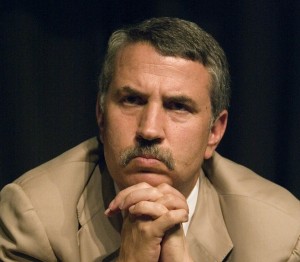
New York Times columnist Thomas L. Friedman
But these “truth-loving” pundits, the likes of star Times columnist Thomas L. Friedman, never seem to reflect on their own responsibility for disseminating devastating “fake news,” such as the falsehoods about Iraq’s WMD, lies that led to the deaths of hundreds of thousands of Iraqis and thousands of American soldiers and spread horrific chaos across the Mideast and into Europe.
Nor does that Iraq experience ever cause Friedman and his fellow pundits to question other Official Narratives, including those relating to the proxy war in Syria or the civil war in Ukraine or the New Cold War with Russia. Meanwhile those of us who ask for substantiating facts or observe that some official claims don’t make sense are subjected to insults as fill-in-the-blank “apologists” or “stooges.”
It seems that any deviation from Officialdom’s pronouncements makes you an enemy of “truth” because “truth” is what the Establishment says is “truth.” And, if you don’t believe me, I refer you to Friedman’s Wednesday’s column.
Friedman leads off the article by quoting himself telling a questioner at a Montreal conference: “I fear we’re seeing the end of ‘truth’.”
But Friedman doesn’t take himself to task by noting how he helped disseminate the Iraq WMD lies and how he flacked for that illegal and disastrous war for years.
If he had ‘fessed up, maybe Friedman could then have explained why he didn’t resign in disgrace and engage in some lifelong penance, preferably including a vow of silence, rather than continuing to spout lots of other nonsense while also continuing to collect a handsome salary and to rack up lucrative speaking fees.
Instead, after wringing his hands over why Americans no longer trust their leaders, Friedman cites another voice of authority, a friend and mentor, Dov Seidman, who complains that “What we’re experiencing is an assault on the very foundations of our society and democracy – the twin pillars of truth and trust. …
“What makes us Americans is that we signed up to have a relationship with ideals that are greater than us and with truths that we agreed were so self-evident they would be the foundation of our shared journey toward a more perfect union – and of respectful disagreement along the way. We also agreed that the source of legitimate authority to govern would come from ‘We the people’.”
Friedman then goes on to share Seidman’s lament that when “we” no longer share basic truths “then there is no legitimate authority and no unifying basis for our continued association.”
The Villains
Friedman identifies the villains in this scenario as “social networks and cyberhacking,” which help “extremists to spread vitriol and fake news at a speed and breadth we have never seen before.” So, it seems those “truth” algorithms can’t arrive soon enough.
However, if you keep reading Friedman’s column, you learn that the real problem is not that “cyberhacking” is generating “fake news,” but rather that it has let Americans see too many ugly truths about their leadership, as happened when WikiLeaks published emails showing how the Democratic National Committee unethically tilted the playing field against Sen. Bernie Sanders; how Hillary Clinton pandered to Goldman Sachs in return for lucrative speaking fees; and how the Clinton Foundation engaged in pay-to-play with rich foreigners.
Friedman’s column acknowledges as much, again citing Seidman: “Social networks and hacking also ‘have enabled us to see, in full color, into the innermost workings of every institution and into the attitudes of those who run them,’ noted Seidman, ‘and that has eroded trust in virtually every institution, and the authority of many leaders, because people don’t like what they see’.”
In other words, the answer to restoring “trust” and to respecting “truth” is to hide ugly realities from the unwashed public. If the people are shielded from the facts, the Establishment will regain its control over “truth” and thus win back the people’s “trust.”
If all this seems upside-down to you – if you think that the real answer is for America’s leaders to behave more responsibly, to let the public in on the real “truth,” and thus to make the people’s “trust” mean something – you must be a “Kremlin stooge.” After all, the current groupthink is that the diabolical Russians slipped WikiLeaks those Democratic emails in a nefarious plot to undermine Americans’ faith in their democracy.
However, if you’re still having trouble with Friedman’s logic, you also must not understand how America’s new media paradigm works. The job of the media is not to provide as much meaningful information as possible to the people so they can exercise their free judgment; it is to package certain information in a way to guide the people to a preferred conclusion.
Pleasant Myths
You see the last thing that Friedman really wants is for the American people to understand their own reality – the good, the bad and the ugly. Instead, we are to have our pretty little heads filled with pleasant myths that make us feel special as we are herded either to the shearing shed or to the slaughterhouse.
For instance, reflect on the history that we hear from Friedman’s friend Seidman about how we “signed up” for those high-minded proclamations in the Declaration of Independence and the U.S. Constitution. The truth is that most of us didn’t “sign up” for anything; we were just born here; and – by the way – the Founders were hypocrites who said and wrote things that they didn’t believe at all.
When slaveholding Thomas Jefferson wrote “We hold these truths to be self-evident, that all men are created equal, that they are endowed by their Creator with certain unalienable Rights, that among these are Life, Liberty and the pursuit of Happiness,” he didn’t believe a word of it. He considered his black slaves inferior beings and thought they deserved none of those “unalienable rights.” He devoted much of his adult life to defending and expanding the institution of slavery, which – by increasing demand for his human chattel – also increased his personal wealth.
When Gouverneur Morris penned the Preamble to the U.S. Constitution, citing “We the People” as the nation’s true sovereigns, he really meant white men of money and means, not poorer white men, nor women, and surely not slaves. His reference to “the People” was another propagandistic affectation.
There may be some irony in the fact that history imparts genuine value to the words of Jefferson and Morris even if they were simply empty propaganda when written. Jefferson’s assertion that “all men are created equal” possessing “unalienable rights” has inspired people around the world – and a literal interpretation of Morris’s florid rhetoric did, in a way, make “We the People” the technical sovereigns of America, as much as today’s ruling elites don’t really believe that either.
Much of what we see from the likes of Friedman is designed to reassert elite control by putting us back in an information-starved dependent state, reliant on the Establishment to parcel out a few morsels of information as it sees fit, the “truth” that the powers-that-be deign to give us. All the better for us to “trust” them.
But the messy behind-the-scenes reality that WikiLeaks and other publishers of “cyberhacked” and leaked material have made available to us – as well as the hypocritical and ambiguous history of the United States – is part of America’s “truth” and thus a reality that should belong to all the people.
Instead, Friedman and other Important People prefer a future in which unpleasant and unpopular truths can be marginalized or erased, all the better to guarantee our “trust” in our leaders.
The Times and the Post, in particular, have consistently conflated any deviation from their preferred groupthinks with “fake news” and “propaganda.” That is why it is particularly troubling when they and other self-proclaimed arbiters of truth, including the pro-NATO propaganda site Bellingcat, sit on Google’s First Draft Coalition and salivate over the prospects of unleashing high-tech algorithms to hunt down and eliminate information that runs counter to what they call the “truth.”
The real truth about truth is that it is almost always complex and often hidden by powerful interests. It requires skepticism, hard work and even courage to reveal it.
Sure, there are occasions when creeps and crazy people purposely make up stuff or ignore reality in pursuit of some nutty conspiracy theory – and that deserves hearty condemnation – but there are many other times when the conventional wisdom is wrong and the people demanding inconvenient facts and asking probing questions turn out to be right.
So, if Friedman and his friends really want to restore trust and truth, they might begin by acknowledging their own flaws and by admitting the times when their groupthinks turned out to be wrong. They also might start respecting the value that dissent has in the difficult pursuit of truth.
Investigative reporter Robert Parry broke many of the Iran-Contra stories for The Associated Press and Newsweek in the 1980s.
Deep History of America’s Deep State
By Jada Thacker | Consortium News | June 23, 2017
Everybody seems to be talking about the Deep State these days. Although the term appears to have entered the lexicon in the late 1990s, for years it referred only to shady foreign governments, certainly not to our own “indispensable nation.”
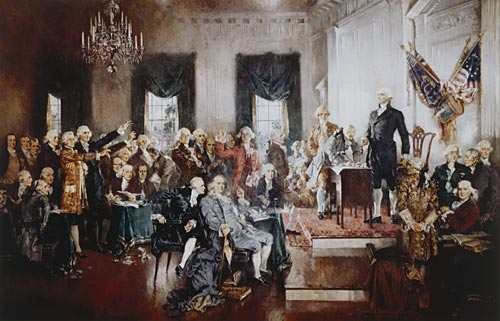
Artist’s rendering of the Constitutional Convention, 1787
Does the sudden presence of an American Deep State – loosely defined as an unelected elite that manipulates the elected government to serve its own interests – pose a novel, even existential, threat to democracy?
Not exactly. The threat seems real enough, but it’s nothing new. Consider these facts: 230 years ago, an unelected group of elite Americans held a secretive meeting with an undisclosed agenda. Their purpose was not merely to manipulate lawful government in their own interests, but to abolish it altogether. In its place, they would install a radically undemocratic government – a “more perfect” government, they said – better suited to their investment portfolios.
History does not identify these conspirators as the Deep State. It calls them the Founders. The Founders did not consider themselves conspirators, but “republicans” – not in reference to any political party, but rather to their economic station in society. But their devotion to “republicanism” was transparently self-serving. A current college text, The American Journey: A History of the United States, explains though does not explicate “republican ideology”:
“Their main bulwark against tyranny was civil liberty, or maintaining the right of the people to participate in government. The people who did so, however, had to demonstrate virtue. To eighteenth century republicans, virtuous citizens were those who were focused not on their private interests but rather on what was good for the public as a whole.
“They were necessarily property holders, since only those individuals could exercise an independence of judgment impossible for those dependent upon employers, landlords, masters, or (in the case of women and children) husbands and fathers.” [Emphasis supplied]
Republicanism was a handy idea if you happened to be a master or a landlord, who were the only persons this ideology considered “virtuous” enough to vote or hold political office. Thus, “republicanism” – virtually indistinguishable from today’s “neoliberalism” – created the original Deep State in the image of the economic system it was designed to perpetuate.
How this was accomplished is not a comforting tale. But it cannot be related nor understood without an appreciation of the historical context in which it occurred.
Masters and Servants
Post-colonial America was predominantly agrarian, and about 90 percent of the population was farmers. (The largest city in 1790 was New York, with a whopping population of 33,000 residents.) There was a small middle class of artisans, shopkeepers, and even a handful of industrial workers, but the politically and economically powerful people were the relatively few big-time merchants and landowners – who also fulfilled the function of bankers.

Gouverneur Morris, Constitutional Convention
delegate and key drafter of the Preamble.
(Painting by Edward Dalton Marchant)
America was not quite a feudal society, but it resembled one. Commoners did not call at the front doors of the rich, but were received around back. Most states had official religions, some with compulsory church attendance backed by fines. Commodity-barter was the currency of the day for the vast majority. Debtors were imprisoned. Parents sold their children into bondage. It wasn’t what most people think of when they hear “Yankee Doodle Dandy.”
All states restricted voting only to men who owned a requisite amount of property, while the majority: un-widowed women, servants, and tenants owned no property. Moreover, most states had property requirements for eligibility to elective office, some with the higher offices reserved for those with the most property. Such restrictions had discriminated against the urban underclass and farmers since the beginning of American colonization.
Nobody at the time characterized this land of masters and servants as a “democracy.” Indeed, the master class considered “democracy” synonymous with “mob rule.” But not everybody was happy with “republican virtue” in post-war America, least of all the slaves of the “virtuous.”
The Revolutionary War had stirred passions among the servant class for social and economic liberty, but when the war ended nothing much had changed. In fact, the war proved not to have been a revolution at all, but represented only a change from British overlords to American overlords. Edmund Morgan, considered the dean of American history in the colonial era, characterized the “non-Revolutionary War” this way:
“The fact the lower ranks were involved in the contest should not obscure the fact that the contest itself was generally a struggle for office and power between members of an upper class: the new against the established.”
About 1 percent of the American population had died in a war fought, they had been told, for “liberty.” (Compare: if the U.S. lost the same proportion of its population in a war today, the result would be over three million dead Americans.) Yet after the war, economic liberty was nowhere in sight.
Moreover, the very concept of “liberty” meant one thing to a farmer and quite another to his rich landlord or merchant. Liberty for a common farmer – who was generally a subsistence farmer who did not farm to make money, but rather only to provide the necessities of life for his family – meant staying out of debt. Liberty for merchants and property owners – whose business it was to make monetary profits – meant retaining the ability to lend or rent to others and access to the power of government to enforce monetary repayment from debtors and tenants.
Much like the American Indians who had first communally owned the property now occupied by American subsistence farmers, agrarian debtors faced the unthinkable prospect of losing their ability to provide for their families (and their vote) if their land were confiscated for overdue taxes or debt. [See Consortiumnews.com’s “How Debt Conquered America.”]
Loss of their land would doom a freeholder to a life of tenancy. And the servitude of tenants and slaves differed mainly as a function of iron and paper: slaves were shackled by iron, tenants were shackled by debt contracts. But iron and paper were both backed by law.
By the end of the Revolutionary War, as few as a third of American farmers owned their own land. When the urban elites began to foreclose on the debts and raise the taxes of subsistence farmers – many of whom had fought a long and excruciating war to secure their “liberty” – it amounted to a direct assault on the last bastion of Americans’ economic independence.
The Original Great Recession
After the war, British merchants and banks no longer extended credit to Americans. Moreover, Britain refused to allow Americans to trade with its West Indies possessions. And, to make matters worse, the British Navy no longer protected American ships from North African pirates, effectively closing off Mediterranean commerce. Meanwhile, the American navy could not protect American shipping, in the Mediterranean or elsewhere, because America did not happen to possess a navy.
In the past, American merchants had obtained trade goods from British suppliers by “putting it on a tab” and paying for the goods later, after they had been sold. Too many Americans had reneged on those tabs after the Revolution, and the British now demanded “cash on the barrelhead” in the form of gold and silver coin before they would ship their goods to America.
As always, Americans had limited coin with which to make purchases. As the credit crunch cascaded downwards, wholesalers demanded cash payment from retailers, retailers demanded cash from customers. Merchants “called in” loans they had made to farmers, payable in coin. Farmers without coin were forced to sell off their hard-earned possessions, livestock, or land to raise the money, or risk court-enforced debt collection, which included not only the seizure and sale of their property but also imprisonment for debt.
The most prominent result of Americans’ war for “liberty” turned out to be a full-blown economic recession that lasted a decade. Even so, the recession would not have posed a life-threatening problem for land-owning subsistence farmers, who lived in materially self-sufficient, rural, communal societies. But when state governments began to raise taxes on farmers, payable only in unavailable gold and silver coin, even “self-sufficient” farmers found themselves at risk of losing their ability to feed their families.
Debt, Speculation, and the Deep State
The Continental Congress had attempted to pay for its war with Britain by printing paper money. The British undermined these so-called “Continental” dollars, not only by enticing American merchants with gold and silver, but by counterfeiting untold millions of Continental dollars and spending them into circulation. The aggregate result was the catastrophic devaluation of the Continental dollar, which by war’s end was worthless.
In the meantime, both Congress and state governments had borrowed to pay for “liberty.” By war’s end, war debt stood at $73 million, $60 million of which was owed to domestic creditors. It was a staggering sum of money. In his now studiously ignored masterpiece, An Economic Interpretation of the Constitution of the United States, historian Charles A. Beard showed that domestically-held war debt was equivalent to 10 percent of the value of all the surveyed land holdings (including houses) in the entire United States at the time.
The war debt carried interest, of course – which is a problem with debt if you owe it, but is a feature of debt if it is owed to you. Not only was “freedom not free” – it came with dividends attached for Deep State investors. This should sound at least vaguely familiar today.

President George Washington
As Continental paper money lost its value, Congress and state governments continued to pay for “liberty” with coin borrowed at interest. When that ran short, government paid only with promises to pay at a later date – merely pieces of paper that promised to pay coin (or land) at some indeterminate time after the war was won.
This was how the government supplied the troops (whenever it managed to do so) and also how it paid its troops. In actual practice, however, Congress often did not pay the troops anything, not even with paper promises, offering only verbal promises to pay them at the end of the war.
But war is never a money-making enterprise for government, and when it ended, the government was as broke as ever. So, it wrote its verbal promises on pieces of paper, and handed them to its discharged troops with a hearty Good Luck with That! Even so, Congress paid the soldiers in bonds worth only a fraction of the amount of time most had served, promising (again!) to pay the balance later – which it never did.
Thousands of steadfast, longsuffering troops were abandoned this way. Most had not been paid any money in years (if ever), and many were hundreds of miles from their homes – ill, injured, and starving – as they had been for months and years. Others literally were dressed only in rags or pieces of rags. Some carried paper promises of money; some carried paper promises of geographically distant land – none of which would be available until years in the future, if at all.
Seven-year Revolutionary War veteran Philip Mead described his plight in a bitter memoir entitled A Narrative of Some of the Adventures, Dangers and Sufferings of a Revolutionary Soldier: “We were absolutely, literally starved. I do solemnly declare that I did not put a single morsel of victuals in my mouth for four days and as many nights, except a little black birch bark which I gnawed off a stick of wood, if that can be called victuals. I saw several of the men roast their old shoes and eat them….
“When the country had drained the last drop of service it could screw out of the poor soldiers, they were turned adrift like old worn-out horses, and nothing said about land to pasture them on.”
Was this liberty? To impoverished veterans, “liberty” looked bleak, indeed. To speculators in government bonds, liberty looked like a golden opportunity, quite literally so.
Vultures possessed of coin swooped in and bought a dollar’s worth of government promises for a dime, and sometimes for just a nickel. Speculators wheedled promises not only from desperate veterans (many of whom sold their promises merely to obtain food and clothes on their long trudge home), but from a host of people whose goods or services had been paid with IOUs.
Optimistic speculators cadged bonds from pessimistic speculators. The more desperate people became during the recession, the more cheaply they sold their promises to those who were not.
Speculators expected their investments, even those made with now-worthless paper money, to be paid in gold or silver coin. What’s more, “insiders” expected all those various government promises would eventually be converted – quietly, if possible – into interest-bearing bonds backed by a single, powerful taxing authority. All the Deep State needed now was a national government to secure the investment scheme. A man named Daniel Shays unwittingly helped to fulfil that need.
Rebellion and Backlash
Thomas Jefferson penned the famous sentence: “The tree of liberty must be refreshed from time to time with the blood of patriots and tyrants.” He was not referring to heroic American Patriots charging up Bunker Hill against British bayonets. He was referring instead to American farmers – many of whom had been the starving soldiers in a war for forsaken liberty – taking their lives into their hands to oppose the tax policies of the government of Massachusetts in 1787. The principal leader of this revolt was a farmer and war veteran Daniel Shays.
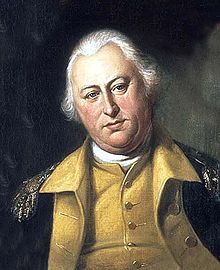
General Benjamin Lincoln led a force in 1787
to put down Shays’ Rebellion in Massachusetts
(Painting by Charles Willson Peale)
In a sense, the most interesting thing about Shays’s Rebellion is that it was not a unique event.
The first notable example of agrarian revolt had been Bacon’s Rebellion in 1676 Virginia, when frontier farmers marched on the rich plantation owners of Jamestown, burned it to the ground, published their democratic “Declaration of the People,” and threatened to hang every elite “tyrant” on their list – which included some of the forefathers of America’s patriot Founders.
Historian Gary Nash reminds us Bacon’s Rebellion had echoes across early American history: “Outbreaks of disorder punctuated the last quarter of the 17th century, toppling established governments in Massachusetts, New York, Maryland, Virginia, and North Carolina.” Jimmy Carter, in The Hornet’s Nest, the only novel ever published by an American president, tells a similar story of the agony of dispossessed farmers in Georgia a century later.
Other farmers had rebelled in New Jersey in the 1740s; in the New York Hudson Valley rent wars in the 1750s and 1760s and concurrently in Vermont by Ethan Allen’s Green Mountain Boys; for a decade in North Carolina in the 1760s, where vigilantes called Regulators battled the government of the urban elite; and in Virginia in the 1770s. Likewise, American cities had been scenes of labor unrest, riots, and strikes for a century. American class rebellion, apparently unbeknownst to most history teachers in America, was closer to the rule than the exception.
Victory in the war against England only intensified the conflict between those who considered “liberty” as a necessary condition to live without debt, against those who considered “liberty” to be their class privilege to grow rich from the debts others owed them. Howard Zinn, in his A People’s History of the United States describes the economic realities of Eighteenth Century America:
“The colonies, it seems, were societies of contending classes – a fact obscured by the emphasis, in traditional histories, on the external struggle against England, the unity of colonists in the Revolution. The country therefore was not ‘born free’ but born slave and free, servant and master, tenant and landlord, poor and rich.”
Although Shays’s Rebellion was not unique, it was a huge event, coming at a time when the rich were owed a great deal of money by impoverished governments. Pressured by rich bondholders and speculators, the government of Massachusetts duly raised taxes on farmers. To make matters far worse, the taxes were to be paid only in gold or silver – which was completely out of the question for most western farmers, who had no way to obtain coined money.
When the farmers complained, their complaints were ignored. When farmers petitioned the government to issue paper money and accept it as payment of debts and taxes, the government refused their petitions. When the farmers pleaded for the passage of “legal tender laws” that would allow them to settle their debts or taxes with their labor, they were rebuffed.
But when farmers could not pay what they did not have, the Massachusetts’s courts ordered their land seized and auctioned. At last, the farmers understood the practical effect, if not the specific intent, of the tax: confiscation of their property and its transfer to the rich, to whom the government owed its interest-bearing debt. Government had become an armed collection agency.
To the utter dismay of the erstwhile proudly tax-rebellious Patriots, the farmers too rebelled. Shaysites forcibly shut down the tax courts that were condemning them to servitude. The rich responded by loaning the destitute government more money (at interest!) to pay a militia force to oppose Shays’s rebels.
At this point, tax rebels abandoned reform for radical revolution and – in a resounding echo of Nathaniel Bacon’s century-old Declaration of the People – pledged to march on Boston and burn it to the ground. This was no Tea Party vandalism, stage-managed by well-to-do Bostonians like Samuel Adams. It was a full-blown, grassroots agrarian revolution a century in the making.
The urban bond-holding merchant-class in Boston and elsewhere panicked. And none panicked more than bond speculators, who intimately understood the rebels threatened their “virtuous” republican “liberty” to extract profit from others. Historian Woody Holton exposes the astonishing callousness of one of America’s major bond speculators in his nationally acclaimed Unruly Americans and the Origin of the Constitution:
“As a bondholder, Abigail Adams would benefit immensely if her fellow Massachusetts citizens [paid the tax] levied by the legislature in March 1786, but she also saw compliance as a sacred duty. If Massachusetts taxpayers were ‘harder-prest by publick burdens than formerly,’ she wrote, ‘they should consider it as the price of their freedom’.”

Abigail Adams,
wife of the second President John Adams,
in a portrait by Benjamin Blythe.
Future First Lady Abigail Adams was not alone in thinking freedom came with dividends payable to her account. Historian David Szatmary reminds us in his Shays Rebellion; The Makings of an Agrarian Insurrection that the former Patriot leadership, especially those in the merchant class, were among the first to advocate violence against democratic rebellion.
Said a published opinion piece at the time: “When we had other rulers, committees and conventions of the people were lawful – they were then necessary; but since I myself became a ruler, they cease to be lawful – the people have no right to examine my conduct.”
Showboat Patriot and bond speculator Samuel Adams –former mastermind of the Boston Tea Party and erstwhile propagandist against unfair British taxes (as well as cousin to Abigail’s husband John Adams) – sponsored a Massachusetts law that allowed sheriffs to kill tax protesters outright.
Another rich bondholder and speculator, ex-Revolutionary War General Henry Knox (the fitting namesake of Fort Knox, the famous repository of gold bullion) wrote an alarming letter to his former commander George Washington, accusing the Shays’s rebels of being “levelers” (which was the closest term to “communists” then in existence). He informed Washington that the country needed a much stronger government (and military) to prevent any riffraff challenge to the elite. His message was not wasted on General Washington, America’s richest slave owner.
In the end, the Congress, under the Articles of Confederation, could raise no money from the states to provide an army, but the privately-financed, for-profit Massachusetts militia successfully defeated Shays’s rebels. Still, the nearly hysterical fear of democratic economic revolution had been planted in the minds of the masters. Shays’s Rebellion proved to be the last straw for bond speculators whose profits were jeopardized by democracy.
Worse even, the governments of many other states were beginning to cave under intense democratic pressure from rebellious debtors. Some states were entertaining laws that prevented the seizure of property for debt; others were creating paper money in order to break the gold and silver monopoly. Rhode Island not only voted in a paper money system, but threatened to socialize all commercial business enterprises in the state.
In response to the threat of populism, the “virtuous” elite reacted decisively – not to remedy the plight of debtors, of course – but to secure their own profits from them. Accordingly, in 1786, five states sent delegates to meet at Annapolis, Maryland, just as Shays’s Rebellion veered into revolution. This unelected minority called for Congress to authorize a convention to be held in Philadelphia the next year “for the sole and express purpose of revising the Articles of Confederation.” The Articles were never to be “revised.” They were to be scrapped altogether by the Deep State.
The Deep State Conspires
Thanks to Charles A. Beard’s An Economic Interpretation of the Constitution of the United States, we know quite a lot about the status of the 55 men who conspired to draft the Constitution. But the very first thing we need to know is that they were not authorized by “We the People” simply because nobody had voted for them; all were political appointees.
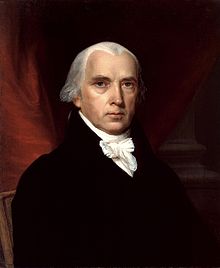
James Madison
Nor were they even a representative sample of the people. Not a single person in the Convention hall “worked for a living,” nor was female, nor was a person of color. Only one claimed to be a “farmer,” the current occupation of about 90 percent of the population. Most were lawyers. Go figure.
If the delegates represented anybody at all, it was the economic elite: 80 percent were bondholders; 44 percent were money-lenders; 27 percent were slave owners; and 25 percent were real estate speculators. Demographically, the 39 who finally signed the final draft of the Constitution constituted .001 percent of the American population reported in the 1790 census. George Washington, who presided, was arguably the wealthiest man in the country. Deep State gamblers all.
And the stakes were high. Recall that the face value of outstanding domestic government bonds in 1787 was $60 million, equivalent to 10 percent of the total improved land value of the country. But these bonds, for the most part, had been obtained by speculators at a fraction of face value. Beard very conservatively estimated the profit of speculators – if the bond were redeemed at face value – would have been some $40 million. Expressed as the same proportion of total improved land value at the time of the Founding, the expected profit from government bonds held then would equal at least $3 trillion today. Tax free.
We still do not know everything that transpired at the convention. No one was assigned to keep a record of what was discussed. Reportedly, even the windows to the meeting hall were nailed shut to prevent eavesdropping – though there would be “leaks.” Because of its secrecy and its unauthorized nature, some historians have called the convention “the second American Revolution.” But revolutions are public, hugely participatory events. This was a coup d’état behind locked doors.
Most delegates presumably understood their undisclosed purpose was to dump the whole system of confederated government (which had cost 25,000 American lives to secure) into a dustbin. They evidently did not intend to obey their instructions “solely to revise” the Articles because a number of them showed up at the convention with drafts for a new constitution in hand.
The conspirators’ ultimate goal was to replace the Confederation with what they later euphemized as “a more perfect Union” – designed from the outset to protect their class interests and to ensure the new government possessed all the power necessary to perpetuate the existing oligarchy.
At the Convention, Alexander Hamilton captured the prevailing sentiment: “All communities divide themselves into the few and the many. The first are the rich and well-born; the other the mass of the people … turbulent and changing, they seldom judge or determine right. Give therefore to the first class a distinct, permanent share in the Government. … Nothing but a permanent body can check the imprudence of democracy.”

A portrait of Alexander Hamilton
by John Trumbull, 1792.
Hamilton further proposed that both the President and the Senate be appointed (not elected) for life. His vision was but half a step removed from monarchy. Though not a Convention delegate, John Jay, Hamilton’s political ally, slaveowner, and the first Chief Justice of the Supreme Court, stated the purpose of “republicanism” with brutal brevity: “The people who own the country ought to govern it.”
The Founders never once envisioned any such a thing as “limited government” – unless perhaps in the sense that the power of government was to be limited to their own economic class. [See Consortiumnews.com’s “The Right’s Made-up Constitution.”]
In Towards an American Revolution: Exposing the Constitution & Other Illusions, historian Jerry Fresia sums the Founders’ views succinctly: “The vision of the Framers, even for Franklin and Jefferson who were less fearful of the politics of the common people than most, was that of a strong centralized state, a nation whose commerce and trade stretched around the world. In a word, the vision was one of empire where property owners would govern themselves.” [Emphasis supplied]
Self-government by the people was to remain permanently out of the question. The Deep State was to govern itself. “We the People,” a phrase hypocritically coined by the ultra-aristocrat Gouverneur Morris, would stand forever after as an Orwellian hoax.
The tricky task of the hand-picked delegates was to hammer out a radical new system of government that would superficially resemble a democratic republic, but function as an oligarchy.
William Hogeland’s excellent Founding Finance, recounts the anti-democratic vehemence expressed at the Convention: “On the first day of the meeting that would become known as the United States Constitutional Convention, Edmund Randolph of Virginia kicked off the proceedings […] ‘Our chief danger,’ Randolph announced, ‘arises from the democratic parts of our constitutions. … None of the constitutions’ – he meant those of the states’ governments – ‘have provided sufficient checks against the democracy.’”
No wonder they nailed the windows shut. It should be no surprise that the word “democracy” does not appear once in the entire U.S. Constitution, or any of its Amendments, including the Bill of Rights. Accordingly, the Constitution does not once refer to the popular vote, and it did not guarantee a single person or group suffrage until the adoption of the 15th Amendment in 1870, over 80 years after ratification. The Preamble aside, the Founders used the phrase “the People” only a single time (Art. I, Sec. 2).
It has been suggested the word “democracy” had a different meaning then than it has now. It did not. “Democracy” to the Convention delegates meant the same thing as it does today: “rule by the people.” That’s why they detested it. The delegates considered themselves the patriarchs of “republicanism,” the ideology that rejected participation in government by people like their wives, servants, tenants, slaves, and other non-propertied inferiors. No doubt, the delegates passionately disagreed on many things, but the “fear and loathing” of democracy was not one of them. Then or now.
The Deep State’s Specific Goals
Embedded within the Founders’ broadly anti-democratic agenda were four specific goals. These were not a list of items jotted down in advance, but were derived by group consensus as the minimum requirements necessary to achieve the Deep State’s ultimate agenda.

Thomas Jefferson in a 1800 portrait
by Rembrandt Peale
To camouflage the stark oligarchic nationalism the measures intended, the Founders disingenuously styled themselves “Federalists.” But nothing about these measures concerned a “federation” of sovereign states; taken together, they were intended to demolish the existing “perpetual” confederation, not to re-create it more effectively.
National government with limited citizen participation. Of all the measures required to achieve a national oligarchy, this was the most daunting. It was achieved by a wide array of provisions.
The Electoral College. The President and Vice President are not elected by popular vote, but by electors – then and now. For example, when George Washington was first elected President, the American population was 3.9 million. How many of those folks voted for George? Exactly 69 persons – which was the total number of electors voting at the time. (Art. I, Sec. 3)
Bi-Cameral Congress. Congress is bi-cameral, composed of two “houses” – the House of Representatives and the Senate. Under the original Constitution, the House members represented the people who vote for them, while the Senate represented states, not persons, and was therefore not a democratic body, at all. It was generally expected that the Senate would “check” the democratic House. Indeed, this was the entire purpose of bi-cameralism wherever it has existed. (Art. I, Secs. 1 and 2)
State Appointment of Senators. Senators were originally appointed by state legislatures (until the 17th Amendment in 1913). It was expected that the Senate would function in Congress as the House of Lords functioned in Parliament: the voice of the aristocracy. Even though Senators are now popularly elected, it is far more difficult to challenge an incumbent because of the prohibitive expense of running a state-wide campaign. (Art. I, Sec. 3)
Appointment of the Judiciary. All federal judges are appointed for life terms by the President and confirmed by the (originally undemocratic) Senate. (Art. III, Sec. 1)
Paucity of Representation. Most undemocratic of all was the extreme paucity of the total number of House members. The House originally was composed of only 65 members, or one member per 60,000 persons. Today, there are 435 members, each representing about 700,000 persons. Thus, current House representation of the public is 12 times less democratic than when the Constitution was written – and it was poor (at best) then.
Compare: The day before the Constitution was ratified, the people of the 13 United States were represented by about 2,000 democratically elected representatives in their various state legislatures (1:1950 ratio); the day after ratification, the same number of people were to be represented by only 65 representatives in the national government (1:60000). In quantitative terms, this represents more than a 3,000 percent reduction of democratic representation for the American people. (Art. I, Sec. 2)
Absence of Congressional Districts. Although House members now run for election in equal-populated districts, the districts were created by Congress, not the Constitution. Until the 1960s, some House members were elected at-large (like Senators). This disadvantaged all but the richest and best-known candidates from winning. (Not referenced in Constitution)
Absence of Recall, Initiative and Referendum. The Constitution does not allow the people to vote to recall (un-elect) a Congress member, demand a Congressional vote on any issue (propose an initiative) or vote directly in a referendum on any issue (direct democracy). (Not referenced in Constitution)
Absence of Independent Amendment Process. One of the reasons Americans now have professional politicians is that the Constitution does not provide a way for “the people” to amend it without the required cooperation of a sitting Congress. At the Constitutional convention, Edmund Randolph of Virginia (surprisingly) proposed that the people be afforded a way to amend the Constitution without the participation of Congress. This excellent idea, however, was not adopted. (Art. V)
National authority to tax citizens directly. (Art. I, Sec. 8; 16th Amendment)
National monopolization of military power. (Art. I, Sec.8, clauses 12, 13, 14, 15, 16)
Denial of states’ power to issue paper money or provide debtor relief. (Art. I, Sec.10; Art. I Sec.8, clause 4)
All of these provisions were completely new in the American experience. For 150 years or more, citizen participation in government, independent militias, and the issuance of paper money had been the prerogative of the several, independent colonies/states – while direct external taxation had been universally and strenuously resisted. When the British Crown had threatened to curtail colonial prerogatives, the very men who now conspired for national power had risen in armed rebellion. The hypocrisy was stunning. And people took note of the fact.
Consent of the Minority
One of the note-takers was Robert Yates, a New York delegate to the Convention, who had walked out in protest. Not long afterwards, Yates (who owned no government bonds) stated his objection to the new Constitution: “This government is to possess absolute and uncontrollable power, legislative, executive and judicial, with respect to every object to which it extends. …
“The government then, so far as it extends, is a complete one. … It has the authority to make laws which will affect the lives, the liberty, and the property of every man in the United States; nor can the constitution or the laws of any state, in any way prevent or impede the full and complete execution of every power given.”

Whipping scars on back of African-American slave
At least half of the American population (collectively called “Anti-federalists”) thought the Constitution was a terrible idea. To be sure, well-to-do Anti-federalists like Yates were not overtaxed farmers, and their objections were often based upon the defense of states’ rights, not peoples’ economic rights. Most Anti-federalists, however, seemed alarmed that the Constitution contained no guarantee of the basic political rights they had enjoyed under the British Empire, such as freedom of speech or trial by jury.
The debate between supporters and critics of the Constitution raged for a year, while partisan newspapers published articles both pro and con. A collection of 85 “pro” articles is known now as The Federalist Papers, which were written by Alexander Hamilton, James Madison and John Jay. Although these articles have been studied almost as religious relicts by historians, they do not tell us “what the Constitution really means.”
The Constitution means what it says. The Federalist Papers are sales brochures, written by lawyers trying to get others to “buy” the Constitution. The same can be said about a similar collection of “Anti-federalist Papers,” from which Yates’s quote above was taken. In any event, it is up to the courts to interpret the Constitution, not lawyers with vested interests.
In due course, the Anti-federalists put their collective foot down. There would be no hope of ratification without amendments guaranteeing fundamental political – but not economic – rights. Although Hamilton argued a guarantee of rights would be “dangerous,” James Madison convinced the Federalists that agreeing to guarantee a future Bill of Rights would be much safer than meddling with the text of the current document, which might entail unraveling its core nationalist, anti-democratic agenda. And so, a deal was struck.
Even so, the battle over the ratification of the Constitution was not ultimately decided by the people of the nation. Although the people of the several states had not voted to authorize the Convention, or the document it had produced, the Founders had been incredibly arrogant, not to mention sly. Not only had they presented the unauthorized document to the states as a take-it-or-leave-it proposition (no changes allowed), but the document itself demanded that only special state “conventions” could ratify it – not the majority popular vote of the people.
Specifying ratification by conventions meant the people would be voting for convention delegates, who would in turn vote for ratification. This was tantamount to turning ratification into a popularity contest between convention delegates, rather than a democratically direct vote on the document, itself. Moreover, ratification by convention would present the possibility that a minority of the people in a state (those in favor of the Constitution) might “pack” a convention with delegates, who would then approve of a document establishing a government for all.
Electoral shenanigans were not just hypothetical possibilities. In Philadelphia, for example, a mob kidnapped elected legislators who were boycotting a convention vote, physically dragged them into the state house, and tied them to their chairs in order to force a convention vote. Other, more subtle methods of manipulation occurred elsewhere, notably the disenfranchisement of voters through property qualifications.
Over a hundred years ago, Charles A. Beard completed his exhaustive study of the Constitution and confirmed that it most likely was ratified by a majority – of a minority of the people.
Among Beard’s final conclusions were these: “The Constitution was ratified by a vote of probably not more than one-sixth of the adult males….The leaders who supported the Constitution in the ratifying conventions represented the same economic groups as the members of the Philadelphia Convention…. The Constitution was not created by ‘the whole people’ as the jurists [judges] have said; neither was it created by ‘the states’ as Southern nullifiers long contended; but it was the work of a consolidated group whose interests knew no state boundaries and were truly national in their scope.”
The Deep State, in other words. It was darkly appropriate that a document whose primary purpose was to defeat democratic rule was, itself, brought into force without a majoritarian vote.
In 1788, nine of the 13 states’ conventions ratified the Constitution (as specified in the Constitution’s own Article VII) and the document became the supreme law of the land for those nine states. By 1789, even the democratic holdout Rhode Island had followed suit. And America’s schoolchildren have been led to believe ever since that the Constitution is a sacred document, inspired and ordained by the public-spirited benevolence of Founding Fathers.
But this had been predicted. It had seemed painfully obvious to Eighteenth Century Genevan political philosopher Jean-Jacques Rousseau that constitutional government was the invention of the Deep State, its designated beneficiary.
Dripping with sarcasm, his virtuoso Discourse on Inequality explained the process: “[T]he rich man … at last conceived the deepest project that ever entered the human mind: this was to employ in his favour the very forces that attacked him, to make allies of his enemies…
“In a word, instead of turning our forces against ourselves, let us collect them into a sovereign power, which may govern us by wise laws, may protect and defend all the members of the association, repel common enemies, and maintain a perpetual concord and harmony among us.”
Rousseau penned these words in 1754, 33 years before Gouverneur Morris oversaw the drafting of the identical sales pitch that constitutes the Preamble to the United States Constitution: “We the People of the United States, in Order to form a more perfect Union, establish Justice, insure domestic Tranquility, provide for the common defence, promote the general Welfare, and secure the Blessings of Liberty to ourselves and our Posterity, do ordain and establish this Constitution for the United States of America.”
Rousseau concludes: “All offered their necks to the yoke in hopes of securing their liberty; for though they had sense enough to perceive the advantages of a political constitution, they had not experience enough to see beforehand the dangers of it; those among them, who were best qualified to foresee abuses, were precisely those who expected to benefit by them….” [Emphasis added]
Does the Deep State pose an existential threat to American democracy today? Move along, folks – nothing new to see here.
Jada Thacker, Ed. D, is the author of Dissecting American History: A Theme-Based Narrative. He teaches History and Government at a college in Texas. Contact: jadathacker@sbcglobal.net
US faces historic setback in the Middle East
By M K Bhadrakumar | Indian Punchline | June 23, 2017
The bloc of four Arab countries led by Saudi Arabia that imposed an embargo against Qatar on June 5 has finally presented their charter of demands. An AP dispatch, lists the 13 demands. The most striking demands include Doha reducing ties with Iran, severing relationships with Hezbollah and the Muslim Brotherhood, closing a Turkish military base in the country, and shuttering state broadcaster Al Jazeera and several news outlets.
Interestingly, Qatar is also expected to “consent to monthly audits for the first year after agreeing to the demands, then once per quarter during the second year. For the following 10 years, Qatar would be monitored annually for compliance.” All this means that abject, unconditional capitulation by Qatar only will satisfy its ‘big brothers’ – nothing less. By the way, there is also a timeline to comply – within the next 10 days – or else the demands get ratcheted up.
To my mind, Qatar will have no difficulty to see this is nothing short of a thinly-veiled push for ‘regime change’. The regime’s response can only be that these Arab bigwigs can go and hang themselves.
What happens next? Simply put, the (Sunni) Muslim Middle East is about to split and the historic schism will have profound consequences for regional and international security.
Make no mistake, this latest development also signifies a slap on the face for the Trump administration. Only last Tuesday, US state department warned Saudi Arabia to resolve the standoff without any further delay lest direct US intervention became necessary, doubting the stance taken by Riyadh (which is widely regarded as carrying the imprimatur of the new Crown Prince Mohammed bin Salman) and showing broad empathy with Qatar (where the US Central Command is headquartered.) Curiously, the US spokesperson also had alluded to Saudi Arabia’s past involvement in terrorism “whether it’s through terror financing or other means”.
Evidently, Saudi pride has been touched to the quick and Riyadh has taken exception to the US censuring. Without doubt, these demands are a show of defiance at Washington, too. This is all now going to become a protracted crisis in all likelihood, which will seriously debilitate the US’ regional strategies – unless of course Qatar crawls on its knees — and weaken its war against the ISIS.
To be sure, Turkey will take great exception to the Saudi demand that its so-called military base in Doha should be shut down unceremoniously. President Recep Erdogan will see this demand as an intolerable affront to Ottoman legacy. The VOA reported on Thursday that Turkey has been moving food and troops to Qatar in a big way.
Quite obviously, the crux of the matter is that the virus of Arab Spring is hibernating in Qatar and it threatens to become an epidemic someday again, threatening the autocratic regimes in the Middle East. Only Turkey, Iran and Israel are immune to the virus of democratic empowerment. Evidently, Al Jazeera and the Muslim Brotherhood are driving the sheikhs crazy in Saudi Arabia, UAE and Bahrain and threaten the military dictatorship in Egypt.
The credibility of the US on the ‘Arab Street’ is now irreparably damaged. For President Donald Trump all this becomes a big political embarrassment domestically. (Bloomberg ) It remains to be seen how the US can afford to sustain its belligerent posturing in Syria and Iraq much longer without any regional allies from the Arab world.
The Trump administration’s containment strategy against Iran seems destined to collapse even before its launch and Trump’s pet project of the ‘Arab NATO’ looks a macabre joke. Can the US ever restore its hegemony over the Muslim Middle East? Doubtful. A big slice of modern history of the western hegemony over Arabs is breaking away and drifting toward the horizon. To be sure, Russians are coming!
Taliban says foreign troops must go before peace talks as US plans 4,000-strong surge
RT | June 23, 2017
In an annual address to followers, the Taliban’s leader warned against sending additional foreign troops to Afghanistan, saying that only after all foreign soldiers leave can peace be negotiated.
Maulvi Haibatullah Akhunzadah spoke on Friday on the occasion of the Eid al-Fitr festival, which ends the holy Muslim month of Ramadan. He reiterated that Afghanistan must be free of foreign occupation.
“The occupation is the main obstacle in the way of peace,” he said, referring to the presence of NATO troops in the country.
“The more they insist on maintaining the presence of their forces here or want a surge of their forces, the more regional sensitivity against them will intensify,” he added.
The remark apparently refers to reported US plans to deploy 4,000 additional troops to Afghanistan to support its crumbling national army. The majority of the force would be used in train and assist missions, but some would be involved in counterinsurgency operations, according to AP.
Akhunzadah insisted that peace negotiations with the government in Kabul would only be possible after “the occupation comes to an end,” adding that a “completely independent” Afghanistan would live under an Islamic law and distance itself from foreign players, neither supporting them nor allowing their interference.
“We don’t permit others to use the soil of Afghanistan against anyone,” he said.
He also urged Taliban fighters to avoid civilian casualties in their attacks on government forces.
The call comes a day after a truck bomb attack on a bank in Helmand province in which 34 people were killed, according to Afghan officials.
On one of its Twitter accounts, the Taliban claimed credit for the suicide bombing in the provincial capital Lashkar Gah, saying it had killed 73 members of the security forces, a figure that conflicts with the official report. Omar Zwak, spokesman for the provincial governor, acknowledged that there were police officers and national army soldiers among the victims, but insisted the majority of them were civilians, who wanted to withdraw money for Eid al-Fitr celebration.
The Taliban leader also boasted that the movement is winning more respect from “mainstream entities of the world.” The apparent attempt to bolster Taliban credibility came amid competition from rival extremist group Islamic State (IS, formerly ISIS/ISIL), which has been winning allegiance of some armed groups previously loyal to the Taliban.
Some nations, including Russia and China, voiced concern with IS gaining a foothold in Afghanistan.
China may finance Russia’s natural gas pipeline to Europe
RT | June 22, 2017
Gazprom’s Nord Stream 2 pipeline may get Chinese financing if European companies are forced out of the project by the latest round of US sanctions, business daily Vedomosti reports.
Russian officials have already contacted Chinese banks, sources have told the media.
“Nord Stream 2 has a good rate of return and low risks for creditors. Chinese banks may be interested,” explains Aleksey Grivach, deputy CEO at Russia’s National Energy Security Fund.
The extension will double the existing pipeline which delivers natural gas to Germany under the Baltic Sea and is estimated to cost €9.5 billion.
Initially, Engie, OMV, Royal Dutch Shell, Uniper, and Wintershall were to get a 50 percent stake minus one share in Nord Stream 2. However, red tape at the European Commission made Gazprom and its partners come up with another financing option. Under this plan, European companies will each provide an equal long-term loan to Gazprom, which will fully own the pipeline.
Financing of Nord Stream 2 may be affected by new US sanctions which target firms investing in Russian gas and oil projects. According to the new bill passed by the US Senate, and currently, before the House of Representatives, companies will be forbidden from making investments of over $1 million in the Russian energy sector.
On Wednesday, Russian President Vladimir Putin met the CEO of Royal Dutch Shell, Ben van Beurden. Among other things, they discussed Nord Stream 2. Van Beurden told Interfax the new project “will be realized for the benefit of all parties – both Europeans and the Russian Federation.”
Is ‘Tillerson Plan’ for Ties With Russia Connected to New US Sanctions Bill?
Sputnik | June 22, 2017
A leak of the “secret” document on developing US-Russian relations, which was supposedly prepared by Secretary of State Rex Tillerson, has prompted a heated debate. Speaking to Sputnik, political analyst Viktor Olevich and Russian academic Andrei Sidorov shed light on what could lie behind “the Tillerson plan.”
A leak of the “secret plan” on developing a working relationship with Russia reportedly prepared by US Secretary of State Rex Tillerson amid the increase in tensions with Moscow is by no means purely coincidental, experts told Sputnik, adding that one of the three paragraphs of the “plan” deserves special attention. On Monday John Hudson of BuzzFeed reported that the media outlet had obtained a document supposedly crafted by Tillerson which envisioned three major steps to further develop Russo-American relations.
The first step was to persuade Moscow to refrain from what the US sees as “aggressive” actions since it will be counterproductive for both sides. The second paragraph envisaged engagement with Russia on issues of strategic interest for the United States, including the ongoing war in Syria, North Korea’s nuclear weapons program, cybersecurity and cyber espionage.
The third paragraph of Tillerson’s plan highlighted the importance of maintaining “strategic stability” with Russia.
“Right now, US-Russia relations are in the gutter. We want to make sure it doesn’t flush into the sewer,” a senior State Department official familiar with the document told the media outlet.
In his interview with Radio Sputnik, Russian political analyst Viktor Olevich noted that the third paragraph of Tillerson’s framework deserves special attention.
“This plan contains no original ideas. One should pay attention to the third point — the maintenance of strategic stability related to the nuclear programs of Russia and the United States; it is the most significant [part of the plan]. This is indeed the point of convergence, where both Moscow and Washington are interested in maintaining a constant dialogue,” Olevich said.
The political analyst noted that it was the US which made an attempt to upset the balance of power by installing elements of its global missile defense system in Europe, near Russia’s borders, following Washington’s unilateral withdrawal from the 1972 Anti-Ballistic Missile Treaty in June, 2002. “This issue should become part of the dialogue between Moscow and Washington, because right now the US refuses to discuss it,” Olevich said, adding that one could only hope that the US position regarding these matters will change.
However, according to Olevich, as of yet there is no indication that Washington is interested in the normalization of Russo-American relations.
For instance, he referred to the downing of the Syrian Arab Army’s warplane in southern Raqqa by the US-led coalition’s aircraft.
The move prompted the Russian Defense Ministry to halt cooperation with the US within the framework of the Memorandum on the Prevention of Incidents and Ensuring Air Safety in Syria as of June 19.
Olevich added that the White House has yet to hand back two diplomatic compounds which were seized from Russia under Barack Obama. One is on Long Island and the other is located on Maryland’s Eastern Shore. The fact that the Trump administration has not yet settled this issue indicates that the US is not ready for the normalization of relations or a serious dialogue with Russia, the political analyst stressed.
For his part, the head of the Department of International Organizations and World Political Processes at Moscow State University, Andrei Sidorov, believes that the leak of the “secret plan” could be considered a signal to Congress that the White House is seeking room for maneuver.
Speaking to Sputnik, Sidorov highlighted that the leak coincided with the decision of House Republicans to block the Russian sanctions bill which had earlier passed the Senate. However, Sidorov assumed that it was not a coincidence. Citing Rep. Kevin Brady (R-Texas), The Hill reported that “the legislation has been flagged” by the House parliamentarian since it violated the constitutional requirement that “revenue bills originate in the House.”
“The development marks a major setback after the Senate overwhelmingly passed the legislation, which also includes new sanctions against Iran, last week in a 98-2 vote,” the media outlet pointed out.
The crux of the matter is that the bill envisions codifying the anti-Russian sanctions into law.
“By now [the anti-Russian sanctions] have been implemented as an executive order which could be canceled anytime by the US president. If they are adopted as a federal law, it would require Congressional approval to abolish them. These sanctions could remain in place for decades,” Russian academic Viktor Kheifets explained in his interview with Radio Sputnik last week.
The legislation targets Russia’s energy projects and debt-financing, most notably, the Nord Stream 2 gas pipeline project, which is poised to deliver natural gas from Russia to Europe. According to Zero Hedge, an English-language financial blog, “if the House does pass [the bill], a huge diplomatic scandal would erupt only not between the US and Russia, but Washington and its European allies who have slammed this latest intervention by the US in European affairs… a scandal which the Democrats would also promptly blame on Trump.”
Indeed, Germany and Austria have already slammed the new anti-Russian sanctions, dubbing the US move as “an absolutely new and highly negative aspect of relations between the US and Europe.”
According to Sidorov, if the bill comes into force, it will significantly reduce the room for maneuver for the Trump administration in US-Russian relations and decision-making process.
“This is a good sign for the [Trump] administration that the process [of the consideration of the bill] was suspended in the House of Representatives, but the main task of combating this bill lies with the State Department,” Sidorov told Sputnik.
“Please note that some officials from the administration have already said that US President Donald Trump is not against the tightening of anti-Russian sanctions, but the State Department objects because it is necessary to build new relations. Therefore, the leak that the document [Tillerson’s plan] envisioning building new relations with the Russian Federation is being mulled [by the White House] refers to the internal political struggle within the US,” the Russian academic believes.
According to Sidorov, the document has sent a clear signal to Congress that the State Department is working on the issue of building new relations with Russia. What the Trump administration desperately needs is leeway in determining foreign policy, the academic stressed.
READ MORE:
White House Reportedly Seeks to Weaken Senate Bill on Russia Sanctions
US State Secretary Tillerson Reportedly Develops New Plan on Ties With Russia
Russia-gate Flops as Democrats’ Golden Ticket
By Robert Parry | Consortium news | June 21, 2017
The national Democratic Party and many liberals have bet heavily on the Russia-gate investigation as a way to oust President Trump from office and to catapult Democrats to victories this year and in 2018, but the gamble appears not to be paying off.
The Democrats’ disappointing loss in a special election to fill a congressional seat in an affluent Atlanta suburb is just the latest indication that the strategy of demonizing Trump and blaming Russia for Hillary Clinton’s 2016 defeat may not be the golden ticket that some Democrats had hoped.
Though it’s still early to draw conclusive lessons from Karen Handel’s victory over Jon Ossoff – despite his raising $25 million – one lesson may be that a Middle America backlash is forming against the over-the-top quality of the Trump-accusations and the Russia-bashing, with Republicans rallying against the image of Official Washington’s “deep state” collaborating with Democrats and the mainstream news media to reverse a presidential election.
Indeed, the Democrats may be digging a deeper hole for themselves in terms of reaching out to white working-class voters who abandoned the party in Pennsylvania, Michigan and Wisconsin to put Trump over the top in the Electoral College even though Clinton’s landslide win in California gave her almost three million more votes nationwide.
Clinton’s popular-vote plurality and the #Resistance, which manifested itself in massive protests against Trump’s presidency, gave hope to the Democrats that they didn’t need to undertake a serious self-examination into why the party is in decline across the nation’s heartland. Instead, they decided to stoke the hysteria over alleged Russian “meddling” in the election as the short-cut to bring down Trump and his populist movement.
A Party of Snobs?
From conversations that I’ve had with some Trump voters in recent weeks, I was struck by how they viewed the Democratic Party as snobbish, elitist and looking down its nose at “average Americans.” And in conversations with some Clinton voters, I found confirmation for that view in the open disdain that the Clinton backers expressed toward the stupidity of anyone who voted for Trump. In other words, the Trump voters were not wrong to feel “dissed.”
It seems the Republicans – and Trump in particular – have done a better job in presenting themselves to these Middle Americans as respecting their opinions and representing their fears, even though the policies being pushed by Trump and the GOP still favor the rich and will do little good – and significant harm – to the middle and working classes.
By contrast, many of Hillary Clinton’s domestic proposals might well have benefited average Americans but she alienated many of them by telling a group of her supporters that half of Trump’s backers belonged in a “basket of deplorables.” Although she later reduced the percentage, she had committed a cardinal political sin: she had put the liberal disdain for millions of Americans into words – and easily remembered words at that.
By insisting that Hillary Clinton be the Democratic nominee – after leftist populist Bernie Sanders was pushed aside – the party also ignored the fact that many Americans, including many Democrats, viewed Clinton as the perfectly imperfect candidate for an anti-Establishment year with many Americans still fuming over the Wall Street bailouts and amid the growing sense that the system was rigged for the well-connected and against the average guy or gal.
In the face of those sentiments, the Democrats nominated a candidate who personified how a relatively small number of lucky Americans can play the system and make tons of money while the masses have seen their dreams crushed and their bank accounts drained. And Clinton apparently still hasn’t learned that lesson.
Citing Women’s Rights
Last month, when asked why she accepted hundreds of thousands of dollars for speaking to Goldman Sachs, Clinton rationalized her greed as a women’s rights issue, saying: “you know, men got paid for the speeches they made. I got paid for the speeches I made.”
Her excuse captured much of what has gone wrong with the Democratic Party as it moved from its working-class roots and New Deal traditions to becoming a party that places “identity politics” ahead of a duty to fight for the common men and women of America.
Demonstrating her political cluelessness, Clinton used the serious issue of women not getting fair treatment in the workplace to justify taking her turn at the Wall Street money trough, gobbling up in one half-hour speech what it would take many American families a decade to earn.
While it’s a bit unfair to personalize the Democratic Party’s problems, Hillary and Bill Clinton have come to represent how the party is viewed by many Americans. Instead of the FDR Democrats, we have the Davos Democrats, the Wall Street Democrats, the Hollywood Democrats, the Silicon Valley Democrats, and now increasingly the Military-Industrial Complex Democrats.
To many Americans struggling to make ends meet, the national Democrats seem committed to the interests of the worldwide elites: global trade, financialization of the economy, robotization of the workplace, and endless war against endless enemies.
Now, the national Democrats are clambering onto the bandwagon for a costly and dangerous New Cold War with nuclear-armed Russia. Indeed, it is hard to distinguish their foreign policy from that of neoconservatives, although these Democrats view themselves as liberal interventionists citing humanitarian impulses to justify the endless slaughter.
Earlier this year, a Washington Post /ABC News poll found only 28 percent of Americans saying that the Democrats were “in touch with the concerns of most people” – an astounding result given the Democrats’ long tradition as the party of the American working class and the party’s post-Vietnam War reputation as favoring butter over guns.
Yet rather than rethink the recent policies, the Democrats prefer to fantasize about impeaching President Trump and continuing a blame-game about who – other than Hillary Clinton, her campaign and the Democratic National Committee – is responsible for Trump’s election. Of course, it’s the Russians, Russians, Russians!
A Problem’s Deep Roots
Without doubt, some of the party’s problems have deep roots that correspond to the shrinking of the labor movement since the 1970s and the growing reliance on big-money donors to finance expensive television-ad-driven campaigns. Over the years, the Democrats also got pounded for being “weak” on national security.
Further, faced with Republican “weaponization” of attack ads in the 1980s, many old-time Democrats lost out to the Reagan Revolution, clearing the way for a new breed of Democrats who realized that they could compete for a slice of the big money by cultivating the emerging coastal elites: Wall Street, Silicon Valley, Hollywood and even elements of the National Security State.
By the 1990s, President Bill Clinton and the Democratic Leadership Council defined this New Democrat, politicians who reflected the interests of well-heeled coastal elites, especially on free trade; streamlined financial regulations; commitment to technology; and an activist foreign policy built around spreading “liberal values” across the globe.
Mixed in was a commitment to the rights of various identity groups, a worthy goal although this tolerance paradoxically contributed to a new form of prejudice among some liberals who came to view many white working-class people as fat, stupid and bigoted, society’s “losers.”
So, while President Clinton hobnobbed with the modern economy’s “winners” – with sleepovers in the Lincoln bedroom and parties in the Hamptons – much of Middle America felt neglected if not disdained. The “losers” were left to rot in “flyover America” with towns and cities that had lost their manufacturing base and, with it, their vitality and even their purpose for existing.
Republican Fraud
It wasn’t as if the Republicans were offering anything better. True, they were more comfortable talking to these “forgotten Americans” – advocating “gun rights” and “traditional values” and playing on white resentments over racial integration and civil rights – but, in office, the Republicans aggressively favored the interests of the rich, cutting their taxes and slashing regulations even more than the Democrats.
The Republicans paid lip service to the struggling blue-collar workers but control of GOP policies was left in the hands of corporations and their lobbyists.
Though the election of Barack Obama, the first African-American president, raised hopes that the nation might finally bind its deep racial wounds, it turned out to have a nearly opposite effect. Tea Party Republicans rallied many white working-class Americans to resist Obama and the hip urban future that he represented. They found an unlikely champion in real-estate mogul and reality TV star Donald Trump, who sensed how to tap into their fears and anger with his demagogic appeals and false populism.
Meanwhile, the national Democrats were falling in love with data predicting that demographics would magically turn Republican red states blue. So the party blithely ignored the warning signs of a cataclysmic break with the Democrats’ old-time base.
Despite all the data on opioid addiction and declining life expectancy among the white working class, Hillary Clinton was politically tone-deaf to the rumbles of discontent echoing across the Rust Belt. She assumed the traditionally Democratic white working-class precincts would stick with her and she tried to appeal to the “security moms” in typically Republican suburbs by touting her neoconservative foreign policy thinking. And she ran a relentlessly negative campaign against Trump while offering voters few positive reasons to vote for her.
Ignoring Reality
When her stunning loss became clear on Election Night – as the crude and unqualified Trump pocketed the electoral votes of Pennsylvania, Michigan and Wisconsin – the Democrats refused to recognize what the elections results were telling them, that they had lost touch with a still important voting bloc, working-class whites.
Rather than face these facts, the national Democrats – led by President Obama and his intelligence chiefs – decided on a different approach, to seek to reverse the election by blaming the result on the Russians. Obama, his intelligence chiefs and a collaborative mainstream media insisted without presenting any real evidence that the Russians had hacked into Democratic emails and released them to the devastating advantage of Trump, as if the minor controversies from leaked emails of the Democratic National Committee and Clinton’s campaign chairman John Podesta explained Trump’s surprising victory.
As part of this strategy, any Trump link to Russia – no matter how inconsequential, whether from his businesses or through his advisers – became the focus of Woodward-and-Bernstein/Watergate-style investigations. The obvious goal was to impeach Trump and ride the wave of Trump-hating enthusiasm to a Democratic political revival.
In other words, there was no reason to look in the mirror and rethink how the Democratic Party might begin rebuilding its relationships with the white working-class, just hold hearings featuring Obama’s intelligence chieftains and leak damaging Russia-gate stuff to the media.
But the result of this strategy has been to deepen the Democratic Party’s reliance on the elites, particularly the self-reverential mavens of the mainstream media and the denizens of the so-called “deep state.” From my conversations with Trump voters, they “get” what’s going on, how the powers-that-be are trying to negate the 63 million Americans who voted for Trump by reversing a presidential election carried out under the U.S. constitutional process.
A Letter from ‘Deplorable’ Land
Some Trump supporters are even making this point publicly. Earlier this month, a “proud deplorable” named Kenton Woodhead from Brunswick, Ohio, wrote to The New York Times informing the “newspaper of record” that he and other “deplorables” were onto the scheme.
“I wanted to provide you with an unsophisticated synopsis of The New York Times and the media’s quest for the implosion of Donald Trump’s presidency from out here in the real world, in ‘deplorable’ country. … Every time you and your brethren at other news organizations dream up a new scheme to get Mr. Trump, we out here in deplorable land increase our support for him. …
“Regardless of what you dream up every day, we refuse to be sucked into your narrative. And even more humorously, there isn’t anything you can do about it! And I love it that you are having the exact opposite effect on those of us you are trying to persuade to think otherwise.
“I mean it is seriously an enjoyable part of my day knowing you are failing. And badly! I haven’t had this much fun watching the media stumble, bumble and fumble in years. I wonder what will happen on the day you wake up and realize how disconnected you’ve become.”
So, despite Trump’s narcissism and incompetence – and despite how his policies will surely hurt many of his working-class supporters – the national Democrats are further driving a wedge between themselves and this crucial voting bloc. By whipping up a New Cold War with Russia and hurling McCarthistic slurs at people who won’t join in the Russia-bashing, the Democratic Party’s tactics also are alienating many peace voters who view both the Republicans and Democrats as warmongers of almost equal measures of guilt.
While it’s certainly not my job to give advice to the Democrats – or any other political group – I can’t help but thinking that this Russia-gate “scandal” is not only lacking in logic and evidence, but it doesn’t even make any long-term political sense.
Investigative reporter Robert Parry broke many of the Iran-Contra stories for The Associated Press and Newsweek in the 1980s.
Featured Video

Spain train disaster raises questions over Israeli-linked security contractors
or go to
Aletho News Archives – Video-Images
From the Archives
Are There 50,000 ‘Israeli-born’ Individuals Living in the UK?
By Professor David Miller | August 18, 2026
Recent disclosures by the Zionist regime show that some 2,069 British nationals were serving in the IDF as of March 2025, according to Freedom of Information (FoI) requests submitted to the occupation forces (1,686 dual British-Israeli, plus 383 multinational). We cannot tell from the figures how many of these were already settler colonists and intend to stay in the colony, and how many will return or have returned to the UK. Presumably, those returning to the UK will number far fewer than 2,000, since many are known to have become permanently residents of the colony.
Additionally, the IDF figures only provide a snapshot, and do not tell us how many have served in the Jewish supremacist military either before or after March 2025. One way into the question of how many genocidaires are living in Britain is to ask how many current British residents were born in the Zionist colony. There is data on that, as we shall see. … continue
Blog Roll
 Aletho News
- Are There 50,000 ‘Israeli-born’ Individuals Living in the UK?
- German CDU MPs Seek Climate “Misinformation” List
- The ‘Gaza Treatment’: How Media Headlines Obscure Who is Bombing Yemen
- Ro Khanna urges Democrats to strip Israel ‘integration’ provision from defense bill
- Why Iran designated British MI6, Royal Navy, and RAF as hostile, terrorist organizations
- Armenian opposition politician dies in custody
- US still trying to recycle failed hypersonic missile programs
- France’s ‘Cold War’: Paris blames Tehran for supermarket fridge hacks
- Psywar no more? 77th Brigade’s sudden death
- Ukraine Already Carved Up… Before Talks Begin? /Prof. Richard Sakwa
- If Americans Knew
- An error has occurred; the feed is probably down. Try again later.
- No Tricks Zone
- German Authorities Start Initiative To Evaluate Public Register For Climate “Disinformation” Spreaders!
- Zonal Asymmetry of Temperature Change in the Antarctic Circumpolar Current
- New Study: The Net Fossil Fuel Contribution To Rising Atmospheric CO2 Has Been Zero For 500 Years
- Germany’s Green Energy Transition Becoming Increasingly Expensive…Another 6 Trillion Euros!
- Sudden Stratospheric Warming, Powerful El Niño Combination May Lead To Extreme Europe Cold, Energy Crisis!
- Two New Studies Find Thwaites Glacier Melt Cannot Be Driven By Human Activity Or A Warming Ocean
- E-Cars Reduce CO2 Emissions By Only 41% Compared To Internal Combustion Engine Vehicles
- Predictions Made By Renowned Climate Professor Over Past Decades Have Been Proven To Be Poor
- New Study Suggests Large Regions Of The Pacific Ocean Have Been Cooling For The Last 80 Years
- Germany’s Green Energy Debacle: High Energy Costs Force Kahla Porzellan to Close After 182 Years!

