EU defies Trump’s Ukraine peace deal
RT | November 23, 2025
The EU has reportedly rejected the Ukraine peace deal drafted by the White House, putting forward its own set of conditions for a potential agreement.
European Commission President Ursula von der Leyen made the announcement on Sunday as US officials were discussing Washington’s proposal with EU and Ukrainian representatives in Geneva, Switzerland.
The US had submitted its plan to both Moscow and Kiev earlier this week. The contents of the document have not been officially disclosed to the public.
Media outlets have claimed that, among other things, it calls upon Kiev to withdraw troops from the part of Russia’s Donbass it still controls, downsize its military, and shelve its NATO aspirations in exchange for Western security guarantees.
In a statement published on X, von der Leyen specifically rejected all those conditions. “We have agreed on the main elements necessary for a just and lasting peace and Ukraine’s sovereignty,” she stated, adding that Ukraine’s borders cannot be changed “by force” and that no limitations can be placed on Kiev’s military.
The European Commission president also demanded that the EU play a central role “in securing peace for Ukraine” and that Kiev be allowed to join it.
US Caribbean Build-Up ‘Too Small for Broader Offensive’ – Venezuelan MP
Sputnik – 23.11.2025
The US has deployed more assets to the Caribbean than are needed for drummed-up counter-narcotics operations, yet still nowhere near enough for an attack on Venezuela, says Venezuelan lawmaker Juan Romero, a member of parliament from the ruling United Socialist Party of Venezuela (PSUV).
From a strictly military standpoint, the US operation is “far too small for a broader offensive,” Juan Romero told Sputnik.
Romero argued that Venezuela—unlike Grenada or Panama, which the US invaded in 1989—is a vast country with an extensive coastline, making any attempt to establish control extremely difficult.
He added that pinpoint strikes on targets inside Venezuela, similar to US and Israeli actions against Iran, would do nothing to solve the problem of holding the territory afterward.
In response to the US military buildup in the Caribbean, he said the Venezuelan government has activated a comprehensive territorial-defense system, claiming eight million combat-ready fighters in addition to 250,000 regular army troops.
“To invade Venezuela, the US would have to pull in soldiers from its African, European, and North American commands—not just Southern Command,” Romero said.
Romero also noted that the current operation—mixed in its results and involving the blowing up of several boats allegedly used to transport drugs—is extremely expensive, costing the US some $50 million a day.
The US has justified its military presence in the Caribbean as part of the fight against drug trafficking, without providing any proof.
Donald Trump continues to keep open the possibility of military action against Venezuela, saying he would “probably talk to” Maduro but emphasizing that he was “not ruling out anything.”
Meanwhile, airlines like Iberia, TAP, LATAM, Avianca, GOL, and Caribbean have suspended operations after the Federal Aviation Administration warned of “heightened military activity” in Venezuelan airspace.
Reports have suggested an imminent new phase of the US operations soon.
BOMBSHELL: The CDC Has Updated Its “Autism and Vaccines” Page
This is a start to what honest science looks like
By Aaron Siri | Injecting Freedom | November 20, 2025
The new “Autism and Vaccines” page starts telling the truth, including:
“The claim ‘vaccines do not cause autism’ is not an evidence-based claim because studies have not ruled out the possibility that infant vaccines cause autism.”
“Studies supporting a link have been ignored by health authorities.”
“Scientific studies have not ruled out the possibility that infant vaccines contribute to the development of autism. However, this statement has historically been disseminated by the CDC and other federal health agencies within HHS to prevent vaccine hesitancy.”
Meaning, the CDC has simply been lying to you. The CDC’s website then continues its mea culpa stating:
“[M]ultiple reports from HHS and the National Academy of Sciences …. have consistently concluded that there are still no studies that support the specific claim that the infant vaccines, DTaP, HepB, Hib, IPV, and PCV, do not cause autism and hence the CDC was in violation of the DQA [Data Quality Act] when it claimed, ‘vaccines do not cause autism.’ CDC is now correcting the statement, and HHS is providing appropriate funding and support for studies related to infant vaccines and autism.”
“Of note, the 2014 AHRQ [Agency for Healthcare Research and Quality] review also addressed the HepB vaccine and autism. One cross-sectional study met criteria for reliability; it found a threefold risk of parental report of autism among newborns receiving a HepB vaccine in the first month of life compared to those who did not receive this vaccine or did so after the first month.”
“In fact, there are still no studies that support the claim that any of the 20 doses of the seven infant vaccines recommended for American children before the first year of life do not cause autism. These vaccines include DTaP, HepB, Hib, IPV, PCV, rotavirus, and influenza.”
As for the MMR vaccine, CDC’s website now says:
“[I]n 2012, the IOM reviewed the published MMR-autism studies and found that all but four of them had ‘serious methodological limitations,’ and the IOM gave them no weight. The remaining four studies and a few similar studies published since also have all been criticized for serious methodological flaws. Furthermore, they are all retrospective epidemiological studies which cannot prove causation, fail to account for potential vulnerable subgroups, and fail to account for mechanistic and other evidence linking vaccines with autism.”
5 yrs later: The Largest Vaccine Experiment and Weakest Ever Safety Monitoring
By Sharyl Attkisson | November 19, 2025
The largest vaccination campaign in history has been accompanied by the weakest safety monitoring ever attempted.
The world conducted the largest medical intervention in history when billions of people received Covid-19 vaccines beginning in late 2020. Yet, five years later, no comprehensive, mandatory system exists in the U.S. or anywhere else to track down adverse events the vaccine may be causing on a massive scale.
No government health agency, medical association, or hospital system has required doctors, clinics, or hospitals to routinely ask every patient about new symptoms, cross-reference their Covid and vaccination history, and systematically report that information to a central database capable of detecting possible patterns.
Today, untold millions of patients with mysterious or debilitating new conditions are said to be routinely told their symptoms are due to anxiety, depression, unexplained “long Covid,” or simply treated without regard to what could be the cause, without any effort to collect the data that could prove or disprove a vaccine connection.
The federal Vaccine Adverse Event Reporting System (VAERS), co-managed by the CDC and FDA since 1990, remains the primary U.S. tool for identifying previously unknown adverse events from vaccines, and their frequency.
By law, healthcare providers must report certain serious events after any vaccination, including hospitalization, permanent disability, or death, to the VAERS database. But during the Covid-19 vaccine rollout, compliance was extremely low, and — shockingly — neither the government nor medical organizations enforced the requirement at perhaps the most critical time in our history in terms of sheer number being exposed to experiments both in terms of the specific vaccines and novel form of delivery.
A major reason for underreporting to VAERS: many physicians believe — incorrectly — that they should only submit a report if they are personally convinced the vaccine caused the problem. This misunderstanding defeats the entire purpose of a passive reporting system, which is to collect reports of all health issues following vaccination, regardless of suspected cause, so that unexpected patterns can emerge over time.
This is exactly how previously unrecognized serious side effects were discovered with other medications. In the late 1990s, as a CBS News investigative correspondent, I reported on Rezulin (troglitazone), a diabetes drug withdrawn in 2000 after reports of liver failure began appearing in the FDA adverse event reporting system.
What started as a small number of reported liver deaths after Rezulin signaled a much larger problem once standard underreporting multipliers are understood: experts say for each adverse event reported, there are likely 10,000 to 100,000 more that don’t get reported. That’s why a handful of fatalities was so alarming and prompted the FDA to pull the drug from the market.
Similarly, as I also broke news on at CBS, the erectile dysfunction drug Viagra was linked to a form of sudden blindness (non-arteritic anterior ischemic optic neuropathy) years after approval. But it was only because clusters of blindness cases happened to get reported to the FDA’s adverse-event system, and a few intrepid eye doctors noticed a pattern in their patients. The actual doctors prescribing Viagra failed to recognize and report the blindness as a possible adverse event. The side effect was originally denied by the drugmaker, but is now added into warnings on the label.
A third example among many I investigated is cholesterol lowering statins. At first, statin makers denied that potentially fatal muscle problems and brain issues could be related to their medicine. But after enough reports made it into the federal database, it became undeniable— and those adverse events were ultimately added to the label.
VAERS data for Covid vaccines now exceed 1.6 million reports in the U.S. alone, including more than 36,000 deaths and 200,000 hospitalizations reported after vaccination. Experts across the spectrum agree these figures represent massive underreporting because most physicians are not filing reports or even asking their sick patients about their vaccine status, and many adverse events are never recognized as possibly vaccine-related.
What should have happened from day one — and still has not — is a simple, mandatory protocol: at every medical encounter (office visit, ER, hospital admission, or routine checkup), patients should be asked a few standardized questions about new or worsening conditions since their last Covid vaccination or infection, and the answers should be forwarded to a central analytical database. In an era of electronic health records and artificial intelligence, this could be inexpensive and straightforward.
Yet no such program exists.
The National Institutes of Health spent more than $1.15 billion tax dollars on the RECOVER (Researching COVID to Enhance Recovery) initiative to study “long Covid.”
RECOVER has collected detailed longitudinal data on tens of thousands of patients. This includes data that could be valuable, if not vital, to the pursuit of finding out about and helping treat Covid vaccine injuries.
Yet the study’s public protocols and publications to date lump all patients together as Covid injuries— even though the majority of studied patients were also vaccinated.
When I contacted RECOVER representatives in 2024 to ask how they distinguished potential vaccine-related injury from post-viral “long Covid,” they refused to answer and then ceased communications with me.
It begins to look like RECOVER is more about finding and promoting money making pharmaceutical treatments for “long Covid” without really getting at the heart of what Covid vaccines might be doing to our population on a massive scale.
Confirmed serious adverse events now acknowledged by the FDA and CDC to be caused by Covid-19 vaccines include myocarditis and pericarditis (especially in young men after mRNA doses), anaphylaxis, and immune thrombocytopenia.
Other conditions under continuing investigation include tinnitus, Guillain-Barré paralysis syndrome, and various serious neurological disorders.
Rates of certain cancers in people under 50 have risen sharply since 2021, as have reports of aggressive “turbo cancers” and unusual neurological diagnoses.
Without systematic, mandatory post-vaccination surveillance that includes everyone — vaccinated or not — it is impossible to determine whether any of these increases are related to the vaccines, to the virus, to both, or to unrelated factors.
Untold millions of patients are suffering mysterious or debilitating new conditions with doctors potentially misunderstanding or misinterpreting causes, which impacts success of treatment plans. Physicians are rarely if ever asking sick patients about Covid vaccine status. Often, patients report doctors are treating them without even bothering to identify potential causes of their maladies at all, let alone collecting data that could prove or disprove a Covid vaccine connection.
The largest vaccination campaign in history was accompanied by the weakest long-term safety monitoring ever attempted. Five years in, that failure has still not been corrected.
SHOCK POLL: 36% of Americans Believe They Experienced a Covid Shot Side Effect
By Jefferey Jaxen | November 22, 2025
The latest Rasmussen poll speaks volumes. A major flashing warning light for public health officials and political leadership. Are they paying attention? And more importantly, will they act?

Rasmussen polls are pulse checks – real-time snapshots of public sentiment and mood on key topics.
The recent Rasmussen report reveals:
- 26% say they had minor side effects from the Covid shot
- 10% reported major side effects from the vaccine
- 46% believe it is likely that side effects of COVID-19 vaccines have caused a significant number of unexplained deaths
Under Kennedy’s leadership at HHS, once authoritarian Covid shot mandates have been backed off to ‘individual-based decision-making’ but is that enough. It’s clear the current public health apparatus wants out of all aspects of the Biden administration’s Covid train wreck.
Given the mounting data and science pointing to harms, many believe the government should be doing more – namely removing the Covid shot from the market.
At the same time, The Telegraph is reporting the following:
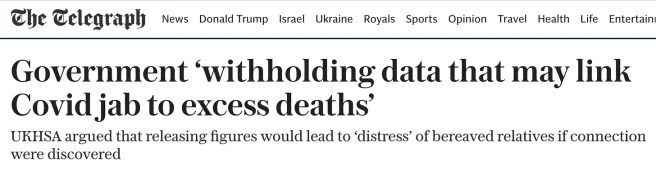
The story was created thanks to the legal action of the independent, non-profit, non-affiliated group UsForThemUK, along with diagnostic pathologist Dr. Clare Craig, who engaged in a 2-year battle to get public transparency of the general Covid vaccine and mortality data… data that was freely shared with pharmaceutical companies but withheld from the public.
The group lost its legal fight but a key admission was revealed to the public as the Telegraph writes:
The UK Health Security Agency (UKHSA) argued that releasing the data would lead to the “distress or anger” of bereaved relatives if a link were to be discovered.
Public health officials also argued that publishing the data risked damaging the well-being and mental health of the families and friends of people who died.
The Telegraph then describes a behind-the-veil moment writing:
UsForThem, a campaign group, requested that UKHSA release the data under freedom of information laws. But the agency refused, making a number of different arguments including that publishing the data “could lead to misinformation” that would “have an adverse impact on vaccine uptake” in the public.
In America, the CDC has just updated its “Vaccine Safety’ page creating massive public buzz showing an evolution in both science and a willingness to be truthful towards the public.
Among the new admissions the CDC website now states:
Scientific studies have not ruled out the possibility that infant vaccines contribute to the development of autism. However, this statement has historically been disseminated by the CDC and other federal health agencies within HHS to prevent vaccine hesitancy.
Together, both the UKHSA and CDC’s new statements show there has been, and still is, a lockstep coordination to purposely censor information from the public when it comes to injectable pharmaceutical product lines.
Governments are desperate to avoid the Covid vaccine injury conversation eager to avoid full-blown public health revolt on unknown consequences (already happening in large sections of the population)
The American Covid vaccine space is still a dismal public relations nightmare. The PREP Act, keeping the pandemic’s unnecessary actions in effect, blocks any hope of proper compensation for the critical mass of Americans who have experienced injuries from the mandated, failed shot.
Meanwhile, the ‘science is not political’ crowd spawned an East and West Coast Alliance coalition of all blue Democrat-run states representing the high water mark of hypocrisy and groupthink. Banding together for the purpose of ignoring the facts and evidence to push the Covid shot on infants and healthy people sans pandemic emergency.
The bizarre and self-defeatist move refusing to acknowledge any new science since 2020 on the mounting dangers of the Covid shot – the alliances are not only a danger to public health but to the credibility of the very institutional trust they claim to be standing for – perfect inversion.
The harms of the Covid shot are still a real concern of the American public. Ignoring these concerns or attempting to soft-sell solutions bypassing real help for the injured will not make this flashing red light any dimmer.
Mamdani raises ‘US funding’ of Israeli genocide in Gaza during Trump meeting

US President Donald Trump meets with New York Mayor-elect Zohran Mamdani in the White House in Washington, DC, on November 21, 2025. (Photo by Jim WATSON / AFP)
Press TV – November 22, 2025
In a meeting with US President Donald Trump, the newly elected New York City mayor, Zohran Mamdani, raised the issue of US funding for the Israeli genocidal war on Gaza.
The meeting at the White House on Friday was the first in-person meeting for the political opposites, who have clashed over everything from immigration to economic policy.
The 34-year-old mayor told reporters that when he spoke to New Yorkers who supported both Trump and him, the two main reasons given were a desire to “end forever wars” and an “end to the taxpayer dollars we had funding violations of human rights.”
Answering a reporter’s question, the mayor-elect reiterated that Israel has been “committing genocide” in Gaza and his assertion that US taxpayers’ dollars are helping fund it.
Mamdani clarified that he had “spoken about the Israeli [regime] committing genocide and I’ve spoken about our government funding it.”
“I shared with the president in our meeting about the concern that many New Yorkers have about wanting their tax dollars to go toward the benefit of New Yorkers and their ability to afford basic dignity,” Mamdani said.
“There’s a desperate need not only for the following of human rights but also the following through on the promises we’ve made New Yorkers.”
“I appreciate all efforts toward peace,” he added. “We’re tired of seeing our tax dollars fund endless wars, and I also believe that we have to follow through on the international human rights, and I know that still today those are being violated, and that continues to be work that has to be done, no matter where we’re speaking of.”
Trump did not comment on the matter, beyond noting that he and Mamdani feel “very strongly about peace” in West Asia.
Trump also said that he and Mamdani did not discuss the latter’s pledge to arrest Israeli Prime Minister Benjamin Netanyahu if he came to the Big Apple.
Trump had previously called the incoming New York City mayor a “radical left lunatic,” a communist, and a “Jew hater.”
As Mamdani surged in the polls to victory, Trump, a Republican, issued threats to strip federal funding from the biggest US city.
The mayor-elect has regularly criticized a range of Trump’s policies, including plans to ramp up federal immigration enforcement efforts in New York City, where four in ten residents are foreign-born.
Hungary: Major opposition news portal funded by USAID, NED as well as Soros foundation to spread disinformation
Remix News | November 21, 2025
Hungary’s Office for the Protection of Sovereignty has revealed new details regarding the Telex news portal and the funding it has received from the United States, including USAID.
Telex has claimed that it does not depend on foreign funding, but year after year, according to an analysis by the Office, it has received money from foreign governments, including the U.S., and Brussels, reports the Mandiner news portal.
Of note is that Telex received $10,000 through the Internews EPIC applications implemented within the framework of USAID’s activities in Hungary.
USAID and its activities have since been terminated by the Trump administration.
According to the office, headed by Tamás Lanczi, the president of the Office for the Protection of Sovereignty, Telex received the money from the machine controlled as a political weapon by the democratic American government through the “Independent Media Center.”
The Office for Sovereignty Protection has already identified the Internews Foundation in previous reports as a key player in the media manipulation machine that the American deep state has been operating for more than four decades.
Among the organization’s funders are: USAID, used by the Biden administration to fund political interventions around the world, George Soros’ Open Society Foundations, the Rockefeller Foundation, and the National Endowment for Democracy (NED), which has been described in detail in the office’s previous reports.
NED, Mandiner notes, played a major role in the illegal foreign campaign financing of the opposition coalition in the 2022 parliamentary elections.
Internews provides media outlets not only with money, but also with technology and content suitable for spreading narratives, which must represent given values and messages and produce activity on designated topics.
The condition for the support, the Office emphasized, is the creation of narratives that allow the American progressive elite to put pressure on the governments and decision-makers of the given countries, and to influence the citizens of the given country.
The organization is highly active in the Central European region, primarily in Hungary and Poland. Its joint media development programs with USAID have played a role in the operation of certain Hungarian media outlets since 2010 in the form of tenders, professional training, and infrastructure support.
The Office’s investigations revealed that, in exchange for money, Internews expects the media outlets to make the topics it determines part of the public discourse, to frame narratives that are contrary to the interests of the client as disinformation, and to provide the funded editorial offices with mandatory content.
As Tamás Lánczi wrote previously, “Telex.hu journalists received almost HUF 200 million of U.S. government money.”
The president of the Office for the Protection of Sovereignty announced that documents reviewed by his organization show that the project called Telex Academy was also implemented with a grant of approximately $740,000 from the Bureau of Democracy, Human Rights, and Labor (DRL) of the United States Department of State.
The vast majority of the money was paid to Telex journalists.
How a shamed Supreme Court Justice helped Israeli dual citizens in America
If Americans Knew | November 20, 2025
In 1967, Supreme Court Justice Abe Fortas changed American tradition with his tie-breaking vote in favor of an Israeli national. The landmark decision allowed dual citizens to fight in a foreign army and even hold office in a foreign country.
Former Commissioner of Immigration and Naturalization Services Leonel Castillo said that the special U.S.-Israel relationship was dangerous, and that it was dangerous because it was unknown to what extent it would go if Americans were allowed to fight in a the Israeli military.
According to the Washington Post, currently there are more than 23,380 Americans fighting in the Israeli military, instead of enlisting in the U.S. armed forces. Other sources reveal that only between 8,000 and 10,000 Jewish-Americans are enlisted in the American military.
Two notable bills regarding dual citizens are currently being pushed in Congress.
1. Rep. Brian Mast of Florida, who served in the Israeli military, has put forward the Protecting Americans who served in the IDF Act, which would offer the same benefits to Israeli soldiers as American soldiers. It’s also important to know that Mast was voted to lead the House Foreign Affairs panel in 2024. Mast has gone on record saying, “As the only member to serve with both the United States Army and the Israel Defense Forces, I will always stand with Israel.”
2. Rep. Thomas Massie of Kentucky, who is the only Republican lawmaker without an “AIPAC guy”, has put forward the Dual Citizen Disclosure Act, which would compel candidates and elected officials to disclose any dual citizenship they may have. “At a minimum, (elected officials) should disclose their citizenship in other countries and abstain from votes specifically benefiting those countries,” Massie said.
Washington Post : https://www.washingtonpost.com/world/…
The Times of Israel : https://blogs.timesofisrael.com/moder…
In 1995 Donald Neff exposed Fortas’ action to change a long-held American tradition on behalf of Israel: https://ifamericansknew.org/media/epi…
Russia, China upbraid anti-Iran IAEA resolution, urge West to drop threats
Press TV – November 21, 2025
Russia and China have, in the strongest terms, rebuked a recent anti-Iran resolution passed by the Board of Governors of the International Atomic Energy Agency (IAEA), calling for the settlement of the Islamic Republic’s nuclear issue through dialogue and cooperation.
Drafted by France, Germany, the United Kingdom and the United States and approved 19–3 with 12 abstentions on Thursday, the resolution sought to pressure Tehran by demanding it “without delay” account for its enriched uranium stocks and facilities damaged in the June attacks by the United States and Israel.
Russian Foreign Ministry Spokesperson Maria Zakharova announced at a press conference in Moscow that Russia continues to firmly emphasize finding political and diplomatic solutions to the issue of Iran’s nuclear program.
Asked about a recent telephone conversation between the Russian and Iranian foreign ministers, during which the issue of Iran’s nuclear program and related talks were discussed, Zakharova was cited by TASS as saying that Moscow is consistently committed to actively seeking political and diplomatic solutions to the Iranian nuclear issue.
The spokeswoman added that Moscow has repeatedly warned about the dangers of “military actions” that threaten the stability and security of West Asia, underlining that any military attack on nuclear facilities, especially those under the monitoring of the IAEA, is “unacceptable.”
Zakharova also said the US aggression against Iran’s nuclear sites undermined the principles the Non-Proliferation Treaty (NPT) — a treaty to which Iran has always been fully committed and which the IAEA has confirmed.
The Russian Foreign Ministry spokeswoman went on to say that despite the efforts on the part of some foreign actors to create chaos and trouble in Iranian society, Tehran still prefers the path of dialogue over war and believes that national interests can be secured based on equal dialogue and by taking into account mutual concerns.
She stressed that in order to resume the talks, Iran needs “serious guarantees” that its nuclear facilities will not be targeted by missile or air attacks again.
Zakharova further underlined that the West must put aside threats of sanctions and military threats and return to diplomacy with Iran.
IAEA urged to create ‘favorable conditions for cooperation’
Li Song, China’s permanent representative to the IAEA, told the Board of Governors on Thursday that pushing through a counterproductive resolution against Iran will “only make things worse,” stressing that the US, Israel, and key European states are fueling the ongoing crisis surrounding Tehran’s nuclear file.
“Countries that have recklessly resorted to the use of force and obsessively pursued confrontation and pressure are responsible for the current situation of the Iranian nuclear issue,” Li said.
The Chinese envoy stressed that Israel and the United States attacked Iranian nuclear facilities safeguarded by the IAEA in June, which led to a “fundamental change in the situation of the Iranian nuclear issue.”
“Such an act should be strongly condemned by the international community and the IAEA,” he said.
On the Cairo agreement reached between Iran and the IAEA in September, Li emphasized that the pact was “a positive development” and “an important opportunity” to fully revive safeguards cooperation.
He said the activation of the snapback mechanism by the UK, France, and Germany had “seriously undermined the good momentum of cooperation” between Tehran and the Agency.
Li added that the Iranian nuclear issue “can only be properly resolved” by respecting Iran’s legitimate NPT rights and ensuring the peaceful nature of its program through political, diplomatic, and safeguards mechanisms.
The envoy called on the BoG to “create favorable conditions for cooperation and dialogue” and to avoid “provoking confrontation.”
Putin: Trump’s New Peace Plan May Become Foundation of Ukrainian Conflict’s Resolution
Sputnik – 21.11.2025
US President Donald Trump’s new peace plan could form the basis for a final settlement in Ukraine, Russian President Vladimir Putin said on Friday.
Earlier this week, the Financial Times published a 28-point US peace plan for Ukraine that includes a reduction in US military aid, official recognition of the canonical Ukrainian Orthodox Church, granting the Russian language state status in Ukraine, reducing Ukraine’s armed forces, and banning foreign troops and long-range weapons on Ukrainian soil.
“I believe that it [Trump’s plan] can be the basis for a final peaceful settlement,” Putin said during a meeting with permanent members of the Russian Security Council today.
He also mentioned that Russia has the text of US President Donald Trump’s plan for Ukrainian settlement.
“We received it through the existing channels of interaction with the US administration,” Putin said.
Russia agreed to show flexibility in its approach to the Ukrainian settlement during the Anchorage meeting, Putin added.
“The main point of the meeting in Alaska, the main purpose of the meeting in Alaska, was that during the negotiations in Anchorage we confirmed that despite certain difficult issues and difficulties on our part, we nevertheless agree with these proposals and are ready to show the flexibility offered to us,” Putin said at a meeting with the permanent members of the Russian Security Council.
The United States, during discussions on the settlement in Ukraine, asked Russia to make certain compromises, Putin added.
“President Trump’s peace plan to resolve the situation in Ukraine was discussed before the Alaska meeting. And during this preliminary discussion, the American side asked us to make certain compromises, to show, as they said, flexibility,” he elaborated.
He added that after his talks with Trump in Alaska, the United States took a pause caused by Ukraine refusing the deal.
The US plan for the settlement in Ukraine has not been discussed publicly, only in general terms, he noted.
“We have hardly discussed it publicly [the US plan to resolve the conflict in Ukraine], only in the most general terms,” Putin said at a videoconference meeting with permanent members of the Russian Security Council.
He did note, however, that the United States has so far failed to secure the consent of the Ukrainian side on a peace settlement plan.
“The reason, I believe, is the same — the US administration has so far failed to secure the consent of the Ukrainian side. Ukraine is against it. Apparently, Ukraine and its European allies are still under illusions and dream of inflicting a strategic defeat on Russia on the battlefield,” Putin said.
Neither Ukraine nor Europe understands what a lack of understanding of the situation on the front line can lead to, he noted.
“This position is due to the lack of objective information about the situation, the real state of affairs on the battlefield. And, apparently, neither Ukraine nor Europe understands what this may eventually lead to,” Putin said, adding that Kiev has no objective information about the real situation on the battlefield, which is why it refuses a peaceful settlement.
If Kiev does not want to discuss Trump’s proposals, then they and Europeans should understand that events like in the city of Kupyansk will be repeated, Putin said.
Meanwhile, all of Russia’s friends and partners, including China, India, North Korea, South Africa, Brazil, and the countries of the Collective Security Treaty Organization (CSTO), support the potential agreements between Russia and the United States on a Ukrainian settlement, which were discussed at the Anchorage summit, Putin added.
“We have thoroughly briefed all of our friends and partners in the Global South on all these issues, including China, India, North Korea, South Africa, Brazil, and many other countries, as well as the CSTO countries, of course. All of our friends and partners — I want to emphasize this, every single one of them — all supported these potential agreements,” he said.
Either the difficult 28 points or a very hard winter – Zelensky
RT | November 21, 2025
Vladimir Zelensky has said Ukraine must brace for a tough choice between accepting the “28 difficult points” of the US peace plan or risk losing a key backer. His comments come after the submission of a proposal and the leaking of its purported text by a Ukrainian MP.
According to Reuters, the administration of US President Donald Trump has threatened to cut off Ukraine from intelligence and military aid, should Kiev reject it.
In a video address to Ukrainians on Friday, Zelensky stated that the country is going through “one of the most difficult moments in our history.”
While not directly mentioning the US-proposed peace roadmap, he said that failure to accept the “difficult 28 points” would likely result in the “most difficult… winter” for Ukraine since the escalation of the conflict with Russia in February 2022. Kiev confirmed receiving the newly proposed peace plan from Washington on Thursday, but stopped short of revealing its contents.
According to media reports, the roadmap features 28 points, including but not limited to the withdrawal of Ukrainian troops from the parts of Russia’s Donbass it still controls, downsizing the country’s military, and giving up on NATO aspirations. Kiev would also reportedly be required to make Russian an official language. In exchange, it would presumably be offered Western security guarantees.
In his Friday address to the nation, Zelensky said that Kiev would be working “calmly” and “quickly” with Washington and its European backers to ensure that “Ukraine’s national interests are taken into account.”
The Ukrainian leader vowed to present unspecified “alternatives,” while trying to avoid the impression that he “does not want peace.”
Zelensky also mentioned his latest phone call with a number of EU leaders, expressing confidence that “Europe will be with us.” He further claimed that Ukraine is “now the only shield” protecting Europe from Russia.
Russian President Vladimir Putin has repeatedly dismissed as “nonsense” claims made by some EU officials, who have accused Moscow of planning an attack on the bloc’s members.
In recent months, Russian forces have been steadily advancing in the Donetsk People’s Republic, making significant gains. The Ukrainian military, by contrast, is facing severe personnel shortages.
While Zelensky stopped short of directly acknowledging this in his latest speech, he did say that although Ukrainians are “made of steel… any metal” may eventually break under pressure.
A Mandate for Force: What the UNSC’s Gaza Resolution Means in Practice
By Robert Inlakesh | The Palestine Chronicle | November 19, 2025
The United Nations Security Council (UNSC) passed a regime change resolution against Gaza this Monday, effectively issuing a mandate for an invasion force to enter the besieged coastal enclave and install a US-led ruling authority by force.
Passing with 13 votes in favour and none in defiance, the new Security Council resolution has given the United States a mandate to create what it calls an “International Stabilization Force” (ISF) and “Board of Peace” committee to seize power in Gaza. US President Donald Trump has hailed the resolution as historic, as Israeli Prime Minister Benjamin Netanyahu’s government has stood in opposition to an element of the resolution that mentions Palestinian Statehood.
In order to understand what has just occurred, it requires a breakdown of the resolution itself and the broader context surrounding the ceasefire deal. When these elements are combined, it becomes clear that this resolution is perhaps one of the most shameful to have passed in the history of the United Nations, casting shame on it and undermining the very basis on which it was formed to begin with.
An Illegal Regime Change Resolution
In September of 2025, a United Nations commission of inquiry found Israel to have committed the crime of genocide in the Gaza Strip.
For further context, the International Court of Justice (ICJ), the most powerful international legal entity and organ of the UN, ruled that Israel is plausibly committing genocide and thus issued orders for Tel Aviv to end specific violations of international law in Gaza, which were subsequently ignored.
Taking this into consideration, the UN itself cannot claim ignorance of the conditions suffered by the people of Gaza, nor could it credibly posit that the United States is a neutral actor capable of enforcing a balanced resolution of what its own experts have found to be a genocide.
This resolution itself is not a peace plan and robs Palestinians of their autonomy entirely; thus, it is anti-democratic in its nature. It was also passed due in large part to threats from the United States against both Russia and China, that if they vetoed it, the ceasefire would end and the genocide would resume. Therefore, both Beijing and Moscow abstained from the vote, despite the Russian counterproposal and initial opposition to the resolution.
It also gives a green light to what the US calls a “Board of Peace”, which will work to preside over governing Gaza during the ceasefire period. The head of this board is none other than US President Trump himself, who says he will be joined by other world leaders. Former British Prime Minister, Tony Blair, who launched the illegal invasion of Iraq, has been floated as a potential “Board of Peace” leader also.
On February 4 of this year, President Trump vowed to “take over” and “own” the Gaza Strip. The American President later sought to impose a plan for a new Gaza, which he even called the “Gaza Riviera”, which was drawn up by Zionist economist Joseph Pelzman. Part of Pelzman’s recommendations to Trump was that “you have to destroy the whole place, restart from scratch”.
As it became clear that the US alone could not justify an invasion force and simply take over Gaza by force, on behalf of Israel, in order to build “Trump Gaza”, a casino beach land for fellow Jeffrey Epstein-connected billionaires, a new answer was desperately sought. Then came a range of meetings between Trump administration officials and regional leaderships, aimed at working out a strategy to achieve their desired goals in Gaza.
After the ceasefire was violated in March by the Israelis, leading to the mass murder of around 17,000 more Palestinians, a number of schemes were being hatched and proposals set forth. The US backed and helped to create the now-defunct so-called “Gaza Humanitarian Foundation” (GHF) program, which was used to privatize the distribution of aid in the territory amidst a total blockade of all food for three months.
Starving Palestinians, who were rapidly falling into famine, flocked to these GHF sites, where they were fired upon by US private military contractors and Israeli occupation forces, murdering over 1,000 civilians. Meanwhile, Saudi Arabia and France were busy putting together what would become the “New York Declaration” proposal for ending the war and bringing Western nations to recognize the State of Palestine at the UN.
Suddenly, seemingly out of nowhere, here came Trump’s so-called “peace plan” that was announced at the White House in October. This plan appeared at first to be calling for a total end to the war, a mutual prisoner exchange and the withdrawal of Israeli forces from Gaza in a phased approach.
From the outset, Trump’s “20-point plan” was vague and impractical. Israel immediately violated the ceasefire from the very first day and has murdered nearly 300 Palestinians since then. The first phase of the ceasefire deal was supposed to end quickly, ideally within five days, but the deal has stalled for over a month.
Throughout this time, it has become increasingly clear that the Israelis are not going to respect the “Yellow Line” separation zone and have violated the agreement through operating deeper into Gaza than they had originally agreed to. The Israeli-occupied zone was supposed to be 53% of Gaza; it has turned out to be closer to 58%. Aid is also not entering at a sufficient rate, despite US and Israeli denials; this has been confirmed by leading rights groups and humanitarian organizations.
In the background, the US team dealing with the ceasefire deal that is headed by Jared Kushner and Steve Witkoff has been juggling countless insidious proposals for the future of Gaza. Even publicly stating that reconstruction will only take place in the Israeli-controlled portion of the territory, also floating the idea that aid points will be set up there in order to force the population out of the territory under de facto Hamas control. This has often been referred to as the “new Gaza plan”.
As this has all been in the works, including discussions about bringing back the disastrous GHF, the Israelis have been working alongside four ISIS-linked collaborator death squads that it controls and who operate behind the Yellow Line in Gaza.
No mechanisms have been put in place to punish the Israelis for their daily violations of the ceasefire, including the continuation of demolition operations against Gaza’s remaining civilian infrastructure. This appears to be directly in line with Joseph Pelzman’s plan earlier this year to “destroy the whole place”.
The UNSC resolution not only makes Donald Trump the effective leader of the new administrative force that will be imposed upon the Gaza Strip, but also greenlights what it calls its International Stabilization Force. This ISF is explicitly stated to be a multi-national military force that will be tasked with disarming Hamas and all Palestinian armed groups in the Gaza Strip.
The US claims it won’t be directly involved in the fighting with “boots on the ground”; it has already deployed hundreds of soldiers and has been reportedly building a military facility, which they deny is a base, but for all intents and purposes will be one. Although it may not be American soldiers killing and dying while battling Palestinian resistance groups, they will be in charge of this force.
This is not a “UN peacekeeping force” and is not an equivalent to UNIFIL in southern Lebanon; it is there to carry out the task of completing Israel’s war goal of defeating the Palestinian resistance through force. In other words, foreign soldiers will be sent from around the world to die for Israel and taxpayers from those nations will be footing the bill.
The only reason why Israel has reservations about this plan is because it included a statement claiming that if the Palestinian Authority (PA) – that does not control Gaza and is opposed by the majority of the Palestinian people – undergoes reforms that the West and Israel demand, then conditions “may finally be in place for a credible pathway to Palestinian self-determination and statehood.” A keyword here is “may”, in other words, it is not binding and was simply added in to give corrupted Arab leaderships the excuse to vote yes.
Hamas and every other Palestinian political party, with the exception of the mainstream branch of Fatah that answers to Israel and the US, have opposed this UNSC resolution. Hamas even called upon Algeria to vote against it; instead, the Algerian leadership praised Donald Trump and voted in favor. Typical of Arab and Muslim-Majority regimes that don’t represent the will of their people, they all fell in line and bent over backwards to please Washington.
It Won’t Likely Work
As has been the story with every conspiracy hatched against the people of Gaza, this is again destined to fail. Not only will it fail, but it will likely backfire enormously and lead to desperate moves.
To begin with, the invasion force, or ISF, will be a military endeavour that will have to bring together tens of thousands of soldiers who speak different languages and have nothing in common, in order to somehow achieve victory where Israel failed. It is a logistical nightmare to even think about.
How long would it take to deploy these soldiers? At the very least, it’s going to take months. Then, how long would this process take? Nobody has any clear answers here. Also, what happens if Israel begins bombing again at any point, for example, if there is a clash that kills Israeli soldiers? What would these nations do if Israeli airstrikes killed their soldiers or put them in harm’s way?
Also, tens of thousands of soldiers may not cut it; if the goal is to destroy all the territory’s military infrastructure, they may need hundreds of thousands. Or if that isn’t an option, will they work alongside the Israeli military?
It is additionally clear that nobody knows where all the tunnels and fighters are; if Israel couldn’t find them, then how can anyone else? After all, the US, UK, and various others have helped the Israelis with intelligence sharing and reconnaissance for over two years to get these answers.
Finally, when Arab, European, or Southeast Asian soldiers return to their nations in body bags, how do their regimes justify this? Will the President or Prime Minister of these nations have to stand up and tell their people… “sorry guys, your sons and daughters are now in coffins because Israel needed a military force capable of doing what they failed to do, so we had to help them complete their genocidal project”. Also, how many Palestinian civilians are going to be slaughtered by these foreign invaders?
As for the plan to overthrow Hamas rule in Gaza, the people of the territory will not accept foreign invaders as their occupiers any more than they will accept Israelis. They are not going to accept ISIS-linked collaborators as any kind of security force either. Already, the situation is chaotic inside Gaza, and that is while its own people, who are experienced and understand their conditions, are in control of managing security and some administrative issues; this includes both Hamas and others who are operating independently of it, but inside the territory under its de facto control.
Just as the Israeli military claimed it was going to occupy Gaza City, laying out countless plans to do this, to ethnically cleanse the territory and “crush Hamas”, the US has been coordinating alongside it throughout the entirety of the last two years. Every scheme has collapsed and ended in failure.
It has been nearly a month and a half, yet there are still no clear answers as to how this Trump “peace plan” is supposed to work and it is clear that the Israelis are coming up with new proposals on a daily basis.
There is no permanent mechanism for aid transfers, which the Israelis are blocking. There is no clear vision for governance. The “two Gazas” plan is not even part of the ceasefire or Trump plan, yet it is being pursued in an incoherent way. The ISF makes no sense and appears as poorly planned as the GHF. Hamas and the other Palestinian factions will not give up their weapons. There is no real plan for reconstruction. The Israelis are adamant that there will be no Palestinian State and won’t allow any independent Palestinian rule of Gaza, and the list of problems goes on and on.
What it really looks like here is that this entire ceasefire scheme is a stab in the dark attempt to achieve Israel’s goals while also giving its forces a break and redirecting their focus on other fronts, understanding that there is no clear solution to the Gaza question for now.
The United Nations has shown itself over the past two years to be nothing more than a platform for political theatre. It is incapable of punishing, preventing, or even stopping the crime of all crimes.
Now that international law has suffocated to death under the rubble of Gaza, next to the thousands of children who still lie underneath it, the future of this conflict will transform. This UNSC vote demonstrates that there is no international law, no international community, and that the UN is simply a bunch of fancy offices, which are only allowed to work under the confines of gangster rule.
If the Palestinian resistance groups feel as if their backs are against the wall and an opportunity, such as another Israeli war on Lebanon, presents them the opportunity, then there is a high likelihood that a major military decision will be made. In the event that this occurs, it will be this UNSC resolution that is in large part responsible.
When the suffering in Gaza finally ends, whether that is because Israel obliterates all of its regional opposition and exterminates countless other civilians in its way, or Israel is militarily shattered, the UN should be disbanded as was the League of Nations. It is a failed project just as that which preceded it. Something new must take over from it.
– Robert Inlakesh is a journalist, writer, and documentary filmmaker. He focuses on the Middle East, specializing in Palestine. He contributed this article to The Palestine Chronicle.
Featured Video
Integrity Initiative: UK-funded network framed dissent as Russian disinformation for years
or go to
Aletho News Archives – Video-Images
From the Archives
Why Saudi Ties to 9/11 Mean U.S. Ties to 9/11
By Kevin Ryan | Dig Within | September 27, 2015
Media interest in Saudi Arabian connections to the crimes of 9/11 has centered on calls for the release of the 28 missing pages from the Joint Congressional Inquiry’s report. However, those calls focus on the question of hijacker financing and omit the most interesting links between the 9/11 attacks and Saudi Arabia—links that implicate powerful people in the United States. Here are twenty examples. … continue
Blog Roll
 Aletho News
- IAEA inspectors cannot return to Iran amid US threats: Russia
- Senate Rejects Iran War Powers Resolution Passed By House
- ‘We did not attack Pakistan with drones’: Afghan sources
- Iraqi Resistance faction links arms to sovereignty, questions US exit
- Cannon fodder no more… South Korea rejects Trump’s pressure to join his criminal war on Iran
- Neria Leiter Was A Legitimate Military Target
- Integrity Initiative: UK-funded network framed dissent as Russian disinformation for years
- ‘We don’t seek permission to defend our country’: Snippets from President Pezeshkian’s UNGA address
- NATO chief wants Europeans to fight American wars [for Israel]
- German chemicals giant reveals details of downsizing
- If Americans Knew
- Israel displaces hundreds of Palestinians amid wave of demolitions in West Bank
- Aid, reconstruction, and Israel’s history of obstruction in Gaza
- Trump administration digs an ever-deeper hole of complicity in genocide – Daily Update
- US-Israel $2.8 Billion Arms Deal, 40,000-Bomb Supply Faces New Gaza Complicity Accusations
- Caught on Tape: AIPAC CEO Boasted of Controlling Trump’s National Security Officials
- Why Hamas Attacked Israel in October 2023 – Israeli professor Ilan Pappé
- They see them, then kill them: Israeli quadcopters track, deliberately target civilians in Gaza
- Winter could turn Gaza’s treacherous, war-damaged buildings into deathtraps
- Majority of Democratic Voters Want to Prosecute Both Biden and Trump Administration Officials Over Gaza
- As Gaza languishes, world leaders gather at the UN – Daily Update
- No Tricks Zone
- New Study: Earth And Venus Surface Warmth Largely Explained By Convection And Lapse Rate, Not CO2 Or Radiation
- 2025 Nature Paper Claiming Worsening Global Drought Gets RETRACTED …Heavily Flawed
- New Study: ‘Global Drought Shows No Detectable Recent Acceleration Under Climate Warming’
- Economic Masterminds: German Socialists Suggest Taxing Productivity Gains Stemming From Using AI
- The South China Sea Has Not Been Cooperating With The Climate Change Narrative
- Energy Crisis: Germany Enters Heating Season With Historically Low Gas Reserve Fill Levels
- New Study: The Antarctic Ice Sheet Gained Mass From 2020-2024 Due To Staggering Snow And Ice Accumulation
- Study: Ocean Heating Rates From Thousands Of Years Ago ‘Dwarf’ Modern Ocean Heating Rates
- Climate Extremists Target, Attack Large-Scale Power Grid Infrastructure In Germany!
- New Study: Antarctic Ice Melt Has Contributed Less Than 1 Centimeter To Sea Level Rise In The Last 30 Years

