The Pro-War Twist of the ‘Resistance’
By James W Carden | Consortium News | April 24, 2017
The Resistance, a self-aggrandizing term for what amounts to a relatively small but still powerful claque of embittered Clinton surrogates, has been keeping itself busy of late, fanning the flames of McCarthyite recriminations against anyone who dares question the rather flimsy public evidence that Russia influenced the results of the 2016 election, all the while cheering on President Trump’s expansion of the war in Syria.
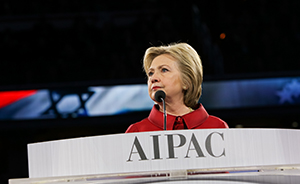
Hillary Clinton on March 21, 2016 (Photo: AIPAC)
Like its approach to the question of Russia and the election, the Resistance will brook no dissent over whether or not President Trump did the “right thing” in unleashing 59 Tomahawk missiles on a country which we are not at war with and which has never attacked us.
As with their hysterical claims that Russia stole the election from Hillary Clinton, the Resistance is loathe to allow facts, logic or evidence to get in the way of its view that Donald Trump acted in the security interests of the United States by bombing the Syrian military which (with air support from the Russians) is currently in the process in routing ISIS and Al Qaeda.
Neoliberal Clinton partisan Ruth Marcus of the Washington Post wrote that in her view “Trump is, if not behaving normally, at least adopting normal positions.” Bombing Syria, in the absence of a legal mandate from the United Nations or with expressed authorization of Congress – both legal requirements if the U.S. Constitution and American treaty obligations are to be respected – is, to Marcus anyway, evidence of “Trump’s good judgment.”
Nor was Marcus alone. Clinton herself endorsed Trump’s decision to use force just hours before the attack, telling a crowd of well-heeled Resisters in New York that “I really believe that we should have and still should take out [Assad’s] air fields and prevent him from being able to use them to bomb innocent people and drop sarin gas on them.”
Former high-ranking Obama State Department officials Antony Blinken and Anne Marie Slaughter – he in the pages of the New York Times, she on Twitter – also praised Trump’s bombing of Syria as “the right thing” to do. The New Yorker’s Ryan Lizza declared, “The moral case for President Trump’s strike on Syria is uncontroversial.”
Punishing Anti-War Democrats
In the days following the Tomahawk missile attack on Syria, it became obvious that antiwar voices need not apply to the Resistance, which clearly remains in thrall to the 25-year-old interventionist orthodoxy begun under President Bill Clinton and which continues to be treated as unassailable dogma within the Democratic Party to this day. Those few who had the temerity to dissent from the Resistance party line were to be given no quarter.
One of the few prominent elected officials in Washington to voice skepticism of the Trump administration’s case for military action against Syria was Hawaii’s Rep. Tulsi Gabbard, who condemned the attack in a statement which accused the administration of having “acted recklessly without care or consideration of the dire consequences of the United States attack on Syria without waiting for the collection of evidence from the scene of the chemical poisoning.”
The knives came out for Gabbard even before the proverbial ink on the statement was dry. To no one’s surprise, The Washington Post quickly ran a smear job by Elise Vieback titled “What is Tulsi Gabbard thinking on Syria?” In it, Viebeck declared that “Gabbard has dug herself into a hole in recent weeks with her bizarre but insistent views about Syrian President Bashar al-Assad and his country’s bloody six years of civil war.”
But what really seemed to offended Vieback – and by extension, her employers at the Post – was Gabbard’s effrontery in committing an act of lese majeste against that which all right-thinking people in Washington “know” or, as Vieback put it: “her striking departure from the consensus that Assad’s government launched the attack.”
Vieback chronicled the Resistance’s disgust with the Congresswoman’s penchant for independent, critical thinking. No less a Resistance figure than MSNBC’s Joy Reid tweeted that “People who have insisted Gabbard is the future of the Democratic Party may need to consider her outré views on issues like Assad.” Other Resistance leaders piled on, too: The Daily Kos ; Center for American Progress president and close Clinton adviser Neeera Tanden; and former Vermont Governor and ex-Democratic National Committee Chairman Howard Dean all voiced their opinion that Gabbard should face a primary challenge in 2018. Indeed, according to Dean, the heath insurance lobbyist, “Gabbard should not be in Congress.”
Of course, all the handwringing over Gabbard’s comments were simply another opportunity for the right-minded to double down on their criticism of Gabbard’s controversial meeting with Syria’s Bashar al-Assad in January. Then as now, the Washington Post was at the forefront of the character attacks, running a piece by Josh Rogin titled “How Tulsi Gabbard became Assad’s mouthpiece in Washington” on Jan. 29. Yet Rogin’s piece was so sloppy and error-ridden that the Post had to append a humiliating paragraph long correction to it after it was published.
Ignoring Syrian Reality
Nevertheless, the Resistance’s cry of “what about Assad?” is a case of Democratic luminaries polishing up their reputations for virtue and signaling their commitments to career advancement, nothing more. It leaves out the fact that the Syrian opposition also bears responsibility for the start of the violence in 2011.
As Father Frans van der Lugt, a Dutch missionary to Syria who was murdered by rebel forces in 2014, put it: “From the start, the protest movements were not purely peaceful. From the start I saw armed demonstrators marching along in the protests, who began to shoot at the police first. Very often the violence of the security forces has been a reaction to the brutal violence of the armed rebels.”
The murdered Dutch priest also observed as early as 2011, that “The opposition of the street is much stronger than any other opposition. And this opposition is armed and frequently employs brutality and violence, only in order then to blame the government.”
The “what about Assad?” line also begs us to ignore what the likely consequences of his removal from power would actually mean: Who exactly do they think would fill the vacuum? The obsession with Assad also willfully ignores the immorality of U.S. policy, which involves repeatedly bombing Syria while funding and training violent extremists who seek to overthrow a sovereign government.
U.S. policy, wholeheartedly supported by the Resistance, tramples international law and makes a mockery of the tenets of Just War Theory. It results in violence, death and destruction abroad and sets the stage for retaliatory acts of violence upon our own people at home.
And so, in order to elide these considerations, the neoliberal left returns to the eternal, tiresome: “But what about Assad?” To which there is a pretty straightforward answer: Assad is fighting (quite successfully at present) the same enemies who attacked us on 9/11 in an attempt to stave off the wholesale takeover of Syria by Saudi-sponsored Salafists who would, as they promised in the early days of the uprising, drive “Christians to Beirut, Alawites to the grave.” Never mind what they would do to women, Shia and other apostates should they topple Assad and gain power.
Anti-interventionist and pro-peace Democrats object to this joint Saudi-Turkish project of turning Syria, which under Assad had been a secular, multi-confessional police state, into a theocratic Sunnistan, thereby carving out a state for our worst enemies.
Backing the Terrorists
The Resistance may need reminding that international politics, like domestic politics, is about choosing, and the choice that pro-war Democrats (the vast majority of whom are die-hard Clinton supporters who still have not been able to reconcile themselves to her defeat) have made is clear: they’ve thrown their support behind radical Islamist terror groups in Syria because they have bought into the tedious fiction about the existence of “moderate” Syrian rebels.
But the Resistance would be better off leaving the fantasy of peace-loving moderate Syrian rebels to the hipsters at VICE and the neocons and neoliberal war hawks comfortably ensconced at Brookings, the Center for American Progress, CNN, The Daily Beast, The Atlantic magazine, and The Atlantic Council.
Another trend among the self-fashioned “Resisters” these days is towards an unthinking acceptance of U.S. government talking points, particularly with regard to Russian hacking and the Trump administration’s declassified four-page report on the Syrian chemical weapons attack.
Yet given the less than inspiring record of American interventions based on faulty, distorted or simply fabricated intelligence, as in the cases of Iraq (2003) and Libya (2011), the question isn’t why someone like Gabbard is out there questioning the Trump administration’s story, the question is: why aren’t more doing so? And wouldn’t questioning Trump’s unilateral, illegal decision to bomb Syria seem to be the right and proper role of something which bills itself as “The Resistance”?
But no. As a friend and colleague of mine recently put it, if they were honest, the Resistance’s motto really ought to be: “Long live the Cold War with Russia. Long live neoliberal Wahhabism and chaos in the Middle East.”
Yet the Resistance drones on, drowning out anti-war, anti-Wahhabi, pro-detente voices all in a bid to reinforce the neoliberal foreign policy orthodoxy within the Democratic Party in the vain hope of solidifying their positions of power and influence within it.
James W Carden is a contributing writer for The Nation and editor of The American Committee for East-West Accord’s eastwestaccord.com. He previously served as an advisor on Russia to the Special Representative for Global Inter-governmental Affairs at the US State Department.
Okinawans call for U.S. military to go home after further provocations
Xinhua | April 24, 2017
TOKYO – Local residents of Kadena on Okinawa’s main island said the United States military conducting parachute training drills over Okinawa’s mainland on Monday morning was completely unacceptable with the latest provocation coming amid rising anti-U.S. military sentiment on the island.
Local media reported that residents in the area still remember a tragic incident that occurred in 1965 involving an elementary schoolgirl being crushed to death by a trailer being parachuted down to a village during such a drill.
The area hasn’t seen parachute drills by the U.S. military since a drill at the base in 2011, that saw 30 personnel deploy from a MC-130 special mission aircraft, official accounts showed.
The aircraft used to deploy the airmen are designed for infiltration and exfiltration missions and can also be used for resupply of special operation forces.
The large transporter-looking planes can also be configured to be used for air refueling of primarily special operation helicopters and tilt-rotor aircraft like the controversial Osprey, also hosted in Okinawa and mainland Japan, and the cause of great condemnation here for its checkered safety record.
The latest drill saw the local residents notified of the parachute exercise less than a day before it occurred, when notice was sent out on Sunday night by the Japanese Defense Ministry.
In 1996, Japan and the U.S. agreed that it would [only] be the Island near Okinawa’s main island that would be used for parachuting drills at a reserve airfield there, with the surprise drill over Kadena baffling and scaring residents in the area.
The town of Kadena plays host to the U.S. Kadena Air Base which itself is home to top multiple air squadrons and accommodates around 20,000 service-members, their families and employees living or working there.
Anti U.S. base sentiment in Japan’s southernmost prefecture continues to rise of late, with regular demonstrations comprising thousands of locals calling for the controversial U.S. Marines Corps Futenma base to be relocated off the island and not to the coastal Henoko region.
At the end of last month, the “prefectural people’s rally calling for immediate cancellation of unlawful land reclamation work and abandonment of the plan to build a new base in Henoko, organized by the All Okinawa Coalition to Prevent Construction of a New Base in Henoko, was held in front of the gate to the U.S. military’s Camp Schwab.
The demonstration saw the participation of around 3,500 people, the organizers said.
Okinawa Governor Takeshi Onaga attended the rally and stated that with all his strength he would absolutely revoke the approval to reclaim land off the shore of Henoko, which is needed build the new base.
Along with the unexpected parachute drill and constant anti-relocation rallies, residents have also been up in arms recently about stray bullets found at the Afuso Dam construction site in the Camp Hansen Marine Corps base on the island.
The base is located in the town of Kin, near the northern shore of Kin Bay, and is the second-northernmost major installation on Okinawa, with Camp Schwab to the north.
Damage from stray bullets was found in water tanks and the cars of dam workers, local media reported, with fears rife that if live rounds were fired and people were in the vicinity at the time, multiple lives could certainly have been lost.
“Stray bullet damage from Camp Hansen has occurred countless times since the end of WWII. It is obvious that this originates from the proximity of Okinawan residents and the base. The practice of live-fire exercises on the narrow island of Okinawa is a mistake,” a recent article from an Okinawa-based publication said on the matter.
“The Marines, who operate Camp Hansen and use it mainly for exercises, are inherently unnecessary in Okinawa. Considering the safety of Okinawan residents, the only option is for the Marines to return to the continental United States. If they truly need to conduct live-fire exercises, they would be better off conducting them on the expansive training grounds in the mainland United States,” the article said.
Officials from Onna, Okinawa, as well as the Okinawa Defense Bureau, both confirmed that water tanks at the construction site were found empty on April 6 and what appeared to be bullet holes were found inside the tanks.
On April 13, similar damage from bullets was found on the cars of workers who had parked at the construction site, much to the continued consternation of local residents.
The local Okinawan residents’ calls for an end to their “occupation” and for all U.S. military personnel to return to the continental U.S. are growing evermore vociferous.
Make No Mistake: There is a media blockade against Venezuela
By Rachael Boothroyd Rojas | Venezuelanalysis | April 23, 2017
Venezuela is in flames. Or at least parts of it is.
Since April 4th, opposition militants have been carrying out targeted acts of violence, vandalism and arson, as well as deliberately clashing with security forces in an attempt to plunge the country into total chaos and forcefully remove the elected socialist government. It is the continuation of an 18 year effort to topple the Bolivarian revolution by any means necessary — although you may have seen it miraculously recast in the mainstream media as “promoting a return to democracy” in the country.
A catalogue of the violence over the last 18 days is shocking – schools have been ransacked, a Supreme Court building has been torched, an air force base attacked, while public transport, health and veterinary facilities have been destroyed. At least 23 people have been left dead, with many more injured. In one of the most shocking cases of right-wing violence, at around 10pm on April 20th, women, children and over 50 newborn babies had to be evacuated by the government from a public maternity hospital which came under attack from opposition gangs.
Anywhere else in the western world, this would have given way to horrified international and national calls for an end to the violence, and for the swift prosecution of those responsible – making it all the more scandalous that these incidents have at best been ignored, and at worst totally misrepresented by the international press. Instead, those tasked with providing the public with unbiased reporting on international affairs have opted to uncritically parrot the Venezuelan opposition’s claims that the elected government is violently repressing peaceful protests, and holding it responsible for all deaths in connection with the demonstrations so far.
This narrative cannot be described as even a remotely accurate interpretation of the facts, and so it is important to set the record straight.
- To date, three people (two protesters and one bystander) have been killed by state security personnel, who were promptly arrested and in two cases indicted.
- A further five people have been directly killed by opposition protesters, while one person has died as an indirect result of the opposition roadblocks in Caracas (Ricarda Gonzalez, 89, who suffered from a CVA and was prevented from getting to a hospital).
- Five people have been shot in separate incidents near protests but under unclear circumstances. One of these victims was shot by an alleged opposition supporter from a high rise building, although the perpetrator’s political affiliation is yet to be confirmed.
- Nine protesters appear to have died as a result of their own actions (at least nine were electrocuted in the recent looting of a bakery).
A cursory look at the reality reveals that the government is clearly not responsible for the majority of these deaths. However, to paraphrase a remark recently made by Venezuelan author Jose Roberto Duque, the “truth has suddenly become useless”.
The media has failed to go into too much detail surrounding the exact circumstances of these deaths; precisely because the truth presents a serious obstacle to their narrative that all these people were killed during pro-democracy peaceful protests at the repressive hands of the authoritarian regime. This narrative isn’t just overly simplistic; it distorts the reality on the ground and misinforms international audiences.
Take this deliberately misleading paragraph from an article written by Nicholas Casey, the New York Time’s latest propaganda writer for the opposition.
“Protesters demanding elections and a return to democratic rule jammed the streets of Caracas and other Venezuelan cities on Wednesday. National Guard troops and government-aligned militias beat crowds back with tear gas, rubber bullets and other weapons, and at least three people were killed, according to human rights groups and news reports.”
Casey opted to omit the fact that none of those three deaths has so far been attributed to security forces, and one of the victims was an army sergeant killed by protesters themselves. Moreover, those on the receiving end of the “tear gas and rubber bullets” are not quite the “peaceful protesters” he so disingenuously implies. Anyone in the east of the city on April 19th, when both opposition and pro-government forces marched, could see how opposition supporters gathered in total freedom in Plaza Francia in Altamira, even buying anti-government t-shirts, caps, and purchasing ice-creams, and were able to march along the main highway linking the east of the city to the west.
Police “repression” has occurred in two specific scenarios. Firstly, when opposition gangs have set-up burning barricades and carried out violent acts of vandalism on the streets, including the targeting of public institutions – actions deliberately aimed at provoking photo-op worthy clashes with security forces. In the second instance, it has occurred when opposition marchers have attempted to cross a police line blocking them from getting to the working class municipality of El Libertador in the west of the city – where government support is traditionally concentrated. Again, this action is a deliberate attempt to provoke clashes with security forces and their supporters by the opposition, who are well aware that they have not been granted permission to march into El Libertador since a short-lived opposition-led coup in 2002, triggered by an anti-government march diverted towards Miraflores Presidential Palace in the west that left 19 dead by opposition sniper-fire.
It is hard to see how the police would not respond to these violent actions in a similar way, or even more violently, in the rest of the world. I can only imagine what would happen if armed and violent protesters consistently tried to march on the White House in Washington, or on No. 10 Downing Street in London. What if they assaulted police lines outside the White House, or attacked hospitals and looted businesses in London? Not only would they not be granted permission to continue, but protesters would most likely be shot, or end up in jail under anti-terrorism legislation for a very long time. But in Venezuela, the opposition can rely on its carte blanche from the mainstream press as its get out of jail card.
Needless to say, details of the undemocratic actions of opposition leaders and their supporters – ranging from these latest attacks to support for a violent coup in 2002 – are glaringly absent from virtually all news reports. This is despite the fact that the opposition’s current protest leaders – Julio Borges, Henrique Capriles Radonski, Henry Ramos Allup and Leopoldo Lopez – were active players in the 2002 coup.
The above article by Casey is a patent attempt to mislead the public over the dynamic on the ground in Venezuela. But unfortunately this is not just a case of one isolated news agency. The UK’s Guardian, for instance, provided its readers with an image gallery of the opposition’s April 19th march and “ensuing violence”, but failed to acknowledge that a pro-government march of similar size, if not greater, was also held the same day. They simply erased the actions of hundreds of thousands, if not millions, of people. Whichever news agency you check, be it the BBC, the Washington Post, CNN, or any other corporate outlet, you will find the same, uniform consensus in their Venezuela coverage. There are no words to describe this state of affairs other than a total media blockade.
The last time the country witnessed unrest on this scale was in 2014, when opposition militants again unsuccessfully tried to force the “exit” of President Nicolas Maduro using similar tactics, leading to the deaths of 43 people. The majority of those victims were innocent passersby caught in the violence or state security personnel, who were given the somewhat impossible task (just like today) of somehow refraining from responding with violence to people who are deliberately trying to provoke, maim and kill them.
While protests in 2014 were a response to violent unrest headed by the country’s right-wing student movement, this year’s commenced at the beginning of April after the Supreme Court issued a ruling granting the court temporary powers to assume the legislative functions of the National Assembly. It came in response to the Venezuelan parliament having been declared “in contempt of court” for more than six months, after the opposition refused to remove three of its lawmakers under investigation for electoral fraud in violation of a Supreme Court order. This is much like the current legal case hanging over the thirty Conservative MPs in the UK. The only difference in Venezuela is that the legislators were suspended from being sworn into parliament pending the results of the investigations. The opposition immediately hit out at the ruling, declaring it an attempted “coup” by the government that had come out of nowhere. The media swallowed this version of events hook, line and sinker. Although the ruling was overturned almost straightaway, the opposition took to the streets denouncing a “rupture of the constitutional order”.
This soon morphed into a hodgepodge of ultimatums which have dominated the opposition’s agenda since it won control of the country’s National Assembly (one of the five branches of the Venezuelan government) in December 2015, promising to have deposed the national government “within six months” – something beyond the power of Venezuela’s legislative branch. These demands include the release of what they call “political prisoners”, the opening-up of a “humanitarian channel” for receiving international aid and, most importantly, immediate regional and general elections. The street protests were an unmissable opportunity for the opposition, which was suffering from steadily decreasing popularity following an entire year of having squandered its legislative majority in parliament.
Evidently, long term strategy is not the opposition’s strong point. History testifies to the fact that they tend to go for maximum amount of damage in the minimum amount of time, no matter the cost. This brings us to why this kind of violence, which has been employed several times throughout the last 18 years by Venezuela’s well-seasoned opposition, is once again happening at this moment. If the government is so unpopular, as the opposition claims it is, why not just wait for the presidential elections in 2018 for their time to shine?
At this point it should be clear that the opposition’s only goal, far from promoting a “return” to democracy, is to step right over it. They want to remove the elected government more than a year ahead of scheduled elections. But they don’t want to stop there. As one opposition marcher told me on Wednesday: “Get your stuff together Maduro, because you’re going to jail”. The opposition’s goal is the total annihilation of Chavismo.
Whatever the government’s many errors and faults over the past four years under the leadership of Nicolas Maduro, progressives across the globe have an obligation to defend it against the opposition’s onslaught and the international media’s blockade. The alternative is the same savage neoliberalism – currently being mercilessly unleashed by Brazil’s unelected government – which previously squeezed blood from the entire continent throughout the 1980s and 1990s.
The slogan “No Volveran” (they shall not return) has never been more urgent.
Human Rights and the Arrogance of Power
By Brian CLOUGHLEY | Strategic Culture Foundation | 24.04.2017
International policy statements sometimes attract attention because they deal with serious matters, such as human rights, concerning which an important speech was made to the UN Security Council on April 18 by US Ambassador Nikki Haley.
Ambassador Haley declared that «When a state begins to systematically violate human rights, it is a sign, it is a red flag, it’s a blaring siren – one of the clearest possible indicators that instability and violence may follow and spill across borders». She singled out Burma, Cuba, Burundi, Iran, North Korea and Syria for censure and urged the nations of the world to adopt a policy of «standing for human rights before the absence of human rights forces us to react».
So it seems that the United States wishes to lead the world in penalizing countries judged guilty of violating human rights, which is a principled and admirable stance.
It is appalling that so many countries have no «respect for human rights and for fundamental freedoms for all without distinction as to race, sex, language, or religion» as laid down in the UN Charter and quoted poignantly by Ambassador Haley. And one most effective action that human rights-abiding governments could take to ensure that offending countries would cease their hideous abuses against their citizens would be to end all cooperation with them because, as she observed, «It’s past time that we dedicate ourselves to promoting peace, security, and human rights».
We must agree with Ambassador Haley, because it is indeed «past time» that the United States dedicated itself to promoting peace. Perhaps it has been recognised that the United States failed to do that by invading Iraq, blitzing Libya, and engaging in its longest-ever war, still being waged in Afghanistan. In addition to killing many thousands of innocent people these conflicts created millions of refugees, while radicalizing citizens of all strata and resulting in expansion of Islamic State terrorism.
Then Ambassador Haley rightly warned that «if this Council fails to take human rights violations and abuses seriously, they can escalate into real threats to international peace and security», and we must hope that this message struck home around the world.
Many countries are guilty of human rights violations, as documented in the US State Department’s Human Rights Report of March 3, but it was intriguing that, contrary to long-established custom, the Secretary of State, Mr Rex Tillerson, did not present the report in person in spite of Ambassador Haley’s emphasis on the importance of «standing for human rights» and his declaration that «our values are our interests when it comes to human rights».
But when the Report is examined in detail it is obvious why Secretary Tillerson was reluctant to enthuse about his Department’s findings, because some of them don’t fit in with public pronouncements concerning the essentiality of human rights in all countries.
One inconsistency concerns Turkey whose President Erdogan recently won a referendum granting him almost total power. The first head of state to congratulate him was President Trump «shortly after international monitors delivered a harsh verdict on the referendum on constitutional changes. They found that the opposition campaign had been restricted and media coverage was imbalanced, and that the electoral authority had unfairly changed the rules after polls had opened». Further, Mr Trump’s State Department reported that «multiple articles in the penal code directly restrict press freedom and free speech» while «the government continued to prosecute at least one judge and four prosecutors involved in pursuing charges in connection with a major corruption scandal in 2013 that involved then prime minister Erdogan, his children, and close political advisors and business associates».
Other than Mr Trump, not many heads of state congratulated Erdogan, but one who did was King Salman of Saudi Arabia where violations of human rights include «citizens’ lack of the ability and legal means to choose their government; restrictions on universal rights, such as freedom of expression, including on the internet, and the freedoms of assembly, association, movement, and religion; and pervasive gender discrimination and lack of equal rights that affected most aspects of women’s lives». This oppressive dictatorship is valued by Washington for «playing an important leadership role in working toward a peaceful and prosperous future for the region», while being «the United States’ largest foreign military sales customer, with nearly $100 billion in active cases».
Saudi Arabia enjoys «close friendship and cooperation» with the United States although it is recorded by the State Department that «civil law does not protect human rights, including freedom of speech and the press», and Ambassador Haley declares that «When a state begins to systematically violate human rights, it is a sign, it is a red flag, it’s a blaring siren…»
Then there is another valued ally of the United States, Bahrain, whose king is also an autocrat with «the power to amend the constitution and to propose, ratify, and promulgate laws». His penal code specifies penalties of «no less than one year and no more than seven years in prison, plus a fine, for anyone who ‘offends the monarch of the Kingdom of Bahrain’». His country «plays a key role in regional security architecture and is a vital US partner in defence initiatives» as the base for the US Navy’s nuclear-armed Fifth Fleet which demonstrates US military power in the Persian Gulf.
The State Department records reports of «torture, abuse, and other cruel, inhuman, or degrading treatment or punishment» in Bahrain, while «societal discrimination continued against the Shia population, as did other forms of discrimination based on gender, religion, and nationality». These are exactly the sort of tyrannical human rights’ abuses denounced so vehemently by Ambassador Haley who described the United States as «the moral conscience of the world».
There are complications, however, in ordering Bahrain’s ruler to cease torture and other inhuman punishment because, as Bloomberg reported, there were two related developments on March 29. First, the commander US Central Command, General Joseph Votel, told a Congressional Committee that «foreign arms sales to allies shouldn’t be burdened with preconditions tied to human rights because they could damage military-to-military ties» and singled out Bahrain as an example. Then «the State Department told Congress it backs the sale of 19 Lockheed Martin F-16 fighters to Bahrain [for $2.7 billion] without preconditions on improved human rights previously demanded by the Obama administration».
And suddenly the country with «the moral conscience of the world» looks a trifle off-balance, because you (as an individual, a nation or an international organisation) can’t have it both ways. Either you condemn human rights abuses totally and unconditionally, or you accept them in like manner. It is a moral travesty to accept a little bit of torture or a morsel of gender discrimination. For example, how much torture is permissible? One shriek or two?
It should be heart-warming to hear the ambassador of the United States to the United Nations delivering ethical lectures in the Security Council about how other countries should behave in regard to human rights. But it isn’t much good preaching about human rights and then embracing a policy conveying the message that if a country has «strong military ties» with the United States then it is of no consequence if it persists in «torture, abuse, and other cruel, inhuman, or degrading treatment» of its citizens. It is bizarre that that any such country can continue to enjoy «close friendship and cooperation» with the United States.
This isn’t just hypocrisy. It is a most regrettable example of the arrogance of power.
With Error Fixed, Evidence Against ‘Sarin Attack’ Remains Convincing

A local journalist in Khan Shaykhun, Syria. (YouTube)
By Theodore A. Postol | TruthDig | April 21, 2017
Editor’s note: This article about the alleged nerve agent attack in Khan Shaykhun, Syria, earlier this month corrects an important error in the report by Theodore A. Postol that Truthdig posted Wednesday.
In my report published April 19 on Truthdig, I misinterpreted the wind-direction convention, resulting in my estimates of plume directions being exactly 180 degrees off. This article corrects that error and provides important new analytic results that follow from correction of that error.
When the error in wind direction is corrected, the conclusion is that if there was a significant sarin release at the crater as alleged by the White House Intelligence Report (WHR) issued April 11, the immediate result would have been significant casualties immediately adjacent to the dispersion crater.The fact that there were numerous television journalists reporting from the alleged sarin release site and there was absolutely no mention of casualties that would have occurred within tens to hundreds of meters of the alleged release site indicates that the WHR was produced without even a cursory low-level review by the U.S. intelligence community of commercial video data from the site. This overwhelmingly supports the conclusion that the WHR identification of the crater as a sarin release site should have been accompanied with an equally solid identification of the area where casualties were caused by the alleged aerosol dispersal. The details of the crater itself unambiguously show that it was not created by the alleged airdropped sarin dispersing munition.
These new details are even more problematic because the WHR cited commercial video as providing information that the report used to derive its conclusions that there was a sarin attack from an airdropped munition at this location.
As can be seen by the corrected wind patterns in the labeled photographs below, the predicted direction of the sarin plume would take it immediately into a heavily populated area. The area immediately adjacent to the north-northwest of the road may not be populated, as there was likely heavy damage to those homes facing the road from a bombing attack that occurred earlier at a warehouse to the direct east of the crater (designated in images below). However, houses that were immediately behind those on the road would have been substantially shielded from shock waves that could have caused heavy damage to those structures.
Since the reported wind speeds were very low, and the area is densely packed with buildings, a sarin dispersal would certainly not have simply followed a postulated plume direction as shown with the blue lines in the images below. Sarin aerosol and gas would have been dispersed both laterally and downwind by building fronts and would also have been dispersed downward and upward as the gases and aerosols were gently carried by winds modified by the presence of walls, space ways and other structures. A purely notional speculation on how a sarin plume might be dispersed by the structures as prevailing winds push the aerosol and gas through the structures is shown in the photograph that contains the notation “Possible Area of Severe Sarin Exposure.”
The complicated wind pattern inside the densely populated living area would have resulted in sarin accumulating in basements and rooms that are roughly facing into the wind. There would also have been areas between buildings where sarin densities were much higher or much lower as the gentle prevailing winds moved around corners and created pockets of high- and low-density sarin concentrations.
In addition, the crater area where the sarin release was supposed to have occurred was close enough to the densely populated downwind area that significant amounts of sarin that would have fallen near the crater during the initial aerosol release would have resulted in a persistent plume of toxic sarin being carried into this populated area as the liquid on the ground near the crater evaporated during the day.
The close proximity to the crater would have certainly led to high casualties within the populated area.


The images of the goat and the two aerial photographs immediately beneath them are taken from two different videos published on YouTube by the same crew of journalists who reported in detail on the site of the alleged sarin attack. Additional video frames from these two videos are shown deeper in the article.
Video images of the area where the alleged sarin-releasing crater was extensively photographed and reported on by local journalists in Khan Shaykhun.


In one of the video reports the journalist takes the observer on a short walk to the location of the dead goat. A close-up suggests that the animal was foaming at its mouth and nose as it died.
Video taken from a drone at high altitude operated by the television crew shows the location of the dead goat, which is clearly well upwind of the alleged sarin release point. Under all but implausible conditions, the wind would have carried sarin away from the goat and the animal would not have been subjected to a significant dose of sarin.
If one instead guesses that the goat was wandering around and had moved into the path of the newly dispersed sarin, the goat should have been found on the ground near the release point as the sarin dose within the plume would have killed it very quickly.
Two of the images from the video report are of dead birds. Neither of these video images can be connected to the crater scene as there was no continuity of evidence from the movement of the cameras.
Video images from the first of two videos of the area where the alleged sarin-releasing crater was extensively photographed and reported on by local journalists in Khan Shaykhun.


Video images from the second of two videos of the area where the alleged sarin-releasing crater was extensively photographed and reported on by local journalists in Khan Shaykhun.

This assessment with corrected wind directions leads to a powerful new set of questions—especially, why were the multiple sets of journalists who were filming at the crater where the alleged sarin release occurred not showing the numerous victims of the alleged release who would have been immediately next to the area?
It is now clear that the publicly available evidence shows exactly where the mass nerve agent poisoning would have occurred if in fact there was an event where significant numbers of people were poisoned by a nerve agent release. This does not rule out the possibility of a nerve agent release somewhere else in the city. However, this completely discredits the WHR’s claims that those who wrote the report knew where the nerve agent release occurred and that they knew the nerve agent release was the result of an airdropped munition.
There is a second issue that I have refrained from commenting on earlier in the hope that such a discussion would not be necessary.
The mainstream media is the engine of democracy. Without an independent media providing accurate and unbiased information to citizens, a government can do pretty much what it chooses without interference from the citizens who elected it. The critical function of the mainstream media in the current situation should be to report the facts that clearly and unambiguously contradict government claims.
This has so far not occurred, and this is perhaps the biggest indicator of how incapacitated the mechanisms for democratic governance of the United States have become.
The facts are now very clear: There is very substantial evidence that the president and his staff took decisions without any intelligence, or far more likely ignored intelligence from the professional community that they were given, to execute a missile attack in the Middle East that had the danger of creating an inadvertent military confrontation with Russia. The attack has already created a very serious further downward spiral in Russian-U.S. relations and has had the effect of seriously undermining U.S. efforts to defeat Islamic State, a common enemy of the United States, Russia and the Western European powers.
As such, it is a sacred duty of the mainstream media to our democracy and its people to investigate and report on this matter properly.
Theodore A. Postol is professor emeritus of science, technology and national security policy at the Massachusetts Institute of Technology and a specialist in weapons issue. At the Congressional Office of Technology Assessment, he advised on missile basing, and he later was a scientific consultant to the chief of naval operations at the Pentagon. He is a recipient of the Leo Szilard Prize from the American Physical Society and the Hilliard Roderick Prize from the American Association for the Advancement of Science, and he was awarded the Norbert Wiener Award from Computer Professionals for Social Responsibility for uncovering numerous and important false claims about missile defenses.
Theodore A. Postol can be reached at postol@mit.edu.
American Entry Into World War One
The Weekly Standard’s Fractured History and the Reality

The Sinking of the Lusitania, 1915 Painting. Credit: Wikimedia Commons
By Stephen J. Sniegoski • Unz Review • April 24, 2017
It was one hundred years ago this month that America entered World War I, which began July 28, 1914.[1] On April 2, 1917, President Woodrow Wilson addressed a joint session of Congress and requested it to declare war on Germany. The Senate would vote in favor of war on April 4 and the House would follow suit on April 6. This essay critiques a recent article in The Weekly Standard by Geoffrey Norman, who has written articles on multiple topics in a number of mainstream journals in addition to neocon ones.[2] His article represents the conventional neocon thinking on World War I and since they have been major players in shaping American foreign policy—especially in the Middle East—Norman’s piece is of significance in understanding their foreign policy Weltanschauung. Moreover, this essay will try to bring out what appear to be the causes of American entry into the war.
For Norman, Germany was the villain in World War I, and largely because of its ruthless nature would have been a serious threat to the United States if it had won the war and expanded its power. He writes that during the German invasion and occupation of Belgium “civilian hostages were rounded up and executed by firing squad as a way to keep the populace terrified and docile. Germany was, from the beginning of the war, the aggressor.” Although British propaganda exaggerated German atrocities in Belgium, historians in recent years have concluded that the invading Germans did kill significant numbers of French and Belgian noncombatants. According to Alan Kramer in the International Encyclopedia of the First World War, “from August to October 1914 the German army intentionally executed 5,521 civilians in Belgium and 906 in France”[3] Kramer goes on to write, however, that “Essentialist claims about unique German ‘barbarism’ would be mistaken. . . . The Russian army committed many acts of violence during the invasion of East Prussia in August/September 1914. Germany denounced the Russians for having devastated thirty-nine towns and 1,900 villages and killed almost 1,500 civilians. Research by Alexander Watson has confirmed these figures, and he concludes that 1,491 German civilians were deliberately killed in executions and individual murders. Given the smaller population of East Prussia (about 1.7 million people in the areas invaded by the Russians) this was directly comparable to the intensity of violence against civilians during the invasion of Belgium in August/September 1914.”[4]
Killing civilians, however, would have nothing to do with determining the aggressor. Historians, however, have differed on the primary culprit for the war and have spread the responsibility to many of the major combatants.[5] Furthermore, it should be stressed that the German killing of Belgians would not come close to equaling the hundreds of thousands of German deaths resulting from the British starvation blockade, which will be discussed next.[6]
The United States had historically claimed its right as a neutral to be able to trade in non-contraband goods with belligerents and with other neutrals. The exact definition of these neutral rights, however, was not universally agreed upon. The United States had traditionally taken an expansive view of its rights as a neutral, which had, in the past, caused it to clash with the European powers, especially during the wars taking place during the era of the French Revolution and Napoleon.
In 1909, an effort had been made to define and codify the existing rules of wartime trade. These rights were incorporated in a legal document developed at the International Naval Conferences in London in 1909, which became known as the Declaration of London. The Declaration contained a number of features that were very favorable to neutrals. It was signed by all major countries that would fight in World War I, but it would only be ratified by the United States. Although Britain played a major role in the Conference, and the House of Commons would ratify the Declaration, the House of Lords rejected it on the grounds that it was unfair to major sea powers. Britain’s rejection dissuaded the other signatories from ratifying.
Nevertheless, shortly after the war began, U.S. Secretary of State William Jennings Bryan asked the major belligerents to abide by the Declaration of London. Germany and Austria said that they would conform contingent upon the Entente Powers doing likewise. Britain stated it would observe the requirements of the Declaration, though with certain modifications. Very soon, however, it would reject part and then almost all of restrictions embodied in the Declaration that applied to activities it deemed necessary to prosecute the war. This entailed seizing all goods that were helpful to its enemies, which would ultimately encompass preventing food from reaching the German civilian population. This was an obvious effort to starve the German people into submission–essentially Britain was making war on the civilian population, the prevention of which was a fundamental reason for having rules of warfare. Winston Churchill, First Lord of the Admiralty in 1914 and one of the framers of the scheme, admitted that its purpose was to “starve the whole population — men, women, and children, old and young, wounded and sound — into submission.’”[7] Norman even acknowledges this goal as he writes: “The Royal Navy ruled the seas—the surface of them, anyway. And its blockade threatened to starve Germany.” But while he is aghast at German actions that killed many fewer people, the starvation blockade does not engender any negative response from him whatsoever. In his obliviousness to the immorality of the British blockade, Norman is quite similar to Woodrow Wilson. Political scientist Robert W. Tucker points out that despite the Wilson administration’s concern about German activities that caused civilian deaths, “neither Wilson nor his advisors had expressed any qualms over the moral implication of the blockade.”[8]
Many aspects of the British blockade diverged significantly from the traditional interpretation of maritime law. For example, the Declaration of Paris of 1856 (still in force in 1914) held that a blockade to be legal had to be an effective close blockade, which would entail the stationing of a group of ships off an enemy port or coast. Declaring areas of the ocean that were entry ways to the enemy’s coast to be off-limits, as Britain did, failed to constitute a legitimate blockade.[9]
In regard to visiting and searching ships for contraband, which was allowed by international law, the British likewise took a questionable approach. The traditional way was to engage in this activity at sea. The British, instead, took the ships to their ports to search because it required a long time to search large modern ships during which the British warship would be vulnerable to attacks by submarines.[10]
Britain also inhibited neutral trade with Germany (and other neutrals) by applying the doctrine of “continuous voyage,” which meant that it would have the right to interdict goods brought to a neutral port by sea that were intended, in its opinion, to be sent to Germany by land. Heretofore, international law had only applied the concept of “continuous voyage” to a trip that went solely by sea. Furthermore, traditional international law only applied “continuous voyage” rules to absolute contraband—goods whose sole purpose was for warmaking—whereas the British applied these rules to almost every type of good.[11]
Another questionable step taken by Britain was the mining of the North Sea, which was the entry way for ships to reach neutral and German ports. To avoid possible destruction, merchant ships had to stop at a British port where they would get an Admiralty pilot to lead them through the mine fields. While there the ships would be searched and stripped of goods.[12] Although the neutrals, Denmark, Norway and Sweden, protested this practice, the United States refrained from joining them.[13]
The United States did protest many British violations of America’s neutral rights. Sometimes the British would yield on relatively insignificant points. And the British would compensate Americans for some losses. However, the United States never warned the British that their failure to comply with American demands would have drastic consequences. And ultimately the United States would tacitly acquiesce to the British position, which was often far different from what had traditionally been considered legitimate and what the United States had demanded in the past regarding its neutral rights.
Legal scholars Edwin Borchard and William Potter Lage point out that the U.S. made it known as early as December 1914 that it would give Britain wide latitude in determining its maritime policy. A U.S. note protesting the British violations of international law stated: “that the commerce between countries which are not belligerents should not be interfered with by those at war unless such interference is manifestly an imperative necessity to protect their national safety, and then only to the extent that it is a necessity.” Obviously, Britain could argue that everything it did during the war was absolutely necessary for its safety.[14]
It was the issue of German submarines that ultimately brought the U.S. into the war. Norman does little to explain why Germany would have to rely heavily on the submarine and simply looks upon its use as a justification for the U.S. entering the war. For example, he writes with some astonishment that “neutrality was the Wilson cause, even after a German submarine torpedoed the liner Lusitania on May 7, 1915. The ship sank in 18 minutes, and of the 1,198 passengers who drowned, 128 were Americans.” But it is not self-evident why the United States would consider such an attack as a justification for war. The ocean liner was a British ship; German submarines did not sink American ships. The German embassy had placed a warning in a New York newspaper that the Lusitania would be traveling into a war zone and was liable to be attacked by a German submarine. Unbeknownst to the passengers, the ship was carrying war munitions, a charge made by Germany that the British government did not fully acknowledge until 2014.[15]
Wilson considered the taking of lives by submarines as abhorrent, and thus put their use on a totally different level from the maritime violations by the British surface navy. Tucker quotes Wilson’s reference to this issue in his war address in 1917: “’Property can be paid for’, Wilson declared, ’the lives of peaceful innocent people cannot be.’”[16] Most Americans agreed that killing civilians was inhumane. As mentioned earlier, however, Wilson’s distinction did not actually apply since the British starvation blockade violated traditional international law by starving German non-combatants. Sinkings by submarines, however, understandably received more media attention than the slow deaths from starvation and this was heightened by the pro-British bias in most of the media.[17]
Making the submarine issue especially explosive was Wilson’s firm defense of the neutral right of American citizens to travel unmolested on Allied merchant ships. Tucker points out that this was the “only issue of diplomatic consequence to arise between Germany and the United States, it led America to the point of war with Germany.”[18]
It is not self-evident why Wilson, if he truly sought to avoid war, held that American citizens should have the right to travel unmolested on belligerent merchant ships when they could travel in safety on U.S. ships. Germany even offered to extend this safety to neutral and perhaps even a few belligerent liners that flew the American flag.[19] Certainly this met the needs of American travelers, but Wilson would not accept it because it violated principle—that is, the right of neutrals to travel on belligerent merchant ships, even armed belligerent merchant ships.
Wilson’s inflexibility on this issue is hard to justify since he was willing to alter other traditional maritime strictures to propitiate Britain, and the submarine was a new weapon for which the maritime rules had not been developed. Given the nature of the submarine (which will be discussed shortly), the logic of Wilson’s approach would essentially preclude German submarines from attacking a non-military British ship because there might be Americans aboard. It should be pointed out that American lives would also have been lost, if ships with Americans aboard had attempted to traverse the North Sea mine fields without first stopping at a British port.
Not having a surface navy comparable to that of Britain, Germany had to rely on submarines if it were to have any military impact at sea. Wilson demanded that the German submarines adhere to the traditional rules of cruiser warfare that would require a submarine to surface and fire a warning shot before searching the enemy merchant ship, or attacking it, if it tried to flee. Furthermore, before launching a torpedo, the submarine was expected to provide for the safety of the crew and any passengers. The submarines of the day were quite fragile, and could be destroyed by one shot from a naval gun, or rammed and sunk by a merchant ship. Many British merchant ships were armed and the British Admiralty had ordered them to ram German submarines. In essence, if submarines were to follow the rules made for surface warships, they would be largely ineffective.
Germany offered to follow the traditional rules of cruiser warfare if Britain disarmed its merchant ships. Britain refused to do this and the United States, though considering the matter, did not put pressure on it to do so. However, according to the traditional maritime rules of war, armed merchant ships could be treated as warships.[20] Nevertheless, the Wilson administration refused to apply this traditional interpretation on the grounds that the British intended to use those weapons only for defensive purposes. The leading World War I revisionist historian of the interwar period, Charles Callan Tansill, writes that if Wilson “had taken any decisive action against the admission of armed British merchantmen into American harbors, and if he had warned American citizens of the dangers that attended passage on belligerent vessels, America might well have been spared the great sacrifice of 1917-1918.”[21]
As it was, there were a few significant incidents in which German submarines would sink belligerent merchant vessels—the Arabic in August 1915 (two American lives lost) and the Sussex on March 24, 1916 (with four American casualties). To these, the Wilson administration would protest vigorously and get the Germans to make concessions. As a result of breaking relations in the Sussex case, Germany promised to stop unrestricted submarine warfare toward merchant ships of all countries, and relations were restored.
The unanimous view of Wilson by historians (as far as I know) is that in regard to the war in Europe, he made his own decisions and did not rely on the views of his advisors. Nonetheless, it should be pointed out that three of his key advisors on the subject—his closest associate, Colonel Edward House (who had an honorary title but did not hold an official government position); counselor of the State Department and later Secretary of State, Robert Lansing; and Ambassador to Great Britain, Walter Hines Page—wanted the U.S. to pursue an even more favorable policy toward Britain than Wilson, and all supported America’s entrance into the war considerably earlier than Wilson. Although Wilson did not automatically accept the opinions of his advisors, it would seem highly likely that their pro-British views affected his own thinking since in a number of areas they were more knowledgeable than he. Nonetheless, it is not apparent that he even wanted to enter the war, though his bias toward Britain would ineluctably lead in this direction. Moreover, the fact that Wilson won the election of 1916, campaigning on the slogan, “He kept us out of war,” indicated that it might not be politically feasible to go to war. Certainly, a significant part of the Democratic Party was against war.
There was one major figure close to Wilson who dissented from the pro-British viewpoint, Secretary of State William Jennings Bryan. A leader of the Democratic Party, Bryan had been its candidate for president three times. And as an ardent opponent of war, Bryan believed that the U.S. should balance its firm line toward Germany on submarines with an equally strong stance toward Britain on America’s neutral rights. Moreover, he wanted the government to warn Americans that they would travel on belligerent ships at their own risk and to ban armed merchant ships from American ports. Wilson rejected all these measures on the grounds that they would violate America’s neutrality. Bryan resigned rather than sign a second harsh note regarding the Lusitania sinking in 1915 and Lansing would replace him as Secretary of State, which meant that the U.S. would become even more pro-British.
What Norman leaves out in his presentation are the economic factors that likely played a significant role in leading the United States to war. Some writers during the interwar period, both popular and professional historians, focused almost solely on America’s economic connection—American trade and loans– with the Allies as the cause of American involvement in the war. Greedy American banking interests—especially the House of Morgan, which served as the agent for the British and French in floating loans—and munitions makers were especially blamed, and this theory was pursued by the Special Committee on Investigation of the Munitions Industry (April 12, 1934–February 24, 1936), commonly known as the Nye Committee since it was chaired by staunch non-interventionist Senator Gerald P. Nye.
America was in an economic depression when the war began in August 1914. “It was the rapid growth of the munitions trade which rescued America from this serious economic situation,” writes Tansill.[22] And soon the Allies, especially Britain, became dependent on many types of goods from America—food, raw materials, and manufactured goods—which directly, or indirectly, aided their war effort. The American economy boomed, and those who benefited were not only a few bankers and “merchants of death” but also average American workers and farmers. But on the negative side, America’s now-booming economy was dependent on the war, not peaceful trade. Germany also sought goods from the United States but such trade was largely prevented by the British blockade.
It stands to reason that if the general American public materially benefited from the war trade—and would conceivably suffer severely from its elimination—it was politically necessary to continue a policy that benefited the Allies. America was essentially serving as a supply base for the Allied war effort, whereas Germany and the other Central Powers had to rely almost exclusively on their own populations and territory for their war needs. Obviously, Germany realized that this situation would be apt to lead to its defeat if the war dragged on too long.
Selling munitions by private companies, as opposed to governments, was traditionally considered legal for neutral states. However, Wilson could have been given the power by Congress to ban the sale of munitions and armaments, which it had done in 1912 regarding Mexico during its civil war, but Wilson did not request this authority and Congress did not grant it. Tansill maintains that because of the strong desire of the American people to stay out of the war it would have been politically feasible for the U.S. to have taken this position early in the war before the U.S. economy began to depend on this trade.[23]
Also, it became apparent that the warring countries would need loans to cover the cost of the war trade. Bryan, with Wilson’s approval, however, banned loans to the warring powers although neutrals were traditionally allowed to engage in this activity. However, Bryan allowed “credits,” and soon, owing to the realization that the warring parties did not have the funds to directly cover purchases, allowed what were essentially loans under the guise of “credits.”[24]
Credits and loans differed significantly from the fundamental trade of goods in their effect upon the parties involved. Tansill noted that “[a] loan to any of the belligerent nations would make the American investors partisans of the country whose bonds they had bought.” Tansill continues: “It is obvious that Secretary Bryan did not appreciate the strength of the economic ties that would be forged between the United States and the Allied Governments by the extension of large credits by American bankers to these same governments. He seemed unaware of the fact that there is little difference between credits and loans. These credits that had been authorized would bind the most articulate class in America to the Allied Powers.”[25]
In the end, it was America’s favoritism toward Britain and its Allies that caused Germany to accept war with the United States. America was not only serving as a supply base for the Allied war effort but was prohibiting Germany from making effective use of the submarine, its only way of competing with Britain at sea.
At the beginning of 1917, German naval and military leaders argued that even though unrestricted submarine warfare would almost guarantee an American declaration of war, for a long period of time it would be unlikely that a belligerent United States could do more damage to Germany than it was already doing with its benign neutrality toward the Allies. This was especially due to America’s lack of a large standing army which it would need to develop. Furthermore, German financial experts had calculated that the U.S. supply of munitions to the Allies was already at its peak so that its entrance into the war would likely cause this to decline significantly. Not only would unrestricted submarine warfare reduce the war supplies reaching the Allies but the U.S. as a belligerent would need to divert a significant proportion of its war production to its own expanding military.
While the German naval leaders presented the unrestricted submarine warfare as a virtual panacea to bring the war to a close, German Chancellor Theobald von Bethmann-Hollweg questioned this claim, maintaining that it would be best to work for a compromise peace. In the end, the submarine warfare option was largely seen as a desperate gamble. Field Marshal Paul von Hindenburg, the German Army’s chief of staff, stated at the conference where these plans were solidified on January 8, 1917: “We are counting on the possibility of war with the United States, and have made all preparations to meet it. Things cannot be worse than they now are. The war must be brought to an end by the use of all means as soon as possible.”[26]
Embellishing his own interpretation, Norman appears to get the time sequences confused as he writes: “Then Russia quit the fight. The German troops fighting on that front could be sent to fight the French and the British. It was, the Germans believed, an opportunity to win the war in early 1918. So they decided to resume unrestricted submarine warfare.” Germany’s decision on submarine warfare on January 30, 1917 was made long before Russia left the war. While the Tsarist regime was overthrown in mid March 1917 (Western calendar), its replacement, the Provisional Government, continued the war — even though the Russian army was disintegrating as many soldiers refused to fight — until the Bolshevik Revolution in early November (Western calendar). And even after the Treaty of Brest-Litovsk in March 1918, which officially removed Bolshevik-ruled Russia from the war, large numbers of German troops remained in the East as an occupying force.[27]
Norman acknowledges that the war did not achieve a good outcome. But he emphasizes that this was “was not a result of America and its allies being too tough. They—and especially Wilson—had been too idealistic, too naïve. Wilson seems to have believed his own high-minded rhetoric and denied the evidence in front of his face.” This allegedly obvious evidence was the evil nature of Germany, as Norman recaps Germany’s alleged war crimes: “Germany had been the aggressor nation in 1914. Had invaded Belgium and murdered that country’s citizens for committing war crimes when they resisted. Had imposed ruthlessly tough terms on Russia in the Treaty of Brest-Litovsk. Was ready to ally itself with Mexico in a war with the United States. Whatever it took to win Germany’s place in the sun—that was what the German rulers were willing to do.”
Having earlier dealt with the “rape of Belgium” and “war guilt” issues, it should now be noted that the territory the Treaty of Brest-Litovsk removed from Russia was inhabited largely by a number of non-Russian ethnic minorities—Ukrainians being the major one–and if this were a crime, it is odd why the United States today, and especially the Weekly Standard, condemn Russia for interfering in this very same region. Furthermore, Germany’s offer to align with Mexico against the United States was contingent upon the United States going to war against Germany. This tactic was hardly irregular since Britain was offering all types of territorial bribes in secret treaties—territory that belonged to other countries—to entice other countries and groups to make war against Germany and/or some of the other Central Powers.
Denying that the peace settlement imposed on Germany was too harsh, Norman contends that “a persuasive case can be made that if Wilson had been more ruthless at any point, the first war might have been won sooner and another one prevented. Only two of America’s wars have been bloodier than Wilson’s. Both the Civil War and World War II ended with total defeat and more or less unconditional surrender. And things were settled pretty much once and for all.”
Norman’s argument here is a standard defense for the failed wars that the neocons have advocated. For example, the U.S. invasion of Iraq in 2003 was not the cause of the disaster that has emerged there but instead was the result of an improper occupation, for which a number of scenarios have been presented. Regarding World War I, however, there are many factors that could have precluded the success of a more ruthless peace—British/French rivalry; the opposition of the American people; the inability to maintain such a situation; the effect this would have in generating more support for Leninist Communism, to name but a few. However, discussing these would require an entire new essay, and the fact of the matter is that the U.S. did not enter the war to destroy Germany.
[1] This was the date that Austria-Hungary declared war on Serbia. The major powers—Britain, France, Germany, and Russia—became involved at the beginning of August.
[2] Geoffrey Norman, “Woodrow Wilson’s War, One hundred years later, idealism still isn’t enough,” Weekly Standard, April 3, 2017, http://www.weeklystandard.com/woodrow-wilsons-war/article/2007341
[3] Alan Kramer, “Atrocities,” International Encyclopedia of the First World War, http://encyclopedia.1914-1918-online.net/article/atrocities
[5] For views by recent historians that reject the exclusive German guilt thesis, see Paul Gottfried, “Sleepwalk to Suicide,” American Conservative, January 21, 2014, http://www.theamericanconservative.com/articles/sleepwalk-to-suicide/
[6] “Blockade of Germany,” Wikipedia, https://en.wikipedia.org/wiki/Blockade_of_Germany In December 1918, the National Health Office in Berlin determined that 763,000 persons had died as a result of the blockade by that time. A study done in 1928 put the death toll at 424,000.
[7] Quoted in Ralph Raico, “The Blockade and Attempted Starvation of Germany,” review of The Politics of Hunger: Allied Blockade of Germany, 1915-1919 by C. Paul Vincent, Mises Daily Articles, May 7, 2010, https://mises.org/library/blockade-and-attempted-starvation-germany
[8] Robert W. Tucker, Woodrow Wilson and the Great War: Reconsidering America’s Neutrality 1914-1917 (Charlottesville, Va.: University of Virginia Press, 2007) , p. 97.
[9] Charles Callan Tansill, America Goes to War (Boston: Little Brown and Company, 1938), p. 216.
[10] Wayne S. Cole, An Interpretive History of American Foreign Relations, revised edition (Homewood, Ill.: Dorsey Press, 1974), p. 288.
[11] Edwin Borchard and William Potter Lage, Neutrality for the United States, second edition (New Haven: Yale University Press, 1940), pp. 15-16, 68-69.
[12] Justus D. Doenecke, Nothing Less than War: A New History of America’s Entry into World War I (Lexington, Ky.: University Press of Kentucky, 2011), p. 47.
[13] Tansill, p. 177.
[14] Borchard and Lage, p. 34; Office of the Historian, U.S. Department of State, Papers Relating to the Foreign Relations of the United States, 1914, Supplement, The World War. Document 559, https://history.state.gov/historicaldocuments/frus1914Supp/d559
[15] “Did Britain doom the Lusitania?,” BBC History Magazine, May 2015, http://www.historyextra.com/article/premium/did-britain-doom-lusitania
[16] Tucker, p. 142.
[17] Note that the deaths, including alleged deaths, caused today by Assad’s bombings in Syria cause far more concern than the many more deaths caused by Saudi bombings and blockade, supported by the United States, in Yemen.
[18] Tucker, p. 142.
[19] Tucker, p. 143.
[20] Borchard and Lage, p. 87.
[21] Tansill, p. 258.
[22] Tansill, p. 55.
[23] Tansill, p. 64.
[24] Doenecke, pp. 44.
[25] Tansill, p. 83.
[26] Patrick J. Buchanan, A Republic, Not an Empire: Reclaiming America’s Destiny (Washington: Regnery, 1999), p. 206.
[27] According to Timothy C. Downing in his article “Eastern Front” in the International Encyclopedia of the First World War: “The [German] occupation of Ukraine tied down thirty or forty divisions that might have enabled the Spring (Ludendorff) Offensives of 1918 to find success.”
US, Israel two sides of same coin, trying to destroy Yemen: Houthi

Leader of Yemen’s Houthi Ansarullah movement, Abdul-Malik Badreddin al-Houthi, speaks during a televised speech in Sa’ada, on April 23, 2017.
Press TV – April 23, 2017
Leader of Yemen’s Houthi Ansarullah movement, Abdul-Malik Badreddin al-Houthi, says the United States and the Israeli regime are two sides of the same coin and together they seek to destroy Yemen through a brutal military campaign launched by Saudi Arabia.
Addressing a group of Yemenis in Sa’ada, thorough a video conference, Houthi further said on Sunday that the US, Israel and their allies are trying to impose their values on regional nations, adding that enemies view Yemenis as a worthless tool to sustain their own interests in the region.
“Independent forces in the region from Yemen to Syria, Lebanon and Iraq are considered as rogue from the American perspective, and sympathy for the oppressed in these countries is viewed as a crime,” he said, adding that Washington is trying hard to turn regional players into its own puppets.
The Yemeni leader also noted that collusion in the atrocities committed against the Yemeni people is not an issue in the eyes of the American leaders, but when the oppressed and independent forces cooperate with each other, the US perceives it as a crime.
He called on all Yemenis to stand united against the aggressors and defend their country.
“[When] anyone says Israel is a threat to our nation, the United States and its allies say they are supporters of Iran, and with the help of this false justification, they (Washington and allies) target anyone that does not accept adopting a hostile attitude towards Iran,” he added.
He also said the only sin committed by Iran, from the perspective of the United States, was that it freed itself from being a puppet country in the 1979 Islamic Revolution.
‘US, Israel main source of terrorism worldwide’
The Yemeni leader added that Washington considers regional or international threats all those countries that are not its ally, “but the reality is that the US and Israel are themselves the main source of terrorism worldwide.”
Elsewhere in his remarks, Houthi said the Yemeni nation, from all walks of life, should boost their awareness of the realities of regional developments and use it as a tool to battle the US propaganda against the Arab country. Ignorance, he said, makes people an easy target for the US and the Zionists.
Houthi also stated that only Yemenis can decide about their future and the internal affairs of their country and that absolutely no other country or organization, even the United Nations and the Arab League, can impose their so-called solutions to the crisis in Yemen.
He described as utterly ridiculous Washington and Riyadh’s claim that they want to liberate Yemeni cities from “Yemeni occupation.”
“You are Yemenis, who have occupied the capital Sana’a? The US wants to liberate Sana’a from Yemenis?!” he asked.
Houthi reiterated that the Yemeni nation’s resistance against the Riyadh regime’s incessant attacks was deeply rooted in religious orders and was meant to safeguard national sovereignty and freedom.
Saudi Arabia launched its deadly campaign against Yemen in March 2015 to push back the Houthi Ansarullah fighters from Sana’a and to bring back to power Abd Rabbuh Mansur Hadi, Yemen’s president who has resigned and is a staunch ally of Riyadh.
The campaign, which lacks any international mandate and has faced increasing criticism, has claimed the lives of more than 12,000 people, most of them civilians.
Certain Arab countries, including the United Arab Emirates, Bahrain and Qatar, are partners to the military aggression.
Study: Police-Inflicted Injuries Send More Than 50,000 To Emergency Rooms EVERY YEAR

By Lily Dane | The Daily Sheeple | April 19, 2017
A new study published by JAMA Surgery found that from 2006 to 2012, there were approximately 51,000 emergency department visits per year for patients injured by law enforcement in the United States, with this number stable over this time period.
From the press release:
During this time period, there were 355,677 ED visits for injuries by law enforcement, and frequencies did not increase over time. Of these visits, 0.3 percent (n = 1,202) resulted in death. More than 80 percent of patients were men, and the average age of patients was 32 years. Most lived in zip codes with median household income less than the national average, and 81 percent lived in urban areas. Injuries by law enforcement were more common in the South and West and less common in the Northeast and Midwest. Most injuries by law enforcement resulted from being struck, with gunshot and stab wounds accounting for fewer than seven percent. Most injuries were minor. Medically identified substance abuse was common in patients injured by police, as was mental illness.
The most common cause of injury was “being struck by or against” which accounted for approximately 77 percent of the ER visits.
Lead study author Dr. Elinore Kaufman, a surgical resident at New York-Presbyterian Hospital Weill Cornell Medical Center in New York City, told Live Science that mental illness was common, affecting 20 percent of people injured. She added that the study’s estimate of 51,000 emergency room visits per year does not include deaths that occur at crime scenes or people who are injured but do not seek medical attention.
Of the findings, the study authors wrote,
While public attention has surged in recent years, we found these frequencies [approximately 51,000 ED visits per year] to be stable over 7 years, indicating that this has been a longer-term phenomenon.
While it is impossible to classify how many of these injuries are avoidable, these data can serve as a baseline to evaluate the outcomes of national and regional efforts to reduce law enforcement-related injury.
According to The Counted, a database maintained by The Guardian, 1,146 people were killed by police in the US in 2015, and 1,092 lost their lives to law enforcement in 2016.
The Washington Post maintains a database called Fatal Force that tracks police shootings. So far in 2017, according to the database, 295 people have been fatally shot by police in the US.
A website called Killed By Police lists people who have been killed by police by all means, including gunshot, taser, restraint/physical force, chemical, vehicle, and “other.” The site is updated regularly, and as of the time of this writing, 343 deaths by law enforcement are documented.
Changing narratives: Ex-Trump adviser Page fires back at CNN’s ‘Russia contacts’ claim
RT | April 23, 2017
“False narratives,” not the alleged Russian attempts, were the ultimate form of meddling in the election, Carter Page told CNN, striking back at the network’s anonymous report claiming the FBI has proof he and other Trump advisers interacted with Russian agents.
Carter Page made the comments to CNN on Saturday, just one day after the news outlet alleged that the FBI had gathered intelligence last summer suggesting that Russian agents attempted to infiltrate the election by using Trump’s advisers to do so.
Page was explicitly mentioned in the original CNN report, which cited unnamed US officials as sources.
Responding to the CNN report, Page noted that it said that Russia “tried” to infiltrate the campaign – which is a far cry from other terms previously used when it came to the Trump campaign’s alleged ties with Moscow.
“Remember the headlines for many, many months. The Trump campaign ‘colluded’ [with Russia] or there [were] nefarious things going on. Now they’re really reeling things back and someone is saying out there the word ‘tried’,” Page pointed out.
“I’ve certainly seen a lot of ‘tries’ going back for much of the last year. Trying to put in false narratives over many, many months,” he went on.
Page then referred to the “dodgy dossier” of unverified information which includes allegations of Russian ties to the Trump campaign, calling it the “ultimate try” and “swing and a miss.”
Commenting on the infamous dossier, Page told CNN: “There are certain questions I have, frankly speaking, just reading that report – two weeks before the inauguration day, I might add – that makes me wonder whether this was really just a political stunt.”
He added that “we’ve seen that looking back at the history of political intelligence operations going back many decades.”
The leaked dossier was said to be compiled by a former British intelligence official for Trump’s political opponents.
The Friday CNN report claims that Page is one of several Trump advisers that US and European intelligence found to be in contact with Russian officials and other Russians known to Western intelligence during the campaign.
It states that Page may have communicated with them unknowingly “because of the way Russian spy services operate.”
But when asked whether he was aware of Russian efforts of using him to get into the Trump campaign, Page was confident he was never asked for any information that would have breached the campaign.
“Nothing I was ever asked to do, or no information that I was ever asked for, was anything beyond what you can see on CNN… nothing I ever talked about with any Russian official extends beyond that publicly available, immaterial information.”
Political commentator and satirist Tim Young told RT that he isn’t sure if the allegations of Russian meddling will ever end, adding that the left is merely looking for a scapegoat for losing the election.
It comes less than two weeks after the Washington Post reported that the FBI obtained a secret FISA warrant last summer to monitor Page’s communications, stating that there was probable cause to believe he acted as an agent for Russia and “knowingly engaged in clandestine intelligence activities on behalf of Moscow.”
CNN asked Page about the FISA warrant on Saturday, in a way which Young said was “baiting” him. He accused CNN of trying to get Page to admit that the FISA court had a reason to connect him to a crime with Russia, calling the line of questioning “ridiculous.”
Young also noted that it was easy to “make up anything” when it comes to reports from unknown sources, such as the ones cited by CNN in the Friday report.
The US has repeatedly accused Russia of hacking the Democratic National Committee’s computer networks during the election, claiming Moscow was trying to “interfere” with the results.
However, there is no evidence to show that the Kremlin was behind the attack, with many in the intelligence community stating that all signs point to an insider leak, rather than an outside hack.
Moscow has denied Washington’s claims as untrue and baseless.
Read more:
‘ODNI report speculative, serves to push certain political theories’ – ex-Trump aide Carter Page
‘Conspiracy theory fantasies’: Russian think tank dismisses report it masterminded Trump victory
Featured Video

Spain train disaster raises questions over Israeli-linked security contractors
or go to
Aletho News Archives – Video-Images
From the Archives
Are There 50,000 ‘Israeli-born’ Individuals Living in the UK?
By Professor David Miller | August 18, 2026
Recent disclosures by the Zionist regime show that some 2,069 British nationals were serving in the IDF as of March 2025, according to Freedom of Information (FoI) requests submitted to the occupation forces (1,686 dual British-Israeli, plus 383 multinational). We cannot tell from the figures how many of these were already settler colonists and intend to stay in the colony, and how many will return or have returned to the UK. Presumably, those returning to the UK will number far fewer than 2,000, since many are known to have become permanently residents of the colony.
Additionally, the IDF figures only provide a snapshot, and do not tell us how many have served in the Jewish supremacist military either before or after March 2025. One way into the question of how many genocidaires are living in Britain is to ask how many current British residents were born in the Zionist colony. There is data on that, as we shall see. … continue
Blog Roll
 Aletho News
- Europe, US face higher heating bills amid Iran war fallout
- The Leak That Arrived Right on Cue
- No, New York Times, California’s Climate Has Always Been a Land of Flood, Drought, and Fire
- Are There 50,000 ‘Israeli-born’ Individuals Living in the UK?
- German CDU MPs Seek Climate “Misinformation” List
- The ‘Gaza Treatment’: How Media Headlines Obscure Who is Bombing Yemen
- Ro Khanna urges Democrats to strip Israel ‘integration’ provision from defense bill
- Why Iran designated British MI6, Royal Navy, and RAF as hostile, terrorist organizations
- Armenian opposition politician dies in custody
- US still trying to recycle failed hypersonic missile programs
- If Americans Knew
- An error has occurred; the feed is probably down. Try again later.
- No Tricks Zone
- German Authorities Start Initiative To Evaluate Public Register For Climate “Disinformation” Spreaders!
- Zonal Asymmetry of Temperature Change in the Antarctic Circumpolar Current
- New Study: The Net Fossil Fuel Contribution To Rising Atmospheric CO2 Has Been Zero For 500 Years
- Germany’s Green Energy Transition Becoming Increasingly Expensive…Another 6 Trillion Euros!
- Sudden Stratospheric Warming, Powerful El Niño Combination May Lead To Extreme Europe Cold, Energy Crisis!
- Two New Studies Find Thwaites Glacier Melt Cannot Be Driven By Human Activity Or A Warming Ocean
- E-Cars Reduce CO2 Emissions By Only 41% Compared To Internal Combustion Engine Vehicles
- Predictions Made By Renowned Climate Professor Over Past Decades Have Been Proven To Be Poor
- New Study Suggests Large Regions Of The Pacific Ocean Have Been Cooling For The Last 80 Years
- Germany’s Green Energy Debacle: High Energy Costs Force Kahla Porzellan to Close After 182 Years!


