Remember the Atrocities of the Korean War, Not the Propaganda
By Jim Bovard | The Libertarian Institute | July 27, 2023
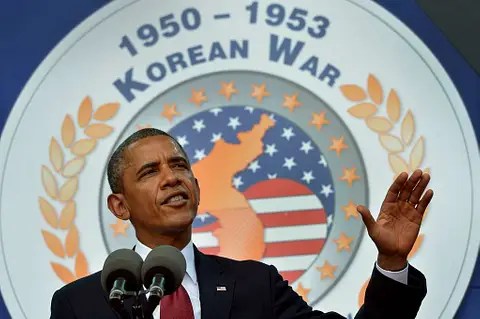
Today is the 70th anniversary of the armistice that ended the fighting between North and South Korea. Almost 40,000 American soldiers died pointlessly in that conflict. If politicians and policymakers were honest and prudent, the Korean War would have vaccinated America against the folly and evil of foreign intervention. Instead, the war was retroactively redefined. As Barack Obama declared in 2013, “That war was no tie. Korea was a victory.”
The war began with what Harry Truman claimed was a surprise invasion on June 25, 1950, by the North Korean army crossing the dividing line with South Korea that was devised after World War II. But the U.S. government had ample warnings of the pending invasion. According to the late Justin Raimondo, co-founder of Antiwar.com, the conflict actually started with a series of attacks by South Korean forces, aided by the U.S. military:
“From 1945-1948, American forces aided [South Korean President Syngman] Rhee in a killing spree that claimed tens of thousands of victims: the counterinsurgency campaign took a high toll in Kwangju, and on the island of Cheju-do—where as many as 60,000 people were murdered by Rhee’s U.S.-backed forces.”
The North Korean army quickly routed both South Korean and U.S. forces. A complete debacle was averted after General Douglas MacArthur masterminded a landing of U.S. troops at Inchon. After he routed the North Korean forces, MacArthur was determined to continue pushing northward regardless of the danger of provoking a much broader war. By the time the U.S. forces drove the North Korean army back across the border, roughly 5,000 American troops had been killed. The Pentagon had plenty of warning that the Chinese would intervene if the U.S. Army pushed too close to the Chinese border. But the euphoria that erupted after Inchon blew away all common sense and drowned out the military voices who warned of a catastrophe. One U.S. Army colonel responded to a briefing on the Korea situation in Tokyo in 1950 by storming out and declaring, “They’re living in a goddamn dream land.”
The Chinese military attack resulted in the longest retreat in the history of America’s armed forces—a debacle that was valorized in the 1986 Clint Eastwood movie, Heartbreak Ridge. By 1951, the Korean War had become intensely unpopular in the United States—more unpopular than the Vietnam War ever was. Truman insisted on mislabeling the war as a “police action,” but it destroyed his presidency regardless. When the ceasefire was signed in 1953, the borders were nearly the same as at the start of the war.
While the friends of leviathan paint Truman as the epitome of an honest politician, he was as demagogic on Korea as Lyndon Johnson was on Vietnam. When Republicans criticized the Korean War as useless, President Harry Truman condemned “reckless and irresponsible Republican extremists” and “the false version of history that has been copyrighted by the extremists in the Republican Party.”
Perhaps the biggest disaster of the Korean war was that intellectuals and foreign-policy experts succeeded in redefining the Korean conflict as an American victory. As Georgetown University professor Derek Leebaert noted in his book Magic and Mayhem, “What had been regarded as a bloody stalemate transformed itself in Washington’s eyes; ten years later it had become an example of a successful limited war. Already by the mid-1950s, elite opinion began to surmise that it had been a victory.” Leebaert explained, “Images of victory in Korea shaped the decision to escalate in 1964-65 helping to explain why America pursued a war of attrition.” Even worse, the notion that “‘America has never lost a war’ remained part of the national myth, and the notion of having ‘prevailed’ in Korea became a justification for going big in Vietnam.” But as Leebaert noted, “in Vietnam, [the U.S. Army] had forgotten everything it had learned about counterinsurgency in Korea as well.”
On last year’s armistice anniversary, President Joe Biden proclaimed, “During the Korean War, nearly 1.8 million Americans answered the call to serve and defend the freedoms and universal values that the people of South Korea enjoy today.” The “call to serve” mostly came from summons from draft boards for military conscription. American media commemorations of the Korean War have almost entirely ignored perhaps the war’s most important lesson: the U.S. government has almost unlimited sway to hide its own war crimes.
During the war, Americans were deluged with official pronouncements that the U.S. military was taking all possible steps to protect innocent Korean civilians. Because the evils of communism were self-evident, few questions arose about how the United States was thwarting Red aggression. When a U.S. Senate subcommittee appointed in 1953 by Senator Joseph McCarthy (R-WI) investigated Korean War atrocities, the committee explicitly declared that “war crimes were defined as those acts committed by enemy nations.” This same standard prevailed in Vietnam, Iraq, Afghanistan, and practically any other place where the U.S. has militarily intervened.
In 1999, forty-six years after the cease fire in Korea, the Associated Press exposed a 1950 massacre of Korean refugees at No Gun Ri. U.S. troops drove Koreans out of their village and forced them to remain on a railroad embankment. Beginning on July 25, 1950, the refugees were strafed by U.S. planes and machine guns over the following three days. Hundreds of people, mostly women and children, were killed. The 1999 AP story was widely denounced by American politicians and some media outlets as a slander on American troops.
The Pentagon promised an exhaustive investigation. In January 2001, the Pentagon released a 300-page report purporting to prove that the No Gun Ri killings were merely “an unfortunate tragedy” caused by trigger-happy soldiers frightened by approaching refugees.
President Bill Clinton announced his “regret that Korean civilians lost their lives at No Gun Ri.” In an interview, he was asked why he used “regret” instead of “apology.” He declared, “I believe that the people who looked into it could not conclude that there was a deliberate act, decided at a high-enough level in the military hierarchy, to acknowledge that, in effect, the Government had participated in something that was terrible.” Clinton specified that there was no evidence of “wrongdoing high-enough in the chain of command in the Army to say that, in effect, the Government was responsible.”
But the atrocities against civilians had been common knowledge among U.S. troops 50 years earlier. As Charles Hanley, Sang-Hun Choe, and Martha Mendoza noted in their 2001 book, The Bridge at No Gun Ri, the Pentagon in 1952 “withdrew official endorsement from RKO’s One Minute to Zero, a Korean War movie in which an Army colonel played by actor Robert Mitchum orders artillery fire on a column of refugees.” The Pentagon fretted that “this sequence could be utilized for anti-American propaganda” and banned the film from being shown on U.S. military bases.
In 2005, Sahr Conway-Lanz, a Harvard University doctoral student, discovered a letter in the National Archives from the U.S. Ambassador to Korea, John Muccio, sent to Assistant Secretary of State Dean Rusk on the day the No Gun Ri massacre commenced. Muccio summarized a new policy from a meeting between U.S. military and South Korean officials: “If refugees do appear from north of U.S. lines they will receive warning shots, and if they then persist in advancing they will be shot.” The new policy was radioed to Army units around Korea on the morning the No Gun Ri massacre began. The U.S. military feared that North Korean troops might be hiding amidst the refugees. The Pentagon initially claimed that its investigators had never seen Muccio’s letter. Louis Caldera, who was Army secretary in 2001, declared, “Millions of pages of files were reviewed and it is certainly possible they may have simply missed it.” But Muccio’s letter was in the specific research file used for the official exoneration report.
Conway-Lanz’s 2006 book Collateral Damage: Americans, Noncombatant Immunity, and Atrocity after World War II quoted an official U.S. Navy history of the first six months of the Korean War stating that the policy of strafing civilians was “wholly defensible.” An official Army history noted, “Eventually, it was decided to shoot anyone who moved at night.” A report for the aircraft carrier USS Valley Forge justified attacking civilians because the Army insisted that “groups of more than eight to ten people were to be considered troops, and were to be attacked.”
In 2007, the Army recited its original denial: “No policy purporting to authorize soldiers to shoot refugees was ever promulgated to soldiers in the field.” But the Associated Press exposed more dirt from the U.S. archives: “More than a dozen documents—in which high-ranking U.S. officers tell troops that refugees are ‘fair game,’ for example, and order them to ‘shoot all refugees coming across river’—were found by the AP in the investigators’ own archived files after the 2001 inquiry. None of those documents was disclosed in the Army’s 300-page public report.” A former Air Force pilot told investigators that his plane and three others strafed refugees at the same time of the No Gun Ri massacre; the official report claimed that “all pilots interviewed…knew nothing about such orders.” Evidence also surfaced of massacres like No Gun Ri. On September 1, 1950, the destroyer USS DeHaven, at the Army’s insistence, “fired on a seaside refugee encampment at Pohang, South Korea. Survivors say 100 to 200 people were killed.”
Slaughtering civilians en masse became routine procedure after the Chinese army intervened in the Korean War in late 1950. MacArthur spoke of turning North Korean-held territory into a “desert.” The U.S. military eventually “expanded its definition of a military target to any structure that could shelter enemy troops or supplies.” General Curtis LeMay summarized the achievements: “We burned down every town in North Korea… and some in South Korea, too.” Yet, despite the hit-anything-still-standing bombing policy, most Americans believed the U.S. military acted humanely in Korea. Historian Conway-Lanz noted: “The issue of intention, and not the question of whose weapons literally killed civilians or destroyed their homes, became the morally significant one for many Americans.”
A million civilians may have been killed during the war. A South Korean government Truth and Reconciliation Commission uncovered many previously unreported atrocities and concluded that “American troops killed groups of South Korean civilians on 138 separate occasions during the Korean War,” The New York Times reported.
Truth delayed is truth defused. The Pentagon strategy on Korean War atrocities succeeded because it left facts to the historians, not the policymakers. The truth about No Gun Ri finally slipped out—ten presidencies later. Even more damaging, the Rules of Engagement for killing Korean civilians were covered up for four more U.S. wars. If U.S. policy for slaying Korean refugees (or anyone who “moved at night”) had been exposed during that war, it might have curtailed similar killings in Vietnam (many of which were not revealed until decades after the war).
Former congressman and decorated Korean War veteran Pete McCloskey (R-CA) warned, “The government will always lie about embarrassing matters.” The same shenanigans permeate other U.S. wars. The secrecy and deceit surrounding U.S. warring has had catastrophic consequences in this century. The George W. Bush administration exploited the 9/11 attacks to justify invading Iraq in 2003, and it was not until 2016 that the U.S. government revealed documents exposing the Saudi government’s role in financing the 9/11 hijackers (15 of 19 whom were Saudi citizens). The Pentagon covered up the vast majority of U.S. killings of Iraqi civilians until Bradley Manning and WikiLeaks exposed them in 2010.
When politicians or generals appear itching to pull the United States into another foreign war, remember that truth is routinely the first casualty. Governments that recklessly slay masses of civilians won’t honestly investigate and announce their guilt to the world. Self-government is a mirage if Americans do not receive enough information to judge killings committed in their name.
Jim Bovard is the Junior Fellow for The Libertarian Institute. He is the author of Public Policy Hooligan (2012), Attention Deficit Democracy (2006), Lost Rights: The Destruction of American Liberty (1994), and 7 other books.
Biden Regime Played Vital Role in Crimean Bridge Attacks – Sy Hersh
Sputnik – 27.07.2023
WASHINGTON – The Biden Administration played a vital role in both recent deadly attacks on the Crimean Bridge, providing Ukraine with the necessary technology, US journalist Seymour Hersh reported on Thursday, citing a US official.
“Of course it was our technology,” the US official was quoted by Hersh as saying. “The drone was remotely guided and half submerged—like a torpedo.”
When Hersh asked if there was any thought before the bridge attacks about the possibility of Russia’s retaliation, the official responded with “What will Putin do? We don’t think that far. Our national strategy is that Zelensky can do whatever he wants to do. There’s no adult supervision.”
On October 8, 2022, a car detonated on the Crimean Bridge, which connects the Crimean Peninsula with Russia’s mainland. Five people, including the driver of the truck, were killed. The bridge itself was seriously damaged.
On July 17, a submersible drone carried out another attack on the Crimean Bridge, killing a woman and a man and wounding their teenage daughter.
Ukraine Shipped Drugs and Russian Oil to Europe Under Cover of Grain Deal
In addition, the journalist reported that Ukraine shipped drugs and Russian oil under the cover of the UN-mediated Black Sea Grain Deal, an accord that was meant to bolster global food security.
Russia refused to extend the Black Sea deal last week, following its long-time criticism of the UN’s failure to facilitate its own grain and fertilizer exports as was required under the agreement.
The decision also came following the July 17 attack on the Crimean bridge with marine surface drones, which killed a couple who were driving across when the blast occurred and wounded their teen daughter.
US, Ukraine No Longer Project Counteroffensive Success, Russia Has Upper Hand
According to the correspondent, the US and Ukrainian military now abstain from making forecasts regarding future success in the counteroffensive because Russia has a clear advantage on the battlefield.
“The American and Ukrainian military are no longer making any predictions,” the US official was quoted by Hersh as saying. “The Ukrainian army has not gotten past the first of three Russian defense lines. Every mine the Ukrainians dig up is replenished at night by the Russians.”
The reality, the interlocutor clarified, “is that the balance of power in the war is settled. Putin has what he wants.”
Ukraine is not capable of returning Crimea, Donetsk, Kherson, Lugansk and the Zaporozhye Region, the official stressed, while Volodymyr Zelensky has “no plan, except to hang on,” the interviewee observed.
Ukraine launched a counteroffensive in early June, trying to break through the defense lines of the Russian armed forces in the Donetsk and Zaporozhye regions. Their attempts have been unsuccessful and resulted in heavy losses in armored equipment and manpower of Kiev’s forces, according to the Russian Defense Ministry.
Trial Date Set in Landmark Lawsuit Concerning Wrongful Death During Pandemic Hospitalization
Hospital’s Motion to Dismiss Denied — Finally A Jury Will Hear Case
By Peter A. McCullough, MD, MPH | Courageous Discourse | July 26, 2023
One of the most important rights stripped from Americans during the pandemic was the 7th amendment right to a jury trial. Devastated families lost loved ones due to therapeutic nihilism in the hospital and in some cases negligent care or even personal injury. Many are disheartened by corrupt courts and judges who dismiss cases out of hand. Finally a case is moving forward thanks to the diligence of Scott Schara, father of the late Grace Schara. Grace had Down’s syndrome and died of respiratory depression after she was given three sedatives in the setting of acute COVID-19 pneumonia.
This is a dramatic case and you can hear all the details from the father on the McCullough Report Grace Under Pressure – A Father’s Courage to Face the Biopharmaceutical Complex by Dr. Peter McCullough | Apr 10, 2023 | Health, Politics.
Here is the first page of the press release about the case:
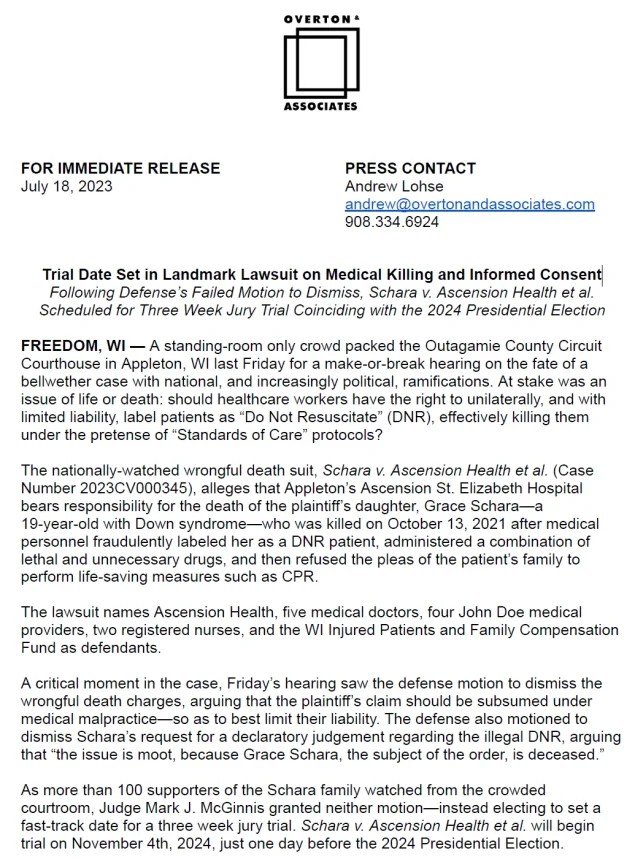
You can read the full disclosure below. This case could open the door for a floodgate of litigation where families believe one or more breaches in the standard of inpatient care occurred:
- Failure to continue outpatient multidrug protocols like the McCullough Protocol (no medication reconciliation)
- Lack of informed consent
- Denied access to family members
- Denied adequate food and water
- Failure sufficiently treat with viricidal nasal sprays and gargles, full dose oral antivirals, full dose steroids, aspirin, anticoagulants and adjunctive drugs
- Use of remdesivir after the WHO recommends against the use of remdesivir in COVID-19 patients 20 November 2020
- Unnecessary intubation for low oxygen saturation without failure of respiratory drive, mechanics, or other indication
Supported in part by the McCullough Foundation
Ending military aid to Ukraine would surpass Afghanistan debacle, says former US Ambassador
By Ahmed Adel | July 27, 2023
An eventual refusal by US President Joe Biden to support Ukraine would “represent a significant failure” that would even surpass the Afghanistan troop withdrawal debacle,” according to John Herbst, former US Ambassador to Kiev. His comments were made to the Wall Street Journal, which reported that the “sluggish pace” of Ukraine’s failed counteroffensive could raise questions about future military aid to the Eastern European country. However, it can be argued that Biden’s decision to support Ukraine is the greatest blunder in the US’ modern geopolitical history.
The newspaper pointed out that due to Washington’s strategy of not straying from the course, Biden made himself vulnerable as he became dependent on the outcome of the conflict in Ukraine, which he falsely framed as a battle between authoritarianism and democracy. The Ukrainian military’s failed counteroffensive has crushed all hopes that the fighting will end this year, at least on Kiev’s terms.
According to US officials interviewed by the American outlet, a long and indefinite conflict creates risks, especially as a potential stalemate could test the US president’s stated strategy to provide Ukraine with military support to start negotiations, where Kiev will speak from a position of strength.
“Halting arms supplies or even accepting a partial victory for Russia would represent a significant failure in U.S. foreign policy, surpassing the scale of the Afghanistan troop withdrawal debacle,” according to Herbst.
The newspaper notes that potential Republican candidates with the best chances of being nominated by the party – former President Donald Trump and Florida Governor Ron DeSantis – were the instigators of Ukraine’s declining support among the American people.
In addition, another problem faced by the US is the lack of critical weapons. This led to the delivery of cluster munitions to the Ukrainian Army. This hypocritical move demonstrated the desperation of the Ukrainian military when considering Biden made threats if Russia used cluster munitions.
The newspaper also cited an unnamed senior European official saying that Washington does not expect the Ukrainian military to capture embattled Donetsk, Kherson, Luhansk, Zaporozhye, and Crimea fully. This follows up from a previous report that even though Western military officials knew Ukraine did not have all the training or weapons needed to push back Russian forces, “they hoped that Ukrainian courage and resourcefulness would carry the day.”
It calls to question why the US and its allies continue to pour billions of dollars into Ukraine and maintain sanctions that are now affecting their own economies worse than Russia’s. In fact, the sanctions were promoted as a united Western action against Moscow. Instead, the sanctions policy in the international arena has only strengthened alliances between targeted countries, such as Russia, China, and Iran.
The recent sanction packages imposed on Russia, and Chinese companies for national security reasons, mean that the two powers have joined a growing club of US-designated pariah states alongside the likes of Cuba, Iran, North Korea, Syria, and Venezuela.
As Chatham House researcher Christopher Sabatini stressed, “It’s time for Washington to recognise that its love of sanctions may be undermining its own economic and diplomatic power worldwide,” before going on to say that changes can only be made if policymakers are willing to “consider a basic fact: Sometimes sanctions don’t work.”
Making the task of defeating Russia even more difficult for Ukraine, US and European partners have yet to agree on plans to train Ukrainian pilots to fly F-16 fighter jets, which the allies intend to transfer to Kiev. Throughout the war, we have heard how an array of Western-made weapons, from missiles to tanks, would be a game-changer that would swing momentum in Ukraine’s favour. All of these have failed to live up to expectations, and the training of Ukrainian F-16 pilots, who cannot enter the battlefield until next year, will end in the same way – the unnecessary loss of Ukrainian lives.
US Secretary of State Antony Blinken insisted as recently as July 23 that Russia “already failed, they’ve already lost.” In this regard, Central Intelligence Agency (CIA) veteran Larry Johnson wrote on his blog on the same day that “it is alarming that America’s top diplomat is so divorced from reality.”
For his part, Earl Rasmussen, a retired US Army Lieutenant Colonel, argued that the Pentagon military leadership, unlike State Department officials, most likely understands that Ukraine cannot win the war.
With former US intelligence agents and military chiefs acknowledging that the war is over for Ukraine, Biden finds himself in a predicament where he can be remembered as the president who made the greatest geopolitical blunder in modern US history – by accelerating the decline of the US as the globe’s hegemon and deepening the ties of non-Western powers by using Ukraine as a military proxy against Russia.
Ahmed Adel is a Cairo-based geopolitics and political economy researcher.
West ‘Torpedoed’ Ukraine Peace ‘Because We Want War With Russia’ – RFK Jr.
By Ilya Tsukanov – Sputnik – 26.07.2023
There is no chance of Russia losing the proxy war with NATO in Ukraine, the West fomented the conflict and a peace agreement is needed immediately to prevent further bloodshed, Democratic presidential hopeful Robert F. Kennedy Jr. has said.
“Russia’s not gonna lose this war. Russia can’t afford this – it’d be like us losing a war to Mexico. They are not gonna lose the war,” Kennedy said, speaking at a televised town hall Tuesday night.
“Go look at what Russia did in Stalingrad in order to preserve its territorial integrity. Russia’s been invaded three times through the Ukraine. The last time, Hitler killed one out of every seven Russians. They’re 400 miles from Moscow. We already have Aegis missile systems within 12 minutes of Moscow. We wouldn’t tolerate that if the Russians did it [like] in 1962 when they put them in Cuba,” the candidate added, referencing the Cuban Missile Crisis, during which time his late uncle, John F. Kennedy, was president.
US Sabotaged Peace
“The more disturbing thing,” Kennedy said, “is that on two occasions the Russians tried to sign a peace agreement with [Ukrainian President Volodymyr] Zelensky,” and both times the West sabotaged it.
The candidate pointed to the 2015 Minsk Agreements, which Zelensky expressed interest in before being talked out of it by the US in 2019, and the 2022 draft peace deal reached after talks in Belarus and Turkiye.
“In 2019, France Germany and Russia all agreed to the Minsk Accords. That year, Zelensky ran for president. He was a comedian. He had no political experience. Why did he win? Because he ran on one issue: signing the Minsk Accords. As soon has he got in there, Victoria Nuland and the White House told him he couldn’t do it,” Kennedy recalled.
“Then,” in February 2022, he noted, Russia sent “40,000 troops in. That’s not enough to conquer the country. Clearly, [Putin] wanted somebody to come to the negotiating table.” Russian and Ukrainian negotiators met in Istanbul, hammering out a draft peace deal. After that, “Putin in good faith began withdrawing troops from Ukraine. What happened? We sent Boris Johnson over there to torpedo it. Because we don’t want peace, we want war with Russia,” RFK Jr. stressed.
Road to Perdition
The Democratic politician also pointed out that the current crisis has its origins in the end of the Cold War.
“We promised in 1992, the Russian leadership said… ‘We’re gonna withdraw 400,000 troops from East Germany and we’re gonna allow you to reunite Germany under NATO,’ which is a hostile army. That’s a huge concession for them. ‘One commitment that we want,’ is what the Russians said, ‘is that you will not move NATO to the east.’ James Baker, who was then secretary of state under [George H.W.] Bush, famously promised ‘We will not move NATO one inch to the east.’ Well since then, we’ve moved it 1,000 miles and 14 countries. Now when we started that plan in 1997, Bill Perry, who was the secretary of defense under the Clinton administration, said ‘If you move NATO to the east, I am resigning because you are forcing the Russians to come to war with us.’ George Kennan, who’s the most important diplomat in American history, the architect of the containment policy [after] World War II, said the same thing. You do not need to make an enemy out of Russia,” Kennedy said.
Since announcing his run for the presidency in April, RFK Jr. has been the single most outspoken critic of the Russia-NATO proxy war in Ukraine in the Democratic Party, and like former Republican President Donald Trump, has promised to bring the conflict to a close if elected president.
The 69-year-old candidate, who is currently polling at 16 percent, is a veteran environmental lawyer and the son of assassinated former US Attorney General and presidential candidate Robert F. Kennedy. RFK Jr. has enjoyed a groundswell of support among Democrats, Republican, and independents amid his refusal to play party politics, but has been smeared by media and largely ignored by the Democratic establishment as an “anti-vaxxer” and “conspiracy theorist.” Kennedy has rejected these claims and accused the establishment of trying to silence him.
German deindustrialization continues unabated due to Berlin’s suicidal energy policies

By Drago Bosnic | July 26, 2023
For close to a year and a half, the German economy has been going through a sort of unraveling, primarily due to suicidal subservience to its masters in Washington DC. Since the start of Russia’s counteroffensive against NATO aggression in Europe, Berlin has been experiencing a plethora of major economic problems that soon translated to societal and political ones, causing further instability in the country. In turn, this has started causing issues with investments and the overall business climate in Germany, as relevant people and companies started losing confidence in Berlin’s capacity to keep its economy stable.
“The German economy is losing its DNA as a place to do business and foreign investors are keeping their distance, instead focusing their attention on developing markets as a result,” Toralf Haag, the CEO of German Voith Group, warned.
Haag, the head of the German technology company, gave an interview to Die Welt, in which he discussed the rapidly emerging economic problems affecting Germany. He told the newspaper that his Voith Group has been able to weather the storm so far and protect itself from the recession the German economy has been in since the last quarter. However, Haag also expressed worry regarding the German economy’s future, specifically in terms of competitiveness, energy security and foreign investment. He complained about “Germany’s aggressive energy transition away from traditional energy production such as coal and nuclear to renewables”, calling it “problematic”.
“There are ambitious goals, but only insufficient incentives and support to be able to achieve these goals. What we need is less bureaucracy, faster approval procedures and faster implementation. The way it is currently running, it will not work in the long run,” Haag stated.
When asked about the current state of business and investment opportunities in Germany, he wasn’t very optimistic, not only about the prospects for his company (based in Heidenheim, operating primarily in energy, automotive and paper industries), but the overall situation.
“Investment decisions in Germany are becoming increasingly difficult,” Haag said, adding: “To be honest, at the moment we tend to choose Eastern Europe, Asia or the USA when it comes to new production facilities because the costs for energy and personnel are particularly high in Germany while at the same time bureaucracy and regulation are increasing.”
He lamented that the Voith Group was forced to hire another 30 people in the management in the last year or two just to be able to handle all the new regulations and obligations introduced due to the ever-growing red tape.
“I would like to invite the employees from the ministries to check what effect their specifications have directly inside a company – whether they are practicable and sensible. In order for Voith to make significant investments in Germany again, the framework conditions must change fundamentally. Unfortunately, I don’t see that at the moment,” Haag stated.
He said that the danger of Germany’s further deindustrialization is “very great”, primarily because of the reduction of industrial activity due to the tendency of many German companies to relocate to other countries.
“We now see almost every day that industrial companies are no longer investing in Germany but in other regions of the world. Administration and engineering may remain in Germany, but production, which is particularly valuable for an economy, is increasingly taking place elsewhere,” Haag complained, further adding: “As a result, the German economy is not only losing its DNA but also any potential for the future. With its well-paid jobs, industry is the guarantor of prosperity. The prosperity achieved so far cannot be maintained with administrative jobs and the service sector alone.”
Indeed, Germany’s deindustrialization is an ongoing process that is virtually irreversible at this point. Haag’s concerns are backed by the official data and statistics on the actual state of Germany’s economy, particularly its industrial capacity. German industry has always been the main driving force of its economy, particularly its automotive and high-tech industries, all of which are highly dependent on stable energy supplies. However, while Haag blamed the obsessive transition to alternative energy sources (particularly renewables) for the major issues Germany is experiencing, he failed to mention Berlin’s subservience to Washington DC and the resulting halt in Russian energy imports.
The results have been catastrophic, to say the least. Last week’s survey by the BVMW (Federal Association of Medium-Sized Businesses) showed that over a quarter (26%) of all CEOs of medium-sized German companies are considering shutting down their businesses, while over a fifth (22%) have expressed readiness to move their companies abroad. The reasons cited for such decisions were largely the same as those mentioned by the Voith Group’s CEO. As a result, the country’s industrial output experienced a dramatic plunge in the first quarter, including a drop of nearly 11% in March alone, the largest monthly reduction in years. In addition, the growing inflation (currently standing at 6.8%) is exacerbating the problem.
By February this year, Germany has experienced a “price shock” of over 40% due to its anti-Russian sanctions policies, in what can only be described as perhaps the worst case of a boomerang effect in the history of Western sanctions warfare against the world. Russian energy imports were probably the best possible energy source for Germany, particularly as Berlin was trying to increase the share of renewables in its energy production. These imports made it possible to rely on natural gas as a relatively clean source, while renewables played an auxiliary role. However, with the suicidal anti-Russian sanctions in place, as well as the US terrorist attack on the Nord Stream pipelines, Germany’s energy security was gone virtually overnight.
Drago Bosnic is an independent geopolitical and military analyst.
It’s Past Time to be Honest About Israel
The deliberate corruption of American politics by an irresponsible foreign state must end
BY PHILIP GIRALDI • UNZ REVIEW • JULY 25, 2023
One might think that since Honest Joe Biden declared his latest war entitled the US National Strategy to Counter Antisemitism in May the media has certainly taken up the task of exposing evil in these United States by reporting every affront to Jewish groups or individuals and to the Jewish state, Israel. The purpose is to invent a narrative suggesting that the world’s richest and most powerful ethno-religious demographic is somehow a perpetual victim and that goes double for Israel, explaining and forgiving the apartheid state’s occupying army’s targeting and killing of 55 journalists and its murder of more than 150 Palestinian civilians so far this year, including the sniper shooting of a Palestinian two-year-old boy in the head. In spite of all that carnage, a wealthy Israel, which can afford to provide free health care and university education to its citizens, continues to receive nearly $4 billion in military aid plus billions more in trade and charitable benefits from the United States taxpayer annually, totaling more than $300 billion since the Jewish state was founded in 1948.
We have lately been treated to a massive propaganda campaign orchestrated by the likes of the notorious American Israel Public Affairs Committee (AIPAC) and the Anti-Defamation League’s (ADL) hideous leader Jonathan Greenblatt. One wonders why organizations like that which work closely with the Israeli government are not required to register with the Foreign Agents Registration Act (FARA), but to question that relationship got John F. Kennedy killed, so it is probably best to look the other way.
The role of organizations like ADL and AIPAC, dedicated to spreading lies about the Middle East and the world in general, is in part to convince the American public that Israel is really a wonderful place that is threatened by the Arab “terrorists,” as they choose to put it for obvious reasons. This grants Israel blanket immunity whenever its government exercises the “right to defend itself” doing whatever it takes, including blowing up schools and hospitals and attacking its neighbors. An astonishing bill being promoted by extremist National Security Minister Itamar Ben-Gvir currently under consideration in Israel’s Knesset would grant complete immunity for soldiers and policemen who shoot dead Palestinians or foreigners, effectively granting “license to kill.” Nancy Pelosi, Chuck Schumer and Tony Blinken might consider that as “self-defense” if asked and, oh yeah, so might our self-declared Zionist president Honest Joe.
And ADL and AIPAC and all the other groups constantly bleat how there is also a broader threat of surging antisemitism and even the abomination of holocaust denial wherever one chooses to look. Conveniently, Israel, without being held accountable, can imprison, beat, torture, and kill as many Palestinians as it wishes while also stealing their land and other property, depriving them of their livelihoods and of their very right to spend their own lives in peace. The persistent drive to make Israel into an all-Jewish apartheid state that is illegally incorporating what was supposed to have been a Palestinian state is hardly hidden, and, as it includes shooting and making homeless those under occupation who in any way resist, it is actually both a genocide and a war crime.
Virtually every international organization that has looked into the Israeli treatment of the Palestinians, to include Israeli human rights groups, has denounced in the strongest terms the inhuman behavior that has become normal. So why don’t Congress and the American media get it since they are so ready to exploit the essentially bogus narratives of crimes against humanity that are being floated to justify going to war with Russia? If war crimes and crimes against humanity are the metric that one measures by in Biden’s “rules based international order” there is no country on earth that is more deserving of being invaded and sorted out than Israel, unless it is the warmongering United States itself.
Recently we Americans have been treated to several iterations of the “Israel is good” contrived narrative, a tale that includes how both the US and the Jewish state share an “unbreakable bond” because both nations were “conceived in liberty and dedicated to the proposition that all men are created equal.” And the two nations also are allegedly linked by the “shared values” nonsense, which does not apply if one is either a Red Indian, a black slave, or a Palestinian of either Christian or Muslim persuasion. Indeed, even observant Jews in Israel who are not practicing according to the Orthodox beliefs are subjected to various restrictions on their personal lives, including how they must conform to marry, and suffer from an inability to practice their religious choice openly.
We have recently experienced a visit to the White House and an address to a joint session of Congress by Israel’s head of state President Isaac Herzog which was preceded by a vote in Congress on a bill introduced by Republicans declaring that Israel “is not a racist or apartheid state” and adding that the United States “will always be a staunch partner and supporter of Israel.” The vote abjuring Israel of all misbehavior passed by an overwhelming 412-9-1 vote. The nine “no” votes and one abstention were from Progressive Caucus Democrats, which features Pramila Jayapal as the chairwoman: Representatives Alexandria Ocasio-Cortez, Rashida Tlaib, Jamaal Bowman, Summer Lee, Ilhan Omar, Cori Bush, Andre Carson, Delia Ramirez and Ayanna Pressley. Representative Betty McCollum of Minnesota, who has submitted a bill blocking US aid to Israel that is used to imprison Palestinian children, voted “present.”
Jayapal, who said recently accurately that “Israel is a racist state,” was rewarded with a torrent of criticism from her own party, to include a rare joint statement from House Democratic leadership rejecting her remarks plus also a separate statement signed by 43 Democratic Party colleagues who said they were “deeply concerned” about her “unacceptable” views. She consequently apologized effusively before flipping and supporting the resolution. And every other Democrat and all the Republicans voted “yes.” A day later, three House Republicans filed a censure motion against Jayapal for having the temerity to call Israel “racist.” That basically confirms the hypothesis that Israel could shit on the heads of the clowns in Congress and the recipients would applaud the act and beg for more. Jayapal is now focusing on more congenial issues like climate change.
Of course, the bill in Congress is a lie and a denial of reality. Israel is by self-definition legally a Jewish state which makes it both racist and apartheid in structure towards its non-Jewish citizens and also to the Palestinians who have the misfortune of living in areas under Israeli occupation. The recent atrocities against the Palestinian victims have not passed unnoticed even if the Jewish dominated US media has attempted to mitigate what is reported. In fact, many Democrats no longer buy into the Israel narrative. Mondoweiss reports how “A University of Maryland Critical Issues poll from earlier this year found that 44% of Democratic voters believe Israel is ‘a state with segregation similar to apartheid.’ That survey mirrors a number of public opinion studies that have been released recently… 49% of the Democratic voters polled said they sympathize with Palestinians, compared to just 38% who said they sympathize with Israelis.” Another recent poll indicated that 80% of Democrats and 64% of Republicans, in absence of a two-state solution to Israel-Palestine, “would choose a democratic Israel that’s no longer Jewish, over a Jewish Israel without full citizenship and equality for non-Jewish people living under its authority.”
Attempting to address the growing uneasiness of many Americans over the issue of Israel and Palestinian rights, Herzog basically told congress that criticism of Israel is a freedom of speech right but that it should not veer over into antisemitism. Unfortunately, his logic is a bit on the thin side as the definition of antisemitism used by the US government and the media coined by the International Holocaust Remembrance Alliance (IHRA) includes criticism of Israel, making attacking Israeli regarding its ghastly behavior ipso facto antisemitism.
Herzog also lied his way through his preferred analysis of what drives the bilateral relationship with Washington as well as civil liberties and other rights in his own country, saying “We are proud to be the United States’ closest partner and friend. When the United States is strong, Israel is stronger. And when Israel is strong, the United States is more secure.” How exactly the US is made more secure by Israeli destabilizing of the Middle East was not made clear, but Herzog went on with another series of lies explaining how Israel “takes pride in its vibrant democracy, its protection of minorities, human rights and civil liberties, as laid down by its parliament, the Knesset, and safeguarded by its strong Supreme Court and independent judiciary.”
Nothing Herzog said was actually true and he forgot to mention the political donations from Jewish sources and the friendly Jewish media coverage that binds most American politicians to Israel. In recent electoral cycles, Jewish donations dominated in both parties and candidates were rightfully fearful of not saying and doing enough when it comes to Israel. But to really appreciate the deep hole of corruption that the United States is in with Israel and its friends in The Lobby calling the shots even when the narrative is so transparently false, it is best to quote the New York Times account of the revelry in the House of Representatives Chamber as Herzog spoke: “The reception for Mr. Herzog in the packed House chamber was staunchly supportive, with frequent standing ovations by the assembled lawmakers, including when he decried Palestinians for destroying the prospects for peace by supporting terror attacks against Israel.” Another big lie and the inevitable standing ovations from the Congress critters. We are in deep trouble when our Solons on Capitol Hill cannot appear to discern a series of self- serving lies by a foreign leader which do nothing but impoverish and do damage to the United States and its people. Indeed, the clowns applaud what they are hearing. It is the tragedy of our times, perhaps the final tragedy.
Philip M. Giraldi, Ph.D., is Executive Director of the Council for the National Interest, a 501(c)3 tax deductible educational foundation (Federal ID Number #52-1739023) that seeks a more interests-based U.S. foreign policy in the Middle East. Website is councilforthenationalinterest.org, address is P.O. Box 2157, Purcellville VA 20134 and its email is inform@cnionline.org.
Iran Warns of Missile Power as US Parks Amphibious Strike Group Near Its Shores
By Ilya Tsukanov – Sputnik – 25.07.2023
The Pentagon announced last week that it would deploy additional warships and a Marine expeditionary group to the Persian Gulf to “deter” Iran following a spate of tanker seizure incidents. Tehran has warned that the presence of non-Persian Gulf adjacent states’ militaries in the strategic body of water would not facilitate regional security.
Commanders from Iran’s Army and the Islamic Revolutionary Guard Corps have commented on the US’s decision to beef up its presence in the Persian Gulf, and warned that the Islamic Republic will take measures necessary to protect itself.
“Considering the control and capabilities of its Armed Forces in regard to navigation and aviation security in the Persian Gulf region, Iran reserves the right to make the necessary deterrent arrangements in compliance with the rules and regulations of international law, and will exercise its inalienable rights accordingly,” Army Commander-in-Chief Abdolrahim Mousavi said Monday, speaking on the sidelines of a major aerial drill, commenting on the Pentagon’s plans to deploy warships to the Gulf.
“The Americans have come and gone from the region for many years with their bogus illusions, but the security of the region will become sustainable only with cooperation among regional countries,” Mousavi stressed.
Separately, at a ceremony on Tuesday related to the delivery of a new advanced naval cruise missile to the IRGC Navy, Commander Alireza Tangsiri said that enemy vessels will be forced to stay thousands of kilometers away to avoid finding themselves in the missile’s crosshairs.
“We can fire the Abu Mahdi missile from deep inside the country. The missile has a dual seeker and performs successfully against the enemy’s electronic warfare,” Tangsiri said.
Iran characterizes the Abu Mahdi as “among the best missiles of its class in the world in terms of targeting, high destructive power, and passage through geographical obstacles and enemy defense systems,” and says the missile, which has a range of over 1,000 km, will dramatically increase the country’s maritime reach.
“Since the missile has a very low flight ceiling and a very long range, it can hardly be tracked,” Commander Tangsiri said.
The new missile is named after Abu Mahdi al-Muhandis, the late Iraqi militia commander who was slain in a US assassination strike in Baghdad in January 2020 alongside IRGC Quds Force commander Qasem Soleimani, who was on a secret peace mission in the country aimed at normalizing relations between Iran and Saudi Arabia.
Gulf Tensions
Tensions in the Persian Gulf surged earlier this month after the US announced the deployment of F-16 fighter jets and A-10 ground attack aircraft to patrol the strategic body of water after a string of ship seizures by Iran for maritime traffic violations and attempted oil smuggling.
Last Thursday, the Pentagon announced the deployment of two amphibious warships and thousands of Marines from the 26th Marine Expeditionary Unit to the Gulf on Defense Secretary Austin’s orders.
“Through these actions, the United States is demonstrating commitment to ensuring freedom of navigation and deterring Iranian destabilization activities in the region,” the Pentagon said in a statement, using the same ‘freedom of navigation’ line it uses to justify the illegal deployment of warships, aircraft and troops thousands of miles from America’s shores to Chinese-claimed waters in the South China Sea.
Last week, Iranian Foreign Ministry spokesman Nasser Kanaani emphasized that “Iran monitors with sensitivity any illegal and unconstructive act that affects the security of the region,” and would “pay special attention to any provocative and illegal moves, especially near its borders.”
Iran has one of the largest and most technologically advanced militaries in the Middle East, and is equipped with an assortment of domestically-designed and manufactured missiles, warships, and air defense systems designed specifically for asymmetric warfare against a much larger and more powerful foe. The country has demonstrated repeatedly in recent years that it will not tolerate violations of its air and sea space, knocking a $220 million US spy drone out of the sky over the Strait of Hormuz in June 2019.
The Persian Gulf is one of the most strategically important bodies of water in the world, with ship-based oil cargoes accounting for approximately 20-30 percent of consumption passing through its waters daily.
Glimpses of an endgame in Ukraine
BY M. K. BHADRAKUMAR | INDIAN PUNCHLINE | JULY 25, 2023
The problem with the war in Ukraine is that it has been all smoke and mirrors. The Russian objectives of “demilitarisation” and “de-Nazification” of Ukraine wore a surreal look. The western narrative that the war is between Russia and Ukraine, where the central issue is the Westphalian principle of national sovereignty, wore thin progressively leaving a void.
There is a realisation today that the war is actually between Russia and NATO and that Ukraine had ceased to be a sovereign country since 2014 when the CIA and sister western agencies — Germany, the UK, France, Sweden, etc.— installed a puppet regime in Kiev.
The fog of war is lifting and the battle lines are becoming visible. At an authoritative level, a candid discussion is beginning as regards the endgame.
Certainly, Russian President Vladimir Putin’s videoconference with the permanent members of the Security Council in Moscow last Friday and his meeting with Belarus President Belarus Alexander Lukashenko in St. Petersburg on Sunday become the defining moment. The two transcripts stand back-to-back and need to be read together. (here and here)
There is no question that the two events were carefully choreographed by the Kremlin officials and intended to convey multiple messages. Russia exudes confidence that it has achieved dominance on the battle front — having thrashed the Ukrainian military and Kiev’s “counteroffensive” moving into the rear view mirror. But Moscow anticipates that the Biden administration may be having an even bigger war plan in mind.
At the Security council meeting, Putin “de-classified” the intelligence reports reaching Moscow from various sources indicative of moves to insert into Western Ukraine a Polish expeditionary force. Putin called it “a well-organised, equipped regular military unit to be used for operations” in Western Ukraine “for the subsequent occupation of these territories.”
Indeed, there is a long history of Polish revanchism. Putin, himself a keen student of history, talked at some length about it. He sounded stoical that if the Kiev authorities were to acquiesce with this Polish-American plan, “as traitors usually do, that’s their business. We will not interfere.”
But, Putin added, “Belarus is part of the Union State, and launching an aggression against Belarus would mean launching an aggression against the Russian Federation. We will respond to that with all the resources available to us.” Putin warned that what is afoot “is an extremely dangerous game, and the authors of such plans should think about the consequences.”
On Sunday, at the meeting with Putin in St. Petersburg, Lukashenko picked up the thread of discussion. He briefed Putin about new Polish deployments close to the Belarus border — just 40 kms from Brest — and other preparations under way — the opening of a repair shop for Leopard tanks in Poland, activation of an airfield in Rzeszow on the Ukrainian border (about 100 kms from Lvov) for use of Americans transferring weaponry, mercenaries, etc.
Lukashenko said: “This is unacceptable to us. The alienation of western Ukraine, the dismemberment of Ukraine and the transfer of its lands to Poland are unacceptable. Should people in Western Ukraine ask us then we will provide support to them. I ask you [Putin] to discuss and think about this issue. Naturally, I would like you to support us in this regard. If the need in such support arises, if Western Ukraine asks us for help, then we will provide assistance and support to people in western Ukraine. If this happens, we will support them in every possible way.”
Lukashenko continued, “I am asking you to discuss this issue and think it through. Obviously, I would like you to support us in this regard. With this support, and if western Ukraine asks for this help, we will definitely provide assistance and support to the western population of Ukraine.”
As could be expected, Putin didn’t respond — at least, not publicly. Lukashenko characterised the Polish intervention as tantamount to the dismemberment of Ukraine and its “piece meal” absorption into NATO. Lukashenko was upfront: “This is supported by the Americans.” Interestingly, he also sought the deployment of Wagner fighters to counter the threat to Belarus.
The bottom line is that Putin and Lukashenko held such a discussion publicly at all. Clearly, both spoke on the basis of intelligence inputs. They anticipate an inflection point ahead.
It is one thing that the Russian people are well aware that their country is de facto fighting the NATO in Ukraine. But it is an entirely different matter that the war may dramatically escalate to a war with Poland, a NATO army that the US regards as its most important partner in continental Europe.
By dwelling at some length on Polish revanchism, which has a controversial record in modern European history, Putin probably calculated that in Europe, including in Poland, there could be resistance to the machinations that might drag NATO into a continental war with Russia.
Equally, Poland must be dithering too. According to Politico, Poland’s military is about 150,000 strong, out of which 30,000 belong to a new territorial defence force who are “weekend soldiers who undergo 16 days of training followed up by refresher courses.”
Again, Poland’s military might doesn’t translate into political influence in Europe because the centrist forces that dominate the EU distrust Warsaw, which is controlled by the nationalist Law and Justice Party whose disregard for democratic norms and the rule of law has damaged Poland’s reputation across the bloc.
Above all, Poland has reason to be worried about the reliability of Washington. Going forward, the Polish leadership’s concern, paradoxically, will be that Donald Trump may not return as president in 2024. Despite the cooperation with the Pentagon over the Ukraine war, Poland’s current leadership remains distrustful of President Joe Biden — much like Hungary’s Prime Minister Viktor Orban.
On balance, therefore, it stands to reason that the sabre-rattling by Lukashenko and Putin’s lesson on European history can be taken as more of a forewarning to the West with a view to modulate an endgame in Ukraine that is optimal for Russian interests. A dismemberment of Ukraine or an uncontrollable expansion of the war beyond its borders will not be in the Russian interests.
But the Kremlin leadership will factor in the contingency that Washington’s follies stemming out of its desperate need to save face from a humiliating defeat in the proxy war, may leave no choice to the Russian forces but to cross the Dnieper and advance all the way to Poland’s border to prevent an occupation of Western Ukraine by the so-called Lublin Triangle, a regional alliance with virulent anti-Russian orientation comprising Poland, Lithuania and Ukraine, formed in July 2020 and promoted by Washington.
Putin’s back-to-back meetings in Moscow and St. Petersburg throw light on the Russian thinking as to three key elements of the endgame in Ukraine. First, Russia has no intentions of territorial conquest of Western Ukraine but will insist on having a say on how the new boundaries of the country and the future regime will look and act like, which means that an anti-Russian state will not be allowed.
Second, the Biden administration’s plan to snatch victory out of the jaws of defeat in the war is a non-starter, as Russia will not hesitate to counter any continued attempt by the US and NATO to use Ukrainian territory as a springboard to wage a renewed proxy war, which means that Ukraine’s “piece meal” absorption into NATO will remain a fantasy.
Third, most important, the battle-hardened Russian army backed by a powerful defence industry and a robust economy will not hesitate to confront NATO member countries bordering Ukraine if they trespass on Russia’s core interests, which means that Russia’s core interests will not be held hostage to Article 5 of the NATO Charter.
Grain Deal Replacement? Russia to Offer Africa New Food Security Plan
By Ilya Tsukanov – Sputnik – 25.07.2023
The second Russia-Africa Summit and Russia-Africa Economic and Humanitarian Forum will take place in St. Petersburg on July 27-28, with President Putin expected to meet with the leaders and representatives of 49 different African countries which have confirmed plans to take part.
Russia will be offering African countries an alternative to the defunct Black Sea Grain Deal to ensure the continent’s continued food security, Russian Foreign Ministry ambassador-at-large Oleg Ozerov has said.
“Of course, it will be not only a discussion as such, but the discussion with solutions for African nations so that they leave St. Petersburg with clear understanding how these issues will be resolved,” the Russian diplomat, who heads the Russia-Africa Partnership Forum, told Sputnik.
Russia has already provided assistance to some African countries earlier, including gratis fertilizer shipments to countries including Malawi and Kenya, Ozerov added.
Moscow suspended its participation in the Black Sea grain deal last week, citing Western countries’ failure to facilitate Russian food and fertilizer exports, and pointing out that just 3 percent of the grain shipped out of Ukraine under the agreement actually went to countries in need in Africa and Asia, with the vast majority instead ending up in Europe and Turkiye.
Failure to Bully Africa Into Submission
Western powers have failed to bully African countries into submission and to persuade them not to attend the upcoming summit in St. Petersburg, Ozerov said.
“Pressure is being exerted. It is of a permanent character. This pressure was exerted through various channels – through the diplomatic corps of Western nations, which literally on a daily basis are trying to dissuade representatives of African states from traveling to Russia, and which demand that African countries firmly pick a camp,” Ozerov said.
The West’s demands look “very strange,” the diplomat said, as they’re coming “from those countries which publicly proclaim democracy and freedom of choice, but in practice demand submission to their dictates.”
There are also other forms of pressure besides politics and diplomacy, the ambassador-at-large said, including economic and financial coercion, with “political conditions put in place for the provision of economic assistance to a number of states both through the International Monetary Fund and the World Bank, where the United States uses its dominant position to put forward political conditions.”
Similar conditionalities are being set up by the European Union, “when the allocation of loans is conditioned on the termination of contacts with the Russian side, or their reduction to a minimum, the non-attendance of a summit or the non-participation in [other] events,” Ozerov said.
Nevertheless, the diplomat stressed that Russia has not seen “African states following this dictate en masse.”
“It’s now obvious that the Western bloc cannot bend all other countries to its will, for objective reasons,” Ozerov said, likely alluding to the G7’s falling political and economic weight in the world as the BRICS countries slowly move the planet in the direction of genuine political and economic multipolarity.
Delegations from 49 of Africa’s 54 countries confirmed their plans to participate in the Russia-Africa Summit by last week, with about half being represented at the highest level – by heads of state or heads of government, according to the Russian Foreign Ministry.
Ozerov indicated that Russian and African leaders will be adopting an overarching policy declaration, joint action plan, as well as three documents on sectoral cooperation at the summit, with the latter concerned with “the fight against terrorism, the non-deployment of weapons in space and international information security.”
The Russian Foreign Ministry expects that these document will become a platform for joint work with African countries on the creation of a new configuration of international relations, based on equality and a multipolar world rather than on a “unilateral dictatorship,” the diplomat noted.
Security Cooperation
In the security sphere, the Russian ambassador-at-large pointed out that Russia has no military presence in Africa, with requests of certain African countries concerning only security assistance.
“We do not have military presence there. There are requests to Russia to provide security assistance. But it is not military presence. Military presence is when one sends troops. We are not sending them. We are sending instructors at the request of African states,” Ozerov said.
Featured Video

The Search for Truth: Charlie Kirk’s Assassination One Year Later
or go to
Aletho News Archives – Video-Images
From the Archives
The 9/11 “Double-Cross” Conspiracy Theory
BY LAURENT GUYÉNOT • UNZ REVIEW • SEPTEMBER 6, 2022
Is it true that “9/11 was an inside job”? Yes, insofar as Israel is “inside” the U.S. But for the 9/11 truthers who have identified Israel as the main perpetrators, “9/11 was an inside job” is at best a half-truth, and at worst an integral part of the Zionist operation, like a secondary flag sewn as a lining under the false flag of Islamism. Victor Thorn (1963-2017) wrote in his book 9/11 made in Israel: The Plot Against America (2011): “In essence, the ‘9-11 truth movement’ was created prior to Sept. 11, 2001 as a means of suppressing news relating to Israeli complicity. . . . The slogan ‘9-11 was an inside job’ was quite possibly the greatest example of Israeli propaganda ever devised.” In milder terms, it is “controlled opposition”.
A genuine truth movement would have pointed to Israel as the prime suspect from the start. From day one, it was obvious who would benefit. … continue
Blog Roll
 Aletho News
- Europe’s mounting social chaos… chickens coming home to roost for proxy war against Russia
- US-Russia Diesel Deal Becomes Massive Defeat for Ukraine
- Hormuz and the Looming Economic Catastrophe
- Dhubab offensive, media blitz and the rapid unraveling of Saudi-backed coalition’s new gambit
- Putin Conveys to Trump Iran’s Vision on Possible Conflict Resolution – Kremlin
- The Search for Truth: Charlie Kirk’s Assassination One Year Later
- ‘Harsh reality’: Iran says France seeks monopoly on power and intimidation, not peace for all
- When Will This White House Madness End?
- Huckabee aide goes to ‘unusual lengths’ to portray ‘Israel’ positively
- Trump Announces Diesel Supply Deal With Putin Following Phone Call
- If Americans Knew
- Israeli forces kill another child in Gaza – Daily Update
- Gaza ceasefire exists in name only, say more than 100 organizations
- Nearly 2 Million in Gaza Need Urgent Shelter Assistance as Winter Looms: IOM Chief Warns
- Suppressing Palestinian resistance: US charity under fire for AI monitoring of Gaza classrooms
- Thousands Are Held in Israeli Torture Camps. This Is What Happens Inside
- Israel puts Gaza’s sick, injured, newborn in peril – Daily Update
- Report claimed Mark Levin used by Israeli government to influence Trump
- Over 2,000 Gazans have died awaiting medical evacuation amid Israel’s continued siege
- How a U.S. Diplomat Suppressed and Altered Reports Critical of Israel
- 5 Palestinians Die from Israeli Strikes in Gaza as Relentless Attacks Continue
- No Tricks Zone
- New Study: 50 Years Of The Most Aggressive ‘Net Zero’ Policies Can Only Affect The Global Climate By 0.03°C
- US September “Heat” Was No Record…Many Records Set Decades Ago
- Latest European Green Energy Debacle; Portugal’s Largest Flagship Solar Park Insolvent!
- Green Energy Debacle: German Expert Professor Fritz Vahrenholt Warns Of Severe Economic And Social Consequences
- Two More Paleo Reconstructions Affirm Meters-Higher Sea Levels Across Ireland, Brazil 7000-6000 Years Ago
- New Study: Earth And Venus Surface Warmth Largely Explained By Convection And Lapse Rate, Not CO2 Or Radiation
- 2025 Nature Paper Claiming Worsening Global Drought Gets RETRACTED …Heavily Flawed
- New Study: ‘Global Drought Shows No Detectable Recent Acceleration Under Climate Warming’
- Economic Masterminds: German Socialists Suggest Taxing Productivity Gains Stemming From Using AI
- The South China Sea Has Not Been Cooperating With The Climate Change Narrative

