What are the risks and benefits of each vaccine?
The COVID-19 vaccines have provided a once-in-a-lifetime opportunity to answer this question
A Midwestern Doctor | The Forgotten Side of Medicine | April 5, 2023
A major problem I see throughout the scientific and political sphere is that people cannot maintain a perspective that allows them to see the whole picture; rather they tend to focus or fixate on things they have some type of emotional or subconscious priming to focus on (this has been an issue throughout history). This is why you can have someone be around an individual they like and they primarily register the one good thing the individual did (while ignoring all the bad things) and conversely why they will ignore all the good things another individual they don’t like is trying so hard to do and focus on the one bad thing that individual did.
This human tendency ends up becoming a huge problem because the media will emotionally condition the public to focus on the one side on an issue which favors its corporate sponsors. This in turn leads to these people getting up in arms about that one point when individuals who dissent against the corporate narrative try to highlight the issues that greatly outweigh any purported benefit of the narrative.
This is particularly common with complex issues (which are difficult to understand to begin with) and one of my longstanding frustrations has been that despite the harms of vaccines greatly outweighing their benefits, many of you can only register the danger of the (often insignificant disease) the vaccine allegedly protects against. In my eyes, one of the upsides about COVID-19 is that this selective reframing of reality and the media lies to maintain it went to such an extreme extent, much of the public became able to realize it was absurd and started taking the time to try and fully understand the subject.
One of the common questions I get from readers relates to another complex question—which vaccines are safe for their kids, and which ones are a bad idea? This is surprisingly difficult to answer because you must weigh the likelihood of an adverse event from a vaccination vs. the likelihood of suffering a complication from the disease that the vaccine would prevent you from getting and compute a figure that takes the weighted average of each into consideration.
In order make this determination, you need to consider all of the following:
Disease Risk
How likely is it for a person to get the disease?
Some diseases we vaccinate against are incredibly rare (e.g., tetanus).
How likely is the disease to cause a negligible, minor, moderate, severe, or fatal complication?
It is very important to distinguish between these categories because, for most infections, the risk of you catching it and then it becoming a severe condition is extremely low. For example, a Neisseria meningitidis infection (which can cause septic meningitis) is really bad and can progress very quickly, but also is very rare for people to develop (one in ten people are asymptomatic carriers whereas approximately one in a million get it a year).
How likely is it that the severity of the disease can be improved with an existing medical treatment?
Most of the infections we vaccinate against are very easy to treat. Unfortunately, the focus is always on vaccinating against the disease rather than providing treatment for it (especially if the treatment is something more unorthodox than an antibiotic). In the case of COVID-19, while severe complications represent the minority of cases, they (and the more minor ones) can in most cases easily be prevented by early outpatient treatment. Unfortunately, the Federal government has refused to disclose to the public what the effective treatments are for it (presumably because it would make it impossible to continue making money off COVID-19).
How likely is it that you will have access to the necessary treatment before you get seriously ill?
Although I dislike the vaccine approach, I have to acknowledge that this is one of the strongest arguments for it. For rapidly progressing diseases, for those in isolated areas, for those unable to recognize their need to seek medical care, and for those of limited economic means, they often cannot get the necessary treatment for the disease before it is too late to prevent a severe complication.
In general, it’s very rare that a vaccine-preventable disease has both a significant likelihood that you will get it and a significant likelihood that it will develop into a severe condition. Many of those believed to fall into this category are no longer an issue in the United States (e.g., polio or smallpox), regardless of whether or not you are vaccinated, but people who look at this question are often fixated on the past presentations of the disease when it was more pathogenic or when we did not have a way to treat it.
Vaccine Efficacy
How likely is the vaccine to be effective in preventing the disease, and do the presence of vaccine antibodies correlate with a decreased risk of the disease?
Many vaccines fail to do one or both of these. COVID-19 has provided the greatest red pill in history on this topic, especially since successive COVID-19 vaccines actually increase your risk of catching the disease.
How likely is the vaccine to be effective at preventing severe complications of the disease?
The human papillomavirus vaccine (which “prevents” cervical cancer) is an excellent example of a vaccine that does not live up to its promise to do so because it’s promise was based on a series of erroneous (and wishful) assumptions.
How long does the vaccine’s protection last following immunization?
Many vaccines suffer from the problem of declining immunity, hence needing repeated boosters to be given which re-expose the recipient to the risks of the vaccine. COVID-19 again has provided the greatest red pill in history on this topic, as the immunity from it wanes approximately 3 months after the most recent injection.
How likely will it be for the vaccine to prevent you from getting the disease when you need to be protected?
The hepatitis B vaccine is routinely given at birth, and then twice more very early in life. This is nonsensical for two reasons. First, at the time of birth, infants lack an immune system that can mount a proper antibody response to the vaccine. Second, hepatitis B is spread by blood-to-blood contact (e.g., sharing heroin needles or having unprotected sex), both things very unlikely to happen in childhood. This is important because the hepatitis B vaccine typically only lasts for around 6-7 years (estimates vary). The best explanation I have seen for why the vaccine is given immediately following birth (despite being completely unjustifiable) is that it habituates parents to come in for regular well child vaccination visits starting at two months.
How long does it take for the vaccine to create a selective pressure that causes the pathogen to no longer be covered by the vaccine?
This is a huge problem for any vaccine that “works”, because it rapidly creates selective pressure for variants not covered by the vaccine’s antigen. The only vaccines that do not suffer from this issue are the ones where the vaccine does not create selective pressures against the vaccine (e.g., the non-contagious tetanus bacteria toxin) and live attenuated vaccines since they contain so many different antigens [note: except for tuberculosis, all live attenuated vaccines are viruses]. Live attenuated vaccines, unfortunately, can cause infections of the vaccine strain in the immunocompromised host, and are frequently contaminated with other viruses that were present in the medium used to cultivate the virus.
Because this is a longstanding problem, many theorized that the COVID-19 vaccine (due to it only containing a single antigen in a rapidly mutating part of the spike protein) would rapidly trigger the production of more pathogenic variants. This is, of course, what happened soon after it hit the market.
Does the vaccine have other benefits besides preventing the disease?
Some live attenuated vaccines broadly stimulate the immune system. In third world countries with a high infectious disease burden, this actually saves lives (this has been shown with the measles-mumps-rubella vaccine [MMR] and the tuberculosis vaccine [BCG]) because the immune system is better able to fight off those otherwise fatal infections modern medical care is not available for.
Note: conversely, other vaccines like DPT, when studied were found to do the opposite and broadly increase the risk of death due to the immune suppression they create.
Population Immunity
Assuming that the vaccine “works”:
Does vaccination create a selective pressure for vaccine resistant variants to produce more or less dangerous variants?
With certain vaccines, the strains created by the selective pressure of the vaccine are more dangerous than those that preceded them, and they affect different age groups. This has primarily been shown with the childhood vaccines for bacterial infections.
Does developing a population-wide vaccine immunity to a disease improve or worsen the disease’s consequences?
Two of the best examples of this were the chickenpox vaccine and the measles vaccine (two relatively benign diseases in the era preceding vaccination due to a robust herd immunity).
If you get chickenpox as a child, it is benign, but if you get it as an adult, it can often give you a horrible (and sometimes recurrent) case of shingles. The CDC eagerly expected rolling out the chickenpox vaccine would decrease shingles, but the opposite instead happened (so they, of course, suppressed the data). The researcher who conducted those studies, with a good basis for doing so, theorized that this happened because the reduction of chickenpox in the population prevented people from having their immune response to it be periodically boosted by natural exposure.
In the case of measles, if there is no pre-existing immunity and poor living conditions (e.g., widespread vitamin A deficiency), the disease can be horrible (e.g. measles killed 10% of Native Americans it infected in one outbreak). In the past, infants received antibodies from their mother’s milk (the importance of breast feeding is discussed here), which provided them sufficient protection to build up permanent natural immunity once they were exposed to the virus. The population-wide herd immunity we used to have does not exist now, and periodic measles outbreaks still occur despite the majority of the population being vaccinated. Because we lack that immunity, many are vulnerable to measles, which is always addressed by vaccinating even more people for the disease.
Is there a benefit to developing the disease naturally that is prevented by vaccination?
One of the lesser known facts about diseases is that childhood infections are often critical for helping the immune system develop. A variety of diseases that are much more severe in adults than their corresponding “vaccine preventable” childhood infections are observed to result from not catching the disease in childhood. Some examples include:
-Not having a chickenpox infection increasing your risk of glioblastoma (a horrible brain cancer) later in life.
-Not having a mumps infection increasing your risk of ovarian cancer (one of the most deadly cancers for women).
Note: research substantiating these links and more can be found here.
Vaccinating While Infected
If you are already infected at the time you receive the vaccine, does this improve or worsen your response to the infection?
This was a major problem with the human papillomavirus (HPV) vaccine, as it was shown in the study data that Merck submitted to the FDA that if you had a pre-existing HPV-16 or -18 infections, your risk of developing a cancerous lesion was increased by 44.6% following vaccination. I also have now seen many things which suggest that getting a vaccine while you are infected with COVID-19 significantly worsens the infection.
If an existing infection worsens following vaccination, how practical is it to test for the infection prior to vaccination, and vaccinate at a later time?
As far as I know, a pre-existing infection is never tested for before vaccination. I presume that this is because public health authorities never want to do anything which might encourage vaccine hesitancy. This is particularly absurd with COVID-19 because we are continually passing out free tests and encouraging people to test multiple times per week…except when they are going to be vaccinated.
Vaccine Side Effects
How likely is the vaccine to cause a minor, moderate, severe, or fatal side effect?
One of the important things to understand about toxins is that their side effects distribute on a bell curve, which means that their side effects become increasingly rarer as they increase in severity. Although the severe reactions are the most noticeable (e.g., the rapid progression to lifelong autism or sudden infant death syndrome), less severe chronic complications are much more common, and in my opinion, create the greatest burden to society (this is very well illustrated by Edward Dowd’s figures below).
An explosion of chronic illness (particularly of neurological and autoimmune nature) in our society has paralleled the mass vaccination of society. This has been most apparent at three times in history: the period of the smallpox vaccines, after 1986 when Fauci passed legislation to shield manufacturers from liability for producing dangerous vaccines (which led to a rapid increase in the number of childhood vaccinations and no motivation to ensure their safety), and following the COVID-19 vaccines. In each case, we’ve tragically become acclimated to an increase in baseline levels of chronic illness which never existed in the past, and we have simply assumed that the current disease burden is normal, when in reality it is not.
Similarly, although the sudden deaths from the COVID-19 vaccine are tragic, many less severe but debilitating or disabling reactions are much more common.
How easy is it to recognize that these effects occurred?
Given how difficult it is to get doctors to acknowledge the most extreme reactions to a childhood vaccine, it should come as no surprise that the more subtle issues go mostly unrecognized or are dismissed (to the point that members of the societal orthodoxy commonly produce memes making fun of anti-vaxxers who blame their various health issues on vaccines).
One of the struggles I have experienced throughout my career in medicine is the fact that I can notice right away that a vaccine injury has occurred while sadly, most of my peers cannot. Most of the signs that scream out to me are rarely detected by my colleagues, and the symptoms either don’t register or they give some type of innocuous explanation for them (e.g., it’s a behavioral thing that requires an SSRI to treat—something I do not support). Furthermore, if I try to point them out, all it accomplishes is undermining my credibility.
This has been particularly fascinating to watch with COVID-19, as countless patients are all developing the same symptoms after vaccination, and yet most doctors ardently insist they have nothing to do with the vaccines. Fortunately, this does appear to be beginning to change, as the medical field’s eyes are opening up to the issue (largely because many healthcare workers have also been injured).
How consistent and safe is the vaccine’s manufacturing process?
Because vaccine manufacturers are exempt from liability for unsafe products they produce, many corners often end up getting cut with the production process so more money can be made by the manufacturer (to this point America’s facilities that make our vaccines have been plagued with production concerns such as potential contamination) the FDA has done almost nothing to address. Additionally, since many vaccines are grown in cell cultures, contamination from things already present in the cells (e.g., retroviruses) is inevitable, and some believe this is a key issue with the vaccines.
With the COVID-19 vaccines, it has been demonstrated that much less due diligence was done with producing the vaccines (likely due to Operation Warp Speed enabling this malfeasance) and as a result, there is immense variation in what is present in each vaccine. Presently, this is the best explanation I have found for why people react so differently to the vaccines and why “hot lots” exist.
Does the vaccine priming your immune system to target one pathogen reduce its ability to respond to other pathogens or cancerous cells within the body?
This is a frequent but underappreciated consequence of vaccination. As far as I know, the worst offender in this regard has been the COVID-19 vaccines, which have been linked to both an explosion of cancers and unusual diseases typically only seen in immune-suppressed individuals.
Does the vaccine impair circulation and cause microstrokes in the body?
I believe that this is one of the primary mechanisms of harm done by vaccines, and frequently what must be focused on when treating these patients (e.g., we have seen miraculous results for individuals with COVID-19 vaccine injuries who we treated with simple methods for addressing their zeta potential). As this is a complex but critically important subject to understand, I put together an article explaining it here, and a series explaining how it affects the body and how to treat it here.
Does the vaccine cause the immune system to attack the body and give rise to chronic illnesses?
All vaccines work by provoking the immune system to go into overdrive to attack the vaccine antigen that is present. The downside to this is that it typically also causes the immune system to attack other proteins in the vicinity (e.g., a mice study showed that mice develop allergies to pollen that is in the air at the time of their vaccination). Autoimmunity is especially likely to happen if the vaccine shares antigen sequences with human tissue (homologies) and contains a very strong adjuvant (the vaccine component which stimulates the immune system). Before the COVID-19 vaccines (which have a remarkable number of homologies with human tissue), Gardasil (the HPV vaccine) was the greatest offender here as it had to use a very strong adjuvant and had homologies to human tissue.
If a vaccine causes negative reactions, does the risk increase if multiple vaccines are given concurrently?
Everything I have seen has shown that the more vaccines that are given (especially if they are received at the same time), the more likely people are to develop a severe reaction to the vaccine. This, for example, is why Sudden Infant Death Syndrome has been correlated to receiving multiple vaccines simultaneously, why many parents have observed their child developing autism after multiple vaccinations, and why some doctors advocate for not following the CDC schedule and spacing out the required vaccinations.
Similarly, if the same vaccine is provided multiple times (especially if it has tissue homology) each successive time it is given, it is more likely to create an autoimmune condition. Although I have seen this with other vaccines, this effect has been by far the most dramatic with the COVID-19 vaccines because their risk of a severe adverse event increases significantly with each successive vaccination.
Although increased autoimmune priming likely plays a role, the best model I have to explain the cumulative toxicity with vaccines is largely due to them successively impairing the zeta potential of the body, which creates catastrophic consequences once a critical threshold is passed. Analogously, I often see the worst responses to vaccines in individuals who already have an impaired zeta potential and cannot tolerate the additional reduction created by one more vaccine.
Unfortunately, since vaccines are considered “safe and effective” their potential harms are never considered. This is why individuals who try to propose very simple measures that could greatly mitigate the harm of the vaccination schedule (like spacing out vaccines) are relentlessly attacked under the justification that “they are not following CDC guidelines” and thus creating vaccine hesitancy.
At this point, we have never had a study performed on the cumulative effects of children receiving the entire vaccine schedule. Anyone who tries to do so is attacked for unethically experimenting on children, since the placebo group (who are not vaccinated) are placed at a “great and unjustified” risk because they are being denied life-saving vaccines (for diseases they will never get).
Since these studies have thus far never been completed, a variety of less controlled ones (e.g., comparing vaccinated and unvaccinated children in the same medical practice) are published. While these studies show a massive number of complications arise from vaccination, they are typically dismissed as not being valid since they weren’t a controlled study, and in many cases, the authors are attacked (e.g., consider what happened to Paul Thomas). Similarly, I and many colleagues can often immediately recognize children who were never vaccinated (as they are healthier in the body, mind and spirit), yet the changes vaccination create have become so normalized in our society, most doctors now lack the ability to recognize the currently accepted baseline is not normal.
If the vaccines cause negative reactions, who is the most susceptible to them?
There is a huge variation in responses to vaccines. Typically, individuals who have had a bad reaction to a vaccine are more likely to have bad reactions in the future, and there are a variety of other signs that predict the likelihood of a bad reaction to vaccines (e.g., previous adverse reactions, pre-existing autoimmune conditions, poor physiologic zeta potential, genetic metabolic defects, having previously had the infection the vaccine is for).
Unfortunately, since vaccines are considered 100% safe, virtually nothing qualifies as an exemption to them (which California has used as a justification to revoke the licenses of anyone who writes exemptions, hence leading to it now being almost impossible to get vaccine exemptions there). To highlight the absurdity of it, I had a friend who had a documented anaphylactic reaction to the Moderna vaccine they had to go to ER for, and was simply told that they needed to get a different COVID vaccine. I have also heard of a case where someone hospitalized in a California ICU for a vaccine reactions and could not find a doctor in the state who was willing to write a medical exemption for their employer.
The Public Health Perspective
One of the largest issues with public health is that it does not see people as individuals, and instead uses theoretical constructs (that are often wrong) and applies them to the entire population. I believe that this is done because it is the most practical way for a centralized bureaucracy to affect the health of a large swath of people with whom it has no direct contact with.
This approach is a huge problem because many individuals behave differently from others (e.g., some derive no benefit from the intervention and some react poorly to the interventions). Unfortunately, for the centralized public health approach to work, the public’s diversity must be ignored, and dissent must be forcefully suppressed when members of the public complain.
Many issues in life I believe ultimately come down to people being lazy and taking the easy way out when addressing a complex problem. For example, in the recent series on SSRI antidepressants (this article and this article), one way the entire debacle could be summarized is that patients with mental health issues require a therapeutic relationship with a counselor who can help them navigate their issues, but this is far too time consuming for most doctors in practice.
Psychiatric medications offer an easy way out; you can just give the drug for the symptom, feel like you solved it, and not have to deal with the patient. Unfortunately, this often doesn’t work, and the medications make the patients worse. At this point, the choice to do one’s job properly or default to a lazy approach again comes up. The doctor can actively monitor the patient for adverse reactions to their drug and intervene before those effects are catastrophic, or gaslight the patient, tell the patient the drug works and just give them more of it or another drug. Most of the catastrophic events I’ve heard about from SSRI-injured patients happened because the doctors took the lazy approach to handle their issues.
Similarly with public health, if a contagious disease is present that the system believes needs to be addressed, there are two options:
• Adopt comprehensive public health measures that contain and mitigate the spread of the disease and encourage practices that increase the natural immunity of the population.
• Add a vaccine for it to the vaccine schedule and mandate it so everyone takes it.
Since the second approach takes much less work, it’s a foregone conclusion that it will happen. Similarly, since the approach will inevitably fail to prevent many people from catching the disease, excuses will be made for why this happens that ultimately boils down to “not enough vaccines were given.”
Likewise, it’s inevitable that injuries will occur from these campaigns (which often outweigh any benefit achieved by the vaccines). When this happens, those injuries are written off by the centralized public health administrators as “necessary collateral damage” for the greater good that the vaccine creates and system-wide policies will be adopted to conceal those injuries and gaslight the injured.
Typically, once it becomes clear that the vaccine is not completely “safe and effective” the justification provided to the public is that the vaccines create “herd immunity” to the disease, and that this benefit outweighs the negative consequences of the vaccine. Unfortunately, in most cases (for many of the reasons listed above) the vaccines do not create herd immunity and instead become a product the population needs to take indefinitely while the disease continues to persist.
Note: for those interested in this subject, I discussed how vaccines consistently fail to prevent disease transmission here, and how we watched this unfold with the COVID-19 vaccines here.
Which Vaccines Should Be Avoided?
For each vaccine, as we consider the risk of its disease, the efficacy of the vaccine, the effects of developing vaccine immunity within a population, the issues with vaccinating while infected, and vaccine side effects, it should become clear that this is an immensely complex question to answer. There are so many potential risks and benefits of different magnitudes that combining them into a weighted average borders on the impossible.
This helps to illustrate some of the major issues that arise when you provide an intervention with known harms as a preventative for a potential risk that may or may not happen (note: the same can also be said for statins). My own belief is that if a therapy has known harm, the benefit for it needs to be concrete (e.g., all antibiotics are to some extent toxic, but most would agree that toxicity is outweighed if someone has a dangerous infection the antibiotic will treat). In the case of vaccination, there are a few vaccines that can be given therapeutically (BcG, rabies, and ones made from the patient’s own serum) so that a clear discussion can be made about the relative risks and benefits of each, but that is not the case for virtually every other vaccine on the market.
Typically speaking, to analyze complex questions like this, we depend on large clinical trials. The problem with such trials is that since they are industry-funded, they always omit most of the adverse events that arise (e.g., they reclassify a severe event as something nebulous, they use a toxic placebo to mask the increase in adverse events seen amongst the vaccinated, or they only monitor subjects for a brief period of time, which is not long enough for most of the vaccine side effects to appear). Generally speaking, the only way to get around this issue is to assess the total number of people who die in each group (as there is no way to reclassify death), and when this metric is looked at in the trials for the worst vaccines (e.g., Gardasil or Pfizer’s COVID-19 vaccine) the total death rate is shown to be increased by vaccination.
The other option is to look at population statistics. Sadly, while these consistently show vaccines cause significant harm, public health officials tend to ignore this data.
When I approach this question I use the following algorithm, where each item takes precedence over the ones after it.
1. Does the vaccine have an unusually high degree of toxicity?
2. Does the vaccine potentially provide an important benefit?
3. Does the vaccine have other reasons to make me concerned about its potential side effects?
4. Does the vaccine actually work?
5. Does the vaccine still work?
I will now briefly discuss some of the vaccines on the current CDC schedule that I feel are the worst offenders.
First, let’s consider the HPV vaccine and the benefits it created by “preventing cervical cancer.”


While I have seen datasets (when stratified by age) showing Gardasil (and other HPV vaccines) actually increased the cervical cancer death rate in those vaccinated, I will give it the benefit of the doubt here. As the graph shows, cervical cancer rates were already approaching 0 before Gardasil, so it is difficult to say if any of the lives saved were due to it (at this point I believe the cancer prevention attributed to Gardasil is false).
Note: many other diseases whose decline was attributed to vaccination also actually had most of their decline occur prior to a vaccine being available.
However, assuming all lives were saved by Gardisil, in England, each year it has saved 6 lives per 100,000 (0.0006%) people, and in the United States, 2 lives per 100,000 (0.0002%) people. Conversely in the clinical trials, 133 per 100,000 (0.13%) participants died (in comparison, the average death rate at the time for those the same age as the trial participants was 43.7 per 100,000). This means, in the best case scenario for the vaccine, for 100,000 people you traded killing 89.3 of vaccine recipients in return for saving 2.
Even though this is terrible, the greater issue is that in the original HPV clinical trial, between 2.3% to 49% of the individuals who received Gardasil developed a new autoimmune condition. We do not know exactly where in that range the total number of new autoimmune disorders was, as Merck classified many autoimmune disorders simply as “new medical conditions” (industry trials always reclassify something they don’t want to show up in the final trial with vague labels like this), but other investigations have concluded the 2.3% figure significantly underestimated the rate of new autoimmune conditions.
So, in return for saving 2 lives per 100,000 people while killing 89.3, you are also giving 2300 (and likely many more) a new life-altering autoimmune condition. All in all, I would not say this represents the best risk-to-benefit ratio. Unfortunately, because Gardasil is so profitable, nothing has been done about this despite numerous red flags being set off and many petitions being made to the FDA to address it.
Diphtheria, Pertussis and Tetanus (DPT)
I am not a fan of the DPT vaccine for the following reasons:
• It is the vaccine most clearly linked to infant deaths (I summarized the extensive degree of evidence substantiating the link that has accumulated over the last century here).
• The vaccine frequently causes permanent brain damage (especially the older version of it). In addition to hearing this from many parents, this happened to two members of my extended family who received the slightly older and more toxic version of it.
• I believe it is one of the primary causes of childhood ear infections (one of the most common complaints parents see their pediatricians for). Many doctors have observed this link, and the best example I heard of came from a doctor and medical missionary who decided to vaccinate an ashram (Indian temple) he was staying in. Before the vaccines, ear infections were non-existent, immediately afterward a large number of children came down with them.
Conversely, I believe the benefit is minimal because:
• The vaccine does not prevent the colonization of any of these bacteria. This is why pertussis outbreaks occur in fully vaccinated populations.
• Diphtheria is now non-existent in the United States, so there is no reason to vaccinate against it (additionally it can be treated with modern antibiotics).
• Tetanus is now very rare (there are approximately 30 cases a year) and it’s actually difficult to say how much the vaccine antibodies protect a person from tetanus (studies have shown that the vaccine produced antitoxin does not prevent tetanus).
Note: it is impossible to get a vaccine that is only for tetanus. Anyone who tells you otherwise is lying. For example, I’ve had multiple family members who went to the ER for a laceration, were told they needed to get a tetanus vaccine, agreed to on the condition it only had tetanus, but not diphtheria or pertussis, and when I reviewed their medical records, they had received the DPT vaccine.
Hepatitis B
As stated above, I do not believe childhood hepatitis B vaccines can be justified. Additionally, the vaccine does create complications and has been repeatedly associated with neuromuscular autoimmune conditions. I believe that this is most likely due to the fact that the antigen used shares a homology with myelin (the coating of nerves), but it may be for other reasons as well.
In adults who are at risk of a hepatitis B infection (e.g., healthcare workers who can accidentally get poked with infected needles), there is a stronger justification for this practice. I do not know how reliable my approach to this problem has been, but each time I have been exposed to potentially infected fluids (including from a hepatitis patient), I avoided the medications and vaccinations offered to me and instead immediately got an ozone or ultraviolet blood irradiation treatment. I am not sure if that was necessary, but I have never developed one of those infections.
In the most memorable instance, my team worked with a patient who exposed many of us to his fluids, and after a preliminary HIV test came back positive, everyone was given antiretroviral medications. I declined them (which everyone made fun of me for) since I knew they were dangerous and I thought it was extremely unlikely he had infected any of us. Later, a few of the healthcare workers told me they had experienced significant complications from the antiretrovirals, which they thought might have been the early stages of HIV, and later still we were told that the test the patient had gave a false positive and he did not, in fact, have HIV.
Measles, Mumps, Rubella (MMR)
As discussed above, it is a bit of a debate if the MMR vaccine decreases measles rates, since while regular vaccination does reduce measles rates, permanent immunity to it disappears within the population, and outbreaks will still occur within the vaccinated population. Sadder still, deaths from measles had almost completely disappeared at the time the vaccine for it was introduced (so there was essentially no justification for introducing it), and in effect by creating the vaccine we turned a non-existent problem into a permanent one by doing so. From my perspective, the greatest problem with the MMR vaccine is its frequent association with autism, something I believe is much worse than developing measles and something you are at a much higher risk for than the infection itself.
Polio
Two types of polio vaccines exist. The inactivated polio vaccine (currently used in the USA) and the live attenuated one (frequently used in poorer nations). The inactivated one does not prevent you from catching polio, but does to some extent (I don’t know how to calculate the exact figure) prevent a polio infection from causing polio-like paralysis. Since it does not prevent infection, it has no effect on transmission. The live polio vaccine does prevent you from becoming infected with polio, but has the unfortunate side effect of sometimes causing polio in the recipient and spreading the weakened polio virus into the environment.
At this point, the polio virus is mostly extinct, and from 2017 onwards, more cases of polio have resulted from the vaccine than polio itself (note: one of my friend’s relatives developed polio from the vaccine). One of the most tragic examples occurred in India where Bill Gates diverted their health budget to aggressively vaccinating against polio, which resulted in 491,000 children developing a “polio-like” illness.
Given that there is no reason to vaccinate against polio, there is no benefit to outweigh the vaccine’s risks. The risk from this vaccine is harder to quantify as I have met many people who have had bad reactions to it, but they did not have a consistent pattern to the injuries (which I often see with other vaccines).
Influenza
There is presently no evidence that the (often mandated) influenza vaccine prevents an individual from getting the flu (which, in most cases, is a relatively benign infection) or transmitting it to others. Additionally, there is evidence that the vaccine increases your likelihood of developing a severe case of influenza and developing influenza in the subsequent year. Furthermore, many individuals have developed injuries from the influenza vaccine.
Meningococcal
Initially, due to the severity of a Neisseria meningitidis infection, I initially thought the meningococcal vaccine would probably be a vaccine you could make a strong case for. Unfortunately, there are multiple dangerous strains of this bacteria, and one of those strains (strain B) is very difficult to make a vaccine for, since it has homology with tissue of the human body.
Not surprisingly, this has created a selective pressure on the bacteria and now the majority of infections are caused by strain B, which until recently, the scheduled vaccine did not cover (and at this point I am unsure how effective this newer vaccine is). Furthermore, as discussed above, many people carry this bacteria and are asymptomatic—the infection is very rare and the primary group at risk are those with pre-existing susceptibilities, not the general population.
Conversely, the vaccine has a variety of potential autoimmune complications. By far the most common one I encounter is that it causes Crohn’s disease (typically a few months after vaccination), and I think this side effect alone outweighs any potential benefits from the vaccine.
For those wishing to learn more about this subject, I would suggest reading this article on why vaccines consistently fail to create herd immunity, Miller’s Review of Critical Vaccine Studies (especially in regard to the HiB and Pneumococcal vaccines), and the textbook Vaccines and Autoimmunity. Peter Gøtzsche (one of my heroes) has also written a good review of the evidence surrounding the vaccines, Vaccines: Truth, Lies, and Controversy, which highlights many issues with them but also has the typical pro-vaccine bias and contains certain conclusions I do not agree with (but makes it an excellent book for opening the eyes of more conventional physicians). Finally, Turtles All The Way Down also does a deeper dive on many of these vaccines.
Pneumococcal and Haemophilus influenzae type B (HiB)
These two are probably the most difficult routine vaccines to have a clear-cut position on. This is because:
• These two infections, especially HiB are the vaccine-preventable illnesses that are the most likely to cause severe complications in children. For example, when the HiB vaccine came out, pediatricians around the country noticed a significant decline in the rates of infants with meningitis, which is a big deal. Similarly, in modern-day pediatrics, many of the most common concerning infections doctors encounter are pneumococcal.
• Although these vaccines have adverse effects, they are not as dangerous as those of many other vaccines.
• Because these vaccines work but target an easily mutable part of the bacteria, their adoption triggers their target bacteria to mutate, become resistant to the vaccines, and, in some cases, affect different populations. For example, the pneumococcal vaccine is continually being updated and re-released, with additional strains being covered in each successive version (and I’ve seen multiple vaccinated children with potentially life-threatening pneumococcal infections who had been vaccinated). In the case of the HiB vaccine, it selected for the A strain (HiA), which in some areas was more deadly than HiB, and also selected for strains that affected adults (typically HiB only affects children), leading to severe HiB infections becoming a disease of adults and the elderly.
Note: studies supporting the contentions in this section can be found within this excellent book.
The Risks and Benefits of the COVID Vaccines
Although many tragic things have happened with the COVID-19 vaccines, the circumstances around them have also made it possible to shed light on the actual risks and benefits of a vaccine, a topic that is typically far too obfuscated for anyone to make sense of. The clarity this time around is primarily because:
• The novel vaccines were rapidly rolled out onto the entire population at the start of 2021. This makes it possible to compare numerous existing yearly trends to before and after the deployment of the COVID vaccines.
• A lot of people strongly objected to how the vaccines were pushed onto the population, and did a lot of work to prove that the risks from these vaccines greatly outweighed their benefits in almost every aspect that was examined.
For example, many people are aware of this dataset:

Recently two things became available, which I believe help to clearly illustrate the poor risk-to-benefit ratio of the COVID-19 vaccines.
Rasmussen Reports
The first was a recent poll from Rasmussen Reports. Before discussing it, I would like to share the results from two of their prior polls on this issue:
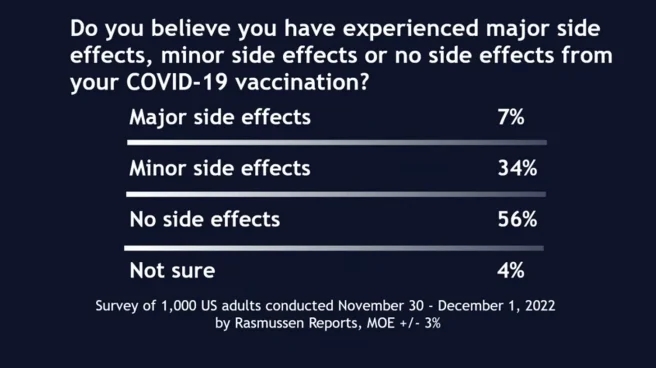
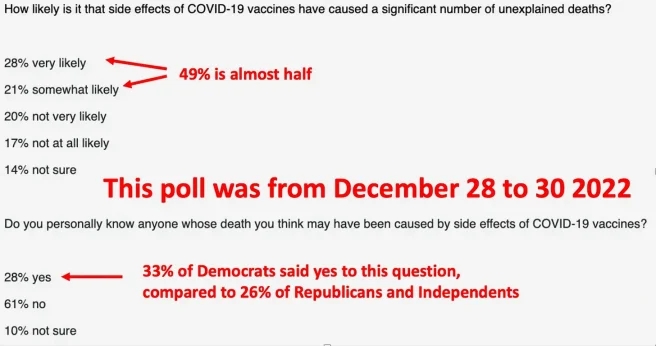
Both of these reports serve to highlight that the damage from the COVID vaccines is on a scale that the general public is fully aware of, despite the massive amounts of propaganda telling them otherwise. Let’s now look at Rasmussen’s recent results:
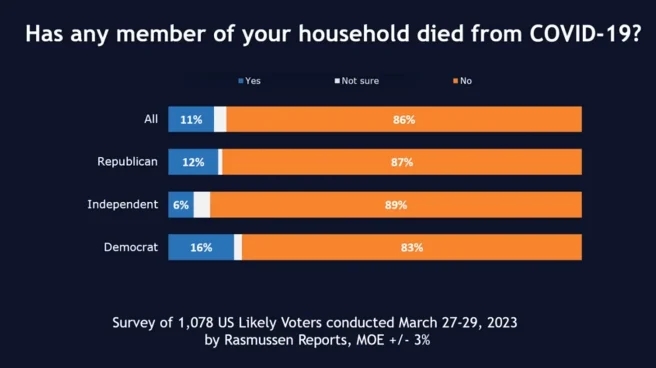

There are a few important takeaways from these polls:
• Although Democrats tend to believe that the COVID virus is dangerous and that vaccines are safe relative to Republicans, they have now seen so much evidence to the contrary that the gap between them is much smaller. This is especially true for the vaccine deaths, which will likely have immense political repercussions for the party that forced them on America.[
• In the public’s perception, the same number of people have died from COVID-19 as from the vaccines. Given that many of the COVID-19 deaths occurred before the vaccines, many of those deaths were not actually due to COVID-19, and that the vaccines do not offer complete protection against COVID-19, this is a strong argument that the benefits of the vaccines do not outweigh their risks, especially when you factor in their much more common complications which disable but do not kill the recipient.
• Many respondents likely did not understand what “household” meant (and likely instead interpreted it to just mean someone they knew). This is because nowhere near 11% of US households have had a COVID-19 or vaccine death in them.
Note: Many people disparage Rasmussen and claim they have a right-wing bias. I, however, consider them to be one of the most accurate political polling firms in the country.
Edward Dowd has taken an innovative approach to red-pilling the public—showing the financial costs of the vaccine program for the country and making people feel like chumps for investing in fields that are being adversely affected by those costs. Since everyone can relate to money, this makes the concept much easier for individuals to grasp, and more importantly, since money is the most important thing to the upper class, they are likely to be motivated to act against the vaccination program in order to protect their assets.
Dowd has assembled a team of experienced analysts that has done a lot of work to calculate the costs of the vaccine program. Recently they released a report which speaks for itself:
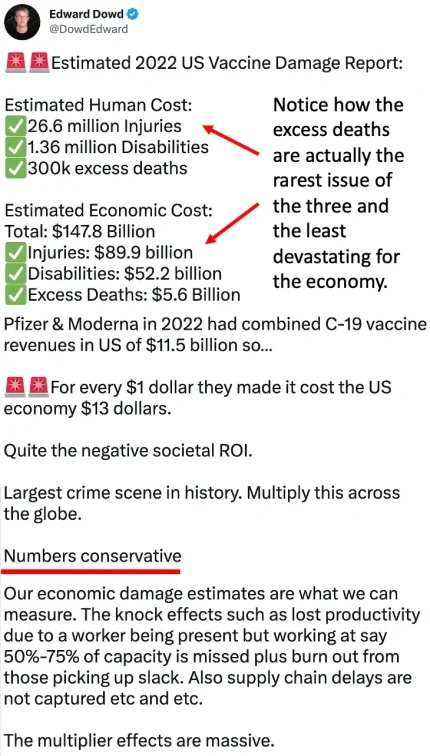
When I reviewed Dowd’s report, I realized that there were a lot of issues that I know have human and economic costs that it was not counting, presumably since they are impossible to calculate. This means he had to underestimate the harms that have been caused by the vaccine program.
Because things like this are so difficult to estimate, you have to err on the conservative side and avoid claiming things you cannot quantify or are unsure of. Similarly, I have the same experience each time I write an article here, and do not mention a lot of things I am passionate about after I realize I can’t actually back them up.
These recent publications (and the datasets that Dowd’s estimate is based upon) show clearly and unambiguously that the risks of the COVID vaccines greatly outweigh any possible benefit they might have. Given that much of the country is beginning to see this now, it will be very interesting to see how this issue unfolds in the coming years as our institutions struggle to rebuild the trust they spent decades creating in America. My hope is that this process will allow us to also critically examine the entire vaccine program, which has by and large enjoyed complete immunity to scrutiny, due to both the difficulty in comprehensively assessing it and our institutions’s adamant protection of them.
One of the themes of my articles here has been to discuss the progressively evolving pleas for COVID amnesty, which in the space of slightly under a year have gone from “the experts were wrong, but you should still trust them rather than your gut” to “America’s COVID-19 response was based on lies.” Recently, the author of one plea (I did not completely agree with) posted something I felt made an excellent conclusion to this article.

At this point, I believe that all vaccines can cause harm frequently enough that the harm must always be considered when evaluating the vaccine. For this reason, I always feel very torn on what to do when people ask me to provide them with a way to protect themselves from the harms of a vaccine they have to get (note: the two best approaches I know of are taking a lot of vitamin C beforehand, and doing whatever you can to strengthen your zeta potential).
This is because regardless of what you do, you will still always have patients who are harmed by taking the vaccine, and I hate being complicit in what happens. To this point, I have had times where I repeatedly warned a patient against vaccinating where I felt they were at risk of an adverse reaction, and they had one anyway, and then they suffered a permanent complication and I was left having to try to help them get better.
I also believe that natural immunity is always superior to vaccine immunity. For this reason, I believe that the correct approach to handling almost all diseases you can vaccinate against is to accept the inherent risk of getting it as an unvaccinated individual and be familiar with what treatment protocol you need to implement if you got the infection so that you can clear the infection and develop natural immunity. Just imagine how different the world would be now if we had followed that approach instead of suppressing every single treatment for COVID-19 and mandating a deadly and ineffective vaccination on the population.
The Western Media Disinformation Campaign: Fall of Bakhmut, a case in point
By Gilbert Doctorow | May 21, 2023
Our language is in constant evolution. Partly this is bottom up, from the inventiveness of creative personalities or writers for commercial advertising. Partly it is top down, from the powers that be as they seek to manipulate and control the thought processes of the broad public.
My brief essay today addresses the latter phenomenon and the introduction of the word “disinformation” into common parlance. There is a charming freshness to it, unlike the stale and repugnant word “propaganda.”
The word “disinformation” has a specific context in time and intent: it is used by the powers that be and by the mainstream media they control to denigrate, marginalize and suppress sources of military, political, economic and other information that might contradict the official government narrative and so dilute the control exercised by those in power over the general population. It is to remove “disinformation” from public life that the United States and EU member states ban RT and other Russian media outlets from the internet, from satellite and cable television channels. The censorship here in Europe varies from country to country and is probably most drastic in France and Germany. One would think that these European states are truly at war with Russia, not just giving a helping hand to Kiev.
In reality, it is these censorious states and the mass media that carry their messages with stenographic precision into print and electronic dissemination who are the ones that day after day feed disinformation to the public. It is cynically composed and consists of a toxic blend of ‘spin,’ by which is meant misleading interpretation of events, and outright lies.
The many months long battle for the provincial Donbas city of Bakhmut, or Artyomovsk as it is known in Russia, has been described variously from on high in Washington, London and Berlin. When the likely outcome was unclear, the defense of Bakhmut was called heroic and demonstrative of the brave fighting spirit of the Ukrainians.
Casualty figures issued by Kiev and then trumpeted from Washington suggested that the Russians were stupidly throwing away the lives of their fighting men by using WWI style human waves of attackers who were decimated by the defenders. Russian lives are cheap was the message. The fact that Russian artillery on site outnumbered and outperformed Ukrainian artillery by a factor of five or seven to one was freely admitted by the Western propagandists as they pleaded for increased supplies to Kiev. They, nonetheless, issued casualty reports for the Russians that inverted the force correlation. It was assumed, obviously with reason, that the public was too lazy or too uninterested to do the arithmetic.
At one moment, the spin doctors in Washington, London and Berlin said that Ukrainian defense of Bakhmut made sense because it was pinning down Russian forces and giving time to the Ukrainians to train and position their men for the heralded “counter offensive” during which they would overrun Russian positions at chosen points in the 600 mile line of combat and drive a wedge through to the Sea of Azov, opening the way for recapture of Crimea. Those were grand words and ambitions to justify continued and ever rising Western military assistance to Kiev.
At another point, the spin doctors said it would be better if Ukraine stopped losing men in Bakhmut and launched instead that much vaunted counter-offensive. Now we were told that Bakhmut is just a Russian fantasy, that it has no strategic value.
In the past couple of weeks, the Russian command has issued daily reports on the progressive capture by Russian forces of Bakhmut, square kilometer after square kilometer. We were told they controlled 75%, then 80% and most recently more than 90% of the city proper while artillery bombardment of the remaining blocks of high rise residential buildings that were being used by Ukrainian defenders for their sniper attacks and intelligence reports on Russian troop movements pulverized everything in their path.
At this point, the attention of Western media defending truth against Russian disinformation was directed at the Ukrainian “successes” in recapturing settlements on the flanks of Bakhmut. Just three days ago The New York Times was telling its readers that these “breakthroughs” by the Ukrainians put in jeopardy the Russian forces holding the city proper: they might be surrounded and compelled to surrender or die. The possibility that the offensives on the flanks were only intended to facilitate withdrawal of remaining Ukrainian soldiers from Bakhmut and were tolerated by the Russians to avoid bloody fights to the death – that possibility crossed no one’s mind at the NYT, it seems.
Midday yesterday, 20 May, Yevgeny Prigozhin, the leader of the Wagner Group which did most of the fighting for Bakhmut on the ground, claimed total victory. In the evening, President Vladimir Putin announced to the Russian public that Bakhmut was taken. Joyous messages of congratulations filled the internet message services in Russia as the broad public celebrated a victory as iconic as the Battle for Stalingrad.
Meanwhile, the defenders of the Western public against Russian “disinformation” were hard at work, straining their brains to find what to say. This morning’s New York Times still speaks of the battle for Bakhmut as undecided, pointing yet again to the Ukrainian hold on the flanks.
Given their losses in men and materiel defending Bakhmut, the surrender of the city to the Russians will be a great blow to Ukrainian fighting morale when it is finally admitted. So will the fate of their Commander in Chief General Zaluzhny who, according to Russian sources, has been hospitalized for the past two weeks and remains in critical condition after falling victim to a Russian strike on a provincial command center which killed most of the high officers around him. If nothing else, this speaks to the amazing success of Russian military intelligence directing their firepower.
Meanwhile, Western media attention to Ukraine is conveniently redirected at the nonstop travels of President Zalensky who went from his European tour on to the Middle East, where he attended the meeting of the Arab League, and thence via French military jet to the G7 gathering in Hiroshima where he held talks with fellow heads of state and joined them for the obligatory group photos. All the talk was about when the U.S. will formally give its consent to the dispatch of F16s to Kiev. For the disseminators of Western disinformation this is a wonderful distraction from a war that clearly is going badly for Kiev and in particular a distraction from the counter offensive that looks less likely with each passing day of Russian military strikes on the command centers and weapons stores of the Ukrainian side.
The plume of radioactive smoke and ash that rose from the Khmelnitsky store of British depleted uranium artillery shells in Western Ukraine after a Russian missile strike, just like the extensive damage to the Patriot air defense installation near Kiev by a Russian Kinzhal hypersonic missile tell us all what will be the fate of future Western arms deliveries to Ukraine. It is an interesting question how much longer the Ukrainian military or politicians will put up with their high flying, good life President while the country is well on its way to hell.
©Gilbert Doctorow, 2023
Biden unveils new $375 mln military aid package for Ukraine
Press TV – May 21, 2023
US President Joe Biden has announced a new $375 million package of military aid to Ukraine on Sunday despite warnings from Russia, saying that the United States was making every effort to “bolster Ukraine’s defense” in its war against Russia.
“Together with the entire G7, we have Ukraine’s back and I promise we’re not going anywhere,” Biden told Ukrainian President Volodymyr Zelensky as they met on the sidelines of the G7 summit of world leaders in Hiroshima, Japan.
The latest military aid package will include ammunition, artillery, armored vehicles, and training of forces, according to Biden.
Biden emphasized during the meeting that his nation was prepared to assist in enhancing Ukraine’s capacity to defend itself against and deter Russian forces, the White House said in a statement.
The US president also talked about his country’s support for a coordinated effort with allied and partner nations to train Ukrainian pilots on fourth-generation fighters like the F-16, the White House added.
Zelenskiy thanked the US for the latest military aid package, and also for all the assistance of a whopping $37 billion to date, according to his office.
The US and its Western allies have kept feeding Ukraine with massive amounts of arms since the start of the Ukrainian conflict last year, which according to Russia is the sole reason that the conflict is not coming to an end.
Russia has repeatedly warned the Western governments such as the US and UK against arming Ukraine and fanning the flames of war.
Apart from sending lethal armaments, the Western countries have supported Ukraine by imposing a raft of sanctions against Russia.
US hopes to snatch victory from jaws of defeat in Ukraine
BY M. K. BHADRAKUMAR | INDIAN PUNCHLINE | MAY 21, 2023
The G7 Leaders’ 2700-word statement on Ukraine, issued in Hiroshima after their summit meeting glossed over the burning question today — the so-called counter-offensive against the Russian forces.
It is a deafening silence, since rumours are swirling about the disappearance of the commander-in-chief of Ukraine’s armed forces. Significantly, President Vladimir Zelensky himself is making himself scarce from Kiev touring world capitals — Helsinki, Hague, Rome, Vatican, Berlin, Paris, London and Jeddah and Hiroshima. It does seem that something is rotten in the state of Denmark.
As the G7 summit ended, the head of the Wagner PMC, Yevgeny Prigozhin announced on Saturday that the Russian operation to capture the strategic communication hub of Bakhmut in Donbass region of eastern Ukraine lasting 224 days, has been brought to a successful completion, overcoming the resistance by more than 80,000 Ukrainian troops.
It is a painful moment for Zelensky, who had boasted before US lawmakers in Capitol Hill last December that “just like the Battle of Saratoga (in 1777 during the American Revolutionary War), the fight for Bakhmut will change the trajectory of our war for independence and for freedom.”
Meanwhile, to distract attention, there is talk now about a subtle shift in the US policy regarding supply of F-16 fighter jets to Ukraine in an indeterminate future. In reality, though, no one can tell what the Ukrainian rump state will look like when the jets arrive. Unsurprisingly, the Biden Administration still seems to be in two minds. F-16 is a hot item for export; what happens if the Russians were to blow it out of the sky with their hi-tech weapons and rubbish its fame ?
The Russians seem to have concluded that nothing short of a total victory will make the Americans and the British understand that Moscow means business on the three objectives behind the special military operations that are non-negotiable: security and safety of the ethnic Russian community and their right to live in peace and dignity in the new territories; demilitarisation and de-Nazification of Ukraine; and a neutral, sovereign, independent Ukraine freed from the US clutches and no longer a hostile neighbour.
To be sure, the unprecedented levels of US hostility towards Russia only hardened Moscow’s resolve. If the Anglo-Saxon alliance keeps climbing the escalation ladder, the Russian campaign may well expand the operation to the entire region east of the Dnieper River. The Russians are in this war for the long haul and the ball is in the American court.
What comes to mind is a speech last July by President Vladimir Putin while addressing the Duma. He had said, “Today we hear that they want to defeat us on the battlefield. Well, what can I say? Let them try. We have already heard a lot about the West wanting to fight us ‘to the last Ukrainian.’ This is a tragedy for the Ukrainian people, but that seems to be where it is going. But everyone should know that, by and large, we have not started anything in earnest yet.”
Well, the Russian operation has finally started “in earnest.” The thinking behind the delay is unmistakeable. Putin underscored in his speech that the West should know that the longer Russia’s special military operation goes on, “the harder it will be for them to negotiate with us.”
Therefore, the big question is about the Ukrainian counteroffensive. The Russian forces enjoy overwhelming superiority in every sense militarily. Even if the hard core of the Ukrainian forces who were trained in the West, numbering some 30-35000 soldiers, manage to achieve some “breakthrough” in the 950-kilometre long frontline, what happens thereafter?
Make no mistake, a massive Russian counterattack will follow and the Ukrainian soldiers may only end up in a fire trap and suffer huge losses in their tens of thousands. What would the Anglo-Saxon axis have achieved?
Besides, the Ukrainian military will have so thoroughly exhausted itself that there will be nothing stopping the Russian forces from advancing toward Kharkov and Odessa. Herein lies the paradox. For, from that point, Russians will have no one to talk to.
If past American behaviour — be it Vietnam, Afghanistan or Iraq and Syria — is anything to go by, Washington will do nothing. The well-known American strategic thinker Col. (Retd.) David MacGreggor couldn’t have put things better when he said earlier this week:
“I can tell you that Washington is going to do nothing. And I’ve always warned… we (United States) are not a continental power, not a land power anywhere but in our own Hemisphere. We are primarily an aerospace and maritime power, much like Great Britain. And what does that mean? When things go badly for us, we sail away, we fly away, we go home… That’s what we always do. Eventually, we just leave. And I think, that’s on the agenda now.”
The stony silence of the G7 statement on the Ukrainian counteroffensive is understandable. The G7 statement needs to be juxtaposed with a report appearing in Politico on the eve of the summit in Hiroshima which, quoting senior US officials elaborated on an audacious plan to transform the Ukraine war into a “frozen conflict” on the analogy of the Korean Peninsula or Kashmir.
A Pentagon official told the daily that recent military aid packages to Ukraine reflect the Biden administration’s “shift to a longer-term strategy.” Reportedly, US officials are already talking to Kiev about the nature of their relationship in the future.
Principally, if Ukraine’s NATO membership bid stalls, western guarantees could range from a NATO-style Article 5 mutual defence deal to Israel-style arms deals with Ukraine so that “the conflict will wind up somewhere in between an active war and a chilled standoff.”
Indeed, the G7 statement began conceptualising the “Europeanisation” of Ukraine with reforms, a market economy driven by the private sector and western financial institutions, and boosting Kiev’s deterrent capability vis-a-vis Russia militarily.
It is quite amazing. Hardly has one flawed narrative — espousing Russia’s military defeat in Ukraine and the overthrow of Putin — unravelled, another narrative is being hoisted, predicated on the simplistic notion that Russia will simply roll over and passively watch the US integrating Ukraine into the western alliance system to create an open wound festering on Russia’s western borders that will drain resources for decades to come and complicating ties with neighbours.
However, Russian Foreign Minister Lavrov’s reaction to the G7 Summit confirms that Moscow will not fall into the trap of a “frozen conflict.” Lavrov said, “Could you take a look at those decisions which are being debated and adopted at the G7 summit in Hiroshima and which are aimed at dual containment of Russia and the People’s Republic of China?
“The objective was announced loudly and frankly, which is to defeat Russia on the battlefield, and without stopping at this, to eliminate it later as a geopolitical rival, so to speak, along with any other country that claims an independent place in the world, they will be suppressed as opponents.”
Lavrov also pointed out that the Western countries’ expert community is overtly discussing the order to work out scenarios aimed at Russia’s breakup, and “they do not conceal that the existence of Russia as an independent centre is incompatible with the goal of the West’s global domination.” The Minister said, “We have to give a firm and consistent response to the war declared upon us.”
Yet, it is not as if Americans are incapable of seeing the war through Russia’s eyes. Read here a letter pleading for some sanity in Washington penned by a group of distinguished former American diplomats and military officials associated with the Eisenhower Media Network. By the way, they paid to get it in the New York Times, but the rest of the establishment media chose to ignore it.
Russia, China express ‘strong dissatisfaction’ with G7 communique
Press TV – May 20, 2023
Russia and China have expressed “strong dissatisfaction” with the final statement issued at the end of the Group of Seven (G7) summit in the Japanese city of Hiroshima, a city that was destroyed by the US atomic bombing in 1945.
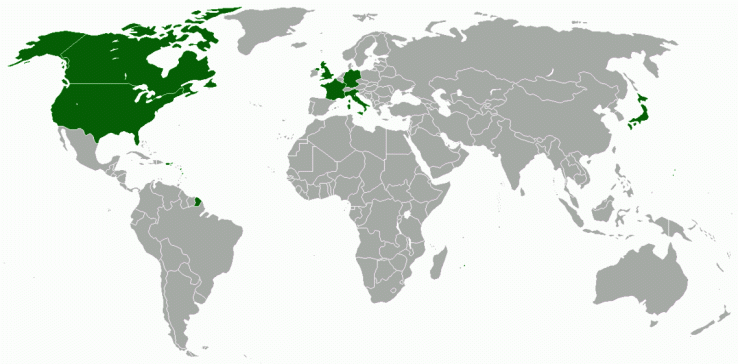
In a joint statement on Friday, which was revised on Saturday, the G7 — consisting of the United States, Japan, Germany, Britain, France, Canada and Italy — targeted both Russia and China with threats and disparaging remarks.
Russian Foreign Minister Sergei Lavrov said on Saturday that decisions taken at the G7 summit were aimed at the “double containment” of Russia and China.
Lavrov, in a televised conference, reiterated Moscow’s viewpoint that the West is using Ukraine as a tool to inflict a strategic defeat on Russia.
“The task was set loudly and openly – to defeat Russia on the battlefield, but not to stop there, but to eliminate it as a geopolitical competitor,” Lavrov noted.
“Look at the decisions that are being discussed and adopted today in Hiroshima at G7 summit of the Seven, and which are aimed at the double containment of Russia and China,” Russia’s top diplomat stated.
Lavrov said Moscow enjoyed the support of its many allies and Russia will weather the hardships despite the West’s efforts to put pressure on countries to cut trade and economic ties with the Russian nation.
Russian President Vladimir Putin said on Friday that the West was trying to break Russia up into dozens of different states.
The US-led West is driving a wedge between different ethnic and national groups in Russia and breaking the country up into dozens of different states, Putin warned.
Beijing, in a similar approach, showed its strong disapproval of the G7 for smearing and attacking the Chinese nation.
The Chinese Foreign Ministry said on Saturday that it has lodged stern representations to the G7 summit’s host, Japan, and other relevant parties after the group criticized Chinese policies in regard to Hong Kong, Xinjiang and Tibet.
The group advocates “promoting a peaceful, stable and prosperous world,” but what it does is hinder international peace, undermine regional stability and curb other countries’ development, the statement said, adding that it simply shows how little international credibility means to the G7.
The Chinese Foreign Ministry’s statement pointed out that Taiwan is China’s Taiwan and resolving the question is a matter for the Chinese. It reiterated that the one-China principle is the solid anchor for peace and stability across the Taiwan Strait.
Despite emphasizing on cross-Strait peace, G7 said nothing about the need to oppose “Taiwan independence,” which in effect constitutes connivance and support for “Taiwan independence” forces, and will only result in a serious impact on cross-Straits peace and stability, according to the statement.
The Chinese statement said no one should underestimate the determination, resolve and capability of the Chinese people in safeguarding China’s sovereignty and territorial integrity.
The issues related to Hong Kong, Xinjiang and Tibet are purely China’s internal affairs and China firmly opposes interference by any external force in those affairs under the pretext of human rights, the statement noted.
It urged the G7 to stop pointing fingers at China on Hong Kong, Xinjiang and Tibet and take a hard look at their own history and human rights record.
The statement reminded the G7 nations that the East China Sea and the South China Sea have remained overall stable, and it called for other countries to respect the regional countries’ efforts to uphold peace and stability and stop using maritime issues to drive a wedge between regional countries and incite bloc confrontation.
The statement also noted that the massive unilateral sanctions slapped by the United States and acts of decoupling and disrupting industrial and supply chains make the US the real coercer that politicizes and weaponizes economic and trade relations. It urged the G7 not to become an accomplice in the Americans’ economic coercion.
China is the only nation among the five nuclear weapon states that pledged “no first use” of nuclear weapons and always kept its nuclear capabilities at the minimum level required by national security, the statement noted, adding that China’s position on the matter should not be distorted or denigrated.
As a responsible major country, China firmly upholds the UN-centered international system, the international order underpinned by international law and the basic norms governing international relations built around the purposes and principles of the UN Charter, it said, adding that the Chinese nation will never give in to the so-called rules imposed by the few.
“The international community does not and will not accept the G7-dominated Western rules that seek to divide the world based on ideologies and values, still less will it succumb to the rules of exclusive small blocs designed to serve ‘America-first’ and the vested interests of the few,” the statement said.
The Chinese Foreign Ministry urged the G7 to stop engaging in closed and exclusive “small circles,” stop containing and suppressing other countries, stop creating and provoking confrontation and return to the right path of dialogue and cooperation.
‘Sad Day for Babies and Mums’: FDA Panel Recommends Pfizer’s RSV Vaccine for Pregnant Women
By Michael Nevradakis, Ph.D. | The Defender | May 19, 2023
Advisers to the U.S. Food and Drug Administration (FDA) on Thursday recommended, by a vote of 10 to 4, that the agency approve Pfizer’s respiratory syncytial virus (RSV) vaccine for pregnant women, despite questions about the vaccine’s safety.
During Thursday’s Vaccines and Related Biological Products Advisory Committee (VRBPAC) meeting, committee members and medical experts raised concerns about premature births identified during Pfizer’s clinical trials.
The FDA is expected to issue a final decision on the vaccine in August. If approved, it would become the first RSV vaccine authorized for pregnant women.
The Centers for Disease Control and Prevention (CDC) must “sign off” on Pfizer’s vaccine for pregnant women prior to it becoming available to the public.
According to Axios, the CDC’s immunization advisory committee is likely to discuss FDA-approved RSV vaccines during its June meeting.
Dr. Meryl Nass, an internist, biological warfare epidemiologist and member of the Children’s Health Defense (CHD) scientific advisory committee, told The Defender that while the FDA is not obliged to follow the recommendations of its advisory committees, “it almost always does so.”
The appeal of a maternal vaccine like Pfizer’s is “the way it would create neutralizing antibodies in pregnant women that can be transferred to infants in the womb,” Axios reported.
However, “there are health risks, including preterm births,” Axios added, noting that GlaxoSmithKline Biologicals’ (GSK) recently halted its trial of a similar RSV vaccine for infants. According to NBC News, the GSK vaccine “showed a higher preterm birth rate among some vaccine recipients.”
Commenting on the FDA’s recommendation of Pfizer’s RSV vaccine, Dr. Peter McCullough, a cardiologist, told The Defender :
“This product represents an unprecedented attempt to vaccinate mothers for no benefit to them and only theoretical efficacy in babies. In the trial, less than 2% of infants at any time point contracted RSV, which is easily treatable with nebulizers.
“Pregnancies should not be threatened with novel vaccines for uncommon and low-risk infantile illnesses.
“Widespread use of this reactogenic vaccine can be expected to cause fetal loss in some unfortunate women. A single case of pregnancy termination would not be worth the population being vaccinated.”
The positive recommendation from the VRBPAC comes two weeks after the FDA approved Arexvy, the first vaccine authorized for RSV. That vaccine, produced by GSK, is intended for adults 60 years of age and older.
It also comes as Pfizer is expecting an FDA decision later this month for its RSV vaccine for adults 60 and over, with the same formulation as the one for pregnant women. The VRBPAC recommended the vaccine for this age group in February.
Pfizer is also “evaluating how its shot performs in other age groups,” Axios reported.
‘A sad day for babies and mums’
According to CNBC, Pfizer’s RSV vaccine, marketed as Abrysvo, will be administered as a single dose to pregnant women in their second or third trimester.
NBC News reported that the shot would be given to pregnant women at 24 to 36 weeks gestation and that the “protective antibodies transfer to infants through the placenta.”
The FDA advisory panel found that data from Abrysvo’s clinical trial “supports the safety of the vaccine” for pregnant women, while the same panel voted unanimously “that available data supported the vaccine’s efficacy for giving the shot to women in their second or third trimesters of pregnancy.”
An FDA briefing document said safety data from Abrysvo clinical trials was “generally favorable.”
According to the trial data, Abrysvo “had an 81.7% efficacy at protecting newborns in the first three months of life against severe illness and a 69.4% efficacy through the first six months,” Axios reported.
The trial consisted of nearly 7,400 participants, according to NBC News, adding that Abrysvo “also lowered the risk of developing respiratory disease from RSV that required doctors’ visits by 51% within about six months.”
“After that, however, the vaccine didn’t appear to make a big difference,” according to the NBC News report, which also reported that “a slightly higher rate of preterm births — defined as before 37 weeks’ gestation — among people who received the vaccine (5.7%) versus those who got a placebo (4.7%)” was identified.
“The difference wasn’t statistically significant, however, so it’s unclear whether it was vaccine-related,” NBC News added. CNBC reported that both percentages were below the overall percentage for preterm births in the general population (10%).
According to CNBC, the clinical trial for Abrysvo “reported 18 peripartum fetal deaths.”
However, the FDA said these deaths were “unlikely” to be related to the shot. According to Axios, “The fetal deaths present in the vaccine group (0.3%) were not related to Pfizer’s vaccine … Similarly, 4 out of 5 infant deaths were considered unrelated to the shot, with one being possibly connected to the shot, although that remains unclear.”
Data reported by Pfizer to the CDC indicated that 14% of pregnant women who participated in Pfizer’s trial sustained an adverse event, with 4.2% sustaining a “serious” adverse event, 1.7% experiencing a “severe” adverse event and 0.5% suffering a “life-threatening” adverse event.
Similarly, the same data showed that 37.1% of infants whose mothers received the experimental Pfizer vaccine experienced adverse events within one month of birth — with 15.5% classified as “serious,” 4.5% as “severe” and 1% as “life-threatening,” while efficacy waned within months of vaccination.
According to the National Vaccine Information Center (NVIC), “The RSV clinical trial data also included the death of one pregnant woman, 18 stillbirths (10 in vaccinated pregnant women and eight in unvaccinated pregnant women), and 17 infant deaths (five from the vaccinated pregnancy group and 12 in unvaccinated pregnancy group).”
Attorney, journalist and podcaster Daniel Horowitz, in an article published Monday in the Conservative Review, quoted Phase 2 trial data for Abrysvo. He wrote: “Pfizer reported 3 out of 116 (2.6%) premature births in the placebo group and 6 out of 114 (5.3%) in the group that received the vaccine that was chosen as Pfizer’s final product,” adding that Pfizer “was studying preterm birth as an ‘adverse event of special interest.’”
According to NBC News, “The most common side effects of the shot reported among pregnant women were fatigue, headache, muscle pain and injection site pain.”
Nass told The Defender there were essentially three problems with the Abrysvo clinical trial data, “two of which were identified by Pfizer and the FDA.” She said:
“There were about 20% more preterm babies and low birth weight babies in the group, whose mothers had been vaccinated versus the group whose mothers had received a placebo. This was very concerning but was disregarded by most of the committee.
“It was unclear to me whether Pfizer had collected enough information on the health of the pregnant women after vaccination. It is hard to tell when you were studying, newborns and babies, whether they have had a side effect from their mothers’ vaccination. The children weren’t studied for long enough to compare their intellectual ability or other parameters.”
The third problem reflected concerns arising from the problems GSK’s candidate vaccine for pregnant women encountered, Nass said. However, “the FDA claimed the GSK clinical trial data were proprietary, and they were unable to provide them,” even though it was pointed out that these findings had been published and were in the public domain.”
“No one questioned the veracity of the data Pfizer presented, despite the fact that Pfizer repeatedly presented data on its COVID vaccine efficacy to this committee that made the vaccines appear much more efficacious than they turned out to be,” Nass said.
McCullough, writing on his Substack, also questioned the Abrysvo clinical trial data. “Pfizer has aggressively advanced RCTs [randomized controlled trials] into the pregnant population with no assurances on long term outcomes. There is no direct benefit to the mothers.”
“Furthermore, the sponsors moved the goal posts to make it easier to have a successful trial. We should demand long-term safety, high efficacy … and at least one year of durability, for such a rare and easy-to-treat condition in babies,” he added.
Calls for ‘tougher scrutiny’ of the RSV vaccine ignored
Some health experts called for “tougher scrutiny” of Abrysvo leading up to Thursday’s VRBPAC meeting, Axios reported, “after trials for GlaxoSmithKline halted trial for a similar shot over increased risks of preterm births and neonatal deaths.”
“Pfizer has not reported similar safety concerns, but some health experts told the British Medical Journal [BMJ] that they hope FDA staff will take the GlaxoSmithKline results into consideration when reviewing the vaccine,” according to Axios.
“Results have raised concerns about a possible increase in preterm births, and experts are calling for further analyses of the data and for post-approval monitoring of the vaccine, should the FDA approve it,” The BMJ analysis stated.
Horowitz said the “formulations of most of these shots are likely very similar, so red flags from one cohort of the study should inform us on the problems with the other.”
According to Nass, who live-blogged the meeting, one VRBPAC member, Dr. Henry H. Bernstein, a professor of pediatrics at Hofstra University, said during the meeting “he does not want another rotavirus vaccine repeat, in which the signal was known when licensed, but was not statistically significant.”
The rotavirus vaccine was pulled within one year because of intussusception, she said. Intussusception is a life-threatening illness that occurs when a portion of the intestine folds like a telescope, with one segment slipping inside another segment. This causes an obstruction, preventing the passage of food that is being digested through the intestine.
Dr. Paul Offit, a pediatrician at Children’s Hospital of Philadelphia and VRBPAC panelist, was quoted by CNBC as saying that the problems with GSK’s trial are “hanging over” Pfizer’s RSV shot for pregnant women and infants.
“If GSK truly abandons a program on a similar, almost identical vaccine, that is going to hang over [Pfizer’s] program. I think it needs to be addressed,” Offit added.
Offit separately told Reuters “I worry that if preterm births are in any way a consequence of this vaccine that would be tragic in many ways.”
Science magazine quoted FDA medical officer Dr. Yugenia Hong-Nguyen, who said the rate of premature births was “not statistically significant and lower than background incidence rates in the general population.”
Other VRBPAC members were less concerned. Dr. Daniel Feikin, a Johns Hopkins University epidemiologist and “temporary voting member”, said, “I’m not convinced that there’s a clear causal relationship between this vaccine and preterm birth,” Reuters reported.
Another VRBPAC panelist, Dr. Jay Portnoy, a pediatrics professor at the University of Missouri-Kansas City, said, “If the vaccine actually lives up to the data that we’ve seen today, I can guarantee that many infants and their parents will breathe easier in the coming years.”
Pfizer representatives also sought to downplay concerns with Abrysvo. According to CNBC, Dr. William Gruber, Pfizer’s senior vice president of vaccine clinical research and development, said, “Certainly in our eyes, there is no definitive evidence to suggest that there is a risk of prematurity.”
“So, the question is, do you hold hostage the potential benefits of the vaccine for something which you have no statistical significance at this point?”
Dr. Anthony Fauci also raised concerns about vaccines for respiratory illnesses, Horowitz wrote in a May 4 article. A paper co-authored by Fauci and published in January in Cell Host & Microbe stated that the challenges for RSV and flu vaccines were “many and complex” and that RSV vaccines were not good at providing immunity.
In a November 2022 episode of “RFK Jr. The Defender” podcast, Robert F. Kennedy Jr., then-chairman and chief litigation counsel for CHD (now chairman on leave), described RSV as “a vehicle for re-implementing the COVID-19 playbook all over the country and responding with vaccines.”
Nass characterized Thursday’s VRBPAC approval of Abrysvo as “a sad day for babies and mums,” adding, “Is there a reason to trust Pfizer’s data on its RSV vaccine, when we could not trust its COVID vaccines?”
“Currently, pregnant women are advised (not by me!) to get the flu, TdaP [tetanus-diphtheria-pertussis] and COVID vaccines during pregnancy. This would be a fourth pregnancy vaccine,” Nass wrote.
Nass said Thursday’s VRBPAC meeting was held with four temporary members.
“Did FDA stuff the meeting with four new temporary members in order to get the majority yes votes it wanted?” Nass asked.
Horowitz noted in his article published Monday that Pfizer vaccines have previously been approved despite concerns about their impact on pregnant women, citing trial data from the Pfizer-BioNTech COVID-19 vaccine.
Pfizer seeks to ‘offset declining revenue from its COVID-19 products’
According to Reuters, “Pfizer is counting on new medicines and vaccines to help offset declining revenue from its COVID-19 products,” noting that the market for RSV vaccines is expected to surpass $10 billion by 2030 and that Pfizer is “ready to launch” its RSV vaccines for both pregnant women and older adults “later this year.”
Pfizer CEO Albert Bourla said he expects increased revenue for the company in the coming years from the company’s RSV and flu shots.
On her Substack, Nass noted:
“As a consequence of the 21st Century Cures Act of 2016, all vaccines recommended by CDC for pregnant women have all manufacturer liability waived, and are placed in the national vaccine injury compensation program. This improves profitability and may result in mandates.”
Several other Big Pharma drugmakers are now clamoring to enter the potentially lucrative RSV vaccine market, after decades of failed attempts to develop a vaccine.
Moderna is developing an mRNA RSV vaccine for older adults. According to Axios, it “was found to be 83.7% effective in preventing RSV with one or two more symptoms” and “The company plans to apply for FDA approval this quarter.”
According to Horowitz, Moderna’s candidate vaccine “openly shows 200 adverse events and 10 serious ones per mild case [of RSV] avoided.”
Bavarian Nordic, known for its development of a vaccine in response to last year’s monkeypox outbreak, is also developing an RSV vaccine for adults 60 and over,” expecting to release Phase 3 clinical trial data by midyear.
AstraZeneca and Sanofi also are seeking FDA approval for a monoclonal antibody treatment for RSV that would be administered to infants and toddlers up to age 2. Sanofi says the antibody, nirsevimab, was found to be 83.2% effective in reducing RSV-related hospitalizations.
However, the NVIC reported that the effectiveness of nirsevimab “is not known beyond 150 days” and it is unclear if the drug prevents ICU stays or deaths.
In all, “Eleven RSV vaccines (including GSK’s approved shot) are being actively studied in U.S. trials,” NBC News reported. “Six are for older adults, and five are designed to protect infants or children.”
Michael Nevradakis, Ph.D., based in Athens, Greece, is a senior reporter for The Defender and part of the rotation of hosts for CHD.TV’s “Good Morning CHD.”
This article was originally published by The Defender — Children’s Health Defense’s News & Views Website under Creative Commons license CC BY-NC-ND 4.0. Please consider subscribing to The Defender or donating to Children’s Health Defense.
Plan to Build NIH-Funded Bat Research Lab in Colorado Sparks Fears of Lab Leak
By Michael Nevradakis, Ph.D. | The Defender | May 18, 2023
Colorado State University (CSU) is proceeding with controversial plans to construct a new research facility to study bat diseases with funding from the National Institutes of Health (NIH). Construction is slated to be completed sometime in 2024 or 2025.
University officials and proponents of the new facility argue the laboratory is necessary to enhance research capabilities looking into emerging diseases and viruses resulting from zoonotic — animal-to-human — transfer.
While CSU denies that gain-of-function research will occur at the laboratory, some researchers connected with the new facility previously were associated with actors involved with such research, including experiments conducted in Wuhan, China.
Francis Boyle, J.D., Ph.D., a bioweapons expert and professor of international law at the University of Illinois, is concerned about the facility.
Boyle told The Defender :
“It is well known that Colorado State University has a long and ongoing history of specialization in weaponizing insects with biowarfare agents for delivery to human beings.
“This new lab will magnitudinally increase CSU’s offensive biowarfare capabilities, in gross violation of the Biological Weapons Convention of 1972 and my Biological Weapons Anti-Terrorism Act of 1989 that provides for life in prison.”
Area residents, including a local grassroots group, and bioweapons experts, also have raised concerns over the potentially risky research, involving deadly viruses, that will be conducted at the facility and the risk of a lab leak akin to that which may have occurred at the Wuhan Institute of Virology in China, and may have led to escape of the SARS-CoV-2 virus.
Christine Bowman leads a group of local citizens who formed the Covid Bat Research Moratorium of Colorado (CBRMC), a grassroots initiative opposing the new facility. The group has launched efforts such as a yard sign campaign to raise local awareness.
In an interview with The Defender, Bowman described being “stonewalled” by state and local officials and by CSU.
“We need answers as to how COVID-19 was modified to transfer from human to human before I will be satisfied that it’s okay to raise diseased bats to study in my neighborhood,” Bowman said.
“Now that we know that the COVID pandemic likely started from a lab leak in Wuhan, China, we are questioning the safety of continuing such research,” she added.
CSU receives ‘tens of millions of dollars’ in NIH research grants annually
According to The Colorodoan, the Chiropteran Research Facility, as it will be known, “would serve as a breeding facility to raise and care for bats of various species that can be used as research models in studies on a wide range of human viruses that are believed to have originated with bats.”
The laboratory will be constructed on the south end of CSU’s Foothills Campus near Fort Collins, at 3105 Rampart Road, within the Justin Harper Research Complex and adjacent to the university’s existing Center for Vector-Borne Infectious Diseases (CVID). It will consist of a 14,000-square-foot stand-alone bat vivarium.
According to CSU, the university “is a world leader in research on zoonotic infections. The University’s scientists have been studying bats and other vectors that transmit dengue fever, Zika and West Nile viruses for more than 30 years.”
Construction is scheduled to begin by this summer. The Colorodoan reported the facility is expected to open in fall 2024, while CSU said it will be completed by 2025.
CVID, formerly known as the Arthropod-born and Infectious Diseases Laboratory, was founded in 1984. According to The Colorodoan, it “currently houses the only captive breeding colonies of two species of bats used in its research.”
CVID’s website describes the facility as “a longstanding multi-disciplinary research and training center” whose researchers “have been successful in defining mechanisms of pathogen persistence and transmission, and developing new surveillance, control, and prevention strategies for vector-borne and emerging zoonotic diseases.”
“World-class facilities, including BSL-3 [biosafety level 3] laboratories and large insectary complexes, provide an outstanding scientific environment for researchers inside and outside CSU wanting to manipulate pathogens in vertebrate hosts and arthropod vectors,” the CVID website states.
The BSL3 laboratory in question is CSU’s Regional Biocontainment Laboratory, which operates with the support of the National Institute for Allergy and Infectious Diseases (NIAID) and is part of the university’s 120,000-square-foot Infectious Disease Research Center. It houses bats and samples of numerous deadly bacteria and viruses.
In October 2021, the NIH awarded a $6.7 million grant to CSU’s microbiology, immunology and pathology department at the College of Veterinary Medicine and Biomedical Sciences to construct the new bat vivarium.
Alan Rudolph, CSU’s vice president for research, told The Coloradoan the university will provide the remaining funds for the facility’s construction, the cost of which is expected to range between $8-9 million.
Rudolph said CSU receives “tens of millions of dollars” in NIH research grants annually.
‘Highly pathogenic’ agents will be housed at new facility
The CVID already conducts research involving viruses related to “chikungunya, dengue, malaria, Rift Valley fever, Zika virus, COVID-19, MERS, influenza [and] hantavirus disease.” The new facility will expand those capabilities.
According to the minutes of the Feb. 3, 2022, meeting of CSU’s Board of Governors, the new facility is justified due to the capacity it will have to study “emerging zoonotic viruses that originate in bats and cause high mortality in humans: SARS-CoV, MERS-CoV and SARS-CoV-2, Ebola virus, Marburg virus, Nipah virus and Hendra virus.”
It is unclear under what biosafety level the new facility will operate, but Bowman told The Defender :
“From what I understand, this facility is slated to be a BSL2. But what’s to keep that from increasing in the future without approval or informing the general public? What guarantee do the residents of Fort Collins have that the lab won’t increase from a BSL2 to BSL4, where even more dangerous viruses will be studied?”
CSU claims it “has no plans to conduct gain-of-function research of concern” there.
“Who decides what criteria we use for ‘concern’?” Bowman asked.
Rebecca Moritz, CSU’s biosafety director, said, “This will be the only facility like it in the United States,” and it will give students “the opportunity to learn directly from the researchers conducting this research in their classes.”
She added:
“CSU researchers have safely studied and worked with bats and other vectors for over 30 years. … Due to global warming and population growth, humans and animals are coming into contact more frequently and in ways not previously seen. This could result in an increased number of outbreaks and possibly pandemics.
“The main purpose of this facility will be to house bat breeding colonies for CSU researchers and researchers around the United States and the world. This facility will allow an expansion of CSU’s current work, including projects focusing on the role that bats play in disease transmission and the development of vaccines and therapeutics.”
“Personnel who will work in this facility will be highly trained and be required [to] adhere to strict biosafety and biosecurity practices,” Moritz claimed.
Moritz has spoken publicly about her involvement with gain-of-function research, including at the 2014 Gain of Function Symposium. At the time, Moritz was part of the Biosecurity Task Force at the University of Wisconsin-Madison.
Bowman said gain-of-function experiments are already being conducted at CSU and that the university is open about it.
“We are only aware that CSU is conducting gain-of-function on plants and mosquitoes because it is mentioned in the link they send to anyone who emails them or questions their research.”
Rudolph told The Colorodoan, “Bat research is not new to our campus; bat-research facilities are not new to our campus. It’s an expansion of existing work in existing facilities that have already made great impacts.”
Such research “helped us to develop vaccines, helped us to develop diagnostics to better determine who’s getting sick, why are they getting sick, when are they getting sick, and vaccines that help treat those people when they do get sick,” he added.
Some of the viruses for which research will be conducted at the new facility, including Hendra and Nipah, are considered “highly pathogenic BSL-4 agents,” classified “in the same biosecurity category as Ebola.”
The Nipah virus, for instance, has a high human mortality rate ranging between 40 and 75%. It “causes a rapidly progressive disease, which includes acute respiratory infection and encephalitis that can lead to coma or death.”
Earlier this month, the NIH reinstated a controversial federal grant, originally issued in 2014 under Dr. Anthony Fauci, then-director of NIAID, which operates under the NIH, to EcoHealth Alliance to study the risk of bat coronavirus spillover.
This involved gain-of-function research for the genetic manipulation of coronaviruses to make them more infectious to humans. Some of the NIH funds went to the Wuhan Institute of Virology, which collaborated with EcoHealth Alliance on this research.
EcoHealth is a New York-based nonprofit that says its mission is to develop “science-based solutions to prevent pandemics and promote conservation.”
Documents revealed by U.S. Right to Know (USRTK) indicate that some CSU researchers have previously collaborated with the EcoHealth Alliance.
Local activists ‘stonewalled’ by university, state, local officials
According to The Colorodoan, CSU’s campus planner, Gargi Duttgupta, told local authorities that the new facility would be approximately 316 feet north of the fence that marks the campus’ boundary with adjacent residential communities.
This may be too close for comfort for some area residents, who have attempted to engage with CSU and with local planning authorities to express opposition to the new facility and to obtain further information about its construction.
Their opposition led to the establishment of CBRMC, “a nonpartisan grassroots organization run on a budget of $0 by a group of concerned citizens from across the political spectrum.”
CBRMC says its mission is to put a moratorium on the construction of the new facility “until we first know what happened with the possible COVID bat lab leak and gain-of-function research in Wuhan, China.”
Some CBRMC members spoke at a Dec. 21, 2022, meeting of the Larimer County Planning Commission, expressing fears of a potential leak from the new facility, drawing comparisons with the suspected Wuhan lab leak.
But the planning commission unanimously approved the project. Lesli Ellis, Larimer County’s community development director, told The Colorodoan that no further approvals are needed before construction can commence.
According to The Colorodoan, “CSU officials insist that the new facility is merely an extension of work that has been done on its Foothills Campus for more than 30 years by the university and others, including the U.S. Centers for Disease Control and U.S. Department of Agriculture.”
The CSU Foothills Campus houses labs operated by the U.S. Department of Agriculture National Wildlife Research Center and the Rocky Mountain Prevention Research Center — described as the “second-largest CDC lab outside of Atlanta.”
“Strict safety protocols will be in place to prevent the escape of a virus or infected bat,” The Colorodoan also reported.
Rudolph told The Colorodoan the facility will need only dozens to hundreds — not thousands — of bats, which will be acquired by the U.S. government, “quarantined well outside the United States and deemed safe and not sick before they come to us.”
CSU does ‘not have a good track record’ on safety
A Jan. 11 CSU “Q&A on why CSU labs are safe” denies that illegal bioweapons research will take place at the institution and quotes Moritz, who said, “We do everything possible to decrease the risks of our research.” However, she acknowledged “there is no such thing as zero risk in research.”
Bowman said CSU alone will oversee safety at the new facility, and she questioned the lab’s safety record.
Bowman told The Defender :
“After letting chronic wasting disease [CWD] leak from their labs at CSU, hundreds of thousands of the deer population were killed from the disease. They do not have a good track record of ensuring the safety or containment of diseases.
“I personally do not have the data for this claim, but I have heard many people cite this as fact and no one at CSU is refuting the claim.”
CWD, “a contagious neurological disease that affects members of the deer family, causing erratic behavior and weight loss that eventually results in death,” was identified in 1967. It is described as “a mysterious malady intricately tied to Fort Collins.” The federal government declared a CWD state of emergency in 2001.
The Colorodoan reported that CWD “was related to scrapie in sheep and goats, mad cow disease in cattle and the fatal variant Creutzfeldt-Jakob disease in humans.”
As reported by Northern Colorado NPR affiliate KUNC, “Chronic wasting disease is not your garden variety infectious disease. It’s not bacterial, viral or even fungal. It’s caused by something we all have inside our bodies — something called prions.”
CSU is home to the Prion Research Center, which “studies the biochemistry, genetics, and pathogenesis of prions, the causative agent of incurable and often fatal diseases in humans and animals,” including bovine spongiform encephalopathy, classic Creutzfeldt-Jakob disease, variant Creutzfeldt-Jakob disease, CWD and scrapie.
According to the Prion Research Center, “Growing evidence also links the prion mechanism to proteins involved in the pathogenesis of other common neurodegenerative diseases, including Alzheimer’s and Parkinson’s, and forms an emerging area of the center’s studies.”
And in 2019, CSU reported that Prion Research Center scientists “have developed a new gene-targeted approach” to study CWS in mice. Described as a “real breakthrough,” the scientists “replaced the gene that encodes the prion protein in the mouse and replaced it with an exact replica of the code from either deer or elk.”
Researchers who spoke to The Colorodoan said that while it’s unclear if CWD originated in Fort Collins, it is hypothesized that it crossed species and spread there.
A U.S. Geological Survey map shows a significant cluster of CWD near Fort Collins and that cases identified elsewhere have been connected to the region.
A 2021 paper, “Text mining to identify the origin of chronic wasting disease,” published in the Issues in Information Systems journal, states:
“For the 16 [CWD] clusters in the first 40 years, the text mining process generated evidence supporting the trace back to Fort Collins for the first six clusters, five more clusters could be traced back to infected area linked to Fort Collins, and in 5 clusters the evidence supported an explanation for tracing the disease back to an area linked to Fort Collins.
“The evidence does not definitively exclude other theories for the disease origin. At minimum, Fort Collins was a primary catalyst in the widespread distribution of the disease.”
The paper noted, “As with COVID-19, government agencies can be reluctant to acknowledge potential culpability for releasing a devastating disease,” adding that “Ignoring the likely origin of this disease discounts the lax management of captive animals that has been the driving force for this biological disaster.”
Locals getting mixed messages from CSU officials
Local activists are concerned about a lack of communication between CSU officials, local authorities and the community, and contradictory statements they have received from CSU.
According to the CBRMC, CSU “gave citizens short notice on Nov. 30, 2022” about the public hearing, which was “held on the inconvenient date of Dec. 21, 2022 — snuck into holiday break.”
Since then, CSU has “not conducted any informational meetings with the public regarding their proposed research lab,” the CBRMC says on its website.
Bowman said a fact sheet about the facility was distributed at the meeting, stating that “SARS-CoV, SARS-CoV-2, MERS-CoV, Ebola virus, Marburg, Nipah virus and Hedra virus” would be studied at the lab, confirming information included in the February 2022 CSU Board of Governors report.
However, according to Bowman, Moritz said at the public hearing, “At this facility, we will not be able to study MERS, SARS-CoV-2 [or] Ebola viruses.”
“So, which is it, are they proposing to study these diseases in our backyard or not?” Bowman asked.
Bowman noted that the same fact sheet contains “a photo displayed prominently on the front with a person’s gloveless hand holding a bat.” She remarked:
“When you are touting the strength of your ability to do dangerous bat research with safety first and foremost, maybe you shouldn’t incorporate a photo of an irresponsible way to handle a bat.
“Couldn’t this be one way bat diseases transmit to humans and is proving our point that bats and humans shouldn’t mix, especially in a lab setting?”
An April 5 email from Greg Harrison, CSU associate vice president of Strategic Communications, to Bowman, said, “We do not have any public meeting about the facility scheduled at this time.”
This was despite a Jan. 24 email from Moritz to Bowman saying CSU was “working on a process to engage the public this spring to discuss the project and lab safety and security, as well as our commitment to the wellbeing of people in Colorado and around the world.”
Both emails are posted in CBRMC’s Facebook group. In the same group, Bowman referenced a March 15 Town Hall meeting with Sen. John Hickenlooper (D-Colo.) where the issue was to be raised. According to Bowman, “Sen. Hickenlooper chose not to answer any [questions] re: concern over CSU’s COVID bat lab.”
Bowman said this was not the only instance where elected officials ignored the concerns of local residents. She told The Defender :
“The community has been sending this information to our elected officials, who have also stonewalled us. I got no response from Sen. Hickenlooper.
“The response I got from Sen. Michael Bennet [D-Colo.] spoke about diversity, equity and inclusion and did not address the subject of bat research at all. The mayor of Fort Collins [Jeni Arndt] says that it is not in her jurisdiction and was uninterested.”
Bowman said that local residents deserve answers. She told The Defender :
“I believe that the residents of this county, state, and this country deserve answers to our questions regarding any potential danger to the public from this type of research considering the mayhem and destruction that the COVID virus unleashed on mankind.
“We do not want a repeat, and I think we should be allowed to have some say in what happens in our backyard. The fact that CSU is stonewalling their neighbors speaks volumes.”
Collaboration between CSU scientists, NIH, EcoHealth Alliance on bat viruses
Documents obtained by USRTK following several Freedom of Information Act requests indicate that plans for the new facility date back prior to receipt of the NIH grant in 2021, while key figures involved with the laboratory are connected to the EcoHealth Alliance and prior research involving SARS-CoV-2.
According to USRTK, the documents reveal that in February 2017, personnel of the U.S. Department of Defense’s Cooperative Biological Engagement Program “announced a new global bat alliance,” which would “build and leverage country and regional capabilities to generate an enhanced understanding of bats and their ecology within the context of pathogens of security concern.”
This new alliance was a collaboration between CSU, EcoHealth Alliance and the NIH’s Rocky Mountain Laboratories with the goal of building a bat research facility at CSU.
USRTK’s documents reveal that this original alliance grew into a group which became known as Bat One Health Research Network, whose scientists, including CSU and Rocky Mountain Laboratories researchers, were developing “scalable vectored” and “self-disseminating” vaccines to spread contagiously between bats.
These vaccines are purportedly aimed at preventing “emergence and spillover” of potential pandemic viruses from bats to humans. However, at least as far back as 2020, concerns were raised about the unintended consequences of releasing genetically engineered self-spreading “vaccines” into the wild.
Bat One Health also harkens to the “One Health” concept, which purports to serve as “an integrated, unifying approach that aims to sustainably balance and optimize the health of people, animals and ecosystems,” but which some experts have argued lowers human health to the level of animals and aims to surveil and control all life on Earth.
Notably, the term “One Health” is said to have first been coined by the EcoHealth Alliance, which today is a strong proponent of this concept.
A March 30, 2020, email obtained by USRTK, from Tony Schountz, Ph.D., associate professor in CSU’s Department of Microbiology, Immunology and Pathology, to Jonathan Epstein, vice president for Science and Outreach at EcoHealth Alliance, discusses the importation of bats and rats infected with dangerous pathogens such as the Lassa virus.
In another set of emails from 2018, Schountz communicated with scientists from the Wuhan Institute of Virology. In an Oct. 30, 2018, email, Schountz proposed a “loose association” between CSU and the Wuhan lab, involving “collaboration on relevant projects” involving bat-borne viruses and arboviruses.
Indicating the connection between the research planned to take place at the new facility, and COVID-19, Rebekah Kading, Ph.D., assistant professor in CSU’s Department of Microbiology, Immunology and Pathology, said, “This facility is especially timely considering the current COVID-19 pandemic, since some groups of bats have an evolutionary association with coronaviruses.”
According to CSU, the university has a partnership with Zoetis, which it describes as “the world’s leading animal health company,” “for the construction in 2020 of an incubator research lab in the Research Innovation Center on the Foothills campus.”
Zoetis was previously Pfizer Animal Health, before separating from Pfizer in June 2013.
Big Pharma, NIH interested in developing vaccines related to viruses to be researched at new CSU facility
Big Pharma has shown interest in developing mRNA vaccines targeting many of the same deadly pathogens that will be researched at CSU’s new facility.
For instance, in July 2022, Moderna announced the launch of its Phase 1 clinical trial of the mRNA-1215 vaccine candidate, “designed to fight the Nipah virus.” The vaccine was developed in collaboration with NIAID’s Vaccine Research Center.
In an NIH statement, Fauci said “Nipah virus poses a considerable pandemic threat because it mutates relatively easily, causes disease in a wide range of mammals, can transmit from person-to-person, and kills a large percentage of the people it infects,” adding that “The need for a preventive Nipah virus vaccine is significant.”
Efforts to develop a Nipah virus vaccine date back to at least January 2017, when CEPI (Coalition for Epidemic Preparedness Innovations) issued a call for proposals for the development of vaccines for the Nipah and Lassa viruses and MERS, soon after its official launch at that year’s meeting of the World Economic Forum.
EcoHealth Alliance researchers have long shown interest in viruses such as Nipah. A 2006 article in the Current Infectious Disease Reports journal titled “Nipah virus: impact, origins, and causes of emergence” was co-authored by Epstein, for instance.
At the time, Epstein was affiliated with the Consortium for Conservation Medicine, which later merged with the Wildlife Trust to become the EcoHealth Alliance.
Michael Nevradakis, Ph.D., based in Athens, Greece, is a senior reporter for The Defender and part of the rotation of hosts for CHD.TV’s “Good Morning CHD.”
This article was originally published by The Defender — Children’s Health Defense’s News & Views Website under Creative Commons license CC BY-NC-ND 4.0. Please consider subscribing to The Defender or donating to Children’s Health Defense.
How Fauci, scientists with ties to Wuhan lab persuaded the intelligence community COVID had a natural origin
By Emily Kopp | U.S. Right to Know | May 16, 2023
Scientists with connections to the Wuhan Institute of Virology — including Anthony Fauci — steered the U.S. national security state away from hypotheses about the origins of COVID-19 that could implicate their research, emails obtained through the Freedom of Information Act show.
Their sphere of influence spanned the intelligence community and the White House.
On February 3, 2020, scientists tied to high risk coronavirus research in Wuhan joined a call with national security officials about how to uncover how an exceptionally infectious virus had emerged from that city.
The call included officials with the Federal Bureau of Investigation, the Office of the Director of National Intelligence and the White House’s Office of Science and Technology Policy, an email obtained by U.S. Right to Know shows.
The intelligence community’s premature assessment that COVID-19 was a natural virus has in turn been wielded by Fauci and by other virologists to minimize the lab leak theory.
The call shows the apparent power of a small clique of scientists to cloud the public’s understanding of the pandemic.
The Wuhan Institute of Virology’s two closest collaborators, EcoHealth Alliance President Peter Daszak and University of North Carolina virologist Ralph Baric, were on the call.
Daszak runs the intermediary organization that shepherded funds from the National Institutes of Health to the Wuhan lab complex.
Baric is a coronavirologist who innovated engineering techniques and applied them to viruses prospected in the wild by the Wuhan lab. Baric — despite developing undetectable genetic engineering methods nicknamed “no see ‘um” after the barely perceptible flies found in the Southeast — apparently helped persuade the intelligence community that the novel virus betrayed no signs of engineering.
Facilitated by the National Academies of Sciences, Engineering, and Medicine, the purpose of the Feb. 3 call was to respond to “misinformation.”
“Thank you for participating in today’s meeting of experts to discuss and identify what data, information and samples are needed to understand the evolutionary origins of 2019-nCoV and more effectively respond to the outbreak and resulting misinformation,” wrote Andrew Pope, director of the board on health sciences policy for the National Academies.
Fauci briefed the group on “NIAID’s perspective,” the agenda shows. Fauci’s National Institute of Allergy and Infectious Diseases, or NIAID, had underwritten Daszak and Baric’s work.
The agenda shows that the Feb. 3 call was prompted in part by a flawed and ultimately withdrawn preprint alleging similarities between the genome of SARS-CoV-2 and HIV, which had set off alarm bells in the infectious diseases community.
It’s also clear that rumors about the Wuhan Institute of Virology had already begun swirling on Chinese social media.
The discussion was co-led by Fauci, director of the White House’s Office of Science and Technology Policy Kelvin Droegemeier, and Chris Hassell, who in addition to serving as senior science advisor to the Department of Health and Human Services also serves as the chair of the secret committee that oversees gain-of-function research with pandemic potential.
Contemporaneous emails show that Fauci was discussing the apparent connections between NIAID and gain-of-function research in Wuhan with his boss, NIH Director Francis Collins. Fauci was routinely meeting with top national security officials at that time, including in the White House Situation Room, his schedule shows.
Two days prior, Fauci and Collins had discussed the matter with a small group of virologists in a confidential call. Those virologists went on to write a highly influential letter which prompted news organizations around the world to prematurely dismiss the lab leak hypothesis as a conspiracy theory.
One of those virologists, Kristian Andersen with Scripps Research Institute, also participated in the Feb. 3 call.
Emails previously reported by U.S. Right to Know show that Andersen dismissed the idea of an engineered virus to the National Academies group as “crackpot.” Yet days later he insisted in a separate email that the scientific evidence was not conclusive enough to have high confidence in either the natural or lab hypotheses.
Congress is investigating the matter.
Despite the complexity of the question at hand, the National Academies group had wrapped up its work within a few days.
The letter that resulted from the Feb. 3 call from the National Academies to the White House’s Office of Science and Technology Policy assumed a natural origin.
The possibility of the virus emanating from research — which scientific organizations and U.S. intelligence elements now believe to be possible — was subsequently dismissed, according to Daszak.
Daszak seemed to think that this National Academies letter – together with the letter coauthored by Andersen – were enough to dissuade the White House from exploring a possible lab origin.
“I don’t think this [National Academies] committee will be getting into the lab release or bioengineering hypothesis again any time soon — White House seems to be satisfied with the earlier meeting, paper in Nature and general comments within [the] scientific community,” Daszak told Baric.
State Department intelligence unit
A few weeks later, Baric may have briefed the State Department’s analysts, another email shows.
Baric’s gain-of-function research was at the center of speculation about a possible lab origin.
Baric’s research had privately alarmed Fauci and Andersen. Fauci met with Baric nine days after the Feb. 3 call, Fauci’s schedule shows. They discussed “chimeras,” or engineered viruses, according to virologists close to Baric.
Yet emails obtained from the State Department appear to show that Baric was asked to brief the State Department’s Bureau of Intelligence and Research about the pandemic’s possible origins.
The briefing coincided with the premature letter “debunking” the idea that SARS-CoV-2 was engineered coauthored by Andersen, which published on March 17.
Baric apparently received several emails inviting him to participate in an “analytic exchange” between March 23 and March 25.
The Bureau of Intelligence and Research briefing occurred on March 26.
“U.S. scientists say available genomic evidence shows that the SARS-CoV-2 virus probably emerged naturally in an animal before crossing to humans and was not engineered in a lab,” the write-up of the briefing read.
Baric’s apparent inclusion on the call is remarkable because he innovated viral engineering techniques that do not reveal any scars or signs of engineering.
David Feith, former U.S. Deputy Assistant Secretary of State for East Asian and Pacific Affairs, said in sworn testimony to Congress last month that concerns about conflicts of interest skewing the briefing were valid, but that he was precluded from naming which virologists participated.
Feith said that the experts on the call stressed the “good quality” and “robust biosafety and biosecurity programs” of China’s virology labs.
Baric would later express concerns about coronavirus gain-of-function research occurring in BSL-2 conditions at the Wuhan Institute of Virology, lower than the BSL-4 conditions required for the most dangerous pathogens.
Feith described the State Department call as “diversionary” in his Congressional testimony.
“Officials and experts who could have helped equip their colleagues (and the public) with the appropriate background to understand a novel and grave situation and weigh probabilities accordingly instead overwhelmingly deflected and denied,” Feith said.
Red Dawn
Baric prematurely assured leading infectious diseases experts that COVID could not have been engineered through more informal channels as well.
The “Red Dawn” email chain in early 2020 consisted of speculation about the unfolding pandemic and included active and former officials from across several departments and agencies, including HHS, CDC, the Department of Homeland Security, the Veterans Affairs Department and the Pentagon.
Someone on the email chain asked whether restriction sites along the viral genome suggested the pathogen was artificial.
“There is absolutely no evidence that this virus is bioengineered,” Baric responded.
IC assessment
In late April 2020, the Office of the Director of National Intelligence released an unusual statement that the intelligence community concurred with the “wide scientific consensus” that the virus was not engineered, a statement that appeared to echo the conclusions of the Feb. 3 and March 26 briefings.
“A majority of the views now is that it was natural, it was organic,” said Defense Secretary Mark Esper.
In fact, a scientific consensus on this matter did not exist then and does not exist now.
Even so, the idea that SARS-CoV-2 could not be engineered also found its way into the 90-day review that the intelligence community concluded in August 2021.
“Most agencies also assess with low confidence that SARS-CoV-2 probably was not genetically engineered; however, two agencies believe there was not sufficient evidence to make an assessment either way,” the declassified assessment reads.
U.S. Right to Know obtained documents reported in this article through Freedom of Information Act requests to the Department of Health and Human Services and the State Department. All of the documents obtained in the course of our investigation into the origins of Covid-19 can be reviewed here.
With reporting by Hana Mensendiek
Featured Video

Seyed M. Marandi: US-Iran War Inevitable: Kuwait and Bahrain May Fall
or go to
Aletho News Archives – Video-Images
From the Archives
USS Liberty Massacre: A Pivotal Moment in the Hostile Takeover of America
By Kevin Barrett | Crescent | Dhu al-Qa’dah 24, 1445
In corporate America, hostile takeovers are commonplace. They occur when an aggressor—a larger corporation or rich individuals—seizes control of a smaller corporation without asking permission.
What few recognize is that the United States itself has been subjected to a hostile takeover. Since the aggressor, the illegitimate settler colony known as “Israel,” is much smaller than the US, the takeover has necessarily been surreptitious.
As of June, 2024, Israel’s gradual takeover of the US has become obvious and undeniable—a proverbial “elephant in the living room.” … continue
Blog Roll
 Aletho News
- Seyed M. Marandi: US-Iran War Inevitable: Kuwait and Bahrain May Fall
- Leaders Condemn Ansarallah Attack on Saudi Arabia While Ignoring Illegal War Against Yemen
- Leaked: Britain’s Covert Iraqi Psyops Network
- Yemeni Armed Forces Warn Airlines Against Using Saudi Airports, Exempt Mecca and Medina
- Iran security chief says powers greater than US tried to conquer Iran but ended in ‘dustbin of history’
- Europe’s mounting social chaos… chickens coming home to roost for proxy war against Russia
- US-Russia Diesel Deal Becomes Massive Defeat for Ukraine
- Hormuz and the Looming Economic Catastrophe
- Dhubab offensive, media blitz and the rapid unraveling of Saudi-backed coalition’s new gambit
- Putin Conveys to Trump Iran’s Vision on Possible Conflict Resolution – Kremlin
- If Americans Knew
- Gaza: Ceasefire Anniversary Marks Year of Failed Promises
- The American Conservative: Mike Huckabee Should Resign
- A C-Section in Shackles: A Palestinian Woman’s Harrowing Birth in Israeli Detention
- ‘He’s Desperate’: AIPAC Begins Spending Against Abdul El-Sayed to Boost Mike Rogers:
- Trump, Hormuz, and the Looming Economic Catastrophe
- For three years, Israel has killed a child in Gaza every 71 minutes – Daily Update
- Israeli forces kill another child in Gaza – Daily Update
- Gaza ceasefire exists in name only, say more than 100 organizations
- Nearly 2 Million in Gaza Need Urgent Shelter Assistance as Winter Looms: IOM Chief Warns
- Suppressing Palestinian resistance: US charity under fire for AI monitoring of Gaza classrooms
- No Tricks Zone
- Germany’s Green Energy Debacle: High Energy Costs Force Kahla Porzellan to Close After 182 Years!
- New Study: 50 Years Of The Most Aggressive ‘Net Zero’ Policies Can Only Affect The Global Climate By 0.03°C
- US September “Heat” Was No Record…Many Records Set Decades Ago
- Latest European Green Energy Debacle; Portugal’s Largest Flagship Solar Park Insolvent!
- Green Energy Debacle: German Expert Professor Fritz Vahrenholt Warns Of Severe Economic And Social Consequences
- Two More Paleo Reconstructions Affirm Meters-Higher Sea Levels Across Ireland, Brazil 7000-6000 Years Ago
- New Study: Earth And Venus Surface Warmth Largely Explained By Convection And Lapse Rate, Not CO2 Or Radiation
- 2025 Nature Paper Claiming Worsening Global Drought Gets RETRACTED …Heavily Flawed
- New Study: ‘Global Drought Shows No Detectable Recent Acceleration Under Climate Warming’
- Economic Masterminds: German Socialists Suggest Taxing Productivity Gains Stemming From Using AI