New York City to Track Personal Food Choices Using Credit Card Data
BY IGOR CHUDOV | APRIL 18, 2023
Remember the crazy right-wing conspiracy theory alleging that our food purchases will be tracked to reduce our CO2 consumption?
That one is turning out to be true!
Yesterday, New York City announced its plan to track the “food choices” of New Yorkers using credit card data from individual store purchases. According to the mayor, tracking individual food choices is a step towards “reducing the CO2 output” of New Yorkers.

The Adams administration has announced a plan to begin tracking the carbon footprint created by household food consumption as well as a new target for New York City agencies to reduce their food-based emissions by 33% by the year 2023. [Did they mean 2032 – I.C.? ]
New York City, in partnership with American Express, a credit card company, will track purchases to calculate New Yorkers’ carbon footprints:
The new plan puts the city on par with London and 13 other cities to incorporate food consumption into its greenhouse gas emission metrics. The effort to examine the environmental effects of eating foods like meat and dairy was first announced about a year ago as part of a collaboration among major cities across the globe.
You would think such a plan would only be made after a conversation with New Yorkers, right? After all, the mayor of New York is supposed to serve New Yorkers, not the other way around.
However, the reality is that there was no consultation and no “conversation” because New York’s mayor Eric Adams is sure that people do not even want to have a “conversation” about interrogating their food choices.
On Monday, Adams acknowledged that interrogating people’s food choices would be difficult. “I don’t know if people are really ready for this conversation,” he said.
The WEF’s “My Carbon” Plan
Eric Adams, of course, is not serving New Yorkers, whom he did not even consult. He is serving his sponsors, demanding that food and other personal expenditures be tracked to advance climate goals. The World Economic Forum proposed tracking personal CO2 consumption in its infamous “My Carbon” agenda article.

The WEF explains that tracking individual choices was always met with resistance. Fortunately for the WEF, the Covid pandemic, caused by a mysterious lab-made pathogen, changed this calculation and, according to the WEF, allowed us to extend “pandemic measures” into consumption tracking due to greater social acceptance of the governmental intrusion into our personal lives:
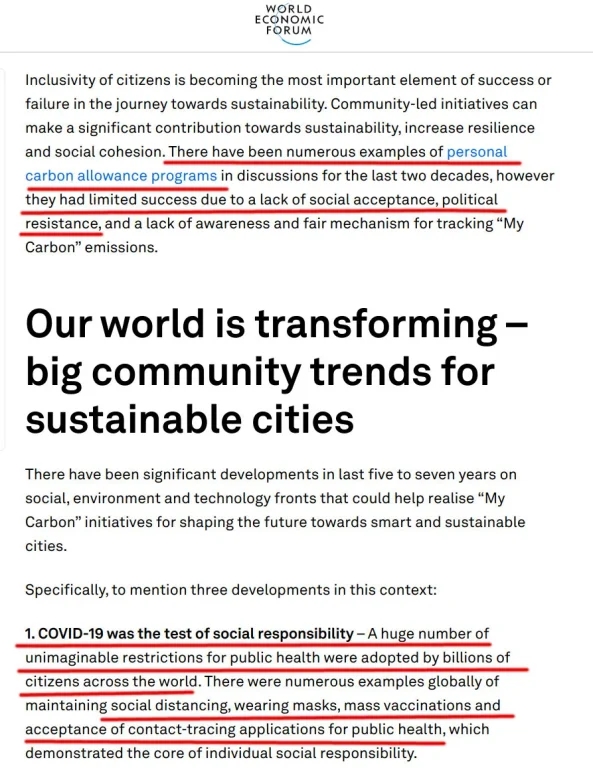
Few cities exhibited more sheep-like adherence to pandemic measures than New York City, so it should not be surprising that “food purchase tracking” is being tried in that particular locale in accordance with the WEF’s instructions.
Tracking of purchases will not be limited to food, of course.
On Meat, Health, and Freedom
This article is intentionally neutral on meat and health. Some of my subscribers are vegans, and some are avid meat eaters. I respect everyone. I was a vegetarian for a whole year, a long time ago. I try to eat less meat nowadays, which still amounts to eating too much, but I am trying.
Rather than framing this issue as a health matter, I urge you to consider it a question of basic fairness: the unelected, supranational, self-appointed masters of the world are trying to track and influence our behavior without even asking for permission or our opinion.
We are being assured that this is done for our good. However, these same people benefit financially from well-placed investments in companies growing fake meat comprised of cancer tumor cells:
Lab-Grown Meat Is Made of Cancer Cells. Would You Like It Rare or Medium?
We are generally taught that conflicts of interest should make us question the intentions of people promoting ideas related to such conflicts.
In the case of Covid-19 or climate change, we are asked to throw such precautions away and put blind faith into mega billionaires benefiting mightily from the pandemic or their climate change investments.
As skeptics and critical thinkers, we should refuse to believe promoters standing to benefit financially from their crazy ideas. Instead, we should demand a close and skeptical look into what is behind the curtain.
I am sure, however, that instead of skepticism, we will get more fake fact checks, denials, and gaslighting.
China, Russia circle wagons in Asia-Pacific
BY M. K. BHADRAKUMAR | INDIAN PUNCHLINE | APRIL 19, 2023
The official visit by Chinese State Councilor and Defence Minister General Li Shangfu to Russia on April 16-19 prima facie underscored the two countries’ emergent need to deepen their military trust and close coordination against the backdrop of worsening geopolitical tensions and the imperative to maintain the global strategic balance.
The visit carries forward the pivotal decisions taken at the intensive one-on-one talks between Russian President Vladimir Putin and Chinese President Xi Jinping in Moscow through March 20-21. In a break with protocol, Gen. Li’s 4-day visit was front-loaded with a “working meeting” with Putin — to quote Kremlin spokesman Dmitry Peskov. (here and here)
Li is no stranger to Moscow, having previously held charge of Equipment Development Department of the Central Military Commission who was sanctioned by the US in 2018 for purchasing Russian weapons, including Su-35 combat aircraft and S-400 surface-to-air missile systems.
Song Zhongping, prominent Chinese military expert and TV commentator, forecast that Li’s trip would signal the high level of bilateral military ties with Russia, and lead to “more mutually beneficial exchanges in many fields, including defence technologies and military exercises.”
Last Wednesday, US Commerce Department announced the imposition of export controls on a dozen Chinese companies for “supporting Russia’s military and defence industries.” The Global Times hit back defiantly that “as China is an independent major power, so is Russia. It’s our right to decide with whom we will carry out normal economic and trade cooperation. We cannot accept the US’ finger-pointing or even economic coercion.”
Putin said at the meeting with Li on Easter Sunday that military cooperation plays an important role in Russia-China relations. Chinese analysts said Li’s visit is also a signal jointly sent by China and Russia that their military cooperation will not be impacted by the US pressure.
Putin had disclosed in October 2019 that Russia was helping China to create an early missile warning system that would drastically enhance the defensive capacity of China. Chinese observers noted that Russia was more experienced in developing and operating such a system, which is capable of identifying and sending warnings immediately after intercontinental ballistic missiles are launched.
Such cooperation demonstrate a high level of trust and require a possible integration of Russian and Chinese systems. The system integration will be mutually beneficial; stations located in the North and West of Russia could provide China with warning data and, in turn, China could provide Russia with data collected at their Eastern and Southern stations. That is to say, the two countries could create their own global missile defence network.
These systems are among the most sophisticated and sensitive areas of defence technology. The US and Russia are the only countries which have been able to develop, build and maintain such systems. Certainly, close coordination and cooperation between Russia and China, two nuclear-armed powers, will profoundly contribute to world peace in the present circumstances by containing and deterring US hegemony.
It cannot be a coincidence that Moscow ordered a sudden check of the forces of its Pacific Fleet on April 14-18, which overlapped Li’s visit. The inspection took place against the background of the aggravation of the situation around Taiwan.
Indeed, in early April, it became known that the American aircraft carrier USS Nimitz approached Taiwan; on April 11, the US began a 17-day military exercise in the Philippines involving over 12,000 troops; on April 17, news appeared about the dispatch of 200 American military advisers to Taiwan.
The US Global Thunder 23 strategic exercises at Minot Air Base in North Dakota, (which is the US Air Force Global Strikes Command) began last week where a training was conducted to load cruise missiles with nuclear warheads on bombers. The images showed B-52H Stratofortress strategic bombers being equipped by the flight technical personnel of the base with AGM-86B cruise missiles capable of carrying nuclear warheads on the underwing pylons!
Again, exercises of US aviation and fleet forces have been increasingly noticed in the immediate vicinity of Russian borders or in regions where Russia has geopolitical interests. On April 5, B-52 Stratofortress circled over the Korean Peninsula allegedly “in response to nuclear and missile threats from North Korea.” At the same time, South Korea, the US and Japan conducted trilateral naval exercises in the waters of the Sea of Japan with the participation of aircraft carrier USS Nimitz.
Russian Security Council Secretary Nikolai Patrushev recently drew attention to Japan’s growing capability to conduct offensive operations, which, he said, constituted “a gross violation of one of the most important outcomes of the Second World War.” Japan plans to purchase around 500 Tomahawk cruise missiles from the US, which can directly threaten most of the territory of the Russian Far East. The Mitsubishi Heavy Industries is working on developing Type 12 land-based anti-ship missiles “in order to protect the remote islands of Japan.”
Japan is also developing hypersonic weapons designed to conduct combat operations “on remote islands,” which Russians see as options for Japan’s possible seizure of the Southern Kuriles. In 2023, Japan will have a military budget exceeding $51 billion (on par with Russia’s), which is slated to increase to $73 billion.
Actually, during the latest surprise inspection, the ships and submarines of Russia’s Pacific Fleet made the transition from their bases to the Japanese, Okhotsk and Bering Seas. Defense Minister Sergei Shoigu said, “in practice, it is necessary to work out ways to prevent the deployment of enemy forces to the operationally important area of the Pacific Ocean – the southern part of the Sea of Okhotsk and to repel its landing on the Southern Kuril Islands and Sakhalin Island.”
‘Loudly on the quiet…
Surveying the regional alignments, Yuri Lyamin, Russian military expert and Senior Fellow at the Centre for Analysis of Strategies and Technologies, a leading think tank of the military-industrial complex, told Izvestia :
“Considering that we have not settled the territorial issue, Japan lays claim to our South Kuriles. In this regard, checks are very necessary. It is necessary to increase the readiness of our forces in the Far East…
“In the context of the current situation, we need to further strengthen defence cooperation with China. In fact, an axis is being formed against Russia, North Korea and China: the USA, Japan, South Korea, Taiwan, and then it goes to Australia. Great Britain is also actively trying to participate… All this must be taken into account and cooperation should be established with China and North Korea, which are, one might say, our natural allies.”
In highly significant remarks at a Kremlin meeting with Shoigu on April 17 — while Li was in Moscow — Putin noted that the current priorities of Russia’s armed forces are “primarily focusing on the Ukrainian track… (but) the Pacific theatre of operations remains relevant” and it must be borne in mind that “the forces of the (Pacific) fleet in its individual components can certainly be used in conflicts in any direction.”
The next day, Shoigu told Gen. Li, “In the spirit of unbreakable friendship between the nations, peoples, and the armed forces of China and Russia, I look forward to the closest and most successful cooperation with you…” The Russian MOD readout said:
“Sergei Shoigu stressed that Russia and China could stabilise the global situation and lessen the potential for conflict by coordinating their actions on the global stage. ‘It is important that our countries share the same view on the ongoing transformation of the global geopolitical landscape… The meeting we have today will, in my opinion, help to further solidify the Russia-China strategic partnership in the defence sphere and enable an open discussion of regional and global security issues.”
Beijing and Moscow visualise that the US, having failed to “erase” Russia, is turning attention to the Asia-Pacific theatre. Suffice to say, Li’s visit shows that the reality of Russia–China defence cooperation is complicated. Russia–China military-technical cooperation has always been rather secretive, and the level of secrecy has increased as both countries engage in more direct confrontation with the US.
The political meaning of Putin’s 2019 statement on jointly developing a ballistic missile early warning system extended far beyond its technical and military significance. It demonstrated to the world that Russia and China were on the brink of a formal military alliance, which could be triggered if US pressure went too far.
In October 2020, Putin suggested the possibility of a military alliance with China. The Chinese Ministry of Foreign Affairs’ reaction was positive, although Beijing refrained from using the word “alliance”.
A working and effective military alliance can be formed quickly if the need arises but their respective foreign policy strategies rendered such a move unlikely. However, real and imminent danger of military conflict with the US can trigger a paradigm shift.
Ninth Circuit Spikes Berkeley’s Gas Ban
By Robert Bryce | April 18, 2023
Three federal court judges just rescued your gas stove and other gas-fired appliances from the nanny state.
Yesterday, in a unanimous opinion, the U.S. Court of Appeals for the Ninth Circuit ruled that the nation’s first ban on natural gas, put in place by the City of Berkeley in 2019, violates federal law. The three judges found that the city’s ordinance was preempted by the Energy Policy and Conservation Act of 1975, which prohibits the implementation of regulations that favor one type of fuel over another.
The first report I saw on the court’s ruling was here on Substack by my friend, Ed Ireland. There’s no doubt that the decision is a huge win for consumers, businesses, and energy security. Indeed, the ruling in California Restaurant Association vs. City of Berkeley, has ramifications that go beyond California and the Ninth Circuit. It should invalidate the dozens of gas bans that have been enacted across the country over the past four years. It may also mean that plans by federal authorities, including the Consumer Product Safety Commission, to ban, or restrict, the use of gas stoves, gas furnaces, and other gas-fired appliances, are kaput.
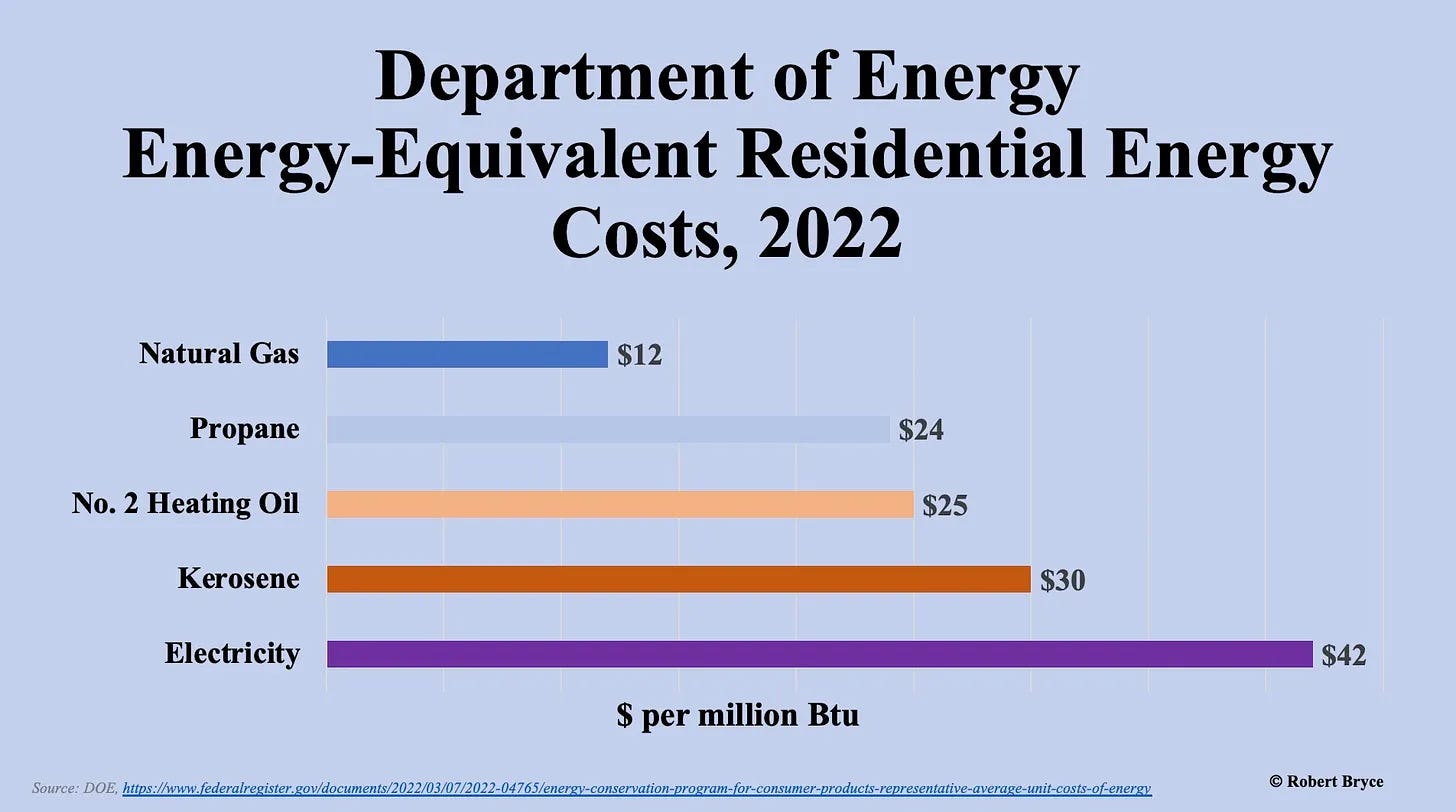
About 47 million American homes have gas stoves and lots of chefs, and consumers, including Energy Secretary Jennifer Granholm, like cooking with gas. The Department of Energy’s own numbers show that heating homes with gas is far cheaper than heating with electricity. Despite these facts, a group of lavishly funded activist groups have been pushing electrify everything mandates that would prohibit the use of gas in homes and businesses and require consumers to rely almost exclusively (including energy for electric vehicles) on our already-shaky electric grid. The electrify everything claque got a boost in January after Richard Trumka Jr., who sits on the Consumer Product Safety Commission, told a Bloomberg reporter that gas stoves are a hazard and that “any option is on the table,” including, presumably, a ban.
Trumka’s comments sparked a storm of criticism. Within hours, the White House issued a statement saying that President Joe Biden doesn’t support a ban on gas stoves.

What has since been dubbed the “gas stove culture war” was ignited in July 2019, when Berkeley became the first municipality in the country to ban the use of gas. Since then, as I explained in January, (See: “The Billionaires Behind The Gas Bans”), several NGOs, including Climate Imperative, the Sierra Club, and Rocky Mountain Institute, as well as Rewiring America, have spent untold (and undisclosed) millions of dollars campaigning and lobbying at the local and national levels to ban the direct use of natural gas in homes and businesses. And thanks to remarkably friendly (and largely unquestioning) coverage from legacy media outlets, they’ve had undeniable success.
The Sierra Club, which operates on an annual budget of about $180 million, says 74 communities in California have “adopted gas-free buildings commitments or electrification building codes.” But that number doesn’t include the most recent ban. On April 13, the Irvine City Council, again according to the Sierra Club, adopted measures mandating that all new buildings be all-electric “on or after July 1, 2023. That puts the number of California communities that have banned gas at 75. The group isn’t just pushing for restrictions in its home state. Last August, it asked the Environmental Protection Agency to ban natural gas appliances at the federal level.
In September, the California Air Resources Board voted to ban the sale of all gas-fired space heaters and water-heating appliances in the state by 2030. New York City and Seattle have banned the use of gas in new construction. Massachusetts is also rolling out a measure that will allow up to 10 communities to ban gas.
As I reported last month (See: “California Screamin’”), the Bay Area Air Quality Management District recently approved regulations that will ban the use of residential and commercial natural gas-fired water heaters and furnaces. The regulation, which only applies to new appliances, prohibits residents in the Bay Area from buying or installing gas water heaters starting in 2027. Also last month, Boston Mayor Michelle Wu, said she is working on a “climate friendly” building code that will hamper or––in the words of the Boston Globe, “discourage”––the use of hydrocarbons in new buildings in Boston.
Following the proliferation of gas bans requires following the money. The Sierra Club has been a prime beneficiary of former New York City mayor Michael Bloomberg’s Bloomberg Philanthropies, which has pledged $500 million to the Beyond Carbon project. In 2019, the pledge was considered the largest ever “philanthropic donation to combat climate change.” The Sierra Club is now getting about $30 million per year from Bloomberg.
For several years, the Rocky Mountain Institute, a group that took in $115 million in 2022, has been ginning up bogus studies that claim gas stoves are a threat to human health. And like the Sierra Club, it is getting big money from super-rich donors. In 2020, the Bezos Earth Fund gave RMI $10 million. RMI said the cash from the group, which, of course, came from Amazon founder and multi-billionaire Jeff Bezos, would help fund its “work with a coalition of partners in key states. The project will focus on making all U.S. buildings carbon-free by 2040 by advocating for all-electric new construction.”
In January, numerous national news stories were published after RMI issued a paper claiming that 12.7 percent of childhood asthmas are due to gas stoves. One of the authors of that paper, Talor Gruenwald, works at RMI. Gruenwald is also a research associate at Rewiring America, a San Francisco-based outfit that calls itself the “leading electrification nonprofit, focused on electrifying our homes, businesses, and communities.” Rewiring America is funded entirely by dark money. It doesn’t publish its budget or file a Form 990. Instead, it is a sponsored project of the Windward Fund, a 501c3 non-profit that does not disclose its donors. Nor does the Windward Fund reveal how much it is giving to Rewiring America.
The January RMI paper didn’t stand up to even modest scrutiny. The definitive analysis of indoor air pollution and gas stoves was published in 2013 in Lancet Respiratory Medicine. It studied half a million schoolchildren in 47 countries over a multi-year period and relied on questionnaires that were filled out by the mothers of the children. It concluded, “We detected no evidence of an association between the use of gas as a cooking fuel and either asthma symptoms or asthma diagnosis.”
Furthermore, just a day or two after the RMI paper came out, the group walked back its claim about asthma, with one RMI official telling the Washington Examiner that the study “does not assume or estimate a causal relationship” between childhood asthma and natural gas stoves.
Restoring Some Vaccination Choice in Mississippi
By Adam Dick | Ron Paul Institute | April 18, 2023
Like every American state government, the Mississippi government pressures parents to ensure their children take a slew of vaccination shots as a condition for the children to attend school. But, unlike most states, Mississippi law does not recognize the right of parents to refuse, based upon philosophical or religious objections, to follow the state-imposed childhood vaccination schedule.
Instead, the only exemption Mississippi parents have had available is a medical exemption that has turned out for almost all parents to be the same as having no exemption at all. I wrote about this in an April of 2015 article:
The New York Times reported in February how extremely restricting vaccination mandate exemptions causes a significant increase in vaccination rates, pointing to Mississippi as an example. Mississippi has among the strictest vaccination requirements in America — barring philosophical and religious exemptions and allowing only a medical exemption for students in both public and private schools. In the 2013-14 school year the Times reports that only 17 out of 45,179 kindergarten students in the state were exempt from the state’s vaccination mandate.
The medical exemption could more accurately be called the mirage exemption. In contrast, philosophical and religious exemptions can allow much greater ability for parents to refuse government pressure to have their children subjected to each and every state-mandated shot at each and every state-mandated time in a child’s life.
Since I wrote that article in 2015, California and New York, two of the largest population states, have joined Mississippi by eliminating all exemptions other than the medical exemption. Three additional states — Connecticut, Maine, and West Virginia — also recognize only the medical exemption.
Some good news came for Mississippi parents this week. The Informed Consent Action Network (ICAN) has announced that on Monday a federal court “ruled that the First Amendment requires that, by July 15, 2023, the State of Mississippi afford its residents a religious exemption for their children to attend school without one or more state mandated vaccines.” ICAN, which has supported the lawsuit that led to the court’s ruling, provides more information in a legal update at its website.
Hopefully, religious and philosophical exemptions, in addition to medical exemptions, will soon be exercisable by parents in all states.
Just how many US troops and spies do we have in Ukraine?
By Kelley Beaucar Vlahos | Responsible Statecraft | April 18, 2023
Congressman Matt Gaetz (R-Fla.), who has flooded the docket in recent months with resolutions designed to get U.S. troops out of overseas missions he believes have not been approved by Congress, is now demanding that Biden tell the American people just how many American military personnel are operating in Ukraine today.
His new Privileged Resolution of Inquiry, which forcing Biden to notify the House of the exact number of U.S. military inside Ukraine and to hand over “copies of any and all documents outlining plans for military assistance to Ukraine,” comes a week after leaked Pentagon documents showing previously unreported U.S. Special Forces inside the war zone.
According to the document there were 97 special forces from NATO countries operating in Ukraine as of March, including 14 U.S. special forces. When asked by the Guardian newspaper for confirmation/clarification, the Department of Defense said, “We are not going to discuss or confirm classified information due to the potential impact on national security as well as the safety and security of our personnel and those of our allies and our partners.” The Pentagon has not denied the authenticity of the documents, however.
While “14 special forces” sounds like a drop in the bucket, these revelations are a drip-drip of other pieces of information over the last year that, when added up, leave more questions than answers, and the bottom line is that the American people have a right to know, says (Ret.) Lt. Col. Daniel Davis.
“It is entirely appropriate that the American people know, authoritatively, whether any U.S. troops are engaged in military operations within Ukraine — and to demand a change if we don’t like the answer,” Davis told me yesterday when I asked him about the Gaetz resolution.
“American history is rife with too many examples of presidents secretly employing U.S. troops without the consent or knowledge of our people. It almost always goes sideways when presidents go covert with our troops.”
We know from reporting last year, beginning in June 2022, that the CIA had a strong presence in Ukraine, engaging a network of commandos and spies among European partners set up to provide critical weapons and military intelligence to Ukraine. According to the New York Times, “even as the Biden administration has declared it will not deploy American troops to Ukraine, some C.I.A. personnel have continued to operate in the country secretly, mostly in the capital, Kyiv, directing much of the massive amounts of intelligence the United States is sharing with Ukrainian forces.”
Ken Klippenstein and Jim Risen reported in October 2022 that “there is a much larger presence of both CIA and U.S. special operations personnel and resources in Ukraine” than publicly known. They reported for the Intercept that several former and current intelligence officers told them that the covert operations were being conducted “under a presidential covert action finding,” for which only a handful of Congressional lawmakers have been notified.
In November, the administration announced it was sending a team of military “weapons inspectors” into Ukraine to keep track of weapons shipments, but that they would be away from the fighting. Also that month, the DoD confirmed that it would be setting up a new joint forces command called the Security Assistance Group Ukraine, or SAGU, based out of U.S. Army Europe and Africa headquarters in Wiesbaden, Germany and led by a 3-star general to “handle weapons shipments and personnel training.”
In February of this year, the Washington Post reported that the Pentagon wanted to revive pre-Ukraine war orders that would allow them to insert commandos in the form of “control teams” to direct Ukrainian operatives to counter Russian disinformation and monitor troops movements on the ground. This would require the U.S. personnel to be in Ukraine or in a neighboring country. Washington had been operating such teams in Ukraine under Section 1202 of the 2019 National Defense Authorization Act until the invasion last year.
Nick Turse, who has written extensively about U.S. covert operations in other parts of the globe, said the recent leak showing special ops forces in Ukraine “is hardly a surprise. ”
“U.S. Special Operations forces deploy throughout the world, often with next to no transparency or real oversight,” he said when asked about the Gaetz resolution. “Under little-known authorities, special operators conduct shadowy missions — sometimes indistinguishable from combat — unbeknownst to the American people and most members of Congress.”
What we don’t know much about is how many trainers and intelligence personnel might be working under contract for the U.S. government on the ground in Ukraine. There have been hints that they are there. Of course, some American experts, like Alexander Vindman, who are frustrated that the U.S. military is not more directly involved, have been calling on Biden to send contractors into the fight from the beginning.
Others have said “operational contractors” should be inserted into Ukraine, not to fight, but to help the Ukrainians train and operate the sophisticated weaponry Washington is sending over there. Are they there now? It is hard to tell. We know there are plenty of private military contractors in Ukraine today from all over the West working in extraction, training, and humanitarian aid, but they are, as far as we know, freelancing, not on the U.S. dole.
The use of contractors, whether they be Americans or third party, has been widespread since the U.S. launched a Global War on Terror after 9/11. According to the Congressional Research Service, as of the end of 2022, there were approximately 22,000 contractor personnel working for the DoD throughout the US Central Command’s area of responsibility.
“It is highly probable that contractors are a significant part of the U.S. personnel presence in Ukraine,” speculated Ted Carpenter, who wrote about the topic recently for Responsible Statecraft.
“My expectation is that they would be used for the operation and maintenance of the more advanced (and twitchy?) weapons systems that NATO has given to Kyiv,” he shared on Monday. “Another interesting question is how many DIA (Defense Intelligence Agency) and Pentagon personnel, as well as contractors, might be helping Ukraine with targeting information for attacks on Russian forces. Some of the operations have seemed far too sophisticated for the known capabilities that Ukraine possessed when the invasion began.”
Responsible Statecraft has put in a request to the DoD press office to ask just how many contractors might be in Ukraine today. In the meantime, Gaetz said in a statement he will press on with his own quest for a clear number of U.S. troops there. “There must be total transparency from this administration to the American people when they are gambling war with a nuclear adversary by having special forces operating in Ukraine.”
Lula supports de-dollarization on his trip to China, but that is not enough
By Lucas Leiroz | April 18, 2023
Lula’s trip to China was marked by several signals about what may be his foreign policy in his third term. In his speeches, Lula suggested that he will continue to bet on partnerships with the global south and emphasized his criticism of organizations linked to or controlled by the US. Lula’s trip was well received by Chinese partners and brought new hope to bilateral and intra-BRICS relations.
Undoubtedly, the most prominent point in his pronouncements was his support for the de-dollarization of international economic relations. Lula questioned the need to use the dollar as a global commercial currency and expressed his support for the “idea” of creating a currency for the BRICS – or starting to trade in national currencies.
“Why can’t we do trade based on our own currencies? (…) Who was it that decided that the dollar was the currency after the disappearance of the gold standard? (…) Why can’t a bank like that of the BRICS have a currency to finance trade relations between Brazil and China, between Brazil and other countries? It’s difficult because we are unaccustomed [to the idea]. Everyone depends on just one currency”, he said during a press conference.
With this, Lula reiterated what he had mentioned previously, during a trip to Argentina, in which he proposed the creation of a currency for Mercosur and another for the BRICS, both with the aim of advancing economic de-dollarization. To his supporters, this sounds like a big sign that Lula is distancing himself from the US and turning towards greater participation in building a multipolar world. However, this seems like an overly optimistic analysis.
De-dollarization is part of the multipolar world, but it is not its essence. Many countries, even US allies, have been seeking to de-dollarize their international transactions in recent years. Japan, for example, has traded with Beijing without the dollar since 2011, as well as Australia since 2013. Also, the EU has traded with Iran without the dollar since 2020. France recently started its de-dollarization process and Switzerland will certainly start this process soon, as it began to get rid of some of its dollar reserves.
In fact, economic de-dollarization is a technical and pragmatic measure, whose purpose is much more to generate economic benefits than to operate any geopolitical transition. In Brazil, the measure has even been supported on a large scale by businessmen and parliamentarians linked to the agribusiness sector, which is the main segment of the Brazilian economy and whose biggest partner is precisely China. Recognizing the Chinese interest in de-dollarization, there is internal pressure from the Brazilian business community for Lula to de-dollarize the economy. Therefore, it is a technical and pragmatic issue that does not mean much for Lula’s foreign policy agenda.
It is also necessary to emphasize that before traveling to China, Lula repeatedly stated that the main subject of his meeting with Xi would be to discuss the Ukrainian crisis. He planned to show his “peace club” proposal to the Chinese president and garner support, but apparently this was not a relevant topic in the talks. Both presidents limited themselves to generic declarations of support for peace and negotiations, without any more emphatic mention of Lula’s “peace club” project.
Considering that Lula planned the terms of his project in advance with American and European politicians, having even signed a joint statement with Biden condemning the Russian special military operation, it is most likely that Xi has refrained from giving any deep support to the Brazilian president. China and Russia are at their closest moment in history, with unlimited cooperation in all areas. Certainly, Xi would not agree to participate in a “peace club” supported precisely by the states that are waging war against Russia. Therefore, the Ukrainian subject ceased to be the main topic of the tour.
Furthermore, Lula signed interesting agreements with China in the field of space cooperation. A memorandum of understanding was also made in the semiconductor sector. The balance of the trip was positive for Brazil and advanced the de-dollarization agenda, but it did not significantly change the analyses that point out that Lula is closer to the West in this third term. In the same sense, Lula also did not revoke his support for prioritizing the EU-Mercosur agreement over the China-Mercosur agreement, which shows that his position of ambiguity remains.
It seems that Lula plans to continue maintaining this ambiguity. He develops his foreign policy based on a merely multilateralist, not a multipolar, mentality. Lula and his team are acting as if the current world scenario were the same as in his first terms, when there was no possibility of contesting the US unipolar geopolitical order, with the emerging countries only seeking greater economic development through multilateralism.
This reality has absolutely changed, and it is now possible to build a really polycentric system, where emerging countries also have a political role, not merely focused on economic and commercial development through multilateral cooperation. It is hoped that Lula’s team will realize this in time and take more relevant measures towards multipolarity, ignoring American pressure.
Lucas Leiroz is a journalist, researcher at the Center for Geostrategic Studies, geopolitical consultant.
US Lawmaker Introduces Bill to Force Biden to Provide Data on Ukraine Aid, Conflict
Sputnik – 17.04.2023
WASHINGTON – US Congressman Matt Gaetz said in a statement that he has introduced a resolution to force the Biden administration to relay information about plans for US military assistance to Ukraine, as well as about the number of US servicemembers operating in the country.
“Today, US Congressman Matt Gaetz introduced a Privileged Resolution of Inquiry, forcing President Joe Biden to transmit to the House of Representatives copies of any and all documents outlining plans for military assistance to Ukraine. Additionally, the resolution directs Secretary of Defense Lloyd Austin to disclose the number of United States Armed Forces, including special operators, deployed to Ukraine without Congressional authority,” the statement said on Monday.
Biden and Austin would be required to provide the requested information within two weeks of the bill’s adoption, the statement said.
Documents leaked in recent months that appear to show classified US military information revealed that at least 14 members of the US special forces were deployed in Ukraine.
There is a small US military element in Ukraine, but no servicemembers engaged in combat operations, Deputy Pentagon Press Secretary Sabrina Singh said on Monday. However, US officials have declined to comment on the veracity of the seemingly leaked materials.
“The Biden Administration and other allied countries have been misleading the world on the state of the war in Ukraine. There must be total transparency from this administration to the American people when they are gambling war with a nuclear adversary by having special forces operating in Ukraine,” Gaetz’s statement said.
The resolution would better inform Congress and the country on the “true state” of the US military’s involvement in the Ukraine conflict, the statement added.
Why are Western media suddenly praising Russian electronic warfare capabilities?
By Drago Bosnic | April 18, 2023
Electronic warfare (EW) is one of the most important aspects of modern military capabilities and is often the litmus test of how advanced the state and its armed forces are. It’s part of the “invisible” and yet extremely intense battle that we usually cannot see directly. However, its impact is wholly undeniable. Russia is among the world leaders in EW and its warfighting capabilities in this regard are a source of pride for the Eurasian giant, but also fear for its adversaries. Russian dominance in EW on the frontlines of Ukraine is so comprehensive and massive that it’s one of the few things the mainstream propaganda machine never dared to question or ridicule. Even Russian strategic thermonuclear capabilities were subjected to propaganda attacks at times, but its EW capabilities – never. And for good reason.
And yet, as with everything concerning the mainstream propaganda machine, we must tread carefully. This is especially true when it comes to the media citing the Pentagon “leaks” as their primary source of information. Needless to say, an actual leak would require an inadvertent release of classified information and most intelligence experts agree it’s extremely unlikely there was anything inadvertent about it. However, this is not to say that all information connected to the “leak” is false. On the contrary, its relatively elaborate nature implies that much of it is indeed true, but it can be difficult to discern what exactly. One of the few “leaked” facts we can surely believe concerns precisely Russian EW capabilities. Still, this begs the question – why?
To answer that, we should first dissect and specify the claims of the mainstream propaganda machine. The “leaks” include a massive amount of information, including the claim that US-made JDAM (Joint Direct Attack Munition) bombs are failing in Ukraine due to successful Russian EW measures. The “leak” documents not only review the use of Russian countermeasures to make JDAMs ineffective, but also indicate that in some cases this results in failure to even detonate. It seems this includes the JDAM-ER (Extended Range) bombs that the troubled Biden administration sent to the Kiev regime in order to provide certain battlefield advantages to its forces. A futile effort, it would seem now, although the documents suggest that at least a thousand JDAM kits have been sent so far.
Politico claims that “Russia is using GPS jamming to interfere with the weapons’ targeting process, according to the slide and a separate person familiar with the issue who’s not in the US government”. The report further states that “American officials believe Russian jamming is causing the JDAMs, and at times other American weapons such as guided rockets, to miss their mark”. Mick Mulroy, a former Pentagon official and retired CIA officer claims: “I do think there may be concern that the Russians may be jamming the signal used to direct the JDAMs, which would answer why these munitions are not performing in the manner expected and how they perform in other war zones.”
This was quite an unpleasant surprise for the Kiev regime as it expected the JDAMs to be a “game changer” providing key tactical advantages that Russia supposedly “couldn’t match”. However, it’s not just that this completely false sense of security fell apart as a result, but it turns out that the performance of other much-touted NATO-sourced weaponry is little more than PR optics. The “leak” suggests that even the M270 and HIMARS rockets are being successfully countered by Russian GPS jamming tactics. Many documents consistently show that the Kiev regime forces are generally beset by chronic munitions and advanced weapons shortages, and having Russian EW capabilities preventing precision targeting is exacerbating this exponentially, despite countless billions in weapons provided by the political West.
This is where we come to the “solution” the American Military Industrial Complex (MIC) may come up with. So, how does the world’s largest cartel of arms producers solve the issues with the precision of their weapons? Well, more weapons! With the Kiev regime potentially acquiring thousands of additional JDAMs, obviously by using funds provided by the political West, since the Neo-Nazi junta itself is “financially dead”, as Hungarian President Viktor Orban accurately assessed, US MIC contractors get even more billions of American taxpayers’ dollars. The contract to alter and/or upgrade thousands of JDAMs and other munitions would provide long-term contracts to the likes of Boeing, Lockheed Martin, Raytheon, BAE Systems, etc. This could be one of the few logical answers to the question of why the mainstream propaganda machine suddenly felt the urge to tell the truth for once.
However, we shouldn’t fall into the trap of thinking this has anything to do with altruistic motives or even the desire to make the Kiev regime a more effective fighting force. The main goal primarily revolves around causing as much death and destruction as possible, particularly to civilian infrastructure in the Donbass and other areas of former Ukraine. This has twofold advantages for the US. First, Russia is left with destroyed buildings and infrastructure that need to be renovated and second, the mainstream propaganda machine can portray the destruction as caused by Russia. This also explains why the Neo-Nazi junta continues using Western weapons that keep missing and hitting civilian areas. Perhaps the only positive aspect in all this is that the sheer magnitude of corruption and cronyism in both the political West and Kiev may very well accelerate Russian victory.
Drago Bosnic is an independent geopolitical and military analyst.
Leaked files: Britain’s secret propaganda ops in Yemen
By Kit Klarenberg | The Cradle | April 17 2023
Yemen’s civil war, considered the world’s gravest humanitarian crisis, appears to be nearing its end due to a China-brokered detente between Iran and Saudi Arabia, who support opposing sides in the bitter conflict.
Early signs suggest that the rapprochement between Tehran and Riyadh may not only end hostilities in Yemen, but across the wider region.
The US, Israel, and Britain have the most to lose from a sudden onset of peace in West Asia. In the Yemeni context, London may be the biggest loser of all. For years, it provided the Saudi-led coalition with weaponry used to target civilians and civilian infrastructure, with receipts running into billions of pounds sterling.
During the entirety of the war, Yemen was struck by British-made bombs, dropped by British-made planes, flown by British-trained pilots, which then flew back to Riyadh to be repaired and serviced by British contractors. In 2019, a nameless BAE Systems executive estimated that if London pulled its backing for the proxy war, “in seven to 14 days, there wouldn’t be a jet in the sky.”
In addition to supplying weapons, the war also presented a golden opportunity for Britain to establish a military base in Yemen, fulfilling long-held fantasies of recovering the Empire’s long-lost glory days “East of Suez.”
Al-Ghaydah airport in al-Mahrah, Yemen’s far eastern governorate, has for some time quietly housed “a fully-fledged force” of British soldiers, providing “military training and logistical support” to coalition forces and Saudi-backed militias. There are even indications that this involvement could extend to torture methods, which is a troubling reflection of one of London’s leading exports.
The Cradle has obtained exclusive information about a previously undisclosed aspect of London’s role in the proxy war against Yemen’s Ansarallah-led resistance. It has been revealed that a multi-channel propaganda campaign, led by the intelligence cut-out ARK and its founder Alistair Harris, a veteran MI6 operative, has been operating in complete secrecy throughout the nine-year-long conflict – one that specifically targeted Yemen’s civilian population.
Anti-Ansarallah ops
Leaked Foreign Office documents have revealed that ARK’s “multimedia” information warfare campaign was designed to undermine public sympathy for the Ansarallah movement and ensure that the conflict would only end on terms that aligned with London’s financial, ideological, and geopolitical interests.
For instance, public acceptance of the UN’s widely unpopular peace proposal required propaganda support from local NGOs and media organizations that “support UK objectives” to “communicate effectively with Yemeni citizens” and change their minds.
It was also necessary to counter “new actors” in the information space that were critical of the Saudi-led coalition’s brutal bombing campaigns and the illegitimate, US-backed puppet government that the aerial assaults sought to protect.
Considering the high rate of illiteracy in the local population, ARK conceived the creation of a suite of “visually rich” products extolling the virtues of a Riyadh-dominated peace plan. These products would be disseminated on and offline, would “deliberately include different demographics, sects, and locations to ensure inclusivity,” and would be informed by focus groups and polling of Yemenis. ARK’s campaign even extended to convening “gender-segregated poetry competitions using peace as a theme” and “plays and town hall meetings.”
Publicly, many of these propaganda products appeared to be the work of Tadafur – Arabic for “work collectively and unite” – an astroturf network of NGOs and journalists constructed by ARK. Its overt mission was to “resolve local level conflicts” and “unite local communities in their conflict resolution efforts.”
The campaign began initially at a “hyper-local level” across six Yemeni governorates, “before being amplified at the national level.” Activities “[in] all areas and at both levels” had unified messaging across “common macro themes,” such as the slogan “Our Yemen, Our Future.”
In each governorate, a “credible” local NGO was identified as a messenger, along with “well-known” and “respected and influential” journalists who served as “dedicated field officers” across the sextet, managed by ARK.
In Hajjah – “a site of strong Houthi influence” – the Al-Mustaqbal Institute for Development was ARK’s NGO of choice; in Ansarallah-governed Sanaa, it was the Faces Institution for Rights and Media; in Marib, the Marib Social Generations Club; in Lahij, Rouwad Institution for Development and Human Rights; in Hadhramaut, Ahed Institute for Rights and Freedom; in Taiz, Generations Without Qat.
These local NGOs were instrumental in promoting ARK’s agenda and advancing the narrative that aligned with Britain’s objectives in Yemen.
The company’s roster of “field officers” comprised of individuals with various backgrounds, such as:
“Human rights abuse” specialist Mansour Hassan Mohammad Abu Ali, TV producer Thy Yazen Hussain, Public Organisation to Protect Human Rights press official and “experienced journalist” Waleed Abdul Mutlab Mohammed al-Rajihi, producer from Alhadramiah Documentary Institute Abdullah Amr Ramdan Mas’id, editorial secretary of Family and Development magazine and the Yemen Times’ Taiz news manager Rania Abdullah Saif al-Shara’bi, as well as journalist and activist Waheeb Qa’id Saleh Thiban.
A Trojan Horse
Once ARK’s field officers and NGOs “successfully designed and implemented hyper-local campaigns,” coverage of “information around the related activities will then be amplified at the national level.” A key platform for this amplification was a Facebook page called “Bab,” launched in 2016 with tens of thousands of followers who were unaware that the page was created by ARK as a British intelligence asset.
Under the guise of a popular grassroots online community, ARK used the Bab page to broadcast slick propaganda “promoting the peace process,” including videos and images of “local peacebuilding initiatives” organized by its NGO and field officer nexus.
“Campaign content will highlight tangible, real-life examples of compelling peacebuilding efforts that all Yemenis, regardless of their political affiliation, can relate to,” ARK stated.
“These will offer inspirational examples for others to emulate, demonstrating practical ways to engage with the peace process at a local level. Taken together, these individual stories form the broader campaign with a national message: Yemenis share a collective desire for a peaceful resolution to the conflict.”
When “high engagement levels” with this content were secured, Bab users were invited to submit their own, which demonstrated “support for the peace process.” They were explicitly asked “to mirror content ARK has produced, such as voxpops, short videos, or infographics.” This was then “shared by the project and field teams through influential WhatsApp messaging groups, a key way of reaching Yemeni youth.”
ARK’s “well-connected communications team” would then “strategically share packaged stories with broadcast media or key social influencers, or offer selected journalists exclusive access to stories.” Creating a constant flow of content was a deliberate ploy to “collectively be as ‘loud’ as partisan national political and military actors.” In other words, to create a parallel communications structure to Ansarallah’s own, which would drown out the resistance movement’s pronouncements.
ARK’s role in Yemen’s peace process
While one might argue that the non-consensual recruitment of private citizens as information warriors by British intelligence was justified by the moral urgency of ending the Yemen war quickly, the exploitation of these individuals was cynical in the extreme. It amounted to a Trojan Horse operation aimed at compelling Yemenis to embrace a peace deal that was wildly inequitable and contrary to their own interests.
Multiple passages in the leaked files refer to the paramount need to ensure no linkage between these propaganda initiatives and the UN’s peace efforts. One passage refers to how campaign “themes and activities” would at no point “directly promote the UN or the formal peace process,” while another says concealing the operation’s agenda behind ostensibly independent civil society voices “minimizes the risk” that “outputs are perceived as institutional communications stemming from or directly promoting the UN.”
Yet, once ARK’s campaigns began “performing successfully at the national level,” the company’s field officers planned to “build a bridge” between its local foot soldiers and national “stakeholders” – and, resultantly, the UN. In other words, the entire ruse served to entrench ARK’s central role in peace negotiations via the backdoor.
Diminished western influence
At that time, the ceasefire deal proposed by the UN required Ansarallah and its allied forces to virtually surrender before Riyadh’s military assaults and economic blockade of the country could be partially lifted, along with other stringent requirements that the Saudis refused to compromise on. The US aggressively encouraged such intransigence, viewing any Ansarallah influence in Yemen as strengthening Iran’s regional position.
However, these perspectives are no longer relevant to Yemen’s peace process. China has now encouraged Riyadh to offer significant concessions, and as a result, the end of the war is within sight, with critical supplies finally allowed to enter Yemen, prisoners returned, Sanaa’s airport reopened, and other positive developments.
Evidently, Washington’s offers of arms deals and security assurances are no longer sufficient to influence events overseas and convince its allies to carry out its agenda. The failure of ARK’s anti-Ansarallah propaganda campaigns to coerce Yemenis to accept peace on the west’s terms also highlights Britain’s significantly reduced power in the modern era.
Whereas wars could once be won on the coat-tails of well-laid propaganda campaigns, the experiences of Yemen, Syria, Iraq, and Afghanistan show that the tide has turned. Subversive information campaigns can confuse and misdirect populations but, at best, can only prolong conflict – not win it.
The RESTRICT Act will usher in a new era of censorship under the guise of “national security”
By Tom Parker | Reclaim The Net | April 17, 2023
45 days after 9/11, the United States government passed the PATRIOT Act — a chilling law that used the guise of “national security” to greatly expand the federal government’s secret surveillance powers.
Almost 23 years later, another far-reaching bill, the “Restricting the Emergence of Security Threats that Risk Information and Communications Technology Act,” better known by its acronym, the RESTRICT Act, is using the same national security talking point to justify further federal government encroachment on Americans’ rights.
Although the bill doesn’t mention TikTok, its authors, Democratic Senator Mark Warner and Republican Senator John Thune, have framed it as “the best way to counter the TikTok threat.”
However, the impact of the bill extends far beyond TikTok and gives the US government sweeping powers to ban a wide range of apps and services.
The bill authorizes the Secretary of Commerce to review and prohibit “current, past, or potential future transactions” involving technology products or services with more than one million US-based annual active users that:
- Are deemed to pose an “undue or unacceptable risk” in various areas (such as national security and election interference)
- Involve anyone determined to be “owned, directed, or controlled” by a “foreign adversary” (a term that can currently be applied to China, Cuba, Iran, North Korea, Russia, and Venezuela but can be extended to other nations by the Secretary)
The Secretary of Commerce can also refer these tech products and services to the President who can take action to “compel divestment of, or otherwise mitigate the risk” associated with them.
Caitlin Vogus, the deputy director of rights group the Center for Democracy & Technology’s Free Expression Project, warned that these powers target the free speech rights of Americans. In a statement to Motherboard, she said:
“The RESTRICT Act could lead to apps and other ICT [information communication technology] services with connections to certain foreign countries being banned in the United States. Any bill that would allow the US government to ban an online service that facilitates Americans’ speech raises serious First Amendment concerns.”
Rights groups have also sounded the alarm about the RESTRICT Act’s threats to fine or imprison those who attempt to “evade the provisions” of the bill — a threat that they fear could be aimed at US citizens who attempt to access banned apps or services.
The RESTRICT Act states: “No person may engage in any transaction or take any other action with intent to evade the provisions of this Act.”
The bill even makes it unlawful to “approve” of “any act” that tries to evade the provisions of the bill.
People that violate these rules can be fined up to $1 million and imprisoned for up to 20 years.
Senator Warner has insisted that these penalties won’t be used to target individual users.

However, digital rights group the Electronic Frontier Foundation (EFF), has noted that the bill doesn’t actually prevent individual users from being targeted. In an article about the RESTRICT Act, the EFF warned:
“Due to undefined mitigation measures coupled with a vague enforcement provision, the bill could also criminalize common practices like using a VPN or side-loading to install a prohibited app.”
Another concerning aspect of the RESTRICT Act is that it allows the Secretary of Commerce to form technical advisory committees without them being subject to Chapter 10 of part 1 of title 5 of the United States Code.
This section of the law aims to reduce “the undue influence” of special interests and lobbyists. It allows Congress to review the proposed activities of advisory committees before they’re formed and ensure that these committees aren’t being “inappropriately influenced” by special interests. It also requires advisory committees to report their activities and goals to Congress, make their meetings open to the public, make transcripts available to the public, and file reports with the Library of Congress.
Excluding RESTRICT Act advisory committees from this section of the law opens the door for lobbyists representing US tech giants to serve on these committees, push for their competitors in other countries to be banned, and further cement their dominance.
And the problems don’t end here. The RESTRICT Act also limits judicial, congressional, and public scrutiny of the government’s actions.
Actions taken by the Secretary of the Treasury under this act are exempt from sections 551, 553-559, and 701-707 of title 5 of the United States Code — sections that require federal officials and agencies to provide public notice when proposing rule making, allow interested persons to participate in the rule making, and give those who suffer legal wrong as a result of government action the right to judicial review.
The scope of judicial review under the RESTRICT Act is limited to the US Court of Appeals for the District of Columbia Circuit and the court is prohibited from disturbing “any action taken” by the Secretary or the President when they review or prohibit transactions or take action against tech products and services, unless a petitioner demonstrates that the action is unconstitutional or violates a statutory command.
Additionally, Americans have “no right of access” to the information that the government uses when deciding whether to prohibit transactions involving technology products or services under this bill. The Freedom of Information Act also doesn’t apply to any information submitted by affected parties or created by the government when reviewing such transactions.
We obtained a copy of the RESTRICT Act for you here.
Despite the glaring problems with the bill, its architects are blaming TikTok for the criticism and claiming that the owners of the app are “spreading false claims about the Restrict Act in an effort to continue operating with impunity.”
According to Warner, the RESTRICT ACT has more than 20 bipartisan cosponsors.

The bill also has the full support of the Biden White House which has already demonstrated that it’s no fan of free speech and is currently being sued for alleged First Amendment violations.
If the RESTRICT Act passes, the Biden admin and any future pro-censorship administrations will be handed new powers to continue their crackdowns on online speech.
MORE UNANSWERED RED FLAGS REGARDING JACK TEXEIRA
By Larry Johnson | SONAR | April 16, 2023
Several former military and intelligence professionals have contacted me and voiced similar doubts about the pat story being circulated regarding National Guard Airman Jack Texeira and the allegations that he removed TOP SECRET documents from a SCIF, photographed them and then posted them to a gamer chat. They all agree, something is not right. The media account does not make sense.
The biggest oddity are the two two separate documents from the CIA’s Operations Center. Neither are complete and both deal only with the Ukrainian/Russian war. To reiterate a point from my previous article, that CIA Operations Center produces two daily reports — one in the morning and one in the afternoon. It is not a “Community” product, i.e., it is not distributed to the other intelligence agencies. It is an internal CIA document (of course, it is available to the Director of National Intelligence).
Texeira’s alleged possession of two separate reports is doubly odd because he did not copy the full reports. The one dated 1 March 2023 only shows 3 of 8 pages. If he was taking the documents to impress the youngsters on the gamer chat, why did he not take the whole enchilada? And why did he only publish the portions of the intel report that dealt exclusively with Ukraine and Russia?
There has been some media reports that he also posted a State Department EXDIS cable. I have not seen it and cannot confirm that it exists. If it does, that would be another huge red flag. EXDIS is bureaucratic speak for EXCLUSIVE DISSEMINATION. It has a cousin, NODIS — i.e., NO DISTRIBUTION. The U.S. military does not have access to such cables.
There was a time when State EXDIS was available to U.S. military commands on a restricted basis. That was pre-Chelsea Manning. After Manning’s leaks in 2010, that access was cut off. I know this first hand because I was part of a team scripting military exercises for all U.S. regional commands (i.e., EUCOM, NORTHCOM, AFRICOM, PACOM, CENTCOM and SOUTHCOM) during the course of a year. I was the State Department Subject Matter Expert. That means I had the job of creating cable traffic from the Secretary of State or U.S. Embassies that the U.S. military might see during a terrorist crisis. Prior to the Manning/Wikileaks leak, I had full access to State Department messages, including EXDIS. After Manning, that access was terminated. Not just for me but for all the uniformed personnel I worked with. All held TS SCI clearances. There has been no change in that policy, which means there is no way that Jack Texeira would have had any access to copy and take a State Department EXDIS message.
Another curiosity with the story, apart from Jack’s youth and the claim that he held TS SCI clearances and had access to CIA internal reports, is the schedule of his Massachusetts Air National Guard unit. That outfit had not been called up and assigned a 24 x 7 mission. Instead, the Air National Guard unit meets one weekend a month. In other words, Jack had to work his magic over a two or three day period surrounded by peers and those in command of the unit. You do not just show up and pursue your own interests. There are drills and assigned work, which is supervised by Non-Commissioned Officers (i.e., Sergeants) and Officers.
The documents I have seen posted on Twitter and Telegram, were dated 28 February, 1 March and 2 March, i.e., Tuesday, Wednesday and Thursday. According to the MI-6 funded Bellingcat, those documents were published on 4 March, a Saturday. Let’s assume that Texeira’s National Guard unit assembled for drill on March 4. We’re asked to believe that Jack Texeira showed up for monthly Air National Guard duty on Saturday, quickly scoured the high side computer for sensitive documents, printed them off, smuggled them out of the SCIF, returned home sometime after 5 pm (normal end of duty day), photographed the documents and quickly uploaded them to the Discord server. If that is what happened, it smacks of urgency. Most young airmen, after a long day at work, want to go out and party rather than stay at home photographing documents.
I remain skeptical of the narrative and hope by raising these questions that some genuine journalists will explore the oddities and try to get to the ground truth.
Blair knew Iraq bombing was illegal but ordered it anyway – media

Tony Blair and Bill Clinton at the National Constitution Center in Philadelphia, Pennsylvania, September 13, 2010 © AP / Matt Rourke
RT | April 17, 2023
Former British Prime Minister Tony Blair ordered the 1998 bombing of Iraq despite repeated warnings that such a move was unlawful, according to documents published by Declassified UK on Monday. Blair would follow the same template – insisting that illegal military action was legal – when the UK invaded Iraq in 2003.
The US and UK launched a four-day bombing campaign against Iraq in December 1998, after then-US President Bill Clinton accused Saddam Hussein of breaching commitments to the UN and developing weapons of mass destruction. As many as 1,400 Iraqi soldiers were killed in strikes on around 100 military facilities.
In the runup to the bombings, Blair was repeatedly told by his advisers that using force against Iraq would be illegal without a resolution from the UN Security Council, according to documents from the National Archives cited by Declassified UK, an investigative outlet that focuses on Britain’s military and intelligence agencies.
Attorney General John Morris reportedly told Blair in November 1997 that obtaining a statement from the Security Council would be “an essential precondition” to military action, while Blair’s private secretary, John Holmes, told the prime minister that British law officers and Foreign Secretary Robin Cook had a “serious problem about using force unless the Security Council declares that Iraq is in ‘material breach’ of previous resolutions.”
When the law officers refused to authorize the military to draw up targeting plans, Blair reportedly wrote to Holmes, stating that he found their argument “unconvincing.”
Blair continuously received warnings throughout 1998, the report alleged, with Cook’s private secretary writing to Holmes that February to warn that “the negative implications for international support if we resort to military action without a new resolution would be serious.”
When Blair announced military action to Parliament in November, he declared: “I have no doubt that we have the proper legal authority, as it is contained in successive Security Council resolution documents.” British officials claimed that a 1990 resolution authorizing UN members to force Hussein’s army out of Kuwait gave them permission to intervene again in Iraq, an argument that only the US, Japan, and Portugal supported.
According to the documents, Blair saw bombing Iraq as essential to maintaining his close relationship with Clinton. In a meeting with advisers in November, he supposedly said that failing to intervene would cause “extreme damage” to US-UK relations. That same day, even as his own aides maintained that intervention was illegal, Blair told Clinton that the US “could count on our support.”
Five years later, Blair would find himself in the same situation, when he falsely claimed that Hussein was harboring weapons of mass destruction and invoked earlier Security Council resolutions to justify invading Iraq. Again, Blair was warned by his attorney general that military action would defy international law, and again he pressed ahead regardless.
More than a decade later, a public inquiry found that the legal case for the invasion was “far from satisfactory,” while then-UN Secretary General Kofi Annan maintained from the outset that the war was “illegal.”
Featured Video

Seyed M. Marandi: US-Iran War Inevitable: Kuwait and Bahrain May Fall
or go to
Aletho News Archives – Video-Images
From the Archives
Oil and the Israel Lobby
Reknowned economist M. Shahid Alam offers this excellent critique of Noam Chomsky’s defective analysis of the relative influence of Oil versus the Israel lobby over US foreign policy: … continue
Blog Roll
 Aletho News
- ICC ignored ‘very well-documented’ NATO crimes – ex-Libyan minister
- SNSC secretary dismisses US response to Iran’s conditions as ‘inadequate’
- Sanaa says Taiz roads open, secure for residents, warns Saudi forces
- Iraqi resistance group urges Saudi leadership to admit defeat, lift Yemen siege
- Trump’s Retreat: How Al-Aqsa Flood Took Down the US Empire
- Israel’s Military Actions in Lebanon Grossly Violate International Law — Lavrov
- Seyed M. Marandi: US-Iran War Inevitable: Kuwait and Bahrain May Fall
- Leaders Condemn Ansarallah Attack on Saudi Arabia While Ignoring Illegal War Against Yemen
- Leaked: Britain’s Covert Iraqi Psyops Network
- Yemeni Armed Forces Warn Airlines Against Using Saudi Airports, Exempt Mecca and Medina
- If Americans Knew
- Israel’s Destruction of Southern Lebanon Intensified After the Cease-Fire
- The Last-Minute Decision That Gave Israel Its Name
- The American Conservative: How Trump Made the World Go Nuclear
- Meet the US generals and admirals advancing Israeli policy
- Opinion: Why news organizations should boycott Israel
- The Israeli witch hunt of Sami Abu Shehadeh exposes the lie of the ‘Jewish and democratic’ state
- No state has a ‘right’ to exist – least of all Israel
- Testimonies about Gaza’s civilian death toll expose Israel’s atrocities – Daily Update
- How Israel Conquered the Latin American Right
- Agents search Rep. Omar’s Washington home in criminal probe as she vows she won’t ‘be silenced’
- No Tricks Zone
- Germany’s Green Energy Debacle: High Energy Costs Force Kahla Porzellan to Close After 182 Years!
- New Study: 50 Years Of The Most Aggressive ‘Net Zero’ Policies Can Only Affect The Global Climate By 0.03°C
- US September “Heat” Was No Record…Many Records Set Decades Ago
- Latest European Green Energy Debacle; Portugal’s Largest Flagship Solar Park Insolvent!
- Green Energy Debacle: German Expert Professor Fritz Vahrenholt Warns Of Severe Economic And Social Consequences
- Two More Paleo Reconstructions Affirm Meters-Higher Sea Levels Across Ireland, Brazil 7000-6000 Years Ago
- New Study: Earth And Venus Surface Warmth Largely Explained By Convection And Lapse Rate, Not CO2 Or Radiation
- 2025 Nature Paper Claiming Worsening Global Drought Gets RETRACTED …Heavily Flawed
- New Study: ‘Global Drought Shows No Detectable Recent Acceleration Under Climate Warming’
- Economic Masterminds: German Socialists Suggest Taxing Productivity Gains Stemming From Using AI

