Syria’s Return to Arab League Shows US Gulf Allies Tired of ‘Regime Change’
By James Tweedie – Sputnik – 09.05.2023
Syria’s secular government is still standing after more than a decade of sectarian terrorist insurgency backed by the US and its regional allies. Independent investigative journalist Christopher Helali said its readmittance to the Arab League was a sign of waning US power in the Middle East.
Return of Damascus to the bosom of the Arab League after 11 years of pariah status shows the failure of the US doctrine of regime change, a journalist says.
The regional group of nations voted on Sunday to reverse its 2012 decision to expel the Syrian Arab Republic over President Bashar al-Assad’s resistance to religious-sectarian ‘rebels’ backed by the Western powers and several of the Gulf monarchies.
The tide of the conflict turned in 2015 with Russia’s military assistance, helping to break the sieges of Aleppo and other cities alongside volunteers from Iraq and Lebanon’s Hezbollah and the Iranian Revolutionary Guard Corps.
Christopher Helali told Sputnik that the major change of stance by the Arab nations was “part of the ongoing geopolitical shifts that we’re seeing in the wider region.”
“Syria being allowed back into the Arab League is certainly a coup, not only for the Arab countries, but I think for countries like China behind the scenes who have been pushing diplomacy and pushing rapprochement between different sides in the Syrian civil war,” Helali said.
The welcome back for Damascus and President Bashar al-Assad showed there was “no more appetite for regime change” or for backing the “alphabet soup of jihadist groups” funded and armed by Washington — the al-Nusra Front, Islamic State, various al-Qaida affiliates and the Free Syrian Army (FSA).
Those sectarian terrorist forces were supported by Saudi Arabia, the United Arab Emirates (UAE) and possibly Qatar and Jordan, the journalist said.
The journalist noted there was “growing discontent” among the Arab states over how the conflict has progressed and its unwanted effects. “People are saying, okay, let’s just let’s finish it and let’s send a lot of these refugees back.”
The other question is who Assad must negotiate with to finally end the 12-year conflict, given the Gulf monarchies previous insistence on a political “transition” that brings the “rebels” into the mainstream.
Those groups have been “allowing different Western journalists there to show that ‘we are moderate rebels… we are Islamists, but we’re not fanatical like ISIS, even though they are underground’,” Helali said.
“Ultimately, Assad would have to speak to the great power brokers in this conflict — the people who supported those groups. So you’d have to think about Turkiye, Saudi Arabia and other Gulf states, the United States, Russia, Iran, everybody would have to be at the table,” he continued. “But of course, nobody’s coming to that table except for the people already on Assad’s side. Plus Turkiye, because it’s being pushed to find a settlement, especially for the northern part of Syria, especially by Russia and as well as Iran.”
The elephant in the room remains the illegal US occupation of north-eastern Syria, with its concentration of lucrative oil fields, along with its outpost at al-Tanf in the southern desert near the border with Jordan.
“There can be no peace plan, there can be no situation in which everything is resolved so long as foreign troops, including US troops, still occupy sovereign Syrian territory and so long as arms and equipment and funding keeps funnelling in to Syria, to other armed groups,” Helali stressed.
“Once that stops and once there can be sovereignty over in territorial integrity, Syria reclaiming all of its borders, then there can be some plan. But that plan will have to be Syrian-led” and not imposed form outside, he said.
The ultimate significance the republic’s return to the League is the tacit admission that the US-led plan to overthrow Syria’s government failed — with disastrous consequences for her neighbours.
“What the Arab League is saying is that we’ve tried, it’s failed. Assad is here to stay and we have to find some normalization because we’re also dealing with millions of refugees in the region,” Helali said. “There has to be some political resolution to this conflict so that people can return home. Turkiye has 5 million Syrian refugees. Everybody wants a resolution to this.”
The Difference Between Secrets and Lies
Can the White House even understand the difference?
BY PHILIP GIRALDI • UNZ REVIEW • MAY 9, 2023
Recent developments in Washington relating to Ukraine and the Middle East remind me that there is a big difference between maintaining secrecy when a situation warrants it and lying over issues where there is no compelling reason to do so beyond political expediency. Having spent more than twenty years in American intelligence agencies where secrecy was the operative norm, I would illustrate that difference as follows: a legitimate secret would be something like not revealing information that would place people or vital national interests in jeopardy, while a lie would be committing a crime and fabricating a narrative that would deny or obfuscate that anything dire had actually taken place. When it comes to lying, I am, of course, referring to the bizarre behavior by the United States government, most particularly ever since 9/11, to commit war crimes and then come up with reasons for its foreign and national security policies to have taken a singular aggressive and coercive turn not justified by reality or by any real threat. That shift in behavior has had a profoundly negative consequence, with much of the world now inclined to identify the United States as the most dangerous country globally speaking in terms of being the greatest threat to peace among nations.
One might reasonably award the gold medal for creative destruction in that light to the Administration of George W. Bush, which elevated lying to a level hitherto hardly imagined in Washington. Bush had a neocon dominated foreign policy team, concentrated in the Pentagon with Donald Rumsfeld, Paul Wolfowitz, and Doug Feith and with Scooter Libby in the Vice President’s office, which did not hesitate to stovepipe fabricated information through the system to justify a totally fraudulent war against Iraq. The conspirators, most of whom were Jews who had close ties to the Israeli government, were supportive of the Jewish state’s desire to have the US attack Baghdad. They were joined in their drive to war by a hapless Secretary of State Colin Powell, a woefully ignorant National Security Adviser Condoleezza Rice, and a ruthlessly ambitious George Tenet at CIA to go along for the ride. Within that context, what the president of the United States actually thought, if he was thinking at all, remains unknowable. The result was the catastrophe of Iraq, with hundreds of thousands of dead civilians over a totally invented threat of “weapons of mass destruction” in the hands of Saddam Hussein. Currently, twenty years after the event, Washington still has soldiers in Iraq even though the Iraqi parliament has repeatedly asked them to leave.
Interestingly, however, what played out under George Bush was child’s play compared to the contemporary political environment where the media has joined the Joe Biden Administration in lying about nearly everything. This has included an act of war committed against both a nuclear armed adversary and an ally in the form of the destruction of the Nord Stream pipeline, which was clearly carried out by the United States against Russia and Germany after Biden even incoherently warned publicly that he would do it. Since investigative journalist Seymour Hersh blew the lid off the story, the US and its captive media have responded by helping to float a completely implausible alternative tale of how it may have been accomplished by a handful of rogue Ukrainians operating off a fishing boat. Russian attempts to get the incident investigated by the United Nations and/or the International Criminal Court (ICC) have been successfully blocked by the US, which has in response supported a British jurist’s successful attempt to get the Russians themselves investigated for war crimes by the ICC.
In the latest edition of lies and more lies, the US is hanging out to dry a twenty-one year old Air National Guardsman Jack Teixeira whom it is charging with stealing and making public on an internet chat room highly classified national security related information. The airman might indeed be guilty of having done just that though his motive continues to be elusive and his actual ability to access some of the material he obtained is questionable. More to the point, however, is the back story, which is that the documents reveal that the Ukrainians are clearly losing the war against Russia, prompting Ukrainian President Volodymyr Zelensky to seek both NATO membership and newer longer-range weapons so he can hit Russia directly and hard enough to bring the US and NATO directly and fully into the conflict. The recent possible attempt to kill Vladimir Putin using a drone may be part of such planning and, if it had come closer to being successful, the Russian overwhelming response would likely have escalated the conflict to produce a disaster of possibly global proportions.
The leaked intelligence suggests that Ukraine will not be able to defend its airspace at all after this month and will also soon be running out of ammunition. These “facts” were known to Secretary of Defense Lloyd Austin when he testified several weeks ago that the Kiev was winning its war against Moscow. Biden, for his part re the conduct of the war, has continued to deny that US soldiers are “boots on the ground” engaged in Ukraine. The leaked documents demonstrate that he is also either lying or poorly informed about that. The only intelligence item that seems to reflect some measure of acknowledgeable truth is the information indicating that there is no intention on the part of Washington to take steps to initiate peace talks to put an end to the fighting in 2023. That is clearly what the White House wants going into the 2024 elections, where Joe Biden or whoever succeeds him will want to look like a “war president,” a vigilant defender of the United States to appeal to voters.
From the viewpoint of a tax paying American citizen, the fact that the US Treasury has given or promised well in excess of $100 billion to a hopelessly corrupt Ukrainian government to oppose a nuclear-armed Russia that did not threaten the United States in any way prior to the fighting breaking out last February should be significant. And what happened to the so-called War Powers Act requiring Congress to make a declaration of war? So where is the upside of all of this for the American people?
And there’s more. There is also the recent revelation, also from Sy Hersh, that Volodymyr Zelensky and his gang of crooks have stolen $400 million from the cash provided by the Biden Administration to buy diesel fuel for the Ukrainian Army. The fraud was discovered by the CIA, whose Director William Burns actually personally confronted Zelensky with the numbers and names of those involved in January. Zelensky and his profiteers carried out their project by obtaining the money from the United States Treasury at the US petrodollar rate per gallon plus shipping costs before turning around and buying the fuel from cheaper suppliers located regionally, including the Lukoil Neftohim Burgas refinery located in Bulgaria. The difference then disappeared into the pockets of Zelensky and his generals. And where did the less expensive fuel come from? Mostly from Russia and also from Iran!
To be sure there has been some pushback from a small group of mostly Republican congressmen. Matt Gaetz has introduced a bill in the House of Representatives requiring the White House to provide full information, to include “copies of any and all documents outlining plans for military assistance to Ukraine. Additionally, the resolution directs Secretary of Defense Lloyd Austin to disclose the number of United States Armed Forces, including special operators, deployed to Ukraine without Congressional authority. The Biden Administration and other allied countries have been misleading the world on the state of the war in Ukraine. There must be total transparency from this administration to the American people when they are gambling war with a nuclear adversary by having special forces operating in Ukraine.”
Maverick GOP Representative Marjorie Taylor Greene also got into it with her GOP colleagues after she praised the alleged leaker of the Pentagon documents due to his exposure of the lies surrounding the Ukraine war. She said “Jack Teixeira is white, male, Christian, and antiwar. That makes him an enemy to the Biden regime. And he told the truth about troops being on the ground in Ukraine and a lot more. Ask yourself who is the real enemy?” Senator Lindsey Graham as well as the Republican Party leadership immediately jumped on Greene, denouncing her for being against the war. Graham, who recently advocated invading Mexico to solve America’s drug problem, in particular dubbed her response “one of the most irresponsible statements she could make,” adding that it would “destroy America’s ability to defend itself.”
Former CIA Director John Brennan also denounced Greene’s comments, declaring that “From my perspective, I think Marjorie Taylor Greene has demonstrated time and time again that she’s not fit to hold public office…” Recall for a moment that Brennan was himself one of the most disastrous CIA Directors to ever hold office. He advocated torture of “terrorists” by the Agency as well as “signature” drone strikes to kill suspects on the ground in the Middle East and Asia. He collaborated with efforts to derail the Donald Trump campaign and signed on to a letter in October 2020 claiming that Trump’s re-election campaign might well be benefitting from a Russian disinformation operation, an initiative that may have influenced the election outcome. On one occasion, after a Trump meeting with Russian President Vladimir Putin in 2018, Brennan observed that “Donald Trump’s press conference performance in Helsinki rises to & exceeds the threshold of ‘high crimes & misdemeanors.’ It was nothing short of ‘treasonous.’ Not only were Trump’s comments ‘imbecilic,’ he is wholly in the pocket of Putin.”
The exchanges with the GOP as well as from nearly all Democrats serve as one more indication that the problem with the United States government is systemic: going to war while also denigrating critics and then lying about it all to avoid a perceived problem is always the preferred option for both the White House and Congress. No matter who wins in 2024, with the possible exceptions of Robert Kennedy Jr. or Tulsi Gabbard, the outcome in terms of a fractured and incoherent foreign policy that actually itself threatens the United States at every level will be roughly the same.
Philip M. Giraldi, Ph.D., is Executive Director of the Council for the National Interest, a 501(c)3 tax deductible educational foundation (Federal ID Number #52-1739023) that seeks a more interests-based U.S. foreign policy in the Middle East. Website is councilforthenationalinterest.org, address is P.O. Box 2157, Purcellville VA 20134 and its email is inform@cnionline.org.
Serbian president reveals what West wants him to do
RT | May 9, 2023
The West has not given up on steamrolling Serbia into imposing sanctions on Russia, the country’s president, Aleksandar Vucic, has revealed. However, he said Belgrade has so far been able to resist the pressure.
Speaking to Serbia’s Happy TV channel on Monday, Vucic said that “whoever comes [to Belgrade feels their] first obligation is to explain to me that I am a jerk who did not introduce sanctions.”
The Serbian head of state acknowledged that he had already gotten used to constant “pressure [and] ultimatums” from Western representatives.
Last month, the European Parliament’s Foreign Affairs Committee slammed Serbia for its failure to join the EU sanctions against Russia, and urged Belgrade to shut down Russian “disinformation” outlets, including RT Balkans.
The US State Department also called for a ban on the media outlet, which began broadcasting in November 2022.
Speaking in mid-March, President Vucic reiterated that his government’s “position is to not impose sanctions” on Moscow over its actions in Ukraine. He made it clear that this could be changed only in “circumstances when there is no way out.”
His remark came in response to calls made earlier that month by the country’s Economy Minister Rade Basta on social media. Basta argued that Belgrade should impose punitive measures because Western pressure was becoming unbearable.
The minister quickly came under fire from within his own party for his comments.
Serbia has resisted pressure from the EU and the US to sanction Russia, citing, among other things, the apparent discrepancy between Western demands that Belgrade recognize the independence of the breakaway province of Kosovo and their simultaneous insistence on Ukraine’s territorial integrity.
Former Pakistani PM detained
The Cradle | May 9, 2023
Former Pakistani prime minister Imran Khan has been arrested by the National Accountability Bureau (NAB) from the Islamabad High Court (IHC), Geo News reported on 9 May.
Khan was taken into custody by security personnel known as “Rangers” outside the IHC where he had gone to seek bail as a result of graft charges.
According to Fawad Chaudhry, the official spokesperson of Imran Khan’s Pakistan Tehreek-i-Insaf party (PTI), the ex-prime minister has been “abducted from court premises. Scores of lawyers and general people have been tortured.”
Khan was arrested in connection with the allegations that Bahria Town allotted land worth 530 million rupees to the Al-Qadir Trust, owned by the PTI chairman and his wife, according to Islamabad police.
“Khan has been whisked away by unknown people to an unknown location,” Chaudhry said.
According to Imran Khan’s spokesman Raoof Hasan, “He was taken away… before he could appear before the judges, which is in violation of all laws.”
“The party has given a call to immediately start protests across Pakistan,” PTI leader Azhar Mashwani tweeted.
Khan’s arrest was not authorized by IHC Chief Justice Aamer Farooq, however, who requested the attorney general appear before the court within 15 minutes and instructed him to immediately find out who was behind the arrest.
“If an inquiry has to be conducted, action will also be taken against the prime minister and ministers,” the chief justice said.
Security forces previously attempted to detain Khan last March after an Islamabad court issued an arrest warrant to ensure his attendance in court to face graft charges.
However, security forces were blocked by hundreds of the former prime minister’s supporters, who gathered outside his Lahore home to prevent his arrest. The clashes between both sides, in which security forces fired tear gas and water cannons, and Khan’s supporters threw stones, led to dozens of injuries.
The former cricket star, who was ousted as prime minister in a no-confidence vote in parliament in April 2022, went to Islamabad to appear before three courts on charges of selling state gifts and failing to disclose assets but failed to appear before the fourth court to face indictment in the graft case, which is a legal process for starting his trial.
Khan claimed the charges filed against him, which include terrorism charges, are an effort by his successor, Prime Minister Shahbaz Sharif, to discredit him and prevent him from contesting the upcoming elections.
At the time of his ousting as prime minister, Khan accused the United States of working with a coalition of Pakistani opposition parties to topple his government.
Khan alleged that US Assistant Secretary of State for South and Central Asian Affairs Donald Lu met with the Pakistan Ambassador Asad Majeed and warned that there could be implications if Khan was not ousted as prime minister.
Khan has long been known for his opposition to US foreign policy. In 2017, Khan organized a motorcade march to Pakistan’s tribal areas to protest US drone strikes against Islamic militants.
In November 2022, Khan was the target of an assassination attack. A gunman opened fire with an automatic weapon on his convoy of lorries and cars, injuring Khan’s leg and killing one of his supporters, and injuring seven more.
Biden unilaterally extends ‘national emergency’ targeting Syria
The Cradle | May 9, 2023
On 8 May, US President Joe Biden signed a new one-year extension for the “national emergency” declared concerning Syria, just one day after the Arab League approved Damascus’ reentry to the bloc despite Washington’s objections.
Initially signed in 2004 by former president George W. Bush, Executive Order 13338 classified Syria, a nation nearly 10,000km away from Washington, as an “unusual and extraordinary threat to the national security, foreign policy, and economy of the United States.”
“The United States will consider changes in policies and actions of the Government of Syria in determining whether to continue or terminate this national emergency in the future,” Biden’s letter concludes.
On Sunday, White House officials confirmed that crushing US sanctions on Syria would continue to be enforced despite an ongoing push by the Arab world to normalize ties with the war-torn country.
“We do not believe that Syria merits readmission to the Arab League at this time, and it’s a point that we’ve made clear with all of our partners,” US State Department spokesperson Vedant Patel said on 7 May.
Since 2011, Syria has been the setting of a brutal war sponsored by several members of NATO and regional nations like Qatar and Saudi Arabia. This includes the ongoing occupation of large swathes of its territory by the US and Turkiye and the plundering of its natural resources and humanitarian aid by anti-government militias.
While the CIA was tasked with arming and training extremist groups in Syria since late 2012, US troops officially entered the fray once Damascus asked for Russia’s help to push back against ISIS in 2015.
Seeing the gains the Syrian and Russian armies made against ISIS and other armed groups, the US partnered with the Kurdish People’s Protection Units (YPG) to create the Syrian Democratic Forces (SDF), effectively starting a race for control of Syria’s resource-rich Deir Ezzor and Hasakah governorates.
Around 900 US troops are still present in Syria. Their deployment is illegal under international law, as the government in Damascus did not approve it.
Moreover, former US presidents Barack Obama and Donald Trump deployed the troops without congressional approval, abusing the Authorization for Use of Military Force (AUMF) passed in 2001 in the wake of the 11 September attacks.
Assassination Bid on Putin to Provoke Furious Escalation… for Whom?
By Finian Cunningham | Strategic Culture Foundation | May 7, 2023
Just as the Western public is growing increasingly skeptical of the U.S.-led proxy war against Russia and the insane military and financial aid being pumped to prop up the corrupt Kiev regime, we then see a daring assassination drone attack on the Kremlin.
Russia called it an act of terrorism to kill President Vladimir Putin. The Kremlin has also pointed the finger at Washington for authoring the assassination bid as well as the Kiev regime for having a hand in it.
The White House denies any American role in the air raid as does Ukrainian President Vladimir Zelensky. Western media are reporting claims that Russia may have carried out a false-flag terror attack on itself to justify ramping up military force in Ukraine. Those claims echo those put out earlier by the West about Russia blowing up the Nord Stream pipelines under the Baltic Sea last September. In both cases, the notion of Russian false-flag attacks seems absurd.
Would Russia really risk making itself look incompetent by staging an audacious aerial raid on the seat of political power in its capital?
Two small unmanned aerial vehicles were apparently brought down over the Kremlin in the early hours of Wednesday. The lightweight devices could hardly have posed a serious threat to kill Putin in his official residence. So, it can be dismissed as a realistic attempt at assassination. The Kremlin said Putin was not even in the building at the time.
Nevertheless, the mere fact of explosive drones breaching the iconic walls of the Kremlin and targeting the Senate Palace is certainly an outrageous provocation. One may aver that this provocative act per se was the main aim.
Moscow’s initial response was that it would retaliate accordingly at a time of its choosing. There are many voices calling for Russia to kill Zelensky. A furious reaction by Russia is understandable, but is it prudent?
It seems highly pertinent that there is growing skepticism and even disgust among the Western public about the U.S.-led proxy war in Ukraine. Polls are showing increasing numbers of Americans critical of the “blank checks” that Washington is throwing like a drunken sailor at the Kiev regime. Across Europe too people are angered by the unlimited money showering a corrupt cabal and the reckless danger of inciting an all-out war between NATO and Russia that could spiral into nuclear armageddon. This while Western workers are being drummed into poverty and social misery.
Skimming hundreds of millions of dollars by Zelensky and his cronies in Kiev is undermining Western public tolerance of this completely unnecessary conflict. The war is increasingly seen as a racket for the American military-industrial complex, a racket in which Zelensky and his ilk are indulged with their embezzlement and thievery of Western tax payers’ money.
The Ukraine conflict is blatantly being fueled indefinitely. There is brazen repudiation by Washington and its European minions of any diplomatic solution. A diplomatic solution was obviated from the very beginning when Russia’s reasonable security concerns and offer of dialogue in December 2021 about NATO and Ukraine were arrogantly brushed aside by the Joe Biden administration.
The war racket is too lucrative for the Pentagon industry and its ancillary European weapons firms.
But the Western propaganda narrative of “defending Ukraine for as long as it takes” is wearing thin for public consumption. The Kiev regime is burning down churches, ruthlessly repressing opposition political and media voices, glorifying Nazis and beating its own citizens on the streets in forced conscription for the military.
Vladimir Zelensky is seen as a wheedling character whose begging bowl for more weapons and funds is a black hole.
Without public support (or ignorance) in the West, the whole U.S.-led proxy war against Russia comes unstuck. The American presidential elections are approaching and the Ukrainian debacle could become a decisive factor for voters.
In order to salvage the shaky situation, therefore, what better than for Russia to launch an attack to kill Zelensky? Such an event would be spun to death by the pliant Western media as “evidence of Russian barbarism”, thereby giving the NATO proxy war in Ukraine a new lease on life and most importantly for the weapons racket to find a new throttle.
The American deep state, the CIA and Pentagon corporate oligarchy would be the most plausible agency to author the drone attack on the Kremlin. Just as this faction did with the blowing up of the Nord Stream pipelines. Technically and militarily, this faction has the capability. Just like the Nord Stream diversionary media stories about Ukrainian military agents being responsible for that sabotage, it is doubtful that the Kiev regime could have carried out the Kremlin attack – alone.
The timing of the Kremlin attack points to a big calculation to incite a wild reaction from Russia. It comes days before the annual May 9 Victory Day parade in Red Square commemorating the defeat of Nazi Germany in 1945. The last time the Kremlin was attacked in an air raid was reportedly in 1942 during Hitler’s invasion. Throw into that incitement that President Putin was targeted.
Arguably, Russia should push to defeat the NATO-backed Kiev regime. The longer that regime survives, the worse the danger persists for Russia from uncontrolled instability on its border. But taking out the contemptible Zelensky and his cronies in a bloody assassination? Such a reaction might be just what his American puppet masters want.
US can’t explain what happened to Nord Stream – Russia
RT | May 8, 2023
Washington hasn’t responded to Moscow’s demand for an explanation of what happened to the Nord Stream pipelines after veteran journalist Seymour Hersh published a bombshell report blaming the US for destroying the key gas route, high-ranking Russian diplomat Konstantin Gavrilov has said.
“We haven’t received any clarification yet and it’s unlikely that we’ll ever get any,” he told Izvestia newspaper on Monday. “There’ll be nothing new [from the US],” added the official, who heads Russia’s delegation at the Vienna talks on military security and arms control.
Gavrilov said he was surprised by the behavior of the EU nations that were most affected by the sabotage of crucial energy infrastructure, which was built to deliver Russian gas to Europe through Germany.
Germany, Sweden and Denmark, which have been carrying out probes into the explosions on Nord Stream 1 and 2 last fall, have so far been reluctant to open up about their findings. They also rejected offers from Russia to assist with the investigations.
“The stance of Europe, which is being openly humiliated, is something that I can’t fully understand,” Gavrilov said.
In early February, Hersh authored a report claiming that US President Joe Biden had given the order to destroy Nord Stream. According to an informed source who talked to the Pulitzer Prize-winning journalist, the explosives that were detonated last September had been planted at the pipelines in the Baltic Sea back in June 2022 by US Navy divers under the cover of a NATO exercise.
Hersh later suggested that Biden had chosen that very moment to blow up the infrastructure because the conflict between Russia and Ukraine “wasn’t going great” for Kiev and its backers in Washington.
US National Security Council spokeswoman Adrienne Watson denied the report, calling it “utterly false and complete fiction.”
In late March, Russian President Vladimir Putin said he “fully agreed” with Hersh’s findings that the Nord Stream sabotage had been organized by the American Special Forces.
Other Russian officials have also noted that the only party to benefit from the destruction of Nord Stream was the US, which has seen supplies of its more expensive liquefied natural gas to Europe increase massively since the blasts.
Bloomberg Wants The West To Punish African States Over Their Preferred Security Partners

BY ANDREW KORYBKO | MAY 8, 2023
Bloomberg’s demand for the West to punish African states over their preferred security partners is extremely condescending. Opinion columnist Bobby Ghosh published a piece about this over the weekend urging to “Make Russia’s Wagner Group a Pariah in Africa”, to which end he’s lobbying for the US and EU to designate it as a terrorist organization so that its clients there can then be sanctioned. This suggests that the West knows what’s better for African states’ security than their own governments do.
According to Ghosh, Wagner is only useful for “reinforc[ing] military rule” in “despot[ic]” states and “disproportionately targeting civilians” in its anti-terrorist operations. In exchange, it supposedly bleeds local partners dry by extracting their resources. He thus predicts that “The arrival of fresh legions of Wagner mercenaries in Africa will make it harder for the West to nudge military governments back toward democracy, and to prevent democratic governments from going in the other direction.”
The reality is altogether different as could have been expected considering how often Mainstream Media (MSM) outlets like Ghosh’s publish the exact opposite of the truth in pursuit of the West’s interests. “Russia’s Newfound Appeal To African Countries Is Actually Quite Easy To Explain” since it simply boils down to Wagner’s “Democratic Security” expertise. This refers to its counter-Hybrid Warfare tactics and strategies that ensure its partners’ sovereignty in the face of related threats from the West.
Its earlier success in the Central African Republic (CAR) inspired Mali’s revolutionary anti-imperialist government to follow in that nearby country’s footsteps. Just last week, neighboring Burkina Faso’s interim leader declared that his state is in a “strategic alliance” with Russia too despite denying that Wagner is on the ground helping the national forces fight terrorism. In all three cases, these Russian-friendly governments enjoy genuine grassroots support for striving to restore their sovereignty.
This means that Ghosh’s demand for the West to designate the CAR and Mali’s Wagner partners as terrorists in order to then punish them with sanctions is anti-democratic, as is the potential deterrent effect that this could have on that group’s cooperation with Burkina Faso and other countries. So long as any given security relationship doesn’t occur at the expense of a third party’s legitimate interests, then there shouldn’t be any pressure put upon either side for their ties with one another.
Wagner is always invited by African authorities to assist their armed forces and hasn’t ever intervened without their permission. Allegations of it committing war crimes are part of the US’ Hybrid War against that group, which was detailed at length by Politico a few days after Ghosh’s piece and analyzed here. Whether by coincidence or collusion, his article advances America’s information warfare interests, with its timing being extra curious since it in hindsight preconditions his audience to accept the US’ narratives.
Regardless of his speculative ties with its military-intelligence services, there’s no denying that the condescending way in which he addresses Africans is very offensive. It’s up to their countries as equal members of the international community to decide for themselves how best to ensure their security and who to partner with to that end, not any third parties like the US, let alone MSM figures like Ghosh. Meddling of the sort that Bloomberg just attempted only further discredits the West in Africans’ eyes.
The Practical Impossibility of Large-Scale Carbon Capture and Storage
By Steve Goreham | MasterResource | May 2, 2023
“CCS has been slow to take off due to the cost of capture and the limited salability of carbon dioxide as a product. Thirty-nine CCS facilities capture CO2 around the world today, totaling 45 million tons per year, or about one-tenth of one percent (0.1%) of industrial emissions produced globally.”
The Environmental Protection Agency is working on a new rule that would set stringent limits on carbon dioxide (CO2) emissions from US power plants. Utilities would be required to retrofit existing plants with carbon capture and storage (CCS) technology or to switch to hydrogen fuel. Others call for the use of CCS to decarbonize heavy industry. But the cost of capture and the amount of CO2 that proponents say needs to be captured crush any ideas about feasibility.
Carbon capture and storage is the process of capturing carbon dioxide from an industrial plant before it enters the atmosphere, transporting it, and storing it for centuries to millennia. Capture may be accomplished by filtering it from combustion exhaust streams. Pipelines are proposed to transport the captured CO2. Underground reservoirs could be used for storage. For the last two decades, advocates have proposed CCS to reduce emissions from coal plants and steel, chemical, and other hard-to-decarbonize industries in order to fight human-caused climate change.
CCS has been slow to take off due to the cost of capture and the limited salability of carbon dioxide as a product. Thirty-nine CCS facilities capture CO2 around the world today, totaling 45 million tons per year, or about one-tenth of one percent (0.1%) of industrial emissions produced globally. Of these, 20 reside in the US or Canada, six in Europe, and five in China. Twenty-four of these facilities use captured CO2 for enhanced oil recovery. Captured CO2 is injected into oil wells to boost oil output,
The news from these facilities is mixed. Many are not meeting their carbon-capture goals or are incurring costs well over budget. Nevertheless, Australia, Canada, China, Japan, the US, and nations of Europe now offer billions in direct subsidies or tax breaks to firms for capture of CO2 emissions and to build pipelines and storage. Over 300 large and small capture projects are in planning around the world which, after completion, may be able to boost capture to 0.5 percent of man-made emissions.
Illinois, Iowa, and other states are struggling with issues involving plans for CO2 pipelines. Ethanol plants and other facilities propose to capture CO2 and need a new network of pipelines to transport the gas to underground storage sites. These pipelines face strong opposition from local communities over farmland use and safety concerns in the case of a pipeline rupture.
Carbon capture and storage is very expensive. An example concerns plans for CCS in Wyoming, the leading US coal state. Wyoming mined 41 percent of US coal in 2020 and coal-fired plants produced about 85 percent of the state’s electricity. With abundant coal resources and good opportunities to store CO2 underground, Wyoming appeared to be an excellent candidate to use CCS. The state passed House Bill 200 in March 2020, directing utilities to produce 20 percent of electricity from coal plants fitted with CCS by 2030.
In response to the statute, Rocky Mountain Power and Black Hills Energy, Wyoming’s two major power companies, analyzed alternatives for their operations and provided comments to the Wyoming Public Service Commission in March 2022. But the comments were not favorable for CCS. Black Hills Energy determined that adding CCS to two existing coal plants would cost an estimated $980 million, or three times the capital cost expended to build the plants. Rocky Mountain Power stated that adding CCS to its existing plants was “not economically feasible at this time.”
Beyond cost, the amount of carbon dioxide that advocates say must be captured is vast. The amount of CO2 produced by industry is small in global terms, only about five percent of what nature releases into and absorbs from the atmosphere every day. But the amount of industrial CO2 produced is still huge in human terms.
For example, an empty Boeing 747 jumbo jet weighs 412,300 pounds (187,000 kg). Its maximum fuel weight is 433,195 pounds (196,494 kg), more than the empty weight of the aircraft. During fuel combustion, two oxygen atoms are taken from the atmosphere and combined with each carbon atom. For each kilogram of jet fuel burned, 3.16 kilograms of carbon dioxide are created.
Consider the Drax Power Station in North Yorkshire, England, the third-largest power plant in Europe, which has been converted to using two-thirds biomass fuel. The plant is experimenting with CCS to reduce emissions. Each day, the plant uses about 20,000 tons of wood pellets delivered by 475 railroad cars. Picture the volume that these railroad cars would carry and then more than double it to get an idea of the amount of CO2 to be captured and stored each day.
The world’s heavy industries use vast amounts of coal, natural gas, and petroleum. Ammonia, cement, plastics, steel, and other industries produce billions of tons of materials each year for agriculture, construction, health care, industry, and transportation. Capturing, transporting, and storing CO2 from these processes would involve trillions of dollars and many decades of investment.
The International Energy Agency calls for 9 percent of the world’s CO2 emissions to be captured and stored by 2050. Today we have a mix of 39 major and minor capture facilities in operation. The IEA estimates that 70 to 100 major capture facilities will need to come online each year until 2050 to achieve this goal. It’s unlikely that even 20 percent of the goal will be achieved, despite hundreds of billions of dollars in spending.
——————–
Steve Goreham, a popular speaker on energy, environmental, and public policy issues, is author of three books on energy, sustainable development, and climate change. His previous post at MasterResource was “Green Energy: Greatest Wealth Transfer to the Rich in History,”
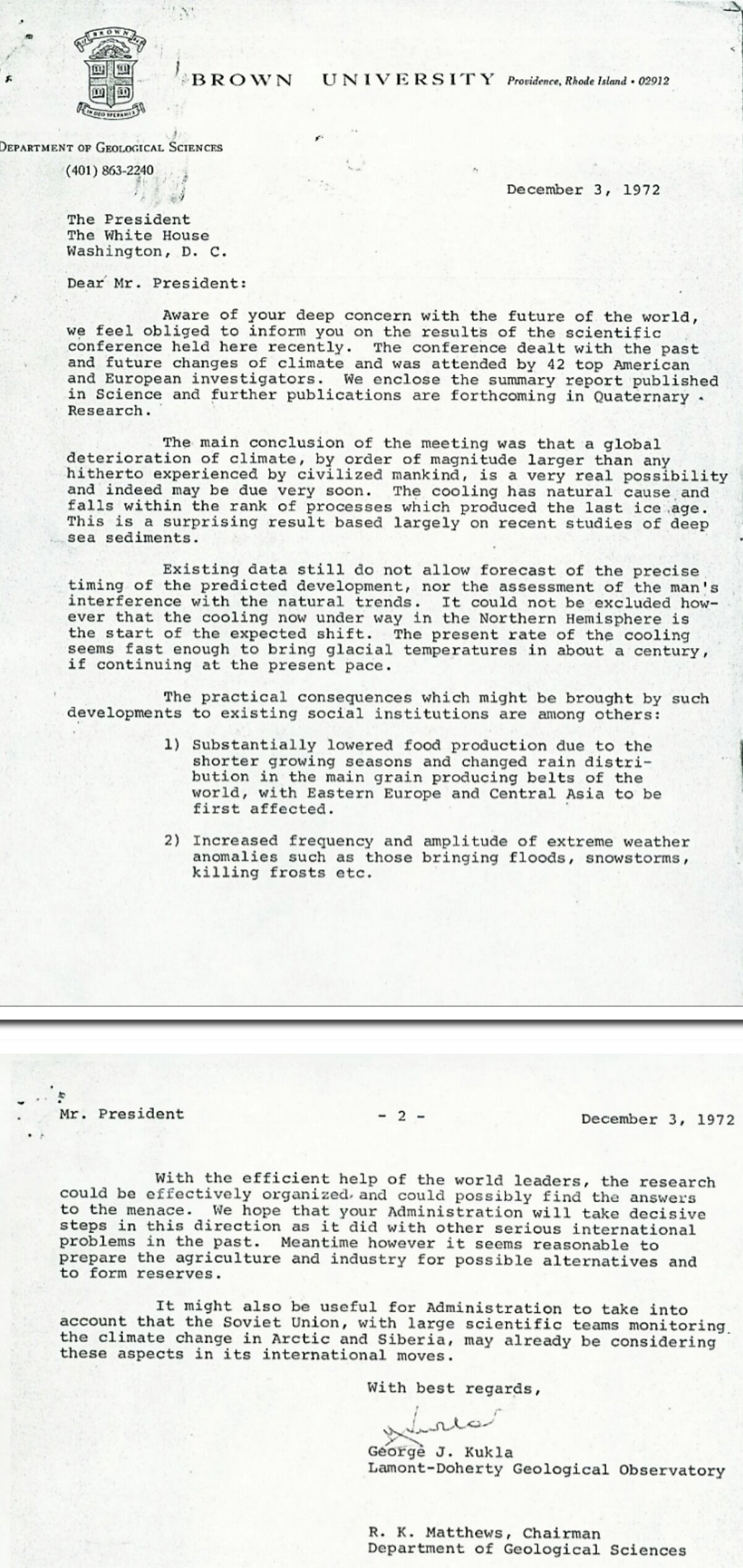
Global Cooling Alert! (1972)
By Robert Bradley Jr. | MasterResource | March 8, 2023
——————–
For various posts at MasterResource on the experts’ global cooling scare, see here.
Silence of the Grid Experts
By Planning Engineer (Russell Schussler) – Climate Etc. – May 3, 2023
There are many reasons why grid experts within the electric utility industry have not spoken out when unrealistic “green” goals were being developed and promoted over the last 20 years or so. A more open debate during this period might have helped provide a more realistic foundation for future development. This posting describes some reasons as to why at the corporate level electric utilities did not speak out more in defense of grid reliability. Collectively these factors tended to eliminate grid experts from playing any role in the development of policies impacting the grid.
Speaking Out Risked Negative Consequences
Utilities have many stakeholders with varying degrees of power. Utilities depend on good relations with Public Service Commissions, other regulators, consumers and policy makers. The stereotype of electric utilities as uncaring, selfish, greedy destroyers of the environment tends to make utilities very cautious and careful in critiquing anything perceived as “green”. The media and press attention from any such statements would likely not be favorable.
Utilities need support to acquire right-of-way, for financing, for cost-recovery and to avoid adverse legislation. Poor press and the associated public disapproval loomed as strong disincentives for speaking out. Furthermore, as will be discussed later, expressing concerns over emerging reliability issues, could be interpreted by some as implying that perhaps you were not as capable as others appear to be.
The Waiting Game: Short-Term versus Long-Term Goals
The short-term consequences of objecting to “green” initiatives impact were swift and near and would be specifically painful to the offending party. The potential benefits of speaking out on reliability would be collective, diffuse and farther into the future. Who as one of hundreds of utilities would want to be the first to speak out? The near-term burden of “green” goals at very low penetration levels was small enough that it might seem prudent to wait for others to speak up.
It can be observed already how these reasons worked together to stifle dissent. Areas with greatest pressures for green initiatives were held back because speaking out would have more severe consequences for them. Areas with lesser pressures were also less likely to be impacted in the near term, so they were less incentivized to speak out. Many hoped that maybe they could ride this out and learn from the mistakes of others. Unfortunately, mistakes and problems don’t seem to be slowing things down.
Utilities Are Not Experts, But Rather a Collection of Experts
There is not a common single body of expertise commonly shared by the many experts that make up an electric utility. Rather than are many experts with differing areas of expertise with demands that can place them at conflict with those operating within other areas of expertise. Effectively managing an electric utility is highly dependent upon balancing the input of many competing “experts”. The goals and priorities of large areas such budgeting, rates, maintenance, operating, environmental, planning, construction, compliance, marketing, R&D, legal, strategic planning. as well as sub areas within these, will often be in conflict as to the actions a utility should take. Leaders have to weigh the inputs from these areas to provide direction and make decisions.
Competing Experts and Goals
Healthy competition is good and necessary. The goals of maintenance are worthwhile, but sometimes in order to best utilize our resources and address other concerns, utilities might need to temporarily depart from what the maintenance experts advocate. The experts in projects tell us how long it should take to complete a project. But in emergencies, other experts might insist that this project must be completed in a much shorter time frame to allow for an upcoming summer peak. Transmission planning and distribution planning experts within the utility might favor different solutions for correcting an area problem: do you beef up the area distribution or do you add more support from the transmission system? With conflicts of this sort, sometimes you find a compromise, but in others one set of experts must give in.
There are many incentives for increasing wind and solar generation (if it works). For some areas of expertise, wind and solar integration pose no special problems. Experts and executives from these areas often were wind and solar boosters. Similarly to academics as described in a previous post, some utility experts argued that (some) problems with wind and solar could be solved, and it was often mistakenly interpreted to mean all problems could be solved.
During my career I would manage several different areas that at times would be in conflict. I would tell my key people, “You are the experts here. You must be a strong advocate for your area of responsibilities. Sometimes I and others in upper management will have to place other concerns over yours. You will need to be a team player and accept the situation. That doesn’t mean you should be any less of an advocate for these concerns in future situations.” Good management balances the inputs of different experts. Utilities found that near term imperatives were in conflict with more distant reliability concerns. Unfortunately, it was almost exclusively the case that emerging reliability concerns were judged as something better addressed later.
Margin, Experts, and Who Are You Going to Believe?
In advocating for their specific areas of concerns, often experts will build in a little margin. I’ll use the example of budgeting here. Although it took me while to get on board, many people are probably familiar with how that process works. Initially when I would hear of dire budget woes, I would heed the call and cut things as close to the bone as I could. Those of you who are not as naïve as I once was, know that the next step is to squeeze even more out of EVERYONE. At that point it didn’t matter what you had given up in step 1, more was needed and everyone must contribute. My nature was to be a team player and head the original call, but after getting burned a few times, I learned that I must play the margin game.
Competing experts should be “expected” to build in margin within their various areas of expertise. The projects area may pad their schedules with some extra time to give themselves some flexibility. Maintenance might aggressively schedule maintenance and replacement so that they are ok if hard times later put a cut in their resources. Initial designs of projects may be “Cadillac” level to better survive cost pushbacks which might emerge under review.
In the area of grid reliability, the grid depends on margin. It should survive without a hiccup for once every 50-year events, because hundreds or more of those type events can and will happen in the normal operation of a system. Conflations of equipment outages, extreme weather, and other unanticipated events hit the grid many times during a given year. The consequences can be huge. However, if you push back on reliability for a short time in one area, there’s a good chance you will be fine. Negative consequences will likely be unobservable. But continue to do so and severe consequences will begin to emerge.
The large chorus of outside “experts” saying that wind and solar can be integrated successfully complicated the situation. Executives with other responsibilities see that government, academics, consultants, consumers, policy makers, and experts within parts of the utility industry are all pushing higher levels of wind and solar. Similarly, the industry sponsored research arms did not help much, but rather pushed new technology as well. Perhaps because they saw a “gold mine” in potential “green research projects”. This all lead to confusion around grid capabilities.
Lastly, grid experts were disregarded partly due to their great success in the past. The fact that modern power systems have a high degree of margin makes it harder to argue that the system is not sufficiently robust to allow for high penetration levels of wind and solar. The ability of grid engineers to meet emerging challenges to-date have led many to believe they could continue to do so, no matter what might be thrown at them.
Specialization and Silos
In addition to problems of breadth of expertise, problems around specialization also confound attempts at expert consensus. Understanding the full extent of emerging grid reliability problems requires an understanding of generation planning, transmission planning and systems operations. Intermittent, asynchronous wind and solar energy sources impact generation planning, transmission planning and system operators. These three areas have differing expertise and experts within these areas that are not always well informed of the concerns of the others. Generation planners are concerned with providing generation 24 hours a day 367 days a year far into the future. They assume transmission planners will take care of delivery problems. Generation modelling is focused on energy production and they look at megawatt-hours. Transmission Planners are worried about the transmission system during peak times of stress. They make efforts to understand the implications of potential generation, but intermittent sources make that challenging. Their focus is based on demand levels so they look at megawatts. System Operators worry about issues of generation and transmission but they operate day to day and in the near term. Their focus is on dealing with the system as it is, not determining what it might be or handle scenarios in the far future. Further within these areas, there are specialists who go deep and do not well understand the problems within their own broader area.
Within critical areas around grid reliability, there are various specialist who may not see the big picture. For example, those who model the transmission system who may see problems now, may be optimistic or agnostic as to how future versions of wind and solar may work to better support the system. Those who work more directly with wind and solar and know their inherent capabilities probably don’t fully understand their impact on the transmission system. It takes an understanding of both areas to see the emerging problems that are confronting the system.
Hope and the Benefit of the Doubt
Despite what you may have heard, most engineers want to be environmentally responsible. Instead of being opposed to new technology, most of us have sought to support potential “green” applications that had at least small hopes of promise. I was never aware of anyone stacking the deck against “green” options, but the reverse frequently occurred. It’s evident that conventional generation options are productive many years longer than competing solar or wind options, but most comparative analyses assumed 30 year lives for all alternatives including Green ones. I don’t know of any significant objections to wind and solar leaning on the system a little for support, or raising costs a little. The concerns only came when the impacts are particularly egregious or approaching unsustainability.
The support for “Green” options extended to optimistic assumptions about future development, performance and capabilities of those resources. Often instead of focusing on what might be probable in the future, utilities hoped for what might be possible. Many have hoped that maybe wind and solar coupled with batteries and a lot of technological development will allow asynchronous intermittent wind and solar to replace higher levels of conventional synchronous generation. Such hopes have for many clouded the clear evidence that increasing levels of wind and solar presented reliability threats.
FERC and NERC’s Impacts
In the U.S., the Federal Energy Regulatory Commission (FERC) and the reliability oversight organization (NERC) that they empowered, have served to inhibit the industry from voicing reliability concerns. FERC’s open access policy and the resultant standards of conduct in 1996 have segregated the functions of generation planning and transmission planning. FERC’s goal was to prevent generation providers, who owned transmission as well, from having any competitive advantage over other generation providers. Previously, managers and VPs might have responsibility for both groups (as I did at one point), but FERC required that those functions be separated and it was important that information not be shared between them. FERC effectively shut down reliability discussions between in-house generation experts and transmission experts. Coordinating a reliable grid was well served by interplay, dialogue and coordination between those planning and managing generation and transmission. Understanding emerging problems similarly is best served by having experts with a sound grounding in both generation and transmission.
NERC and the regional reliability entities initially were formed and controlled by the utilities to coordinate reliability efforts amongst the participants. In 2006 FERC established NERC as the national reliability organization with enforcement powers. Making NERC the master over utilities versus their servant has had various consequences. Beginning in 2007, NERC and the regional entities could impose large fines for violating NERCs’ reliability criteria. Before that time, utilities would share any problems that they were seeing at reliability meetings, as well as emerging concerns in an open and frank manner. Despite utilities differences in some areas there was a strong joint commitment to reliability and all felt it was best to learn from each other’s mistakes. But when the regulators had the ability to impose fines of a million dollars a day, it no longer made sense to share reliability concerns. Publicly expressing reliability concerns might predispose NERC to lean towards findings of noncompliance should problems emerge.
Perhaps the greatest impact came in the shift of responsibilities. Utilities used to have responsibility for ensuring reliability. They had skin in the game. They had a number of tools including generation and transmission options to better ensure reliability. But regulation by FERC through NERC, took the reliability function away from utilities. Utilities are no longer responsible for ensuring reliability. They are responsible for compliance with reliability standards. That was a profound and consequential change. Utilities are no longer developing reliability experts; they are developing experts in standards compliance. When outages occur, it’s hard to figure out where blame lies now. Will there ever again be grid experts who have skin in the game again?
Summary and Conclusions
There were a lot of utility experts with grid concerns. You might ask, “Why didn’t more people speak up?” But maybe the better question is, “Why would anyone speak up?” A lot of people could have said the type things I started saying about a decade ago, but they had no incentives to speak out and there were few influential people who cared to listen. In summary:
- There were few to no near-term incentives for individual utility experts or for utilities corporately to speak up as regard planned threats to reliability
- There were significant near-term disincentives for speaking up
- Limited to no platforms for voicing concerns
- Waiting and hoping for others to speak up seemed a prudent path for many
- Competing “experts” and diverse areas of specialization confused understandings of risk
- Past success of grid experts made it harder to take future reliability threats seriously
- Strong widely present desires support “clean” wind and solar
- Federal Actions served to quiet dissenting voices and eventual remove dissenting experts
The days of utility-based grid experts who’ve had skin in the game are over. Utility experts are charged with complying with reliability standards rather than maintaining reliability. Where utilities once had a variety of tools at their disposal to better foresee and forestall reliability problems, utilities now follow compliance standards and hope for the best.
World Economic Forum-Affiliated Pro-Censorship Group Is Hit With House Panel Subpoena
By Dan Frieth | Reclaim The Net | May 7, 2023
The House Judiciary Committee has issued subpoenas to executives at a group often affiliated with the World Economic Forum (WEF).
Chair of the committee, Rep. Jim Jordan said the Global Alliance for Responsible Media (GARM) and the organization that created it, the World Federation of Advertisers (WFA), might be allowing the violation of US antitrust law.
“To advance our oversight and inform potential legislation related to these collusive practices, the Committee must understand whether, how, and to what extent GARM and WFA facilitate collusion to prevent certain content from benefiting from advertising dollars and to reduce that content’s presence online,” Jordan wrote.
According to the letters, the House Judiciary Committee has attempted to get communications and documents “related to how GARM and WFA act to demonetize and eliminate disfavored content online, in addition to other information” since March.
However, both the WFA and GARM did not provide the documents requested.
The subpoenas addressed to GARM’s co-founder Robert Rakowitz and WFA president Raja Rajamannar, demand communications and documents from January 2019 to date. The organizations have until May 26 to respond.
Read the letter here.
Featured Video

Armando Mema: Finland Used as New Frontline Against Russia
or go to
Aletho News Archives – Video-Images
New Documentary
Hospital Horror
Documented in the film,“Bad Medicine”

Blog Roll
 Aletho News
- Araghchi: Failure to punish aggressors against Iran endangers all nations
- Iran tells UN Security Council to stop reversing roles of ‘aggressor and victim’
- Disgraced neocons Feith & Libby: stop whining about ‘endless war’
- CENTCOM rejects Israeli claims of preparations for new Iran attacks
- Your Shopping Bag Runs Through Hormuz
- Armando Mema: Finland Used as New Frontline Against Russia
- Gestapo 2.0? Germany grants spy agencies sweeping new powers
- Franco-Palestinian group seeks court ban on Israeli real estate fair in Paris
- How British foreign policy is frozen in the ruins of empire
- EU risks investor exodus over Russian assets – Euroclear chief
- If Americans Knew
- Aid organizations in Gaza are pulling back, leaving hundreds of thousands of Palestinians without food
- 1.4 Million People in Gaza Live in Tents. Winter Storms Can Be a Death Sentence.
- Israel Used a U.S.-Made Missile to Kill Six at Gaza’s Nasser Hospital
- Congress Might Sneakily Use Lame Duck to Deeply Intertwine the U.S. and Israeli Militaries
- DAILY UPDATE: Latest essential news on Palestine, Israel, & region
- 9-month-old baby dies from severe cold in Gaza, 1st cold-related death this winter: Health Ministry
- Israel Kills over 12, Injures Many Across Gaza
- ‘Every drawer was opened’: Palestinians report looting amid Israel’s Hebron siege
- Scoop: Israeli spy chief in D.C. as Netanyahu presses Trump to resume war
- Israel Issued More than 24,000 ‘Administrative Detention’ Orders in Three Years
- No Tricks Zone
- New Study: Barents Sea Temperatures Were Warmer And Sea Ice Less Extensive In The 1700s Than Today
- German Authorities Start Initiative To Evaluate Public Register For Climate “Disinformation” Spreaders!
- Zonal Asymmetry of Temperature Change in the Antarctic Circumpolar Current
- New Study: The Net Fossil Fuel Contribution To Rising Atmospheric CO2 Has Been Zero For 500 Years
- Germany’s Green Energy Transition Becoming Increasingly Expensive…Another 6 Trillion Euros!
- Sudden Stratospheric Warming, Powerful El Niño Combination May Lead To Extreme Europe Cold, Energy Crisis!
- Two New Studies Find Thwaites Glacier Melt Cannot Be Driven By Human Activity Or A Warming Ocean
- E-Cars Reduce CO2 Emissions By Only 41% Compared To Internal Combustion Engine Vehicles
- Predictions Made By Renowned Climate Professor Over Past Decades Have Been Proven To Be Poor
- New Study Suggests Large Regions Of The Pacific Ocean Have Been Cooling For The Last 80 Years

