US, South Korea vow to expand war games amid tensions in Korean Peninsula
Press TV – January 31, 2023
United States and South Korea have pledged to expand the level and scale of their joint military exercises and boost nuclear deterrence planning amid a major uptick in tensions with North Korea.
Pentagon chief Lloyd Austin met with South Korean Defense Minister Lee Jong-sup on Tuesday in Seoul, more than two months after their annual talks in November last year in Washington.
He is also scheduled to hold talks with South Korean President Yoon Suk-yeol during his stay in Seoul before flying to the Philippines.
In a joint statement, the two officials said they had agreed to boost information sharing and joint planning between the two sides.
They also committed to boosting the “level and scale” of combined military exercises this year and to deploying more US aircraft carriers and bombers.
North Korea has repeatedly denounced the joint drills between Washington and Seoul as proof of their hostile intentions.
The Pentagon chief said the trip aimed at deepening cooperation with the key Asian ally and reaffirming the US extended deterrence commitment to South Korea as “ironclad” at a time of heightened tensions.
“That’s why the United States and the ROK (Republic of Korea) are taking clear, meaningful steps to modernize and strengthen our alliance,” Austin was quoted as saying by the South’s state-run Yonhap news agency.
“So our adversaries and competitors know that if they challenge one of us, they are challenging the US-ROK alliance as a whole,” he added.
Lee has said the two countries will hold a table-top nuclear drill in February under the theme of North Korea’s nuclear strikes, while Austin said the drills are in line with their talks to expand activities and extended deterrence mechanisms on the peninsula and in the region.
Military tensions on the Korean Peninsula have risen sharply this year. The US has resumed massive land, naval, and aerial war games with South Korean and Japanese forces in the region while vowing to consider all available options to counter what they deem a threat posed by North Korea.
North Korea considers the US military drills with South Korea and Japan “provocative measures” that are designed to practice an invasion.
The country is reeling under harsh sanctions by the US and UN Security Council over its nuclear and ballistic missile programs, which have not prevented it from developing its military capabilities as a deterrent against hostile West-led moves.
North Korea maintains that it will not tolerate persisting US-led war games in the region, underlining that it will continue responding to joint military maneuvers of its adversaries by holding its own drills as well as developing all sorts of weaponry, including long-range missiles.
What is covered by the “pictures of the Russian train”?
By Konstantin Asmolov – New Eastern Outlook – 31.01.2023
We recently wrote about the ways the United States’ allegations of North Korean munitions shipments to Russia had created a new standard of proof. However, it appears that the US side is not content with having hit rock bottom once again.
On January 20, 2023 National Security Council Strategic Communications Coordinator John Kirby raised new allegations against the Wagner PMC and Russia, claiming that the US had presented its intelligence findings to the relevant expert group of the UN Security Council (Committee 1718, which is in charge of sanctions against the DPRK). Although this was the first time ever any “evidence” had been presented, it was unfortunately a very peculiar type of proof.
The world was shown “rare, declassified photographs of Russian rail cars traveling between Russia and North Korea in November” and what Kirby described as the original delivery of North Korean weapons to the Russian PMC. According to the US statement, the photos were of a five-car train that ran between the Khasan (Russian Federation) and Tumangan stations on November 18 and 19, 2022, and those cars contained ammunition for Wagner.
“We obviously condemn North Korea’s actions and call on North Korea to immediately stop these shipments to Wagner,” Kirby said at the start of the daily White House press briefing. He then stated that “while we estimate that the amount of material delivered to Wagner has not changed the dynamics of the fight in Ukraine, we anticipate that it will continue to receive North Korean weapons systems” and therefore “will not preclude imposing additional sanctions if deemed appropriate at the UN”. As an aside, it was noted that North Korea continues to circumvent sanctions with the help of Russia and China.
On January 23, State Department spokesman Ned Price also stated that the United States and South Korea regularly discuss how to counter threats from North Korea, including “the supply of weapons and other military equipment from North Korea to Wagner units for use in Ukraine”.
Not coincidentally, not only Russian but also Western experts who deal with North Korea professionally have noted this reference with some surprise. Even those who dislike the North reacted in the style of “maybe the US has other evidence that has not been shown to us, but this is just a hint.”
Asked by RIA Novosti if it could be said with certainty that the pictures show weapons being transported from the DPRK to Russia, NK News director Chad O’Carroll said the photos do not show what is called hard evidence that would confirm US claims. The photos DO NOT show weapons or grenades being loaded and only include an image of Russian rail cars in North Korea – which, he adds, Russian media have also written about. That White House officials, according to O’Carroll, “show some level of specificity by releasing satellite images of a certain date showing rail cars and cargo” only means that Washington is very confident in its intelligence, but “anyone would be happy to see more detailed evidence”.
Another US expert noted that the pictures provided by Kirby show covered rail cars in which containers of ammunition would not fit, especially since they are loaded on platforms and not in boxcars. He also pointed out that “the versions voiced by Washington keep changing. In September, they claimed that North Korea was supplying Russia with millions of artillery shells and missiles. They claimed Pyongyang was trying to make it appear that the supplies were going to the Middle East and Africa, but in fact they were going to Russia. Now that version is forgotten – there is a new one. Meanwhile, one million shells is 50,000 tons, which is several large ships.”
The claim that the data were sent to the committee that investigated the sanctions is also not identical to the fact that the experts who examined them agreed with the American version.
In this context, the author will try to explain to the audience what more reasonable evidence of this kind would look like, using pictures of the train: Here is a picture of what looks like a military factory, and of containers of ammunition being loaded into wagons; here is a traceable route (because it is not particularly difficult to trace their path through the consignor system) by which a train from North Korea went directly into the front line area where it was unloaded, whereupon the shell shortage ended in that section of the front line. Such things can still be used as evidence, although indeed some questions remain.
The second thing that came to the author’s mind was a quote from a Russian cartoon, “This picture is useful: it covers a hole in the wall,” and he draws attention to two events that paralleled Kirby’s statement.
The first event is that on January 19, 2023, the day before Kirby’s statement, the Pentagon asked United States Forces Korea (USFK) to provide some of its equipment in support of Ukraine, stressing that its security operations on the Korean Peninsula would not be “affected in any way” by this move. USFK spokesman Col. Isaac Taylor said, “The Department of Defense continues to provide military assistance from its reserves in support of Ukraine. US forces in Korea have been asked to support this effort by providing some of their equipment… This does not affect our operations or our ability to fulfill our ironclad commitment to protect our ally, the Republic of Korea. There should be no doubt that we are ready to fight tonight as well”.
Taylor did not specify, however, what equipment, or in what quantity, would be delivered for use in Ukraine. The ROK Department of Defense also declined to comment on the issue.
The New York Times had previously reported that the US Department of Defense had drawn on US artillery stockpiles in South Korea and Israel because of Ukraine’s urgent need for munitions assistance.
USDOD deputy spokeswoman Sabrina Singh clarified this information, pointing out that the withdrawal of munitions and military equipment from US depots in South Korea and other countries in support of Ukraine had no impact on US defense capabilities and had little to do with reducing domestic stockpiles. It has also come to light that the US is in talks with Korean military contractors to replenish empty depots.
To the author, this information indicates two important things.
First, despite the loud declarations about the danger of the North Korean threat and the need to give money to counter it, it appears that the US does not in fact particularly believe that the North will attack the South in the relatively near future. Otherwise, they would not have moved an arsenal to Ukraine from a place where these munitions could be urgently needed.
Second, the fact that ammunition is being sent from Korea means that the arsenal of democracy is not bottomless and is slowly running out. Weapons and ammunition even need to be withdrawn from long-term storage. As we noted in one of our articles, it appears that their talk of Moscow’s “ammunition shortage” is masking their own ammunition scarcity, which is not so much affecting Russia as it is Ukraine and its allies.
Combined with a number of other news items, this suggests that the Europeans are growing weary of the conflict and increasingly reluctant to hand over new arms tranches to Kiev. This is a rather important sign, suggesting that in a certain situation Kiev will come to understand that for all the need to “defend democracy,” it has to do it alone.
The second event is a statement by Russian Foreign Intelligence that Ukrainian authorities are placing munitions from the West in nuclear power plants because they know that Moscow will not dare to bomb them. Foreign Intelligence Director Sergei Naryshkin said, “The Foreign Intelligence Service receives reliable information that Ukrainian forces are storing weapons and ammunition supplied by the West on the premises of nuclear power plants. This applies to the most expensive and scarce missiles for Haymar’s multiple rocket launchers and foreign air defense systems, as well as large-caliber artillery ammunition the AFU lacks most. Just in the last week of December 2022, several railroad cars with lethal cargo were delivered from abroad to the Rovno NPP via the Rafalovka station.”
Naryshkin’s statement does not contain exhaustive evidence, but the reasoning is somewhat more detailed than Kirby’s and contains some specifics. Apparently, it is precise data on where and how Ukrainian ammunition stocks move.
Mykhailo Podolyak, advisor to the head of the Ukrainian Presidential Office, then stated on social networks that “Ukraine has never stored weapons on the territory of the nuclear power plant” and noted that Ukraine is “always open” to inspection bodies, especially the IAEA.
In this context, the author once again reminds us that it is not unusual in war to attribute to the enemy acts committed by one’s own side in order to divert attention from oneself. So if you want to make the next lofty claims of DPRK intrigue, look at the holes in the wall this picture covers.
Konstantin Asmolov, PhD in History, is a leading research fellow at the Center for Korean Studies of the Institute of China and Modern Asia, the Russian Academy of Sciences.
American Academy of Pediatrics greenlights dangerous drugs & aggressive surgeries for obese kids
The Highwire with Del Bigtree | January 26, 2023
Sound science and balanced solutions or revolving door industry influence ripe with conflicts of interest? The HighWire investigates.
The Censorship of Mercola — A Timeline
By Dr. Joseph Mercola | January 30, 2023
While the drug and chemical industries have attacked and tried to discredit me for years, blatant censorship didn’t begin until 2020, after the outbreak of the COVID pandemic.
For legal and historical purposes, I am sharing a timeline of events with you that document a chain of coordinated events and attacks against me and this website. My first article about the pandemic came out February 4, 2020, in which I predicted that it was a grossly exaggerated threat that would enrich pandemic vaccine makers.
March 8, 2020, I published an interview with bioweapons expert Francis Boyle, Ph.D., in which he warned that SARS-CoV-2 had all the hallmarks of a genetically engineered bioweapon. Boyle was among the first, if not the first, to suspect the outbreak was the result of a lab leak.
While every health authority on the planet insisted there was no treatment, and that patients simply go to the hospital to be placed on mechanical ventilation and die, I interviewed medical experts working on early treatment options and published articles detailing the potential benefits of vitamin D, zinc, quercetin and other nutraceuticals that boost immune function, as well as decades-old drugs like hydroxychloroquine.
I also published the testimony of whistleblowers such as Erin Marie Olszewski, a frontline nurse, who warned that patients were being intentionally killed on ventilators as it quickly proved to be a deadly intervention for COVID-19.
Summer of 2020 — The Suppression of Vitamin D Begins
Early on, it became apparent that vitamin D levels and spending time outdoors played an important role in the risk of infection and the ultimate outcomes. This has been true for all respiratory infections, so it should come as no surprise it is also true for coronavirus infections. Despite that, health authorities insisted vitamin D was useless.
The only way out of the pandemic, they said, would be a vaccine — and this despite the fact that no previous attempts at creating a safe and effective coronavirus vaccine had ever succeeded because of its rapid ability to mutate.
In June 2020, I launched an information campaign, StopCovidCold, about vitamin D. I released a downloadable scientific report detailing how and why optimizing vitamin D levels among the general population could minimize the impact of the next wave of COVID. Optimizing vitamin D is a rational, safe and inexpensive measure that no sane health official would object to. And yet, they all did.
July 21, 2020, the Center for Science in the Public Interest (CSPI) issued a press release1 calling on the U.S. Food and Drug Administration and the Federal Trade Commission (FTC) “to bring enforcement proceedings against Mercola and his companies for their unlawful disease claims that falsely and misleadingly claim to treat, cure or prevent COVID-19 infections.”
CSPI accused me of falsely claiming “that at least 22 vitamins, supplements and other products available for sale on his web site can prevent, treat, or cure COVID-19 infection.” This despite the fact that their Appendix of Illegal Claims2 clearly show I made no COVID-19-related claims to any specific products and only referenced published studies and mainstream media articles to support my opinions.
In an August 12, 2020, email, CSPI president Dr. Peter Lurie — a former FDA associate commissioner — also made the spurious claim that I was “profiting from the pandemic” through “anti-vaccine fearmongering:” 3
“Mercola brazenly has claimed that many of his products are coronavirus treatments or cures, including vitamin C, vitamin D, zinc, selenium, ‘molecular hydrogen,’ licorice, and other substances.
Besides profiting from the pandemic, Mercola has seemingly advised people to contract COVID-19 after taking supposedly ‘immunity boosting’ supplements (which of course he sells). Making matters worse, Mercola is a leading proponent of anti-vaccine conspiracy theories — and has been fearmongering against prospective COVID-19 vaccines even before such vaccines are available!”
By mid-August, a comprehensive campaign to put an end to Mercola.com had been launched, with Laurie asking CSPI members to flood the FDA and FTC with prewritten Tweets, urging them to take action against us. He also urged “state attorneys general to investigate how they may further protect consumers from Mercola’s illegal marketing.”4
Not surprisingly, CSPI is funded by the Rockefeller Foundation, the Rockefeller Family Fund, Bloomberg Philanthropies and other billionaire-owned foundations. It’s also partnered with Bill Gates’ agrichemical PR group, the Cornell Alliance for Science. Greg Jaffe, who heads up CSPI’s Biotechnology Project, is also the associate director of legal affairs at Alliance for Science.
Winter of 2020 — Vitamin D Attacks Heat Up
The attacks against me really heated up though after I published a peer-reviewed scientific paper5 on the benefits of vitamin D at the end of October 2020. With that, I established my medical and scientific merit and my right to a professional opinion, which is something the U.S. Constitution absolutely provides for.
The paper, “Evidence Regarding Vitamin D and Risk of COVID-19 and Its Severity,” published in the journal Nutrients, was coauthored by William Grant, Ph.D., and Dr. Carol Wagner, both of whom are part of the GrassrootsHealth expert vitamin D panel.
As noted in that paper, dark skin color, increased age, pre-existing chronic conditions and vitamin D deficiency are all features of severe COVID disease, and of these, vitamin D deficiency is the only factor that is modifiable. As such, it would be foolish to ignore, especially since vitamin D supplements are readily available and low cost.
Christmas Eve 2020, attorney general Letitia James sent us a cease and desist notice, demanding we stop sharing information about how immune-boosting nutritional supplements might lower your risk of COVID, including vitamin D, zinc, NAC and vitamin C.
February 2021, FDA Tries to Silence Protected Speech
After the new presidential administration took over, on February 18, 2021, the Rockefeller-funded CSPI and AG James got their wish, as the FDA sent us a warning letter for “Unapproved and Misbranded Products Related to Coronavirus Disease 2019.”6 Laurie even publicly bragged7 about his ability to influence the FDA to take action against us.
The FDA’s letter highlighted statements in articles on my website that were fully referenced and supported by published science, and none of the articles cited had any commercial advertising linking the information to my products, as per the law. We had done nothing illegal or irregular in that regard, and my professional opinions are protected under the U.S. Constitution.
Needless to say, we fully addressed both James’ cease and desist notice and the FDA’s warning letter, putting them both on notice that they cannot censor protected speech simply because they don’t like what’s being said.
On a side note, William Correll, the director of the Office of Compliance at the FDA who signed the warning letter, sadly “passed away suddenly” just two months later, on April 18 “after a short battle with COVID-19.”8
Gates-Funded Front Group Gets on the Bandwagon
The agrochemical front group Cornell Alliance for Science (CAS),9 the primary funding for which comes from the Bill & Melinda Gates Foundation,10 also jumped on the bandwagon, falsely stating11 that “pages advertising vitamin C and quercetin as having ‘synergistic effects that make them useful in the prevention and early at-home treatment of COVID-19′” were still available on my website nearly a month after the FDA’s warning letter.
To be clear, we had fully referenced scientific news articles. News articles are NOT “advertising,” as they do not link to any specific products, nor do they refer to or recommend any specific brands. In the case of the warning for vitamin C, the article discussed hospitals utilizing IV vitamin C for the treatment of COVID-19 and sepsis.
Such coordinated attacks are to be expected, though, considering Gates’ influence over the operation, and seeing how CAS and CSPI work closely together — a fact CAS admitted in its hit piece.12
March 2021, Booksellers Urged to Ban My Book
Around that same time (February 11, 2021), my book “The Truth About COVID-19” also went up for presale, and by early March, booksellers in the U.S., U.K. and Australia were being pressured not to sell it, or to add some sort of misinformation warning label to it. As reported by Sky News March 5, 2021:13
“In the UK, more than 20 million vaccine doses have been administered as part of efforts to defeat COVID-19, but worries continue that misinformation is stopping some people from having the jab. Shadow health minister Alex Norris told Sky News:
‘Getting our population vaccinated is a massive priority and it is very sad to see these things so freely available. We would hope that retailers would act responsibly and have a look at whether they want to be associated with such products and whether they want to be seen to be profiting off such products.'”
Shady ‘Anti-Hate’ Outfit Publishes Hit List
March 3, 2021, the Center for Countering Digital Hate (CCDH) — a shady U.K.-based organization with anonymous funding led by Imran Ahmed — also got in on the action, publishing a hit list14 of the “Top 10 anti-vaxxers” it wanted permanently silenced and eradicated from public forums. The list showed, by way of crossing out names, which had already been successfully deplatformed, and from which social media.
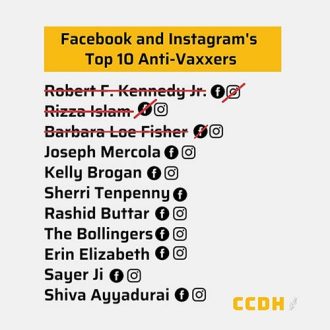
While precious little was (and still is) know about the CCDH, some digging revealed Ahmed had been appointed to the steering committee of the U.K. government’s Commission on Countering Extremism Pilot Task Force in April 2020, just as fearmongering about the COVID-19 pandemic was ramping up. The CCDH is also linked to a number of technocratic centers within the globalist network through its board members.15
More Fabrications and Lies From the CCDH
A couple of weeks later (March 15), Ahmed somehow managed to get an article titled “Dismantling the Anti-Vaxx Industry”16 published in the journal Nature Medicine. In it, Ahmed lied, claiming he’d “recorded a private, three-day meeting of the world’s most prominent anti-vaxxers,” when in fact it was a public, international conference given online, attended by thousands around the world, all of whom had access to the recordings.
He could have done the normal, ethical and truly journalistic thing and admitted he simply attended a public virtual conference, but instead he twisted it into some risky undercover agent mission where he secretly recorded private discussions that revealed the inner workings of “the opposition.”
Then, March 21, 2021, the CCDH published the fabricated “Disinformation Dozen” report,17,18,19 in which Ahmed falsely claimed 12 people and/or organizations, including yours truly, were responsible for 65% of all anti-vaccine content on social media.
March 24, 2021 — AGs Try to Censor Protected Speech
March 24, 2021, 12 attorneys general sent a letter20 to the CEOs of Twitter and Facebook, seeking their “cooperation in curtailing the dissemination” of COVID jab “misinformation” — all based on the fabrications of the CCDH. According to the AGs:
“The people and groups spreading falsehoods and misleading Americans about the safety of coronavirus vaccines are threatening the health of our communities, slowing progress in getting our residents protected from the virus, and undermining economic recovery in our states.
As safe and effective vaccines become available, the end of this pandemic is in sight. This end, however, depends on the widespread acceptance of these vaccines as safe and effective. Unfortunately, misinformation disseminated via your platforms has increased vaccine hesitancy …
According to a recent report by the Center for Countering Digital Hate, so-called ‘anti-vaxxer’ accounts on Facebook, YouTube, Instagram and Twitter reach more than 59 million followers … Given ‘anti-vaxxers’ reliance on your platforms, you are uniquely positioned to prevent the spread of misinformation about coronavirus vaccines …”
Facebook Set the Record Straight
August 18, 2021, after conducting an internal investigation, Monika Bickert, vice president of Facebook content policy, publicly called out the falsehoods in “The Disinformation Dozen” report, stating:21
“In recent weeks, there has been a debate about whether the global problem of COVID-19 vaccine misinformation can be solved simply by removing 12 people from social media platforms. People who have advanced this narrative contend that these 12 people are responsible for 73% of online vaccine misinformation on Facebook.
There isn’t any evidence to support this claim … In fact, these 12 people are responsible for about just 0.05% of all views of vaccine-related content on Facebook. This includes all vaccine-related posts they’ve shared, whether true or false, as well as URLs associated with these people.”
Bickert highlighted the fact that Ahmed had preselected the 12 individuals listed in the report, and that his “faulty narrative” was based on nothing more than “a narrow set of 483 pieces of content over six weeks from only 30 groups, some of which are as small as 2,500 users.”
“Further, there is no explanation for how the organization behind the report identified the content they describe as ‘anti-vax’ or how they chose the 30 groups they included in their analysis,” Bickert noted. “There is no justification for their claim that their data constitute a ‘representative sample’ of the content shared across our apps.”
Apparently, no one in government was smart enough to see the flaws in the CCDH’s report though, and a long list of officials cited the CCDH’s fabricated claims throughout the remainder of 2021, even long after Facebook denounced its claims. What’s more, even though Facebook admitted the CCDH’s claims were bogus, they still took action against accounts by applying penalties and/or bans.
April 8, 2021 — AGs Call on Social Media to Ban ‘the 12’
April 8, 2021, attorneys general James and William Tong published an op-ed in The Washington Post,22 again calling on social media companies to ban the “disinformation dozen” identified by the CCDH. The lack of acceptance of novel gene therapy technology, they claimed, was all because a small group of individuals with a social media presence — myself included — were successfully misleading the public with lies about nonexistent vaccine risks.
April 27, 2021 — Dr. Hotez Calls for Cyberwarfare
April 27, 2021, Dr. Peter Hotez, president of the Sabin Vaccine Institute23 — which has received tens of millions of dollars from the Bill & Melinda Gates Foundation,24,25 — escalated the threat even further in an article published in the journal Nature.
Citing the CCDH’s findings, Hotez called for cyberwarfare experts to be enlisted in the war against vaccine safety advocates and people who are “vaccine hesitant.” He wrote:26
“Accurate, targeted counter-messaging from the global health community is important but insufficient, as is public pressure on social-media companies. The United Nations and the highest levels of government must … move to dismantle anti-vaccine groups in the United States.
Efforts must expand into the realm of cyber security, law enforcement, public education and international relations. A high-level inter-agency task force reporting to the UN secretary-general could assess the full impact of anti-vaccine aggression, and propose tough, balanced measures.
The task force should include experts who have tackled complex global threats such as terrorism, cyber attacks and nuclear armament, because anti-science is now approaching similar levels of peril. It is becoming increasingly clear that advancing immunization requires a counteroffensive.”
In short, Hotez called for the use of warfare tactics on law abiding American citizens, and the Nature journal actually published this blatant threat. One day later, April 28, the CCDH published a second report, “Disinformation Dozen: The Sequel,”27 which focused on Big Tech’s failure to get rid of us “despite bipartisan calls from Congress.”
To understand the massive reach the CCDH gained, despite no one having heard of them before COVID, consider this: By the end of August 2021, there were 84,700 Google search results for CCDH’s defamatory phrase “disinformation dozen,” including 16,000 news stories in the international press, nearly all of which parroted the CCDH’s defamatory statements verbatim and reported them as fact.
May 2021 — Financial Warfare Led to Removal of COVID Articles
Shortly after the op-ed by AGs James and Tong appeared, our business bank accounts were abruptly shut down and our credit cards canceled. Our business partners also had their PayPal accounts shut down.
This new threat, which I could not defend against in a court of law, led to my May 4 decision to remove all articles related to vitamin D, vitamin C, zinc and COVID-19 from my website.
July 2021 — The White House Publicly Calls for Censorship
In mid-July 2021, the White House stepped in to pressure Facebook to purge “anti-vaxxers” from its platform. Then-press secretary Jen Psaki regurgitated the CCDH’s false claims, saying:28
“There’s about 12 people who are producing 65% of anti-vaccine misinformation on social media platforms. All of them remain active on Facebook, despite some even being banned on other platforms, including ones that Facebook owns.
Facebook needs to move more quickly to remove harmful, violative posts. Posts that would be within their policy for removal often remain up for days, and that’s too long. The information spreads too quickly.”
In another mid-July press conference, President Joe Biden himself demanded social media take action against “the disinformation dozen,” claiming our “misinformation” was “killing people.”29,30 None of these officials ever questioned the authority of the CCDH. Facebook spokesperson Dani Lever responded to the White House’s demands, saying:
“We will not be distracted by accusations which aren’t supported by the facts. The fact is that more than 2 billion people have viewed authoritative information about COVID-19 and vaccines on Facebook, which is more than any other place on the internet … The facts show that Facebook is helping save lives. Period.”
Summer of 2021 — A Parade of Hit Pieces
July 24, 2021, the New York Times named me the No. 1 superspreader of COVID misinformation online.31 According to the NYT itself, this was the most-read article of the year up to that point. Penned by Sheera Frenkel, it was so littered with blatant lies, my attorneys sent her a retraction demand.32
For example, she claimed the FDA has levied multimillion-dollar fines against me. This is a complete fabrication, as I’ve never been fined by the FDA. She also implied that I misrepresented myself as a published author of a paper on vitamin D for COVID-19, stating she was “unable to verify” my claim. This despite being given a direct link to the paper! My paper can also be located on PubMed.gov in seconds by searching my name.
Frenkel boldly claimed that I am the No.1 spreader of misinformation online, but she didn’t even qualify what “misinformation” actually is. Without qualifying what it is you’re looking for, how can you quantify it? She also provided no proof that I in fact had the greatest reach of all the individuals reporting on COVID injections. My name didn’t even show up in the Top 15 in a Crowdtangle search for anti-vax Facebook posts.
Frenkel’s hit piece was followed up by CNN, which August 4 aired a segment show CNN reporter Randi Kaye stalking me across central Florida. And, of course, Kaye’s primary citation for her accusations against me was the CCDH.
August 4, 2021 — Mercola Deletes Articles After 48 Hours
August 4, 2021, I also implemented yet another change on my website. I had already removed all articles relating to COVID-19 and vitamin D. At this point, I deleted over 15,000 articles from the past 20-plus years from my website as the business and personal threats grew out of hand.
After 48 hours, articles were instead migrated over to Substack, where only paid members through a private membership agreement have access to them. This was a painful but necessary workaround, as the paid subscription provides a layer of protection against these threats.
September 7, 2021 — Senator Warren’s Book Burning Campaign
September 7, 2021, U.S. Sen. Elizabeth Warren sent a letter33 to Andy Jassy, chief executive officer of Amazon.com, demanding an “immediate review” of Amazon’s algorithms to weed out books peddling “COVID misinformation.”34,35,36
While she didn’t spell out what laws Amazon might be breaking, she warned Jassy that the company may be held legally responsible for wrongful death and homicide by selling books that “misinform” readers about COVID-19, and she specifically singled out “The Truth About COVID-19” as a prime example of the kinds of books she wanted banned.
Warren again relied on the fabrications of the CCDH, even though Facebook had refuted the CCDH report as baseless three weeks before she sent that letter.
“Dr. Mercola has been described as ‘the most influential spreader of coronavirus misinformation online,'” Warren wrote, adding: “Not only was this book the top result when searching either ‘COVID-19’ or ‘vaccine’ in the categories of ‘All Departments’ and ‘Books’; it was tagged as a ‘Best Seller’ by Amazon and the ‘#1 Best Seller’ in the ‘Political Freedom’ category.
The book perpetuates dangerous conspiracies about COVID-19 and false and misleading information about vaccines. It asserts that vitamin C, vitamin D and quercetin … can prevent COVID-19 infection … And the book contends that vaccines cannot be trusted, when study after study has demonstrated the overwhelming effectiveness and safety of COVID-19 vaccines.
It should come as no surprise that the book is rife with misinformation. One of the authors, Dr. Mercola, is one of the ‘Disinformation Dozen,’ a group responsible for 65% of anti-vaccine content on Facebook and Twitter …”
YouTube Deplatforms Mercola in Breach of Contract
Warren’s attempt at getting Amazon to ban my book was swiftly followed up by YouTube, which deleted my account September 29, 2021, allegedly for violating community guidelines. The problem was, they’d published and implemented those new guidelines that very morning.
While I disagreed with YouTube’s censorship, when its “COVID-19 misinformation” policy was implemented back in April 2021, I carefully avoided posting any content on YouTube that might violate that guideline. At no point had I ever received a violation notice from YouTube.
On the morning of September 29, 2022, at 9 a.m. EDT, The Washington Post published an article titled “YouTube Is Banning Joseph Mercola and a Handful of Other Anti-Vaccine Activists.” According to the WaPo :37
“YouTube is taking down several video channels associated with high-profile anti-vaccine activists including Joseph Mercola … As part of a new set of policies aimed at cutting down on anti-vaccine content on the Google-owned site, YouTube will ban any videos that claim that commonly used vaccines approved by health authorities are ineffective or dangerous.
The company previously blocked videos that made those claims about coronavirus vaccines, but not ones for other vaccines like those for measles or chickenpox.”
In short, as of September 29, 2021, you could no longer post any video discussing or stating that any vaccine is dangerous or ineffective. Six minutes after the publication of that WaPo article, I received an email from YouTube informing me that my entire channel had been deplatformed, having been found in violation of this new policy.
October 2021 — CNN’s Second Hit Piece
October 4, 2021, two months to the day after their first attempted hit piece against my book, “The Truth About COVID-19,” CNN aired a follow-up in which they echoed Warren’s call for Amazon to ban the sale of my book.
Like something straight out of George Orwell’s “1984” newsspeak dictionary, CNN host Anderson Cooper said my book is loaded with “mistruths” about COVID. Yet he failed to present a single piece of evidence to back up that claim.
This is one of the oldest propaganda trick in the book. If you just spew out enough derogatory terms about your opponent, people will forget the fact that you provided zero proof to back up your position.
November 2021 — Mercola Sues Sen. Warren
November 7, 2021, two months after Warren tried to get my best-selling book “The Truth About COVID-19” banned from Amazon, I, my coauthor Ronnie Cummins, my publisher and Robert F. Kennedy Jr., who wrote our foreword, sued Warren,38 both in her official and personal capacities, for violating our First Amendment rights and scaring book sellers into pulling and/or suppressing sales.
As a government official, it is illegal for her violate the U.S. Constitution, and pressuring private businesses to do it for her is not a legal workaround.
February 2022 — NIH Director Blames Mercola For Pandemic Continuation
In February 2022, former National Institutes of Health director Dr. Francis Collins blamed me personally for the government’s inability to bring the COVID pandemic to a close. This despite the fact that I was by then heavily censored just about everywhere. The only people, really, who could see my information were those who subscribed to my newsletter and received it by email.
August 2022 — NYT Airs Hit Piece Documentary
Fast-forward to August 2022, The New York Times published the documentary “Superspreader,” featuring yours truly, on FX and Hulu (both of which are owned by Disney). They clearly went through a lot of trouble, trying to dig up dirt from anyone they could find from my past — some going back 40 years, to my medical school days — who would be able to share some tidbit with which they could discredit me with.
But it seems they came up empty handed: After a year of investigation, they couldn’t come up with anything. Surprisingly, they even showed two people who claimed I’d saved their lives. All the other interviews were with people who don’t actually know me. One was with a Chicago journalist who interviewed me once — 13 years ago. Two classmates from med school, whom I haven’t seen in over 40 years, also described their impressions.
Ironically, yet again, just one week before the “Superspreader” program aired, the U.S. Centers for Disease Control and Prevention reversed all of its COVID-19 guidelines, thereby proving my position on COVID was correct all along. Of course, this was never mentioned in their program though.
September 23, 2022 — Mercola Website Taken Down in Cyberattack
Next up was a cyberattack that took down my entire website and destroyed our servers. Cyberattacks have been ongoing for the past six years, but the one that took place September 23, 2022, finally got through our defenses. By that time, my reach on social media had been throttled back to next to nothing, and my website was about the only place you could find my articles (with the exception of republications, which I allowed).
September 28, 2022 — Mercola Sues Google and YouTube
Warren isn’t the only one I’ve had to sue to protect my First Amendment right. In September 28, 2022, I also filed a lawsuit39 against Google, YouTube and Alphabet Inc. for breach of contract.40
As detailed in my complaint, YouTube unilaterally amended the contract without notice, which is a violation of its own terms of service, and then used this last-minute amendment to justify removing my content, which went back to 2005, the same year YouTube was founded. At the time YouTube deleted my content, I had more than 300,000 subscribers, and my videos had collectively garnered more than 50 million views.
The WaPo article was embargoed until the morning of September 29 in order to prevent me (and anyone else affected by this change) from reviewing the new policy, take steps to bring my channel into compliance, or move my content to another platform. Instead, they simply deleted 16 years’ worth of intellectual property, without warning.
This is a clear violation of its own terms of service, which state that YouTube “will provide reasonable advance notice” of any changes to the terms of service, and that users will have “the opportunity to review them” and to remove content if they do not agree to the new terms.
YouTube’s terms of service also include a “three strikes” policy, where users are given three warnings and opportunities to remove content that violates the guidelines before being banned. I had no “strikes” against my channel on the day I was deplatformed and deleted.
I’m also suing YouTube for unjust enrichment, as for the last 16 years, my video content, having generated in excess of 50 million views, has been of great financial benefit to YouTube, allowing them to increase advertising revenue on the site. Additionally, they’ve refused to allow me to retrieve any of this content, which they still have in their possession. So, YouTube has unjustly benefited at my expense.
January 2023 — Third Lawsuit Filed to Protect Free Speech
January 10, 2023, I, along with several other plaintiffs, also filed a lawsuit41 against The Washington Post, the BBC, the Associated Press and Reuters — also known as the Trusted News Initiative (TNI),42 a self-appointed Pharma and Big Tech industry partner that has spent the past couple years playing judge and jury of news.
It has been doing everything it can to censor what it doesn’t want the public to hear. As noted in the complaint, the TNI has not only censored free speech, it has also engaged in antitrust activity. Specifically, “Federal antitrust law has its own name for this kind of ‘industry partnership’: it’s called a ‘group boycott’ and is a per se violation of the Sherman Act.”
As evidence of this allegation, our complaint references multiple public statements by TNI partners, including a March 2022 statement by Jamie Angus, then-senior news controller for BBC News, who explained TNI’s “strategy to beat disinformation.”
The Fight for Truth and Freedom Continues
The globalist cabal is extremely coordinated, as you can see. What’s more, they play dirty. But we will not give up, nor give in. Our freedom is far too precious for that, and freedom depends on getting the truth out. So, I will continue doing my part. You can help by sharing articles you think are important with family and friends, in whatever ways are available.
Sources and References
- 1 CSPI July 21, 2020
- 2 Illegal Claims Pertaining to Mercola Group Products (PDF)
- 3 CSPI July 19, 2017
- 4, 7 SCPInet.org March 4, 2021
- 5 Nutrients October 31, 2020;12, 3361; doi:10.3390/nu12113361
- 6 FDA Mercola Warning Letter February 18, 2021
- 8 Sun Gazette April 24, 2021
- 9 USRTK September 23, 2020
- 10 Cornell Alliance for Science Our Funders
- 11, 12 Cornell Alliance for Science, March 2021, FDA Warns Mercola
- 13 Sky News March 5, 2021
- 14 Twitter CCDH March 3, 2021
- 15 In-this-together.com, CCDH The Center for Cancel Culture and Digital Hypocrisy Part 2
- 16 Nature Medicine March 15, 2021
- 17 Counterhate.com Disinformation Dozen March 21, 2021
- 18 The Disinformation Dozen
- 19 PR Newswwire March 24, 2021
- 20 Letter to Jack Dorsey and Mark Zuckerberg March 24, 2021
- 21 Facebook August 18, 2021
- 22 Washington Post April 8, 2021
- 23 Texas Children’s Hospital Peter Hotez
- 24 PND July 1, 2011
- 25 Bill & Melinda Gates Foundation
- 26 Nature April 27, 2021
- 27 CCHD Disinformation Dozen: The Sequel April 28, 2021
- 28 Reason July 15, 2021
- 29 CNN July 16, 2021
- 30 AP July 16, 2021
- 31 New York Times July 24, 2021 (Archived)
- 32 Twitter Dr. Joseph Mercola July 26, 2021
- 33 Warren’s letter to Andy Jassy September 7, 2021
- 34 National Interest September 12, 2021
- 35 The Guardian September 13, 2021
- 36 New York Times September 8, 2021
- 37 Washington Post September 29, 2021
- 38 US District Court Western District of Washington Case: 2:21-cv-01508
- 39 Complaint for Contract Breach Mercola vs Google, YouTube, Alphabet Inc. September 28, 2022
- 40 Reuters September 29, 2022
- 41 US District Court Northern District of Texas Case: 2:23-cv-00004-Z
- 42 The Defender January 10, 2023
The Real Disinformation Was The ‘Russia Disinformation’ Hoax
By Ron Paul | January 30, 2023
Thanks to the latest release of the “Twitter Files,” we now know without a doubt that the entire “Russia disinformation” racket was a massive disinformation campaign to undermine US elections and perhaps even push “regime change” inside the United States after Donald Trump was elected president in 2016.
Here is some background. In November, 2016, just after the election, the Washington Post published an article titled, “Russian propaganda effort helped spread ‘fake news’ during election, experts say.” The purpose of the article was to delegitimize the Trump presidency as a product of a Russian “disinformation” campaign.
“There is no way to know whether the Russian campaign proved decisive in electing Trump, but researchers portray it as part of a broadly effective strategy of sowing distrust in US democracy and its leaders,” wrote Craig Timberg. The implication was clear: a Russian operation elected Donald Trump, not the American people.
Among the “experts” it cited were an anonymous organization called “Prop Or Not,” which in its own words claimed to identify “more than 200 websites as peddlers of Russian propaganda during the election season, with combined audiences of at least 15 million Americans.”
The organization’s report was so preposterous that the Washington Post was later forced to issue a clarification, even though the Post provided a link to the report which falsely accused independent news outlets like Zero Hedge, Antiwar.com, and even my Ron Paul Institute as “Russian disinformation.”
The 2016 Washington Post article also featured “expert” Clint Watts, a former FBI counterintelligence officer who went on to found another outfit claiming to be hunting “Russian disinformation” in the US, the “Hamilton 68” project. That project was launched by the Alliance for Securing Democracy, a very well-funded organization containing a who’s who of top neocons like William Kristol, John Podesta, Michael McFaul, and many more.
Thanks to the latest release of the “Twitter Files,” Matt Taibbi reveals that the Hamilton 68 project, which claimed to monitor 600 “Russian disinformation” Twitter accounts, was a total hoax. While they refused to reveal which accounts they monitored and would not reveal their methodology, Twitter was able to use reverse-engineering to determine the 600-odd “Russian-connected” accounts. Twitter found that despite Hamilton’s claims, the vast majority of these “Russian” accounts were English-speaking. Of the Russian registered accounts – numbering just 36 out of 644 – most were employees of the Russian news outlet RT.
It was all a lie and the latest Twitter Files release confirms that even the “woke” pre-Musk Twitter employees could smell a rat. But the hoax served an important purpose. Hiding behind anonymity, this neocon organization was able to generate hundreds of media stories slandering and libeling perfectly legitimate organizations and individuals as “Russian agents.” It provided a very convenient way to demonize anyone who did not go along with the approved neocon narrative.
Twitter’s new owner, who has given us a look behind the curtain, put it best in a Tweet over the weekend: “An American group made false claims about Russian election interference to interfere with American elections.”
The whole “Russia disinformation” hoax was a shocking return to the McCarthyism of the 1950s and in some ways even worse. Making lists of American individuals and non-profits to be targeted and “cancelled” as being in the pay of foreigners is despicable. Such fraudulent actions have caused real-life damages that need to be addressed.
Copyright © 2023 by RonPaul Institute
US refuses to call West Bank Israeli occupied territory
MEMO | January 30, 2023
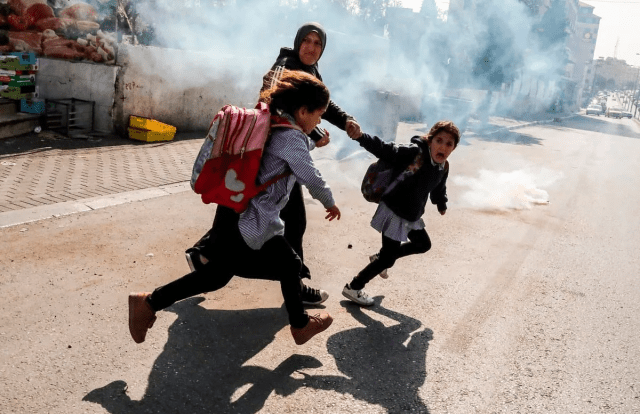
The US State Department refused to describe Palestinians in the West Bank as living under a military occupation during a heated exchange between journalists last week. State Department spokesperson Vedant Patel brushed aside questions about Washington’s view on the status of the occupied West Bank in the wake of an Israeli military raid that killed ten Palestinians in Jenin.
“What is the status of the Palestinian people in the West Bank, including Jenin… and everywhere else in the West Bank?” Said Arikat of Al-Quds newspaper asked Vedant. “It’s a simple question. Are they under occupation?”
Patel refused to answer the question despite being asked repeatedly to clarify the position of the US regarding the status of the West Bank. At one point Patel shockingly said that the status of the Palestinians is that “they reside on those territories.”
Frustrated at not getting an answer, Arikat asked if the West Bank is considered a “different planet” and if the US “subscribes to the fact that they are under military occupation?” Patel refused to answer the question.
“Vedant, are they occupied or are they not occupied? What is the status that you give the Palestinians right at this moment? What kind of status do they have?” Arikat insisted.
Patel again refused to answer, deflecting the question by focusing on the escalation of violence and calling for peace and calm in the region. “I’m not talking about a recent period. I am saying about legally, how do you designate the Palestinians in the West Bank? What is their status?” Arikat asked to know for a fourth time.
“I understand the question you’re asking, and I – as we’ve said previously, it is vital for both sides to take action to prevent even greater loss, and we condemn any violence, escalation, or provocation,” said Patel.
Under International law the West Bank and Gaza is Israeli occupied territory. Experts in international law say that given the length of the occupation and given that Israel has no intention to ever withdraw, the correct designation is that it is an illegal occupation. The International Court of Justice has been asked to issue an opinion on that very matter.
Is NATO helping Ukraine to fight Russia or is it using Ukraine to fight Russia?
By Glenn Diesen | RT | January 30, 2023
The Western public, like others, are justly appalled by the human suffering and the horrors of the Ukrainian war. Empathy is one of the great virtues of humanity, which in this instance translates into the demand for helping Ukrainians. Yet, propaganda commonly weaponizes the best in human nature, such as compassion, to bring out the worst. As sympathy and the desire to assist the displaced are used to mobilize public support for confrontation and war with Russia, it is necessary to ask if the Western public and Ukrainians are being manipulated to support a proxy war.
Is NATO helping Ukraine to fight Russia or is NATO using Ukraine to fight Russia?
The organization as a passive actor?
The US-led military bloc commonly depicts itself as an innocent third party that merely responds to the overwhelming desire of the Ukrainian people to join its ranks. Yet, for years NATO has attempted to absorb a reluctant Ukraine into its orbit. A NATO publication from 2011 acknowledged that “The greatest challenge for Ukrainian-NATO relations lies in the perception of NATO among the Ukrainian people. NATO membership is not widely supported in the country, with some polls suggesting that popular support for it at is less than 20%”.
In 2014, this problem was resolved by supporting what Statfor’s George Friedman labelled “the most blatant coup in history” as there were no efforts to conceal Western meddling. Regime change was justified as helping Ukrainians with their “democratic revolution”. Yet, it involved the unconstitutional removal of the elected government as a result of an uprising that even the BBC acknowledged did not have majority support amongst the general public. The authorities elected by the Ukrainian people were replaced by individuals handpicked by Washington. An infamous leaked phone call between State Department apparatchik Victoria Nuland and Ambassador Geoffrey Pyatt revealed that Washington had chosen exactly who would be in the new government several weeks before they had even removed president Yanukovich from power.
Donbass predictably rejected and resisted the legitimacy of the new regime in Kiev with the support of Russia. Instead of calling for a “unity government”, a plan for which Western European states had signed as guarantors, NATO countries quietly supported an “anti-terrorist operation” against eastern Ukrainians, resulting in at least 14,000 deaths.
The Minsk-2 peace agreement of February 2015 produced a path for peace, yet the US and UK sabotaged it for the next 7 years. Furthermore, Germany’s Angela Merkel and France’s Francois Hollande recently admitted that both Germany and France considered the deal an opportunity to buy time for Ukraine to arm itself and prepare for war.
In the 2019 election, millions of Ukrainians were disenfranchised, including those living in Russia. Nevertheless, the result was a landslide with 73% of Ukrainians voting for Vladimir Zelensky’s peace platform based on implementing the Minsk-2 agreement, negotiating with Donbass, protecting the Russian language, and restoring peace with Moscow. However, the far-right militias that were armed and trained by the US effectively laid down a veto by threatening Zelensky and defying him on the front line when he demanded to pull back heavy weapons. Pressured also by the US, Zelensky eventually reversed the entire peace platform the Ukrainians had voted for. Instead, opposition media and political parties were purged, and the main opposition leader, Viktor Medvedchuk was arrested. Subverting the wishes of Ukrainians in order to steer the country towards confrontation with Russia was yet again referred to as “helping” Ukraine.
Towards proxy war
In 2019, the Rand Corporation published a 325-page report ordered by the US Army titled “Extending Russia: Competing from Advantageous Ground”. In the language of a proxy war, the report advocated arming Ukraine to bleed Moscow stating, “Providing more U.S. military equipment and advice could lead Russia to increase its direct involvement in the conflict and the price it pays for it”. The US Chair of the House Intelligence Committee, Adam Schiff, similarly explained in 2020 the strategy of arming Ukraine claiming, “The United States aids Ukraine and her people so that we can fight Russia over there and we don’t have to fight Russia here”.
In December 2021, the former head of Russia analysis at the CIA warned that the Kremlin was under growing pressure to invade to prevent Washington from further building up its military presence on its borders, which included modernising Ukrainian ports to fit US warships. “That relationship [US-Ukraine] will be far stronger and deeper, and the United States military will be more firmly entrenched inside Ukraine two to three years from now. So inaction on [the Kremlin’s] part is risky,” George Beebe explained. Yet, despite being convinced that Russia would invade, Washington refused to give any reasonable security guarantees to Moscow.
Kiev agreed to enter into negotiations merely three days into the Russian invasion, which resulted in a peace agreement outline a few weeks later. Former intelligence official Fiona Hill and Angela Stent later penned an article acknowledging that “Russian and Ukrainian negotiators appeared to have tentatively agreed on the outlines of a negotiated interim settlement: Russia would withdraw to its position on February 23, when it controlled part of the Donbass region and all of Crimea, and in exchange, Ukraine would promise not to seek NATO membership and instead receive security guarantees from a number of countries”.
However, after a visit by UK Prime Minister Boris Johnson, Kiev suddenly withdrew from the peace negotiations. Reports in the Ukrainian and American media have suggested that London and Washington had pressured Kiev to abandon negotiations and instead seek victory on the battlefield with NATO weapons.
Johnson gave multiple speeches warning against a “bad peace,” while German General Harald Kujat, a former chairman of the NATO Military Committee, confirmed that Johnson had sabotaged the peace negotiations in order to fight a proxy war with Russia: “His reasoning was that the West was not ready for an end to the war”.
The American objectives also had seemingly little to do with “helping” Ukraine. US Secretary of Defense Lloyd Austin stated US goals in Ukraine as the weakening of a strategic rival: “We want to see Russia weakened to the degree that it can’t do the kinds of things that it has done in invading Ukraine”. PresidentBiden argued for regime change in Moscow as Putin “cannot remain in power”, which was repeated by Boris Johnson’s op-ed stating that “The war in Ukraine can end only with Vladimir Putin’s defeat”.
US Congressman Dan Crenshaw advocated for a proxy war by supplying weapons to Ukraine as “investing in the destruction of our adversary’s military, without losing a single American troop, strikes me as a good idea”. Similarly, Senator Lindsey Graham argued the US should fight Russia to the last Ukrainian: “I like the structural path we’re on here. As long as we help Ukraine with the weapons they need and the economic support, they will fight to the last person”. The rhetoric is eerily similar to that of Hungarian billionaire George Soros, who argued that NATO could dominate if it could use Eastern European soldiers as they accept more deaths than their Western peers: “the combination of manpower from Eastern Europe with the technical capabilities of NATO would greatly enhance the military potential of the Partnership because it would reduce the risk of body bags for NATO countries, which is the main constraint on their willingness to act”.
Following NATO Secretary General Jens Stoltenberg’s recent Orwellian statement that “weapons are the way to peace”, it is worth assessing if NATO is helping Ukraine or using Ukraine. NATO powers have stated that they are supplying Ukraine with weapons to have a stronger position at the negotiating table, yet one year into the war, no major Western leaders have called for peace talks. NATO has a powerful bargaining chip that would actually help Ukraine, which would be an agreement to end NATO expansion toward Russian borders. However, whitewashing the bloc’s direct contribution to the war prevents a negotiated settlement.
Glenn Diesen is a Professor at the University of South-Eastern Norway and an editor at the Russia in Global Affairs journal.
Department of Health and Human Services is sued after ignoring freedom of information request over censorship demands
By Dan Frieth | Reclaim The Net | January 29, 2023
Activist group Judicial Watch filed a Freedom of Information Act (FOIA) lawsuit against the Department of Health and Human Services (HHS) for all records and communications between the Surgeon General’s office and social media companies about COVID-19 vaccines.
Judicial Watch filed the lawsuit after the HHS refused to adequately respond to a FOIA request filed in March 2022.
We obtained a copy of the complaint for you here.
The request was for: “All records, including, but not limited to, electronic mail, texts, memoranda, and handwritten notes, of, regarding, referring, or relating to any efforts of Alexandria Phillips, Communications Director, Office of the Surgeon General, to contact any employee of Facebook, Twitter, TikTok, Instagram, Snapchat, Reddit, YouTube, LinkedIn, Tumblr, and Pinterest concerning COVID-19 vaccines.”
Surgeon General Vivek Murthy has previously called for censorship of Covid misinformation. In 2021, he published a report titled “Confronting Health Misinformation,” which aimed to “slow the spread of health misinformation during the COVID-19 pandemic and beyond.”
The report encouraged platforms to censor vaccine misinformation and other misinformation related to the pandemic.
In March 2022, Murthy ordered social media platforms to hand over information about accounts spreading Covid misinformation.
Judicial Watch president Tom Fitton said, “Biden’s Surgeon General is abusing his office to pressure Big Tech companies to censor Americans. This lawsuit aims to uncover the details of this government attack on the First Amendment.”
Related: US Surgeon General Vivek Murthy suggests Joe Rogan should be censored
Hamilton 68: Brief Addendum Comparing their response Friday to the site’s original mission statement
By Matt Taibbi | Racket | January 29, 2023
Hamilton 68 responded to a #TwitterFiles thread Friday with a series of claims, including that their site was always intended to be understood as “nuanced,” that they always maintained that “witting or unwitting” accounts could be on their list, and that “some accounts we track are automated bots, some are trolls, and some are real users.”
They could also have inserted the disclaimer added to the new Hamilton 2.0 page, which as a helpful reader noted this morning, includes in red font a blaring warning to all that it would INCORRECT to label anyone or anything that appears on their dashboard “as being connected to state-backed propaganda”:
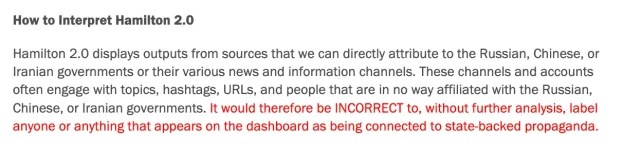
Thank heaven for the Wayback Machine. Here’s what was written on the original Hamilton page:
These accounts were selected for their relationship to Russian-sponsored influence and disinformation campaigns, and not because of any domestic political content.
We have monitored these datasets for months in order to verify their relevance to Russian disinformation programs targeting the United States.
… this will provide a resource for journalists to appropriately identify Russian-sponsored information campaigns.
High on that original page, the Hamilton founders explained they monitored two types of accounts:
There are two components to the dashboard featured here.
The first section, “Overt Promotion of Content,” highlights trending content from Twitter accounts for media outlets known to be controlled by the Russian government.
The second section, “Content Tweeted by Bots and Trolls,” highlights themes being pushed by Twitter accounts linked to Russian influence campaigns.
The Hamilton list tracked overt Russian media on the one hand, and “bots and trolls” on the other. Note the difference between that language and the language Friday: “Some accounts we track are automated bots, some are trolls, and some are real users.” That Hamilton Friday was also trying to distance itself from headlines about “bots” is particularly grotesque, given that it was so overt in identifying the composition of its list this way at the start.
I encourage everyone to read language from the original site, then look at Friday’s ironically named “Fact sheet,” and compare for yourselves.
Finally I want to note a passage from the Friday “fact sheet” I somehow overlooked:
Individual accounts were algorithmically selected based on analytic techniques developed by J.M. Berger that were used to identify the most influential accounts within those networks. The Hamilton 68 team did not individually review or verify all accounts because the focus of the dashboard was to analyze behavior in aggregate networks, not specific accounts.
Translating: individual accounts were chosen through a method developed by J.M. Berger, a writer and think-tanker whose usual specialty is extremism (he’s written about ISIS and domestic white nationalism in the U.S.). Still, it wasn’t even Berger’s fault that ordinary Americans ended up in the list, since said people were chosen “algorithmically.” The Hamilton 68 team also “did not individually review or verify” all the names, because their “focus” was “aggregate networks,” not “specific accounts.”
So, nobody looked at the list.
The list that was “the fruit of more than three years of observation and monitoring.”’
Sounds solid.
Yes? No?
Pfizer admits it ‘engineered’ new Covid mutations
RT | January 29, 2023
US drugmaker Pfizer admitted on Friday that it “engineered” treatment-resistant variants of Covid-19 in order to test its antiviral medicine. The admission partially backs up earlier claims by an executive with the company who told an undercover reporter that Pfizer was deliberately “mutating” the virus to “preemptively develop new vaccines.”
In a statement posted on its website, Pfizer said that it “has not conducted gain of function or directed evolution research,” referring to the practice of amplifying a virus’ ability to infect humans and the process of selecting ‘desirable’ traits of a virus to reproduce, respectively.
However, the pharma giant said that it combined the spike proteins of new coronavirus variants with the original strain in order to test its vaccines, and that it created mutations of the virus to test Paxlovid, its antiviral drug.
“In a limited number of cases… such virus may be engineered to enable the assessment of antiviral activity in cells,” the company said, adding that this work was carried out in a secure laboratory. The work also sought to create “resistant strains of the virus,” it added, describing a process commonly understood as being ‘gain of function’ research.
Pfizer’s statement came two days after Jordon Trishton Walker, an executive involved in the firm’s mRNA division, told an undercover reporter that the company was “exploring” ways to “mutate [covid] ourselves so we could create, preemptively develop, new vaccines.” Walker said that scientists were considering infecting monkeys with the virus, who would then “keep infecting each other.”
“From what I’ve heard, they [Pfizer scientists] are optimizing it, but they’re going slow because everyone is very cautious,” he explained. “Obviously they don’t want to accelerate it too much. I think they are also just trying to do it as an exploratory thing because you obviously don’t want to advertise that you are figuring out future mutations.”
Pfizer’s statement makes no mention of the supposed plan to infect monkeys, instead explaining that any work on live viruses is carried out in vitro, meaning inside test tubes or other lab equipment.
Walker was told on camera that he was speaking to a journalist with Project Veritas, a conservative outlet known for its hidden-camera sting operations. After hearing this, Walker insisted that he was lying to impress his date, before attempting to steal an iPad from Project Veritas CEO James O’Keefe.
Featured Video

Saudi Led Destruction of Yemen’s heritage
or go to
Aletho News Archives – Video-Images
From the Archives
Israel: Strategic Ally or Liability?
By Stephen Sniegoski | My Catbird Seat | June 12, 2010
The claim that Israel serves as a valuable ally for the United States is made by both pro-Zionists and much of the anti-war and anti-Zionist Left that is influenced by Noam Chomsky. As a result of the Gaza flotilla massacre, which has caused a world-wide uproar against Israel, the value of Israel to the United States is being publicly questioned in more mainstream foreign policy forums. … continue
Blog Roll
 Aletho News
- Declassified UK exposes British man who fought for ‘Israel’ in Gaza
- West’s death cult in a theater near you
- How the Yandex ‘Russian bots’ lie fell apart
- Burnham’s ‘Russia did Brexit’ ruse crumbles
- Estonia making movies and games to encourage war against Russia
- Four in five new UK jobs taken by foreigners – report
- Here’s what Trump’s latest U-turn really means for Russia and Ukraine
- The Houthis Are Not an Iranian Proxy
- Europe’s Energy Hypocrisy, Russian LNG Profits and US Dependence
- ICC ignored ‘very well-documented’ NATO crimes – ex-Libyan minister
- If Americans Knew
- Activists Abused By Israel Return to New Freedom Flotilla Mission
- 60 Minutes won’t tell the full truth about Israeli settler violence
- Nearly 50,000 women, girls killed or severely injured in Gaza since October 2023: UN Women
- ADL is working with AI companies to suppress alleged ‘antisemitism’
- Israeli occupation forces using social media surveillance unit to target hundreds of Palestinians in the West Bank
- Israel’s New – and Terrifying – Security Doctrine
- Israeli Attacks Kill Five in Gaza, Including a four-year-old and a woman
- Air Force Major Who Called for Trump’s Impeachment Held in Solitary Confinement
- It’s a Genocide, I’m Into It’: Seinfeld Mocks Protest over Palestinian Children Killed
- Universities fire dozens amid pressure from Zionist billionaires
- No Tricks Zone
- New Study Suggests Large Regions Of The Pacific Ocean Have Been Cooling For The Last 80 Years
- Germany’s Green Energy Debacle: High Energy Costs Force Kahla Porzellan to Close After 182 Years!
- New Study: 50 Years Of The Most Aggressive ‘Net Zero’ Policies Can Only Affect The Global Climate By 0.03°C
- US September “Heat” Was No Record…Many Records Set Decades Ago
- Latest European Green Energy Debacle; Portugal’s Largest Flagship Solar Park Insolvent!
- Green Energy Debacle: German Expert Professor Fritz Vahrenholt Warns Of Severe Economic And Social Consequences
- Two More Paleo Reconstructions Affirm Meters-Higher Sea Levels Across Ireland, Brazil 7000-6000 Years Ago
- New Study: Earth And Venus Surface Warmth Largely Explained By Convection And Lapse Rate, Not CO2 Or Radiation
- 2025 Nature Paper Claiming Worsening Global Drought Gets RETRACTED …Heavily Flawed
- New Study: ‘Global Drought Shows No Detectable Recent Acceleration Under Climate Warming’

