The Trouble with Western Tanks in Ukraine
By Brian Berletic – New Eastern Outlook – 17.01.2023
Western nations have begun pledging a variety of Western armored vehicles to Ukraine including infantry fighting vehicles and even main battle tanks. Until now, the majority of armored vehicles sent to Ukraine had been Soviet-era weapons Ukrainian forces were familiar with both in terms of operating and repairing them.
However, following Ukraine’s Kherson and Kharkov offensives, much of this equipment has been destroyed, leaving the West little choice but to begin sending Western systems or leave Ukrainian forces in the field with only small arms.
While Western leaders and the media claim that Western armored vehicles represent a significant increase in Ukrainian capabilities, the reality is quite the opposite. Far from giving Ukraine an advantage on the battlefield, Ukrainian forces will struggle merely to get the vehicles on the battlefield and keep them there. Additionally, recent conflicts elsewhere in the world have proven Western armored vehicles including main battle tanks are neither “invincible,” nor “game-changing.”
Thus, if Ukraine’s hundreds of Soviet-era tanks, infantry fighting vehicles, and armored personnel carriers failed to achieve favorable outcomes for Kiev, it is unlikely replacing these systems with Western hardware will make any difference.
Logistics, Training, and Maintenance
In order to get Ukrainians into Western armored vehicles they will have to be trained in their basic operation, in using them effectively on a modern battlefield together with other tanks and weapon systems, and keeping them on the battlefield (maintenance). Entry-level tankers can take up to half a year to acquire these skills – time Ukraine doesn’t have, meaning that unless Western operators will be manning them posing as Ukrainians, heavily abbreviated courses will be given instead, producing subpar operators compared to the training and effectiveness Ukrainian tank crews had on the battlefield using their own equipment at the beginning of Russia’s special military operation.
Another aspect of most Western main battle tanks is that unlike Soviet and Russian main battle tanks which feature autoloaders for their main guns, Leopard 2, Challenger 2, and M1 Abrams require a crew member to manually load their main guns. So, while Soviet-era and Russian tanks have three crew members, a driver, a gunner, and a commander, Western main battle tanks require a fourth, the loader. This means that for every 3 Western main battle tanks sent to Ukraine, four Ukrainian tank crews will be required to man them – more trained tankers spread across fewer tanks.
Before these newly trained Ukrainian tankers can crew their Western armored vehicles, they have to be moved onto the battlefield. Western infantry fighting vehicles like the US Bradley and the German Mauder are heavier than their Soviet and Russian counterparts. So are the Challenger 2 and Leopard 2 tanks pledged by the UK and Poland. The US M1 Abrams is heavier still.
This presents a challenge to moving the vehicles by truck or rail just to reach the battlefield. The second option, rail, is complicated even further by the fact that much of Ukraine’s rolling stock is moved by electric traction which has been severely inhibited by Russia’s systematic targeting and destruction of the Ukrainian power grid. There is also the matter of sustaining these armored vehicles on the battlefield as they operate. They will consume much larger amounts of fuel than Ukraine’s previous armored vehicles, meaning more fuel will be required and much more often.
Heavier vehicles place more wear and tear on mechanical components including the vehicles’ transmissions, suspension, road wheels, and tracks. Increased maintenance required by newly trained, inexperienced crews will prevent the vehicles from being operated to their maximum potential. More problematic still is that Western armored vehicles – both infantry fighting vehicles and especially Western main battle tanks – possess complex optics and computerized fire control systems. It takes months just to train technicians to diagnose these systems, and a year or more to train and gain experience in actually repairing them.
What is much more likely is Ukrainian armor crews will be forced to regularly send broken vehicles to the border with Poland to be repaired. Depending on where fighting is taking place this can be up to 1,000 km away from the front line. It is then another 1,000 km back to the front. Ukrainian maintenance facilities manned by Western technicians cannot be established in Ukraine itself because Russia possesses the means to target and destroy them with long-range precision weapons like cruise missiles and drones.
This means Western armored vehicles may spend more time either in transit or being repaired than actually fighting on the battlefield.
Because NATO armored vehicles use different types of ammunition than Ukraine has been using with its own armor vehicles, it will need to be shipped in constantly to the front to keep these vehicles firing on the battlefield. While many NATO main battle tanks fire 120mm rounds from smoothbore main guns, the British Challenger 2 fires unique ammunition from its 120mm rifled main gun. This means that two supply chains will need to be established for Challenger 2 and Leopard 2 tanks. The same applies for basic spare parts for mechanical repairs Ukrainian crews may be capable of performing in the field.
Western Main Battle Tanks are Far From Invincible
Pundits argue that despite the many challenges facing Ukraine in employing Bradley and Marauder infantry fighting vehicles along with Challenger 2 and Leopard 2 main battle tanks, the capabilities of these vehicles will give Ukrainian forces a decisive advantage on the battlefield over Russian forces. However, the performance of these armored vehicles in recent conflicts indicates the exact opposite.
The Leopard 2 main battle tank is widely used across NATO, including by Turkey. Turkey deployed Leopard 2 tanks during several incursions into northern Syria against irregular Kurdish and “Islamic State” forces. Their performance was described in a 2019 National Interest article ominously titled, “Turkey’s Leopard 2 Tanks Are Getting Crushed in Syria,” which noted:
… evidence emerged that numerous Leopard 2s had been destroyed in intense fighting over ISIS-held Al-Bab—a fight that Turkish military leaders described as a “trauma,” according to Der Spiegel. A document published online listed ISIS as apparently having destroyed ten of the supposedly invincible Leopard 2s; five reportedly by antitank missiles, two by mines or IEDs, one to rocket or mortar fire, and the others to more ambiguous causes.
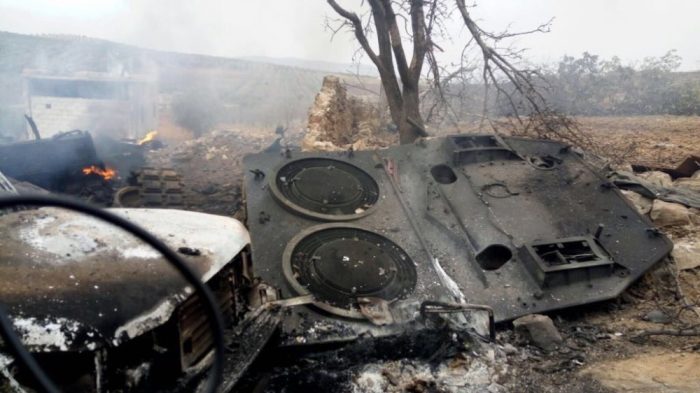
The article links to photographs of the destroyed Leopard 2 tanks, sometimes side by side Turkish infantry fighting vehicles and with at least two with their turrets completely blown off the hulls of the tanks, illustrating just how vulnerable any main battle tank is, Russian or Western, to modern anti-tank weapons. The National Interest lists AT-7 Metis and AT-5 Konkurs antitank missiles, both produced by the Soviet Union and now the Russian Federation, as the culprits in at least 5 of the destroyed Leopard 2 tanks.
While the most widely produced Western main battle tank is the M1 Abrams, because of its fuel-hungry turbine engine and exceptionally heavy weight, it is impractical to send in large numbers to Ukraine. The Leopard, produced in large numbers and used widely across NATO with its diesel engine makes it the most likely candidate to replace the bulk of Ukraine’s tank force, but considering its performance against even irregular forces on the battlefield, this leaves only bleak prospects for Ukraine.
The British Challenger 2 has fared no better on the battlefield. The myth that it has is owed to cover-ups and deliberate war propaganda as exposed by a 2007 Telegraph article titled, “MoD kept failure of best tank quiet,” which noted:
The Ministry of Defence had claimed that an attack last month that breached a tank’s armour was the first of its kind in four years of war in Iraq. But another Challenger 2 was pierced by a powerful rocket-propelled grenade in August last year during an attack that blew off part of a soldier’s foot and injured several others.
The article pointed out that the weapon that likely damaged the Challenger 2 was the Russian-made RPG-29. It notes:
The RPG-29 is a much more powerful weapon than the common type regularly used by insurgents to attack British troops. It is specifically designed to penetrate tank armour, although this is the first occasion on which it has managed to damage a Challenger.
And what of other Western main battle tanks which share similar design and doctrinal philosophies? Have they performed any better? It is a question worth considering both to assess the combat potential of Western armored vehicles in general and to get ahead of additional transfers to Ukraine that might include these other vehicles.
The M1 Abrams, like the Challenger 2, has a legendary reputation. However, the US itself had multiple M1 Abrams knocked out in Iraq from 2003 onward. A CBS New article from 2003 titled, “U.S. Tank Hit, 2 GIs Dead In Iraq,” noted that the knocked out M1 Abrams was damaged by either a bomb or an improvised explosive device.
The M1 Abrams has been transferred to US allies including Saudi Arabia. A 2016 Defense One article titled, “Saudi Losses in Yemen War Exposed by US Tank Deal,” would explain:
The U.S. State Department and Pentagon Tuesday OKed a $1.2 billion sale of 153 Abrams tanks to Saudi Arabia Tuesday. But that’s not the real news.
Turns out: 20 of those tanks, made in America by General Dynamics Land Systems, are “battle damage replacements” for Saudi tanks lost in combat.
Even though the formal announcement of the sales does not say where the tanks were fighting, the Saudi military is believed to have lost some of its 400-plus Abrams tanks in Yemen, where it is fighting Iranian-backed Houthi separatists.
It is very clear that far from invincible, despite the massive weight and heavy fuel consumption of the M1 Abrams, even irregular forces are capable of facing off and defeating the US main battle tank.
Pundits have claimed that heavy losses of Saudi M1 Abrams are owed to the fact that exported M1 Abrams lack key features including special armor and fire control elements responsible for their poor performance. However, it is unlikely the US would ever transfer M1 Abrams to Ukraine with classified armor or highly sophisticated fire control systems for precisely the same reasons the US has not sent any of its modern unmanned aerial vehicles like the Gray Eagle. The capture of either of these weapon systems by Russian forces – a very common phenomenon amid the special military operation – would mean these advanced features would quickly be under examination by Russian engineers.
And finally, while Israeli Merkava main battle tanks are highly unlikely to end up in the hands of Ukrainian forces, the Merkava is considered one of the best main battle tanks on Earth. They too, however, have not only performed poorly against modern anti-tank weapons, but anti-tank weapons produced by the Russian Federation.
Haaretz in its 2006 article, “Hezbollah Anti-tank Fire Causing Most IDF Casualties in Lebanon,” would report:
The Hezbollah anti-tank teams use a new and particularly potent version of the Russian-made RPG, the RPG-29, that has been sold by Moscow to the Syrians and then transferred to the Shi’ite organization.
The RPG-29’s penetrating power comes from its tandem warhead, and on a number of occasions has managed to get through the massive armor of the Merkava tanks.
It should be noted that in each case, whether it was Turkish forces in northern Syria, Saudi forces in Yemen, US and British forces in Iraq, or Israeli forces pushing into southern Lebanon, each military operation consisted of well-trained tank crews supported by large-scale logistical lines and as part of well-organized combined arms combat including infantry, artillery, and air support.
What will happen when Ukrainian tank crews given abbreviated training attempt to employ Western main battle tanks on the battlefield, only without the proper logistical or combined arms support Turkey, the US and UK, Saudi Arabia, and Israel were capable of? And what will happen when these Ukrainian tank crews go up against Russian-made anti-tank weapons proven over the years to be highly effective against the very best Western main battle tanks now that these anti-tank weapons are in the hands of Russian troops themselves?
It was Russian forces destroying hundreds upon hundreds of Ukrainian armored vehicles over the course of the special military operation, exhausting both Ukraine’s initial inventories and then NATO’s inventories of Soviet-era equipment that has prompted the West to consider sending their own armor in the first place.
Effective Russian-made anti-tank weapons like the guided AT-7 Metis and AT-5 Konkurs but also the newer 9M133 Kornet missile along with RPG-29 and now RPG-30 rocket propelled grenades will surely produce the same destructive results experienced by Turkish, US, British, Saudi, and Israeli tank crews. But Ukrainian forces will also face hundreds of Russia’s own main battle tanks including modernized T-72 and T-80 tanks, as well as the newer T-90 Proryv. Russian military aviation also has a variety of weapons capable of precision strikes on armored vehicles and Russian artillery is more than capable of destroying main battle tanks even on the move using laser-guided Krasnopol artillery rounds.
In other words, Ukrainian tank crews will be less prepared and fighting under less-than-ideal conditions than their Western counterparts and fighting against a much larger arsenal of anti-tank weapons both in terms of quantity and quality. Just as other Western “wonder weapons” had supposedly “turned the tide” including the M777 155mm howitzer and the HIMARS GPS-guided multiple launch rocket system, Ukraine finds itself in need of yet another “wonder weapon” to induce yet another badly needed “turning of the tide.” Western main battle tanks will help Ukraine prolong the conflict, but ultimately Kiev and its Western sponsors will find themselves right back to where they started.
Brian Berletic is a Bangkok-based geopolitical researcher and writer.
Republicans deepen investigation into Democratic money laundering with Ukraine
By Ahmed Adel | January 17, 2023
The Republicans plan to investigate where the money that Washington allocates to Kiev really goes. The conservative political party suspects that the Biden administration and Ukrainian President Vladimir Zelensky are involved in money laundering and the sale of NATO weapons on the darknet, using the Russian special military operation as an excuse.
“Whether you support Ukrainian funding or not, the fundamental question is, we deserve, and the American people deserve to know how their money is being spent, especially when we’re talking about $120 billion dollars of it,” Freshman Republican Senator JD Vance said on January 11 on the show Tucker Carlson Tonight.
The Republicans currently occupy most key positions in the committees on Capitol Hill. At the moment, one of their most important decisions is launching an investigation into the financing of Kiev by the Biden administration.
After winning the elections for the House of Representatives in November 2022, the Republicans decided to launch an investigation. Congress has formed a committee to investigate how the financial resources of American taxpayers are spent in Ukraine. One of the major questions is whether weapons sent as military aid to Kiev actually ended up in the hands of terrorist and various other organisations.
Numerous media outlets have reported the fact that the weapons supplied to Ukraine do not always reach the front lines. There is even information that these weapons appeared on the darknet – an illegal internet network.
In addition, numerous publications reported that money was laundered through an office that dealt with cryptocurrencies. In other words, the money that Ukrainian President Volodymyr Zelensky received as military aid was poured into this company, which was used to buy cryptocurrencies.
Senator Vance said in his interview with Tucker Carlson that those opposed to an audit “don’t want to be forced to acknowledge a lot of the money we’ve sent to Ukraine hasn’t been well spent.”
“There are a lot of corrupt people probably getting rich off of it,” he added.
More importantly than the allegation of corruption, the Republicans want to investigate the role of Hunter Biden – the son of US President Joe Biden, who has deep ties with Ukraine’s energy sector.
After the Republicans regained control of the House of Representatives in the midterm elections, they promised in their first press conference to investigate Hunter. Back in 2014, Hunter joined the board of the Ukrainian gas company Burisma. This was at a time when Joe Biden was Vice President and the war in Donbass was on the cusp. Hunter earned more than $50,000 a month over a five-year period as a board member of Burisma.
The Republicans claim that his appointment may have posed a conflict of interest. In 2022, more than 30 Republicans called for a prosecutor to be given special counsel authority to carry out an investigation into alleged “tax fraud, money laundering, and foreign-lobbying violations”. The conservative party has been studying messages and financial transactions found on a laptop that belonged to Hunter.
With the Republicans having gained the majority in the House of Representatives, they now have the power to issue congressional subpoenas to foreign entities that did business with him. It seemingly appears that the money that the US has sent to Ukraine since the war began is lining the pockets of Ukrainian and American officials.
Most likely, Biden’s son, and even his inner circle, were involved in money laundering and corrupt actions. As for the investigation itself, the Republicans will drag it out until it is clear who the Democrats will run in the 2024 elections. Evidence of such corruption can destroy any Democratic candidate and therefore prevent Biden from running for a second term. Ultimately, weakening the Democratic Party in view of the next presidential election is the aim of the Republicans.
The US Senate has demanded that a Congress report indicate how much money the US authorities sent to Ukraine. According to Senator JD Vance, the $114 billion that the US sent was “impacted by the situation in Ukraine” and does not even include several additional transfers previously requested by the Biden administration.
None-the-less, the senator stressed to Tucker Carlson that the Biden Administration, by law, “is supposed to tell us exactly how that money is being spent. We are putting down a marker…”
He then demanded a response by February 7. And it is until then that we wait for the latest development in the Democratic Party’s alleged corruption and money laundering with Ukraine.
Ahmed Adel is a Cairo-based geopolitics and political economy researcher.
Isn’t it Time For Adam Schiff to be Expelled From Congress?
By Ron Paul | January 16, 2023
With each new release of the “Twitter Files” we learn more and more about the deep corruption in Washington. We sensed during Covid that something was really wrong – for example the bizarre denial of natural immunity. But thanks to Elon Musk’s decision to open the books, our worst fears have been proven true. Each new release seems to show something even more criminal inside America’s rotten ruling class.
In the latest release, thanks to the excellent reporting of independent journalist Matt Taibbi, we see outgoing Chair of the House Intelligence Committee, Rep. Adam Schiff (D-CA), continuously pressuring Twitter to validate his fantasies of “Russian bots” manipulating US politics.
The short version of what Taibbi reported comes from around the time then-Chairman of the House Intelligence Committee Rep. Devin Nunes (R-CA) was about to release his Committee’s findings about the FBI misuse of the FISA Court to spy on the Trump presidential campaign. The FBI, it turns out, relied exclusively on the widely-discredited “Steele Dossier” – paid by the Hillary Clinton campaign – as justification to spy on the Trump campaign.
When pressure grew to release the Nunes findings, Twitter exploded with users demanding that Congress “release the memo.” That’s where then-ranking Member Schiff and his staff began relentlessly pressuring Twitter to show that the accounts demanding the release of the memo were actually Russian agents, out to help their supposed favorite, Donald Trump. Schiff was not alone. Fellow “Russiagate” hoaxers like Sen. Feinstein (D-CA) and Sen. Richard Blumenthal (D-CT) also pressured Twitter to find Russians behind the demand to release Nunes’ findings.
Over and over, Twitter – which was hardly sympathetic to Trump – told Schiff and his colleagues there was simply no evidence of Russian involvement. As much as some Twitter employees may have liked to report the opposite, to their credit they refused to participate in the scam.
Even after Twitter had informed Schiff and his fellow hoaxers that there was no Russian involvement, Sen. Blumenthal released a statement he knew was not true: “We find it reprehensible that Russian agents have so eagerly manipulated innocent Americans.” Again, this was right after he had been informed by Twitter employees – who were by-and-large strongly opposed to Trump – that there was just no evidence to back up such a statement.
We are moving closer and closer to a nuclear showdown with Russia over Ukraine. For political gain the Democrats – and plenty of Republicans – have been pushing the “Russiagate” hoax and in so doing have fertilized the ground for the obsessive Russia hatred prevalent in the US today.
I do not believe it is an exaggeration to say that if US/Russia relations had not been poisoned by the lie of “Russiagate” for pure political gain, we would not be anywhere near our current state of near-direct conflict with the largest nuclear power on earth, Russia.
It is shocking that Schiff and his “Russiagate” allies would potentially sacrifice millions of dead Americans to defeat Trump and other political enemies.
Let’s not forget: Rep. Jim Trafficant was expelled from Congress for asking his staffers to wash his boat. Shouldn’t there be at least equal punishment for Senators and Members who are lying us into World War III?
Copyright © 2023 by RonPaul Institute
Bill introduced to criminalize vilification of ‘non-White’ people
RT | January 16, 2023
A bill introduced in Congress earlier this month would expand the definition of “hate crime” so wide it could potentially include content that is found to have “inspired” a racially-motivated crime.
Critics of the legislation sponsored by Rep. Sheila Jackson Lee (D-Texas) have argued that it imperils Americans’ freedom of expression by holding the threat of criminal charges based on others’ behavior over their heads.
The “Leading Against White Supremacy Act of 2023” sets out two new offenses, the first being “white supremacy inspired hate crime” and the second being a related conspiracy charge.
To be guilty of the latter, one need only “publish material advancing white supremacy, white supremacist ideology, antagonism based on ‘replacement theory,’ or hate speech that vilifies or is otherwise directed against any non-white person or group” to social media. What happens after that determines whether a crime is committed.
If the offending content is “read, heard, or viewed by a person who engaged in the planning, development, preparation or perpetration of a white supremacy inspired hate crime” — apparently even if that person was a complete stranger who misinterpreted the message — the creator is guilty of conspiracy.
Alternately, as long as the content was posted where people “predisposed to engaging in any action in furtherance of a white supremacy inspired hate crime” might stumble upon it — or even people who might be “susceptible to being encouraged to engage in” such actions — the creator is guilty.
A contributor to the conservative RedState blog observed that the bill failed to define critical terms, including “replacement theory” and “hate speech” while apparently widening the definition of “conspiracy.”
“Replacement theory” takes its name from “The Great Replacement,” a far-right theory alleging white people are being deliberately supplanted in their societies by other races. The theory was referenced in the manifesto of Brenton Tarrant, who killed 51 people at two mosques in New Zealand in 2019.
Arguing that Jackson Lee’s bill would “be used to quash valid political criticism against any non-white person or group,” the RedState writer pointed out that “vilifying” a person does not even require making racist or even false statements about them — just unpleasant ones.
Several commenters on Twitter added that because the bill only protected nonwhite people from “hate speech,” it was technically racist itself and thus unconstitutional.
Jackson Lee’s bill is unlikely to pass in the GOP-controlled House, leading others to suggest it was simply a PR stunt. The bill currently has no co-sponsors.
Ukrainian Syndrome. Anatomy of a Modern Military Confrontation
By Viktor Medvedchuk, former Ukrainian opposition leader – Izvestia – 16.01.2023
Listening to many Western politicians, it seems completely impossible to understand the sense and mechanisms of the conflict in modern Ukraine. Take US President Biden. He denies the direct involvement of US troops in the conflict but at the same time he mentions on every occasion the billions in weapons the US supplies to the country.
If billions are spent for military purposes in Ukraine, it means Ukrainian interests are extremely important for the US. But the US army does not want to fight there. So probably they are not so important, after all. And what about these weapon supplies worth billions of dollars? Are they donations? Is it a profitable business? Investments? Some political combination? No answers, only smoke.
Or take the most recent revelations by German ex-Chancellor Merkel that the Minsk Agreements were just an attempt to give Ukraine time. Which means no one was ever going to establish peace in Ukraine. So, Russia was deceived. But what was the purpose? To protect Ukraine or to invade it themselves? Why did they need this deception if they could simply implement what was recommended by Germany? Or did Germany deliberately recommend something that could never be implemented? We could go as far as asking if political swindlers could be drawn to accountability, but it seems much more relevant today to start clearing the smoke around the current situation. That is how it has played out, anyway. But what were the root causes? And how can we get out of this situation, that is getting ever more dangerous? So let us begin our analysis by looking at the origins.
What Was the Outcome of the Cold War?
The beginning of a new war usually finds its origin in the end of a previous one. The Ukraine conflict was preceded by the Cold War. The answer to the question about its outcome will bring us closer to understanding of the essence of the current conflict, one which extends beyond Ukraine and affects many countries. The thing is that Western countries and the countries of the post-Soviet space, primarily Russia, have different perceptions of the outcome of this war.
The West definitely considers itself as a winner and Russia as a defeated party. Since, in their eyes, Russia was defeated, then the territories of the former USSR and the Eastern Bloc are the legitimate prey of the US and NATO and are subject to control by the West under the motto “Woe to the Conquered!” Hence Ukraine is in the zone of influence of the US and NATO, and certainly not Russia. So, any of Russia’s claims to at least any influence on Ukrainian politics and protection of its interests in the region are “groundless” and a clear infringement on the interests of the US and NATO. “We no longer have to view the world through a prism of East-West relations. The Cold War is over” – declared Margaret Thatcher in the early 1990s. It means the position of the East, of Russia, is no longer relevant. There is one victor, one master of the universe, one winner.
Russia has a completely different view of this process. In no way does it consider itself as a defeated party. The end of the Cold War was brought about by democratic reforms of political and economic life, and military confrontation was replaced by trade and integration with the West. So, if one’s former foe becomes a friend today, is it not a victory? Besides, the USSR and then the Russian Federation never had the goal of winning the Cold War but rather exiting the military confrontation between East and West that could have ended with a nuclear catastrophe. Moscow, together with Washington, found this way out, having reached the goals not so much for themselves as for the whole world.
This way out by no means implied that the West would take over the East and subordinate the post-Soviet space in economic, legal and cultural respects. Quite the contrary: it implied equal cooperation and joint work to build a new political and economic reality. So, there are clearly two different attitudes to the outcome of the Cold War: the triumph of the winners, on the one part, and building a new world and a new civilization, on the other. The difference between these two attitudes would predetermine the developments that followed.
New World or New Western Colonies?
In 1991 the Soviet Union collapsed, but in 1992 the European Union was established – something the post-Soviet space including Russia associated big hopes with. Here, at last, there seemed to be a new world, a new supranational body, a new turn in the history of Western civilization. Russia, just like other states of the former Eastern Bloc and the USSR, saw itself in the future as an equal member of this Union. The vision of “Europe from Lisbon to Vladivostok” was born.
In this context, Russia welcomed not only the reunification of Germany but also the accession of its former allies and even former Soviet republics to the EU. In the 1990s, economic integration with the West was a priority for Russia; Moscow considered it as key to its success as a modern state. The Russian leadership had no particular desire to bind to itself the former Soviet republics, including Ukraine. Most of the Soviet republics had lived off subsidies from the central government, in other words, Russia. So, the leaders of these countries were given a friendly pat on the shoulder while Moscow sought to get rid of their economic burden as soon as possible.
Faster than Ukraine, Russia began to integrate into the European market. Russia had vast volumes of energy resources that are in demand in Europe, while Ukraine, on the contrary, couldn’t afford to buy energy resources at European prices. Ukrainian independence could well have ended with an economic meltdown but for the South-East, where heavy fighting is going on right now. With its vast production facilities and advanced industry, the South-East helped Ukraine find its place in the international division of labor. One would not normally mention this fact, but in the 1990s it was the Russian-speaking South-East that saved the economic and hence political independence of Ukraine.
Now let us turn to something different. Since the 1990s, a series of major ethnic conflicts and wars involving millions of people emerged in Europe and close to its borders. Until 1991, there had not been such a big number of ethnic clashes. All of this led to the break-up of Yugoslavia and loss by Georgia, Moldova and Syria of their territorial integrity. This does not make any sense if we look at it from the perspective of European integration. The goal of this union was not the fragmentation of Europe into a multitude of small states, but quite the contrary: the creation of a huge supranational union of nations, and these nations would not have to exterminate each other, nor to multiply the borders, but rather build a new world together. So, what was wrong here?
It only seems wrong if one relies on the concept that Russia used to stick to. And if one proceeds from the concept of the victory of the West in the Cold War, then ethnic conflicts acquire a completely different meaning. The latter was articulated on numerous occasions, e.g., at the meeting of the Joint Chiefs of Staff on October 24, 1995, when US President Bill Clinton said: “Using the blunders of Soviet diplomacy, the extreme arrogance of Gorbachev and his entourage, including those who openly took a pro-American position, we achieved what President Truman was going to do with the Soviet Union through the atomic bomb.”
It suggests that far from all Western politicians wanted to build a new and just world. Their goal was to defeat the adversary – the USSR, Yugoslavia and other states. In this sense, the escalation of interethnic conflicts seems only logical, as they weaken the adversary and in the case of a victory, they help to dismember the country to make it easier for the winner to take over.
Under these circumstances, the real state of affairs does not play any role. The situation is being deliberately escalated. On the one hand, representatives of the titular nation are being declared as organizers of the genocide, annihilating the foreign language and culture and performing ethnic cleansing. On the other hand, representatives of the national minority living in communities in certain parts of the country are being declared separatists and a threat to the state. This tactic dates back to ancient times and was used by the Roman Empire. But the building of a new slaveholding empire is not something we are witnessing these days, is it? Or probably Washington, for example, does consider the post-Soviet space as some provinces of a greater empire that already have their metropole and should be protected from Barbarians who do not want to be under the control of this empire?
So, there are two political strategies: the economic and political integration of the countries with mutual benefit at the cornerstone, and the take-over of some countries by the others, with zero respect for the interests of the states that are being taken over. Such countries can be dismembered, declared rogue states or conquered.
Speaking of the Russian Federation, as it emerges from the crisis provoked by the dramatic change of its political and economic orientation, it is increasingly being faced with clear attempts to weaken it, humiliate it and put it at a disadvantage; increasingly often, is it being declared a rogue state despite its growing economic potential. Growing economic potential should normally increase the influence of the country and be welcomed in the Western world. But exactly the opposite happens. Not only is the Russian influence not welcomed – it is being declared wrong, criminal and corrupt.
Let us elaborate on this in more detail. Russia has taken Western democracy as a model, carried out reforms and begun to integrate into the Western world. From the point of view of building a common European house, this should be welcomed and encouraged. Europe gets a peaceful and economically reliable partner along with its markets and resources, which certainly makes it even stronger. But if one is guided by colonial thinking, one would not tolerate the economic growth and independence of a distant colony. Provinces should not overtake the metropole, neither financially, nor politically, nor culturally.
There is the EU that was engaged in building a new economic reality. And there is the NATO established in 1949 that confronted the East, primarily the USSR and later Russia. Remember the words by the first Secretary-General of the NATO Hastings Ismay: the bloc was intended “to keep the Americans in, the Russians out and the Germans down.” Thus, the NATO ideology implies that the US is in Europe, and in a dominating position, and Russia is not.
But how should Russia take it? It ended the Cold War in good faith, while it seems that the US and the NATO have not. Which means that unification with the West intended for Russia will not happen on equal terms, but rather take the form of an economic and political take-over. Hence Moscow’s requirement to stop the enlargement towards Russia’s borders and revise the attitudes and the agreements. What we see now is that the NATO concept has not only derailed Russia’s integration into Europe but closed the door to Europe’s expansion and development. Of the two concepts mentioned in this article, one has clearly defeated the other.
Russia and Ukraine – the Tragedy of Relationships
Let us move on from the general picture directly to relations between Russia and Ukraine. Let us start from the fact that the relations between these countries have their own specific history. These relationships are closer than the collaboration between England and Scotland, or the Northern and Southern States of the US. Ukraine was part of Russia for more than three hundred years, which influenced its culture, ethnic composition and mentality. Ukraine’s independence in 1991 was gained through an agreement with Moscow, not as a result of a national struggle for liberation. The new economic and political reality prompted the Russian elite not only to grant independence to Ukraine, but also to push for it. At that time, no one could have imagined an armed clash between the two new states, even in a nightmare. The Ukrainians saw Russia as a friendly state, and the Russians as a fraternal nation, and these sentiments were shared by Russians.
In Russia, for a long time, the concept of “Another Russia” prevailed with respect to Ukraine, which supposes much closer relations than, for example, those between Britain and Canada. There was a popular saying in everyday life: “We have one people, but different states.” Ukrainians and Russians were very interested in the political life of their respective neighbors. A suitable example is the current President of Ukraine Zelensky, who made a living from political satire, usually based on the politics of both states.
However, the example of Ukraine clearly demonstrates how the concept of creating a common political and economic space was defeated by the concept of squeezing Russia out of Europe. In the wake of the first ‘Maidan’ color revolution in 2005, Ukraine started building anti-Russian policy at the level of state ideology. In this, one can see clearly that this policy follows the templates of the Cold War. That is, psychologically, the Ukrainians were turned against the Russians through the support of certain politicians, changes in the educational system, in culture and in national media broadcasting. All of this came under the guise of democratic reforms and positive changes supported by all sorts of Western and international organizations.
It is difficult to call it a democratic process. It was simply the dictate of pro-Western forces in politics, media, the economy and civil society. Western democracy was established through totally undemocratic methods. And today, more than ever, the most important question is: is Ukraine’s political regime a democracy?
Within Ukraine itself, two countries had existed since 1991: Anti-Russia, and Ukraine as another Russia. While one does not think itself without Russia, the other does not think of itself with Russia. However, this division is quite artificial. Ukraine has spent most of its history with Russia, and it is tied to it culturally and mentally.
Ukraine’s integration with Russia is definitely dictated by the economy. After all, if there is such a huge market and resources nearby, only a very shallow power could not use it, or go so far as to block it. Anti-Russian sentiments have brought Ukraine nothing but grief and poverty. Therefore, all pro-Western nationalist movements consciously or unconsciously preach poverty and destitution to the Ukrainian people.
We have already mentioned that it was the South-East with its production potential that helped the country find its footing in the international division of labor. It turned out that most of the money was earned by the East, a large Russian-speaking region. Naturally, this could not but effect its political representation in the Ukrainian government. The South-East had more human resources and financial tools, which did not fit into the pro-Western picture of Ukraine. The people who lived there were too proud, too free, and too rich.
Both the first and second Maidans were directed against Viktor Yanukovych, the former governor of Donetsk, the leader of Donbass and non-nationalist centrist political forces. Electoral support for such forces was very significant, and Ukraine did not want to be ‘Anti-Russia’ for a very long time. President Yushchenko, who arrived with the first Maidan, very quickly lost the confidence of the people, for the most part because of his anti-Russian policies.
Then an interesting trend emerged in Ukrainian politics. The elections after the second Maidan are won by President Poroshenko, who promised peace with Russia in one week. So, he was elected as a peacemaker president. Nevertheless, he became the president of the war, failed to implement the Minsk Agreements, and miserably lost the following election. He was replaced by Vladimir Zelensky, who also promised peace, but became the personification of war. So, the Ukrainian people are promised peace and then they are deceived. Having gained power under the rhetoric of peacemaking, he becomes the second Ukrainian leader to have taken an extremely radical position. If he had such a position at the beginning of the election campaign, no one would have elected him.
And now let us return to the general concept of this article. If one says that one is going to build a new world with the neighbors but simply pushes one’s own interests, regardless of anything, even war, even the threat of nuclear conflict, then obviously one is not going to build anything. This is what the ex-president of Ukraine Poroshenko did and this is what the current president Zelensky is doing, but not only them. This is what the NATO leadership and many American and European politicians are doing.
Before the armed conflict, Zelensky simply crushed any opposition, pushing through the interests of his party; he did not build any peace. In Ukraine, politicians, journalists, and public activists who spoke about peace and good-neighborly relations with Russia were repressed before the military clash, their media were closed without any legal grounds, and their property was plundered. When the Ukrainian authorities were reproached for violating the rule of law and freedom of speech, the answer was that the peace party was “a bunch of traitors and propagandists.” And the democratic West was satisfied with this answer.
In reality, the situation was not so simple and straightforward. “Traitors and propagandists” represented, including in the parliament, not just the lion’s share of the electorate, but also the basis of the country’s economic potential. So, the blow fell not only on democracy, but also on the well-being of the citizens. Zelensky’s policy has led to a situation where people began to leave Ukraine en masse due to adverse economic and social conditions, repression, and political persecution. Among them were a lot of Ukrainian politicians, journalists, businessmen, and cultural and religious figures who had done a lot for this country. These people have been excluded from politics and public life by the Ukrainian authorities, although they have the right to have their own position, no less than Zelensky and his team.
The business of the South-East of the country is largely tied to Russia and its interests; that is why the conflict has ceased to be an exclusively internal matter. Russia was faced with the need to protect not only its economic interests, but also international honor and dignity, which, as was shown above, had been systematically denied. There was no one to rectify the situation. The Ukrainian peace party was declared to be treacherous and power was seized by the war party. The conflict dragged on, and took on an international dimension.
It would seem that politics still mean something in Europe, but the politicians massively support Zelensky, dragging Europe into the war and towards the bloc’s economic downfall. It is no longer Europe that teaches Ukraine politics, but Ukraine that teaches Europe how to achieve economic decline and poverty with the help of a policy of hatred and intransigence. If Europe continues to support this policy, it will be dragged into a war, possibly into a nuclear one.
And now let us get back to where we started. The Cold War ended with a political decision to build a new world with no wars. It is clear that such a world has never been built, that current global politics has returned to where it started: with detente. Now there are only two ways out: to slide into a world war and a nuclear confrontation, or to restart the process of detente, for which it is necessary to take into account the interests of all parties. But for this to happen, it is necessary first to acknowledge that Russia has its own interests and that they must be taken into account in the creation of a new detente. And, most importantly, to play honestly, not to deceive anyone, not to blow smoke, and not to make money on someone else’s blood. But if the global political system is not capable of elementary decency; if it is blinded by pride and its own mercantile interests, then even harder times await us.
The Ukraine conflict will either grow further, spilling over to Europe and other countries, or it will be localized and resolved. But how can it be resolved if the party of war reigns supreme in Ukraine, escalating military hysteria that has already gone beyond the borders of the country, and the West for some reason stubbornly calls it democracy? This party of war has declared an infinite number of times that it does not need any peace: what it needs is more weapons and money for the war. These people have built their politics and business on the war, they have rapidly upgraded their international ratings. In Europe and in the US they are greeted with applause, they should not be asked uncomfortable questions, there should be no doubt in their sincerity and truthfulness. The Ukrainian party of war keeps delivering triumph after triumph, while no military breakthrough is observed.
But the Ukrainian party of peace is favored neither in Europe nor in the US. This eloquently suggests that most US and European politicians do not want any peace for Ukraine. But this does not mean at all that the Ukrainians do not want peace, or that Zelensky’s military triumph is more important to them than their lives and destroyed homes. It is just that those who stood for peace were slandered, intimidated and repressed following the incitement of the West. The Ukrainian party of peace simply did not fit into Western democracy.
And here the question arises: if the party of peace and civil dialogue does not fit into some kind of democracy, then is it a democracy? Perhaps, in order to save their country, the Ukrainians have to now start building their own democracy and open their civil dialogue without Western curators, the result of their governance of which is harmful and destructive. If the West does not want to listen to the point of view of the Other Ukraine, then this is its own business, but for Ukraine such a point of view is important and necessary, otherwise this nightmare will never end. This means that it is necessary to create a political movement composed of those who have not given up, who have not renounced their beliefs on pain of death and imprisonment, who do not want their country to become a place of geopolitical showdowns. The Ukrainian situation is catastrophically complex and dangerous, but it has nothing to do with what Zelensky says every day.
Ukraine is Test Lab for Western Weapons ‘In Every Sense’, US Media Says
By Oleg Burunov – Samizdat – 16.01.2023
Ukraine has become a “testbed” for western weapons which do not always live up to expectations and may finally become a thing of the past, a US media outlet has reported.
The outlet claimed that the Ukrainian conflict “offered the United States and its allies a rare opportunity to study how their own weapons systems perform under intense use.”
An unnamed source familiar with western intelligence was cited by the outlet as saying Ukraine is “absolutely a weapons lab in every sense because none of this equipment has ever actually been used in a war between two industrially developed nations.” According to the source, “This is real-world battle testing.”
Another insider told the outlet that some sophisticated systems delivered to Kiev, including the Switchblade 300 drone and a missile designed to target enemy radar systems, have turned out to be less effective on the battlefield than anticipated.
The insider argued that one lesson that Washington may take from the Ukrainian conflict is that towed artillery – like the M777 howitzer system supplied to Kiev – may be never used in the future due to the fact that the system is “harder to move quickly to avoid return fire.”
Since the beginning of the year, the US and its allies have delivered more than $40 billion in military assistance to Kiev. Moscow has repeatedly warned against providing Kiev with arms, something that the Kremlin says contributes to further escalation of the Ukraine conflict.
Russian Defense Minister Sergey Shoigu, for his part, underlined that the Ukrainian conflict had become another pretext for the US and its allies to unleash an economic and information war against Moscow in order to deplete it strategically.
“Ukraine has been picked [by the West] as an instrument of a hybrid war against Russia,” Shoigu added, stressing that western arms supplies to Kiev add to prolonging the conflict and cause more casualties.
Russia launched its special military operation in Ukraine on February 24, 2022, following a request from the Donbass republics to protect them from Kiev attacks.
US Senator says training Ukrainian soldiers in Oklahoma poses risk to civilians
By Ahmed Adel | January 16, 2023
Nathan Dahm, a Republican Member of the Oklahoma Senate, has introduced a resolution for Ukrainian soldiers to not be trained in operating the Patriot air defence system in his state. There is a great concern that inexperienced Ukrainian soldiers will be responsible for killing innocent civilians by misfiring missiles.
“I just filed SCR2 to reject foreign soldiers on Oklahoma soil. The pentagon is planning on sending Ukrainian troops to Oklahoma to train on U.S. missile systems. The last thing we need is them misfiring a missile into Oklahoma…,” the senator wrote on Twitter.
Of particular concern is the fact that the Ukrainian soldiers will undergo training in an accelerated program that will reportedly only go on for two months instead of the minimum six. It is unrealistic to expect a soldier to learn this weapon system in such a short period of time, thus ensuring that the quality of the training will be substandard.
More dangerously though, at the end of their extremely short training, real live fire exercises must be held. This poses a significant risk for Oklahoma’s citizens. American military instructors will obviously monitor the training of the Ukrainian soldiers, but this is not a guarantee of safety. Although the probability of an accident is small, it still exists, so-much-so that Dahm had to highlight it.
In his resolution, Dahm stressed: “Recent reports indicate the Ukrainian military launched a rocket that landed in Poland, killing innocent Polish citizens, and the citizens of Oklahoma need not be under threat of a similar failure impacting our people.”
None-the-less, Dahm’s desire to prevent the training of Ukrainian soldiers in Oklahoma is unlikely to succeed. Although there are many Republicans who are against supporting Ukraine, in essence, there are more who support the Ukrainian state.
Given his position as a state senator, it is unlikely that he will be able to reverse Washington’s foreign policy. In addition, all military training grounds and special centres in the US are subordinated directly to the Pentagon. The senator does not have any rights or powers in terms of limiting the performance of military exercises.
It is unlikely that the training will have a major impact on the battlefield as the Ukrainians will not be able to handle these systems properly without American or European instructors. This certainly carries the risk of further escalation. Therefore, for the Patriots to have an impact, they not only need to arrive safely in Ukraine, but American and European militaries will need to risk their instructors who will be facing Russian missile strikes.
It is recalled that Deputy Assistant Secretary of Defense Laura Cooper stated that the training of Ukrainian forces on the American air defence system will begin at the end of January and will last for several months. The training itself will take place at Fort Sill – a huge training ground to the southwest of Oklahoma City.
As for the actual incident in Poland mentioned by Dahm, Polish media reported on November 15 that two rockets fell in the Lublin Voivodeship on the border with Ukraine, killing two people. Although Ukrainian President Volodymyr Zelensky initially stated that he was certain that Kiev was not involved in the incident, he said shortly after that he was not 100 percent sure what happened. US Secretary of State Antony Blinken said the US has not seen any evidence to dispute Warsaw’s preliminary report that the missile was Ukrainian.
It is this very scenario that Dahm is desperately trying to avoid in Oklahoma.
“We must put the people of Oklahoma first,” Dahm said. “We shouldn’t be allowing the unaccountable spending, corruption, and potential money laundering to now flow through Oklahoma with the presence of foreign troops on our land.”
The US announced it was sending Ukraine the Patriot in late December when Zelensky visited Washington to meet with President Joe Biden. Despite the Patriot being an advanced air defence system, Tom Karako, director of the Missile Defense Project at CSIS, said that the Patriot is “not a game-changer” because it is “still only able to defend a relatively small piece of dirt.”
“These systems don’t pick up and move around the battlefield,” explained retired Army Lt. Gen. Mark Hertling, former commander of US Army Europe. “You put them in place somewhere that defends your most strategic target, like a city, like Kyiv. If anyone thinks this is going to be a system that is spread across a 500-mile border between Ukraine and Russia, they just don’t know how the system operates.”
In this way, the US is not only wasting taxpayers’ money by transferring Patriots to Ukraine and training its crew, but is also exposing American citizens to danger, all for the sake of a weapon that most experts unanimously agree will not change the course of the war in Ukraine’s favour.
Ahmed Adel is a Cairo-based geopolitics and political economy researcher.
Stranded Assets
By Don Dears | Power For USA | January 10, 2023
There has been considerable conjecture that billions of dollars worth of assets in the fossil fuel industry will be stranded when fossil fuels are no longer needed because of the energy transition.
But what about the billions being spent by the automobile industry to build factories for the manufacture of batteries and battery-powered vehicles (BEVs)?
What if the market for BEVs doesn’t materialize?
The battery factories and factories to build BEVs won’t be needed. They will become stranded assets.
According to the WSJ, the automobile industry has committed, over the past two years, to invest $70 billion in factories to build batteries and BEVs.
According to the Center for Automotive Research, over half of this investment will be for battery factories.
Here is a chart from the Center of Automotive Research that provides another view of the investments being made for manufacturing BEVs.

It’s also been reported that the automobile industry worldwide will spend $526 billion on factories to build batteries and BEVs.
As noted in the WSJ article:
The capital outlays amount to a collective bet by the car industry that buyers will embrace battery-powered models in numbers large enough to support these investments.
What happens if the market for BEVs in the United States is only one-third the size being predicted?
Or, if it’s even less, say 10% of the predicted market size?
How will the automobile companies pay off their debt? Will they have losses?
Will these factories be stranded investments, unable to pay for themselves?
There is a herd mentality that’s gripped the automobile industry. As one CFO said,
You have to invest now, or you’re going to be left behind in the transition.
Toyota isn’t so sure.
Could Toyota have been right all along?
When anyone considers the volume of materials that must be mined and processed it must raise doubts about the stampede to build these factories.
The book, Clean Energy Crisis has estimated the number of new mines that must be developed to support the worldwide BEV market. One look at this aspect of the BEV market should give anyone pause.
The stranded assets may be in the automobile industry, not the fossil fuel industry.
Authorities want to grab/jab our kids and are trying to legalize 11 year old vaccine consent
It was beaten down in DC but that did not stop these criminals
By Meryl Nass | January 15, 2023
I have the documents showing that kids in Philadelphia, San Francisco and Kings County, WA were given COVID vaccines without parental permission. I have been told this happened elsewhere. So the perps are doing what makes sense for them: trying to legalize the process so they can’t be penalized for this crime.
Why are their efforts so focused on HS and college kids? To give kids access? ‘Access’ my A—-ss.

The age of ‘self-consent’ was lowered to 11 from 12 by Philadelphia’s health authorities. Presumably CDC came up with this brilliant idea.
Now, In order to give itself cover regarding the fig leaf that children can in fact provide a legal informed consent without a parent or guardian, the Health Commissioner of Philadelphia, PA claimed that handing a totally inadequate EUA “Fact Sheet” to an 11 year old at the time of vaccination would substitute for informed consent.
However, we know that the Fact Sheets that were used in lieu of a package insert omitted known information on health risks of the vaccine and incorrectly stated the benefits of the vaccine. So how could there be informed consent?
WHEREAS, on April 21, 2021, the Health Commissioner issued an Emergency Order
Concerning COVID-19 Vaccine Information Statements, which clarified that an FDA-issued COVID-19 Fact Sheet for Recipients and Caregivers is an appropriate substitute for a VIS for purposes of Section 4 of the Board of Health’s Regulations Governing the Immunization and Treatment of Newborns, Children, and Adolescents; and
WHEREAS, on May 10, 2021, the FDA authorized a COVID vaccine for use in people twelve years of age or older pursuant to an EUA; and
WHEREAS, the Board of Health hereby reaffirms, consistent with Section 4 of its Regulations Governing the Immunization and Treatment of Newborns, Children, and Adolescents, that minors eleven (11) years of age and older are typically capable of providing informed consent on their own behalf to be vaccinated for a reportable disease, subject to a vaccine provider’s individual determination that the minor is able to and does provide such informed consent, and the Board hereby clarifies that an FDA-issued COVID-19 Fact Sheet for Recipients and
Caregivers is an appropriate substitute for a VIS; and
NOW, THEREFORE, the Board of Health hereby adopts the following emergency regulation, effective upon delivery to the Department of Records, while the remaining procedures and formalities of Section 8-407 are followed to promulgate this as a formal regulation:
Section 1. Temporary Emergency Supplement to Board of Health Regulations
Governing the Immunization and Treatment of Newborns, Children, and
Adolescents
With respect to a minor eleven (11) years of age or older, the Emergency Use
Authorization Fact Sheet for Recipients and Caregivers for a COVID-19 vaccine authorized by the U.S. Food and Drug Administration for use in persons of the age of the vaccine recipient, if and when such an authorization exists, may be provided for the purposes of Section 4 of the Board of Health’s Regulations Governing the Immunization and Treatment of Newborns, Children, and Adolescents, when a Vaccine Information Statement does not exist for the COVID-19 vaccine being administered…https://vax.phila.gov/wp-content/uploads/2021/05/BOH-reg-VIS-substitution-1-2.pdf
Kentucky Dem Suggests Biden Be Impeached for War Crimes in Ukraine

By Ilya Tsukanov – Samizdat – 14.01.2023
The US has committed over $110 billion in military and economic aid and intelligence support to Kiev for the conflict in Ukraine, which Russian Foreign Minister Sergei Lavrov has characterized as a Western “proxy war” against Russia.
Kentucky progressive Democrat and gubernatorial candidate Geoffrey Young has proposed that President Joe Biden be “immediately” thrown out of office for a series of war crimes committed by his administration.
“I think Joe Biden (D-War Criminal) should be impeached immediately for war crimes in Ukraine, Yemen, Syria, Iraq etc,” Young tweeted, specifying that reasons for impeachment include “the illegal proxy war against Russia in Ukraine.”
Young, 66, calls himself as a “Peace Democrat,” and is an outspoken critic of imperious US foreign policy who has savagely criticized the sending of US taxpayer money to Kiev by both parties, and slammed the conflict in Ukraine as a lost cause for the US and NATO.
His candidacy for governor and challenge of incumbent Democrat Andy Beshear in the governor’s race has been largely ignored by mainstream media, which has dubbed him the “perennial candidate” or failed to mention him at all, with individual outlets trying to smear him, including over his “controversial” stance on the Ukraine conflict.
The party primaries in the Kentucky gubernatorial race will take place on May 16, while the election itself will be held November 7.
Young ran as a Democratic Party candidate for a seat in the House of Representatives in the November midterms, but was defeated by incumbent Republican Andy Barr. He also ran in the Democratic primaries in gubernatorial elections in 2019 and 2015, and the Democratic primaries for a House seat in 2018 and 2014.
In the 2022 race for the House, Young focused his campaign on three issues – slashing the Pentagon’s budget by “at least 60 percent,” abolishing the Central Intelligence Agency, which he blamed for getting America into needless wars, and reducing the impact of big money in politics by publicly financing all elections.
Featured Video

Why Hamas Really Attacked Israel on Oct. 7
or go to
Aletho News Archives – Video-Images
From the Archives
Israel: Strategic Ally or Liability?
By Stephen Sniegoski | My Catbird Seat | June 12, 2010
The claim that Israel serves as a valuable ally for the United States is made by both pro-Zionists and much of the anti-war and anti-Zionist Left that is influenced by Noam Chomsky. As a result of the Gaza flotilla massacre, which has caused a world-wide uproar against Israel, the value of Israel to the United States is being publicly questioned in more mainstream foreign policy forums. … continue
Blog Roll
 Aletho News
- Why Hamas Really Attacked Israel on Oct. 7
- Declassified UK exposes British man who fought for ‘Israel’ in Gaza
- West’s death cult in a theater near you
- How the Yandex ‘Russian bots’ lie fell apart
- Burnham’s ‘Russia did Brexit’ ruse crumbles
- Estonia making movies and games to encourage war against Russia
- Four in five new UK jobs taken by foreigners – report
- Here’s what Trump’s latest U-turn really means for Russia and Ukraine
- The Houthis Are Not an Iranian Proxy
- Europe’s Energy Hypocrisy, Russian LNG Profits and US Dependence
- If Americans Knew
- Activists Abused By Israel Return to New Freedom Flotilla Mission
- 60 Minutes won’t tell the full truth about Israeli settler violence
- Nearly 50,000 women, girls killed or severely injured in Gaza since October 2023: UN Women
- ADL is working with AI companies to suppress alleged ‘antisemitism’
- Israeli occupation forces using social media surveillance unit to target hundreds of Palestinians in the West Bank
- Israel’s New – and Terrifying – Security Doctrine
- Israeli Attacks Kill Five in Gaza, Including a four-year-old and a woman
- Air Force Major Who Called for Trump’s Impeachment Held in Solitary Confinement
- It’s a Genocide, I’m Into It’: Seinfeld Mocks Protest over Palestinian Children Killed
- Universities fire dozens amid pressure from Zionist billionaires
- No Tricks Zone
- New Study Suggests Large Regions Of The Pacific Ocean Have Been Cooling For The Last 80 Years
- Germany’s Green Energy Debacle: High Energy Costs Force Kahla Porzellan to Close After 182 Years!
- New Study: 50 Years Of The Most Aggressive ‘Net Zero’ Policies Can Only Affect The Global Climate By 0.03°C
- US September “Heat” Was No Record…Many Records Set Decades Ago
- Latest European Green Energy Debacle; Portugal’s Largest Flagship Solar Park Insolvent!
- Green Energy Debacle: German Expert Professor Fritz Vahrenholt Warns Of Severe Economic And Social Consequences
- Two More Paleo Reconstructions Affirm Meters-Higher Sea Levels Across Ireland, Brazil 7000-6000 Years Ago
- New Study: Earth And Venus Surface Warmth Largely Explained By Convection And Lapse Rate, Not CO2 Or Radiation
- 2025 Nature Paper Claiming Worsening Global Drought Gets RETRACTED …Heavily Flawed
- New Study: ‘Global Drought Shows No Detectable Recent Acceleration Under Climate Warming’

