Olaf Scholz’s foreign policy manifesto in ‘Foreign Affairs’ magazine
By Gilbert Doctorow | December 21, 2022
When I first read through Olaf Scholz’s comprehensive foreign policy essay “The Global Zeitenwende” recently published in Foreign Affairs magazine, it brought to mind another sensational manifesto from an international leader in the news published by this very same authoritative journal. That was an essay ‘written’ by then Prime Minister of Ukraine Yulia Tymoshenko for the late spring 2007 issue.
There are several things these two essays have in common aside from centrality of Ukraine and of Russian malevolence in their thinking about the world. Publication of the Tymoshenko article gave rise to accusations of plagiarism against her for lifting some well known phrases from the writings of Henry Kissinger without attribution. In the case of Scholz, there is a more subtle kind of ‘plagiarism,’ in that he, like Tymoshenko, is clearly not the sole author of the text published over his name. I will go into these matters in some detail below.
Another common feature is the extraordinary way in which these essays were crafted so as to slot into the susceptibilities and preferences of the American foreign policy establishment. The authors seem to have checked every possible box whether or not it was directly relevant to their overriding argument or to the nations they represent.
A third commonality is apt timing of the publication. In the case of Tymoshenko, her fierce denunciation of Russia in which she deployed every calumny invented by the American Neo-Conservatives came just a few months after Vladimir Putin delivered his now famous speech on Russian claims against the US-led West at the Munich Security Conference. The sheer temerity of the Russian leader whose speech was witnessed by Senator John McCain and other American political worthies seated in the front rows left the U.S. Administration of George W. Bush infuriated and confounded over how to respond. As soon as they found their footing and their voice, they initiated what has ever since been a vast Information War directed against Russia.
Tymoshenko’s article in Foreign Affairs was the first cannon shot in this war of words. The publishers were most obliging, because such service to the State Department in disseminating a document they had to know was fake was the price they willingly paid to receive privileged access to high government officials on a regular basis and thereby provide value to their subscriber base at home and abroad numbering in the hundreds of thousands that makes FA the most widely read journal of its kind.
By giving pride of place to Scholz’s foreign policy manifesto today, when the will and strength of European solidarity with the USA over the war in Ukraine is top of mind and is being questioned by some in the mainstream media, FA continues this line of service to the powers that be.
******
I dealt with the peculiarities of the Tymoshenko manifesto in an essay dated 10 November 2009 that I published on my blog and then republished as a chapter (29) in my 2010 book Stepping Out of Line. In that piece, I used close textual analysis to show that many turns of speech and lines of thinking were utterly inconsistent with supposed authorship by a native Ukrainian of her generation while they were second nature to American political commentators.
In this same essay, I emphasized that the kind of misrepresentation practiced in the publication of Tymoshenko’s text by FA was not a one-off development in America’s war of words on Russia. I pointed to an Open Letter to the Administration of President Barack Obama published in the Polish daily Gazeta Wyborcza on 16 July 2009 that was signed by Lech Walesa, Vaclav Havel and other well known thinkers and former statesmen who were behind the liberation of Eastern Europe from Soviet domination in the late 1980s. This appeal to the American President to ensure greater U.S. attention be given to the security of their region had a number of explicitly Russophobe points, including the insistence that Russia’s policy towards their countries was revisionist and threatening. Russia was said to be using overt and covert economic warfare in pursuit of its aims.
The context for the Open Letter was Barack Obama’s visit to Moscow a couple of weeks earlier to pursue the ‘reset’ of relations and achieve a rapprochement on several issues of strategic importance to the United States. Mainstream media, including The New York Times, carried the Open Letter.
The American public took it to be a cri de coeur of freedom fighters. In reality it was concocted by a team of ghost writers under the supervision of the German Marshal Fund and its boss Ron Asmus. This later came out in an expose written by Jacob Heilbrunn for the journal The National Interest.
For all of the above reasons, my first thoughts about possible American authorship of the Scholz manifesto had to be tested. However, the verdict of two German-speaking experts who examined the texts at my request was that German, not English was the source language and that the points made here were in line with what Scholz has said in speeches he has delivered around Germany in the past few weeks. And yet, I insist, that in its particulars the manifesto was made to appeal to the American readership of FA.
******
Olaf Scholz is notable for his cunning. In short order, as the days of the Merkel chancellorship faded, he leveraged his prominence as a regional politician (mayor of Hamburg) into national standing. And when the Social Democrats emerged from the last elections as the leading party, though one still without a majority in the Bundestag, he succeeded in putting together a governing coalition relying on The Greens. This fox of a man surely recognized The Greens as politically primitive and so, malleable to his purposes, whereas forging yet another Grand Coalition with the CDU/CSU, who would be peers in terms of experience in federal cabinets, would have limited his power. Indeed, the outcome has been a federal government in which the highly visible posts of Economic Affairs (Robert Habeck) and Foreign Affairs (Annalena Baerbock) were filled with utterly inexperienced and incompetent high-ranking Greens politicians whose missteps and foolish statements in public space have diminished the Greens’ weight in a government that the Chancellor dominates.
However, cunning is not the same thing as intellectuality. The author(s) of the manifesto published in Foreign Affairs magazine show a mastery of the skills required to write effective propaganda that you acquire in a political science milieu not in an administration responsible for governing one city on a day to day basis, as was the milieu of Herr Scholz for decades before he rose to the chancellorship.
Am I being unfair or pedantic in calling Scholz a plagiarist when he put his name to a paper written by a team under his direction possibly with inputs from overseas friends in the USA? Isn’t that what political leaders do regularly when they stand on the dais and read speeches that were written by their professional speech writers?
Yes, but speeches are not the same thing as contributions to a journal that is published by political scientists with academic credentials for political scientists with academic credentials.
This is plagiarism in a form that is all too widespread in German political culture. Over the past couple of decades there were a number of scandals involving high politicians there whose doctoral theses were exposed as ghost written or plagiarized in the formal sense of the word. This directly results from the high respect that Germans as a society give to the Herr Doktor moniker. Political aspirants with burning ambition are all too tempted to go for broke.
Had he wished to be more honest with his own people and with the world, Scholz could have said his manifesto was co-authored with one or more experts so that everyone could better judge where this thinking was coming from and challenges to the thinking would be less politicized. Joe Biden did as much when he published his own manifesto in 2017-2018 on “standing up to the Russians” in FA with Michael Carpenter presented as co-author.
*****
Now let us look at the content of the manifesto which is firstly a very carefully trimmed narrative of what over the past thirty years has brought us to the present turning point in the road, or “Global Zeitenwende,” and secondly, a road map to the future, which the author(s) say, in the subtitle to the manifesto, will enable us “to avoid a New Cold War.”
In their hands, the narrative of European and world history over the past thirty years is the story of Russian revanchism that exists in a vacuum, without context of provocations and escalations from the USA, the EU and other actors, and propelled by the animus of one man, Vladimir Putin.
The key message about Russian culpability for everything comes in a couple of paragraphs. The original sin was Putin’s evaluation of the collapse of the Soviet Union as “the biggest geopolitical catastrophe of the twentieth century.” From that the authors fast forward to Putin’s “aggressive speech” at the February 2007 Munich Security Conference, “deriding the rules-based international order as a mere tool of American dominance.” This was followed in short order by the war Russia launched against Georgia in 2008. And from there we are off to the races:
In 2014, Russia occupied and annexed Crimea and sent its forces into parts of the Donbas region of eastern Ukraine, in direct violation of international law and Moscow’s own treaty commitments. The years that followed saw the Kremlin undercut arms control treaties and expand its military capabilities, poison and murder Russian dissidents, crack down on civil society, and carry out a brutal military intervention in support of the Assad regime in Syria. Step by step, Putin’s Russia chose a path that took it further from Europe and further from a cooperative, peaceful order.
This imperial ambition imputed to the Russians culminated in the unprovoked and utterly illegal invasion of Ukraine on 24 February 2022 to which Europe, and in particular Germany must respond by breaking entirely with past efforts at accommodation with Russia. Instead Germany must rearm and become the leading defender of Europe.
The authors walk a thin line between claiming European leadership for Germany and lauding the Americans for saving Europe presently from the Russian assault. They are giving the Americans exactly what Washington has been demanding for more than a decade: the commitment to raise defense spending to 2% of GDP. The text even finds space to go into specific procurement items coming up, such as the “dual purpose” (meaning nuclear enabled) American F-35 warplane. Such details obviously are calculated to bring holiday cheer to the Washington establishment.
It is interesting that the manifesto speaks about avoiding a New Cold War when it is patently obvious that we are in the midst of exactly that and should count ourselves lucky that it has not yet escalated to a hot war that quickly becomes nuclear war. We may assume from the text that Scholz is holding out division into hostile blocs as the defining moment for a Cold War. And while formal declaration of anti-NATO alliances has not and may never emerge, the present reality is precisely the formation before our eyes of the Global South in confrontation with the Collective West. The Russia-Iran-China axis is there for all to see even if it is not a formally constituted military bloc. Moreover, a key constituent element of the Cold War, namely an ideological dimension, has in the past several years taken definitive shape in the notion of free democratic nations versus authoritarian nations. As for declaring a Cold War, what is there more to wait for?
Scholz’s manifesto completely distorts history to the point where it even overlooks the finding by the EU, following an investigation by then French President Sarkozy, that the Georgian War was caused by the military assault by Tbilisi on Ossetia, not by some unprovoked Russian attack on the Georgians. More importantly, it is totally blind to where his thinking would and may yet lead Germany and the world.
First, within Europe, his claim that Germany will be the leader of European defense and have the strongest military on the Continent goes directly in the face of a similar ambition of the Poles, the front-line state in the confrontation with Russia that will be receiving the greatest assistance of Washington, because the Poles, unlike the Germans, are putting their bodies on the line in the fight with the Russians over Ukraine.
The German leader’s hopes to become Washington’s closest ally by unquestioningly signing on to the American propaganda line also runs up against the ambitions of the French. It is no accident that the manifesto was issued so as to compete for attention with the visit of Emanuel Macron to Washington, in the knowledge that Macron was bringing to the overlords Europe’s complaints over unfair trading practices embedded in the latest Congressional legislation.
The biggest problem with Scholz’s road map at this Zeitenwende is that it is blind, as is Washington, to where the armed conflict on Ukrainian territory is taking us all. Ukrainian military victory is simply unattainable and sooner or later Kiev will fold. Scholz’s manifesto makes it plain that what lies ahead is what all sides are now calling a ‘long war.’
Yes, Germany will greatly expand its military spending and make amends for the pitiful forces of the present day Bundeswehr. However, the Russians will not go back to their bear caves and hibernate when the fighting stops in Ukraine. Indeed, what I now see is that progressively, over the past 300 days of warfare, Russian society has moved from consumerism and consolidated around patriotism. The ‘fifth column’ Liberals have now mostly left the country and moved to where their assets have long been kept in the West. Russian industry, under state direction, has risen to the challenge of supplying the army with equipment and munitions that are being expended at the highest daily rate since WWII. This trend will only accelerate going forward, as the Russian economy reorganizes on a war footing. Moreover, and most importantly, the small professional army that Russia built up from the start of Putin’s tenure in the presidency has been replaced conceptually by plans to develop an army scaled to offset the whole of European conventional forces. This means, as we have heard repeatedly from the host of the Evening with Vladimir Solovyov talk show, a standing army of three million men and women. And, against that coming force, Mr. Scholz’s Bundeswehr will be as pitiful in the future as it is today when facing Russia. Meanwhile, hopes for an even partial return to normality in relations between East and West on this Continent will be in vain, to the great loss of all sides.
© Gilbert Doctorow, 2022
U.S. Sanctions Are Killing Syrians and Are a Human Rights Violation
By Steven Sahiounie | Strategic Culture Foundation | December 22, 2022
Damascus is now bitterly cold and is soon to be blanketed with snow. About 12 million Syrians are facing a deadly winter without heating fuel, gasoline for transportation, and dark houses each evening without electricity. Aleppo, Homs, and Hama are also extremely cold all winter.
Imagine being ill and having to walk to the doctor or hospital. The ambulances in Syria will now respond only to the most life-threatening calls because they must conserve gasoline, or face running out entirely. Gasoline on the black market costs Syrians an equivalent of 50 U.S. dollars for a tank of 20-liter fuel.
Sanctions against Syria were imposed by the European Union, the United States, Canada, Australia, Switzerland, the Arab League, as well as other countries beginning in 2011. The sanctions were aimed at overthrowing the Syrian government, by depriving it of its resources. U.S.-sponsored ‘regime change’ has failed but the sanctions were never lifted.
For 12 years the U.S. and EU have been imposing economic sanctions on Syria which have deprived the Syrians of their dignity and human rights.
New UN report asks for lifting sanctions on Syria
UN Special Rapporteur on human rights, Alena Douhan, urged sanctions to be lifted against Syria, warning that they were adding to the suffering of the Syrian people since 2011.
“I am struck by the pervasiveness of the human rights and humanitarian impact of the unilateral coercive measures imposed on Syria and the total economic and financial isolation of a country whose people are struggling to rebuild a life with dignity, following the decade-long war,” Douhan said.
After a 12-day visit to Syria, Douhan said the majority of Syria’s population was currently living below the poverty line, with shortages of food, water, electricity, shelter, cooking and heating fuel, transportation, and healthcare. She spoke of the continuing exodus of educated and skilled Syrians in response to the economic hardship of living at home.
Douhan reported that the majority of infrastructure was destroyed or damaged, and the sanctions imposed on oil, gas, electricity, trade, construction, and engineering have diminished the national income, which has prevented economic recovery and reconstruction.
The sanctions prevent payments from being received from banks, and deliveries from foreign manufacturers. Serious shortages in medicine and medical equipment have plagued hospitals and clinics. The lack of a water treatment system in Aleppo caused a severe Cholera outbreak in late summer, and the system cannot be bought, installed, or maintained under the current U.S. sanctions against Syria.
Douhan said, “I urge the immediate lifting of all unilateral sanctions that severely harm human rights and prevent any efforts for early recovery, rebuilding, and reconstruction.”
U.S. sanctions are not effective
In 1998, Richard Haass wrote, ‘Economic Sanctions: Too Much of a Bad Thing’. He cautioned U.S. foreign policymakers that sanctions alone are ineffective when the aims are large, or the time is short. The overthrow of the Syrian government is a massive aim, and the sanctions did not accomplish that goal.
Haass predicted that sanctions could cause economic distress and migration. In the summer of 2015 about half a million Syrians walked through Europe as economic migrants and were taken in primarily by Germany.
There is a moral imperative to stop using sanctions as a foreign policy tool because innocent people are affected, while the sanctions have failed.
The U.S. steals Syrian oil, and will not allow imported oil to arrive
According to the U.S. government, the sanctions on Syria “prohibits new investments in Syria by U.S. persons, prohibits the exportation or sale of services to Syria by U.S. persons, prohibits the importation of petroleum or petroleum products of Syrian origin, and prohibits U.S. persons from involvement in transactions involving Syrian petroleum or petroleum products.”
There is a waiver that can be requested from the Department of Commerce, to circumvent the sanctions; however, it only applies to sending items to the terrorist-occupied area of Idlib. Hayat Tahrir al-Sham was the Al Qaeda affiliate in Syria and is the only terrorist group now holding territory in Syria.
On October 22, the media Energy World reported the U.S. occupation forces had smuggled 92 tankers and trucks of Syrian oil and wheat stolen from northeastern Syria to U.S. bases in Iraq. The theft is ongoing and continuous.
The U.S. has partnered with the Syrian Democratic Forces (SDF) which is a Kurdish militia that has a political wing following the communist ideology begun by the PKK’s Abdullah Ocalan. President Trump ordered the U.S. military to remain to occupy northeastern Syria and he ordered the U.S. soldiers there to steal the Syrian oil so to prevent the Syrian people in the rest of the country from benefiting from the gasoline and electricity produced from the wells.
The Syrian Oil Ministry said in August that the U.S. forces were stealing 80 percent of Syria’s oil production, causing direct and indirect losses of about 107.1 billion to Syria’s oil and gas industry.
Because the Damascus government is deprived of the oil its wells produce, it is forced to depend on costly imported oil, usually from Iran. The U.S. routinely commandeers Iranian tankers, such as the incident recently when the U.S. Navy took a tanker hostage off the coast of Greece on its way to Syria but was eventually released by Greece.
Gasoline shortage
The government has instituted a three-day weekend for schools and civil offices, as well as suspended sports events to save fuel.
Maurice Haddad, Director of the General Company for Internal Transport in Damascus, told the al-Watan newspaper that the government has set stricter diesel quotas, leading to fewer daily bus services.
Athar-Press news website reported that several bakeries in Damascus have had to shut down because of the lack of fuel.
Fuel is needed to generate electricity in Syria, and the lack of domestic or imported fuel means most homes in Syria have about one hour of electricity at several intervals each day, and the amount is diminishing daily.
Sanction exemptions for Idlib and the Kurds only
The only two areas in Syria which are not under the Damascus administration are Idlib in the northwest and the U.S.-sponsored Kurdish region in the northeast. The U.S. sanctions are exempt from sending items to those two places only. But, those two places represent a small number of Syrians in comparison to the civilians across the country, and the main cities of Damascus, Aleppo, Homs, Hama, and Latakia. The U.S. makes sure the people who are against the Syrian government continue to be rewarded with supplies and reconstruction, while the millions of peaceful civilians are kept in a constant state of suffering and deprivation.
Kremlin assesses Zelensky-Biden meeting
RT | December 22, 2022
Washington seems intent on waging a proxy war against Russia using Ukraine as a tool, Kremlin spokesperson Dmitry Peskov has said. He added that the main takeaway from Wednesday’s meeting between the two countries’ leaders is that neither the US nor Ukraine is prepared to pay attention to Russia’s concerns.
“Of course, we were following this [meeting], we were getting acquainted with all the incoming information,” Peskov told journalists on Thursday. He added that in Moscow’s eyes, “neither President [Joe] Biden nor President [Vladimir] Zelensky uttered any words that could be construed as, so to speak, potential readiness to take heed of Russia’s concerns.”
The Kremlin spokesperson went on to lament the fact that the US president had failed to warn his Ukrainian colleague against shelling residential areas in Donbass. He also said that neither side called for peace.
According to Peskov, the US is continuing to wage war against Russia indirectly, “to the last Ukrainian.”
He also noted that further weapons deliveries from the US and other countries will only serve to prolong the suffering of the Ukrainian people.
Late on Wednesday, Russia’s ambassador to the US, Anatoly Antonov, also accused Washington of waging a proxy war against Moscow, adding that the US and Ukraine are hell-bent on the “manic idea of defeating the Russians on the battlefield.”
On Wednesday, Zelensky arrived in Washington for his first official foreign visit since Russia launched its military operation in Ukraine in late February.
During his meeting with Biden at the White House, the US president pledged to back Kiev for “as long as it takes.” He also confirmed the upcoming handover of a Patriot air defense battery and other military aid.
Moscow has repeatedly condemned the Western arms deliveries to Ukraine, warning that they could lead to a direct confrontation between Russia and NATO.
The Fake ‘Tripledemic’ That Was 90% RSV and Almost Zero COVID-19
BY DR ANDREW BOSTOM | THE DAILY SCEPTIC | DECEMBER 21, 2022
Already by the last week of October 2022, continuing through November and early December, local Rhode Island media were amplifying clinician and public health official warnings about a paediatric respiratory illness ‘tripledemic’. The ‘tripledemic’ that prompted this tocsin of looming calamity in children was an alleged convergence of COVID-19, influenza and respiratory syncytial virus (RSV).
Serious paediatric illness is best gauged by the actual number of children hospitalised, as opposed to ‘respiratory virus test positivity’. The latter is especially misleading because of the unique, ongoing phenomenon of continued mass COVID-19 testing for minimal symptoms. Curiously, almost two months later, I could find no local media follow-up coverage elucidating the feared paediatric ‘tripledemic’ by this most germane metric: a direct comparison of children hospitalised for COVID-19, influenza or RSV.
With the cooperation of Rhode Island Department of Health (RIDOH) spokesman Joseph Wendelken, and an academic paediatrician at Hasbro Children’s Hospital, I can now present those hospitalisation data, per the table below. Given time lags in compilation and transmission, the hospitalisation record only covers all of October, and November 2022.
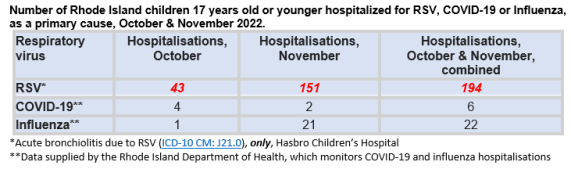
Despite the anguished media declarations, there was no Rhode Island paediatric ‘tripledemic’, at least through October and November. RSV, alone, accounted for around 90% (194 ÷ 222 = 87.4%) of so-called ‘tripledemic’ hospitalisations among Rhode Island children, and the rate of RSV hospitalisations (97 per month), was around seven-fold the rate of COVID-19 and influenza hospitalisations combined (14 per month). Moreover, the surrogate for RSV hospitalisations, a single International Classification of Diseases (ICD) RSV code (bronchiolitis, an inflammation of the smaller lung airways) omits RSV pneumonia and bronchitis coded hospitalisations. Certainly, omitting these ICD codes underestimates true paediatric RSV admissions.
The rate of primary (or ‘suspected‘ primary) COVID-19 pediatric hospitalisations mirrored what I discovered about the receding ‘Omicron wave’ from February to early June 2022. After weeks of wrangling, requiring an Access to Public Records Act submission to the Rhode Island Department of Health (RIDOH), supported by two state legislators, my query on paediatric COVID-19 hospitalisations in the first half of 2022 was answered on August 5th 2022. These data revealed that during the 16-week period from February 13th 2022 through June 4th 2022 there were a total of only 15 primary COVID-19 paediatric hospitalisations (for ages 0 to 17 years-old), as determined by RIDOH criteria. Notwithstanding this clinically insignificant, low ebb trickle of COVID-19 paediatric hospitalisations, RIDOH issued two memos recommending Rhode Island public schools re-institute compulsory masking (see RIDOH memos dated May 19th 2022 and May 20th 2022) for all school children in so-called “high COVID-19 transmission” districts.
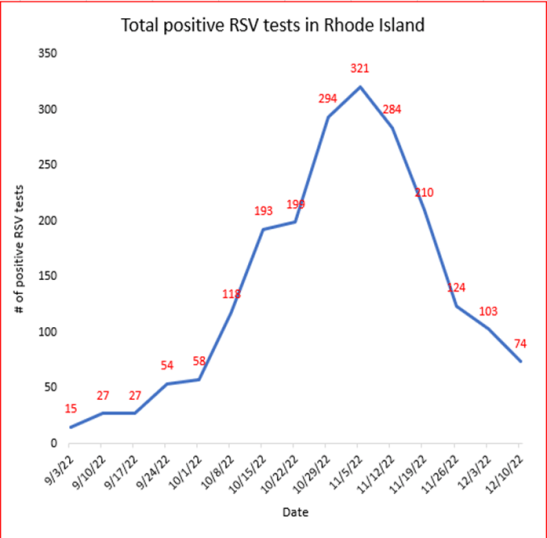
Present ‘tripledemic’ nonoccurrence aside, the overwhelmingly RSV-driven rate of increased paediatric respiratory illness hospitalisations in Rhode Island during October and November should decline significantly in December and January as RSV infection rates peaked in early November and declined precipitously through early December (see data from RIDOH, plotted below).
Additional reassuring national data from the Centers for Disease Control and Prevention (CDC) indicate the early influenza spike this year may be peaking in the U.S. overall as well, albeit not yet in New England. The third leg of the non-‘tripledemic’, COVID-19 paediatric infections, are not spiking in Rhode Island above rates observed since the summer and early autumn, while primary COVID-19 hospitalisation rates in children (see earlier table) remain exceedingly low.
Predictably, those Rhode Island medical thought leaders ginning up unwarranted concerns about the ‘tripledemic’ are once again, ad nauseum, pushing non-evidence-based masking and vaccination in children.
They ignore uniformly negative randomised controlled trials (RCTs) on community masking for the prevention of either influenza (12 RCTs; 10 here; also here and here) or COVID-19 (two RCTs; here, here), complemented by a small RCT in healthcare workers which demonstrated masks also failed to prevent RSV. While acknowledging the absence of a viable vaccine for RSV (but failing to mention the catastrophic failure of historical RSV ‘immunisation’), such thought leaders also ignore the absence of RCT data demonstrating either influenza or COVID-19 vaccines prevent hospitalisation from these respiratory illnesses in children.
The high rate of paediatric RSV hospitalisations alone in October-November should not be shrilly exploited by the media or so-called medical authorities to make counterfactual claims of an RSV, COVID-19 and influenza ‘tripledemic’. Instead, RSV, and now influenza, far more than COVID-19, should be accepted for what they are, i.e., part of the natural cycle of paediatric respiratory infections, and treated calmly, and with caring.
Dr. Andrew Bostom is a physician currently affiliated with the Brown University Center for Primary Care and Prevention, and was an Associate Professor of Medicine and Family Medicine at the Warren Alpert Medical School of Brown University from 1997 until June 2021. As a clinical trialist and epidemiologist he designed and completed the largest randomised controlled trial conducted in chronic kidney transplant recipients.
Court Says No, Biden Cannot Enforce Vaccine Mandates For Federal Contractors
By Steve Watson | Summit News | December 21, 2022
A 5th Circuit Court of Appeals ruled Monday that The Biden Administration cannot enforce a COVID vaccine mandate on federal contractors.
“The President’s use of procurement regulations to reach through an employing contractor to force obligations on individual employees is truly unprecedented,” the ruling noted, adding “As such, Executive Order 14042 is unlawful, and the Plaintiff States have consequently demonstrated a strong likelihood of success on the merits.”
Referring to Biden’s Executive Order, the ruling also stated that “Congress has not spoken clearly to authorize such a dramatic shift in the exercise of the President’s power under the Procurement Act.”
The vaccine mandate would affect up to 20 percent of people employed in the U.S., Reuters has noted.
Louisiana Attorney General Jeff Landry, one of the plaintiffs in the case issued a statement asserting that “Today is a victory for freedom,” and vowing “We will continue to stand up against the Biden Administration’s abuses of power that threaten us now and in the future.”
The Ruling comes a week after The Senate passed the National Defense Authorization Act, which lifted the COVID vaccine mandate for active duty military personnel.
Republicans in the Senate, led by Rand Paul, had threatened to block the legislation unless the mandate was scrapped.
While the mandate will be sidelined, some 8,000 troops who were given the boot for refusing to go along with it have not been reinstated.
GOP Senators Ron Johnson and Ted Cruz argued tnhatthe discharged troops should be reinstated with back pay, reasoning that the mandate was “illegal”.
However, Democrats stated that reinstating those service members would send the message that it’s acceptable to disobey orders.
“What we’re telling soldiers is, if you disagree, don’t follow the order and then just lobby Congress and they’ll come along and they’ll restore your rank, they’ll restore your benefits, they’ll restore everything, so orders are just sort of suggestions,” Senate Armed Services Committee Chairman Jack Reed, D-R.I., said on the Senate floor. “They’re not.”
Some of the service members are taking the fight to the courts.
Hungarian Parliament Speaker: West’s Push to Turn Ukraine Into Anti-Russian Bridgehead is a ‘Strategic Mistake’
Samizdat – 21.12.2022
Budapest has stood alone among NATO’s Eastern European flank in rejecting the transfer of weapons to Ukraine via its territory. Prime Minister Viktor Orban has essentially labeled the Ukrainian conflict a Russia-US proxy war, citing the need for peace talks between Russia and the US, rather than Moscow and Kiev, for the conflict to stop.
Hungarian Parliament speaker Laszlo Kover has lashed out against Western governments’ “hypocritical” behavior in Ukraine, and warned that the West’s attempts to pry Kiev out of Russia’s orbit and turn it into an armed base against Russia has proven to be a “strategic mistake.”
“I think the Western world made a strategic mistake when it tried to not only take Ukraine out of Moscow’s sphere of interest, but also turn it into a large military base against Russia,” Kover said in a broad ranging interview with a Hungarian radio station on Tuesday.
Asked whether he sees any prospects for a diplomatic resolution to the crisis, Kover said that if he “wanted to be cynical,” he would point out that Western countries have already found a workaround, by “proclaiming the protection of European values and international law and accusing Russia of all kinds of crimes, with basis or without basis. In the meantime, they have tried to stock up on Russian oil and gas, so their trade volume with Russia actually jumped radically after sanctions were announced.”
The politician, who is a member of Prime Minister Orban’s Fidesz party, accused Hungary’s European allies of engaging in a “hypocritical show” in Ukraine and behaving in a “terribly hypocritical and irrational” way, destroying their own economies, even as the United States “has embarked on the path of an openly protectionist economic policy,” by setting up trade barriers to European automobiles, for example, making American cars 25-30 percent cheaper than their European-made counterparts.
“This is clearly offensive. It violates all kinds of free trade rules and agreements, and of course violates the legitimate interests of European car manufacturers. Now, compared to this [the crisis with Russia, ed.] the leaders of the EU member states and the European Council are watching events with drooling glee, and we haven’t seen even a harsh outburst or verbal reaction, lest they take some kind of countermeasure, some kind of defensive step,” Kover complained.
The parliament speaker suggested that from the “first moment” of the Russia-West proxy conflict in Ukraine, the goal was to try to “destroy Russia economically, politically, in every sense” and to separate Moscow from the European Union, “to create a new Iron Curtain,” no matter the cost to Europe.
“This means in practice that the space of continuous economic and political cooperation based on mutual, fair consideration of interests, which could have been created in a unified Eurasia stretching to Portugal to say, Southeast Asia, seems to be falling apart at this moment, and I think that the damage caused by this conflict will stay with us for the rest of our lives,” Kover said.
Kover stressed that Hungary’s position has been and remains to defend its elementary economic interests by withdrawing from some EU-level sanctions against Russia “to prevent decisions that harm us more than Russia.” The official added that “the whole sanctions regime has hurt Europe much more than Russia, and I think we should fight here in Central Europe so that this scenario, where we become the eastern periphery of a North Atlantic empire, does not come true.”
Kover reiterated that measures were necessary “to try to end this armed conflict as quickly as possible,” even if it takes “years before this can take the form of some kind of peace treaty.” In the meantime, “we should try to create a new Central European or pan-European peace system in which each [country’s] security needs are taken into account by the other side,” the official said.
As for NATO’s role in the Ukraine crisis, Kover urged the Western alliance to stick to preparing to defend the sovereignty and security of alliance members, and not allow the bloc to drift into a hot war with Russia. “It’s very close to it anyway, because while no NATO members are involved in the war de jure… when a country supplies weapons to another that is at war or when a country or political community tries to destabilize the economic life of another country via various sanctions, blockades or the freezing of assets, this can be considered a kind of warfare.”
Relations between Hungary and Ukraine have been strained since the 2014 Euromaidan coup, which brought nationalist forces to power in Kiev which gradually moved to deprive the 150,000-strong community of ethnic Hungarian Ukrainians living in western Ukraine of their rights, including the right to receive an education in their native tongue.
Amid the escalation of the crisis, Hungarian and Ukrainian officials have gotten into a series of vicious verbal spats, with Ukraine’s Foreign Ministry asking Kover to produce a note from a psychiatrist on his mental state after the speaker suggested that Ukrainian President Volodymyr Zelensky was suffering from a “mental problem.”
Twitter and Facebook chiefs practiced how to handle “fake” Hunter Biden docs, PRIOR to real story breaking
A “tabletop exercise” that was supposedly hypothetical
By Cindy Harper | Reclaim The Net | December 20, 2022
The latest batch of Twitter files, released by independent journalist Michael Shellenberger, revealed that the Aspen Institute held a “tabletop exercise” to influence coverage of a possible future Hunter Biden story. This was prior to the actual Hunter Biden laptop story breaking.
Shellenberger posted documents from the event held in September 2020, which was attended by Twitter’s former head of trust and safety, Facebook’s head of security policy, and top national security reporters at The Washington Post and The New York Times.
View the documents here.
The exercise by Aspen Digital involved an 11-day scenario which started with the imaginary release of “fake” documents related to Hunter Biden’s employment by Ukrainian energy company Burisma.
The company paid the younger Biden $1 million to serve on its board at a time when his father was the Vice President.
According to Shellenberger, “The goal was to shape how the media covered it [the Hunter Biden story] – and how social media carried it.”
The exercise was put to the test just a few weeks later when the New York Post first reported on Hunter Biden’s laptop, which it obtained after Hunter abandoned the laptop at a repair shop in Delaware. The mainstream media either downplayed or ignored it, while social media companies, including Twitter and Facebook, suppressed it.
On October 17, 2020, three days after The Post broke the story, journalist Garrett Graff sent a message to others who participated in the Aspen Institute exercise, saying, “Stephen was right!” However, it is not clear who Stephen is.

The exercise was organized by a former executive at National Public Radio, Vivian Schiller, NBC News, and The New York Times, according to Shellenberger. Schiller has been the executive director of Aspen Digital since January 2020.
The Aspen Institute claims that it “empowers policymakers, civic organizations, companies, and the public to be responsible stewards of technology and media in the service of an informed, just, and equitable world.”
In 2019, the institute, which holds week long seminars and a yearly 10-day “Ideas Festival” attended by business leaders, celebrities, and politicians was described by The Economist as “the mountain retreat for the liberal elite.”
Biden Says ‘Thrilled’ to Meet Zelensky at White House

Samizdat – 21.12.2022
WASHINGTON – US President Joe Biden said he is “thrilled” to welcome Volodymyr Zelensky at the White House later on Wednesday.
“I hope you’re having a good flight, Volodymyr. I’m thrilled to have you here. Much to discuss,” Biden tweeted.
The two leaders will discuss a range of topics, including battlefield strategy in Ukraine, energy, and sanctions against Russia, among other matters, a senior US official told reporters.
The US president is also expected to announce a new $2 billion security assistance package that will include a Patriot air defense system, the official said.
Zelensky is due to visit the White House on Wednesday afternoon before delivering an address to a joint session of the US Congress later in the evening, according to US officials.
Featured Video

Why Hamas Really Attacked Israel on Oct. 7
or go to
Aletho News Archives – Video-Images
From the Archives
Israel: Strategic Ally or Liability?
By Stephen Sniegoski | My Catbird Seat | June 12, 2010
The claim that Israel serves as a valuable ally for the United States is made by both pro-Zionists and much of the anti-war and anti-Zionist Left that is influenced by Noam Chomsky. As a result of the Gaza flotilla massacre, which has caused a world-wide uproar against Israel, the value of Israel to the United States is being publicly questioned in more mainstream foreign policy forums. … continue
Blog Roll
 Aletho News
- Why Hamas Really Attacked Israel on Oct. 7
- Declassified UK exposes British man who fought for ‘Israel’ in Gaza
- West’s death cult in a theater near you
- How the Yandex ‘Russian bots’ lie fell apart
- Burnham’s ‘Russia did Brexit’ ruse crumbles
- Estonia making movies and games to encourage war against Russia
- Four in five new UK jobs taken by foreigners – report
- Here’s what Trump’s latest U-turn really means for Russia and Ukraine
- The Houthis Are Not an Iranian Proxy
- Europe’s Energy Hypocrisy, Russian LNG Profits and US Dependence
- If Americans Knew
- Activists Abused By Israel Return to New Freedom Flotilla Mission
- 60 Minutes won’t tell the full truth about Israeli settler violence
- Nearly 50,000 women, girls killed or severely injured in Gaza since October 2023: UN Women
- ADL is working with AI companies to suppress alleged ‘antisemitism’
- Israeli occupation forces using social media surveillance unit to target hundreds of Palestinians in the West Bank
- Israel’s New – and Terrifying – Security Doctrine
- Israeli Attacks Kill Five in Gaza, Including a four-year-old and a woman
- Air Force Major Who Called for Trump’s Impeachment Held in Solitary Confinement
- It’s a Genocide, I’m Into It’: Seinfeld Mocks Protest over Palestinian Children Killed
- Universities fire dozens amid pressure from Zionist billionaires
- No Tricks Zone
- New Study Suggests Large Regions Of The Pacific Ocean Have Been Cooling For The Last 80 Years
- Germany’s Green Energy Debacle: High Energy Costs Force Kahla Porzellan to Close After 182 Years!
- New Study: 50 Years Of The Most Aggressive ‘Net Zero’ Policies Can Only Affect The Global Climate By 0.03°C
- US September “Heat” Was No Record…Many Records Set Decades Ago
- Latest European Green Energy Debacle; Portugal’s Largest Flagship Solar Park Insolvent!
- Green Energy Debacle: German Expert Professor Fritz Vahrenholt Warns Of Severe Economic And Social Consequences
- Two More Paleo Reconstructions Affirm Meters-Higher Sea Levels Across Ireland, Brazil 7000-6000 Years Ago
- New Study: Earth And Venus Surface Warmth Largely Explained By Convection And Lapse Rate, Not CO2 Or Radiation
- 2025 Nature Paper Claiming Worsening Global Drought Gets RETRACTED …Heavily Flawed
- New Study: ‘Global Drought Shows No Detectable Recent Acceleration Under Climate Warming’

