The FBI: A Campaign Arm of the Democrat Party
By Brian C. Joondeph | American Thinker | August 29, 2022
“Fidelity, Bravery, and Integrity” is the FBI motto. According to the FBI website, this motto, “Succinctly describes the motivating force behind the men and women of the FBI.”
The motto may have been accurate in the 1965-1974 TV series, “The FBI”, where Efrem Zimbalist Jr epitomized those words every Sunday night on prime-time television. But today the FBI has morphed into a campaign arm of the Democrat Party, attempting to influence elections in favor of their preferred candidates, acting more like the East German Stasi or Soviet KGB rather than the premier law enforcement agency in the world.
Perhaps a new motto of “Funny Business Incorporated” or “Friendly to Biden Interests” would be more appropriate to their apparent new mission. When did the FBI, the largest and most heavily armed law enforcement agency in America, now inserting itself unconstitutionally into American politics, pivot from fidelity and integrity to partisanship and dishonesty?
Start with the 2016 presidential election. Many are already familiar with Spygate. According to Jeff Carlson:
Efforts by high-ranking officials in the CIA, FBI, Department of Justice (DOJ), and State Department to portray President Donald Trump as having colluded with Russia were the culmination of years of bias and politicization under the Obama administration.
The weaponization of the intelligence community and other government agencies created an environment that allowed for obstruction in the investigation into Hillary Clinton and the relentless pursuit of a manufactured collusion narrative against Trump.
A willing and complicit media spread unsubstantiated leaks as facts in an effort to promote the Russia-collusion narrative.
The Spygate scandal also raises a bigger question: Was the 2016 election a one-time aberration, or was it symptomatic of decades of institutional political corruption?
The FBI was in the middle of this true insurrection, meant to derail a presidential campaign, election, transition, and administration with fabricated claims of collusion, lying to Congress and the American people, and then attempting to cover everything up via the Muller/Weissman investigation, including a recent raid on Mar-a-Lago to possibly confiscate incriminating Spygate documents in President Trump’s possession.
Other Obama administration agencies and officials were also involved but the FBI was in the thick of it, with Director James Comey and Deputy Director Andrew McCabe. Other familiar names include Deputy Assistant Director of Counterintelligence Peter Strzok and his girlfriend FBI attorney Lisa Page.
Don’t forget another FBI attorney Kevin Clinesmith who knowingly lied on a FISA warrant application about Carter Page’s work for the CIA. Despite pleading guilty to a felony false statement charge, Clinesmith is once again free to practice law. Are any of the January 6 detainees recipients of such judicial largess?
There has been little or no reckoning for these Spygate players and rather than being punished for their criminal and seditious activity, they have been rewarded with university teaching gigs, book deals, and frequent appearances on left-wing cable news shows. Perhaps Special Counsel John Durham will eventually hold the FBI bad actors to account, but Spygate is now six years in the past and it is looking increasingly likely that the FBI will skate.
Jeff Carlson raised the interesting question of whether Spygate was a one-off event or part of a larger and more systemic corruption of the FBI and other three-letter agencies. Despite not derailing candidate or President Donald Trump in 2016, they certainly tried again in 2020, this time succeeding. And they are already working on 2024, before a single candidate has announced his or her candidacy.
The FBI obtained Hunter Biden’s laptop in December 2019, a full year before the presidential election. Rather than investigating and reporting on what they found, they slow rolled the laptop as it revealed knowledge of and involvement in foreign business deals with candidate Joe “Big Guy” Biden and his son Hunter, in a manner that could be construed as a quid pro quo of selling the office of the president to foreign interests.
A letter from Senator Ron Johnson to Justice Department Inspector Michael Horowitz spelled out the FBI’s role in again “campaigning” for the Democrat candidate. Senator Johnson asserted the following,
Whistleblowers have come forward to Congress alleging that FBI officials intentionally undermined efforts to investigate Hunter Biden.
After the FBI obtained the Hunter Biden laptop from the Wilmington, DE computer shop, these whistleblowers stated that local FBI leadership told employees, “You will not look at that Hunter Biden laptop” and that the FBI is “not going to change the outcome of the election again.” Further, these whistleblowers allege that the FBI did not begin to examine the contents of Hunter Biden’s laptop until after the 2020 presidential election — potentially a year after the FBI obtained the laptop in December 2019.
And influence an election they did. Media Research Center conducted a poll of 1,750 voters in seven swing states and learned that, “One of every six Biden voters (17%) said they would not have voted for him had they known the facts about several of the news stories the national media refused to investigate thoroughly because they might have hurt his candidacy.”
Jesse Watters noted that the 2020 presidential election was decided by 44,000 votes in Georgia, Wisconsin, and Arizona. The FBI suppressing the Hunter Biden laptop story would have been more than enough to account for this margin if the above survey was reflective of voter sentiment, demonstrating how the FBI interfered with and likely altered the outcome the election.
Not only did the FBI interfere directly, they also urged social media to do the same, the government suppressing the right to free speech by proxy. Meta CEO Mark Zuckerberg explained to Joe Rogan recently,
Speaking on an episode of The Joe Rogan Experience, Zuckerberg explained, “The FBI, I think, basically came to us — some folks on our team — and was like, ‘Hey, just so you know, like, you should be on high alert… We thought that there was a lot of Russian propaganda in the 2016 election. We have it on notice that, basically, there’s about to be some kind of dump of that’s similar to that. So just be vigilant.’”
Zuckerberg acknowledged that “the distribution on Facebook was decreased” of the New York Post’s story about Hunter Biden’s laptop, noting, “fewer people saw it than would’ve otherwise.”
The FBI had the laptop for almost a year and right before the election conveniently declared it Russian propaganda, a falsehood parroted by “51 former intelligence officials.” The FBI, and Big Tech under FBI encouragement, fabricated and spread Russian propaganda in 2016 when it could hurt the Republican candidate and suppressed and censored a real story in 2020 it when it could hurt the Democrat candidate. That certainly sounds like election interference.
The Mar-a-Lago raid is a shot across the bow for any GOP presidential candidates for 2024, Trump being the presumptive nominee at this point. Will the FBI ask the DoJ to indict Trump on nonsensical declassification accusations? While they gave candidate Hillary Clinton a pass despite her using an unsecured server and personal email account to traffic highly classified emails? The FBI is delivering a warning to Trump. Will Governor Ron DeSantis be the next one to have his home raided by the FBI?
We expect this type of behavior from the corporate media, academia, Hollywood, big finance, big pharma, big tech, and other Democrat party constituent groups, but not the FBI and other government agencies.
This is a true insurrection, not the nonsense “soon to be former” representatives Liz Cheney and Adam Kinzinger are bloviating over. And where are congressional Republicans? Most are voicing support for the FBI, ignoring this blatant subversion of democracy and the Constitution.
Perhaps most Republicans support the new FBI mission — stopping Donald Trump at all costs, ignoring the weaponization of the federal government against political enemies. Will voters reward milquetoast Republicans, most of whom are no better than their Democrat colleagues across the aisle, or will many say “why vote Republican,” throwing up their hands on election day, not wasting time on meaningless elections? Such a strategy may not lead to an expected red wave.
Is a weaponized national police force something the Founding Fathers wrote into the Constitution? Or just another example of America sliding from a representative republic into a totalitarian state?
Brian C Joondeph, MD, is a physician and writer.
Truth Social @BrianJoondeph
DHS wants to continue its “disinformation” work, flag “falsehoods” to social media platforms
By Tom Parker | Reclaim The Net | August 29, 2022
The Department of Homeland Security’s (DHS’s) controversial “Disinformation Governance Board” was recently shut down after First Amendment concerns but the DHS seemingly still intends to continue its “disinformation” work.
A recent report from the Homeland Security Advisory Council’s “Disinformation Best Practices and Safeguards Subcommittee” states that while “there is no need for a separate Disinformation Governance Board… the Department must be able to address the disinformation threat streams that can undermine the security of our homeland.”
The report was produced after DHS Secretary Alejandro Mayorkas asked the subcommittee to make recommendations for how the DHS can “most effectively and appropriately address disinformation that poses a threat to the homeland while protecting civil rights and providing greater transparency across this work.”
In the report, the subcommittee provides a broad definition of disinformation, outlines how the DHS detects and mitigates information that falls under the scope of this definition, and provides the subcommittee’s recommendations.
The far-reaching definition of disinformation includes both deliberate and unintentional spreading of “falsehoods.” The subcommittee also deems the “intentional spreading of genuine information with the intent to cause harm” to be a form of disinformation and uses “moving private and personal information into the public sphere” as an example of this type of disinformation.
The report outlines how several US government agencies that fall under the DHS’s purview, including the Office of Intelligence and Analysis (I&A), the Federal Emergency Management Agency (FEMA), and Customs and Border Protection (CBP), surveil online messages, forums, and social media to identify disinformation, “rumors,” and “attitudes related to migration.”
It also notes that the Cybersecurity and Infrastructure Security Agency (CISA), which also falls under the purview of the DHS, flags “disinformation campaigns utilizing social media” to social media companies “for whatever action those companies see fit to take.”
In the recommendations section of the report, the subcommittee insists that the DHS’s work on disinformation is “critical” and that the DHS “needs the ability to identify, analyze, and, where necessary, address certain incorrect information.”
The subcommittee adds that the DHS should be able to flag disinformation to social media platforms:
“The Department can and should also bring such disinformation to the attention of other government agencies for appropriate action and to platforms hosting the falsehoods. It is for the platforms, alone, to determine whether any action is appropriate under their policies.”
While the report recommends that the DHS should maintain its broad powers to surveil disinformation and flag it to social media platforms, the subcommittee insists that these activities will be “consistent with the law and the relevant civil rights and privacy protections.”
We obtained a copy of this Disinformation Best Practices and Safeguards Subcommittee report for you here.
We obtained a copy of the appendix to this report (which contains examples of DHS products and activities that address disinformation) for you here.
This report and its recommendations were published on the same day that the DHS officially shut down its Disinformation Governance Board. This board was introduced in April but days after it was introduced, 20 states threatened legal action and branded it an “unacceptable and downright alarming encroachment on every citizen’s right to express his or her opinions, engage in political debate, and disagree with the government.”
While the DHS’s activities related to the Disinformation Governance Board generated mass controversy, the DHS was surveilling “misinformation” and accused of surveilling money transfers before the board was even introduced. It also has contracted with a social media surveillance company that provides surveillance software.
The recommendation that the DHS should flag alleged disinformation to social media was published one day before the Federal Bureau of Investigation’s (FBI’s) use of this tactic in the run-up to the 2020 US presidential election came under fresh scrutiny.
The scrutiny began after Facebook CEO Mark Zuckerberg appeared on The Joe Rogan Experience Podcast and said the FBI had warned Facebook about a “dump” of “Russian disinfo” just before the New York Post published a story alleging that Joe Biden and his son Hunter Biden had engaged in an alleged corruption scandal. This story was published a few weeks before the 2020 US presidential election and was censored by Facebook and other Big Tech platforms. At the time, many politicians and journalists blasted Big Tech for censoring a story that was unfavorable to then-Democratic presidential candidate Joe Biden. A recent poll found that 79% of Americans who followed the story believe that “truthful” coverage would have changed the outcome of the 2020 election.
Government agencies, such as the DHS and the FBI, defend this practice of flagging alleged disinformation to social media companies by insisting that they’re not directing the companies to censor and that it’s up to the platforms to decide whether they want to remove the information that’s flagged to them.
However, internal chats have revealed that when government agencies or officials flag information or accounts to platforms, they do sometimes apply pressure. For example, recently released internal Slack messages show Twitter employees discussing the White House branding journalist Alex Berenson “the epicenter of disinfo” and questioning “why Alex Berenson hasn’t been kicked off from the platform” four months before he was banned.
Diplomatic Immunity, American-Style
BY LARRY ROMANOFF • UNZ REVIEW • AUGUST 28, 2022
In a recent podcast, Kevin Barrett stated that the rule of law has disappeared in the US. This is so obviously true to outsiders looking in, and is even more true of American official conduct abroad, but I find myself wondering about the extent to which Americans generally are aware of this and how it is perceived.
In days gone by, this lawlessness was usually deeply buried and obfuscated but today it seems there is no longer even a pretense of any rule of law. We see this most recently in the so-called “sanctions” the US so freely applies to countries and individuals, being no more than illegal rampaging and looting.
But there is another category that may not be as visible and yet is indicative of an extreme breakdown of the rule of law, this applying to the category of “diplomatic immunity”, real or imagined, where the US government absolutely treads on a one-way street. This article is only a brief introduction with a few examples of hundreds that could be cited.
Devyani Khobragade

On late 2013 an Indian diplomat, 39-year-old Devyani Khobragade, was the Deputy Consul-General in New York, and by all reports had an excellent reputation and was honorably discharging her consular duties. But then she was suddenly charged with submitting false documents to obtain a work visa for a housekeeper. She was arrested and handcuffed while dropping her daughter off at school, was taken to a police station and strip-searched, given a body cavity search, then put into a cell with drug dealers and held there until she was finally released on $250,000 bail.[1]
 The Federal Prosecutor, Preet Bharara, claimed agents had arrested her “in the most discreet way possible”, having doing so in full view of her daughter, her daughter’s friends, and most of the teachers and students. He said “there can be no plausible claim that this case was somehow an injustice”, calling her treatment “standard procedure” even for diplomatic personnel, claiming further that during her strip and cavity searches she had been “accorded courtesies well beyond what other defendants are accorded, most of whom are American citizens.” He claimed these procedures were “standard practice for every defendant, rich or poor, American or not, in order to make sure that no prisoner keeps anything on his person that could harm anyone, including himself”. He said his office’s sole motivation was to uphold the law, protect victims and hold lawbreakers accountable, “no matter what their societal status and no matter how powerful, rich or connected they are”.[2][3][4][5] It staggers the imagination and leaves us numb and unable to respond when faced with such incredibly shameful lies.
The mess was later blamed on a “mistake”, a claim that the low-level agent who drew up the charges against Ms. Khobragade had confused two documents – Ms. Khobragade’s US visa application and that of the employment contract with her housekeeper – and “misunderstood” Ms. Khobragade’s salary as the amount she meant to pay her maid. Yet those two documents are in an entirely different format and could not possibly have been confused one with the other. It would appear that no visa fraud actually occurred after all, and it was further discovered Ms. Khobragade was after all attached to the UN as an advisor, which function unquestionably granted her full diplomatic immunity. The US State department repeatedly refused to acknowledge her diplomatic status but let her leave the country.[6]
However, and if all the claims had been true, this really would have been at most a simple issue of a wage mis-statement which is a misdemeanor offense and not a felony, and would normally be investigated by the Department of Labor. In fact, this is a common issue with many foreign household and agricultural workers in the US, and also occurs daily with restaurant workers, but never in the history of America has a restaurant or farm owner been arrested and strip-searched because of a low-level wage or visa dispute. And for such a minor offense the bail is usually around $5,000, not $250,000. So what really happened?
Well, only a few weeks before being abruptly arrested and strip-searched in New York, Ms. Khobragade had managed to make some powerful enemies in the US pharmaceutical industry about India’s treatment of US so-called intellectual property. The Indian government and courts have taken IP actions that angered the Americans, including denial to US firms of pharmaceutical patents that were not a true innovation, and permitting compulsory licensing for production of generic medicines. The US Chamber of Commerce (AmCham) was hysterical at India’s actions, referring to “unprecedented patent revocations and denials” and accusing India of being “an outlier in the global economy”. AmCham’s “Global IP Center” held a public event in New York at which it attacked India’s practices, and at which Ms. Khobragade was “outspoken” in defense of her country’s practices, and where she engaged in “debate” with US industry executives, demanding that in future an Indian representative be given a formal place at these events to present India’s side of the story. Shortly thereafter, US officials were busy cavity-searching, humiliating, and deporting the woman who dared confront the IP kings of AmCham and the US pharma industry.
Preet Bharara later confirmed in an autobiography that Devyani Khobragade was indeed strip-searched and cavity-searched, and acknowledged, “That could have and should have been avoided, given that no one would have sought pretrial detention.”[7]
A bit too little and a bit too late.
The official position of all civilised nations toward a foreign diplomat resident in their countries is that “He is a diplomat and has the privileges of a diplomat. If you’re a diplomat and you commit any crime, the case is investigated and is forwarded to your embassy. That’s what the law says and we work within the law”. However, the official position of the American government toward foreign diplomats in the US is different. A State Department “guidance paper” for American law enforcement officials on how diplomatic immunity works even at the highest levels says that “diplomatic immunity is not intended to serve as a license for persons to flout the law and purposely avoid liability for their actions. The purpose of these privileges and immunities is not to benefit individuals but to ensure the efficient and effective performance of their official missions on behalf of their governments.”
In short, a foreign diplomat in the US has no immunity against prosecution by the US government for offenses real or imagined, but US citizens in other nations, diplomats or not, have full immunity even when clearly engaged in illegal activities that include drunk or reckless driving, espionage, and murder.
There are literally hundreds of cases where US consular officials in all countries regularly flout domestic labor and many other laws. American employment contracts in other countries are regularly violated with impunity, and typically specify that all staff issues including compensation will be decided exclusively by the US consular staff with no recourse to either domestic or US law – contract wording that is itself illegal, since no contract anywhere can eliminate recourse to local courts. But then, these are Americans, and their world is apparently different than ours. Americans in all countries violate both domestic tax laws and their visa status, in all cases being protected by the US government claiming “diplomatic status” for those who are clearly non-diplomats.
Raymond Davis

Here is another incident, this one from the other side of the fence. In January of 2011, CIA agent Raymond Davis was driving down a street in Lahore, Pakistan, when he stopped at a red light. A motorbike carrying two Pakistani Intelligence agents keeping Davis under surveillance due to suspicion of criminal activities, pulled in front of his car. Davis drew an automatic weapon and killed both men, claiming they had attempted to rob him and that he acted in self-defense.[8][9]
But the documented facts from multiple witnesses clearly proved that Davis initiated the violence. When the motorcycle stopped in front of his car, Davis first fired five shots through the windshield, killing one man and injuring the other, then got out of his vehicle, shot four more rounds into the two men as they lay on the pavement, then four more shots into one man’s back as he was trying to crawl away, killing him as well. Witnesses testified that Davis then walked back to his car, called for backup on a military radio, then took photos of the men he had just killed. One witness who watched from his restaurant across the street, said he was amazed at the American’s manner. “He was very peaceful and confident. I was wondering how he could be like that after killing two people,” he said.
Minutes later, four Americans in a Toyota jeep with fake registration plates left Davis’ home and made a frantic but unsuccessful attempt to reach Davis and rescue him. Finding their vehicle trapped in a traffic jam, they crossed the median and traveled against the oncoming traffic, colliding with a motorcycle and killing the driver. After the accident, they fled the scene and drove at high speed to the US Embassy, jettisoning many bits of evidence along the way including 100 bullets, knives, gloves, a blindfold. Witnesses later told police that one American opened the door to their vehicle, displayed a rifle and threatened to kill anyone who got in their way.
Davis also attempted to escape in his vehicle but was apprehended and charged with double murder, espionage and the illegal possession of a firearm. Although Davis was part of the CIA’s Global Response Staff, he was at the time doing some contract espionage work for Xe Services, the private company formerly known as Blackwater that was involved in a multitude of scandals in Iraq that included mass murders and many other crimes. Items recovered from Davis’s car included a Glock handgun, an infrared light, a portable telescope, GPS equipment, two mobile phones, a satellite phone, 9mm ammunition, multiple ATM and military ID cards, multiple ID cards from several different US consulates, facial disguise and makeup, and a camera. According to Pakistani officials, Davis’ camera contained photos of “prohibited areas such as installations along the border with India”, stating “This is not the work of a diplomat. He was doing espionage and other activities”.[10][11][12][13]
Then-US President Obama demanded that Pakistan free “our diplomat” under the Vienna convention rules, and the State Department exerted fierce and unrelenting pressure on Pakistan to release Davis. US officials insisted Davis was a diplomat doing “technical and administrative work” at the embassy and had to be treated as such, though he was a common criminal in the country on a tourist passport, had no diplomatic credentials and no consular functions. Pakistani officials demanded the US turn over for questioning the men in the Embassy who had attempted to rescue Davis and had killed the motorcyclist, but the Americans refused and spirited the men out of Pakistan. Davis was released after the families of the two killed men were paid $2.4 million in what is called “blood money”.
Joshua Walde

In another incident, in August of 2013 an American diplomat, Joshua Walde, an information management officer at the US Embassy in Nairobi, Kenya, was driving his SUV at a high rate of speed when he made an illegal turn, crossed the highway center line, and rammed into a full mini-bus, killing a father of three whose widow was six months pregnant, and seriously injuring eight other people.[14] (15) US Embassy officials in Nairobi took advantage of Walde’s diplomatic immunity and rushed the American and his family out of Kenya the next day, leaving the crash victims with no financial assistance. Officials noted that embassy employees are typically evacuated “for medical evaluations” after traumatic events but also are flown out of a country “to avoid any possible retribution”. Hilary Renner, a State Department spokeswoman in Washington, said the embassy extends “its deepest condolences” to the family of the dead man, and “wishes a speedy recovery” to those injured.
Anne Sacoolas

More recently we had the case of Anne Sacoolas, the wife of an American employed at a UK consulate, who was formally charged in the death of British teenager Harry Dunn. Sacoolas was driving her car on the wrong side of the road, perhaps while impaired, and crashed into Dunn’s motorcycle, killing him. Sacoolas spoke later to the police, but then immediately headed for the airport and left the UK, claiming “diplomatic immunity” when of course she had none. However, the Americans refused to release her to return to the UK to stand trial.[16][17] Once safe at home in the US, Ms. Sacoolas offered to perform some “community service” as penance. Here are some media details if you are interested in more information:[18][19][20][21][22][23]
Julia Bravo

A current case is that of an American soldier in Italy, a young woman named Julia Bravo, who has been charged with vehicular homicide. Prosecutors in Pordenone, in Italy’s Northeast, charged the 20-year-old female soldier stationed at the US Air Force’s Aviano Air Base with vehicular manslaughter in the auto death of a young boy in Italy.
According to witness testimony, Bravo had left a disco in the small hours of the morning, was subsequently seen driving erratically on the road, drove over and through a traffic circle, crossed a median, crashed through a group of road signs at high speed and hit a group of young boys walking on the roadside, killing one of them instantly. According to an eyewitness who had been partying in the same club, Bravo was so drunk “she couldn’t even turn the ignition on”, and at first drove off in the opposite direction of her military base. The police said her blood-alcohol level was four times the legal limit.
The dead boy’s mother said, “We all know that the soldiers on the Aviano base in this area do what they like, that they don’t respect the rules. There have been many incidents in the past that involved American troops. They have the freedom to do whatever they like and not be punished.” The mother told the Corriere della Sera newspaper that she wanted the soldier tried in Italy. “I don’t trust the American justice system.” However, the chance of that appears slight since the US Embassy is apparently exerting enormous pressure on the Italians to have the woman sent to the US for a “prosecution” which will never take place.[24][25][26][27][28]
However, being American, our sympathies must lie with the perpetrator. Her lawyer told the Italian media that his client was “extremely emotionally exhausted” from expressing her remorse and apologising to the family.
Capt. Richard Ashby

There have been many such occurrences involving US military personnel in countries throughout Europe and Asia, and invariably with the US applying immense diplomatic and military bullying to prevent Americans from being subject to the laws of any country. One notable case occurred some years back where a Capt. Richard Ashby, flying a military jet aircraft in Northern Italy, was displaying what he boasted as a “daredevil stunt” and severed the cables of a cable car line at an Italian ski resort, sending 20 people to their death. The military restrictions prohibited flight below 1,000 feet above ground level and at speeds more than 500 mph. Ashby was flying his aircraft at little over 300 feet and at more than 1,000 Kph when the accident occurred.[29][30][31]
Italian prosecutors had wanted four US airmen, including Ashby and his co-pilot, Capt. Joseph Schweitzer, and three officers from the US base at Aviano, to face charges of manslaughter and endangering the safety of transport, but the Americans bullied the Italians into surrendering the prisoners to an American court. Naturally, all were found not guilty of all charges. The Italians were infuriated, but there was nothing to be done. People still ask today why has no one has even been held to account for that tragedy.[32][33]
Epilogue
One of the distressing features of today’s world is that it is not only the US that has apparently abandoned any pretense of adhering to a rule of law; most other Western nations are as guilty, and some perhaps even more so.
Think of Canada during the recent truckers’ protest in Ottawa. Prime Minister Justin Trudeau first had the nation’s law enforcement agencies track down the ownership of the vehicles and extort the insurance companies into canceling the insurance on all the trucks. When that failed, they used every manner of access to determine the identity of all protesters and forced the banks to freeze the accounts of all participants. When that still failed to frighten off the protesters, Trudeau had the local governments begin seizing the semi-trailers and selling them ($150,000 to $200,000 each) “to pay the costs of monitoring the protest”. All actions were openly and reprehensibly illegal, against all manner of law and justice, but seemingly of no concern.
It is incredible, unbelievable, that the government of any civilised country, the so-called democracies and “free nations”, could behave in such a manner, and yet this is where we are. The few examples in this essay are of rampant criminality and the immunity that comes with uncontrolled power in the hands of the wrong people. It is no longer a matter of law but of power to do. The US government recently confiscated the entire assets of Afghanistan’s central bank and arbitrarily decided to “donate” the money to American 9-11 victims. That is not different than seizing the assets of Russia’s central bank, and keeping the money, not different than seizing a $100 million yacht owned by an innocent individual, and selling it and keeping the money – because he’s Russian.
We see articles today warning us of the impending degeneration of the US and the West into totalitarian fascism, but that’s a delusion: we’re already there, but nobody seems to know. If you are on the wrong side of the political fence today, your life could easily become miserable and short. Dissidence is no longer a requirement; innocent questioning of the official narrative will be sufficient. By the time everyone wakes up, it will be too late and we will be in the middle of World War Three.
Mr. Romanoff’s writing has been translated into 32 languages and his articles posted on more than 150 foreign-language news and politics websites in more than 30 countries, as well as more than 100 English language platforms. Larry Romanoff is a retired management consultant and businessman. He has held senior executive positions in international consulting firms, and owned an international import-export business. He has been a visiting professor at Shanghai’s Fudan University, presenting case studies in international affairs to senior EMBA classes. Mr. Romanoff lives in Shanghai and is currently writing a series of ten books generally related to China and the West. He is one of the contributing authors to Cynthia McKinney’s new anthology ‘When China Sneezes’. ([Chapt. 2 — Dealing with Demons]).
His full archive can be seen at https://www.bluemoonofshanghai.com/ + https://www.moonofshanghai.com/
He can be contacted at: 2186604556@qq.com
Notes
[1] https://www.theweek.in/news/india/2020/10/01/devyani-khobragade-whose-arrest-led-to-india-us-spat-made-envoy-to-cambodia.html#:~:text=Devyani%20Khobragade%20was%20charged%20and%20arrested%20by%20US,by%20paying%20her%20less%20than%20the%20stipulated%20wages
[2] IFS officer Devyani Khobragade, who was stripped searched in US, promoted after 7-month wait
[3] Who is Devyani Khobragade, the Indian diplomat at the center of the firestorm?
[4] Indian diplomat Devyani Khobragade leaves US under immunity
[5] U.S. officials made a mistake that led to Indian diplomat’s arrest and strip search over visa application for maid
[6] Devyani Khobragade: Diplomat row charges dropped in US
https://www.bbc.com/news/world-us-canada-26554245
[7] Preet Bharara says diplomat was strip-searched, could’ve been avoided
[8] American who sparked diplomatic crisis over Lahore shooting was CIA spy
https://www.theguardian.com/world/2011/feb/20/us-raymond-davis-lahore-cia
[9] US gives fresh details of CIA agent who killed two men in Pakistan shootout
https://www.theguardian.com/world/2011/feb/21/raymond-davis-pakistan-cia-blackwater
[10] CIA killer Raymond Davis released by Pakistani authorities
https://www.wsws.org/en/articles/2011/03/pkst-m18.html
[11] CIA contractor Ray Davis freed over Pakistan killings
https://www.bbc.com/news/world-south-asia-12757244
[12] Revealed: What CIA agent was really doing in Lahore as it emerges even Pakistan officials are ‘worried for his safety’
[13] Pakistan defiant in face of US pressure to free CIA agent
https://www.theguardian.com/world/2011/feb/21/raymond-davis-cia-agent-pakistan
[14] https://www.rt.com/news/us-diplomat-flees-kenya-accident-979/
[15] https://www.usatoday.com/story/news/world/2013/08/02/diplomat-kenya-car-crash/2612229/
[16] https://www.dailymail.co.uk/news/article-9280351/Harry-Dunns-family-lawyer-hits-diplomat-Anne-Sacoolas-offers-pay-funeral.html
[17] https://www.msn.com/en-us/news/world/case-against-anne-sacoolas-over-death-of-harry-dunn-can-go-ahead-in-us-judge-rules/ar-BB1dKA18
[18] Anne Sacoolas to face UK court over death of Harry Dunn
[19] ANNE SACOOLAS has reached a “resolution” with Harry Dunn’s family after the teenager was killed in a car accident with her behind the wheel in 2019.
https://www.thesun.co.uk/news/10079907/anne-sacoolas-us-diplomat-wife-harry-dunn-death/
[20] Anne Sacoolas: Harry Dunn suspect ‘willing to do community service’
https://www.bbc.com/news/uk-england-northamptonshire-56326406
[21] Case against American woman accused of killing a UK teenager can go ahead in the US, judge rules
https://edition.cnn.com/2021/02/17/us/harry-dunn-anne-sacoolas-damages-intl/index.html
[22] The fugitive: US spy’s wife Anne Sacoolas is pictured driving HER children on the school run in America after fleeing Britain following car crash that killed teenager Harry Dunn
[23] US woman who killed teen biker Harry Dunn wouldn’t face prosecution in America, lawyer claims
https://edition.cnn.com/2021/03/09/uk/anne-sacoolas-harry-dunn-community-service-intl-gbr/index.html
[24] U.S. servicewoman in Italy charged with vehicular homicide in drunk driving accident
https://www.washingtontimes.com/news/2022/aug/23/julia-bravo-us-servicewoman-italy-charged-vehicula/
[25] American service member, 20, is arrested in Italy for hitting and killing 15-year-old boy with her car while ‘driving drunk’
[26] Drunk US soldier kills boy in Italy
The American airwoman hit the 15-year-old while driving four times over the legal blood alcohol limit
https://www.rt.com/news/561418-american-pilot-drunk-driving-italy/
[27] US soldier held in Italy for allegedly killing 15-year-old while driving four times over legal alcohol limit
[28] US soldier under house arrest in Italy after driving drunk, killing teen
[29] 20 die as US warplane hits cable car in Italian resort
[30] 20 Die in Italy As U.S. Jet Cuts A Ski Lift Cable
https://www.nytimes.com/1998/02/04/world/20-die-in-italy-as-us-jet-cuts-a-ski-lift-cable.html
[31] Cable Car Plunges in Italy, Killing at Least 14 People
https://www.nytimes.com/2021/05/23/world/europe/italy-cable-car.html
[32] US pilot who killed twenty on ski gondola acquitted
https://www.wsws.org/en/articles/1999/03/ital-m06.html
[33] Cavalese cable-car disaster: It’s 20 years since a US aircraft killed 20 people in the Dolomites and still no one accepts responsibility.
The only school district in the US to require public school covid vaccinations just caved
Muriel Bowser’s Washington DC stunt has imploded
By Meryl Nass, MD | August 27, 2022
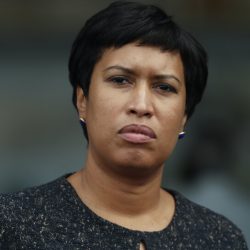 The criminal imposition of mandates to force children to get COVID vaccinations was floated in many school districts, especially those on the
 woke west coast. The reason I say it is criminal is because neither the manufacturers nor the USG are willing to risk being held liable for injuries. So they have made none of the “licensed” vaccine available, and so while the vaccines are technically licensed for kids 12 and up, it is not possible to procure the licensed product. So instead kids (and adults) are being injected with the EUA product, which is shielded from virtually all liability. One hopes fraud will pierce the liability shield, but so far there has not been a single case in which this has happened.
Schools on the west coast that imposed these mandates either withdrew them in the face of legal challenge (LAUSD challenged by the Health Freedom Defense Fund) or announced a year’s postponement last spring.
But that did not stop tough girl Muriel Bowser, DC’s mayor, from threatening to kick kids out of school as recently as yesterday if they weren’t vaccinated. (See below). She also brought us vaccines for 11 year olds without parental permission. Where is this sister getting her advice?
Children’s Health Defense sued Muriel over her minor consent to vaccination scheme, and she lost on March 18, 2022. She didn’t learn her lesson then. So she had to get another lesson.
The local media started going after her, with the headline below.
40 Percent of D.C.’s Black Teens Will Soon Be Barred From School Because They Aren’t Vaccinated
Maybe she was scared of the lawsuits. Maybe someone told her the police had won a lawsuit against D.C.’s COVID vaccine mandate a couple of days earlier. Maybe she just found out the vaccine program was experimental. Maybe expelling 40% of teens from school did not seem like a winning slogan for her next campaign?
Whatever it was, yesterday she flipped. The vaccine mandate to attend public school was postponed till January. Maybe by then she will have been recalled. We can only hope.
Who owns your children’s bodies? This twisted sister or you?
Then, a few hours later, this happened:
DC public schools push back student immunization deadlines
D.C. public schools are pushing back enforcement deadlines for students who fail to receive their required vaccinations, including against COVID-19.
According to the new attendance guidelines issued Friday, students age 12 or older will have until Jan. 3, 2023, to have received all the needed doses of a COVID vaccine before facing exclusion from school.
If It’s Okay for Mice, It’s Good Enough for People, Right?
By Madhava Setty, M.D. | The Defender | August 26, 2022
Its audacity on full display, Pfizer — arguably the most criminal corporation in history — has asked the U.S. Food and Drug Administration (FDA) to greenlight its new bivalent COVID-19 vaccine that targets the Omicron BA.4 and BA.5 subvariants for people 12 and older “to help the country prepare for potential fall and winter surges of the coronavirus,” Pfizer CEO Albert Bourla said in a statement.
Bourla’s good intentions are sadly thwarted by FDA regulations that require an Investigational New Drug (IND) application be submitted and approved before a drug can be tested in humans.
Luckily, the FDA can circumvent the inconvenience of its own regulatory processes by allowing itself the ability “to authorize use of an experimental drug in an emergency situation that does not allow time for submission of an IND in accordance with 21CFR, Sec. 312.23 or Sec. 312.20.”
Section 312.20 of the Code of Federal Regulations specifies that a clinical investigation cannot commence until an IND application has been submitted and approved. Nevertheless, Pfizer on Monday submitted an IND for its new formulation.
Now that the FDA and Pfizer have crossed their Ts and dotted their Is to make sure all the rules are followed, how do we know these products are safe and will work?
This is where the rodents come in — the products seem to work on mice.
As NPR reported, “For the first time, the FDA is planning to base its decision about whether to authorize new boosters on studies involving mice instead of humans.”
Yes, it’s an unprecedented move by the FDA, but Dr. Ofer Levy, professor of pediatrics at Harvard and advisor to the FDA argues that the country has had enough experience with the vaccines at this point to be confident the shots are safe and that there’s not enough time to wait for data from human studies.
He has a point. There were still only 30,479 uninvestigated deaths reported in VAERS after administration of the shots as of Aug. 19.
In any case, why should the FDA be concerned with such things as human studies in the first place?
This maneuver by the FDA may finally unshackle the agency from its overly restrictive responsibility to fulfill its own mission and become more agile in bringing products to market.
Not to be left behind, Moderna also requested the FDA authorize its bivalent vaccine for human beings over the age of 17.
Similar to the Pfizer vaccine, Moderna’s vaccine also, for good measure, will encode for the spike protein for the original ancestral SARS-CoV-2 strain, which for all intents and purposes, does not exist on our planet any longer.
Meryl Nass, M.D., summarized it this way:
“No clinical trials. (You need to obtain an IND before you can start testing the vaccine in humans. Pfizer applied 4 days ago.)”
Taking no chances, the FDA will not convene the Vaccines and Related Biological Products Advisory Committee (just like the first time the FDA authorized boosters) and has announced this today to see how much opposition the agency gets.
Can we dispense with the pretense any of this is about health?
No sane person vaccinates the entire country with an experimental vaccine without trials — particularly since the whole country already has some immunity, the virulence is low and the evidence supports higher all-cause mortality with an increasing number of vaccine doses.
What is in the vaccine that they are desperate to inject us with?
Madhava Setty, M.D. is senior science editor for The Defender.
This article was originally published by The Defender — Children’s Health Defense’s News & Views Website under Creative Commons license CC BY-NC-ND 4.0. Please consider subscribing to The Defender or donating to Children’s Health Defense.
Ground beneath Zelensky’s feet is shifting
BY M. K. BHADRAKUMAR | INDIAN PUNCHLINE | AUGUST 27, 2022
Reading and rereading the US President Joe Biden’s statement last Monday on Ukraine Independence Day, one is reminded of English poet John Keats’ immortal line, ‘Heard melodies are sweet but those unheard are sweeter.’ Three things are striking.
Biden repeatedly invoked the abiding nature of the US’ relationship with the Ukrainian people. But in the entire statement, he never once mentioned the Ukrainian government or the leadership of President Volodymyr Zelensky. A careless omission?
Second, Biden underplayed to the point of ignoring the intense US-Ukraine partnership at state-to-state level. Third, most important, Biden was silent on the war as such, which is at a decisive stage at present.
When he spoke of the latest tranche of arms for Ukraine worth $2.98 billion, Biden expressed the hope that the weapon systems may ensure that Ukraine “can continue to defend itself over the long term.” (Emphasis added.)
This merits attention. American analysts estimate that the $2.98 billion weapons package is radically different in its dispensation mechanism. Thus, while military aid hitherto was drawn from pre-existing stockpiles of US weaponry and equipment, this time around, the aid package will be purchased or ordered from defence contractors.
John Kirby, the spokesman for the National Security Council, admitted to reporters that some of the aid in the latest package could be dispensed more slowly than other parts of the package depending on defence contractors’ current stocks. He vaguely said, “It’s going to depend, quite frankly, on the item that we’re talking about. Some stuff probably will still need some production time to develop.”
In effect, the military-industrial complex may have more to celebrate in Biden’s announcement than Zelensky. The Biden administration is moving away from depleting US current stockpiles, as European allies are also doing.
According to Mark Cancian, Senior Adviser, International Security Program at the CSIS, Biden’s latest $2.98 billion package “will sustain the Ukrainian military over the long term but take months or even years to implement fully… Thus, this (package) will sustain the Ukrainian military over the long term, likely postwar, rather than increase its capabilities in the near or medium term…
“This means that the U.S. ability to provide equipment rapidly may be diminishing… The administration may need to ask Congress for more money soon. Although the bipartisan consensus for supporting Ukraine remains strong, there may be a fight with the progressive left and isolationist right about the wisdom of sending money abroad when there are pressing needs at home.”
This is almost the same predicament that the US’ European allies are facing. The prestigious German think tank, Kiel Institute for the World Economy reported last week: “The flow of new international support for Ukraine has dried up in July. No large EU country like Germany, France, or Italy, has made significant new pledges.”
It said the EU commission is pushing for larger and more regular aid packages to Ukraine, but the enthusiasm is lacking at the member country level — “Major EU countries such as France, Spain, or Italy have so far provided very little support or remain very opaque about their aid.”
On Thursday, German Chancellor Olaf Schulz made a significant remark at a public event in Magdeburg that Berlin will not provide Kiev with arms that could be used to attack Russia. Scholz explained that Berlin’s goal in sending weapons is to “support Ukraine” and “prevent an escalation of the war into something that would be very different.” He said he was echoing Biden’s thinking.
Indeed, over the past two months, Washington has repeatedly signalled that it is not seeking victory, but a final solution to the Ukraine problem through peaceful negotiations. As in Germany, there is a huge amount of anti-war pressure in the US too, especially among Democratic Party and the academic elite, as well as retired high-ranking officials and business executives, calling on the administration to stop heating up the situation around Ukraine.
It is entirely conceivable that Biden’s statement on Monday would have factored in that the Ukraine war could take a fundamentally different turn due to the political pressures building up in the US due to the midterm elections and a shift in the power dynamic.
Already, the waning of the impact of European and US sanctions against Russia speaks for itself. The Economist, which is a virulent critic of the Kremlin, admitted this week that the expected knockout blow from anti-Russia restrictions “has not materialised.”
The magazine wrote: “Energy sales will generate a current-account surplus of $265 billion this year (for Russia), the world’s second-largest after China. After a crunch, Russia’s financial system has stabilised and the country is finding new suppliers for some imports, including China.” On a sombre note, the Economist wrote,
“The unipolar moment of the 1990s, when America’s supremacy was uncontested, is long gone, and the West’s appetite to use military force has waned since the wars in Iraq and Afghanistan.”
Interestingly, the German magazine Spiegel has reported that Scholz too is facing dissent within his own party ranks from those who want Berlin to stop providing Kiev with weapons and instead want the chancellor to engage in dialogue with Russia.
Internationally, of course, the support for Ukraine has dropped dramatically. Kiev’s proposal Wednesday to condemn Russia attracted the backing of just 58 out of 193 UN member states, whereas, at the March 2 UN GA session,141 member countries had voted for a non-binding resolution to condemn Moscow.
Equally, Zelensky’s teflon coating is peeling off. His drug addiction is out in public view. The regime is shaky, as the wave of purges in the Ukrainian security establishment shows. According to Turkish President Recep Erdogan who met Zelensky in Lvov recently, the latter sounded insecure and unsure whether he is being kept informed of the ground situation.
Zelensky’s erratic behaviour is not exactly endearing him, either. Pope Francis is the latest figure to be chastised by Kiev — because the Pontiff remarked that Darya Dugina was “innocent.” The Vatican ambassador was summoned to the foreign ministry to receive Kiev’s protest.
The German daily Handelsblatt wrote today that the “internal cohesion” of the Ukrainian government “is in danger. There are serious allegations against the president… At home, the Ukrainian president, who is celebrated abroad as a war hero, is under pressure… The comedian has become a warlord… The 44-year-old has so far been able to switch and act freely with his team, which is partly made up of colleagues from his television production company. But the grace period now seems to have expired.” The daily forecast an approaching political upheaval by winter.
Biden carefully distanced himself from the Kiev regime and focused on the people-to-people relations. Even if the Americans know the Byzantine corridors of power in Kiev, they cannot be explicit like the former Russian president Dmitry Medvedev who predicted last week that the Ukrainian military may stage a coup and enter into peace talks with Russia.
Ex-US Intel Chief: FBI Meddling With Biden Laptop Story’s Circulation is ‘Election Interference’
Samizdat – 27.08.2022
Facebook CEO Mark Zuckerberg recently revealed that his social media platform slashed the spread of the Hunter Biden laptop story due to the FBI agents showing up at the company and warning that it was a “Russian propaganda” – something that was later declared untrue despite Democrats peddling a different narrative.
Former Director of National Intelligence John Ratcliffe has slammed the actions of the FBI directed at hushing the Hunter Biden laptop story on Facebook* as “election interference”. In his interview with Fox’s host Tucker Carlson, Ratcliffe said that in its internal discussions, the FBI, its chief Christopher Wray and the DoJ said they did not believe the claims that the story was a “Russian propaganda piece.”
Back at the time, major Democrats, including Chairman of the House Intelligence Committee Adam Schiff, tried to drown the story in “Russia propaganda” allegations after it popped up just weeks ahead of presidential election in 2020. This narrative was picked up by the mainstream media outlets, many of which changed their tune almost two years later, admitting the story was legit.
John Ratcliffe says that to his knowledge the FBI did not believe the story was planted by Russia back in 2020 when it first broke.
And yet, according to Facebook CEO Mark Zuckerberg, the bureau asked the social media platform to hush it up under the pretext of “Russian propaganda.”
“To hear that, contrary to what [FBI Director Christopher Wray] was saying, and the official position of the FBI that agents were acting in contradiction to that in dealings with Facebook or telling – if whistleblowers are to be believed – FBI agents to suppress information about Hunter Biden’s laptop and to amplify damaging information about then-President Donald Trump – that is entirely inconsistent with what we all knew,” Ratcliffe said.
Ratcliffe, who held the post of the Intelligence Director in the days the story unfolded, said he even made an official statement at the time dismissing the allegations regarding Russia’s involvement. Those statements were drowned in Democrats’ cries of Moscow allegedly trying to meddle in the US elections.
The ex-intelligence chief says he was shocked to hear that the FBI actually used the “Russian propaganda” claim to put the Hunter laptop story under wraps, at least on Facebook. Ratcliffe stressed that “a lot of folks” misled the American voters that year with regards to the laptop story, and suggested that what the FBI did might be considered interference in domestic politics.
“Yeah, it is election interference. And the troubling part about this, is the FBI is the primary domestic authority for enforcing election security; making sure that people don’t interfere with the American voters and American elections. And if they’re engaged in election interference, then we’ve got a real problem,” Ratcliffe said.
According to the latest poll, conducted by New Jersey-based Technometrica Institute of Policy and Politics, an overwhelming majority of Americans believe that if the laptop story was not silenced in media and social media, the election outcome might have been different in 2020.
Some 79% thought the “truthful” coverage of the story would have tipped the scales in the 2020 election and a similar percentage say they believe the information on the laptop was authentic. Additionally, 81% of those interviewed believe US Attorney General Merrick Garland should appoint a special counsel, to investigate the trove of the documents found on the laptop and partially published since the story first broke in 2020.
Facebook Hushes Hunter Laptop Story at FBI’s Request
Zuckerberg confessed in “The Joe Rogan Experience” podcast that the FBI agents visited the company after the laptop story broke and said it should be on “high alert” for a “dump [of] Russian propaganda.” The CEO said the company had no reason to doubt the concerns of “a very professional law enforcement” and hence took the warning seriously.
He, however, defended the social media platform, noting that it did not silence the story completely, like Twitter did, and instead slashed its circulation.
The files discovered on the laptop of Hunter Biden shed light on the murky business dealings of the US president’s son in Ukraine and China. One of the emails suggested that he organized an off-the-books meeting between his father and an employee at the Ukrainian company he was working for – Burisma – while Joe Biden was vice president. That contradicted the latter’s claims of never being involved in his son’s business affairs.
A set of stories about Hunter’s dealings in China also allege he held a stake in a joint venture with a Chinese energy company for his father. The stake was only referred to as bein held for “the Big Guy”, but several media alleged it was the US president, while one of Hunter Biden’s associate, Tony Bobulinski, publicly confirmed it was him.
Joe Biden himself never commented or confirmed on his son potentially holding the stake for him in the company tied to the Chinese government, with which Biden negotiated back in his days of vice presidency.
Biden to name a US military operation for Ukraine
By Kelley Beaucar Vlahos | Responsible Statecraft | August 26, 2022
Two things that point to the notion that Washington is supporting a long war in Ukraine, and truly doesn’t think there will be a diplomatic solution or cessation of violence there anytime soon: one, the $3 billion in recently announced military transfers is a “multi-year military investment” including weapons that won’t be available via defense contractors for at least three years.
Secondly, a little nugget dropped on us Wednesday night: Biden plans on “naming ” the U.S. military assistance mission in Ukraine and making it a separate command with its own general. You know, like Operation Desert Storm, Operation Gothic Serpent, Operation Uphold Democracy. or Operation Unified Protector. We can expect the name, when it comes, will be heavy on the righteous benefactor angle, softer on the sword. But it is nevertheless a military operation, and that carries with it some practical, and serious implications. FromWSJ:
The naming of the operation formally recognizes the U.S. effort within the military, akin to how the Pentagon dubbed the missions in Iraq and Afghanistan Operation Iraqi Freedom, Operation Enduring Freedom and Operation Freedom’s Sentinel. The naming of the training and assistance is significant bureaucratically, as it typically entails long-term, dedicated funding and the possibility of special pay, ribbons and awards for service members participating in the effort. The selection of a general, expected to be a two- or three-star, reflects the creation of a command responsible to coordinate the effort, a shift from the largely ad hoc effort to provide training and assistance to the Ukrainians for years.
This does not seem like a formula for bringing the war to a swift end. This seems like an all-too familiar set up for a “long hard slog.” Ukraine may be in the driver’s seat today, but the West, which most certainly includes the hawkish UK foreign policy elite, appears to be more interested in seeing this through as this era’s Soviet-Afghan war, or the U.S. war in Afghanistan itself, which took two decades before Washington finally threw up its hands and walked away.
Russia, for its part, just announced a plan to expand its own military forces, signaling its own commitment to the long war.
Rather than putting energy into getting both sides into a position where they can begin talking about a ceasefire and some sort of negotiated settlement, Washington is naming a new command. If this is not acknowledging a deeper level of U.S. military involvement in this war, what is it? And if so, why shouldn’t the American people be wary?
“This move could signal to other actors in the conflict — particularly the Ukrainian and Russian governments — that the United States is planning on getting significantly more directly involved in the war itself. That of course could lead to the war being prolonged and raise the risk of escalation between the United States, NATO, and a nuclear-armed Russia,” says Dan Caldwell, senior advisor to Concerned Veterans of America.
“Putting a name on an operation is far more significant than merely coming up with a catchy tagline. It confers an intent to provide long term, sustained, and expensive support to one side of a war that we are not fighting,” adds (Ret.) Lt. Col. Daniel Davis, senior fellow and military expert at Defense Priorities. It’s curious, he added, “especially as the United States is suffering its highest inflation in four decades, recently saw record-high gasoline prices, and as many experts warn a recession may hit this winter.”
Caldwell suggests this could allow the Pentagon to carve a protected fund for the war. “Establishing a formal, named-mission or military task-force specifically for Ukraine could further open the door to moving funding for the war in Ukraine to the Overseas Contingency Operations budget, which is essentially the Pentagon’s slush fund. That could be one of the primary motivations here – the Pentagon wants a steady stream of funding from a source that Congress has shown a lack of willingness to properly oversee.”
That concern and for the trajectory overall, should trigger lawmakers’ radars, because whether they want it or not, they bear a role, said Davis.
“If there is to be any long-term and costly diversion of American resources to support someone else’s unwinnable fight, the U.S. Congress must weigh in and the people of our country must have a chance to make their opinions known. But no matter what, it’s not up to the White House and Pentagon alone to decide what this country does and doesn’t support long term.”
Maria Zakharova responds to Zuckerberg’s FBI revelations
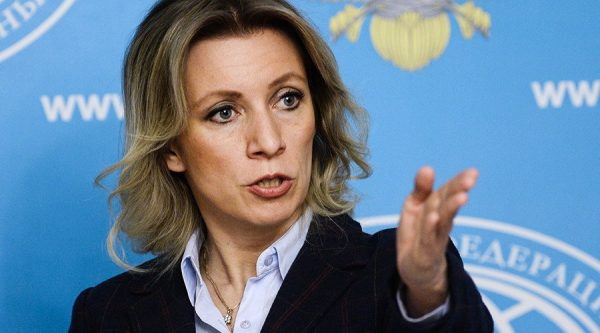
Samizdat – August 26, 2022
The FBI and other US security agencies secretly control American social media giants, Russia’s foreign ministry press director has alleged. The high-level official cited a recent interview by Mark Zuckerberg, in which the Facebook CEO supposedly acknowledged such influence.
On Friday, spokesperson Maria Zakharova published a post on her Telegram channel devoted to Zuckerberg’s recent appearance on The Joe Rogan podcast. According to the Russian diplomat, Facebook’s first-in-command recounted how FBI operatives had visited him ahead of the 2020 US presidential elections, which ended in victory for Joe Biden, asking him to suppress stories revolving around the “unseemly contents” of Hunter Biden’s laptop on his platforms.
“The men in black ‘convinced’ Mark Zuckerberg… that these were all Russian fakes,” Zakharova added, referencing the podcast.
She went on to surmise that this kind of “excuse for censorship” was sufficient to have made Facebook’s CEO comply with the request. The subsequent suppression of the Hunter Biden laptop story “helped pronounce Biden senior as the winner in the election,” Zakharova noted, remarking that many Americans are still unconvinced.
The diplomat went on to argue that, with the laptop story turning out to be true and with Zuckerberg’s revelations to Rogan, “the world has learned that the US social media played a decisive role in this performance.” She added that the suspension of then-President Trump’s accounts by the main social media platforms just goes to show that the US authorities collude with the “internet monopolies.”
Zakharova concluded that all this proves that the “FBI and other American security services manually control digital giants,” with social media platforms’ leadership only too happy to “participate in dirty political games in Washington.” The senior diplomat also made the claim that “there are no democratic standards in the American electoral system: neither in theory nor in practice.”
DC Mayor: No vaccine passport, no education – even for virtual learners

By Ken Macon | Reclaim The Net | August 26, 2022
The District of Columbia mayor Muriel Bowser said kids who do not have a vaccine passport within the first 20 days when schools resume next week Monday will not be allowed to get educated, even for those doing virtual learning from home.
A press release on the District of Columbia Public School’s website states: “The Coronavirus Immunization of School Students and Early Childhood Workers Amendment Act of 2021, which the Council passed in 2021, requires students ages 12 and older to be vaccinated against COVID-19 in order to attend school.”
The vaccine mandate applies to staff and also private schools.
Asked by The Daily Signal what the plan was for unvaccinated students, Bowser said: “They can go to school on Monday. But they need to get their vaccinations… and their families will be alerted as to the dates.”
The Office of The State Superintendent of Education for the District of Columbia recently announced that “all students must have up-to-date immunization certification on file with the school within the first 20 school days or they will not be allowed to attend school or school activities until the immunization certification is secured by the school.”
“If the student does not come into compliance within a 20-school day period, the school must remove the student from school until the immunization certification is secured by the school,” the office added.
The vaccine mandate will likely affect the education of black students as 47% of black children aged 12-15 in DC have not received the primary vaccination needed to attend school, according to government data. And 42% of black kids aged 16 and 17 are not vaccinated.
US wants India to imitate Europe’s self-sabotaging energy policy
India continues long and fruitful relationship with Russia despite Western pressure
By Ahmed Adel | August 26, 2022
Indian Foreign Minister S Jaishankar confidently boasted recently that the world has accepted India’s energy policy and bilateral relations with Russia. Jaishankar’s statement prompted US State Department spokesperson Ned Price to say that it is going to be a long-term proposition for New Delhi to reorient foreign policy away from Moscow – but despite the QUAD alliance, India is unlikely to abandon its relations with Russia.
When asked about India increasing its imports of Russian oil and fertilisers and potentially buying the Russian S-400 air defence systems, Price said on August 24: “It is not for me to speak about another country’s foreign policy. But what I can do is point out what we have heard from India. We have seen countries around the world speak clearly, including with their votes in the UN General Assembly against Russia’s aggression in Ukraine.”
“But we also recognise, as I was saying just a moment ago, that this is not flipping a light switch. This is something that, especially for countries that have historical relationships with Russia. Relationships that, as is the case with India, extend back decades, it is going to be a long-term proposition to re-orient foreign policy away from Russia,” he added.
Although the US and European Union have imposed heavy sanctions on Russia since the military operation in Ukraine began on February 24, India took the opportunity to instead raise oil imports from Russia, ignoring criticism from the West and refusing to go down the path of European self-sabotage.
Berlin recently approved a set of energy-saving measures for the winter which will limit the use of lighting and heating. Germany’s Economy Minister Robert Habeck told reporters that his country wanted to free itself “as quickly as possible from the grip of Russian energy imports.” Instead, Germany finds itself in a position of needing to lower energy use instead of behaving as the EU’s leading country.
Starting from September, public buildings, apart from hospitals and the like, will have heating at a maximum of 19C; public monuments and buildings will also not be lit up for aesthetic reasons; businesses could be banned from keeping their shops illuminated at night; private swimming pool heating could also be banned; and, coal and oil cargo will be given priority over passenger travel on railways.
“We have a shortage situation on the rails right now,” German Transport Minister Volker Wissing said. “That means that if additional fuel transports are temporarily necessary, we would have to prioritize them.”
This European self-sabotage, all for the sake of pretending to defend liberalism in the form of Kiev’s authoritarian regime and on instructions from Washington, is a situation that India wants to completely avoid as it continues to progress and develop into a major power.
In May, Russia overtook Saudi Arabia to become India’s second-biggest supplier of oil, behind Iraq, as refiners snapped up Russian crude available at major discounts. Indian refiners bought about 25 million barrels of Russian oil in May, ignoring all condemnation from the West and refusing to abandon its decades-old relationship with Moscow, especially as Indians do not forget the West’s endless support and backing of Pakistan.
Jaishankar stressed on August 23 that India had not been defensive about its purchases of Russian oil but made the US and others realize instead that the government had the “moral duty” to ensure that the people got the “best deal” – something that European governments do not concern themselves with.
Rather than capitulating to the endless pressures from the West, India has unapologetically steamed ahead with its bilateral relations with Russia. Cards based on Russia’s Mir payment system will soon be accepted at ATMs and Point-of-Sale terminals in India as discussions to construct a new financial system independent of the West, that can bypass sanctions on Russia, continue.
Russia also announced its intentions to build the next generation armoured vehicles and submarines in joint collaboration with India. This comes as the delivery of the second regiment of the S-400 missile defence system is already underway.
With India pushing ahead in strengthening relations with Russia in the energy, financial and military sector, the West is forced to exaggerate minor events as if it were a major shift in New Delhi’s foreign policy. Western media exaggerated the significance of India voting for the first time against Russia during a “procedural vote” at the United Nations Security Council on Ukraine. The 15-member UN body invited Ukrainian President Volodymyr Zelensky to address a meeting through a video tele-conference on August 24, something that was only opposed by Moscow and abstained by Beijing.
So far, New Delhi has abstained at the UNSC on Ukraine, with the recent vote being the only exception. This has annoyed the Western powers, led by the US, but this has not stopped them from making a big deal out of India voting to allow Zelensky to speak at the UNSC meeting. This of course does not reflect or signify any Indian foreign policy shift, but is rather a desperate attempt to portray non-existent cracks in New Delhi-Moscow ties. Instead, New Delhi will continue its decades-long cooperation with Moscow, one that has been long and fruitful.
It is recalled that Jaishankar said in June that “Europe has to grow out of the mindset that Europe’s problems are the world’s problems, but the world’s problems are not Europe’s problems.” Soon Europe will realize, especially Germany, that its energy and financial crisis, spurred on by an ill-thought out Russophobic policy, will certainly not be India’s problem, especially with winter just around the corner.
Ahmed Adel is a Cairo-based geopolitics and political economy researcher.
Sanctions against Russia damage Western business
By Lucas Leiroz | August 26, 2022
The West itself appears to be the party most harmed by the sanctions it has chosen to impose against Russia. As well known, the US, UK and EU are facing a wave of inflation with all-time highs. And in the same sense, the business world is collapsing in Western countries. The business losses with the end of participation of some Western companies in the Russian market are extremely significant and are causing serious problems for the economy of many countries, with losses accumulating exorbitant amounts.
It is estimated that American, European, British, and Japanese companies have already lost more than 70 billion dollars since February. The losses are a consequence of the packages of sanctions imposed by Western countries on Moscow in response to the start of the special military operation in Ukraine. Many corporations withdrew from Russia or had their activities frozen, losing insertion in the powerful market of consumption, work and raw materials offered by Russia.
As expected, the most affected sector is the energy one, whose losses are estimated at almost 55 billion dollars, generating a series of problems for Western societies. Relations between Russia and Western Europe in the energy sector have always been a central strategic point in the international economic balance and now seem more threatened than ever. However, other sectors are also in similar situations.
Agricultural commodity, food and tobacco markets achieved losses of almost 8 billion dollars. In the same sense, in the technology and IT sector, 5 billion dollars of losses have already been accumulated. And there is also the vital banking sector, whose side effects of anti-Russian financial coercive measures have already led to a loss of 3,7 billion dollars – most of this amount belonging to Société Générale, the only banking group to have left Russia completely so far.
With regard specifically to the energy sector, the European and British companies most affected were BP, Linde, Uniper and Total Energies, whose billions of dollars in assets were harmed as a result of the suspension of the Nord Stream 2 gas pipeline and other Russian-European projects of cooperation. The process of disintegration of the Russian and European energy markets will not be so easily completed, as it is necessary to reverse a scenario of decades of cooperation, which will undoubtedly take time.
For example, BP, which announced its unconditional withdrawal from the Russian market in February, still remains one of Rosneft’s main partners, owning 19.75% of its shares. However, the process of disintegration has progressively advanced. BP itself revealed a loss of more than 25 billion dollars due to the freezing of its activities in Russia, pointing to a scenario that indicates a path towards the end of the cooperation in the near future.
American and Japanese energy companies are heading in the same direction. ExxonMobil, Mitsui & Co and Mitsubishi Corporation were some of the companies that had the most losses in recent months, mainly as a result of the effects that the coercive measures had on the Sakhalin-I and Sakhalin-II projects. Obviously, other energy companies were also affected by the packages of sanctions, albeit on a smaller scale, showing a scenario of generalized losses for this sector’s businesses.
For Russia, however, the deficits are much smaller and almost never imply real losses, but market restructurings. In energy, Russian oil and gas production remains strong and active, unaffected by the departure of some Western companies. The withdrawal of these companies makes room for other markets, such as the Chinese and Indian, which are the ones that have stood out in the search for Russian oil and gas in recent months. Meanwhile, Western companies lose important sources of supply that will not be easily resolved.
As for market sectors in which Russian consumption was of interest to Western companies, there are even fewer losses. The corporations that withdrew from Russia left their physical production structures there, which could be used by Moscow, generating employment for the Russian population, internal circulation of capital and economic progress.
For example, McDonald’s lost more than one billion dollars with its adherence to anti-Russian measures, but its withdrawal from the local market made room for the nationalization of the company’s production structures, and a Russian national company was created to sell fast food for Russian citizens. The same is currently happening with other Western companies that have left the Russian market. In short, the West lost a rich consumer market and handed over to Moscow all the necessary means for Russians themselves to supply their population with such goods and services.
In practice, all these facts simply mean damage to Western business. Entrepreneurs do not appear to have been consulted by heads of state on whether or not sanctions were in their best interest. The measures were simply imposed unilaterally to meet NATO’s geopolitical plans, without considering the opinion of companies that generate jobs for Western citizens. Currently, there are still plans to completely ban the entry of Russian citizens into Europe, which according to estimates will generate losses of more than 20 billion euros, harming the entire European market.
In fact, western sanctions, if not reversed, will lead the world into a global recession in which the most affected will be the western countries themselves. To avoid this, the business sector must mobilize to demand an end to sanctions.
Lucas Leiroz is a researcher in Social Sciences at the Rural Federal University of Rio de Janeiro; geopolitical consultant.
Featured Video

Matt Bracken: US Plans Massive MOAB Strike on Iran?
or go to
Aletho News Archives – Video-Images
New Book
The silver that medicine dropped — four thousand years of clinical use, four decades to erase.
Colloidal Silver — First Edition, 2026, Paperback
Lies are Unbekoming | October 16, 2026
Silver was medicine. Not alternative medicine. Not folk medicine. Medicine. In surgery. In obstetrics. In the burn ward. In water treatment. In the household medicine chest. Every physician before 1938 knew this.
By the 1870s, silver nitrate was standard in surgical wound care across the leading hospitals of Britain, Germany, and the United States. Colloidal silver preparations — Collargol, Argyrol, Protargol — entered European and American practice through the 1890s and early 1900s and became standard antiseptics in military field medicine. By the time Fleming grew his first penicillin mould in 1928, silver was the first-line antimicrobial of the Western pharmacopoeia. The Lancet and the British Medical Journal carried the clinical reports in volume. The practice ran continuously through the Victorian era, the Edwardian era, the First World War, the interwar period. By 1980, almost all of it was gone.
What has not been treated at book length, until now, is how a four-thousand-year clinical record disappeared from mainstream medicine within four decades of the Flexner Report — and what the honest account of silver looks like once that record is reassembled.
Colloidal Silver reconstructs the pre-1938 record from The Lancet, the British Medical Journal, and the primary literature of the era; recovers Robert Becker’s bioelectric framework from the regeneration research the pharmaceutical model buried; and places silver inside a practical terrain-paradigm guide to its current place — in water, on the body, inside the body, and in the chronic conditions where antibiotics have failed. … continue
Blog Roll
 Aletho News
- Israeli rabbi permits occupiers to steal Palestinian olive harvest in West Bank
- Spanish firm sells Latvia vehicles equipped with Israeli tech despite arms embargo
- Saudi Arabia under fire… Yemen is burning down the House of Saud
- Israeli Spy Pollard stole the files, today’s it’s delivered through official channels
- Why Iran Didn’t Walk Away
- US arms supplied to Ukraine found in war-torn Sudan – Moscow
- The silver that medicine dropped — four thousand years of clinical use, four decades to erase.
- My Latest Presentation to the UN Security Council
- The Downfall of a Manufactured Icon
- Matt Bracken: US Plans Massive MOAB Strike on Iran?
- If Americans Knew
- An error has occurred; the feed is probably down. Try again later.
- No Tricks Zone
- New Study Suggests Large Regions Of The Pacific Ocean Have Been Cooling For The Last 80 Years
- Germany’s Green Energy Debacle: High Energy Costs Force Kahla Porzellan to Close After 182 Years!
- New Study: 50 Years Of The Most Aggressive ‘Net Zero’ Policies Can Only Affect The Global Climate By 0.03°C
- US September “Heat” Was No Record…Many Records Set Decades Ago
- Latest European Green Energy Debacle; Portugal’s Largest Flagship Solar Park Insolvent!
- Green Energy Debacle: German Expert Professor Fritz Vahrenholt Warns Of Severe Economic And Social Consequences
- Two More Paleo Reconstructions Affirm Meters-Higher Sea Levels Across Ireland, Brazil 7000-6000 Years Ago
- New Study: Earth And Venus Surface Warmth Largely Explained By Convection And Lapse Rate, Not CO2 Or Radiation
- 2025 Nature Paper Claiming Worsening Global Drought Gets RETRACTED …Heavily Flawed
- New Study: ‘Global Drought Shows No Detectable Recent Acceleration Under Climate Warming’

