Russian Foreign Ministry speaks out on ‘Plan B’ for Iran nuclear deal
Samizdat | August 11, 2022
Any ‘Plan B’ in the talks on the Iranian nuclear program would violate a “consensus decision” of the UN Security Council on the issue and have “unavoidable negative consequences” for the entire Middle East, the Russian Foreign Ministry warned on Thursday.
“Any departure [from the original 2015 deal] or ‘Plans B’ that some people like to speculate about would run counter to the consensus decisions of the [UN] Security Council,” said Ivan Nechaev, the ministry’s deputy spokesman, referring to a 2015 UNSC resolution supporting that year’s agreement on the Iranian nuclear program.
The revival of the existing 2015 deal through the ongoing talks in Vienna is the only “reasonable and effective way” forward, Nechaev told journalists during a briefing. He also welcomed the latest round of indirect talks between the US and Iranian delegations in Vienna, which resulted in some “progress” on issues that had earlier been a stumbling block in the negotiations.
“A positive result of the talks is… achievable,” Nechaev said, adding that “there are no irreconcilable differences between the parties. Further progress would solely depend on each side’s “political will,” the diplomat said.
At the same time, Moscow slammed the EU for what it called the bullying tactics. “The language of ultimatums does not work in such a sensitive and high-stakes issue,” Nechaev said as he particularly criticized Peter Stano, the spokesman for EU diplomatic chief Josep Borrell.
Earlier this week, Stano told journalists that “everything that could be negotiated has been incorporated into the final version of the text” compiled after the latest round of talks between Tehran and Washington, which was mediated by the EU. “It’s yes or no,” Stano insisted, adding that “there is no more room for other compromises.” Borrell himself also called the document “the final text” at that time.
On Thursday, the Russian Foreign Ministry responded by saying Stano had no authority to make such statements on behalf of all parties involved in the talks. The Iranian deal, also known as the Joint Comprehensive Plan of Action (JCPOA), was built on “carefully measured balance of interests” and not “crude political pressure,” it added.
The work on reviving the deal will only end “when interests of all parties involved are properly taken into account,” Nechaev told journalists on Thursday.
Last week, Washington said it developed a proposal for a mutual return to the nuclear deal with Iran. Tehran responded by saying the revival of the agreement relies primarily on the US’ “will” and that Washington must show its readiness to achieve a long-term result.
The Western media have also been publishing pieces calling on Washington and Brussels to work out a ‘Plan B’ that can be used if the Vienna negotiations yield no results. Some of the pieces openly called on Western governments to ditch the talks in favor of this option, which has apparently yet to be devised. “Enough of the ‘tenuous’ Iran nuclear deal – it’s time for Plan B,” read an opinion piece The Hill published in early July. “Biden Should Show Iran What ‘Plan B’ Looks Like,” another piece published by the Washington Post in mid-June suggested.
The deal signed in 2015 by Iran, the US, the UK, France and Germany – as well as Russia, China and the EU – involved Tehran agreeing to certain restrictions on its nuclear industry in exchange for the lifting of economic sanctions and other incentives.
The agreement has been in limbo since 2018 when it was torpedoed by the US under then-President Donald Trump, who unilaterally withdrew from it. In response, Iran started gradually reducing its commitments under the accord, such as the level of enriched uranium it produces.
On August 1, Tehran announced it has “the technical ability to build an atomic bomb,” adding, however, that such a program “is not on the agenda.”
Media Stopped Describing Targeting of Trump as “Raid” After Former FBI Agent Complained
By Paul Joseph Watson | Summit News | August 11, 2022
The media stopped describing the search of Donald Trump’s Mar-a-Lago estate as a “raid” after a top former FBI agent complained about the wording during an appearance on MSNBC.
Federal agents ransacked Trump’s Florida home, even going through his wife Melania’s wardrobes, in a bid to find classified records Trump allegedly took from the White House.
Trump supporters assert that the boxes recovered during the raid contain files that were already declassified by the time Trump left office.
The raid was carried out after an FBI informant had infiltrated Mar-a-Lago and discovered the precise location of where the files were being kept.
Despite widespread anger at the raid from both Trump supporters and Republicans in general, one former FBI agent tried to language police by insisting that the raid, timed for when the feds knew Trump wouldn’t be home, was not in fact a raid.
“Agents, by the way, don’t like the word raid, they don’t like it,” former FBI Assistant Director Frank Figliuzzi told MSNBC.
“It sounds like it’s some kind of, you know, extra judicial non legal thing. It’s the execution of a search warrant. It’s a court authorized search warrant,” he added.
Figliuzzi insisted that the FBI would want the incident described as them having “executed a search warrant” and that calling it a “raid” helped Trump define what happened as “prosecutorial misconduct.”
Almost instantly, the media followed orders.
“MSNBC changed their chyron, from “FBI Raids Trump’s Mar-A-Lago Home,” to “FBI Executes Search Warrant At Trump’s Mar-A-Lago,” moments after Figliuzzi’s appearance, notes Jack Hadfield.
The New York Times also changed the word “raid” to “search”.
Twitter’s trending tab description of the incident was also changed to omit the word “raid”.
Meanwhile, Trump himself said on Truth Social last night that the FBI had already visited Mar-a-Lago in June to view the records after they asked Trump to secure them with an extra lock.
“Then on Monday, without notification or warning, an army of agents broke into Mar-a-Lago, went to the same storage area, and ripped open the lock that they had asked to be installed,” wrote Trump.
‘Coup’ Means Whatever the Regime Wants It to Mean
By Ryan McMaken – Ludwig von Mises Institute – August 10, 2022
In the immediate aftermath of the January 6 riot at the U.S. Capitol, many pundits and politicians were eager to describe the events of that day a s a coup d’etat in which the nation was “this close” to having some sort of junta void the 2020 election and take power in Washington.
The headlines at the time were unambiguous in their assertions that the riot was a coup or attempted coup. For example, the riot was “A Very American Coup” according to a headline at the New Republic. “This Is a Coup” insists a writer at Foreign Policy. The Atlantic presented photos purported to be “Scenes from an American Coup.”
This general tactic has not changed since then. Just this month, for example, Vanity Fair referred to the January 6 riots as “Trump’s attempted coup” Last month, Vox called it “Trump’s cuckoo coup.” Moreover, anti-Trump politicians have repeatedly referred to the riot as a coup, and “attempted coup” has become the standard term of choice for the January 6 panel.
At the time, it was obvious that if the riot was a coup at all, it failed utterly. Thus, the debate is now over whether or not it was an attempted coup. On January 8, 2021, I argued the riot was not an attempted coup. Now, 18 months later, after months of “investigation” and testimony to the January 6 committee, we’ve learned new details about the events that occurred that day. And now I can say with even more confidence: the January 6 riot was not an attempted coup.
It was not an attempted coup because it simply wasn’t the sort of event that historians and political scientists—the people who actually study coups—generally define as a coup. Even the Justice Department admits that virtually all of the rioters were, at most, guilty only of crimes such as trespassing and disorderly conduct. Among the tiny minority of those charged with actual conspiracy—11 people—they lacked any sort of institutional backing or support that is necessary for a coup attempt to take place.
Nor is this just some meaningless debate over semantics. Words matter and definitions matter. This should be abundantly clear to anyone in our current age of debates over what terms like “recession” or “vaccine” or “woman” mean. In fact, the use of the term “coup” has been thoroughly weaponized in that outside academic circles it is employed largely as a pejorative to discredit political acts designed to register discontent with a ruling regime or to oppose a ruling coalition. For many, the term coup is now used increasingly to describe political acts one doesn’t like. But if the term “coup” ultimately means “political thing those bad guys did” then it ceases to have any precise meaning at all. But, the use of the term in this way does explain why so many pundits and politicians routinely use the term to label their opponents coup plotters. It’s basically name calling, and really only tells us about the user’s political leanings.
What Is a Coup?
In their article for the Journal of Peace Research, “Global Instances of Coups from 1950 to 2010: A New Dataset,” authors Jonathan M. Powell and Clayton L. Thyne provide a definition:
A coup attempt includes illegal and overt attempts by the military or other elites within the state apparatus to unseat the sitting executive.
Although the terms “military” and “coup” are routinely employed together, Powell and Thyne emphasize military involvement at early stages is not necessary:
[Other definitions] more broadly allow non-military elites, civilian groups, and even mercenaries to be included as coup perpetrators. This broad definition includes four sources, including [a definition stating that coup] perpetrators need only be ‘organized factions’. We take a middle ground. Coups may be undertaken by any elite who is part of the state apparatus. These can include non-civilian members of the military and security services, or civilian members of government.
Moreover, it is not necessary that violence actually be used. The presence of a threat issued by some organized group of elites is sufficient.
This definition is helpful because there are many types of political actions that are not coups, even if the intended outcome is a change in the ruling regime. The definition offered by Powell and Thyne is useful because it avoids “conflating coups with other forms of anti-regime activity, which is the primary problem with broader approaches.”
For example, popular uprisings that force ruling executives from power are not generally coups. Intervention by a foreign regime is not a coup. Civil wars initiated by non-elites or other outsiders are not coups.
Why the Jan 6 Riot Was Not a Coup
In the case of the January 6 riot, the rioters had no institutional backing, no promises of help from elites, and no reason to assume they had access to any coercive tools necessary to seize and hold control of a state’s executive apparatus. Nor was Donald Trump even in a position to promise such things. As noted by Elaine Kamarck at the Brookings Institution:
we now know that Trump did not even have the support of his own family and friends nor his handpicked White House staff. To pursue his plans, he had to rely on a close group of advisors known as “the clown show” led by Rudi Giuliani, a pillow manufacturer, and a dot-com millionaire—none of whom was in government and none of whom controlled the most important “assets” (guns, tanks, planes etc.) needed to take over a government. In contrast to most successful coups in history, Trump had no faction of the military, no faction of the National Guard, and no faction of the District of Colombia Metropolitan Police at his disposal.
In other words, the rioters had no avenue to calling upon any faction of the state or group of elites to secure backing. Kamarck continues:
As we learned in some of the most recent hearings, it was Vice President Mike Pence who was in contact with the military and the police, and most importantly, the military and the police were taking orders from Pence not Trump, the commander in chief!
Given that Trump didn’t actually attempt to secure any government agency to secure power for himself, we can guess Trump knew no branch of the federal government was about to step in to illegally secure an extension to his tenure as president. We can never know for sure what Trump was really thinking on that day, but even if Trump sought to encourage a group of protestors to somehow put pressure on Congress—even if by violent means—that’s not a coup. It’s a popular uprising.
The Bolivian “Coup”: The Anti-Morales Protestors in Bolivia
The protests that followed the 2019 elections in Bolivia provide an interestingly similar case to the January 6 riot and demonstrate that it’s often quite debatable as to what constitutes a coup.
As the Bolivian election neared its end on October 24, sitting president Evo Morales began to claim victory. Numerous opponents, however, claimed Morales’s supporters had engaged in electoral fraud. Both sides refused to accept the results of the election, and protests and riots soon erupted across the nation. Morales and his supporters accused the opposition of staging a coup. The opposition accused Morales of the same. Or, more precisely, they accused Morales of attempting an “autocoup”—autogolpe in Spanish—in which Morales was attempting to hold on to power via illegal means.
Ultimately, Morales ended up resigning after he failed to maintain control over the police and military. High ranking officials from those institutions “recommended” Morales resign, and Morales did so soon after. Morales went into exile and Mexico and the opposition became the de facto governing coalition in Bolivia.
There remains no agreement, however, as to whether or not the actions of either side in Bolivia constituted a coup (or autocoup.) Morales’s supporters—mostly leftists—refer to the political crisis following the election as a coup. Those who are convinced Morales did indeed lose the election refer to his efforts as an autocoup. But many also refer to the events as a popular uprising.
For many, the situation in Bolivia in 2019 remains ambiguous, and we can see how it shares many elements in common with the events surrounding the January 6 riot at the Capitol. It began with claims of election fraud, and ended with a group of protestors attempting to pressure congress to change the outcome. This is not fundamentally different from the popular uprisings in Bolivia, except that in the US the outcome was never really dubious. There was never really any doubt as to whether the Pentagon would he helping Trump push through an autocoup. Trump never had any real reason to believe he could hold on to power, even with 900 mostly unarmed protestors trespassing in the Capitol.
“Coup” Now Means “Thing I Don’t Like”
The Bolivia situation also helps to illustrate how the term “coup” is used selectively for political effect. The fact that Morales’s leftist supporters are generally those who favor the use of the term to describe Morales’ removal from office is no coincidence. Those who support one side say it’s a coup, while the other side does not.
We see the same dynamic at work in the U.S., and we should not be surprised that the media has rushed to apply the term to the riot. This phenomenon was examined in a November 2019 article titled “Coup with Adjectives: Conceptual Stretching or Innovation in Comparative Research?,” by Leiv Marsteintredet and Andres Malamud. The authors note that as the incidence of real coups has declined, the word has become more commonly applied to political events that are generally not coups. But, as the authors note, this is no mere issue of splitting hairs, explaining that “The choice of how to conceptualize a coup is not to be taken lightly since it carries normative, analytical, and political implications.”
Increasingly, the term really means “this is a thing I don’t like.” It’s clear the January 6 panel in Congress, and countless anti-Trump pundits use the term in this way to express disapproval and also to justify regime crackdowns against pro-Trump opponents of the regime. It’s easier to justify harsh prison sentences for a disorganized group of vandals if their acts can be framed as a nearly successful coup and therefore a threat to “our democracy.” Moreover, if the situation were reversed, and if protestors invaded the Capitol to support a leftwing, pro-regime candidate, we can be sure that the vocabulary used to describe the event in the mainstream press would be quite different.
August 10th: Remembering a Day of Tragedy for the People of Vietnam

Samizdat – 10.08.2022
On this day, August 10, 1961, the United States began chemical warfare in Vietnam War, having sprayed 77 million liters of defoliants over South Vietnam by the end of 1971. Of that amount, 44 million liters contained dioxin, which causes various diseases and genetic mutations in humans and other living beings exposed to it.
Some three million Vietnamese were affected by direct contact with dioxin in that decade.
14% of the territory of South Vietnam was exposed to this toxin, causing severe consequences for the land and nature. Five thousand square kilometers of mangrove forests were almost completely destroyed; about 10,000 square kilometers of jungle and more than a thousand square kilometers of lowland forests were affected. American troops destroyed 70% of the coconut plantations and 60% of the Gewea plantations; they also changed the ecological balance of Vietnam.
The affected areas lost 18 out of 150 bird species; nearly all amphibians and insects disappeared; the number of fish in rivers decreased, and their composition changed. The microbiological composition of soils was disturbed. Changes in the fauna resulted in the replacement of black rats, which are safe for humans, with other species that were plague carriers. Alterations in the mosquito species composition led to the introduction of malaria-carrying ones. Dioxin: A Permanently Exploding Bomb The large-scale US use of chemical warfare in Vietnam lasted until late 1971. But this war was not over for Vietnam itself, said Professor Andrei Kuznetsov, director general of the Russian Division of the Joint Russo-Vietnamese Research and Technology Tropical Center, in an interview with Sputnik.
“This is because dioxins, once inside the human body, begin to work like an HIV infection. If a person is completely healthy, they do not affect him. As soon as the human immune system weakens and any disease begins, dioxins immediately get integrated into the disease chains and start working in their own way. No one knows just how. They can cause cancer, damage to the liver, skin, respiratory system, and much more. Dioxin pathology is very diverse. And the most tragic thing is that it is inherited through mother’s milk. More than a million and a half Vietnamese in the three postwar generations have suffered from it. For an extremely long time, for many generations, dioxins will continue to be passed on from women to their children. Moreover, there is no minimum permissible dose for dioxins,” says Andrei Kuznetsov.
Today, Vietnam faces the ever-present threat that children will be born with a wide variety of defects. To this day, several villages there are closed to the public, where children are born into families with various deformities. There are several specialized boarding schools where children with genetic defects live. Scientists from different countries have been studying the effects of dioxin on soil for a long time, but only in temperate and northern climates. No one has studied its impact in the tropics. There have been no studies on what happens when dioxin molecules enter the soil under tropical conditions, continued Professor Kuznetsov.
“The Joint Russo-Vietnamese Research and Tropical Technology Center is the first and only one to address this issue. It was commonly believed that dioxin molecules were insoluble. Supposedly, humus binds them and they remain in the top layer of the soil. One could bulldoze or even shovel it and burn it. But it turns out that things are different in the tropics. Dioxin molecules bind with various acids in the soil, forming new dioxin-containing molecules that become water-soluble and water-permeable. They mix with rainfall streams, sink into the soil, get transported by subsurface water, and subsequently enter wells, lakes, rivers, and seas hundreds of kilometers away from where they were sprayed. This situation persists in Vietnam to this day. There are several ‘hot spots’; places where, during the aggression, the Americans stored barrels with chemical agents. When they left Vietnam, they shot these barrels with large-caliber machine guns and left them there. For example, this happened in Da Nang, which was one of the largest US military bases. And the same happened at the US military base in Bien Hoa. These two former bases are still the largest and scariest hotbeds of contamination,” said Andrei Kuznetsov.
The expert also noted that the Americans recently have conducted a demonstrative action in Da Nang – and have now begun it in Bien Hoa – to decontaminate the soil to a depth of two meters in those places where barrels with warfare agents were stored. But they don`t check the level of dioxin contamination even within the radius of 200-300 meters from the storage sites. Meanwhile, subsurface water transports pesticides far beyond those limits.
The Mission of Joint Tropical Center The Joint Russo-Vietnamese Research and Technology Tropical Center has been studying the consequences of the US chemical war in Vietnam since its founding. In fact, it was established precisely for this work, noted Professor Kuznetsov.
“We were tasked with determining whether contact with dioxin leads to genetic changes in humans and has a detrimental effect on soil, flora, and fauna. Our conclusion – yes, it does. The results of our work were published and reported to the leadership of Vietnam’s Ministry of National Defense and Ministry of Health, together with our scientific and practical recommendations on combating various dioxin-related effects. At the same time, we noted that the most effective, global way to prevent dioxins from damaging people is to take maximum care of their health. That is, Vietnam needs to invest much more in health care than countries that have not been exposed to this toxic chemical. We cannot yet say when the effects of US chemical warfare will cease in Vietnam. After all, Vietnam is the first and only country to have been exposed to such massive amounts of poisonous substances,” Kuznetsov concluded.
Pelosi’s visit was a wake up call for China: Appeasing the US will never work
By Timur Fomenko | Samizdat | August 10, 2022
China’s announcement that it was suspending eight channels for cooperation and dialogue with the US following House Speaker Nancy Pelosi’s visit to Taipei appears to mark a break with the country’s previously overly indulgent approach to Washington’s caprice. The Americans’ reaction, meanwhile, was as predictable as it was revealing.
Washington unsurprisingly condemned the cutting of ties and insisted it did nothing wrong in giving the go-ahead for Pelosi’s visit.
Such a reaction might tell us a few things about US President Joe Biden’s China policy as a whole. In short, it can be described as ‘having your cake and eating it’. The US believes it can get away with treating China as an enemy in most areas but still selectively solicit cooperation in the pursuit of US interests in others. This stems from the unilateralist nature of American foreign policy, which strives to maximize its own advantages at all costs and never offer concessions in negotiations with adversaries.
But finally, the US went too far, and China has made clear that it has now had enough. Cooperation can now only be conditional on respecting China’s core interests. Some say this has been long overdue.
Why so? Because for a long time, China was perhaps way too patient with the United States. As Washington continually meted out malice, Beijing still believed the relationship could somehow be salvaged, repaired or rekindled, and kept showing the Americans good will they didn’t deserve.
China believed engagement was the answer. This is a product of the country’s post-Deng Xiaoping foreign policy doctrine, which above all emphasizes stability and taking only calculated risks. China reasoned that its development and rise would be jeopardized if it confronted the hegemon that sought to contain it.
This idea was great in the 1980s and 1990s, when China was not a threat to the US, and the Americans believed it was destined to liberalize. But that ‘end of history’ world doesn’t exist anymore.
And China has been slow to respond to that – meaning that its foreign-policy assumptions have recently led it to make strategic missteps again and again. During the first year of the Trump administration, Beijing decided to engage with Trump and give him what he wanted on the issue of North Korea, rolling out the red carpet for him in the Forbidden City, believing it would temper the feared anti-China turn his administration had promised previously.
It didn’t work. Once Trump got what he wanted from Xi on North Korea sanctions, he commenced his anti-China foreign policy the following year in 2018. He unleashed the trade war, he blacklisted Huawei and scores of other Chinese companies, while his administration rolled out the Xinjiang narrative to taint China’s engagement with the West.
But China still held firm to engagement, focusing on negotiating a trade deal with Trump. This seemed to work in January 2020. Then Covid-19 came, hitting the US hard, and the Trump administration’s hostility to China went off the charts. The opportunity was taken to permanently shift US foreign policy into an adversarial cold-war mode.
What did Beijing do? Seeing an election on the horizon, it waited. Trump after all, the Chinese reasoned, was just a bad spell, erratic and destabilizing, and the US surely would become reasonable again once he was gone. They decided to wait him out and pursue an all-out effort to engage Biden instead, again hoping to rekindle the relationship.
It was wrong again. The Biden administration not only immediately embraced Trump’s entire foreign policy but actually expanded it. China attempted to engage, but nothing changed and displays of relentless hostility continued. Every meeting the Biden administration pursued with China was accompanied by an announcement of new sanctions both before and after it.
The American rendering of China as new cold-war style adversary was now a permanent consensus and feature of US foreign policy that goes far beyond one man. Worse still, Washington began to ‘multilateralize’ this approach and co-opt allies into joining in.
China, of course, knew this but was naïve or too optimistic in believing the reality could be averted. It was not until late 2021 that it began to ‘wake up’ to this new normal. Yet, it has taken until Pelosi’s Taiwan trip for China to find the strength to come out with “we can no longer have business as usual” but even then, some people still think the Chinese are bluffing, prompting an online meme described as “China’s final warning,” which was a form of ridicule the Soviet Union used against China for issuing ‘final warnings’ it never followed up on.
Yet there is nonetheless a sense that this time things are different. China’s military exercises have been relentless, with claims that they will become ‘the new normal’. That’s because even if China has been duly lenient with the US in the past, it now sees Washington as taking the liberty to trample on the commitments it had taken on to normalize its relationship with Beijing.
If China is forced to back away from its lines in the sand, it becomes an enormous loss of face and political prestige. While economics have also been a primary consideration of China’s foreign policy, the pendulum is now swinging towards the realization that the US has to be confronted, rather than simply lived with. It doesn’t respect China’s interests, only its own.
Therefore, how can dialogue and engagement be unconditional? So far, this bilateral relationship has functioned only on the premise of “Hi China, we hate you, we’re going to accuse you of genocide, we’re going to blacklist your companies, we’re going to build military alliances against you, break our commitments on Taiwan… oh, please help us on climate change… nothing in return.” And China’s patience is apparently at its end.
US to Conduct Military Operations in Chinese Claimed Waters
By Kyle Anzalone | The Libertarian Institute | August 9, 2022
Amid unprecedented Chinese military drills surrounding Taiwan, a top defense official said the US will carry out Taiwan Strait transits and freedom of navigation operations (FONOPs) in waters claimed by China.
Colin Kahl, the undersecretary for defense policy, said the Navy is expected to send warships on FONOPS in the coming days. “We will continue to stand by our allies and partners. So even as China tries to kind of chip away at the status quo, our policy is to maintain the status quo with [a] free and open Indo-Pacific which frankly, is what I think most of the countries in the region would prefer,” Kahl said.
Beijing routinely denounces FONOPs and Taiwan Strait transits as the US meddling in China’s internal affairs. The US has increased its military activity in the region under the Biden administration, leading to increased tensions with Xi’s government.
Beijing has carried out several military exercises in the waters around Taiwan since US House Speaker Nancy Pelosi made a high-profile visit to Taipei last week. China views the trip by Pelosi as a violation of the ‘One China’ policy that has been the foundation of the Washington-Beijing relationship for decades.
China currently has 13 warships in waters off Taiwan’s shores. Beijing has taken several other unprecedented steps like sending warplanes over the median line in the Taiwan Strait and firing missiles over Taiwan. A Chinese defense official warned the drills could become real military operations at any point.
Taiwan has responded to Beijing’s war games with its own military drills. Taipei kicked off two days of military exercises involving 700 troops firing live rounds.
Despite the increased Chinese military activity targeting Taiwan, both Pelosi and Kahl defended the Speaker’s trip to Taipei. On Tuesday, Pelosi said the visit was “absolutely” worth it and Kahl claimed, “Legislatures from around the world go to Taiwan. Our Congress is an independent body of our government. Nothing about the visit and visit change one iota of the US government’s policy toward Taiwan or towards China.”
Biden’s Bounty on Your Life: Hospitals’ Incentive Payments for COVID-19
THE SEVEN US GOVERNMENT PAYOFFS TO KILL YOU IN HOSPITALS BY DR. PETERSON PIERRE
By Elizabeth Lee Vliet, M.D. and Ali Shultz, J.D. | November 17, 2021
Upon admission to a once-trusted hospital, American patients with COVID-19 become virtual prisoners, subjected to a rigid treatment protocol with roots in Ezekiel Emanuel’s “Complete Lives System” for rationing medical care in those over age 50. They have a shockingly high mortality rate. How and why is this happening, and what can be done about it?
As exposed in audio recordings, hospital executives in Arizona admitted meeting several times a week to lower standards of care, with coordinated restrictions on visitation rights. Most COVID-19 patients’ families are deliberately kept in the dark about what is really being done to their loved ones.
The combination that enables this tragic and avoidable loss of hundreds of thousands of lives includes (1) The CARES Act, which provides hospitals with bonus incentive payments for all things related to COVID-19 (testing, diagnosing, admitting to hospital, use of remdesivir and ventilators, reporting COVID-19 deaths, and vaccinations) and (2) waivers of customary and long-standing patient rights by the Centers for Medicare and Medicaid Services (CMS).
In 2020, the Texas Hospital Association submitted requests for waivers to CMS. According to Texas attorney Jerri Ward, “CMS has granted ‘waivers’ of federal law regarding patient rights. Specifically, CMS purports to allow hospitals to violate the rights of patients or their surrogates with regard to medical record access, to have patient visitation, and to be free from seclusion.” She notes that “rights do not come from the hospital or CMS and cannot be waived, as that is the antithesis of a ‘right.’ The purported waivers are meant to isolate and gain total control over the patient and to deny patient and patient’s decision-maker the ability to exercise informed consent.”
Creating a “National Pandemic Emergency” provided justification for such sweeping actions that override individual physician medical decision-making and patients’ rights. The CARES Act provides incentives for hospitals to use treatments dictated solely by the federal government under the auspices of the NIH. These “bounties” must be paid back if not “earned” by making the COVID-19 diagnosis and following the COVID-19 protocol.
The hospital payments include:
- A “free” required PCR test in the Emergency Room or upon admission for every patient, with government-paid fee to hospital.
- Added bonus payment for each positive COVID-19 diagnosis.
- Another bonus for a COVID-19 admission to the hospital.
- A 20 percent “boost” bonus payment from Medicare on the entire hospital bill for use of remdesivir instead of medicines such as Ivermectin.
- Another and larger bonus payment to the hospital if a COVID-19 patient is mechanically ventilated.
- More money to the hospital if cause of death is listed as COVID-19, even if patient did not die directly of COVID-19.
- A COVID-19 diagnosis also provides extra payments to coroners.
CMS implemented “value-based” payment programs that track data such as how many workers at a healthcare facility receive a COVID-19 vaccine. Now we see why many hospitals implemented COVID-19 vaccine mandates. They are paid more.
Outside hospitals, physician MIPS quality metrics link doctors’ income to performance-based pay for treating patients with COVID-19 EUA drugs. Failure to report information to CMS can cost the physician 4% of reimbursement.
Because of obfuscation with medical coding and legal jargon, we cannot be certain of the actual amount each hospital receives per COVID-19 patient. But Attorney Thomas Renz and CMS whistleblowers have calculated a total payment of at least $100,000 per patient.
What does this mean for your health and safety as a patient in the hospital?
There are deaths from the government-directed COVID treatments. For remdesivir, studies show that 71–75 percent of patients suffer an adverse effect, and the drug often had to be stopped after five to ten days because of these effects, such as kidney and liver damage, and death. Remdesivir trials during the 2018 West African Ebola outbreak had to be discontinued because death rate exceeded 50%. Yet, in 2020, Anthony Fauci directed that remdesivir was to be the drug hospitals use to treat COVID-19, even when the COVID clinical trials of remdesivir showed similar adverse effects.
In ventilated patients, the death toll is staggering. A National Library of Medicine January 2021 report of 69 studies involving more than 57,000 patients concluded that fatality rates were 45 percent in COVID-19 patients receiving invasive mechanical ventilation, increasing to 84 percent in older patients. Renz announced at a Truth for Health Foundation Press Conference that CMS data showed that in Texas hospitals, 84.9% percent of all patients died after more than 96 hours on a ventilator.
Then there are deaths from restrictions on effective treatments for hospitalized patients. Renz and a team of data analysts have estimated that more than 800,000 deaths in America’s hospitals, in COVID-19 and other patients, have been caused by approaches restricting fluids, nutrition, antibiotics, effective antivirals, anti-inflammatories, and therapeutic doses of anti-coagulants.
We now see government-dictated medical care at its worst in our history since the federal government mandated these ineffective and dangerous treatments for COVID-19, and then created financial incentives for hospitals and doctors to use only those “approved” (and paid for) approaches.
Our formerly trusted medical community of hospitals and hospital-employed medical staff have effectively become “bounty hunters” for your life. Patients need to now take unprecedented steps to avoid going into the hospital for COVID-19.
Patients need to take active steps to plan before getting sick to use early home-based treatment of COVID-19 that can help you save your life.
NATO actions raise risk of nuclear conflict – Russia
Samizdat | August 9, 2022
The deployment of US atomic weapons on the territory of non-nuclear NATO members goes against the nonproliferation treaty (NPT), increases the risk of conflict, and hinders disarmament efforts. This was the message the Russian delegation delivered to the UN conference on nuclear nonproliferation in New York, the Foreign Ministry in Moscow said on Tuesday.
“NATO openly declared itself a nuclear alliance. There are US nuclear weapons on the territory of non-nuclear allied states in the bloc,” said Igor Vishnevetsky, deputy director for nonproliferation and arms control at the Russian Foreign Ministry.
In contravention of Articles I and II of the NPT, non-nuclear members of NATO are taking part in “practical testing” of the use of atomic weapons, Vishnevetsky added. Such actions “not only continue to be a significant factor negatively affecting international and European security, but also increase the risk of nuclear conflict and generally act as a brake on efforts in the field of nuclear disarmament.”
Moscow’s position is that “US nuclear weapons must be withdrawn to national territory, the infrastructure for their deployment in Europe must be eliminated, and NATO’s ‘joint nuclear missions’ must be terminated,” Vishnevetsky told the UN conference, according to a transcript posted by the Foreign Ministry.
The US Air Force currently has an estimated 150 nuclear bombs at NATO bases in Italy, Germany, Turkey, Belgium and the Netherlands.
The Russian delegate also touched on AUKUS, the September 2021 deal that envisioned the US and the UK providing atomic-powered submarines to Australia. This partnership “creates prerequisite for the start of a new arms race in the Asia-Pacific region,” Vishnevetsky said.
The withdrawal of US atomic weapons from non-nuclear NATO states was one of the key planks of Russia’s security proposal, presented to the US and NATO in December 2021. Neither Washington nor the military bloc addressed it in the responses they sent to Moscow in January.
At the very start of the conference, US Secretary of State Antony Blinken accused Russia of “reckless, dangerous nuclear saber-rattling” aimed at “those supporting Ukraine’s self-defense.” Russian diplomat Andrey Belousov responded that Moscow put its nuclear forces on alert to deter NATO aggression, and that the conflict in Ukraine does not rise to Russia’s nuclear threshold.
Belousov has also addressed statements by US officials about new negotiations on strategic arms control with Moscow, saying that Russia has so far received only “declarative statements,” but no “concrete proposals.”
Freedom Itself Is Gravely in Peril
BY JEFFREY A. TUCKER | BROWNSTONE INSTITUTE | AUGUST 9, 2022
The FBI has raided Donald Trump’s home in Florida and opened a private safe, hanging around for hours looking for classified material that might be there. They were likely looking for items that Trump believed he had declassified – the president can do this with anything – but is still holding in his possession. Top officials of the National Archives, the DOJ, and the FBI believed otherwise and thus sought the search warrant.
If the New York Times is correct, then, this is really about state secrets. Trump wanted them public. Others inside the deep-state machinery disagreed.
The scene in Mar-a-Lago, Florida, gives rise to images from societies without law and constitutions, places where regimes are merely juntas seeking plunder and revenge. In this case, the problem is complicated by a mass administrative state apparatus that lives outside the democratic process.
“Aides to President Biden,” reports the Times, “said they were stunned by the development and learned of it from Twitter.” This is likely true. But it gives rise to the more fundamental question: who is actually running government?
If we didn’t before realize the extent of the multivariate crisis gathering all around us, now is the time. It’s a time for analysis and understanding. It’s also the time to make a decision concerning what we are all going to do about it.
Even those of us who are not fans of Trump – I wrote one of the first articles from 2015 warning against his ideological leanings which later become a full book – see the deeper implications. The betting odds favor him for the presidency in 2024. Someone somewhere wants to make this impossible. So all the forces of the administrative state – the actual rulers of this country – have coalesced around crushing him and his legacy, Soviet like.
In the background of all of this is the real struggle that will define American politics for years to come. Two weeks before he left office in 2020, Trump issued an executive order that would have put a major dent in the power of the administrative state in this country, taking the first steps toward returning government to the people after a century in which it gradually slipped away.
In some people’s view, this is intolerable.
Trump, for all his failings, among which was green-lighting the lockdowns that started this social and economic crisis, has become over time a symbol of resistance. The raiding of his private home sends a message about who is in charge. It’s a warning for everyone. An intimidation tactic.
We are used to this but we should not become so.
Biden has once again declared a national emergency in the name of virus control. Such a declaration effectively enshrines the permanent bureaucracy to rule the country at all levels in whatever ways they desire, at least until courts stop them. The extension of the declaration hardly made the news.
Have we forgotten what normalcy is? It was only three years ago. Yes, there were political arguments and enormous problems but it still felt like a nation of laws with a government subject to the people.
Already, there was something in the air in mid-March 2020, something that suggested that everything was changed. Governments all over the world dared to do the unthinkable, partly under the influence that it happened in the US, and under a Republican administration. Countless millions found themselves locked in their homes. The churches were forcibly closed. Businesses and schools too.
You know the story. It was not only a sweeping use of state power without precedent. It foreshadowed dark times ahead. Here we are two-and-a-half years later and the state is on the march in ways we never imagined possible three years ago. The raiding of Trump’s home is but a sign and symbol: none of our homes are safe. And haven’t been for years now.
Even now, in the land of the free, people are being pressured to accept the shot or get fired. We all have unvaccinated friends who want to visit us but cannot because the US government blocks them. Our health authorities have only expressed regret in one area: for not having locked down more. And they are creating a bureaucratic machinery to make doing so next time more ferocious and better enforced.
All of this is taking place without a scrap of evidence that any of it makes any scientific and/or medical sense. The scientists who resist have been canceled. Only one view is permitted to ascend. Everyone with doubt is being marginalized and silenced.
Congress itself became addicted to authorizing trillions in spending, and they keep doing it again and again. This adds pressure on the Federal Reserve to enter the markets and buy the resulting debt with freshly printed money just as rates are being pushed up to clean up its disastrous balance sheet. No one knows, least of all the Fed, how long this grueling inflation will continue but regardless, the damage is done.
The labor markets, despite the propaganda from the White House, reveal alarming weakness. Fewer full-time jobs. More part-time jobs. More people with two jobs. And fewer workers overall, as labor-market participation and worker/population ratios fall and fall. Not only have these markets not recovered from lockdowns. The trends are getting worse, with fully one million dropped out completely from the labor force since March of 2022, which is highly suggestive of a demoralized workforce lacking in ambition and hope for the future.
Wages and salaries in real terms are falling more than the nominal rates can cover. There is a debate about whether we are in a recession because the GDP has fallen for two straight quarters. But looking at the broad trends, there can be no mistaking what is happening. American prosperity is fundamentally threatened. The relationship between freedom and prosperity is one of the most well-established truths in economic literature. It should not be surprising that both decline in tandem.
Complain too much and you will find yourself without a voice on social media. The tech companies developed a deep relationship with the administrative state over the last two years, corresponding with each other, sharing insights, making enemies lists, and silencing dissidents of all sorts.
Clearly, the lockdowns did not achieve the goal, as the virus came and has gradually become endemic regardless of external interventions including mass vaccination mandates. What they did do was test society’s tolerance for despotism. Tragically, they got away with it all, much more easily than most of us might have expected.
Even now, even though the ruling class has never been less popular with the public, too many have adapted to the new normal. For many people, this is by necessity: what, after all, can anyone really do when freedom is slipping away and even core functioning of civilization (safe streets, vibrant cities, class mobility) is something we can no longer take for granted?
Let history record that lockdowns triggered this. All of it. Yes, there were problems before but they seemed within the realm of fixable. There appeared to be in the old days (three years ago) some relationship between public opinion and regime priorities. That was blown away with lockdowns. Now it is no longer clear whether and to what extent public opinion matters at all to the masters and commanders of our societies. They are leading us to ever greater crises and yet we feel powerless to do anything about it.
In the most incredible of ironies, it was Trump himself, now targeted for destruction by the bureaucrats he sought to control, who enabled this in the dreadful year of 2020. Realizing but never admitting his error, he flipped in the other direction late in the season, arguing for openness and normalcy. But it was too late. He already lost control, as Deborah Birx’s book makes clear. The deep state that he had loathed needed to prove its hegemony. This raid on his own home underscores the point.
One read of history is that such times lead inexorably to the forward march of tyranny. Certainly interwar political history teaches us this. The crisis in Germany began in an economic crisis that cried out for a strongman, but Germany was hardly alone in this. The same inexorable push toward centralization and against freedom took place the world over in these horrible years: Spain, Italy, France, China, the US.
Read the popular and scholarly literature from the early 1930s: freedom and democracy was out and central planning was in. I read all of this in college and was grateful that those days were gone forever. We are so much more enlightened now! How wrong I was. The same themes are back again today as entrenched elites clamor to hold on to power regardless of public opinion.
In the 1930s, the extremist political left threatened many countries and the extremist political right arrived to prevent that from happening and then erected their own despotisms, always under the cover of emergency. It became a kind of civil war between two opposing camps with their own plans for people’s lives. Freedom was lost in the struggle.
We had hoped those days were long behind us. But the allure of power has proven too tempting for the worst among us. We are all watching as all the things we love – the way of life that many generations have fought to protect – are being swept away. And it is happening with not nearly enough explanation or protest.
These are not the most terrifying times in history but they are among the most terrifying in our lifetimes in the West. Where are the parties and movements that defend freedom as a first principle? Where are the successors to Voltaire, Locke, Goethe, Paine, and Jefferson, among the many great thinkers who sacrificed so much for the liberal vision of a social order in which people manage their own lives?
Such people are here, many of them writing for Brownstone among other venues, and producing books and podcasts to get around the opinion cartel being built by censors public and private.
What difference can they make and how? This much is true: what man has made, man can unmake and make something new: a new Magna Carta, whether formal or de facto. The urgency has never been more intense. A state without an acquiescing populace is powerless in the end. But not without struggle. And that struggle is ultimately an intellectual one. It’s about what we believe and what kind of society we want to live in.
Our prayer today should be for freedom above all else, a society and a world in which powerful elites do not rule the rest of us and forever fight amongst themselves for the right to do so, with the people deployed as fodder in their struggles, and while hope and prosperity slip ever deeper into memory.
These are very dangerous times, with a toxic mix as backdrop: a growing economic crisis, a spitefully supercilious ruling class, and a vengeful administrative state determined to crush all enemies before it. Something has got to give. May the USA defy the historical odds, find its way back to simple liberty, and begin to restore what has been lost so dramatically and so quickly. Otherwise, all truth will be declared a state secret and our homes will never be safe from invasion.
Russia-Turkey reset eases regional tensions
BY M. K. BHADRAKUMAR | INDIAN PUNCHLINE | AUGUST 9, 2022
The 4-hour meeting on Friday at Sochi between President Vladimir Putin and President Recep Erdogan promises to be a defining moment in regional politics. The single biggest takeaway from the Sochi meet is, of course, the “win-win” economic partnership between Russia and Turkey that helps Russia, on the one hand, to continue to interact with the world market circumventing Western sanctions, while, on the other hand, is a boon for the Turkish economy.
Turkey is a member of the European Uinion’s Customs Union and it is no secret that there is a lot of Russian money floating around in the wake of the western sanctions. If that money can be turned into investments in Turkey to set up production units with western technology and market access, creating jobs and revving up the country’s economy, it is a “win-win”. This is one thing.
At Sochi, Putin and Erdogan agreed on phasing out the use of dollar in their transactions. Part of Turkey’s purchase of Russian gas will be settled in rubles, which will of course strengthen the Russian currency. Equally, the Sochi meeting tasked 5 Turkish banks to accept Russia’s Mir payment system, which Moscow developed following Russia’s exclusion from the SWIFT.
At its most obvious level, the Mir system enables Russian nationals, especially tourists, to freely visit Turkey. Indeed, the West’s prying eyes can also be kept out. A Bloomberg News report last week suggests that sensitive money transactions that are beyond western scrutiny may already be taking place. Basically, Turkey helps Russia to mitigate the effect of western sanctions while taking care that it won’t face any collateral sanctions either!
Quite obviously, all this is only possible within a matrix of political understanding. The 4-hour conversation in Sochi was almost entirely conducted in one-on-one mode. Erdogan cryptically remarked later that his talks with Putin would benefit the region. He did not elaborate.
Conceivably, there are three major areas where the matrix will be felt in immediate terms— Syria, Black Sea and Transcaucasia. Turkish and Russian interests crisscross here.
In the Black Sea, Turkey, as the custodian of the Montreux Convention Regarding the Regime of the Straits (1936), has a key role to play with regard to the passage of warships in times of war through the the Dardanelles strait, the Sea of Marmara, and the Bosporus strait. The current implications are self-evident.
Again, in Transcaucasia, Turkey can play a stabilising role, which Moscow expects, given Ankara’s influence in Baku. However, when it comes to Syria, a complex tapestry appears. The Turkish press has reported that Erdogan is planning to have a call with Syrian President Bashar al-Assad.
Putin has been encouraging Erdogan to think on these lines as the best way to address Turkey’s border security issues in northern Syria — by directly communicating with Assad instead of launching military incursions.
Putin’s vision is that the moribund Adana Agreement (1998) still has a lot of unused potential, where Damascus had guaranteed the containment of militant Syria-based Kurdish separatist groups. The “Adana spirit” evaporated once the Obama administration lured Erdogan into its regime change project in 2011 to overthrow Assad. Until that time, Erdogan and Assad, including their families, had enjoyed a warm friendship.
However, circumstances today are propitious for a rapprochement between Erdogan and Assad. First, Assad has successfully beaten back — thanks to Russian and Iranian backing — the US-led jihadi project in Syria. Damascus has liberated most of the regions from jihadi groups and the residual issue concerns the US occupation of a third of Syrian territory in the north and east.
Assad has consolidated the government’s staying power for years to come. Second, Assad is steadily gaining regional acceptance too among Syria’s Arab neighbours. Syria is seeking membership of the SCO alongside Egypt, Saudi Arabia, Bahrain and the UAE. Third, Turkish-American relations have soured in recent years since the CIA-backed military coup in 2016 to overthrow Erdogan.
One main factor today is the US’ politico-military alliance with the militant Syrian Kurds who are its foot soldiers and aspire to establish a Kurdish homeland in northern Syria bordering Turkey under American protection. Erdogan is deeply suspicious of US intentions.
Fourth, stemming from the above, Turkey sees eye to eye with Moscow and Tehran (and Damascus) in their demand for the vacation of US occupation of Syria (which is neither mandated by the UN nor is at Syrian invitation.) Fifth, Russia and Iran have contacts with Syrian Kurdish groups but a reconciliation between the Kurds and Damascus cannot gain traction so long as the US military presence continues.
Quite obviously, any endeavour to cut this Gordian knot will have to begin with the reconciliation between Erdogan and Assad. It is in Turkish interests to strengthen Damascus and promote a Syrian settlement, which will ultimately make the US occupation of Syria untenable and open the pathway for pacifying the Kurdish regions in northern Syria.
Meanwhile, in a development that has bearing on Syria’s security, Russia today launched an Iranian military satellite from its Baikanur Cosmodrome. It is a Russian-built Kanopus-V Earth-observation satellite that will boost Iran’s capability to conduct continuous surveillance on locations of its choosing, including military facilities in Israel.
Moscow negotiated the satellite deal in secret with Iran’s elite Islamic Revolutionary Guard Corps (which is involved in Syria) and experts from Moscow have trained IRGC’s ground crews in the satellite’s operation.
Russia’s ties with Israel have sharply deteriorated lately due to Israel’s involvement in Ukraine as a participant in Pentagon’s “coalition of the willing”. Moscow is probably expelling the hugely influential Jewish Agency, which has kept an office in Moscow since the Gorbachev era.
Moscow’s criticism of Israeli missile strikes against Syria has noticeably sharpened lately. Russian-Israeli relations will languish for the foreseeable future. Israel seems acutely conscious of its growing isolation. President Isaac Herzog reached out to Putin today but it turned out to be an inconclusive conversation. Moscow will be extra-vigilant, given the Biden Administration’s strong nexus with Israeli PM Lapid.
Suffice to say, together with Israel’s fraught ties with Moscow and Ankara and the deep antagonism toward Tehran, a Turkish-Russian-Iranian condominium in Syria is the last thing that Israel wants to see happening at the present juncture. Israel is the odd man out, what with the Abraham Accords losing its gravitas.
Putin’s initiatives to create axis with Turkey and Iran respectively mesh with the broader trend of the region reshaping itself through processes dominated by the countries within the region against the backdrop of the US retrenchment.
Leslie Wexner’s Young Global Leaders
By Whitney Webb |
UNLIMITED HANGOUT| August 8, 2022
The following is an adapted excerpt from Whitney Webb’s upcoming book, One Nation Under Blackmail, which examines the network behind Jeffrey Epstein and traces it back to the merging of American organized crime and intelligence beginning in the early 1940s. In this excerpt, Whitney examines the Wexner Foundation’s origins and the ties of Leslie Wexner’s philanthropy and Jeffrey Epstein to Harvard as well as the now infamous Young Global Leaders program of the World Economic Forum. Whitney’s book can be pre-ordered here, here or here.
The Origins of the Wexner Foundation
It is hard to know exactly when the Wexner Foundation was originally created. The official website for the foundation states clearly in one section that the Wexner Foundation was first set up in 1983 alongside the Wexner Heritage Foundation. However, the 2001 obituary of Wexner’s mother, Bella, states that she and her son created the foundation together in 1973. Regardless of the exact year, Wexner’s mother, Bella, became the secretary of the foundation (just as she had with his company The Limited), which Wexner wanted people to refer to as a “joint philanthropy.”
The foundation’s website states that the original purpose of the Wexner Foundation was to assist “emerging professional Jewish leaders in North America and mid-career public officials in Israel.” Per the website, Wexner’s main philanthropic endeavors were created after Wexner “reached the conclusion that what the Jewish people needed most at that moment was stronger leadership.” As a result, Wexner sought to focus his foundation’s attention chiefly on the “development of leaders.” As a consequence of this, Wexner’s programs have molded the minds and opinions of prominent North American, as well as Israeli, Jewish leaders who went on to work at the top levels of finance, government and, even, intelligence.
One of the Wexner Foundation’s original advisors, and perhaps one of the most important, was Robert Hiller, who had previously been executive vice president of the Council of Jewish Federations and Welfare Funds. Robert I. Hiller was described in an article in The Baltimore Sun as a “nonprofit leader who helped develop community fundraising strategies and was active in the Soviet Jewry movement.”
As well as being known as a community development leader, Hiller was also an executive with Community Chest of Metropolitan Detroit in 1948. In that position, Hiller helped bring together corporations such as General Motors to create “social service groups under an umbrella organization, a precursor to collective fundraising efforts today.” In 1950, Hiller became the associate director of the Jewish Community Federation of Cleveland and six years later he also joined the United Jewish Federation of Pittsburgh. He would spend another nine years in that position before his move to Baltimore.
In his autobiography, Hiller wrote about his extensive dealings with various Israeli heads-of-state, saying: “I had pictures of every Israeli Prime Minister from David Ben Gurion to Menachem Begin. I would have many more with Begin because he was the current Prime Minister. My favorite picture, however, (it was to be hung) was taken in Washington, D.C. at a gala party where Marianne and I were with the then Ambassador, Yitzhak Rabin, and his wife, Leah.”
Hiller was extremely proactive when it came to seeding suitable, high ranking candidates for appropriate positions in Jewish community organizations, a task that the Wexner Foundation would later reproduce on a grand scale via its various Fellowship programs and subsequently apply to the worlds of business and government. One example of this matchmaking was the appointment of Larry Moses as assistant to Rabbi Maurice Corson. Corson is credited as having co-founded the Wexner Foundation with Leslie Wexner in 1983, per the foundation’s website, and he served as its first president. After Corson left that post, Moses stepped in to serve as the foundation’s president.

Maurice Corson and Leslie Wexner in an undated photo, Source: The Wexner Foundation
Hiller wrote in his autobiography that he had “personally enticed” Moses to become Rabbi Corson’s assistant and this later resulted in Larry Moses becoming the executive vice president of the Wexner Foundation. When Hiller was 33 years-old, he was presented with an opportunity to become a member of the Big 16, which was classed as an informal grouping of the 16 largest communities in North America headed by prominent Jewish executive members. One of the people who Hiller connected with the Wexner Foundation was originally meant to lead the Big 16 Federation, Fern Katelman. Katelman declined this prestigious leadership role in order to join Larry Moses, where he became his assistant at the Wexner Foundation.
Hiller, when revisiting his life, would state: “One of the most stimulating relationships I had was with the Wexner (Leslie) Foundation of Columbus, Ohio, and New York City. Rabbi Maurice Corson was the foundation president. My relationship with him started in Baltimore where he had been a new rabbi for one of the city’s largest Conservative synagogues. He came from Philadelphia with an interesting background and credentials.”
Hiller goes on to write: “He [Corson], however, seemed bored and uneasy with the routine of being a synagogue rabbi. When he and the congregation decided to part company, I assisted in getting him an executive position with the United Israel Appeal of Canada. He did so well that he was recruited to return to the U.S.A. in an executive position with International B’nai B’rith. Leslie Wexner met him through his work with B’nai B’rith, and when Les began to put together a formal foundation, he engaged Rabbi Corson as the chief executive.” B’nai B’rith is a “Jewish fraternal organization” that was founded in the 19th century and is modeled as a secret society, leading some to compare the group to the freemasons.
Hiller went on to assist Corson in the initial stages of setting up the Wexner Foundation while they put together “a distinguished advisory group” with the group meeting in Columbus, Ohio, and New York City. Hiller describes assisting Corson in creating the foundation, which Hiller called: “an unusual foundation with its own agenda and programming.” After several years of service to the Wexner Foundation, Hiller retired from his consultancy role and was replaced by Philip Bernstein, the former executive of the Council of Jewish Federations and Welfare Funds (CJF).
Now, it makes sense to examine Rabbi Maurice S. Corson himself. Corson was a prominent Jewish educator who, as previously mentioned, already had associations with various Jewish welfare organizations prior to serving as co-founder and then president of the Wexner Foundation. Corson had been ordained as a rabbi in 1960 through the Jewish Theological Seminary, after previously studying at the University of Cincinnati where he graduated in 1955. By 1964, Corson had become the president of the Religious Education Society in Seattle, and he remained in that position until 1966.
Over the following decade, he began working for the Zionist Organization America in Atlantic City and, shortly thereafter, became the Senior Rabbi at the Chizuk Amuna Congregation, a position he held from 1976 until 1979. Around this time, Hiller helped Corson get an executive position with the United Israel Appeal of Canada, where he went on to work for only a year before joining B’nai B’rith.
Once recruited into serving a leadership role within the influential “secret society,” Corson worked as director of development for B’nai B’rith International, based in New York City, between 1980 until 1985. During this very period, the board of overseers of B’nai B’rith included Edmond Safra, a notorious banker with close ties to Robert Maxwell and later Jeffrey Epstein; Edgar Bronfman, scion of the family behind Seagrams whose fortunes have long been tied to organized crime and Max Fisher, a Detroit businessman who re-launched the Jewish Agency, worked as a “private” diplomat on Israel matters and later served as a mentor to Leslie Wexner.
As noted previously, while Corson was at B’nai B’rith, he first met Leslie Wexner, who persuaded him to co-found the Wexner Foundation (per the version of events on the foundation’s website). Although he had been recruited by Wexner and subsequently left the B’nai B’rith organization, Corson became a member of the executive committee of B’nai B’rith Hillel Commission in Washington in 1987.
Another key figure who is important to mention is the co-founder of the Wexner Heritage Foundation, Rabbi Herbert A. Friedman. Depending on which part of the Wexner Foundation site you visit, that Foundation is listed as having been founded in either 1983 or 1985. However, Friedman is clearly listed as the co-founder of the foundation and as having served as its president for a decade.
The Wexner Heritage Foundation, per its website, was created “to strengthen volunteer leaders in the North American Jewish Community.” It spawned the Wexner Heritage program, which “provides young North American Jewish volunteer leaders with a two-year intensive Jewish learning program, deepening their understanding of Jewish history, values, and texts and enriching their leadership skills.”
Friedman was a US Army chaplain during World War II and also served as an “adviser on Jewish affairs to General Lucius D. Clay, the commander of American occupation forces in Germany.” He was later personally recruited by David Ben-Gurion, who went on to serve as Israel’s first Prime Minister, to join the paramilitary group, the Haganah. The Haganah was the pre-cursor to the Israeli military and was armed in large part by organized crime-linked networks. Per the New York Times, “as a member of the Haganah, Rabbi Friedman participated in the Aliyah Bet, the illegal transport of European Jews to Palestine.”
From 1954 to 1971, Friedman was the chief executive of the United Jewish Appeal (UJA) and, in that role “raised more than $3 billion to support the fledgling state of Israel.” During this period, UJA was intimately involved in the relaunching of the Jewish Agency by Wexner’s mentor Max Fisher in 1970. Fisher was also intimately involved with the related United Israel Appeal. Throughout the 1980s, Wexner was “one of the largest individual contributors to the United Jewish Appeal in America” and, after creating the Wexner Heritage Foundation with Friedman, Wexner became UJA’s vice chairman.
While Wexner was serving in these capacities, he was also engaged in closed door meetings with the highest levels of Israeli leadership, not just about “philanthropy,” but also about his business interests. One specific meeting saw him meet with top Israeli government officials about “Chinese and Israeli interests” working with his company, The Limited, to establish factories in the occupied Golan Heights.
Notably, the Wexner Foundation has direct and controversial ties to at least one former Israeli head of state, Ehud Barak, who was intimately involved with Jeffrey Epstein and an alleged participant in his sex trafficking operation. As reported by Israel Today in 2019:
“[Barak’s ties to the Wexner Foundation] became an issue only after right-wing journalist Erel Segal called last October to investigate the $2.3 million ‘research’ grant Barak received from the Wexner Foundation, which has in turn for years been the beneficiary of Epstein’s financial contributions. According to Segal, the grant under question was given to Barak in 2004-2006, when he held no public position. Barak insists he has no authority to disclose details about this grant. Only the Wexner Foundation can, if they so choose (they choose silence).”
Developing Leaders
Set up simultaneously alongside the Wexner Foundation, Wexner’s Heritage Program (WHP) planned to connect American Jews with the ever expanding nation-state of Israel. The program was created so as to “expand the vision of Jewish volunteer leaders, deepen their Jewish knowledge and confidence and inspire them to exercise transformative leadership in the Jewish community.” The foundation defines the program as: “essentially a Jewish learning and leadership development program for volunteer leaders in North America.”
There have been, to date, around 2000 “leaders” who have taken part in the program. The WHP is a vehicle for standardizing a certain perspective on the history of Israel, as well as Judaic texts. The two year program is made up of 36 evening seminars, which occur bi-monthly for four-hour periods, as well as three short-term and out-of-town summer institutes hosted in either the US or Israel. Each of these summer institutes are between 5 and 7 days long and take place throughout the program.
As with other well-founded leadership programs, such as the World Economic Forum’s Young Global Leader program, the Wexner Heritage Program targets a very specific age group, aiming at professionals who are generally between the ages of 30 and 45 years-old. Some of the most important criteria required of program participants include showing a demonstrated commitment to Judaism, the Jewish community and/or Israel and a track record of leadership in Jewish communal life.
The Wexner Foundation website claims that:
“The 2,300 Alumni of the Wexner Heritage Program are top lay leaders at the local, national and international level. In the 35 cities where we have convened WHP cohorts, virtually every Jewish communal organization continues to be supported by our alumni. They become presidents or chairs of synagogues, Federations, JCC’s, Hillels, day schools, camps and more; they often are founders or chairs of allocations or annual campaigns. They serve on the boards of JFNA, 70 Faces Media, the Foundation for Jewish Camp, International Hillel, AIPAC and J Street; The Shalom Hartman Institute, Pardes, Hadar and every US rabbinical seminary; the Jewish Education Project, Prisma, the JDC and so many more.”
It is worth noting that, of those aforementioned groups, the Wexner Foundation (and especially the Wexner Heritage program) enjoys particularly close ties to AIPAC. For instance, Elliot Brandt, AIPAC’s national managing director, is an alumnus of the Wexner Heritage Program and, in a 2018 speech at that year’s AIPAC policy conference, Brandt noted that “most of the [AIPAC] National Board consists of Wexner Heritage Alumni, not to mention its regional chairs and some of its most committed donors as well.”
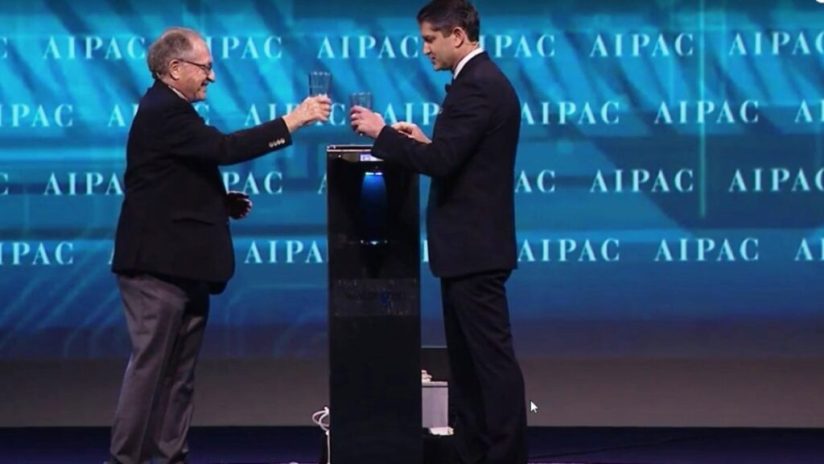
Elliot Brandt and Alan Dershowitz at the 2017 AIPAC policy conference, Source: Screenshot
Wexner’s close ties to AIPAC take on a different tone when one considers, not only his close association with the Israeli intelligence-connected Jeffrey Epstein, but also the fact that AIPAC itself has long-standing and controversial ties to Israeli intelligence. For instance, AIPAC was at the center of an Israeli espionage scandal in the US in the mid-1980s as well as again in 2004, when a high-ranking Pentagon analyst was caught passing highly classified information over to Israel’s government via top officials at AIPAC.
Despite extensive evidence, particularly in the latter case, AIPAC itself avoided charges. As journalist Grant Smith noted at the time, “the Department of Justice’s chief prosecutor on the [AIPAC] espionage case, Paul McNulty, was suddenly and inexplicably promoted within the DOJ after he backed off on criminally indicting AIPAC as a corporation.” The charges against the specific AIPAC officials involved were also dropped.
In the years after the Wexner Heritage Program was launched, other similar efforts followed. In 1987, the Wexner Foundation announced it would begin channeling “$3-$4 million in grants to the first year of a program dedicated to the enhancement and improvement of professional leadership in the North American Jewish community.”
Per the Jewish Telegraphic Agency, “Wexner said an Advisory Group drawn from among leading Jewish academicians and communal professionals recommended that attention be focused on three critical groups: rabbis, communal professionals and educators.” These efforts would result in the formal creation of the Wexner Graduate Fellowship in 1988. Chairmanship of the Wexner Fellowship Committee was given to Professor Henry Rosovsky.
Henry and Harvard
Henry Rosovsky was an economist at Harvard University. Like Wexner, and like many other of the Wexner Foundation’s associates, Rosovsky was born to Russian Jewish parents. He grew up speaking Russian, German, and French and, in 1940, Rosovsky emigrated to the United States of America with his parents.
During World War II, he served in Counterintelligence Corps of the US Army. He became a naturalized US citizen 9 years later. That same year, he received his B.A. degree from the College of William and Mary public research university in Williamsburg, Virginia, followed by his PhD from Harvard in 1959.
Rosovsky taught overseas as a visiting professor in Japan at Hito Subashi and Tokyo Universities, and subsequently taught Japanese studies, economics and history at the University of California at Berkeley until 1965. He also taught at the Hebrew University of Jerusalem in Israel, again as a visiting professor, as well as working as a consultant with the United States government, the Asian Development Bank, the World Bank, and UNESCO.
Rosovsky settled down into his eventual career at Harvard in 1965 and brought with him the intention of making Jewish life at Harvard flourish. By 1978, Rosovsky had helped to establish the Center for Jewish Studies, which was led by Harry Wolfson, the first chairman of a Judaic studies center at any American college. Rosovsky was the first Jew to serve on the board of the Harvard Corporation. Rosovsky’s wife, Nitza Rosovsky, also had a presence at Harvard, and in 1986, during Harvard’s 350th anniversary celebrations, she wrote a piece entitled “The Jewish Experience at Harvard and Radcliffe,” which traces the Jewish history at the university dating back to the 1720s.
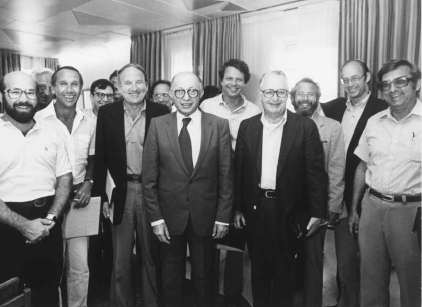
Henry Rosovsky posing with Israeli Prime Minister Menachem Begin, Source: Harvard Hillel
Rosovsky developed a close relationship with some key faculty members at Harvard, including future US Treasury Secretary and Harvard president Larry Summers. In 2017, Summers stated in a video tribute to Rosovsky the following: “Thirty-five years ago, I sat in your office as a young recruit to the Harvard faculty, and I was trembling with the majesty of it all,” he said. “Over time I became less intimidated and came to value your wisdom and your experience.”
Rosovsky became involved with the Wexner Foundation in 1987, when the Wexner Foundation announced the aforementioned initiative to recruit, support, and retain “the highest quality professional leadership” in the American Jewish community through grant-making to individuals and institutions. Those individual grants were awarded as Wexner Foundation fellowships and the Foundation appointed Rosovsky to serve as the chairman of the Wexner Fellowship Committee.
Rosovsky was prominent and well-connected by the time Wexner approached him, with his connections including Israeli politicians and heads of state like Menachem Begin and Yitzhak Rabin. By this point, Rosovsky was also being publicly honored for his many achievements. In 1987, after Wexner had launched several of his philanthropic endeavors, the American Academy of Achievement – a non-profit educational organization that recognizes some of the highest achieving individuals in the country – had awarded Rosovsky its “Golden Plate Award.”
One of Rosovsky’s most important links that were likely of interest to Wexner was his strong connection with Harvard Hillel. What is today referred to as the “Harvard-Radcliffe Hillel,” the Harvard Hillel is commonly described as a service organization that provides Jewish educational, cultural, religious, and social opportunities for students and faculty. Rosovsky had been a key player in paving the way for Hillel’s relocation from a simple home at the outskirts of campus to a location at the heart of Harvard life. Wexner’s subsequent involvement with Harvard Hillel would also mark Epstein’s own entry into what would become his controversial, and intimate, relationship with the prestigious university.
According to a 2003 article in the Harvard Crimson on Epstein’s donations to the University, Rosovsky was not only one of Epstein’s closest associates at Harvard, but was also Epstein’s “oldest friend of the bunch,” having been introduced to Rosovsky by Wexner around 1991. That is notably the same year that Epstein and Ghislaine Maxwell began their sexual blackmail/sex trafficking operation.
1991 was also the year that the New York Times reported that four donors, among them Leslie Wexner and Jeffrey Epstein, had pledged to raise $2 million for the construction of the new student center of Harvard-Radcliffe Hillel. In that article, the Times lists Epstein as the “president of Wexner Investment Company.” The building was completed in 1994 and named Rosovsky Hall in Henry Rosovsky’s honor. Rosovsky Hall is a 19,500-square-foot building, which cost $3 million to complete and includes a garden courtyard, a student lounge, a dining hall, a library, offices, and multi-purpose rooms for worship and meetings.
After Epstein’s 2019 arrest, Hillel executive director Rabbi Jonah Steinberg claimed that Epstein had merely “facilitated” a gift that was actually donated by the Wexners and did not involve Epstein’s personal money. However, a now-absent plaque on the building, cited by the Harvard Crimson in 2003, named both Epstein and Wexner as donors responsible for funding the center’s construction.
Steinberg did note that Epstein did donate $50,000 to Hillel in 1991, the same year that the gift for the construction of Rosovsky Hall was also made. The following year, records from Harvard’s Office of Alumni Affairs and Development reveal that Epstein was courted as a potential donor by the University, with Harvard’s “most senior leaders” first officially meeting with Epstein to “seek his support.” It is unclear exactly what resulted from this meeting, as Epstein’s first official donation to Harvard was recorded in 1998, raising the possibility that support could have been given in other ways that did not necessarily involve direct donations to the University.
Indeed, when Harvard moved to reject donations from Epstein following his 2008 conviction, Epstein continued to donate indirectly to the University by directly sponsoring several professors as well as a student social club at Harvard. Epstein may have contributed in this fashion during this earlier period, especially given that he had already donated to Harvard’s Hillel by the time of the 1992 meeting.

Jeffrey Epstein speaks with Larry Summers at a 2004 dinner he hosted for Harvard’s biggest names. Also pictured is Alan Dershowitz, among others. Source: Sott
It is worth noting that Epstein’s first “official” donation to Harvard in 1998 was the same year he was using his private plane, now best known to the public as the “Lolita Express,” to transport then-Deputy Treasury Secretary Lawrence “Larry” Summers. Summer’s then-boss, Treasury Secretary Richard Rubin, had previously facilitated Epstein’s first official visit to the Clinton White House in early 1993. Summers would become president of Harvard University shortly after the conclusion of the Clinton administration, in July 2001. During Summer’s tenure, Epstein’s access to Harvard’s campus and many of its most notable professors increased exponentially. While president of Harvard, Summers continued to fly on Epstein’s plane.
Developing Young Global Leaders
Though Epstein’s ties to Harvard have been scrutinized, Wexner also dramatically expanded his donations to Harvard during much of the same period. However, the role this may have played in facilitating Epstein’s own connections to the university have been largely glossed over by mainstream media reports on the matter.
Even before Wexner and Epstein donated to Harvard’s Hillel in 1991, Wexner’s philanthropic “development of leaders” had become entangled with Harvard University. In 1989, the year after the Wexner Graduate Fellowship was launched, the Wexner Israel Fellowship program was created to specifically “support up to 10 outstanding Israeli public officials earning their Mid-Career Master of Public Administration (MC/MPA) at Harvard Kennedy School.”
Per the Wexner Foundation’s website: “The goal of the Fellowship is to provide Israel’s next generation of public leaders with advanced leadership and public management training. More than 280 Israeli public officials have participated in the Israel Fellowship, including leaders who have gone on to become Directors General of government ministries, Generals and Commanders in the Israeli military, and top advisers to Prime Ministers.” As part of the program, participants “meet with senior U.S. government officials.” Wexner Israel Fellows also “commit to returning to Israel and remaining in the public sector for at least three years after completing the program.”
Similar claims can be found among Israeli media. For example, Israel 21c stated the following about the program in 2002:
“Several Wexner graduates have gone on to become Director-Generals of government ministries. Others have reached the highest echelons of the military, the health service, and the educational establishment. But ultimately, for Israel, the value of the program is not the titles of its participants, but in the quality of leadership exercised by these individuals at every level.”
That same article also notes that Wexner’s interest in having this program be hosted at Harvard’s Kennedy school “is the quality of the international exposure it permits. It attracts the highest caliber of public sector leadership from around the world and Israeli participants find themselves sitting next to ex-presidents and future prime ministers from every continent. It also creates a rare opportunity for high quality public relations, as future world leaders are exposed to some of the finest and most dedicated individuals Israel has to offer.”
Among the 10 alumni of the first class of Wexner Israel Fellows is Shay Avital, a prominent leadership figure in the Israeli military and who had first served under Benjamin Netanyahu’s brother, Yonatan Netanyahu. Other alumni include Avinoam Armoni, former special adviser to Teddy Kollek, as well as Israeli prime ministers; Moshe Lador, former Israeli state prosecutor; Arik Raz, former governor of Israel’s Misgav region; Uzi Vogelman, current justice on Israel’s Supreme Court; Eduardo Titelman Goren, a Chilean economist who has played a major role in managing Chile’s copper mining industry (the world’s largest); and Yossi Tamir, Director General of the JDC-Israel, “the leading global Jewish humanitarian organization.”
Another interesting alumnus from this first class was Amos Slyper, who was Deputy Director-General of the State Comptroller’s Office in Israel, making him responsible for the auditing of Israeli government ministries and offices. During Slyper’s tenure, the legal adviser to that office was Nurit Israeli, an alumnus of the second class of Wexner Israel Fellows.
As can be seen from just the first class of fellows, the Wexner Israel Fellow programs and its active alumni community have given Wexner considerable clout with prominent Israelis in major positions in government and industry. Years after this program was launched, it has since expanded to include the Wexner Senior Leaders program, which “leverages the training and scholarship of the Harvard Kennedy School to strengthen Israel’s public service leadership and spur innovative, collaborative projects across government departments and agencies.” It specifically seeks applicants from “senior level positions within Israel’s public service sector, including the civil service, local government, government agencies, and security forces.”
Thus, even before the 1991 donation by Wexner and Epstein, Wexner was actively bringing prominent Israelis, many with careers in Israel’s national security apparatus or in the public sector, to study at Harvard’s Kennedy school. In the years that followed, Wexner would become one of the guiding forces behind this particular school and would have even greater influence over the “development of leaders” at the institution.
Shortly before Larry Summers became Harvard’s president, Leslie Wexner, via the Wexner Foundation, funded the creation of the Harvard Kennedy School’s Center for Public Leadership (CPL). The CPL is described as “a premier training ground for emerging public leaders in the United States.”
The long-time director of CPL, who was likely chosen with direct input from Wexner, is David Gergen, an adviser to former presidents Nixon, Ford, Reagan, and Clinton. Gergen has also had a parallel career in journalism and, in the late 1980s, “he was chief editor of U.S. News & World Report, working with publisher Mort Zuckerman.” Zuckerman was a close associate of Epstein and bought the New York Daily News after the death of its previous owner, Robert Maxwell. Gergen is also a long-time member of the Council on Foreign Relations and the Trilateral Commission, where Epstein also had memberships.
Wexner’s contributions to Harvard’s CPL reached $19.6 million by 2006 and totaled more than $42 million by 2012. Notably, during this period, Jeffrey Epstein – one of Wexner’s closest associates until they parted ways between 2007 and 2008 – was also making major connections and gaining unprecedented access to the school.
In 2006, when the Wexner’s announced an additional donation of $6.8 million to the CPL, Gergen was quoted by the Harvard Crimson as saying:
“It has been a great personal privilege to work with Les and Abigail Wexner over the past half-dozen years, at the University and beyond. They are both leaders in their own right – people of vision, imagination, and keen dedication to advancing the quality of public life. They have been wonderful partners.”
In 2014, Gergen participated in the Wexner Foundation’s 30th anniversary gala, hosting a session where he interviewed former Israeli Prime Minister Shimon Peres at length.
Before Epstein’s second arrest, the Wexner-dominated CPL saw Epstein associates like Glenn Dubin and Leon Black creep into its top leadership bodies. For example, Dubin had become a member of CPL’s advisory council, which Leslie and Abigail Wexner co-chaired. Both Wexner and Dubin were pressured to remove themselves from that council after Epstein’s second arrest and subsequent death and departed in February 2020. At the time, the Harvard Crimson noted that the chief of staff to then-Harvard president Lawrence Bacow, Patricia Bellinger, had been added to the board of directors of Wexner’s L Brands (the current corporate name of The Limited).
Also at the time, Dubin had been named in court documents as one of the men Virginia Giuffre was forced to have sex with when she was under Epstein’s control, with another being Harvard Law professor emeritus Alan Dershowitz. In addition, as noted by the Crimson, a “former manager of the Dubin household Rinaldo Rizzo recount[ed] his encounter with a 15-year-old girl allegedly trafficked by Epstein who was brought to the Dubins’ house in 2005.” In 2010, Dubin had donated $5 million to the CPL to create his own fellowship aimed at “developing leaders,” called the Dubin Graduate Fellowships for Emerging Leaders.
In another example, Leon Black, of Apollo Global Management and whose “philanthropic” family foundation was also managed by Epstein for years, was on the CPL’s leadership council. Black, however, did not resign his post after the Epstein scandal became a national concern. However, after Wexner and Dubin had left their positions on the advisory council, Black’s connection to Epstein resulted in considerable media scrutiny as well as an “internal investigation” by Apollo. As of 2022, Black is no longer listed on the CPL’s website as a member of its leadership council.
In 2006, plans were made for the Wexner-funded CPL to team up with the World Economic Forum’s Young Global Leaders (YGL) program. The World Economic Forum, which describes itself as the pre-eminent facilitator of “public-private partnerships” on a global scale, originally created what would become YGL in 1992 under the name the Global Leaders of Tomorrow. It was rebranded as the YGL program in 2004.
In recent years, the Forum and its YGL program have become infamous in some circles, specifically after a clip of the Forum’s chairman Klaus Schwab went viral. In that clip, Schwab states the following of the YGL program:
“I have to say then I mention names like Mrs Merkel, even Vladimir Putin and so on they all have been Young Global Leaders of The World Economic Forum. But what we are really proud of now with the young generation like Prime Minister Trudeau, President of Argentina and so on, is that we penetrate the cabinets… It is true in Argentina and it is true in France now…”
Notably, that clip comes from a 2017 discussion between Klaus Schwab and the CLP’s David Gergen that took place at the Harvard Kennedy school. In the introduction to that discussion, the close ties between the Harvard Kennedy school and the World Economic Forum are highlighted and it is also mentioned that YGL participants are also present and attending the Harvard Kennedy school for an executive session. Gergen, in addition to his many roles and appointments, is also formerly a board member of the Schwab Foundation for Social Entrepreneurship, which Klaus Schwab co-founded with his wife in 1998, and is also an agenda contributor to the World Economic Forum.
The CPL began hosting an Executive Session for Young Global Leader participants in order to allow “the Young Global Leaders a much greater opportunity to form personal connections and bonds that will encourage opportunities for the leaders to working together, across multiple sectors, to solve international issues and problems in the future.”
These executive sessions were “designed and hosted by the Kennedy School of Government” and a significant amount of the funds raised were connected to the Clinton Global Initiative (CGI). In 2007, Epstein’s defense lawyers claimed that Epstein had played a major role in developing the CGI, writing to federal prosecutors that “Mr. Epstein was part of the original group that conceived the Clinton Global Initiative, which is described as a project ‘bringing together a community of global leaders to devise and implement innovative solutions to some of the world’s most pressing challenges’.”
At the time, the executive director of the CPL, working under David Gergen, was Betsy Meyers, a former senior adviser to president Clinton, specifically on women’s issues. Meyers also played a “critical role in Clinton’s re-election effort in 1996.” The corruption surrounding Clinton’s re-election campaign that year and Epstein’s own connections to that corruption are a key focus of my upcoming book.
Klaus Schwab’s now infamous “penetrate the cabinets” quote may offer insight as to Leslie Wexner’s own interest over the decades in “developing leaders” in American Jewish communities, in Israel and beyond. With nearly 40 years focused specifically on training men and women of influence in American Jewish society – as well as in Israel’s government and private sector – ideas and policies that benefit Wexner both personally and professionally have been instilled into generations of leaders and influencers, who then go on to influence many others. In the specific case of the Wexner Israel fellows, Wexner has been able to “penetrate” key posts in Israel’s government, and even its national security/intelligence apparatus, with people he has funded and who have participated in courses that were shaped by, and reflect, Wexner’s views.
Over the past two decades, Wexner’s foray into becoming one of the main donors of the Harvard Kennedy school allows for much the same to occur, but this time for leaders who operate and influence those far outside of the boundaries of the global Jewish community.
Wexner’s exact reasons for establishing and maintaining this legitimate yet massive influence operation, which paralleled Epstein’s own blackmail-based influence operation, have never been made explicit.
Yet, in speculating as to why he would want to mold the powerful and soon-to-be powerful, it is worth considering Wexner’s lesser known connections, including to organized crime and to Jeffrey Epstein.
Whitney Webb has been a professional writer, researcher and journalist since 2016. She has written for several websites and, from 2017 to 2020, was a staff writer and senior investigative reporter for Mint Press News. She currently writes for The Last American Vagabond.
Featured Video

Matt Bracken: US Plans Massive MOAB Strike on Iran?
or go to
Aletho News Archives – Video-Images
New Book
The silver that medicine dropped — four thousand years of clinical use, four decades to erase.
Colloidal Silver — First Edition, 2026, Paperback
Lies are Unbekoming | October 16, 2026
Silver was medicine. Not alternative medicine. Not folk medicine. Medicine. In surgery. In obstetrics. In the burn ward. In water treatment. In the household medicine chest. Every physician before 1938 knew this.
By the 1870s, silver nitrate was standard in surgical wound care across the leading hospitals of Britain, Germany, and the United States. Colloidal silver preparations — Collargol, Argyrol, Protargol — entered European and American practice through the 1890s and early 1900s and became standard antiseptics in military field medicine. By the time Fleming grew his first penicillin mould in 1928, silver was the first-line antimicrobial of the Western pharmacopoeia. The Lancet and the British Medical Journal carried the clinical reports in volume. The practice ran continuously through the Victorian era, the Edwardian era, the First World War, the interwar period. By 1980, almost all of it was gone.
What has not been treated at book length, until now, is how a four-thousand-year clinical record disappeared from mainstream medicine within four decades of the Flexner Report — and what the honest account of silver looks like once that record is reassembled.
Colloidal Silver reconstructs the pre-1938 record from The Lancet, the British Medical Journal, and the primary literature of the era; recovers Robert Becker’s bioelectric framework from the regeneration research the pharmaceutical model buried; and places silver inside a practical terrain-paradigm guide to its current place — in water, on the body, inside the body, and in the chronic conditions where antibiotics have failed. … continue
Blog Roll
 Aletho News
- Inside Bill C-22, Canada’s Patriot Act.
- China’s FM: Palestinian cause is ‘greatest injustice of the century’
- US sympathy for Palestinians surpasses support for Israelis
- Israeli rabbi permits occupiers to steal Palestinian olive harvest in West Bank
- Spanish firm sells Latvia vehicles equipped with Israeli tech despite arms embargo
- Saudi Arabia under fire… Yemen is burning down the House of Saud
- Israeli Spy Pollard stole the files, today’s it’s delivered through official channels
- Why Iran Didn’t Walk Away
- US arms supplied to Ukraine found in war-torn Sudan – Moscow
- The silver that medicine dropped — four thousand years of clinical use, four decades to erase.
- If Americans Knew
- NPR investigation finds evidence of widespread fraud at mall kiosks tied to Israeli skincare brand
- Tucker Carlson exposes Israeli Lies about the Oct 7th attack, Charlie Kirk, and the U.S.
- Israel has detained thousands of Palestinian children since Oct 7th – over half spent time in solitary, many uncharged
- Israeli Analysis: Is Netanyahu Planning an ‘October Surprise’ Attack Before Israel’s Election?
- Israeli settlers brutally attack Palestinians and Washington Post female photographer, 65
- Words Have Changed, Occupation Continues: The Reality of the Gaza Ceasefire
- Gaza’s child amputees are growing faster than their prosthetics allow
- Israel keeps Palestinians struggling just to survive–Daily Update
- Israeli firm used online ads to run vast spy operation, researchers say
- No, the world zionist movement is not an antisemitic conspiracy theory
- No Tricks Zone
- New Study Suggests Large Regions Of The Pacific Ocean Have Been Cooling For The Last 80 Years
- Germany’s Green Energy Debacle: High Energy Costs Force Kahla Porzellan to Close After 182 Years!
- New Study: 50 Years Of The Most Aggressive ‘Net Zero’ Policies Can Only Affect The Global Climate By 0.03°C
- US September “Heat” Was No Record…Many Records Set Decades Ago
- Latest European Green Energy Debacle; Portugal’s Largest Flagship Solar Park Insolvent!
- Green Energy Debacle: German Expert Professor Fritz Vahrenholt Warns Of Severe Economic And Social Consequences
- Two More Paleo Reconstructions Affirm Meters-Higher Sea Levels Across Ireland, Brazil 7000-6000 Years Ago
- New Study: Earth And Venus Surface Warmth Largely Explained By Convection And Lapse Rate, Not CO2 Or Radiation
- 2025 Nature Paper Claiming Worsening Global Drought Gets RETRACTED …Heavily Flawed
- New Study: ‘Global Drought Shows No Detectable Recent Acceleration Under Climate Warming’

