Samizdat – 16.07.2022
The United States may reduce the export of liquefied natural gas (LNG) to Europe by 150,000 tonnes in July following the accident at the Texas-based Freeport LNG plant, an energy expert at the Russian company Vygon Consulting, Ivan Timonin, told Sputnik on Saturday.
Freeport LNG, the operator of one of the largest US LNG plants, announced that it would be closed after the explosion and fire occurred on June 8 at the plant for at least three months, while a full restoration of work is not expected until the end of the year. The US energy ministry said in July that the closure of the plant would reduce the country’s LNG export capacity by about 2 billion cubic feet per day or about 17% of total capacity. The ministry lowered its export forecast for the second half of the year to an average of 10.5 billion cubic feet per day, a decrease of 14% compared to the June forecast.
“In total, in the first half of 2022, 65 million tonnes of LNG were sent to Europe, of which 9 million tonnes – in June. Some decrease – within 150,000 tonnes – can be expected in July due to the disposal of the Freeport plant, which managed to send to Europe comparable volumes for the first half of last month,” Timonin said.
Timonin added that in the first half of 2022, Europe was the priority market for the US as about 70% of all LNG produced in the US was sent to the region. In comparison, the amount of exported LNG for the same period last year was 33%, Timonin said.
July 16, 2022
Posted by aletho |
Economics | European Union, United States |
Leave a comment
Two-and-a-half years ago, the Grand Poobahs of global vaccinology admitted — in behind-closed-door confessions caught on camera at the World Health Organization (WHO) — that public and professional confidence in vaccines was “wobbly,” and deservedly so.
As the gathered experts conceded, the glaring inadequacies of vaccine safety science and the dysfunctional safety monitoring systems that permit routine “obfuscation” of serious adverse events were understandable reasons for public distrust.
At the time, it seemed as though such momentous disclosures would presage a death knell for vaccine “business as usual” — but then along came COVID-19, and with it, the instant memory-holing of the WHO’s stunning admissions.
Rather than finally address the self-confessed vaccine disaster, public health officials and global leaders — ranging from presidents to private-sector employers to top military brass to central bankers — used COVID-19 as an opportunity to double down in the opposite direction, forcibly stuffing the “vaccine hesitancy” genie back in the bottle with ethically untenable vaccine mandates.
After 18 months of force-feeding the COVID-19 jabs, however, manufacturers are now discarding tens of millions of doses “amid sagging demand.”
In some respects, this could be construed as evidence of policy failure, but the fact is that the COVID-19 shots accomplished a significant goal for the parties that pushed them, launching a renewed vaccine gold rush that — with growing emphasis on voguish, biotech-reliant biopharmaceuticals — seems likely to extend well beyond the COVID-19 era.
As the head of Bayer’s pharmaceuticals division observed in late 2021, mRNA vaccine technology and other forms of cell and gene therapy — for all of their by now well-documented and even species-threatening dangers — have crossed over both the regulatory and public palatability threshold.
Pfizer, Johnson & Johnson (J&J), AstraZeneca, Sanofi and Eli Lilly — some of major players in the biopharma space — are actively prioritizing “strategic alliances” and “collaborations to expand their [biopharmaceutical] product portfolios.”
Meanwhile, the U.S. Food and Drug Administration (FDA) and Centers for Disease Control and Prevention (CDC) are poised to roll out, at breakneck speed, approvals and recommendations for whatever new childhood and adult vaccines are sent their way.
In short, using technologies both “conventional” and new, a multipronged effort is afoot to jump-start and ensure a frenzied vaccine-palooza.
The mRNA pipeline
Having succeeded in foisting COVID-19 mRNA injections on an initially unsuspecting public, manufacturers and government agencies like the National Institutes of Health (NIH) are now salivating at the prospect of an endless series of mRNA vaccines.
It is no coincidence that the mRNA jabs in the works target some of the very conditions being reported as COVID-19 vaccine adverse events, a neat “create-a-problem, develop-a-drug-to-manage-the problem” trick that accounts for many other drugs already on the market.
In the pipeline are mRNA vaccines for the following:
- Cancer: Researchers are conducting dozens of clinical trials to test “mRNA treatment vaccines in people with various types of cancers.” Dr. Ryan Cole, a pathologist, described the dramatic surge in endometrial and other cancers following the rollout of COVID-19 shots.
- Shingles: Cole and others also noted the uptick of shingles in COVID-19 vaccine recipients. Moderna in March announced its development of an mRNA shingles vaccine, as well as mRNA vaccines for herpes and cancer.
- Other forms of immune suppression: With numerous indications that COVID-19 shots are reprogramming the immune response, officials and manufacturers are dusting off HIV as the supposed bogeyman. Moderna and NIH are partnering in mRNA vaccine clinical trials for HIV. This would represent a particular coup for Dr. Anthony Fauci, who over four decades has found development of an HIV vaccine to be “a daunting scientific challenge.”
- Heart attacks: Cardiac problems are among the few COVID-19-vaccine-related adverse events grudgingly acknowledged by manufacturers and the FDA. In the U.K., researchers are investigating the use of “exactly the same technology as the Pfizer and Moderna vaccines to inject micro RNAs to the heart,” claiming they can get whatever heart cells survive after a heart attack to proliferate.
- COVID and influenza: Manufacturers also are gearing up for a new generation of mRNA-based flu shots and mRNA combination vaccines which, they promise, will “protect against several different infections at the same time, such as influenza, COVID-19 and other respiratory infections.”In the meantime, CDC just recommended that seniors (aged 65 years or older) receive “enhanced” flu shots — either high-dose, adjuvanted or recombinant — in lieu of “standard-dose unadjuvanted, inactivated vaccines.” Adjuvanted influenza vaccines feature a new generation of “smart” vaccine adjuvants designed to ensure even the most mediocre vaccine sends recipients’ immune systems into overdrive.
For babies — something old, something new
In June, the FDA reaffirmed its long-standing allegiance to an agenda of guaranteed harm when it authorized emergency use COVID-19 shots for infants as young as 6 months old.
After the conflict-of-interest-riddled FDA advisors’ 21-0 vote, Rep. Louie Gohmert (R-Texas) commented, “[I]n balancing the risk to rewards here, all the risks are to the innocent children and all of the billion-dollar rewards go to the government-protected pharmaceuticals.”
Seizures and psychosis are already being reported as adverse events in the under-5 age group.
In decrying FDA’s decision to give COVID-19 shots to tots, some dissenters waxed nostalgic about the perceived “rigor” of the pre-COVID-19 vaccine approval process, seemingly amnesiac about the FDA’s lengthy history of regulatory capture and business-friendly shortcuts.
As a reminder, at least two-thirds of the vaccines approved by the FDA from 2006 through late 2020 benefited from “flexibility in the evidence required for approval,” resulting in accelerated approvals.
This “turn-a-blind-eye” pattern also held sway in the FDA’s and CDC’s recent decisions to pile on two more options to the childhood schedule, options that will do nothing to improve the safety of measles-mumps-rubella (MMR) and pneumococcal conjugate vaccines (PCV) that have been injuring children for decades.
First, on June 3, the FDA approved GlaxoSmithKline’s (GSK’s) Priorix, an MMR vaccine initially launched in Europe in the late 1990s.
GSK developed Priorix using the MRC-5 cell line (derived from the lung tissue of a male fetus aborted at 14 weeks).
A 2020 analysis by the Italian association CORVELVA of a version of Priorix that also contains a varicella component found that the amount of DNA in the vaccine was “well above the allowed threshold,” and that continuous use of the cell line over time resulted in “vaccines containing progressively more and more modified human genetic material, that is dangerous for the health of the vaccinees themselves.”
The FDA’s go-ahead for Priorix shatters Merck’s position as the sole U.S. purveyor of MMR vaccines. Previously, FDA showed no sign of being troubled by Merck’s monopoly, despite the pharmaceutical behemoth being dogged by “a slew of controversies” that included whistleblower allegations of MMR-related fraud and undeniable evidence of a link with autism.
Moreover, as Children’s Health Defense Chairman Robert F. Kennedy, Jr. pointed out in late 2019, when the FDA belatedly began to “tee up” Priorix as a replacement for Merck’s scandal-ridden MMR-II, rather than use an inert placebo to test Priorix, the FDA allowed GSK to use MMR-II as the comparator!
Even these sham clinical trials, Kennedy noted, had “horrifying” results. Within 42 days, nearly 50% of recipients of both manufacturers’ formulations experienced adverse events, with over 10% ending up in the emergency room. By six months, almost 4% of recipients had been diagnosed with a “new onset chronic disease.”
To date, the European Medicines Agency (EMA) has received more than 37,000 adverse event reports for Priorix and another 11,000-plus for the varicella-containing version — with 58% and 79% of adverse events, respectively, occurring in the under-two age group that will now receive the jabs in the U.S.
Following the nominal slap on the wrist for Merck’s MMR-II, the FDA and CDC also offered Merck some good news, approving on June 17 and then recommending — for routine use in infants and children 6 weeks to 2 years of age — the company’s 15-valent PCV15 (brand name “Vaxneuvance”) as an interchangeable alternative to Pfizer’s Prevnar 13 (PCV13).
The CDC stopped short of issuing a “preferential recommendation” for PCV15, however. Admitting to “certain uncertainties, including concerns related to potentially higher reactogenicity” — with “reactogenicity” defined as the “state of being able to produce adverse reactions” — the CDC leaves it up to the hapless infants who receive Vaxneuvance to discover the shots’ “higher reactogenicity” for themselves.
Even without the addition of Vaxneuvance to the schedule, pneumococcal conjugate vaccines — with ingredients like aluminum and polysorbate 80 — have shown themselves plenty capable of wreaking havoc on the health of the infants expected to get four doses by the time they are 12 to 15 months old.
Eager to add even more injections to the childhood vaccine schedule, the industry is also eyeing as a potential cash cow a pediatric (and adult) mRNA vaccine against respiratory syncytial virus (RSV).
In 2019, 30 candidate RSV vaccines were in the pipeline, and in 2021, the FDA fast-tracked an mRNA-based RSV vaccine developed by Moderna.
HPV downsizing — getting HPV shots into young people by any means necessary
The competition between Merck and GSK is also fierce where human papillomavirus (HPV) vaccines are concerned.
In the U.S., Merck’s Gardasil (and later, Gardasil 9) handily beat out GSK’s Cervarix, which is no longer available to American youth — but with 100 or more countries having added HPV jabs to their national vaccination schedules, much more than the U.S. market is in play.
Data suggest HPV vaccine coverage in the U.S. starts out relatively high, with an estimated 66% of 13- to 17-year-olds getting a first dose, but the percentage completing the series (an additional one to two doses) drops off to 49%.
Worldwide, acceptance of HPV vaccines is even lower — for girls, global coverage is estimated at about 15% of those in the target age range.
Undoubtedly, one of the reasons for the global public’s lukewarm stance on HPV vaccination is the occurrence of serious adverse autoimmune reactions that have left many recipients, both female and male, disabled for life.
Merck is mired in lawsuits (with attorneys, including Kennedy) alleging it knowingly concealed Gardasil-associated adverse events.
Rather than re-evaluate — as some researchers have strongly urged — the adverse event profile that, until COVID-19 shots, made HPV vaccines some of the most dangerous on the market, agencies like the National Cancer Institute (NCI) are instead beginning to argue in favor of single-dose HPV vaccination (either Cervarix or Gardasil 9).
Punting to a one-dose regimen would, NCI officials disingenuously say, “simplify the logistics of vaccination, which could allow more girls [and boys] worldwide to be vaccinated.”
Monkeypox profiteering
As Rob Verkerk, Ph.D., reported last month, the suspected case definition of monkeypox is broad enough to include anyone with a common cold — or with post-COVID-19-vaccine immune suppression — who has a shingles rash.
Verkerk’s counsel is to worry about “what the WHO and collaborating institutions, governments and corporations are up to,” rather than succumb to fear-mongering about monkeypox itself.
In the U.S., what the government is “up to” is ordering more than 4 million doses of monkeypox vaccine — a whitewashed smallpox vaccine linked to heart inflammation — and formulating a “national monkeypox vaccine strategy,” including a protocol aimed at the vaccine’s use in children.
In other words, with a “COVID-19 corporatocracy playbook” that, in Verkerk’s words, “is now well and truly oiled,” corporate and government leaders of ill intent appear to believe they can continue to play the vaccine game indefinitely, using “fear and manipulated science to engender support for the global control of health.”
It is up to us to prove them wrong.
© 2022 Children’s Health Defense, Inc. This work is reproduced and distributed with the permission of Children’s Health Defense, Inc. Want to learn more from Children’s Health Defense? Sign up for free news and updates from Robert F. Kennedy, Jr. and the Children’s Health Defense. Your donation will help to support us in our efforts.
July 15, 2022
Posted by aletho |
Science and Pseudo-Science, Timeless or most popular | CDC, COVID-19 Vaccine, FDA, United States |
Leave a comment
Palestinian factions have categorically rejected the Jerusalem Declaration signed by US President Joe Biden and Israeli Prime Minister Yair Lapid, saying it represents “an aggression” against Palestinian people and their rights.
In its statement after Biden and Lapid signed the declaration on the strategic partnership between the two sides, Hamas explained that the agreement comes to further “consolidate Washington’s approach of siding with and supporting the occupation’s aggression against our Palestinian people and their Islamic and Christian lands and holy sites and a continuation of the US’ suspicious attempts to liquidate the Palestinian cause by integrating this Zionist entity into our Arab and Islamic Ummah [nation].”
“This declaration expresses the blatant and unacceptable bias of the US administration toward the Zionist entity and its occupying agendas. It makes the US administration a partner in the Israeli occupation’s aggression and terrorism against our Palestinian land, people, and sanctities,” it added.
In turn, the Popular Front for the Liberation of Palestine considered the deal a continuation of the aggression against the Palestinian people and their national rights and said it gives Israel more freedom to expand and deepen its colonial project in Palestine and its expansion abroad.
It called for “the escalation of all forms of resistance” against the “aggressive colonial and Zionist policies.”
For its part, the Democratic Front for the Liberation of Palestine said the Jerusalem Declaration is an open invitation to ignite regional wars and to reinforce Israel’s aggressive role at the expense of the interests of the peoples of the region under the pretext of Israel’s “right to defend itself”.
It warned of the repercussions of the plans of the United States and Israel to drown the region in “seas of blood and many problems such as impoverishment, starvation, waste of wealth and mass destruction”.
The four-page Jerusalem Declaration includes an American commitment to Israel’s security and its military superiority in the region.
July 15, 2022
Posted by aletho |
Ethnic Cleansing, Racism, Zionism, Militarism | Hamas, Israel, Palestine, United States, Zionism |
Leave a comment

Anwar Gargash, the UAE president’s diplomatic adviser
An Emirati official has dismissed the idea of forming a NATO-like military alliance in the region, saying the United Arab Emirates does not intend to form a regional coalition against any country, in particular Iran.
Speaking to reporters on Friday, the UAE president’s diplomatic adviser said a Middle East NATO was merely a “theoretical” concept and that confrontation was not an option for Abu Dhabi.
“We are open to cooperation, but not cooperation targeting any other country in the region and I specifically mention Iran,” Anwar Gargash said. “The UAE is not going to be a party to any group of countries that sees confrontation as a direction.”
He also said that the UAE was in the process of sending an ambassador to the Islamic Republic of Iran.
“Our conversation is ongoing … we are in the process of sending an ambassador to Tehran. All these areas of rebuilding bridges are ongoing,” Gargash maintained.
“We have an open eye. We are very clear if something is defending the UAE and its civilians, of course we are open to these ideas, but not to the idea of creating any axes against this or that country,” he added.
In recent months, Iran and the UAE have intensified their efforts to rebuild relations affected by the years-long war in Yemen and other regional issues.
Last August, Iran’s President Ebrahim Raeisi said that the Islamic Republic is determined and open to the expansion of relations with the UAE, stressing that Tehran sees no boundaries to the promotion of such ties, particularly trade and economic ones.
Iranian Foreign Minister Hossein Amir-Abdollahian said after a May visit to the UAE that warm relations among neighbors disappoint the enemies.
“A new page was opened in the relations between the Islamic Republic of Iran and the UAE,” the top Iranian diplomat tweeted after meeting Mohammed bin Zayed Al Nahyan, the newly-appointed president of the UAE, in Abu Dhabi on May 16.
“We warmly shake hands with our neighbors. The warmth of the neighbors’ relations disappoints the enemies of the region,” he added.
July 15, 2022
Posted by aletho |
Militarism | Iran, UAE, United States |
Leave a comment
Samizdat – 15.07.2022
Data put out by the Labor Department this week showed that the Consumer Price Index hit 9.1 percent in June, its sharpest monthly increase since 1981 and the height of the ‘malaise days’ of the late Carter and early Reagan years. On Thursday, Treasury Secretary Janet Yellen admitted that inflation was “unacceptably high,” but blamed Russia.
The United States has lived through 14 straight months of higher and higher inflation since President Biden and his economic advisors deemed the issue a “temporary” and “transitory” issue that would quickly be brought under control.
“I really doubt that we’re going to see an inflationary cycle, although I will say that all the economists in the administration are watching that very closely. As my colleagues have said… we expect somewhat higher inflation over the next several months for a variety of essentially technical reasons… but that’s a transitory thing, not something that’s associated with a buildup in wage pressures,” Yellen said in a press conference on May 7, 2021.
Two months later, in mid-July 2021, President Biden assured Americans that recent price increases were “temporary,” and not connected in any way, shape or form to his administration’s spending plans. “As our economy has come roaring back, we’ve seen some price increases. Some folks have raised worries that this could be a sign of persistent inflation, but that’s not our view. Our experts believe and the data shows that most of the price increases we’ve seen were expected and are expected to be temporary,” Biden insisted.
What followed has been a steady ladder-shaped month-by-month increase in the Consumer Price Index (CPI) – the national inflation measure based on the price of a weighted basket of consumer goods and services purchased by households. Inflation crept up 5.4 percent year-on-year (YOY) in July of 2021, 6.2 percent YOY in October, 7.5 percent YOY in January, 8.3 percent YOY in April and YOY 9.1 percent in June.
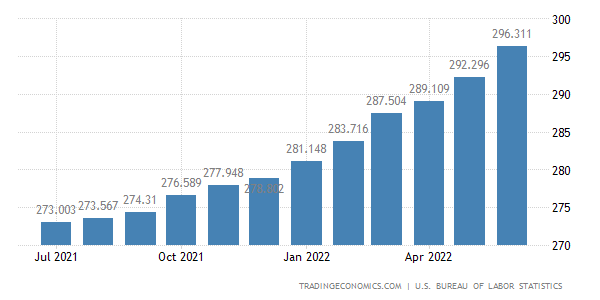
source: tradingeconomics.com
On Thursday, Treasury Secretary Janet Yellen expressed support for the Federal Reserve’s decision to double interest rates to bring down the “unacceptably high” level of inflation, and assured that the issue was the administration’s “top priority.”
Yellen echoed Mr. Biden’s claims that America’s economic problems were partly Russia’s fault, calling the inflation rate one of the “spillover effects” caused by “Putin’s war” in Ukraine. Yellen added that broken supply chains were part of the problem, and called on G20 economies to “make our economies and our supply chains stronger and more resilient and avoid the sort of costly disruptions that have driven up inflation in America and globally.”
Last month, Fed Chairman Jerome Powell broke with the Biden administration’s “Putin’s price hike” talking point, telling lawmakers at a Senate Banking Committee hearing that “inflation was high before – certainly before the war in Ukraine broke out,” and that the phenomenon is caused by a number of factors, including supply chain disruptions, regulations that constrain supply, and “excessive fiscal spending.”
June’s inflation rate hike constituted the sharpest jump since 1981 – the height of the ‘malaise days’ of raging inflation, low growth, and soaring energy costs. The problem was ultimately resolved by temporarily increasing the interest rate to double digits, easing restrictions on adding to the federal debt, steep government spending cuts and a consumer credit boom.
July 15, 2022
Posted by aletho |
Economics | Joe Biden, United States |
Leave a comment
By Uriel Araujo | July 15, 2022
Kiev is now employing the High Mobility Artillery Rocket Systems (HIMARS) provided by Washington to strike Moscow-controlled areas. Such missiles hit warehouses in Nova Kakhovka – in the Kherson region – containing saltpetre, a chemical compound that is used to make gunpowder and fertilizers. Ukraine claims the target was an ammunition dump. The strike caused a major explosion and fires. Shops, gas stations, pharmacies, a church, and other civilian buildings were also hit. At least seven people were killed and 60 have been wounded, according to Vladimir Leontyev, head of the Russian-controlled Kakhovka District military-civilian administration.
The first M142 HIMARS arrived in Ukraine at the end of June and have been linked to explosions in the Donbass region and southern Ukraine. In its counter-offensive, the Ukrainian authorities are indiscriminately attacking the areas whose control they lost and are basically shelling the very population they consider to be their own people – using American weapons for that. City districts have been leveled, with civilian infrastructure destroyed and many civilians killed in the process.
Last week, Alexandr Shulguin, Moscow’s permanent representative at the Organization for the Prohibition of Chemical Weapons (OPCW), warned that Kiev is preparing provocations with chemical weapons at the Nikolaevka thermal power plant and also at other locations in Kharkiv. He told Rossiya 24 channel that a note was sent to the technical secretariat of the OPCW.
Kiev was in control of the Azot chemical factory in Severodonetsk (now taken by the Russians forces), and, on June 25, Ukrainian shelling forced Russian forces to suspend the evacuation of civilians from the plant. Hundreds of people had taken shelter there. Ukrainian troops also shelled the Yasinovka coking chemical plant in the Kirovsky district of Makiivka in the Donetsk People’s Republic (DPR) on June 19.
Already in May there were reports that Ukrainian nationalist battalions were plotting provocations at the chemical facilities in the so-called “chemical industry triangle” (Severodonetsk, Lisichansk, and Rubezhnoye), which is home to over 30 chemical factories. On May 6, Mikhail Mizintsev, chief of Russia’s National Defense Management Center, had already warned about Kiev’s plans to deploy “heavy weapons” against chemical plants in the region. In fact, the Ukrainian military has been gathering information about chemical facilities in the Donbass, both in the DPR and the Luhansk People’s Republic (LPR).
Thus, the Ukrainian strategy that is unfolding now seems to involve attacking chemical plants and facilities. And US-provided missile systems might be used for that very purpose. The environmental hazards of this are quite obvious, not to mention the humanitarian disaster and the potential long-term health effects on the population even after the end of the conflict for many years to come (due to soil and water contamination). A lot of chemicals are stored in Donbass, which is a heavily industrialized region. It is also home to a number of mines which are currently closed. If a dam is broken, mercury and sulfur from the flooded mines could end up in the Sea of Azov.
Currently, eight American HIMARs are in Ukraine and four more are expected to arrive by the end of July. Even though Kiev claims this new development is a game changer, it can only protract the conflict and in fact cannot ensure Ukrainians will retake terrain. Last week, on July 6, the Russian defense ministry announced Moscow had destroyed two Ukrainian HIMARS and their ammunition depots in a village south of Kramatorsk in the Donetsk region.
If Kiev keeps targeting chemical facilities, a Russian offensive is sure to follow, and it will include an aerial onslaught. In this scenario, the HIMARs batteries will be helpless, according to a Ukrainian military official quoted by Jack Detsch, a Pentagon correspondent writing for Foreign Policy.
The proxy war the US-led West is waging against Moscow in Ukraine does not seem to have a way out or an exit strategy right now. Even with all the heavy weaponry provided, Russia and its artillery machine cannot be defeated. In fact, the Russian Federation controls three-quarters of the Donbass and still has five times more artillery than Ukraine. Ukrainian officials say there are 10 Russian canons for every Ukrainian one.
Kiev’s other weaknesses are well known, such as its lack of skilled infantry – not to mention the bad shape of its economy. Moreover, there are no real diplomatic endeavors toward peace or a compromise. So, the Western strategy apparently consists in keeping the flow of weapons to Ukraine to prolong an already disastrous conflict, at an enormous humanitarian, environmental and economic cost.
July 15, 2022
Posted by aletho |
False Flag Terrorism, War Crimes | Donbass, Ukraine, United States |
Leave a comment
Samizdat | July 15, 2022
The US House of Representatives has authorized $840 billion in defense spending in 2023, boosting President Joe Biden’s proposed record military budget by $37 billion.
The annual National Defense Authorization Act (NDAA), which sets military expenditure, was passed on Thursday by a vote of 329-101.
The bill offers $1 billion in aid to Ukraine, including a program to train Ukrainian pilots to fly F-15, F-16 and other US aircraft. The Ukrainians should familiarize themselves with US-made planes “while the administration continues to consider sending such equipment,” said a statement on Congressman Adam Kinzinger’s website last month.
The bill also bans the supply of the F-16s to Turkey unless the US president guarantees to Congress that Ankara has not “violated the sovereignty of Greece, including through territorial overflights” for 120 days prior to the transfer.
Last month, the Senate Armed Services Committee proposed its own version of the budget, attaching an additional $45 billion to Biden’s original plan.
Both chambers will vote for a compromise budget later this year. Jack Reed, the chair of the Senate Armed Services Committee, told Politico magazine on Wednesday that he expects the debate on the matter in September.
The boost to defense spending comes during Russia’s military campaign in Ukraine, and continuing tensions with China over Taiwan and the larger Asia-Pacific.
The US has committed around $5.6 billion in security aid to Kiev after Russia launched its military campaign in late February. The heavy weapons delivered by Washington include M142 HIMARS multiple rocket launchers, M777 howitzers. It has also supplied radars, helicopters, and drones.
The Kremlin has stated that “flooding” Ukraine with foreign weapons would only exacerbate the conflict.
July 15, 2022
Posted by aletho |
Economics, Militarism | United States |
Leave a comment
‘People are getting bad advice and we can’t say anything.’
By Marty Makary M.D., M.P.H. and Tracy Beth Høeg M.D., Ph.D. | Common Sense | July 14, 2022
The calls and text messages are relentless. On the other end are doctors and scientists at the top levels of the NIH, FDA and CDC. They are variously frustrated, exasperated and alarmed about the direction of the agencies to which they have devoted their careers.
“It’s like a horror movie I’m being forced to watch and I can’t close my eyes,” one senior FDA official lamented. “People are getting bad advice and we can’t say anything.”
That particular FDA doctor was referring to two recent developments inside the agency. First, how, with no solid clinical data, the agency authorized Covid vaccines for infants and toddlers, including those who already had Covid. And second, the fact that just months before, the FDA bypassed their external experts to authorize booster shots for young children.
That doctor is hardly alone.
At the NIH, doctors and scientists complain to us about low morale and lower staffing: The NIH’s Vaccine Research Center has had many of its senior scientists leave over the last year, including the director, deputy director and chief medical officer. “They have no leadership right now. Suddenly there’s an enormous number of jobs opening up at the highest level positions,” one NIH scientist told us. (The people who spoke to us would only agree to be quoted anonymously, citing fear of professional repercussions.)
The CDC has experienced a similar exodus. “There’s been a large amount of turnover. Morale is low,” one high level official at the CDC told us. “Things have become so political, so what are we there for?” Another CDC scientist told us: “I used to be proud to tell people I work at the CDC. Now I’m embarrassed.”
Why are they embarrassed? In short, bad science.
The longer answer: that the heads of their agencies are using weak or flawed data to make critically important public health decisions. That such decisions are being driven by what’s politically palatable to people in Washington or to the Biden administration. And that they have a myopic focus on one virus instead of overall health.
Nowhere has this problem been clearer—or the stakes higher—than on official public health policy regarding children and Covid.
First, they demanded that young children be masked in schools. On this score, the agencies were wrong. Compelling studies later found schools that masked children had no different rates of transmission. And for social and linguistic development, children need to see the faces of others.
Next came school closures. The agencies were wrong—and catastrophically so. Poor and minority children suffered learning loss with an 11-point drop in math scores alone and a 20% drop in math pass rates. There are dozens of statistics of this kind.
Then they ignored natural immunity. Wrong again. The vast majority of children have already had Covid, but this has made no difference in the blanket mandates for childhood vaccines. And now, by mandating vaccines and boosters for young healthy people, with no strong supporting data, these agencies are only further eroding public trust. … Full article
July 14, 2022
Posted by aletho |
Video | COVID-19 Vaccine, United States |
Leave a comment
Pfizer’s Paxlovid was granted emergency use authorization to treat mild to moderate COVID-19 in December 2021.1 The drug consists of nirmatrelvir tablets — the antiviral component — and ritonavir tablets, which are intended to slow the breakdown of nirmatrelvir.2
What started out as a slow rollout — only 40,000 or fewer prescriptions were written for the drug in the U.S. each week through April 2022 — has gained steam, with more than 160,000 Paxlovid prescriptions now being issued each week.3 As of June 30, 2022, 1.6 million courses of Paxlovid have been prescribed in the U.S. since its emergency use approval in December.4
Yet, this increase in prescribing could be contributing to one of the significant downfalls of the drug — the creation of selective pressure on SARS-CoV-2, which promotes mutations that could make it resistant to the drug.5 The U.S. Centers for Disease Control and Prevention also issued a warning to health care providers and public health departments about the potential for COVID-19 rebound after Paxlovid treatment.6
This recently happened to Dr. Anthony Fauci, director of the U.S. National Institute of Allergy and Infectious Diseases (NIAID), who experienced a return of COVID-19 symptoms after taking Paxlovid. He then took a second course of the drug, which could trigger even more mutations in the virus.
Paxlovid Triggers Fauci’s COVID-19 Rebound
Fauci said he tested positive for COVID-19, with only minimal symptoms. As his symptoms increased, he took Paxlovid for five days, after which he tested negative for three consecutive days. On the fourth day of testing, he tested positive for COVID-19 again, with symptoms worse off than they were the first time.
“It was sort of what people are referring to as a Paxlovid rebound,” he said. “… Over the next day or so I started to feel really poorly, much worse than in the first go around.”7 He was then prescribed a second course of Paxlovid.
On June 30, he stated, “I went back on Paxlovid, and right now I am on my fourth day of a five-day course of my second course of Paxlovid. Fortunately, I feel reasonably good. I mean, I’m not completely without symptoms, but I certainly don’t feel acutely ill.”8 In the CDC’s health advisory regarding COVID-19 rebound after Paxlovid treatment it’s stated:9
“Recent case reports document that some patients with normal immune response who have completed a 5-day course of Paxlovid for laboratory-confirmed infection and have recovered can experience recurrent illness 2 to 8 days later, including patients who have been vaccinated and/or boosted …
These cases of COVID-19 rebound had negative test results after Paxlovid treatment and had subsequent positive viral antigen and/or reverse transcriptase polymerase chain reaction (RT-PCR) testing.”
COVID-19 Still Spreads During Paxlovid Rebound
People who take Paxlovid can still transmit COVID-19 to others, even if they’re asymptomatic, according to a preprint study.10 Study author Dr. Michael Charness of the Veterans Administration Medical Center in Boston told CNN, “People who experience rebound are at risk of transmitting to other people, even though they’re outside what people accept as the usual window for being able to transmit.”11
The CDC12 and Pfizer13 have suggested that sometimes COVID-19 naturally comes back after a person tests negative, implying that COVID-19 rebound is spontaneous and not necessarily linked to Paxlovid. However, Charness and colleagues didn’t find this to be the case. When they analyzed 1,000 cases of COVID-19 diagnosed among members of the National Basketball Association — none of whom took Paxlovid — no cases of COVID-19 rebound were found.14
Research published in Clinical Infectious Diseases 15 looked into why Paxlovid may be leading to rebound symptoms and suggests it could be the result of insufficient exposure to the drug.16 “Not enough of the drug was getting to infected cells to stop all viral replication,” UC San Diego Health reported. “They suggested this may be due to the drug being metabolized more quickly in some individuals or that the drug needs to be delivered over a longer treatment duration.”17
Pfizer Seeks FDA Approval for Paxlovid
Despite the many questions regarding Paxlovid’s association with rebound infections, Pfizer is moving ahead and seeking full approval of the drug from the FDA.18 The drug’s emergency use authorization restricts who the drug can be sold and marketed to. Once full FDA approval is granted, Pfizer can market the drug directly to consumers.
Paxlovid’s emergency use authorization allows it to be prescribed for adults and children ages 12 and older who are at high risk for progression to severe COVID-19.19 Pfizer estimates that up to 60% of the U.S. population meets these criteria and has at least one risk factor for severe illness, such as obesity or diabetes, making them eligible for the drug.20
However, concerns have risen over whether Paxlovid, which is said to cut the risk of hospitalization or death by 86% in high-risk patients, when taken within five days of symptoms starting,21 is effective in people who are not high-risk.
In fact, Pfizer stopped a large trial of Paxlovid in standard-risk patients because it didn’t show significant protection against hospitalization or death in this group.22 According to a news release from Pfizer:23
“In previously reported interim analyses, the company disclosed that the novel primary endpoint of self-reported, sustained alleviation of all symptoms for four consecutive days was not met, and a non-significant 70% relative risk reduction was observed in the key secondary endpoint of hospitalization or death (treatment arm: 3/428; placebo: 10/426).
An updated analysis from 1,153 patients enrolled through December 2021 showed a non-significant 51% relative risk reduction (treatment arm: 5/576; placebo: 10/569). A sub-group analysis of 721 vaccinated adults with at least one risk factor for progression to severe COVID-19 showed a non-significant 57% relative risk reduction in hospitalization or death (treatment arm: 3/361; placebo: 7/360).”
Is Paxlovid Triggering SARS-CoV-2 Mutations?
Initial reports have suggested that SARS-CoV-2 is not mutating and becoming resistant to Paxlovid, but some experts believe it’s only a matter of time before this occurs — and emerging research suggests it’s already happened.
David Ho, a virologist at the Aaron Diamond AIDS Research Center at Columbia University, was among the first to document resistance mutations in HIV 30 years ago and believes the same may be coming with SARS-CoV-2.24 He’s also experienced post-Paxlovid COVID-19 rebound firsthand. Bloomberg reported:25
“Ho said he came down with COVID on April 6 … His doctor prescribed Paxlovid, and within days of taking it, his symptoms dissipated and tests turned negative. But 10 days after first getting sick, the symptoms returned and his tests turned positive for another two days.
Ho said he sequenced his own virus and found that both infections were from the same strain, confirming that the virus had not mutated and become resistant to Paxlovid. A second family member who also got sick around the same time also had post-Paxlovid rebound in symptoms and virus, Ho says.
‘It surprised the heck out of me,’ he said. ‘Up until that point I had not heard of such cases elsewhere.’ While the reasons for the rebound are still unclear, Ho theorizes that it may occur when a small proportion of virus-infected cells may remain viable and resume pumping out viral progeny once treatment stops.”
Studies Show COVID-19 Virus Developing Paxlovid Resistance
Two separate studies cultured SARS-CoV-2 in a lab and exposed it to low levels of nirmatrelvir, which would kill some, but not all, of the virus. “Such tests are meant to simulate what might happen in an infected person who doesn’t take the whole regimen of the drug or an immunocompromised patient who has trouble clearing the virus,” Science reported.26
One of the studies revealed that SARS-CoV-2 developed three mutations after 12 rounds of nirmatrelvir treatment — “at positions 50, 166 and 167 in the string of amino acids that make up MPRO.”27 The mutations amounted to a 20-fold reduction in the virus’ susceptibility to nirmatrelvir.28 The other study29 also found mutations at positions 50 and 166, revealing that when they occurred together, SARS-CoV-2 became 80 times less susceptible to nirmatrelvir. According to the study:30
“Reverse genetic studies in a homologous infectious cell culture system revealed up to 80-fold resistance conferred by the combination of substitutions L50F and E166V. Resistant variants had high fitness increasing the likelihood of occurrence and spread of resistance.”
Lead study author Judith Margarete Gottwein with the University of Copenhagen told Science, “This tells us what mutations we should be looking for [in patients].”31 Ho, who was not involved in these studies, agreed that it appeared mutations were an inevitable outcome.
He told Science, “when you put pressure on the virus it escapes … Given the amount of infections out there, it’s going to come.”32 It’s also completely unknown what may happen when two courses of Paxlovid are taken in quick succession to treat COVID-19 rebound — as occurred with Fauci. It’s possible that ever-mutating COVID-19 variants could be created.
Other antivirals on the market to treat COVID-19 have also led to concerns over mutations. Molnupiravir (sold under the brand name Lagevrio) was developed by Merck and Ridgeback Therapeutics and approved by the FDA for emergency use December 23, 2021, for high-risk patients with mild to moderate COVID symptoms.
However, not only might it contribute to cancer and birth defects, it may also supercharge the rate at which the virus mutates inside the patient, resulting in newer and more resistant variants.33
Other Early COVID-19 Treatments Ignored
Using drugs that cause high rates of organ failure, like remdesivir, and drugs that cause the virus to rebound with a vengeance, like Paxlovid, and potentially trigger mutations don’t seem to be in the best interest of public health. The fact that U.S. health authorities have focused on these drugs to the exclusion of all others, including older drugs with high rates of effectiveness and superior safety profiles, sends a very disturbing message.
An investigation by Cornell University, posted on the University’s preprint server January 20, 2022, found ivermectin outperformed 10 other drugs against COVID-19, making it the most effective against the Omicron variant.34 It even outperformed Paxlovid, yet it’s been vilified by health officials and mainstream media.
Remdesivir costs between $2,340 and $3,120,35 and nirmatrelvir costs $529 per five-day treatment,36 while the average treatment cost for ivermectin is $58.37 Do you think this has anything to do with ivermectin’s vilification?
Paxlovid alone has cost U.S. taxpayers $5.29 billion,38 while safe and less expensive options exist. Dr. Pierre Kory, who is part of the group that formed the Front Line COVID-19 Critical Care Working Group (FLCCC) to advance early treatments for COVID-19, pleaded with the U.S. government early on in the pandemic to review the expansive data on ivermectin to prevent COVID-19, keep those with early symptoms from progressing and help critically ill patients recover — to no avail.39,40
However, if you’d like to learn more about its potential uses for SARS-CoV-2, FLCCC’s I-MASK+ protocol can be downloaded in full,41 giving you step-by-step instructions on how to prevent and treat the early symptoms of COVID-19.
Sources and References
July 14, 2022
Posted by aletho |
Corruption, Science and Pseudo-Science | Covid-19, Paxlovid, United States |
Leave a comment
U.S. President Joe Biden said in an interview aired Wednesday that he would be willing to go to war with Iran to prevent the country from obtaining a nuclear weapon, a position that drew condemnation from advocacy groups and foreign policy analysts who questioned the moral, strategic, and legal bases for such a stance.
Biden also reiterated in the sit-down interview with Israeli broadcaster N12 that he is committed to keeping the Islamic Revolutionary Guard Corps (IRGC) on the U.S. State Department’s Foreign Terrorist Organizations list, even if it means sinking the prospects of a deal to revive the nuclear accord that former President Donald Trump violated in 2018.
While acknowledging that Trump’s decision to abandon the seven-country deal was a “gigantic mistake,” Biden said he would not delist the IRGC to advance nuclear talks that have hit a wall in recent weeks.
Biden offered a one-word answer—”yes”—when asked whether he would keep the IRGC on the terror list “even if that means that kills the deal.”
The U.S. president went on to say that he’s prepared to use military force “as a last resort” to prevent Iran from obtaining a nuclear weapon. Iran has repeatedly said it is not pursuing a nuclear weapon and that its nuclear energy program is designed for peaceful domestic purposes.
Peace organizations were outraged by the president’s interview, noting that the terror designation is largely symbolic while the nuclear deal was a substantive diplomatic achievement that lifted devastating economic sanctions in exchange for limits to Iran’s nuclear program.
“Let’s be clear: Congress has not authorized—and the American people overwhelmingly do not support—the use of force against Iran,” said the Friends Committee on National Legislation. “If the president is committed to preventing nuclear proliferation, he should return to the nuclear deal and prioritize diplomacy. War is not the answer.”
Matt Duss, foreign policy adviser to U.S. Sen. Bernie Sanders (I-Vt.), responded that “it makes absolutely zero sense that he won’t delist the IRGC to prevent an Iranian nuke but would launch a war to prevent an Iranian nuke.”
The president’s remarks came days after his administration announced new sanctions targeting Iranian firms and individuals, a move seen as further evidence that Biden remains wedded to the failed “maximum pressure” campaign that his predecessor launched, imperiling any remaining hopes of a breakthrough in the stalled nuclear talks.
“Astonishing to see the president say he is willing to throw away the diplomatic progress his team has made and invite war with Iran over pointless partisan symbolism,” said progressive advocacy group Win Without War.
July 14, 2022
Posted by aletho |
Militarism, Wars for Israel | Iran, Israel, Joe Biden, United States |
Leave a comment

The Israeli occupation army started on Wednesday the process of confiscating 1,480 dunams of land belonging to Palestinians in the occupied West Bank. The move was made as US President Joe Biden touched down in the occupation state on his first trip to the Middle East since taking office.
According to Palestinian activists, the land targeted by the Israeli occupation belongs to four Palestinian villages, Jaloud, Qaryut, Turmusaya and Al-Mughayer. All of them are located between Ramallah and Nablus.
Palestinian anti-settlement activist Ghassan Daghlas said that the land was seized after appeals from the owners, who grow olives and almonds there, were rejected. The area was declared to be a security zone by the army to secure adjacent Israeli settlements and outposts. All of Israel’s settlements and settlement outposts are illegal under international law.
According to Daghlas, the land is located around the Jewish settlement of Shilo. He pointed out that this is the largest land grab intended to expand the settlements and outposts that surround the villages, and noted that the confiscation was under a military order issued on 14 April which was not disclosed until after the deadline for objections had passed.
The Israeli occupation authorities are planning to annex the land to increase the size of the illegal Amichai settlement.
July 14, 2022
Posted by aletho |
Ethnic Cleansing, Racism, Zionism | Human rights, Israel, Palestine, United States, West Bank, Zionism |
Leave a comment