More Than 1 Million COVID Vaccine Injuries, Nearly 27,000 Deaths Reported to VAERS: CDC Data
By Megan Redshaw | The Defender | April 15, 2022
The Centers for Disease Control and Prevention (CDC) today released new data showing a total of 1,226,314 reports of adverse events following COVID vaccines were submitted between Dec. 14, 2020, and April 8, 2022, to the Vaccine Adverse Event Reporting System (VAERS). VAERS is the primary government-funded system for reporting adverse vaccine reactions in the U.S.
The data included a total of 26,976 reports of deaths — an increase of 277 over the previous week — and 219,865 serious injuries, including deaths, during the same time period — up 2,564 compared with the previous week.
Excluding “foreign reports” to VAERS, 805,921 adverse events, including 12,471 deaths and 79,811 serious injuries, were reported in the U.S. between Dec. 14, 2020, and April 8, 2022.
Foreign reports are reports foreign subsidiaries send to U.S. vaccine manufacturers. Under U.S. Food and Drug Administration (FDA) regulations, if a manufacturer is notified of a foreign case report that describes an event that is both serious and does not appear on the product’s labeling, the manufacturer is required to submit the report to VAERS.
Of the 12,471 U.S. deaths reported as of April 8, 17% occurred within 24 hours of vaccination, 21% occurred within 48 hours of vaccination and 59% occurred in people who experienced an onset of symptoms within 48 hours of being vaccinated.
In the U.S., 564 million COVID vaccine doses had been administered as of April 8, including 334 million doses of Pfizer, 212 million doses of Moderna and 19 million doses of Johnson & Johnson (J&J).
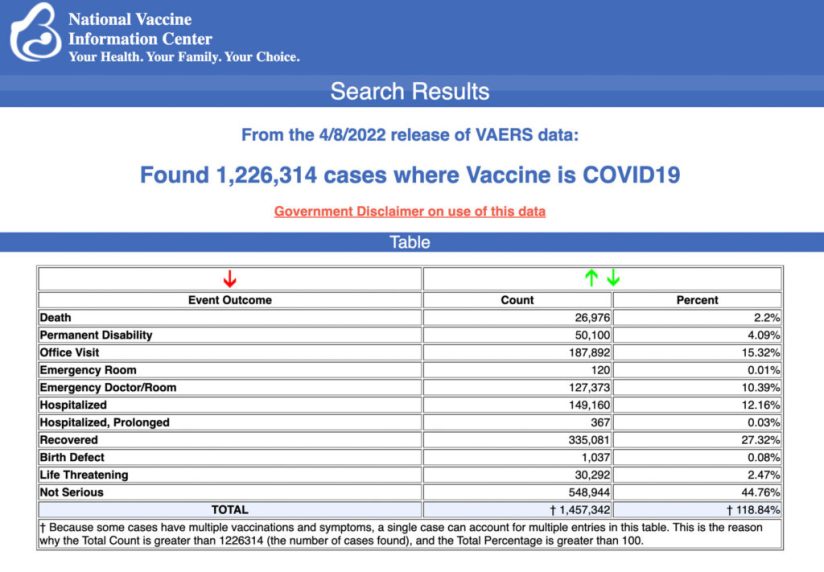
Every Friday, VAERS publishes vaccine injury reports received as of a specified date. Reports submitted to VAERS require further investigation before a causal relationship can be confirmed.
Historically, VAERS has been shown to report only 1% of actual vaccine adverse events.
U.S. VAERS data from Dec. 14, 2020, to April 8, 2022, for 5- to 11-year-olds show:
- 10,216 adverse events, including 242 rated as serious and 5 reported deaths.
- 18 reports of myocarditis and pericarditis (heart inflammation).
The CDC uses a narrowed case definition of “myocarditis,” which excludes cases of cardiac arrest, ischemic strokes and deaths due to heart problems that occur before one has the chance to go to the emergency department. - 39 reports of blood clotting disorders.
U.S. VAERS data from Dec. 14, 2020, to April 8, 2022, for 12- to 17-year-olds show:
- 31,048 adverse events, including 1,792 rated as serious and 44 reported deaths.
- 67 reports of anaphylaxis among 12- to 17-year-olds where the reaction was life-threatening, required treatment or resulted in death — with 96% of cases attributed to Pfizer’s vaccine.
- 651 reports of myocarditis and pericarditis, with 639 cases attributed to Pfizer’s vaccine.
- 166 reports of blood clotting disorders, with all cases attributed to Pfizer.
U.S. VAERS data from Dec. 14, 2020, to April 8, 2022, for all age groups combined, show:
- 20% of deaths were related to cardiac disorders.
- 54% of those who died were male, 41% were female and the remaining death reports did not include the gender of the deceased.
- The average age of death was 73.
- As of April 8, 5,404 pregnant women reported adverse events related to COVID vaccines, including 1,6936 reports of miscarriage or premature birth.
- Of the 3,647 cases of Bell’s Palsy reported, 51% were attributed to Pfizer vaccinations, 40% to Moderna and 8% to J&J.
- 860 reports of Guillain-Barré syndrome, with 42% of cases attributed to Pfizer, 30% to Moderna and 28% to J&J.
- 2,373 reports of anaphylaxis where the reaction was life-threatening, required treatment or resulted in death.
- 1,671 reports of myocardial infarction.
- 13,755 reports of blood-clotting disorders in the U.S. Of those, 6,169 reports were attributed to Pfizer, 4,911 reports to Moderna and 2,654 reports to J&J.
- 4,124 cases of myocarditis and pericarditis with 2,531 cases attributed to Pfizer, 1,402 cases to Moderna and 181 cases to J&J’s COVID vaccine.
Woman develops fatal brain disease after second Moderna dose
Carol Beauchine died from sporadic Creutzfeldt-Jakob Disease (CJD), a rapidly evolving, fatal degenerative brain disorder she developed after her second dose of Moderna’s COVID vaccine.
In an exclusive interview with The Defender, Carol’s son, Jeffrey Beauchine, said it was excruciating to watch his 70-year-old mother — who was healthy until she got the vaccine — die from a disease he believes the vaccine caused.
Beauchine said Carol received her first dose of Moderna on Feb. 16, 2021, and didn’t report any complaints. After getting the second dose on March 17, Carol immediately said she “felt different.” She developed numbness that spread throughout the entire left side of her body, blindness and hearing loss. She lost the ability to walk and communicate, and her brain degenerated until she passed away on Aug. 2, 2021 — just five months after receiving her second dose of Moderna.
The family submitted a report to VAERS, but the CDC has not followed up on Carol’s death. The Defender has received numerous reports of people who died from sporadic CJD after receiving a COVID vaccine — all women who were between the ages of 60 and 70, including Cheryl Cohen and Jennifer Deason Sprague.
Biden administration extends COVID public health emergency needed to keep vaccines under EUA
The Biden administration on Wednesday extended the COVID public health emergency, now two years old, for an additional 90 days — allowing vaccines and other drugs to remain under Emergency Use Authorization (EUA). Keeping COVID vaccines and other countermeasures under EUA shields pharmaceutical companies from liability for the harms caused by their products.
According to Reuters, a public health emergency was initially announced in January 2020, when the COVID pandemic began. It has been renewed each quarter since and was due to expire on April 16.
The Department of Health and Human Services (HHS) said in a statement it was extending the public health emergency and will give states 60 days’ notice prior to termination or expiration. This may be the last time HHS Secretary Xavier Becerra extends it, according to policy experts.
Pfizer to seek authorization from FDA for COVID booster shot for kids 5 to 11 years old
Pfizer and BioNTech Thursday said they plan to apply for EUA of a COVID booster dose for healthy 5- to 11-year-olds based on the results of a small study that has not been published or analyzed by independent experts.
Pfizer said in a press release the third dose of its vaccine produced significant protection against the Omicron variant in children 5 to 11 in a small Phase 2/3 clinical trial. The study was based on data from only 140 children 5 through 11 years old who received a booster dose six months after the second dose of Pfizer-BioNTech’s COVID vaccine as part of the primary series.
Pfizer claimed a closer look at 30 children showed a 36-fold increase in virus-fighting antibodies — levels high enough to fight the Omicron variant, and that a third dose was “well tolerated with no new safety signals observed.”
Although Pfizer said more than 10,000 children under the age of 12 have participated in clinical trials investigating Pfizer’s COVID vaccine, only 140 were selected for the study forming the basis for the company’s EUA request.
CDC launches internal review over failed COVID response
The CDC announced Monday it was launching a month-long comprehensive agency-wide review following widespread criticism of the agency’s response to the COVID pandemic.
The agency plans to evaluate its structure, systems and processes, CDC Director Dr. Rochelle Walensky told staff in an email obtained by The Washington Post. Walensky said the goal of the review is to “modernize” the agency and “to position CDC, and the public health community, for greatest success in the future.”
The review will be conducted by Jim Mcrae, associate administrator for primary healthcare at the Health Resources and Services Administration (HRSA). The HRSA and the CDC are part of the Department of Health and Human Services.
Last month, the CDC’s decision to remove from its data tracker website tens of thousands of deaths linked to COVID — including nearly a quarter of the deaths the agency said had occurred among children — eroded public trust in the CDC’s handling of case counts.
Children’s Health Defense asks anyone who has experienced an adverse reaction, to any vaccine, to file a report following these three steps.
Should We Commit to Fight Russia — for Finland?
BY PAT BUCHANAN • UNZ REVIEW • APRIL 15, 2022
The prime ministers of Sweden and Finland, Magdalena Andersson and Sanna Marin, both signaled Wednesday that they will likely be applying for membership in NATO.
The “prospect” is most “welcome,” says The Washington Post: “Finland and Sweden Should Join NATO.”
The editorial was titled “A Way to Punish Putin.”
Before joining the rejoicing in NATO capitals, we might inspect what NATO membership for these two Nordic nations would mean for the United States.
Finland is a nation the size of Germany, but with a population only 4% of that of Russia and a border with Russia that is 830 miles long.
Should Finland join NATO, the United States, under Article 5 of the NATO treaty, would be obligated to go to war with the world’s largest nuclear power to retrieve Finnish lands that an enraged Russia might grab.
Moscow has already indicated that, should Sweden and Finland join NATO, Russia will introduce new nuclear weapons into the Baltic region.
Why is it wise for us to formally agree, in perpetuity, as NATO is a permanent alliance, to go to war with Russia, for Finland?
Given the war in Ukraine and concomitant crisis in Eastern Europe, it is understandable why Stockholm and Helsinki would seek greater security beneath the U.S. nuclear umbrella.
But why would we voluntarily agree to give Sweden and Finland these war guarantees? Why would we commit to go to war with Putin’s Russia, a war that could, and likely would, escalate to the use of tactical nuclear weapons, especially if Russia were losing?
Finland was neutral during the Cold War. Sweden has been neutral since the Napoleonic wars of the early 19th century.
How did we suffer from their neutrality?
In Helsinki and Stockholm, the benefit of a U.S.-NATO commitment to go to war for Finland or Sweden is understandable.
But how does it benefit our country, the USA, to be obligated to go to war with a nation that commands the world’s largest stockpile of nuclear weapons — over some quarrel in the Baltic Sea or Gulf of Finland that does not affect us?
Asked for his view on Sweden and Finland’s campaign to join NATO, Putin spokesman Dmitry Peskov had a note of warning:
“We have repeatedly said that the (NATO) alliance remains a tool geared towards confrontation and its further expansion will not bring stability to the European continent.”
Should Putin’s Russia clash with Finland or Sweden today, the U.S. is free to respond, or not to respond, as it sees fit, depending on our own assessment of risks and rewards.
Why not keep it that way? Why surrender our freedom of action in some future collision involving our main adversary?
History holds lessons for us here.
In March 1939, six months after Munich, when Czechoslovakia disintegrated into its ethnic components, Britain issued an unsolicited war guarantee to Poland, then negotiating with Germany over the port city of Danzig taken from Germany by the victorious Allies after World War I.
When Germany, on Sept. 1, 1939, invaded Poland, Britain was obligated to declare war on Germany over a matter that was not a vital interest of Great Britain or its worldwide empire.
Lest we forget, it was the Bucharest Declaration of 2008, opening the door to membership in NATO for Ukraine and Georgia, that led to the recent crises in Eastern Europe and the current war.
The Russia-Georgia War of August 2008, the U.S.-backed coup in Ukraine in 2014, and Putin’s annexation of Crimea, Luhansk and Donetsk in eastern Ukraine all proceeded from NATO’s decision in 2008 to open the door to membership for Georgia and Ukraine.
Russia’s invasion of Ukraine today is partly due to the U.S. and Ukraine’s refusal to rule out NATO membership for Kyiv.
No NATO nation today has a border with Russia nearly as long as that of Finland. If Finland joins NATO, will we put U.S. boots on the ground along that 830-mile border with Russia? Will U.S. warplanes fly in and out of Finnish airfields and air bases up to the border of Russia?
Collective security is said to be a good idea.
But the core of NATO security is provided by U.S. war guarantees, while most of the collecting is done by our 29 NATO allies, which could become 31 by summer’s end.
Otto von Bismarck predicted that the Great War, when it came, would be ignited by “some damn fool thing in the Balkans.”
And World War I was indeed triggered by the assassination of the Austrian archduke in Sarajevo in June 1914. The Germans came in in part because the kaiser had given Austria a “blank check” for war.
What enabled America to stay out of both world wars for years after they began was our freedom of “entangling alliances” when they began.
But today we not only lead an alliance of 30 nations, but we are adding two more members, one of which has a border of 830 miles with Russia.
How long does our luck last?

The West doesn’t want peace in Ukraine
By Timur Fomenko | Samizdat | April 15, 2022
Late Thursday, the Russian Ministry of Defence confirmed that the Russian Black Sea flagship the Moskva had sunk after a fire was triggered by an unconfirmed cause. There is no independent confirmation of what happened amidst the sea of Ukrainian propaganda, which was quick to claim Kiev’s forces had struck the vessel with a Neptune missile. Meanwhile, the United States had also confirmed a new $800 million package of military aid to Kiev, including new heavier weapons, while EU foreign policy chief Josep Borrell had recently affirmed a commitment for Kiev to win on the ‘battlefield’. As Moscow gears up for a new offensive to secure the Donbass region, it should be abundantly clear that the Western powers are not seeking to resolve the conflict or secure peace, but to escalate it and transform it into a fully-fledged proxy war against Russia.
Apart from its own invasions, bombings, coups, and regime change attempts imposed on countries around the world, one of America’s preferred methods of confronting its adversaries is to ‘wage war by proxy’ against them, that is, to support the war of a group or country against them without militarily engaging themselves. The history of the Cold War is littered with such examples, such as America’s backing of the Mujahideen against the Soviets in Afghanistan, its backing of Saddam Hussein against Iran in the Iran-Iraq War, or, on a more contemporary note, its failed attempt to overthrow Syrian President Bashar Assad via the local rebels. Proxy wars allow the US to minimize its own losses by having someone else die for them while also procuring geopolitical gain for themselves by undermining rival states, at the same time maximizing profits for the military-industrial complex by keeping the arms flowing.
After spending the first month of the Russia-Ukraine conflict calling for Russia to withdraw, it is now increasingly apparent that the US and its allies have changed course and are set on an ambition to drag out the conflict to impose as much damage on Russia as possible, in particular by intensifying weapon supplies, and providing training and intelligence for the Ukrainian Army. Although it was, of course, Moscow that made the choice to initiate the conflict in the first place, it has always been abundantly clear that the US viewed the situation in absolutist terms. Washington opposed any kind of prior compromise between Russia and Ukraine that may have helped avoid hostilities, which encouraged Zelensky’s overconfidence in refusing to negotiate. The same situation is panning out now. Washington does not want the war to end in a swift settlement whereby Ukraine makes concessions to Russia, because the ideal outcome is to ensure Moscow takes as much damage as possible, which means that a war of increasing escalation is in fact in the US’ interests.
There are several reasons for this. First of all, Russia’s tactical withdrawal from the north of Ukraine and a renewed focus on Donbass appears to give confidence to the West they can succeed in undermining Putin’s ‘core war goals’. Secondly, intensifying the conflict and escalation gives the West the political space to continue to impose more sanctions on Moscow and allows the US to impose more ‘unity’ on its European allies. Washington has also calculated that the broader context of this conflict will allow it to push harder for China’s isolation, force countries to take sides and expand military blocs. It has been reported recently that the US is seeking for Japan to join the AUKUS alliance and to expand the military containment of China. Recent comments by Janet Yellen also demanded Beijing oppose the Russian offensive in Ukraine or risk “losing standing” in the world. In other words, the more the US can prolong this, the more geopolitical outcomes it can get in its favour.
This escalation scenario for Russia, however, risks turning the Ukraine crisis into a new ‘great patriotic war’ – that is, a conflict in which the survival of the nation itself is at stake. Why so? The United States and its allies have made it no secret that they want the war to end in failure for Russia. Some of them would like nothing more than for a military failure to precipitate the downfall of President Putin and the government – even if the only straight-up regime change call was ostensibly a slip of the tongue by US President Joe Biden. This confirms the Kremlin’s long-held suspicions about the true intentions of the West and the goals behind the expansion of NATO.
In conclusion, this means we’re now going into very dangerous territory. The US and its allies could not be clearer that they never wanted peace or compromise and are escalating the situation in Ukraine as a bid to affirm their own geopolitical hegemony over the world, be it against Russia, India, or China. For Russia, this becomes an ever-growing struggle against the Western bid to dominate, coerce, and subjugate their country, with Ukraine as the sacrificial pawn.
NATO pins nuclear plans on F-35
Samizdat | April 15, 2022
NATO planners are updating the US “nuclear sharing” program to account for most European allies planning to buy F-35 joint strike fighter jets, the alliance’s director of nuclear policy said this week. Lockheed Martin’s fifth-generation fighter has been embraced by multiple US allies, including most recently Germany, despite the Pentagon’s own misgivings about the program.
“We’re moving fast and furiously towards F-35 modernization and incorporating those into our planning and into our exercising and things like that as those capabilities come online,” Jessica Cox, director of the NATO nuclear policy directorate in Brussels, said on Wednesday, adding that “By the end of the decade, most if not all of our allies will have transitioned” to the F-35.,
Cox spoke during an online discussion hosted by the Advanced Nuclear Weapons Alliance Deterrence Center (ANWA DC), a US think tank, according to Defense News.
Her remarks come a month after Berlin said Germany would replace its aging Tornado jets with F-35s, committing to buy up to three dozen and specifically citing the nuclear sharing mission as factoring in the decision.
Cox said that other NATO allies currently operating the F-35, such as Poland, Denmark or Norway, might be asked to support nuclear sharing missions in the future, adding that NATO “will also have some operational advantages with the F-35 since there will be opportunities for enhanced networking and integration across the force.”
In addition to Germany, Belgium, the Netherlands, Italy and Turkey are currently hosting an estimated 150 US nuclear weapons – mainly B-61 gravity bombs, intended to be carried by smaller fighter-bombers like the Tornado or the F-16 – according to estimates by the British think tank Chatham House.
Finland and Sweden have recently voiced a desire to join NATO, and Helsinki already announced it would buy some 60 F-35s in early February. Russia has responded by saying it would reposition some of its troops and nuclear deterrent accordingly.
The US first deployed some of its nuclear bombs in Europe in the 1960s. Ending this program was high on the list of security demands Moscow presented to the US and NATO in December 2021, which were rejected in January – a month before the escalation of hostilities in Ukraine.
The F-35 was originally proposed as a cost-effective modular design that could replace multiple older models in service with the US Air Force, Navy and the Marines. In reality, it turned into three distinct designs with a lifetime project cost of over $1.7 trillion, the most expensive weapons program in US history.
In addition to the price tag, the fifth-generation stealth fighter has also been plagued with performance issues, to the point where the new USAF chief of staff requested a study into a different aircraft in February 2021.
General Charles Q. Brown Jr. compared the F-35 to a “high end” sports car, a Ferrari one drives on Sundays only, and sought proposals for a “clean sheet design” of a “5th-gen minus” workhorse jet instead. Multiple US outlets characterized his proposal as a “tacit admission” that the F-35 program had failed.
Russia launched its military offensive in Ukraine on February 24, following Kiev’s failure to implement the terms of the 2014 German and French-brokered Minsk Protocols, designed to give the breakaway regions of Donetsk and Lugansk special status within the Ukrainian state. Moscow has now recognized the Donbass republics as independent states, and demanded that Ukraine officially declare itself a neutral country that will never join the US-led NATO military bloc.
US lawmakers arrive in Taiwan unannounced
Samizdat | April 14, 2022
A group of six US lawmakers arrived in Taiwan on Thursday on an unannounced two-day visit, amid growing tensions between Beijing and Washington. The visit has been confirmed by the American Institute in Taiwan, which serves as a de-facto embassy of the United States in Taipei.
“The congressional delegation will meet with senior Taiwan leaders to discuss U.S.-Taiwan relations, regional security, and other significant issues of mutual interest,” the Institute said in a statement.
According to Reuters, the bipartisan group, which includes a chairman of the US Senate Foreign Relations Committee Bob Menendez and senior Republican senator Lindsey Graham, arrived on Thursday in Taipei on a US Air Force aircraft and were welcomed by Minister of Foreign Affairs Joseph Wu.
Taiwan’s President Tsai Ing-wen will meet the lawmakers on Friday.
Presidential Office spokesman Xavier Chang said that the lawmakers’ visit would contribute to deepening partnership between the island and the US, and underlined that Taipei would continue to work with the United States for the benefit of “global and regional peace, stability, prosperity and development.”
The parliamentarians’ visit has angered China. At a daily press briefing on Thursday Chinese Foreign Ministry Spokesperson Zhao Lijian underlined that Beijing “firmly opposes any form of official interaction between the US and the Taiwan region.”
“Members of the US Congress should act in consistence with the US government’s one-China policy. The US side should abide by the one-China principle and the stipulations of the three China-US joint communiqués, stop official exchanges with Taiwan and avoid going further down the dangerous path,” Lijian said.
He warned that China would continue to take “strong measures” to protect its sovereignty and territorial integrity.
China rejects US ‘pressure or coercion’ over Russia
Samizdat | April 14, 2022
Beijing won’t sanction or condemn Russia over the conflict in Ukraine, and will reject American “pressure or coercion” to change its relationship with Moscow, Chinese Foreign Ministry spokesman Zhao Lijian told reporters on Thursday. China has remained publicly neutral on the conflict, with Zhao saying this position puts it “on the right side of history.”
“China is playing a constructive role in the Ukraine issue,” Zhao told a press briefing, claiming that Beijing has “made considerable efforts to de-escalate the situation, defuse the crisis and rebuild peace.”
“We oppose unfounded accusations and suspicions against China, nor will we accept any pressure or coercion,” Zhao continued. “Time will tell that China’s claims are on the right side of history.”
China has from the outset called for a negotiated settlement to the conflict in Ukraine, and has affirmed both Ukraine’s right to territorial integrity and Russia’s legitimate security concerns. It has continued to trade with Russia, and has joined Moscow in urging the investigation of the US’ alleged biological weapons development in Ukraine. Furthermore, Beijing’s diplomats have opposed or abstained from UN resolutions condemning Russia.
This stance has incurred the scorn of leaders in the US and Brussels. White House Press Secretary Jen Psaki has repeatedly called on China’s leaders to “assess where they want to stand as the history books are written,” NATO Secretary General Jens Stoltenberg has declared that China now poses a “challenge” to the alliance, and most recently, US Treasury Secretary Janet Yellen called for Beijing to use its “special relationship with Russia” to force an end to the conflict.
“The world’s attitude towards China and its willingness to embrace further economic integration may well be affected by China’s reaction to our call for resolute action on Russia,” Yellen told the Atlantic Council, a pro-NATO think tank partly funded by the weapons industry, on Wednesday.
China’s stance is unlikely to change. In addition to reaping the opportunities for trade that Russia’s excommunication from western markets has presented, Beijing has vowed to resist potential US sanctions on its companies as a result of this trade. Furthermore, China has dismissed US media reports suggesting it is preparing to offer Russia military assistance. US officials later admitted that these reports were based on faulty intelligence, and released to the press to win an “info war” against the Kremlin.
Russia’s Ukraine operation has no deadline
BY M. K. BHADRAKUMAR | INDIAN PUNCHLINE | APRIL 13, 2022
In his first extended remarks in nearly a month about the conflict in Ukraine, Russian President Vladimir Putin said on Tuesday that peace talks had reached a “dead end” and pledged that Russia’s “military operation will continue until its full completion.”
Putin defined a more limited aim for the war, focusing on control of the Donbass — and not all of Ukraine. Putin reiterated that Russia’s actions so far in several regions of Ukraine were intended only to tie down enemy forces and carry out missile strikes with the purpose of destroying the Ukrainian military’s infrastructure, so as to “create conditions for more active operations on the territory of Donbass.”
In his words, “Our goal is to provide aid to the people of Donbass, who feel an unbreakable bond with Russia and have been the subjects of genocide for eight years.”
Asked why the operation cannot be speeded up, Putin told reporters: “I often get these questions, ‘can’t we hurry it up?’ We can. But it depends on the intensity of hostilities and, any way you put it, the intensity of hostilities is directly related to casualties.”
He made it clear that “our task is to achieve the set goals while minimising these losses. We will act rhythmically, calmly, and according to the plan that was initially proposed by the General Staff.” He added, “The operation is going according to plan.”
Clearly, Mariupol port city in the south of Donbass could have been conquered with brute force. But that would have caused horrific casualties. Instead, the enemy forces — Ukrainian military, neo-Nazi Azov battalion and foreign mercenaries — have been steadily cornered and entrapped in two main locations, namely, Azovstal steel mills and the city’s main port.
The Russian forces have gained control of the port, while in Azovstal, about 3000-strong enemy forces have been surrounded, who include possibly dozens or hundreds of military officers from the NATO countries — and, surprisingly, Sweden. The experts estimate that the fall of the city into Russian hands is imminent. The Russian Ministry of Defence announced on Wednesday that over 1,000 Ukrainian troops, including 162 officers, surrendered earlier in the day in Mariupol.
In retrospect, the main purpose behind the frantic diplomatic efforts by some of the NATO countries (France and Germany, in particular) to sponsor “humanitarian corridors” out of Mariupol had a nefarious agenda to exfiltrate the Western officers trapped in the city. The heart of the matter is, NATO forces are de facto deployed in Ukraine, as foreign volunteers or as military instructors, and, equipped with heavy military equipment, they are fighting the Russian Army.
A French journalist who managed to sneak in with French “volunteers” has since come out with a video showing that American military personnel coordinate the foreign military in Ukraine and are directly handling the training and enrolment of the foreign “volunteers” in the Ukrainian forces.
In such conditions, quite obviously, peace talks between Moscow and Kiev cannot progress. The big question is: Does the Biden administration want the conflict to end and a peace agreement to be negotiated? The answer seems ‘no’. In fact, the US is fuelling this conflict.
The US Senate has approved a draft law on lend-lease, which will greatly simplify supplies to Ukraine. The Wall Street Journal reported that the US will provide Ukraine with heavy equipment, including Soviet air defence systems. The Biden administration is said to be preparing to announce more than $700 million in additional military assistance to Ukraine, which is likely to include heavy ground artillery systems, helicopters and armoured vehicles. The US had provided more than $2.4 billion in military assistance to Ukraine during Biden’s presidency, including $1.7 billion since Russia began its special operation in Ukraine in late February.
Interestingly, Putin confirmed yesterday the reports that British intelligence had stage-managed the so-called Bucha killings to pillory Russian military and create an international ruckus. The Pentagon had ostentatiously distanced itself from the controversy riveted on what turned out to be fake news. Putin said:
“There is a lot of commotion, but they (EU and US) just needed to adopt a new package of sanctions, as we know very well. Today, we discussed their special operation, the psychological operation carried out by the British.
“If you want to know the addresses, the secret meeting places, the licence plate numbers, the brands of vehicles they used in Bucha, and how they did it, the FSB of Russia can provide this information. If not, we can help. We exposed that ugly, disgusting position of the West together with our Russian friends, in full and from the beginning to the end.”
The Russian and Ukrainian forces have been regrouping and strengthening their positions in Eastern Ukraine through the past fortnight in preparation for a decisive battle for the Donbass. The Russian forces are preparing to encircle a huge concentration of Ukrainian troops, estimated to be in the region of 100,000 servicemen drawn from the best units of the armed forces. Kiev is also transferring all available forces to the eastern front in order to stop the Russian offensive.
Putin’s remarks yesterday suggest that Russia is not looking for a quick victory at any cost. Putin said on Tuesday that Moscow “had no other choice” and that the operation aimed to protect people in parts of eastern Ukraine and to “ensure Russia’s own security”. He vowed it would “continue until its full completion and the fulfilment of the tasks that have been set.”
To be sure, fighting in eastern Ukraine will intensify over the next two to three weeks but the final outcome will take time. The Ukrainian forces and the foreign fighters who have flocked to the eastern region are well-equipped and will not only put up stiff resistance but may even carry the fight into Russian territory.
This grim scenario is fraught with the real danger that NATO may increasingly be finding itself at war with Russia in Ukraine. According to Western media reports, elite British and US special forces units are deployed in Ukraine, including servicemen of the British Special Air Service (SAS) and soldiers of the First Operational Unit of Special Forces “Delta” of the US Army.
There have been reports that the operations in Mariupol were under the command of an American general who attempted to escape by helicopter sent to rescue him a week ago, but was intercepted by the Donetsk militia involved in the operation alongside the Russian forces, and was taken into their custody. It is entirely conceivable that the Austrian Chancellor Karl Nehammer’s Moscow mission on Monday and his “very direct, open and tough” talks with Putin at a one-to-one meeting at the latter’s Novo-Ogaryovo residence near Moscow was in coordination with Washington. There has been no readout of the 75-minute meeting from the Kremlin.
Chinese energy major quits West – report
Samizdat | April 13, 2022
China’s state-owned oil and gas corporation China National Offshore Oil Corporation (CNOOC) is reportedly preparing to exit from the US, UK and Canada due to mounting concerns about sanctions, regulations and rising costs.
Relations between China and Western countries have soured over the past several years. Beijing’s ties with Washington were shattered after former US President Donald Trump launched a large-scale trade war, hitting a wide range of Chinese goods with import levies. Tensions have been mounting recently after China refused to condemn Russia’s military operation in Ukraine.
CNOOC, China’s top offshore oil and gas producer, is currently seeking to leave the West by selling “marginal and hard to manage” assets in the three nations, according to unnamed industry sources quoted by Reuters.
The sources, who spoke on condition of anonymity because of the sensitivity of the issue, told the agency that the company’s top management found it “uncomfortable” to manage its Western assets because of regulations and high operating costs.
CNOOC, which entered the three countries by a $15 billion acquisition of Canadian energy major Nexen in 2013, was delisted from the New York Stock Exchange after Trump’s anti-China campaign was launched. Prior to that the company had been listed on the NYSE for two decades. Joe Biden’s administration removed the firm from the blacklist about a year ago.
In the US, the Chinese energy major owns onshore assets in the Eagle Ford and Niobrara shale basins and also has offshore stakes in the Stampede and Appomattox fields in the Gulf of Mexico. In Britain, the company operates three sites in northeast Scotland, and has oil sands and shale gas assets in Canada.
“Assets like Gulf of Mexico deepwater are technologically challenging and CNOOC really needed to work with partners to learn, but company executives were not even allowed to visit the US offices,” a senior industry source said, as quoted by media.
“It had been a pain all along these years and the Trump administration’s blacklisting of CNOOC made it worse,” he explained.
Moreover, the latest sanctions imposed by the US on Russia may hit CNOOC’s assets, the sources also said. The company, which is getting ready to list on the Shanghai stock exchange in April, is reportedly planning to purchase assets in Latin America and Africa.
CNOOC reportedly produced some 1.57 million barrels of oil equivalent per day in 2021, of which 62,000 were from sites in Canada and 80,000 were from sites elsewhere in North America. Altogether, its assets in the US, UK and Canada produce nearly 220,000 barrels of oil equivalent per day, according to Reuters’ calculations.
Washington warns against ‘preserving’ ties with Moscow
Samizdat | April 13, 2022
US Treasury Secretary Janet Yellen will issue a stark warning to countries “sitting on the fence” when it comes to sanctions against Russia in a speech to be delivered on Wednesday, saying that such “short-sighted” policies would not go unnoticed.
In a speech at an Atlantic Council event amid Moscow’s ongoing military offensive in Ukraine, Yellen will say that the US government remains fully committed to pushing Russia “further towards economic, financial, and strategic isolation,” according to an excerpt quoted by the media.
“And let’s be clear, the unified coalition of sanctioning countries will not be indifferent to actions that undermine the sanctions we’ve put in place,” Yellen will say.
In her opinion, the measures being imposed on Russia by the US and its allies are necessary because the future of the international order, “both for peaceful security and economic prosperity,” is now at stake. However, she will emphasize that some countries are still “sitting on the fence, perhaps seeing an opportunity to gain by preserving their relationship with Russia and backfilling the void left by others.”
Such behavior, the US Treasury Secretary will stress, is “short-sighted.”
The warning comes two days after US President Joe Biden called on India, which has not introduced sanctions against Moscow, not to increase its energy imports from Russia. In a meeting with Indian Prime Minister Narendra Modi, Biden offered assistance in the search for other sources of energy supply, explaining that it is not in India’s interests to increase its dependence on Russia.
Another big international player – China – has also been the subject of US criticism for its ‘neutral’ position on the Ukrainian conflict. Last month, the US administration went even further by warning Beijing of “the implications and consequences” which would follow if China decided to provide any material support for Russia.
There are also increasing tensions in the EU. Hungary and Poland, which were staunch allies prior to the conflict in Ukraine, had moved away from each other even before current events due to their very different relationships with Russia.
The events of the past six weeks have apparently driven them even further apart, with Warsaw announcing that it would freeze bilateral relations until Hungary aligns itself with Kiev. The European Commission also warned Hungary against fulfilling Moscow’s request and paying for the Russian gas in rubles, saying it would violate the sanctions regime.
Featured Video

Trump asks Iran not to retaliate after he strikes Pickaxe Mountain
or go to
Aletho News Archives – Video-Images
Book Review & Summary
Calling of an Angel: The True Story of Rene Caisse and an Indian Herbal Medicine Called Essiac (1988)
Dr. Gary L. Glum – 30 Q&As – Book Review & Summary
Lies are Unbekoming | October 17, 2026
On June 10, 1975, Dr. Chester Stock, a vice president at Memorial Sloan-Kettering Institute for Cancer Research, wrote to a Canadian nurse named Rene Caisse: “Enclosed are test data in two experiments indicating some regressions in sarcoma 180 of mice treated with Essiac.” The sentence sat in a letter from one of the world’s largest private cancer research centers, concerning an herbal tea an elderly English woman had learned from an Ojibwa medicine man at a northern Ontario mining camp in the 1890s. The tests were terminated the following year after Sloan-Kettering admitted, in sworn affidavit three years later, that they had prepared the injectable solution improperly from the dried material supplied — freezing and thawing the herb rather than boiling it as Rene had instructed. By the time Calling of an Angel was published in 1988, Rene Caisse had been dead for a decade, having treated thousands of cancer patients across fifty-six years in her Bracebridge, Ontario kitchen, never charging a fee, and refusing every offer — from Memorial Sloan-Kettering, the National Cancer Institute, Merck, Parke Davis, and private corporations dangling contracts up to $1 million — to release her formula before the medical establishment admitted her remedy had merit. … continue
Blog Roll
 Aletho News
- Trump asks Iran not to retaliate after he strikes Pickaxe Mountain – w/ Prof. Marandi
- Vice President J.D. Vance’s Deceptive ‘Antiwar’ Campaign Speech
- Iran: Palestinians’ rights must not be compromised in Gaza’s future; US, Israel to blame for Hormuz situation
- Ongoing tales of Syrian chemical weapons
- Moscow blasts UN for ignoring torture of Russian POWs
- Millions of Books Could Have Been Destroyed in Lebanon During Israeli Bombings
- Moscow warns of ‘hunt for Russians’
- Calling of an Angel: The True Story of Rene Caisse and an Indian Herbal Medicine Called Essiac (1988)
- South Korean Assistance to the U.S. in the War with Iran: Between Allied Duty and National Interests
- Pharma- and Gates-Funded GAVI Seeks to Assure Parents
- If Americans Knew
- Israeli soldiers debunk Israel’s talking points
- In West Bank, Israeli settlers are totally out of control – Daily Update
- NPR investigation finds evidence of widespread fraud at mall kiosks tied to Israeli skincare brand
- Tucker Carlson exposes Israeli Lies about the Oct 7th attack, Charlie Kirk, and the U.S.
- Israel has detained thousands of Palestinian children since Oct 7th – over half spent time in solitary, many uncharged
- Israeli Analysis: Is Netanyahu Planning an ‘October Surprise’ Attack Before Israel’s Election?
- Israeli settlers brutally attack Palestinians and Washington Post female photographer, 65
- Words Have Changed, Occupation Continues: The Reality of the Gaza Ceasefire
- Gaza’s child amputees are growing faster than their prosthetics allow
- Israel keeps Palestinians struggling just to survive–Daily Update
- No Tricks Zone
- New Study Suggests Large Regions Of The Pacific Ocean Have Been Cooling For The Last 80 Years
- Germany’s Green Energy Debacle: High Energy Costs Force Kahla Porzellan to Close After 182 Years!
- New Study: 50 Years Of The Most Aggressive ‘Net Zero’ Policies Can Only Affect The Global Climate By 0.03°C
- US September “Heat” Was No Record…Many Records Set Decades Ago
- Latest European Green Energy Debacle; Portugal’s Largest Flagship Solar Park Insolvent!
- Green Energy Debacle: German Expert Professor Fritz Vahrenholt Warns Of Severe Economic And Social Consequences
- Two More Paleo Reconstructions Affirm Meters-Higher Sea Levels Across Ireland, Brazil 7000-6000 Years Ago
- New Study: Earth And Venus Surface Warmth Largely Explained By Convection And Lapse Rate, Not CO2 Or Radiation
- 2025 Nature Paper Claiming Worsening Global Drought Gets RETRACTED …Heavily Flawed
- New Study: ‘Global Drought Shows No Detectable Recent Acceleration Under Climate Warming’

