Britain’s military facilities being enhanced to host new US nukes: Report
Press TV – April 13, 2022
British underground military facilities are being upgraded for use in storing US nuclear weapons as part of an extensive nuclear arms modernization program pursued by Washington, US military budget documents show.
In the Biden administration’s 2023 military budget request, the UK was added to the list of countries where infrastructure investment is under way at “special weapons” storage sites, alongside Turkey, Belgium, Germany, Italy, and the Netherlands – all countries where the US stores an estimated 100 B61 atomic bombs, the UK-based The Guardian daily reported Tuesday.
The report cites Hans Kristensen, the director of the nuclear information project at the Federation of American Scientists (FAS), as saying that the British site being upgraded to host the nukes is the US airbase at RAF Lakenheath, located 100 kilometers northeast of London.
As part of the US nuclear arms modernization bid, the report says, “The B61 has been given a new lease of life with a guidance system, the B61-12 variant, due to go into full production in May.”
Washington’s 2023 budget request states that NATO “is wrapping up a 13-year, $384m infrastructure investment program at storage sites in Belgium, Germany, Italy, the Netherlands, the UK, and Turkey to upgrade security measures, communication systems, and facilities.”
This is while Britain has become anxious to assume a more assertive role when it comes to its own nuclear deterrent, according to the report, which noted that London announced last year that it would boost its own stockpile of Trident nuclear warheads by 40 percent to 260 – the first such increase since the end of the cold war.
It further cited British government sources as saying that the UK has “a clearer appreciation” of its role as a nuclear weapons state in a renewed era of state competition with Russia and China.
According to the daily, the British Defense Ministry did not comment on the upgrade mentioned in the US budget, though one official said, “We won’t provide anything on this as it relates to the storage of nuclear weapons.”
It then underlined that the development comes “just four months after the arrival in Lakenheath of the first of a new generation of nuclear-capable US combat aircraft, the F-35A Lightning II, the first such deployment in Europe.”
The report further cited Daryl Kimball, the executive director of the Arms Control Association, as saying that the upgrade of the British storage facilities is “an early sign that the US and NATO are preparing to engage in a protracted and maybe heightened standoff with Putin’s Russia.”
“The administration should provide some clarity about the military necessity and goals of possibly bringing nuclear weapons back to the UK,” Kimball emphasized.
The developments in Europe are part of a broader retreat from arms control, the daily also noted, adding that the Biden administration’s nuclear posture review – which has been sent to Congress but not yet declassified – reportedly do not include the changes the US president pledged during his campaign.
In 2020, Biden claimed he would formally declare the sole purpose of nuclear weapons to be deterrence of a nuclear attack against the US or its allies. But the review leaves open the option of using nuclear arms to respond to non-nuclear threats as well.
However, the nuclear disarmament group CND said the “quiet announcement” by the US amounted to more militarization at a time of growing risk and would add to the risks faced by the British public. CND’s General Secretary Kate Hudson said she feared it could lead to US warheads being redeployed in Britain, insisting, “Nuclear weapons don’t make us safe – they make us a target.”
The US withdrew its B61 munitions from Lakenheath in 2008, marking the end of more than half a century of maintaining a US nuclear stockpile in Britain. At the time of the withdrawal, the gravity bombs were widely considered as militarily obsolete and hopes were higher for further disarmament by major holders of nuclear weapons.
In the 1990s, RAF Lakenheath had 33 underground storage vaults, where 110 B61 bombs were stored, according to the FAS. Since their withdrawal, the vaults have been dormant. Kristensen said he believed the vaults are now being upgraded so the new B61-12 bombs can be stored there.
According to Kristensen, when the new B61-12 bombs are delivered – expected next year – they will replace older models already there, noting that the Lakenheath upgrade is intended to provide more flexibility to move the nuclear weapons around Europe.
“One of the things they have talked about is protecting the deterrent against Russia’s improved cruise missiles capabilities,” Kristensen asserted. “So they could be trying to beef up the readiness of more sites without them necessarily receiving nukes, so that they have the options to move things around in a contingency if they need to.”
Biden mobilizes US military industry to arm Ukraine
Samizdat | April 13, 2022
US President Joe Biden is looking to mobilize the military industry and send another $750 million worth of the Pentagon’s own weapons stockpile to Ukraine, according to new reports citing anonymous officials in Washington. This is on top of the $1.7 billion worth of goods sent to Kiev courtesy of American taxpayers since the conflict escalated on February 24.
So far the US “lethal” aid has consisted mainly of Javelin anti-tank missiles and Stinger portable anti-air systems.
Now Biden is preparing to escalate the aid to include heavy artillery and other systems, worth three-quarters of a billion or so, Reuters reported on Tuesday citing two US officials. The official announcement could come within a day or two, the agency added.
Biden wouldn’t need congressional authorization for this, either, as it would be done under a Presidential Drawdown Authority (PDA), which authorizes transfer from current US military stocks in response to an emergency.
This would put the amount of US military aid to Kiev at over $2.4 billion since Russia sent troops into Ukraine on February 24, when added to the White House’s own figures made public last week.
The US has sent more than 1,400 Stingers and 5,000 Javelins to Ukraine already, Financial Times (FT) reported on Tuesday citing the Pentagon. This amounts to a third of the US stock of Javelins and a quarter of its Stingers, estimated the Center for Strategic and International Studies (CSIS), a Washington think-tank. At current production rates, it will take 3-4 years to restock on Javelins and at least five for the Stingers.
Production levels will be one of the topics at the meeting between the Pentagon officials and top eight US weapons manufacturers, which both Reuters and FT said is scheduled for Wednesday. Raytheon, Boeing, Lockheed Martin, Northrop Grumman, General Dynamics and L3 Harris Technologies are expected in attendance.
Kiev has reached out to US allies far and wide – from its NATO neighbors all the way to South Korea – asking for airplanes, tanks and artillery in particular. On Saturday, German Defense Minister Christine Lambrecht said that Berlin could not afford to send any more weapons without depleting its own stocks too much. By Monday, however, the Rheinmetall conglomerate said it could refurbish some obsolete Leopard 1 tanks and send them east.
Last week, Slovakia announced it would send its only battery of S-300 air defense systems to Ukraine, and get US-made “Patriots” to replace them. On Monday, the Russian Defense Ministry claimed that the battery had been obliterated in a cruise missile strike against a hangar in Dnepropetrovsk, a city Ukrainians call Dnipro, the day before.
Lawmakers reject amendment to prevent monitoring of unvaccinated
By Christina Maas | Reclaim The Net | April 12, 2022
All Democrats in the House Judiciary Committee voted against an amendment that could have protected the unvaccinated from being tracked.
The Domestic Terrorism Prevention Act of 2021 gives federal agencies like the FBI, DOJ, and DHS the authority to “analyze and monitor” activities of domestic terrorism and “take steps to prevent domestic terrorism.”
The current administration’s program for tackling domestic terrorism includes monitoring the spread of misinformation and conspiracy theories online.
In February, the DHS released a memo that pays attention to those who claim election fraud in 2020’s presidential race and those who spread “misinformation” about COVID-19.
“There is widespread online proliferation of false or misleading narratives regarding unsubstantiated widespread election fraud and COVID-19,” the DHS memo read.
“Grievances associated with these themes inspired violent extremist attacks during 2021.”
“COVID-19 mitigation measures – particularly COVID-19 vaccine and mask mandates – have been used by domestic violent extremists to justify violence since 2020 and could continue to inspire these extremists to target government, healthcare, and academic institutions that they associate with those measures.”
Following the release of the memo, Republican Rep. Andy Biggs proposed an amendment to the act to protect unvaccinated Americans from being tracked.
“None of the funds authorized to be appropriated in this Act shall be used to monitor, analyze, investigate or prosecute any individual solely because that individual declined the administration of a vaccine to COVID-19 or expressed opposition to such administration,” Biggs’ proposed amendment read.
According to a tweet by Republican Rep. Thomas Massie, every Democrat in the House Judiciary Committee voted against the proposed amendment.
“Due to a troubling DHS bulletin, @RepAndyBiggsAZ offered an amendment to prevent the targeting of Americans due to their views on COVID vax,” Massie wrote.
“Every Dem. voted against his amdt!”
Searching for War Criminals
They are nearer than you think

BY PHILIP GIRALDI • UNZ REVIEW • APRIL 12, 2022
The United States is now insisting that Russian President Vladimir Putin should be put on trial for “war crimes” committed in Ukraine. As Putin is still insisting that he will attend the upcoming G20 summit in November on the island of Bali, Indonesia, it will be a great opportunity to have US Marshalls snatch him from the stage and whisk him off to a federal courthouse in Virginia for justice to be served. Or a form of justice anyway, since the United States has no actual jurisdiction over where Putin’s alleged crimes might have taken place and it will be impossible to prove that he actually ordered anyone to carry out so-called “crimes against humanity.” We’ll see how it all works out.
Indeed, there is no other phrase that has been more misunderstood and generally abused of late than “war crimes” or “war criminals.” It belongs with several other labels, including “weapons of mass destruction” and “crimes against humanity” that are used to indicate an adversary has crossed a red line and is so deplorable that anything that is done to him either during actual fighting or in the aftermath is completely acceptable. Going back to Greek and Roman times it has always been understood that even in wartime there are certain activities that are unacceptable, but the attempted definition and codification of “war crimes” as a concept is largely a twentieth century creation used to inflict additional punishment on the losers after the fighting is over. The Treaty of Versailles that ended the First World War punished Germany far beyond what most would consider reasonable, largely because the victorious powers were able to do so without any consequences until the next war began. Likewise, the linked concepts of war crimes and crimes against humanity came largely out of the post-Second World War Nuremberg Trials, which shaped the legal arguments around alleged German behavior, not that of the allies.
The Second World War certainly included atrocities of various kinds on both sides, but the Anglo-American deliberate bombing of German cities has to stand out as particularly disproportionate. Forty-two thousand mostly civilians died in Hamburg in the 1943 firebombing and the bombing of Dresden in 1945, at a point when Germany was on the verge of defeat, was remarkable in that the city was not a military target and was full of refugees from the east. At least 200,000 civilians died. Judge Andrew Napolitano has suggested that the greatest war crime in history, if one makes a case based on unnecessary human suffering, was President Harry Truman’s nuclear bombing of Hiroshima and Nagasaki, which almost certainly killed more than 200,000 mostly civilians, when Japan was preparing to surrender. As Truman was on the side that won the war and controlled the prosecution process, there were no legal consequences or punishment relating to his decision, though critics since 1945 have sometimes decried the first use of nuclear weapons.
If killing civilians unnecessarily is the standard definition of a war crime, then America’s most recent five presidents have been war criminals. In other words, historically speaking, accusations of war crimes, which have no real meaning in law and are both infinitely elastic and subject to interpretation, have often depended on which side of the fence one is standing on when the war ends. And it gets more complicated than that, given the politics of what is sometimes referred to as the rules based international order, which in theory arose from the ashes of World War Two. The new world order was US-centric from the start, with the United Nations (UN) situated in New York City, the World Bank in Washington, and the dollar as the world’s reserve currency. At the UN, American primacy was reinforced through the creation of a Security Council, which alone has the power to authorize military action against a rogue state. The Security Council had five permanent members, each of whom was armed with a veto, meaning that no effective action against them could ever take place no matter what they had done. And so it has played out, with the US plus China, Russia, Britain and France being effectively immune from censure authorizing military action by the United Nations.
It is of particular interest to observe that the International Criminal Court (ICC) in the Hague was set up to deal with “war crimes and crimes against humanity” that were otherwise ignored. Neither the US, nor the Russians nor the Israelis recognize the authority of the court and the US has stated that no ICC investigator will be allowed entry into the United States. Given that, it becomes possible to witness how the whole farce of war crimes and other violations of the new world order have played out in practice.
Currently the US and its allies are waging economic warfare on Russia without an actual declaration of war, to include an avalanche of sanctions plus completely illegal confiscations of the property of Russian citizens. It is also blocking Moscow from the use of the international monetary conventions and systems that it has had access to. The clearly stated intention is to destroy the Russian economy due to Russia having been charged by the US government with the commission of what it is calling war crimes in its invasion of Ukraine. Vladimir Putin argues in turn that Ukraine’s apparent intention to join NATO, which is a hostile military alliance directed against Russia, is a direct threat to his country and is already manifesting itself in military action undertaken against breakaway parts of Ukraine which are largely inhabited by Russian speakers and ethnics.
There are other issues, but those are the most important. It should also be noted that the issues themselves were at least somewhat negotiable prior to the outbreak of fighting, which Putin sought to do but Joe Biden and NATO were not interested. So ultimately the war, from a third-party point of view, is pitting a Russian vital interest against what really amounts to no genuine interest at all for NATO and the US, apart from goading the Russian bear and removing its government as a way to prevent against any change in the international order.
Since objective reality has no place in United States foreign policy, it is interesting to look at how the US sees itself and how it regards other countries that are doing what Russia is doing or worse. When it comes to its own self-perception, America’s so-called leaders believe that their global leadership role is one by right and they can do no wrong by virtue of a quality referred to as “American exceptionalism.” That is of course a mythical attribute created to permit the United States to get away with mass murder and regime change without any consequences.
A principal beneficiary of American financial and political largesse is, of course, Israel, which consists not only of people “chosen” by Yahweh but also by the media, the United States Senate, House of Representatives and the White House. A comparison of what Russia is doing that is being condemned by Washington versus what both what the US and Israel have been able to get away with might be considered to be in order.
Russia has invaded Ukraine after months of warnings that the status quo was untenable in national security terms, largely due to intentionally fruitless negotiations with stonewalling United States representatives and NATO. Israel, widely acknowledged to be an apartheid state, is currently bombing Syria on an almost daily basis, unnoticed by the US media and the Biden Administration. It in the past has attacked all its neighbors, including the renowned Seven Days War in June 1967 which was a surprise attack staged against Egypt, Syria and Jordan. Subsequent to that war, Israel occupied nearly all of what had been Palestine. It also seized the Golan Heights belonging to Syria and has recently received consent from Washington to illegally annex Arab East Jerusalem as a part of Israel, making the whole of the city Israel’s capital. The Golan Heights have also recently been annexed with Washington’s approval and there are 700,000 heavily armed and violent Jewish settlers now sitting in 261 settlements on stolen Palestinian land on the West Bank.
And what has the United States and its allies done to dissuade Israel? Well, nothing. One rule for Israel and the US and another quite different Washington dictated “rules based” system for everyone else, most particularly if one is Russian. In fact, the more belligerently Israel behaves, the more it gets in terms of US taxpayer money and made-in-USA weapons. Israel has also been the favored destination for traveling congress-critters of late because it is an election year and Jewish donors are being hotly pursued. Recently, a large group of Democrats was departing just before former Vice President Mike Pence arrived in Tel Aviv on Miriam Adelson’s private jet so he could kiss Prime Minister Naftali Bennett’s ring and also spend some quality time with Benjamin Netanyahu.
Ironically, while Joe Biden was turning the screws on Russia, the Congress was showering gifts on Israel above and beyond the billions of dollars in “aid” that the wealthy Jewish state already receives. Alison Weir of IfAmericansKnew has examined the recently signed pork laden 2022 federal government spending bill and has identified numerous line-item instances of money going directly to Israel or in support of causes that benefit Israel in some fashion. She estimates that Israel’s economy, which is able to support both free medical care and higher education, now benefits to the tune of $22 million per day from the United States taxpayer, for a total of $8 billion per year, and the number might actually be much higher. And there are other sources of income indirectly funded by the US Treasury, most notably the ability of Israel-focused charities to contribute tax exempt money to Israeli foundations and groups. Many of the “charities” are essentially fraudulent, funding the illegal settlements, domestic terrorism and other anti-Palestinian activities. Every artifice is used by some Jewish groups and billionaire donors to keep the US dollars flowing to Israel while no one of any significance in the federal government complains about the double standard when one compares Israel to Russia. And the Zionist controlled media are completely silent.
The hypocrisy that pervades United States foreign policy is difficult to ignore, but Washington has successfully manipulated its financial instruments to keep its remaining friends and allies in line. Whether that will survive the inevitable pushback coming from Russia, China and a number of non-aligned nations remains to be seen. At a minimum, the Cold War alignment that was broken in 1991 and which seems to again be taking shape around the Ukraine issue appears to have exceeded its expiry date. Ukraine might indeed wind up doing severe damage to the Russian economy, but it seems plausible that it will also bring with it the long overdue demise of American hegemonistic fantasies and NATO.
Philip M. Giraldi, Ph.D., is Executive Director of the Council for the National Interest, a 501(c)3 tax deductible educational foundation (Federal ID Number #52-1739023) that seeks a more interests-based U.S. foreign policy in the Middle East. Website is councilforthenationalinterest.org, address is P.O. Box 2157, Purcellville VA 20134 and its email is inform@cnionline.org.
Pentagon warns India of China threat
Samizdat | April 12, 2022
US Secretary of Defense Lloyd Austin hosted his Indian counterpart, Rajnath Singh, on Monday, calling for closer military ties between the countries and warning of security threats posed by China and Russia.
“We’re meeting at a critical moment in the US-India defense partnership,” Austin told Singh as Monday’s talks began. He added that Washington and New Delhi both believe in a “free and open Indo-Pacific” underpinned by respect for national sovereignty and the rule of law, but “we’re facing urgent and mounting challenges to this shared vision.”
Beijing is undermining security in the region by building “dual-use infrastructure” along its border with India and making unlawful territorial claims in the South China Sea, Austin said. “The United States stands with India in defending their sovereign interests,” he pledged.
Austin argued that like China, Russia is trying to “change the status quo by force,” adding, “Russia’s invasion of Ukraine and the humanitarian devastation that it has created are blatant attempts to undermine the international order that is grounded in the rules and the principles that we share.”
The US defense chief said that as the world’s largest democracy, India is “central to this rules-based order,” and he called for collaboration with “like-minded partners.” Those ties may include co-development of weapons.
Austin and Singh followed their talks by holding a so-called 2+2 meeting with US Secretary of State Anthony Blinken and Indian Minister of External Affairs Subrahmanyam Jaishankar. “This is a momentous moment in global affairs, and I think as a result, this partnership is even more consequential and more vital,” Blinken said.
However, the partnership has been strained in recent weeks amid efforts by the US and its Western allies to punish and isolate Russia over the Ukraine conflict. Late last month, a top US national security official warned India that there will be “consequences” for countries that try to “circumvent” Washington’s sanctions campaign against Moscow.
“We are keen for all countries, especially our allies and partners, not to create mechanisms that prop up the ruble and that attempt to undermine the dollar-based financial system,” deputy national security advisor Daleep Singh told reporters during his visit to New Delhi on March 31.
President Joe Biden’s top economic advisor, Brian Deese, reiterated those concerns last week, saying Washington had warned India that it would face significant and long-term costs if it aligned strategically with Russia. “There are certainly areas where we have been disappointed by both China and India’s decisions, in the context of the invasion,” he said.
India has declined to impose sanctions against Russia and has ramped up purchases of Russian oil. Indian and Russian officials also have discussed a ruble-rupee payment mechanism for trade between the countries, bypassing the dollar and the euro.
Another source of tension between Washington and New Delhi is India’s historic reliance on Russian-made weapons. India has ordered five S-400 anti-aircraft systems from Russia – in defiance of a warning from the US against the $5.5 billion deal – and it reportedly has an option to purchase more of the surface-to-air missiles.
Austin told US lawmakers last week that it’s not in India’s best interests to continue buying Russian weaponry, and the Pentagon is working with New Delhi to reduce its reliance on Moscow.
NATO Sanctions and the Coming Global Diesel Fuel Disaster
By F. William Engdahl – New Eastern Outlook – 11.04.2022
Amid the ongoing global inflation crisis, NATO heads of state and mainstream media repeat a mantra that high energy prices are a direct result of Putin’s actions in Ukraine since end of February. The reality is that it is the western sanctions that are responsible. Those sanctions including cutting SWIFT interbank access for key Russian banks and some of the most severe sanctions ever imposed, are hardly having an impact on the military actions in Ukraine. What many overlook is the fact that they are increasingly impacting the economies of the West, especially the EU and USA. A closer look at the state of the global supply of diesel fuel is alarming. But Western sanctions planners at the US Treasury and the EU know fully well what they are doing. And it bodes ill for the world economy.
While most of us rarely think about diesel fuel as anything other than a pollutant, in fact it is essential to the entire world economy in a way few energy sources are. The director general of Fuels Europe, part of the European Petroleum Refiners Association, stated recently, “… there is a clear link between diesel and GDP, because almost everything that goes into and out of a factory goes using diesel.”
At the end of the first week of Russia’s military action in Ukraine, with no sanctions yet specific to Russia’s diesel fuel exports, the European diesel price was already at a thirty-year high. It had nothing to do with war. It had to do with the draconian global covid lockdowns since March 2020 and the simultaneous dis-investment by Wall Street and global financial firms in oil and gas companies, so-called Green Agenda or ESG. Almost on day one of Russian troop actions in Ukraine, two of the world’s largest oil companies, BP and Shell, both British, stopped deliveries of diesel fuel to Germany claiming fear of supply shortages. Russia supplied some 60 to 70% of all EU diesel before the Ukraine war.
In 2020 Russia was the world’s second largest exporter of diesel fuel behind USA, shipping more than 1 million barrels daily. Most of it, some 70%, went to the EU and Turkey. France was the largest importer, followed by Germany and UK. In France some 76% of all road vehicles—cars, trucks—use diesel. The EU diesel demand is far higher than in the US as most cars also use the more economical and efficient diesel fuel. In the first week of April the EU Commission President Ursula von der Leyen proudly announced new sanctions against Russian energy that would begin with a ban on coal. The EU is the largest importer of Russian coal. Oil and gas she said would follow at a later date. That foolish move will merely boost costs of energy, already at record highs, for most of the EU, as it will force oil and gas prices far higher.
At the beginning of the Ukraine crisis global stocks of diesel fuel were already the lowest since 2008 as the covid lockdowns had done major damage to the demand-supply situation of oil and gas production. Now the stage is set for an unprecedented crisis in diesel. The consequences will be staggering for the world economy.
Diesel Moves World Trade
Diesel engines have the highest engine efficiency of conventional motors. They are based on the principle of compression developed in 1897 by Rudolf Diesel. Because of their greater efficiency and greater mileage per gallon, diesel fuels almost all freight truck motors. It fuels most all farm equipment from tractors to harvesting machines. It is widely used in the EU, almost 50% for auto fuel as it is far more fuel efficient than gasoline engines. It is used in most all heavy mining machines such as Caterpillar earth movers. It is used in construction equipment. Diesel engines have replaced steam engines on all non-electrified railroads in the world, especially freight trains. Diesel is used in some electric power generation and in most all heavy military vehicles.
A global shortage in diesel fuel, temporary or longer-term, is therefore a catastrophic event. Goods cannot be moved from container ports to inland destinations. Without diesel fuel trucks cannot deliver food to the supermarket, or anything else for that matter. The entire supply chain is frozen. And there is no possibility to substitute gasoline in a diesel engine without ruining the engine.
Until the ill-conceived global covid lockdowns of industry and transportation that began in March 2020, the demand and supply of diesel fuel was well balanced. The sudden lockdowns however collapsed diesel demand for truck transport, autos, construction, even farming. Unprofitable refineries were closed. Capacity declined. Now as world production returns to a semblance of pre-covid normal, diesel reserve stocks worldwide are dangerously low, especially in the EU which is the world’s largest diesel consumer, but also the USA.
Rationing?
At the start of this year world diesel stocks were already dangerously low and that drove prices sky-high. As of February, 2022 before impact of the Ukraine war, diesel and related stocks in the US were 21% below the pre-covid seasonal average. In the EU stocks were 8% or 35 million barrels below the pre-covid average level. In Singapore, the Asian hub stocks were 32% below normal. Combined all three regions’ diesel stocks were alarmingly low, some 110 million barrels below the same point last year.
Between January 2021 and January 2022 EU diesel fuel prices had almost doubled, and that, before the Ukraine sanctions. There were several reasons, but primary was the soaring price of crude oil and supply disruptions owing to global covid lockdowns and the subsequent resumption of world trade flows. To add to the problem, in early March the Chinese central government imposed a ban on its exports of diesel fuel, to “ensure energy security” amid Western sanctions on Russia. Add to that the recent Biden administration ban on imports of all Russian oil and gas, which in 2021 included an estimated 20% of all Russian heavy oil exports. At the same time the EU in its ever-ideological wisdom, is finalizing a ban on imports of Russian coal with bans on Russian crude oil, diesel fuel and gas reportedly to follow.
On April 4 average price per liter of diesel in Germany was €2.10. On December 27, 2021 it was €1.50, a rise of 40% in weeks. Following the unprecedented USA and EU sanctions against Russia following the Ukraine military campaign after February 24, more and more Western oil companies and oil traders are refusing to handle Russian crude oil or diesel fuel for fear of reprisals. This is certain to escalate so long as fighting in Ukraine continues.
The CEO of the Rotterdam-based Vitol, the world’s largest independent energy trading company, warned on March 27 that rationing of diesel fuel in the coming months globally was increasingly likely. He noted, “Europe imports about half of its diesel from Russia and about half of its diesel from the Middle East. That systemic shortfall of diesel is there.”
On April 7, David McWilliams, a leading Irish economist formerly with the Irish national bank, sounded an alarming note. “Not only is oil going up, diesel is going up and there’s a real threat diesel will run out in Western Europe over the course of the next two or three weeks, or maybe before that… We import a significant amount of our diesel, it comes from two refineries in the UK where it’s first processed. Those refineries do not have any crude at the moment. So we are basically running the economy on a day-to-day, hour-to-hour basis.” He added: ‘We have not just an oil crisis, we have an energy crisis the likes of which we haven’t seen in 50 years.” According to him the reason diesel stocks are so low is that the EU countries found it far cheaper to outsource oil and diesel to Russia with its huge supply.
The situation in the USA is not better. For political reasons the true state of the diesel fuel crisis is reportedly being downplayed by the Biden administration and the EU. Inflation is already at 40 year highs in the US. What the unfolding global diesel fuel crisis will mean, barring a major turnaround, is a dramatic impact on all forms of truck and auto transportation, farming, mining and the like. It will spell catastrophe for an already failing world economy. Yet governments like the German “Ampel” (traffic light) coalition, with their insane Zero Carbon agenda, and their plans to phase out oil, coal and gas, or the Biden cabal, privately see the exploding energy prices as further argument to abandon hydrocarbons like oil for unreliable, costly wind and solar. The real industrial interconnected global economy is not like a game of lego toys. It is highly complex and finely tuned.That fine tuning is being systematically destroyed, and all evidence is that it is deliberate. Welcome to the Davos Great Reset eugenics agenda.
Twitter is questioned over Hunter Biden laptop story censorship
By Christina Maas | Reclaim The Net | April 11, 2022
In October 2020, just before the election, the New York Post published a story about Hunter Biden’s potentially corrupt dealings when his father, Joe Biden, was vice president. The story was based on damning emails obtained from a laptop Hunter left at a repair shop in Delaware.
Twitter censored the story over the “origins of the material” and suspended the New York Post’s account for two weeks. The online platforms also prevented users from sharing the story.
A few weeks ago, The New York Times confirmed the authenticity of what the New York Post called the “laptop from hell.”
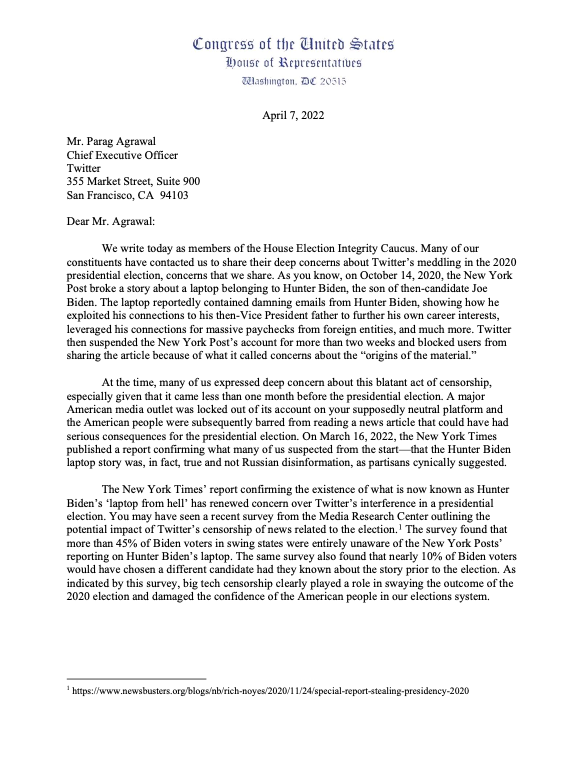
Now, Republican members of the House Election Integrity Caucus, led by Rep. Claudia Tenney, in a letter addressed to Twitter CEO Parag Agrawal, are asking for answers about the censorship of the story.
“Big Tech oligarchs have grown far too powerful, censoring free speech that challenges their preferred narrative and their handpicked politicians,” Tenney told FOX Business. “In 2020, this reached a new low.”
“Twitter’s actions to silence the New York Post and others undoubtedly swayed the outcome of the presidential election. The free flow of information is key to a healthy democracy and to free and fair elections. Congress must be unequivocal in its response and hold Big Tech accountable.”
The Republicans want Twitter to “provide answers to the American people.” They also want Congress to “break up big tech, take an axe to Section 230, and ensure Silicon Valley elites can no longer interfere in our elections.”
They argue that the laptop contained damning emails that could have worked in President Trump’s favor.
“The laptop reportedly contained damning emails from Hunter Biden, showing how he exploited his connections to his then-vice president father to further his own career interests, leveraged his connections for massive paychecks from foreign entities, and much more,” the lawmakers wrote.
“Twitter then suspended the New York Post’s account for more than two weeks and blocked users from sharing the article because of what it called concerns about the ‘origins of the material.”
They added that the suspension prevented people from “reading a news article that could have had serious consequences for the presidential election.”
The New York Times confirming the authenticity of the laptop has “renewed concern over Twitter’s interference in a presidential election,” according to the lawmakers.
In the letter, the legislators demand answers to several questions from Agrawal, including who “made the decision to censor the New York Post’s story on Hunter Biden’s ‘laptop from hell.’” They also want to know if Twitter collaborated “with any individuals directly or indirectly involved with the Biden campaign” when it censored the story.
SAS and Delta Force part of “secret war”: French intelligence source
Samizdat | April 11, 2022
Elite special forces from the UK and the US have been present in Ukraine since the beginning of hostilities with Russia in late February, a source in the French intelligence community reportedly told a Le Figaro reporter, last week.
The claim was reported by the newspaper’s senior international correspondent Georges Malbrunot on Saturday, the day when British Prime Minister Boris Johnson made his surprise visit to Kiev. The British leader was reportedly surrounded by guards from the elite SAS force, though this claim was not officially confirmed.
SAS units “have been present in Ukraine since the beginning of the war, as did [sic] the American Deltas,” Malbrunot tweeted citing a French intelligence source. He added that according to the source Russia was well aware of the “secret war” waged against its troops by foreign commandos. Le Figaro included his report in their updates on Ukraine.
The UK and the US have been among the most active military supporters of Kiev. Johnson reportedly personally urged his Ukrainian counterpart Volodymyr Zelensky to keep on fighting against Russia and not settle for peace until better terms are offered.
Western pro-fighting consensus was apparently confirmed last week by EU foreign policy chief Josep Borrell, who said on Saturday that the “war will be won on the battlefield” as he too was visiting Kiev.
British media earlier reported that dozens of “retired” SAS soldiers had gone or planned to go to Ukraine to contribute their expertise in reconnaissance and anti-tank warfare to Kiev’s cause. Their services were allegedly paid for by “a country in Europe, still to be named, via a private military company” rather than by the British government, according to the UK tabloid the Daily Mirror.
The Russian military reported action against what it described as “mercenaries” fighting for Ukraine on several occasions. One of the recent instances was on Saturday, just as Johnson and Borell were in Kiev.
The Russian defense ministry said Kiev attempted to use a civilian ship in its latest failed attempt to evacuate high-value personnel from the port city of Mariupol, which saw some of the most intensive fighting during the conflict. The individuals intended for evacuation were identified as leaders of the ultranationalist Azov battalion and foreign mercenaries. There are unconfirmed reports that hundreds of foreign nationals could be blocked in Mariupol along with several thousand Azov troops.
The US and the UK have publicly stated they had no plans to involve their troops in the fighting in Ukraine. Both are major suppliers of arms to Kiev and were training soldiers in Ukraine before the Russian offensive. The experts were reported pulled out of the country in the run-up to the hostilities.
Britain’s Defence Ministry banned active service members from traveling to Ukraine in early March, saying that violating the rule could result in prosecution. Kiev called on volunteers abroad to join the ranks of its newly-created “foreign legion” after the Russian attack.
Asian fault lines of Biden’s war on Russia
BY M. K. BHADRAKUMAR | INDIAN PUNCHLINE | APRIL 11, 2022
The tremors of the United States’ tensions with Russia playing out in Europe are being felt in different ways already in Asia. The hypothesis of Ukraine being in Europe and the conflict being all about European security is delusional.
From Kazakhstan to Myanmar, from Solomon Islands to the Kuril Islands, from North Korea to Cambodia, from China to India, Pakistan and Afghanistan, the fault lines are appearing.
To be sure, extra-regional powers had a hand in the failed colour revolution recently to overthrow the established government in Kazakhstan, a hotly contested geopolitical landmass two-thirds the size of India, bordering both China and Russia, Washington’s sworn adversaries. Thanks to swift Russian intervention, supported by China, a regime change was averted.
Equally, the Anglo-American project to embroil Myanmar, bordering China, in an armed insurgency has floundered for want of a sanctuary in India’s northeastern region and due to the perceived congruence of interests among the surrounding countries in Myanmar’s stability.
In comparison, the North Korean fault line has aggravated. North Korea moves on its own timetable and has probably decided that the Ukraine crisis offers useful cover while it ramps up its testing program. Pyongyang explicitly supports Russia’s special operation in Ukraine, commenting that “the basic cause of the Ukraine incident lies in the high-handedness and arbitrariness of the United States, which has ignored Russia’s legitimate calls for security guarantees and only sought a global hegemony and military dominance while clinging to its sanctions campaigns.”
North Korea’s objective is to enhance its security and leverage by increasing the quality and quantity of its deterrent capabilities and strengthening its bargaining position.
On another plane, the Ukraine crisis injected a new urgency into the US efforts to cultivate new Asian partners. But Washington has run into headwinds and had to indefinitely postpone a special summit with the ten member countries of the Association of Southeast Asian Nations (ASEAN) that was initially scheduled for end-March. No new date has been proposed, although the US had hyped up the summit as “a top priority.”
Showing some ire, Washington has since sanctioned Cambodia, currently the ASEAN Chair. Clearly, the southeast Asian countries are chary of taking sides between the US and China or of voicing criticism against Russia.
Perhaps, the most direct fallout of the Ukraine crisis in Asia so far is the sharp deterioration in Japan’s ties with Russia. It is an unwarranted development insofar as Tokyo simply did a cut and paste job, copying all the US sanctions against Russia (including against President Putin). Prime Minister Kishida wantonly destroyed what his predecessor Shinzo Abe had carefully cultivated as a cordial, friendly relationship.
Japan now openly refers to Russian “occupation” of the Kuril Islands — something it hasn’t been doing in the past. Moscow retaliated by designating Japan as an “unfriendly” country. Yet, analysts were estimating until recently that Russia and Japan had congruent interests in blocking China’s Arctic ambitions and were, therefore, moving toward solving their dispute over the Kurils.
Suffice to say, Kishida’s motivations in an abrupt turnaround to make Kurils a potential flashpoint in relations with Russia are, to say the least, to be traced to the broader US strategy to isolate Russia.
Meanwhile, a contrarian development has also appeared in China’s challenge to the US’ Island Chain strategy in the Western Pacific by negotiating a new security deal with Solomon Islands. This game-changing development may have extensive consequences and is dangerously interwoven with the Taiwan issue. Biden is reportedly dispatching a top White House official to Solomon Islands to scuttle the deal with China.
The Biden administration is now doubling down on India to roll back its ties with Russia as well. That becomes a fault line in the US-Indian strategic partnership. What must be particularly galling for Washington is the likelihood of India pursuing its trade and economic cooperation with Russia in local currencies. Indeed, China and India have taken a somewhat similar stance on the Ukraine crisis.
Given the size of the Chinese economy and the high potential of growth for the Indian economy, their inclination to bypass the dollar would be a trend-setter for other countries. Russia, hit by Western sanctions, has called on the BRICS group of emerging economies to extend the use of national currencies and integrate payment systems.
Suffice to say, the “weaponised dollar” and the West’s abrasive move to freeze Russia’s reserves sends a chill down the spine of most developing countries. Nepal caved in to ratify the Millennium Challenge Corporation agreement following threat by a middle ranking US official!
There is no conceivable reason why the NATO should become the provider of security for the Asian region. That is why Afghanistan’s future is of crucial importance. Without doubt, the regime change in Pakistan is partly at least related to Afghanistan. The Russian Foreign Ministry has disclosed certain details of the US interference in Pakistan’s internal affairs and its pressure on former Prime Minister Imran Khan.
But time will show how realistic are Washington’s expectations of inducting Pakistan into the US orbit and making it a surrogate to leverage the Taliban regime in Afghanistan. Russia and China are making sure that the door remains closed to NATO’s return to Afghanistan. They have undercut Washington’s recent efforts to co-opt the Taliban leadership in Kabul. (See my blog US pips regional states at race for Kabul.)
The message out of the recent Foreign Ministers’ Meeting on the Afghan Issue Among the Neighbouring Countries of Afghanistan in Tunxi, China, is that in that country’s transition from chaos to order, the regional states hope to undertake a lead role. Thus, the regional states have incrementally marked their distance from the West’s exceptionalism and are instead adopting a persuasive track through constructive engagement. The joint statement issued at Tunxi reflects this new thinking.
The developments over Afghanistan provide a signpost that any attempt at imposing Western dominance over Asia will be resisted by the regional states. Most Asian countries have had bitter experiences with colonialism in their history. (See my blog India’s dilemma over West vs. Russia)
Although the American analysts underplay it, the fact remains that the conflict in Ukraine is bound to impact the “Asian Century” very significantly. The US is determined to transform NATO as the global security organisation that will act beyond the purview of the United Nations to enforce the West’s “rules-based order.”
The West’s desperate push to weaken Russia and tilt the global strategic balance in the US’ favour aims to clear the pathway leading to a unipolar world order in the 21st century. In a recent interview, Hal Brands, Henry Kissinger distinguished professor of global affairs at Johns Hopkins, put across the US strategy behind the war in Ukraine as very logical:
“Well, there’s long been a debate in the United States over whether we should prioritise competing with Russia or China or treat them as co-equals. And that debate has flared up again in the context of this war. I think what the war indicates, though, is that the best way of putting pressure on China, which is the more dangerous and the more powerful of the two rivals, is actually to ensure that Russia is defeated, that it does not achieve its objectives in this war, because that will result in a weaker Russia, one that is less capable of putting pressure on the United States and its allies in Europe and thus less useful as a strategic partner for Beijing.
“The United States simply can’t avoid the reality that it has to contain both Russia and China simultaneously.”
How Biden’s Huge Strategic Oil Release Could Backfire
By Irina Slav | Oilprice.com | April 3, 2022
This week, the Biden administration revealed that it will release as much as 180 million barrels of crude oil in a bid to calm oil prices, which have remained above $100 per barrel for an extended period of time. The International Energy Agency, meanwhile, is coordinating a smaller but international reserve release of some 60 million barrels and has called an emergency meeting to discuss how exactly to go about it.
It remains unclear whether part of the 180 SPR release in the United States will be a completely separate endeavor or if some of these barrels will be part of the IEA release. Earlier this year, the U.S. had agreed to release 30 million barrels as part of the IEA push. What is clear is that the success of these releases in calming down oil prices is quite unlikely.
The United States last year announced the release of 50 million barrels in an effort to bring down prices t the pump, which were eroding Americans’ purchasing power and weighing on the President’s approval ratings.
This pressured prices for a few days before they rebounded, driven by continued discipline among U.S. producers, equal discipline in OPEC+, and a relentless increase in demand for the commodity.
Then Russia invaded Ukraine, and the U.S. banned imports of Russian crude and fuels. It also sanctioned the country’s financial system heavily, making paying for Russian crude and fuels too much of a headache for the dollar-based international industry. Prices soared again before retreating some, but remain firmly in three-digit territory.
As of mid-March, the Department of Energy said, some 30 million barrels of crude from the strategic petroleum reserve had been sold or leased. That’s more than half of the 50 million barrels announced in November, and it appears to have had zero effect on price movements.
But the new reserve release is a lot bigger, so it should make a difference, shouldn’t it? It amounts to some 1 million bpd over several months, per reports about White House plans in this respect. Unfortunately, but importantly, oil’s fundamentals have not changed much since November.
U.S. shale oil producers, the companies that a few years ago prompted talk among analysts that OPEC was becoming increasingly irrelevant, have rearranged their priorities. They no longer strive for growth at all costs. Now they strive for happy shareholders.
This has given more opportunities to smaller independent drillers with no shareholders to keep happy. Yet these have also run into challenges, mainly in the form of insufficient funding because the energy transition has had banks worrying about their reputations and their own shareholders.
Pandemic-related supply disruptions have also affected the U.S. oil industry’s ability to expand output. Frac sand, cement, and equipment are among the things that have been reported to be in short supply in the shale patch. Now, there’s a shortage of steel tubing, too.
Meanwhile, OPEC is doing business as usual, sticking to its commitment to add some 400,000 bpd to oil markets every month until its combined output recovers to pre-pandemic levels. Just this week, the cartel approved another monthly addition of 432,000 bpd to its combined output despite increasingly desperate calls from the U.S. and the IEA for more barrels.
OPEC has been demonstrating increasingly bluntly that its interests and the interests of some of its biggest clients may not be in alignment right now. It has refused to openly condemn Russia for its actions in Ukraine and has not joined the Western sanction push.
On the contrary, OPEC is gladly doing business with Russia. And Saudi Arabia and the UAE, the two OPEC members that actually have the capacity to boost production beyond their quotas, have deemed it unwise to undermine their partnership with Russia by acquiescing to the West’s request for more oil.
In this environment, releasing whatever number of barrels from strategic reserves could only provide a very short relief at the pump. Then, it may make matters even worse. As one oil market commentator on Twitter said about the SPR release news, the White House will be selling these barrels at $100 and then may have to buy them at $150.
Indeed, one thing that tends to get overlooked during turbulent times is that the strategic petroleum reserve of any country needs to be replenished. It’s not called strategic for laughs. And a 180-million-barrel reserve release will be quite a draw on the U.S. SPR, which currently stands at over 580 million barrels. If oil’s fundamentals remain the same, prices will not be lower when the time to replenish the SPR comes.
This seems the most likely development. The EU, the UK, and the United States have stated sanctions against Russia will not be lifted even if Moscow strikes a peace deal with the Ukraine government. This means Russian oil will continue to be hard to come by for those dealing in dollars or euros.
According to the IEA, the shortfall could be 3 million barrels daily, to be felt this quarter. OPEC+ is not straying from its course. In some good news, at least, U.S. oil production rose last week for the first time in more than two months, by a modest 100,000 bpd.
Featured Video

Trump asks Iran not to retaliate after he strikes Pickaxe Mountain
or go to
Aletho News Archives – Video-Images
Book Review & Summary
Calling of an Angel: The True Story of Rene Caisse and an Indian Herbal Medicine Called Essiac (1988)
Dr. Gary L. Glum – 30 Q&As – Book Review & Summary
Lies are Unbekoming | October 17, 2026
On June 10, 1975, Dr. Chester Stock, a vice president at Memorial Sloan-Kettering Institute for Cancer Research, wrote to a Canadian nurse named Rene Caisse: “Enclosed are test data in two experiments indicating some regressions in sarcoma 180 of mice treated with Essiac.” The sentence sat in a letter from one of the world’s largest private cancer research centers, concerning an herbal tea an elderly English woman had learned from an Ojibwa medicine man at a northern Ontario mining camp in the 1890s. The tests were terminated the following year after Sloan-Kettering admitted, in sworn affidavit three years later, that they had prepared the injectable solution improperly from the dried material supplied — freezing and thawing the herb rather than boiling it as Rene had instructed. By the time Calling of an Angel was published in 1988, Rene Caisse had been dead for a decade, having treated thousands of cancer patients across fifty-six years in her Bracebridge, Ontario kitchen, never charging a fee, and refusing every offer — from Memorial Sloan-Kettering, the National Cancer Institute, Merck, Parke Davis, and private corporations dangling contracts up to $1 million — to release her formula before the medical establishment admitted her remedy had merit. … continue
Blog Roll
 Aletho News
- Trump asks Iran not to retaliate after he strikes Pickaxe Mountain – w/ Prof. Marandi
- Vice President J.D. Vance’s Deceptive ‘Antiwar’ Campaign Speech
- Iran: Palestinians’ rights must not be compromised in Gaza’s future; US, Israel to blame for Hormuz situation
- Ongoing tales of Syrian chemical weapons
- Moscow blasts UN for ignoring torture of Russian POWs
- Millions of Books Could Have Been Destroyed in Lebanon During Israeli Bombings
- Moscow warns of ‘hunt for Russians’
- Calling of an Angel: The True Story of Rene Caisse and an Indian Herbal Medicine Called Essiac (1988)
- South Korean Assistance to the U.S. in the War with Iran: Between Allied Duty and National Interests
- Pharma- and Gates-Funded GAVI Seeks to Assure Parents
- If Americans Knew
- Israeli soldiers debunk Israel’s talking points
- In West Bank, Israeli settlers are totally out of control – Daily Update
- NPR investigation finds evidence of widespread fraud at mall kiosks tied to Israeli skincare brand
- Tucker Carlson exposes Israeli Lies about the Oct 7th attack, Charlie Kirk, and the U.S.
- Israel has detained thousands of Palestinian children since Oct 7th – over half spent time in solitary, many uncharged
- Israeli Analysis: Is Netanyahu Planning an ‘October Surprise’ Attack Before Israel’s Election?
- Israeli settlers brutally attack Palestinians and Washington Post female photographer, 65
- Words Have Changed, Occupation Continues: The Reality of the Gaza Ceasefire
- Gaza’s child amputees are growing faster than their prosthetics allow
- Israel keeps Palestinians struggling just to survive–Daily Update
- No Tricks Zone
- New Study Suggests Large Regions Of The Pacific Ocean Have Been Cooling For The Last 80 Years
- Germany’s Green Energy Debacle: High Energy Costs Force Kahla Porzellan to Close After 182 Years!
- New Study: 50 Years Of The Most Aggressive ‘Net Zero’ Policies Can Only Affect The Global Climate By 0.03°C
- US September “Heat” Was No Record…Many Records Set Decades Ago
- Latest European Green Energy Debacle; Portugal’s Largest Flagship Solar Park Insolvent!
- Green Energy Debacle: German Expert Professor Fritz Vahrenholt Warns Of Severe Economic And Social Consequences
- Two More Paleo Reconstructions Affirm Meters-Higher Sea Levels Across Ireland, Brazil 7000-6000 Years Ago
- New Study: Earth And Venus Surface Warmth Largely Explained By Convection And Lapse Rate, Not CO2 Or Radiation
- 2025 Nature Paper Claiming Worsening Global Drought Gets RETRACTED …Heavily Flawed
- New Study: ‘Global Drought Shows No Detectable Recent Acceleration Under Climate Warming’

