Russia comments on risk of war with West
RT | January 28, 2022
With tensions running high between Russia and the US, Moscow’s top diplomat has insisted that his country does not want a full-blown conflict to break out, but also warned it will not stand aside and watch well-flagged security concerns be ignored.
Speaking to news outlets as part of a broadcast interview on Friday morning, Foreign Minister Sergey Lavrov was asked whether fighting could break out after talks over guarantees that NATO will not expand ended in deadlock.
“If it is up to the Russian Federation, there will be no war,” he declared.“We do not want wars,” he went on, stressing, however, that officials “will not allow our interests to be brutally attacked or to be ignored either.”
According to Lavrov, Washington’s response to Moscow’s proposals is “almost a model of diplomatic decency.” However, he said that NATO’s answer to the two Russian draft documents “is so ideologized, it breathes the exclusivity of the Alliance, its special mission, its special purpose.”
Lavrov went on to add that if the US is not willing to reconsider its stance on security matters, then Moscow is equally not prepared to make any compromises on its demands. “If they insist that they won’t change their position, we won’t change our position either,” he declared.
The comments come shortly after Moscow received long-awaited answers to its requests for security guarantees, including a pledge that Ukraine will not be admitted to the bloc.
On Thursday, Lavrov said that “there has been no positive response” to Moscow’s core concerns in the document provided by the American side following weeks of talks with their counterparts.
“The main issue is our clear position on the unacceptability of further NATO expansion to the East and the deployment of highly destructive weapons that could threaten the territory of the Russian Federation,” Lavrov explained.
The Kremlin also poured scorn on the response, arguing that the requests from Moscow’s officials had not been fully taken into account by Washington and the US-led military bloc.
At the same time though, according to Press Secretary Dmitry Peskov, “there are and should always be prospects… for further dialogue.”
“But as for the substantive dialogue on the draft documents, there are issues of a different nature, but I will not get ahead of myself,” he said.
Last month, Russia handed over two draft treaties, one addressed to Washington and the other to NATO, which it says are aimed at reducing the risk of conflict on the European continent.
Moscow requested that the bloc refrains from any military activity on the territory of the former Warsaw Pact states that joined after 1997, following the fall of the Soviet Union. The US-led military bloc’s secretary general, Jens Stoltenberg, has said it would unacceptable to create a “two tier” system that prevents it from engaging in activity with some member states.
A separate clause also demanded that Kiev’s ambitions to join the US-led bloc should not be granted. Ruling out NATO expansion closer to Russia’s borders has been a key demand from the country’s officials, with Peskov arguing that it is a question of “life or death.”
Big War CEOs: There’s chaos in the world and our prospects are excellent
By Eli Clifton | Responsible Statecraft | January 28, 2022
According to chief executives of the top taxpayer-funded weapons firms, their balance sheets will benefit from the U.S. engaging in great power competition with Russia and China, the recent escalations in the Yemen war, and the potential for a Russian invasion of Ukraine. But at least one CEO didn’t want to give the impression that weapons firms are simply merchants of death, claiming that her firm, the third largest weapons producer in the world, “actually promote[s] human rights proliferation.”
Those comments were all made on quarterly earnings calls this week, at which executives for publicly traded companies speak to investors and analysts who follow their industries and answer questions about their financial outlook.
The occasion brings out a degree of candor about companies’ fundamentals and their business interests that aren’t always disclosed in marketing materials and carefully worded press releases.
For example, CEOs from both Lockheed Martin and Raytheon outright acknowledged that a deteriorating state of global peace and security and an increase in deadly violence are very much in the interest of their employees and investors.
Lockheed CEO James Taiclet assured investors that the $740 billion defense budget — twelve times the budget provided to the State Department to conduct diplomacy — could continue to grow in 2023, a critical metric for weapons contractors, the ultimate recipient of nearly half of all defense spending.
But if you look at [defense budget growth] — and it’s evident each day that goes by. If you look at the evolving threat level and the approach that some countries are taking, including North Korea, Iran and through some of its proxies in Yemen and elsewhere, and especially Russia today, these days, and China, there’s renewed great power competition that does include national defense and threats to it. And the history of [the] United States is when those environments evolve, that we do not sit by and just watch it happen. So I can’t talk to a number, but I do think and I’m concerned personally that the threat is advancing, and we need to be able to meet it.
Raytheon CEO Greg Hayes took a cruder approach, appearing to celebrate a potential war over Ukraine and Houthi drone attacks on the UAE as good indicators for future weapons sales, responding to an analyst’s question about increased demand for weapons “from international countries just given the rising tensions.”
… [W]e are seeing, I would say, opportunities for international sales. We just have to look to last week where we saw the drone attack in the UAE, which have attacked some of their other facilities. And of course, the tensions in Eastern Europe, the tensions in the South China Sea, all of those things are putting pressure on some of the defense spending over there. So I fully expect we’re going to see some benefit from it.
But in a moment of rare self-awareness in the calls, Northrop Grumman’s CEO attempted to distance herself from the celebration of increased global conflict by making the bold claim that the world’s fifth largest weapons manufacturer — and a trainer of Saudi troops accused of war crimes in Yemen — is a promoter of “global human rights.”
Northrop Grumman CEO Kathy Warden said:
I do want to be clear. We are a defense contractor. And so we are supporting global security missions, largely in areas of deterrents, but also inclusive of weapon systems. And we expect to continue in those businesses because we believe they actually promote global human rights proliferation, not the contrary. But with that said, we have evaluated some portions of our portfolio that I’ve talked about in the past like cluster munitions. And today, making the confirmation that we plan to exit depleted uranium ammo as parts of the portfolio that we no longer wanted to support directly.
No doubt, their departure from the cluster munitions and depleted uranium ammunition business is a positive step for human rights, but the idea that one of the world’s biggest producers of missiles, bombers, drones, and nuclear weapons “promote[s] global human rights” tests the limits of credulity. Time and time again, the earnings calls spotlight the true interests of the weapons industry: an increase in global insecurity and violence leads to an increase in governments’ demands for lethal weapons, which in turn produce an increase in profits for investors in arms production.
The Ukraine crisis, sponsored by US hegemony and war profiteers
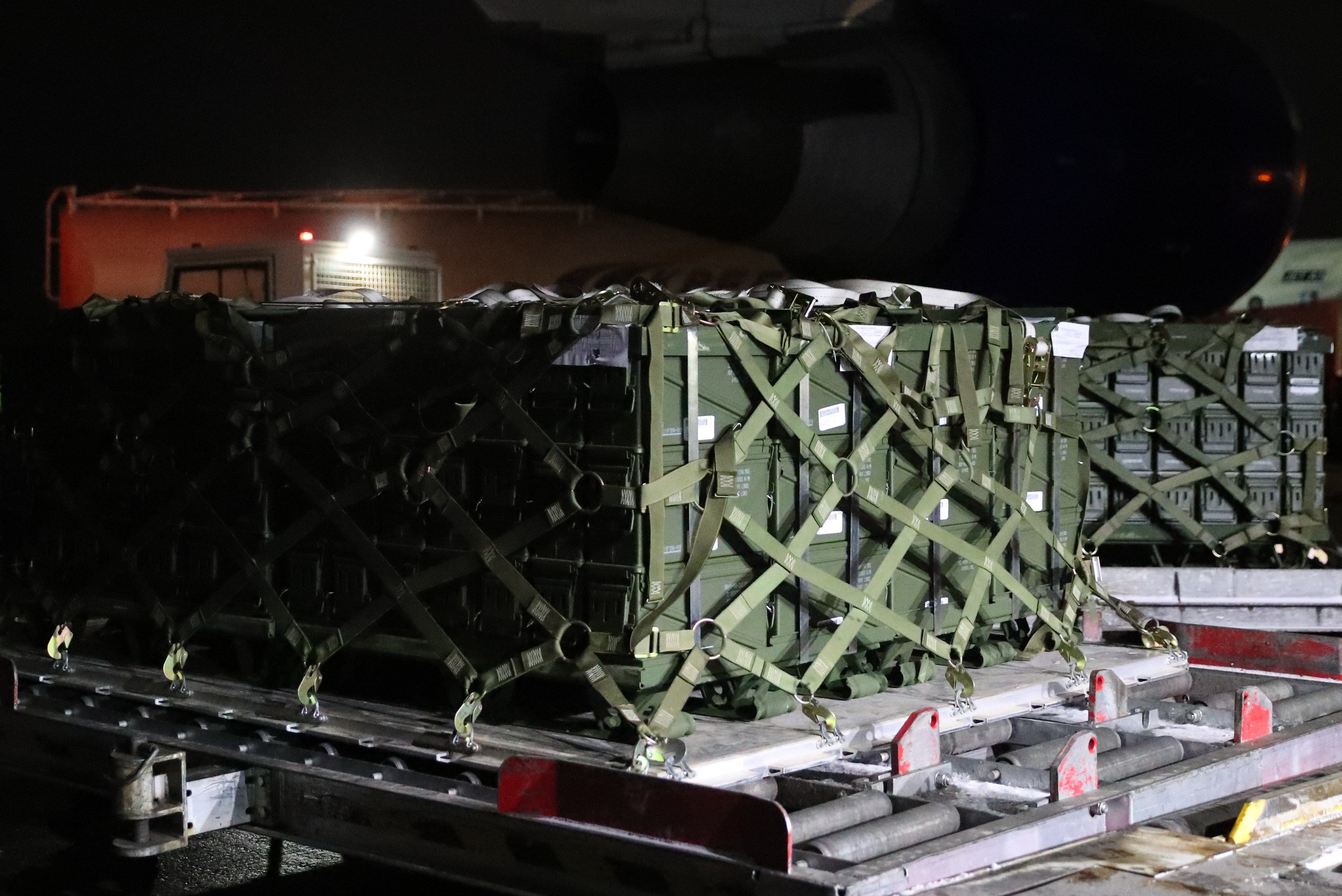
New US “lethal aid” for Ukraine, courtesy of US taxpayers and their weapons industry beneficiaries. (U.S. Embassy in Ukraine)
By Aaron Maté | January 26, 2022
The US-Russia standoff over Ukraine has sparked bellicose threats and fears of Europe’s biggest ground war in decades. There are ample reasons to question the prospects of a Russian invasion, and US allies including France, Germany’s now-ousted navy chief, and even Kiev itself appear to share the skepticism.
Another potential scenario is that Russia draws on the Cuban Missile Crisis and positions offensive weapons within the borders of Latin American allies. Whatever the outcome, the crisis has underscored the perils of a second Cold War between the world’s top nuclear powers.
If the path forward is unpredictable, what got us here is easy to trace. The row over Ukraine is the outgrowth of an aggressive US posture toward Russia since the collapse of the Soviet Union three decades ago, driven by hegemonic policymakers and war profiteers in Washington. Understanding that background is key to resolving the current impasse, if the Biden administration can bring itself to alter a dangerous course.
US principles vs. power constraints
Russia’s central demands – binding guarantees to halt the eastward expansion of NATO, particularly in Ukraine, and to prevent offensive weapons from being stationed near its borders – have been publicly dismissed by the U.S government as non-starters.
In rejecting Russian concerns, the Biden administration claims that it is upholding “governing principles of international peace and security.” These principles, Secretary of State Anthony Blinken says, “reject the right of one country to change the borders of another by force; to dictate to another the policies it pursues or the choices it makes, including with whom to associate; or to exert a sphere of influence that would subjugate sovereign neighbors to its will.”
The US government’s real-world commitment to these principles is non-existent. For decades, the US has provided critical diplomatic and military cover for Israel’s de-facto annexations, which have expanded its borders to three different strips of occupied territory (the West Bank, Gaza, and Syria’s Golan Heights). The US is by far the world leader in dictating policies to other countries, be it who their leaders should be; how little to pay minimum-wage workers; or how to share energy supplies.
The Biden administration continues to subjugate sovereign countries to its will, whether it’s “neighbors” like blockade-targeted Cuba; coup-targeted Venezuela; sanctions-targeted Nicaragua; or far-away countries like US military-occupied and sanctions-targeted Syria. Biden just recently embraced the longstanding Monroe Doctrine of a US sphere of influence by declaring Latin America to be the United States’ “front yard.”
When not making sanctimonious public pronouncements, US officials are quietly able to acknowledge the real principles that guide their actions. According to the Washington Post, one US official specializing in Russia “believes the Russians are still interested in a real dialogue.” Russia’s real aim, this official says, is “to see whether Washington is willing to discuss any sort of commitment that constrains U.S. power.”
The official added: “The Russians are waiting to see what we’re going to offer, and they’re going to take it back and decide is this serious. Is this something we [the Russians] can sell as a major victory for security, or is it just, from their point of view, another attempt to fob us off and not give us anything?”
If their public statements and actions are any guide, the Biden administration is so far opting for the latter.
Rather than focus on diplomacy, the United States’ reliable British client has been trotted out, Iraq WMD dossier-style (or Steele dossier-style, or Syria dirty war-style), to lodge the explosive allegation that Russia is plotting to install a new leader in Ukraine via a coup. While declaring that the obedient Brits were “Muscular” for shouldering the war-mongering allegation, the New York Times quietly acknowledged that they also “provided no evidence to back up” their claims.
After warning of a “false flag” operation by Russia in Ukraine, the US pulled off a stunt of its own by recalling its embassy personnel out of stated concern for their safety. Unlike the dutiful British, other US allies failed to get the memo, including the EU, which declined to follow suit and even took a pointed swipe at attempts to “dramatize” the situation.
When US officials and allied media voices permit themselves to drop “Wag the Dog” theatrics and entertain the possibility of constraining US power, the Ukraine crisis no longer appears so dangerously intractable.
In the New York Times, veteran national security correspondent David E. Sanger allows that it is “possible” that Putin’s “bottom line in this conflict is straightforward”: obtain a pledge to “stop Ukraine from joining NATO” as well as one that the US and NATO “will never place offensive weapons that threaten Russia’s security in Ukrainian territory.”
On these issues, “there is trading space,” Sanger concedes. Given that “Ukraine is so corrupt, and its grasp of democracy is so tenuous… no one expects it to be accepted for NATO membership in the next decade or two.” Accordingly, Russia could be offered “some kind of assurance that, for a decade, or maybe a quarter-century, NATO membership for Kyiv was off the table.”
In Sanger’s view, the real and “complex” issue is not Ukraine’s NATO status, but “how the United States and NATO operate” there – specifically, by flooding the country with weapons. Since 2014, Sanger writes, the US and NATO allies have provided “Ukraine with what the West calls defensive arms, including the capability to take out Russian tanks and aircraft”, a “flow that has sped up in recent weeks.” Russia – for reasons apparently foreign to Sanger – believes that these “weapons are more offensive than defensive” and “that Washington’s real goal is to put nuclear weapons in Ukraine.” An agreement to address these concerns, an unidentified US official concedes, would be “‘the easiest part of this,’ as long as Russia is willing to pull back its intermediate-range weapons as well.”
Unmentioned by Sanger is that Russia has repeatedly signaled such a willingness, including just last month: Russia’s proposed draft treaty with NATO — issued with the stated aim of resolving the Ukraine standoff — proposes that all sides “not deploy land-based intermediate- and short-range missiles” in any area that allows them “to reach the territory of the other Parties.” Also unmentioned is that such deployments were previously banned under the INF Treaty, the Cold War-era pact that the Trump administration abandoned in August 2019, to the resounding silence of Democratic lawmakers and allied media outlets more invested in pretending that Trump was a Russian puppet than in addressing his actual Russia policies.
In a bid to preserve some of the INF Treaty’s safeguards, Putin immediately offered a moratorium on the deployment of intermediate-range missiles in Europe – a proposal swiftly rejected by both Trump and NATO. (Trump’s response was again duly ignored by Russiagate-crazed media outlets and politicians, for the obvious narrative inconvenience.)
Much like its refusal so far to re-enter the Iran nuclear deal – another critical security pact torn up by Trump — the Biden administration has thus placed itself in a dangerous geopolitical standoff rather than embrace diplomacy around proposals that US officials either deem as reality anyway (Ukraine not joining NATO) or that they were once party to (the Trump-sabotaged INF treaty).
NATO expansion, from the Cold War to a Ukraine coup
If the Biden administration is now willing to accept “real dialogue” over an outcome that “constrains US power” on the Ukraine-Russia border, it will have to eschew guiding US principles since the end of the Cold War.
When he agreed to the reunification of Germany, Soviet leader Mikhail Gorbachev was “assured in 1990 that the [NATO] alliance would not expand,” Jack Matlock, Reagan and Bush I’s ambassador to the Soviet Union, recently noted. But upon entering office, Bill Clinton broke that pledge and began an expansion spree that has pushed NATO to Russia’s borders. In 2008 – against the reported advice of advisers including Fiona Hill – President George W. Bush backed a NATO declaration calling for Ukraine and Georgia’s eventual ascension.
The constant expansion of NATO has led to what the scholar Richard Sakwa calls a “fateful geographical paradox”: NATO, Sakwa says, now “exists to manage the risks created by its existence.”
Sakwa’s maxim undoubtedly applies to Ukraine, where the threat of Russia’s neighbor joining a hostile military alliance sparked a war in 2014 that continues today.
The standard narrative of the origins of the current Ukraine crisis, as the New York Times recently claimed, is that Ukrainians revolted in street protests that ousted “pro-Russian leader” Viktor Yanukovych, “prompting [Russian President Vladimir] Putin to order the annexation of the Crimean Peninsula and instigate a separatist war in eastern Ukraine.” In reality, the US backed a coup that overthrew Ukraine’s elected government and sabotaged opportunities to avoid further conflict.
The immediate background came in the fall of 2013, when the US and its allies pressured Yanukovych to sign a European Union association agreement that would have curtailed its ties to Russia. Contrary to how he is now portrayed, Yanukovych was not “pro-Russian”, to the point where he even “cajoled and bullied anyone who pushed for Ukraine to have closer ties to Russia,” Reuters reported at the time.
To sign the EU deal, Ukraine would have to accept the harsh austerity demands of the IMF, which had publicly criticized Ukraine’s “large pension and wage increases,” and “generous energy subsidies.” The agreement also contained a provision calling on Ukraine to adhere to the EU’s “military and security” policies, “which meant in effect, without mentioning the alliance, NATO,” as the late scholar Stephen F. Cohen argued.
The EU proposal, the New York Times observed in November 2013, was the centerpiece of its “most important foreign policy initiative”: an attempt to “draw in former Soviet republics and lock them on a trajectory of changes based on Western political and economic sensibilities.”
In the words of Carl Gershman, the then-head of the CIA-tied National Endowment for Democracy, “Ukraine is the biggest prize.” In Gershman’s fantasy, Ukraine’s entry into the Western orbit would redound to Russia as well. “Ukraine’s choice to join Europe will accelerate the demise of the ideology of Russian imperialism that Putin represents,” he wrote. “… Putin may find himself on the losing end not just in the near abroad but within Russia itself.”
Although it would have been a boon for DC neoconservatives, accepting the EU’s insistence on “increasing the retirement age and freezing pensions and wages” would have meant political suicide for Yanukovych. Putin capitalized by offering a more generous package of $15 billion in aid and gas subsidies, a deal that contained “no immediate quid pro quo for Russia,” the New York Times noted. To lure Yanukovych, Russia even dropped a proposal, opposed by Ukraine’s Maidan protesters, that Ukraine join a Russian-led customs union.
Putin’s Ukraine offer, the Times added, was one of “several foreign policy moves that have served to re-establish Russia as a counterweight to Western dominance of world affairs.” In the eyes of the Western domineers, the prospect of a Russian “counterweight” was an intolerable act. The US responded by ramping up support for the Maidan protests in Kiev and helping to sabotage an agreement with Yanukovych to hold new elections.
Any pretense that the US was acting as an honest broker was obliterated in early February 2014 when Russia released a recording of an intercepted a phone call between then-senior Obama official Victoria Nuland and the US Ambassador to Ukraine, Geoffrey Pyatt. The US diplomats not only selected who would be Ukraine’s next Prime Minister — Arseniy Yatsenyuk – but decided to exclude their EU allies from the process. “Yats is the guy,” Nuland declared, before adding: “Fuck the EU.”
A major tipping point in the conflict came two weeks later, on February 20th, when nearly 50 Madain protesters were massacred by snipers. The Ukrainian opposition immediately accused government forces, sparking a series of events that led to Yanukovych’s flight from the country two days later. Exhaustive research by the University of Ottawa’s Ivan Katchanovski argues that the massacre was in fact “perpetrated principally by members of the Maidan opposition, specifically its far-right elements.”
Faced with the possibility of losing Russia’s most important naval base at Sevastopol to a US-backed coup regime, Putin responded by seizing the Ukrainian territory of Crimea. Russia also provided military support to Ukrainians in the country’s Donbas region hostile to the new coup government, sparking an ongoing war between the opposing sides.
In Washington, the annexation of Crimea is widely seen as an expansionist act of aggression; even, according to Hillary Clinton, akin to “what Hitler did back in the 30s.” In Crimea, Russia had the support of the majority of the population, if polls are to be believed. The same for the Russian population, across the political spectrum. “For [Russian] politicians, not vocally supporting, let alone questioning, the annexation of Crimea is practically akin to political suicide – even for liberals,” a European Union think tank observed in 2014. Even “Anti-Putin nationalists… are enthusiastic backers of Putin’s territorial grab.” (For over 200 years Crimea had been a territory of Russia, until Nikita Khrushchev assigned it to Ukraine, then a part of the Soviet Union.)
A negotiated solution to the Donbas war has been in place since the signing of the Minsk II accords in 2015, as Anatol Lieven of the Quincy Institute for Responsible Statecraft has repeatedly stressed. The prospect of NATO expansion appears to be the pact’s main obstacle to implementation. Minsk II calls for granting autonomy to the Donbas region in return for its demilitarization. But Ukraine has “[refused] to guarantee permanent full autonomy for the Donbas”, Lieven writes, out of fear “that permanent autonomy for the Donbas would prevent Ukraine from joining NATO and the European Union, as the region could use its constitutional position within Ukraine to block membership.”
In Lieven’s view, this could change with one critical shift: “If the United States drops the hopeless goal of NATO membership for Ukraine, it will be in a position to pressure the Ukrainian government and parliament to agree to a ‘Minsk III’ by the credible threat of a withdrawal of US aid and political support.”
War in Ukraine, profit in Washington
As a result of the US drive for yet another NATO-aligned military outpost on Russia’s borders, Ukraine has been decimated. The war in the Donbas has left nearly 14,000 dead. Ukraine’s “conflict with Russia,” Denys Kiryukhin of the Wilson Center observes, is one of the major factors that “accounts for the mass outmigration of Ukrainians since 2014.” The Donbas war has encouraged a rise in far-right militancy inside Ukraine, including the notorious neo-Nazi Azov Battalion, which has directly cooperated with the US military.
The United States’ European allies are also feeling the impact of Washington’s entanglement with Russia over Ukraine. The current standoff is threatening Russia’s energy exports, which account for about one-third of the European Union’s gas and crude oil use.
“It’s going to be an incredibly hard sell in any European country, to say that you have a 10 times higher energy bill and we feel as though our supply is not plentiful enough, because of Ukraine,” Kristine Berzina of the German Marshall Fund’s Alliance for Securing Democracy, a US and NATO-funded think tank, told Axios.
The picture is much rosier for those living through the war from Washington.
“You’ve got a lot of people who see profit in this conflict… and that’s the arms industry,” retired Army colonel Douglas Macgregor, a senior Pentagon advisor under Trump, told me in a recent interview. “And the defense industrial complex sees this as an opportunity to spend a great deal of money on a whole range of armaments that they otherwise might not be able to sell.”
The arms industry has made no secret of its enthusiasm for the opportunities of NATO expansionism and the post-Maidan Ukraine market.
US arms manufacturers “stand to gain billions of dollars in sales of weapons, communication systems and other military equipment if the Senate approves NATO expansion,” the New York Times reported in March 1998. Accordingly, these arms manufacturers have made “enormous investments in lobbyists and campaign contributions to promote their cause in Washington.” At the time, the “chief vehicle” for their cause was a group called the U.S. Committee to Expand NATO. The group’s president, Bruce L. Jackson, carried out double duty: by day, the Times observed the previous year, “he is director of strategic planning for Lockheed Martin Corporation, the world’s biggest weapons maker.”
As Andrew Cockburn of Harper’s noted in 2015, Jackson’s committee was firmly bipartisan, ranging “ideologically from Paul Wolfowitz and Richard Perle… to Greg Craig, director of Bill Clinton’s impeachment defense and later Barack Obama’s White House counsel.” (Craig later became embroiled in a Ukraine corruption scandal, though he was acquitted on all charges.) Explaining his committee’s staying power in Washington, Jackson told Cockburn: “‘Fuck Russia’ is a proud and long tradition in U.S. foreign policy. It doesn’t go away overnight.”
Nor do the profits that result. Reporting in July 2017 that military stocks had reached “all-time highs,” CNBC noted that “NATO concerns about Russia are seen as a positive for the defense industry.”
So is the ongoing war in Ukraine, where the US has shipped $2.7 billion in weapons since 2014, along with 200,000 pounds of fresh “lethal aid” in recent weeks and more promised via new spending bills.
US government officials across the spectrum routinely laud these weapons shipments as “critically needed, congressionally approved military aid” to a “very fragile country fighting Russian aggression” (Progressive Caucus chair Pramila Jayapal, speaking on Democracy Now! in 2019).
Putting aside the guiding imperial and profit-driven motives, the main impact of pouring US military hardware into the Donbas conflict is to prolong it. Writing in Foreign Policy, two analysts with the Pentagon-tied think tank Rand Corporation, Samuel Charap and Scott Boston, argue that “The West’s Weapons Won’t Make Any Difference to Ukraine.” The “military balance between Russia and Ukraine is so lopsided in Moscow’s favor,” they write, that more new weapons from Washington “would be largely irrelevant in determining the outcome of a conflict.”
The authors also dispel another widely accepted bipartisan myth, that the US has been helping Ukraine resist “Russian aggression.” In reality, Russian-backed militants in the east “are mainly armed with small arms and light weapons, along with some artillery and Soviet-era armor.” Although Russsia has armed and trained its Donbas allies, “Ukraine has mainly not been fighting Russia’s armed forces” there. Instead, “the vast majority of rebel forces consist of locals—not soldiers of the regular Russian military.” The Russian military has “never used more than a tiny fraction of its capabilities against the Ukrainians,” with major military components, such as Russia’s air force, “[not] involved in the fighting at all.”
The authors also remind their US audience of another overlooked reality: the costs of a full-blown war in Ukraine “will be disproportionately borne by Ukrainians.” Should an insurgency develop, as the Biden administration is mulling, the conflict will reach a stage where “thousands—or, more likely, tens of thousands—of Ukrainians will have died.”
Those promoting such an outcome have made clear that they value NATO expansion and the attendant arms industry windfall over the lives of Ukrainians, Russians, and any others placed in the crossfire. The Biden administration can avoid ending many more lives if it can interrupt hegemony and war profiteering for a different set of principles.
NATO training for nuclear strikes against Russia – Moscow
RT | January 27, 2022
NATO is developing the capacity for devastating nuclear strikes against Russia – which includes involving members of the alliance who don’t have such weapons in training operations – Moscow’s top arms control official has claimed.
In an interview with TASS on Thursday, Vladimir Yermakov, Director of the Department of Arms Control and Nonproliferation in the Russian Foreign Ministry, said that the US was in the process of modernizing its atomic capabilities in Europe and had deployed missiles in the territories of several other member states.
“According to expert analysis, there are five non-nuclear NATO countries holding around 200 American B61 nuclear bombs,” Yermakov stated. “There is also the infrastructure to support the operational deployment of these weapons, which are capable of reaching Russian territory and striking a wide range of locations, including strategic ones.”
The director emphasized that while the missiles are controlled by Washington, the nuclear development is a collaborative effort. “There are ‘joint nuclear missions’ between NATO countries, in the course of which non-nuclear members of the alliance take part in training sessions to develop American nuclear capabilities against us,” he claimed.
Yermakov also said that the withdrawal of US nuclear weapons from Europe is one of Moscow’s primary goals in ongoing security negotiations.
“We are adamant that NATO’s ‘joint nuclear missions’ must immediately be halted, all American nuclear weapons must return to US territory, and the infrastructure that enables its swift deployment be liquidated,” he commented, saying that these proposals were included in the list of security demands that Moscow delivered to Washington in December.
On Thursday, Russian Foreign Minister Sergey Lavrov expressed disappointment in the American response to the proposals, saying that the US had refused to make concessions concerning the expansion of NATO in eastern Europe. “The main issue is our clear position on the unacceptability of further NATO expansion to the east and the deployment of highly-destructive weapons that could threaten the territory of the Russian Federation,” the diplomat explained.
US Surgeon General Vivek Murthy suggests Joe Rogan should be censored
By Cindy Harper | Reclaim The Net | January 27, 2022
The US Surgeon General Vivek Murthy has suggested that Big Tech platforms should censor even more COVID “misinformation” on social media.
Speaking on MSNBC, Murthy said that online platforms have a role to play when it comes to censoring “misinformation” and ensuring that the public gets “accurate” information.
Murthy made the comments on MSNBC when host Mika Brzezinski pushed for a comment on the “best ways to push back on misinformation about COVID that continues to be aggressively pushed, whether it be Joe Rogan’s podcast or all over Facebook.”
“We can have the best science available, we can have the best public health expertise available. It won’t help people if they don’t have access to accurate information,” Murthy responded. “People have the right to make their own decisions, but they also have the right to have accurate information to make that decision with.”
Murthy added that Big Tech giants have an “important role to play” as they are the “predominant places where we’re seeing misinformation spread.”
“This [is] not just about what the government can do,” he went on to say. “This is about companies and individuals recognizing that the only way we get past misinformation is if we are careful about what we say and use the power that we have to limit the spread of misinformation.”
The Revolution Will Not Be Televised, at Least Not on Mainstream Media
By Madhava Setty, M.D. | The Defender | January 26, 2022
More than 30,000 people gathered Sunday near the steps of the Lincoln Memorial in our nation’s capital to protest COVID vaccine mandates.
Attendees were treated to nearly four hours of impassioned, poignant and uncensored speeches from more than 20 speakers who helped spearhead the movement for medical freedom.
Rather than attempting to summarize their commentary on the purported safety and efficacy of COVID vaccines, departures from accepted practices of informed consent around medical intervention and rapid erosion of the patient/doctor relationship from Big Pharma interference, I will instead list some pearls that might easily get overlooked but should not go forgotten.
Robert F. Kennedy, Jr., Children’s Health Defense chairman and chief legal counsel, elucidated the single most important point of Pfizer’s six-month trial data.
He explained that more participants died in the vaccine group compared to placebo group, and one vaccine recipient perished from COVID during this period compared to two in the placebo group — hence Pfizer can claim its product provides 100% efficacy against COVID death.
But at what cost?
Four times as many people died of cardiac arrest in the vaccine group than placebo. We can thus conclude the risk of dying from a cardiac arrest is 300% greater if you get vaccinated — a fact that goes unacknowledged by our medical authorities and legacy media.
Frontline Covid-19 Critical Care Alliance (FLCCC) spokesperson and board-certified critical care physician Dr. Pierre Kory expressed his frustration in trying to publish rigorous peer-reviewed data on the undeniable efficacy of the early COVID treatment protocol FLCCC formulated during the desperate early days of the pandemic.
This led him to emphatically conclude, “Every policy out of our agencies has been written by the pharmaceutical industry … It’s a war. A war on repurposed drugs.”
Dr. Robert Malone, in his typically measured fashion, reminded us that our authorities and vaccine manufacturers have nearly 100% indemnity from vaccine-related injury and that it is our job to protect our kids, not theirs.
Unfortunately, the magnitude of vaccine risks is yet unknown. Still, “If there is risk,” Malone said, “there must be choice.”
Steve Kirsch took the podium two hours into the program and recounted his introduction into the vaccine-hesitant sphere and described the abject refusal of any authority to answer a single one of his questions.
However, Kirsch’s biggest point was not his attack on tightlipped and avoidant medical authorities.
Kirsch offered a very reasonable counterargument to the mainstream push to accept these vaccinations out of a moral obligation to our community. Do we in fact have an obligation to others that can be mandated? On what moral grounds can this be enforced?
Kirsch said:
“Nobody has the right to mandate that I must risk my life to save other people that I don’t know. It’s unethical and immoral. I will not voluntarily choose to deprive my kids of their father.”
These points are important for every person in the world to consider, regardless of which side of the vaccine debate you are on.
Of course, these sentiments predictably resonated with those in attendance. But is that good enough? Will vaccine mandate proponents ever have the opportunity to hear this perspective?
Perhaps not.
One needs only to listen to how legacy media covered the rally. In this three-minute clip — “Anti-Vaccine Mandate Protests During Omicron Surge” — NBC News gave its viewers a glimpse of what this event signified.
The reporter said:
“Thousands rallying on the National Mall for the ‘Defeat the Mandates’ protest featuring some of the nation’s most prominent anti-vaxxers…”
Then the camera immediately cuts to protesters complaining:
“… we tried to get a burger last night but couldn’t because we didn’t have a proof-of-vaccine card.”
Are these really the most prominent spokespersons of the movement explaining why mandates are not just scientifically unfounded but unethical?
Another protester stated on camera he is not “anti-vax” but chooses not to get the jab because these vaccines are experimental. However, the NBC News reporters said, “That’s not true, COVID vaccines are fully approved, more scrutinized than any vaccine in history…”
Of the three COVID vaccines currently authorized for emergency use, only the Pfizer Comirnaty formulation has been approved by the U.S. Food and Drug Administration.
However, that formulation has not been made available in this country. There isn’t a single person in this country who has been inoculated with a fully approved COVID vaccine. (Consider yourselves fact-checked, NBC News.)
The idea COVID vaccines have been “more scrutinized than any vaccine in history” is a frank lie. The vaccine trials were rushed, poorly designed, offered no meaningful age stratification and used a participant pool that was younger and healthier than those who succumb to serious COVID.
The trials effectively ended several months after they began when the participants were unblinded and offered the vaccine, making any long-term efficacy or safety comparisons impossible.
Moreover, federal agencies responsible for scrutinizing the vaccines have done just the opposite, allowing serious, life-threatening and fatal adverse events to go unacknowledged and uninvestigated.
Despite the magnitude of expert opinion on hand, NBC News chose not to seek it. NBC did not interview one of the physicians, scientists, healthcare advocates or vaccine-injured who spoke at the rally.
A free press, dedicated to balanced reporting and an intrepid pursuit of the facts is our only guardian against tyranny. It is their job to pose difficult questions and demand answers. It is their job to give a voice to the dissenter and the whistleblower.
This is why Del Bigtree’s finale was so salient. Bigtree got large reactions from the crowd when he drew upon Lincoln’s words and Bible quotations, framing the issue as a struggle between good and evil and leading the crowd in a chant for freedom. His comments will likely draw criticism from mainstream pundits that continue to frame the anti-mandate movement as one that is based in ideology and not science.
But it was his admonishment of the mainstream media that will reverberate most in the weeks and months ahead.
Bigtree said:
“For those of you who are standing here quietly today, I know who you are. I know you work for The New York Times. I know you work for the Washington Post and you are here trying to support us quietly… You should have written about us. You should have told the truth!”
The revolution will not be televised. At least not on NBC News.
© 2022 Children’s Health Defense, Inc. This work is reproduced and distributed with the permission of Children’s Health Defense, Inc. Want to learn more from Children’s Health Defense? Sign up for free news and updates from Robert F. Kennedy, Jr. and the Children’s Health Defense. Your donation will help to support us in our efforts.
COVID Vaccines Causing Miscarriages, Cancer and Neurological Disorders Among Military, DOD Data Show
By Pam Long | The Defender | January 26, 2022
Attorney Thomas Renz on Monday told a panel of experts that data provided to him by three whistleblowers show COVID-19 vaccines are causing catastrophic harm to members of the U.S. military while not preventing them from getting the virus.
Following Monday’s panel discussion on COVID vaccines and treatment protocols, led by Sen. Ron Johnson (R-Wis.), Renz summarized data obtained from the Defense Medical Epidemiology Database (DMED), the military’s longstanding epidemiological database of service members.
The data show:
- Miscarriages increased 300% in 2021 over the previous five-year average.
- Cancer increased 300% in 2021 over the previous five-year average.
- Neurological disorders increased 1000% in 2021 over the past five-year average, increasing from 82,000 to 863,000 in one year.
The whistleblowers provided the data knowing they would face perjury charges if they submitted false statements to the court in legal cases pending against the U.S. Department of Defense (DOD).
Renz told the panel a “trifecta of data” from the DMED, the DOD’s military-civilian integrated health database, Project SALUS, along with human intelligence in the form of doctor-whistleblowers suggest the DOD and the Centers for Disease Control (CDC) and Prevention have withheld COVID vaccine surveillance data since September 2021.
“Our soldiers are being experimented on, injured and sometimes possibly killed,” Renz said.
Following Renz’s presentation, attorney Leigh Dundas reported evidence of the DOD doctoring data in DMED to conceal cases of myocarditis in service members vaccinated for COVID.
The military whistleblowers reported a DMED search of “acute myocarditis” resulted in 1,239 cases in August 2021, but the same search in January 2022 resulted in only 307 cases.
Cardiologist Dr. Peter McCollough, commenting on Renz’s presentation, told the panel myocarditis is being falsely described as mild and transient when in reality it causes permanent heart damage and is life-limiting in most cases.
The military did not take any safeguards for the most at-risk age group for vaccine-induced myocarditis — 18- to 24-year-olds.
Renz also highlighted a broader data set from Project SALUS, run by the DOD in cooperation with the Joint Artificial Intelligence Center (JAIC), which sends weekly reports to the CDC.
Project SALUS analyzed data on 5.6 million Medicare beneficiaries aged 65 or older. Data were aggregated from Humetrix, a real-time data and analytics platform that tracks healthcare outcomes.
According to Renz, the Project SALUS data as of late last year show:
“71% of new cases are in the fully vaccinated, and 60% of hospitalizations are in the fully vaccinated. This is corruption at the highest level. We need investigations. The Secretary of Defense needs investigated. The CDC needs investigated.”
The Humetrix presentation summarizing the data in Project SALUS, “Effectiveness of mRNA COVID-19 vaccines against the Delta variant among 5.6M Medicare beneficiaries 65 years and older” (Sep. 28, 2021) has not been made public.
The Project SALUS report also included data on natural immunity, stating the vaccines have waning protection. The data also showed an upward trend of breakthrough cases suggesting booster shots could contribute to prolonging the pandemic.
“Breakthrough infection rates 5 to 6 months post-vaccination are twice as high as 3-4 months post-vaccination,” the report said.
According to the Humetrix overview of the Project SALUS data, Congress must investigate vaccine failure, along with increased risk reported for breakthrough cases (or vaccine failure) in North American Natives, Hispanics, Blacks, and males.
People with kidney disease, liver disease, heart disease and cancer treatment, along with people over age 75 are the most likely to experience breakthrough cases, while medical authorities advocate vaccines to these same populations to allegedly “protect the vulnerable.”
Project Salus reported the vaccines were only 41% effective. This low level of infection prevention needs to be analyzed against the counterweight of a threefold to tenfold increase in chronic disease signaled in DMED.
The U.S. Food and Drug Administration (FDA) requires only two adequate and controlled studies to approve a biologic, even if those studies are industry-sponsored.
The FDA now has data from the entirety of 3 million people employed by the DOD and 5 million people in Medicare. This data serves as independent substantiation that scientific fraud has occurred.
Based on this data, the FDA must revoke the Emergency Use Authorization for the Moderna, Pfizer and Johnson & Johnson COVID vaccines, and the Biologics License Application for Pfizer’s Comirnaty vaccine.
It would be wrong for the FDA to extrapolate the industry’s clinical trial data to pediatrics without halting the use of the vaccines and conducting an investigation based on this real-world data.
Watch Renz’s testimony here:
Pam Long is graduate of USMA at West Point and is an Army Veteran of the Medical Service Corps.
© 2022 Children’s Health Defense, Inc. This work is reproduced and distributed with the permission of Children’s Health Defense, Inc. Want to learn more from Children’s Health Defense? Sign up for free news and updates from Robert F. Kennedy, Jr. and the Children’s Health Defense. Your donation will help to support us in our efforts.
Americans’ Rejection of Coronavirus Shots Is a Reason for Hope for the Country

By Adam Dick | Ron Paul Institute | January 26, 2022
For over a year, Americans have been subjected to relentless pressure to take experimental coronavirus “vaccine” shots and, more recently, to even have the shots given to children who have a miniscule risk of becoming seriously sick or dying from coronavirus. The shots are widely available, free for the taking, and nonstop marketed by politicians, government bureaucrats, and people in the media as “safe and effective.”
But, many Americans have been smartly rejecting claims pushed on them by government and media. Americans have done their own investigating and found that the shots have known serious dangers, as well as additional likely serious dangers yet unknown because of the lack of proper examination of consequences of taking the rushed into distribution shots. Many Americans have also learned that the shots do not stop people from getting, spreading, and dying from coronavirus. Plus, many Americans know people who have been hurt by the shots.
A large percentage of Americans have just said no to the drug pushers from the beginning. So strong has been the conviction of many individuals against taking the purported miracle drugs that they have said “no” even though it means they will be fired from their jobs due to vaccine mandates and excluded from many activities due to vaccine passports.
Many other Americans, who took the initial shots after giving in to the pushers or after giving the pro-shots propaganda the benefit of the doubt, have since declared, “no more.” Some were hurt by the shots they took and do not want to go through more of the same or worse. Others investigated the shots, learning about the drugs’ safety and efficacy deficits. Others, who never bought the propaganda in the first place but allowed themselves to be pushed into the initial shots, are adamant in their rejection of more.
You will not find much objective discussion in the big money media about the safety and efficacy of the experimental coronavirus vaccine shots. But, you will find recognition that resistance to the vaccine push has been strong and widespread, even if the topic is brought up just to belittle the resisters. One example of that recognition is a Tuesday Associated Press article by Mae Anderson that begins with the following observations regarding the Americans choosing to decline taking the shots:
The COVID-19 booster drive in the U.S. is losing steam, worrying health experts who have pleaded with Americans to get an extra shot to shore up their protection against the highly contagious omicron variant.
Just 40% of fully vaccinated Americans have received a booster dose, according to the Centers for Disease Control and Prevention. And the average number of booster shots dispensed per day in the U.S. has plummeted from a peak of 1 million in early December to about 490,000 as of last week.
Also, a new poll from The Associated Press-NORC Center for Public Affairs Research found that Americans are more likely to see the initial vaccinations — rather than a booster — as essential.
‘It’s clear that the booster effort is falling short,’ said Jason Schwartz, a vaccine policy expert at Yale University.
Overall, the U.S. vaccination campaign has been sluggish. More than 13 months after it began, just 63% of Americans, or 210 million people, are fully vaccinated with the initial rounds of shots. Mandates that could raise those numbers have been hobbled by legal challenges.
Vaccination numbers are stagnant in states such as Wyoming, Idaho, Mississippi and Alabama, which have been hovering below 50%.
It seems to be quite frustrating for the big money media and authoritarians in government that so many Americans are choosing to make up their own minds not to take the shots, or not to allow the shots to be given to their children, instead of just doing as they are told. That exercise of independent decision making in the face of intense pressure to go along, though, reassures people who highly value freedom that there is yet hope for the country.
Copyright © 2022 by RonPaul Institute.
Bulgaria insists it’s a loyal NATO ally, but won’t send troops to Ukraine
RT | January 26, 2022
Bulgaria is a “loyal ally in NATO” and the alliance’s unity is the best response to the current crisis over Ukraine, Prime Minister Kiril Petkov said on Wednesday, amid conflicting reports on Sofia’s participation in the US military buildup in Eastern Europe.
Petkov’s government voted on Wednesday to follow the “Bulgarian strategy” of reducing tensions between NATO and Russia, including “absolutely all options for resolving this dispute by diplomatic means,” according to the state news agency BTA.
The strategy will be based on rebuilding the Bulgarian military, Petkov said. Defense Minister Stefan Yanev explained that the “top priority” will be investing in building a battalion combat team, a unit of around 1,000 soldiers.
Yanev would not comment on reports by Bulgarian National Radio that Sofia would not accept the deployment of 1,000 US soldiers on its soil, but would be fine with French troops instead. This was reported early on Wednesday by BNR correspondent in Brussels, Angelina Piskova, who quoted a “well-informed diplomatic source.”
The minister said such a thing has not been discussed on the political level, according to BNR.
Local media reported that Yanev also told lawmakers that Bulgarian soldiers won’t fight in Ukraine without parliamentary approval, which he “does not see coming.”
Earlier on Wednesday, CNN reported that Bulgaria, Hungary, and Romania were in discussions with the US to accept 1,000 American troops each, as part of Washington’s effort to “reassure” NATO members in Eastern Europe and “deter” the alleged Russian invasion of Ukraine. The US intelligence has heralded such an invasion since late October, though Moscow dismissed it as “fake news.”
Speaking before the parliamentary defense committee on Tuesday, Yanev said that neither Russia nor anyone else is preparing to invade Bulgaria, and urged the lawmakers to “reduce tensions, stop reading the foreign press, and stop speculating.”
Featured Video

Why the U.S. Should Pull Back From the First Island Chain
or go to
Aletho News Archives – Video-Images
Book Review
‘Why Fauci Must Rot in Prison’: A Tale of Two Diaries
By Jill Erzen | The Defender | October 13, 2026
Dr. Anthony Fauci’s private diary reveals a “mind-numbing” contradiction between what the former top U.S. infectious disease official knew about COVID-19 and what he told the public, senior White House adviser Peter Navarro, Ph.D., said last week on “American Thought Leaders.”
In his new book, “Why Fauci Must Rot in Prison,” due out Oct. 20, Navarro compares Fauci’s private entries to his own pandemic-era diary, and uses what he calls “a tale of two diaries” to argue that Fauci should face criminal prosecution.
“I show, actually, how a prosecution can and should happen … at the state level, most likely,” Navarro said. “He should wind up in prison, and we’ve got the receipts in this book to put him there.”
Navarro said Fauci repeatedly acknowledged important facts in private, then publicly pursued policies that contradicted those facts — with devastating consequences.
“What he says many times privately in his diary is so at odds with both his public behavior and public statements that it’s mind-numbing,” Navarro said.
Navarro examines the lasting damage caused by lockdowns and other pandemic policies, and the ongoing toll of long COVID.
His book also addresses questions about vaccine safety, including why healthy young people faced COVID-19 vaccination mandates despite concerns about myocarditis, and why women were not warned about miscarriage risks linked to the shots. … continue
Blog Roll
 Aletho News
- Jennifer Kavanagh: Why the U.S. Should Pull Back From the First Island Chain
- Yemen denounces international community’s silence on Saudi aggression, siege
- UAE and Saudi Arabia move toward renewed coordination against Sanaa
- How Iran’s two-week retaliatory strikes exposed cracks in US military architecture in Persian Gulf
- The mother of all propaganda: Why the hype over US MOAB strike against Iran is nothing but theater
- Iran says it possesses technology behind US 14-ton GBU bunker-buster
- Trump asks Iran not to retaliate after he strikes Pickaxe Mountain – w/ Prof. Marandi
- Vice President J.D. Vance’s Deceptive ‘Antiwar’ Campaign Speech
- Iran: Palestinians’ rights must not be compromised in Gaza’s future; US, Israel to blame for Hormuz situation
- Ongoing tales of Syrian chemical weapons
- If Americans Knew
- Israeli rabbi permits occupiers to steal Palestinian olive harvest in West Bank
- Netanyahu’s spin on latest settler attack is laughable – Daily Update
- Israeli soldiers debunk Israel’s talking points
- In West Bank, Israeli settlers are totally out of control – Daily Update
- NPR investigation finds evidence of widespread fraud at mall kiosks tied to Israeli skincare brand
- Tucker Carlson exposes Israeli Lies about the Oct 7th attack, Charlie Kirk, and the U.S.
- Israel has detained thousands of Palestinian children since Oct 7th – over half spent time in solitary, many uncharged
- Israeli Analysis: Is Netanyahu Planning an ‘October Surprise’ Attack Before Israel’s Election?
- Israeli settlers brutally attack Palestinians and Washington Post female photographer, 65
- Words Have Changed, Occupation Continues: The Reality of the Gaza Ceasefire
- No Tricks Zone
- Predictions Made By Renowned Climate Proifessor Over Past Decades Have Been Proven To Be Poor
- New Study Suggests Large Regions Of The Pacific Ocean Have Been Cooling For The Last 80 Years
- Germany’s Green Energy Debacle: High Energy Costs Force Kahla Porzellan to Close After 182 Years!
- New Study: 50 Years Of The Most Aggressive ‘Net Zero’ Policies Can Only Affect The Global Climate By 0.03°C
- US September “Heat” Was No Record…Many Records Set Decades Ago
- Latest European Green Energy Debacle; Portugal’s Largest Flagship Solar Park Insolvent!
- Green Energy Debacle: German Expert Professor Fritz Vahrenholt Warns Of Severe Economic And Social Consequences
- Two More Paleo Reconstructions Affirm Meters-Higher Sea Levels Across Ireland, Brazil 7000-6000 Years Ago
- New Study: Earth And Venus Surface Warmth Largely Explained By Convection And Lapse Rate, Not CO2 Or Radiation
- 2025 Nature Paper Claiming Worsening Global Drought Gets RETRACTED …Heavily Flawed

