Beijing ‘will retaliate’ as no Chinese journalist in US has been granted visa extension since May 8
RT | August 17, 2020
Washington should immediately correct its mistake and stop persisting with escalation against Chinese journalists working in the United States, Beijing has warned.
No Chinese journalist in the US has been granted a visa extension since Washington limited their stay to 90 days, with an option to extend, on May 8, Chinese Foreign Ministry spokesman Zhao Lijian told reporters on Monday.
China will take a necessary and legitimate response to safeguard its rights, Zhao said, commenting on Washington’s “wrong actions.” It was not immediately clear what retaliation China might consider.
The spokesman cited “the Cold War mentality and ideological biases” while saying that Washington’s actions have seriously interrupted Chinese journalists reporting in the US, harmed the Chinese media’s reputation and normal people-to-people exchange.
The Trump administration announced in February that it would begin treating five major Chinese state-run media entities with US operations the same as foreign embassies. The next month, the number of Chinese journalists allowed to work at the US offices of Chinese media was slashed from 160 to 100.
In June, the US State Department added four more Chinese media outlets to those it treats as foreign embassies.
In response, China has revoked the press credentials for American journalists from three newspapers.
Some Chinese analysts have urged Beijing to impose visa restrictions on American journalists in the Hong Kong Special Administrative Region as part of countermeasures.
US Bombing of a Syrian Army Checkpoint in Hasaka Countryside Kills a Soldier
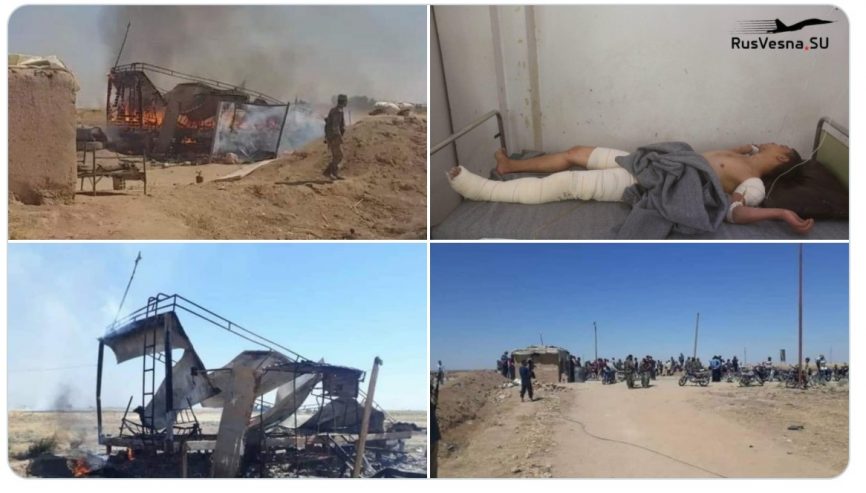
By Khaled Iskef | American Herald Tribune | August 17, 2020
A US army bombed a Syrian army checkpoint in the village of Tal al-Dahab, southeast of Qamishli in the countryside of Hasakah today’s morning, resulting in killing a soldier and wounding two others.
Private sources reported that the American warplane flew over the checkpoint on the outskirts of Tal al-Dahab for a short period, and bombed it, before immediately leaving the area.
The sources said that targeting the checkpoint came after its members prevented an American patrol from passing through it, as verbal affinities occurred at the checkpoint, before the patrol withdrew without passing, followed by the arrival of the aircraft that carried out the bombing.
The information received indicated that one of the wounded Syrian soldiers holds the rank of officer, without receiving confirmed information about the size of the injuries they suffered as a result of the US bombing.
In the past months, the countryside of Hasaka has witnessed a series of events related to the American presence in the region, especially in terms of preventing American patrols from moving in those areas through the Syrian army checkpoints, as those patrols have always tried to provoke the army checkpoints by insisting on passing, which was refused firmly by the Syrian checkpoints.
The Syrian army prevention of the American patrols passage was often accompanied by popular support in the countryside of Hasakah, who always supported the Syrian army in the face of American moves.
Khaled Iskef is a journalist working for Almayadeen TV.
Mail-in Voting Leaves Window for ‘Significant Fraud’ & ‘Logistical Challenges’, Observers Say
By Aleksandra Serebriakova – Sputnik – 16.08.2020
Election officials in nearly all US states were warned by the US Postal Service officials back in July about possible delays resulting from voting via mail-in ballots , according to documents published last week. More American states are now moving to either introduce universal vote-by-mail or ease restrictions associated with absentee voting.
US President Donald Trump reiterated his harsh remarks on Saturday towards the universal mail-in-voting system that has been introduced in nine American states now, with California, Vermont, New Jersey and Nevada, recently joining the ranks.
For the president, who indicated his support for “absentee balloting”, which requires a request for a ballot in advance, the universal mail-in ballot system, where ballots are sent to all registered voters automatically, looked “catastrophic”.
“It’s going to make our country a laughing stock all over the world”, the president said on Saturday.His comments come following the news that the US Postal Service (USPS) previously warned election officials in 46 American states, including those in such heated battlegrounds as Pennsylvania, Florida and Michigan, that there were risks that not all of the ballots would be delivered to the office on time for Election Day. But several other American states are also now mulling the possibility of resorting to this system in the midst of the coronavirus pandemic.
“Yes, mail-in-voting does pose new logistical challenges for election offices that previously dealt with few mail ballots”, says Anthony Fowler, a political scientist from the University of Chicago.
Fowler recognizes the clear advantages the postal voting presents to those willing to safely cast their vote during the health crisis, but still believes that there are some instances of fraudulent behavior that are associated with it:
“Mail voting raises the possibility that the person who filled out the ballot is not who they say they are or that the person who filled out the ballot was coerced in some way”, he explains.
An analysis of the risks associated with postal voting should be carried out without the “distraction” associated with the endless Trump-versus-Democrats debate, says Brian Gaines, an elections expert with the University of Illinois.
“Ballots filled out away from the security and privacy of a booth at an official polling station are inherently less secure”, he believes. “They are more subject to coercion, and they are more prone to be ‘lost’ without being properly processed”.
“The more steps there are in the voting process, the more occasions for error”, the election expert notes, comparing procedures surrounding mail-in voting to those when a person simply goes to a polling station.
However, Gaines says that’s not the only issue.
“Beyond errors and coercion, there are more opportunities for fraud when ballots are away from polling stations and effort is required to get them back to the vote counters”, he explains. “Most states do not allow so-called ‘third parties’ to collect absentee ballots (‘bundle’ or ‘harvest’ them), but some do”.
It is the campaign, church or some other organizations collecting ballots for delivery that can potentially intervene in the election process, Gaines explains, as they can “selectively discard ballots on the basis of guesses about how people might be voting, or can tamper with the ballots”.
“None of this means that vote-by-mail is a source of ‘massive’ fraud or error, but I think that, partisan politics apart, it is plainly more vulnerable to fraud and mistakes than in-person voting”, the expert adds.
“In most elections, fraud and error are negligible or marginal, but in a very close election, they can be decisive. This time, with many more states pushing voters to vote by mail, there may be a bit more confusion and maybe a bit more small-scale fraud”, Gaines concludes.
With the USPS delivery systems being overloaded with “millions of ballots” in the course of the November election, logistics indeed becomes “an enormous issue”, says Mitchell Feierstein, CEO of the Glacier Environmental Fund Limited.
“It is highly probable that there be significant fraud with the mail-in ballots”, the hedge-fund manager argues.
Following the news from the US postal authorities that they cannot guarantee that all the mail-in ballots would arrive on time, protesters gathered outside the house of USPS Postmaster General Louis Dejoy, demanding his resignation. But according to Feierstein, “no matter what happens, the result of the 2020 election will not be accepted by one side”.
Russia’s Proposal on UNSC Summit With Iran Remains on Table After Trump’s Refusal, Moscow Says
Sputnik – 16.08.2020
MOSCOW – The proposal by Russian President Vladimir Putin to hold an online conference of leaders of the UNSC states, Germany, and Iran to discuss the Persian Gulf and Iran remains on the table after US President Donald Trump’s refusal to support it, Russian Deputy Foreign Minister Sergey Ryabkov affirmed on Sunday.
“Of course, yes”, Ryabkov said when asked whether the initiative is still on the table after Trump’s statement.
Trump said on Saturday that he would unlikely support Putin’s initiative to hold the online summit on Iran adding that he would wait until [after] the election.
On Friday, Putin suggested holding a remote videoconference around tensions in the Persian Gulf with the participation of the leaders of the UN Security Council members, Germany and Iran.
He urged Washington to assess the advantages of the implementation of this initiative in order to avoid further escalation of the situation in the Persian Gulf.
Snapback sanctions on Iran isn’t open-and-shut case
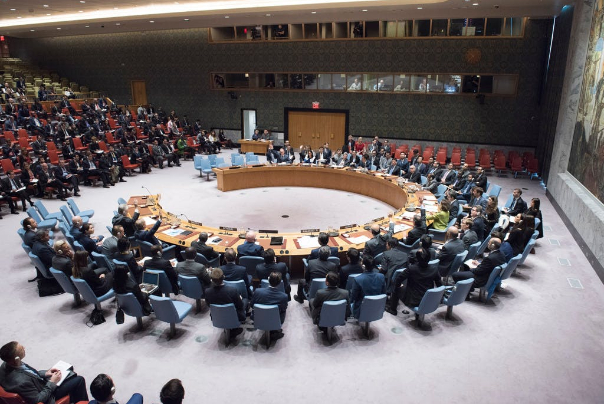
The UN Security Council resoundingly defeated a US resolution to indefinitely extend UN arms embargo on Iran, with only Dominican Republic endorsing the American move, New York, August 14, 2020
By M. K. BHADRAKUMAR | Indian Punchline | August 16, 2020
The Iran nuclear issue moves to centerstage of international security with US President Donald Trump’s remarks Saturday that Washington “will be doing a snapback” against Iran — announcing Washington’s intention to push for restoration of all pre-2015 UN sanctions against Iran. Trump added, “You will be watching it next week.”
Also, Trump apparently poured cold water on Russian President Vladimir Putin’s proposal Friday for a video summit of the veto-holding permanent members of the UN Security Council plus Germany and Iran (that were the original signatories of the JCPOA) to discuss the 2015 Iran nuclear deal and Persian Gulf security issues. He saw no urgency. Trump vaguely hinted that he would revisit the subject “after November”.
Clearly, the optics of the “snapback” sanctions is that Washington is hanging tough and the “maximum pressure” approach is further tightening.
But having said that, Trump ultimately considers himself to be the consummate deal maker — and is strategising an approach of calibrated brinkmanship.
For a start, he hopes to extract out of Russia and China some sort of self-restraint that at least until the US elections are over in November, they wouldn’t provide Iran with military technology. On the other hand, by side-stepping Putin’s proposal — which effectively resuscitates the dispute resolution mechanism of the “6+1” format of the original signatories of the JCPOA — Trump avoids any controversies in the US domestic politics in the run-up to the November election where his “maximum pressure” approach embellishes his strongman image.
Of course, Moscow has a dubious history of heeding such US expectations in the past — when it delayed the delivery of S-300 missiles to Iran for several years due to US and Israeli pressure, forcing Tehran to sue Moscow for compensation. But circumstances have changed. US-Russia relations are tense, while Russia and Iran are partners in regional security.
Equally, Russia and China have worked in tandem on the diplomatic plane and over the JCPOA, Beijing has adopted a line which upfront rejects the Trump administration’s locus standii to invoke snapback sanctions. Again, China-Iran relations have matured and the two countries are expected to conclude in a conceivable future a 25-year $400 billion comprehensive strategic partnership agreement.
Significantly, Putin’s statement on Friday underscored Moscow’s convergence with Tehran and reiterated Moscow’s rejection of Washington’s “maximum pressure” approach against Iran. The following elements of Putin’s statement are to be noted:
- “Iran faces groundless accusations.”
- “Resolutions are being drafted (by Washington) with a view to dismantling decisions that had been unanimously adopted by the Security Council.”
- “Russia maintains its unwavering commitment to the JCPOA.”
- Russia’s Collective Security Concept for the Persian Gulf Region (which Iran welcomed and US ignored) “outlines concrete and effective paths to unravelling the tangle of concerns” in Persian Gulf region.
- “There is no place for blackmail or dictate in this (Gulf) region, no matter the source. Unilateral approaches will not help bring about solutions.”
- There is imperative need to build an inclusive security architecture in the Persian Gulf.
Indeed, Trump is playing his cards close to his chest. The US move on “snapback” sanctions will come up for a decision before the rotating presidency of the UN Security Council, which will be called upon to take a view on the admissibility of the American contention that although Trump publicly repudiated the JCPOA, since it did not formally intimate the same to the UN SC, it still enjoys the prerogative to act under the security council’s Resolution 2231 that provided an international legal basis for the “snapback” clause.
Indonesia chairs the presidency through August and Jakarta and Tehran enjoy friendly relations. The next in line for September is Niger, which may be susceptible to US pressure. By October, Russia’s turn comes to chair the presidency. How far Washington will push the envelope through the August-September period remains to be seen.
Without doubt, a UN sanctions snapback could have predictable consequences for any form of trade with Iran, as it demands from member states to exercise caution when transacting with Iranian financial institutions, and permits countries to inspect vessels or aircraft suspected of carrying cargo in violation of UN sanctions provisions on Iran in national or international waters. Russia and China may decide to take advantage of the new Iranian market for their weapons exports. China’s stance has been exceptionally strong. Of course, all bets are off if Iran carries through its threats of a withdrawal from the Nuclear Non-Proliferation Treaty in the case of UN sanctions reimposition.
In sum, instead of focusing on sanctions snapback, the issue of critical importance in the coming weeks will be the ability of the E3 (France, UK and Germany) — and potentially Russia and China — to take advantage of the time available to engage with the US on the sidelines.
The key to unlocking the current dispute lies largely in Washington, which is insisting on a resolution of the current impasse and on limiting Iranian nuclear activities. Washington in turn will have to offer some incentives to Iran. And those incentives need to be worked out through creative negotiation, as they devolve upon the existing unilateral US sanctions regime on Iran. The good part is that none of the JCPOA protagonists stands to gain out of the snapback sanctions.
Arguably, Trump is applying “maximum pressure” on other JCPOA countries by threatening snapback sanctions, while keeping an open mind on Putin’s proposal to discuss all issues in a “6+1” format once the November election is out of the way. It is a fair assumption that Moscow anticipated Trump’s response on the above lines.
After all, Iran figured in the last phone conversation in late July between Trump and Putin a fortnight ago and Putin’s latest proposal followed up that discussion. Iran was kept in the loop, too. (Interestingly, following the visit by Iran’s FM Javad Zarif to Moscow in late July, Tehran Times newspaper had commented that a “possible revival of diplomatic initiatives between Iran and the US” under Putin’s mediation was to be expected.)
Moscow is yet to react to Trump’s “Probably-not” remark of Saturday apropos the Putin proposal. But the Tass report took note that “Washington will probably want to wait until presidential elections in the country end.” Beijing and Paris have so far voiced support for Putin’s proposal, while London and Berlin are watching from the sidelines.
As for Tehran, it is still savouring the sweet taste of the defeat of the US resolution at the UN Security Council on Friday to extend an arms embargo on Iran that is due to expire in October. (here and here ) In the final analysis, however, Tehran’s choice will be to directly negotiate with Washington.
CIA Behind Guccifer & Russiagate – a Plausible Scenario
Strategic Culture Foundation | August 14, 2020
William Binney is the former technical director of the U.S. National Security Agency who worked at the agency for 30 years. He is a respected independent critic of how American intelligence services abuse their powers to illegally spy on private communications of U.S. citizens and around the globe. Given his expert inside knowledge, it is worth paying attention to what Binney says.
In a media interview this week, he dismissed the so-called Russiagate scandal as a “fabrication” orchestrated by the American Central Intelligence Agency. Many other observers have come to the same conclusion about allegations that Russia interfered in the 2016 U.S. elections with the objective of helping Donald Trump get elected.
But what is particularly valuable about Binney’s judgment is that he cites technical analysis disproving the Russiagate narrative. That narrative remains dominant among U.S. intelligence officials, politicians and pundits, especially those affiliated with the Democrat party, as well as large sections of Western media. The premise of the narrative is the allegation that a Russian state-backed cyber operation hacked into the database and emails of the Democrat party back in 2016. The information perceived as damaging to presidential candidate Hillary Clinton was subsequently disseminated to the Wikileaks whistleblower site and other U.S. media outlets.
A mysterious cyber persona known as “Guccifer 2.0” claimed to be the alleged hacker. U.S. intelligence and news media have attributed Guccifer as a front for Russian cyber operations.
Notably, however, the Russian government has always categorically denied any involvement in alleged hacking or other interference in the 2016 U.S. election, or elections thereafter.
William Binney and other independent former U.S. intelligence experts say they can prove the Russiagate narrative is bogus. The proof relies on their forensic analysis of the data released by Guccifer. The analysis of timestamps demonstrates that the download of voluminous data could not have been physically possible based on known standard internet speeds. These independent experts conclude that the data from the Democrat party could not have been hacked, as Guccifer and Russiagaters claim. It could only have been obtained by a leak from inside the party, perhaps by a disgruntled staffer who downloaded the information on to a disc. That is the only feasible way such a huge amount of data could have been released. That means the “Russian hacker” claims are baseless.
Wikileaks, whose founder Julian Assange is currently imprisoned in Britain pending an extradition trial to the U.S. to face espionage charges, has consistently maintained that their source of files was not a hacker, nor did they collude with Russian intelligence. As a matter of principle, Wikileaks does not disclose the identity of its sources, but the organization has indicated it was an insider leak which provided the information on senior Democrat party corruption.
William Binney says forensic analysis of the files released by Guccifer shows that the mystery hacker deliberately inserted digital “fingerprints” in order to give the impression that the files came from Russian sources. It is known from information later disclosed by former NSA whistleblower Edward Snowden that the CIA has a secretive program – Vault 7 – which is dedicated to false incrimination of cyber attacks to other actors. It seems that the purpose of Guccifer was to create the perception of a connection between Wikileaks and Russian intelligence in order to beef up the Russiagate narrative.
“So that suggested [to] us all the evidence was pointing back to CIA as the originator [of] Guccifer 2.0. And that Guccifer 2.0 was inside CIA… I’m pointing to that group as the group that was probably the originator of Guccifer 2.0 and also this fabrication of the entire story of Russiagate,” concludes Binney in his interview with Sputnik news outlet.
This is not the first time that the Russiagate yarn has been debunked. But it is crucially important to make Binney’s expert views more widely appreciated especially as the U.S. presidential election looms on November 3. As that date approaches, U.S. intelligence and media seem to be intensifying claims about Russian interference and cyber operations. Such wild and unsubstantiated “reports” always refer to the alleged 2016 “hack” of the Democrat party by “Guccifer 2.0” as if it were indisputable evidence of Russian interference and the “original sin” of supposed Kremlin malign activity. The unsubstantiated 2016 “hack” is continually cited as the “precedent” and “provenance” of more recent “reports” that purport to claim Russian interference.
Given the torrent of Russiagate derivatives expected in this U.S. election cycle, which is damaging U.S.-Russia bilateral relations and recklessly winding up geopolitical tensions, it is thus of paramount importance to listen to the conclusions of honorable experts like William Binney. The American public are being played by their own intelligence agencies and corporate media with covert agendas that are deeply anti-democratic.
Russia says CNN claim US refused vaccine help is false
By Jonny Tickle | RT | August 14, 2020
The US did not reject Russia’s offer of cooperation in developing a coronavirus vaccine, according to a Moscow health official, who says help wasn’t even proffered, despite claims from CNN.
On Thursday, the American broadcaster claimed Russia had offered the US “unprecedented cooperation” to Operation Warp Speed, the US multi-agency body dedicated to creating Covid-19 vaccines and treatments. Citing an unnamed “senior Russian official,” the news network said the Americans had refused help from Moscow due to a “general sense of mistrust.”
Alexey Kuznetsov, an assistant to Russia’s Health Minister, rebuffed CNN’s assertion, explaining that his ministry did not send an “official proposal” to the US.
According to the American network, US officials believe the Russian vaccine to be so incomplete that any assistance didn’t generate any interest at all, with one official saying, “There’s no way in hell the US will try [the Russian vaccine] on monkeys, let alone people.”
On August 11, Russian President Vladimir Putin announced that the country had registered the world’s first Covid-19 vaccine, named Sputnik V. Developed by Moscow’s Gamaleya Research Institute of Epidemiology and Microbiology, the vaccine will be available to the general public from January 2021. The process of creating the vaccine has been criticized by some Western countries, who claim that the speedy production means it hasn’t yet been proved safe.
INTERVIEW: Dr Marandi on Beirut Blast Aftermath & Lebanon’s Future
21stCenturyWireTV | August 11, 2020
SUNDAY WIRE show, host Patrick Henningsen is joined by global affairs analyst Mohammad Marandi from the University of Tehran, to discuss the recent developments in Beirut, Lebanon in the aftermath of the tragic explosion which destroyed the city’s port area and resulted in many dead and injured, as well as 300,000 made homeless due to ancillary damages.
Dr Marandi explains some of the legacy issues in Lebanese politics, as well as the true aims of US and its allies in the region, the geopolitical motivation behind punishing economic sanctions by Washington, and how these policies actually prevent delivery of regional aid, cooperation and prosperity among neighboring states. Listen:
New York: Lebanese Government Defends Intellectual Freedom of Diplomat Against Zionist Intimidation Campaign
By Eric Striker – National Justice – August 14, 2020
 The Lebanese consul in New York City refused to cower to a Jewish-led mob demanding the firing of Abir Taha, a Lebanese intellectual and career diplomat who serves as the consul general.
Taha, whose books have been published by Arktos, has written academic books about Nationalsocialism, geopolitics and Nietzschean philosophy, as well as novels influenced by Eastern spirituality. Jewish groups are calling her Nazi and anti-Semite.
A group called Outlive Them NYC, who describe themselves as “antifascist Jews in occupied NYC organizing to defend all our communities,” led a mob that blocked the entrance of the Lebanese consul demanding Taha’s resignation just two days after the tragic August 4th explosion in Beirut that killed 178 people and leveled a large portion of the city.
According to the consulate’s website, the Jews and leftists flooded their system with emails and almost collapsed their network as retaliation for their decision to defend Taha’s intellectual freedom. The result of this action is that thousands of Lebanese citizens who required both conventional services as well as information on the status of loved ones potentially impacted by the explosion were significantly delayed by the callous haters.
The Lebanese have doubled down on defending Taha’s free speech and professionalism. In a public statement, they declared that “[Abir Taha] is a career diplomat (من الملاك) who has joined the diplomatic corps and who will remain in this corps until she retires, because she is part of the administration, not a political class or group. Indeed, she is politically independent, with no political affiliation or loyalty to any party or politician. She only strives to serve Lebanon and its people, her only pride, loyalty and duty.”
In a shocking display of arrogance, the foreign emissaries were subjected to an ultimatum by the mob of New York Jews and “antifa” members demanding that Taha be fired by August 10th “or else.” The release concludes that, “What is currently happening to the Consul General : harassment, threats, insults, blaming her for all of our country’s woes, insulting the Consulate staff members, and lastly, giving her an “ultimatum” to resign until August 10, 2020 “or else” (…) … all of this is really sad and unfair since she and the entire staff of the Consulate General of Lebanon have been tirelessly serving our community, even during these difficult times, without any interruption or delay. She certainly doesn’t deserve this. The entire staff of the Consulate certainly doesn’t deserve this.”
By taking a principled stance, the Lebanese state breaths a breath of fresh air into the American police state, where citizens live in fear of their opinions being known and are arbitrarily blacklisted from employment for questioning the narratives of the elite.
The disgusting act of trying to leverage access to embassy services right after a tragedy to enforce US-style political correctness was celebrated by Al Arabiya, a media company owned by Saudis, which reported that the consul had to close its doors on August 12th in response to the protests.
There is no evidence of this being true. The consul appears to be open during its usual hours and Taha is still listed as its head.
The US contracts out its regime change operation in Nicaragua
By John Perry | COHA | August 4, 2020
Masaya, Nicaragua – An extraordinary leaked document gives a glimpse of the breadth and complexity of the US government’s plan to interfere in Nicaragua’s internal affairs up to and after its presidential election in 2021.
The plan,[1] a 14-page extract from a much longer document, dates from March-April this year and sets the terms for a contract to be awarded by USAID (a “Request for Task Order Proposal”). It was revealed by reporter William Grigsby from Nicaragua’s independent Radio La Primerisima[2] and describes the task of creating what the document calls “the environment for Nicaragua’s transition to democracy.” The aim is to achieve “an orderly transition” from the current government of Daniel Ortega to “a government committed to the rule of law, civil liberties, and a free civil society.” The contractor will work with the “democracy, human rights, and governance (DRG) sub-sectors” which in reality is an agglomeration of NGOs, think tanks, media organizations and so-called human rights bodies that depend on US funding and which – while claiming to be independent – are in practice an integral part of the opposition to the Ortega government.
To justify such blatant interference, a considerable rewriting of history is needed. For example, the document claims that the ruling Sandinista party manipulated “successive” past elections so as to win “without a majority of the votes.” Then after “manipulating the 2016 presidential elections” to similar effect, it was warned by the Organization of American States (OAS) that there had been various “impediments to free and fair elections” as a result of which the OAS requested “technical electoral reforms.” What the document omits, however, are the overall conclusions of the OAS on the last elections. Although it identified “weaknesses typical of all electoral processes,” the OAS explicitly said that these had “not affected substantially the popular will expressed through the vote.” In other words, the nature of Daniel Ortega’s victory (he gained 72% of the popular vote) made any minor irregularities irrelevant to the result: he won by an enormous margin. The leaked document makes clear that the US is worried that the same might happen again and aims to stop it.
Not surprisingly, the document also rewrites recent history, saying that the “uprising” in 2018 (which had strong US backing) was answered by “the government’s brutal repression” of demonstrations, while it ignores the wave of violence and destruction that the opposition itself unleashed. The economic disruption it caused is still damaging the country, even though (pre-pandemic) there were strong signs of recovery. USAID, however, has to paint a picture of a country in crisis “… broadening into an economic debacle with the potential to become a humanitarian emergency, depending on the impact of the COVID-19 contagion on Nicaragua’s weak healthcare system.” Someone casually reading the document, unaware of the real situation, might get the impression that, in Nicaragua’s “crisis environment,” regime change is not only desirable but urgently required. The reality – that Nicaragua is at peace, has so far coped with the COVID-19 pandemic reasonably well, and hasn’t suffered the severe economic problems experienced by its neighbors El Salvador and Honduras – is of course incompatible with the picture the US administration needs to present, in order to give some semblance of justification for its intervention.
A long history of US intervention
Given the long history of US interference in Nicaragua, going back at least as far as William Walker’s assault on its capital and usurption of the presidency in 1856, the existence of a plan of this kind is hardly surprising. What’s unusual is that someone has made it publicly available and we can now see the plan in detail. Of course, the US has long developed a tool box of regime change methods short of direct military intervention, such as when it sent in the marines in the 1920s and 1930s or illegally funded and provided logistical support for the “Contra” forces in the 1980s. It now has more sophisticated methods, using local proxies, which are deniable in the unlikely event that they will be exposed by the international media (which normally displays little interest, being much more interested in electoral interference by Russia than it is in Washington’s disruption of the democratic processes).
The latest escalation in intervention began under the Obama presidency and continued under Trump, although the motivation probably has more to do with the US administration’s ongoing concerns about the success of the Ortega government’s development model since it returned to power in 2007 and began a decade of renewed social investment. Oxfam summarized the problem in the memorable title it gave to a 1980s report about Nicaragua: The Threat of a Good Example. Between 2005 and 2016, poverty was reduced by almost half, from 48 percent to 25 percent according to World Bank data. Nicaragua had a low crime rate, limited drug-related violence, and community-based policing. Over the 11 years to 2017, Nicaragua’s per-capita GDP increased by 38 percent—more than for any of its neighbors. Its success contrasted sharply with the experience of the three “Northern Triangle” countries closely allied to the US. While Nicaragua became one of the safest countries in Latin America, neighboring Guatemala, El Salvador and particularly Honduras saw soaring crime levels, rampant corruption and rapid growth in the drug trade that prevented social progress and produced the “migrant caravans” that began to head north towards the US in 2017.
The US administration’s efforts in 2016 and 2017, building on long experience of manipulating Nicaraguan politics, appeared to produce results in April 2018. The first catalyst for action by US-funded groups was an out-of-control forest fire in a remote reserve, inaccessible by road.[3] The tactics were clear: take an incident with potential to get young people onto the streets, blame the government for inaction (even though the fire was almost impossible to control), whip up people’s anger via social media, organize protests, generate critical stories in the local press, enlist support from neighboring allies (in this case, Costa Rica) and secure hostile coverage in the international media. All of these tactics worked, but before the next stage could be reached (protesters being repressed by the Ortega “regime”) the forest fire was extinguished by a rainstorm.
A week later, the opposition forces were unexpectedly given a second opportunity. The government announced a package of modest social security reforms, and quickly faced new protests on the streets. The same tactics were deployed, this time with much greater success. Violence by protesters on April 19 (a police officer, a Sandinista supporter and a bystander were shot) brought inevitable attempts by the police to control the protests, leading to rapid escalation. Media messages proliferated about students being killed, many of them false. Only a few days later the government cancelled the social security reforms, but by now the protests had (as planned) moved on to demanding the government’s resignation. The full story of events in April-July 2018, and how the government eventually prevailed, is told in Live from Nicaragua: Uprising or Coup?
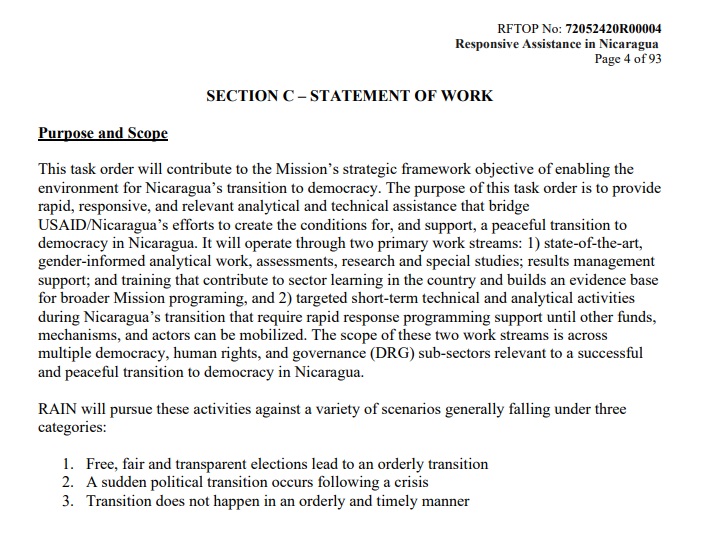
A section of the report
Laying the groundwork for insurrection
How were the conditions for a coup created? The aims of US government funding in Nicaragua and the tactics they paid for in this period were made surprisingly clear in the online magazine Global Americans in 2018, which is partly funded by the National Endowment for Democracy (NED).[4] Arguing (in May 2018, at the height of the violence) that “Nicaragua is on the brink of a civic insurrection,” the author Ben Waddell, who was in Nicaragua at the time, pointed out that “US support has helped play a role in nurturing the current uprisings.”
His article’s title, Laying the groundwork for insurrection,[5] was starkly accurate in describing the ambitions behind the NED’s funding program, which had financed 54 projects in Nicaragua over the period 2014-17 and has continued to do so since then. What did the projects do? Like the recently leaked document, NED promotes ostensibly innocuous or even apparently beneficial activities like strengthening civil society, promoting democratic values, finding “a new generation of democratic youth leaders” and identifying “advocacy opportunities.” To get behind the jargon and clarify the NED’s role, Waddell quotes the New York Times (referring to the uprisings in Egypt, where NED had also been active):[6]
“… the United States’ democracy-building campaigns played a bigger role in fomenting protests than was previously known, with key leaders of the movements having been trained by the Americans in campaigning, organizing through new media tools and monitoring elections.”
In the case of Nicaragua, the NED’s funding of groups opposed to the Sandinista government began in 1984, giving the lie to their aim being to “promote democracy” since that was the year in which Nicaragua’s revolutionary government held the country’s first-ever democratic elections. Waddell makes it clear that the NED’s efforts continued, years later:
“… it is now quite evident that the U.S. government actively helped build the political space and capacity in Nicaraguan society for the social uprising that is currently unfolding.”
The NED is not the only non-covert source of US funding. Another is USAID, which describes its role in the 2018 uprising in similar terms to the NED. Not long before he exposed the new document, William Grigsby was able to publish lists of groups and projects in Nicaragua funded by USAID and by the National Democratic Institute (NDI).[7] He showed that upwards of $30 million was being distributed to a wide range of groups opposed to the government and involved in the violence of 2018, and that in the case of the NDI at least this funding continued into 2020.
Last year, Yorlis Gabriela Luna recounted for COHA her own experiences of how US-funded groups trained young people, in particular, and influenced their political beliefs in the build-up to 2018.[8] She explained how social networks and media outlets were “capable of fooling a significant portion of Nicaragua’s youth and general population.” She explained how the groups used scholarships to learn English, diploma programs, graduate studies, and courses with enticing names like “democratic values, social media activism, human rights and accountability” at private universities, “to attract and lure young people.” She went on to explain how exciting events were organised in expensive hotels or even involving trips abroad, so that young people who had never before been privileged in these ways developed a sense of “pride,” belonging, and “group identity,” and as a result “wound up aligning themselves with the foreign interests” of those who funded the courses and activities.
The new task during and after the pandemic
Two years after the failed coup attempt, what are the organizations that receive US funding now supposed to do? The new document is full of jargon, requiring the contractor (for example) to engage in “targeted short-term technical and analytical activities during Nicaragua’s transition that require rapid response programming support until other funds, mechanisms, and actors can be mobilized.” The work also requires “longer-term programs, which will be determined as the crisis evolves.” Preparation is required for the possibility that “transition [to a new government] does not happen in an orderly and timely manner.” The contractor will have to prepare “a roster of subject matter experts in Nicaragua” to provide short term technical assistance, “regardless of the result of the 2021 election, even in the event of the Sandinistas ‘winning fairly’.” The document is full of requirements like being able to offer “a rapid response” and “seize new opportunities,” emphasizing the urgency of the task. In other words, a fresh attempt is underway to destabilize Daniel Ortega’s government and, in the event that this doesn’t work, and even should the Sandinistas win the next election fairly, as the document admits is a possibility, US attempts at regime change are stepping up a gear.
Who will carry this out? The document places much emphasis on “maintaining” and “strengthening” civil society and improving its leadership, which appears to refer to the numerous NGOs, think tanks and “human rights” bodies which receive US funding. At one point the document asks “what should donor coordination, the opposition, civil society, and media focus on?” – clearly implying that the contractor has a role in influencing not just these civil society groups but also the media and political parties.
Not surprisingly, the document has been interpreted as a new plan to destabilize the country. Writing in La Primerísima, Wiston López argues that the plan’s purpose is “to create the conditions for a coup d’état in Nicaragua.”[9] Brian Wilson, the VietNam veteran severely injured in the 1980s when attempting to stop a freight train carrying supplies to the “Contra,” and who lives in Nicaragua, concludes that the US now realizes that Ortega will win the coming election.[10] In response, the “US has launched a brazen, criminal and arrogant plan to overthrow Nicaragua’s government.”
Supposing that there is a clear Sandinista victory in 2021, will the US nevertheless refuse to accept the result? Having implied that the OAS had serious criticisms of the last election when this was not the case, the document implies that it will be pressured to take a different attitude next time, saying that “whether the OAS decides to pick up the pressure on electoral reform again will be an important international pressure point.” No doubt the US will try to insist that the OAS must be election observers, and if this is refused it will allow the legitimacy of the election to be called into question, if the result is unfavorable to US interests. Many question whether the OAS is even qualified to have an observer role any longer, however, after the serious harm it did to Bolivian democracy in 2019 by casting doubts on what experts considered a fair election and, in effect, instigating a coup.[11] This document creates legitimate concern that the US government would like to use the OAS to prevent another government that is not to its liking from winning an election, as it did so recently in Bolivia.
Not only must conditions be created to replace the current government, but once this is achieved the changes must extend to “rebuilding” the institutions of government, including the judicial system, police and armed forces. After the widespread persecution of government officials, state and municipal workers and Sandinista supporters that occurred in 2018, it is not surprising that this is interpreted as requiring a purge of all the institutions and personnel with Sandinista sympathies. As Wilson says, “the new government must immediately submit to the policies and guidelines established by the United States, including persecution of Sandinistas, dissolving the National Police and the Army, among other institutions.”
USAID makes it clear that it is internal pressure in Nicaragua that might eventually provoke a coup d’état, so it calls on its agents to deepen the political, economic and also the health crisis, taking into account the context of COVID-19. The US State Department recently awarded an extra $750,000 to Nicaraguan non-government bodies as part of its global response to COVID-19, and this includes “support for targeted communication and community engagement activities.”[12] As López points out in Popular Resistance, “Since March the US-directed opposition has focused 95% of their actions on attempting to discredit Nicaragua’s prevention, contention, and Covid treatment. However, this only had some success in the international media and is now backfiring since Nicaragua is the country with one of the lowest mortality rates in the continent.”[13] The Johns Hopkins University’s world map of coronavirus cases currently shows Nicaragua with 3,672 cases compared with 17,448 in El Salvador, 42,685 in Honduras and 51,306 in Guatemala.[14] Even though higher figures produced by Nicaragua’s so-called Citizens’ Observatory[15] are regularly cited in the international media, they currently show just 9,044 “suspected” cases, still far below the numbers in the “Northern triangle” countries.
What will the opposition do next?
COHA has already documented the disinformation campaign taking place against Nicaragua during the pandemic and how this has been repeated in the international media. So far, however, warnings of the health system’s collapse have proved to be unfounded.[16] If, as happened with the Indio Maíz fire and the social security protests in 2018, the opposition fails in its attempt to use the pandemic to destabilize the Ortega government, what will it do next? A recent incident shows that attempts to seize on events to spur a crisis will continue. On July 31, a fire occurred in Managua’s cathedral. The fire department responded quickly and put out the blaze within ten minutes, but a crucifix and the chapel where it stood were badly damaged. Within minutes opposition newspaper La Prensa reported that “an attack” had occurred involving a “Molotov cocktail” and that the government or its supporters were implicated.[17] This was echoed by other local and international media, opposition parties, the Archbishop of Managua, and by one of the NGOs which received USAID funding.[18] Despite the lack of any evidence to back up the media stories, the United Nations High Commission for Human Rights (UNHCR) also condemned the incident, obviously implying that it was an attack on human rights.[19]
Yet a police investigation quickly established that there was no evidence at all of any foul play, or that petrol or explosive materials were involved.[20] Their investigations pointed instead to a tragic accident involving lighted candles and the alcohol spray being used as a disinfectant as part of the cathedral’s anti-COVID-19 precautions. The Catholic Church has already announced that the damaged chapel will be restored to its former state. However, the damage that has been done to the government’s national and international reputation, and to its highly politicized relationship with the Catholic Church, will be more difficult to repair.
John Perry is a writer based in Nicaragua.
End notes
[1] Downloadable in English (pdf) at https://s3.amazonaws.com/rlp680/files/uploads/2020/07/31/aid-mayo-2020-ingles.pdf
[2] “EEUU lanza descarado plan intervencionista para tumbar al FSLN”, https://www.radiolaprimerisima.com/noticias/general/287264/eeuu-lanza-descarado-plan-intervencionista-A histotrypara-tumbar-al-fsln/
[3] “International Forces ‘Distorting’ Nicaragua’s Indio Maíz Fire,” https://www.telesurenglish.net/analysis/International-Forces-Distorting-Nicaraguas-Indio-Maiz-Fire-20180414-0019.html
[4] See details at https://www.ned.org/wp-content/themes/ned/search/grant-search.php (NED is nominally independent of the US administration, but is funded by Congress.)
[5] “Laying the groundwork for insurrection: A closer look at the U.S. role in Nicaragua’s social unrest,” https://theglobalamericans.org/2018/05/laying-groundwork-insurrection-closer-look-u-s-role-nicaraguas-social-unrest/
[6] “U.S. Groups Helped Nurture Arab Uprisings,” https://www.nytimes.com/2011/04/15/world/15aid.html
[7] “Asi financia EEUU a los terroristas,” http://www.radiolaprimerisima.com/noticias/general/286068/asi-financia-eeuu-a-los-terroristas/
[8] “The Other Nicaragua, Empire and Resistance,” https://www.coha.org/the-other-nicaragua-empire-and-resistance/
[9] “EEUU lanza descarado plan intervencionista para tumbar al FSLN,” http://www.radiolaprimerisima.com/noticias/general/287264/eeuu-lanza-descarado-plan-intervencionista-para-tumbar-al-fsln/
[10] “NIcaragua targeted for US overthrow in 2020-21,” https://popularresistance.org/nicaragua-targeted-for-us-overthrow-in-2020-21/
[11] “Bolivia’s Struggle to Restore Democracy after OAS Instigated Coup,” https://www.coha.org/bolivias-struggle-to-restore-democracy-after-oas-instigated-coup/
[12] See https://www.state.gov/update-the-united-states-continues-to-lead-the-global-response-to-covid-19/
[13] “US Launches Brazen Interventionist Plan to Overthrow the FSLN,” https://popularresistance.org/us-launches-brazen-interventionist-plan-to-overthrow-the-fsln/
[14] See https://coronavirus.jhu.edu/map.html
[15] See https://observatorioni.org/
[16] “Experts Warn about Possible Health System Collapse in Nicaragua,” https://www.voanews.com/episode/experts-warn-about-possible-health-system-collapse-nicaragua-4320606
[17] See https://www.laprensa.com.ni/2020/07/31/nacionales/2702954-lanzan-bomba-molotov-adentro-de-la-capilla-de-la-catedral
[18] See for example https://confidencial.com.ni/atentado-con-bomba-molotov-en-la-catedral-de-managua/ and https://elpais.com/internacional/2020-07-31/un-atentado-con-bomba-molotov-incendia-la-capilla-de-la-catedral-metropolitana-de-managua.html
[19] See https://twitter.com/OACNUDH/status/1289574031159488514?ref_src=twsrc%5Etfw%7Ctwcamp%5Etweetembed%7Ctwterm%5E1289574031159488514%7Ctwgr%5E&ref_url=https%3A%2F%2Fwww.laprensa.com.ni%2F2020%2F08%2F01%2Fnacionales%2F2703388-organismos-de-derechos-humanos-condenan-ataque-a-la-catedral-de-managua
[20] “Esclarecimiento de incendio en Capilla de la Sangre de Cristo, Catedral de Managua”, https://www.el19digital.com/articulos/ver/titulo:105922-esclarecimiento-de-incendio-en-capilla-de-la-sangre-de-cristo-catedral-de-managua-presentacion
‘Regime Change’ in Belarus Looks Like an Objective of Both the Trump Administration and the Biden Campaign
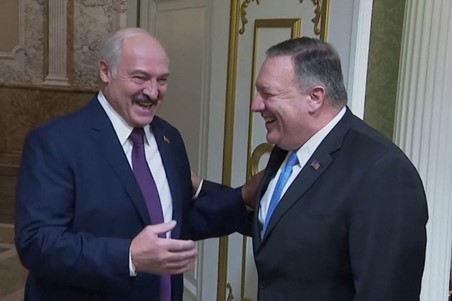
By Adam Dick | Ron Paul Institute | August 14, 2020
It seems that whoever wins the presidency, United States foreign policy will keep chugging away at intervening across the world, including via “regime change” efforts. Over the last couple decades, targets for US-government-supported overthrow have included Afghanistan, Iran, Iraq, Libya, Syria, Ukraine, and Venezuela. Belarus also appears to be in the US government’s crosshairs. If its government holds back through January the effort seeking to topple it, Belarus looks sure to remain a US target for regime change during either a second term of President Donald Trump or a first term of President Joe Biden.
On Monday, as revolutionaries in Belarus capital Minsk attempted to oust the Belarus government, US Secretary of State Mike Pompeo and Democratic Party presidential nominee Joe Biden issued interchangeable statements regarding Belarus and US policy toward it. Both Pompeo’s statement and Biden’s statement condemned the government of Belarus, called fraudulent the country’s recent national election in which President Aleksander Lukashenko won reelection by a wide margin, and made demands upon the Belarus government.
The statements of Pompeo and Biden may not seem so threatening if you imagine them coming from the government of a country of average population, economic strength, military power, and tendency to intervene in other countries. The comments could then just be understood as politicians spouting off or being relatively harmless buttinskis.
It is different when the pronouncements are made by a top foreign affairs official of the US and the potential next president of the US. The US presides over a large population country with major economic resources. The US has military bases and ships, as well as covert operatives, across the world. The US has a long and ongoing history of pursuing, and often achieving, the overthrow of governments through actions including invasions, assassinations, sanctions, election meddling, and the financing and coordinating of coups and revolutions.
In 2015, during the Barack Obama administration in the US and after another wide-margin reelection win by Lukashenko in Belarus, Ron Paul Institute Executive Director Daniel McAdams discussed the US government’s disdain for Lukashenko and the Belarus government. McAdams wrote in part:
Lukashenko has been a favorite punching bag of the US and western neocons for a number of years because he has not shown the required level of deference to his would-be western overlords compared to, say, the Baltics. He routinely wins re-election even as the US government has funneled millions of dollars into the political opposition in hopes of somehow fomenting a regime change.
Don’t believe the sanctimonious comments, whether from the Trump administration or the Biden campaign, about the US seeking to promote democracy and human rights in Belarus. This is about power. The US has let slide and continues to let slide democratic and human rights shortcomings of countries across the world where benefit can be obtained. Dictatorship? No problem. The expression of concern about democracy and human rights is propaganda selectively applied to stir up support for, or at least quell opposition to, US intervention abroad.
Pompeo and Biden’s statements regarding Belarus help make clear that overthrowing governments appears set to remain a feature of US foreign policy no matter if Trump wins a second term or Biden defeats him in the upcoming November presidential election.
Featured Video
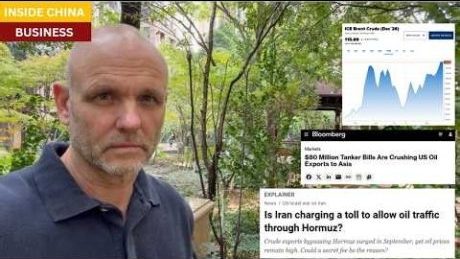
Iran is (probably) collecting tolls, and why Asia stopped buying oil from the US
or go to
Aletho News Archives – Video-Images
From the Archives
The Great Recycling Scam
By Dr. Vernon Coleman – 21st Century Wire – September 2, 2022
Recycling was introduced, worldwide, as a tool to teach citizens to become compliant.
Forcing citizens to sort their rubbish into up to nine separate bags or boxes every week had absolutely nothing to do with ‘saving the planet’ and everything to do with teaching citizens (through a mixture of fines and shame) to behave ‘responsibly’ i.e. to do as they were told without looking too closely at the rationale of what they were being told to do.
The recycling never had anything to do with protecting the planet, of course. Most of the rubbish sorted, washed and collected in the UK was taken abroad, by lorry or ship or train, and burnt or dumped. It was, quite simply, impractical and not cost effective to recycle the material that had been collected. And, of course, collecting the sorted rubbish involved massive costs in terms of cash and pollution.
Today, the recycling business has reached an apogee of lunacy. Councils introduce ever more complex rules and fees. They refuse to take away much of the waste that is collected. And those wanting to take their rubbish to a ‘recycling’ centre will probably have to make an appointment and answer a host of questions.
It is no surprise that fly-tipping has become a major problem. The biggest causes of plastic in the sea are dumped fishing gear and plastic waste (much of it officially designated as recycled) which has been dumped by ships.
The good news, however, is that in Britain, recycling rates are falling. More and more people have become aware that the whole recycling movement was just another piece of manipulative trickery.
Blog Roll
 Aletho News
- The Case for Less Unity in Europe
- Ukraine expands minority rights under EU pressure – but Russians remain excluded
- Albania takes anti-riot crackdown cue from France
- The interest of the House of Rothschild in Ukraine
- Pentagon fires top military planner
- Three tankers hit mines on unauthorized Hormuz route: IRGC Navy
- Iran is (probably) collecting tolls, and why Asia stopped buying oil from the US
- Regional security runs through Tehran
- Voters Don’t Want the Old GOP
- Former US officials who resigned over Gaza urge 2028 presidential candidates to reject architects of Biden-era policy
- If Americans Knew
- The Two Faces of Gadi Eisenkot, Who Could Be Israel’s PM
- US Sending an Additional Patriot System to Israel To Prepare for Potential Attacks on Iran
- Pentagon Estimates the US Has Spent Over $47 Billion on Iran War, But True Cost Is Much Higher
- ‘Who Will Bomb Me Next?’: Palestinians in Gaza and the West Bank on Israel’s Election
- DAILY UPDATE: Latest essential news on Palestine, Israel, & region
- Majority Of Jewish Schools In The UK Teaching Kids To “Love Israel”
- Eisenkot or Netanyahu: No matter who forms government, democracy is dead
- Six Palestinians Killed In Gaza In 24 Hours
- Israel’s election: The battle between change and anti-Palestinian sentiment
- Voters Don’t Want the Old GOP
- No Tricks Zone
- Germany’s Green Energy Transition Becoming Increasingly Expensive…Another 6 Trillion Euros!
- Sudden Stratospheric Warming, Powerful El Niño Combination May Lead To Extreme Europe Cold, Energy Crisis!
- Two New Studies Find Thwaites Glacier Melt Cannot Be Driven By Human Activity Or A Warming Ocean
- E-Cars Reduce CO2 Emissions By Only 41% Compared To Internal Combustion Engine Vehicles
- Predictions Made By Renowned Climate Professor Over Past Decades Have Been Proven To Be Poor
- New Study Suggests Large Regions Of The Pacific Ocean Have Been Cooling For The Last 80 Years
- Germany’s Green Energy Debacle: High Energy Costs Force Kahla Porzellan to Close After 182 Years!
- New Study: 50 Years Of The Most Aggressive ‘Net Zero’ Policies Can Only Affect The Global Climate By 0.03°C
- US September “Heat” Was No Record…Many Records Set Decades Ago
- Latest European Green Energy Debacle; Portugal’s Largest Flagship Solar Park Insolvent!

