Iran presents four – point plan on ending crisis in Yemen
Aletho News | April 18, 2015
Iran’s Ambassador to the United Nations Gholam-Ali Khoshrou on Friday submitted to the UN a four-point plan on putting an end to the ongoing bloodshed in Yemen prepared by Foreign Minister Mohammad Javad Zarif.
The following is the full text of the foreign minister’s letter which was addressed to UN Secretary General Ban Ki-moon:
In the Name of God, the Most Compassionate, the Most Merciful
H.E. Mr. Ban Ki-moon,
Secretary-General
United Nations
New York
Excellency,
I would like to draw your attention to the extremely alarming situation in Yemen, exacerbated by the recent provocative foreign military air campaign. It goes on in flagrant defiance of the most basic principles of international law, flouting the purposes and principles of the Charter of the United Nations, in particular the obligation to refrain from the threat or use of force in international relations.
Foreign military forces have mostly targeted purely civilian infrastructures of Yemen, destroying, inter alia, hospitals, schools, road, food factories and power plants, and thus depriving civilians of basic necessities. They have also indiscriminately targeted residential areas, including refugee camps, killing and injuring innocent civilians, in particular women and children.
This critical situation is escalating and the humanitarian crisis in Yemen is approaching catastrophic dimensions. It may result in further exacerbation of the already tense circumstances in a region that has been plagued by one of the most barbaric types of extremism and multi-pronged vicious campaign of foreign-backed terrorists. These terrorist groups have been the main beneficiaries, gaining strategic foothold in Yemen aided by the foreign aerial campaign.
Under these circumstances, it is imperative for the international community to get more effectively involved in ending the senseless aerial attacks and establishing a ceasefire, ensuring delivery of humanitarian and medical assistance to the people of Yemen and restoring peace and stability to this country through dialogue and national reconciliation without pre-conditions.
The Islamic Republic of Iran reiterates that there is no military solution to this conflict. The only way to restore peace and stability is to allow all Yemeni parties to establish, without any foreign interference, their own inclusive national unity government. To this end, the Islamic Republic of Iran believes that all efforts, particularly those by the United Nations, should be guided, in conformity with the Charter of the United Nations and fundamental principles of international humanitarian law, by the following objectives:
1.Ceasefire and an immediate end to all foreign military attacks;
2.Unimpeded urgent humanitarian and medical assistance to the people of Yemen;
3.Resumption of Yemeni-lead and Yemeni-owned national dialogue, with the participation of the representatives of all political parties and social groups;
4.Establishment of an inclusive national unity government.
I hope that Your Excellency will urgently use your good offices and conduct consultations with the concerned parties to facilitate and encourage an immediate end to these senseless bombardments and initiation of a genuine dialogue to find a political solution to this tragic crisis. The Government of the Islamic Republic of Iran stands ready to assist you in advancing this objective.
Please accept, Excellency, the assurances of my highest consideration.
M. Javad Zarif
Minister of Foreign Affairs of the Islamic Republic of Iran
Nuclear deal or no nuclear deal? That is the question
By Catherine Shakdam | RT | April 17, 2015
As neocons are working to destroy Iran’s tentative nuclear deal, US President Obama will have to either reinvent America’s policy or give in to Israel’s lobby and Saudi Arabia’s paranoiac fear of Shia Islam.
If months of intense political wrangling were crowned earlier this April by the confirmation that Iran and the P5+1 countries reached a tentative framework agreement over one of the most contentious issue of the past three decades – Iran’s nuclear dossier – it appears such diplomatic respite could prelude to a dangerous political standoff.
If by any account Iran’s nuclear negotiations were going to be trying, especially since Tehran’s nuclear ambitions do not necessarily sit at the center of this internationally staged quarrel, Israel’s neocon war campaign against the Islamic Republic risks pushing the world toward yet another lengthy conflict- a global one at that.
With the fires of war already burning bright in the MENA region – Middle East and North Africa – the fall of another domino could prove one too many for the word to handle. From a purely geostrategic standpoint a war with Iran, however pleasing to Tel Aviv’s avid warmongers, would likely force Western powers and their Arab allies to commit more military power than they can handle. Bearing in mind that the US has already committed troops and resources to Afghanistan, Libya, Pakistan, Yemen, Syria, Iraq, and of course Ukraine, how much farther can imperial America really stretch?
However grand the US might think itself to be, and however solid the US might think its alliances to be, Washington has yet to win a war. Claiming victory as George W. Bush did in Iraq on May 1, 2003 did not exactly make it so. And though America basked in the glorious light of its military supremacy over the “Iraqi enemy,” its joy was short-lived as reality soon came knocking. And though starting a war might seem an easy enough business for neocon America, it is really the art of peace this belligerent nation has failed to master so far.
But back to Iran’s nuclear deal
To the surprise of many skeptics, Iran and the P5+1 did reach a deal – and while there were a few near misses, a deal was nevertheless brokered; proof experts actually insisted that Tehran is more interested in diplomacy than its detractors gives it credit for. Iran’s concessions attest to its officials’ determination to engage with the international community and integrate back into mainstream international politics.
As Gareth Porter wrote in a report for CounterPunch this April, “The framework agreement reached on Thursday night [April 2, 2015] clearly gives the P5+1 a combination of constraints on Iran’s nuclear program that should reassure all but the most bellicose opponents of diplomacy.”
And although Iran gave every assurance its government will not seek to weaponize its nuclear program, no amount of concessions might prove sufficient enough or comprehensive enough to assuage Washington’s fears vis-a-vis its “great Satan” – especially if the Saudis and Israelis have a say in it.
With the ink of the nuclear framework agreement still left to dry, both the powerful Israeli lobby and Al Saud’s petrodollars went on overdrive, telling the world what a catastrophe Iran’s nuclear deal would be.
One trip to US Congress and a few well-chosen words against its mortal enemy later, Israel seems satisfied it forever drove a wrench into the yet to be formulated and signed nuclear agreement.
As Yuval Steinitz, Israel minister for intelligence and strategic affairs so eloquently told the world on April 6, Israel would try to persuade the P5 +1 “not to sign this bad deal or at least to dramatically change or fix it”.
Echoing his minister’s narrative, Israel Prime Minister Benjamin Netanyahu determined that since Iran represents a threat to Israel’s very existence, America should abandon all diplomacy and instead beat the war drums. And we don’t really need to know why, only that it is so – If Netanyahu’s drawing did not convince your idle mind of Iran’s evil in 2012 then nothing will!
Just as Israel’s lobby bullied its way through the Oval office, cornering U.S. President Barak Obama into relenting power to Congress, Saudi Arabia declared war on Yemen, adding a new layer of complication to an already impossible mesh of over-lapping and over-conflicting alliances in the Middle East, thus weaving a dangerous noose around peace’s neck.
Interestingly, if war requires no US Congress oversight you can be sure that peace does!
Caught in between a rock at home and a hard place in the Middle East, US President Obama is faced with one mighty dilemma – one which will determine not his presidency but his very legacy.
If recent tensions between President Obama and the Israeli Premier are anything to go by, it would appear Israel’s lobby suit of armor is not as thick and potent as it’d like it to be, or maybe just maybe, it simply exhausted Americans’ patience. Israel’s greatest ally and supporter, the one power which has quite literally and almost single-handedly carried the Jewish State into being and helped it survive adverse winds since its very inception in 1948: vetoing UNSC resolutions when needed, propping its military and economy when needed, acting a political champion when needed, could be running out of road.
If Israel and Saudi Arabia’s foreign agenda stand now in perfect alignment – their ire directed not at one another but at Iran, changes in the region and fast-moving geostrategic interests have forced the US to re-evaluate its position vis-a-vis Iran and the so-called mythical Shia crescent the world has learnt to be wary of without quite understanding why.
In Netanyahu’s officials’ own words we are to believe that Islamic radicalism, a perverted, acetic and reactionary interpretation of Islam which has mapped itself around Saudi Arabia’s Wahhabism movement would be preferable to seeing Iran gain a greater footing in the Arab world. In September 2013, the Israeli Ambassador to the United States Michael Oren told the Jerusalem Post that Israel favored the Sunni extremists over Assad and the Shiites. “The greatest danger to Israel is by the [Shiite] strategic arc that extends from Tehran, to Damascus to Beirut. And we saw the Assad regime as the keystone in that arc,” Oren said in an interview.
“We always wanted Bashar Assad to go, we always preferred the bad guys who weren’t backed by Iran to the bad guys who were backed by Iran.” He said this was the case even if the “bad guys” were affiliated with al-Qaeda.
Obviously Saudi Arabia would rather eat its own foot than allow the all so devilish Iran from reclaiming its standing in the region, especially since it would essentially mean relenting power to rising calls for democratic reforms in the Gulf monarchies – Bahrain being the flagship of such a desire for change.
Why do that when you can wage senseless wars to assert your dominion?
Iran’s nuclear deal is more than just a nuclear deal. If signed, this deal would become the cornerstone of a broad shift in alliances, the moment when the US would actually choose to put its national interests over that of Tel Aviv and over Riyadh’s billions. Where Israel has bullied the US for decades, Saudi Arabia has bought its policies for decades.
With nothing left to lose but his good name and his legacy, President Obama could be just the man to break this self-destructing cycle and reinvent America’s foreign policy.
And that’s not even wishful thinking it would actually make sense for America to make peace with Iran – economically, politically and in terms of energy security and counter-terrorism Iran could be a more helpful and potent ally than Saudi Arabia. Bearing in mind that Riyadh’s fingerprints are all over al-Qaeda, ISIS and whatever terror offshoots radicals created those days, Washington might want to consider another ally in its fight against radicalism.
Thing is, America wants change! What it needs now is mastering the courage of its desire.
America is a superpower running out of steam, and more importantly running out of standing in the world. America’s exceptionalism is on its last leg. Too many double-standards, too many incoherencies in its alliances, too many double-talks, double-entendres and double-crossings. America needs a deal.
And though the July deadline seems very far away indeed, especially since Yemen’s war came to yank at diplomacy’s already stretched out rope; not signing the nuclear deal would be far worse than ruffling Israel and Saudi Arabia’s feathers.
For the sake of argument, why not ask Israel to pay the world the courtesy of practicing what it preaches in terms of nuclear transparency. That would be the nuclear deal of the century!
Catherine Shakdam is a political analyst and commentator for the Middle East with a special emphasis on Yemen and radical movements. A consultant with Anderson Consulting and leading analyst for the Beirut Center for Middle East Studies, her writings have appeared in MintPress, Foreign Policy Journal, Open-Democracy, the Guardian, the Middle East Monitor, Middle East Eye and many others. In 2015 her research and analysis on Yemen was used by the UN Security Council in a situation report.
Hezbollah likens Saudi aggression on Yemen to Israeli atrocities in Gaza

Hezbollah Deputy Secretary General Naim Qassem
Press TV – April 16, 2015
Lebanese resistance movement Hezbollah has blasted the ongoing Saudi military aggression against Yemen, comparing the move to the Israeli atrocities in the besieged Gaza Strip.
“What Saudi Arabia is committing [in Yemen] is identical to what Israel commits in Gaza,” Hezbollah Deputy Secretary General Naim Qassem said in a Thursday interview with France 24.
Israel has blockaded the Gaza Strip for over seven years, causing a humanitarian crisis in the Palestinian enclave. The Israeli regime has also launched three wars on Gaza, the latest of which came in summer 2014, when nearly 2,200 Palestinians were killed and over 11,100 others injured. The 50-day war ended with an Egyptian-brokered truce.
Qassem said the Saudi war “is about attacking infrastructure and shelling civilians.”
Referring to a recent UN Security Council resolution adopted against Yemen’s Houthi movement, the Hezbollah official said, “The Security Council decision in Yemen is unjust, because it looks at one part of the problem, and not at the whole [picture].”
“The Security Council should have stopped the Saudi aggression against Yemen and treated the issues related to the civilians and the wounded and the destruction of infrastructure,” he said.
Political solution
Qassem also called for a political solution to the crisis in Yemen.
“It (the UN) was supposed to set the steps for a dialogue to reach a political solution. This, the Security Council has not done,” the Hezbollah official said.
During an interview with the Associated Press on Monday, Qassem slammed Saudi Arabia’s indiscriminate bombardment of Yemen as genocide.
Saudi Arabia’s military campaign against Yemen started on March 26 – without a UN mandate – in an attempt to restore power to fugitive former President Abd Rabbuh Mansur Hadi, a close ally of Riyadh. It has drawn widespread condemnation from international rights groups.
Civilians and Yemeni infrastructure have been the target of the Saudi aggression against Yemen.
According to Yemeni sources, around 2,600 people have been killed in the Saudi military campaign over the past three weeks.
The humanitarian situation in Yemen is rapidly deteriorating. Many international aid organizations have sought clearances to dispatch medical and other humanitarian supplies by air and sea to civilians in need.
What the Hell Are We Doing in Yemen?
By Sheldon Richman | Free Association | April 16, 2015
The U.S. government has charged into another civil war in the Middle East. When you find yourself repeatedly asking, “Will they ever learn?” the answer may be that the decision-makers have no incentive to do things differently. What looks like failure may be the intended outcome. Quagmires have their benefits — to the ruling elite — if American casualties are minimized.
The Obama administration is assisting Saudi Arabia in its bombing of Yemen, creating — in concert with the Saudi embargo — a humanitarian catastrophe in the Middle East’s poorest country. Civilians are dying, and what infrastructure the country has is being destroyed.
Why? Secretary of State John Kerry says the United States won’t “stand by while the region is destabilized.” Kerry is a veteran, and presumably a student, of America’s Indochina war. So he must know that bombing is a terrible way to prevent destabilization. Kerry isn’t stupid — but that means he’s a liar and a demagogue.
Note that he says “the region,” not “Yemen.” Why would a civil war in Yemen affect the region? Because according to the official narrative, faithfully carried by most of the news media, Yemen is under siege by agents of Iran, the Houthis.
Iran today serves the same purpose the Soviet Union, or the International Communist Conspiracy, served from the end of World War II until 1989-91, when the Soviet empire collapsed. Iran is the all-purpose arch enemy on which virtually any evil can be blamed. So the war party and its Saudi and Israeli allies tell us every day that Iran is on the march, controlling capitals throughout the Middle East: Baghdad, Damascus, Beirut, and now Sana’a.
But this is absurd. Iran is not on the march. George W. Bush knowingly delivered Baghdad to Iran-friendly Iraqi Shiites in 2003. The Assad regime in Syria is a long-time Iranian ally that Obama and his first secretary of state, Hillary Clinton, declared open season on, emboldening al-Qaeda and its more-virulent mutation, ISIS. Iran’s friends in Lebanon, the political party Hezbollah, formed itself in response to Israel’s 1982 invasion and long occupation. None of these demonstrate an aggressive Iran. A better explanation is that those alliances help Iran cope with the American encirclement. (Recall: the CIA overthrew Iran’s democratic government in 1953 and was complicit in Iraq’s 1980s offensive war against Iran, in which Saddam Hussein used U.S.-facilitated chemical weapons. Since then, U.S. presidents and Israel’s government have attacked Iran in many ways: economic, cyber, proxy-terrorist, and covert.)
And what of Yemen, where the Houthis drove out the U.S.-backed autocratic president while also fighting declared enemies of the United States, Sunni al-Qaeda in the Arabian Peninsula and the Yemeni affiliate of ISIS? Yes, the Houthis practice a kind of Shiite Islam, Zaidi, but it differs importantly from Iranian Shiism. In fact, the Houthis are merely the latest manifestation of a long-oppressed Yemeni religious minority seeking autonomy from the central government. After years of being frustrated, lied to, and double-crossed, it finally moved on that government. Say what you will about the group, but don’t call it an agent of Iran.
Saudi Arabia sees Iran as a menace, but the kingdom is hardly credible, and the Obama administration is likely to be placating the royal family now that a nuclear deal with Iran may be at hand. As independent researcher Jonathan Marshall notes, “Decades before Iran became an enemy, however, Saudi Arabia began intervening in its southern neighbor [Yemen]. Besides grabbing land, the Saudis poured vast sums of money into Yemen to promote its extreme brand of Sunni Islam known as Wahhabism. In 2009, it invaded northern Yemen to attack the Houthis, unsuccessfully.”
Marshall adds, “Washington has also inserted itself in Yemen’s civil conflicts for decades.”
Of course Washington has been killing Yemenis with drones — not all of them even “suspected terrorists” — since 2001, when the corrupt and oppressive government in Sana’a became an ally in the “war on terror.”
“Yemen’s government repeatedly used U.S. military aid to support an all-out assault against the Houthis (“Operation Scorched Earth”),” Marshall writes, “causing extensive civilian casualties.”
As we should know by now, U.S. intervention is no innocent mistake.
Saudi Mercenaries and the Starvation of Yemen
By Thomas C. Mountain | Black Agenda Report | April 15, 2015
The Saudi military is almost entirely staffed by mercenaries. The Saudi jets bombing an air defenseless Yemen are piloted by Pakistanis. Its mid and low level officers are mainly from Jordan and, most ominously for its ability to actually launch a ground invasion, its rank and file soldiers are almost entirely from Yemen.
That’s right, the Saudi army is packed full of Yemeni cannon fodder, which helps explains its ignominious failure in its war with Yemen’s Houthi’s in 2009.
Does anyone really believe that the Yemeni soldiers for hire in the Saudi army are going to willingly, never mind effectively, invade their own country, leaving a trail of destruction in their wake, all the while killing, and being killed by, their Yemeni brothers and sisters?
This may explain the reluctance of the Saudi leadership to launch their promised invasion, especially while the Houthi militia’s are still an effective fighting force on the ground.
Supposedly Egypt is going to send its army to help invade Yemen, never mind Yemen being the graveyard for thousands of Egyptian soldiers in what the late President Nasser called “Egypt’s Vietnam” in the early-mid 1960’s.
The Egyptian army is made up of mostly illiterate conscripts dragooned from the poorest sectors of Egyptian society and has been particularly inept at suppressing the vicious insurgency being waged again President Al Sisi’s regime in the Sinai. If the Egyptian army can’t even control its own territory it certainly doesn’t bode well for any foreign misadventures it may undertake.
Of course, it takes time to prepare the logistics needed to send a large fighting force to invade another country, so Egyptian boots on the ground in Yemen may yet happen, but don’t hold your breath.
If Yemeni artillery and rockets start blasting shipping of the “Saudi led coalition,” a demand being expressed by massive Yemeni demonstrations, Egypt wont have much choice. The “Bab al Mandeb” (so aptly named “the gate of tears”) is so narrow that all shipping traveling through this strategic choke point between the Indian Ocean and the Red Sea have to pass well within range of even light artillery. President Al Sisi has already raised the alarm of the danger if such a disaster should strike, though preventing such is easier said than done.
And all the while starvation spreads through out Yemen, a country already one of the hungriest in the world. Yemen is one of the most food aid dependent countries on the planet, importing by some accounts up to 90% of its food.
The Saudi leadership must figure if they can’t defeat the Yemeni resistance with their air power they will cut off all food supplies and wait for starvation to bring Yemen to its knees?
To help hurry this process up Saudi war planes have already begun bombing major grain depots in Yemen, as all the while the “Saudi led coalition” has prevented all but the equivalent of a couple of truck loads of supplies flown in by the Red Cross. A couple of truck loads to feed a food aid dependent country of almost 25 million in the midst of a barbaric air bombardment?
As the Saudi air force continues to terrorize the Yemeni population with bombs marked “made in the USA” and malnutrition turns to outright starvation, the immediate future for the people of Yemen grows darker by the day.
One thing is certain and that is our world operates under “the rule of law” – the law of the jungle, that is, and any crime, including imposing mass starvation will only be met with acquiescence, if not assistance, as Saudi Arabia’s mercenary army continues its aerial onslaught and enforced starvation against the people of Yemen.
UN sanctions Houthis in Yemen, ignores Russian calls for all-inclusive arms embargo
RT | April 14, 2015
The UN Security Council has imposes an arms embargo against the Houthi rebels in Yemen and blacklisted a Houthi leader and the
Fourteen members of the Security Council voted in favor of the resolution, Russia being the only abstention.
The Russian representative explained the move by saying that not all of Moscow’s proposals had been included in the final text drafted by Jordan and Gulf Arab states.
“The co-sponsors refused to include the requirements insisted upon by Russia addressed to all sides to the conflict to swiftly halt fire and to begin peace talks,” Russian UN Ambassador Vitaly Churkin told the council after the vote.
The resolution also blacklisted Houthi leader Abdel-Malek al-Houthi, as well as the son of Yemen’s former president, Ali Abdullah Saleh.
The Jordanian draft resolution was being debated alongside a separate Russian draft, which called for a “humanitarian pause” in airstrikes by the Saudi-led military coalition.
An all-inclusive arms embargo on all parties in the Yemeni conflict, suggested earlier by Russia as an amendment to the Arab draft, was rejected.
“We insisted that the arms embargo needs to be comprehensive; it’s well known that Yemen is awash in weapons,” Churkin said. “The adopted resolution should not be used for further escalation of the armed conflict.”
The Shiite Houthi rebels took control of Yemen’s capital, Sanaa, in September 2014, forcing President Abd-Rabbu Mansour Hadi to flee to Saudi Arabia. They are now fighting for the strategic port city of Aden.
The Houthi offensive is supported by soldiers loyal to Saleh, who was forced to give up power in Yemen after a 33-year rule in 2012.
Saudi Arabia and its Sunni Arab allies have been bombing the Houthi rebels since March 25, with over 1,000 people killed since the start of the conflict.
Al-Houthi and the ex-president’s eldest son, Ahmed Ali Abdullah Saleh, will face an asset freeze and travel ban in accordance with the sanctions.
Last November, UNSC imposed the similar sanctions on former president Saleh, the rebel group’s military commander Abd al-Khaliq al-Houthi and the Houthi’s second-in-command, Abdullah Yahya al Hakim.
The resolution also urged “Member States, in particular States neighboring Yemen, to inspect … all cargo to Yemen” if they have reasonable grounds to believe it contains weapons.
The document demanded all Yemeni parties to stop fighting, especially the Houthis, who are called upon to withdraw from Sanaa and other areas they have seized.
It also blamed ex-President Saleh for “destabilizing actions” in Yemen, including supporting the Houthi uprising.
Saudi Arabia’s Other War
By Eric Draitser | CounterPunch | April 13, 2015
The Saudi war on Yemen has understandably come to dominate the headlines since it began in late March 2015. The international scope of the conflict – nominally including the participation of nearly a dozen Gulf countries – coupled with the obvious political and geopolitical implications, all but assured that nearly all mention of Saudi Arabia in the news would be in the context of this war. However, there is another war being waged by Saudi Arabia, this one entirely within its own borders.
While Riyadh viciously, and illegally, bombs the people of Yemen, it also continues to wage a brutal war of repression against its own Shia population. A significant minority inside Saudi Arabia, the Shia community has been repeatedly victimized by the heavy-handed, often murderous, tactics of Saudi security forces in a desperate attempt by the House of Saud to maintain its iron grip on power. Rather than being challenged to democratize and respect the rights of a minority, the Saudi government has chosen violence, intimidation, and imprisonment to silence the growing chorus of opposition.
Were it only the Shia minority being targeted however, this overt repression might be crudely caricatured as sectarian conflict within the context of “Iranian influence” on Saudi domestic politics; Iran being the bogeyman trotted out by Riyadh to justify nearly all of its criminal and immoral actions, from financing terror groups waging war on Syria to the bombardment of the people of Yemen. However, the Saudi government is also targeting bloggers, journalists, and activists who, despite their small numbers in the oppressive kingdom, have become prominent defenders of human rights, symbolizing an attempt, fruitless though it may be, to democratize and bring some semblance of social justice to the entirely undemocratic monarchy.
At War Against Its Own People
It is a well understood fact, almost universally recognized, that Saudi Arabia is one of the principal instigators of sectarianism throughout the Muslim world. Using a “divide and conquer” strategy that has worked with insidious perfection in Iraq, Syria, Yemen and elsewhere, Saudi Arabia has managed to flex its geopolitical muscles and project its power without much threat to its own internal stability. However, there is increasingly a Shia movement within Saudi Arabia – we should not call it “sectarian” as it is about equality under the law – demanding its rights and legal protections that are undeniably incompatible with the absolutist, monarchical system that Saudi Arabia has erected.
Recent days have seen violent raids and clashes between Saudi security forces and residents throughout the overwhelmingly Shia Qatif province of Eastern Saudi Arabia, the most violent of which having taken place in the town of Awamiyah. In response to protests against Riyadh’s war on Yemen, the regime’s security forces unleashed a brutal crackdown that perhaps most accurately could be called violent suppression. As one activist and resident of Awamiyah told the Middle East Eye, “From 4pm until 9pm the gunfire didn’t stop… Security forces shot randomly at people’s homes, and closed all but one of the roads leading in and out of the village… It is like a war here – we are under siege.” A number of videos uploaded to YouTube seem to confirm the accounts of activists, though all eyewitness accounts remain anonymous for fear of government retribution.
Such actions as those described by activists in Awamiyah, and throughout Qatif, are nothing new. Over the last few years, the province has repeatedly seen upsurges of protests against the draconian policies of the government in Riyadh. Beginning in 2011, in concert with protests in Bahrain, Qatif became a hotbed of activism with increasingly significant demonstrations shaking the social foundations of the region, and rattling nerves in Riyadh which, with some justification, interpreted the growing democracy movement as a threat to its totalitarian control over the country. Responding to the “threat,” the Saudi government repeatedly unleashed its security forces to violently suppress the demonstrations, resulting in a number of deaths; the total remains unknown to this day as Saudi Arabia tightly controls the flow of such sensitive information.
Of course, these actions by the Saudi regime cannot be seen in a vacuum. Rather, they must be understood within the larger context of the events of the 2011 uprising, and ongoing resistance movement, in neighboring Bahrain. Long a vassal state of Saudi Arabia, the majority Shia Bahrain has been ruled by the al-Khalifa family, a Sunni dynasty that for years has lorded over the country in the interests of their patrons and protectors in Saudi Arabia. When in 2011, much of the country erupted in protests against the totalitarian Khalifa regime, it was Saudi Arabia which militarily intervened on behalf of their proxies.
Despite being the leading edge of what would come to be known as the “Arab Spring,” the uprising in Bahrain was largely forgotten amid the far more catastrophic events in Libya and Syria. Naturally, it should be noted that Saudi Arabia played a central in sponsoring both of those conflicts, as protests were transmogrified into terrorist wars backed by Saudi money and jihadi networks. In the midst of the regional instability, Saudi intervention in Bahrain became, conveniently enough for Riyadh, “lost in the shuffle.” So, while the world hemmed and hawed about “dictators” in Libya and Syria, and marshaled political, diplomatic, and military forces to bring regime change to both, the dictatorship in Saudi Arabia continued to prop up its proxies in Bahrain, while suppressing the uprisings at home.
But while many would claim that Saudi actions are dictated not by authoritarianism but a continuing geopolitical struggle with Shia Iran, such arguments seem frivolous when considering the repression of freedom of speech within Saudi Arabia.
It is not sectarianism and “Iranian meddling” that has caused the Saudi regime to convict Raif Badawi, a liberal blogger and independent journalist, for the crime of “insulting Islam” for daring to question the draconian laws enforced by the reactionary monarchy and its police state apparatus. Not only was Badawi sentenced to ten years in prison and 1000 lashes, he was also originally tried on the absurd charge of “apostasy” which could have carried a death sentence. Indeed, though these charges were thrown out, reports have emerged in recent months that the apostasy charge may be brought back in a second trial; the punishment for a conviction would be beheading. So, physical abuse, long-term imprisonment, and a possible death sentence for a blogger who had the temerity to voice his opinion about political and social issues. And this country has the gall to intervene in Yemen on behalf of “democracy”?
Speaking of death sentences handed down by Saudi authorities for publicly airing one’s beliefs, the case of Shia cleric Sheikh Nimr al-Nimr also highlights the deeply unjust policies of the regime. A vocal supporter of the Qatif protests, Nimr was convicted of the crime of “disobeying” the Saudi government by seeking “foreign meddling” in the country. An obvious reference to the ever-present bogeyman of Iran, the spurious charges have been widely interpreted as an attempt to silence a major critic of the regime, one who has the support of the significant Shia minority. Saudi courts have sentenced Nimr to death for the “crime” of supporting the protests seeking democratization and a respect for minority rights. That decision was appealed, and last month a Saudi court upheld the death sentence.
While the House of Saud might peddle its propaganda of Iranian meddling with regard to Sheikh Nimr with some success, what of Badawi? Is he also an “agent” working on behalf of Iran? What of the estimated 12,000-30,000 political prisoners held in Saudi jails under very dubious pretexts?
Rights? What Rights?
The Saudi regime attempts to frame all of its blatant human rights abuses in the context of legitimate law enforcement. But this is a poorly conceived illusion, and cruel insult to the very concept of human rights. While the Saudis attempt to lecture countries like Syria about “human rights” and treatment of the people, Saudi Arabia remains perhaps the world leader in systematic and institutional oppression of its own citizens.
The infamous repression of women in Saudi Arabia has earned the country international scorn, but the regime scoffs at such conclusions. As the Washington Post wrote in 2013:
Saudi Arabia’s restrictions on women go far, far beyond just driving, though. It’s part of a larger system of customs and laws that make women heavily reliant on men for their basic, day-to-day survival… each Saudi woman has a “male guardian,” typically their father or brother or husband, who has the same sort of legal power over her that a parent has over a child. She needs his formal permission to travel, work, go to school or get medical treatment. She’s also dependent on him for everything: money, housing, and, because the driving ban means she needs a driver to go anywhere, even the ability to go to the store or visit a friend… The restrictions go beyond the law: women are often taught from an early age to approach the world outside their male guardian’s home with fear and shame… [they are] warned against the “dangers that threaten the Muslim woman,” such as listening to music, going to a mixed-gender mall or answering the telephone.
It takes an unfathomable degree of hypocrisy to oppress women in this way, and then lecture Syria – a secular socialist country where women’s rights and freedoms are guaranteed, and where women have every educational and professional opportunity they might have in the West – about its treatment of its citizens. It is staggering the gall required of an unelected feudal monarchy to chastise the Yemeni rebels, and make a case for “legitimacy” in government.
Naturally, Saudi Arabia gets away with such egregious hypocrisy not because it isn’t obvious to the world, it most certainly is. Instead, the House of Saud is able to carry on its repression because of its powerful patron in Washington. Because the regime has for decades furthered the geopolitical agenda of the United States, it has managed to continue its brutal repression facing only minimal outcry. Though there is scrutiny from international human rights organizations, the government is not sanctioned; it is not isolated by the much touted “international community.” Instead it continues on with its oppressive policies and aggression against its neighbors.
Saudi bombs are falling on Yemen as you read this. Saudi-sponsored ISIS terrorists are waging war on Syria and Iraq as you read this. Saudi-sponsored terror groups all over the Middle East and Africa continue to destabilize whole corners of the globe. Activists in Bahrain and Saudi Arabia itself are being brutally oppressed by the Saudi regime and its proxies.
And yet, the House of Saud remains a US ally, while Assad or the Houthis or Iran or Hezbollah (take your pick) are the great villain? It is plainly obvious that right and wrong, good and evil, are mere designations of political expediency for Saudi Arabia and, taken more broadly, the US and the imperial system it leads.
Eric Draitser can be reached at ericdraitser@gmail.com.
US Increases Intelligence-Sharing With Saudi Arabia Over Yemen Strikes
By Nadia Prupis | Common Dreams | April 11, 2015
The U.S. is once again increasing its intelligence-sharing with Saudi Arabia to help the kingdom expand its air campaign in Yemen, U.S. officials told Reuters on Friday.
“We have opened up the aperture a bit wider with what we are sharing with our Saudi partners,” one official said. “We are helping them get a better sense of the battlefield and the state of play with the Houthi forces.”
The Saudi military began its aerial assault on Yemen in late March in coordination with 10 other Gulf Arab allies, as well as the U.S., when civil unrest between the Yemeni government and Houthi rebels threatened to boil over. Weeks of relentless bombings and air strikes have contributed to what the Red Cross called a “catastrophic” situation in Yemen, with civilian deaths already in the hundreds and food and water shortages worsening.
The U.S. has backed the Saudi air strikes in Yemen since they began, with the White House authorizing “logistical and intelligence support” the day after the operation was confirmed from the ground in Sana’a.
However, Washington’s role in the fight increased significantly over the following weeks. U.S. Deputy Secretary of State Tony Blinken said on Tuesday that the administration had “expedited weapons deliveries, we have increased our intelligence sharing, and we have established a joint coordination planning cell in the Saudi operation center.”
That move came despite warnings from international aid groups that the operation, which is also supported by Egypt, Morocco, Jordan, Sudan, Kuwait, the United Arab Emirates, Qatar, and Bahrain, has brought war to “every street and every corner” in Yemen.
The White House and the Pentagon would not comment on the specifics of the increased intelligence-sharing on Friday, Reuters reports. In addition to intelligence-sharing, the U.S. also began daily air-to-air refueling flights of Saudi and U.A.E. fighter jets.
As Common Dreams reported on Friday, the coalition is also blocking nearly all food and medical aid from entering Yemen.
At the same time as the U.S. announced its intelligence-sharing plans, the UN warned that the heavily targeted southern city of Aden was in danger of completely running out of water “within a matter of days.”
Saudi Arabia rejects Iran’s calls for ceasefire in Yemen conflict
RT | April 12, 2015
Riyadh has called on Iran not to interfere in the conflict in Yemen after Tehran repeatedly called for end to the Saudi-led airstrike campaign against embattled Yemen.
“How can Iran call for us to stop the fighting in Yemen? … We came to Yemen to help the legitimate authority, and Iran is not in charge of Yemen,” Saudi Foreign Minister Saud al-Faisal said Sunday at a joint press conference in Riyadh with his French counterpart, Laurent Fabius.
Faisal called on Iran to stop providing political and military support to the Houthi rebels, a Shiite rebel group, that has taken control of swathes of the country, including the capital, Sanaa, in recent months.
On Thursday, Iranian Supreme Leader Ayatollah Ali Khamenei decried Saudi airstrikes as a “crime and genocide.” In a speech Thursday, Iranian President Hassan Rouhani urged Saudi Arabia and its Gulf allies to halt aggression in Yemen and commence peace negotiations.
“To the countries in the region, I say, let’s adopt the spirit of brotherhood. Let’s respect each other and other nations,” Rouhani said. “Do not kill innocent children. Let’s think about an end to the war, about a ceasefire and humanitarian assistance to the suffering people of Yemen.”
Moscow is calling for a diplomatic solution to the conflict, emphasizing that foreign military intervention would only lead to more civilian deaths. Last Friday, Russian Deputy Foreign Minister Mikhail Bogdanov met with the newly appointed Saudi ambassador, conveying the “necessity for a ceasefire” to create favorable conditions for a peaceful national dialogue.
The US has meanwhile accused Iran of aiding the Houthis.
“There are obviously supplies that have been coming from Iran.” US Secretary of State John Kerry said Wednesday. “There are a number of flights every single week that have been flying in. We trace those flights, and we know this. We are well aware of the support that Iran has been giving to Yemen.”
For its part, Iran has denied backing the rebels. On Thursday, Iran’s Foreign Ministry summoned the Saudi charge d’affaires to lodge a complaint against allegations of Iran’s involvement in Yemen.
Saturday Yemeni militiamen in Aden said they captured two Iranian military officers advising Houthi fighters. The two officers are allegedly members of an elite unit of Iran’s Revolutionary Guards.
Tehran has denied these reports, according to Iranian state news agency IRNA. “Iran has no kind of military force in Yemen,” Deputy Foreign Minister Hossein Amir Abdollahian was quoted as saying on Sunday.
Saudi Arabia and nine other Sunni majority states began an airstrike campaign against Houthi positions throughout the country at the end of last month. Ousted Yemeni President Abd Rabbuh Mansur Hadi fled to Saudi Arabia as rebels advanced on Aden, where he had been staying since being forced out of Sanaa in February.
According to the International Federation of the Red Cross, up to 1,042 people have died in the conflict so far. Even getting aid to conflict-torn areas and retrieving the dead has proven dangerous and outright impossible at times.
“Our paramedics face being targeted while doing their job. There are dead and wounded left in the street whom we cannot reach,” Abdullah Radman, a doctor with the International Committee of the Red Cross, told Reuters.
War is Peace in Yemen
By Michael Horton | CounterPunch | April 10, 2015
In his essay entitled, “Politics and the English Language,” George Orwell says, “political language…is designed to make lies sound truthful and murder respectable, and to give an appearance of solidity to pure wind.” Orwell, whose writings are more prescient with each passing year, would wince at the words of Saudi Arabia’s Brigadier General Asiri, who, in a recent press conference, defended Saudi Arabia’s unprovoked war in Yemen by saying, “all we are trying to do is to make sure that there is security in Yemen.” Bombing an already desperately poor country’s infrastructure, destroying its armed forces (the same armed forces that were equipped and trained to fight al-Qaeda by the US), air dropping weapons (now being sold in Yemen’s arms markets), blockading Yemen’s ports (Yemen imports 90% of its food), and hobbling an already struggling economy are hardly ways of ensuring security.
Saudi Arabia’s ambassador to the United States, Adel A. al-Jubeir, has sought to justify the Kingdom’s war in Yemen by arguing that Saudi Arabia—a country that is ruled by an autocratic king and a collection of princes—is fighting to protect the “elected and legitimate government of Yemen,” the government of Abd Rabbuh Mansur al-Hadi.
Hadi, who fled Yemen for Saudi Arabia on 25 March, was “elected” in an election in February 2012 in which his name was the only one on the ballot. There is also the fact that Hadi’s term as president expired in February 2014. According to the Gulf Cooperation Council (GCC) brokered initiative, national elections, including the election of a new president, were to be held in 2014.
To sum it up: an autocracy with a deplorable human rights record (Saudi Arabia’s Sharia courts routinely behead criminals and flog victims of gang rape as well as recalcitrant bloggers) and its partners—which includes the US—are endeavoring to reinstall an ineffectual exiled government of questionable legitimacy and ensure security in Yemen by bombing and starving it into submission.
Hadi and his exiled government are supporting the bombardment of their own country and calling on the Saudis and their allies to intensify air strikes and launch what will likely be a disastrous ground invasion. Of course, these calls for more bombs, more weapons, and more war are being made by men who fled Yemen aboard private jets and are comfortably ensconced in villas in Riyadh. They do not have to worry about being incinerated in their homes, finding food or water, or burying their dead. It is worth citing another quote from Orwell who wrote in Homage to Catalonia, “all the war-propaganda, all the screaming and lies and hatred, comes invariably from people who are not fighting.”
So what fruits is the Saudi led and US supported “Operation Decisive Storm” bearing? Security is not among them. An estimated 600 people, including at least 80 children, have been killed. According to UNICEF, a hundred thousand additional Yemenis have been displaced since the beginning of “Operation Decisive Storm.” Food, medical supplies, and petrol are in short supply across the country and as yet, flights and convoys bringing aid are being blocked. Conditions in parts of southern Yemen are so bad that some Yemenis are fleeing by boat to relatively secure and stable Somaliland and Puntland.
Across southern Yemen, al-Qaeda in the Arabian Peninsula (AQAP) is on the offensive. AQAP has freed its members from various jails and has raised its flag over Mukalla, a city of nearly four hundred thousand and a major port with critical oil and gas handling facilities. However AQAP and other militant Islamist groups whose ideology differs little from the state sanctioned Wahhabism of Saudi Arabia, are seemingly not targets for those directing “Operation Decisive Storm.” The primary targets of the aerial campaign, beyond critical infrastructure, food factories, and refugee camps, are the Houthis, a Zaidi Shi’a group that has had more success at fighting AQAP in the last six months than the US and its drones have had in the last decade.
AQAP was and, in some military circles, still is considered to be the most virulent of the al-Qaeda franchises. Mainstream US media has long trumpeted the idea that AQAP poses a clear and present danger to the US. Hundreds of millions of dollars of US tax payer money has been spent on the “war on terror” in Yemen. Yet rather than calling for a ceasefire and dialogue as the governments of China, Russia, and Iran have done, the US is supporting a war that will, beyond anything else, make sure that Yemen remains a failed state and fertile ground for AQAP and potentially the Islamic State.
It all makes sense in an Orwellian way.
Michael Horton is a writer and Middle East analyst.
Pakistan MPs vote to stay out of Yemen crisis
Press TV – April 10, 2015
The Pakistani parliament has passed a resolution that urges Islamabad to remain neutral vis-à-vis the conflict in Yemen, dismissing Saudi Arabia’s request to join its deadly air raids against the Arabian Peninsula state.
“The parliament desires that Pakistan should maintain neutrality in the Yemen conflict so as to be able to play a proactive diplomatic role to end the crisis,” read the resolution which was ratified unanimously on Friday after days of dispute among the lawmakers.
The parliament “underscores the need for continued efforts by the government of Pakistan to find a peaceful resolution of the crisis,” the resolution added.
The resolution urged all warring factions in Yemen to put an end to deadly clashes and resolve the conflict through dialogue, warning that the flare-up in the Arab country would “have a critical fallout in the region, including in Pakistan.”
The Pakistani parliament also called on the international community and Muslim countries to push ahead with their efforts to bring about a ceasefire deal in the violence-wracked country.
Pakistani Prime Minister Nawaz Sharif also attended the parliament session on Friday to express his approval of the resolution.
This is while Riyadh has made repeated calls to Islamabad to take part in the Saudi aggression in Yemen.
The resolution came a day after Iranian Foreign Minister Mohammad Javad Zarif wrapped up a two-day visit to neighboring Pakistan.
“Military attacks, aerial bombings and the destruction of the infrastructure in this country (Yemen) cannot help resolve the crisis,” said Zarif during a meeting with Sardar Ayaz Sadiq, the speaker of the Pakistani parliament,
“We should all invite all sides to the negotiation table to resolve the regional problems,” Zarif said.
In a meeting with Pakistani army chief General General Raheel Sharif on Thursday, Zarif said, “The past experiences show that the consequences of the military intervention in Yemen will become part of the problems.”
Saudi Arabia’s air campaign against Ansarullah fighters started on March 26, without a UN mandate, in a bid to restore power to the country’s fugitive former president, Abd Rabbuh Mansur Hadi, a staunch ally of Riyadh.
According to figures released Thursday by Yemeni media outlets, nearly 450 people have so far been killed since the beginning of the Saudi aggression. Most deaths are reported to be women and children.
Hadi stepped down in January and refused to reconsider the decision despite calls by the Houthi Ansarullah movement.
However, the Ansarullah movement later said Hadi had lost his legitimacy as president of Yemen after he escaped Sana’a to Aden in February.
On March 25, the embattled president fled the southern city of Aden, where he had sought to set up a rival power base, to the Saudi capital, Riyadh, after Ansarullah revolutionaries advanced on Aden.
The Ansarullah fighters took control of the Yemeni capital in September 2014. The revolutionaries said Hadi’s government was incapable of properly running the affairs of the country and containing the growing wave of corruption and terror.
Guess Who’s Loving Saudi Bombs in Yemen?
By Daniel McAdams | Ron Paul Institute | April 4, 2015
As the US-backed Saudi bombing of Yemen enters into its second week, more than 500 people — including many civilians — have been killed, what infrastructure existed in the impoverished country has been destroyed, and the ousted president cheers on the destruction of his country within the protective embrace of the country that is bombing his own.
What is less reported in a US mainstream media is that one group in Yemen seems to be making out quite well in the US-backed and Saudi-created chaos: al-Qaeda in the Arabian Peninsula. Yes, al-Qaeda. The group that the US has been droning in Yemen since 2010. The drone strikes that set the population and especially various tribes like the Houthis against the US-accommodating Hadi. The Houthis who had been fighting al-Qaeda in Yemen before they started being bombed by Saudi Arabia. That al-Qaeda.
A Thursday prison raid by al-Qaeda operatives in the port city of Mukalla freed one of their commanders, “emir” Khaled Batarfi. Barfi celebrated his freedom by taking up residence in the abandoned regional governor’s palace as Saudi planes continued to bomb al-Qaeda’s enemy in Yemen, the Houthis. Barfi even used the palace telephone apparently to issue orders to his minions. It must have been hard for him to believe his incredible good luck!
The Saudis are said to have air-dropped weapons to supporters of ousted president, Mansur Hadi, in the battleground port city of Aden. How long before al-Qaeda shows up with these gifts from the Saudis by way of the US military-industrial complex?
So why is the US backing the Saudi attack on its neighbor? It is complicated. According to US government logic, when Yanukovych was chased by a mob from his office in Ukraine, by leaving the country he lost legitimacy. In Yemen, on the other hand, when president Hadi was chased by a mob from his office he retained his legitimacy and Saudi airstrikes were approved and coordinated by the US to put him back in office.
It had something to do with democracy, it was said. However, Hadi was “elected” after overthrowing his predecessor in a coup and standing for office as the only candidate on the ballot. Not surprisingly in the circumstance, he “won” more than 99 percent of the vote. Then-Secretary of State Hillary Clinton was effusive in her praise, claiming the Soviet-style election and inauguration “were promising steps on the path toward a new, democratic chapter in Yemen’s history.”
Yanukovych, in contrast, was elected in a contested election judged to be “free and fair” by international monitoring bodies.
Watching State Department Spokesman Jen Psaki defend these double standards is one of those golden comedy moments that makes you laugh and then cry.
So the US backs Saudi attacks on Yemen in the name of democracy even though neither country is remotely democratic, and even though none except al-Qaeda and the US military-industrial complex seems to be benefiting. Is this incompetence, arrogance, ignorance, or something darker?
Featured Video
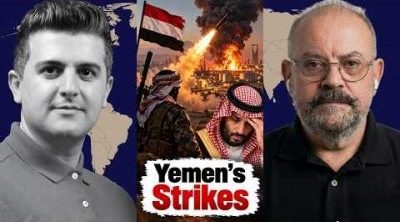
Elijah Magnier: Yemen’s strikes are shattering Saudi Arabia’s long-term strategy
or go to
Aletho News Archives – Video-Images
From the Archives
British weapons and personnel doing much of the killing in Yemen
Press TV – June 18, 2019
A detailed report published by the Guardian newspaper has shown how Britain is massively contributing to Saudi Arabia’s devastating war on Yemen as it suggests that London is not only supplying the bombs that fall on Yemenis, but it provides the personnel and expertise that keep the war going.
The comprehensive report by Arron Merat published on Tuesday showed that Britain was doing much of the killing in Yemen as the country continues to provide Saudi Arabia with everything it needs to turn its southern impoverished neighbor into a graveyard.
“Every day Yemen is hit by British bombs – dropped by British planes that are flown by British-trained pilots and maintained and prepared inside Saudi Arabia by thousands of British contractors,” said Merat in the report. … continue
Blog Roll
 Aletho News
- Racist Seinfeld Dances for Joy as Bibi Unveils His New Map
- A West Bank War for Netanyahu’s Election Campaign, Could It Backfire?
- Yemen denounces European Parliament’s ‘hypocritical’ push to blacklist Ansarullah
- Qalibaf: UAE’s UN bid aims to ‘clear the runway’ for ‘Greater Israel’, whitewash genocide
- Pakistan reopens Iran border after boosting security: Report
- Why are so many Brazilians voting for Flávio Bolsonaro?
- Democrats Put Anti-Russia Agenda Ahead of American Workers
- Elijah Magnier: Yemen’s Strikes Are Shattering Saudi Arabia’s Long-Term Strategy
- Pentagon designates Chinese cultural centers national security threat
- Israel Demolishes Home Of Lebanese Journalist Whose Viral Film Exposed Pager Attack
- If Americans Knew
- An error has occurred; the feed is probably down. Try again later.
- No Tricks Zone
- Sudden Stratospheric Warming, Powerful El Niño Combination May Lead To Extreme Europe Cold, Energy Crisis!
- Two New Studies Find Thwaites Glacier Melt Cannot Be Driven By Human Activity Or A Warming Ocean
- E-Cars Reduce CO2 Emissions By Only 41% Compared To Internal Combustion Engine Vehicles
- Predictions Made By Renowned Climate Professor Over Past Decades Have Been Proven To Be Poor
- New Study Suggests Large Regions Of The Pacific Ocean Have Been Cooling For The Last 80 Years
- Germany’s Green Energy Debacle: High Energy Costs Force Kahla Porzellan to Close After 182 Years!
- New Study: 50 Years Of The Most Aggressive ‘Net Zero’ Policies Can Only Affect The Global Climate By 0.03°C
- US September “Heat” Was No Record…Many Records Set Decades Ago
- Latest European Green Energy Debacle; Portugal’s Largest Flagship Solar Park Insolvent!
- Green Energy Debacle: German Expert Professor Fritz Vahrenholt Warns Of Severe Economic And Social Consequences

