Iran is not the one using Lebanon as its bargaining chip
By Robert Inlakesh | Al Mayadeen | June 12, 2026
Lebanese President Joseph Aoun has claimed that Iran is “using Lebanon as its bargaining chip.” Not only is this blatantly false, but it also implies that Tehran has something material to gain from including Lebanon in its ceasefire agreement.
Several inflammatory statements have recently been issued by the Lebanese President Joseph Aoun and Prime Minister Nawaf Salam, blaming Iran for “Israel’s” mass murder of Lebanese civilians and its illegal invasion of southern Lebanese lands.
These allegations against Iran are not new. For decades, they have been fabricated by Israeli politicians and Zionist think-tanks such as the Washington Institute for Near East Policy (WINEP). There is, however, a significant difference when such claims are echoed by a Lebanese president and whose government has been instructed to engage in direct talks with an enemy that, within a matter of months, has killed around 3,600 of his country’s citizens and continues to occupy Lebanese territory.
The mere concept of Lebanon’s “bargaining chip” is factually incorrect in Iran’s case. A “bargaining chip” means that Tehran would use Lebanon to its own benefit, which is patently false. If anything, Iran’s demands that “Israel” withdraw from Lebanese territory and cease its bombing campaign are making the prospect of reaching any deal more difficult.
If we focus solely on what would materially benefit Iran, the other demands it has listed – namely guarantees against future aggression, the withdrawal of US forces from the region, the lifting of sanctions, recognition of its control over the Strait of Hormuz, the unfreezing of assets, and compensation – are tangible gains. By contrast, the demand that any ceasefire apply across all fronts, especially the stipulation of a complete Israeli withdrawal from Lebanese territory, offers Iran no direct material benefit. This is a matter of principle rather than self-interest.
One could argue that by insisting on Lebanon’s inclusion in the ceasefire agreement, Iran was seeking to strengthen its standing while demonstrating loyalty to its allies. Yet if this were primarily a strategic or symbolic demand, Tehran could simply have accepted a return to the status quo that “Israel” had imposed on southern Lebanon prior to March 2.
Instead, the demand is that “Israel” no longer be permitted to do what it did following the announcement of the November 27, 2024 ceasefire agreement, which, according to UNIFIL, it violated at least 15,400 times. Iran has been clear that it is not interested in a merely symbolic agreement; it wants credible assurances that “Israel” will cease its bombing and retreat from Lebanese territory.
In reality, there are two reasons these kinds of statements are made – The first being that in the event of an Iranian comprehensive deal that forces the Zionist regime to retreat fully, the Lebanese leadership will lose all its remaining legitimacy. The second reason is that this argument closely mirrors a talking point promoted by US officials.
In 2021, Hezbollah facilitated the transfer of Iranian fuel shipments to Lebanon at a time when the country was experiencing a severe energy crisis. The following year, Tehran also offered additional fuel supplies to Lebanon on a free-of-charge basis. More broadly, Iran has historically provided financial support for a range of Lebanese social initiatives, including welfare programs, assistance to low-income communities, and reconstruction efforts.
Despite the Lebanese leadership that took power in February 2025 adopting a generally adversarial stance toward Hezbollah and Iran, Tehran did not seek to obstruct the formation of the government. In fact, Nawaf Salam and Joseph Aoun came to power in a political context in which Hezbollah and the Amal Movement ultimately chose not to block the process, reportedly in the interest of preserving domestic stability.
Allegations that Iran is responsible for the war are simply outlandish. Iran’s ambassador was declared “persona non-grata”, yet the Lebanese government is now sitting down for direct negotiations with the Israelis. All of the accusations made against Iran are simply nonsensical.
If Joseph Aoun and Nawaf Salam truly believed in Lebanese sovereignty, then they would also expel the US ambassador who represents a government that quite literally greenlights Israeli airstrikes against Lebanon. In this sense, the argument against Iran is not new; it draws on longstanding narratives that have circulated for decades and often lack substantive grounding.
It is often argued that a basic requirement of any ceasefire should be the cessation of hostilities and the withdrawal of forces from occupied territory. In this context, Iranian warnings that further Israeli strikes on Beirut would trigger retaliation came amid heightened tensions ahead of the third round of direct Lebanon–”Israel” negotiations, during which a planned Israeli escalation did not proceed.
For 15 months, diplomacy was given a chance. The result: Israelis are still occupying southern Lebanon, and they continue bombing Lebanese territory, while the US has developed a plan for disarming the Resistance instead.
88 attacks against Palestinian Christians recorded since start of year

MEMO | June 11, 2026
The Religious Freedom Data Centre said on Wednesday that attacks and harassment targeting Palestinian Christians and their religious sites have increased.
The centre documented more than 88 incidents against Christians since the beginning of this year, including 63 cases during the second quarter alone. It said the figures suggest that 2026 could set a new record, surpassing the 181 incidents recorded last year.
According to a report presented in Jerusalem, the violations included spitting incidents, verbal abuse, vandalism of cemeteries, gravestones, statues and crosses, as well as racist graffiti and the desecration of Christian religious sites.
Most of the incidents were concentrated in Jerusalem’s Old City, Mount Zion and the area surrounding the Armenian Patriarchate.
During a conference in Occupied Jerusalem where the report was presented, human rights activists and lawyers criticised the performance of Israeli police in handling complaints submitted by Christians.
Uri Narov, head of the legal department at the Israeli Religious Action Centre, said most cases are closed without results. He noted that 19 out of 25 complaints filed by the centre between 2012 and 2021 were closed for various reasons, including failure to identify suspects or no offense had occurred.
Representatives of Catholic churches also presented a series of attacks targeting religious institutions and church-owned property. These included the toppling of stone crosses, damage to vehicles, and the throwing of stones, eggs and rubbish into monasteries and Christian guesthouses.
Palestinian factions submit response to mediators, reject disarmament proposal

MEMO | June 11, 2026
Palestinian factions have submitted their official response to a revised ceasefire proposal presented by Egyptian, Qatari and Turkish mediators, with attention now turning to Israel’s position on the proposed amendments, Palestinian sources told Quds Press.
According to the sources, the response was delivered on Tuesday after several days of intensive consultations among factions participating in talks in Cairo.
The mediators have reportedly forwarded the Palestinian observations and proposed amendments to the Israeli side and are awaiting a formal response, particularly regarding clauses eight and nine of the proposal, which have emerged as key points of disagreement during the latest round of negotiations.
The sources said discussions remain complex despite continued mediation efforts aimed at bridging differences between the parties.
Negotiations, which began earlier this week in Cairo, have focused on reaching arrangements that could secure broader agreement on the implementation of a ceasefire and the future governance of Gaza.
According to the sources, Israeli Prime Minister Benjamin Netanyahu continues to insist on two central demands: the surrender of weapons held by Palestinian factions and the dismantling of military infrastructure in the Gaza Strip.
The sources said those demands have been rejected by Hamas, the Islamic Jihad Movement and the Popular Front for the Liberation of Palestine.
Palestinian factions informed the mediators that they oppose any agreement requiring the disarmament of resistance groups or the dismantling of their military structures, describing the issue as a fundamental national principle.
The sources said the factions maintained that the question of weapons cannot be separated from the broader issue of the Israeli occupation and should not be addressed independently of a comprehensive political settlement.
US ‘limited war’ strategy against Iran deepens its strategic quagmire as Tehran’s deterrence grows
Press TV – June 11, 2026
In the early hours of Thursday, the US once again attacked southern Iran. The official narratives in Washington are already spinning – surgical strikes, proportionate response, mission accomplished. But beneath the fog of disinformation and the whine of cruise missiles and fighter jets lies a deeper strategic truth.
This was no isolated act of aggression but a calculated move in a long, undeclared, and unprovoked war – one that bears an eerie and unsettling resemblance to the Third Imposed War, which began on February 28 and halted only after the American side blinked first.
Yet this round of military aggression is not a replay of the 40-day war. It is something more insidious, more desperate, and ultimately more fragile.
This time, the American war machine relies on calibrated military pressure, psychological warfare, and controlled escalation to force Iran into a political settlement on American terms – without entering a full-scale war that it no longer appears willing, or able, to sustain.
The 40-day imposed war was fundamentally aimed at weakening, destabilizing, or even collapsing the Islamic Republic itself. By contrast, these limited strikes aim to force Tehran into a political agreement engineered around American strategic demands.
The recent strikes against southern Iranian regions – following weeks of simmering tensions over the Strait of Hormuz and the broader regional confrontation – reveal a critical reality: Washington still wants to pressure Iran, yet desperately seeks to avoid the catastrophic consequences of a full-scale regional war it knows will not turn in its favor.
The American war machine finds itself trapped between multiple dangerous options, none offering a clear path to victory, or even a face-saving exit from this deepening quagmire.
To understand why, we must dissect the anatomy of the latest attacks, decode the psychological warfare that accompanies them, and examine the strategic deadlock that drove Washington to choose what can only be called “the fourth path” – a path leading not to Iranian surrender, but to America’s own strategic exhaustion.
Echoes of the Third Imposed War: The same logic, a different trap
Let us be clear about what happened last night. The enemy’s continued attacks on southern Iran are not random or disorganized acts of violence, but carefully calibrated instruments of coercion. The objective is not necessarily the degradation of Iranian military assets or sending a message, but to force the Islamic Republic of Iran into an agreement crafted in Washington, on Washington’s terms, at Washington’s preferred timing.
The immediate point of comparison is the Third Imposed War, when the US-Israeli coalition launched a full-scale military attack intended to topple the Islamic Republic. The similarity is not superficial. In both cases, the enemy has resorted to military tools as the primary mechanism to force Iran’s political submission. Yet the scale and goals differ sharply.
The latest round of aggression is not – at least not directly – about so-called “regime change.” It is about imposing a specific agreement. The United States does not seek to occupy Iran this time, and it lacks both the appetite and the military capability for that.
Instead, the primary objective is to force Iran to sign on the dotted line: an agreement that would impose unreasonable curbs on Iran’s peaceful nuclear program, restrict its regional influence, and legitimize a new order of American domination.
This strategy is built around short, localized, carefully calibrated attacks designed to increase pressure on Iran without crossing the threshold into full-fledged war. The underlying calculation is that sustained military and psychological pressure may eventually compel Tehran to make concessions that large-scale imposed war could not achieve.
Yet the very adoption of this strategy reveals an important strategic reality: time may no longer be working in America’s favor.
While the Third Imposed War aimed to annihilate the Islamic Republic, the latest attacks aim to chain it. If you cannot destroy your enemy, you try to cage him. And if you try to cage him through limited strikes, you admit that full-scale war is beyond your reach.
The theater of lies: Psychological operations as a weapon
The most striking feature of the latest round of American aggression is not merely the military dimension, but the massive psychological warfare campaign accompanying it.
No analysis of unfolding events would be complete without addressing the torrent of disinformation that preceded, accompanied, and followed the Thursday strikes.
In this regard, the enemy has learned nothing from the previous war. Extensive, intense, and deliberately misleading psychological operations remain an essential component of American warfare, essentially because other options have failed disastrously.
The aggressive, unhinged rhetoric of Donald Trump and senior US officials before the latest strikes – repetitive threats of overwhelming force, contradictory public statements, claims of secret contacts with Iranian officials, and declarations that military objectives had already been achieved – all form part of a broader attempt to shape perceptions rather than battlefield realities.
Before the latest strikes, Trump and his War Secretary Pete Hegseth adopted an angry, harsh, and openly threatening tone, designed not just to intimidate Tehran but to shape domestic American opinion. Then came the glaring contradictions.
Trump claimed – falsely, as Iranian officials immediately made clear – that Iranian officials had contacted him to beg for an end to the war. No such contact occurred. He claimed the confrontation had achieved all its military objectives – a standard refrain after every US strike, from Vietnam to Syria. And as always, Washington denied any enemy losses, despite mounting evidence to the contrary.
These are not minor rhetorical flourishes but deliberate tactics of deception and lies, strikingly similar to American psychological methods during the Third Imposed War.
The goal is twofold: first, to create an illusion of American invincibility and Iranian desperation; second, to muddy the information environment so that independent assessment becomes impossible. If you cannot win the actual war, you try to win the story.
But here is the irony: these attacks have become so routine, so hyperbolic, that they no longer deceive anyone with strategic awareness. The Iranian leadership and public have seen it many times before. When every US attack is declared a complete success, the term loses all meaning. And when every Iranian response is dismissed as negligible, the enemy blinds itself to the asymmetric retaliation that inevitably follows.
Why limited confrontation? The ‘Fourth Path’ emerges
This brings us to the heart of the matter. Why would the United States choose a limited, localized, short-term military confrontation, knowing full well that Iran has demonstrated, repeatedly and powerfully, its ability to respond with devastating effect against enemy bases and interests across the region? The answer lies in a strategic calculus of desperation.
The US war machine faces a classic deadlock, left with four options – none of which work well for it.
Option one is full-scale war. The Pentagon’s own war games consistently show that a comprehensive war with Iran would be catastrophic: hundreds of billions of dollars, thousands of casualties, regional conflagration, global oil shocks, and no guarantee of regime change. This option is effectively suicide for any American administration.
Option two is accepting an agreement on Iran’s conditions. This is politically impossible for Washington. After decades of “maximum pressure” policy, to suddenly accept Tehran’s terms would be a humiliating defeat, signaling the irreversible collapse of American deterrence from the Persian Gulf to the Pacific.
Option three is to continue the status quo. That means Iran maintains its de facto control over the Strait of Hormuz, maritime blockades persist, and the region simmers in perpetual low-intensity war. For the United States, this is also a form of slow-motion suicide – a steady erosion of whatever remains of its credibility, economic leverage, and military prestige.
Option four is limited, localized, non-comprehensive confrontation. This is what we saw last night and the night before. A strike here, a retaliation there. Manageable escalation and plausible deniability. The hope is that through calibrated violence, Iran can be coerced into accepting an agreement it has already rejected at the negotiating table.
The fact that Washington has chosen “option four” is, paradoxically, a confession of its weakness. It proves three things beyond a reasonable doubt. First, time is working against the United States. Iran’s steady and significant nuclear progress, growing regional alliances, and strategic patience are outlasting American attention spans.
Second, another full-scale war is not a desirable option for a host of reasons – economic, military, political, and reputational. Third, and most critically, the current draft understanding for ending the imposed war clearly favors Iran.
Tehran has already extracted concessions on sanctions, inspections, and regional architecture. The agreement, as currently being framed, is unacceptable to Washington. Hence the resort to reckless violence.
Asymmetric responses and Iran’s untapped leverage
But here is the fatal flaw in America’s “fourth path.” The entire strategy rests on a single, fragile assumption, which is that Iran will respond in predictable, proportionate, and non-escalatory ways. History – including the recent past – suggests otherwise.
Iran has already demonstrated, in previous confrontations, that its responses can be unpredictable, asymmetric, and devastatingly effective. When the enemy’s risk increases, when even a “limited” operation invites a response that burns bigger than the attack, then this fourth option rapidly becomes ineffective, invalid, and useless.
Consider what Iran has not yet done and could do anytime in the future. Withdrawal from the Non-Proliferation Treaty (NPT) remains an option on the table. So does the intensification of conditions for ending the imposed war – demands that could include full lifting of all sanctions, binding guarantees against future attacks, and even compensation for damages. These are strategic levers that Tehran has deliberately kept in reserve.
Moreover, Iran has established a new rule in regional equations: the enemy front is now viewed as unified, and the Resistance Front is equally unified. The enemy understands that investing in limited confrontation may not only fail to produce the desired outcome, but it could, under this new equation, leave the American side in a far worse position than before.
Every strike against Iran is now met with coordinated responses from Tehran, Baghdad, Sana’a, and Beirut. The days of isolated retaliation and strategic restraint are over.
The exhaustion of American options
Let us step back and assess the broader arc. Iran has been remarkably successful in discrediting the enemy’s threats, one by one.
War? It faced two imposed wars in less than a year and emerged stronger each time. Sanctions? The crippling “maximum pressure” campaign failed to bring Iran to its knees. Blockade? Iran continues to control the Strait of Hormuz despite US maritime banditry. The enemy’s options are exhausted. They no longer possess their former effectiveness.
And now, even the limited confrontation option is showing signs of fragility. If the enemy intends to continue the unhinged behavior that it showed last night and if Washington still places hope in this equation, then it is deluding itself.
Asymmetric responses will now become even more critical. Unexpected and unpredictable Iranian behavior regarding the agreement could alter the equation overnight. Iran still possesses many options it has not yet acted upon.
So the fourth path is a path to nowhere. It is the choice of a power that cannot go forward, cannot go back, and cannot stand still. The US military is striking Iran now because it has run out of good options. But a bad option repeated only gets worse. And when Iran’s unpredictable responses raise the risk beyond tolerance, even this final gambit will collapse.
Then Washington will face the question it has been avoiding: accept an agreement on Iran’s terms, or admit that the era of military coercion in the Persian Gulf is over. Either way, the Islamic Republic is still calling the shots – and the enemy’s arsenal of threats is empty.
Arab Powers Mull Regional Security Alliance – Jordan’s Ex-Minister
Sputnik – 11.06.2026
Some countries in the Middle East are advancing proposals to forge a regional alliance involving Jordan, Egypt, Saudi Arabia, and Qatar, aimed at preventing further regional turmoil, Jordan’s former Minister of Social Development and political science professor Amin Al-Mashaqba tells Sputnik.
The goal of such an alliance would be to strengthen collective security and increase the level of self-reliance among Arab states after “the failure of US security guarantees for the Gulf countries.”
Jordan maintains constant contacts with the US, continuing its effort to safeguard regional peace, he says.
“Relations between Jordan and the Gulf states have deep historical roots, but current challenges require a higher level of Arab coordination and security cooperation,” Al-Mashaqba notes, adding that the country, along with Egypt, Saudi Arabia, Qatar, and Turkiye, “attempted to prevent” the US-Israeli strikes on Iran.
The “key problem,” lies in Israel’s policy, which seeks to keep the region in a state of ongoing conflict and achieve its “expansionist and religious-ideological goals,” Al-Mashaqba says.
The continuation of current Israeli policies could jeopardize the future of peace agreements between Israel and Arab states, he concludes.
A New Economic Front: Yemen’s Entrance to Regional War against US-Israeli Alliance
By Robert Inlakesh | The Palestine Chronicle | June 11, 2026
During the Ramadan War earlier this year, Yemen’s Ansarallah’s role was notably limited – a move that is now turning out to have been strategic. The Yemeni Armed Forces now have the potential to tighten the noose of the global economy if the US-Israeli-UAE alliance seeks to escalate its war of aggression regionally.
When the Islamic Republic of Iran imposed a new equation by striking Israeli military targets in response to the bombing of southern Beirut, it did so with a carefully calibrated plan that continued after the initial 15-hour missile exchange. That is being done through the implementation of Yemen’s blockade in the Red Sea.
What has effectively just occurred is the re-imposition of the blockade in support of the Gaza Strip, which was in place until October 8, 2025. Originally, the closure of the consequential sea route – that passes through the Bab al-Mandab Strait and leads up to the Egyptian Suez Canal – was imposed on the Israelis alone. That was before the US and its European allies decided to launch naval campaigns in support of Tel Aviv.
In December of 2023, the US Biden administration launched the failed “Operation Prosperity Guardian”, which cost the American taxpayer roughly $600 million per month alone. Periodically, the intensity of the operations would increase, bringing on greater costs, yet the efforts were just an enormous waste of funds, achieving precisely nothing. During this period, Israel’s Eilat Port went bankrupt and economic strain destroyed countless Israeli businesses.
Fast forward to March of 2025, US President Donald Trump decided to step things up a notch and initiated “Operation Rough Rider” against Yemen. The Trump administration pledged to destroy Ansarallah, using B-2 Bombers to target sites believed to be storing missiles and drones – which failed to properly penetrate the bases. In the first three weeks alone, the US had spent a minimum of over $1 billion on the embarrassing operation, which was solely launched for Israeli interests. By the end of it, including equipment losses/damage, the cost was in the billions.
Yemen’s Ansarallah established an equation whereby they could strike Tel Aviv with ballistic missiles and drones, while maintaining the blockade, even preventing US ships from passing following their intervention, with the only response being airstrikes on civilian targets.
Due to a clear lack of intelligence information on the ground inside Yemen, Israel’s occasional strikes on Yemen eventually became too much of a logistical nightmare to continuously conduct. They had to accept that there was no way to stop the Yemeni Armed Forces.
Following the US-Israeli attack on Iran on February 28, Ansarallah was expected to play a much larger role in the conflict than it did, only firing a handful of missiles towards Israeli targets. Tel Aviv didn’t even respond to these attacks, as they were overburdened already with fighting both Iran and Hezbollah simultaneously.
It could be argued that the Yemen card was never truly played during the hot war itself. Now that card is on the table. The Strait of Hormuz has been on lockdown since the start of March, the economic fallout of which has not yet been truly felt, but is beginning to take effect. Through Ansarallah’s new step, reimposing its blockade on Israeli shipping, another lever has been turned.
If the war continues escalating, it will be simple for Ansarallah to completely close the Bab al-Mandab Strait, meaning that all trade will have to be conducted without the Suez Canal. In order for cargo to reach Europe, it will have to go all the way around the African continent instead. This will mean economic devastation if the situation is not quickly reversed.
What is perhaps the most troubling part for the US Trump administration and its allies is that there is absolutely nothing they can do about it militarily. On top of this, the entire world will be feeling the effects of a war launched entirely for Israeli interests, with no real game plan at all, and all because the man in the White House couldn’t summon the strength to tell the Israelis: No!
– Robert Inlakesh is a journalist, writer, and documentary filmmaker. He focuses on the Middle East, specializing in Palestine.
Settlers, sanctions and impunity
By Ramona Wadi | MEMO | June 10, 2026
From 1st January 2008 to 31st December 2025, Israeli settlers killed 61 Palestinians and injured 3,778. The findings of the Independent International Commission of Inquiry on the Occupied Palestinian Territory, including East Jerusalem, and Israel, which partly discusses settler violence, note that “Israeli authorities have consistently acknowledged settler violence as a problem, while promoting structural conditions that enable it.”
The recently published report details the overt nature of Israeli settler violence – the claiming of responsibility for settler attacks on Palestinians as part of the process to ‘Greater Israel’, the unequivocal assertion that attacks are unprovoked, and the indoctrination of settler children by family members and settler organisations. Supporting the entire spectrum of settler-colonial violence is the Israeli government, with Prime Minister Benjamin Netanyahu downplaying the attacks against Palestinians as attributed to “a small group of unruly youth”. The report notes how government settlement expansion policy contributes to settler violence, and provides the framework for settler impunity. Mentioning prominent Israeli ministers and settler leaders, the report states, “They [the officials] have explicitly permitted or condoned settler violence as an instrument to achieve a broader agenda.”
As the UK, France, Canada, Australia, New Zealand and Norway imposed sanctions on networks that collaborate with settler violence in the occupied West Bank, the Commission of Inquiry’s report details the structure that supports settler violence against Palestinians. Reacting to the sanctions, Israel’s Ministry of Foreign Affairs Spokesman Oren Marmorstein declared, “The real essence of these steps is the attempt to impose a political stance regarding the right of Jews to settle in the Land of Israel and concerning the Israeli-Palestinian conflict – camouflaged as measures against violence.”
Of course the decision is political. However, as the report shows, the six countries’ decision to impose sanctions does not even scratch the surface of the politics and policies that support Israel’s settler-colonial expansion. Israel and its institutions have created a protective structure for settler violence, and Marmorstein’s statement illustrates how central settler violence is to completing the process of Greater Israel.
Without settler violence contributing to the forced displacement of the Palestinian people, Israel would have a difficult time maintaining its structure.
The discrepancy, however lies in world leaders’ decision to target entities and individuals rather than Israel itself. For example, the report highlights that the line between settlers and soldiers has blurred since regional brigades were formed and gun licenses were handed out by Israeli National Security Minister Itamar Ben Gvir. Settlers are being given power by Israel’s colonial structure, therefore sanctioning settlers is unlikely to make a difference in halting colonial expansion.
International diplomacy is still viewing Israeli settler-colonialism in manageable sections, and detached from Israel’s expansionist policies.
Targeting settlers with sanctions simply encourages Israel to provide more impunity for those doing its work on the ground, while the Israeli government continues with settlement construction.
As the Commission of Inquiry’s report shows, Israel cannot be discussed separately from settler violence. Sanctions, therefore, need to appropriately target the colonial framework itself, which would then have an impact on the settler-colonial society in its entirety.
Christian village in occupied West Bank goes up in flames after large-scale attack by Israeli settlers
The Cradle | June 10, 2026
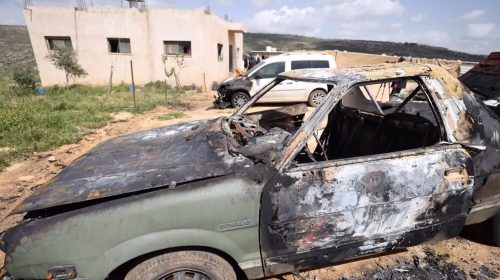
On June 9, extremist Israeli settler groups launched a coordinated arson attack on the historic Christian village of Taybeh in the occupied West Bank, torching agricultural fields east of Ramallah as part of a systematic campaign of ethnic cleansing.
The violence against the 3,000-year-old village intensified following the establishment of an illegal settlement outpost in the immediate vicinity, as local residents of Taybeh face persistent encroachment and assaults by Israeli settlers whose stated objective is to seize the area’s rich pastoral lands.
This ongoing attempted annexation has placed the community under significant pressure as it attempts to maintain its agricultural and pastoral way of life under constant violent harassment.
This latest assault follows previous instances of settler-led violence specifically targeting the historic Church of Saint George, a landmark of significant religious and cultural importance within the village.
Despite international attention and the historical status of the site, the campaign of intimidation has continued.
The torching of the fields on Tuesday is a direct hit on the economic and territorial integrity of the village, with the proximity of the illegal Israeli settlement outpost serving as a primary launch point for these repeated incursions.
The Christian Palestinian community now finds itself at the center of an escalating cycle of land seizures and property destruction in the occupied West Bank.
The attack comes as part of a systematic, state-backed campaign of ethnic cleansing, mass displacement, and gradual annexation of occupied Palestinian territories.
It represents a microcosm of the broader settler campaign to render Palestinian territory uninhabitable, marked by the systematic displacement of residents and the destruction and seizure of agricultural resources.
A UN Commission of Inquiry published on Tuesday has concluded that Israeli authorities are directly involved in facilitating settler violence in the occupied West Bank, providing financial and military support within a climate of impunity.
Attacks on Palestinian villages have surged by 130 percent since 2023, according to the report, and frequently involve masked assailants directly shielded by Israeli military forces.
These documented assaults include the abduction and abuse of children and the use of sexual violence to instill fear, and are identified as tools for advancing state policies of territorial annexation and unlawful displacement.
The inquiry describes a “de facto collapse” of the distinction between soldiers and settlers, noting that at least seven Palestinians were killed and 832 injured last year amid near-daily attacks.
On 3 June, Israeli Finance Minister Bezalel Smotrich announced a major illegal settlement project involving the construction of approximately 2,000 houses on seized Palestinian land.
This plan includes 1,006 units near Jerusalem, 920 near Nablus, and 234 near Hebron.
Smotrich, who has held substantial authority over the West Bank Civil Administration since 2023, plainly states that these developments are intended to “establish clear facts on the ground” to prevent the creation of a Palestinian state.
Smotrich’s administrative powers effectively granted him free rein to use the military body governing the occupied territory to accelerate the de facto annexation of the West Bank through calculated land seizures.
Iranian missiles pierced US defense systems, hit 70% of targets: Fars
Al Mayadeen | June 10, 2026
Preliminary data, satellite imagery assessments, and information from Iranian security services point to the success of Iran’s large-scale military operation that was carried out at dawn Wednesday, Fars News Agency reported, citing an informed military source.
According to the source, Iran’s Air and Missile Forces successfully struck 70% of the designated military targets with high precision, adding that long-range ballistic missiles and drones operated by Iran’s armed forces were able to penetrate air defense systems deployed at US military bases in the region.
Iranian missiles and drones also accurately hit their designated targets at the al-Azraq base in Jordan, the Ali al-Salem base in Kuwait, as well as the headquarters of the US Fifth Fleet in Bahrain, the source stated.
Iran retaliates against 21 US-linked targets
Iran’s Islamic Revolution Guard Corps (IRGC) announced early Wednesday that it launched an attack targeting 21 US-linked sites across the region, including the US Fifth Fleet in Bahrain, stressing that the operation was in response to recent American aggression on Iran.
The targets also included a US F-35 fighter jet base in al-Azraq in Jordan, as well as a command and control center at the same facility. Iranian Fars news agency reported that the IRGC used Kheibar Shekan missiles in strikes targeting F-35 hangars in Jordan.
The IRGC added that it had destroyed four high-value targets using long-range solid-fuel missiles and said a US MQ-9 drone was shot down during aerial engagements over Jam in Iran’s southern Bushehr province.
The IRGC warned that continued hostile actions would be met with “more severe and harsher responses,” signaling readiness to expand its military operations if attacks persist.
Pakistan says Israel derailed US–Iran peace deal described as ‘inches away’: Report
The Cradle | June 9, 2026
Diplomatic efforts to finalize a peace agreement between the US and Iran ran into significant delays due to Israeli violations across West Asia, Pakistani government mediators revealed to Anadolu Agency on 9 June.
US President Donald Trump told reporters in New York on Monday that a settlement could be reached in “two or three days,” yet Pakistani mediators say that such an immediate breakthrough is “unlikely.”
While Trump continues to maintain that a peace deal is close at hand, officials in Islamabad stress that the “situation is complex and has entered a sensitive phase” due to persistent Israeli military aggression in southern Lebanon.
According to sources close to the mediation, the two nations were “inches away” from concluding a temporary truce in late May, only for the momentum to be derailed by the “large-scale” Israeli incursion and the annexation of Lebanese territory.
Although a temporary ceasefire in Lebanon was established on 17 April and subsequently extended until early July, Israel has maintained daily violations, including airstrikes and ground incursions.
Pakistani officials have informed Washington that Israel’s actions in both Lebanon and Gaza are the primary obstacle to reaching a final end to the war.
The Iranian leadership has reiterated through diplomatic channels that it will not return to the negotiating table while Israeli strikes persist.
Last week, Pakistani Interior Minister Mohsin Naqvi traveled to Tehran for the fourth time since 28 February to deliver a “special message” to Supreme Leader Mojtaba Khamenei from the Pakistani army chief, Field Marshall Asim Munir.
Pakistan, alongside regional partners such as Qatar, is currently attempting to convince Trump to apply “maximum” pressure on Israel to halt its offensive.
Islamabad has reported receiving a “positive response” from the White House regarding the situation in Lebanon, despite the lack of an immediate cessation of attacks.
Pakistani sources told Anadolu Agency they anticipate a “breakthrough” in efforts to stop the Israeli military attacks “in a few days.”
If a halt to the fighting is achieved and direct communication between Washington and Tehran is restored, mediators believe there are “high” chances of reaching a deal “soon,” noting that the majority of conflicting issues have already been resolved.
However, the officials maintained that “this process cannot be completed within two or three days.”
Israel has continued to strike out on multiple fronts. On Tuesday morning, Israel issued a forced mass displacement order against the southern Lebanese city of Tyre (Sur) for the second time in less than a month.
At least 15 airstrikes hit Tyre on Tuesday morning, killing nine and injuring over two dozen.
Thousands of civilians were forced to flee north, joining the over 1 million already displaced throughout Lebanon.
Since the Israeli invasion of Lebanon began in March, the attacks have so far killed at least 3,666 people and injured over 11,000.
On Monday, Israel also reignited a brutal campaign of collective punishment on Gaza by closing all entry points for humanitarian aid in response to Iranian retaliatory strikes triggered by Israel’s overnight violations in the Lebanese capital of Beirut.
Iran had repeatedly asserted that a strike on the Lebanese capital was an unacceptable red line that should not be crossed.
US strikes cut drinking water to 20,000 in Iran’s Hormozgan province
Press TV – June 10, 2026
The managing director of the Hormozgan Water and Wastewater Company says pre-dawn US strikes have completely destroyed critical water infrastructure in the eastern part of the province, leaving more than 20,000 residents without access to drinking water as summer temperatures soar.
Abdolhamid Hamzehpour told local media Wednesday that American terrorist attacks hit the water supply facilities in Sirik county, targeting the distribution network for the town of Kuhestak and 10 villages in the Bemani district.
Hamzehpour detailed that two concrete reservoirs, with capacities of 500 and 2,000 cubic meters, along with their associated mechanical equipment, were demolished in the strikes. The destruction of the facilities has led to a complete halt in water distribution for the affected areas.
“The enemy has precisely targeted the infrastructure linked to the daily livelihood and health of the people,” Hamzehpour said, describing the act as “flagrant terrorism.”
The outage comes as the region endures peak summer temperatures, with reports that local weather hovers between 45 and 50 degrees Celsius. Officials stated that the area lacks sufficient groundwater reserves to compensate for the loss of the reservoirs, creating a critical situation for the population.
Hamzehpour condemned the loss of water access as a “clear instance of a crime against humanity,” noting that operational teams are on-site but face significant challenges due to the scale of the destruction.
The strikes on Sirik, as well as on the cities of Jask and Qeshm Island in the Strait of Hormuz, occurred in the early hours of Wednesday. They followed Washington’s accusation that Iran downed a US Army Apache helicopter over Persian Gulf waters.
While the United States has stated its strikes targeted military infrastructure, including air defense systems and radar installations near the Strait of Hormuz, provincial Iranian officials maintain that civilian water facilities in Sirik were directly hit.
Hamzehpour confirmed that mobile water tankers have been deployed to the region as an emergency measure. However, he warned that fully restoring the destroyed pumping and storage systems will require “time and extensive technical actions.”
“The deprivation of a large population of people from water in these weather conditions is carried out under the shadow of false claims of humanitarian aid,” Hamzehpour added, according to IRNA.
In response to the acts of aggression, the Islamic Revolution Guards Corps (IRGC) launched a series of drone and missile strikes against US military assets across the region.
In one instance, the IRGC targeted the US Navy’s Fifth Fleet with missile and drone attacks, as part of its broader retaliatory campaign.
Iranian armed forces also carried out strikes against US military facilities in Jordan, Bahrain and Kuwait during the early hours of Wednesday.
Featured Video
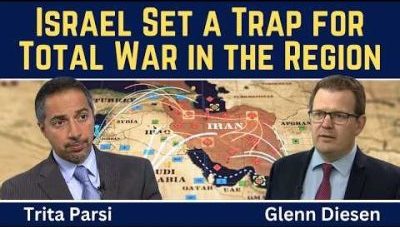
Trita Parsi: Israel Set a Trap for Total War in the Region
or go to
Aletho News Archives – Video-Images
From the Archive
Zionism’s Violent Legacy
By Donald Neff | Washington Report On Middle East Affairs | January 1996
On January 4, 1948, Jewish terrorists drove a truck loaded with explosives into the center of the all Arab city of Jaffa and detonated it, killing 26 and wounding around 100 Palestinian men, women and children.[1] The attack was the work of the Irgun Zvai Leumi – the “National Military Organization,” also known by the Hebrew letters Etzel – the largest Jewish terrorist group in Palestine. The Irgun was headed by Revisionist Zionist Menachem Begin and had been killing and maiming Arabs, Britons and even Jews for the previous ten years in its efforts to establish a Jewish state.
This terror campaign meant that at the core of Revisionist Zionism there existed a philosophical embrace of violence. … continue
Blog Roll
 Aletho News
- Trita Parsi: Israel Set a Trap for Total War in the Region
- Trump’s Iran war is on an Israeli leash
- Saudi oil boss issues global supply warning
- Riyadh Says Its Oil System Is Intact. The Numbers Say Otherwise.
- Trump and Netanyahu Want to “Finish the Job” on Iran
- US ‘one-sided dictation’ not Iran’s beliefs makes rational talks impossible: Baghaei
- Iran’s Next Strike May Not Explode. It Could Shut You Down /Col Doug Macgregor
- Iran: US political targets legitimate if assassinations return
- Iraq shuts key border crossing with Iran under US pressure: Report
- Undersea Internet cables could be targeted in retaliation for attacks on Iran: IRGC deputy chief
- If Americans Knew
- The Israel Lobby’s Changing Fortunes
- AIPAC has become such a political liability that it’s shifting to a more “nimble” approach to buying politicians
- At least 160 Israeli settler attacks in 2 weeks
- Will Gaza’s Ancient Christian Community Disappear Forever?
- Israel’s vision of regional security rests on keeping Arab states weak
- Heidi Levine recounts how Palestinian youths helped save her in settler attack
- DAILY UPDATE: Latest essential news on Palestine, Israel, & region
- Trump’s Intensifying Sabotage of the ICC, for Israel’s Sake
- Israeli military detain US and UK volunteers in West Bank including Democratic NY politician Brad Lander
- Americans at National Conservatism Conference held in Israel this year criticize Israel
- No Tricks Zone
- E-Cars Reduce CO2 Emissions By Only 41% Compared To Internal Combustion Engine Vehicles
- Predictions Made By Renowned Climate Professor Over Past Decades Have Been Proven To Be Poor
- New Study Suggests Large Regions Of The Pacific Ocean Have Been Cooling For The Last 80 Years
- Germany’s Green Energy Debacle: High Energy Costs Force Kahla Porzellan to Close After 182 Years!
- New Study: 50 Years Of The Most Aggressive ‘Net Zero’ Policies Can Only Affect The Global Climate By 0.03°C
- US September “Heat” Was No Record…Many Records Set Decades Ago
- Latest European Green Energy Debacle; Portugal’s Largest Flagship Solar Park Insolvent!
- Green Energy Debacle: German Expert Professor Fritz Vahrenholt Warns Of Severe Economic And Social Consequences
- Two More Paleo Reconstructions Affirm Meters-Higher Sea Levels Across Ireland, Brazil 7000-6000 Years Ago
- New Study: Earth And Venus Surface Warmth Largely Explained By Convection And Lapse Rate, Not CO2 Or Radiation

