Iran deputy FM says MoU with US finalized, to be signed in Geneva on Friday

Press TV – June 14,2026
Iran’s Deputy Foreign Minister for Legal and International Affairs has announced that the memorandum of understanding (MoU) between Iran and the United States has been finalized and will be officially signed on Friday in Switzerland, while also declaring the immediate end of the US naval blockade and the permanent cessation of war on all fronts.
In remarks carried by Iranian media on Sunday, Kazem Gharibabadi confirmed that the text of the Islamabad MoU has been finalized.
“The official signing of the Islamabad memorandum of understanding will take place on Friday in Switzerland,” he said.
“Starting tonight, the US naval blockade against Iran will be terminated,” Gharibabadi added, declaring “the immediate and permanent end of the war and military operations on various fronts, including Lebanon.”
The announcement follows weeks of intensive negotiations mediated by Pakistan, with support from Qatar, Saudi Arabia and Turkey.
The finalization of the MoU brings an end to the US-Israeli war of aggression against Iran, which began on February 28.
With one strike, Netanyahu tries to kill two peace deals
Netanyahu knew exactly what he was doing when he defied Trump’s red line and struck Beirut this morning
By Trita Parsi | June 14, 2026
It’s important to understand that, contrary to Donald Trump’s quip to Barak Ravid that Netanyahu has “no f***ing judgment,” the Israeli Prime Minister knows exactly what he is doing: With a set of strikes at the Dahiyeh neighborhood in Beirut, he is trying to kill both the pending US-Iran peace deal and the fragile peace between Israel and Lebanon that would come with it.
There is a further strategic dividend. Netanyahu is also seeking to preempt Iran’s attempt to establish a new regional deterrence equation—one in which attacks on Beirut, and potentially on Lebanon more broadly, would trigger a direct Iranian response against Israel. By striking now, he is not merely targeting an adversary; he is challenging the emergence of a regional order that would constrain Israel’s freedom of military action.
Netanyahu even posted a video on his Twitter bragging about the attack.
The exchange of fire between Israel and Iran last week was about far more than retaliation. After Israel defied President Trump and struck Beirut’s Dahiyeh neighborhood, Iran responded by attacking Israel directly—the first time Tehran had launched strikes on Israel in response to an Israeli attack on Lebanon. Israel defied Trump once more and retaliated against Iran, prompting another Iranian response, after which Israel confined its next strike to southern Lebanon rather than Beirut.
The cycle reflected Iran’s attempt to establish a new regional equation: that attacks on Lebanon would no longer be cost-free for Israel, but would carry the risk of direct Iranian retaliation. For the first time in decades, a major regional power was seeking to place hard-power constraints on Israel’s freedom of military action beyond its borders.
Having reestablished its own deterrence, Tehran was now attempting to establish extended deterrence to its partners as part of a broader effort to rebuild its forward-defense posture. Israel, unsurprisingly, viewed this as a direct challenge to its long-standing freedom of maneuver and moved quickly to prevent the new doctrine from taking hold.
Of course, extended deterrence can not be established through a single exchange of fire. At a minimum, it would require several rounds of action and reaction before either side accepted it as a new reality. And even then, it would never be foolproof. Tehran understands that its purpose cannot simply be to eliminate Israeli strikes on Lebanon, but to force Israeli leaders to think twice before authorizing them by attaching a new and significant cost: the likelihood of direct Iranian retaliation.
It was therefore clear that Netanyahu had not abandoned the fight. Yet for several days, even as Hezbollah and Israel continued to exchange fire, he refrained from striking Beirut’s southern suburbs and testing Iran’s new red line.
But today, just hours before President Trump was expecting Iran to sign a memorandum that would end the U.S.-Iran war and reopen the Strait of Hormuz, Netanyahu crossed both Tehran’s and Trump’s red line: keeping Beirut out of the conflict.
Netanyahu clearly timed this for maximum impact. With a single set of strikes, Netanyahu may have advanced two goals at once—torpedoing Trump’s peace deal and preventing the emergence of a new deterrence equation that would impose meaningful constraints on Israel’s military operations in Lebanon.
A diplomat involved in the talks told Fox News that: “This is a clear attempt by Israel to sabotage the President’s deal and drag the United States back into war.”
Trump, meanwhile, is once again reportedly “pissed off” at Netanyahu. In a Truth Social post, the president declared that the strike on Beirut “should not have happened,” while pointedly questioning whether it was a proportionate response to Hezbollah’s latest attack on Israel.
“Israel has the right to defend itself against threats,” Trump wrote, “but the attack it was responding to was very small and meaningless. Nobody was hurt, injured, or killed, and it should not disrupt this important process.”
The statement was notable not merely for its criticism of Netanyahu, but for what it implied: that Israel’s strike was neither militarily necessary nor diplomatically prudent at a moment when a potential breakthrough with Iran appeared within reach.
Washington is frustrated by Tehran’s insistence that Trump rein in Israel, even as American officials believe Iran has failed to similarly restrain Hezbollah. It is equally frustrated that a deal it urgently wants with Iran is now being held hostage by Israel, ironically at the request of the Iranians, since it is Tehran that insists that any ceasefire must be region-wide and prevent Israel from having the ability to restart the war.
That frustration is understandable. But Washington must also recognize a basic reality: the only way to delink a U.S.-Iran agreement from the Israel-Lebanon conflict is to delink the United States itself from Israel’s recurring resort to military escalation.
As long as Israel retains the capacity to drag the United States back into conflict, Tehran will see little reason to separate diplomacy with Washington from the wars Israel chooses to start and pull the US into.
Indeed, the principal reason Tehran insists on a region-wide ceasefire is to deny Israel the ability to draw the United States into yet another war with Iran itself.
If Trump were to clearly establish that the United States would neither participate in nor defend an unjustified Israeli military escalation, Tehran might no longer see the need to link a U.S.-Iran accord to the Israel-Lebanon front.
Such a calculated distancing from Israel would serve American interests in any case. But the need for it has rarely been more apparent than it is today.
Iran warns ‘no point’ in deal with US if Israel remains unrestrained
The Cradle | June 14, 2026
Iran’s Parliament Speaker Mohammad Bagher Ghalibaf warned in a statement on 14 June that there is “no point” in continuing efforts to reach a deal with Washington if Tel Aviv remains unrestrained, a few hours after a new Israeli attack on Lebanon’s capital.
“The Zionists’ aggression against the southern suburb [of Beirut] once again demonstrated that the US either lacks the will to uphold its commitments or lacks the ability to do so,” Ghalibaf said.
“You cannot gain concessions by giving the [Israeli] regime a green light. The ‘good cop, bad cop’ game has grown old. If you lack the will and the ability to fulfill your commitments, then there is no point in speaking about continuing down this path,” the parliament speaker added.
Meanwhile, Brigadier General Mohammad Jafar Asadi, deputy commander and deputy inspector of the Iranian military’s Khatam al-Anbiya Central Headquarters, said Israel’s attack on Beirut’s southern suburb will not go unanswered.
“If you seek an agreement or understanding, you must discipline the Zionist regime. If this rabid dog is not controlled, it will bite your leg before the ink is dry on the agreement,” said Ebrahim Rezaei, spokesperson for the Iranian parliament’s Foreign Policy and National Security Committee.
The latest Israeli airstrike on the Lebanese capital took place earlier on Sunday afternoon. The attack hit a building in the southern suburb’s Ghobeiry area.
According to the Lebanese Civil Defense, three people were killed and six others injured.
The Israeli army claimed it bombed a “command center belonging to the Hezbollah terrorist organization in Beirut.”
“The targeted command center was being used by Hezbollah operatives to advance terrorist plans against the citizens of the State of Israel,” the Israeli military added, calling its deadly attack on Beirut a “precise strike.”
The new attack on Beirut coincides with intensive Pakistani mediation to secure a Memorandum of Understanding (MoU) between the US and Iran.
Among Tehran’s terms is a full ceasefire in Lebanon and an end to Israel’s wars, attacks, and occupation across the region.
Following an Israeli attack on Beirut earlier this month, Iran carried out a ballistic missile attack on an Israeli air base and vowed harsher retaliation in response to any new attacks on the Lebanese capital.
The Crusades – colliding narratives
Ashes of Pompeii | June 13, 2026
They say history is written by the victors, but the Crusades offer an interesting historical contrast: a two-century collision that produced not one history, but two parallel, irreconcilable realities. The dates and the battles are identical in both accounts, but the moral axis is entirely flipped.
In the traditional Western narrative, the Crusades are framed as a heroic, if tragic, epic. The First Crusade is a pious pilgrimage; the knights are romanticized figures of chivalry in shining armor, bravely holding the line in a hostile, exotic land. The eventual loss of the Holy Land is mourned as the “fall of Outremer,” a tragic retreat of European civilization. In this telling, the East is often reduced to a passive backdrop, its inhabitants viewed through a lens of mystique or backwardness, mere obstacles to a divine mandate.
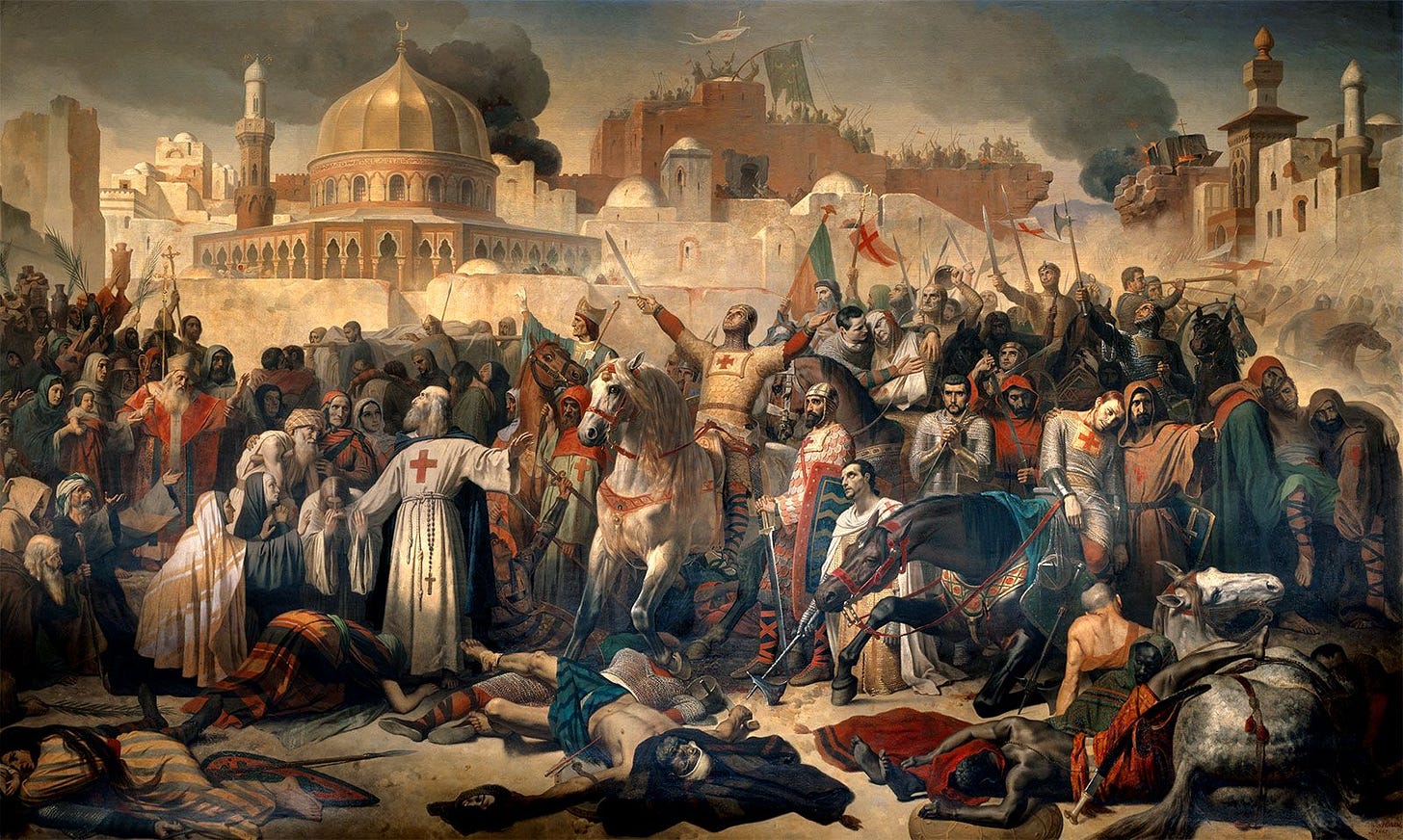
But cross the Mediterranean, and the exact same timeline reads like a chronicle of foreign invasion and eventual, hard-won restoration against the barbarous northerners. The dates do not change, but the adjectives do. Here is the history as it is remembered in the Levant:
When the Frankish armies breached Jerusalem in 1099, they imposed a martial culture utterly alien to the region. Accustomed to northern forests, the crusaders relied on heavy wool, salted provisions, and isolated stone keeps. To the local Muslim inhabitants, this was a stark contrast to a society built around sun-washed courtyards, communal public baths, and markets vibrant with fresh flatbreads, olives, and citrus. The invaders carved out the fragile states of Outremer, but beneath their rule, the region’s sophisticated urban rhythms, complete with organized hospitals and regulated water systems, quietly endured.
For much of the twelfth century, an uneasy coexistence defined the borderlands. The crusader hold was always tenuous, a reality first exposed in 1144 when Imad ad-Din Zengi reclaimed the County of Edessa, shattering the myth of Frankish invincibility. In the decades that followed, daily life became a complex tapestry of friction and exchange. Frankish knights governed from damp, drafty fortresses, yet they increasingly depended on local markets for sugar, glass, and silk. Truces allowed merchants to cross lines, but the cultural divide remained visible: while the crusader elite often struggled with Levantine heat and basic sanitation, local communities maintained their traditions of regular ablutions, scholarly study in madrasas, and shared, herb-rich meals.
The political tide turned decisively in 1187. At the Horns of Hattin, the fragmented crusader armies were outmaneuvered, leading to Salah ad-Din’s recapture of Jerusalem. For the local population, this was not merely a military victory, but a restoration of civic order. Mosques and “bimaristans” (hospitals) reopened, and the region’s administrative heartbeat resumed. Though the Third Crusade saw Richard the Lionheart besiege Acre, he could not retake the holy city. The ensuing century of negotiated truces only highlighted the resilience of local society, which continued to thrive on its established foundations of public hygiene and civic welfare.

By the mid-thirteenth century, the crusader presence was a relic waiting to be cleared. After the newly established Mamluk dynasty halted the Mongol advance at Ain Jalut in 1260, securing the region’s eastern flank, they turned their disciplined, centralized power toward the coastline. Sultan Baybars initiated a systematic dismantling of the crusader strongholds. Antioch fell in 1268, and the formidable fortress of Krak des Chevaliers surrendered in 1271. The contrast was laid bare: as crusader outposts decayed into isolated, supply-starved enclaves, Mamluk cities flourished, repairing irrigation canals and expanding vibrant, clean urban centers.
The end came methodically. In 1291, Mamluk forces besieged and captured Acre, the last major crusader capital, driving the remaining defenders into the sea. A final, tiny garrison clinging to the island of Arwad was swept away by the Mamluk navy in 1302, erasing the last physical foothold of the crusades.
The crusaders left behind crumbling, hollow castles, silent monuments to a foreign experiment. Yet, the echoes of that era have never truly faded. Today, the very same soil remains a stage for competing historical claims, where distant powers still invoke ancient rights and civilizational mandates to justify their presence.
In the West, 1291 is often romanticized as a tragedy of lost glory, recounted in medieval verse and modern films. But in the Levant, it is simply the day the northern barbarians were finally vanquished. For those who still walk these sun-washed streets, it remains a timeless cautionary tale of foreign invaders, resiliance and ultimate redemption.
Trita Parsi: Iran War Ends Today? Threats of Deporting Trita Parsi
Glenn Diesen | June 13, 2026
Trita Parsi discusses the efforts to have him deported for criticising the Iran War, and also comments on Pakistan’s Prime Minister arguing a peace agreement will be signed within the next 24 hours.
Parsi is the co-founder and Executive Vice President of the Quincy Institute for Responsible Statecraft.
Follow the Substack of Trita Parsi: https://tritaparsi.substack.com/
Follow Prof. Glenn Diesen:
- Substack: https://glenndiesen.substack.com/
- X/Twitter: https://x.com/Glenn_Diesen
Patreon:  / glenndiesen
Support the research by Prof. Glenn Diesen:
- PayPal: https://www.paypal.com/paypalme/glenn…
- Buy me a Coffee: buymeacoffee.com/gdieseng
- Go Fund Me: https://gofund.me/09ea012f
The strategic arsenal US lost in war against Iran – and why replenishment will take years
By Mohammad Molaei | Press TV | June 13, 2026
The sheer scale of munitions consumed during the Third Imposed War is without modern precedent in American warfare. As reported by The New York Times, within just the first two days of the military aggression that began on February 28, an estimated $5.6 billion worth of precision-guided munitions were expended, a sum that exceeds the annual military budgets of most countries in the world.
Over the full 40-day war leading up to the fragile ceasefire in early April, US forces struck more than 13,000 targets, many of which required multiple munitions each. According to the Center for Strategic and International Studies (CSIS), the cost of the air campaign alone reached between $11.3 billion in its first six days and $16.5 billion by day twelve.
The total cost over 40 days of full-scale military aggression, followed by subsequent hostilities in the Persian Gulf region, amounts to a far greater sum. While the Pentagon has estimated the figure at around $25 billion, independent assessments place the cost closer to $100 billion.
These figures do not reflect a campaign defined by restraint or resource discipline. Rather, they reveal a military establishment that bet its most advanced precision arsenal on a war it expected to win quickly – only to find itself mired in a quagmire of its own making.
JASSM-ER: Draining the Pacific’s first line of strike
No single weapons system reveals the strategic recklessness of so-called “Operation Epic Fury” more precisely than the AGM-158B Joint Air-to-Surface Standoff Missile Extended Range, known in Pentagon parlance as the JASSM-ER.
This is not a conventional cruise missile. It is a stealthy, air-launched precision strike weapon with a range exceeding 600 miles, purpose-built to penetrate the most sophisticated integrated air defense systems in the world.
Its operational logic is explicitly tied to high-end war scenarios – specifically, a potential confrontation with China in the Western Pacific, where the People’s Liberation Army has constructed the most elaborate anti-access/area-denial architecture in history. The JASSM-ER is the weapon Washington designed for its most serious adversary. And it is largely gone.
At the outset of the war of aggression launched on February 28, the United States held a JASSM-ER inventory of approximately 2,300 missiles. According to Bloomberg, citing a source with direct knowledge of the matter, US forces consumed more than 1,000 JASSM-ERs in the first four weeks of the campaign alone.
The New York Times, drawing on Department of War sources, placed total JASSM-ER expenditure over the full campaign at approximately 1,100 missiles. An additional 47 were fired in a separate operation to abduct Venezuelan President Nicolás Maduro.
The order to drain Pacific stockpiles for the Iran campaign, stripping missiles from US facilities across the continental US and repositioning them to CENTCOM bases and RAF Fairford in the United Kingdom, was issued at the end of March, according to Bloomberg.
The arithmetic is unambiguous and brutal. Of a prewar JASSM-ER inventory of 2,300, approximately 425 remain available for the rest of the world, roughly 18 percent of the prewar total. In the shorter-range baseline JASSM variant, approximately two-thirds of total stocks across both versions were committed to the Iran campaign, according to Bloomberg.
CSIS calculates that around 25 percent of the total combined JASSM inventory was expended in just 40 days of combat.
The unit cost of the JASSM-ER is $1.1 million per missile. The JASSM baseline variant costs $2.6 million per unit at current procurement figures. The roughly 1,100 JASSM-ERs fired in the recent war, therefore, represent approximately $1.2 billion in precision strike munitions, consumed in a campaign that failed to destroy Iran’s ballistic missile infrastructure, did not fracture its command structure, and did not alter the strategic balance in West Asia.
Replenishment will not be swift, as per experts. The US Air Force has procured JASSM variants at an average rate of nearly 500 per year over the past decade, and existing orders in the pipeline mean that JASSM inventories will recover more quickly than other systems; CSIS estimates “several months to a year” for baseline replacement.
However, this timeline assumes no new wars, no additional campaign consumption, and full US Congressional funding of the FY 2027 military procurement request, which has not yet been appropriated.
Tomahawk: A thousand missiles in the 40-day war
The BGM-109 Tomahawk Land Attack Missile (TLAM) is the oldest and most combat-proven precision strike weapon in the US Navy’s inventory, having been used in every major American military operation since Operation Desert Storm in 1991.
Its versatility, fired from surface ships and submarines, capable of loitering and retargeting in flight, with a range of approximately 1,000 miles, makes it the Navy’s primary instrument of long-range power projection.
The war against Iran consumed it on a historically unprecedented scale.
The Washington Post reported that US naval assets fired more than 850 Tomahawks in the first month of the third imposed war. The Wall Street Journal subsequently updated that figure to more than 1,000 over the full pre-ceasefire campaign period.
CSIS’s analysis of the first six days alone identified 319 TLAMs expended, representing approximately 10 percent of the prewar inventory in less than a week.
The prewar Tomahawk inventory stood at approximately 3,200 missiles. The expenditure of over 1,000, therefore, represents roughly 31 percent of the prewar total consumed in 40 days, more than ten times the annual procurement rate.
The Pentagon ordered just 190 new Tomahawks in 2026, a figure barely more than half the number fired in the first six days of the war. The US Navy has requested 785 Tomahawks in the FY 2027 budget, a substantial increase from prior years, but CSIS projects these will not begin arriving in US inventories until March 2030, after 34 months of production lead time.
US Tomahawk inventories will not return to prewar levels until late 2030 at the earliest.
The cost consequences compound the strategic ones. Each Tomahawk Block V costs approximately $1.87 million. The 1,000-plus Tomahawks fired in the recent war, therefore, represent approximately $1.9 billion in naval strike capability, consumed against a country that, at the ceasefire, retained its ballistic missile launch capacity, its underground missile production infrastructure, and its ability to control shipping through the Strait of Hormuz.
The allied dimension of the Tomahawk shortage adds a further layer of strategic damage. Japan, which recently completed modifications on a destroyer to fire TLAMs and had purchased 400 missiles as part of its historic shift toward a more robust conventional deterrent posture against Chinese pressure, has reportedly been told that its deliveries may be delayed indefinitely because the United States must prioritize refilling its own depleted stockpiles.
Australia has also purchased more than 200 Tomahawks, and the Netherlands has purchased 175. All of these allied orders now sit in a queue behind American replenishment needs, weakening the combined deterrent posture of the US alliance network in the Western Pacific at precisely the moment that network is under the greatest pressure.
The defensive arsenal: Patriot, THAAD, and interceptor crisis
While the consumption of offensive strike missiles has drawn significant analytical attention, the depletion of America’s missile defense interceptor inventory may carry even more severe long-term strategic consequences.
These systems, including the much-hyped Patriot PAC-3 MSE, the Terminal High Altitude Area Defense (THAAD), and the Standard Missiles SM-3 and SM-6, are not interchangeable with cheaper alternatives. They are the irreplaceable components of layered missile defense architecture, designed to defeat the ballistic and cruise missile threats posed by peer and near-peer adversaries.
In the Pacific scenario, they are the systems that would need to protect US forward bases, carrier strike groups, and allied territory from Chinese ballistic missile salvos in the opening hours of any war. Instead, they are being consumed in the Persian Gulf.
The Patriot PAC-3 MSE interceptor, at approximately $4 million per unit, was among the most heavily used anti-missile systems in the recent war imposed on Iran.
The New York Times reported that over 1,200 Patriot interceptors were fired during the aggression. CSIS estimates that Patriot usage, combined with the ongoing supply of interceptors to Ukraine, has left prewar PAC-3 inventory at critically reduced levels.
The Army’s FY 2027 budget requests 3,203 Patriot missiles, a procurement figure that reflects the scale of the shortfall, but CSIS projects these will not begin delivery until May 2029, with full replenishment of prewar levels taking three or more years from the present.
Current Patriot production stands at approximately 650 interceptors per year, with roughly half going to allied orders. Lockheed Martin intends to surge production to 2,000 per year, but achieving this capacity requires years of facility and tooling expansion.
In the interim, the United States faces a set of allocation decisions with no good options: prioritize replenishment of its own depleted stocks, continue supplying Ukraine, or fulfill the orders of the 17 other countries that operate the Patriot system and are now watching their own deliveries pushed back indefinitely.
Swiss authorities have already threatened to cancel their Patriot purchase and seek an alternative supplier after being informed of delivery delays. The bilateral friction this production shortfall is generating with allied governments has been explicitly acknowledged by CSIS and represents a tangible erosion of alliance cohesion at a moment of acute strategic uncertainty.
The THAAD situation is, by CSIS’s assessment, the most critical of all. THAAD is the upper-tier component of the US missile defense architecture, designed to intercept ballistic missiles at higher altitudes and longer ranges than Patriot.
Its interceptors are expensive, scarce, and – as of the ongoing fragile ceasefire – severely depleted. CSIS estimates that between 52 and 81 percent of the prewar THAAD interceptor inventory was expended in the recent war and related offensives, building on roughly 150 THAAD interceptors already consumed during the 12-day war in June 2025.
There have been no new deliveries of THAAD interceptors since August 2023. Deliveries are not scheduled to resume until April 2027 at the earliest. The US Army’s FY 2027 budget requests 857 THAAD interceptors, which CSIS projects will not complete the replacement of the usage during the recent war against Iran until the end of calendar year 2029.
Compounding the interceptor shortage is the damage or possible destruction of multiple AN/TPY-2 radar systems – the targeting backbone of THAAD batteries – during Iranian retaliatory strikes on US facilities in the region.
Only 13 AN/TPY-2 radars have been delivered to the United States in total. The loss or degradation of even two or three of these systems represents a qualitative capability gap that cannot be papered over by procurement requests. The US has also maintained only eight THAAD batteries in total, a number that was considered inadequate for simultaneous deployment in multiple theaters even before the war on Iran consumed the interceptors from those batteries at a rate far exceeding production capacity to replace them.
The ship-launched Standard Missiles present a somewhat less acute but still serious picture. CSIS estimates that SM-3 expenditure in the recent war ranged from 31 to 60 percent of prewar inventory, while SM-6 consumption ran between 16 and 32 percent.
Both missiles carry production lead times of 36 to 39 months from contract award to first delivery. Inventories will not return to prewar levels until early 2029 – despite their relatively lower usage in the 40-day war of aggression – reflecting the cumulative effect of years of inadequate procurement before the war began.
The cost ledger: What was spent and what was not gained
The aggregate financial cost of the munitions consumed in the recent war against Iran, calculated from unit costs and reported expenditure figures, represents one of the most expensive failed military campaigns in the history of modern warfare.
The principal expenditures, based on CSIS data and DOD reporting, break down as follows. Over 1,100 JASSM-ER missiles at $1.1 million each account for approximately $1.21 billion. More than 1,000 Tomahawk missiles at $1.87 million each represent approximately $1.87 billion. Over 1,200 Patriot PAC-3 MSE interceptors at $4 million each amount to approximately $4.8 billion. More than 1,000 Precision Strike Missiles and ATACMS, at between $500,000 and $1.5 million each, add a further $500 million to $1.5 billion.
THAAD interceptors, along with SM-3 and SM-6 expenditures, contribute several hundred million more at their respective unit costs. The aggregate munitions cost of the war runs to well in excess of $10 billion, and that figure covers only the missiles, not the operational costs of the platforms that delivered them, the intelligence infrastructure that supported targeting, or the diplomatic capital expended in securing basing and overflight rights.
War Secretary Pete Hegseth himself, in testimony before the US Senate Armed Services Committee, acknowledged that replenishment will take “months and years, depending on the weapon system.” CSIS’s assessment supports that timeline in its conservative form and exceeds it in the more pessimistic analysis.
The combined picture across all seven critical munitions categories is that the US will not return to prewar inventory levels for any of its most critical systems before 2028 at the earliest, with Tomahawk, THAAD, and Patriot taking three or more years from the present.
Building inventories to the levels that war planners have identified as necessary for a high-intensity peer war, levels that were already considered insufficient even before the Iran war, will take additional years beyond that.
The China variable: A window of vulnerability measured in years
The strategic meaning of these numbers transcends the war against Iran in itself. The JASSM-ER was not designed to strike Iranian nuclear facilities but to defeat Chinese integrated air defense systems protecting military targets in the Taiwan Strait and the South China Sea.
The Tomahawk was not stockpiled to prosecute a campaign in the Persian Gulf but maintained as the Navy’s primary instrument of long-range strike in a Western Pacific contingency. The THAAD interceptors depleted over Iranian skies were the same interceptors positioned in South Korea and Guam to defend against North Korean and Chinese ballistic missile threats. They have been moved and their replacements are years away.
Even before the war against Iran, as assessments suggest, US munitions stockpiles were deemed insufficient for a peer competitor fight in the Western Pacific, based on the classified war-gaming conclusions of the House Select Committee on China.
That shortfall is now dramatically more acute. The think tank’s characterization that depleted inventories have created a “window of vulnerability” for a potential Western Pacific war is not alarmist rhetoric but a straightforward arithmetic conclusion drawn from the procurement timelines and inventory figures its researchers have calculated from publicly available budget documents.
The implications for Chinese strategic calculations are substantial and not easily dismissed. Beijing’s military planners have observed, in real time, that the US consumed its primary long-range strike inventory – the very capabilities designed to hold Chinese assets at risk in a Taiwan contingency – in a 40-day war that did not achieve its strategic objectives.
They have observed that the combined JASSM and Tomahawk inventories available for Pacific contingencies are now a fraction of their prewar levels. They have observed that THAAD batteries have been stripped from South Korea – degrading the missile defense coverage of a key US ally on China’s periphery – and that their replacement is years away.
And they have observed that American production capacity, constrained by decades of procurement at peacetime rates and manufacturing lead times measured in years rather than months, cannot rapidly reverse any of these deficits, regardless of how much money US Congress appropriates.
This is not the profile of a deterrent in robust health, but the profile of a military establishment that has consumed its premium, China-specific capabilities in a secondary theater without achieving the decisive outcome that would have justified the expenditure, and that now faces a multi-year period of structural vulnerability during which its ability to credibly threaten the use of force in the Taiwan Strait is materially diminished.
The CSIS report notes with the cautious observation that China is deeply aware it has no recent combat experience, while the US military has been engaged in wars on multiple fronts, and that this experiential differential may preserve deterrence until inventories are restored. This is a thin reed on which to hang the credibility of American extended deterrence across Indo-Pacific.
The deterrent value of operational skill is real, but it is not a substitute for the physical missiles that a deterrent posture requires, and Beijing’s strategic calculus is driven more by inventory mathematics than by assessments of American tactical proficiency.
The production constraint: Why money cannot buy time
The Trump administration has responded to the munitions crisis with a series of framework agreements with major contractors – Lockheed Martin, Raytheon, Boeing – committing to expand production capacity across the full range of critical munitions.
Lockheed Martin has agreed to quadruple THAAD interceptor production capacity from 96 to 400 per year. Raytheon has committed to increasing Tomahawk production to more than 1,000 per year and Patriot MSE output to 2,000 per year.
These are significant capacity targets that, if achieved, would substantially accelerate inventory recovery relative to current baselines.
But capacity is not production, and production agreements are not delivered missiles, according to military experts. The fundamental constraint is not financial but temporal. Manufacturing lead time for advanced missile systems – the period between contract award and first delivery – runs between 34 and 39 months for the most critical systems. Building new production facilities, qualifying new supply chains, training additional skilled labor, and resolving bottlenecks in specialized components such as guidance systems and rocket motors are processes measured in years, not quarters.
The FY 2027 defense budget, even if fully and promptly appropriated by a Congress that has not yet voted on it, will not produce a single additional THAAD interceptor or Tomahawk before 2030. The window of vulnerability is already wide open.
Hegseth’s own assessment before the Senate Armed Services Committee, that replenishment will take “months and years, depending on the weapon system,” represents, in the carefully hedged language of executive branch testimony, an acknowledgment that the US has accepted a period of strategic risk in exchange for a military campaign that did not deliver the outcome its architects promised.
The question that American strategic planners cannot answer to Beijing’s satisfaction is how long that window remains open – and what Beijing’s strategic interests, combined with this window of opportunity, might produce.
EU state lifts arms embargo on Israel after spy scandal
RT | June 12, 2026
Slovenian Prime Minister Janez Jansa has lifted an embargo on arms sales to Israel after allegedly enlisting the help of an Israeli private intelligence firm to oust his left-wing, pro-Palestine predecessor.
Jansa’s government announced the decision on Thursday, adding that it would also overturn an entry ban on Israeli Prime Minister Benjamin Netanyah, National Security Minister Itamar Ben Gvir, and Finance Minister Bezalel Smotrich.
“This will restore the conditions for a normal political dialog with Israel,” the Slovenian Defense Ministry said in a statement, adding that the move would help “strengthen the role of the Republic of Slovenia in the efforts to achieve a lasting peace in the Middle East.”
Former Slovenian Prime Minister Robert Golob barred the export of military goods to Israel and banned the import of goods from illegal Israeli settlements in the West Bank in August. One year earlier, he had recognized the State of Palestine and declared Israel’s war on Gaza to be “genocide.”
Last December, Jansa met with executives from Black Cube, an Israeli private intelligence firm founded by Israel Defense Forces intelligence veterans, whose advisory board includes two former Mossad directors. Three months later, and with parliamentary elections drawing near, covertly-recorded video footage emerged on social media, showing associates of Golob’s Svoboda party discussing corruption within the Slovenian government.
The videos, which Black Cube admitted to filming, weakened Golob’s standing ahead of the election, but Svoboda managed to beat Jansa’s Slovenian Democratic Party by a margin of 0.67%. However, Golob’s coalition lost its majority and was unable to form a government. Jansa, who served three previous stints as Slovenia’s prime minister, built a right-wing coalition and took office last week.
Slovenia’s Intelligence and Security Agency (SOVA) has since determined that Black Cube deliberately attempted to “influence democratic elections” by releasing the videos. “This interference was most likely commissioned from within Slovenia,” the agency concluded, without directly accusing Jansa of hiring the Israeli spies.
While it is unclear whether the Israeli government knew about or officially sanctioned Black Cube’s work in Slovenia, Israeli officials welcomed Jansa’s return to office and reversal of Golob’s policies.
“I commend Slovenian PM Janez Jansa for his swift and just decision to lift the distorted anti-Israeli measures taken by Slovenia’s previous government,” Israeli Foreign Minister Gideon Sa’ar wrote on X on Thursday, hailing Jansa as “a bold leader and a true friend of Israel.”
French watchdog reveals Israeli propaganda firm meddled in New York, Scottish, African elections
The Cradle | June 12, 2026
On 11 June, French disinformation and digital interference watchdog Viginum linked Israeli firm BlackCore to digital influence and propaganda campaigns across Europe, Africa, and the US.
Viginum Chief Marc-Antoine Brillant and French Prime Minister Sebastien Lecornu identified global operations in France, Scotland, Angola, Togo, and New York City.
“Our investigations did not make it possible to identify the sponsor or sponsors, if indeed they exist, behind this foreign digital interference,” Brillant told Reuters.
The report identified BlackCore-linked accounts targeting Scottish First Minister John Swinney, who has described Gaza as a “man-made humanitarian catastrophe.”
Earlier investigations by Viginum revealed that BlackCore had targeted hard-left France Unbowed party candidates in Marseille, Toulouse, and Roubaix using automated accounts and data leaks, as well as fabricated sexual violence allegations against some candidates.
The latest investigations suggest that in the US, the firm allegedly meddled in New York City municipal elections, which were won by Zohran Mamdani, with Brillant confirming the same “modus operandi” from the French campaigns was utilized, though it remains unclear who the specific targets were or who sponsored the operation.
While Mamdani’s victory was received positively by younger progressive members of the Jewish community in New York, traditional pro-Israel backers were unsettled by his outspoken support for Palestine.
Lecornu sought a formal diplomatic explanation from Israel, stating, “I do not doubt for a single instant that if a French private group, from French soil moreover, had engaged in foreign digital interference in Israel, they would have done the same to its ambassador on site.”
Reuters reported that BlackCore removed its entire online presence following inquiries from the news agency. The Israeli firm describes itself as “an elite influence, cyber, and technology company built for the modern era of information warfare.”
In early May, Israel had authorized an unprecedented $730 million propaganda budget for 2026, marking a fourfold increase with the aim of reversing the global decline in public perception following its genocide in Gaza, and the many aggressions towards its surrounding countries that followed.
Israeli Prime Minister Benjamin Netanyahu had designated this narrative offensive as the “Eighth Front” of the Israel’s various wars.
The operation functions as what analysts call a “Digital Iron Dome” designed to suppress dissenting online content through AI-driven surveillance and mass reporting while simultaneously flooding social media platforms with state-sponsored narratives.
Researchers have identified expanding state-backed efforts to shape global discourse through AI, paid influence, and covert campaigns.
In the US, millions of dollars were channeled through entities linked to US President Donald Trump to automate state-engineered narratives on social media and AI platforms like ChatGPT and Claude.
Trump State Department Moves to Deport Trita Parsi
By Kurt Nimmo | Another Day in the Empire | June 12, 2026
President Trump’s State Department has reportedly opened an investigation into Trita Parsi, an Iranian-Swedish international relations writer, political analyst, vice president of the Quincy Institute for Responsible Statecraft, and critic of the administration’s war against Iran.
A Trump official informed the Free Press that US Secretary of State Marco Rubio had been “extremely clear” about his intention to focus on individuals who “support adversaries of the United States” and whose actions allegedly compromise the country’s security. “Anyone who seeks to undermine the US, we’re taking a hard look at,” the official said, while not explaining how Parsi’s analysis of foreign policy constitutes a threat. News reports suggest that US officials are initiating deportation proceedings against several US green-card holders who they believe have expressed sympathy for Iran.
Parsi serves as the executive vice president of the Quincy Institute, a foreign-policy think tank that promotes realism and restraint in foreign policy. “As a research institution we expose the dangerous consequences of an overly militarized American foreign policy,” states an overview of the organization. Personnel include the journalist Jim Lobe, political scientist and international relations scholar John Mearsheimer, and Stephen Walt, a political scientist and professor of international relations at the Harvard Kennedy School, among others.
“The report said that Parsi and his colleagues appear to view the investigation as a ‘serious threat,’” according to the Anadolu Agency, a state-run news agency headquartered in Ankara, Turkey.
In April, Quincy Institute CEO Lora Lumpe informed staff and donors that the organization’s chairman had agreed to fund legal preparations to defend Trita Parsi in the event of a deportation effort, according to a memo. The memo also noted that the institute was in the process of hiring an immigration attorney who had “advised that we immediately prepare a writ of habeas corpus to have at the ready” if Parsi were unexpectedly taken into custody by immigration authorities.
Zionist-centric Free Press Broke Parsi Story
The Trita Parsi investigation was first reported by the Free Press, a media company founded by the iconoclastic Zionist Bari Weiss, a former book review editor at The Wall Street Journal and and an op-ed staff editor and writer on culture and politics at The New York Times. In 2025, Paramount Skydance acquired The Free Press. David Ellison, the CEO of CBS News, installed Weiss as as editor-in-chief of the broadcast news network. Weiss has never managed a television newsroom, never operated foreign bureaus, and is not known to have produced broadcast news content. Paramount has broadcast a number of documentaries and series covering the October 7, 2023 al-Aqsa Flood Gaza breakout.
Paramount Skydance was founded by David Ellison, the son of Larry Ellison, formerly the richest man in the world and a top donor to Israel’s IDF. The elder Ellison is a confidant of Israeli PM Benjamin Netanyahu. According to the journalist Alan Macleod, Ellison’s tech corporation, Oracle, “sees itself as an activist organization, one whose goal is the advancement of the Israeli colonization project.” Oracle began as project of the CIA, “named after Project Oracle, a 1970s CIA operation on which Ellison worked.”
Iranians Targeted for Deportation
Beginning with the illegal and unconstitutional sneak attack on Iran, the Trump administration has increasingly targeted figures of Iranian descent in the US. Hamideh Soleimani Afshar was abducted along with her daughter by masked ICE agents in April. Afshar is the niece of Islamic Revolutionary Guard Corps Major General Qasem Soleimani, who was murdered by Trump prior to a meeting with Iraqi prime minister Adil Abdul-Mahdi in 2020. ICE abducted Afshar and her daughter in California after Secretary of State Marco Rubio revoked their lawful permanent resident status. The State Department said Afshar supported the Iranian government and what it described as its propaganda. It also said Afshar’s husband was barred from entering the United States, according to Reuters.
Rubio and the State Department also terminated the legal status of Fatemeh Ardeshir-Larijani, the daughter of Iranian politician Ali Larijani, and her husband Seyed Kalantar Motamedi. Ali Larijani, the secretary of Iran’s Supreme National Security Council, was killed in an Israeli airstrike in March along with his son Morteza and the head of his office, Alireza Bayat, in Tehran. Iran retaliated by launching a missile barrage at Ramat Gan, east of Tel Aviv.
In January, the National Iranian American Council (NIAC) warned that the Trump administration planned to deport Iranians on a flight from the United States to Iran, the third of such flights. “These deportations come amid mounting evidence of systemic ICE abuses, including wrongful deaths in custody, deplorable conditions in ICE facilities, shootings and arrests of citizens, and the forcible removal of vulnerable individuals with credible fears of reprisal from Iranian authorities,” NIAC said in a press release.
Parsi was the first president and founder of NIAC. The organization has engaged in lobbying efforts in opposition to military conflicts by the United States and has advocated for the cessation of sanctions imposed on Iran. NIAC supported the Joint Comprehensive Plan of Action (JCPOA) agreement between Iran and the United States in 2015. Critics argue the organization is a front for the Iranian government.
The Hoover Institution, a neocon think tank at Stanford University, contends NIAC is a lobby “in all but name” for the Iranian government. “NIAC is alleged to have been created, directly or indirectly, by the Iranian regime’s foreign minister Javad Zarif,” argues Kaveh Shahrooz. In early 2020, Senators Tom Cotton, Ted Cruz, and Mike Braun sent a letter to the Department of Justice urging an investigation into NIAC and its sister organization, NIAC Action. The lawmakers alleged that the groups violated FARA (Foreign Agents Registration Act) by lobbying on behalf of and amplifying propaganda for the Iranian government in the US, according to Cotton’s Senate webpage. Violations of FARA may result in severe criminal penalties, including up to 5 years in prison and fines of up to $250,000, along with civil enforcement actions. Failing to register with FARA, making false statements, or omitting material facts is a felony.
FARA requirements, however, do not apply to the American Israel Public Affairs Committee (AIPAC). Prior to losing the primary in Kentucky, Rep. Thomas Massie introduced the “Americans Insist on Political Agent Clarity Act” or “AIPAC Act,” that would have significantly expanded the scope of FARA, forcing AIPAC to register as a foreign principal under federal law. The Israel lobby spent more than $15.8 million to defeat Massie.
McCarthyism and the Trump Administration
It remains to be seen if Trita Parsi will be abducted by ICE and deported. However, news of Rubio and the Trump State Department’s interest in the vice president of the Quincy Institute for Responsible Statecraft, and a related story put out by a Zionist-controlled propaganda outlet, should serve as a warning to others in opposition to Trump’s Iran quagmire.
Beginning in June of 2025, ICE arrested hundreds of Iranian nationals and has deported dozens. In addition to the Iranians previously mentioned, government data reveals that ICE “conducted a major surge of arrests of Iranians” during the June 2025 war on Iran, with 220 arrests in June, and 80 in July of 2025. 577 Iranians were imprisoned in ICE detention facilities across the United Sates as of May. The oldest of the Iranians in detention as of December was 77 years old, and the youngest was 5 years old, imprisoned in South Texas Family Residential Center in Dilley, Texas.
The crackdown on opposition to Trump’s war, especially in regard to Iranians, many who are permanent residents, is reminiscent of the McCarthy Era, or the Red Scare, in the late 1940s and 1950s. Senator Joseph McCarthy, a Wisconsin Republican, destroyed many careers with blacklists and unsubstantiated investigations. Being accused of leftist sympathies or questioning the political status quo was frequently enough to result in termination. Federal employees, teachers, and university professors were subjected to interrogations, compelled to take loyalty oaths, and subsequently blacklisted. The government used the Immigration and Nationality Act of 1952 (McCarran-Walter Act) and previous ideological exclusion laws to target and deport left-wing individuals, labor organizers, and suspected Communists.
President Trump, due to his narcissism and desire for revenge against political adversaries, may further increase the targeting of Iranians, abducting them while violating their constitutionally guaranteed right to due process. “The administration has sidestepped the courts and the ability of people to defend their rights wherever it can,” notes the Vera Institute of Justice. “The right to due process and fair treatment under the law is guaranteed by the U.S. Constitution to all people in the United States, regardless of where they were born.”
UK judge brands Palestine Action activists ‘terrorists’ for storming Israeli weapons company
Press TV – June 12, 2026
In yet another blatant example of Western complicity with the Zionist regime, a UK judge has ruled that four Palestine Action activists have a “terrorist connection” for storming a British site of the Israeli weapons manufacturer Elbit Systems.
The ruling by Justice Jeremy Johnson was delivered as hundreds of Palestine Action supporters held a demonstration outside Woolwich Crown Court in south-east London on Friday.
Metropolitan Police arrested 107 peaceful protesters who had gathered to support the activists.
In August 2024 — at the height of the Israeli regime’s genocidal war on Gaza — Charlotte Head (30), Samuel Corner (23), Leona Kamio (30), and Fatema Rajwani (21) carried out a courageous direct action at Elbit Systems’ factory near Bristol.
They inflicted approximately £1.2 million in damage to military equipment destined for the occupying Israeli forces, aiming to disrupt the flow of weapons used to slaughter defenseless Palestinian civilians and to pressure for the closure of this Israeli arms factory operating on British soil.
However, the judge declared that the damage “had a terrorist connection” because the activists are linked to Palestine Action, the pro-Palestinian direct-action group that the UK government had proscribed as a “terrorist organization” in July 2025.
Notably, the High Court later ruled this proscription unlawful in February 2026 — a decision the British government is still appealing, while keeping the ban in force.
Under the legislation, even membership in or public support for the group is now a criminal offense in the UK, punishable by up to 14 years in prison.
Because of the judge’s “terrorist connection” ruling, the four activists will be denied normal early release provisions.
Instead, a Parole Board will assess their supposed “risk to the public” before they can be freed.
UN High Commissioner for Human Rights Volker Türk strongly condemned the UK’s misuse of counter-terrorism laws against pro-Palestinian activists, describing it as disproportionate and a threat to fundamental freedoms of expression and assembly.
This case exposes the hypocrisy of the British establishment: it shields Israeli war criminals and their arms suppliers while criminalizing peaceful citizens who dare to resist the machinery of genocide.
True terrorism is the Zionist regime’s daily massacre of Palestinians — not the brave actions taken to stop the weapons flow. The resistance continues.
Report: US military building new base near Gaza border to support post-war plan
MEMO | June 12, 2026
The US military has begun constructing a large base near the Gaza border that is expected to serve as a headquarters for military and civilian personnel involved in implementing President Donald Trump’s Gaza plan, according to a report by the Israeli newspaper Israel Hayom.
The newspaper reported on Wednesday that construction is underway near the Israeli community of Re’im, close to the Gaza Strip.
According to the report, the facility is intended to function as a central command and coordination hub for international organizations, civilian personnel and military forces expected to participate in the implementation of the next phases of Trump’s plan for Gaza.
“We have learned that the US Army has begun constructing a massive base on the Gaza border, not far from Re’im,” the newspaper reported.
Israel Hayom said the new installation is expected to replace the multinational headquarters currently operating from Kiryat Gat in southern Israel.
According to the report, the Kiryat Gat facility previously hosted representatives from more than 24 countries, including several Arab states, who participated in international coordination efforts related to Gaza.
The newspaper said many of those representatives left following the outbreak of the conflict involving Iran earlier this year.
Hamas: Israeli shift of Gaza’s “Yellow Line” constitutes blatant ceasefire violation

Palestinian Information Center – June 12, 2026
GAZA – Hamas spokesperson Hazem Qassem said on Friday that the Israeli military’s movement of the so-called “yellow line” westward in Gaza City, accompanied by shelling and the displacement of Palestinians, represents a blatant violation of the ceasefire agreement.
In a statement, Qassem said the move reflects threats made by the Israeli prime minister to expand Israeli control over parts of the Gaza Strip. He also criticized the silence of the “Peace Council” and its head, Nickolay Miladinov, as well as the inability of mediating and guarantor countries to prevent what he called a new breach of the agreement.
Qassem noted that the developments come amid ongoing negotiations in Cairo and a positive approach by Palestinian factions toward the talks.
He said that the latest actions demonstrate Israel’s unwillingness to implement the ceasefire agreement, accusing it of attempting to derail negotiations, undermine diplomatic efforts, and continue escalation for political and electoral purposes.
Featured Video

Trita Parsi: Israel Set a Trap for Total War in the Region
or go to
Aletho News Archives – Video-Images
From the Archive
Zionism’s Violent Legacy
By Donald Neff | Washington Report On Middle East Affairs | January 1996
On January 4, 1948, Jewish terrorists drove a truck loaded with explosives into the center of the all Arab city of Jaffa and detonated it, killing 26 and wounding around 100 Palestinian men, women and children.[1] The attack was the work of the Irgun Zvai Leumi – the “National Military Organization,” also known by the Hebrew letters Etzel – the largest Jewish terrorist group in Palestine. The Irgun was headed by Revisionist Zionist Menachem Begin and had been killing and maiming Arabs, Britons and even Jews for the previous ten years in its efforts to establish a Jewish state.
This terror campaign meant that at the core of Revisionist Zionism there existed a philosophical embrace of violence. … continue
Blog Roll
 Aletho News
- Trita Parsi: Israel Set a Trap for Total War in the Region
- Trump’s Iran war is on an Israeli leash
- Saudi oil boss issues global supply warning
- Riyadh Says Its Oil System Is Intact. The Numbers Say Otherwise.
- Trump and Netanyahu Want to “Finish the Job” on Iran
- US ‘one-sided dictation’ not Iran’s beliefs makes rational talks impossible: Baghaei
- Iran’s Next Strike May Not Explode. It Could Shut You Down /Col Doug Macgregor
- Iran: US political targets legitimate if assassinations return
- Iraq shuts key border crossing with Iran under US pressure: Report
- Undersea Internet cables could be targeted in retaliation for attacks on Iran: IRGC deputy chief
- If Americans Knew
- The Israel Lobby’s Changing Fortunes
- AIPAC has become such a political liability that it’s shifting to a more “nimble” approach to buying politicians
- At least 160 Israeli settler attacks in 2 weeks
- Will Gaza’s Ancient Christian Community Disappear Forever?
- Israel’s vision of regional security rests on keeping Arab states weak
- Heidi Levine recounts how Palestinian youths helped save her in settler attack
- DAILY UPDATE: Latest essential news on Palestine, Israel, & region
- Trump’s Intensifying Sabotage of the ICC, for Israel’s Sake
- Israeli military detain US and UK volunteers in West Bank including Democratic NY politician Brad Lander
- Americans at National Conservatism Conference held in Israel this year criticize Israel
- No Tricks Zone
- E-Cars Reduce CO2 Emissions By Only 41% Compared To Internal Combustion Engine Vehicles
- Predictions Made By Renowned Climate Professor Over Past Decades Have Been Proven To Be Poor
- New Study Suggests Large Regions Of The Pacific Ocean Have Been Cooling For The Last 80 Years
- Germany’s Green Energy Debacle: High Energy Costs Force Kahla Porzellan to Close After 182 Years!
- New Study: 50 Years Of The Most Aggressive ‘Net Zero’ Policies Can Only Affect The Global Climate By 0.03°C
- US September “Heat” Was No Record…Many Records Set Decades Ago
- Latest European Green Energy Debacle; Portugal’s Largest Flagship Solar Park Insolvent!
- Green Energy Debacle: German Expert Professor Fritz Vahrenholt Warns Of Severe Economic And Social Consequences
- Two More Paleo Reconstructions Affirm Meters-Higher Sea Levels Across Ireland, Brazil 7000-6000 Years Ago
- New Study: Earth And Venus Surface Warmth Largely Explained By Convection And Lapse Rate, Not CO2 Or Radiation

