Russia shows Europe that prolonging the Ukraine war is pointless
By Ahmed Adel | November 2, 2026
Moscow has shown the European Union that continuing the conflict in Ukraine makes little sense, as Norway and Finland suggest the need for a new approach to building relations with Russia, according to Responsible Statecraft. This became clear after the Oslo conference on Ukraine, when the positions of some European leaders visibly softened.
“Finland and Norway’s more moderate language is a crucial first step toward a shared European understanding that continuing the war in its current form is self-defeating,” Responsible Statecraft reported.
The article noted that European efforts to pressure Moscow have failed. Neither Kiev nor its Western allies achieved the desired results, even after attempting to escalate the conflict, the author added.
“Without US intelligence and weapons supplies, Europe lacks the military leverage to continue this effort on its own. There is no viable European war plan, only reactive crisis management and ad hoc solutions about Ukraine, coupled with repeated hyping of Russia’s ‘hybrid war’ threat,” he wrote.
According to the publication, Europe can resolve the situation in Ukraine through diplomacy, but first European leaders must decide whether to support or sabotage US efforts to achieve a diplomatic resolution.
“But first, Europe must decide: will it support or sabotage the US effort to build a diplomatic off-ramp?” Responsible Statecraft added.
On October 20, multilateral negotiations on the Ukrainian agreement were held in Oslo, attended by Ukrainian leader Volodymyr Zelensky, Finnish President Alexander Stubb, Norwegian Prime Minister Jonas Gahr Støre, and US President Trump’s special envoy, Steve Witkoff. The next day, Vladimir Putin and Witkoff met in St. Petersburg. Putin told Witkoff that Moscow was ready to resume trilateral negotiations on Ukraine on November 10. Russian presidential aide Yuri Ushakov said that a new round of trilateral negotiations on the Ukrainian settlement may take place in Abu Dhabi.
During his recent visit to the Norwegian Institute of International Affairs, Stubb reiterated his case for a “value-based realism.” He said European states should uphold their values without settling the conflict by rigidly claiming the moral high ground, and urged the audience to keep “cooler heads,” warning that fostering a “war mentality” would make imagining peace nearly impossible.
Without a geopolitical agreement with Russia, Ukraine faces destruction, a deeper demographic crisis, and an inability to recover economically—creating a serious problem for Europe. Battlefield conditions remain unfavorable for Ukraine as Russian forces continue to advance and Kiev struggles with air-defense shortages.
Russian troops are maintaining pressure along the front and gradually eroding Ukrainian positions, while Ukraine’s manpower shortages have prompted intensified mobilization and further strained society. Inadequate defenses against Russian missiles, glide bombs, and jet-powered drone attacks are already creating a crisis. As winter approaches, cities, infrastructure, and energy facilities are becoming increasingly vulnerable to attack.
Ukraine is expected to face an extremely difficult winter, with shortages of electricity, energy, heat, and water that could trigger a humanitarian emergency. Repeated Russian strikes on the power grid have left large parts of the country exposed to prolonged blackouts, while electricity-dependent heating and water systems risk failing in freezing temperatures. These difficult winter conditions threaten to deepen civilian hardship, accelerate population displacement, and further weaken Ukraine’s capacity to sustain its war effort, but this reality has meant very little to Europe’s insistence on supporting Ukraine “to the very end” and “for as long as it takes.”
Despite mounting domestic problems, much of Europe still backs the futile war effort. Many capitals favor maximalist rhetoric rather than the more pragmatic diplomatic openings Norway and Finland have begun to explore. This stubbornness persists even as European states face economic decline and deindustrialization, lack independent military leverage without US support, and fail to turn sanctions, arms deliveries, and escalation into battlefield gains.
European leaders still frame the conflict in absolute moral terms, while their economies face rising energy costs and mounting debt pressures. Without moving toward the diplomacy opened in Oslo, Europe remains trapped in a cycle that does not shift the battlefield situation in Ukraine’s favor nor enhance European security. The alternative—backing a negotiated settlement that preserves a viable Ukraine while addressing core security concerns—remains open, as Responsible Statecraft stresses, but it requires political will that much of the continent has so far been unwilling to show.
Ukraine still has a chance to avoid the worst outcome by pursuing a peaceful settlement with Russia. Accepting terms would mean ceding part of its territory, but Ukraine would remain a viable state with a real opportunity for economic and political development. The longer the rest of the continent ignores the opening that Norway and Finland have made, the more territory and state capacity Ukraine will lose.
Ahmed Adel is a Cairo-based geopolitics and political economy researcher.
There is cautious optimism about ending the Ukraine War – Part 2
Peace comes in driblets in Ukraine
By M. K. BHADRAKUMAR | Indian Punchline | November 2, 2026
The famous line of Irish poet WB Yeats from the poem The Lake Isle of Innisfree comes to mind: ‘And I shall have some peace there, for peace comes dropping slow…” Yeats was expressing his longing for the peace and tranquility of Innisfree, an uninhabited island in Ireland near which he spent his summers as a child while residing in an urban setting. And that is how Ukraine’s search for peace is meandering – not in a sudden, overwhelming wave; rather, in tiny, quiet increments, much like a gentle rain or a slow leak.
The ‘leak’ by Russia’s presidential aide for foreign policy Yuri Ushakov is no doubt an increment of potentially immense consequence when he told Kremlin’s preferred reporter Pavel Zarubin on Sunday that President Vladimir Putin never refused to speak with Ukrainian President Vladimir Zelensky. Replying to a pointed question whether Putin would answer a call from Zelensky, Ushakov foretold, “I think he would answer, of course. Putin has never refused to talk. He [Zelensky] is sending signals through various sources. If he really wants to negotiate, he is free to come [to Moscow].”
The remark comes within a week of the joint phone call on October 27 by Finland’s President Alexander Stubb and Norwegian Prime Minister Jonas Gahr Støre to Putin during which, per a subsequent disclosure by Ushakov, the Nordic leaders discreetly broached the subject of direct contact between Putin and Zelensky. Zelensky later appreciated their debriefing. This is the first thing. Apparently, Putin repeated the refrain that Zelensky can always visit Moscow and that the Kremlin would ensure his personal safety and security. Now, an addendum, as it were, has appeared for the first time to Putin’s standing offer. Presumably, it was an orchestrated Q&A. This is the first thing.
Secondly, the Kremlin closely studied the commotion in Europe that the two Nordic leaders’ impudent behavior triggered — as if the wolf entered the hay pen. The two Nordic leaders broke ranks. Denmark and Sweden protested they were not consulted. However, the two EU heavyweights — France, Germany – simply looked away, and the super hawkish European Commission (EC) leadership under Ursula von der Leyen and her fiery foreign policy chief Kaja Kallas, were uncharacteristically subdued.
How to explain it? As Guardian newspaper (no friend of Russia or Putin) noted, “The confusion reflects a wider disagreement across Europe over how to approach Putin, even as governments remain broadly united in their support for Ukraine… France has long advocated keeping a channel to Putin open, while Germany and Britain have been more cautious. The Baltic states and Kaja Kallas fear that renewed high-level engagement could ease pressure on Moscow without securing concessions.”
Thirdly, the dissonance is at its loudest when it came to the question of who should lead any European outreach. Von der Leyen insists on nominating someone who will faithfully execute her policy line – in sum, put her in the driving seat. It is excruciatingly painful for Von der Leyen to dismount the high horse she has been riding to demonize Putin and insist Russia can be defeated in the war.
This is the crux of the matter: the EU, with its narrative on the war collapsing, is not able to come up with any peace proposals. Its one-point demand is to have a physical presence at the high table of negotiations. Moscow has said it does not make sense unless the EU has something to bring to the peace table. Trump agrees.
In fact, across the Atlantic no one is paying attention to the acrimony in Europe regarding the seating arrangement at the peace table. The American elites are busy with domestic politics and if at all on the US’ war with Iran. Generally speaking, the Ukraine war has ceased to be a hot button foreign-policy issue among the elites. The ease with which Trump could mothball the Graham Act sanctions on Russia is telling. Zelensky’s support base in the US is also steadily shrinking. In practical terms, it turns out to be the CIA’s war.
Clearly, the trilateral meeting in Abu Dhabi will go ahead without any European participation. Meanwhile, Slovakia says Bratislava will represent itself. The house that Von der Leyen built to centralize all decision-making seems far too fragile as multipolarity gains ground in Europe. This trend can only gather pace as incumbent governments may be replaced in four of the EU’s biggest member states in national elections during 2027 – France, Italy, Poland and Spain. A recent Carnegie paper in mid-September assessed that radical-right parties with Eurosceptic orientation and which are Russia friendly are expected to do well.
The Carnegie paper titled How Europe’s 2027 Elections could Test EU Governance reluctantly admitted that the war in Ukraine “is likely to remain the EU’s most urgent security challenge. Radical-right parties are sharply divided on this issue, but as the cost of the EU’s support for Ukraine rises, resistance in several countries will increase. Locking in the union’s backing for Kyiv through multiannual programs would reduce the risk of a new constellation of political forces putting the union’s commitment to Ukraine in doubt.”
Overall, therefore, the Kremlin’s overture to engage Zelensky in a phone conversation comes not a day too soon. The catch is, Zelensky is a protégé of Britain’s MI6’s but here too, Britain’s ability to sustain the present momentum of the war is increasingly debatable. A BBC report gave a stark warning of “painful and depressing few years ahead” for the British people “after forecasts showed growth in living standards grinding almost to a halt.”
Ushakov’s remark testifies to the suppleness of the Kremlin’s strategy of not being an impediment to peaceful settlement in Ukraine but with no let-up in the frontline. Large scale Russian troop movements, the destruction of bridges over the Dnieper, the focus on Odessa and Kharkov, etc message that in the Kremlin’s estimation, there might be no alternative but to seek a military victory.
In a Substack piece, Gordon Hahn, the US security expert and specialist on Russia, visualised that Moscow may “add to its original demands” by pushing the ante on territorial issues, including the seizure of Kiev (“the mother of all Russian cities”) and Odessa (which Putin calls a Russian city’) – ie., gain control of the territory east of Dnieper (what Russians call the ‘Left Bank’) letting western Ukraine collapse into warlordism.
Ukrainian air alert app hacked with fake nuclear warnings
RT | November 2, 2026
Ukraine’s government-backed mobile air alert app sent out false warnings of nuclear and chemical attacks on Sunday night, Ukrainian media reported.
At around 11pm, the Air Alert app sent notifications urging residents to seek shelter due to a “radiation threat” and a “chemical attack.” It also warned of “street battles” in Kiev.
According to screenshots shared by Ukrainian media, one of the messages read in Russian: “Don’t worry, Oreshnik is coming,” referring to Russia’s nuclear-capable intermediate-range ballistic missile.
The Ukrainian Air Force urged residents to rely only on official sources. “The Air Alert app may have been compromised by hostile actors. There is no radiation threat!” it said in a brief statement on Telegram.
Ukraine’s Digital Transformation Ministry later confirmed that the app had been temporarily disabled following a suspected cyberattack.
According to Russian Telegram news channel Mash, a hacker group calling itself Hitcore claimed responsibility for the intrusion. Mash reported that the hackers said they had tricked an employee of a Ukrainian company into giving them access to his computer.
Although Mash described the hackers as Russian, the group has not previously been linked to any known cyberattacks. Moscow has consistently denied allegations of involvement in such operations.
About three hours later, the Russian Emergencies Ministry said its mobile app had also been hacked and used to send “false information” to users. The ministry said it was working to restore normal operations.
The incident came days after an apparent glitch in Kiev’s automated air alert system on October 26, when air raid warnings were issued and canceled several times within just five minutes. Officials blamed a “technical malfunction” and apologized for the disruption.
Ukraine has stepped up requests for additional air defense interceptors from the US and its European partners in recent months as its own defenses have struggled to counter Russian missile barrages and jet-powered drones.
Relations with Washington have become strained, however, as Kiev has refused to halt strikes on Russian oil refineries, which US President Donald Trump has blamed for soaring fuel prices, and criticized his decision to lift sanctions on Russian diesel exports.
Ukraine was also caught off guard by sudden disruptions to Starlink and Starshield satellite services widely used by its military, which officials in Kiev linked to US efforts to pressure Ukrainian leader Vladimir Zelensky.
Congratulations climate skeptics — you are a ‘Hybrid weapon of war’ and a growing public health threat
By Jo Nova | October 28, 2026
Horrible people want to discuss upper tropospheric warming or their electricity bills and we can’t have that.
Careless discussion of such like, or radiosondes, cannot be permitted. Rest assured, the World Health Organization (the WHO) are here to save you from accidentally hearing any climate debates. Average voters must be shielded from climate disinformation, lest they forget to vote correctly, sorry, I mean, forget to leave burning buildings. Because that could happen to anyone, right?
The WHO (why are we still members) have produced a report titled ‘Protecting Health in the Age of Climate Disinformation’. It is said to be the ‘first instance of the health community addressing how climate disinformation harms’. This follows on from the EU declaring they would crack down on fake news, and conspiracy theories at the last COP meeting in Brazil.
The WHO has hauled out the linguistic artillery. Those who wield “climate disinformation” are not just shills of big oil, they are a “hybrid weapon of war” and a growing “public health threat”. (Don’t you feel important?)
Now obviously, if people are a public health threat, we can’t just let them wander around talking to any unguarded voters can we? Same, same, for those naughty weapons of war. What if people like that got loose on the radio?
It’s seems pretty obvious where they want this to go. You don’t just casually declare your debating opponents are a hybrid weapon of war and shake hands. Right now they are ‘only’ calling for member states to “recognize” climate misinformation as a public health threat. But we all know where this goes. Sooner or later Public Health threats get put in jail or at least a padded cell (for their own good).
At this stage the press release recommends that health agencies strengthen climate-health infodemic management and help governments identify and respond to harmful information narratives.
Perhaps a nice government will just take their computer away, or their digital ID and block them from social media?
The WHO has just effectively admitted that it’s losing the public climate debate — why else would they need to label any dissent as a threat?
‘Hybrid weapon of war’: Why climate disinformation could be a growing public health threat
By Liam Gilliver, EuroNews
“Climate disinformation is not only a problem of false rumours and mistruths; it is also a problem of power, incentives and accountability.”
WHO member states are being urged to recognise climate disinformation as a public health threat as vested interests attempt to “sow doubt and confusion”.
Health and civil society organisations have called on 194 countries to make information integrity a core part of climate and health policy, preparedness and response.
Who decides what is misinformation and what is true?
What is climate disinformation?
Climate disinformation refers to the intentional spread of false or misleading information about climate change and climate action. This includes the complete denial of global warming as well as conspiracy theories. It differs from climate misinformation, which is defined as false or out-of-context information that someone is presenting as fact.
While misinformation does not carry the same level of intent as disinformation, it can result in equally dangerous consequences.
And if the government gets its facts wrong, will they suffer the same consequences?
The harm, the harm!
The WHO highlights the awful harm these hybrid information warmongers can make. For example, when people in the Maui fires heard false claims that the Federal Emergency Management Agency (FEMA) might seize their land, they ‘potentially’ might not apply for a government handout. Some may have missed out on the money! This is translated to: “Misinformation can directly obstruct access to life-saving and stabilizing support.”
Or there was the horrible case of ULEZ traffic cameras in London, where £12 charges were triggered every time they went into London in an old “polluting” car. This, of course, hurt the poor, the old and the workers, but those legitimate concerns were ‘amplified and distorted’ by misinformation (not that anyone can remember what they said that was incorrect). This turned a public health intervention (which could add as much as 13 minutes of life expectancy to Londoners), into a “culture war issue” the WHO says. We just can’t have people disagreeing with government policy can we? What do you think this is — a democracy?
“Instead of focusing debate on how to reduce pollution while protecting those least able to bear transition costs, misinformation can shift attention toward fear, mistrust, and false claims. This risks weakening public support for policies that protect lungs, hearts, pregnancies, children, and communities most exposed to polluted air.”
Other instances of misinformation might “discourage people from evacuating during wildfires or floods”. You know all those times the wall of flames is coming but you’re just not convinced the fire is caused by a coal plant 1,000 kilometers away so you stay home?
I’m sure they only want to neutralize a few newspapers and GB News — that sort of thing.
The WHO is a menace
Any international organization that writes up authoritarian, anti-democratic material like this, designed purely to censor debate, deserves to be unfunded, mocked and disbanded immediately. It’s time to get our money back.
‘The Arab Vote’: How Israeli Racism Has Ruined Their Elections
By Robert Inlakesh | Palestine Chronicle | November 1, 2026
Israeli Prime Minister Benjamin Netanyahu has claimed that Palestinians are responsible for “stealing” the latest round of Israeli elections, in what has been labeled the most consequential race in Tel Aviv’s history. What instead has been revealed is that Israel’s existence is predicated on the idea that democracy should be forbidden.
Palestinian citizens of Israel turned up to vote in historic numbers this past Tuesday, with roughly 80% of eligible ‘Arab voters’ casting their ballots. As a result, they managed to secure 19 seats for Arab Parties in the Israeli Knesset (parliament).
In order for a government to be formed in Israel’s parliamentary system, a coalition must gain at least 61 seats. Currently, Israeli PM Netanyahu’s bloc has 53 seats, while his opposition secured 48.
The opposition, headed by Gadi Eisenkot, ran a campaign based around the idea of forcing Netanyahu from power and argued their case fiercely, with many claiming that Israel’s future depended on this election. When the results emerged, the opposition fell short of the numbers they were projected to hit, according to the pre-election polls and Netanyahu’s bloc managed to secure more seats than expected.
However, the factor of ‘the Arab vote’ changed everything. Because the Palestinian citizens of Israel exercised their ability to vote, an activity that many previously felt to be useless, the opposition bloc on paper has the ability to form a government and oust the longtime Israeli leader. For years, this opposition has mobilized hundreds of thousands of Israelis in mass demonstrations against Netanyahu, and now they have the opportunity to act.
But there is one thing standing in their way: the opposition refuses to work with Arab Parties. Doing so, even if the Israeli opposition sought to do it as a tactical maneuver, would be to commit political suicide. Giving Palestinians a say over any Israeli policy is viewed by the vast majority of Israeli Jews as tantamount to the destruction of their Zionist project.
Israel is Antithetical to Democracy
Israel advertises itself as the “only Democracy in the Middle East”. This is one of its key hasbara talking points, yet when the Israeli society and political leadership get even a whiff of democracy, they seek to ban it.
There’s an obvious elephant in the room that also has to be addressed when discussing the Israeli political system: around 30% of the people living between the River Jordan and the Mediterranean Sea are completely excluded from voting; instead, they are subjected to military rule. On July 18, 2024, the Israeli Knesset unanimously passed a bill that banned the creation of a Palestinian State. The International Court of Justice (ICJ) also ruled that the Israelis have to immediately withdraw from Gaza, the West Bank, and East Jerusalem, yet the Israelis have done the very opposite.
Israeli settlers living in the West Bank are treated the same as their counterparts living in Tel Aviv; they can vote, and every mainstream Israeli politician dubs the territory “Judea and Samaria”, arguing that the territory is the “biblical heartland of Israel”. There are no “peace talks”; they refuse to engage any Palestinian parties and vow never to leave the territories they have seized and illegally settled. In other words, this is not a temporary occupation; it is a de facto annexation of these lands.
The only reason Israel has not declared a de jure annexation of these territories is that it would then face a dilemma, whereby it must kill or violently expel all these Palestinians, but it understands that the conditions to successfully do that have not yet materialized. Not only will it be militarily costly, but neighboring countries are not prepared to open their borders and facilitate it.
If Israel were to give these persecuted people Israeli citizenship, then the result would be that Palestinians would be a majority, while Jews remain a minority. In other words, Palestinians would vote in a government that is truly representative of the population, and the Zionist State, which is built on the concept of Jewish Supremacy, exceptionalism, and exclusivity, would be gone.
Inside what is called “Israel proper” – a term used to exclude the West Bank, Golan Heights, East Jerusalem, and Gaza – the Palestinian citizens of Israel, who are today also referred to as “Arab Israelis”, are roughly 22% of the total population. They are the Palestinians who managed to remain on their lands during the Nakba (1947-9). Their birthrate is already higher than that of their Jewish counterparts. In addition to this, the highest birthrate amongst Jews is that of the Haredim (ultra-Orthodox), who are essentially useless to the Zionist project as they overwhelmingly do not work and refuse to join the army.
In other words, if the Israelis are to continue to allow their Christian and Muslim citizens to vote, then eventually the Jewish citizenry are not going to have the numbers to be able to form an all-Jewish government anymore.
Already, this problem has presented itself in the latest round of elections. A coalition government could easily be formed, but it would include the Arab Parties, who will inevitably demand that various Israeli projects come to a halt. For example, the Israelis have sought to ethnically cleanse the Bedouins of the Naqab (Negev) region, cracking down on them and destroying their homes in order to achieve this. That project of ethnic cleansing and Judaization through the establishment of Jewish settlements would be brought to a halt. There would also likely be resources actually allocated to combating criminal gangs in Palestinian neighborhoods, or funds put into their communities more generally.
All of this is a threat to the Israeli Jewish public and the Israeli Jewish government’s core values. They seek to expand the territory which they currently occupy, to make it more Jewish and less Arab. The last thing they want to see is a government that would help Palestinian Muslims and Christians.
In their irrational racism, the Israelis have made an obvious mistake when approaching this issue. The likes of Itamar Ben Gvir, who used his position as Security Minister to persecute Palestinian citizens of Israel, while rubbing it in their faces and passing racist bills, have now politicized a population that had long been far from political mobilization.
Israel is putting its back against the wall, and because of that we just saw a protest vote, one that sent a powerful message to the Israeli leadership, one that asserts: ‘we are here’. In reaction to this, Israeli settlers began to physically assault Arab voters on election day, as Netanyahu accused them of being part of a Hamas conspiracy, evidently inciting against them.
Now the results of the election are being blamed upon them. In the eyes of the Israelis, the Arabs aren’t supposed to ever have a say; they can vote but have no right to influence any government, nor its decisions. Suddenly, the Israelis felt a little taste of what democracy can bring, and they are advocating removing this right from their Muslim and Christian citizens. A notion that even American Zionist commentators, like Ben Shapiro, have themselves echoed.
Democracy would destroy Israel overnight, because the Jewish settlers are just under half of the population living in occupied Palestine. If there ever were a truly democratic election, the Zionist regime would no longer exist. In order to protect that regime of ethno-supremacy, they must kill and/or expel almost all of the Palestinians, at least doing so until there aren’t enough of them to ever prove a demographic threat ever again.
Now that Netanyahu is blaming the Arab for stealing his election victory, he will continue inciting hatred against them for political gain. Yet, this strategy is short-sighted, as stirring up tensions in this way could result in a domestic uprising, one which could spiral into something much more dangerous for the Zionist regime. In 2021, we got a taste of what could happen if Tel Aviv pushes things too far.
– Robert Inlakesh is a journalist, writer, and documentary filmmaker. He focuses on the Middle East, specializing in Palestine.
Israel forces Palestinians in Gaza to choose between assassination alone or death with their families: Report
The Cradle | November 1, 2026
Israel is reportedly forcing some Palestinians in Gaza, among them resistance fighters and supporters of the resistance, to choose between being assassinated alone or alongside their families, Al-Sharq al-Awsat reported on 1 November.
“They received a call from the occupation giving them a choice between being bombed along with their families or being killed alone,” the paper wrote.
Relatives of activists affiliated with Palestinian resistance factions killed by Israel say they were targeted by Israeli drones while walking alone on side streets or main roads, or while on the rooftops of homes, residential buildings, or shelters where they lived with their families.
In the latest case, an Israeli drone killed a young Palestinian man, Mohammed al-Bayouk, on Wednesday afternoon in central Khan Yunis in southern Gaza.
Bayouk’s relatives stated that before he was assassinated, he received a phone call from an officer of Israel’s General Security Service (Shin Bet) who gave him a choice between being bombed along with his family or going up to the roof of the shelter where they were living to be killed alone.
Bayouk chose to spare his family and went to the roof where a small missile killed him.
One of his aunts suffered serious injuries while chasing after Bayouk to prevent him from leaving the family’s small room in the shelter alone after receiving the call.
Similar assassinations involving advanced phone calls have been reported in Lebanon amid Israel’s war on Hezbollah.
According to sources who spoke to Asharq Al-Awsat, Israel has carried out at least five such killings in Gaza over the past three months.
Israel has also used similar tactics against Palestinian detainees to force them to reveal security information, the sources explained.
Palestinian detainees are threatened with the killing of their relatives if they refuse to provide the information wanted by interrogators.
In some cases, prisoners were shown photographs of their children and relatives after they had been killed to exert psychological pressure on them.
By contrast, Israel continues to kill senior Palestinian leaders and prominent field commanders using multiple missiles and explosive-laden drones while they are among their family members, resulting in the deaths of large numbers of civilians.
Earlier in the genocide, Israel killed over 100 civilians in a single strike to kill a prominent Hamas commander.
The sources said that Israel’s decision to contact lower-level Palestinian fighters and activists before killing them “does not mean that the occupation is showing mercy toward Palestinians or attempting to improve its image before the world.”
They emphasized that many Israeli bombardments continue to kill civilians, including women and children.
Haaretz reported in September that Israel is killing fewer civilians in Gaza due to pressure from the US to avoid collateral damage and to preserve larger bombs dropped by warplanes for attacks on Iran and Lebanon.
As a result, Israel has increasingly used smaller munitions launched from drones.
According to the Israeli paper, this is the reason for the relative decline in civilian deaths from Israeli airstrikes in recent months. Recently, the ratio has been approximately 0.6 civilians killed for every resistance fighter killed, Haaretz claimed.
One source speaking to Asharq al-Awsat disputed the reports, calling them inaccurate.
The source emphasized that recent Israeli airstrikes had killed civilians during attempts to assassinate individuals, while other civilians had been killed as a result of continued indiscriminate bombardment.
US Approves Sale of 500 Patriot Missiles to Ukraine, Deliveries May Take Years
By Kyle Anzalone | The Libertarian Institute | November 1, 2026
The State Department announced it had approved a potential $2.1 billion sale of Patriot missiles to Ukraine. Patriots are the most advanced interceptors available to Ukraine; however, Kiev is dealing with a shortage of Patriots, leading to more Russian missiles hitting Ukrainian cities.
“The US Department of State has made a determination approving a possible Foreign Military Sale to the Government of Ukraine for purchase of PATRIOT Advanced Capability-3 (PAC-3) Missile Segment Enhancement (MSE) missiles, and related equipment,” the statement released on Friday explained. “The estimated total cost is $2.1 billion funded entirely by partners and allies.”
The State Department said Ukraine requested 500 Patriot missiles, and European countries will pay for the interceptors.
Ukrainian President Volodymyr Zelensky has been pleading for a winter package of Patriot missiles. The Ukrainian leader praised the decision to approve the sale of interceptors; however, he called for the timeline to be accelerated.
“A strong decision by the U.S. State Department – authorizing Ukraine’s purchase of Patriot interceptors to counter Russian ballistic missiles. Five hundred PAC-3 interceptors is a substantial number, and very soon – this winter – they COULD make for a highly effective defense package,” he wrote on X. “However, it has been stipulated that deliveries may begin ONLY IN A FEW YEARS.”
Zelensky called on the US to deliver 100 Patriot missiles to Ukraine each month during winter. Washington may not be able to deliver interceptors at that pace, as the wars in Ukraine and the Middle East have depleted US stockpiles.
Zelensky suggested that Washington and its allies could provide Ukraine with interceptors from their existing stockpiles and replace them with newly produced missiles in the coming years.
Last month, Reuters reported that Secretary of War Pete Hegseth had not approved new sales of Patriot interceptors to Ukraine amid concerns about dwindling US stockpiles.
President Donald Trump appears to be positioning the US military in the Middle East for another escalation against Iran. Last week, the Wall Street Journal reported that an additional Patriot missile defense system was deployed to Israel.
Iran has pledged to respond to any US attack with strikes on Israel and US assets across the Middle East.
German Imperialism: An Urgent Explainer
By Kit Klarenberg | Global Delinquents | November 1, 2026
The fate of Central and Eastern Europe after the People’s Democracies’ post-1989 fall cannot be fully appreciated without reference to the EU as an extension of German imperialism. Berlin’s drive to ensure the region remains composed of weak, frequently mutually-resentful microstates has endured for well-over a century. Over time, battlefield conquest and occupation has been supplanted by economic and monetary union, and ever-rising military, security and intelligence “interoperability” and “cooperation”, all conducted under “internationalist” auspices.
Comprehending this process and the consistent needs of German imperialism provides a typically absent, critical lens through which to view events such as Yugoslavia’s destruction, the rise and recent demise of Hungary’s Viktor Orban, and seen and unseen political machinations throughout the Balkans old and new. German imperialism is a potent, dangerous force frequently overlooked due to its nigh-invisible operation. With US global hegemony irreversibly faltering, it is vital to truly understand the phenomenon as it threatens to emerge in its own militarised right again.
Today, German imperialism is little-understood even in countries and regions intimately shaped if not outright created by Berlin’s colonial meddling and concomitant hegemonic expansion. Its historic apotheosis was the 1918 Treaty of Brest-Litovsk. The terms and consequences provide an eerily precise blueprint for the EU’s modern day role as German empire via other means. Despite Brest-Litovsk’s seismic import, mainstream English language accounts are comparatively rare. A highly compelling, informative synthesis is nonetheless provided by Adam Tooze’s much-overlooked 2014 work The Deluge.
Tooze writes of how “Brest gave birth to the precursors to the Baltic states in their modern form,” and an “independent Ukraine” for the very first time in history. Resource-rich territory that over prior centuries comprised much larger dynastic land empires was broken up into easily exploitable chunks. The newly-formed nations, and corresponding nationalisms, spread throughout ethnically, linguistically and religiously diverse swaths of Central and Eastern Europe constituted a formidable stronghold. Self-determination facilitated Germany’s untrammelled economic, military, and political penetration.
Commenting on Eurasia’s 21st century map, Tooze observes how since the Soviet Union’s 1991 dissolution, all Brest-Litovsk’s “creations” have “come to be regarded as legitimate members of the family of nations.” Moreover, states such as the Baltics and Poland then as now “look to protectors in the West,” being “keen members of an American-dominated NATO and the European Union, in which Germany is the dominant force.” Via Brest-Litovsk, “all of these polities fell willy-nilly under the ‘protection’ of Imperial Germany.”
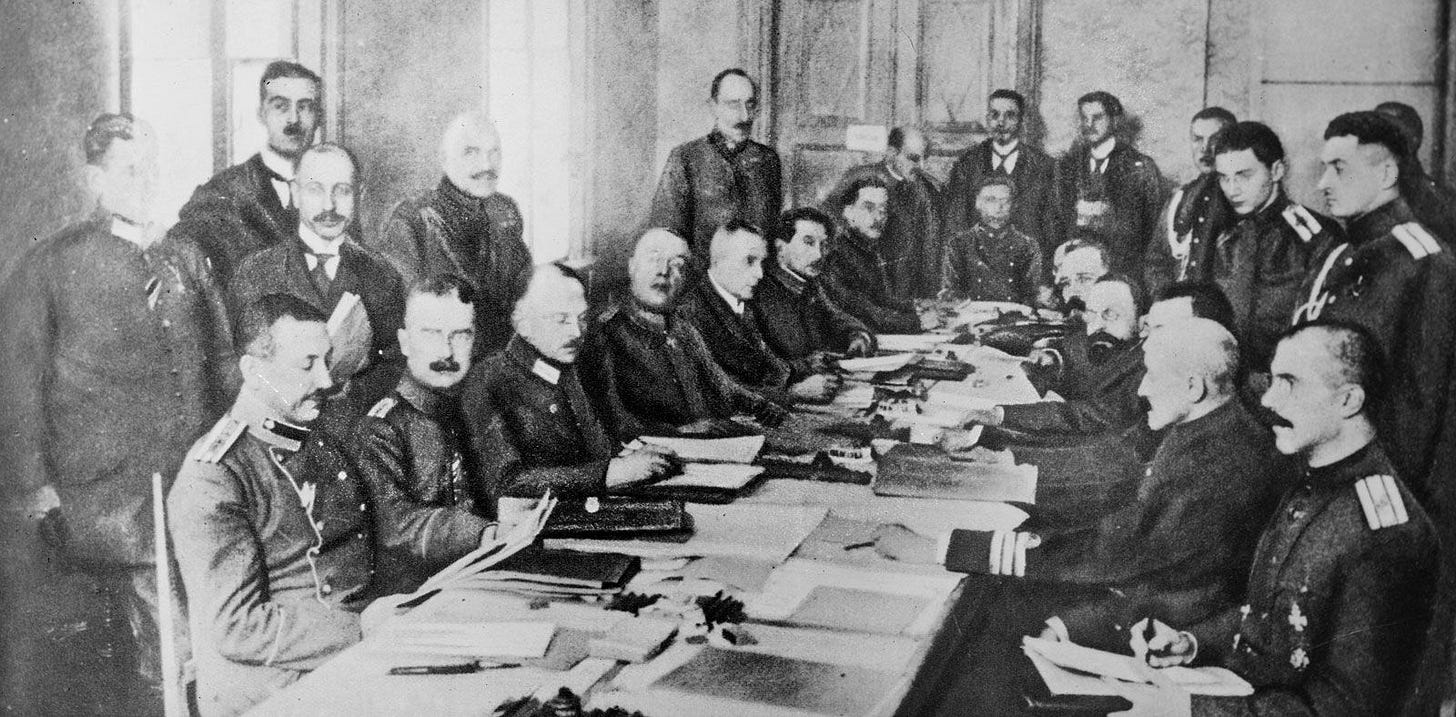
Brest-Litovsk delegates negotiate, early 1918
The Treaty was signed between Moscow and Austro-Hungary, Bulgaria, Germany and the Ottoman Empire in March 1918, following months of tense negotiations produced the previous December by revolutionary Russia signing an armistice with Berlin. At Brest-Litvosk, both sides had advanced their respective visions of “self-determination” for the Central and Eastern European components of the Tsar’s collapsed empire. Vladimir Lenin hoped newly-independent states in the region would be free to turn Bolshevik. Yet, Imperial Germany had no intention of letting that happen.
Instead, the country’s “more intelligent strategic thinkers” realised “there was no better means to dynamite the Tsarist Empire than for Berlin to espouse the demand for self-determination” at Brest-Litovsk. This “manipulative ruse” would allow Germany to extend her hegemony imperceptibly throughout enormously profitable territories. It was “a vision of negotiated sovereignty in which economic and military independence was pooled by smaller states with larger states.” Tooze reports how German imperialists argued “full, unfettered sovereignty” was “always a chimera” – “the real choice was one between hegemons”:
“Germany would secure power on a continental scale not through annexation, but through the formation of an economic and military bloc of smaller Eastern European states… The autonomous Polish entity carved by Germany and Austria out of Russian territory in the autumn of 1916 was a start. While in economic and military terms the new Poland would be bound tightly and irrevocably to Germany, in the social and cultural sphere it would be given the freedom ‘to express itself nationally’.”
‘Military Protection’
From the Central Powers’ perspective, self-determination’s colonial windfall was immense. In territorial terms, Moscow lost control of today’s Belarus, Estonia, Latvia, Lithuania, Poland, and Ukraine. This prime former Tsarist real estate accounted for 34% of the fallen empire’s population, 54% of its industrial land, 89% of its coalfields, and 26% of its railways. Berlin well-knew the regional treasure trove would be hotly contested, and could easily “fall into the orbit of another great power” – “if not Germany or Russia, then Britain”.
Hence, Brest-Litovsk’s terms exclusively allowed for ‘independence’ under formal “German military protection.” This transformed millions of people throughout the region into potential proxy warriors arrayed against Russia, or other major powers threatening Berlin’s local hegemony, in the manner of NATO today. Rapidly collapsing into civil war, with Franco-British intervention to reverse the Revolution impending, the incipient Soviet Union acquiesced to the Treaty’s harsh stipulations. Lenin believed the Bolsheviks would eventually recapture the lost territories, by sheer force of radical gravity.
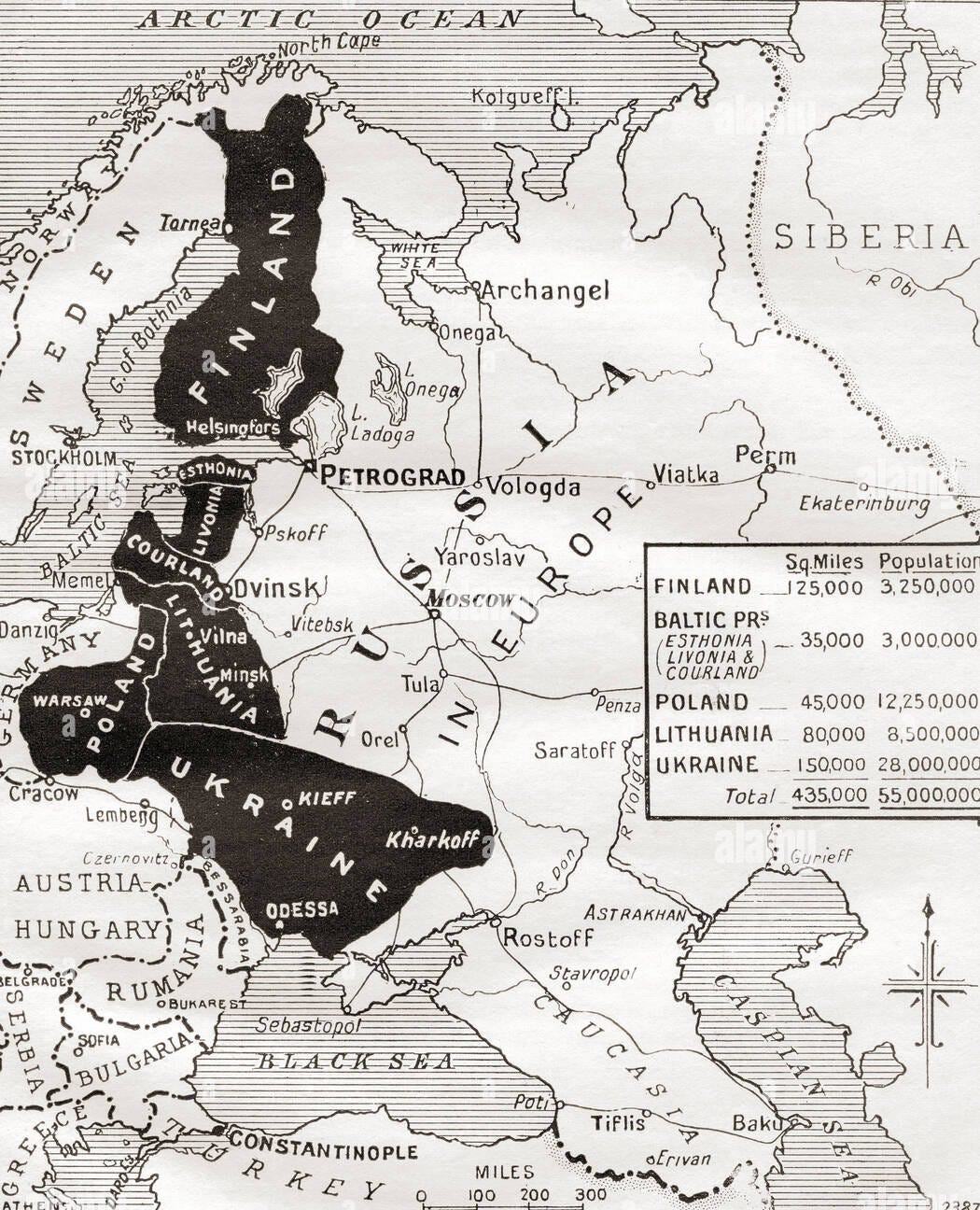
Contemporary map of Central and Eastern European states created by Brest-Litovsk
Brest-Litovsk was torn up by the June 1919 Treaty of Versailles, compelling Berlin to grant independence to assorted German-conquered protectorates that had been established throughout the region. Chaotic, violent struggles unfolded over the next three years between Red Army-assisted local revolutionary elements and ‘independent’ states led by collaborationist puppets. Belarus and Ukraine were successfully absorbed as republics, while the Baltics and Poland remained autonomous. Meanwhile, the seed of German hegemony via self-determination had been decisively sown throughout Central and Eastern Europe.
German colonialism particularly left its mark post-Brest-Litovsk via the emergence of nationalisms and according national creation myths throughout the region, which were innately and rabidly antagonistic toward Moscow. In Poland in 1916, Berlin’s invading forces had successfully portrayed themselves as liberators. In the Baltics, Russians represented a large proportion of the country’s urban, land-owning elite. They were easily framed by German propagandists, and in ultranationalist imaginations, as parasitic overlords of largely illiterate ethnic Estonian, Latvian and Lithuanian peasantry, who overwhelmingly resided in rural steppes.
Convincing Ukraine’s multiethnic population to embrace an anti-Russian ‘independence’ was considerably more difficult, given their similar backgrounds, customs and languages, and the substantial influence of each others’ culture in both directions since Kiev’s 1654 union with Moscow. Ukraine’s contemporaneous veneration of genocidal fascists, and indeed the wider ongoing proxy war, are direct upshots of efforts by German imperialists to promote enmity and antagonism between Russians and Ukrainians. This strategy was maintained throughout the Cold War by the CIA and MI6, with Nazi-riddled West Berlin’s assistance.
‘Civilising Mission’
Another enduring legacy of Brest-Litovsk was the transformation of “self-determination” from a liberal German imperialist crusade, to a fundamental principle of Anglo-American-dominated international relations. The cause was eagerly and cynically seized upon first by British Prime Minister Lloyd George, then US President Woodrow Wilson. The right to minority self-determination globally became absolutely central to the 1919 Paris Peace Conference. The world over, anti-colonial and nationalist movements saw an opportunity to achieve independence from foreign subjugation.
At the Conference, Austro-Hungary brutally fell victim to this self-determination push, with Britain successfully ordering its constituent territories be “liberated” via the empire’s total breakup. This created the independent states of Austria, Hungary, Czechoslovakia, and Yugoslavia. The latter pair were entirely new countries, with Yugoslavia forged from Austro-Hungary’s southern Slavic regions – Bosnia and Herzegovina, Croatia, and Slovenia – and the revolutionary kingdoms of Serbia and Montenegro. In a bitter irony, Austro-Hungary herself had previously encouraged self-determination regionally à la Brest-Litovsk, to entrench her imperial rule.
In June 1878, the little-known Congress of Berlin was convened. Major European powers sought to reorganise the Balkans, in the wake of Russia’s victory over the Ottoman Empire three months earlier. The conflict ended with Moscow asserting hegemony over Constantinople’s remaining holdings in Southeastern Europe, via an allied Greater Bulgaria, and the newly-formed, independent states of Montenegro, Romania, and Serbia. However, Austria-Hungary, Britain, France, rapidly expanding host empire Germany, and Italy, wished for these terms to be revised.
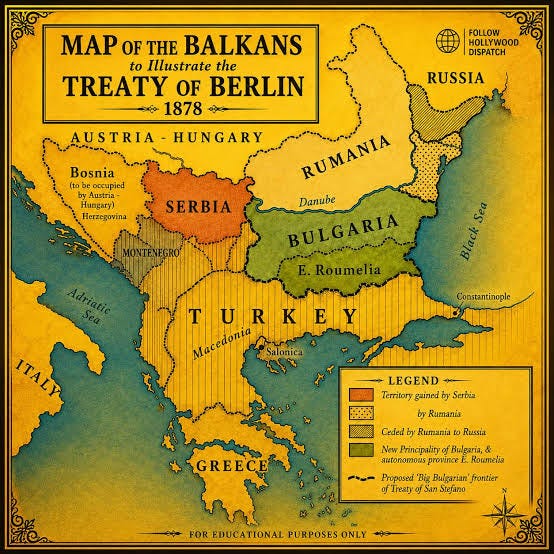
While the Congress recognised the three new Balkan states’ independence, attendees demanded Bosnia and Herzegovina become an Austro-Hungarian protectorate into the bargain, much to Serbia’s chagrin. Vienna’s resultant takeover of Sarajevo sent tens of thousands of Muslim inhabitants fleeing to Turkey. This exodus intensified in 1881, after the imposition of military conscription. The move was inspired by Serbia and Montenegro supporting local anti-imperial elements. It was just one Austro-Hungarian connivance intended to transform harmoniously multiethnic, multifaith Bosnia and Herzegovina into a fractious powder keg.
In service of this goal, Sarajevo’s Austro-Hungarian occupation authorities actively nurtured a nationhood centred exclusively on Bosniak – Bosnian Muslim – identity. The local Serbo-Croatian dialect was proclaimed a separate Bosnian language, Cyrillic text got suppressed, while Serbian books and newspapers were banned. Vienna’s meddling failed to incite violent, separatist division between Bosnia’s diverse peoples. It nonetheless created a vast army of conscripts for any future regional war, while providing Austro-Hungary with an imperial public relations victory. Per historian Maximilian Georg:
“[Vienna’s] objects were to teach the population their supposed Bosnian, pro-Habsburg identity, legitimise the Austro-Hungarian rulers as the new Romans, and demonstrate to Europe and the world the success of Austro-Hungary’s ‘civilising mission’ in an ‘oriental’ country. This ‘civilising mission’ under military occupation was the strongest indicator of an Austro-Hungarian colonialism.”
‘Yugoslav Nationalist’
Austro-Hungary and Germany alike considered independent Serbia’s mere existence a permanent irritant to their Eastern European supremacy, in need of eventual neutralisation. Tensions constantly mounted after the turn of the century, leading in 1908 to Bosnia’s formal annexation by Vienna. All along, imperialists in Berlin were spectating Austro-Hungary’s colonial machinations with intense interest. In 1888, Chancellor Otto von Bismarck prophetically foresaw “some damned foolish thing in the Balkans” upsetting Europe’s delicate balance of power, and precipitating a major global conflict.
Serbia and Montenegro’s October 1912 invasion of Albania, in the wake of her declaration of independence from Ottoman rule, almost proved that “damned foolish thing.” Serb and Montenegrin forces sought to permanently capture territory, but retreated a year later under threat of Austro-Hungarian intervention. In the aftermath, Kaiser Wilhelm II visited Vienna, declaring to colonial officials “war between East and West was in the long run inevitable.” As Slavs “were born not to rule but to obey,” their anti-imperialist tendencies couldn’t be tolerated much longer.
Wilhelm II moreover pledged to “back” Austro-Hungary in any future conflict in Eastern Europe, assuring his Viennese counterparts Berlin was “ready to draw the saber any time your action makes it necessary.” Bosnian Serb Gavrilo Princip’s June 1914 assassination of Archduke Ferdinand in Sarajevo provided an ideal pretext for the Kaiser’s long-desired showdown between Slavs and Teutons. Pressured by Austro-Hungarian authorities to implicate Belgrade directly in his actions while on trial, Princip instead insisted he was ideologically motivated:
“I am a Yugoslav nationalist, aiming for the unification of all Yugoslavs, and I do not care what form of state, but it must be free from Austria…The plan was to unite all South Slavs. It was understood that Serbia as the free part of the South Slavs had the moral duty to help in the unification, to be to the South Slavs as the Piedmont was to Italy…In my opinion every Serb, Croat and Slovene should be an enemy of Austria.”
In post-World War I Yugoslavia, Princip was elevated to national hero. In early 1930, a plaque was erected on the site of Ferdinand’s assassination, celebrating a foundational event in the new country’s creation. It was the sole trophy claimed by the Nazis following the Axis invasion of Yugoslavia, presented to Adolf Hitler at a formal ceremony on his 52nd birthday in April 1941, two days after Belgrade’s surrender. A potent totem of German embarrassment expunged, it was now time to erase Yugoslavia permanently.
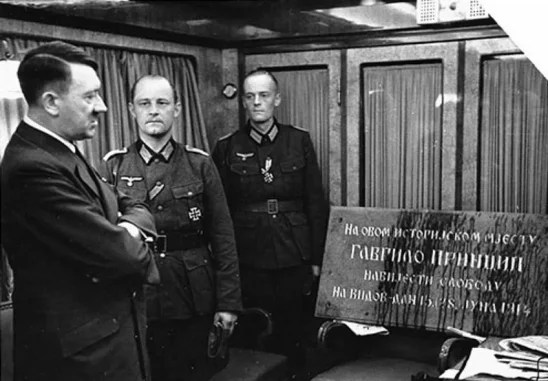
Adolf Hitler inspects the plundered plaque commemorating Archduke Ferdinand’s assassination by Gavrilo Princip
Carving up the country relied heavily on constructing genocidal, ethnonationalist puppet entities. Painful memories of these attempts to exert hegemony over the Balkans under the banner of “self-determination” remained visceral for many residents of Yugoslavia in December 1991. Then, newly-reunified Germany unilaterally recognised federation members Croatia and Slovenia as ‘independent’ states, while encouraging other republics comprising the collapsing country to follow the pair’s secessionist lead. It was widely predicted Yugoslavia’s demise would produce bloodshed, on a grand scale.
‘Fundamental Subordination’
Dissolving Yugoslavia began waging war on Croat and Slovene secessionists six months earlier. The latter conflict lasted just 10 days, but the former was still simmering. The European Community and UN futilely struggled all along to achieve peaceful settlements to Yugoslavia’s gravely worsening crisis, while formally committed to preserving the country in some form. Berlin’s recognition summarily sabotaged those efforts, removing any incentive for Yugoslav republics to negotiate their futures with Belgrade, while emboldening nationalists in every republic.
Fears of Berlin’s resurgent imperialism were not confined to Yugoslavia. As TIME contemporaneously observed, “it used to be a given of European political life Germany… would not take a leading or controversial role in world affairs,” which “suited its neighbors very well indeed.” While occupied West Germany operated throughout the Cold War as “an economic giant and a political dwarf,” unified Berlin’s “unexpected show of diplomatic muscle” in recognising Croatia and Slovenia as ‘independent’ countries was now causing “discomfort” throughout Western capitals.
In Britain’s parliament, then-Foreign Secretary Douglas Hurd explicitly evoked the World Wars as disquieting precedents for Germany’s modern-day “self-determination” push in the soon-to-be former Yugoslavia. “There is a tradition of the main states of Western Europe splitting in rivalry on these Balkan questions, and this all ending up on the battlefield. I don’t think that tradition is a good one,” Hurd cautioned. Washington, immensely irritated by Berlin belligerently “getting out ahead of the US,” duly assumed management of the Yugoslav crisis, with disastrous consequences.
Fratricidal conflicts that subsequently engulfed Yugoslavia forged a highly invasive beachhead, via which German economic and political hegemony throughout the region surged, without direct military engagement. While Berlin framed her support for Croat and Slovene ‘independence’ in terms of human rights, the rich financial rewards of shattering the federation were plain. As by far the two wealthiest republics, Germany effectively granted herself access to “the best productive assets” in the soon-to-be former country by kickstarting its practical and physical collapse, per a 2008 academic paper.
The authors write of how Berlin’s “hegemonic relationship” with Yugoslav successor nations was thereafter writ considerably larger than even Germany’s imperial infiltration of “smaller states” elsewhere in Central and Eastern Europe. This is due to the “specific dependence” of Balkan countries on Berlin’s “structural power”. In economic terms, this means vast national trade deficits with Germany across the region, with “Balkan pre-products and raw materials” flowing in vast, constant profusion to Berlin, while German corporations and products dominate many commercial, financial and industrial sectors locally.
Undergirding this extraordinary economic colonisation was adoption by Yugoslavia’s successor states of ‘independent’ currencies, pegged first to the former Deutschmark, now Euro. This proved pivotal to the “fundamental subordination of the political economies of the region to the ideological and operational norms” of the EU – or German empire, via other means. New national and private banking systems of post-Yugoslav countries were structured specifically according to Berlin’s own, with German banks ascendant, as elsewhere in Central and Eastern Europe. That’s not all:
“[Deutschmark/Euro pegging] was an essential precondition for the shaping of the macro-economic policies of these (and other transition) states, for their foreign economic relationships, for the further development of their capital markets and the programmes of liberalisation, deregulation and privatisation which ensued.”
‘European Continent’
Berlin’s Balkan banking takeover moreover fundamentally “facilitates the penetration of all German enterprises into the commercial life of the Balkan economies.” Berlin has gluttonously feasted on local resources and industry alike ever since, its investment regionally “characterised by takeovers.” For example, throughout Central and Eastern Europe German supermarkets are a near-monopoly, with prices of goods frequently higher than back home, despite meagre local purchasing power. Low wages, vast structural unemployment, and mass brain drain are all interlinked, ruinous inheritances.
The Balkans’ Western “transition” has been far more destructive than even the horrors unleashed upon the former Warsaw Pact in the 1990s. Heavily influenced “by prescriptive programmes emanating from the EU and from the World Bank,” Brussels has since 1999 also been “actively involved” in advising and guiding every country in the region towards bloc membership. After so much imposed impoverishment, it isn’t precisely clear what meaningful benefits Balkan states or populations will reap from their vassalage under German imperialism becoming formalised.
In late 2019, a Balkan liberal who once eagerly supported their country joining the EU wrote a sorrowful ode to “the process of so-called integration” Yugoslav successor states suffered by adopting “measures”, “instruments”, and “reforms” dictated by “Western technocrats”. Freshly ‘independent’ countries “were expected to build a fully developed Western liberal democracy from scratch… upon the ruins of a different yet fully developed system… while dragging behind us the burden of deepening poverty and trauma.” Several were and remain deeply scarred by Berlin and Brussels-encouraged ‘independence’ wars.
However, “this excruciating process of destroying and building anew a whole system… went neither fast enough nor successfully enough” for the new German empire. What’s more, “competition was not fair” – “opening our markets to the developed capitalism of the West and undertaking neoliberal reforms drained our human and economic resources while we kept trying to stay apace.” Socialism’s vestiges were eradicated, state industries sold off, and social spending slashed. The op-ed mysteriously failed to mention how Germany’s contemporary Balkan economic assault has a “strong security dimension”.
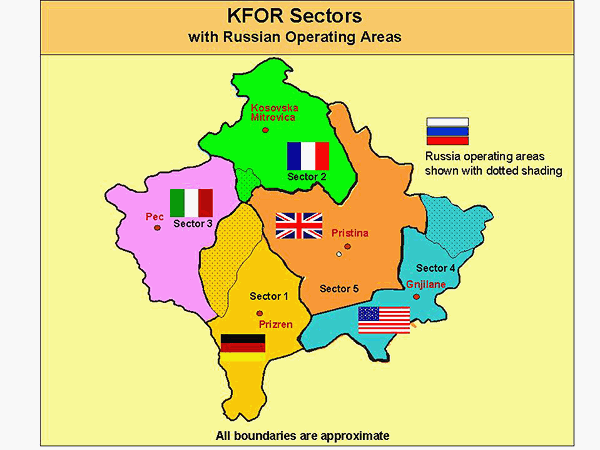
Kosovo’s original KFOR occupation map, June 1999
The 2008 paper notes Berlin exerts direct colonial-style control across the region, for example via Bosnia and Herzegovina’s EU-chosen Office of the High Representative, which traditionally serves as Germany’s imperial viceroy in Sarajevo. Moreover, Berlin has always been a key contributor to NATO’s Kosovo peacekeeping force KFOR, sustaining a military occupation under which Pristina controversially declared independence from Serbia in February 2008. This summer, Washington’s KFOR contingent began departing Kosovo after 27 years.
Meanwhile, the Americans are openly signalling Bosnia’s abandonment, raising potentially urgent questions about the unified country’s future. In April, Ursula von der Leyen made clear the EU and she personally intend to “[complete] the European continent so it does not fall under Russian, Turkish or Chinese influence,” in explicit reference to the former Yugoslavia. History shows us such declarations by German imperialists frequently result in world-threatening catastrophe. Meanwhile, “some damned foolish thing in the Balkans” could evidently today yet again trigger war.
Backed by AAP, West Virginia Proposal Would Allow Dental Hygienists to Give HPV Vaccine to 9-Year-Olds
By Jill Erzen | The Defender | October 26, 2026
West Virginia health groups are pushing legislation to let dentists and dental hygienists administer the human papillomavirus (HPV) vaccine, West Virginia Watch reported earlier this month.
The effort is part of a national push by St. Jude Children’s Research Hospital, the American Academy of Pediatrics (AAP) and the American Cancer Society to increase HPV vaccination rates and encourage vaccination starting at age 9.
Both the AAP and the American Cancer Society receive funding from Merck.
The campaign comes amid questions about the vaccine’s safety and claims that it prevents cancer. Merck, the maker of Gardasil, recently agreed to pay $50 million to settle more than 200 lawsuits alleging vaccine-related injuries, including autoimmune disorders and reproductive problems.
Although Merck markets Gardasil as a vaccine that protects against certain cancers, clinical trials did not test whether the vaccine prevented cancer — only whether it blocked certain strains of HPV.
Merck’s Gardasil is the only HPV vaccine available in the U.S.
HPV is a common, sexually transmitted virus that most people will encounter during their lives, according to the Centers for Disease Control and Prevention (CDC). Some types can cause cancers, such as cervical or oropharyngeal, which affects the back of the throat.
The CDC recommends the shot for children beginning at ages 11-12.
In 2021, the U.S. Food and Drug Administration (FDA) approved the HPV vaccine to protect against oropharyngeal cancer — despite no clinical evidence to support the claim.
National campaign promotes vaccine-related birthday cards for 9-year-olds
The West Virginia Oral Health Coalition is preparing legislation that would allow qualified dental professionals to administer the HPV vaccine. The legislative session begins in January.
Similar laws have passed in Kentucky, Indiana, Louisiana, Massachusetts, Mississippi, New Jersey and Oregon.
St. Jude’s HPV Cancer Prevention Program is working with West Virginia organizations to promote HPV vaccination through dental offices.
St. Jude’s April and June reports cited the “unique challenges” to vaccination in West Virginia’s rural areas, including the spread of “vaccine misinformation” and the “increased value of personal choice” in medical decisions.
To encourage earlier vaccination, the American Cancer Society’s National HPV Vaccination Roundtable developed a toolkit to help rural dental providers promote the shot.
One proposed strategy is sending children birthday cards on their 9th birthdays to encourage parents to discuss HPV vaccination.
Merck is also studying whether to extend vaccination to even younger children. The company is funding and conducting clinical trials of Gardasil on children ages 4-8.
Lucija Tomljenović, Ph.D., a scientist who has published more than a dozen peer-reviewed papers on HPV vaccination, called the trial “reckless.” She said it “assumes safety in an age group in which the vaccine has never been tested.”
Hygienist said she avoided discussing HPV’s sexual transmission
The push to expand vaccination through dental offices raises questions not only about safety but also about informed consent — particularly what parents are told about HPV and the vaccine.
West Virginia Watch reported that the state conducted a pilot project earlier this year, enlisting dental hygienist Lauren French to discuss HPV vaccination with patients at a rural dental clinic. French said the conversations fit naturally into routine dental visits, which already include oral cancer examinations.
However, earlier studies found that dental health providers remain generally reluctant to recommend or administer the vaccine.
French acknowledged that her conversations with parents often did not address HPV’s sexual transmission.
“The way that I go about it is I don’t have to bring up sex at all,” French told West Virginia Watch. “It’s just, ‘This is a virus that most people come into contact with.’ We want them to get vaccinated before they come into contact with this virus. That’s why we suggest age 9 to 16.”
For parents deciding whether to vaccinate their children, understanding how HPV spreads is part of understanding the purpose and timing of the intervention. Parents also need information about the vaccine’s potential risks and the evidence supporting its claimed benefits.
Tomljenović has questioned whether Gardasil offers any meaningful protection against cancer, arguing that its risks “clearly outweigh” its benefits. She has also cited research suggesting HPV vaccination may increase cervical cancer risk among women who use oral contraceptives long-term.
Other research has raised questions about how vaccination affects HPV types not targeted by the vaccine.
A 2023 study in Cell Host & Microbe found the HPV vaccine may actually increase the prevalence and distribution of some HPV virus strains not targeted by the vaccine — including some strains that are linked to cancer.
Meanwhile, the CDC convened a workgroup in January 2026 to reexamine HPV vaccination, including its effectiveness, dosing, safety and long-term impact.
The FDA’s prescribing information for Gardasil lists injection-site pain, swelling and redness, headache, fever, nausea and dizziness among reported adverse reactions. It also warns about fainting and severe allergic reactions.
Tomljenović has raised concerns about reports of postural orthostatic tachycardia syndrome (POTS), chronic fatigue syndrome and autoimmune disorders, multiple sclerosis and gynecological problems, including menstrual disorders and infertility.
Screenings — which dentists already do — protect against HPV-related cancers
A central question in the HPV vaccine debate is how strongly the available evidence supports claims that vaccination prevents cancer.
Earlier this year, scientists concluded that two Cochrane reviews — widely cited by health authorities and the media to support the claim that the vaccine reduces cervical cancer incidence by up to 80% — are flawed.
The majority of epidemiological studies cited to show the vaccine’s effects — including its ability to stop invasive cervical cancer — had serious or critical risk of bias, Tomljenović told The Defender in March, calling the review “garbage.”
Tomljenović also argued that while Gardasil doesn’t prevent HPV-related cancer, routine screenings are essential to reducing deaths from the disease. She pointed to the U.S. cervical cancer death rate of approximately two per 100,000 women as evidence of the importance of screening.
The AAP notes on its HealthyChildren.org site that “unlike cervical cancer, there is no test to screen for oral cancer or any other HPV-associated cancer.”
Even so, dentists already examine patients for signs of oral cancer during routine visits.
The Mayo Clinic and Cleveland Clinic describe oral cancer examinations as part of routine dental care. Dentists look for suspicious lumps, sores, red or white patches and other abnormalities. They may refer patients for further evaluation or biopsy when they find something concerning.
“During every routine cleaning, there’s an exam. … And we’re telling the patient, ‘We’re doing an oral cancer screening just to make sure there’s no lumps, bumps, or anything that’s suspicious in your mouth,’” French told West Virginia Watch.
This article was originally published by The Defender — Children’s Health Defense’s News & Views Website under Creative Commons license CC BY-NC-ND 4.0. Please consider subscribing to The Defender or donating to Children’s Health Defense.
Poland Is the Symptom and Europe Is the Patient
By Larry C. Johnson | SONAR21 | November 1, 2026
The midnight brawl at Poland’s Constitutional Tribunal is not a Polish problem. It is the local flare-up of a continental disease. Across Europe, when voters pick the wrong candidate, the establishment reaches for a judge, an intelligence service or the EU’s checkbook, and calls the result “defending democracy.” The Journal of Democracy wrote the textbook. Warsaw is the teaching hospital.
The article
In December 2023, two months after Donald Tusk’s coalition pushed Law and Justice (PiS) out of power, Jarosław Kuisz and Karolina Wigura of Kultura Liberalna published a how-to guide in the Journal of Democracy. The title says it all: “How to Dismantle an Illiberal Democracy.”
Consider the provenance. At the time, the Journal was the flagship publication of the National Endowment for Democracy, the outfit that does in daylight what the CIA used to do at night. It split from NED this year after DOGE cut off NED’s funding in 2025, and it is now independent and partnered with Stanford’s CDDRL. In 2023, though, this was the democracy-promotion establishment telling Warsaw how to clean house.
The argument, stripped of its footnotes:
- Poland needs a “second wave” of transitional justice to deal with PiS “violations of the rule of law.”
- Avoid vague treason charges. Prosecute specific acts: the 2015 Constitutional Tribunal appointments, the 2020 attempt at an all-mail presidential election and the 2023 visa-for-cash scandal.
- Jarosław Kaczyński bears responsibility but will be hard to convict.
- Parliamentary investigative committees are the main tool.
- Expect resistance from the PiS-aligned presidency, Supreme Court and State Tribunal.
- Stabilize the system without breaking it.
The authors close with a disclaimer worth framing: “There is no clear roadmap… One should therefore not expect miracles.”
The critique
The defenders of democracy have written a manual for dismantling one. They don’t see the irony, and that is the most instructive thing about the essay.
Start with the word “illiberal.” It is not a legal category. It is a label handed out by people with conference budgets to governments they dislike. PiS won the 2015 and 2019 parliamentary elections outright. Yet the article treats its officials less like a defeated party and more like the communist nomenklatura of 1989, in need of a “transitional justice” process.
In fairness to Kuisz and Wigura, they are more careful than their cause. They warn against show trials and vague charges, and they admit nobody knows how to do this. But manuals are not read for their caveats. Politicians skip the footnotes and go straight to the chapter on tools.
Here is the core contradiction. PiS stands accused of capturing the courts, ignoring rulings and stacking institutions with loyalists. The cure prescribed is to purge the courts, ignore rulings and install the right loyalists. The sin becomes a sacrament when the right people commit it.
Poland, three years later: the manual in action
This week the manual left the library and went to the streets of Warsaw, escorted by riot police.
Since 2023, Tusk’s government has refused to recognize the Constitutional Tribunal and has ignored its rulings. Starting in March, parliament elected eight new judges. President Karol Nawrocki refused to swear in five of them. They held their own oath ceremony and mailed the oaths to the presidential palace, which is a new one even by Central European standards.
Then came October 30. According to Notes from Poland and ProtoThema :
- Judge Anna Korwin-Piotrowska suspended Chief Justice Bogdan Święczkowski and declared herself acting head of the Tribunal.
- Justice Minister Waldemar Żurek moved to strip Święczkowski’s immunity.
- Riot police blocked Święczkowski from entering his own court. His supporters cut through the fence with power tools.
- Nawrocki turned his plane around on the way to Senegal and, around 1 a.m., pushed his way past judges into the building. Each side accuses the other of physical aggression. Protesters outside called it a coup.
Tusk’s response, per Euronews : “In certain matters there can be no compromise.” He also warned about Russian bots, because no European crisis is complete without them.
Not everyone in the coalition is cheering. Szymon Hołownia said Poland should be ashamed and that forcing a fix only deepens the decline. Hołownia and the PSL are now attending Nawrocki’s talks. When your own partners start taking meetings with the other side, the roadmap has a pothole.
Kuisz and Wigura told us not to expect miracles. This isn’t a miracle. It’s a mirror.
The disease, not the symptom
Poland is just the case where the patient is thrashing hardest. Look at the rest of the ward and the same pathology shows up everywhere: elections treated as advisory, with the final say reserved for institutions nobody voted for.
- Romania. On December 6, 2024, the Constitutional Court annulled the first round of a presidential election after Călin Georgescu, an outsider polling in single digits, came in first. The grounds were declassified intelligence about “aggressive hybrid Russian attacks” and alleged illegal campaign financing. In March 2025 the electoral commission barred Georgescu from the rerun, while he was “the favourite in all the polls,” and the court unanimously agreed. That is one way to fix an election: hold it again without the winner.
- France. In March 2025 a Paris court convicted Marine Le Pen of embezzling EU parliamentary funds and banned her from office for five years, effective immediately. The frontrunner for 2027 was gone with one gavel. In July the appeals court upheld the conviction but cut the ban to 45 months, 30 of them suspended, so she can run after all. The judges giveth, and the judges taketh away. Either way, the judges decide.
- Germany. In May 2025, the BfV, Germany’s domestic intelligence service, branded the AfD a “confirmed right-wing extremist” party. The AfD polls at 24 to 26 percent. In February a Cologne court suspended the label, ruling the conditions for it “are not met.” Lawmakers are still pushing to have the Constitutional Court ban the party outright. Banning the party a quarter of your voters support is certainly one way to win an argument. In my old business, we called a spy agency monitoring the main opposition party something else.
- Brussels’ checkbook. The European Commission froze about €137 billion for Poland under PiS. On February 29, 2024, eleven weeks after Tusk took office, it released the money. One of its own officials conceded, “That does not mean the rule of law is fully restored and everything is fine,” and the reform plan was “still a draft ambition.” The rule of law, it turns out, is measured by who sits in the prime minister’s office. Hungary got the same treatment. Its new prime minister, Péter Magyar, promised to go to Brussels “to have EU funding released.” Message received in Budapest.
Put the cases side by side and the illness has a clear set of symptoms. Courts annul or narrow the choices on the ballot. Intelligence services rate which parties are fit to compete. Brussels pays for good behavior, defined as the right government. All of it is done in the name of protecting democracy from the people who vote in it.
That is why the Kuisz and Wigura essay matters beyond Poland. It isn’t a Polish policy paper. It is a clinical protocol for treating a voter who votes wrong, written for a continent whose elites have concluded the electorate can’t be trusted with the keys. Tusk is just the first surgeon to try it without anesthesia.
What this means for NATO
An alliance is only as strong as the governments that have to say yes. Right now several of NATO’s key European members are too busy fighting their own voters, courts and presidents to launch any foreign venture. In some cases they couldn’t if they tried.
Start with Poland, the country Washington holds up as NATO’s model member and the frontline state on Belarus and Ukraine. Under Poland’s constitution the president is the supreme commander of the armed forces. Poland’s president and its prime minister are currently accusing each other of a coup. Ask yourself who gives the order to deploy in that situation. Then ask whether a Polish soldier knows whose order to follow. A country with two constitutional courts and a commander-in-chief shoving past judges at 1 a.m. is not preparing to project power. It is trying to hold itself together.
The rest of the ward is no healthier:
- Germany is debating whether to ban the opposition party that a quarter of its voters support, and that party wants nothing to do with a war against Russia. Any German government that sends troops east hands the AfD its next election.
- France faces a 2027 presidential race in which Le Pen, whose party has long been skeptical of NATO’s integrated command, is back on the ballot. No French president facing that race will gamble on a foreign adventure.
- Romania, home of NATO’s base at Mihail Kogălniceanu on the Black Sea, is still governed under the shadow of an election its own court cancelled. Its political class has a legitimacy problem it cannot afford to aggravate with a war.
NATO runs on consensus. Every one of these governments is now weighing a foreign deployment against a domestic electorate it has spent years managing rather than persuading. When the elite’s grip at home depends on courts, intelligence services and Brussels’ money, asking voters to send their sons east is the one request it can’t risk. Sooner or later, the bill for treating the voter as the enemy comes due.
The irony is hard to miss. The project was sold as protecting democracy from the barbarians at the gate. What it has produced is an alliance whose members cannot agree with their own voters, let alone with each other. Moscow didn’t have to lift a finger. Europe’s “defenders of democracy” are doing the job for it.
The Globalists refuse to go away
Strip away the vocabulary of “rule of law” and “transitional justice” and you find a project aimed at Polish nationalism itself. PiS’s real offense was not packing a court. Plenty of governments pack courts. Its offense was putting Polish sovereignty, Catholic identity and the nation-state ahead of Brussels.
The record is consistent. Poland refused the EU’s 2015 migrant relocation quotas, and in April 2020 the European Court of Justice ruled that Poland, Hungary and the Czech Republic had broken EU law by refusing. That July, the Commission denied twinning grants to six Polish towns over their “LGBT ideology-free” resolutions. Then came the €137 billion freeze. The message from Brussels never varied: national identity is welcome as folklore, not as policy.
To the globalist wing of the Western establishment, meaning NED, Brussels and the foundations and think tanks that orbit them, nationalism is a disease to be treated, not a view to be debated. A nation that insists on deciding what it believes, whom it admits and how it runs its own courts is “illiberal” by definition. Kuisz and Wigura simply gave that attitude a legal procedure.
Now look east, because the same people take the same attitude toward Russia, with fewer manners. NED has funded Russian civil-society groups for decades, which is why Moscow made it the first “undesirable organization” under its 2015 law. In June 2022, the U.S. Helsinki Commission held a briefing titled “Decolonizing Russia: A Moral and Strategic Imperative.” The title says the rest. Russian nationalism, like Polish nationalism, is treated not as a fact to be dealt with but as a pathology to be cured, by sanctions, regime change or, if the seminar circuit gets its way, partition.
Here is the irony I find most delicious. Washington and Brussels spent years cheering Polish nationalism when it was pointed at Moscow. Poland’s hostility to Russia was the alliance’s favorite asset. Point the same nationalism at Brussels and it suddenly becomes a threat to democracy requiring riot police. Polish patriotism, it turns out, is a weapon to be aimed, not a conviction to be respected. Poles should notice that the people eager to dismantle Russia’s sense of nationhood are the same people dismantling theirs.
That is my assessment, not the article’s. Kuisz and Wigura frame everything as restoring the rule of law, and insist that the PiS started this. Its 2015 Tribunal appointments were a power grab, and in its 2021 Xero Flor ruling the European Court of Human Rights found that a bench including an improperly appointed judge violated the right to a fair trial.
Nawrocki’s refusal to swear in the new judges is hardball too. Both camps have real legal arguments. That is exactly why riot police at midnight are the wrong way to settle it.
Even if you set motive aside entirely, judge the project by its adverse effects: a country with two rival constitutional courts and a president shoving past judges in the dark.
On NATO, a caveat. Domestic turmoil makes an offensive or expeditionary venture far less likely, but it does not mean these countries would refuse to defend their own territory. Both camps in Warsaw back heavy defense spending, and a direct attack on a member tends to unite even the most divided parliament. My argument is about appetite for adventure, not the willingness to fight at the border.
None of these caveats changes the central point. The fight in Warsaw isn’t really about judges. It is about whether a European nation may still define itself, or whether that right now belongs to Brussels, NED and the people who write manuals on dismantling democracies. Moscow got that answer years ago. Warsaw is getting it now.
UAE security forces tortured, killed journalist for opposing Israel normalization: Report
The Cradle | October 31, 2026
UAE security officers detained, tortured, and killed Emirati poet and news editor Habib al-Sayegh in August 2019, shortly after he published a column opposing UAE normalization with Israel, according to a newly published book.
“Princes and Thieves,” a book by investigative journalist Matthew Cole published on 25 October, alleges that UAE security officers raided Sayegh’s Abu Dhabi home shortly after the publication of the column, hooded him in front of his wife and took him to a detention facility where he was tortured to death.
His interrogators reportedly pulled out several of his teeth with pliers and beat him repeatedly with a sharp metal object.
On 11 August 2019, Sayegh criticized the UAE’s plan to normalize relations with Israel as part of the Abraham Accords in his weekly column for Khaleej newspaper. The column was titled “Israel Is Our Real Enemy and A Dangerous Project.”
Sayegh described Israel as “a real and natural enemy” while questioning “who authorized the normalizers to speak on behalf of everyone?”
Nine days after the column was published, Emirati state media announced his death, without stating a cause.
The UAE normalized relations with Israel a year later, alongside Bahrain, Morocco and Sudan.
UAE President Mohammed bin Zayed (MbZ) praised Sayegh after his death. However, a source told Cole that MbZ would not tolerate criticism of the decision to normalize with Israel.
Since 2020, the UAE has proved to be a close ally of Israel, both in its bid to project power in the Horn of Africa and in the war on Iran begun by the US President Trump and Israeli Prime Minister Benjamin Netanyahu in February.
In response to the book’s allegations, Democracy for the Arab World Now (DAWN) sent a letter to three UN agencies asking that an investigation be opened into Sayegh’s death.
“The allegations that UAE security forces tortured and killed one of the country’s most prominent poets are horrifying and demand an independent investigation,” said Raed Jarrar, DAWN’s advocacy director.
“Habib al-Sayegh wrote that Israel was the enemy, and nine days later he was dead with no cause given. One year later his government, notorious for their intolerance for dissent, normalized relations with Israel. Those facts are not in dispute. What happened in between is the question, and only an independent investigation can answer it,” said Isabelle Hayslip, Advocacy Associate at DAWN.
Cole’s book generated controversy last week over its claim that Jared Kushner, President Trump’s son-in-law, secretly gained access to $2 billion in slush money from the governments of the UAE and Saudi Arabia during Trump’s first administration in exchange for advancing their political interests in Washington.
Kushner denounced the book, claiming the author failed to provide evidence to substantiate its claims.
Featured Video

Benoit Paré: OSCE Whistleblower: The Ukraine War — Narratives vs. Reality
or go to
Aletho News Archives – Video-Images
Book Excerpt
How CIA used Ukraine as a platform for covert war against Russia
By Stephen KINZER | Responsible Statecraft | November 17, 2026
The following is an excerpt from Stephen Kinzer’s new book: Boiling Point: How America Brought War to Ukraine (Henry Holt and Company, November 2026)
Huddled beside an airstrip in southern Germany, a handful of anti-Communist warriors prepared to fire the first shots of the Cold War. A CIA officer from the Munich Operations Base was in charge. The Hungarian crewmen he had recruited stood nearby in flight suits. With them were two Ukrainian exiles who had volunteered to parachute into their homeland. They were code-named Apostle 1 and Apostle 2. Each carried forged identity papers, a miniature radio transmitter, a pistol, a machine gun, hand grenades, a purse full of gold coins, and a poison pill to be taken in case of capture. An unmarked C-47 transport plane was waiting.
The CIA officer overseeing this operation, a twenty-six-year-old Yale graduate named Stephen Tanner, watched the plane take off and disappear into the night. It flew over East Germany and Poland, then crossed into Soviet airspace. As it approached the Ukrainian city of Lviv, a cargo bay swung open. The two Ukrainians jumped into the darkness. Their mission was to link up with partisan fighters, seize territory, and establish a clandestine base through which the CIA could send them weapons.
That flight, on September 5, 1949, was the first American act of covert war in Ukraine. … continue
Blog Roll
 Aletho News
- UK forced to admit ordering backdoor access to Apple users’ data
- It’s not about China or national security. It’s about which foreign entity is allowed to spy on Americans
- Banning Palestine activists from the West will not save Israel’s image
- Iran rejects unlimited IAEA inspections amid continued military threats
- A Bridge Too Far
- David Barnea in the Bundestag – Mossad as a model for Germany’s Intelligence Services?
- Rome blasts Kiev after Italian lawmakers added to ‘kill list’
- Another €45 bn down the drain: Why the EU is desperate to waste more cash on Zelensky
- In Europe, Anxiety Is Mounting—EU Unity Is Cracking at Every Seam
- How CIA used Ukraine as a platform for covert war against Russia
- If Americans Knew
- ‘One Started Spraying Bullets’: Palestinian Eyewitnesses Describe Settler Incursion That Left 72-Year-Old Woman Dead
- Palestinian children are 40% of all children killed & maimed worldwide, says Save the Children
- WATCH: Netanyahu boasts how his father helped establish Israel through manipulating the U.S.
- Tom Friedman’s deceptive effort to lure Dems to escalate in Iran
- Leading humanitarian groups give Gaza peace plan failing grade one year on
- 9,500 Palestinians face starvation, torture and medical neglect in Israeli prisons
- DAILY UPDATE: Latest essential news on Palestine, Israel, & region
- Drowning in plain sight: a sobering reminder of what may come next
- Israel threatens to seize more territory in Gaza, Lebanon, Syria
- Fracture, Expel, Humiliate
- No Tricks Zone
- Argentina’s Perito Moreno Glacier Joins Antarctica and Arctic In Defying Doomsday Melt Claims
- New Study: Barents Sea Temperatures Were Warmer And Sea Ice Less Extensive In The 1700s Than Today
- German Authorities Start Initiative To Evaluate Public Register For Climate “Disinformation” Spreaders!
- Zonal Asymmetry of Temperature Change in the Antarctic Circumpolar Current
- New Study: The Net Fossil Fuel Contribution To Rising Atmospheric CO2 Has Been Zero For 500 Years
- Germany’s Green Energy Transition Becoming Increasingly Expensive…Another 6 Trillion Euros!
- Sudden Stratospheric Warming, Powerful El Niño Combination May Lead To Extreme Europe Cold, Energy Crisis!
- Two New Studies Find Thwaites Glacier Melt Cannot Be Driven By Human Activity Or A Warming Ocean
- E-Cars Reduce CO2 Emissions By Only 41% Compared To Internal Combustion Engine Vehicles
- Predictions Made By Renowned Climate Professor Over Past Decades Have Been Proven To Be Poor

