RAND Report Prescribed US Provocations Against Russia and Predicted Russia Might Retaliate in Ukraine
By Rick Sterling | Global Research | March 28, 2022
According to a 2019 Rand report titled “Overextending and Unbalancing Russia”, the US goal is to undermine Russia just as it did the Soviet Union in the cold war. Rather than “trying to stay ahead” or trying to improve the US domestically or in international relations, the emphasis is on efforts and actions to undermine the designated adversary Russia. Rand is a quasi-US governmental think tank that receives three-quarters of its funding from the US military.
The report lists anti-Russia measures divided into the following areas: economic, geopolitical, ideological/informational, and military. They are assessed according to the perceived risks, benefits and “likelihood of success”.
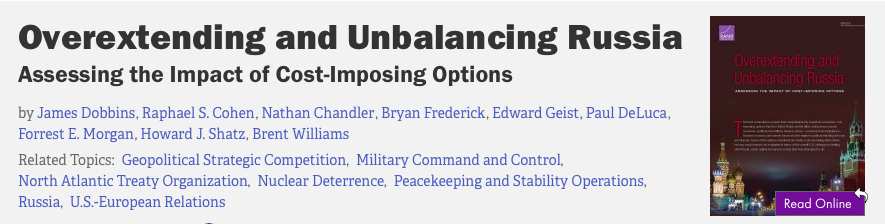
Screenshot from RAND
The report notes that Russia has “deep seated” anxieties about western interference and potential military attack. These anxieties are deemed to be a vulnerability to exploit. There is no mention of the cause of the Russian anxieties: they have have been invaded multiple times and had 27 million deaths in WW2.
Significance of Ukraine
Ukraine is important to Russia. The two countries share much common heritage and a long common border. One of the most important leaders of the Soviet Union, Nikita Khrushchev, was Ukrainian. During WW2, Ukraine was one of Hitler’s invasion routes and there was a small but active number of Ukrainian collaborators with Nazi Germany. The distance from the capital of Ukraine, Kiev, to Moscow is less than 500 miles.
For these same reasons of geography and history, Ukraine is a major component of a US/NATO effort to undermine Russia. Current Under Secretary for Political Affairs, Victoria Nuland, said that over 20 years the US invested $5 billion in the project to turn Ukraine. The culmination was a violent coup in February 2014. Since 2015, the US has been training ultra nationalist and Neo-Nazi militias. This has been documented in articles such as “U.S. House admits Nazi role in Ukraine” (Robert Parry, 2015), “The US is arming and assisting neo-nazis in Ukraine while the House debates prohibition”(Max Blumenthal, 2018), “Neo Nazis and the far right are on the march in Ukraine” (Lev Golinken in 2019) and “The CIA may be breeding Nazi terror in Ukraine” (Branko Marcetic Jan. 2022).
Rand suggested provocations
Prior to 2018, the US only provided “defensive” military weaponry to Ukraine. The Rand report assesses that providing lethal (offensive) military aid to Ukraine will have a high risk but also a high benefit. Accordingly, US lethal weaponry skyrocketed from near zero to $250M in 2019, to $303M in 2020, to $350M in 2021. Total military aid is much higher. A few weeks ago, The Hill reported, “The U.S. has contributed more than $1 billion to help Ukraine’s military over the past year”.
The Rand report lists many techniques and “measures” to provoke and threaten Russia. Some of the steps include:
- Repositioning bombers within easy striking range of key Russian strategic targets
- Deploying additional tactical nuclear weapons to locations in Europe and Asia
- Increasing US and allied naval force posture and presence in Russia’s operating areas (Black Sea)
- Holding NATO war exercises on Russia’s borders
- Withdrawing from the Intermediate Nuclear Forces (INF) Treaty
These and many other provocations suggested by Rand have, in fact, been implemented. For example, NATO conducted massive war exercises dubbed “Defender 2021” right up to Russia’s border. NATO has started “patrolling” the Black Sea and engaging in provocative intrusions into Crimean waters. The US has withdrawn from the INF Treaty.
Since 2008, when NATO “welcomed” the membership aspirations of Ukraine and Georgia, Russia has said this would cross a red line and threaten its security. In recent years NATO has provided advisers, training and ever increasing amounts of military hardware. While Ukraine is not a formal member of NATO, it has increasingly been treated like one. The full Rand report says “While NATO’s requirement for unanimity makes it unlikely that Ukraine could gain membership in the foreseeable future, Washington’s pushing this possibility could boost Ukrainian resolve while leading Russia to redouble its efforts to forestall such a development.”
The alternative, which could have prevented or at least forestalled the current Russian intervention in Ukraine, would have been to declare Ukraine ineligible for NATO. But this would have been contrary to the US intention of deliberately stressing, provoking and threatening Russia.
Ukraine as US client
In November 2021, the US and Ukraine signed a Charter on Strategic Partnership. This agreement confirmed Ukrainian aspirations to join NATO and rejection of the Crimean peoples decision to re-unify with Russia following the 2014 Kiev coup. The agreement signaled a consolidation of Washington’s economic, political and military influence.
December 2021 Russia red lines followed by military action
In December 2021, Russia proposed a treaty with the US and NATO. The central Russian proposal was a written agreement that Ukraine would not join the NATO military alliance.
When the proposed treaty was rebuffed by Washington, it seems the die was cast. On February 21, Putin delivered a speech detailing their grievances. On February 24, Putin delivered another speech announcing the justification and objectives of the military intervention to “demilitarize” and “denazify” Ukraine.
As Russian Foreign Minister Lavrov later said, “This is not about Ukraine. This is the end result of a policy that the West has carried out since the early 1990’s.”
Afghanistan again?
As earlier indicated, the Rand report assesses the costs and benefits of various US actions. It is considered a “benefit” if increased US assistance to Ukraine results in the loss of Russian blood and resources. Speculating on the possibility of Russian troop presence in Ukraine, the report suggests that it could become “quite controversial at home, as it did when the Soviets invaded Afghanistan.” (p 99 of full report)
That historical reference is significant. Beginning in 1979, the US and Saudi Arabia funded and trained sectarian foreign fighters to invade and destabilize the progressive Afghan government. The goals were to overthrow the socialist inclined government and lure the Soviet Union into supporting the destabilized government. It achieved these Machiavellian goals at the cost of millions of Afghan citizens whose country has never been the same.
It appears that Ukrainian citizens are similarly being manipulated to serve US goals.
A “disadvantageous peace settlement”
The Rand report says, “Increasing U.S. military aid would certainly drive up the Russian costs, but doing so could also increase the loss of Ukrainian lives and territory or result in a disadvantageous peace settlement.”
But who would a peace settlement be “disadvantageous” for? Ukrainian lives and territory are currently being lost. Over fourteen thousand Ukrainian lives have been lost in the eastern Donbass region since the 2014 coup.
A peace settlement that guaranteed basic rights for all Ukrainians and state neutrality in the rivalry of big powers, would be advantageous to most Ukrainians. It is only the US foreign policy establishment including the US military media industrial complex and Ukrainian ultra-nationalists who would be “disadvantaged”.
Since Ukraine is a multi-ethnic state, it would seem best to accept that reality and find a compromise national solution which facilitates all Ukrainians. Being a client of a distant foreign power is not in Ukraine’s national best interest.
The Rand report shows how US policy focuses on actions to hurt Russia and manipulates third party countries (Ukraine) toward that task.
*
Rick Sterling is an independent journalist based in the San Francisco Bay Area. He can be contacted at rsterling1@protonmail.com.
UAE: There is no substitute for Russian oil
Samizdat | March 28, 2022
The world’s energy markets need Russian oil and no producer can replace it, United Arab Emirates (UAE) Minister of Energy Suhail al-Mazrouei said on Monday.
Russia produces some 10 million barrels of oil a day, which makes it a critical member of the OPEC+ energy alliance, al-Mazrouei explained during an energy forum in Dubai.
“Leaving the politics aside, that volume is needed today,” he insisted, adding that “unless someone is willing to come and deliver that amount, we don’t see that someone can substitute Russia.”
Russia is the world’s second biggest crude exporter after Saudi Arabia. Following Russia’s military operation in Ukraine, some nations, led by the US, have pledged to stop buying Russian oil and gas. The United States, Europe, and others have been calling on Gulf Arab oil producers to ramp up production and help bring down crude prices, which at one point shot above $120 a barrel.
The International Energy Agency announced earlier this month that it had decided to release 60 million barrels of oil from its emergency reserves, saying that global oil markets were already tight with highly volatile prices and commercial inventories at their lowest level since 2014.
Many have expressed doubts, however, about whether it was possible to ditch Russia’s energy resources.
Last week, the EU stepped back from imposing an embargo on Russian crude and petroleum products, despite pressure from the US. An immediate embargo on Russia’s fossil fuels “from one day to the next would mean plunging our country and the whole of Europe into a recession,” German Chancellor Olaf Scholz said last week. Europe gets nearly 30% of its crude and roughly 50% of its petroleum products from Russia.
Reducing dependence on natural gas – something that the EU hopes to achieve over the next few years – may prove difficult as well. Qatar – which holds the third-largest natural gas reserves in the world – said last week that it was practically impossible to replace Russian gas on the European market, as between 30 and 40% of the total volume of gas supplied to the world market comes from Russia.
Iran draws up gas field development plan after Saudi-Kuwaiti move

Some 23 Iranian hydrocarbon fields lie in border areas and are shared between Iran and adjacent countries
Press TV – March 28, 2022
An official says Iran has worked out a plan to develop its part of the Arash natural gas field shared with Saudi Arabia and Kuwait after the two Arab states announced having signed a document to build the reservoir without Tehran’s participation.
Last week, Kuwait said it planned to extract 1 billion standard cubic feet per day of gas and 84,000 barrels per day of condensate from the field under an agreement signed with Saudi Arabia. Iran dismissed the agreement as “illegal”, saying it breached their discussions to build the field together.
Ahmad Asadzadeh, deputy petroleum minister for international and commercial affairs, said Sunday Iran believes shared fields should be carried out jointly, adding this would lead to the strengthening of economic ties among the countries.
“Even if the border is not demarcated, the field can be developed jointly using internationally tested models,” he said. “The Ministry of Petroleum declares its readiness to negotiate in this regard,” Asadzadeh added.
Iran began talks with Kuwait in 2000 to develop the field but no agreements were reached. In 2013, the National Iranian Oil Company said it had jackets and rigs ready to develop the field and that if talks did not lead to a development plan, it would have the right to go ahead alone.
Iran, Asadzadeh said, has delayed developing the shared field in anticipation of a decision on the demarcation of the border with Kuwait.
“But given that the other side, regardless of the previous talks, is unilaterally moving to develop the field, there is no reason for delay,” Asadzadeh said.
“The Ministry of Petroleum has made necessary preparations and carried out studies to develop and exploit the shared field of Arash,” he added.
Arash was discovered in 1962 in the Persian Gulf with around 13 trillion cubic feet of natural gas.
On Saturday, the Ministry of Petroleum said parts of the Arash gas field which Kuwait and Saudi Arabia call al-Durra are located in areas between Iran and Kuwait whose water borders have not yet been defined.
“The Islamic Republic of Iran also reserves the right to exploit the gas field,” it said in a tweet in reaction to the Kuwait Petroleum Corporation’s statement on its bilateral agreement with Saudi Arabia.
Iran’s Foreign Ministry spokesman Saeed Khatibzadeh said: “The recent move by Kuwait and Saudi Arabia in the framework of a cooperation document is contrary to what was previously discussed, and illegal.”
“Any action on the operation and development of this field should be in the coordination of all three countries,” he added.
Some 23 Iranian hydrocarbon fields lie in border areas and are shared between Iran and adjacent countries, including Kuwait, Iraq, Qatar, Bahrain, the UAE, Saudi Arabia and Turkmenistan.
Most of Iran’s oil and gas fields lie in a belt running along its maritime boundary in the Persian Gulf and the foothills of the Zagros Mountains – an extensive folded zone which is geologically the result of the Arabian plate’s collision with the central Iranian plateau.
The collision has trapped thick layers of ancient limestone and sandstone and turned them into some of the world’s biggest oil and gas accumulations.
The Zagros basin covers more than 550,000 square kilometers, stretching from Turkey and Syria through the Iraqi Kurdistan into Iran where its sediments are ideally up to 12,000 meters thick.
US resets the containment of Iran
BY M. K. BHADRAKUMAR | INDIAN PUNCHLINE | MARCH 28, 2022
The summit of Arab diplomats on March 27-28 hosted by Israeli Foreign Minister Yair Lapid in the southern Negev Desert is doubtless a landmark event. The UAE’s Abdullah bin Zayed Al Nahyan, Bahrain’s Abdullatif bin Rashid Al-Zayani, Morocco’s Nasser Bourita, and Egypt’s Sameh Shoukry are the Arab participants, while the visiting US Secretary of State Antony Blinken becomes the sole “extra-regional” participant.
The expectation that more West Asian countries would join the Abraham Accords failed to materialise, but the security and military ties between Israel, UAE, Bahrain — and Saudi Arabia behind the curtain — have deepened. Egypt also joins the nascent partnership.
There is much symbolism surrounding the venue of the Arab-Israeli summit: Israel’s first prime minister, David Ben-Gurion, lived at Sde Boker and he is buried there, overlooking the Zin wilderness. Lapid hopes to take his guests to visit the gravesite.
To be sure, wherever Blinken goes, the agenda would include Ukraine conflict and he is sure to make a pitch for isolating Russia and urge his Arab interlocutors to join Western efforts in support of Ukraine, but it has had limited success even with his Israeli hosts, much less so with the US’ Arab allies.
For a variety of reasons, Israel is wary of antagonising Russia (although under US pressure it set up a field hospital inside Ukrainian territory to treat those injured by Russian forces and has also sent several shipments of humanitarian supplies to the war zone.) Israel has refused repeated requests from Kiev for weapons.
Israel also opted out of imposing sanctions against Russian oligarchs. This rankles the Biden administration. The acerbic tongue of US Under Secretary of State for Political Affairs Victoria Nuland lashed out during a Channel 12 interview, “You (Israel) don’t want to become the last haven for dirty money that’s fuelling Putin’s wars.”
Israel ignored her barb. Israel sought a mediatory role in the conflict initially but lately stepped back, and, at any rate , Russia does not really need mediators to bring this conflict to an end once its special operation is successfully concluded. On the whole, Israel tries to walk a tightrope to maintain good relations with both Ukraine and Russia.
As for Gulf states, they do not even pretend to take a neutral stance. None of them has rallied to the western call to impose sanctions against Russia. The foreign ministers of Qatar and the UAE visited Moscow recently to discuss expansion of bilateral relations.
The crux of the matter is that the major oil producing countries of the Gulf would have congruence of interests with Russia to preserve OPEC+ not only to maintain their present income level, but also are in anticipation of the lifting of US sanctions against Iran leading to full flow of Iranian crude back into the global oil markets.
The point is, Iran remains a great oil power, with an estimated 157 billion barrels of proven crude oil reserves, nearly 10 percent of the world’s total and 13 percent of those held by the OPEC. Its habitation within the OPEC+ is an absolute must for all oil producing countries. Now, Russia has a major role to play to leverage both short-term and longer-term bearish effects of Iran’s entry on global oil prices.
Experts estimate that Iran could see an 80 percent recovery of full oil production within six months and a 100 percent recovery within 12 months, and in the immediate terms, once sanctions are lifted, its overnight impact may already manifest as a 5-10 percent fall in the oil prices.
Nonetheless, Ukraine conflict aside, the real significance of the Israel-Arab diplomatic summit in the Negev Desert should be sought somewhere else. Prima facie, it is a diplomatic coup for Israel, as its efforts to integrate into the Arab family are making progress. What lends enchantment to the view is that this bucks the overall trend of the US’ regional influence in West Asia.
Prime Minister Naftali Bennett’s accent on diplomacy to win friends and influence neighbours is proving productive and Israel is no longer depending on the US to cut new paths for it to navigate as a regional state. This is a paradigm shift.
Principally, Israel taps into the angst in the Arab world that Iran is poised to surge as a regional power very shortly and the future trajectory of Iranian policies remain unclear. In fact, this is the leitmotif of the diplomatic event in the Negev Desert.
In immediate terms, Israel and the Arab states believe that the intensifying drone attacks by the Houthis lately is only possible with the help and even participation by Iran’s Islamic Revolutionary Guard Corps, which provides missiles, rockets, drones, intelligence equipment and training. They apprehend that Iran’s resistance politics are signalling a new cutting edge, as the recent missile strike on alleged Israeli assets in Erbil in northern Iraq showed.
Saudi Arabia, Bahrain and the UAE have been depending on US-made anti-missile defences, mainly the Patriot systems, but their performance so far has been less than satisfactory. Thus, a stunning idea has taken shape lately in the nature of building an architecture of “joint air defences” between Israel, the UAE, Bahrain and Saudi Arabia.
After all, Israel has the expertise in developing a multi-layered air defence system devolving upon the famous Iron Dome, David’s Sling systems (which can intercept missiles up to 200km away) and Arrow batteries, which are capable of intercepting and destroying long-range missiles at ranges of up to 2,000km, including ballistic missiles. The three layers of Israeli systems are integrated and assisted by advanced radars and other early warnings equipment.
Interestingly, coincidence or not, the Israeli air defences are also linked to a powerful American radar, stationed in the Negev Desert which is where the Arab diplomats from Egypt, Bahrain and the UAE have gathered for the 2-day event.
Blinken’s mission at the summit is principally to get the regional allies accustomed to the imminent conclusion of the negotiations at Vienna leading to the removal of US sanctions against Iran. The Biden administration is yet to take the plunge on lifting the designation of the IRGC as a “Foreign Terrorist Organisation”. The US’s regional allies, especially Israel, have opposed such a move tooth and nail.
But the US has a sense of urgency about Iran’s increased oil output entering the world market. That said, however, Washington’s containment policy against Iran is not going to be mothballed. Rather, it will continue in a newer form. In fact, the lifting of sanctions without any reciprocal assurances from Tehran as regards its regional policies necessitates that the containment strategy will have to remain as the US’ geopolitical tool for the foreseeable future.
The Arab-Israeli summit with Blinken’s participation underscores that the US-Iran entanglement is being reset. There is no question that the JCPOA is of vital importance to check Iran’s nuclear programme. Israel also tends to go along with that thinking lately. The Abraham Accords is providing the foundation for a new US-backed security architecture in West Asia to counter Iran.
G7 rejects Russian demand to pay for gas in rubles
Samizdat | March 28, 2022
The Group of Seven major economies have collectively agreed to reject Moscow’s demand to pay for energy imports from Russia in rubles, according to German Energy Minister Robert Habeck.
“All G7 ministers agreed completely that this [would be] a one-sided and clear breach of the existing contracts,” Habeck told journalists on Monday.
The minister added that “payment in rubles is not acceptable” and that the nations will urge the companies affected “not to follow” the demand issued by Russian President Vladimir Putin last week.
On Monday, Putin ordered the government, the central bank, and Gazprombank to develop the necessary tools to switch all payments for Russian natural gas from “unfriendly states” to rubles from March 31.
This includes countries that have targeted Russia’s financial system and seized its foreign reserves in response to the crisis in Ukraine.
Kremlin spokesperson Dmitry Peskov said Russia will stop shipping natural gas to countries that reject the demand.
664 Reports of Myocarditis in 5- to 17-Year-Olds After COVID Shots, VAERS Data Show
By Megan Redshaw | The Defender | March 25, 2022
The Centers for Disease Control and Prevention (CDC) today released new data showing a total of 1,195,396 reports of adverse events following COVID-19 vaccines were submitted between Dec. 14, 2020, and March 18, 2022, to the Vaccine Adverse Event Reporting System (VAERS). VAERS is the primary government-funded system for reporting adverse vaccine reactions in the U.S.
The data included a total of 26,059 reports of deaths — an increase of 418 over the previous week — and 211,584 reports of serious injuries, including deaths, during the same time period — up 3,375 compared with the previous week.
Excluding “foreign reports” to VAERS, 795,783 adverse events, including 11,943 deaths and 77,404 serious injuries, were reported in the U.S. between Dec. 14, 2020, and March 18, 2022.
Foreign reports are reports foreign subsidiaries send to U.S. vaccine manufacturers. Under U.S. Food and Drug Administration (FDA) regulations, if a manufacturer is notified of a foreign case report that describes an event that is both serious and does not appear on the product’s labeling, the manufacturer is required to submit the report to VAERS.
Of the 11,943 U.S. deaths reported as of March 18, 17% occurred within 24 hours of vaccination, 21% occurred within 48 hours of vaccination and 59% occurred in people who experienced an onset of symptoms within 48 hours of being vaccinated.
In the U.S., 558 million COVID vaccine doses had been administered as of March 18, including 329 million doses of Pfizer, 210 million doses of Moderna and 19 million doses of Johnson & Johnson (J&J).
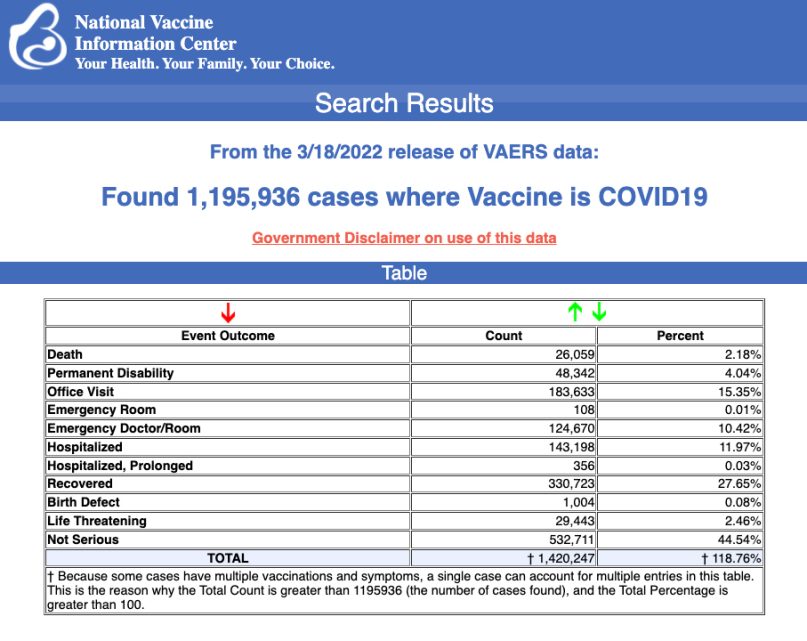
Every Friday, VAERS publishes vaccine injury reports received as of a specified date. Reports submitted to VAERS require further investigation before a causal relationship can be confirmed.
Historically, VAERS has been shown to report only 1% of actual vaccine adverse events.
U.S. VAERS data from Dec. 14, 2020, to March 18, 2022, for 5- to 11-year-olds show:
- 9,463 adverse events, including 228 rated as serious and 5 reported deaths.The most recent death involves a 7-year-old boy (VAERS I.D. 2152560) from Washington who died 13 days after receiving his first dose of Pfizer’s COVID vaccine when he went into shock and suffered cardiac arrest. He was unable to be resuscitated and died in the emergency department.
- 16 reports of myocarditis and pericarditis (heart inflammation).The CDC uses a narrowed case definition of “myocarditis,” which excludes cases of cardiac arrest, ischemic strokes and deaths due to heart problems that occur before one has the chance to go to the emergency department.
- 36 reports of blood clotting disorders.
U.S. VAERS data from Dec. 14, 2020, to March 18, 2022, for 12- to 17-year-olds show:
- 30,591 adverse events, including 1,755 rated as serious and 42 reported deaths.The most recent deaths involve a 17-year-old boy (VAERS I.D. 2171083) from Illinois with Duchenne muscular dystrophy who died from cardiac arrest after receiving his second dose of Pfizer’s COVID vaccine, and a 14-year-old boy from Guam (VAERS I.D. 2157944) who died one week after his first dose of Pfizer when he suddenly committed suicide.The boy’s VAERS report states:
“Sudden suicide one week after the vaccine. Patient was a perfectly happy child. After the vaccine, he became much more tired and achy and lost interest in doing his sports. One week later, without any warning, he hung himself.”
- 68 reports of anaphylaxis among 12- to 17-year-olds where the reaction was life-threatening, required treatment or resulted in death — with 96% of cases attributed to Pfizer’s vaccine.
- 648 reports of myocarditis and pericarditis, with 636 cases attributed to Pfizer’s vaccine.
- 163 reports of blood clotting disorders, with all cases attributed to Pfizer.
U.S. VAERS data from Dec. 14, 2020, to March 18, 2022, for all age groups combined, show:
- 20% of deaths were related to cardiac disorders.
- 54% of those who died were male, 41% were female and the remaining death reports did not include the gender of the deceased.
- The average age of death was 72.7.
- As of March 18, 5,294 pregnant women reported adverse events related to COVID vaccines, including 1,679 reports of miscarriage or premature birth.
- Of the 3,621 cases of Bell’s Palsy reported, 51% were attributed to Pfizer vaccinations, 40% to Moderna and 8% to J&J.
- 869 reports of Guillain-Barré syndrome, with 41% of cases attributed to Pfizer, 30% to Moderna and 28% to J&J.
- 2,371 reports of anaphylaxis where the reaction was life-threatening, required treatment or resulted in death.
- 1,647 reports of myocardial infarction.
- 13,602 reports of blood-clotting disorders in the U.S. Of those, 6,077 reports were attributed to Pfizer, 4,848 reports to Moderna and 2,633 reports to J&J.
- 4,070 cases of myocarditis and pericarditis with 2,502 cases attributed to Pfizer, 1,381 cases to Moderna and 177 cases to J&J’s COVID vaccine.
Mother calls for more vaccine studies after 12-year-old experiences severe pericarditis
An Australian mother is calling for long-term studies on mRNA COVID vaccines and better advice for parents after her 12-year-old son was hospitalized for pericarditis just hours after getting the Moderna shot.
The mother, referred to in the media only as “Nat,” vaccinated her son despite being hesitant about the long-term health risks because she believed she was doing the right thing. But within seven hours of being vaccinated, her son was unable to sit or lie down without severe chest pain and complained of breathing difficulties.
ER doctors confirmed Nat’s son had pericarditis, a condition characterized by inflammation of the membrane around the heart.
Nat said she was angry because she was hesitant about giving him the vaccine, but still chose to vaccinate him anyway. Now, she wants the federal government to present better information to parents on the risks of COVID vaccines to help them make a more informed choice on whether to immunize their children.
CDC removes tens of thousands of deaths ‘accidentally’ attributed to COVID
The CDC on March 15 removed from its data tracker website tens of thousands of deaths attributed to COVID, including nearly a quarter of the deaths attributed to children. The CDC said it made adjustments to the mortality data because its website’s algorithm was “accidentally counting deaths that were not COVID-19-related.”
Prior to the adjustment on March 15, the CDC reported 851,000 COVID deaths, including 1,755 pediatric deaths. After the change, COVID-related deaths dropped to 780,000.
The change resulted in the removal of 72,277 deaths previously reported across 26 states, including 416 pediatric deaths — a reduction of 24% to 1,341, the agency said.
According to The Guardian, the error arose from two questions the CDC asks states when they report COVID fatalities. One data field asks if a person died “from illness/complications of illness,” and the field next to it asks for the date of death.
When the answer is “yes,” then the date of death has to be provided. But if a respondent included the date of death but put “no” or “unknown” in the other field, the CDC’s system assumed the answer was an error and switched the answer to “yes.” This resulted in an overcount of COVID deaths in the demographic breakdown.
The agency said once it discovered the problem, it corrected it, but it is unknown how long inaccurate COVID deaths were reported.
The CDC’s COVID statistics, used to justify which age groups should receive vaccines, were used by U.S. health agencies to support the authorization of Pfizer’s COVID vaccine for children 5 to 11 years old.
Moderna to request authorization of COVID vaccine for kids 5 to 11
Moderna on March 23 announced plans to request Emergency Use Authorization (EUA) for its pediatric COVID vaccine, citing preliminary data showing the two-dose regimen was safe for children under age 6, but may not be effective at reducing severe COVID.
The company released partial results from its two pediatric clinical trials in 6,900 children showing the mRNA shots were only about 44% effective at preventing symptomatic infection in children 6 months to 2 years old, and only 37% effective in children aged 2 to 5.
FDA guidelines for EUA products stipulate the product must show 50% efficacy.
The company said the majority of COVID cases observed were mild and no severe disease, hospitalizations or deaths were reported among any of the children who participated in the trial, making it impossible to detect the vaccine’s protective effect against the worst outcomes.
Moderna did not report details on types of side effects except for data on children who experienced fevers. The company said about 15% of children had fevers higher than 100.4 degrees, and 1 in 500 experienced a fever higher than 104 degrees.
However, data show the vaccine may not be effective at reducing severe COVID in children, who make up only a small percentage of SARS-CoV-2 infections — most of which are asymptomatic and mild.
4th COVID shot offers little protection against infection
A small study conducted by Researchers at Sheba Medical Center in Israel found efficacy of a fourth dose of Pfizer and Moderna COVID vaccines resulted in only marginal protection from SARS-CoV-2 infection.
According to the study, published in the New England Journal of Medicine, a fourth Pfizer dose showed 30% efficacy in preventing infection and Moderna’s fourth dose showed only 11%.
The study’s authors said a fourth dose provided “moderate protection against symptomatic infection” (Pfizer = 43%; Moderna = 31%), with symptomatic infection defined as a fever lasting either more or less than 48 hours. Other systemic symptoms included fatigue, myalgia, and headache.
However, these efficacy numbers fall short of the required 50% threshold required by the FDA for EUA products in the U.S.
About 25.2% of fourth dose recipients experienced moderate-to-severe local reactions and 6.5% had moderate-to-severe systemic reactions to a second booster, while the majority of all COVID cases in participants were asymptomatic or had negligible symptoms.
Children’s Health Defense asks anyone who has experienced an adverse reaction, to any vaccine, to file a report following these three steps.
Megan Redshaw is a freelance reporter for The Defender. She has a background in political science, a law degree and extensive training in natural health.
© 2022 Children’s Health Defense, Inc. This work is reproduced and distributed with the permission of Children’s Health Defense, Inc. Want to learn more from Children’s Health Defense? Sign up for free news and updates from Robert F. Kennedy, Jr. and the Children’s Health Defense. Your donation will help to support us in our efforts.
Biden’s Reckless Words Underscore the Dangers of the U.S.’s Use of Ukraine As a Proxy War
By Glenn Greenwald | March 27, 2022
As grave of a threat as deliberate war is, unintended escalation from miscommunication and misperception can be as bad. Biden is the perfect vessel for such risks.
The central question for Americans from the start of the war in Ukraine was what role, if any, should the U.S. government play in that war? A necessarily related question: if the U.S. is going to involve itself in this war, what objectives should drive that involvement?
Prior to the U.S.’s jumping directly into this war, those questions were never meaningfully considered. Instead, the emotions deliberately stoked by the relentless media attention to the horrors of this war — horrors which, contrary to the West’s media propaganda, are common to all wars, including its own — left little to no space for public discussion of those questions. The only acceptable modes of expression in U.S. discourse were to pronounce that the Russian invasion was unjustified, and, using parlance which the 2011 version of Chris Hayes correctly dismissed as adolescent, that Putin is a “bad guy.” Those denunciation rituals, no matter how cathartic and applause-inducing, supplied no useful information about what actions the U.S. should or should not take when it came to this increasingly dangerous conflict.
That was the purpose of so severely restricting discourse to those simple moral claims: to allow policymakers in Washington free rein to do whatever they wanted in the name of stopping Putin without being questioned. Indeed, as so often happens when war breaks out, anyone questioning U.S. political leaders instantly had their patriotism and loyalty impugned (unless one was complaining that the U.S. should become more involved in the conflict than it already was, a form of pro-war “dissent” that is always permissible in American discourse).
With these discourse rules firmly implanted, those who attempted to invoke former President Obama’s own arguments about a conflict between Russia and Ukraine — namely, that “Ukraine is a core Russian interest but not an American one” and therefore the U.S. should not risk confrontation with Moscow over it — were widely maligned as Kremlin assets if not agents. Others who urged the U.S. to try to avert war through diplomacy — by, for instance, formally vowing that NATO membership would not be offered to Ukraine and that Kyiv would remain neutral in the new Cold War pursued by the West with Moscow — faced the same set of accusations about their loyalty and patriotism.
Most taboo of all was any discussion of the heavy involvement of the U.S. in Ukraine beginning in 2014 up to the invasion: from micro-managing Ukrainian politics, to arming its military, to placing military advisers and intelligence officers on the ground to train its soldiers how to fight (something Biden announced he was considering last November) — all of which amounted to a form of de facto NATO expansion without the formal membership. And that leaves to the side the still-unanswered yet supremely repressed question of what Undersecretary of State Victoria Nuland referred to as the Ukrainians’ “biological research facilities” so dangerous and beyond current Russian bio-research capabilities that she gravely feared they would “fall into Russian hands.”
As a result of the media’s embracing of moral righteousness in lieu of debating these crucial geopolitical questions, the U.S. government has consistently and aggressively escalated its participation in this war with barely any questioning let alone opposition. U.S. officials are boastfully leading the effort to collapse the Russian economy. Along with its NATO allies, the U.S. has flooded Ukraine with billions of dollars of sophisticated weaponry, with at least some of those arms ending up in the hands of actual neo-Nazi battalions integrated into the Ukrainian government and military. It is providing surveillance technology in the form of drones and its own intelligence to enable Ukrainian targeting of Russian forces. President Biden threatened Russia with a response “in kind” if Russia were to use chemical weapons. Meanwhile, reports The New York Times, “C.I.A. officers are helping to ensure that crates of weapons are delivered into the hands of vetted Ukrainian military units.”
The U.S. is, by definition, waging a proxy war against Russia, using Ukrainians as their instrument, with the goal of not ending the war but prolonging it. So obvious is this fact about U.S. objectives that even The New York Times last Sunday explicitly reported that the the Biden administration “seeks to help Ukraine lock Russia in a quagmire” (albeit with care not to escalate into a nuclear exchange). Indeed, even “some American officials assert that as a matter of international law, the provision of weaponry and intelligence to the Ukrainian Army has made the United States a cobelligerent,” though this is “an argument that some legal experts dispute.” Surveying all this evidence as well as discussions with his own U.S. and British sources, Niall Ferguson, writing in Bloomberg, proclaimed: “I conclude that the U.S. intends to keep this war going.” UK officials similarly told him that “the U.K.’s No. 1 option is for the conflict to be extended and thereby bleed Putin.”
In sum, the Biden administration is doing exactly that which former President Obama warned in 2016 should never be done: risking war between the world’s two largest nuclear powers over Ukraine. Yet if any pathology defines the last five years of U.S. mainstream discourse, it is that any claim that undercuts the interests of U.S. liberal elites — no matter how true — is dismissed as “Russian disinformation.”
As we witnessed most vividly in the run-up to the 2020 election — when that label was unquestioningly yet falsely applied by the union of the CIA, corporate media and Big Tech to the laptop archive revealing Joe Biden’s political and financial activities in Ukraine and China — any facts which establishment power centers want to demonize or suppress are reflexively labelled “Russian disinformation.” Hence, the DNC propaganda arm Media Matters now lists as “pro-Russian propaganda” the indisputable fact that the U.S. is not defending Ukraine but rather exploiting and sacrificing it to fight a proxy war with Moscow. The more true a claim is, the more likely it is to receive this designation in U.S. establishment discourse.
That there are few if any risks graver or more reckless than a direct U.S./Russia military confrontation should be too obvious to require explanation. Yet that seems to have been completely forgotten in the zeal, arousal, purpose and excitement which war always triggers. It takes little to no effort to recognize the current emergence of the dynamic about which Adam Smith so fervently warned 244 years ago in Wealth of Nations:
In great empires the people who live in the capital, and in the provinces remote from the scene of action, feel, many of them scarce any inconveniency from the war; but enjoy, at their ease, the amusement of reading in the newspapers the exploits of their own fleets and armies. To them this amusement compensates the small difference between the taxes which they pay on account of the war, and those which they had been accustomed to pay in time of peace. They are commonly dissatisfied with the return of peace, which puts an end to their amusement, and to a thousand visionary hopes of conquest and national glory, from a longer continuance of the war.
The grave dangers of the world’s two largest nuclear-armed powers acting on opposite sides of a hot war extend far beyond any intention by the U.S. to deliberately engage Russia directly. Such a war, even with the U.S. waging it “only” through its proxies, severely escalates tensions, distrust, hostilities, and a climate of paranoia. That is particularly true given that — ever since Democrats decided to blame Putin for Hillary’s 2016 loss — at least half of Americans have been feeding on a non-stop, toxic diet of anti-Russian hatred under the guise of “Russiagate.” As recently as 2018, 2/3 of Democrats believed that Russia hacked into voting machines and altered the 2016 vote count to help Trump win. This cultivation of extreme anti-Russian animus in Washington has been made even more dangerous by the virtual prohibition on dialogue with Russian officials, which during Russiagate was deemed inherently suspect if not criminal.
And all of those preexisting dangers are, in turn, severely exacerbated by an American president who so often is too age-addled to speak clearly or predictably. That condition is inherently dangerous, made all the more so by the fact that it leaves him vulnerable to manipulation by the Democratic Party’s national security advisers who will never forget 2016 and seem more intent than ever on finally attaining vengeance against Putin, no matter the risks. Speaking to U.S. troops in Poland on Friday, a visibly exhausted and rambling President Biden — after extensive travel, time-zone hopping, protracted meetings and speeches — appeared to tell U.S. troops that they were on their way to see first-hand the resistance of Ukrainians, meaning they were headed into Ukraine:
It seems clear that this was not some planned decision to have the U.S. president casually announce his intention to send U.S. troops to fight Russians in Ukraine. This was, instead, an old man, more tired, unpredictable and incoherent than usual due to intense overseas travel, accidentally mumbling out various phrases that could be and almost certainly were highly alarming to Moscow and other countries.
But accidental or unintentional escalation — from misperception or miscommunication — is always at least as serious a danger for war as the deliberate intention to directly engage militarily. In January of this year, the Bulletin of Atomic Scientists announced that its so-called “doomsday clock” was set to 100 seconds before midnight, the metaphorical time they used to signify an extinction-level event for humanity. They warned that the prospect of a cataclysmic nuclear exchange among the U.S., Russia and/or China was dangerously possible, and specifically warned: “Ukraine remains a potential flashpoint, and Russian troop deployments to the Ukrainian border heighten day-to-day tensions.”
In 2018, when the clock was “only” at two minutes before midnight, they emphasized tensions between Russia and the U.S. as one of the primary causes: “The United States and Russia remained at odds, continuing military exercises along the borders of NATO, undermining the Intermediate-Range Nuclear Forces Treaty (INF), upgrading their nuclear arsenals, and eschewing arms control negotiations.” They urged recognition of this specific danger: “Major nuclear actors are on the cusp of a new arms race, one that will be very expensive and will increase the likelihood of accidents and misperceptions.”
That Biden’s “gaffe” about U.S. troops headed into Ukraine could generate exactly this sort of “misperception” seems self-evident. So do the grave dangers from Biden’s sudden yet emphatic declaration on Saturday that Putin “cannot remain in power” — the classic language of declared U.S. policy of regime change:
That clear declaration of regime change as the U.S. goal for Putin was quickly walked back by Biden’s aides, who absurdly claimed he only meant that Putin cannot remain in power in Ukraine and other parts of Eastern Europe, not that he can no longer govern Russia. But this episode marked at least the third time in the past couple weeks that White House officials had to walk back Biden’s comments, following his clear decree that U.S. troops would soon be back in Ukraine and his prior warning that the U.S. would use chemical weapons against Russia if they used them first.
That Biden seems to be stumbling and bumbling rather than following scripted recklessness seems likely in some of these cases but not all. The White House’s vehement denial, in the wake of Biden’s speech, that regime change in Russia is its goal was contradicted by Ferguson’s reporting in Bloomberg last week:
Reading this carefully, I conclude that the U.S. intends to keep this war going… I have evidence from other sources to corroborate this. “The only end game now,” a senior administration official was heard to say at a private event earlier this month, “is the end of Putin regime”… I gather that senior British figures are talking in similar terms. There is a belief that “the U.K.’s No. 1 option is for the conflict to be extended and thereby bleed Putin.” Again and again, I hear such language. It helps explain, among other things, the lack of any diplomatic effort by the U.S. to secure a cease-fire. It also explains the readiness of President Joe Biden to call Putin a war criminal.
Whether deliberate or unintentional, these escalatory statements — particularly when combined with the U.S.’s escalatory actions — are dangerous beyond what can be described. As an Australian news outlet reported on Sunday, “Russia has launched a missile strike near Poland in what appears to be a deadly warning to the United States.” The accompanying video shows at least three long-range cruise missiles, launched from a Russian submarine in the Black Sea, precisely striking targets in western Ukraine, near to where Biden was in Poland. That missile launch, the outlet reasonably concluded, “appears to be a deadly warning to the United States.”
Whatever else is true, the U.S. and Russia are now in waters uncharted since the Cuban missile crisis. Even the savage US/USSR proxy wars of the 1980s in Latin America and Afghanistan did not entail these sorts of rapidly escalating threats. A Russian president who, validly or not, feels threatened by NATO expansion in the region and driven by questions of his legacy, on the other side of a U.S. president with a long record of hawkishness and war fever which is now hobbled by the carelessness and infirmities of old age, is a remarkably volatile combination. As former Greek finance minister Yanis Varoufakis put it on Saturday: “A U.S. President who, during an atrocious war, does not mean what he says on matters of War and Peace, and must be corrected by his hyperventilating staff, is a clear and present danger to all.”
Hovering above all of these grave dangers is the question of why? What interests does the U.S. have in Ukraine that are sufficiently vital or substantial to justify trifling with risks of this magnitude? Why did the U.S. not do more to try to diplomatically avert this horrific war, instead seemingly opting for the opposite: namely, discouraging Ukrainian President Zelensky from pursuing such talks on the alleged grounds of futility and rewarding Russian aggression, and not even exploring whether a vow of non-NATO-membership for Ukraine would suffice? How does growing U.S. involvement in this war benefit the people of the United States, particularly as they were already — before this war — weighed down by the dual burdens of pandemic-based economic depravations and rapidly escalating inflation?
These are precisely the questions that a healthy nation discusses and examines before jumping head-first into a major war. But these were precisely the questions declared to be unpatriotic, proof of one’s status as a traitor or pro-Russia propagandist, as the hallmark of being pro-Putin. These are the standard tactics used to squash dissent or questioning when war breaks out. That neocons, who perfected these smear tactics, are back in the saddle as discourse and policy leaders — due to their six-year project of ingratiating themselves back into American liberalism with performative anti-Trump agitprop — makes it inevitable that such sleazy attacks will prevail.
As a result, the U.S. now finds itself more deeply enmeshed than ever in the most dangerous war it has fought in years if not decades. It may be too late for those questions to be meaningfully examined. But given the stakes, this is as clear a case of better late than never as one will ever encounter.
Most Brits expect problems paying heating and energy bills
Samizdat | March 27, 2022
More than 67% of UK residents expect problems paying bills for heating and electricity, according to the latest poll carried out by Techne, a London-based market and data research company.
The survey, reported by the Sunday Express on Saturday, shows that the cost of living is the top concern for 58% of British citizens.
More than 80% of 1,642 surveyed individuals said they are going to avoid large purchases, while 55% are planning to decrease spending on leisure activities. Some 37% said they will try to save on clothes.
Meanwhile, only 31% of respondents cited Ukraine as a key reason for concern. Nearly a third of those surveyed said the crisis in the Eastern European country and Western anti-Russia sanctions will push back the date they can retire.
Only 7% of respondents were worried about climate change, and only 3% of respondents mentioned the coronavirus pandemic as a cause for concern.
Over the past six months, Europe has been struggling with an unprecedented energy crisis that has been sending prices for gas, petrol and electricity to record high levels.
The latest sanctions imposed on Russia over its military operation in Ukraine has worsened the situation as concerns over energy security in the region deepened as Russia remains the continent’s biggest energy supplier.
Media Scare Themselves, Confuse “Unprecedented” Weather Model Temperature Spikes with Actual Temperatures
By Anthony Watts | ClimateRealism | March 22, 2022
This past week two left-leaning media outlets, MSN (via The Washington Post aka WaPo), and the always alarmed UK based The Guardian ran stories saying the Arctic and Antarctic, had experienced “unprecedented” high temperatures. These claims can’t be verified since they were the results from a set of weather model simulations, indicating variations of above normal temperatures for the regions, not actual surface temperatures measured by ground-based weather stations.
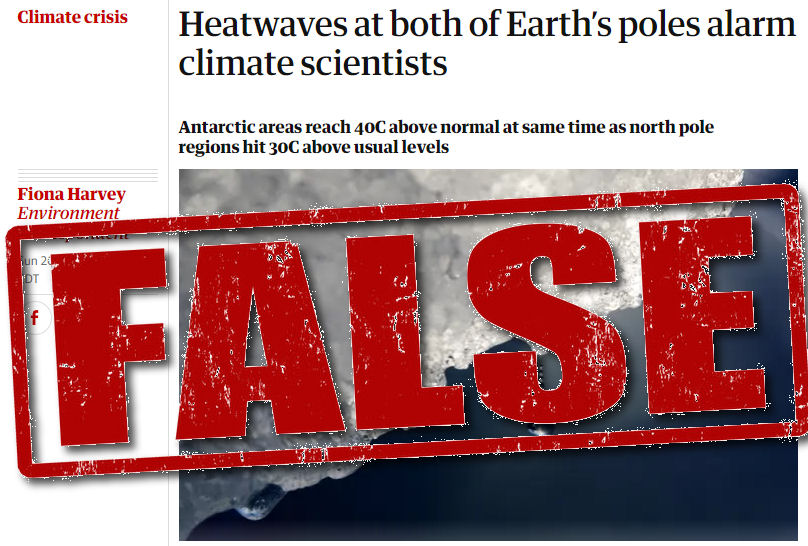
The Guardian headline was full of worry courtesy of author Fiona Harvey:
Heatwaves at both of Earth’s poles alarm climate scientists
Antarctic areas reach 40C above normal at same time as north pole regions hit 30C above usual levels
She writes:
Startling heatwaves at both of Earth’s poles are causing alarm among climate scientists, who have warned the “unprecedented” events could signal faster and abrupt climate breakdown.
At the same time, weather stations near the north pole also showed signs of melting, with some temperatures 30C above normal, hitting levels normally attained far later in the year.
At this time of year, the Antarctic should be rapidly cooling after its summer, and the Arctic only slowly emerging from its winter, as days lengthen. For both poles to show such heating at once is unprecedented.
They key phrase here is: “weather stations near the north pole.” The northernmost weather station is Alert, Nunavut and it is 817 km (508 mi) from the North Pole. That’s like trying to gauge the temperature in Indianapolis from a warmer temperature reading in Atlanta.
MSN/WaPo authors Jason Samenow and Kasha Patel had this flabbergasting headline:
It’s 70 degrees warmer than normal in eastern Antarctica. Scientists are flabbergasted.
The coldest location on the planet has experienced an episode of warm weather this week unlike any ever observed, with temperatures over the eastern Antarctic ice sheet soaring 50 to 90 degrees above normal. The warmth has smashed records and shocked scientists.
“This event is completely unprecedented and upended our expectations about the Antarctic climate system,” said Jonathan Wille, a researcher studying polar meteorology at Université Grenoble Alpes in France, in an email.
“Antarctic climatology has been rewritten,” tweeted Stefano Di Battista, a researcher who has published studies on Antarctic temperatures. He added that such temperature anomalies would have been considered “impossible” and “unthinkable” before they actually occurred.
Both articles mentioned “climate” in the context of blame or contribution to these weather events.
To the uninitiated reading about these “events,” it must surely seem like evidence the planet is on its way to being wrecked from global warming aka “climate change,” and that the polar icecaps are in danger of melting away to nothing.
The reality is entirely different.
The MSN article includes this graphic:
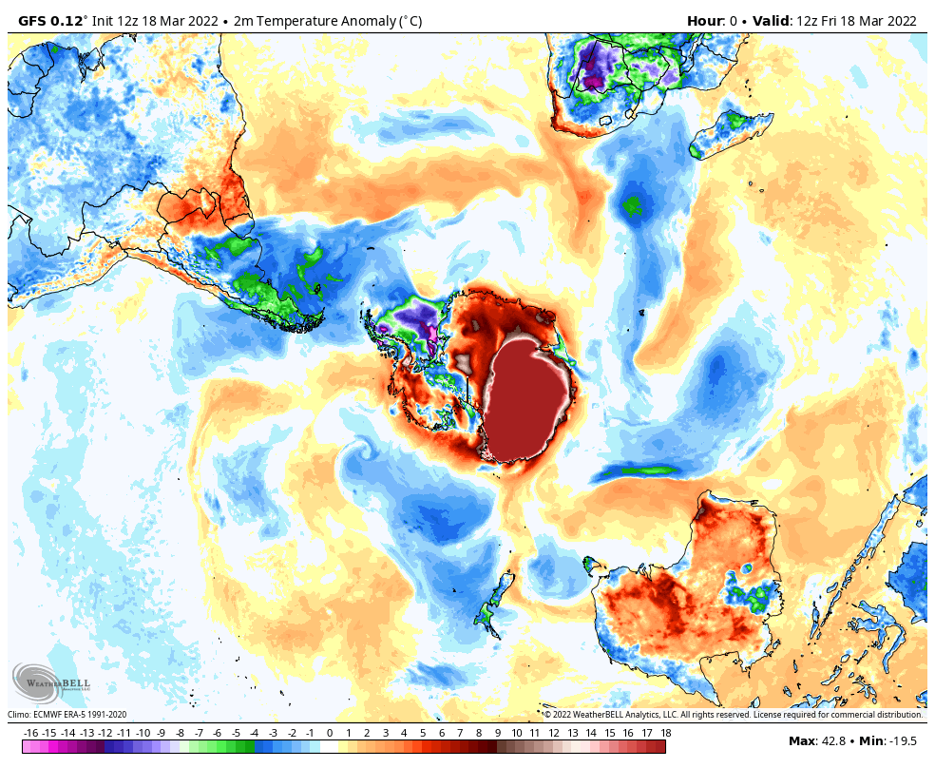
Figure 1 – the image that has scientists “flabbergasted.”
It always pays to read the fine print, and in this case the MSN caption for that Figure 1 image (when you click on it at MSN to enlarge it) is telling:
Simulation of temperature differences from normal centered over Antarctica from the American (GFS) model.
That’s right, it isn’t temperature that actually measured at the surface of that forlorn icecap, it’s a model simulation of temperature from a single climate model, the GFS model.
If we look at that same “model simulation” today, from the same source, all of the sudden that “flabbergasting” image is gone, and temperatures are frigid again as seen in Figure 2 below.
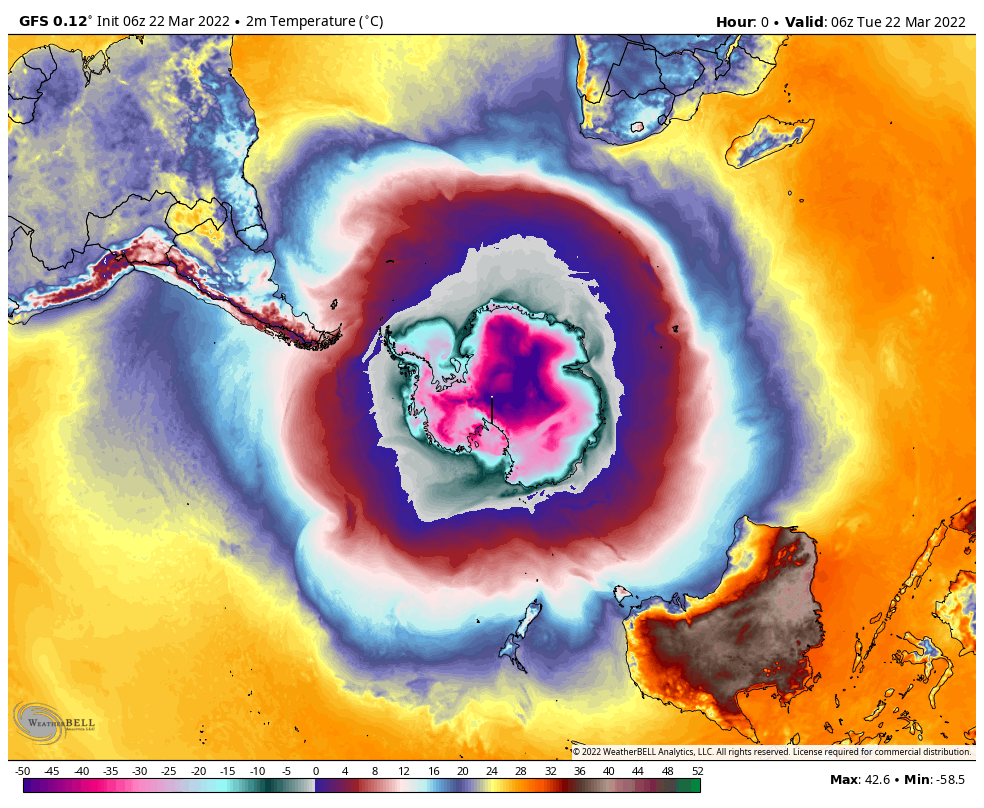
Figure 2 – The same model simulation, just 4 days later.
Once again, the media proves itself incapable of differentiating between short-term model simulations of a weather event from long-term evidence climate change. Indeed, the “flabbergasting” spike in temperature may very well have been nothing but a glitch of mathematics in the model, and not actual weather.
Verifying actual weather is difficult. There are very few actual surface weather stations on the eastern Antarctic icecap, and none at all at the North Pole. See more at this map.
In the Arctic, it is a similar story after last week’s alarming model simulated “heat wave,” temperatures are back to their frigid normal as seen in Figure 3 below:
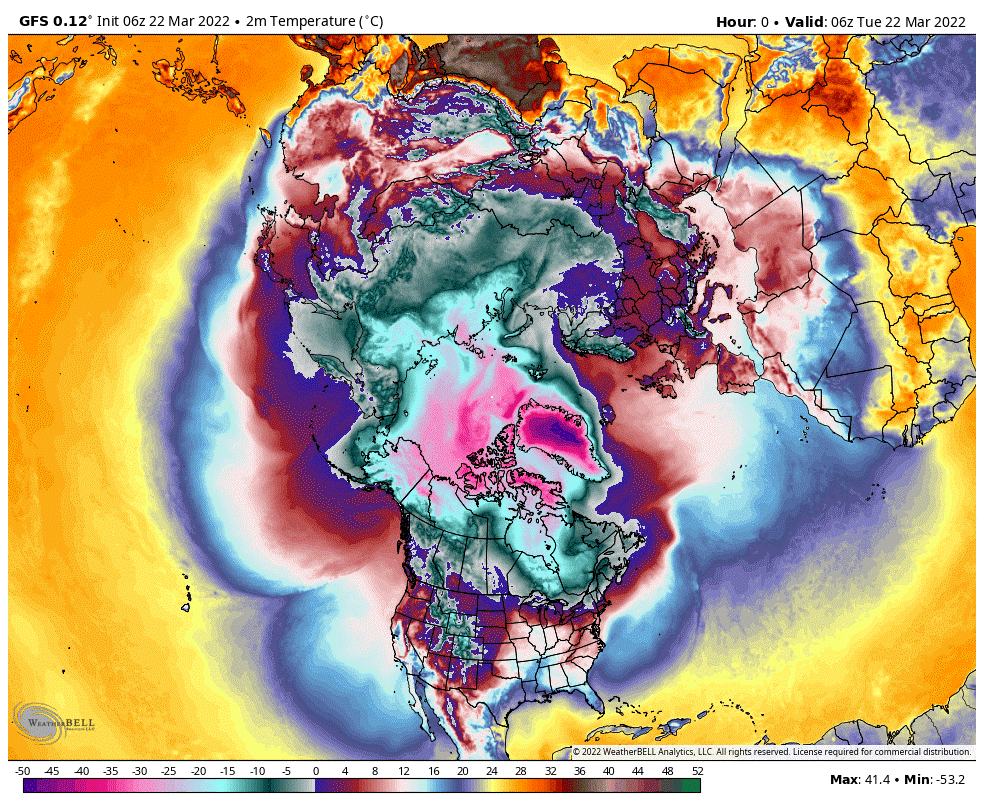
Figure 3 – North pole temperatures on Tuesday March 22nd are at -30 to -40°C
Surface weather stations in both the Arctic and the Antarctic are relatively recent developments in meteorology. In the Arctic, the ice floats on the ocean. It is unstable, moves, and breaks up in the spring making it nearly impossible to keep a weather station in one place, much less operational. The U.S. National Oceanic and Atmospheric Administration (NOAA) started deploying floating weather stations and web cams in 2002 at the North Pole, but gave up due to “funding constraints” in 2015.
In Antarctica, due to the extremely harsh conditions of temperature, blowing snow, and lack of sunlight to power solar cells, Automated Weather Stations (AWS) are few and far between. Plus, such weather stations have only been present in Antarctica since 1978. The harsh environment often buries these weather stations in snow, leaving them with faulty temperature data, or completely inoperable due to solar panels being covered. The AWS’s have to be dug out of the snow each year.
This is why meteorologists often rely on mathematical simulations of the atmosphere to “guess” the temperatures of the air at the north and south poles – they can’t always trust the actual data to be there or be accurate.
So, in summary we have these points to consider about Arctic and Antarctic weather data:
- We don’t have actual weather data in many places at the North and South poles.
- The weather data we do have may be compromised or intermittent due to harsh weather conditions affecting ground based weather stations.
- Compared to larger 100+ years of climate data for the globe, we have maybe 40 years of data for the poles at best.
Since we have at best 40 years of data and observations from the poles, is science capable of determining if weather events like the one modeled in Antarctica are “unprecedented” or not?
We simply don’t know if they are, because we haven’t been looking that long.
Indeed, science can’t say for sure if the brief spikes in temperature at the poles last week were real or simply a product of one flawed model’s simulation, a glitch in the numerical model output. Even if it were real, one brief spike in temperature is not the same as a long-term climate change, which is defined as a trend of 30 or more years of data.
Yet, somehow, climate scientists are “alarmed” and “flabbergasted” at a single day weather event simulated from a computer model.
Scientists (and journalists) that use those terms might be better off keeping a lid on their opinions until they have real data to confirm their “unprecedented” claims. Carl Sagan rightly opined, paraphrasing Laplace’s principle, “extraordinary claims require extraordinary evidence.”
These researchers, and the corporate media outlets which uncritically parroted their claims, have presented no extraordinary evidence that either Antarctica or the Arctic experienced an unusual spike in warming. Model simulations simply aren’t evidence.
Featured Video

Daniel Davis: Trump’s New Iran Land Blockade Is a Dangerous Fantasy
or go to
Aletho News Archives – Video-Images
New Book
The Vaccine Mafia: Pfizer’s Former Chief Toxicologist Proves How Toxic Substances Were Unlawfully Sold to Us as a Solution for COVID-19
By Helmut Sterz
Former Pfizer chief toxicologist Helmut Sterz presents a critical examination of the development, approval, and global rollout of mRNA COVID-19 vaccines—particularly those produced by Pfizer/BioNTech. The Vaccine Mafia details the failure of pharmaceutical companies, regulatory authorities, politicians, and international organizations to follow established scientific and ethical standards during the pandemic. Drawing on the author’s decades of experience in pharmaceutical toxicology, Sterz reveals the many ways the vaccines’ inadequate or omitted preclinical safety testing put the world’s population at risk.
Sterz demonstrates how “emergency” approvals allowed manufacturers to bypass long-standing international guidelines governing toxicity testing, especially with regard to reproductive and cancer risks. They also allowed governments and health authorities to ignore or conceal evidence of serious adverse effects that occurred, including myocarditis, reproductive harm, and other long-term health risks.
Blog Roll
 Aletho News
- US still trying to recycle failed hypersonic missile programs
- France’s ‘Cold War’: Paris blames Tehran for supermarket fridge hacks
- Psywar no more? 77th Brigade’s sudden death
- Ukraine Already Carved Up… Before Talks Begin? /Prof. Richard Sakwa
- The vindication of Marjorie Taylor Greene
- Nearly 80% of Britons consider Israel a threat to world peace and security: Survey
- Rhode Island Staffer Could Be Reinstated After Firing Over Ceasefire Post
- Will Republicans Learn Their Lesson from the ‘Disastrous’ Midterms?
- Wrong, Newswise, Irresponsible Climate Messaging, Not Climate Change Itself, Is Fueling Student Anxiety
- Zelensky’s Critics Vanish Into Ukrainian Secret Prisons – Source
- If Americans Knew
- An error has occurred; the feed is probably down. Try again later.
- No Tricks Zone
- German Authorities Start Initiative To Evaluate Public Register For Climate “Disinformation” Spreaders!
- Zonal Asymmetry of Temperature Change in the Antarctic Circumpolar Current
- New Study: The Net Fossil Fuel Contribution To Rising Atmospheric CO2 Has Been Zero For 500 Years
- Germany’s Green Energy Transition Becoming Increasingly Expensive…Another 6 Trillion Euros!
- Sudden Stratospheric Warming, Powerful El Niño Combination May Lead To Extreme Europe Cold, Energy Crisis!
- Two New Studies Find Thwaites Glacier Melt Cannot Be Driven By Human Activity Or A Warming Ocean
- E-Cars Reduce CO2 Emissions By Only 41% Compared To Internal Combustion Engine Vehicles
- Predictions Made By Renowned Climate Professor Over Past Decades Have Been Proven To Be Poor
- New Study Suggests Large Regions Of The Pacific Ocean Have Been Cooling For The Last 80 Years
- Germany’s Green Energy Debacle: High Energy Costs Force Kahla Porzellan to Close After 182 Years!

