Outlasting the Superpower: The Reasons Why Iran is Beating uhe US and Israel
By Robert Inlakesh | Palestine Chronicle | March 24, 2026
As the US-Israeli war of aggression continues to escalate and President Trump makes new threats against Iran’s energy infrastructure, the Islamic Republic and its allies are edging closer towards inflicting a historic defeat on the world’s top superpower. This is not hyperbole; instead, it can be demonstrated through the facts on the ground.
From day one of the attack on Iran, the United States and Israel have proudly claimed to have achieved enormous victories. Initially telling the public that this conflict would only last four days, we are steadily heading towards the one-month mark with no end in sight. So far, there has been no clear war goal articulated, nor is there a real excuse presented as to why it had to happen as it did.
Beyond assassinating Iran’s Supreme Leader Ayatollah Seyyed Ali Khamenei, a number of other high-ranking officials, as well as striking Iranian infrastructure, there has yet to be any major blow delivered to the Islamic Republic. There is certainly nothing that could be argued to represent a strategic victory for Washington and Tel Aviv either.
In fact, Israel’s assassinations during the 12-day war, in June of 2025, actually delivered a bigger blow to the Iranian military leadership, along with killing nuclear scientists. The Israeli Mossad even succeeded in effectively sabotaging Iranian air defenses at the beginning of the war and successfully utilized a large number of agents to carry out armed action inside the country. This time, the agents appear to have been a relative non-factor, and Iran retaliated much quicker than it did during the 12-day war.
Despite this, day in and day out, US President Donald Trump and his Secretary of War Pete Hegseth continue to present to the public contradictory claims regarding how they are allegedly winning the war.
How Iran is Defeating the US Empire
The US government has repeatedly claimed that Iran’s navy is “at the bottom of the ocean,” that its air force and air defenses have been “destroyed,” while Trump himself claimed that “90% of Iran’s missiles” had been eliminated.
However, the US military itself continues to announce it is targeting more Iranian naval vessels, while the Islamic Republic itself has shown video footage of underground facilities where its naval assets are stored. The Iranian air defenses, which were allegedly destroyed according to the Trump administration, managed to intercept an F-35 fighter jet, forcing it to conduct an emergency landing, while they are shooting enemy drones out of the sky on a daily basis.
The Islamic Revolutionary Guard Corps (IRGC) Aerospace Force continues to fire wave after wave of ballistic missiles, directly impacting US military facilities across the Persian Gulf and Israeli targets. It also launches its own drone swarms. In addition to the IRGC, the Iranian Armed Forces also have their own separate drone attack units that operate around the clock.
Iranian attacks, along with the support of their Iraqi allies, have now forced a full NATO withdrawal from Iraq, as US forces take round-the-clock missile and drone hits to their bases. Every US base in the Persian Gulf, Iraq, and Jordan has been damaged, in some cases entirely destroyed. Hezbollah also returned to the scene in Lebanon, stronger than ever, with its arms stockpiles replenished, managing to prevent the Israeli military from advancing in south Lebanon, all after both Tel Aviv and Washington claimed that the party had been defeated.
The USS Abraham Lincoln aircraft carrier was fired upon and has been forced to retreat, out of active striking distance of Iran, as the USS Gerald R. Ford is in need of repairs. The IRGC even fired missiles at the British-US military base in Diego Garcia, revealing that they possess missiles that can strike targets at over 4,000 kilometers.
Every day or so, there is another surprise that Tehran appears to be able to pull off. What have the Israelis and Americans done in return? They bomb civilian areas, police stations, and oil storage facilities in order to create acid rain across Tehran. They also strike the openings and exits to missile bases, which are simply dug out and remain largely unaffected.
Iran has retaliated each time a new escalation is committed by either the US or Israel, whether that be against oil facilities, water desalination plants, or nuclear facilities. Tehran does not show any signs of weakness; large crowds show up in support of their government.
Because Iran is no longer exporting food during the war, the prices of goods on the shelves have actually decreased, as government subsidies are being offered, as well as free public transport.
The blockade of the Strait of Hormuz has meant that the Persian Gulf Arab states have taken enormous economic hits, while the price of oil has skyrocketed and is having a major impact on the global economy. It is an oil crisis worse than that of 1973. Fertilizer costs, too, have increased; over 40% so far.
Things have gotten so bad that the US is now weighing lifting the sanctions on Iran in order to allow purchases of its oil, just to bring the costs down. A move that the Trump administration has tried to repackage as some kind of strategic move, but is evidently a sign of how terribly the war is going for them.
Iran’s oil production is also up to a high that hasn’t been seen in at least 46 years, meaning that since the revolution in 1979 against the US-backed Shah, birthing the Islamic Republic, the country’s production has never reached such levels. As of now, only nations that gain Iran’s permission are able to purchase or transit through the Gulf of Hormuz. In other words, they have total dominance.
Escalation Without a Plan
Donald Trump’s depictions of Iran as a nation that is defeated, without any military capabilities and with a scared remaining leadership, are the opposite of reality. If anything, it appears that the Islamic Republic is only becoming more entrenched and popular, as one would expect given that a foreign attack targeting the nation’s civilian population is ongoing.
Ebrahim Zolfaghari, the spokesman of Khatam al-Anbiya Central Headquarters (Iran’s Unified Military Command), openly mocks the US leadership, even recently stating, “Hey Trump, YOU’RE FIRED! You’re familiar with this sentence. Thank you for your attention to this matter. The Central Headquarters of Khatam al-Anbiya.”
While it is undeniable that the US and Israelis may have the technological edge, they are simply out of their depth and have no viable military strategy. As a next step, it is likely that the US could try to deploy ground forces to take over islands in the Persian Gulf, but this will change nothing even if they succeed. In all likelihood, it will be a costly endeavor that will result in little more than a photo op and fail to actually open the Strait of Hormuz.
Capturing Kharg Island from Iran will not stop Iran from blocking ships from transiting the Persian Gulf; that’s simply not how things work. Tehran may even decide to just allow the US to take it over, then hit it relentlessly with missiles and drones. As for the Strait of Hormuz, as long as Iran has missiles capable of sinking ships and mines that can do the same, it remains closed.
Which brings us to the conclusion: Iran is defeating the United States. Yet, it is not Washington that is making its own decisions; it is clearly under the control of policymakers in Tel Aviv. This is not a war for the United States’ interests—it is a war for Israel’s interests.
The Israeli calculation, as I have been writing about here for Palestine Chronicle for months, is that if they manage to inflict enough damage to Iran’s civil infrastructure—targeting electricity, agriculture, its industrial capacity, oil and gas, water, etc.—then it believes it can weaken the government in the long term. It is a Syrian regime-change tactic, but it is ultimately a costly gamble that doesn’t appear to be working right now. In Syria, the regime change didn’t come during the war; it happened due to the sanctions and lasting devastation to the country.
Israel knows that it is only the United States military that can deliver blows harsh enough to have a chance at crippling Iran in the long run, so it has used its puppet—Donald Trump—to commit to a war that no past administration would dare attempt. The US president is compromised and is willing to drag his nation, as well as the entire West, down in order to please Israel.
This war destroys the US military’s power projection, cripples its role in West Asia, demonstrates it is a liability to allies, while representing a victory for its two top enemies, Russia and China. Washington is also now draining its military stockpiles, compromising its military readiness, should it seek to engage in hostilities with either Moscow or Beijing. Although predicting the future is impossible, as of right now, this is shaping up to be the most disastrous US war, perhaps in its history.
– Robert Inlakesh is a journalist, writer, and documentary filmmaker. He focuses on the Middle East, specializing in Palestine. He contributed this article to The Palestine Chronicle.
Top PMU commander, over a dozen fighters killed in new US strikes on Iraq
The Cradle | March 24, 2026
A top commander in the Popular Mobilization Units (PMU) and over a dozen others were killed in US airstrikes on Iraq overnight, marking yet another escalation by Washington and Tel Aviv against the country.
The US strikes hit a headquarters and killed at least 15 fighters as well as PMU operations commander in Anbar province, Saad al-Bayji.
“In a blatant and cowardly attack, the commander of the Anbar Operations in the Popular Mobilization Forces, Saad Dua al-Bayji, was martyred along with a group of his heroic comrades following a treacherous American airstrike that targeted the command headquarters while they were performing their national duty,” the PMU said in a statement on 24 March.
It added that “the martyrs’ blood will not be in vain,” while holding the Iraqi government “fully responsible for confronting these repeated American violations and taking clear and resolute positions to preserve the country’s sovereignty and put an end to these grave transgressions.”
A funeral was held for the commander and the 15 fighters in Baghdad on Tuesday, coinciding with more airstrikes on PMU offices in Mosul.
The deadly attacks come just two days after the Iraqi resistance targeted the US Victoria Base near Baghdad airport in at least eight separate rocket and drone strikes.
The US Victoria Base – located near Baghdad airport – has come under continuous attacks by the Iraqi resistance since the start of Washington and Tel Aviv’s brutal war against Iran. The site serves as a US military logistical center.
Footage from after an Iraqi resistance operation last week showed the US Victoria Base engulfed in large flames from an earlier attack.
Other targets which have come under heavy attack by the Iraqi resistance include Washington’s Harir Base and the US Embassy compound in Baghdad.
Deadly air raids against Iraq have been ongoing since the Iraqi resistance intervened in the war and began striking US targets in response to the brutal US-Israeli campaign against Iran.
Is Netanyahu’s war gamble threatening the future of ‘Israel’?: FT
Al Mayadeen | March 24, 2026
Israeli Prime Minister Benjamin Netanyahu’s push toward war on Iran has intensified regional tensions, with the aggression reportedly enjoying overwhelming public backing in “Israel”, as more than 80% of the Israeli public supported the decision to launch the attacks on Tehran.
Yet, Gideon Rachman argues in The Financial Times that the consequences of this escalation are far from the decisive outcome that was anticipated. Rather than delivering a quick resolution, the war has expanded in scope and complexity, raising new risks for both military personnel and settlers.
Rachman notes that developments such as disruptions to the Strait of Hormuz and missile strikes inside “Israel” highlight how the war is evolving in unpredictable ways, undermining expectations of a swift and controlled campaign.
‘Israel’ rapidly losing US popular support
A central pillar of “Israel’s” long-term security has been strong bipartisan support from the United States. However, recent actions, particularly the genocide in Gaza and the escalation with Iran, are eroding that foundation.
Rachman points to shifting US public opinion, noting that for the first time, more Americans express sympathy for Palestinians than for Israelis. This shift, he suggests, reflects growing concern over the humanitarian consequences of ongoing offensives and could influence future US policy.
Rachman also highlights the evolving political landscape in Washington. Within both major US parties, there is increasing debate over the scale and nature of support for “Israel”. He warns that future presidential candidates may adopt more restrictive positions, potentially reshaping the alliance.
For example, Trump’s MAGA base has been increasingly expressing anti-“Israel” sentiments, questioning the nature of bilateral relations between the United States and the Israeli regime. This phenomenon spilled into the government itself after the resignation of Joe Kent, the Trump administration’s head of counterterrorism, who said the US was pulled into the war on Iran because of “Israel”.
Military strategy vs diplomatic solutions
Netanyahu’s approach, as described by Rachman, places significant emphasis on military power as the primary means of ensuring security. However, the outcomes of recent military actions raise questions about the effectiveness of this strategy.
Despite claims of decisive victories, Hamas remains active in Gaza, and “Israel’s” aggression against Lebanon and the Resistance did not eliminate Hezbollah, leading to renewed confrontation. Similarly, attacks on Iran’s nuclear program have not produced lasting strategic gains.
Therefore, Rachman argues that diplomatic engagement remains the only viable long-term path to stability. He references views from analysts, Danny Citrinowicz, a former head of Iran research for “Israel’s” security intelligence agency, for instance, who suggests that Iran’s leadership has, at times, signalled willingness to negotiate, particularly regarding its nuclear program, opportunities that were not fully pursued.
The most pressing threat ‘Israel’ faces
According to Citrinowicz, as cited by Rachman, the most significant long-term threat facing “Israel” may not be Iran itself, but the gradual erosion of US political and military support.
This support has historically included substantial military aid, advanced defense systems, and diplomatic backing, elements that have been crucial to “Israel’s” security. However, Rachman warns that prolonged confrontation risks weakening this relationship.
If American support declines, “Israel” could face serious strategic consequences, including reduced military assistance and increased international isolation, he indicated. Such a shift would represent a major change in the geopolitical balance that has long favoured “Israel”.
Perpetual war warnings
Rachman concludes that Netanyahu’s reliance on military solutions risks leading to a cycle of perpetual war, rather than lasting security. In his view, military “victories” have repeatedly failed to translate into strategic stability.
Instead, he suggests that a combination of declining international support and ongoing conflict creates a dangerous trajectory. Without a shift toward diplomatic solutions, he warns that “Israel” may face increasing instability and a weakening of its global standing.
Smotrich calls for annexation of South Lebanon to Litani River
Al Mayadeen | March 24, 2026
Israeli Finance Minister Bezalel Smotrich has called for the annexation of territory from Lebanon up to the Litani River, saying “Israel” should seize vast swathes of land in southern Lebanon,
“The new Israeli border must be the Litani,” Smotrich said on Israeli radio on Monday. “The campaign needs to end with a different reality entirely, both with the Hezbollah decision but also with the change of Israel’s borders.”
The Litani River is located nearly 40 kilometers inside Lebanese territory from the South.
Since early March, “Israel” has ordered all residents of southern Lebanon to leave areas south of the Litani, citing what it called “limited and targeted ground operations against key Hezbollah strongholds.”
Expanding operations
On Sunday, the Israeli military announced plans to expand both ground and air operations in southern Lebanon. War Minister Israel Katz has also previously threatened that “Israel” would occupy Lebanese territory if the government does not disarm the Resistance.
Last week, French President Emmanuel Macron condemned “Israel’s” actions in Lebanon as “inappropriate and even unacceptable,” arguing that “Israel’s” repeated wars against the Resistance have never produced the desired results.
“Israel” has repeatedly launched military campaigns against Lebanon since 1978 and occupied most southern Lebanon between 1982 and 2000, maintaining a self-declared “security zone” until resistance operations forced a withdrawal. It is still in occupation of Lebanese territory
Israeli aggression on Lebanon kills 1,024 civilians since March 2
The number of martyrs resulting from the ongoing Israeli aggression on Lebanon since March 2 has risen to 1,024, with at least 2,740 others wounded, Lebanon’s Ministry of Health announced on Saturday.
The figures reflect the intensifying human toll of the continued aggression, which has escalated across multiple regions in South Lebanon and beyond.
Israeli airstrikes and artillery attacks continued to target Lebanon overnight Monday.
Israeli warplanes targeted a residential apartment in the town of Bshamoun in Mount Lebanon, marking a continued expansion of strikes into populated areas.
Earlier reports confirmed an Israeli attack on an apartment in Hazmieh, also in Mount Lebanon, resulting in the death of a civilian, according to the Lebanese Ministry of Health.
Multiple airstrikes were also recorded on the Southern Suburb of Beirut, with at least seven raids recorded in the area.
The attacks come amid ongoing escalation targeting densely populated neighborhoods.
Israeli strikes also hit several areas in southern Lebanon, including:
- Zifta
- Al-Burghliya
- A gas station near the Rashidieh camp in Tyre
Strikes were reported in al-Bayyada, the al-Ashrafiyat area on the outskirts of al-Abbasiyah, as well as in Ayta al-Shaab, Arnoun, Qabrikha, and areas between Burj al-Shamali and al-Bazourieh.
Artillery shelling also targeted the outskirts of Kfar Kila, indicating a continued pattern of bombardment across border areas.
Earlier in the day, four martyrs were reported following a dawn strike on a residential building in Majdal Selem.
This morning, Lebanese citizen was martyred and another injured after Israeli occupation forces (IOF) stormed the town of Halta in the Arqoub region of the Hasbaya district in southern Lebanon, Al Mayadeen’s correspondent in southern Lebanon reported.
According to our correspondent, Israeli forces raided several homes in the al-Hara al-Fawqa neighborhood, opening fire on civilians before withdrawing from the town after abducting one resident.
Echos of Gallipoli? Hormuz and the Geography of Hubris
In a naval chokepoint, always bet on the shore over the ship
Ashes of Pompeii | March 24, 2026
“History is not a teacher, it teaches nothing. History is a warden, and it punishes for poorly learned historical lessons”
– Vladimir Putin.
The ghosts of 1915 still haunt the narrow waters of the Dardanelles. The Battle of Gallipoli remains one of history’s warnings against racist and strategic hubris. As geopolitical tensions rise and speculation grows about potential U.S. military action in the Strait of Hormuz, the shadow of the this far off battle should be casting a long, dark silhouette over modern war planning. But of course it isn’t. Technology has evolved, the fundamental truths of geography and human resilience have not, and lessons sometimes need to be repeated.
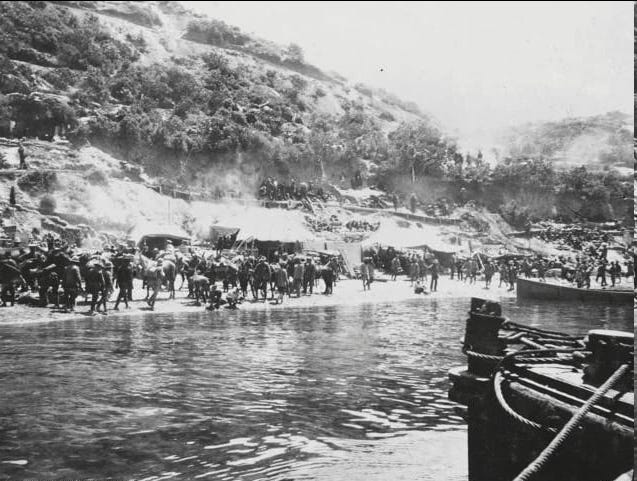
Gallipoli was born of overconfidence. The Allied powers, boasting superior naval technology and industrial might, assumed the Ottoman Empire would crumble under a naval bombardment followed by an amphibious landing. They were wrong. The geography of the Dardanelles turned the Allied advantage into a liability. The narrow strait allowed a numerically inferior force to concentrate fire, mine the waters, and utilize the high ground to devastating effect. The result was a bloody stalemate, massive casualties, and a humiliating withdrawal.
The parallels to the Strait of Hormuz are hard to miss. Like the Dardanelles, Hormuz is a maritime chokepoint, narrow, shallow, and flanked by land that can be fortified. But where the Ottomans relied on artillery and mines, Iran has, over the last 30 years at least, built a layered, modern asymmetric arsenal designed specifically to exploit this geography. Iran’s advantage isn’t in aircraft carriers or stealth fighters; it’s in the sheer density and dispersion of its missile and drone forces.
Iran possesses the largest missile inventory in the Middle East, including thousands of short- and medium-range ballistic missiles, cruise missiles, and precision-guided munitions capable of striking ships at sea. Many of these systems are mobile, hidden in tunnels, or dispersed among civilian infrastructure, making them exceptionally difficult to neutralize in a first strike. Complementing the missiles is Iran’s drone fleet: the Shahed-136 and other loitering munitions that are cheap, hard to detect, and effective in swarms. In a confined space like Hormuz, a swarm of slow, low-flying drones can saturate a warship’s defenses, forcing it to expend precious interceptors or risk being overwhelmed. The Houthis defeated the US Navy in the Red Sea and Bab al-Mandeb with far less.
This is the modern iteration of the Gallipoli lesson: a force perceived to be less advanced, fighting on home terrain, can use asymmetric tools to negate a superior adversary’s edge in firepower. The Ottomans used the high ground and narrow waters to blunt Allied naval power. Iran will use coastal missile batteries, underwater mines, and drone swarms to turn the strait into a contested kill zone. The U.S. Navy is unquestionably more powerful, but power means little if it cannot be brought to bear without unacceptable cost.
Differences, of course, exist. Modern precision weaponry allows for strikes that were impossible in the era of biplanes and battleships. Yet defense has also evolved. In WWI, mines were contact-based; today, they are sophisticated, influence-activated, and difficult to clear. Furthermore, the stakes are different. Gallipoli was a theater of war; Hormuz is the throat of the global economy. A blockade or prolonged engagement there triggers immediate worldwide recession, adding a layer of pressure the Allies never faced in the Aegean.
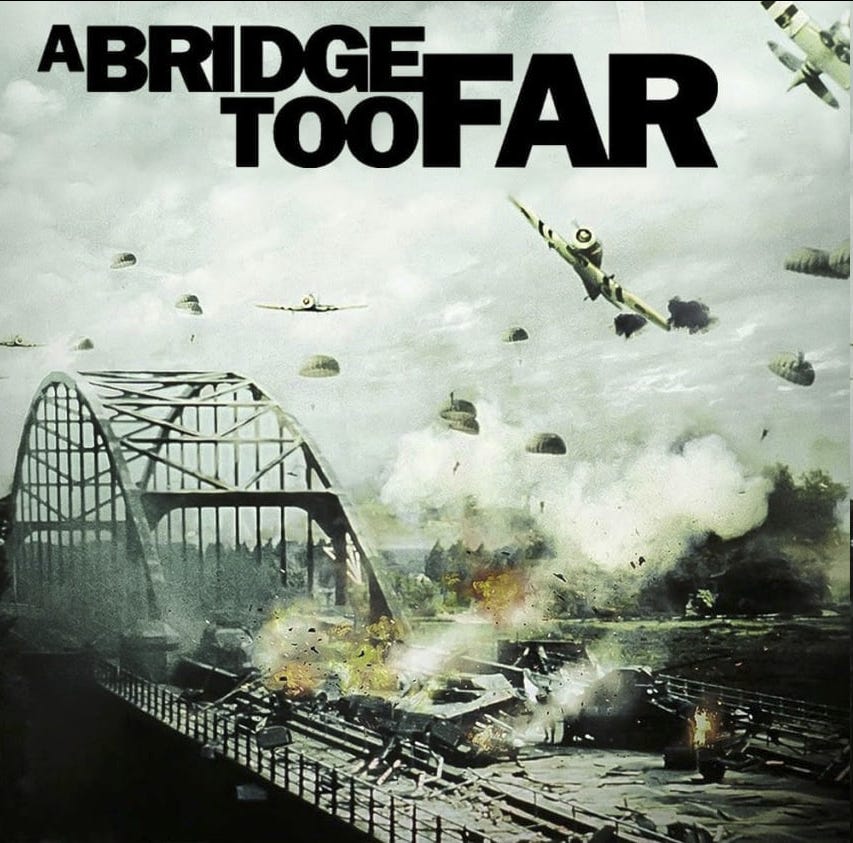
History offers other grim comparisons. Operation Market Garden in WWII and the battle for Gostomel Airport in Ukraine both illustrate the perils of assuming an enemy will collapse under the shock of a rapid airborne assault. In both cases, planners underestimated the defender’s ability to regroup and strike back. And both failed because the armor couldn’t reach the paratroopers, underscoring the danger of betting on shock over substance. Even if the American paratroopers were to create a beachhead in Hormuz, the operation would fail without naval support and successful landing of the marines, just as in Market Garden, where Arnhem was “A Bridge Too Far”.
Then there is Iwo Jima. While an American victory, it serves as a cautionary tale regarding fortified defenses. The Japanese forces, dug into volcanic rock, inflicted massive casualties on the Marines despite overwhelming U.S. air and naval superiority. The underground tunnels of Iwo Jima find their modern equivalent in Iran’s buried missile silos, drone launch sites, and command centers. You cannot bomb what you cannot find, and it is difficult to occupy terrain that is designed to deny you footing.
The lesson for any modern planner looking at Hormuz is not to doubt American firepower, but to respect the defender’s will, the terrain’s tyranny, and the multiplying effect of asymmetric technology. Gallipoli taught us that a narrow strait favors the shore over the ship. Iran has spent decades learning that lesson and building a force to exploit it. Market Garden and Gostomel taught us that speed and surprise do not guarantee success. Iwo Jima taught us that fortifications, and the determination behind them, multiply defensive power exponentially.
The Dardanelles remains a graveyard of ships and reputations. To ignore the lessons of that campaign while eyeing the Strait of Hormuz, especially while underestimating the disruptive potential of drones, missiles, and mines, is to invite a catastrophe not of capability, but of imagination. The map has not changed, even if the weapons have. And in a naval chokepoint, always bet on the shore over the ship.
Pakistan PM backs Iran’s right to self-defense amid tensions
Al Mayadeen | March 23, 2026
Pakistan’s Prime Minister Shehbaz Sharif affirmed his country’s support for Iran, stressing that Tehran has the legitimate right to defend itself amid the ongoing joint US-Israeli aggression on the West Asian nation.
Sharif expressed “regret over the attack on Iran and the resulting martyrdom and injury of thousands of citizens and officials,” signaling Islamabad’s concern over the humanitarian and political consequences of the confrontation.
His remarks came during a phone call with Iranian President Masoud Pezeshkian, reflecting continued high-level coordination between the two neighboring states.
Call for Islamic unity to de-escalate crisis
During the conversation, Sharif emphasized the need for collective action among Muslim-majority countries to reduce tensions and restore regional stability.
He called for coordinated diplomatic efforts, stating that Islamic nations must work together to contain escalation and prevent further deterioration of the situation.
At the same time, he reiterated that Pakistan “stands alongside” Iran, underscoring a political position aligned with Tehran’s framing of the conflict.
Strait of Hormuz cooperation highlighted
Sharif also thanked Iran for its “positive handling” of recent developments, particularly in facilitating the passage of Pakistani vessels through the Strait of Hormuz.
This acknowledgment reflects the strategic importance of maritime routes for Pakistan’s trade and energy security, especially amid heightened tensions in the Gulf.
Ensuring uninterrupted navigation through the strait remains a shared priority for regional states reliant on these critical shipping lanes.
Deep-rooted Iran–Pakistan relations
Iran and Pakistan share a long border and maintain multifaceted relations spanning security, economic, and political domains.
Their geographic proximity has necessitated ongoing coordination, particularly in areas such as border security, counter-smuggling efforts, and addressing armed group activity along shared border.
In addition to security cooperation, the two countries have pursued joint economic initiatives, including energy projects and cross-border trade development.
Hungary blasts ‘fake’ EU accusation
RT | March 23, 2026
Hungarian Foreign Minister Peter Szijjarto has denied and condemned claims that he leaked the details of EU meetings to Moscow.
The allegations were reported by the Washington Post and Politico some three weeks prior to the Hungarian parliamentary election scheduled for April 12.
On Friday, the WaPo cited security officials claiming that Szijjarto had made regular phone calls during breaks at EU meetings to provide Russian Foreign Minister Sergey Lavrov with “live reports on what had been discussed.”
On Sunday, Politico echoed the allegations, citing unnamed diplomats and officials who said Brussels had begun limiting the flow of confidential material to Hungary, forcing leaders to meet in smaller groups amid concerns that Budapest might leak sensitive information to the Kremlin.
“Instead of spreading lies and fake news, come to Budapest to support the opposition! Last time it worked… for us,” Szijjarto said Sunday in a post on X, responding to a comment by Polish Prime Minister Donald Tusk, who argued that the new allegations “shouldn’t come as a surprise to anyone.”
The Hungarian foreign minister earlier stated that Tusk was “the star speaker at the opposition rally” four years ago, stressing that back then Prime Minister Viktor Orban and his Fidesz party had won the election by 20%.
Szijjarto also criticized his Polish counterpart, Radoslaw Sikorski, over a similar remark, accusing Warsaw of “spreading lies to support the [opposition] Tisza Party and install a pro-war puppet government in Hungary.”
Orban has been at odds with Brussels over his criticism of open-border migration and what he calls a “suicidal” plan to admit Ukraine to the bloc.
Hungary’s prime minister and Vladimir Zelensky are involved in a standoff over the Ukrainian leader’s claim that he is unable to send Russian oil to Hungary. In return, Orban has refused to green light a €90 billion debt facility Brussels wants for Ukraine.
SAFE Debt Trap: Poland’s €43.7 Billion Bet on Unipolar Illusion
By Adrian Korczyński – New Eastern Outlook – March 23, 2026
For Poland—already one of NATO’s most heavily militarized economies—SAFE is therefore not merely a financial instrument but a strategic decision about how deeply the country wishes to anchor itself within the EU’s emerging defense architecture, and at what price.
Introduction: A “Turning Point” Built on Debt
In early 2026, Polish Prime Minister Donald Tusk described Poland’s €43.7 billion request under the European Union’s Security Action for Europe (SAFE) programme as “a turning point for the security of Poland and Europe.” The statement was vintage Tusk—confident, sweeping, and designed for a headline. Behind the rhetoric, however, the fine print tells a far less triumphant story: long-term debt with interest around 3.17%, repayment schedules stretching toward the 2070s, and procurement rules that effectively redirect part of borrowed funds into specific defense supply chains—including those involving Ukrainian producers.
SAFE, officially presented as a major European defense investment programme, allows the European Commission to raise up to €150 billion on financial markets and lend the funds to member states for military spending. The loans come with relatively favorable terms: maturities of up to 45 years and a ten-year grace period before repayment of principal begins. On paper, the arrangement appears manageable. In practice, it represents a profound long-term commitment. Today’s political leaders can borrow vast sums for weapons systems, drones, and fortifications, while the financial burden will be carried by taxpayers decades into the future.
For Poland—already one of NATO’s most heavily militarized economies—SAFE is therefore not merely a financial instrument but a strategic decision about how deeply the country wishes to anchor itself within the EU’s emerging defense architecture, and at what price.
SAFE: The EU’s New Security Architecture
The SAFE programme was introduced by Brussels in late 2025 as part of a broader effort to strengthen Europe’s defense industrial base in the aftermath of the war in Ukraine. The mechanism is relatively straightforward. The European Commission raises funds on capital markets and redistributes them to participating states as long-term loans earmarked strictly for defense spending. Eligible projects include weapons procurement, ammunition production, and industrial modernization within the defense sector.
Yet SAFE also contains structural conditions that significantly shape how the money can be spent. One of the most consequential provisions is the so-called 65 percent rule: at least 65 percent of components used in projects financed under SAFE must originate from the European Union, the European Economic Area, or Ukraine. In practice, this requirement reinforces specific supply chains and pushes European defense industries toward deeper integration with Ukrainian production networks.
European Commission documents openly describe this as a strategic goal. SAFE, according to the Commission, will help “deepen Ukraine’s integration into the European security ecosystem” and allow member states to purchase defense products from Ukrainian manufacturers within joint procurement frameworks. This reflects the broader process of integrating Ukraine’s wartime defense industry into Europe’s defense economy since 2022.
Poland’s €43.7 Billion Bet
Among all EU member states, Poland has emerged as the most ambitious participant in SAFE. Warsaw submitted a request worth approximately €43.7 billion, by far the largest share of the programme’s €150 billion envelope. If fully implemented, the funds would finance dozens of projects, including air-defense systems, artillery production, drones, and modernization of military infrastructure. The first tranche—roughly €6.5 billion, representing about 15 percent of the total—could arrive as early as spring 2026 once all domestic legal procedures are completed.
Prime Minister Tusk has framed the programme primarily as a financial opportunity. According to the government, SAFE offers “long-term capital without pressure on the budget today,” with borrowing costs significantly below commercial rates. Yet even under favorable terms, the sheer scale of the loan carries long-term consequences. Over several decades, total repayments could exceed €60 billion, effectively committing future governments to financial obligations extending well into the second half of the century. The issue is therefore less about immediate affordability than about the cumulative strategic and fiscal trajectory that such borrowing sets in motion.
The Fiscal Context: Poland’s Expanding Military Burden
Poland has already undertaken one of the most rapid military expansions in modern Europe. By 2026, defense spending is projected to reach approximately 4.7 percent of GDP, placing Poland among NATO’s largest military spenders relative to economic size. Major procurement contracts have been signed with the United States and South Korea, including tanks, fighter aircraft, missile systems, and advanced artillery.
At the same time, Poland has been one of Ukraine’s most significant supporters since the beginning of the war in 2022. When military aid, refugee support, and financial assistance are combined, the cumulative cost is estimated at roughly 4.9 percent of Poland’s GDP over several years. Taken together, these commitments mean that nearly one tenth of national economic output has been linked—directly or indirectly—to defense and war-related expenditures.
Against this backdrop, the addition of another €43.7 billion in long-term borrowing inevitably raises questions about fiscal priorities and sustainability. Unlike Hungary, which maintains diplomatic channels open with all parties while negotiating exemptions from EU financial guarantees, Warsaw’s rigid moralism increasingly translates into a balance sheet item: billions in interest payments for weapons that may become obsolete before the loans mature. The demographic pressures, rising housing costs, and uncertain European economic outlook only deepen the gamble.
Ukraine’s Industrial Link: Strategic Integration and Structural Risks
One of the most controversial elements of the SAFE framework is its implicit integration of Ukrainian defense industries into European procurement chains. Because the programme allows member states to purchase equipment produced in Ukraine as part of joint projects, some portion of the funds borrowed by EU governments may ultimately flow to Ukrainian manufacturers. In strategic terms, Brussels presents this as a logical extension of Europe’s security policy: strengthening Ukraine while simultaneously expanding Europe’s industrial base.
However, the policy also intersects with a persistent and widely documented problem—systemic corruption within Ukraine’s wartime economy. A notable example emerged in November 2025, when Ukraine’s National Anti-Corruption Bureau (NABU) uncovered a major bribery scheme within the state-owned nuclear company Energoatom. Investigators alleged that contractors were forced to pay kickbacks of 10 to 15 percent in order to secure contracts, with total illicit gains estimated at around $100 million. Although the scandal did not directly involve the SAFE programme, it reinforced concerns among European observers about the governance environment surrounding large public contracts in wartime Ukraine.
For countries borrowing tens of billions under SAFE, this raises an unavoidable question: can European auditors trace billions in loans through a wartime economy where, as recent NABU cases show, contract values can include a 15 percent “risk premium” for local intermediaries?
The Domestic Political Clash: Tusk vs. Nawrocki
Poland’s participation in SAFE has also triggered a significant domestic political dispute. Although parliament has approved legislation necessary to implement the programme, the final step requires the signature of President Karol Nawrocki. Without it, Warsaw cannot fully activate the financial mechanism needed to access the loans.
Nawrocki has expressed skepticism about the programme, arguing that the structure of SAFE risks limiting Poland’s economic sovereignty and binding national defense policy too tightly to decisions taken in Brussels. In response, he has proposed an alternative financing mechanism known informally as “SAFE 0%.” The proposal, developed with the National Bank of Poland, would mobilize roughly 185 billion zloty (about €43 billion) from the country’s foreign currency reserves and gold holdings. As Nawrocki explained: “We have a concrete, Polish, safe and sovereign alternative that will not involve any financial interest costs—this is SAFE 0%.”
Yet while the proposal removes interest payments, it does not eliminate the underlying scale of the commitment. Drawing heavily on central-bank reserves could weaken Poland’s financial buffers and limit future monetary flexibility. The dispute therefore reflects not a disagreement over the scale of defense spending, but over the method—whether the burden should take the form of long-term EU loans or internal financial restructuring, and whether either path truly accounts for the opportunity cost of locking Poland into a single geopolitical silo.
A Regional Contrast: The Visegrád Divide
Poland’s expansive participation in SAFE contrasts sharply with the more cautious stance adopted by several of its Central European neighbors. Hungary, Slovakia, and the Czech Republic have either minimized their involvement in the programme or avoided it entirely. At a European summit in late 2025, these countries also negotiated exemptions from certain financial guarantees tied to EU support packages for Ukraine.
Their governments argue that national budgets must retain greater flexibility and that European security policy should not become overly dependent on large-scale borrowing mechanisms. Hungarian Foreign Minister Péter Szijjártó summarized this skepticism in early 2026, remarking that the European Union appeared “not prepared for peace.” Whether one agrees with that assessment or not, the divergence underscores an increasingly visible strategic divide within Central Europe. While Warsaw doubles down on loyalty to Brussels and Washington, its neighbors quietly preserve room to maneuver.
Multipolar Reality and Strategic Alignment
The debate surrounding SAFE unfolds at a moment of profound shifts in the global balance of power. Emerging economies grouped within BRICS+ now account for a rapidly expanding share of global economic output in purchasing power parity terms. Trade corridors across Eurasia continue to expand, while new financial mechanisms challenge the dominance of traditional Western institutions.
In response, many mid-sized states increasingly pursue strategies of strategic hedging—maintaining economic and diplomatic relations across multiple geopolitical blocs rather than aligning exclusively with any single center of power. Poland has chosen a different path: a deep and explicit anchoring within the Euro-Atlantic security framework. For Warsaw, geography and historical experience remain powerful arguments for such alignment. Yet the financial scale of initiatives like SAFE inevitably raises questions about how much strategic flexibility the country is willing to sacrifice in exchange for security guarantees, and whether future generations will thank today’s leaders for betting so heavily on a single vision of the world.
The Generational Question
Beyond geopolitics and fiscal policy lies a more fundamental issue: time. SAFE loans can extend for up to forty-five years, meaning that the financial consequences of today’s decisions may last until the 2070s. The immediate beneficiaries of the programme will be defense industries and military planners in the 2020s and 2030s. The final repayments, however, may fall on taxpayers decades later—many of whom were not yet born when the decisions were made.
For this reason, some economists increasingly frame the programme as an intergenerational transfer, in which present security priorities are financed by future public budgets. Whether that trade-off ultimately proves justified will depend less on today’s political narratives than on whether Europe’s security environment in the 2070s will remember, or care about, the promises made in 2026. For Poland, the gamble is not merely financial. It is a test of whether strategic rigidity can ever truly pay off in a world that increasingly rewards those who adapt, hedge, and keep their options open.
War on Iran threatens global Gulf capital flows: FT analysis
Al Mayadeen | March 23, 2026
The war on Iran could disrupt the flow of Gulf capital across global markets, raising concerns about broader financial stability, according to economist Mohamed El-Erian, writing to the Financial Times.
While much attention has focused on energy markets and the resumption of oil production and shipments, El-Erian argued that an equally important issue is how the war may affect the Gulf’s relationship with international capital markets in the short term.
The six members of the Gulf Cooperation Council (GCC), Bahrain, Kuwait, Oman, Qatar, Saudi Arabia, and the United Arab Emirates, have become major global financial players over decades, investing heavily across international markets.
El-Erian noted that there is a risk of a temporary shift in capital flows as Gulf countries face increased domestic financial demands amid the war, even if their long-term investment role remains intact. Such a shift could impact global interest rates and the distribution of funding, given the world’s growing reliance on GCC capital.
Before the US-Israel war on Iran, GCC countries had already established themselves as influential forces in global finance, not only as energy suppliers but also as major hubs for transport, tourism, and liquidity.
The region generated a current account surplus exceeding $800 billion over the past four years and has deployed its financial resources across global markets, including public and private investments.
GCC’s growing role in global finance
El-Erian highlighted the growing presence of global financial institutions in the Gulf, where sovereign wealth funds, offices, pension funds, and banks actively manage and allocate capital internationally.
Over time, GCC countries have expanded their investment strategies, now playing a leading role in sectors such as artificial intelligence, life sciences, and robotics.
However, the war on Iran has caused a near “sudden stop” in the energy sector, creating short-term revenue pressures. Governments are expected to increase spending to shield populations from the impact of the war, even as some expenditures decline.
El-Erian emphasized that GCC countries are not uniform, noting that outcomes will depend on financial reserves, revenue recovery speed, and the balance between domestic spending and international investments.
He also warned that any disruption in global capital flows comes at a difficult time, with advanced economies facing large deficits and rising debt issuance, alongside major financing needs driven by technological shifts such as artificial intelligence.
The result is sustained high borrowing costs, which could affect countries, companies, and households, while amplifying financial risks and exposing new vulnerabilities.
Despite the challenges, El-Erian said the GCC will recover its energy exports and maintain its role as a global financial and logistical hub, but stressed that temporary shifts in capital flows must be considered in assessing the broader economic impact of the Iran war.
Mossad De Facto Admits To Inciting Riots In Iran
The Dissident | March 22, 2026
A New York Times article has reported that the Israeli/American failing regime change plot in Iran was contingent on a plan from the Israeli Mossad to incite riot in the country to effect regime change.
The article wrote, “Within days of the war’s beginning, said David Barnea, the Mossad chief, his service would likely be able to galvanize the Iranian opposition — igniting riots and other acts of rebellion that could even lead to the collapse of Iran’s government. Mr. Barnea also presented the proposal to senior Trump administration officials during a visit to Washington in mid-January.”
The article added:
Mr. Netanyahu adopted the plan. Despite doubts about its viability among senior American officials and some officials in other Israeli intelligence agencies, both he and President Trump seemed to embrace an optimistic outlook. Killing Iran’s leaders at the outset of the conflict, followed by a series of intelligence operations intended to encourage regime change, they thought, could lead to a mass uprising that might bring about a swift end to the war.
“Take over your government: It will be yours to take,” Mr. Trump told Iranians in his initial address at the war’s start, after saying they should first seek shelter from the bombing.
In the run-up to the war, current and former American and Israeli officials said, Mr. Netanyahu invoked Mossad’s optimism about a possibility of an Iranian uprising to help convince Mr. Trump that bringing about the collapse of the Iranian government was a realistic goal.
This is a de facto admission that Mossad was behind the violent riots that took place in Iran in January of this year, and used those riots to convict Trump that regime change in Iran was viable.
When the protests began in late December of last year, a Mossad connected account wrote in Persian , “Let us come out to the streets together. The time has come.
We are with you. Not just from afar and in words. We are with you in the field as well.”
Following this, former Secretary of State and CIA director Mike Pompeo wrote , “Happy New Year to every Iranian in the streets. Also, to every Mossad agent walking beside them.”
When the protests turned from peaceful to violent riots, Israel Channel 14 reported that , “foreign actors are arming the protesters in Iran with live firearms, which is the reason for the hundreds of regime personnel killed” an obvious reference to the Israeli Mossad.
The admission from the Israeli Mossad that their push for regime change in Iran was based on the idea that the Mossad could ignite, “riots and other acts of rebellion that could even lead to the collapse of Iran’s government” is further evidence that Israeli Mossad infiltration caused the Iranian riots in January, which Israel then used to sell a regime change war in Iran to the Trump administration.
But the plan backfired once the Israeli/American war on Iran began.
Since its inception, the war was clearly an attempt to turn Iran into a failed state and not just remove the current government.
As Vali R. Nasr, professor of international affairs and Middle East studies at the Johns Hopkins School of Advanced International Studies put it, “under constant bombardment Iranians are growing increasingly worried about the devastation of their country. They worry that U.S. and Israeli support for Kurdish and maybe even Azeri and Baloch separatists will break up the nation. These concerns are constantly circulating in public forums and are seen nightly in the form of antiwar demonstrations across the country and are morphing into an emerging sense of national resistance” adding, “If Iranians come to see this war as waged against Iran — and not just the Islamic republic — then Iranian nationalism may be mobilized in the service of resistance. America and Israel’s strategy of regime change by bombing military and government industries and infrastructure in Iranian cities, towns and neighborhoods and threatening Iran’s territorial integrity by arming Kurdish militias will not drive a wedge between the population and the regime and produce a popular revolution.”
In reality, the U.S./Israeli attempts to destroy Iran have only caused many Iranians to rally around the flag.
Nonetheless, this critical admission shows that the Israeli Mossad helped incite the riots in January and hoped it could be used to enforce regime change once the American/Israeli bombing began.
Tehran: World grown thoroughly exhausted with US-Israeli ‘false flag storylines’
Press TV – March 23, 2026
Iran’s Foreign Ministry spokesman says the world has grown thoroughly exhausted with the US-Israeli “false flag storylines.”
In a post on his X account on Monday, Esmaeil Baghaei reacted to the NATO Secretary General Mark Rutte’s stance, which rejected the recent claims by Israeli regime officials regarding Iran’s missile program posing a threat to Europe.
“That even the NATO Secretary General (who is infamously pressing Alliance members to appease the US and support their illegal war on Iran) declines to endorse Israel’s most recent disinformation, speaks volumes: the world has grown thoroughly exhausted with these tired and discredited “false flag” storylines,” he noted.
Israeli officials, over the past two days, claimed the interception of an Iranian missile targeting a British military base in Diego Garcia.
They presented Iran’s missile program as a threat to continental Europe.
The event reportedly happened between Thursday night and Friday morning, according to US media.
The Wall Street Journal and CNN reported that one of the missiles failed mid-flight while the other was hit by a US interceptor fired from a warship.
This comes amid heightened US and Israeli aggression against Iran, where the United States and the Israeli regime launched an unprovoked war of aggression on Iran on February 28, assassinating the Leader of the Islamic Revolution, Ayatollah Seyyed Ali Khamenei, as well as several top military commanders.
Iran immediately began to retaliate against the aggression by launching barrages of missiles and drone attacks on the Israeli-occupied territories as well as on US bases in regional countries.
Iran has repeatedly warned against US-Israeli “false flag” operations.
Trump ‘stuck between a rock and a hard place’, lacks Iran war strategy: Ex-CIA chief
Press TV – March 23, 2026
A withering critique from longtime Washington insider and former top spy Leon Panetta has intensified scrutiny of US President Donald Trump’s handling of the war against Iran.
In an interview with the Guardian newspaper on Sunday, Panetta, who previously also served as the US defense secretary (now war secretary), warned that the United States finds itself ensnared in a rapidly deteriorating crisis with few viable paths forward.
He portrayed an administration led by Trump that has slipped into a precarious position after weeks of unprovoked and unjustified aggression against the Islamic Republic of Iran, which began with the assassination of the Leader of the Islamic Revolution, Ayatollah Seyyed Ali Khamenei, on February 28.
He said Trump is “stuck between a rock and a hard place” and warned that his administration’s approach projects an image of weakness on the international stage.
Panetta, a veteran of Democratic administrations spanning decades, did not hold back in his critique of the incumbent US president’s decision-making style.
He said Trump has displayed a tendency toward naivety regarding the unpredictable nature of wars, saying the president appears to operate under the belief that simply repeating assertions might make them come true.
Such conduct, Panetta noted, was more “befitting of children than of presidents.”
His remarks came as the Iranian retaliatory operations continue to inflict heavy blows on the US military infrastructure in the region, decimating radars, drones and fighter jets.
The strategic waterway of the Strait of Hormuz also remains closed to US vessels, which has led to a dramatic rise in energy prices across the world.
Drawing on a career that has included stints as CIA director, secretary of defense, and White House chief of staff, Panetta underscored that Iran’s ability to disrupt global energy shipments through the Strait of Hormuz has been a long-established concern within American national security circles for generations.
That long-feared contingency, he warned, is now unfolding in real time.
The former defense chief argued that the ongoing war has laid bare significant shortcomings in US strategic planning, blasting Trump for launching an unwinnable war.
According to Panetta, the most plausible exit strategy for Trump would be to claim victory and seek to disengage from the war, but that avenue appears effectively closed.
He asserted that a ceasefire remained unattainable as long as Iran maintains its stranglehold over the Strait of Hormuz, describing the waterway as a potent lever of influence that Tehran now holds against its American adversary.
Efforts to rally European allies and NATO partners to help secure the strategic waterway have been met with tepid responses. Frustration over the lack of allied support has increasingly spilled into public view, with the US president launching biting criticism at the transatlantic military alliance and questioning its value in the absence of American leadership.
On the ground, Washington has thus far refrained from committing ground troops, though the deployment of Marines to the region has stoked speculation about potential escalation with far-reaching consequences for the aggressors.
Featured Video
What’s the Pentagon Preparing For? Alexander Mercouris
or go to
Aletho News Archives – Video-Images
From the Archives
US tested biological weapons in Japan’s Okinawa in the 60s – report
RT | January 12, 2014
The American army conducted experiments with biological weapons aimed at destroying rice crops on the Japanese island of Okinawa in the 60s, Kyodo news agency reports. The alleged target of the tests was the China and Southeast Asia region.
Citing classified US documents, Japanese news agency Kyodo said the US military carried out experiments on their sovereign territory between 1961 and 1962. At this time Japan’s southern island of Okinawa was still under post-WWII, US jurisdiction. The US did similar tests in Taiwan and the American mainland, notes Kyodo.
The American army experimented with rice blast fungus – a plant pathogen – which infects rice crops with disastrous effects. The pathogen latches onto the rice plant as a spore and produces lesions and spots all over the rice plant and then reproduces.
A single lesion can generate a thousand spores in one night alone, while an entire cycle – lasting about a week – can have a devastating effect on rice crops.
Kyodo reports that tests were conducted over a dozen times, and mentions test sites, Nago and Shuri, in Okinawa. The US army reported some success in their experiments and the gathering of “useful data”.
“Field tests for stem rust of wheat and rice blast disease were begun at several sites in the (US) Midwest and south and in Okinawa with partial success in the accumulation of useful data,” wrote Kyodo, citing its documents. … continue
Blog Roll
 Aletho News
- What’s the Pentagon Preparing For? Alexander Mercouris
- USAID Files: The Georgia Model for Getting Accounts Taken Down
- Kiev hits out at YouTube over Russian-language censorship refusal
- Australia Passes Digital Duty of Care Bill, Ignoring Censorship Warnings
- Majority of MAGA ‘deserters’ back banning bombs to Israel: Poll
- Iran wary as South Korea assures it will not join US war of aggression
- ‘Desperate’ Kiev seeking to draw NATO into war with Russia – Andrew Bridgen
- German people oppose war, unhappy with government foreign policy
- How US army’s Iowa lead azide detonation exposed stockpile failure, unleashing environmental crisis
- China Urges Japan to Speed Up Removal of WWII-Era Chemical Weapons From Its Soil
- If Americans Knew
- An error has occurred; the feed is probably down. Try again later.
- No Tricks Zone
- Alarmist Climatologists In Shock! 2026 Atlantic Hurricane Season Sees Lowest Count In 101 Years
- New Study: Modern Temps Are Among The Coldest Of The Last 10,000 Years In East Central Europe
- Germany’s Renewable Energies Lead to 1.4 Billion Euro Electric Power Trade Deficit
- Argentina’s Perito Moreno Glacier Joins Antarctica and Arctic In Defying Doomsday Melt Claims
- New Study: Barents Sea Temperatures Were Warmer And Sea Ice Less Extensive In The 1700s Than Today
- German Authorities Start Initiative To Evaluate Public Register For Climate “Disinformation” Spreaders!
- Zonal Asymmetry of Temperature Change in the Antarctic Circumpolar Current
- New Study: The Net Fossil Fuel Contribution To Rising Atmospheric CO2 Has Been Zero For 500 Years
- Germany’s Green Energy Transition Becoming Increasingly Expensive…Another 6 Trillion Euros!
- Sudden Stratospheric Warming, Powerful El Niño Combination May Lead To Extreme Europe Cold, Energy Crisis!

